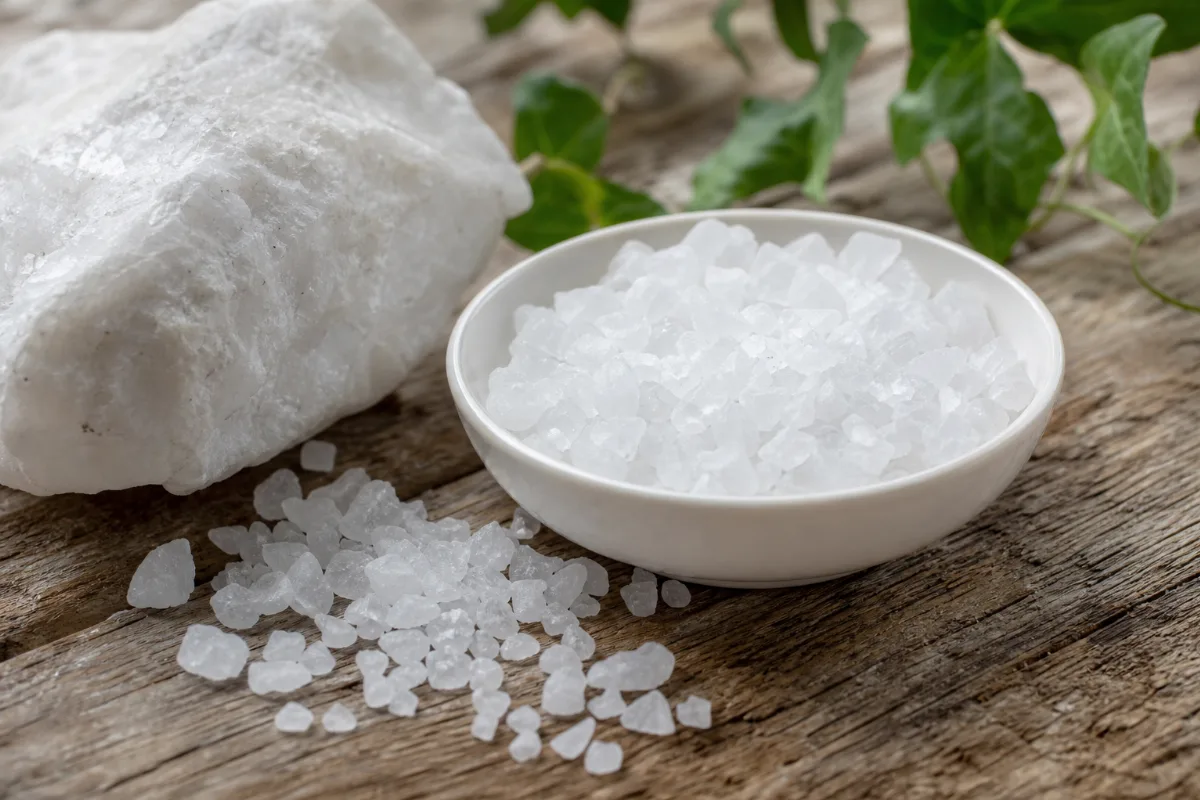
Salts & Minerals · Therapy
Salt Therapy (Halotherapy)
Sodium chloride (dry salt aerosol) · also called Halotherapy, salt room, salt cave, salt chamber, dry salt therapy, speleotherapy (natural caves)
Salt therapy means breathing very fine dry salt in a salt room, or staying in a natural salt cave or mine. It is sold to help breathing in asthma and COPD. Trials are small, often have no sham room, and results are mixed; there are no official guidelines. Salt mist can tighten the airways in some people, so ask your doctor first and never stop prescribed medicines.
General information, not medical advice. Last substantive update · Not medically reviewed. A named clinician has not signed off on this page. How this page is made
About Salt Therapy (Halotherapy)
Salt therapy has not been shown to treat lung disease. The evidence is a few small trials, mostly without a sham room, and results are mixed. Salt mist can tighten the airways in some people, especially with asthma. There are no official guidelines. People with asthma, COPD or other lung disease should talk to a doctor first and keep taking prescribed medicines.
What the research found
Asthma: a double-blind pilot trial in 55 children found less airway over-reactivity after 14 sessions in a salt room with a generator, but no change in spirometry or exhaled nitric oxide. A 208-person cave trial missed its main test (FeNO) in asthma, though asthma-control and quality-of-life questionnaires improved; controls had no comparison stay. A Cochrane review of cave stays in 124 children could not reach a conclusion.
COPD and bronchiectasis: a 2014 review found one randomised trial and could not recommend halotherapy for COPD. A crossover trial in 25 people found no change in mucus clearance after dry salt. A small trial of a salt inhaler in 20 people with bronchiectasis found no change in lung tests or quality of life. We found no trial in cystic fibrosis.
Across 21 trials pooled in a 2022 analysis, lung-function numbers were better when rock salt aerosol was added to usual care, but the quality was graded low or very low. Claims for detox, immunity, skin and sleep rest on one survey about a single patented system, with no comparison group.
What it is
Halotherapy means breathing in tiny dry salt particles (sodium chloride) in a room made to copy the air of a salt cave. Some rooms use a halogenerator that puffs out fine salt. Speleotherapy is the older practice of staying in real caves or mines. A handheld dry salt inhaler is a third, different product.
Results from one setting cannot be assumed for another. This page does not cover swallowing salt or bathing in it, and it gives no session lengths or amounts.
At a glance
Traditional uses history, not proof
- Staying in natural salt caves and mines for lung conditions, widely used in some Central and Eastern European countries (Cochrane review).
- Salt rooms in modern spas, where fine dry salt is puffed into a room made to copy a cave (2022 review).
- The American Lung Association blog tells of Polish and German physicians who noticed lung benefits for salt mine workers and cave shelterers; we did not check these stories against primary sources.
Studied for research
- Asthma in children (salt room): low
- Asthma in adults (natural caves): mixed
- COPD: insufficient
- Bronchiectasis: insufficient
- Lung disease in general (pooled trials): very low
- Cystic fibrosis: insufficient (no trial found)
- Long COVID breathlessness, allergy symptoms, adenoids, athletes: very low
- Mold-related illness, detox, immunity, skin, sleep: insufficient to very low
Main compounds
- Sodium chloride (table salt) in fine particles
- Other minerals in cave air, such as potassium, magnesium and calcium (amounts not given)
Common forms
- Salt room, sometimes with a salt generator
- Natural salt cave or mine stay (speleotherapy)
- Handheld dry salt inhaler (a different product)
Research links: American Lung Association: salt halotherapy (blog) · Review of halotherapy for COPD (abstract) · Pilot trial in children with asthma (abstract) · Cochrane review: speleotherapy for asthma (abstract) · Cave trial in asthma, COPD and long COVID (abstract) · Meta-analysis of rock salt aerosol (abstract) · Research Library · Genes & Biomarkers Library
What it is and its history
- Accepted scientific name
- Salt therapy (halotherapy): breathing very fine dry sodium chloride in a salt room, or air in natural salt caves and mines (speleotherapy)
- Naming authority
- Sodium chloride: PubChem CID 5234, formula ClNa, molecular weight 58.44 (checked 2026-10-25)
- Synonyms
- Halotherapy; Salt therapy; Salt room; Salt cave; Salt chamber; Dry salt therapy; Speleotherapy (natural caves and mines); Dry salt inhaler (a different, handheld product)
- Common names
- Salt therapy (English); Halotherapy (English)
- Family or group
- Salt (sodium chloride)
- Harvest and processing
- A 2022 review defines halotherapy as inhaling micronised dry salt in a chamber that mimics a salt cave. Some rooms use a halogenerator that puffs out fine salt; a trial compared a room with the generator against the same room without it. Natural salt sources named in the papers include a Polish mine (for the Salitair inhaler). How rooms are built and maintained was not checked.
- Look-alikes and adulterants
- Name: Natural salt caves and mines (speleotherapy); Note: A real cave has its own air, temperature and humidity. A 2026 trial tested real caves, not salt rooms.; Name: Handheld dry salt inhaler; Note: A small device used in a COPD trial and a bronchiectasis trial; a different product.; Name: Nebulised hypertonic saline; Note: A liquid saline mist given as a medicine in some lung conditions under medical care. It is not halotherapy.; Name: Himalayan salt lamps and salt-wall decor; Note: Do not release a measured salt aerosol. See the separate page on salt lamps.
Traditional use and history history, not clinical proof
| Tradition or era | Documented use | Source |
|---|---|---|
| 1843, Poland | The American Lung Association blog says a Polish physician, Feliks Boczkowski, noticed salt mine workers did not have the breathing problems of other miners. | s-ala-halo |
| World War II, Germany | The same blog says Karl Hermann Spannagel noticed his patients' health improved after sheltering in salt caves during bombing. These stories are told as history by the blog; we did not check them against primary sources. | s-ala-halo |
| Central and Eastern Europe, modern times | A Cochrane review describes speleotherapy as virtually unknown in the UK or US, but widely used in some Central and Eastern European countries. | p11406004 |
| Modern spas | The American Lung Association describes salt therapy as a spa trend, including salt rooms made of Himalayan salt slabs in some Korean bathhouses in the US. | s-ala-halo |
Traditional use shows how it was used. It does not show that it works or is safe today.
What is inside, and how it may work
What it contains and how those compounds act in cells and animals. Laboratory and animal mechanisms are not proven effects in people.
Main compounds
| Compound | Family | Where it is concentrated | Activity studied | Level of evidence |
|---|---|---|---|---|
| Sodium chloride (table salt) PubChem 5234 | inorganic salt | Described as the main active ingredient of halotherapy and speleotherapy; the particle sizes and amounts in rooms were not given in the abstracts read. | Said to draw water into the airway lining and thin mucus (an expert's suggestion on the ALA blog), with claimed antibacterial and anti-inflammatory effects (a review by salt-therapy authors). Not shown in the one direct mucus-clearance trial. 20 18 17 16 | Laboratory research |
| Other minerals in cave or mine air (potassium, magnesium, calcium) | minerals | A review notes that cave air also contains sodium, potassium, magnesium and calcium. Amounts were not given. | Not established. 17 | Laboratory research |
Mechanisms, receptors and pathways
| Target or pathway | Gene or receptor | What was found | Level |
|---|---|---|---|
| Mucus thinning and mucociliary clearance | Proposed: salt particles land on airway linings and draw in water, thinning mucus. In one crossover trial in 25 people with COPD, dry salt did not change mucus clearance. 18 16 | Human data | |
| Antibacterial, anti-inflammatory and IgE effects | Claimed by two authors in a narrative review; the abstract names no experiments. The 2026 cave trial found no improvement in airway inflammation (FeNO). 17 15 | Human data | |
| Clean, allergen-poor air and relaxation | An adviser quoted on the ALA blog says cave-like rooms are allergen-free; the 2026 cave trial's authors say effects on breathing pattern were more consistent than direct airway effects. Expectation and relaxation could also play a part because trials had no sham cave. 18 15 | Human data | |
| Airway narrowing from salt aerosol | Salt mist can make over-reactive airways tighten; hypertonic saline challenges are used to diagnose asthma, and nebulised hypertonic saline caused airway narrowing in some people with bronchiectasis. 6 10 | Human data |
Absorption, metabolism and elimination
- Absorption
- Not studied in the sources read. Whether any salt is absorbed from room air was not found.
- Distribution
- Not studied.
- Metabolism
- Not studied.
- Elimination
- Not studied.
- Bioavailability
- Not studied.
Isolated compounds versus whole extracts
A salt room, a salt generator, a natural cave and a handheld dry salt inhaler differ in particle size, amount and setting. The pilot child trial compared a room with and without a generator; the COPD dry-salt trial compared a salt inhaler with an empty inhaler; the cave trial compared a stay with no stay. These are not interchangeable.
Nutritional composition
Breathing salt air is not a way to get sodium or any nutrient, and no source suggests it is.
1 mixed findings1 low certainty6 very low certainty4 not enough evidence
What was looked at
The 12 benefits and uses checked for Salt Therapy (Halotherapy), each with how strong the evidence is. Tap one to open it.
- Asthma in children (salt room)Low certainty
- Asthma in adults and caves (speleotherapy)Mixed findings
- COPDNot enough evidence
- BronchiectasisNot enough evidence
- Lung disease in general (pooled trials)Very low certainty
- Cystic fibrosisNot enough evidence
- Breathlessness after COVID-19 (long COVID)Very low certainty
- Allergic rhinitis and hay fever symptomsVery low certainty
- Enlarged adenoids in childrenVery low certainty
- Breathing muscles and fitness in athletesVery low certainty
- Mold-related illnessNot enough evidence
- Detox, immunity, skin and sleep claimsVery low certainty
Lab markers tracked in the studies
Bronchial hyper-responsivenessExhaled nitric oxide (FeNO)Lung function (FEV1, FVC, PEF)Mucus clearance from the lungsBreathing muscle strength (MIP and MEP)Aerobic fitness (estimated VO2max and Yo-Yo test)
What is Salt Therapy (Halotherapy) good for?
The uses and claims people ask about, and how strong the human evidence is for each. None is proven, and every row should be read with the Safety tab.
Benefits, one by one
Each card is a research question, not a promise. Tap a goal to filter. Open a card to see the studies, doses and limits.
Asthma in children (salt room)
Low certaintyOne small pilot trial in 55 children with mild asthma found less airway over-reactivity after 14 sessions in a salt room with a salt generator than in a room without one. Breathing tests did not improve.
3 studiesSalt rooms (with or without a salt generator), natural caves and mine…
Studies, doses and limits
What the trials found
One double-blind controlled pilot trial (children aged 5 to 13 with mild asthma, not on anti-inflammatory medicine) and a narrative review of 18 asthma studies, mostly adults and diagnostic challenge tests.
Results
In the pilot, bronchial over-reactivity improved in the group with the salt generator and stayed the same in the control room (29 vs 26 children, 14 sessions over 7 weeks). Spirometry and exhaled nitric oxide did not improve. Most quality-of-life scores improved. The review of 18 studies reported positive effects as an add-on with no adverse events reported, and asked for larger studies.
Effect sizes as reported
Better airway over-reactivity and quality-of-life scores; no change in spirometry or FeNO
Why this rating
One small randomised pilot with a test result that improved but breathing tests that did not. No second trial to confirm it. The authors themselves call it a pilot.
Form and dose studied
Salt rooms (with or without a salt generator), natural caves and mines, and handheld dry salt inhalers are different things and were tested separately. We give no session lengths or amounts.
Who was studied
Children aged 5 to 13 with mild asthma not on anti-inflammatory medicines.
Limits
Pilot size (55 children), short follow-up, one salt-room setup, no long-term data. Not tested in babies, toddlers, teenagers or in children with moderate or severe asthma.
Why researchers looked
Salt rooms are sold to families as a gentle way to help breathing. The pilot trial tested whether a salt generator makes a difference compared with an identical room without one.
Traditional use
Salt rooms copy the air of salt caves and mines, which have been used in Central and Eastern Europe for lung conditions (Cochrane review background).
Proposed mechanism Pharmacological theory
Fine salt particles are thought by some to thin mucus and calm the airways, but the American Lung Association says scientists are not sure how salt therapy would work.
A proposed mechanism does not show that the effect happens in people.
Salt aerosol can narrow the airways in some people. People with asthma, COPD or other lung disease should talk to a doctor first and must not stop prescribed medicines. See the Safety tab.
Asthma in adults and caves (speleotherapy)
Mixed findingsIn a large trial of stays in natural salt caves, the main airway-inflammation test did not improve in asthma, but asthma-control and quality-of-life questionnaires did. The control group had no comparison stay.
3 studiesNatural salt caves and mines (speleotherapy), not salt rooms. We give…
Studies, doses and limits
What the trials found
One 2026 multicentre randomised trial (208 people with asthma, COPD or long COVID), one 2020 controlled trial of cave stays plus winter exercise, and a 2001 Cochrane review of speleotherapy in children.
Results
In the 2026 trial, 107 people with asthma had 6 cave sessions over 3 weeks. The main outcome (FeNO) did not improve. Asthma control (ACT p<0.001) and asthma quality of life (AQLQ p=0.005) improved, and FVC and PEF showed modest gains (p=0.011 and p=0.010). In the 2020 trial, cave stays plus winter exercise did not beat winter exercise alone on airway inflammation tests. The Cochrane review found three trials in 124 children, only one of reasonable quality, and could not reach a reliable conclusion.
Effect sizes as reported
Questionnaire gains; modest lung-function gains; main airway-inflammation outcome unchanged
Why this rating
Results point both ways: the pre-set main test failed but questionnaires improved. Controls had no comparison stay, so the cave break itself or expectation could explain questionnaire gains. Older Cochrane review could not conclude.
Form and dose studied
Natural salt caves and mines (speleotherapy), not salt rooms. We give no session details as advice.
Who was studied
Adults with asthma on standard treatment, and children in older trials.
Limits
Control group had no comparison stay and the 2026 trial was registered after the fact. The 2020 trial mixed exercise with cave stays. The Cochrane review is from 2001.
Why researchers looked
Natural caves and mines have been used for asthma for generations. A salt room tries to copy the cave. A cave stay is a different product, so its results cannot be assumed for a salt room.
Traditional use
Speleotherapy is described as widely used in some Central and Eastern European countries and almost unknown in the UK and US (Cochrane review).
Proposed mechanism Pharmacological theory
Proposed explanations include clean, allergen-poor air and salt particles in the airway. The 2026 trial's authors suggest effects on breathing pattern are more consistent than direct effects on the airways.
A proposed mechanism does not show that the effect happens in people.
Salt aerosol can narrow the airways in some people. People with asthma, COPD or other lung disease should talk to a doctor first and must not stop prescribed medicines. See the Safety tab.
COPD
Not enough evidenceA 2014 review could not recommend halotherapy for COPD, and a small trial of inhaled dry salt found no difference in how fast the lungs cleared mucus. A cave trial improved a symptom questionnaire but not lung function.
4 studiesSalt rooms, handheld dry salt inhalers and natural caves were all tes…
Studies, doses and limits
What the trials found
One 2014 systematic-style review (one randomised trial plus three case-control studies, 1,041 people), one 2026 crossover trial in 25 people with COPD, and the COPD group (59 people) in the 2026 cave trial.
Results
The review found only one randomised trial that met its rules, raised quality concerns, and said recommendations for halotherapy in COPD cannot be made. In the 2026 crossover trial, 40 mg of dry sodium chloride from an inhaler and an empty inhaler gave the same mucus clearance at 1 hour (11.3% vs 11.4%) and 2 hours (15.3% vs 16.1%); it was well tolerated but stopped early. In the cave trial, the COPD symptom score (CAT) improved (p=0.036) and lung function did not.
Effect sizes as reported
No mucus-clearance difference; symptom score better in the cave trial; lung function unchanged
Why this rating
Too few and too weak studies. The one direct test was null but underpowered; the cave result is a questionnaire without a comparison stay.
Form and dose studied
Salt rooms, handheld dry salt inhalers and natural caves were all tested differently. We give no amounts.
Who was studied
Adults with mild to moderate COPD.
Limits
Review dated 2014; the crossover trial tested one dose, not a course; the cave trial had no comparison stay.
Why researchers looked
People with COPD often have thick mucus that is hard to cough up. Salt aerosol is thought to thin it, so researchers tested whether it helps clear mucus and breathing.
Traditional use
Salt rooms are marketed for COPD symptoms. The American Lung Association says a sensible question is whether it helps or harms, and advises talking to your doctor.
Proposed mechanism Pharmacological theory
The idea is that salt draws water into the airway and thins mucus. In the one trial that measured mucus clearance directly, a single dry salt dose made no difference.
A proposed mechanism does not show that the effect happens in people.
Salt aerosol can narrow the airways in some people. People with asthma, COPD or other lung disease should talk to a doctor first and must not stop prescribed medicines. See the Safety tab. Never replace COPD inhalers or medicines with salt therapy.
Bronchiectasis
Not enough evidenceOne small 2013 trial with a handheld salt inhaler found no change in lung tests, walking distance or quality of life in 20 people with bronchiectasis. Evidence is insufficient.
3 studiesA handheld salt inhaler (a named commercial product), not a salt room…
Studies, doses and limits
What the trials found
One 2013 uncontrolled before-and-after trial (Iran; 20 adults finished of 40 enrolled) and a two-author narrative review that says trials confirmed benefit but names none.
Results
After 2 months using a Salitair salt inhaler (salt from a Polish mine), there was no significant change in lung function, 6-minute walk test or SF-36 quality of life. 65% of patients were satisfied and wanted it again. No significant side effects were noted. The narrative review's claim of benefit is not backed by a trial in its abstract.
Effect sizes as reported
No benefit on lung tests; no significant side effects noted
Why this rating
One small uncontrolled study with half of enrolled people lost, and it was negative. The positive claim comes from a review that names no trial.
Form and dose studied
A handheld salt inhaler (a named commercial product), not a salt room. No amounts given.
Who was studied
Adults with stable non-cystic-fibrosis bronchiectasis.
Limits
Half dropped out, no control group, short, one product. Nebulised hypertonic saline, a prescribed medicine given by a specialist team, is a different treatment and did cause airway narrowing in some people in a separate trial.
Why researchers looked
Bronchiectasis causes widened airways and mucus build-up. Some salt-therapy sellers and authors list it as a benefit, so a trial checked it.
Traditional use
Salt therapy reviews by its supporters list bronchiectasis as a condition that improves.
Proposed mechanism Pharmacological theory
Salt is said to help clear mucus. The trial did not show a measurable benefit.
A proposed mechanism does not show that the effect happens in people.
Salt aerosol can narrow the airways in some people. People with asthma, COPD or other lung disease should talk to a doctor first and must not stop prescribed medicines. See the Safety tab.
Lung disease in general (pooled trials)
Very low certaintyA Chinese meta-analysis of 21 trials found better lung-function numbers when rock salt aerosol was added to usual treatment, but the evidence was graded low or very low quality.
2 studiesRock salt aerosol of several kinds, always alongside usual treatment.…
Studies, doses and limits
What the trials found
One 2022 meta-analysis of 21 randomised trials (1,125 people on rock salt aerosol, 973 controls) and a 2022 narrative review of 13 papers.
Results
The pooled effective rate was higher with rock salt aerosol (RR 1.22, 95% CI 1.15 to 1.29), as were FEV1 (0.20 L, 0.09 to 0.31), FEV1% predicted (5.06, 3.47 to 6.65), FVC (0.22, 0.16 to 0.27) and PEF (21.3, 9.2 to 33.4). GRADE rated 3 outcomes as very low and 2 as low quality, and the authors say the result needs confirming with high-quality evidence. Three trials reported adverse reactions in the salt group. The narrative review said no official guidelines exist for salt rooms or dry powder inhalers.
Effect sizes as reported
Higher lung-function numbers when added to usual treatment; low or very low quality
Why this rating
Pooled mixed diseases and mixed aerosol methods; GRADE very low to low; trials of low quality; the abstract does not say what the adverse reactions were.
Form and dose studied
Rock salt aerosol of several kinds, always alongside usual treatment. No amounts given.
Who was studied
People with various respiratory diseases (mostly adults in Chinese trials).
Limits
Mixed diseases and methods, mostly low-quality trials, abstract only, no breakdown of side effects.
Why researchers looked
Many small trials exist, often from Russia, Eastern Europe and China. A pooled analysis tries to see whether together they show a clear effect.
Traditional use
Halotherapy chambers have been used in some health resorts and clinics for chronic lung disease for decades.
Proposed mechanism Pharmacological theory
Not tested in this analysis.
A proposed mechanism does not show that the effect happens in people.
Salt aerosol can narrow the airways in some people. People with asthma, COPD or other lung disease should talk to a doctor first and must not stop prescribed medicines. See the Safety tab.
Cystic fibrosis
Not enough evidenceNo trial of halotherapy in cystic fibrosis was found in our PubMed searches. Evidence is insufficient.
1 studiesNot applicable.
Studies, doses and limits
What the trials found
No human trial of halotherapy, salt rooms or dry salt inhalers in cystic fibrosis was found in our searches (2026-10-25). The 2026 dry salt COPD trial mentions cystic fibrosis only as background for inhaled saline.
Results
No results to report.
Why this rating
No studies found. Medical hypertonic saline given as a prescribed medicine is separate and is not evidence for salt rooms.
Limits
No trials found.
Why researchers looked
Inhaled salt water is a well-known medical treatment for cystic fibrosis, so people ask whether salt rooms do the same. They are a different thing.
Traditional use
Not described in the sources we read.
Proposed mechanism Pharmacological theory
Not tested.
A proposed mechanism does not show that the effect happens in people.
Salt aerosol can narrow the airways in some people. People with asthma, COPD or other lung disease should talk to a doctor first and must not stop prescribed medicines. See the Safety tab. Any cystic fibrosis treatment should be led by the person's care team.
Breathlessness after COVID-19 (long COVID)
Very low certaintyIn the 2026 cave trial, people with long COVID reported less breathlessness and dysfunctional breathing after cave stays, but lung function did not change and there was no comparison stay.
1 studiesNatural salt caves, not salt rooms. No amounts given.
Studies, doses and limits
What the trials found
The long COVID group (42 people) of the 2026 multicentre trial. A second paper on speleotherapy in post-COVID syndrome (2025) was seen but its abstract was not read.
Results
After 6 cave sessions over 3 weeks, dysfunctional-breathing scores (Nijmegen, p=0.014 at the end) and breathlessness (p=0.026, then p=0.001 at 3 months) improved, as did stair-climbing difficulty, anxiety and sleep symptoms. Lung function did not improve.
Effect sizes as reported
Questionnaire gains; no lung-function change
Why this rating
Questionnaire results from a subgroup of 42 people, with no comparison stay, so expectation and a relaxing break could explain them.
Form and dose studied
Natural salt caves, not salt rooms. No amounts given.
Who was studied
Adults with long COVID.
Limits
Small subgroup, no comparison stay, retrospectively registered.
Why researchers looked
Long COVID can leave people breathless without clear lung damage, so a calm, clean-air cave stay was tested.
Traditional use
Not described in the sources we read.
Proposed mechanism Pharmacological theory
The trial's authors say effects on breathing pattern were more consistent than direct effects on the airways.
A proposed mechanism does not show that the effect happens in people.
Cave air is not the same as salt-room air. Check with a doctor first if you have other lung or heart problems.
Allergic rhinitis and hay fever symptoms
Very low certaintyA 2020 trial found allergy symptoms improved in people who did winter exercise with or without a cave stay, so the cave stay itself did not show an extra benefit.
1 studiesNatural cave stay with exercise; no amounts given.
Studies, doses and limits
What the trials found
One 2020 controlled trial in adults with allergic rhinitis and/or asthma (23 in a cave plus exercise group, 18 in an exercise-only group).
Results
Quality of life and allergic symptoms improved over time in both groups. There was no significant effect on FeNO or nasal nitric oxide, and the authors say the specific effect of speleotherapy still needs study.
Effect sizes as reported
No extra benefit of the cave stay shown
Why this rating
The cave stay was combined with exercise so it cannot be separated, and the groups were small.
Form and dose studied
Natural cave stay with exercise; no amounts given.
Who was studied
Adults with allergic rhinitis and/or asthma.
Limits
Small, combined treatment.
Why researchers looked
Cave air is low in pollen, so researchers asked if it eases allergic symptoms.
Traditional use
Described in the trial as widely applied in Europe.
Proposed mechanism Pharmacological theory
Low-allergen air is the proposed reason.
A proposed mechanism does not show that the effect happens in people.
Salt aerosol can narrow the airways in some people. People with asthma, COPD or other lung disease should talk to a doctor first and must not stop prescribed medicines. See the Safety tab.
Enlarged adenoids in children
Very low certaintyA 2023 narrative review reports smaller adenoids with micronised iodised-salt aerosol, but the abstract names no studies and gives no numbers.
1 studiesIodised-salt aerosol; no amounts given.
Studies, doses and limits
What the trials found
One 2023 narrative review of adjunctive methods (nasal irrigation, herbs, bacteriotherapy, halotherapy).
Results
The review says adenoid and/or tonsillar enlargement decreased with halotherapy using micronised iodised-salt aerosol and that the methods can be used safely, with further clinical studies needed.
Effect sizes as reported
Authors report a decrease; no numbers in the abstract
Why this rating
A narrative review with no named studies in the abstract.
Form and dose studied
Iodised-salt aerosol; no amounts given.
Who was studied
Children with enlarged adenoids.
Limits
Study details not available; the abstract alone cannot be checked.
Why researchers looked
Enlarged adenoids can block the nose in children, and parents look for gentle add-on options.
Traditional use
Described as an adjunct to usual medical care.
Proposed mechanism Pharmacological theory
Not described.
A proposed mechanism does not show that the effect happens in people.
Children should be assessed by a doctor. Salt rooms were not tested in babies or toddlers in the sources we read.
Breathing muscles and fitness in athletes
Very low certaintyA 2026 trial of 28 elite female footballers found better breathing-muscle strength and fitness scores after 12 weeks of salt chamber sessions after training. The group was small and there was no sham room.
1 studiesSalt chamber sessions after training; no amounts given.
Studies, doses and limits
What the trials found
One 2026 randomised trial in 28 healthy elite players.
Results
Group by time results favoured the halotherapy group for MIP, MEP, estimated VO2max, FEV1, PEF, MVV and the Yo-Yo running test (p<0.05), but not for FVC.
Effect sizes as reported
Better fitness test results in a small group
Why this rating
Tiny trial in healthy athletes with no sham room, results not repeated.
Form and dose studied
Salt chamber sessions after training; no amounts given.
Who was studied
Healthy elite female football players.
Limits
28 athletes, no sham comparison, registered in February 2026.
Why researchers looked
Athletes look for ways to improve breathing efficiency.
Traditional use
Not described.
Proposed mechanism Pharmacological theory
Not tested.
A proposed mechanism does not show that the effect happens in people.
Salt aerosol can narrow the airways in some people. People with asthma, COPD or other lung disease should talk to a doctor first and must not stop prescribed medicines. See the Safety tab.
Mold-related illness
Not enough evidenceA narrative review by two salt-therapy authors says salt therapy could be recommended for illness from damp buildings. The abstract names no trials, so the claim is insufficiently supported.
2 studiesNot applicable.
Studies, doses and limits
What the trials found
One 2021 two-author narrative review.
Results
The abstract states that clinical trials have confirmed effectiveness in several respiratory conditions and that salt therapy is safe and well tolerated, but it names no trials and gives no numbers. A separate review in allergy and immunology lists halotherapy among unproven treatments.
Effect sizes as reported
No measurable results in the abstract
Why this rating
Claims without cited data in the abstract; another review calls halotherapy unproven.
Who was studied
People exposed to damp indoor air (claimed).
Limits
Two authors, no trial data given.
Why researchers looked
Some people feel unwell in water-damaged buildings, and salt rooms are promoted for it.
Traditional use
Not described.
Proposed mechanism Pharmacological theory
The authors claim salt particles have antibacterial and anti-inflammatory action; this was not shown in the data read.
A proposed mechanism does not show that the effect happens in people.
Avoiding the moldy building and medical review matter more than any spa visit.
Detox, immunity, skin and sleep claims
Very low certaintySellers promote salt rooms for detox, immunity, skin and sleep. We found no controlled trial. One company-linked survey reported high satisfaction but had no comparison group.
2 studiesSalt rooms, no amounts given.
Studies, doses and limits
What the trials found
A 2025 Italian online survey of people who had sessions in one patented system (80 centres), and a general NCCIH page on detox claims that does not mention salt therapy.
Results
Over 92% of survey respondents said their health issues resolved after 10 sessions, with better sleep and relaxation. There was no control group, no objective measures, and word of mouth drove most visits. NCCIH says studies of detox programs are few and of low quality.
Effect sizes as reported
Self-reported satisfaction only
Why this rating
Self-selected survey with no control and a possible industry link; no controlled trial found for these claims.
Form and dose studied
Salt rooms, no amounts given.
Who was studied
Adults using one patented system in Italy.
Limits
Online survey, no control, possible industry link, authors describe the devices as certified medical devices (we did not check this).
Why researchers looked
Spa and wellness marketing often bundles these claims with salt rooms.
Traditional use
Spa-style marketing; not a recognised medical use.
Proposed mechanism Pharmacological theory
No mechanism shown in the human data we read.
A proposed mechanism does not show that the effect happens in people.
If you have skin or sleep problems, see a clinician rather than relying on a salt room.
Connections to the rest of health
How Salt Therapy (Halotherapy) connects to the rest of our health knowledge graph. Every link says what kind of connection it is. A safety link (for example to the liver) is a warning, not a benefit. A study that merely mentions a topic never creates a benefit link.
Explore every connection: goals, body systems, organs, symptoms, genes
A. Wellness goals
| Connected to | Kind of connection | Evidence status | Context | Studies |
|---|---|---|---|---|
| Breathing Support | Preliminary mechanism | Low certainty | Asthma in children (salt room): One small pilot trial in 55 children with mild asthma found less airway over-reactivity after 14 sessions in a salt room with a salt generator than in a room without one. Breathing tests did not improve. Asthma in adults and caves (speleotherapy): In a large trial of stays in natural salt caves, the main airway-inflammation test did not improve in asthma, but asthma-control and quality-of-life questionnaires did. The control group had no comparison stay. | 2 6 18 15 7 4 12 16 11 17 10 5 3 21 14 1 8 19 |
| Lung Support | Preliminary mechanism | Low certainty | Asthma in children (salt room): One small pilot trial in 55 children with mild asthma found less airway over-reactivity after 14 sessions in a salt room with a salt generator than in a room without one. Breathing tests did not improve. Asthma in adults and caves (speleotherapy): In a large trial of stays in natural salt caves, the main airway-inflammation test did not improve in asthma, but asthma-control and quality-of-life questionnaires did. The control group had no comparison stay. | 2 6 18 15 7 4 12 16 11 17 10 5 3 1 |
B. Body systems
| Connected to | Kind of connection | Evidence status | Context | Studies |
|---|---|---|---|---|
| Respiratory system | Adverse effect or risk | Very low certainty | Salt aerosol can narrow airways in some people; seen with hypertonic saline in bronchiectasis and used as a challenge test in asthma. Salt aerosol can narrow airways in some people (hypertonic saline in bronchiectasis; challenge tests in asthma). Preparation or compound: Salt aerosol |
10 6 |
| Respiratory System | Biological association | Low certainty | Studied for: Asthma in children (salt room) Studied for: Asthma in adults and caves (speleotherapy) | 2 6 18 15 7 4 12 16 11 17 10 5 3 21 14 1 8 19 |
I. Biomarkers
| Connected to | Kind of connection | Evidence status | Context | Studies |
|---|---|---|---|---|
| Bronchial hyper-responsiveness | Biological association | Low certainty | Measured in trials: lowered. A lab change is not the same as a health benefit. | 2 9 |
| Exhaled nitric oxide (FeNO) | Biological association | Low certainty | Measured in trials: unchanged. A lab change is not the same as a health benefit. | 2 15 7 |
| Lung function (FEV1, FVC, PEF) | Biological association | Very low certainty | Measured in trials: mixed. A lab change is not the same as a health benefit. | 2 15 11 5 |
| Mucus clearance from the lungs | Biological association | Low certainty | Measured in trials: unchanged. A lab change is not the same as a health benefit. | 16 |
| Breathing muscle strength (MIP and MEP) | Biological association | Very low certainty | Measured in trials: raised. A lab change is not the same as a health benefit. | 15 14 |
| Aerobic fitness (estimated VO2max and Yo-Yo test) | Biological association | Very low certainty | Measured in trials: raised. A lab change is not the same as a health benefit. | 14 |
K. Biological pathways
L. Active compounds
| Connected to | Kind of connection | Evidence status | Context | Studies |
|---|---|---|---|---|
| Sodium chloride (table salt) | Biological association | In vitro | Said to draw water into the airway lining and thin mucus (an expert's suggestion on the ALA blog), with claimed antibacterial and anti-inflammatory effects (a review by salt-therapy authors). Not shown in the one direct mucus-clearance trial. | 20 18 17 16 |
| Other minerals in cave or mine air (potassium, magnesium, calcium) | Biological association | In vitro | Not established. | 17 |
Each connection is stored with the ingredient, the connected record, the kind of connection, the evidence status, the supporting studies, the preparation or compound involved, and a review date (last reviewed October 25, 2026).
Evidence at a glance: what changed in 4 lab markers
Tap a number to show only those markers. Counts are markers, not people.
The evidence
The research centre for Salt Therapy (Halotherapy). Every record here was checked against PubMed or the publisher's page; we never list a study we have not verified.
Evidence by outcome
Bars show how many studies we found for each outcome, not how well it works. People are added up across trials only (reviews are not added, to avoid double counting).
How we rate evidence
High certainty
Several well-run trials or reviews agree; further research is unlikely to change the picture much.
Moderate certainty
Good trials point the same way, but some doubt remains.
Low certainty
Small, short or inconsistent trials. The finding could change with better research.
Very low certainty
Very little or very weak human data. Treat as a possibility only.
Mixed findings
Trials or reviews disagree with each other.
Not enough evidence
Not enough human research to say either way.
Evidence against
Good research found no benefit, or found harm.
We take the reviewers' own risk-of-bias and GRADE statements where they exist, and otherwise judge from study size, design, consistency, directness and whether a product matches what is sold. Many publications do not make evidence high. Method note: We read the abstracts of 18 PubMed papers, plus the American Lung Association blog and the NCCIH detox page in full text, and checked sodium chloride in PubChem. The Cochrane speleotherapy review is from 2001. One meta-analysis (in a Chinese journal) was read through its English abstract. Certainty ratings are the compiler's own reading unless a review gives its own (GRADE for the meta-analysis). Industry links are flagged: a survey about one patented system and a trial of a named commercial inhaler.
Study library: every study we checked 21
| Study | Design | People | Product, dose, length | Result |
|---|---|---|---|---|
| Agnihotri 2019 Unproved and controversial methods and theories in allergy/immunology. Allergy Asthma Proc · PMID 31690401 · DOI |
Review |
Review of unproven methods in allergy and immunology | Halotherapy (listed among others) Not given as advice here |
The review lists halotherapy, together with acupuncture, homeopathy and autogenous urine injections, among unproven treatments and intervention methods for allergic and immunologic conditions. It says unproved methods lack supporting data or sufficient scientific scrutiny and should not be used in allergy and immunology practice. Classed as unproven for allergic and immune conditions Methods, limits and fundingOutcomes: Whether methods have scientific support Limitations: Brief mention within a broad review; the abstract gives no trial-level reasons. Funding and conflicts: Not stated in the abstract. Read: abstract |
| Bar-Yoseph 2017 Halotherapy as asthma treatment in children: A randomized, controlled, prospective pilot study. Pediatr Pulmonol · PMID 27723955 · DOI |
Controlled trial |
55 55 children aged 5 to 13 with mild asthma, not on anti-inflammatory medicine (Israel) |
Salt room with a salt generator (halogenerator) dry sodium chloride Not given as advice here 7 weeks, 14 sessions · vs Same salt room without the generator (double-blind) |
BHR improved significantly in the generator group and stayed unchanged in the control group. Spirometry and FeNO did not improve. Most quality-of-life scores improved in the generator group. 29 children were in the treatment group and 26 in the control group. Better BHR and quality-of-life scores; no change in spirometry or FeNO Methods, limits and fundingOutcomes: Bronchial hyper-responsiveness (BHR), exhaled nitric oxide (FeNO), spirometry, paediatric asthma quality-of-life questionnaire (PAQLQ) Limitations: Pilot study with 55 children; surrogate test (BHR) improved but breathing tests did not; short follow-up; one salt-room setup. Funding and conflicts: Funding and competing interests not stated in the abstract. Authors call it a pilot and ask for larger trials with long follow-up. Read: abstract |
| Barber 2022 Halotherapy for Chronic Respiratory Disorders: From the Cave to the Clinical. Altern Ther Health Med · PMID 32827399 |
Narrative review |
13 manuscripts on halotherapy, heliotherapy and speleotherapy in chronic respiratory disease found in PubMed (1980 to 2018) | Halotherapy (salt rooms and dry salt inhalers) and speleotherapy dry sodium chloride Not given as advice here Varied · vs Varied |
The authors report that studies overwhelmingly showed improvement in lung function (FEV1, FVC, PEF) and quality of life, and conclude that halotherapy has a positive effect. They also state that no official guidelines exist for salt rooms or dry powder inhalers and that more randomised trials are required. Authors positive; they also say no official guidelines exist Methods, limits and fundingOutcomes: Lung function and quality of life Limitations: Narrative review of only 13 papers, search ended in 2018, no quality grading in the abstract; other reviews are less positive. Funding and conflicts: Funding and competing interests not stated in the abstract. Read: abstract |
| Beamon 2001 Speleotherapy for asthma. Cochrane Database Syst Rev · PMID 11406004 · DOI |
Systematic review |
124 3 controlled trials of speleotherapy (underground stays) in 124 children with chronic asthma |
Speleotherapy (stays in natural caves or mines) natural cave or mine air Not given as advice here Varied · vs Other interventions or no intervention |
Only one of the three trials had reasonable methodological quality. Two trials reported a beneficial short-term effect on lung function. Other outcomes could not be assessed reliably. The reviewers concluded the evidence does not allow a reliable conclusion on whether speleotherapy works for chronic asthma, and said randomised trials with long-term follow-up are needed. Evidence insufficient for a conclusion Methods, limits and fundingOutcomes: Lung function and other asthma outcomes Limitations: Cochrane review from 2001 (search to July 2000); about 25 years old. Natural caves, not salt rooms. Funding and conflicts: Cochrane review; funding not stated in the abstract. Read: abstract |
| Cao 2022 [Meta analysis of rock salt aerosol therapy for respiratory tract diseases]. Zhonghua Lao Dong Wei Sheng Zhi Ye Bing Za Zhi · PMID 36348556 · DOI |
Meta-analysis |
2098 21 randomised trials (1,125 people on rock salt aerosol, 973 controls) in respiratory tract diseases; mostly published in Chinese databases |
Rock salt aerosol therapy added to usual treatment (types of aerosol not broken down in the abstract) rock salt aerosol Not given as advice here Varied · vs Usual treatment without rock salt aerosol |
Pooled results favoured the aerosol: effective rate RR 1.22 (95% CI 1.15 to 1.29); FEV1 higher by 0.20 L (0.09 to 0.31); FEV1% predicted higher by 5.06 (3.47 to 6.65); FVC 0.22 (0.16 to 0.27); PEF 21.3 (9.2 to 33.4). Three trials reported adverse reactions in the salt group. GRADE rated 3 outcomes as very low and 2 as low quality. The authors say the effect needs confirming with high-quality evidence. Pooled gains in lung function, but very low to low GRADE quality (RR 1.22 (1.15 to 1.29)) Methods, limits and fundingOutcomes: Total clinical effective rate, FEV1, FVC, PEF Limitations: Pooled mixed diseases and mixed aerosol methods; trials were of low quality; the abstract does not say what the three adverse reactions were; published in Chinese with an English abstract. Funding and conflicts: Not stated in the abstract. Read: abstract |
| Crisan-Dabija 2021 Halotherapy-An Ancient Natural Ally in the Management of Asthma: A Comprehensive Review. Healthcare (Basel) · PMID 34828649 · DOI |
Narrative review |
18 original articles on asthma (halotherapy exposure) found by searching PubMed, MEDLINE and EMBASE | Halotherapy (various settings) dry sodium chloride Not given as advice here Varied · vs Varied |
Five adult and five child studies used hypertonic saline bronchial challenges to diagnose asthma or vocal cord dysfunction; three looked at mucus clearance; four looked at treatment (three adult, one child); one reported fewer night-time attacks. The authors say all studies seem to support overall positive effects as an add-on with no reported adverse events, and call for larger evidence-based studies. Authors report positive effects as an add-on with no adverse events reported Methods, limits and fundingOutcomes: Use of salt aerosol as asthma challenge test, mucociliary clearance, treatment and prevention of exacerbations Limitations: Narrative review with no quality grading in the abstract; includes diagnostic challenge studies, not only treatment; small, mostly older studies. Funding and conflicts: Funding and competing interests not stated in the abstract. Read: abstract |
| Freidl 2020 Winter Exercise and Speleotherapy for Allergy and Asthma: A Randomized Controlled Clinical Trial. J Clin Med · PMID 33076411 · DOI |
Controlled trial |
41 Adults with allergic rhinitis and/or asthma (Austria): 23 in a speleotherapy plus winter exercise group, 18 in an exercise-only group |
Ten-day programme of winter exercise with speleotherapy natural cave air Not given as advice here 10 days · vs Winter exercise alone |
No significant effects on fractional exhaled nitric oxide or nasal nitric oxide. Quality of life and allergic symptoms improved in both groups. The authors conclude winter exercise improves these outcomes and that the specific effect of speleotherapy still needs study. No extra effect of speleotherapy over exercise shown Methods, limits and fundingOutcomes: Allergic airway inflammation (FeNO, nasal NO), quality of life, allergic symptoms, spirometry, fitness Limitations: Small groups; the cave stay was combined with exercise so its own effect cannot be separated; natural cave. Funding and conflicts: Funding and competing interests not stated in the abstract. Read: abstract |
| Gelardi 2025 Italian survey on the effectiveness of halotherapy administered via the Aerosal® system. Monaldi Arch Chest Dis · PMID 39221656 · DOI |
Survey |
People who had Aerosal halotherapy sessions at 80 Italian centres who answered an online survey | Aerosal system (dry salt dispenser, 30 g salt dose, salt-coated chamber) dry salt (device) Not given as advice here 10 sessions |
Most people learned of it by word of mouth rather than medical advice. Over 92% reported that their health issues resolved after treatment, with improved sleep quality and relaxation especially in adults. The authors describe the therapy as safe and well tolerated with no notable side effects. Self-reported satisfaction only Methods, limits and fundingOutcomes: Self-rated improvement in skin, sleep, relaxation and breathing Limitations: Online survey with no control group, self-selected respondents, no objective tests; the authors describe the Aerosal parts as certified Class 2A medical devices (we did not check this). Possible industry link: it studies one patented system and the abstract does not state funding. Funding and conflicts: Funding not stated in the abstract; study is about a single patented commercial system (industry link possible). Read: abstract |
| Gorbenko 1996 [Bronchial hyperreactivity to the inhalation of hypo- and hyperosmolar aerosols and its correction by halotherapy]. Ter Arkh · PMID 9019826 |
Before after |
18 18 people with mild or moderate bronchial asthma (Russia, 1996) |
Halotherapy dry sodium chloride Not given as advice here Course of halotherapy · vs Before and after comparison |
Before halotherapy, 72% reacted to water mist and 69% to hypertonic salt mist. Halotherapy reduced the over-reactivity in two thirds (water mist) and half (salt mist) of patients. In the rest the reactivity stayed the same or increased; the abstract says the increase was in people with allergic (atopic) asthma and only to the water mist. Reactivity fell in some people and stayed or rose in others Methods, limits and fundingOutcomes: Bronchial hyper-reactivity to inhaled water mist and to hypertonic salt solution mist Limitations: Very small, old study; Russian abstract with limited detail; no control group. Funding and conflicts: Not stated in the abstract. Read: abstract |
| McLeese 2026 Implementation and outcomes of drug response assessments for inhaled hypertonic saline in bronchiectasis: a post hoc analysis of the CLEAR trial. Thorax · PMID 42557060 · DOI |
Post hoc analysis |
145 145 adults with bronchiectasis assigned to inhaled hypertonic saline who completed a drug response assessment (CLEAR trial) |
Nebulised hypertonic saline (a prescribed medicine, not dry salt) hypertonic saline aerosol (liquid) Not given as advice here Test dose before starting treatment |
In this trial, 12 of 145 people failed the first test: 7 had a drop of 15% or more in FEV1, 2 had a 10 to 15% drop with symptoms, 1 had severe coughing and 2 had no reason documented. Of the 142 who started, 46 later withdrew from hypertonic saline, 17 because of tolerance problems even after passing the first test. The test did not predict later tolerance well. Airway narrowing after hypertonic saline in a minority Methods, limits and fundingOutcomes: Fall in FEV1 after the first dose; later withdrawal Limitations: Nebulised liquid hypertonic saline is a different exposure from the dry salt in salt rooms; it shows that salt aerosol can narrow airways in some people but not how often salt rooms do. Funding and conflicts: Funding and competing interests not stated in the abstract. Read: abstract |
| Rabbani 2013 Efficacy of Halotherapy for Improvement of Pulmonary function Tests and Quality of Life of Non-Cystic Fibrosis Bronchiectatic Patients. Tanaffos · PMID 25191458 |
Uncontrolled trial |
20 20 adults with stable non-cystic-fibrosis bronchiectasis who completed the study (40 enrolled, 20 excluded for various reasons), Iran, mean age 35 |
Salt spray from a Salitair salt-crystal inhaler (salt from the Klodawa mine, Poland) dry salt crystals (inhaler) Not given as advice here 2 months |
No significant difference in lung function, walk test or quality of life before and after 2 months. 65% of patients were satisfied and wanted to receive it again. No significant side effects were noted. The authors recommend larger and longer studies. No benefit on tests; no significant side effects noted Methods, limits and fundingOutcomes: Spirometry, 6-minute walk test, SF-36 quality of life Limitations: Half of the enrolled patients dropped out; no control group; the device is a named commercial product; a handheld inhaler, not a salt room. Funding and conflicts: Funding and competing interests not stated in the abstract. Read: abstract |
| Rashleigh 2014 A review of halotherapy for chronic obstructive pulmonary disease. Int J Chron Obstruct Pulmon Dis · PMID 24591823 · DOI |
Systematic review |
1041 Four studies of halotherapy in COPD (one randomised trial and three case-control studies; 661 intervention, 380 control) |
Halotherapy (inhaled micronised dry salt in a chamber) dry sodium chloride Not given as advice here Varied · vs Control groups in the included studies |
151 articles were retrieved but only one randomised controlled trial met the inclusion criteria. A meta-analysis was not possible. Three case-control studies were added to allow a narrative summary. Quality problems were found with randomisation and patient selection. The authors say recommendations for halotherapy in COPD cannot be made at this point and high-quality studies are needed. Cannot be recommended for COPD on this evidence Methods, limits and fundingOutcomes: Respiratory function, quality of life, medication use Limitations: Review is from 2014; very few trials; low methodological quality in those found. Funding and conflicts: Not stated in the abstract. Read: abstract |
| Rogula-Kopiec 2026 Underground vs outdoor air in the "Wieliczka" Salt Mine health resort: particulate matter and selected gaseous pollutants. Environ Geochem Health · PMID 42440014 · DOI |
Observational n/a (air measurements) |
Air measured in the underground treatment chamber of the Wieliczka salt mine health resort (Poland) and outside | Underground salt mine air (not a salt room) salt mine air Not given as advice here Measurements over visits with varying numbers of people · vs Outdoor air |
Fine particles (PM1) were lower underground than outside (ratio 0.623), but larger particles (PM4 to total) were more than twice as high indoors, likely stirred up by visitors. Volatile compounds and nitrogen dioxide were low; carbon monoxide was moderately raised but below the strictest limits. The authors say episodic rises show the need for monitoring, ventilation and control of visitor numbers. Larger dust particles higher underground; fine particles and gases lower Methods, limits and fundingOutcomes: Particulate matter (PM), volatile organic compounds, carbon monoxide, nitrogen dioxide Limitations: A mine chamber in a tourist and health resort, not a commercial salt room; no health outcomes measured. Funding and conflicts: Funding and competing interests not stated in the abstract. Read: abstract |
| Sarışık DÇ 2026 Effects of Halotherapy as an Adjunct to Preseason Training on Respiratory and Aerobic Outcomes in Elite Female Football Players: A Randomized Controlled Trial. Life (Basel) · PMID 42652921 · DOI |
Controlled trial |
28 28 elite female football players, Turkey |
Halotherapy in a controlled salt chamber after training (45 min, three times per week) dry sodium chloride Not given as advice here 12 weeks · vs Same training without halotherapy |
Group by time differences favoured the halotherapy group for MIP, MEP, VO2max, FEV1, PEF, MVV and Yo-Yo test (p<0.05). FVC rose in both groups with no group difference. The authors conclude halotherapy may be a complementary strategy and ask for confirmation. Better fitness tests in a small group; not confirmed Methods, limits and fundingOutcomes: Respiratory muscle strength (MIP, MEP), spirometry, estimated VO2max, Yo-Yo running test Limitations: Only 28 athletes, unblinded as far as the abstract shows, no sham room; registered in February 2026 (NCT07406386); healthy athletes, not patients. Funding and conflicts: Funding and competing interests not stated in the abstract. Registration: NCT07406386 Read: abstract |
| Schwarz 2026 A randomized controlled trial of adjunctive speleotherapy in asthma, COPD and long COVID. Sci Rep · PMID 42173973 · DOI |
Controlled trial |
208 208 adults with asthma (107), COPD (59) or long COVID (42) on standard treatment, nine centres in Germany, Austria and Italy |
Speleotherapy in natural salt caves (6 sessions of 2 hours) natural salt cave air Not given as advice here 3 weeks, then follow-up at 3 months · vs Control group kept usual treatment and had no cave stay |
In asthma the main outcome (FeNO) did not improve. Asthma control (ACT p<0.001) and asthma quality of life (AQLQ p=0.005) improved, and lung function showed modest gains (FVC p=0.011, PEF p=0.010). In COPD, symptom score (CAT) improved (p=0.036) with no lung-function change. In long COVID, breathing pattern and breathlessness scores improved. Across all groups, respiratory muscle strength (MIP p=0.002, MEP p=0.018) and dysfunctional-breathing scores were better than in controls. Main outcome (FeNO) not improved; symptom questionnaires improved; lung function gains modest Methods, limits and fundingOutcomes: FeNO (primary, asthma), lung function, respiratory muscle strength, questionnaires Limitations: Controls had no comparison stay, so expectation and a relaxing break could account for questionnaire gains; registered after the study (retrospectively); natural caves, not salt rooms. Funding and conflicts: Funding and competing interests not stated in the abstract. Registration: DRKS00033365 (retrospectively registered) Read: abstract |
| Thomsen 2026 The effect of inhaled dry salt on pulmonary mucociliary clearance in obstructive lung disease: A randomised, placebo-controlled, crossover study. Clin Physiol Funct Imaging · PMID 41921975 · DOI |
Controlled trial |
25 25 adults with COPD (GOLD stage I to III; 72% with excess mucus), Denmark |
Inhaled dry sodium chloride from a dry powder inhaler (40 mg) dry sodium chloride Not given as advice here Single session per day, two test days · vs Empty inhaler (placebo), crossover |
No difference in lung mucus clearance between dry salt and placebo at 1 hour (11.3 vs 11.4%, p=0.97) or 2 hours (15.3 vs 16.1%, p=0.55). The inhalation was well tolerated without acute adverse effects. The study stopped early because of COVID-19 after 25 of 35 planned patients, so it was underpowered and cannot rule out an effect. No difference in mucus clearance; well tolerated Methods, limits and fundingOutcomes: Pulmonary mucociliary clearance by radioactive tracer imaging at 1 and 2 hours Limitations: Stopped early (25 of 35); a single dose, not a course of treatment; a handheld inhaler, not a salt room. Funding and conflicts: Funding and competing interests not stated in the abstract. Read: abstract |
| Wasik 2021 Salt Therapy as a Complementary Method for the Treatment of Respiratory Tract Diseases, With a Focus on Mold-Related Illness. Altern Ther Health Med · PMID 34726628 |
Narrative review |
Narrative review of salt therapy for respiratory disease with a focus on mold-related illness | Salt therapy (halotherapy and speleotherapy) dry sodium chloride Not given as advice here Varied · vs Varied |
The two authors state that salt particles have antibacterial and anti-inflammatory properties, aid mucus transport and reduce IgE, that clinical trials have confirmed benefit in several respiratory conditions including bronchiectasis, and that salt therapy is safe and well tolerated and could be recommended in damp-building exposure. The abstract names no trials and gives no numbers. Strong claims by the authors; no trials or numbers named in the abstract Methods, limits and fundingOutcomes: Claims about antibacterial, anti-inflammatory and mucus-clearing action; sinusitis, bronchiectasis, chronic bronchitis, asthma, COPD, mold-related illness Limitations: Two-author narrative review that names no studies in the abstract; its claims are not supported by the controlled data read elsewhere on this page (the bronchiectasis trial was negative). Funding and conflicts: Not stated in the abstract. Read: abstract |
| n/a 2025 American Lung Association: "Promising or Placebo? Halo Salt Therapy: Resurgence of a Salt Cave Spa Treatment" (Each Breath blog, 8 June 2016; page shows last updated 24 October 2025) American Lung Association · Source |
Health organisation page n/a |
n/a | n/a |
States that the scientific community is not sure how salt therapy works, that there are no evidence-based findings to create guidelines for patients and clinicians, that it is unclear how well salt rooms are maintained since warm rooms could favour bacterial growth, and that salt therapy should definitely be discussed with your doctor. Tells the story of Boczkowski (1843) and Spannagel (WWII). An association adviser suggests fine salt particles may draw water into the airway and thin mucus (an opinion, not a trial result). Page text read on 2026-10-25. Methods, limits and fundingOutcomes: States that the scientific community is not sure how salt therapy works, that there are no evidence-based findings to create guidelines for patients and clinicians, that it is unclear how well salt rooms are maintained since warm rooms could favour bacterial growth, and that salt therapy should definitely be discussed with your doctor. Tells the story of Boczkowski (1843) and Spannagel (WWII). An association adviser suggests fine salt particles may draw water into the airway and thin mucus (an opinion, not a trial result). Page text read on 2026-10-25. Limitations: A short blog post by the association's editorial staff, not a formal guideline or position statement. Read: full-text |
| n/a 2025 NCCIH: "Detoxes" and "Cleanses": What You Need To Know NCCIH · Source |
Health agency page n/a |
n/a | n/a |
Says that only a small number of studies on "detoxification" programs in people exist, and that they have been of low quality; a 2015 review found no compelling research to support detox diets for eliminating toxins. The page does not mention salt therapy or halotherapy. Page text read on 2026-10-25. Methods, limits and fundingOutcomes: Says that only a small number of studies on "detoxification" programs in people exist, and that they have been of low quality; a 2015 review found no compelling research to support detox diets for eliminating toxins. The page does not mention salt therapy or halotherapy. Page text read on 2026-10-25. Limitations: General page about detox diets and cleanses, not about salt rooms; used only for context on detox claims. Read: full-text |
| n/a 2026 PubChem: sodium chloride (CID 5234) PubChem · Source |
Health agency page n/a |
n/a | n/a |
Sodium chloride, molecular formula ClNa, molecular weight 58.44 (checked via PubChem API 2026-10-25). Methods, limits and fundingOutcomes: Sodium chloride, molecular formula ClNa, molecular weight 58.44 (checked via PubChem API 2026-10-25). Limitations: Identity only. Read: full-text |
| Çetkin 2023 Adjunctive Treatment of Pediatric Adenoidal Hypertrophy: A Review. Altern Ther Health Med · PMID 33711820 |
Narrative review |
Narrative review of adjunctive treatments for enlarged adenoids in children | Halotherapy with micronised iodised-salt aerosol (among other methods) dry sodium chloride Not given as advice here Varied · vs Varied |
The review reports that adenoid or tonsillar enlargement decreased with halotherapy using micronised iodised salt aerosol, and says the studied adjunctive methods can be used safely alone or with usual treatment. It calls for further clinical studies. Authors report smaller adenoids; study details not in the abstract Methods, limits and fundingOutcomes: Adenoid and tonsil size, symptoms Limitations: Narrative review; the abstract gives no numbers or trial quality; the studies are not named. Funding and conflicts: Funding and competing interests not stated in the abstract. Read: abstract |
What we do not know yet
- No large, independent trial of a salt room against a sham room in adults with asthma or COPD was found.
- No trial in cystic fibrosis, and only one tiny uncontrolled trial in bronchiectasis.
- No safety data for babies, toddlers, pregnancy or breastfeeding, and no long-term data.
- No study of salt-room hygiene or of the purity of the salt.
- No regulator statement (FDA, EMA, NHS, NICE or others) was read.
How new research is added
New studies are found by a saved PubMed search and are placed in a review queue. A person reads each one before it changes any evidence rating or safety wording.
Lab markers
What changed in blood or saliva tests during trials. A changed number is not the same as feeling or being healthier, and we give no "normal ranges".
Other 6
Bronchial hyper-responsiveness
Lowered in trials
How easily the airways tighten when exposed to a trigger such as a salt or water mist or a chemical. Higher means touchier airways.
Low certaintyResults and what it means
Why it was measured
A common way to see if asthma airways are calmer after treatment.
Statistical vs. clinical meaning
A test result, not how people feel or how often they have attacks. Only one controlled trial.
Safety implication
The same test shows airways can react to salt mist in some people; see Safety.
| Study | Result | People | Product |
|---|---|---|---|
| 2 | Significant improvement in the salt generator group; unchanged in the control group. | 55 children aged 5 to 13 with mild asthma | 14 sessions in a salt room with or without a salt generator over 7 weeks |
| 9 | Over-reactivity fell in about two thirds (water mist) and half (salt mist) of 18 patients; in the rest it stayed the same or increased. | 18 people with mild or moderate asthma (1996, Russia) | Halotherapy course |
Exhaled nitric oxide (FeNO)
Unchanged in trials
A breath test that estimates inflammation in the airways, often used in asthma.
Low certaintyResults and what it means
Why it was measured
To see if salt exposure reduces airway inflammation.
Statistical vs. clinical meaning
Three studies agree that this inflammation marker did not move.
Safety implication
None.
| Study | Result | People | Product |
|---|---|---|---|
| 2 | No improvement in FeNO. | 55 children with mild asthma | Salt room with or without generator |
| 15 | The main outcome, FeNO in asthma, did not improve significantly. | 107 adults with asthma (part of 208 people) | 6 natural-cave sessions over 3 weeks vs no comparison stay |
| 7 | No significant effect on FeNO or nasal nitric oxide. | Adults with allergic rhinitis and/or asthma | Cave stay plus winter exercise vs exercise alone |
Lung function (FEV1, FVC, PEF)
Mixed results in trials
Breath-blow tests (spirometry) that measure how much air you can push out and how fast.
Very low certaintyResults and what it means
Why it was measured
The standard way to measure lung function in asthma and COPD.
Statistical vs. clinical meaning
The pooled gain is statistically clear but rests on low-quality trials, while the best individual trials are mostly null or modest.
Safety implication
None for the measure itself.
| Study | Result | People | Product |
|---|---|---|---|
| 2 | No improvement in spirometry. | 55 children with mild asthma | Salt room |
| 15 | Modest gains in asthma (FVC p=0.011, PEF p=0.010); no change in COPD or long COVID. | 208 adults | Natural-cave sessions |
| 11 | No significant change in lung function. | 20 adults with bronchiectasis | Salt inhaler for 2 months |
| 5 | Pooled FEV1 higher by 0.20 L (95% CI 0.09 to 0.31); FEV1% higher by 5.06 (3.47 to 6.65); GRADE very low to low. | 21 randomised trials, mixed respiratory diseases | Rock salt aerosol added to usual treatment |
Mucus clearance from the lungs
Unchanged in trials
How fast the lungs sweep out inhaled particles, measured with a tracer.
Low certaintyResults and what it means
Why it was measured
Salt aerosol is said to thin mucus and help it move.
Statistical vs. clinical meaning
The only direct measurement was null, but the trial stopped early and tested one dose.
Safety implication
Well tolerated in this trial.
| Study | Result | People | Product |
|---|---|---|---|
| 16 | No difference between dry salt and empty inhaler at 1 hour (11.3% vs 11.4%) or 2 hours (15.3% vs 16.1%). | 25 adults with COPD | 40 mg dry sodium chloride inhaler vs empty inhaler, crossover |
Breathing muscle strength (MIP and MEP)
Raised in trials
The strongest pressure a person can breathe in (MIP) or out (MEP) against resistance.
Very low certaintyResults and what it means
Why it was measured
A measure of how strong the breathing muscles are.
Statistical vs. clinical meaning
Two small studies, neither with a sham comparison.
Safety implication
None.
| Study | Result | People | Product |
|---|---|---|---|
| 15 | MIP (p=0.002) and MEP (p=0.018) were higher than in controls across the whole group. | 208 adults with asthma, COPD or long COVID | 6 natural-cave sessions over 3 weeks |
| 14 | Group by time differences favoured halotherapy for MIP and MEP. | 28 elite female football players | 12 weeks of salt chamber sessions after training |
Aerobic fitness (estimated VO2max and Yo-Yo test)
Raised in trials
A running-test estimate of how much oxygen the body can use during hard exercise.
Very low certaintyResults and what it means
Why it was measured
Used in sport to judge fitness.
Statistical vs. clinical meaning
One tiny trial in healthy athletes; an estimate, not a direct lab measurement.
Safety implication
None.
| Study | Result | People | Product |
|---|---|---|---|
| 14 | Group by time interaction favoured the halotherapy group for estimated VO2max and Yo-Yo test (p<0.05). | 28 elite female football players | Salt chamber sessions three times a week for 12 weeks |
Safety
What studies and official sources say about side effects, medicines and who should check first. Each point shows what kind of evidence it comes from.
Main points to know 5
- Salt aerosol can make airways tighten in some people, especially with asthma. No salt-room trial we read reported wheeze or an asthma attack, but the trials are small and many do not say how side effects were checked. Salt mist is used on purpose in clinics to provoke and diagnose over-reactive airways (a review of 18 asthma studies lists hypertonic saline challenges). In a trial of nebulised hypertonic saline, a prescribed liquid medicine and a different exposure from a salt room, 12 of 145 people failed a first test dose, 7 of them with a 15% or greater drop in FEV1, and 17 later stopped treatment because of tolerance problems. A 1996 study of 18 people with asthma found halotherapy lowered airway over-reactivity in some, while in others it stayed the same or increased. Anyone with asthma or touchy airways should not assume salt therapy is harmless. Indirect evidence and small studies 6 10 9
- Do not replace or stop prescribed lung medicines. Salt therapy is studied as an add-on to usual care, not a replacement. No trial showed it can replace inhalers or other lung treatments. The American Lung Association says there are no evidence-based findings on which to base guidelines for salt therapy and that it should definitely be discussed with your doctor. Health organisation page 18 12
- No official guidelines, and some experts call it unproven. A 2022 review says no official guidelines exist for salt rooms or dry salt inhalers. A 2019 review in allergy and immunology lists halotherapy among unproven treatments. A Cochrane review of caves in children and a 2014 review of COPD could not support recommending it. Reviews and organisation page 3 1 4 12
- Cleanliness of the room is unknown. The American Lung Association asks how well salt rooms are maintained, since warm rooms could provide ideal conditions for bacteria to grow. We found no study of salt-room hygiene. A 2026 study of a salt mine health resort chamber found larger dust particles higher indoors than outdoors, probably stirred up by visitors, and called for ventilation and crowd control. A mine chamber is not a salt room. Health organisation page and air measurement 18 13
- Children, babies and pregnancy: very little is known. The only controlled child trial we read was in 55 children aged 5 to 13 with mild asthma, and it did not report problems in its abstract. We found no safety data for babies, toddlers, pregnancy or breastfeeding. Ask a doctor first. Gap 2
Side effects 3
| Effect | How often | Severity and recovery | Evidence |
|---|---|---|---|
| Airway narrowing: cough, wheeze or chest tightness Different exposure from a salt room; shown only to explain why people with touchy airways should be cautious. | Not measured for dry salt rooms. With nebulised hypertonic saline in bronchiectasis, 12 of 145 failed the first test dose. | mild to severe Not described | Indirect trial and small studies 10 9 6 |
| No side effects reported in several small trials A single dry-salt dose in COPD was well tolerated without acute adverse effects, the bronchiectasis inhaler trial noted no significant side effects, and the review of 18 asthma studies reported no adverse events. Not described is not proof of none, and most trials were small. | None reported | none noted n/a | Trial abstracts 16 11 6 |
| Adverse reactions in some trials The abstract does not say what the reactions were. | Three of 21 trials reported adverse reactions in the salt group | not stated not stated | Meta-analysis 5 |
Liver
No liver effects of salt therapy were reported in the sources read.
How often. No rate found.
This is a safety connection. It is not evidence that Salt Therapy (Halotherapy) supports liver health.
Medicines and supplements 2
| With | Why it matters | Importance | Evidence | What to do |
|---|---|---|---|---|
| Asthma, COPD and other lung medicines prescription | Not studied as an interaction. The practical risk is that people may reduce proven treatment. | Unknown | None found Not enough evidence 18 | Keep taking prescribed medicines. Ask your doctor or pharmacist before adding salt therapy. |
| All other medicines prescription | No interaction study of salt rooms with any medicine was found. | Unknown | None found Not enough evidence | If you take any medicine, ask a doctor or pharmacist. |
Who should check first 4
| Situation | Advice | Evidence |
|---|---|---|
| People with asthma, COPD, bronchiectasis or any lung disease | Talk to your doctor before trying salt therapy, and do not stop prescribed treatment. | Health organisation page 18 |
| People whose airways tighten easily (over-reactive airways) | Salt aerosol is used in clinics to provoke airway narrowing in tests, so be cautious and ask a doctor. | Review and trial 6 10 |
| Babies, toddlers, pregnant or breastfeeding women | No safety data were found; ask a doctor. | Gap |
| Anyone with heart, kidney or blood-pressure conditions | No source we read says how much salt, if any, is absorbed from salt-room air or whether it matters for these conditions. Ask a doctor. | Gap |
Overdose, product quality and regulators
Summary. No toxicity data were found for breathing salt-room air. Swallowing large amounts of salt is dangerous but is a separate subject and is not part of this therapy.
Animal. Not reviewed.
Human doses studied. Not given as advice here.
High dose or long term signals. Long-term safety is not known; trials last weeks to months.
Genotoxicity. Not read.
Little is known about air quality and cleanliness in commercial salt rooms.
Room hygiene. The American Lung Association raises the question of bacterial growth in warm rooms. We found no study of it. 18
Dust in a salt mine health resort. Larger particles (PM4 and above) were more than twice as high indoors as outdoors, probably stirred up by visitors; fine particles were lower. Carbon monoxide was moderately raised but below the strictest limits. This was a mine chamber. 13
Salt source and purity in rooms and inhalers. No source we read tested the purity, iodine content or contaminants of the salt used in commercial rooms or inhalers.
| Body | Action | Date |
|---|---|---|
| American Lung Association (United States) | Says there are no evidence-based findings to create guidelines for patients and clinicians about salt therapy, that the scientific community is not sure how it works, and that it should definitely be discussed with your doctor. It also questions how well salt rooms are maintained. source | 2025-10-24 |
When to get medical help
- Trouble breathing, wheezing that does not settle, a tight chest, or blue or grey lips during or after a session: stop and get urgent medical help.
- Worsening asthma or COPD symptoms that your usual reliever does not ease: follow your action plan and call emergency services if needed.
- Any child who becomes breathless, wheezy or very sleepy: seek urgent medical care.
Stop using the product and contact a clinician or emergency service. In the US, Poison Control is 1-800-222-1222.
General information only, not medical advice. Ask a clinician or pharmacist before use, especially with medicines, in pregnancy or with a health condition. See the Natural Remedy Safety guide.
Frequently asked questions
Is salt therapy safe?
Not shown to be risky in the small trials we read, but not proven safe either. Several trials report no side effects, yet they are small and most do not say how side effects were checked. Salt mist can tighten the airways in some people, especially with asthma, so ask a doctor first. The American Lung Association says salt therapy should definitely be discussed with your doctor.
Does salt therapy work for asthma?
The evidence is limited and mixed. One pilot trial in 55 children with mild asthma found less airway over-reactivity, but spirometry did not improve. A large cave trial did not improve its main airway-inflammation test, though asthma questionnaires improved without a comparison stay. A Cochrane review of cave stays in children could not reach a conclusion. Salt therapy does not replace asthma medicines.
Does salt therapy help COPD?
Can salt therapy make asthma worse?
It may in some people. Salt mist is used in clinics to provoke and diagnose over-reactive airways, and in a trial of medical hypertonic saline mist in bronchiectasis, 12 of 145 people failed the first test dose. That is a different exposure from a salt room, and no salt-room trial we read reported attacks, but the trials are small. If you have asthma, ask a doctor first.
Is salt therapy good for bronchiectasis or cystic fibrosis?
Not shown. One small trial of a salt inhaler in 20 people with bronchiectasis found no change in lung tests or quality of life. We found no trial in cystic fibrosis at all. Prescribed saline treatments given by a care team are a different thing.
Is a salt room the same as a salt cave or mine?
Is salt therapy safe for children?
Little is known. The only controlled child trial we read was in 55 children aged 5 to 13 with mild asthma. We found no safety data for babies or toddlers. Ask a doctor first.
Is salt therapy safe in pregnancy or breastfeeding?
We found no source on this, so nothing can be said. Ask a doctor or midwife.
Does salt therapy detox the body or boost immunity?
Are salt rooms clean?
Do any health authorities approve salt therapy?
Is the research independent?
Explore by health goal
Editorial transparency
- Written by
- AlternativeMed editorial team. Research compiled with AI assistance, then checked against PubMed records.
- Medical review
- None. This page has not been reviewed by a physician or pharmacist.
- First published
- 2026-10-25
- Last substantive update
- 2026-10-25
- How we research
- We read the abstracts of 18 PubMed papers, plus the American Lung Association blog and the NCCIH detox page in full text, and checked sodium chloride in PubChem. The Cochrane speleotherapy review is from 2001. One meta-analysis (in a Chinese journal) was read through its English abstract. Certainty ratings are the compiler's own reading unless a review gives its own (GRADE for the meta-analysis). Industry links are flagged: a survey about one patented system and a trial of a named commercial inhaler.
- How we rate evidence
- See "How we rate evidence" in the Evidence tab.
- Independence
- No product, room or device is promoted on this page. No affiliate links are shown, and none will be added.
Sources 21
Each source was opened and checked. Where we read only the abstract, it says so. The small numbers in the text point here.
- Agnihotri NT, Greenberger PA. Unproved and controversial methods and theories in allergy/immunology.. Allergy Asthma Proc. 2019. PMID 31690401. DOI 10.2500/aap.2019.40.4278. (abstract)
- Bar-Yoseph R, Kugelman N, Livnat G, et al. Halotherapy as asthma treatment in children: A randomized, controlled, prospective pilot study.. Pediatr Pulmonol. 2017. PMID 27723955. DOI 10.1002/ppul.23621. (abstract)
- Barber D, Malyshev Y, Oluyadi F, et al. Halotherapy for Chronic Respiratory Disorders: From the Cave to the Clinical.. Altern Ther Health Med. 2022. PMID 32827399. (abstract)
- Beamon S, Falkenbach A, Fainburg G, et al. Speleotherapy for asthma.. Cochrane Database Syst Rev. 2001. PMID 11406004. DOI 10.1002/14651858.CD001741. (abstract)
- Cao N, Peng LJ, Du W. [Meta analysis of rock salt aerosol therapy for respiratory tract diseases].. Zhonghua Lao Dong Wei Sheng Zhi Ye Bing Za Zhi. 2022. PMID 36348556. DOI 10.3760/cma.j.cn121094-20210719-00345. (abstract)
- Crisan-Dabija R, Sandu IG, Popa IV, et al. Halotherapy-An Ancient Natural Ally in the Management of Asthma: A Comprehensive Review.. Healthcare (Basel). 2021. PMID 34828649. DOI 10.3390/healthcare9111604. (abstract)
- Freidl J, Huber D, Braunschmid H, et al. Winter Exercise and Speleotherapy for Allergy and Asthma: A Randomized Controlled Clinical Trial.. J Clin Med. 2020. PMID 33076411. DOI 10.3390/jcm9103311. (abstract)
- Gelardi M, Giancaspro R, Fortunato F, et al. Italian survey on the effectiveness of halotherapy administered via the Aerosal® system.. Monaldi Arch Chest Dis. 2025. PMID 39221656. DOI 10.4081/monaldi.2024.3007. (abstract)
- Gorbenko PP, Adamova IV, Sinitsyna TM. [Bronchial hyperreactivity to the inhalation of hypo- and hyperosmolar aerosols and its correction by halotherapy].. Ter Arkh. 1996. PMID 9019826. (abstract)
- McLeese RH, O'Neill B, McAuley DF, et al. Implementation and outcomes of drug response assessments for inhaled hypertonic saline in bronchiectasis: a post hoc analysis of the CLEAR trial.. Thorax. 2026. PMID 42557060. DOI 10.1136/thorax-2025-224572. (abstract)
- Rabbani B, Makki SS, Najafizadeh K, et al. Efficacy of Halotherapy for Improvement of Pulmonary function Tests and Quality of Life of Non-Cystic Fibrosis Bronchiectatic Patients.. Tanaffos. 2013. PMID 25191458. (abstract)
- Rashleigh R, Smith SM, Roberts NJ. A review of halotherapy for chronic obstructive pulmonary disease.. Int J Chron Obstruct Pulmon Dis. 2014. PMID 24591823. DOI 10.2147/COPD.S57511. (abstract)
- Rogula-Kopiec P, Żurawka M, Bihałowicz JS, et al. Underground vs outdoor air in the "Wieliczka" Salt Mine health resort: particulate matter and selected gaseous pollutants.. Environ Geochem Health. 2026. PMID 42440014. DOI 10.1007/s10653-026-03338-x. (abstract)
- Sarışık DÇ, Aydın AS, Söyler M, et al. Effects of Halotherapy as an Adjunct to Preseason Training on Respiratory and Aerobic Outcomes in Elite Female Football Players: A Randomized Controlled Trial.. Life (Basel). 2026. PMID 42652921. DOI 10.3390/life16081233. (abstract)
- Schwarz J, Eicke M, Schwedler N, et al. A randomized controlled trial of adjunctive speleotherapy in asthma, COPD and long COVID.. Sci Rep. 2026. PMID 42173973. DOI 10.1038/s41598-026-52301-4. (abstract)
- Thomsen RS, Mikkelsen C, Olsen NE, et al. The effect of inhaled dry salt on pulmonary mucociliary clearance in obstructive lung disease: A randomised, placebo-controlled, crossover study.. Clin Physiol Funct Imaging. 2026. PMID 41921975. DOI 10.1111/cpf.70060. (abstract)
- Wasik AA, Tuuminen T. Salt Therapy as a Complementary Method for the Treatment of Respiratory Tract Diseases, With a Focus on Mold-Related Illness.. Altern Ther Health Med. 2021. PMID 34726628. (abstract)
- n/a. American Lung Association: "Promising or Placebo? Halo Salt Therapy: Resurgence of a Salt Cave Spa Treatment" (Each Breath blog, 8 June 2016; page shows last updated 24 October 2025). American Lung Association. 2025. (full-text)
- n/a. NCCIH: "Detoxes" and "Cleanses": What You Need To Know. NCCIH. 2025. (full-text)
- n/a. PubChem: sodium chloride (CID 5234). PubChem. 2026. (full-text)
- Çetkin M, Çetkin HE. Adjunctive Treatment of Pediatric Adenoidal Hypertrophy: A Review.. Altern Ther Health Med. 2023. PMID 33711820. (abstract)
Where to buy
Check the label first. Whatever you buy, look for these:
- Whether it is iodized if you rely on salt for iodine
- The origin and purity statement
- Food grade versus bath or cosmetic grade
- Sodium amount, which matters for blood pressure
Talk to a pharmacist or doctor before you start any supplement, especially if you take medicines. See the Safety tab for interactions.
Support our free guides: as an Amazon Associate we earn from qualifying purchases. Full disclosure.


