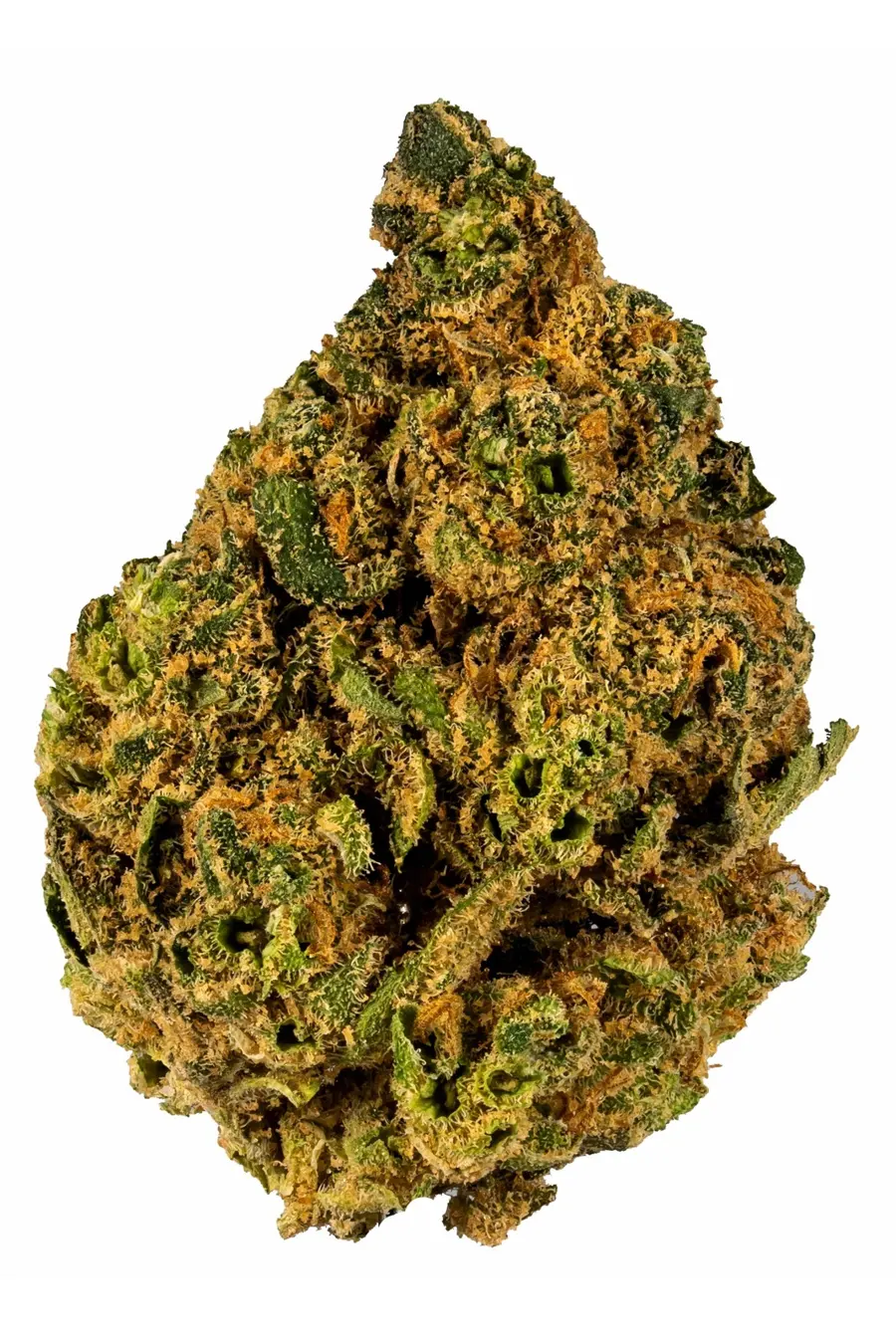
Strain library · Cannabis strain
Beetlejuice
Hybrid (retail label) Reported THC 23.25%
Beetlejuice is a hybrid cannabis strain with listed parentage of UW and Gorilla Biscuit. Its flavor profile features sour and sweet characteristics. Available figures report THC at 23.246%. Reported experiences include calmness and happiness.
Reported effects are not established medical benefits. Figures are source-reported, not batch certificates.
About Beetlejuice
Strain highlights
Safety at a glance
Full safety section. General THC cautions apply to every strain.
Flavors
Sour SweetFlavor tags are descriptions, not lab measurements.
Reported effects
Calm Happy Dry MouthReported by a source. Not medical benefits. Yellow chips are unwanted effects. More on effects
Activities people associate with it
Doing Nothing SleepingThese are descriptive tags from the source, not advice. Cannabis impairs. Do not drive, swim, fish from a boat, exercise hard or use machines while impaired.
Lab report (source-reported)
Figures as the source lists them. A dark band is a range across several samples (with the highest value marked); a single dark bar is one figure. They may not come from one lab sample and are not a verified batch certificate.
Cannabinoids (% of flower)
Terpenes (mg per g), highest first
The small icon shows the usual aroma family of each terpene. Compare terpenes within this strain only: different sources report terpenes on different scales.
Reported THC compared with the library
This strain: 23.2% reported THC, higher than 62% of the 1,210 strains in this library that list a THC figure (library median 22%). Source-reported figures, not batch certificates, and they vary a lot between samples.
How common are the reports?
The bar shows the share of all 1,248 library strains that list each effect. Highlighted rows are the ones listed for this strain. The data records which effects are listed, not how strong they are.
Lineage
Parents and grandparents as listed by the source. Colour shows the retail label: indica, sativa, hybrid. Breeders and growers often disagree about lineage.
- Beetlejuice Hybrid THC 23.246%
- UW Indica
- Gorilla Biscuit Hybrid
- Sensi Star Indica THC 15-16%
- Stardawg Hybrid THC 28.08%
Reported effects
These are experiences that a source lists for this name. They are not benefits, and they do not predict how any one person will react.
Reported feelings
Calm HappyReported unwanted effects
Dry MouthDry mouth, dry eyes, dizziness, nervousness and headache are common with THC-containing cannabis. See the Safety tab.
Why the same name feels different
Effects depend on the dose, how it is taken, the person, their tolerance, other medicines and the exact product. Labels like indica, sativa and hybrid have not been shown to predict effects reliably. Why labels do not predict effects.
How good is the information on this page?
What this page is built from
- Source-reported figures. The type, parents, flavors, reported effects and lab numbers come from a third-party strain database, retrieved 2026-10-25. They are not a batch certificate and may not be from one lab sample.
- Our own lab-report data. This name does not appear in the lab results we collected, so we have nothing stronger than the database listing.
- Research on this strain. This page cites no clinical trial of this named strain. Research is mostly on single compounds or on pharmaceutical products, not on strain names.
What research says about the compounds listed here
- THCA (Tetrahydrocannabinolic Acid): Safety first: THCA converts to THC with heat, so the risks of THC apply to products that are smoked, vaped or baked: psychosis and mental health problems with heavy use, dependence (about 22% of people who use cannabis), driving impairment, harm in pregnancy and poisoning of children.
- THC (Delta-9-Tetrahydrocannabinol): Safety first: the main risks are psychosis and mental health problems with heavy or daily use, cannabis use disorder (about 22% of people who use cannabis), cannabis hyperemesis syndrome, driving impairment, low birth weight and preterm birth, and serious poisoning in young children from edibles.
- CBGA (Cannabigerolic Acid): No study of CBGA alone in people was found. The evidence is mouse, dog, cell and test-tube research, with mixed seizure results in mice, and several studies are linked to companies or patents. Safety in people is unknown.
- CBDA (Cannabidiolic Acid): No trial has tested CBDA on its own in people. Two small human studies used mixed products, and one of them had no placebo group. Almost everything else is mouse, rat or cell work, mostly from a few research groups. Safety, drug interactions and product accuracy are unstudied or poor.
- CBD (Cannabidiol): Strong proof exists only for the prescription solution in three rare epilepsies. For anxiety, sleep and pain the evidence is weak or mixed. Liver enzyme rises, sleepiness, drug interactions and mislabelled products are real concerns.
- Myrcene: Safety and honesty first: most evidence is from animals or cells. In people, the only study of pure myrcene is a 10-person driving-simulator pilot, which suggests impairment. The other human studies tested mixtures. Rodents given very high doses for two years developed kidney and liver tumours;
- Pinene (Alpha-Pinene and Beta-Pinene): Safety and honesty first: only alpha-pinene has been tested with THC in people, in one 19-person vaporizer trial that found no effect on THC memory impairment. Everything else is from animals, cells, whole oils or mixtures.
- Beta-caryophyllene: Evidence first: most results are from cells and mice and are labelled that way. The CB2 binding finding has not been cleanly replicated, and no human trial of BCP alone shows a health benefit. Safety data in people are small and short.
- Limonene: Safety and honesty first: nearly all evidence is from animals, cells or small human studies. In people, the best-designed study is a 20-person vaporizer trial in which a high d-limonene dose lowered anxious and paranoid ratings after THC but changed nothing else. Orange-scent studies used whole oil.
- Linalool: Safety and honesty first: the best human evidence is for Silexan, an oral lavender oil capsule, and it is not linalool. Pure linalool has been studied mainly in mice, rats and cells, with two very small human inhalation trials (shingles nerve pain, carpal tunnel) and one 24-person stress experiment.
- Humulene: Safety and honesty first: nearly all evidence is from cells and animals. In rodents, humulene lowered inflammation signals and allergic lung inflammation. Results on cannabis-like and pain effects disagree between mouse and rat studies. No human trial of isolated humulene was found, so no health benefit is established.
All evidence ratings · How to read a lab report · Names vs lab profiles
Safety for Beetlejuice
Safety at a glance
Specific to this listing
- Reported THC is 23.25%. THC is the compound behind impairment, anxiety and most of the risks below, and labels and lab figures can be wrong.
- Unwanted effects reported for this name: dry mouth.
- Strain names are not reliable. Another product with this name may be much stronger or different.
THC safety, which applies to every strain
- Prescription THC medicines are separate from cannabis from a shop or dispensary
FDA has not approved the cannabis plant for any disease. It has approved prescription medicines: dronabinol (synthetic THC, as Marinol and Syndros) and nabilone (a THC-like drug, as Cesamet). - Psychosis and mental health
Heavy cannabis use is linked to psychosis. A meta-analysis of 66,816 people found the heaviest users had about 3.9 times the odds of psychosis outcomes versus non-users (OR 3.90, 95% CI 2.84 to 5.34). - Cannabis use disorder (dependence)
About 22% of people who use cannabis (95% CI 18 to 26%) meet criteria for a cannabis use disorder, and the risk of dependence was 33% among young people who use weekly or daily. - Cannabis hyperemesis syndrome (CHS)
Long-term heavy cannabis use can cause repeated attacks of severe nausea, vomiting and belly pain. People may relieve symptoms with hot showers, but the NIDA page says it only resolves when use stops completely. - Driving and impairment
Cannabis impairs driving. A meta-analysis of 57 experiments found cannabis alone impaired lane control, and cannabis with alcohol was worse than either alone. - Pregnancy and breastfeeding
Use in pregnancy is linked to lower birth weight (RR 2.06 for under 2,500 g), small-for-gestational-age babies (RR 1.61), preterm birth (RR 1.28) and NICU admission (RR 1.38). - Teens and young adults
Cannabis use before age 18 is linked to depression in young adulthood (OR 1.37), suicidal ideas (OR 1.50) and suicide attempts (OR 3.46). Frequent or dependent use in youth is linked to about a 2-point IQ decline. - Older adults
Older adults may be more sensitive to the thinking and blood pressure effects of THC, and dizziness on standing raises fall risk. NCCIH links cannabis use to injury in older adults.
CBD safety, which applies to every strain
- One approved CBD medicine (prescription only); shop products are not the same thing
The FDA has approved only one CBD product: a prescription solution for seizures with Lennox-Gastaut syndrome, Dravet syndrome or tuberous sclerosis complex in people 1 year and older. The EU authorised it for age 2 and older. - Liver injury is the main serious risk
In controlled studies of the prescription CBD solution, liver enzyme (ALT) rises above 3 times normal happened in 12% to 13% of treated patients versus 1% on placebo, mostly in the first two months but sometimes much later. - Interactions with other medicines are common and some matter a lot
With clobazam, CBD raised its active breakdown product N-desmethylclobazam 3.4-fold in healthy volunteers, and sleepiness and sedation rose. Valproate with CBD raises the chance of liver enzyme rises. - Sleepiness and sedation
In Lennox-Gastaut and Dravet trials, 32% of treated patients had sleepiness or sedation versus 11% on placebo, and 46% of those also taking clobazam. Alcohol and other sedating drugs can add to it. - Tummy and appetite effects
Diarrhea and decreased appetite are among the most common effects. In a 2020 pooled analysis of 12 randomized trials, diarrhoea was the only adverse outcome still linked to CBD after childhood epilepsy trials (where interactions… - Shop CBD products often do not match their labels, and may contain THC
In 80 hemp-derived CBD oils bought in Kentucky, 37 held at least 10% more or less CBD than the label said (12 under 90%, 25 over 110%). - Pregnancy and breastfeeding: avoid unless a doctor says otherwise
The prescription label says animal data suggest CBD may cause fetal harm and that there are no data on human milk. The FDA says the effects of CBD on a developing fetus or breastfed newborn are unknown. - Mental health and mood
The prescription label carries the warning that all seizure medicines have: monitor for new or worsening depression, suicidal thoughts or unusual mood or behaviour changes.
Also keep in mind
- Keep all cannabis products away from children and pets. Edibles look like sweets.
- Do not drive or use machines while impaired.
- Pregnancy and breastfeeding: avoid, unless a doctor says otherwise.
- Laws about cannabis differ by country and state and change often. Check your local rules. Safety and legal basics.