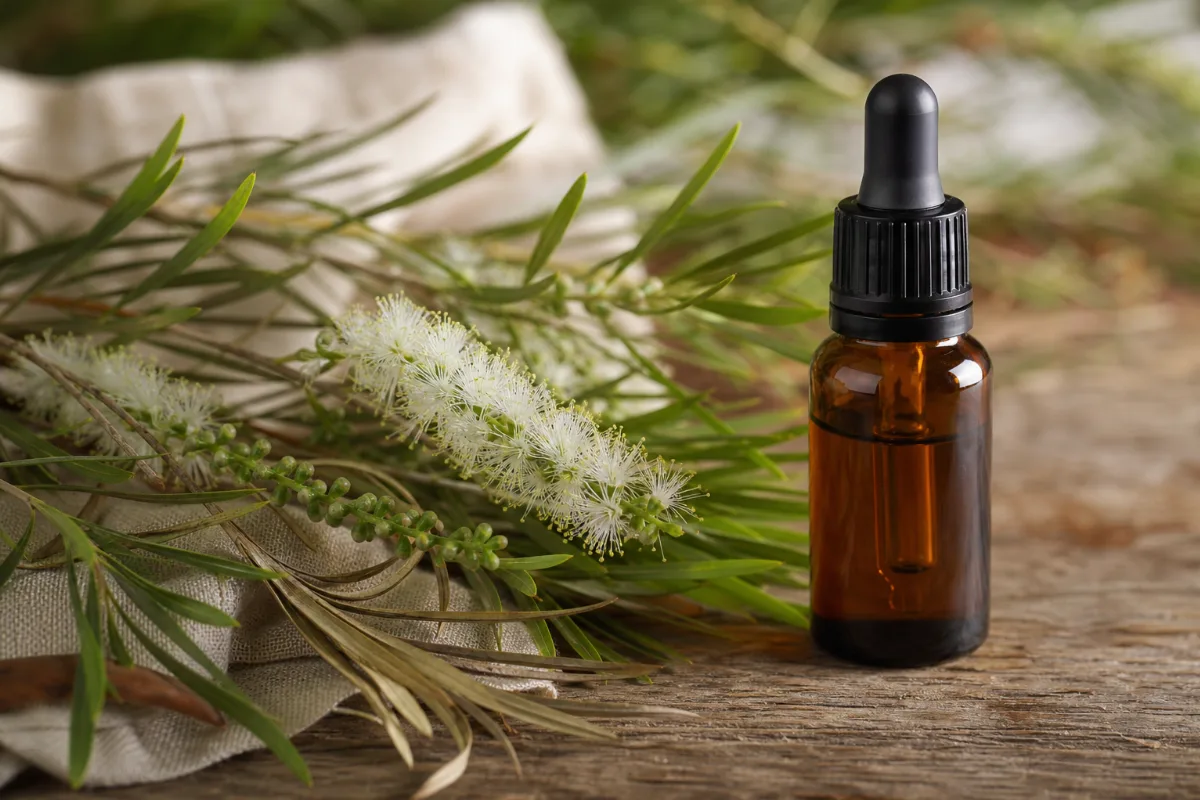
Essential Oils & Aromatherapy · Essential oil
Tea Tree Oil
Melaleuca alternifolia (Maiden & Betche) Cheel · also called Melaleuca oil, Australian tea tree oil, tea tree essential oil
Tea tree oil is the strong-smelling oil steam-distilled from the leaves of an Australian tree. It is put on the skin for acne, athlete's foot and dandruff, and added to shampoos, gels and mouthrinses. Small trials suggest modest help for some skin uses, but the evidence is limited. The main caution: never swallow the oil, because small amounts have made toddlers unsteady and unresponsive, and it is dangerous for cats and dogs.
General information, not medical advice. Last substantive update · Not medically reviewed. A named clinician has not signed off on this page. How this page is made
About Tea Tree Oil
Tea tree oil comes from the leaves of an Australian tree. People put it on the skin for acne, athlete's foot and dandruff. Small, short trials of products at set strengths suggest modest help for acne and dandruff, mixed results for athlete's foot, and too little evidence for nails and lice. Safety comes first: do not swallow the oil, it can cause skin allergy, and it is dangerous for pets.
What tea tree oil is
Tea tree oil is the essential oil from steam-distilling the leaves of Melaleuca alternifolia, a tree native to New South Wales and Queensland in Australia. GBIF lists the accepted name as Melaleuca alternifolia (Maiden & Betche) Cheel, in the myrtle family, Myrtaceae.
In three batches that met the ISO 4730 standard, a lab found 30% to 40% terpinen-4-ol, a compound that favors the oil's germ-fighting action in the lab.
Products labelled tea tree can differ. Poison Control says it can be hard to know the species, strength or contaminants in an essential oil bottle.
What people use it for, and how strong the evidence is
Acne and dandruff have the best, though still limited, evidence, from small trials of a 5% gel and a 5% shampoo. Athlete's foot results are mixed: one trial cleared the fungus better than placebo, another did not but eased symptoms. For toenail fungus, head lice and eyelid mites the evidence is insufficient or low, and for MRSA carriage it is very low. A 2023 review finds some support for low-strength mouthwashes against plaque.
The strengths in these trials are not advice. Some trial strengths caused dermatitis. This page does not tell you how strong to use. A pharmacist can advise on made products.
The research in one view
Most trials are small, short and old, many are single-blind, and a strong scent is hard to hide from a comparison group. A 2023 review of 46 trials rated the quality as poor to modest. NCCIH says more studies are needed for acne and athlete's foot and that there is not enough evidence for other conditions.
Bottled oil, gels, shampoos and pet products are different things
The 5% gel, the 5% shampoo, the mouthrinses and the creams in the trials are made products at set strengths. Results for them do not show that bottled oil is safe or works, and the oil should not be swallowed or used undiluted. Poison Control says diluting an essential oil in a carrier oil is the best way to avoid a bad skin reaction, and it should not go on damaged skin. Pet shampoos under about 1 to 2% are described as generally non-toxic when used as labelled.
What authorities say
NCCIH (page last updated April 2025) says tea tree oil on the skin might help acne and athlete's foot but more studies are needed, that it should not be swallowed, and that skin products may be safe in pregnancy and breastfeeding. Poison Control and Pet Poison Helpline give the general and pet warnings above. We did not find or read a statement from the FDA, EMA, LiverTox or LactMed.
At a glance
Traditional uses history, not proof
- Leaves used by the Aboriginal people of Australia for wounds, burns and insect bites (NCCIH).
- Used as a skin antiseptic for almost 80 years, mostly by anecdote (2006 toxicity review).
- Promoted today for acne, athlete's foot, toenail fungus, lice and other conditions on the skin (NCCIH).
Studied for research
- Acne, 5% gel on the skin, low
- Athlete's foot, on the skin, mixed
- Dandruff, 5% shampoo, low
- Toenail fungus, insufficient
- Eyelid and skin mites (Demodex), low
- Head lice, insufficient
- MRSA germ carriage, very low
- Dental plaque and gum disease, mouthrinse or gel, low
Main compounds
- Terpinen-4-ol, 30% to 40% in three batches that met the ISO 4730 standard (one lab study)
Common forms
- Essential oil (steam-distilled leaves)
- Gels, creams and solutions for the skin (set strengths)
- Shampoo
- Mouthrinse or dental gel
- Pet products at low strengths
Research links: NCCIH: Tea tree oil · Poison Control: Essential oils · Pet Poison Helpline: Tea tree oil · Safety review of tea tree oil (abstract) · Systematic review of trials (abstract) · Acne meta-analysis, 2026 (abstract) · Research Library · Genes & Biomarkers Library
What it is and its history
- Accepted scientific name
- Melaleuca alternifolia
- Naming authority
- (Maiden & Betche) Cheel
- Common names
- Tea tree oil (English); Melaleuca oil (English); Australian tea tree oil (English); Tea tree essential oil (English)
- Family or group
- Myrtaceae (myrtle family), per GBIF.
- Classification
- Plantae > Tracheophyta > Magnoliopsida > Myrtales > Myrtaceae > Melaleuca > Melaleuca alternifolia
- Native range
- NCCIH says the tea tree is native to New South Wales and Queensland in Australia, and most oil is produced in Australia, with China and several countries in Africa also producing it.
- Habitat
- Not checked.
- What it looks like
- Part used: Leaves are steam-distilled to make the oil (NCCIH). This page does not describe how to recognise the plant.
- Cultivation
- Not covered by the sources read.
- Harvest and processing
- Steam distillation of the leaves (NCCIH).
- Look-alikes and adulterants
- Name: Other oils sold as 'tea tree' or 'melaleuca' oil; Note: Poison Control says it can be hard to know the species and strength in an essential oil bottle. A source naming other species sold under these names was not read, so none is listed.
- Sustainability and conservation
- Not checked.
Traditional use and history history, not clinical proof
| Tradition or era | Documented use | Source |
|---|---|---|
| Aboriginal peoples of Australia | NCCIH says the Aboriginal people of Australia traditionally used the leaves of the tea tree for treating wounds, burns and insect bites. The 2023 review attributes this to First Nations Australians. | NCCIH |
| Modern antiseptic use | A 2006 review says almost 80 years of anecdotal use suggests topical use is relatively safe. Today NCCIH says it is promoted for acne, athlete's foot, toenail fungus, lice and other conditions. | Hammer 2006; NCCIH |
Traditional use shows how it was used. It does not show that it works or is safe today.
What is inside, and how it may work
What it contains and how those compounds act in cells and animals. Laboratory and animal mechanisms are not proven effects in people.
Main compounds
| Compound | Family | Where it is concentrated | Activity studied | Level of evidence |
|---|---|---|---|---|
| Terpinen-4-ol PubChem 11230 | monoterpene alcohol | Steam-distilled oil from the leaves 30% to 40% in three batches that met the ISO 4730 chemotype (one lab study). | Described as a compound that favors the oil's antimicrobial activity in the lab. Its role in people is not shown. 28 18 | Laboratory |
Mechanisms, receptors and pathways
| Target or pathway | Gene or receptor | What was found | Level |
|---|---|---|---|
| Growth of the acne germ Cutibacterium acnes | In agar tests 2% tea tree oil stopped growth of C. acnes in all three batches, and the lowest effective concentration was 0.25% v/v. The authors say work on germs from patients is still needed. 18 | Laboratory research | |
| Estrogen and androgen receptor activity | Estrogen receptor, androgen receptor | In human cell lines lavender and tea tree oils showed estrogen-like and anti-androgen activity. A 2023 review says limited skin penetration of some components means the cell-line findings cannot be applied to the body. 11 4 | Laboratory research |
Absorption, metabolism and elimination
- Absorption
- Not established in the sources read. Limited skin penetration of some components is cited as a reason the cell-line findings may not apply in the body (Braunstein 2023).
- Distribution
- Not established.
- Metabolism
- Not established.
- Elimination
- Not established.
- Bioavailability
- Not established.
Isolated compounds versus whole extracts
Bottled essential oil, 5% gels, shampoos, creams, mouthrinses and pet products are different products at different strengths. Results do not carry between them, and the nail, MRSA and combination trials mixed tea tree oil with other active ingredients.
Nutritional composition
Tea tree oil is not a food or a nutrient and is not a supplement to swallow. NCCIH says it should not be swallowed.
1 mixed findings4 low certainty1 very low certainty2 not enough evidence
What was looked at
The 8 benefits and uses checked for Tea Tree Oil, each with how strong the evidence is. Tap one to open it.
- Acne (5% gel on the skin)Low certainty
- Athlete's foot (tinea pedis) on the skinMixed findings
- Dandruff (5% shampoo)Low certainty
- Toenail fungus (onychomycosis)Not enough evidence
- Demodex mites on the eyelids and skinLow certainty
- Head liceNot enough evidence
- Clearing MRSA germ carriageVery low certainty
- Dental plaque and gum disease (mouthrinse or gel)Low certainty
Lab markers tracked in the studies
Acne lesion count and severity scoreFungal culture cure (athlete's foot, nails)
What is Tea Tree Oil good for?
The uses people ask about and how strong the evidence is for each. Read the certainty label first: these are skin, scalp, eyelid or mouth products at set strengths, not bottled oil swallowed or used undiluted.
Benefits, one by one
Each card is a research question, not a promise. Tap a goal to filter. Open a card to see the studies, doses and limits.
Acne (5% gel on the skin)
Low certaintySmall trials of a 5% tea tree oil gel found fewer acne spots than placebo, and a 2026 pooled analysis found a modest drop in acne severity. The trials are small and short, so the certainty is low.
6 studiesStudied as products at set strengths made for the skin (strengths are…
Studies, doses and limits
What the trials found
A 2026 meta-analysis of 7 clinical studies (445 people); a 1990 single-blind trial of 124 people comparing a 5% gel with 5% benzoyl peroxide lotion; and a 2007 double-blind, placebo-controlled trial of 60 people using a 5% gel for 45 days. The 2023 Frontiers systematic review (46 trials across all uses) says more evidence is needed for acne. NCCIH says a small amount of research suggests it might help.
Results
2026 meta-analysis: modest lower acne severity versus controls (pooled odds ratio 0.74, 95% CI 0.63 to 0.88), with mostly mild, local side effects and less itching than the control treatments. 1990: both the 5% gel and 5% benzoyl peroxide reduced inflamed and non-inflamed spots; tea tree oil acted more slowly and had fewer side effects. 2007: the gel beat placebo on spot count and the acne severity index (the authors say 3.55 and 5.75 times more effective), with similar tolerable side effects in both groups.
Effect sizes as reported
Pooled odds ratio 0.74 (95% CI 0.63 to 0.88) for acne severity in the 2026 meta-analysis. The 2007 trial gives only the authors' 'times more effective' figures.
Why this rating
Positive results, but trials are small, short and old; the one comparison was single-blind and against another active treatment; reviewers (NCCIH, Kairey 2023) say more evidence is needed; the 2026 authors call for larger, standardized trials.
Form and dose studied
Studied as products at set strengths made for the skin (strengths are given in the results). No amounts are advised here. Bottled essential oil is concentrated and should not be used undiluted or swallowed; ask a pharmacist.
Who was studied
Teenagers and adults with mild to moderate acne.
Limits
Only 7 studies in the pooled analysis, different products and controls, short follow-up. The 1990 trial was single-blind. Funding was not stated in the abstracts read.
Why researchers looked
Tea tree oil stops the acne germ Cutibacterium acnes from growing in the lab, so researchers tested it on the skin of people with acne.
Traditional use
NCCIH says the Aboriginal people of Australia traditionally used the leaves of the tea tree for wounds, burns and insect bites. Acne is a modern use.
Proposed mechanism Preliminary mechanism
In test-tube work on three batches of oil, 2% tea tree oil stopped growth of the acne germ C. acnes and the lowest effective concentration was 0.25% v/v. That is lab work only and does not show the oil clears acne in people.
A proposed mechanism does not show that the effect happens in people.
Skin irritation and allergy are possible, more so with old or air-exposed oil (see Safety). The 5% gel is a made product, not a reason to use bottled oil undiluted.
Athlete's foot (tinea pedis) on the skin
Mixed findingsTwo trials of tea tree oil on the skin for athlete's foot disagree on whether it clears the fungus, but both found it eased symptoms. NCCIH says it may not work as well as standard treatments.
3 studiesStudied as products at set strengths made for the skin (strengths are…
Studies, doses and limits
What the trials found
A 2002 randomized, placebo-controlled trial of 158 people using 25% or 50% solutions twice a day for 4 weeks, and a 1992 randomized trial of 104 people using a 10% cream against 1% tolnaftate cream and placebo cream. NCCIH says a small amount of research suggests it may help.
Results
2002: a marked clinical response in 72% (25% solution) and 68% (50% solution) versus 39% with placebo; fungal culture cure was 64% with the 50% solution versus 31% with placebo; 3.8% of people using tea tree oil had moderate to severe dermatitis. 1992: culture turned negative in 85% with tolnaftate, 30% with tea tree oil and 21% with placebo (no real difference between tea tree oil and placebo for clearing the fungus), but symptoms improved more with tea tree oil (24 of 37) than placebo (14 of 34).
Effect sizes as reported
Not given as effect sizes in the abstracts read.
Why this rating
Two older trials point different ways on clearing the fungus; both found symptom relief. The 2002 trial used strong solutions that caused dermatitis in some people.
Form and dose studied
Studied as products at set strengths made for the skin (strengths are given in the results). No amounts are advised here. Bottled essential oil is concentrated and should not be used undiluted or swallowed; ask a pharmacist.
Who was studied
Adults with athlete's foot between the toes.
Limits
Older trials (1992 and 2002), short, fairly small, no funding details in the abstracts. Strengths tested differed greatly (10% to 50%).
Why researchers looked
Tea tree oil is active against skin fungi in the lab, so it was tested on athlete's foot.
Traditional use
Not described in the sources read.
Proposed mechanism Preliminary mechanism
Not shown in the human trials read; the trial abstracts cite lab activity against fungi that infect the skin.
A proposed mechanism does not show that the effect happens in people.
At the strengths tested in 2002, some people had moderate to severe dermatitis.
Dandruff (5% shampoo)
Low certaintyOne trial of a 5% tea tree oil shampoo found dandruff scores improved more than with a placebo shampoo over 4 weeks. It is one trial, single-blind.
1 studiesStudied as products at set strengths made for the skin (strengths are…
Studies, doses and limits
What the trials found
A 2002 randomized, single-blind, parallel-group trial of 126 people aged 14 and over with mild to moderate dandruff, used daily for 4 weeks.
Results
The tea tree shampoo group improved 41% on a severity score versus 11% with placebo (P<.001). Itchiness and greasiness scores improved significantly; scaliness improved but not significantly. No adverse effects were reported.
Effect sizes as reported
41% versus 11% improvement in the quadrant-area-severity score (P<.001).
Why this rating
One trial of one product, single-blind (scent may reveal the group), 4 weeks only; not repeated in the sources read.
Form and dose studied
Studied as products at set strengths made for the skin (strengths are given in the results). No amounts are advised here. Bottled essential oil is concentrated and should not be used undiluted or swallowed; ask a pharmacist.
Who was studied
People aged 14 and over with mild to moderate dandruff.
Limits
Single-blind; short; no second trial found; conflicts not stated in the abstract.
Why researchers looked
Dandruff is linked to a yeast on the scalp, and tea tree oil acts against that yeast in the lab.
Traditional use
Not described in the sources read.
Proposed mechanism Preliminary mechanism
The trial authors say dandruff appears related to the yeast Pityrosporum ovale and that tea tree oil has antifungal activity against it. This was not shown in the trial itself.
A proposed mechanism does not show that the effect happens in people.
No adverse effects were reported in this trial; skin allergy remains possible with any tea tree product.
Toenail fungus (onychomycosis)
Not enough evidenceEvidence is too limited to say. One trial found tea tree oil did about as well as a weak antifungal solution; one trial of a cream mixing tea tree oil with another antifungal found cures. Neither shows tea tree oil alone works.
3 studiesStudied as products at set strengths made for the skin (strengths are…
Studies, doses and limits
What the trials found
A 1994 double-blind trial of 117 adults with culture-proven toenail fungus comparing twice-daily 1% clotrimazole solution with full-strength tea tree oil for 6 months, and a 1999 placebo-controlled trial of 60 people using a cream with 2% butenafine plus 5% tea tree oil for 16 weeks. NCCIH says both the amount and quality of research are insufficient to reach conclusions.
Results
1994: culture cure was 18% with tea tree oil and 11% with clotrimazole; partial or full clinical resolution was 60% and 61%; about half of each group reported continued improvement 3 months later. 1999: 80% cured with the medicated cream and none with placebo, but the cream combined two active ingredients.
Effect sizes as reported
Not given as effect sizes in the abstracts read.
Why this rating
NCCIH calls the research insufficient. The 1994 trial had no placebo group. The 1999 cream mixed two actives, so tea tree oil's own effect is unknown.
Form and dose studied
Studied as products at set strengths made for the skin (strengths are given in the results). No amounts are advised here. Bottled essential oil is concentrated and should not be used undiluted or swallowed; ask a pharmacist.
Who was studied
Adults with toenail fungus.
Limits
Old trials (1994, 1999), no placebo in one, a combination product in the other, and low cure rates in the first.
Why researchers looked
NCCIH says tea tree oil is promoted for toenail fungus.
Traditional use
Not described in the sources read.
Proposed mechanism Preliminary mechanism
Not shown in the human trials read.
A proposed mechanism does not show that the effect happens in people.
Four of 40 people using the combination cream had mild inflammation. The 1994 trial used full-strength oil on nails, which this page does not advise.
Demodex mites on the eyelids and skin
Low certaintyTea tree oil has been tested a lot against Demodex mites. Two pooled reviews call it promising or find it no better than other treatments, with more mild reactions. NCCIH calls effectiveness uncertain.
4 studiesStudied as products at set strengths made for the skin (strengths are…
Studies, doses and limits
What the trials found
A 2023 systematic review and meta-analysis of 21 studies of anti-Demodex strategies, and a 2021 systematic review and meta-analysis of 18 studies (1,195 people) of treatments for Demodex eyelid inflammation. NCCIH says several studies tested it for Demodex eyelid inflammation but effectiveness is uncertain.
Results
2023: topical tea tree oil was one of three strategies the authors called promising (with topical ivermectin and ivermectin plus metronidazole); adverse events were mostly mild. 2021: tea tree oil and its derivatives were the most often tested; no significant difference was found between tea tree oil and other treatments; adverse reactions were more frequent with tea tree oil treatments, all mild.
Effect sizes as reported
Not given as effect sizes in the abstracts read.
Why this rating
Pooled reviews disagree on whether tea tree oil beats other options; studies are mixed in design; NCCIH calls it uncertain.
Form and dose studied
Studied as products at set strengths made for the skin (strengths are given in the results). No amounts are advised here. Bottled essential oil is concentrated and should not be used undiluted or swallowed; ask a pharmacist.
Who was studied
Adults with Demodex eyelid inflammation or skin mite infestation.
Limits
Many products and strengths pooled; the abstracts give no tea tree specific numbers; long-term re-infestation is unknown.
Why researchers looked
Tea tree oil and its derivatives (such as terpinen-4-ol) are the most often tested treatments for Demodex mites, which live in eyelash follicles and skin.
Traditional use
Not described in the sources read.
Proposed mechanism Preliminary mechanism
The reviews describe activity against mites; the sources read do not give a mechanism.
A proposed mechanism does not show that the effect happens in people.
Eye-area irritation was more frequent with tea tree oil treatments in the 2021 review. Do not put bottled oil near the eyes.
Head lice
Not enough evidenceEvidence is insufficient. NCCIH says head lice have only been tested with tea tree oil mixed into combination products, so the effect of the oil itself is unclear.
3 studiesStudied as products at set strengths made for the skin (strengths are…
Studies, doses and limits
What the trials found
NCCIH says head lice have only been evaluated in combination with other ingredients, so it is unclear whether any effect is due to tea tree oil. A 2022 systematic review of 71 lab, animal and human studies says its authors found promising results against ectoparasites in general.
Results
No human trial of tea tree oil alone for head lice was found in the sources read.
Effect sizes as reported
Not given as effect sizes in the abstracts read.
Why this rating
Only combination products tested in people (NCCIH); the 2022 review mostly covers lab work.
Form and dose studied
Studied as products at set strengths made for the skin (strengths are given in the results). No amounts are advised here. Bottled essential oil is concentrated and should not be used undiluted or swallowed; ask a pharmacist.
Who was studied
Not established.
Limits
No oil-alone trial found. The 2022 review's abstract does not separate lice from other parasites.
Why researchers looked
NCCIH says tea tree oil is promoted for head lice.
Traditional use
Not described in the sources read.
Proposed mechanism Preliminary mechanism
Not shown in the human data read. The 2022 review says the lab activity against pests seems to have carried over into clinical studies; its abstract does not detail the mechanism.
A proposed mechanism does not show that the effect happens in people.
Children's skin is thin and Poison Control notes children may be more sensitive to essential oils; ask a pharmacist before using any lice product.
Clearing MRSA germ carriage
Very low certaintyOne small trial of a tea tree nasal ointment and body wash looked at least as good as standard products, but the difference was not statistically significant. Evidence is very limited.
2 studiesStudied as products at set strengths made for the skin (strengths are…
Studies, doses and limits
What the trials found
A 2000 randomized trial of a combination of 4% tea tree oil nasal ointment and 5% tea tree oil body wash against 2% mupirocin nasal ointment and triclosan body wash, and the 2023 Frontiers systematic review.
Results
2000: the tea tree combination appeared to perform better, but the difference was not statistically significant because of the small number of patients. 2023 review: body decolonization looked similar to standard treatments, though use inside the nose may irritate the lining.
Effect sizes as reported
Not given as effect sizes in the abstracts read.
Why this rating
A very small trial with no significant difference and a combined tea tree product.
Form and dose studied
Studied as products at set strengths made for the skin (strengths are given in the results). No amounts are advised here. Bottled essential oil is concentrated and should not be used undiluted or swallowed; ask a pharmacist.
Who was studied
People carrying MRSA.
Limits
The abstract does not give the number of patients; old trial.
Why researchers looked
A trial abstract calls tea tree oil a long-regarded topical antiseptic in Australia, so it was tried against resistant staph germs on the skin and in the nose.
Traditional use
Not described in the sources read.
Proposed mechanism Preliminary mechanism
Not shown in the human trials read.
A proposed mechanism does not show that the effect happens in people.
The 2023 review says use inside the nose may irritate mucous membranes.
Dental plaque and gum disease (mouthrinse or gel)
Low certaintyA 2023 review found that mouthwashes with a low strength of tea tree oil may limit plaque and that a 5% gel may help as an add-on in gum disease. NCCIH calls effectiveness uncertain. Rinses are spat out, never swallowed.
2 studiesStudied as products at set strengths made for the skin (strengths are…
Studies, doses and limits
What the trials found
The 2023 Frontiers systematic review of 46 randomized trials (18 in dentistry). NCCIH says the effectiveness of tea tree mouthrinses for gum inflammation, plaque and bad breath is uncertain.
Results
Mouthwashes with 0.2% to 0.5% tea tree oil may limit accumulation of dental plaque. Gels with 5% tea tree oil applied to the periodontium may aid treatment of periodontitis as an adjunct to scaling and root planing.
Effect sizes as reported
Not given as effect sizes in the abstracts read.
Why this rating
The reviewers say overall research quality was poor to modest; NCCIH says effectiveness is uncertain.
Form and dose studied
Studied as products at set strengths made for the skin (strengths are given in the results). No amounts are advised here. Bottled essential oil is concentrated and should not be used undiluted or swallowed; ask a pharmacist.
Who was studied
Adults in dental trials.
Limits
The abstract gives no numbers for dental outcomes; many small trials.
Why researchers looked
Dentistry accounted for the most trials in the 2023 review (18 of 46), so mouth products are among the best-studied uses.
Traditional use
Not described in the sources read.
Proposed mechanism Preliminary mechanism
Not described in the sources read.
A proposed mechanism does not show that the effect happens in people.
NCCIH: mouthrinses with tea tree oil should not be swallowed.
Connections to the rest of health
How Tea Tree Oil connects to the rest of our health knowledge graph. Every link says what kind of connection it is. A safety link (for example to the liver) is a warning, not a benefit. A study that merely mentions a topic never creates a benefit link.
Explore every connection: goals, body systems, organs, symptoms, genes
A. Wellness goals
| Connected to | Kind of connection | Evidence status | Context | Studies |
|---|---|---|---|---|
| Healthy Skin | Low certainty | Acne (5% gel on the skin): Small trials of a 5% tea tree oil gel found fewer acne spots than placebo, and a 2026 pooled analysis found a modest drop in acne severity. The trials are small and short, so the certainty is low. Athlete's foot (tinea pedis) on the skin: Two trials of tea tree oil on the skin for athlete's foot disagree on whether it clears the fungus, but both found it eased symptoms. NCCIH says it may not work as well as standard treatments. | 25 2 8 13 18 26 19 22 20 5 21 | |
| Healthy Skin | Low certainty | Demodex mites on the eyelids and skin: Tea tree oil has been tested a lot against Demodex mites. Two pooled reviews call it promising or find it no better than other treatments, with more mild reactions. NCCIH calls effectiveness uncertain. | 15 16 26 13 |
B. Body systems
| Connected to | Kind of connection | Evidence status | Context | Studies |
|---|---|---|---|---|
| Skin Hair Beauty | Biological association | Low certainty | Studied for: Acne (5% gel on the skin) Studied for: Athlete's foot (tinea pedis) on the skin | 25 2 8 13 18 26 19 22 20 5 21 15 16 |
| Integumentary System | Biological association | Low certainty | Studied for: Acne (5% gel on the skin) Studied for: Athlete's foot (tinea pedis) on the skin | 25 2 8 13 18 26 19 22 20 5 21 15 16 |
E. Health conditions
| Connected to | Kind of connection | Evidence status | Context | Studies |
|---|---|---|---|---|
| Contact dermatitis | Adverse effect or risk | Documented risk | Allergic skin reactions in a clinic series and patch-test study. Preparation or compound: Tea tree oil, especially old or air-exposed oil |
1 24 |
| Prepubertal gynecomastia (breast growth in boys) | Not enough evidence | Case reports; reviews find a cause unproven. Preparation or compound: Skin products with lavender and tea tree oils |
11 10 4 | |
| Essential oil poisoning | Adverse effect or risk | Documented risk | Child case reports and a pet case series. Preparation or compound: Swallowed tea tree oil |
17 7 12 14 |
| Prepubertal gynecomastia / premature thelarche | Very low certainty | A few case reports; cause unproven. Preparation or compound: Lavender and tea tree skin products |
11 10 4 | |
| Acne | Low certainty | Modest drop in severity in small trials. Preparation or compound: Tea tree oil 5% gel on the skin |
25 8 2 |
I. Biomarkers
| Connected to | Kind of connection | Evidence status | Context | Studies |
|---|---|---|---|---|
| Acne lesion count and severity score | Biological association | Low certainty | Measured in trials: decrease. A lab change is not the same as a health benefit. | 25 8 2 |
| Fungal culture cure (athlete's foot, nails) | Biological association | Mixed findings | Measured in trials: decrease. A lab change is not the same as a health benefit. | 19 22 5 |
J. Genes, receptors and enzymes
L. Active compounds
Each connection is stored with the ingredient, the connected record, the kind of connection, the evidence status, the supporting studies, the preparation or compound involved, and a review date (last reviewed October 25, 2026).
Evidence at a glance: what the research found for 8 outcomes
Each outcome below is one thing researchers measured. Certainty is how far the evidence can be trusted, not how well it works. The full studies are on the next tab.
The evidence
The research centre for Tea Tree Oil. Every record here was checked against PubMed or the publisher's page; we never list a study we have not verified.
Evidence by outcome
Bars show how many studies we found for each outcome, not how well it works. People are added up across trials only (reviews are not added, to avoid double counting).
How we rate evidence
High certainty
Several well-run trials or reviews agree; further research is unlikely to change the picture much.
Moderate certainty
Good trials point the same way, but some doubt remains.
Low certainty
Small, short or inconsistent trials. The finding could change with better research.
Very low certainty
Very little or very weak human data. Treat as a possibility only.
Mixed findings
Trials or reviews disagree with each other.
Not enough evidence
Not enough human research to say either way.
Evidence against
Good research found no benefit, or found harm.
We take the reviewers' own risk-of-bias and GRADE statements where they exist, and otherwise judge from study size, design, consistency, directness and whether a product matches what is sold. Many publications do not make evidence high. Method note: We read the abstracts of 25 PubMed papers and the NCCIH, Poison Control and Pet Poison Helpline pages, checked the plant name in GBIF and the compound in PubChem. We did not find or read a LiverTox, LactMed or FDA statement.
Study library: every study we checked 30
| Study | Design | People | Product, dose, length | Result |
|---|---|---|---|---|
| Barbaud 2023 Allergic contact dermatitis from essential oil in consumer products: Mode of uses and value of patch tests with an essential oil series. Results of a French study of the DAG. Contact Dermatitis · PMID 37403438 · DOI |
Case series |
42 42 patients with allergic contact dermatitis from their own essential oils (79% women, average age 50) |
Essential oils on the skin; mostly lavender, tea tree and ravintsara oil Not reported here |
All 42 were sensitized to the essential oil they used, mainly lavender, tea tree and ravintsara (two cases were helichrysum). Eight needed hospital care. Patch testing with oxidized tea tree oil, with limonene and linalool, was enough to find most sensitized people. 40% did not mention using essential oils and only 33% had received advice when buying. Methods, limits and fundingOutcomes: Patch-test results; mode of use Limitations: Patients already known to be allergic: it shows harm happens, not how often. Funding and conflicts: Not stated in the abstract. Read: abstract |
| Bassett 1990 A comparative study of tea-tree oil versus benzoylperoxide in the treatment of acne. Medical Journal of Australia · PMID 2145499 · DOI |
Randomized controlled trial |
124 Patients with mild to moderate acne |
Tea tree oil (Melaleuca alternifolia) 5% gel, on the skin oil in a gel 5% gel · vs 5% benzoyl peroxide lotion |
Both treatments reduced inflamed and non-inflamed lesions. Tea tree oil acted more slowly. Fewer side effects were reported with tea tree oil. Methods, limits and fundingOutcomes: Inflamed and non-inflamed acne lesions; side effects Limitations: Single-blind and old (1990). It compared against benzoyl peroxide, not a placebo. Funding and conflicts: Not stated in the abstract. Read: abstract |
| Bezabh 2022 Antiparasitic Activity of Tea Tree Oil (TTO) and Its Components against Medically Important Ectoparasites: A Systematic Review. Pharmaceutics · PMID 36015213 · DOI |
Systematic review |
71 lab, animal and human studies of tea tree oil against mites, lice, fleas and other pests | Tea tree oil and its components leaf (oil) Varied Varied · vs Varied |
The authors say the strong lab activity seems to have carried over into clinical studies and that the results justify use in treating infestations. Methods, limits and fundingOutcomes: Activity against ectoparasites Limitations: Mostly lab and mixed study types, and the abstract does not separate human lice trials. NCCIH says head lice have only been tested in combination products, so we rate the human evidence for lice as insufficient. Funding and conflicts: Not stated in the abstract. Read: abstract |
| Braunstein 2023 Are Prepubertal Gynaecomastia and Premature Thelarche Linked to Topical Lavender and Tea Tree Oil Use? touchREVIEWS in Endocrinology · PMID 38187077 · DOI |
Narrative review review |
12 Reported cases: 8 boys with breast growth and 4 girls with early breast development |
Topical lavender and/or tea tree oil products oil |
All twelve children's breast tissue regressed after they stopped the oils. Both oils and some constituents have estrogen-like and anti-androgen activity in the lab, but limited skin penetration of some components means that cannot be applied to the body. It is unknown how much oil the products held, other exposures are unknown, and these conditions often regress by themselves, so the authors say the oils cannot be concluded to be the cause. Methods, limits and fundingOutcomes: Whether a link can be concluded Limitations: A narrative review of case reports. Funding and conflicts: Not stated in the abstract. Read: abstract |
| Buck 1994 Comparison of two topical preparations for the treatment of onychomycosis: Melaleuca alternifolia (tea tree) oil and clotrimazole. Journal of Family Practice · PMID 8195735 |
Randomized controlled trial |
117 Adults with culture-proven toenail fungus (distal subungual onychomycosis) |
Tea tree oil (Melaleuca alternifolia) used at full strength in this trial, on the nail twice a day oil 100% (as the trial describes it) 6 months · vs 1% clotrimazole solution |
After 6 months, culture cure was 18% with tea tree oil and 11% with clotrimazole, and partial or full clinical resolution was 60% and 61%. About half of each group reported continued improvement 3 months later. Methods, limits and fundingOutcomes: Culture cure; clinical assessment Limitations: No placebo group, so the result shows tea tree oil did about as well as a weak comparator, not that either works. Full-strength oil is not advised by this page. Funding and conflicts: Not stated in the abstract. Read: abstract |
| Caelli 2000 Tea tree oil as an alternative topical decolonization agent for methicillin-resistant Staphylococcus aureus. Journal of Hospital Infection · PMID 11073734 · DOI |
Randomized controlled trial |
People carrying MRSA (a resistant staph germ) | Combination: 4% tea tree oil nasal ointment and 5% tea tree oil body wash oil in ointment and wash 4% and 5% · vs 2% mupirocin nasal ointment and triclosan body wash |
The tea tree combination appeared to do better than the standard combination, but the difference was not statistically significant because of the small number of patients. Methods, limits and fundingOutcomes: Clearing MRSA carriage Limitations: The abstract does not give the number of patients. A small, old trial. Funding and conflicts: Not stated in the abstract. Read: abstract |
| Del Beccaro 1995 Melaleuca oil poisoning in a 17-month-old. Veterinary and Human Toxicology · PMID 8588296 |
Case report |
1 A 17-month-old boy |
Tea tree oil (Melaleuca alternifolia), swallowed oil Less than 10 mL |
He swallowed less than 10 mL and developed unsteadiness (ataxia) and drowsiness. Methods, limits and fundingOutcomes: Clinical course Limitations: One child; short abstract. Funding and conflicts: Not stated in the abstract. Read: abstract |
| Enshaieh 2007 The efficacy of 5% topical tea tree oil gel in mild to moderate acne vulgaris: a randomized, double-blind placebo-controlled study. Indian Journal of Dermatology, Venereology and Leprology · PMID 17314442 · DOI |
Randomized controlled trial |
60 Patients with mild to moderate acne (Iran) |
Tea tree oil (Melaleuca alternifolia) 5% gel, on the skin oil in a gel 5% gel 45 days · vs Placebo gel |
Over 45 days tea tree oil gel did better than placebo on total lesion count and on the acne severity index (the authors say 3.55 and 5.75 times more effective). Side effects were similar and tolerable in both groups. Methods, limits and fundingOutcomes: Total lesion count; acne severity index Limitations: Small trial (30 per group) and short. The abstract gives no lesion numbers or confidence intervals. Funding and conflicts: Not stated in the abstract. Read: abstract |
| Hammer 2006 A review of the toxicity of Melaleuca alternifolia (tea tree) oil. Food and Chemical Toxicology · PMID 16243420 · DOI |
Narrative review review |
Published toxicity data on tea tree oil | Tea tree oil (Melaleuca alternifolia) leaf (oil) |
Almost 80 years of anecdotal use suggests topical use is relatively safe, with minor, self-limiting, occasional adverse events. The oil is toxic if swallowed in higher amounts and can irritate skin at higher concentrations. Allergy occurs in people predisposed, possibly due to oxidation products formed by light or air. Avoiding swallowing, applying only diluted oil and storing it correctly lowers the risk. Data on individual components suggest it could be harmful to a developing baby if swallowed in higher doses; the oil and its components are not genotoxic. Methods, limits and fundingOutcomes: Safety and toxicity Limitations: A review that says relatively limited safety data are available. It dates from 2006. Funding and conflicts: Not stated in the abstract. Read: abstract |
| Hawkins 2020 The relationship between lavender and tea tree essential oils and pediatric endocrine disorders: A systematic review of the literature. Complementary Therapies in Medicine · PMID 32147050 · DOI |
Systematic review |
11 4 case-report papers describing 11 children with early breast growth |
Lavender and tea tree oil products on the skin oil |
The review did not find evidence to support a link between tea tree oil and hormone disruption in children, and found little to no evidence for lavender. Reporting of the cases was insufficient, and the authors call for population studies. Methods, limits and fundingOutcomes: Evidence of a link with early breast growth Limitations: Only case reports exist, so a cause cannot be proved or ruled out. Funding and conflicts: Not stated in the abstract. Read: abstract |
| Henley 2007 Prepubertal gynecomastia linked to lavender and tea tree oils. New England Journal of Medicine · PMID 17267908 · DOI |
Case series human and cell lines |
3 Three boys with breast growth before puberty |
Skin products containing lavender and tea tree oils oil |
In all three boys the breast growth coincided with skin products containing lavender and tea tree oils and went away soon after they were stopped. Their own hormone levels were normal. In human cell lines both oils showed estrogen-like and anti-androgen activity. The authors concluded that repeated skin exposure probably caused the breast growth. Methods, limits and fundingOutcomes: Breast growth; hormone levels; cell-line tests Limitations: Three boys, one year, products mixed; the cell-line findings do not show effects in the body. Later reviews call the link unproven. Funding and conflicts: Not stated in the abstract. Read: abstract |
| Jacobs 1994 Melaleuca oil poisoning. Journal of Toxicology: Clinical Toxicology · PMID 8057407 · DOI |
Case report |
1 A 23-month-old boy |
A commercial product with 100% melaleuca oil, swallowed oil Less than 10 mL |
Thirty minutes after swallowing less than 10 mL he was confused and unable to walk. He had no symptoms within 5 hours and went home the next day. Methods, limits and fundingOutcomes: Clinical course Limitations: One child. Funding and conflicts: Not stated in the abstract. Read: abstract |
| Kairey 2023 Efficacy and safety of Melaleuca alternifolia (tea tree) oil for human health-A systematic review of randomized controlled trials. Frontiers in Pharmacology · PMID 37033604 · DOI |
Systematic review |
46 eligible randomized trials (dentistry 18, dermatology 9, infectious disease 9, ophthalmology 6, podiatry 3, other 1) | Tea tree oil (Melaleuca alternifolia) in many products and strengths leaf (oil) Varied Varied · vs Any control |
Mouthwashes with 0.2% to 0.5% tea tree oil may limit dental plaque. A 5% gel on the gums may help as an add-on in gum disease. More evidence is needed for acne. Body decolonization of MRSA looked similar to standard treatments, though inside-the-nose use may irritate. More evidence is needed for eyelid wipes for Demodex mites. Side effects were reported in 60% of the included studies and were minor, except where tea tree oil was applied at 25% or more. Research quality was poor to modest. Methods, limits and fundingOutcomes: Efficacy and safety across uses Limitations: The authors call the quality poor to modest. Funding is not stated in the abstract; the review also drew on industry white papers. Funding and conflicts: Not stated in the abstract. Registration: PROSPERO CRD42021285168 Read: abstract |
| Khan 2014 Concentrated tea tree oil toxicosis in dogs and cats: 443 cases (2002-2012). Journal of the American Veterinary Medical Association · PMID 24344857 · DOI |
Retrospective case series dogs and cats |
443 337 dogs and 106 cats exposed to 100% tea tree oil (US and Canada, ASPCA Animal Poison Control Center) |
100% tea tree oil oil 0.1 to 85 mL used |
Exposure was on the skin in 50%, skin and swallowed in 30%, and swallowed alone in 15%. Signs began within 2 to 12 hours and lasted up to 72 hours: drooling, drowsiness or lethargy, weak legs, unsteady walking and tremors. Younger and lighter cats were more likely to become seriously ill. Methods, limits and fundingOutcomes: Signs, severity and outcome Limitations: A call-centre database of exposures to pure oil; many were intentional use by owners (89%). It cannot give rates of illness. Funding and conflicts: Not stated in the abstract. Read: abstract |
| Li 2023 Comparison of Different Anti-Demodex Strategies: A Systematic Review and Meta-Analysis. Dermatology · PMID 36310014 · DOI |
Systematic review meta analysis |
21 studies of ways to reduce Demodex mites (skin and eyelids) | Tea tree oil (topical), among several treatments leaf (oil) Varied Varied · vs Other treatments |
The authors found topical ivermectin, ivermectin plus metronidazole, and topical tea tree oil promising. Tea tree oil, topical ivermectin, permethrin, intense pulsed light and baby shampoo reached a nearly 100% fall in mite numbers. Adverse events were mostly mild. Methods, limits and fundingOutcomes: Mite counts and decrease rates; adverse events Limitations: Pooling of many different treatments and measures; the abstract gives no tea tree oil specific numbers. Funding and conflicts: Not stated in the abstract. Read: abstract |
| Martinez-Pulgarin 2021 Interventions for Demodex blepharitis and their effectiveness: A systematic review and meta-analysis. Contact Lens and Anterior Eye · PMID 33972176 · DOI |
Systematic review meta analysis |
1195 Adults with Demodex eyelid inflammation; 18 studies, 1,195 people |
Tea tree oil and its derivatives (such as terpinen-4-ol) among 29 interventions leaf (oil) Varied Varied · vs Other treatments |
Tea tree oil and its derivatives were the most often tested treatments. The authors could not find a significant difference between tea tree oil and other treatments. Adverse reactions were more frequent with tea tree oil treatments, all mild. Methods, limits and fundingOutcomes: Mite counts, eradication, symptoms, adverse reactions Limitations: Mixed designs and products. Longer follow-up is needed to see whether the mites return. Funding and conflicts: Not stated in the abstract. Read: abstract |
| Morris 2003 Ingestion of tea tree oil (Melaleuca oil) by a 4-year-old boy. Pediatric Emergency Care · PMID 12813303 · DOI |
Case report |
1 A 4-year-old boy who swallowed a small amount of tea tree oil |
Tea tree oil (Melaleuca alternifolia), swallowed oil A small quantity |
Within 30 minutes he was unsteady, and soon after he was unresponsive and needed a breathing tube. His nervous system improved slowly over 10 hours and he was well at follow-up. Methods, limits and fundingOutcomes: Clinical course Limitations: One child. Funding and conflicts: Not stated in the abstract. Read: abstract |
| Ossa-Tabares 2020 Evaluation of tea tree oil physicochemical features and its antimicrobial activity against Cutibacterium acnes (Propionibacterium acnes) ATCC 6919. Biomedica · PMID 33275348 · DOI |
Laboratory study in vitro |
Three batches of tea tree oil tested in the lab | Tea tree oil (Melaleuca alternifolia) (three batches) leaf (oil) 2% v/v and a range |
All three batches met the ISO 4730 chemotype and contained 30% to 40% terpinen-4-ol. In the lab, 2% oil stopped growth of the acne germ C. acnes, and the lowest concentration that did so was 0.25% v/v. Methods, limits and fundingOutcomes: Oil composition; lab growth of the acne germ Limitations: A lab (test-tube) study of one germ strain. It does not show an effect on acne in people. Funding and conflicts: Not stated in the abstract. Read: abstract |
| Satchell 2002 Treatment of interdigital tinea pedis with 25% and 50% tea tree oil solution: a randomized, placebo-controlled, blinded study. Australasian Journal of Dermatology · PMID 12121393 · DOI |
Randomized controlled trial |
158 People with interdigital athlete's foot (tinea pedis) |
Tea tree oil (Melaleuca alternifolia) 25% or 50% solution, on the skin twice a day oil in solution 25% and 50% solutions 4 weeks · vs Placebo solution |
Marked clinical response in 68% with 50% solution and 72% with 25% solution versus 39% with placebo. Fungal culture cure was 64% with 50% solution versus 31% with placebo. Four people (3.8%) using tea tree oil had moderate to severe dermatitis, which improved quickly after stopping. Methods, limits and fundingOutcomes: Clinical response; fungal culture cure; skin reactions Limitations: Short (4 weeks). The strengths tested are high and are not advice: they caused dermatitis in some people. Funding and conflicts: Not stated in the abstract. Read: abstract |
| Satchell 2002 Treatment of dandruff with 5% tea tree oil shampoo. Journal of the American Academy of Dermatology · PMID 12451368 · DOI |
Randomized controlled trial |
126 People aged 14 and over with mild to moderate dandruff |
Tea tree oil (Melaleuca alternifolia) 5% shampoo oil in a shampoo 5% shampoo Daily for 4 weeks · vs Placebo shampoo |
The tea tree shampoo group improved 41% on the severity score versus 11% with placebo (P<.001). Itchiness and greasiness scores improved significantly; scaliness improved but not significantly. No adverse effects were reported. Methods, limits and fundingOutcomes: Dandruff severity score; self-rated scaliness, itchiness, greasiness Limitations: Single-blind, 4 weeks, one product. Scent may have revealed which group people were in. PubMed lists non-US government research support; conflicts are not stated in the abstract. Funding and conflicts: Not stated in the abstract. Read: abstract |
| Syed 1999 Treatment of toenail onychomycosis with 2% butenafine and 5% Melaleuca alternifolia (tea tree) oil in cream. Tropical Medicine and International Health · PMID 10357864 · DOI |
Randomized controlled trial |
60 Outpatients with toenail fungus (Pakistan) |
Cream with 2% butenafine PLUS 5% tea tree oil (a combination) oil in a cream 5% in the cream 16 weeks · vs Placebo cream |
After 16 weeks 80% of the people using the medicated cream were cured and none using placebo were. Four had mild inflammation. Methods, limits and fundingOutcomes: Cure of toenail fungus Limitations: Two active ingredients were combined, so it cannot show what tea tree oil did alone. Small trial. Funding and conflicts: Not stated in the abstract. Read: abstract |
| Tong 1992 Tea tree oil in the treatment of tinea pedis. Australasian Journal of Dermatology · PMID 1303075 · DOI |
Randomized controlled trial |
104 People with athlete's foot (tinea pedis) who completed the trial |
Tea tree oil (Melaleuca alternifolia) 10% cream, on the skin oil in a cream 10% w/w cream · vs 1% tolnaftate cream and placebo cream |
Fungal culture turned negative in 85% with tolnaftate, 30% with tea tree oil and 21% with placebo, so tea tree oil was no better than placebo at clearing the fungus. Symptoms (scaling, inflammation, itching, burning) improved more with tea tree oil (24 of 37) and tolnaftate (19 of 33) than with placebo (14 of 34). Methods, limits and fundingOutcomes: Symptoms; fungal culture Limitations: Old trial (1992), fairly small; the abstract gives no funding information. Funding and conflicts: Not stated in the abstract. Read: abstract |
| Vetere 2020 Acute tea tree oil intoxication in a pet cockatiel (Nymphicus hollandicus): a case report. BMC Veterinary Research · PMID 32005244 · DOI |
Case report bird |
1 A one-year-old, 80 g pet cockatiel |
Tea tree oil (Melaleuca alternifolia), 3 drops on the skin of the wing oil 3 drops |
After 3 drops on the skin of the wing the bird was very low in energy. Blood tests showed severe liver damage and slight kidney involvement. It improved with fluids and vitamin B12 and went home after 48 hours. Methods, limits and fundingOutcomes: Clinical signs; blood tests Limitations: One bird. Funding and conflicts: Not stated in the abstract. Read: abstract |
| Warshaw 2017 Positive Patch-Test Reactions to Essential Oils in Consecutive Patients From North America and Central Europe. Dermatitis · PMID 28614106 · DOI |
Retrospective analysis |
62354 62,354 patch-tested patients (North American and central European contact-dermatitis networks) |
Patch tests with several essential oils, including oxidized tea tree oil 5% in petrolatum oil 5% in petrolatum (test material) |
0.3% of the North American patients reacted to oxidized Melaleuca alternifolia oil. Among 140 North American patients who reacted to one or more of 5 essential oils but to no fragrance mix, tea tree oil gave the most positive reactions (45%); about half of those reactions were strong (50.8%) and about half were of definite or probable clinical relevance (52.4%). Methods, limits and fundingOutcomes: Share of patients reacting Limitations: Patients sent to skin clinics, not the general public. Tea tree oil was tested in the North American group only. Funding and conflicts: Not stated in the abstract. Read: abstract |
| Ye 2026 Efficacy and Safety of Melaleuca alternifolia (Tea Tree) Oil for Acne-A Systematic Review and Meta-Analysis. Phytotherapy Research · PMID 42098589 · DOI |
Systematic review meta analysis |
445 People with acne in 7 clinical studies (445 patients) of tea tree oil on the skin |
Tea tree oil (Melaleuca alternifolia) applied to the skin; products and strengths varied leaf (oil) Not reported here Varied · vs Control treatments (not all named in the abstract) |
Tea tree oil was linked to a modest drop in acne severity versus controls (pooled odds ratio 0.74, 95% CI 0.63 to 0.88). Side effects were mostly local and mild. In an exploratory analysis mild itching was less common with tea tree oil than with the control treatments (pooled odds ratio 0.09, 95% CI 0.03 to 0.23). Pooled OR 0.74 for acne severity (0.63 to 0.88) Methods, limits and fundingOutcomes: Acne severity; adverse events Limitations: Only 7 studies; the abstract does not say which controls were used. The authors call for larger, standardized trials and long-term follow-up. Funding and conflicts: Not stated in the abstract. Read: abstract |
| n/a 2025 National Center for Complementary and Integrative Health (NCCIH, US): Tea Tree Oil, Usefulness and Safety (page read 2026-10-25; page shows last updated April 2025) n/a · Source |
Authoritative guidance n/a |
n/a | n/a |
A small amount of research suggests tea tree oil on the skin might help acne and athlete's foot, though maybe not as well as standard treatments. Evidence for nail fungus is insufficient, head lice have only been tested in combination products, eyelid-mite results are uncertain, and mouthrinse effectiveness is uncertain. It should not be swallowed: it can cause confusion, unsteadiness, inability to walk and coma. Skin products are usually fine but can cause redness or irritation, more likely if old or exposed to heat, light or air. Skin products may be safe in pregnancy and breastfeeding. Methods, limits and fundingOutcomes: Uses, evidence and safety Limitations: A government information page; it is not a systematic review. It gives no details on trial sizes. Read: full-text |
| n/a 2026 GBIF Backbone Taxonomy: Melaleuca alternifolia (Maiden & Betche) Cheel, species key 5416091 (GBIF match API, read 2026-10-25) n/a · Source |
Registry or database n/a |
n/a | n/a |
Accepted species name Melaleuca alternifolia (Maiden & Betche) Cheel, family Myrtaceae, order Myrtales, kingdom Plantae (match type exact, confidence 99). Methods, limits and fundingOutcomes: Accepted name and family Limitations: Name and family only; synonyms were not read. Read: full-text |
| n/a 2026 PubChem: Terpinen-4-ol, CID 11230 (PUG REST API, read 2026-10-25) n/a · Source |
Registry or database n/a |
n/a | n/a |
Terpinen-4-ol, formula C10H18O, IUPAC name 4-methyl-1-propan-2-ylcyclohex-3-en-1-ol. Methods, limits and fundingOutcomes: Compound identity Limitations: Identity only. Read: full-text |
| n/a n/d Poison Control (US): Essential oils, poisonous when misused (page read 2026-10-25; undated) n/a · Source |
Authoritative guidance n/a |
n/a | n/a |
Essential oils can be poisonous if swallowed or absorbed and can cause skin rashes. Aspirating an oil into the lungs can cause pneumonia. Children have thin skin and immature livers, which might make them more susceptible. It can be hard to know what species, concentration or contaminants are in an essential oil bottle. Diluting an oil in a carrier oil is the best way to avoid a bad reaction on the skin, and oils should not go on damaged skin. Bottles must be locked away from children and pets. Tea tree oil is mentioned for acne and fungal skin infections; no tea tree poisoning case is described. Methods, limits and fundingOutcomes: General essential-oil safety Limitations: A general page on essential oils; it has no tea tree specific toxicity data. Read: full-text |
| n/a n/d Pet Poison Helpline: Tea Tree Oil (page read 2026-10-25; undated) n/a · Source |
Authoritative guidance pets |
n/a | n/a |
Pet products such as shampoos with less than 1 to 2% tea tree oil are generally considered non-toxic when used as labelled. Higher concentrations are toxic to pets, and even a few concentrated drops on the skin or swallowed can cause severe poisoning. Signs include drooling, stumbling, weakness, tremor, coma, organ injury (liver failure in cats), low body temperature and death. The page says it is not veterinary advice. Methods, limits and fundingOutcomes: Toxicity to pets Limitations: A short information page from a commercial poison-helpline service; it gives no study data. Read: full-text |
What we do not know yet
- What the evidence supports: low for acne and dandruff, mixed for athlete's foot, insufficient for nails and lice.
- No large, modern, independent placebo-controlled trial for most uses.
- No population study of the breast-growth reports.
- No study of pregnancy, breastfeeding or children's safety.
- No LiverTox, LactMed, FDA or EU statement was read.
- No oil-specific source explains why cats seem more affected.
How new research is added
New studies are found by a saved PubMed search and are placed in a review queue. A person reads each one before it is added.
Lab markers
What changed in blood or saliva tests during trials. A changed number is not the same as feeling or being healthier, and we give no "normal ranges".
Other 2
Acne lesion count and severity score
Decrease in trials
A count of inflamed and non-inflamed spots, or a clinician severity score; lower is better.
Low certaintyResults and what it means
Why it was measured
The main outcome in the acne trials.
Statistical vs. clinical meaning
A skin-appearance score, not a lab marker.
Safety implication
A lower score does not show the oil is safe for everyone.
Fungal culture cure (athlete's foot, nails)
Decrease in trials
Whether a lab culture of skin or nail scrapings no longer grows the fungus.
Mixed findingsResults and what it means
Why it was measured
A lab test of whether the infection is gone, beyond how it looks and feels.
Statistical vs. clinical meaning
Results disagree between trials.
Safety implication
None established.
Safety
What studies and official sources say about side effects, medicines and who should check first. Each point shows what kind of evidence it comes from.
Main points to know 4
- Do not swallow tea tree oil. Small amounts have made young children unsteady, confused or unresponsive.. NCCIH says swallowed tea tree oil can cause confusion, unsteadiness, inability to walk and coma. Case reports describe a 4-year-old who became unsteady within 30 minutes, then unresponsive and needed a breathing tube (he recovered over about 10 hours), a 17-month-old who swallowed less than 10 mL and became unsteady and drowsy, and a 23-month-old who swallowed less than 10 mL and could not walk (he had no symptoms within 5 hours). A 2006 review says the oil is toxic if swallowed in higher amounts. Poison Control adds that breathing an essential oil into the lungs while swallowing can cause pneumonia, and that children's thin skin and immature livers may make them more sensitive. Keep bottles locked away from children and pets. Case report 26 17 7 12 9 29
- Dogs, cats and birds: even a few drops of strong oil on the skin or swallowed can cause severe poisoning.. Pet Poison Helpline says pet products with less than 1 to 2% tea tree oil are generally considered non-toxic when used as labelled, but higher strengths are toxic and a few concentrated drops on the skin or swallowed can cause severe poisoning, with liver failure listed in cats. A review of 443 cases of exposure to 100% oil (337 dogs, 106 cats) found drooling, drowsiness, weak legs, unsteady walking and tremors within 2 to 12 hours, lasting up to 72 hours; younger and lighter cats were more likely to be seriously ill. A pet cockatiel developed severe liver damage after 3 drops on the skin of its wing. The sources read do not explain why cats are more affected. Observational 30 14 23
- Tea tree oil is a known skin allergen, and old or air-exposed oil is the bigger problem.. In a French series of 42 people allergic to their own essential oils, all were sensitized to the oil they used, mainly lavender, tea tree and ravintsara, and 8 needed hospital care. In North American patch-test clinics 0.3% of patients reacted to oxidized tea tree oil, and among those who reacted to an essential oil but no fragrance mix, tea tree oil caused the most reactions (45%), about half of them strong and about half of clear clinical relevance. NCCIH and a 2006 review say reactions are more likely if the oil is old or has met heat, light or air. Stop using a product that causes a rash. Case series 1 24 26 9
- Breast growth in a few children: a link was reported, but cause is unproven.. A 2007 report described three boys whose breast growth began while using skin products with lavender and tea tree oils and went away after stopping; the oils had estrogen-like and anti-androgen activity in human cell lines. Later reviews found 11 to 12 reported children in all (boys and some girls with early breast development). A 2020 systematic review found no evidence supporting a link between tea tree oil and hormone disruption in children, and little to none for lavender, because reporting was insufficient. A 2023 review says the cell-line findings cannot be applied to the body because some components barely cross the skin, the amount of oil in the products and other exposures are unknown, and these conditions often clear by themselves. So the reports do not prove the oils were the cause, and they do not rule it out. Case series 11 10 4
Side effects 5
| Effect | How often | Severity and recovery | Evidence |
|---|---|---|---|
| Skin irritation or redness The 2006 review says the oil can irritate skin at higher concentrations. The 2023 review found minor side effects in 60% of included studies, except at 25% or more, where reactions were worse. | Not established | mild to moderate NCCIH describes redness and irritation without saying how fast they clear | Authoritative guidance 26 9 |
| Allergic contact dermatitis Clinic populations, so not general-public rates. | 0.3% of North American patch-test patients reacted to oxidized tea tree oil; among 140 who reacted to an essential oil but no fragrance mix, 45% reacted to tea tree oil | mild to severe (8 of 42 needed hospital care in the French series) Not stated in the abstracts | Case series 1 24 |
| Moderate to severe dermatitis at high-strength use for athlete's foot These strengths were trial strengths and are not advice. | 4 people (3.8%) applying 25% or 50% tea tree oil solution | moderate to severe Improved quickly on stopping | RCT 19 |
| Irritation inside the nose or around the eyes The 2023 review says use inside the nose may irritate mucous membranes. A 2021 review found adverse reactions more frequent with tea tree oil treatments for eyelid mites, all mild. | Not established | mild Not stated | Systematic review 13 16 |
| Poisoning if swallowed (unsteadiness, confusion, drowsiness, coma) See the first safety point. | Not established | serious in young children The three child cases recovered within hours | Case report 26 17 7 12 |
Liver
We found no report of liver injury in people from tea tree oil in the sources read; LiverTox was not read. Liver damage is described in a pet cockatiel after 3 drops on the skin and Pet Poison Helpline lists liver failure in cats. 23 30
How often. Not established in people.
- .
This is a safety connection. It is not evidence that Tea Tree Oil supports liver health.
Medicines and supplements 2
| With | Why it matters | Importance | Evidence | What to do |
|---|---|---|---|---|
| Prescription and over-the-counter medicines, in general medicines-general | NCCIH gives its general advice that some herbs and medicines interact in harmful ways. No tea tree oil specific interaction is named in the sources read. | No specific interaction was found. Absence from the sources read is not proof of none. | Authoritative guidance Not enough evidence 26 | Ask your pharmacist or doctor if you take regular medicines, especially before using oil on large areas of skin or in the mouth. |
| Other skin products (acne treatments, antifungals, perfumed products) skin-products | Not studied in the sources read. Reactions to fragrance mixes and to tea tree oil can coexist in people with essential oil allergy. | Unknown. In the French series 71% of the allergic people also had positive patch tests to fragrance mix I or II. | Case series Not enough evidence 1 | Stop and ask a pharmacist if a rash appears after combining products. |
Who should check first 4
| Situation | Advice | Evidence |
|---|---|---|
| Swallowing the oil, or any product not made to be swallowed | Do not swallow. If a child or pet may have swallowed any, call poison control (US: 1-800-222-1222) or your emergency number. | Case report 26 17 |
| Known allergy to tea tree oil or other essential oils or fragrances | Avoid. A patch test by a dermatologist can find which oil causes the reaction. | Case series 1 |
| Undiluted bottled oil on skin; old, thick or air-exposed oil | Not advised here. Poison Control says diluting an essential oil in a carrier oil is the best way to avoid a bad reaction, and the 2006 review says to apply only diluted oil and store it correctly. Do not use on damaged skin. | Authoritative guidance 29 9 26 |
| Around children and pets | Keep bottles locked away. Do not put the oil on pets without a vet's advice. | Authoritative guidance 30 29 |
Overdose, product quality and regulators
Summary. Toxicity is described by three child poisoning case reports, a 443-case pet review, one bird case and a 2006 toxicity review. No lethal amount is established in the sources read and none is stated here.
Amounts. No safe amount is established, and this page gives none. The child cases involved a small quantity or less than 10 mL.
Onset and course. Children: unsteadiness within 30 minutes; recovery over about 5 to 10 hours in the cases. Pets: signs within 2 to 12 hours, lasting up to 72 hours.
Repeated use. Repeated skin use has been linked to allergy and to the children's breast-growth case reports.
Animal data. A review of 443 dogs and cats and a cockatiel case (see above). The 2006 review says the oil and its components are not genotoxic, and that the oil is toxic to some insect species.
Toxic parts. The leaf oil is the concentrated form; the sources read do not name a toxic principle.
Not read. LiverTox, Poisons Centre statistics, asthma or lung studies, and any seizure data were not read.
Essential oil products are not well regulated, so what is in the bottle can differ from the label, and tea tree oil changes with air.
Unknown species, strength and contaminants. Poison Control says it can be hard to know what species of plant, what concentration of active ingredient or whether contaminants are in an essential oil bottle. 29
Oxidation on air, heat and light exposure. The 2006 review says allergic reactions may be due to oxidation products formed by light or air. NCCIH says irritation is more likely with old or exposed product. Patch-test clinics use oxidized tea tree oil to find allergic people. 9 26 1
Composition standard. Three batches tested in one lab study met the ISO 4730 chemotype and contained 30% to 40% terpinen-4-ol. 18
| Body | Action | Date |
|---|---|---|
| National Center for Complementary and Integrative Health (NCCIH) (United States) | Says a small amount of evidence suggests topical tea tree oil might help acne and athlete's foot but more studies are needed; not enough evidence for other conditions. Tea tree oil should not be swallowed (confusion, unsteadiness, inability to walk, coma). Skin products are usually fine but can cause redness or irritation; products may be safe in pregnancy and breastfeeding. source | 2025-04 |
| Poison Control (US national poison help service) (United States) | Essential oils can be poisonous if swallowed or absorbed; keep them locked away from children and pets; dilute for skin use; stop if a rash appears. General page, not tea tree specific. source | |
| Pet Poison Helpline (United States) | Pet products under about 1 to 2% tea tree oil are generally considered non-toxic when used as labelled; higher strengths are toxic to pets. Not veterinary advice. source |
When to get medical help
- If a child or pet may have swallowed tea tree oil, call poison control straight away (US: Poison Help 1-800-222-1222; for pets, a vet or a pet poison line) or your local emergency number. Do not make them vomit.
- Unsteadiness, confusion, unusual sleepiness, a seizure, trouble breathing or being hard to wake: call emergency services at once.
- Coughing or choking while swallowing oil, then fever or breathing trouble later (possible oil in the lungs): get medical help.
- A spreading rash, blistering, or swelling of the face or lips after using a tea tree product: stop, wash the area, and get medical help.
Stop using the product and contact a clinician or emergency service. In the US, Poison Control is 1-800-222-1222.
General information only, not medical advice. Ask a clinician or pharmacist before use, especially with medicines, in pregnancy or with a health condition. See the Natural Remedy Safety guide.
Frequently asked questions
Is tea tree oil safe to swallow?
No. NCCIH says swallowing it can cause confusion, unsteadiness, inability to walk and coma. A 4-year-old who swallowed a small amount became unresponsive and needed a breathing tube, and two toddlers swallowing less than 10 mL became unsteady, drowsy or confused. If a child or pet may have swallowed any, call poison control (US: 1-800-222-1222) or your emergency number.
Is tea tree oil safe for cats and dogs?
Not as strong oil. Pet Poison Helpline says a few concentrated drops on the skin or swallowed can cause severe poisoning, and lists liver failure in cats. A review of 443 dog and cat cases found drooling, weakness, unsteady walking and tremors, with young, light cats at most risk. Pet shampoos under about 1 to 2% are described as generally non-toxic when used as labelled. A pet cockatiel had liver damage after 3 drops. Ask a vet.
Can tea tree oil cause an allergic reaction?
Yes. In a French series all 42 people with allergic dermatitis from their own essential oils were sensitized to the oil they used, mainly lavender, tea tree and ravintsara, and 8 needed hospital care. In North American patch-test clinics 0.3% of patients reacted to oxidized tea tree oil. Old or air-exposed oil is more likely to cause reactions. Stop using a product that causes a rash.
Does tea tree oil help acne?
A little, according to small trials. A 2026 pooled analysis of 7 studies (445 people) found a modest drop in acne severity versus controls, and a 5% gel beat placebo in a 60-person trial. A 1990 trial found it worked more slowly than 5% benzoyl peroxide with fewer side effects. Certainty is low, and NCCIH says more evidence is needed. It is not a replacement for care from a clinician.
Does tea tree oil work for athlete's foot?
Results are mixed. A 2002 trial found marked improvement in 68% to 72% with tea tree oil solutions versus 39% with placebo, but 4 users had moderate to severe dermatitis. A 1992 trial found a 10% cream eased symptoms but was no better than placebo at clearing the fungus. NCCIH says it may not work as well as standard treatments.
Does tea tree oil help dandruff?
One trial says yes. In 126 people a 5% tea tree oil shampoo improved a dandruff score by 41% versus 11% with placebo over 4 weeks. It was single-blind and has not been repeated in the sources we read, so certainty is low.
Does tea tree oil cure toenail fungus?
Does tea tree oil kill head lice or eyelid mites?
Head lice: insufficient evidence; NCCIH says it has only been tested in combination products. Eyelid mites (Demodex): one pooled review called it promising and another found no significant difference from other treatments, with more mild reactions. NCCIH calls effectiveness uncertain. Ask an eye doctor or pharmacist; do not put bottled oil near the eyes.
Does tea tree oil cause breast growth in boys?
It has been reported, but cause is unproven. Three boys had breast growth while using products with lavender and tea tree oils, and it went away after stopping. In all, 11 to 12 children were reported. A 2020 systematic review found no evidence supporting a link for tea tree oil. A 2023 review says the lab findings cannot be applied to the body, the oil content and other exposures are unknown, and these conditions often clear alone.
Is tea tree oil safe for children?
Is tea tree oil safe in pregnancy or breastfeeding?
NCCIH says tea tree oil products used on the skin may be safe in pregnancy and while breastfeeding, and that the oil should not be swallowed. That is not proof, and a 2006 review says data on individual components suggest it could be harmful to a developing baby if swallowed in higher doses. No LactMed record was read. Ask your midwife or doctor.
Does tea tree oil interact with medicines?
No specific interaction was found in the sources we read, which is not proof there is none. NCCIH advises talking to your provider before using any herbal product if you take medicine. Tell a pharmacist about tea tree products, especially if you use other skin products.
Explore by health goal
Editorial transparency
- Written by
- AlternativeMed editorial team. Research compiled with AI assistance, then checked against PubMed records.
- Medical review
- None. This page has not been reviewed by a physician or pharmacist.
- First published
- 2026-10-25
- Last substantive update
- 2026-10-25
- How we research
- We read the abstracts of 25 PubMed papers and the NCCIH, Poison Control and Pet Poison Helpline pages, checked the plant name in GBIF and the compound in PubChem. We did not find or read a LiverTox, LactMed or FDA statement.
- How we rate evidence
- See "How we rate evidence" in the Evidence tab.
- Independence
- No product is promoted on this page. No affiliate links are shown.
Sources 30
Each source was opened and checked. Where we read only the abstract, it says so. The small numbers in the text point here.
- Barbaud A, Kurihara F, Raison-Peyron N, et al. Allergic contact dermatitis from essential oil in consumer products: Mode of uses and value of patch tests with an essential oil series. Results of a French study of the DAG.. Contact Dermatitis. 2023. PMID 37403438. DOI 10.1111/cod.14377. (abstract)
- Bassett IB, Pannowitz DL, Barnetson RS. A comparative study of tea-tree oil versus benzoylperoxide in the treatment of acne.. Medical Journal of Australia. 1990. PMID 2145499. DOI 10.5694/j.1326-5377.1990.tb126150.x. (abstract)
- Bezabh SA, Tesfaye W, Christenson JK, et al. Antiparasitic Activity of Tea Tree Oil (TTO) and Its Components against Medically Important Ectoparasites: A Systematic Review.. Pharmaceutics. 2022. PMID 36015213. DOI 10.3390/pharmaceutics14081587. (abstract)
- Braunstein EW, Braunstein GD. Are Prepubertal Gynaecomastia and Premature Thelarche Linked to Topical Lavender and Tea Tree Oil Use?. touchREVIEWS in Endocrinology. 2023. PMID 38187077. DOI 10.17925/EE.2023.19.2.9. (abstract)
- Buck DS, Nidorf DM, Addino JG. Comparison of two topical preparations for the treatment of onychomycosis: Melaleuca alternifolia (tea tree) oil and clotrimazole.. Journal of Family Practice. 1994. PMID 8195735. (abstract)
- Caelli M, Porteous J, Carson CF, et al. Tea tree oil as an alternative topical decolonization agent for methicillin-resistant Staphylococcus aureus.. Journal of Hospital Infection. 2000. PMID 11073734. DOI 10.1053/jhin.2000.0830. (abstract)
- Del Beccaro MA. Melaleuca oil poisoning in a 17-month-old.. Veterinary and Human Toxicology. 1995. PMID 8588296. (abstract)
- Enshaieh S, Jooya A, Siadat AH, et al. The efficacy of 5% topical tea tree oil gel in mild to moderate acne vulgaris: a randomized, double-blind placebo-controlled study.. Indian Journal of Dermatology, Venereology and Leprology. 2007. PMID 17314442. DOI 10.4103/0378-6323.30646. (abstract)
- Hammer KA, Carson CF, Riley TV, et al. A review of the toxicity of Melaleuca alternifolia (tea tree) oil.. Food and Chemical Toxicology. 2006. PMID 16243420. DOI 10.1016/j.fct.2005.09.001. (abstract)
- Hawkins J, Hires C, Dunne E, et al. The relationship between lavender and tea tree essential oils and pediatric endocrine disorders: A systematic review of the literature.. Complementary Therapies in Medicine. 2020. PMID 32147050. DOI 10.1016/j.ctim.2019.102288. (abstract)
- Henley DV, Lipson N, Korach KS, et al. Prepubertal gynecomastia linked to lavender and tea tree oils.. New England Journal of Medicine. 2007. PMID 17267908. DOI 10.1056/NEJMoa064725. (abstract)
- Jacobs MR, Hornfeldt CS. Melaleuca oil poisoning.. Journal of Toxicology: Clinical Toxicology. 1994. PMID 8057407. DOI 10.3109/15563659409011050. (abstract)
- Kairey L, Agnew T, Bowles EJ, et al. Efficacy and safety of Melaleuca alternifolia (tea tree) oil for human health-A systematic review of randomized controlled trials.. Frontiers in Pharmacology. 2023. PMID 37033604. DOI 10.3389/fphar.2023.1116077. (abstract)
- Khan SA, McLean MK, Slater MR. Concentrated tea tree oil toxicosis in dogs and cats: 443 cases (2002-2012).. Journal of the American Veterinary Medical Association. 2014. PMID 24344857. DOI 10.2460/javma.244.1.95. (abstract)
- Li J, Wei E, Reisinger A, et al. Comparison of Different Anti-Demodex Strategies: A Systematic Review and Meta-Analysis.. Dermatology. 2023. PMID 36310014. DOI 10.1159/000526296. (abstract)
- Martinez-Pulgarin DF, Avila MY, Rodriguez-Morales AJ. Interventions for Demodex blepharitis and their effectiveness: A systematic review and meta-analysis.. Contact Lens and Anterior Eye. 2021. PMID 33972176. DOI 10.1016/j.clae.2021.101453. (abstract)
- Morris MC, Donoghue A, Markowitz JA, et al. Ingestion of tea tree oil (Melaleuca oil) by a 4-year-old boy.. Pediatric Emergency Care. 2003. PMID 12813303. DOI 10.1097/01.pec.0000081241.98249.7b. (abstract)
- Ossa-Tabares JC, Llanos CJ, Garcia AM. Evaluation of tea tree oil physicochemical features and its antimicrobial activity against Cutibacterium acnes (Propionibacterium acnes) ATCC 6919.. Biomedica. 2020. PMID 33275348. DOI 10.7705/biomedica.5122. (abstract)
- Satchell AC, Saurajen A, Bell C, et al. Treatment of interdigital tinea pedis with 25% and 50% tea tree oil solution: a randomized, placebo-controlled, blinded study.. Australasian Journal of Dermatology. 2002. PMID 12121393. DOI 10.1046/j.1440-0960.2002.00590.x. (abstract)
- Satchell AC, Saurajen A, Bell C, et al. Treatment of dandruff with 5% tea tree oil shampoo.. Journal of the American Academy of Dermatology. 2002. PMID 12451368. DOI 10.1067/mjd.2002.122734. (abstract)
- Syed TA, Qureshi ZA, Ali SM, et al. Treatment of toenail onychomycosis with 2% butenafine and 5% Melaleuca alternifolia (tea tree) oil in cream.. Tropical Medicine and International Health. 1999. PMID 10357864. DOI 10.1046/j.1365-3156.1999.00396.x. (abstract)
- Tong MM, Altman PM, Barnetson RS. Tea tree oil in the treatment of tinea pedis.. Australasian Journal of Dermatology. 1992. PMID 1303075. DOI 10.1111/j.1440-0960.1992.tb00103.x. (abstract)
- Vetere A, Bertocchi M, Pelizzone I, et al. Acute tea tree oil intoxication in a pet cockatiel (Nymphicus hollandicus): a case report.. BMC Veterinary Research. 2020. PMID 32005244. DOI 10.1186/s12917-020-2255-4. (abstract)
- Warshaw EM, Zug KA, Belsito DV, et al. Positive Patch-Test Reactions to Essential Oils in Consecutive Patients From North America and Central Europe.. Dermatitis. 2017. PMID 28614106. DOI 10.1097/DER.0000000000000293. (abstract)
- Ye Y, Lim JJ, Huang Z, et al. Efficacy and Safety of Melaleuca alternifolia (Tea Tree) Oil for Acne-A Systematic Review and Meta-Analysis.. Phytotherapy Research. 2026. PMID 42098589. DOI 10.1002/ptr.70344. (abstract)
- n/a. National Center for Complementary and Integrative Health (NCCIH, US): Tea Tree Oil, Usefulness and Safety (page read 2026-10-25; page shows last updated April 2025). n/a. 2025. (full-text)
- n/a. GBIF Backbone Taxonomy: Melaleuca alternifolia (Maiden & Betche) Cheel, species key 5416091 (GBIF match API, read 2026-10-25). n/a. 2026. (full-text)
- n/a. PubChem: Terpinen-4-ol, CID 11230 (PUG REST API, read 2026-10-25). n/a. 2026. (full-text)
- n/a. Poison Control (US): Essential oils, poisonous when misused (page read 2026-10-25; undated). n/a. n/d. (full-text)
- n/a. Pet Poison Helpline: Tea Tree Oil (page read 2026-10-25; undated). n/a. n/d. (full-text)
Where to buy
Check the label first. Whatever you buy, look for these:
- The botanical (Latin) name on the label and 100% pure oil
- A dark glass bottle and a batch number
- Essential oils are strong: dilute for skin, and do not swallow unless a qualified professional directs it
- Keep away from children and pets
Talk to a pharmacist or doctor before you start any supplement, especially if you take medicines. See the Safety tab for interactions.
Support our free guides: as an Amazon Associate we earn from qualifying purchases. Full disclosure.


