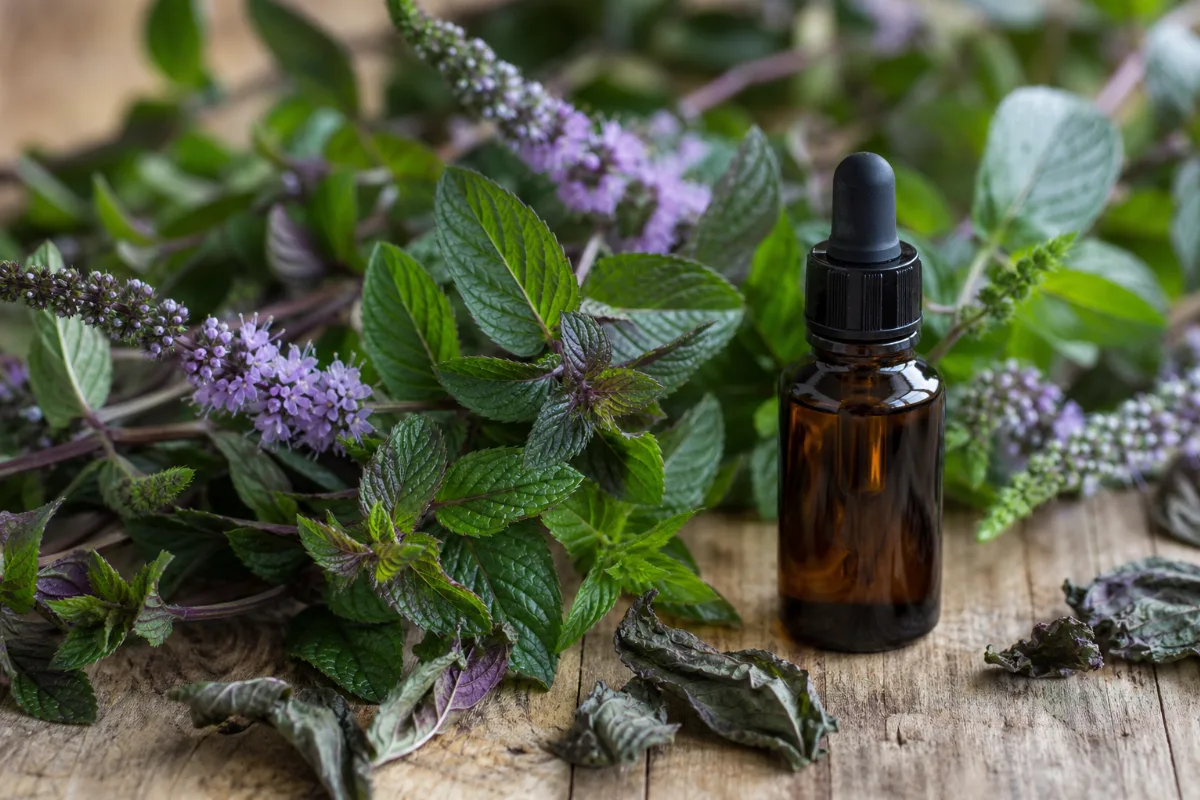
Essential Oils & Aromatherapy · Essential oil
Peppermint Oil
Mentha x piperita L. · also called Peppermint, peppermint essential oil
Peppermint oil is the strong, cooling oil steam-distilled from the peppermint plant. It is used in diffusers, skin products, sweets and in medicine-style capsules for irritable bowel syndrome (IBS). Capsule trials for IBS are mixed, and evidence for headache and nausea is limited. The main caution: menthol can affect breathing in babies and young children, so keep the oil away from their faces, and never swallow bottled oil.
General information, not medical advice. Last substantive update · Not medically reviewed. A named clinician has not signed off on this page. How this page is made
About Peppermint Oil
Peppermint oil is known for its cool, sharp scent. Capsules made for IBS have mixed trial results. For headache and nausea the evidence is limited. Safety comes first: menthol near a baby's face can affect breathing, the oil is not for swallowing from a bottle, it can cause skin allergy, and it should be kept away from pets.
What peppermint oil is
Peppermint oil is the essential oil from the flowering parts and leaves of Mentha x piperita, a natural cross between water mint and spearmint. The EMA says its conclusions cover oil steam-distilled from the fresh above-ground parts. GBIF lists the accepted name as Mentha x piperita L., in the mint family, Lamiaceae.
Menthol is the main compound behind the cooling feel. Menthone, menthyl acetate and pulegone are also named in the sources we read. We found no source giving the typical share of each.
Spearmint oil is a different oil, and pennyroyal oil is a different and far more dangerous one. Peppermint leaf and peppermint tea are separate products.
What people use it for, and how strong the evidence is
IBS is the best-studied use. A 2022 pooled analysis of 10 trials favoured capsules, but the authors called the quality very low. A 2020 Dutch trial and a 2021 US trial in adults did not find a clear benefit on their main targets, and a 2026 trial in children found none. NCCIH says a 2021 gastroenterology guideline recommended peppermint oil for overall IBS symptoms.
For tension headache, one small trial of a medicine-style oil in alcohol solution on the forehead found relief. For nausea, a 2024 review of aromatherapy was positive in cancer care, while a Cochrane review found no clear effect of smelled peppermint after surgery.
For colds, muscle pain and itching, the EMA accepts use on tradition only.
The research in one view
Most trials are small and short, and a scent is hard to hide from a comparison group. The IBS capsule evidence is the largest body of work, but the pooled result and the newer single trials disagree. NCCIH says the research is small and mostly in IBS.
No independent trial of plain bottled peppermint oil was found for any use.
Bottled oil, capsules, forehead solution and tea are different things
The IBS capsules are manufactured, enteric-coated products made to release the oil lower in the gut. They do not show that bottled oil works, and we do not advise swallowing bottled oil. The headache product was a medicine-style solution in alcohol. Peppermint tea is made from leaves and appears safe, NCCIH says, but it is not the oil.
A study of 12 healthy volunteers found peppermint oil raised blood levels of a blood-pressure medicine, felodipine, in a way similar to grapefruit juice. Tell your pharmacist about any peppermint oil product.
What regulators say
In the EU, oral peppermint oil medicines are accepted for minor belly spasms, wind and belly pain, especially in IBS, and forehead products for mild headache in adults. These are well-established uses. Coughs, colds, muscle pain and itching are accepted on traditional use only. Never under 2 years; oral belly products not under 8; headache products not under 18.
NCCIH (updated May 2025) says peppermint oil appears safe in the amounts commonly used, lists heartburn, nausea, abdominal pain, dry mouth and rare allergy as oral side effects, and says it should not go on the face of infants or small children.
At a glance
Traditional uses history, not proof
- Mint used for digestive complaints since ancient Greece, Rome and Egypt (NCCIH).
- Oral peppermint oil medicines accepted in the EU for minor belly spasms, wind and belly pain, and forehead products for mild headache in adults (EMA).
- Inhaled or skin products for coughs, colds, local muscle pain and itching accepted in the EU on long-standing use (EMA).
Studied for research
- IBS in adults, enteric-coated capsules, mixed
- IBS in children, capsules and sweets, against
- Tension headache, oil in alcohol on the forehead, low
- Chemotherapy nausea, inhaled mint oil, low
- Nausea after surgery, smelled, insufficient
- Coughs, colds, muscle pain, itching, traditional use, insufficient
Main compounds
- Menthol, the cooling compound
- Menthone
- Menthyl acetate
- Pulegone
Common forms
- Essential oil (steam-distilled)
- Enteric-coated capsules (manufactured medicine-style product used in IBS trials)
- Oil in alcohol solution for the forehead (medicine product)
- Peppermint leaf and tea (different products)
Research links: NCCIH: Peppermint oil · EMA: Peppermint oil herbal summary · Poison Control: Essential oils · ASPCA: Mint · Pet Poison Helpline: Essential oils · IBS pooled analysis (abstract) · Research Library · Genes & Biomarkers Library
What it is and its history
- Accepted scientific name
- Mentha x piperita
- Naming authority
- L.
- Common names
- Peppermint (English); Peppermint oil (English); Peppermint essential oil (English)
- Family or group
- Lamiaceae (mint family), per GBIF. NCCIH calls peppermint a natural cross between water mint and spearmint.
- Classification
- Plantae > Tracheophyta > Magnoliopsida > Lamiales > Lamiaceae > Mentha > Mentha piperita
- Native range
- NCCIH says peppermint grows throughout Europe, North America and the Mediterranean.
- Habitat
- Not checked.
- What it looks like
- Part used: NCCIH says the oil is taken from the flowering parts and leaves. The EMA conclusions cover oil made by steam distillation of the fresh above-ground parts of the flowering plant.
- Look-alikes and adulterants
- Name: Spearmint oil (Mentha spicata); Note: A different mint oil. One chemotherapy nausea trial tested spearmint and peppermint oils side by side, and results for one do not carry over to the other.; Name: Pennyroyal oil; Note: Poison Control describes swallowed pennyroyal oil as highly poisonous to the liver. It is a different oil and must not be confused with peppermint.
- Sustainability and conservation
- Not checked (no IUCN or CITES source read).
Traditional use and history history, not clinical proof
| Tradition or era | Documented use | Source |
|---|---|---|
| Ancient Greece, Rome and Egypt | NCCIH says the medicinal use of mint plants for digestive disorders dates back to ancient Greece, Rome and Egypt, and that peppermint oil has been used for centuries to treat stomach and gut complaints. | NCCIH |
| Modern European herbal medicine | The EMA committee accepts oral peppermint oil for minor belly spasms, wind and belly pain, and forehead products for mild headache, as well-established use (at least 10 years in the EU), and inhaled or skin uses for colds, muscle pain and itching as traditional use (at least 30 years). | EMA |
| Today | NCCIH says peppermint is promoted for IBS, indigestion, headaches, muscle tension, nausea and other conditions. | NCCIH |
Traditional use shows how it was used. It does not show that it works or is safe today.
What is inside, and how it may work
What it contains and how those compounds act in cells and animals. Laboratory and animal mechanisms are not proven effects in people.
Main compounds
| Compound | Family | Where it is concentrated | Activity studied | Level of evidence |
|---|---|---|---|---|
| Menthol PubChem 1254 | monoterpene alcohol | Steam-distilled oil from the flowering plant No typical share was read in the sources. | The compound behind the cooling feel. Reversibly blocked the CYP3A4 enzyme in liver-cell tests. Infant breathing reflex and newborn jaundice findings were studied with menthol. 23 4 9 12 10 | Laboratory and human |
| Menthone PubChem 26447 | monoterpene ketone | Steam-distilled oil No typical share was read. | Named by the 2025 liver report as one of the main constituents with potential to affect liver enzymes. No separate activity was read. 23 2 | Case report discussion |
| Menthyl acetate PubChem 27867 | terpene ester | Steam-distilled oil No typical share was read. | Reversibly blocked CYP3A4 in liver-cell tests. 23 4 | Laboratory |
| Pulegone PubChem 442495 | monoterpene ketone | Steam-distilled oil No typical share was read. | Named by the 2025 liver report among the main constituents with potential liver effects. No amount was given in the sources read. 23 2 | Case report discussion |
Mechanisms, receptors and pathways
| Target or pathway | Gene or receptor | What was found | Level |
|---|---|---|---|
| Gut smooth muscle relaxation | Calcium channels / enteric nerves | The EMA says peppermint oil may relieve cramps by interfering with calcium ions that drive contraction of smooth muscle in the gut. Chumpitazi and colleagues say this may involve calcium channel blockade or direct effects on the gut nerves. 17 3 | Hypothesis, mostly lab |
| Cold sensation and pain signalling | Cold-sensitive nerves; TRP channels | The EMA says oil on the skin triggers a prolonged cold sensation by stimulating cold-sensitive nerves, which may give pain relief for headache. Chumpitazi and colleagues say TRP channels may change gut pain sensitivity. 17 3 | Hypothesis, mostly lab |
| Drug-metabolising enzyme | CYP3A4 | Peppermint oil, menthol and menthyl acetate reversibly blocked CYP3A4 in human liver preparations, and in 12 volunteers peppermint oil raised felodipine exposure. 4 | In vitro and human pharmacokinetic |
| Infant airway reflex | Nasal and airway nerves | Inhaling menthol fumes briefly stopped or slowed breathing in premature infants. 9 | Human physiology |
Absorption, metabolism and elimination
- Absorption
- Not described in the abstracts read, apart from menthol odour appearing in urine and stool (EMA).
- Distribution
- Not established.
- Metabolism
- Peppermint oil blocks CYP3A4 in the liver (see mechanisms). Newborns may not be able to process menthol (Olowe).
- Elimination
- The EMA lists menthol odour in urine and stool as a side effect, suggesting it leaves by those routes. Not otherwise established.
- Bioavailability
- Not established.
Isolated compounds versus whole extracts
Bottled essential oil, enteric-coated IBS capsules, forehead solutions in alcohol, peppermint leaf and tea, and isolated menthol are different products. Trial results belong to the exact product tested, and the IBS capsule trials do not show bottled oil works or is safe. One author argues menthol should not be judged together with camphor or eucalyptus oil, but the EMA and NCCIH still warn about menthol near babies' faces.
Nutritional composition
Peppermint oil is not a nutrient. NCCIH describes it as a herbal product, and some peppermint oil products are sold as dietary supplements.
1 mixed findings2 low certainty5 not enough evidence1 evidence against
What was looked at
The 9 benefits and uses checked for Peppermint Oil, each with how strong the evidence is. Tap one to open it.
- Irritable bowel syndrome in adults (enteric-coated capsules)Mixed findings
- Irritable bowel syndrome and belly pain in childrenEvidence against
- Gut spasm during procedures such as endoscopyNot enough evidence
- Indigestion with peppermint oil on its ownNot enough evidence
- Tension-type headache (peppermint oil in alcohol on the forehead)Low certainty
- Nausea and vomiting with chemotherapy (inhaled mint oil)Low certainty
- Nausea after surgery (smelled peppermint)Not enough evidence
- Coughs and colds, local muscle pain and itching (traditional use)Not enough evidence
- Other limited uses named by NCCIHNot enough evidence
Lab markers tracked in the studies
IBS global symptom improvementAbdominal pain responseIBS Severity Scoring System (IBS-SSS)Adverse events in IBS trialsHeadache intensity (diary score)Nausea intensity
What is Peppermint Oil good for?
The uses people ask about and how strong the evidence is for each. Read the certainty label first. The best-studied use is capsules for IBS, which are not the same as bottled oil.
Benefits, one by one
Each card is a research question, not a promise. Tap a goal to filter. Open a card to see the studies, doses and limits.
Irritable bowel syndrome in adults (enteric-coated capsules)
Mixed findingsPooled trials favour peppermint oil capsules over placebo for IBS symptoms and belly pain, but the evidence is rated very low quality and the two newest large adult trials did not meet their main targets. Side effects were more frequent than with placebo. These were manufactured medicine-type capsules, not bottled oil.
6 studiesNot covered. This page gives no amounts and no way to use the oil.
Studies, doses and limits
What the trials found
A 2022 pooled analysis of 10 randomised trials (1,030 adults) found peppermint oil better than placebo for global IBS symptoms and abdominal pain, with more adverse events; the authors rated quality very low. A 2020 Dutch trial (189 adults, 8 weeks) found neither of two capsule types beat placebo on the main pain-response and overall-relief targets, though one improved secondary pain scores. A 2021 US trial (6 weeks) found no difference from placebo. NCCIH says the 2021 American College of Gastroenterology guideline recommended peppermint oil for overall IBS symptoms; we read that only through NCCIH.
Results
Pooled analysis: global symptoms not improved relative risk 0.65 (95% CI 0.43-0.98, NNT 4); abdominal pain not improved relative risk 0.76 (95% CI 0.62-0.93, NNT 7); any adverse event relative risk 1.57 (95% CI 1.04-2.37). Dutch trial: pain response 46.8% and 41.3% against 34.4% with placebo, not significant. US trial: IBS-SSS fell 90.8 points with peppermint oil and 100.3 with placebo (P = 0.97).
Effect sizes as reported
Pooled analysis: a number needed to treat of 4, meaning roughly one extra person in four improved, with very wide uncertainty (2.5 to 71).
Why this rating
A pooled analysis favours the oil, but its authors rated the quality very low and the two most recent adult trials were negative on their main endpoints. Placebo response in IBS is large.
Form and dose studied
Not covered. This page gives no amounts and no way to use the oil.
Who was studied
Adults with IBS.
Limits
Capsule products differ and the amounts differ between trials. Results do not apply to bottled oil. Short trials (6 to 8 weeks).
Why researchers looked
IBS causes cramping belly pain and bowel changes, and peppermint oil may relax gut muscle.
Traditional use
NCCIH says peppermint oil has been used for centuries for stomach and gut complaints. The EU accepts oral peppermint oil medicines for minor belly spasms, wind and belly pain, especially in IBS (EMA).
Proposed mechanism Preliminary mechanism
The EMA says the oil may relax gut muscle by interfering with calcium ions. Chumpitazi and colleagues also describe effects on gut pain sensitivity through TRP channels.
A proposed mechanism does not show that the effect happens in people.
Heartburn and reflux are the commonest side effects. Capsules are made enteric-coated for this reason (NCCIH). Not for swallowing from a bottle. See the Safety tab, including a liver injury case report.
Irritable bowel syndrome and belly pain in children
Evidence againstA large 2026 trial in 228 children and teenagers found neither peppermint oil capsules nor peppermint sweets better than placebo for IBS or functional belly pain.
2 studiesNot covered. This page gives no amounts and no way to use the oil.
Studies, doses and limits
What the trials found
A randomised trial in 13 Dutch hospitals gave children aged 8 to 18 peppermint oil capsules (double-blind), peppermint sweets (open-label) or placebo for 8 weeks.
Results
Treatment success (30% fall in belly pain) was 44.0% with capsules, 38.7% with sweets and 37.3% with placebo; none of the differences were significant (capsules versus placebo odds ratio 1.33, 97.5% CI 0.58-3.09). Adverse events were mild and infrequent.
Effect sizes as reported
No difference from placebo.
Why this rating
One large randomised trial found no benefit. A single trial is not the last word, but no better trial supports use.
Form and dose studied
Not covered. This page gives no amounts and no way to use the oil.
Who was studied
Children aged 8 to 18 in the Netherlands.
Limits
One trial; the sweets arm was not blinded.
Why researchers looked
Few medicines work for children with long-lasting belly pain, so peppermint oil has been tried.
Traditional use
The EMA says oral peppermint oil medicines for belly problems should not be used in children under 8.
Proposed mechanism Preliminary mechanism
Not tested in this trial.
A proposed mechanism does not show that the effect happens in people.
Peppermint oil capsules are not for small children (EMA under 8). Ask a paediatrician.
Gut spasm during procedures such as endoscopy
Not enough evidenceNCCIH says a small amount of research suggests peppermint oil might reduce spasms during some procedures. We did not read those trials.
2 studiesNot covered. This page gives no amounts and no way to use the oil.
Studies, doses and limits
What the trials found
NCCIH mentions a small amount of research. A review (Chumpitazi 2018) says peppermint oil has been used to help complete colonoscopy and a bile-duct scan (ERCP). We read only these summaries.
Results
No trial results were read.
Why this rating
Summary-level statements only; no trial read.
Form and dose studied
Not covered. This page gives no amounts and no way to use the oil.
Who was studied
People having medical procedures.
Limits
This is a clinical use given by doctors, not a home use.
Why researchers looked
Gut muscle spasm can make a scope examination harder.
Proposed mechanism Preliminary mechanism
Relaxation of gut smooth muscle (EMA, Chumpitazi).
A proposed mechanism does not show that the effect happens in people.
Not a home use; only for clinicians.
Indigestion with peppermint oil on its own
Not enough evidenceNCCIH says there is no evidence that peppermint oil alone helps indigestion, and that it may make it worse in some people. A few specific combination products had some support, but they are different products.
1 studiesNot covered. This page gives no amounts and no way to use the oil.
Studies, doses and limits
What the trials found
NCCIH reports a few studies of specific peppermint plus caraway oil products and specific products that include peppermint leaves, and no evidence for the oil alone.
Results
No oil-alone result was found by NCCIH.
Why this rating
No evidence for peppermint oil alone, and a possible worsening.
Form and dose studied
Not covered. This page gives no amounts and no way to use the oil.
Who was studied
Adults with indigestion.
Limits
Combination products cannot be used to judge the oil alone.
Why researchers looked
Indigestion is a common reason people try mint products.
Traditional use
Mint is used traditionally for digestion (NCCIH).
Proposed mechanism Preliminary mechanism
Not assessed.
A proposed mechanism does not show that the effect happens in people.
Heartburn is a listed side effect of oral peppermint oil.
Tension-type headache (peppermint oil in alcohol on the forehead)
Low certaintyOne randomised crossover trial in 41 adults found a peppermint oil in alcohol solution rubbed on the forehead and temples eased tension-type headache and worked about as well as acetaminophen. The EU accepts it for mild headache in adults. It is a medicine-type solution, not a diffuser or a bottle mix.
4 studiesNot covered. This page gives no amounts and no way to use the oil.
Studies, doses and limits
What the trials found
A randomised, placebo-controlled double-blind crossover trial treated 164 headache attacks in 41 adults (1996, in German). In healthy volunteers, a separate 1994 study found peppermint oil with ethanol reduced sensitivity in an experimental headache-pain test. NCCIH says limited evidence suggests skin use might relieve tension headache.
Results
Headache intensity fell more with the peppermint oil solution than with placebo from 15 minutes (p < 0.01) and stayed lower over one hour; it did not differ significantly from acetaminophen. No adverse events were reported.
Effect sizes as reported
p < 0.01 versus placebo.
Why this rating
One small trial of a drug company product, old, and not repeated in our sources. NCCIH calls the evidence limited.
Form and dose studied
Not covered. This page gives no amounts and no way to use the oil.
Who was studied
Adults aged 18 to 65 with tension-type headache; healthy adults for the lab study.
Limits
Single trial; the abstract names the maker (Lichtwer Pharma) and gives no funding. Not shown for scent or for other headache types.
Why researchers looked
Tension-type headache is the commonest headache and many people want a skin remedy.
Traditional use
The EMA accepts forehead and temple products for mild headache in adults (well-established use), not under 18.
Proposed mechanism Preliminary mechanism
The EMA says the oil on skin triggers a prolonged cold sensation through cold-sensitive nerves, which may give pain relief.
A proposed mechanism does not show that the effect happens in people.
Skin irritation, eye irritation and menthol effects on the face are real. Never use on the face of a baby or young child. Keep away from the eyes. The EMA says not under 18 for this use.
Nausea and vomiting with chemotherapy (inhaled mint oil)
Low certaintyA 2024 review found aromatherapy lowered nausea and vomiting in people with cancer, and called peppermint oil particularly successful. The one peppermint trial we read pooled spearmint and peppermint, did not state how the oil was used, and compared with a control group.
3 studiesNot covered. This page gives no amounts and no way to use the oil.
Studies, doses and limits
What the trials found
A 2024 meta-analysis of 25 randomised trials in people with cancer found aromatherapy helped; NCCIH says 4 peppermint studies (290 people) found inhaled peppermint oil particularly successful for chemotherapy nausea and vomiting. A randomised double-blind trial in Iran compared spearmint or peppermint oil with a control group over the first 24 hours.
Results
Meta-analysis: overall nausea and vomiting standardised mean difference -0.81 (95% CI -1.11 to -0.52); vomiting alone not significant. Iran trial: both mint oils reduced intensity and number of vomiting events in the first 24 hours (p < 0.05), with no adverse effects reported.
Effect sizes as reported
Large score differences in the pooled analysis, but many oils were pooled.
Why this rating
Many trials are small, a scent is hard to blind, the review pooled several oils, and the peppermint trial summary leaves out the route.
Form and dose studied
Not covered. This page gives no amounts and no way to use the oil.
Who was studied
Adults and children having chemotherapy.
Limits
Blinding is hard. Use during cancer treatment should be agreed with the cancer team.
Why researchers looked
Nausea is a common side effect of chemotherapy.
Proposed mechanism Preliminary mechanism
Not established.
A proposed mechanism does not show that the effect happens in people.
Tell your cancer team about any oil you use. Scent can bother some people with breathing problems or strong nausea.
Nausea after surgery (smelled peppermint)
Not enough evidenceA Cochrane review pooled 4 trials of smelled peppermint and found no evidence it reduced nausea severity after surgery, though the evidence was low certainty.
1 studiesNot covered. This page gives no amounts and no way to use the oil.
Studies, doses and limits
What the trials found
The 2018 Cochrane review included 16 studies (1,036 people) of aromatherapy. For peppermint against placebo, 4 trials (115 people) showed no effect on nausea severity at five minutes.
Results
Peppermint versus placebo: standardised mean difference -0.18 (95% CI -0.86 to 0.49). Aromatherapy overall: people needed fewer rescue anti-sickness drugs (low certainty).
Effect sizes as reported
No clear effect.
Why this rating
The best review found no effect, but only small, low-certainty trials exist.
Form and dose studied
Not covered. This page gives no amounts and no way to use the oil.
Who was studied
Adults and children after surgery.
Limits
Short follow-up; small trials.
Why researchers looked
Nausea after surgery is common and a scent is a low-risk idea.
Proposed mechanism Preliminary mechanism
Not established.
A proposed mechanism does not show that the effect happens in people.
Follow the surgical team's advice.
Coughs and colds, local muscle pain and itching (traditional use)
Not enough evidenceThe EMA accepts peppermint oil products for coughs and colds, local muscle pain and itching on undamaged skin only on the basis of long-standing use. It said trial evidence was insufficient and firm conclusions could not be drawn.
1 studiesNot covered. This page gives no amounts and no way to use the oil.
Studies, doses and limits
What the trials found
The EMA looked at clinical studies of colds and coughs and saw a possible effect on easing breathing but could not draw firm conclusions.
Results
No trial results were read.
Why this rating
Traditional-use acceptance, not proof of benefit.
Form and dose studied
Not covered. This page gives no amounts and no way to use the oil.
Who was studied
Adults and older children, as stated by the EMA.
Limits
Not tested here.
Why researchers looked
Cooling mint scent is a long-standing home remedy.
Traditional use
The EMA accepts these uses on the basis of at least 30 years of use, including at least 15 years in the EU. Cold and cough products are not for children under 12; none for under 2.
Proposed mechanism Preliminary mechanism
The EMA says the cooling sensation comes from cold-sensitive nerves in the skin.
A proposed mechanism does not show that the effect happens in people.
Menthol on the face of babies and young children can cause breathing problems. Not for children under 2; EMA says not for cold and cough use at 2 to 11.
Other limited uses named by NCCIH
Not enough evidenceNCCIH mentions limited evidence for a peppermint oil gel to reduce bed sores and for sore, cracked nipples in breastfeeding. We did not read those studies.
1 studiesNot covered. This page gives no amounts and no way to use the oil.
Studies, doses and limits
What the trials found
NCCIH says a limited amount of evidence suggests a peppermint oil gel might reduce pressure ulcers and that peppermint oil in a gel, water or cream on the nipple area might help pain and cracked skin. It says the oil should be used only after breastfeeding and wiped off before the next feed.
Results
No results read.
Why this rating
Summary-level statements only.
Form and dose studied
Not covered. This page gives no amounts and no way to use the oil.
Who was studied
Bed-bound adults; breastfeeding women.
Limits
Not a general home remedy.
Why researchers looked
People look for natural skin and wound remedies.
Proposed mechanism Preliminary mechanism
Not established.
A proposed mechanism does not show that the effect happens in people.
A baby breathing menthol is the concern; see the Safety tab.
Connections to the rest of health
How Peppermint Oil connects to the rest of our health knowledge graph. Every link says what kind of connection it is. A safety link (for example to the liver) is a warning, not a benefit. A study that merely mentions a topic never creates a benefit link.
Explore every connection: goals, body systems, organs, symptoms, genes
A. Wellness goals
| Connected to | Kind of connection | Evidence status | Context | Studies |
|---|---|---|---|---|
| Digestive Support | Mixed findings | Irritable bowel syndrome in adults (enteric-coated capsules): Pooled trials favour peppermint oil capsules over placebo for IBS symptoms and belly pain, but the evidence is rated very low quality and the two newest large adult trials did not meet their main targets. Side effects were more frequent than with placebo. These were manufactured medicine-type capsules, not bottled oil. | 8 16 11 3 19 17 | |
| Gut Health | Mixed findings | Irritable bowel syndrome in adults (enteric-coated capsules): Pooled trials favour peppermint oil capsules over placebo for IBS symptoms and belly pain, but the evidence is rated very low quality and the two newest large adult trials did not meet their main targets. Side effects were more frequent than with placebo. These were manufactured medicine-type capsules, not bottled oil. | 8 16 11 3 19 17 | |
| Digestive Support | Evidence against | Irritable bowel syndrome and belly pain in children: A large 2026 trial in 228 children and teenagers found neither peppermint oil capsules nor peppermint sweets better than placebo for IBS or functional belly pain. | 14 17 | |
| Digestive Support | Preliminary mechanism | Not enough evidence | Gut spasm during procedures such as endoscopy: NCCIH says a small amount of research suggests peppermint oil might reduce spasms during some procedures. We did not read those trials. | 19 3 |
| Digestive Support | Not enough evidence | Indigestion with peppermint oil on its own: NCCIH says there is no evidence that peppermint oil alone helps indigestion, and that it may make it worse in some people. A few specific combination products had some support, but they are different products. | 19 | |
| Pain Relief | Low certainty | Tension-type headache (peppermint oil in alcohol on the forehead): One randomised crossover trial in 41 adults found a peppermint oil in alcohol solution rubbed on the forehead and temples eased tension-type headache and worked about as well as acetaminophen. The EU accepts it for mild headache in adults. It is a medicine-type solution, not a diffuser or a bottle mix. | 6 5 17 19 | |
| Nausea Relief | Potential benefit | Low certainty | Nausea and vomiting with chemotherapy (inhaled mint oil): A 2024 review found aromatherapy lowered nausea and vomiting in people with cancer, and called peppermint oil particularly successful. The one peppermint trial we read pooled spearmint and peppermint, did not state how the oil was used, and compared with a control group. | 1 13 19 |
| Nausea Relief | Not enough evidence | Nausea after surgery (smelled peppermint): A Cochrane review pooled 4 trials of smelled peppermint and found no evidence it reduced nausea severity after surgery, though the evidence was low certainty. | 7 | |
| Breathing Support | Traditional use | Not enough evidence | Coughs and colds, local muscle pain and itching (traditional use): The EMA accepts peppermint oil products for coughs and colds, local muscle pain and itching on undamaged skin only on the basis of long-standing use. It said trial evidence was insufficient and firm conclusions could not be drawn. | 17 |
| Pain Relief | Traditional use | Not enough evidence | Coughs and colds, local muscle pain and itching (traditional use): The EMA accepts peppermint oil products for coughs and colds, local muscle pain and itching on undamaged skin only on the basis of long-standing use. It said trial evidence was insufficient and firm conclusions could not be drawn. | 17 |
| Healthy Skin | Not enough evidence | Other limited uses named by NCCIH: NCCIH mentions limited evidence for a peppermint oil gel to reduce bed sores and for sore, cracked nipples in breastfeeding. We did not read those studies. | 19 |
B. Body systems
| Connected to | Kind of connection | Evidence status | Context | Studies |
|---|---|---|---|---|
| Digestive System | Biological association | Mixed findings | Studied for: Irritable bowel syndrome in adults (enteric-coated capsules) Studied for: Irritable bowel syndrome and belly pain in children | 8 16 11 3 19 17 14 1 13 7 |
| Nervous System | Biological association | Low certainty | Studied for: Tension-type headache (peppermint oil in alcohol on the forehead) | 6 5 17 19 |
| Pain Inflammation | Biological association | Low certainty | Studied for: Tension-type headache (peppermint oil in alcohol on the forehead) | 6 5 17 19 |
| Respiratory System | Biological association | Not enough evidence | Studied for: Coughs and colds, local muscle pain and itching (traditional use) | 17 |
| Integumentary System | Biological association | Not enough evidence | Studied for: Coughs and colds, local muscle pain and itching (traditional use) Studied for: Other limited uses named by NCCIH | 17 19 |
E. Health conditions
| Connected to | Kind of connection | Evidence status | Context | Studies |
|---|---|---|---|---|
| Irritable bowel syndrome | Mixed findings | Pooled analysis positive, very low quality; two recent adult trials and one children's trial negative. Preparation or compound: Enteric-coated peppermint oil capsules (not bottled oil) |
8 16 11 14 | |
| Tension headache | Low certainty | One small randomised crossover trial. Preparation or compound: Peppermint oil in alcohol solution on the forehead |
6 17 | |
| Contact dermatitis | Adverse effect or risk | Documented risk | 0.9% positive patch tests in North American clinic patients; EMA and NCCIH list rash and irritation. Preparation or compound: Peppermint oil on skin |
15 19 17 |
| Drug-induced liver injury | Very low certainty | One case report. Preparation or compound: Peppermint oil capsules above label amount |
2 | |
| Breathing pauses in infants | Adverse effect or risk | Documented risk | Premature infants stopped breathing briefly after menthol fumes; NCCIH and EMA warn. Preparation or compound: Menthol fumes |
9 19 17 |
I. Biomarkers
| Connected to | Kind of connection | Evidence status | Context | Studies |
|---|---|---|---|---|
| IBS global symptom improvement | Biological association | Mixed findings | Measured in trials: improve. A lab change is not the same as a health benefit. | 8 16 |
| Abdominal pain response | Biological association | Mixed findings | Measured in trials: decrease. A lab change is not the same as a health benefit. | 8 16 |
| IBS Severity Scoring System (IBS-SSS) | Biological association | Low certainty | Measured in trials: decrease. A lab change is not the same as a health benefit. | 11 |
| Adverse events in IBS trials | Biological association | Low certainty | Measured in trials: increase. A lab change is not the same as a health benefit. | 8 16 19 |
| Headache intensity (diary score) | Biological association | Low certainty | Measured in trials: decrease. A lab change is not the same as a health benefit. | 6 |
| Nausea intensity | Biological association | Low certainty | Measured in trials: decrease. A lab change is not the same as a health benefit. | 1 7 |
J. Genes, receptors and enzymes
| Connected to | Kind of connection | Evidence status | Context | Studies |
|---|---|---|---|---|
| CYP3A4 | Preliminary mechanism | In vitro and human pharmacokinetic | Reversibly inhibited by peppermint oil, menthol and menthyl acetate in liver-cell tests. | 4 |
| TRP channels / cold-sensitive nerves | Preliminary mechanism | Hypothesis | Proposed route for cooling and pain effects. | 17 3 |
L. Active compounds
| Connected to | Kind of connection | Evidence status | Context | Studies |
|---|---|---|---|---|
| Menthol | Biological association | Laboratory and human | The compound behind the cooling feel. Reversibly blocked the CYP3A4 enzyme in liver-cell tests. Infant breathing reflex and newborn jaundice findings were studied with menthol. Preparation or compound: Steam-distilled oil from the flowering plant |
23 4 9 12 10 |
| Menthone | Biological association | Case report discussion | Named by the 2025 liver report as one of the main constituents with potential to affect liver enzymes. No separate activity was read. Preparation or compound: Steam-distilled oil |
23 2 |
| Menthyl acetate | Biological association | Laboratory | Reversibly blocked CYP3A4 in liver-cell tests. Preparation or compound: Steam-distilled oil |
23 4 |
| Pulegone | Biological association | Case report discussion | Named by the 2025 liver report among the main constituents with potential liver effects. No amount was given in the sources read. Preparation or compound: Steam-distilled oil |
23 2 |
Each connection is stored with the ingredient, the connected record, the kind of connection, the evidence status, the supporting studies, the preparation or compound involved, and a review date (last reviewed October 25, 2026).
Evidence at a glance: what the research found for 9 outcomes
Each outcome below is one thing researchers measured. Certainty is how far the evidence can be trusted, not how well it works. The full studies are on the next tab.
The evidence
The research centre for Peppermint Oil. Every record here was checked against PubMed or the publisher's page; we never list a study we have not verified.
Evidence by outcome
Bars show how many studies we found for each outcome, not how well it works. People are added up across trials only (reviews are not added, to avoid double counting).
How we rate evidence
High certainty
Several well-run trials or reviews agree; further research is unlikely to change the picture much.
Moderate certainty
Good trials point the same way, but some doubt remains.
Low certainty
Small, short or inconsistent trials. The finding could change with better research.
Very low certainty
Very little or very weak human data. Treat as a possibility only.
Mixed findings
Trials or reviews disagree with each other.
Not enough evidence
Not enough human research to say either way.
Evidence against
Good research found no benefit, or found harm.
We take the reviewers' own risk-of-bias and GRADE statements where they exist, and otherwise judge from study size, design, consistency, directness and whether a product matches what is sold. Many publications do not make evidence high. Method note: We read the abstracts of 16 PubMed papers (one in full text) and the NCCIH, EMA, Poison Control, ASPCA and Pet Poison Helpline pages, and checked the plant name in GBIF and the compounds in PubChem. We could not read LiverTox or LactMed and did not find an FDA statement.
Study library: every study we checked 23
| Study | Design | People | Product, dose, length | Result |
|---|---|---|---|---|
| Ahn 2024 Effects of aromatherapy on nausea and vomiting in patients with cancer: A systematic review and meta-analysis of randomized controlled trials Complement Ther Clin Pract · PMID 38330531 · DOI |
Systematic review and meta analysis of randomised trials |
Adults with cancer in 25 randomised trials (10 articles) | Aromatherapy (several oils; peppermint singled out) essential oils (inhaled or massage) Not reported here · vs control/placebo |
Aromatherapy overall reduced nausea and vomiting, nausea, and combined nausea and vomiting, but not vomiting alone. Inhalation and massage helped, especially for chemotherapy nausea, and peppermint oil was described as particularly successful. The authors say conclusive evidence is lacking because few trials exist. Overall SMD -0.81; nausea SMD -0.85; vomiting alone SMD -0.24 (not significant). (Overall SMD -0.81, 95% CI -1.11 to -0.52; vomiting alone 95% CI -1.03 to 0.55) Methods, limits and fundingOutcomes: Nausea and vomiting scores Limitations: Many oils pooled; the abstract gives no separate peppermint number; blinding is hard with a scent. Funding and conflicts: Not stated in the abstract. Read: abstract |
| Ali 2025 Peppermint oil-associated hepatotoxicity J Hepatol · PMID 40216027 · DOI |
Case report (letter), full text read |
1 One 18-year-old man with diarrhoea-predominant IBS |
Two over-the-counter peppermint oil soft-gel products, taken in more than the label allowed peppermint oil capsules Not reported here |
He developed raised liver enzymes (AST up to 408 U/L, ALT up to 172 U/L) while using peppermint oil capsules above the label amount. Other causes were excluded by tests. After he stopped all peppermint products, the enzymes improved over about 6 weeks and stayed normal for 6 months. The authors say it fit drug-induced liver injury and call for more research. Methods, limits and fundingOutcomes: Liver enzymes after stopping the products Limitations: A single case; cause is likely but a liver biopsy was not done. Funding and conflicts: No competing interests declared. Read: full-text |
| Chumpitazi 2018 Review article: the physiological effects and safety of peppermint oil and its efficacy in irritable bowel syndrome and other functional disorders Aliment Pharmacol Ther · PMID 29372567 · DOI |
Narrative review (PubMed search to July 2017) |
Human and lab literature on peppermint oil | Peppermint oil (various) peppermint oil (steam-distilled from Mentha x piperita) Not reported here |
Peppermint oil may relax smooth muscle (calcium channel blockade or direct effects on the gut nerves), may change gut pain sensitivity through TRP channels, and has anti-microbial and anti-inflammatory activity. The authors say placebo-controlled studies support its use in IBS, functional dyspepsia, children's functional abdominal pain and post-operative nausea, that few adverse effects were reported in trials, and that it appears to have a good safety profile. Methods, limits and fundingOutcomes: Mechanisms, gut physiology, clinical use, safety Limitations: A narrative review, not a pooled analysis. Its safety view is more positive than the 2022 pooled analysis, which found more adverse events than placebo. Later trials (2020 to 2026) were negative for children and mixed for adults. Funding and conflicts: Supported by NIH grants; no company funding stated in the abstract. Read: abstract |
| Dresser 2002 Evaluation of peppermint oil and ascorbyl palmitate as inhibitors of cytochrome P4503A4 activity in vitro and in vivo Clin Pharmacol Ther · PMID 12235445 · DOI |
Lab study plus 4 way crossover pharmacokinetic study |
12 12 healthy volunteers |
Peppermint oil taken with a 10 mg extended-release felodipine tablet (amount not repeated here) peppermint oil (oral) Not reported here single dose · vs water; grapefruit juice; ascorbyl palmitate |
In liver-cell preparations peppermint oil, menthol and menthyl acetate each blocked CYP3A4, an enzyme that clears many medicines. In the volunteers, felodipine exposure (AUC) was 140% of the water value with peppermint oil and 173% with grapefruit juice. The authors say peppermint oil may have acted through the same mechanism but this needs further study. Felodipine AUC 140% of water value with peppermint oil (range 77%-262%, P < .05). Methods, limits and fundingOutcomes: Felodipine blood levels; CYP3A4 inhibition in human liver microsomes Limitations: Single dose, 12 people, one drug; a wide range between people. Funding and conflicts: Not stated in the abstract. Read: abstract |
| Goebel 1994 Effect of peppermint and eucalyptus oil preparations on neurophysiological and experimental algesimetric headache parameters Cephalalgia · PMID 7954745 · DOI |
Randomised double blind placebo controlled crossover study |
32 Healthy volunteers |
Peppermint oil with ethanol; peppermint plus eucalyptus oil with ethanol (skin of forehead and temples) oil preparations (skin) Not reported here single applications · vs placebo |
In healthy people, peppermint oil with ethanol reduced sensitivity in an experimental headache-pain test. The peppermint plus eucalyptus plus ethanol mix raised cognitive performance and had muscle-relaxing and mentally relaxing effects, but little effect on pain sensitivity. Methods, limits and fundingOutcomes: Neurophysiological, psychological and experimental pain-sensitivity measures Limitations: Healthy volunteers and a lab pain test, not people with headache. Funding and conflicts: Not stated in the abstract. Read: abstract |
| Goebel 1996 Effectiveness of Oleum menthae piperitae and paracetamol in therapy of headache of the tension type (in German) Nervenarzt · PMID 8805113 · DOI |
Randomised placebo controlled double blind crossover trial |
41 Adults aged 18 to 65 with tension-type headache (164 attacks) |
Peppermint oil in 90% ethanol, rubbed on the forehead and temples peppermint oil solution (skin) Not reported here 4 attacks per patient, 1-hour follow-up · vs alcohol placebo solution; acetaminophen; placebo tablet |
The peppermint oil solution reduced headache intensity compared with placebo from 15 minutes on (p < 0.01), and the effect lasted the hour. Acetaminophen also beat placebo, and the two did not differ significantly. No adverse events were reported. p < 0.01 versus placebo; no significant difference from acetaminophen. Methods, limits and fundingOutcomes: Headache intensity in a diary at 15, 30, 45 and 60 minutes Limitations: Small; one trial; the abstract does not give funding. The abstract names the test product's maker, Lichtwer Pharma, so an industry link is possible. Funding and conflicts: Test preparation was from Lichtwer Pharma (named in the abstract); funding not stated. Read: abstract |
| Hines 2018 Aromatherapy for treatment of postoperative nausea and vomiting Cochrane Database Syst Rev · PMID 29523018 · DOI |
Cochrane systematic review (GRADE) |
1036 Adults and children after surgery, 16 included studies |
Aromatherapy (peppermint, isopropyl alcohol, blends) inhaled scents Not reported here · vs placebo or standard antiemetics |
Aromatherapy overall did not clearly reduce nausea severity compared with placebo (low-certainty evidence), though people needed fewer rescue anti-sickness drugs (low). For peppermint specifically, 4 trials (115 participants) showed no evidence of an effect on nausea severity at five minutes (low certainty). Peppermint versus placebo: standardised mean difference -0.18 (not significant). (Peppermint SMD -0.18, 95% CI -0.86 to 0.49) Methods, limits and fundingOutcomes: Nausea severity, nausea-free, rescue antiemetics Limitations: Small trials, mixed methods; low-certainty evidence. Funding and conflicts: The review reports a nursing research grant for the original 2012 review; the granting body had no influence. Read: abstract |
| Ingrosso 2022 Systematic review and meta-analysis: efficacy of peppermint oil in irritable bowel syndrome Aliment Pharmacol Ther · PMID 35942669 · DOI |
Systematic review and meta analysis of randomised controlled trials |
1030 Adults with irritable bowel syndrome in 10 randomised trials |
Peppermint oil (oral, as studied in the trials; the NCCIH summary says enteric-coated capsules) peppermint oil (steam-distilled from Mentha x piperita) Not reported here varied · vs placebo |
Peppermint oil beat placebo for global IBS symptoms and for abdominal pain. Adverse events were more frequent with peppermint oil. The authors rated the quality of the evidence very low. Not improving global symptoms: relative risk 0.65 (NNT 4). Abdominal pain not improving: relative risk 0.76 (NNT 7). Any adverse event: relative risk 1.57. (Global symptoms RR 0.65, 95% CI 0.43-0.98; abdominal pain RR 0.76, 95% CI 0.62-0.93; any adverse event RR 1.57, 95% CI 1.04-2.37) Methods, limits and fundingOutcomes: Global IBS symptoms, abdominal pain, any adverse event, reflux Limitations: Very low quality evidence; the abstract does not say which products were pooled; recent trials cast doubt on the benefit. Funding and conflicts: Not stated in the abstract. Read: abstract |
| Javorka 1980 Protective and defensive airway reflexes in premature infants Physiol Bohemoslov · PMID 6444736 |
Physiology study |
44 Premature newborn infants |
Inhaled menthol fumes; nasal drops of a menthol-containing product menthol (a main constituent) Not reported here |
Inhaling menthol fumes, or nasal drops of a menthol product, caused a brief stop in breathing or a drop in breathing rate in the premature infants. Methods, limits and fundingOutcomes: Breathing responses to nasal stimulation Limitations: Old, small study in premature infants; the abstract does not say how many reacted; it tested menthol, not peppermint oil itself. Funding and conflicts: Not stated in the abstract. Read: abstract |
| Kolassa 2013 Menthol differs from other terpenic essential oil constituents Regul Toxicol Pharmacol · PMID 23207345 · DOI |
Expert commentary / review |
Toxicology literature | Menthol compared with camphor, eucalyptol and thujone menthol (a main constituent) Not reported here |
The author notes that the EMA found a risk of convulsions in infants and small children from cough-and-cold suppositories containing terpene compounds. He argues menthol differs: convulsions have occurred with camphor, thujone and eucalyptus oil overdose, but he says none have been reported in menthol overdose cases, and that lumping all terpenes together is inappropriate. Methods, limits and fundingOutcomes: Convulsion risk of terpene compounds Limitations: One author's view; it does not cover breathing reflexes in infants, which are covered by NCCIH and the EMA. Funding and conflicts: Not stated in the abstract. Read: abstract |
| Nee 2021 Peppermint Oil Treatment for Irritable Bowel Syndrome: A Randomized Placebo-Controlled Trial Am J Gastroenterol · PMID 34319275 · DOI |
Randomised double blind placebo controlled trial, one US centre |
Adults with IBS (Rome IV), moderate to severe symptoms | Enteric-coated peppermint oil capsules peppermint oil capsules Not reported here 6 weeks · vs placebo (1:2 ratio) |
Both groups improved a lot: 90.8 points with peppermint oil and 100.3 with placebo. The difference was not significant, and the placebo group was numerically better. Difference not significant (P = 0.97; effect size d = -0.11). Methods, limits and fundingOutcomes: Change in IBS Severity Scoring System (IBS-SSS) Limitations: Single centre; six weeks; authors call for larger trials. Funding and conflicts: Not stated in the abstract. Read: abstract |
| Olowe 1980 The risk of jaundice in glucose-6-phosphate dehydrogenase deficient babies exposed to menthol Acta Paediatr Scand · PMID 7376859 |
Controlled study |
60 Newborns with G6PD deficiency in Lagos, Nigeria |
Mentholated powder used daily to dress the umbilical cord menthol-containing powder (skin) Not reported here · vs untreated babies |
Babies whose cords were dressed with the mentholated powder developed significantly more jaundice than untreated babies. The authors blame the newborns' inability to process menthol and recommend stopping menthol- or camphor-containing products on newborns, especially where G6PD deficiency is common. Methods, limits and fundingOutcomes: Severity of neonatal jaundice Limitations: Old study, one powder product, newborns only; it tested menthol, not peppermint oil. Funding and conflicts: Not stated in the abstract. Read: abstract |
| Tayarani-Najaran 2013 Antiemetic activity of volatile oil from Mentha spicata and Mentha x piperita in chemotherapy-induced nausea and vomiting Ecancermedicalscience · PMID 23390455 · DOI |
Randomised double blind clinical trial, Iran |
People having chemotherapy (50 courses analysed per group) | Essential oil of Mentha spicata (spearmint) or Mentha x piperita (peppermint) applied as in the trial essential oils Not reported here · vs placebo; control group kept their usual anti-sickness drugs |
Both mint oils reduced the intensity and number of vomiting events in the first 24 hours compared with the control group (p < 0.05). No adverse effects were reported. The abstract does not state how the oil was given, and spearmint and peppermint groups are pooled in the summary. p < 0.05 for both oils versus control. Methods, limits and fundingOutcomes: Number of vomiting events and nausea intensity over 20 hours Limitations: Route of use not stated in the abstract; the comparison group was a control that continued usual drugs; small. Funding and conflicts: Not stated in the abstract. Read: abstract |
| Vermeijden 2026 Peppermint Oil and Sweets in Pediatric Irritable Bowel Syndrome and Functional Abdominal Pain: A Randomized Trial Clin Gastroenterol Hepatol · PMID 41610933 · DOI |
Randomised controlled trial in 13 Dutch hospitals (capsules double blind, sweets open label) |
228 Children and teenagers aged 8 to 18 with IBS or functional abdominal pain |
Peppermint oil capsules; peppermint sweets peppermint oil capsules and sweets Not reported here 8 weeks, 4-week follow-up · vs placebo |
Success was 44.0% with peppermint oil capsules, 38.7% with peppermint sweets and 37.3% with placebo. None of the differences were significant. Adverse events were mild and infrequent. The authors conclude neither was better than placebo. Capsules versus placebo: odds ratio 1.33; sweets versus placebo: odds ratio 1.05. (Capsules vs placebo OR 1.33, 97.5% CI 0.58-3.09 (P = .44)) Methods, limits and fundingOutcomes: Treatment success (30% fall in abdominal pain at 8 weeks); adequate relief Limitations: Children only; sweets arm was open-label. Funding and conflicts: Not stated in the abstract. Read: abstract |
| Warshaw 2017 Positive Patch-Test Reactions to Essential Oils in Consecutive Patients From North America and Central Europe Dermatitis · PMID 28614106 · DOI |
Retrospective analysis of patch test registries |
62354 Consecutive patients tested in skin clinics (North America 2009-2014; central Europe 2010-2014) |
Essential oils in patch tests, including Mentha piperita 2% in petrolatum (North America only) patch-test material Not reported here |
In the North American group, 0.9% of patients tested to peppermint (Mentha piperita) reacted. Lavender was 0.3% and oxidised tea tree oil 0.3%. The authors say clinical relevance is often hard to judge. Mentha piperita 0.9% positive (North America). Methods, limits and fundingOutcomes: Share of patients with positive patch-test reactions Limitations: Skin-clinic patients are people already sent for allergy testing, so this is not the rate in the general public; only one test strength. Funding and conflicts: Not stated in the abstract. Read: abstract |
| Weerts ZZRM 2020 Efficacy and Safety of Peppermint Oil in a Randomized, Double-Blind Trial of Patients With Irritable Bowel Syndrome Gastroenterology · PMID 31470006 · DOI |
Randomised double blind placebo controlled trial, 4 hospitals in the Netherlands |
190 Adults with IBS (Rome IV) |
Small-intestinal-release peppermint oil capsules, ileocolonic-release peppermint oil capsules peppermint oil capsules Not reported here 8 weeks · vs placebo |
Neither capsule type met the main targets. Pain response was 46.8% (small-intestinal-release), 41.3% (ileocolonic-release) and 34.4% (placebo), with no significant difference. Overall relief did not differ. The small-intestinal-release capsule did improve the secondary outcomes of pain, discomfort and severity. Adverse events were mild but more common with peppermint oil. Main pain response not significant (P = .170 and P = .385 versus placebo); secondary pain P = .016. Methods, limits and fundingOutcomes: Abdominal pain response (US FDA definition); overall relief (EMA definition); secondary pain, discomfort, severity; adverse events Limitations: Eight weeks; the secondary results are less reliable than the main targets. Funding and conflicts: Not stated in the abstract. Read: abstract |
| n/a 2020 EMA (European Medicines Agency): Menthae piperitae aetheroleum, peppermint oil, herbal medicine summary and document list (page read 2026-10-25) n/a · Source |
Regulator / herbal committee (HMPC) summary n/a |
n/a | n/a |
Oral peppermint oil medicines for minor belly spasms, wind and belly pain, especially in IBS (well-established use; not under 8). Forehead and temple products for mild headache (well-established use; not under 18). Inhaled, sprayed, oral or chest/back/nose products for coughs and colds, and skin products for local muscle pain and itching on undamaged skin (traditional use only, insufficient trial evidence). Never under 2 years; cold and cough products not 2 to 11 years. Side effects listed include menthol odour in urine and stool, heartburn, allergy including anaphylaxis, slow heart rate, muscle tremor, skin rash and eye irritation; when inhaled, apnoea and airway constriction in allergic patients. Oral belly products must not be used with low stomach acid, liver disease, gallstones or bile problems; cold, muscle and itch products must not be used in children who have had seizures. Mechanism thought to be calcium effects in gut muscle; cold nerve stimulation on skin. The page also shows a consultation on a periodic review of the monograph from 2026-03-15 to 2026-06-15. Methods, limits and fundingOutcomes: Accepted uses, age limits, side effects, contraindications Limitations: The summary is not practical advice; the full assessment report was not read. Read: full-text |
| n/a 2024 Poison Control (US): Essential oils, poisonous when misused (page read 2026-10-25) n/a · Source |
Poison centre public page n/a |
n/a | n/a |
Says misuse of essential oils can cause serious poisoning; some are poisonous if swallowed; aspirating an oil can cause pneumonia; children have thin skin and immature livers; pure oils are potent and should be diluted for skin; stop and wash off if a rash occurs; it can be hard to know the species, strength or contaminants in a bottle; swallowed pennyroyal oil is highly poisonous to the liver; peppermint is described only as used for stomach discomfort and as a flavouring, with no peppermint poisoning case. If someone swallows an essential oil call 1-800-222-1222 (US). Methods, limits and fundingOutcomes: General essential-oil safety Limitations: General guidance for essential oils, not a peppermint-specific case series. Read: full-text |
| n/a 2025 NCCIH (US National Institutes of Health): Peppermint Oil, Usefulness and Safety (page read 2026-10-25; page says Last Updated May 2025) n/a · Source |
Regulator / government health page n/a |
n/a | n/a |
Says research is small and mostly in IBS; enteric-coated capsules may improve IBS symptoms in adults (2022 review of 10 studies, 1,030 people: better than placebo, more side effects, mostly mild reflux and indigestion); the 2021 American College of Gastroenterology guideline recommended peppermint oil for overall IBS symptoms; inhaled or oral peppermint may help chemotherapy nausea (2024 review of 4 peppermint studies, 290 people); no evidence the oil alone helps indigestion and it may worsen it; limited evidence that skin use may ease tension headache; menthol should not be inhaled by or applied to the face of an infant or small child; side effects of oral use include heartburn, nausea, abdominal pain, dry mouth and rare allergy; skin use can cause rash and irritation; food amounts are likely safe in pregnancy and breastfeeding but little is known about medicinal amounts. Methods, limits and fundingOutcomes: Evidence summary and safety Limitations: The ACG guideline is known here only through this page. Read: full-text |
| n/a 2026 ASPCA Animal Poison Control: Mint, toxic and non-toxic plants (page read 2026-10-25) n/a · Source |
Veterinary poison centre plant page n/a |
n/a | n/a |
Lists garden mint (Mentha sp.) as toxic to dogs, cats and horses; toxic principle essential oils; clinical signs vomiting and diarrhoea with large ingestions. Methods, limits and fundingOutcomes: Mint plant toxicity in pets Limitations: About the plant, not diffused or bottled oil. Read: full-text |
| n/a 2026 Pet Poison Helpline: Essential Oils (page read 2026-10-25) n/a · Source |
Veterinary poison centre public page n/a |
n/a | n/a |
Says essential oil poisoning can affect all species but cats and birds are at greatest risk; signs include drooling, vomiting, lethargy, loss of appetite, breathing, skin and mucous membrane irritation, usually within 6 to 8 hours; oral exposure is the highest risk route, then skin, then breathing; high concentrations are more concerning. Its list of oils that can cause poisoning does not name peppermint. Methods, limits and fundingOutcomes: Essential oil poisoning in pets Limitations: General essential-oil page; no peppermint-specific information. Read: full-text |
| n/a 2026 GBIF Backbone Taxonomy: Mentha x piperita L. (match API, checked 2026-10-25) n/a · Source |
Registry or database n/a |
n/a | n/a |
Accepted species name Mentha x piperita L. (GBIF key 8707933), status ACCEPTED, family Lamiaceae, order Lamiales. Methods, limits and fundingOutcomes: Accepted name and family Limitations: Synonyms were not read. Read: full-text |
| n/a 2026 PubChem compound records (PUG REST, checked 2026-10-25): menthol, menthone, menthyl acetate, pulegone n/a · Source |
Chemical database n/a |
n/a | n/a |
Menthol CID 1254 (C10H20O); menthone CID 26447 (C10H18O); menthyl acetate CID 27867 (C12H22O2); (+)-pulegone CID 442495 (C10H16O). Methods, limits and fundingOutcomes: Compound identity Limitations: Identity only; PubChem pages were not used for any activity claim. Read: full-text |
What we do not know yet
- What the evidence supports: IBS capsules are mixed, children's IBS is against, headache and chemotherapy nausea are low, the rest is insufficient.
- No trial of plain bottled peppermint oil for any use was found.
- No oil-specific source for cats or dogs.
- No source on peppermint oil in G6PD deficiency beyond a menthol powder study in newborns.
- No LiverTox, LactMed or FDA statement was read.
- No source on interactions with sedatives, blood thinners or acid-reducing medicines.
How new research is added
New studies are found by a saved PubMed search and are placed in a review queue. A person reads each one before it is added.
Lab markers
What changed in blood or saliva tests during trials. A changed number is not the same as feeling or being healthier, and we give no "normal ranges".
Other 6
IBS global symptom improvement
Improve in trials
Whether a person with IBS says their overall symptoms got better.
Mixed findingsResults and what it means
Why it was measured
Main outcome in the pooled analysis and the Dutch trial.
Statistical vs. clinical meaning
Self-rated, with a large placebo response.
Safety implication
A better score does not show the product is safe.
Abdominal pain response
Decrease in trials
A set drop (30% in the trials) in the worst daily belly pain.
Mixed findingsResults and what it means
Why it was measured
The regulators' main target in IBS trials.
Statistical vs. clinical meaning
Self-rated pain; results disagree between the pooled analysis and the later trial.
Safety implication
Not applicable.
IBS Severity Scoring System (IBS-SSS)
Decrease in trials
A questionnaire score that adds up pain, bloating, bowel habit and life impact.
Low certaintyResults and what it means
Adverse events in IBS trials
Increase in trials
How often participants reported side effects.
Low certaintyResults and what it means
Why it was measured
Safety outcome in the pooled analysis.
Statistical vs. clinical meaning
Mostly mild events such as reflux and indigestion (NCCIH).
Safety implication
Peppermint oil capsules cause more side effects than placebo.
Headache intensity (diary score)
Decrease in trials
A self-rated score of how strong the headache is.
Low certaintyNausea intensity
Decrease in trials
A self-rated score for how sick a person feels.
Low certaintyResults and what it means
Why it was measured
Outcome in the nausea trials and reviews.
Statistical vs. clinical meaning
Self-rated and easy to bias.
Safety implication
Not applicable.
Safety
What studies and official sources say about side effects, medicines and who should check first. Each point shows what kind of evidence it comes from.
Main points to know 5
- Babies and young children: menthol near the face can affect breathing.. NCCIH says menthol should not be inhaled by or applied to the face of an infant or small child because it may affect breathing, and that serious side effects can occur if they inhale it. The EMA says peppermint oil medicines must not be used in children under 2, lists apnoea (a pause in breathing) and airway narrowing as inhaled side effects, and says some uses are not for older children either. In 44 premature infants, breathing in menthol fumes briefly stopped or slowed breathing. In newborns with G6PD deficiency, a mentholated cord powder led to more jaundice. Keep peppermint oil away from babies' and young children's faces, cots and rooms, and ask a paediatrician. Regulatory 19 17 9 12
- Do not swallow peppermint essential oil from a bottle.. Poison Control says some essential oils are poisonous if swallowed, that breathing an oil into the lungs while swallowing can cause pneumonia, and that children have thin skin and immature livers. It does not name a peppermint poisoning case, and we found no peppermint-specific swallowing case series. The capsules tested for IBS are manufactured, enteric-coated medicine-type products and are not the same as bottled oil. If a child or pet may have swallowed any essential oil, call poison control (US 1-800-222-1222) or your emergency number. Regulatory 18 19
- Cats, dogs and other pets: keep the oil away.. The ASPCA lists garden mint as toxic to dogs, cats and horses, with essential oils as the toxic part and vomiting and diarrhoea with large ingestions. Pet Poison Helpline says cats and birds are at greatest risk from essential oils in general, with signs usually within 6 to 8 hours. Its list of problem oils does not name peppermint. We found no source on diffused or bottled peppermint oil in pets. Keep bottles locked away and ask a vet. Regulatory 20 21
- Skin: irritation and allergy are real.. NCCIH lists skin rash and irritation and rare allergic reactions. In skin-clinic patch testing, 0.9% of North American patients reacted to peppermint. The EMA lists skin rash, eye irritation and irritation of the nose lining. Poison Control says pure essential oils are potent and stop use and wash off if a rash appears. This page gives no mixing amounts. Case series 19 15 17 18
- Capsule studies do not make bottled oil safe or proven.. The IBS results belong to enteric-coated capsules. Their pooled analysis found more side effects than placebo, mostly reflux and indigestion. A case report links taking more than the label amount of peppermint oil capsules with raised liver enzymes. Neither result covers bottled oil. Meta-analysis 8 19 2
Side effects 6
| Effect | How often | Severity and recovery | Evidence |
|---|---|---|---|
| Heartburn, indigestion and reflux (oral products) Food-amount peppermint tea and bottled oil are different from capsule trials. | More adverse events than placebo in the pooled IBS analysis (relative risk 1.57); NCCIH says most were mild acid reflux and indigestion. | mild Usually settles when stopped; capsules are enteric-coated to reduce it. | Meta-analysis 8 19 17 |
| Nausea, abdominal pain and dry mouth (oral products) The EMA also lists menthol odour in urine and stool, burning around the anus, and pain passing urine. | Not given. | mild Not stated. | Regulatory 19 17 |
| Skin rash, irritation and eye irritation Clinic patients, so not the rate in the general public. | 0.9% positive patch tests in North American clinic patients. | mild to moderate Usually clears when stopped. | Case series 15 19 17 |
| Allergic reactions, rarely severe The EMA lists allergic reactions with headache, slow heart rate, muscle tremor and anaphylaxis for oral products. | Rare. | can be severe Varies. | Regulatory 19 17 |
| Breathing pauses and airway narrowing when inhaled (infants; allergic people) Small old study of premature infants, plus agency statements. | Not given. | can be severe Transient in premature infants. | Human physiology 9 17 19 |
| More jaundice in newborns with G6PD deficiency (menthol powder on the cord) Tested menthol powder, not peppermint oil. | Significantly more jaundice in 30 treated babies than in 30 untreated. | can be severe Not stated. | Controlled study 12 |
Liver
One case report (2025) describes a young man with IBS whose liver enzymes rose while he used peppermint oil capsules above the label amount; after he stopped all peppermint products, the enzymes improved over about 6 weeks and stayed normal for 6 months. Other causes were excluded by tests. The authors say peppermint oil and its main constituents pulegone, menthone, menthol and menthofuran may harm the liver through liver enzymes, and that safety has not been well studied. The EMA says oral peppermint oil belly products must not be used in liver disease. A LiverTox entry could not be read. 2 17
How often. Not established; one case in the sources read.
Monitoring. Stop and see a doctor if jaundice, dark urine, severe tiredness or pain in the upper right belly appear.
- . 18-year-old man, raised AST and ALT, recovered after stopping; overuse above label. 2
This is a safety connection. It is not evidence that Peppermint Oil supports liver health.
Medicines and supplements 3
| With | Why it matters | Importance | Evidence | What to do |
|---|---|---|---|---|
| Medicines broken down by the CYP3A4 enzyme (the study used felodipine, a blood-pressure medicine) medicines cleared by CYP3A4 | Peppermint oil, menthol and menthyl acetate blocked CYP3A4 in liver-cell tests. In 12 healthy volunteers, peppermint oil taken with felodipine raised felodipine exposure to 140% of the water value (range 77%-262%). | The authors say peppermint oil may have acted like grapefruit juice but this needs more study. A single-dose study; it covers one drug. | Human pharmacokinetic study Low certainty 4 | Tell your pharmacist about any peppermint oil product, especially if you take blood-pressure or other medicines that are affected by grapefruit juice. |
| Medicines or supplements that can harm the liver liver-affecting medicines | A case report links peppermint oil capsules above the label amount with raised liver enzymes. | Unknown; single case. | Case report Very low certainty 2 17 | Ask a doctor if you have liver disease; the EMA says oral belly products must not be used in liver disease. |
| Sedatives, blood thinners, antacids and other drug classes other | Not found in the sources read. | No source read describes these. | None found Not enough evidence 19 | Ask a pharmacist. Acid-reducing medicines and enteric-coated capsules were not covered by any source we read. |
Who should check first 7
| Situation | Advice | Evidence |
|---|---|---|
| Infants and small children: face, nose, chest near the face, cots | Do not use. The EMA says never under 2; NCCIH says not on or near the face of infants or small children. | Regulatory 19 17 9 |
| Swallowing bottled essential oil, especially by or near children | Do not swallow. Call poison control for any swallowed essential oil. | Regulatory 18 |
| Children who have had seizures (cold, muscle and itch products) | The EMA says these medicines must not be used. This is an agency contraindication; one author notes menthol overdose has not been reported to cause convulsions. | Regulatory 17 10 |
| Low stomach acid, liver disease, gallstones or bile-duct problems (oral belly products) | The EMA says these medicines must not be used. Ask a doctor. | Regulatory 17 2 |
| Newborns, especially with G6PD deficiency | Avoid menthol-containing products on newborns, as the authors of a controlled study advise. | Controlled study 12 |
| Broken or damaged skin | The EMA accepts the skin products for muscle pain and itching only on undamaged skin. | Regulatory 17 |
| Allergy to mint or to essential oils; asthma that reacts to scents | Avoid. The EMA warns of airway narrowing when inhaled in allergic patients. | Regulatory 17 19 |
Overdose, product quality and regulators
Summary. Peppermint-specific poisoning data were not found. General essential-oil sources warn of poisoning if swallowed, lung damage if aspirated, and pet risk. Menthol near a baby's face can disturb breathing. Capsules above the label amount were linked to a liver injury case.
Amounts. No safe amount is established, and this page gives none.
Onset and course. For pets, Pet Poison Helpline says signs usually appear within 6 to 8 hours. For people, no peppermint-specific course was found.
Repeated use. A single case links repeated high use of capsules with liver enzymes. Skin allergy can develop from repeated skin contact.
Animal data. ASPCA lists the mint plant as toxic to dogs, cats and horses (vomiting and diarrhoea with large ingestions); Pet Poison Helpline says cats and birds are at greatest risk from essential oils in general. No peppermint-oil pet study was read.
Toxic parts. The oil is the concentrated form. Pulegone is named by the 2025 liver report as one of its main constituents with liver toxicity potential; the sources did not give its amount in peppermint oil. Pennyroyal oil (a different mint) is described by Poison Control as highly poisonous to the liver if swallowed.
Not read. LiverTox, LactMed and any FDA statement could not be read; the full EMA assessment report was not read.
Essential oil products are not tightly regulated, so what is in the bottle can differ from the label.
Unknown species, strength and contaminants. Poison Control says it can be hard to know what species, concentration or contaminants an essential oil bottle holds. 18
Different mint oils. Spearmint and peppermint oils are different products; one trial pooled them. Pennyroyal oil is much more dangerous. Label mix-ups are possible. 13 18
Capsule products. Over-the-counter capsules differ in size and design; the liver case involved two products used together. 2
| Body | Action | Date |
|---|---|---|
| EMA Committee on Herbal Medicinal Products (HMPC) (European Union) | Peppermint oil medicines accepted for minor belly spasms, wind and belly pain (especially IBS) and for mild headache on the forehead in adults (well-established use), and for coughs and colds, local muscle pain and itching on traditional use. Never under 2; oral belly products not under 8; headache products not under 18; contraindications for low stomach acid, liver disease, gallstones and bile problems, and for children with seizures (cold, muscle, itch products). source | 2020-09-16 |
| NCCIH (US National Institutes of Health) (United States) | Says research is small and mostly in IBS; capsules may help adult IBS; menthol should not be on or near the face of infants or young children; side effects include heartburn and skin irritation; pregnancy and breastfeeding information limited. source | 2025-05 |
| Poison Control (US) (United States) | Says essential oils can poison if misused and are potent; call 1-800-222-1222 if swallowed; peppermint is not named in a poisoning case. source | 2024 |
| ASPCA Animal Poison Control (United States) | Lists garden mint as toxic to dogs, cats and horses (vomiting and diarrhoea with large ingestions). source | 2026-10-25 |
When to get medical help
- If a child or pet may have swallowed any essential oil, call poison control (US: 1-800-222-1222) or your emergency number.
- If a baby or small child coughs, chokes, goes pale or blue or pauses breathing after menthol or peppermint oil was near the face, get emergency help.
- Trouble breathing, swelling of the lips or face, or a spreading rash after use is an emergency.
- Yellow skin or eyes, dark urine, severe tiredness, or pain in the upper right belly while using peppermint oil capsules: stop and see a doctor.
- A seizure or collapse after any essential oil exposure needs emergency help.
Stop using the product and contact a clinician or emergency service. In the US, Poison Control is 1-800-222-1222.
General information only, not medical advice. Ask a clinician or pharmacist before use, especially with medicines, in pregnancy or with a health condition. See the Natural Remedy Safety guide.
Frequently asked questions
Is peppermint oil safe for babies and young children?
No, not near the face. NCCIH says menthol should not be inhaled by or applied to the face of an infant or small child because it may affect breathing. The EMA says peppermint oil medicines must not be used under age 2. In premature infants, menthol fumes briefly stopped or slowed breathing. Ask a paediatrician before using any mint product around a child.
Can I swallow peppermint essential oil?
We do not advise swallowing oil from a bottle. Poison Control says some essential oils are poisonous if swallowed and can cause pneumonia if inhaled into the lungs. The capsules in IBS trials are manufactured enteric-coated products, not bottled oil. If a child or pet may have swallowed any essential oil, call poison control (US 1-800-222-1222) or your emergency number.
Does peppermint oil help IBS?
Results are mixed. A 2022 pooled analysis of 10 trials found capsules better than placebo, with more side effects and very low quality evidence. A 2020 Dutch trial and a 2021 US trial in adults did not find a clear benefit on their main targets, and a 2026 trial in children found none. Talk with a doctor first.
Is peppermint oil safe for cats and dogs?
Does peppermint oil help headaches?
Does peppermint oil help nausea?
Can peppermint oil cause a skin reaction?
Does peppermint oil cause heartburn?
Is peppermint oil safe in pregnancy or breastfeeding?
Unclear. NCCIH says peppermint in food amounts by mouth is likely safe, but little is known about medicinal amounts. On the nipple area it should be used only after feeding and wiped off before the next feed. Ask your midwife or doctor.
Can peppermint oil harm the liver?
Does peppermint oil interact with medicines?
Possibly. In a study of 12 healthy volunteers, peppermint oil raised the blood level of felodipine, a blood-pressure medicine, in a way similar to grapefruit juice, though the authors say it needs more study. Tell your pharmacist about any peppermint oil product.
Who should avoid peppermint oil?
Babies and young children (not near the face), children who have had seizures (EMA, for cold, muscle and itch products), people with low stomach acid, liver disease, gallstones or bile-duct problems (oral belly products), and anyone allergic to mint. Newborns with G6PD deficiency should avoid menthol products. Ask a doctor or pharmacist.
Explore by health goal
Digestive SupportPain ReliefNausea ReliefGut HealthBreathing SupportHealthy Skin
Editorial transparency
- Written by
- AlternativeMed editorial team. Research compiled with AI assistance, then checked against PubMed records.
- Medical review
- None. This page has not been reviewed by a physician or pharmacist.
- First published
- 2026-10-25
- Last substantive update
- 2026-10-25
- How we research
- We read the abstracts of 16 PubMed papers (one in full text) and the NCCIH, EMA, Poison Control, ASPCA and Pet Poison Helpline pages, and checked the plant name in GBIF and the compounds in PubChem. We could not read LiverTox or LactMed and did not find an FDA statement.
- How we rate evidence
- See "How we rate evidence" in the Evidence tab.
- Independence
- No product is promoted on this page. No affiliate links are shown. Trials linked to a product maker are labelled.
Sources 23
Each source was opened and checked. Where we read only the abstract, it says so. The small numbers in the text point here.
- Ahn JH, Kim M, Kim RW. Effects of aromatherapy on nausea and vomiting in patients with cancer: A systematic review and meta-analysis of randomized controlled trials. Complement Ther Clin Pract. 2024. PMID 38330531. DOI 10.1016/j.ctcp.2024.101838. (abstract)
- Ali K, Al Snih GM, Beyder A, Abdelmalek MF. Peppermint oil-associated hepatotoxicity. J Hepatol. 2025. PMID 40216027. DOI 10.1016/j.jhep.2025.04.004. (full-text)
- Chumpitazi BP, Kearns GL, Shulman RJ. Review article: the physiological effects and safety of peppermint oil and its efficacy in irritable bowel syndrome and other functional disorders. Aliment Pharmacol Ther. 2018. PMID 29372567. DOI 10.1111/apt.14519. (abstract)
- Dresser GK, Wacher V, Wong S, Wong HT, Bailey DG. Evaluation of peppermint oil and ascorbyl palmitate as inhibitors of cytochrome P4503A4 activity in vitro and in vivo. Clin Pharmacol Ther. 2002. PMID 12235445. DOI 10.1067/mcp.2002.126409. (abstract)
- Goebel H, Schmidt G, Soyka D. Effect of peppermint and eucalyptus oil preparations on neurophysiological and experimental algesimetric headache parameters. Cephalalgia. 1994. PMID 7954745. DOI 10.1046/j.1468-2982.1994.014003228.x. (abstract)
- Goebel H, Fresenius J, Heinze A, Dworschak M, Soyka D. Effectiveness of Oleum menthae piperitae and paracetamol in therapy of headache of the tension type (in German). Nervenarzt. 1996. PMID 8805113. DOI 10.1007/s001150050040. (abstract)
- Hines S, Steels E, Chang A, Gibbons K. Aromatherapy for treatment of postoperative nausea and vomiting. Cochrane Database Syst Rev. 2018. PMID 29523018. DOI 10.1002/14651858.CD007598.pub3. (abstract)
- Ingrosso MR, Ianiro G, Nee J, et al. Systematic review and meta-analysis: efficacy of peppermint oil in irritable bowel syndrome. Aliment Pharmacol Ther. 2022. PMID 35942669. DOI 10.1111/apt.17179. (abstract)
- Javorka K, Tomori Z, Zavarska L. Protective and defensive airway reflexes in premature infants. Physiol Bohemoslov. 1980. PMID 6444736. (abstract)
- Kolassa N. Menthol differs from other terpenic essential oil constituents. Regul Toxicol Pharmacol. 2013. PMID 23207345. DOI 10.1016/j.yrtph.2012.11.009. (abstract)
- Nee J, Ballou S, Kelley JM, et al. Peppermint Oil Treatment for Irritable Bowel Syndrome: A Randomized Placebo-Controlled Trial. Am J Gastroenterol. 2021. PMID 34319275. DOI 10.14309/ajg.0000000000001395. (abstract)
- Olowe SA, Ransome-Kuti O. The risk of jaundice in glucose-6-phosphate dehydrogenase deficient babies exposed to menthol. Acta Paediatr Scand. 1980. PMID 7376859. (abstract)
- Tayarani-Najaran Z, Talasaz-Firoozi E, Nasiri R, Jalali N, Hassanzadeh M. Antiemetic activity of volatile oil from Mentha spicata and Mentha x piperita in chemotherapy-induced nausea and vomiting. Ecancermedicalscience. 2013. PMID 23390455. DOI 10.3332/ecancer.2013.290. (abstract)
- Vermeijden NK, van der Feen C, Groeneweg M, et al. Peppermint Oil and Sweets in Pediatric Irritable Bowel Syndrome and Functional Abdominal Pain: A Randomized Trial. Clin Gastroenterol Hepatol. 2026. PMID 41610933. DOI 10.1016/j.cgh.2026.01.014. (abstract)
- Warshaw EM, Zug KA, Belsito DV, et al. Positive Patch-Test Reactions to Essential Oils in Consecutive Patients From North America and Central Europe. Dermatitis. 2017. PMID 28614106. DOI 10.1097/DER.0000000000000293. (abstract)
- Weerts ZZRM, Masclee AAM, Witteman BJM, et al. Efficacy and Safety of Peppermint Oil in a Randomized, Double-Blind Trial of Patients With Irritable Bowel Syndrome. Gastroenterology. 2020. PMID 31470006. DOI 10.1053/j.gastro.2019.08.026. (abstract)
- n/a. EMA (European Medicines Agency): Menthae piperitae aetheroleum, peppermint oil, herbal medicine summary and document list (page read 2026-10-25). n/a. 2020. (full-text)
- n/a. Poison Control (US): Essential oils, poisonous when misused (page read 2026-10-25). n/a. 2024. (full-text)
- n/a. NCCIH (US National Institutes of Health): Peppermint Oil, Usefulness and Safety (page read 2026-10-25; page says Last Updated May 2025). n/a. 2025. (full-text)
- n/a. ASPCA Animal Poison Control: Mint, toxic and non-toxic plants (page read 2026-10-25). n/a. 2026. (full-text)
- n/a. Pet Poison Helpline: Essential Oils (page read 2026-10-25). n/a. 2026. (full-text)
- n/a. GBIF Backbone Taxonomy: Mentha x piperita L. (match API, checked 2026-10-25). n/a. 2026. (full-text)
- n/a. PubChem compound records (PUG REST, checked 2026-10-25): menthol, menthone, menthyl acetate, pulegone. n/a. 2026. (full-text)
Where to buy
Check the label first. Whatever you buy, look for these:
- The botanical (Latin) name on the label and 100% pure oil
- A dark glass bottle and a batch number
- Essential oils are strong: dilute for skin, and do not swallow unless a qualified professional directs it
- Keep away from children and pets
Talk to a pharmacist or doctor before you start any supplement, especially if you take medicines. See the Safety tab for interactions.
Support our free guides: as an Amazon Associate we earn from qualifying purchases. Full disclosure.


