Bone Broth as Food: Claims Checked
Bone broth claims about gut lining, collagen, joints and bones checked against laboratory analyses, animal studies and small contamination tests, with sodium and label notes.
Content last updated . This page has not been medically reviewed.
Safety first. Natural products can cause side effects and interact with medicines. Read functional food safety before you use anything on this page.
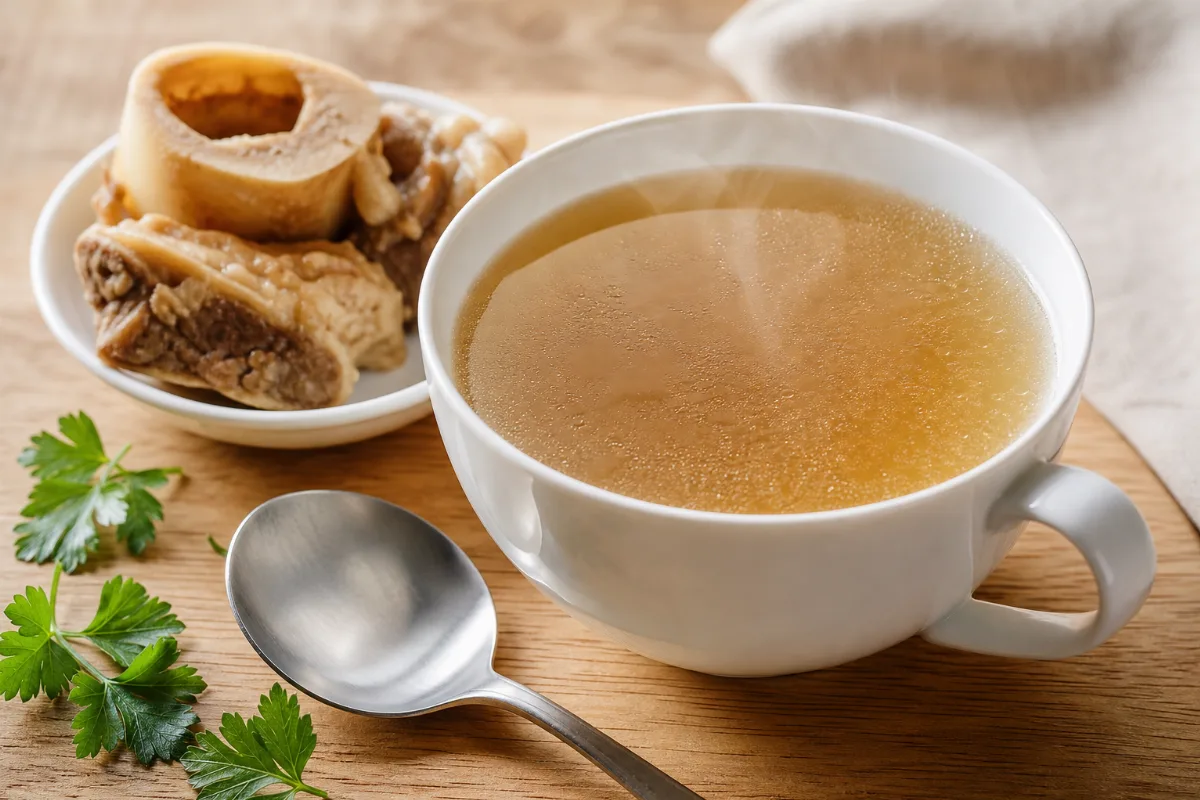
Bone broth is a liquid food made by simmering animal bones, and sometimes connective tissue, in water for a long time. Claims about it are common: that it repairs the gut lining, supplies collagen for skin and joints, and strengthens bones. This page checks those claims against what the sources we read actually measured. A 2025 review describes bone broth as a traditional nutrient and remedy. [1] This page does not judge tradition, only the health claims.
The claims, and what the evidence is
| Claim | What the sources found | Evidence label |
|---|---|---|
| "Bone broth supplies the building blocks of collagen." | A laboratory study measured six amino acids in commercial and home-made broths. Broth made to a standard recipe had significantly less of key amino acids (glycine, proline, hydroxyproline, lysine and others) than a 20 g reference collagen supplement. Amounts varied widely between broths made without a standard recipe. [2] | Lab measurement; no health outcome measured |
| "Bone broth repairs the gut." | A 2025 narrative review of animal and human studies of amino acids and minerals found in bone broth reported that these components support the gut barrier, and encouraged further research. Its abstract describes studies of the components, not a human trial of bone broth itself. [1] A mouse study gave broth made from beef bone before inducing colitis and found less tissue damage and changes in inflammatory markers. [3] | Preclinical (animals) and component studies; human trials of bone broth: Proper evidence not found |
| "Bone broth builds strong bones and treats osteoporosis." | A 2024 study found fractions of chicken-vegetable broth slowed bone loss in rats whose ovaries had been removed, and a fraction containing hyaluronan and chondroitin sulfate reduced the formation of osteoclasts (cells that break down bone) in mouse cells. [4] | Preclinical (cells and rats) |
| "Bone broth is good for skin and joints." | Proper evidence not found in the sources we read for human studies of bone broth on skin or joint outcomes. Collagen supplements are a separate product; see Collagen for skin, joints and bone. | No usable evidence |
| "Bone broth is a rich source of minerals." | A 2017 laboratory study found the calcium and magnesium in home-made or commercial broth or soup were under 5% of daily recommended levels per serving. [5] | Lab measurement |
How we searched: we looked up the words "bone broth" in titles and abstracts on PubMed (27 records when we searched). Judging by their titles and the abstracts we read, they were food-science, flavor and food-safety studies, animal and cell studies, laboratory analyses, a case report, a history of postpartum diet culture and a review. One was a human study of dairy and collagen proteins, not of broth. None was a human trial of bone broth for gut, joint, skin or bone outcomes.
Why a broth is hard to study
Broths vary with the bones, the animal, the cooking time and the acidity. [5] [2] A result for one broth does not transfer to another, to a powder, or to a collagen supplement. A cell or animal result also does not show what happens in people, and an amino acid found in broth is not proof it reaches the gut or skin.Contamination: what two small studies found
Bones can hold lead from the environment. A small 2013 test of three organic chicken broths found lead concentrations several times those of the tap water used, up to 9.5 micrograms per liter against 0.89 for the water; the authors suggested clinicians consider this when advising bone broth diets. [6] A 2017 study of metals in broth found heavy metals such as lead and cadmium at a few micrograms per serving and judged the risk minimal. [5] The two studies disagree on how much to worry, both were small, and neither is a regulator's finding. Whether any agency has set a lead limit for broth is not described in the sources we read. See Heavy metals and contaminants in foods.What a reader can do
Read the label for sodium and ingredients, and treat broth as a food, not a treatment. For gut or joint symptoms, see a clinician. For collagen products, read Collagen peptides vs gelatin.Health connections for Bone Broth
What research links to eating or drinking this food, and how strong the evidence is. Many studies are observational or use juice, powder, oil or extracts rather than the food as eaten; each card says which.
Bone broth and the gut lining
Lab or animal research onlyA 2025 narrative review of animal and human studies of amino acids and minerals found in bone broth reported support for the gut barrier. A mouse study gave beef-bone broth before inducing colitis and found less tissue damage. We found no human trial of bone broth itself.
Supplements: Not applicable.
Collagen building blocks in bone broth
Lab or animal research onlyA laboratory study found broth made to a standard recipe had significantly less hydroxyproline, glycine, proline, lysine and leucine than a 20 g reference collagen supplement, and amounts varied widely between broths.
Supplements: Collagen supplements are a separate product; the study compared amino acid amounts, not health outcomes.
Bone broth and bone loss
Lab or animal research onlyA 2024 study found fractions of chicken-vegetable broth slowed bone loss in rats with the ovaries removed and reduced osteoclast formation in mouse cells. Human trials of bone broth for bones: proper evidence not found.
Supplements: Not applicable.
Bone broth for skin and joints
Not enough evidenceProper evidence not found in the sources we read for human studies of bone broth on skin or joint outcomes.
Supplements: Collagen supplements are a separate product.
Minerals in bone broth
Not enough evidenceA 2017 laboratory study found calcium and magnesium in home-made or commercial broth or soup did not exceed low tenths of a milligram per serving, under 5% of daily recommended levels.
Supplements: Not applicable.
Protein and B vitamins in a cup of stock
Established roleUSDA lists 6.1 g protein and about 3.8 mg niacin (24% of the Daily Value) in a cup (240 g) of home-prepared chicken stock, with 86 kcal. A cup of stock is not a collagen supplement.
Supplements: Not applicable.
Connected topics
Open a group to see how each topic connects and how strong the evidence is.
Health goals (3)
- Bone HealthLab or animal research only
Rat and mouse-cell results for broth fractions; calcium and magnesium in broth are low.
- Digestive SupportLab or animal research only
Same animal and component studies; not shown in people.
- Gut HealthLab or animal research only
Animal and component studies suggest effects on the gut barrier; no human trial of bone broth was found.
Body systems (1)
- Digestive SystemLab or animal research only
Gut barrier results are from animals and components.
Body parts (2)
Functional actions (1)
- Gut RepairLab or animal research only
Claim studied in mice and as components; proper human evidence not found.
Root causes (1)
- Heavy Metal ExposureDocumented risk
Two small studies measured lead in broth with different conclusions; amounts were micrograms per liter or per serving.
Conditions & symptoms (1)
- Ulcerative ColitisLab or animal research only
Beef-bone broth reduced tissue damage in a mouse colitis model; no human trial found.
Documented risks and interactions (3)
- Lead and metals in bone broth. A small 2013 test of three organic chicken broths found lead up to 9.5 micrograms per liter against 0.89 for the tap water used. A 2017 study judged heavy metal risk minimal at a few micrograms per serving. The two small studies disagree on how much to worry.
- Sodium in broth. Home-prepared chicken stock has 143 mg sodium per 100 g (about 343 mg, 15% of the Daily Value, in a cup); canned condensed broth has 621 mg per 100 g (about 782 mg, 34%, in half a cup of the condensed product).
- Allergen labeling of broths. FDA labeling rules cover the nine major allergens in most packaged foods, but meat, poultry and egg products are regulated by USDA. Check ingredient lists of commercial broths.
Frequently asked questions
Does bone broth heal the gut?
Not shown in people. The evidence we found is a narrative review and a mouse study. [1] [3]
Does bone broth give you collagen?
Broth contains some of the amino acids found in collagen, but a laboratory study found broth made to a standard recipe had significantly less of them than a 20 g reference collagen supplement and varied widely between recipes. [2]
Is bone broth high in lead?
One small test found lead several times higher than in the water used [6]; another found a few micrograms per serving and judged the risk minimal. [5]
Is bone broth better than a collagen supplement?
We found no study comparing health outcomes. The only comparison we read measured amino acid amounts. [2]
Is bone broth high in sodium?
It depends on the product. The Dietary Guidelines name soups among foods that supply sodium and set a daily limit of less than 2,300 milligrams. [7] Check the label.
More details: evidence, limits and cautions
The details behind this page: cautions, limits of the evidence and where sources disagree. Open any note to read it.
Safety and individual considerations
- Sodium. The U.S. Dietary Guidelines advise less than 2,300 milligrams of sodium a day, and name soups among the many foods that supply sodium. [7] Sodium in broth differs by product, so check the Nutrition Facts label (Reading food labels). If you have been given a sodium limit, ask your clinician.
- Allergy. Broths can be made from animals and with added ingredients. FDA allergen labeling rules cover most packaged foods but not meat or poultry products, which USDA regulates. [8]
- Kidney disease, pregnancy, and medicines. The sources we read do not describe interactions between bone broth and medicines, or advice for pregnancy or kidney disease. Ask a clinician or dietitian, and see Safety and individual considerations.
- Home handling. Leftover storage matters for any soup. See Food safety basics.
References
- Bone Broth Benefits: How Its Nutrients Fortify Gut Barrier in Health and Disease. Dig Dis Sci 2025. PMID 40180691. Read 2026-10-23.
- Bone Broth Unlikely to Provide Reliable Concentrations of Collagen Precursors Compared With Supplemental Sources of Collagen Used in Collagen Research. Int J Sport Nutr Exerc Metab 2019. PMID 29893587. Read 2026-10-23.
- Analysis of the Anti-Inflammatory Capacity of Bone Broth in a Murine Model of Ulcerative Colitis. Medicina (Kaunas) 2021. PMID 34833355. Read 2026-10-23.
- Hyaluronan and chondroitin sulfate in chicken-vegetable bone broth delay osteoporosis progression. J Food Sci 2024. PMID 38317402. Read 2026-10-23.
- Essential and toxic metals in animal bone broths. Food Nutr Res 2017. PMID 28804437. Read 2026-10-23.
- The risk of lead contamination in bone broth diets. Med Hypotheses 2013. PMID 23375414. Read 2026-10-23.
- U.S. Department of Agriculture and U.S. Department of Health and Human Services. Dietary Guidelines for Americans, 2020-2025, sodium. Read 2026-10-23.
- U.S. Food and Drug Administration. Food Allergies. Read 2026-10-23.