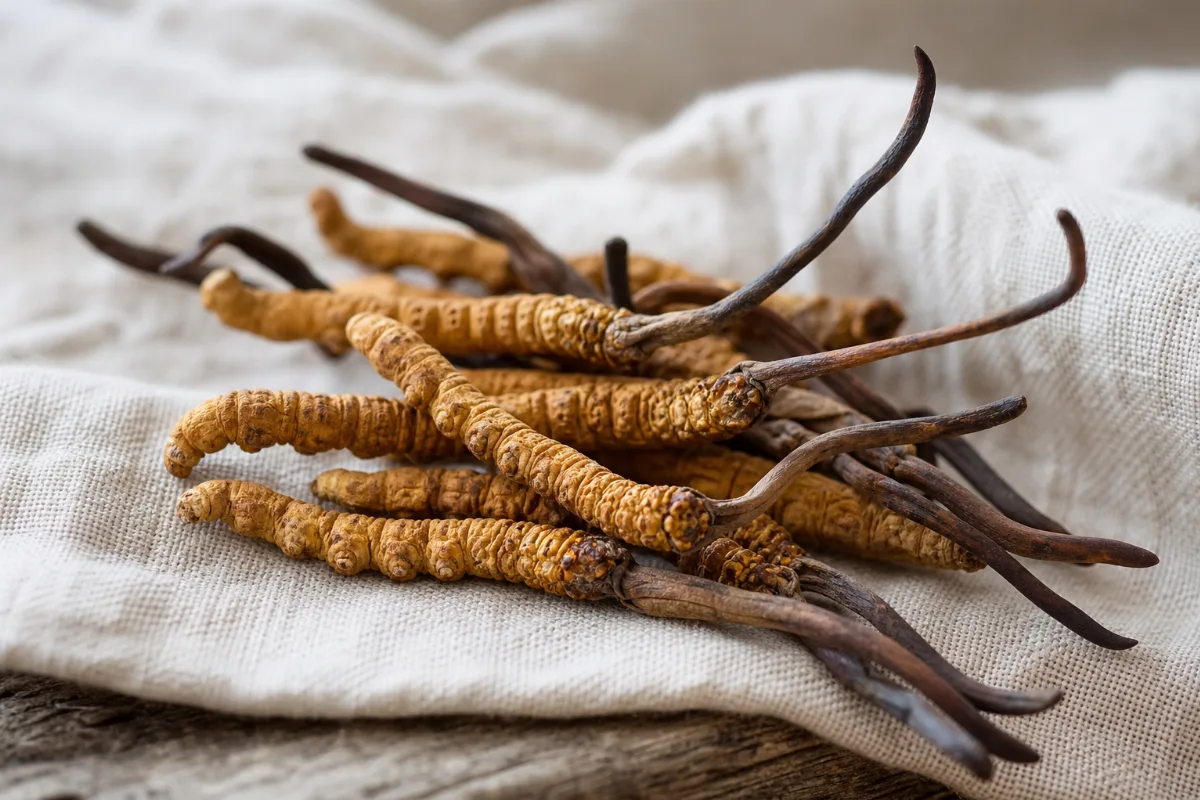
Mushrooms · Medicinal fungus
Caterpillar fungus
Ophiocordyceps sinensis (older name Cordyceps sinensis) · also called Chinese caterpillar fungus, yartsa gunbu (spellings vary), dong chong xia cao (winter worm, summer grass)
The caterpillar fungus is a rare fungus that grows out of a buried moth caterpillar on the high Tibetan Plateau. It is a traditional tonic in China and the Himalayan region and one of the costliest natural products in the world. Most of the kidney and lung trials behind its name tested factory-grown fungus products, not the wild one, and the certainty is low. The main cautions are arsenic in wild samples, a falling wild supply, and bleeding and diabetes-medicine cautions.
General information, not medical advice. Last substantive update · Not medically reviewed. A named clinician has not signed off on this page. The Tibetan and Himalayan cultural context also needs review by a Tibetan-medicine scholar or community reviewer. How this page is made
About Caterpillar fungus
The caterpillar fungus, Ophiocordyceps sinensis, is a rare fungus that grows out of a buried moth caterpillar on the high Tibetan Plateau and nearby mountains. Premium prices run to tens of thousands of US dollars per kilogram, and the IUCN lists the species as Vulnerable. Nearly all human trials tested factory-grown fungus products such as Bailing and Jinshuibao, mostly as add-ons in Chinese kidney and lung care, and reviewers rate the certainty low. Wild samples carry a lot of arsenic, mostly not in the inorganic form, and no retail product has been tested. There is no data for pregnancy, breastfeeding or children. This page is about the wild species; cordyceps in general is covered separately.
What it is
It is a fungus (family Ophiocordycipitaceae), not a plant. It infects the larva of a ghost moth underground, fills it, and sends a club-shaped stalk up through the soil. The traditional product is the stalk together with the mummified caterpillar. It grows at about 3,000 to 5,000 metres in Bhutan, south-west China, northern India and Nepal.
The wild fungus is among the costliest natural products. A 2025 review quotes premium prices of US$10,000 to 60,000 per kilogram, and up to US$140,000 for top grades by 2017, quoting other work. We treat those as order-of-magnitude figures.
Names and look-alikes
GBIF treats Ophiocordyceps sinensis as the accepted name. Cordyceps sinensis is the older name still seen on many papers and labels, and Hirsutella sinensis is listed as a synonym and is the asexual stage used to make cultured products. Local names include yarsagumba and yarchagunbu (spellings differ), and the Chinese name dong chong xia cao means winter worm, summer grass.
The word cordyceps on a label can mean other fungi. Cultivated Cordyceps militaris is a different fungus. Cs-4 and Jinshuibao come from Paecilomyces hepiali. A 2026 review says many reviews call commercial mycelium products O. sinensis even though they are different organisms.
Wild, cultured and fermented products
Three very different things are sold under the same name: the wild fungus with its caterpillar; cultured mycelium made in tanks, such as Bailing (from Hirsutella sinensis) and Jinshuibao (from Paecilomyces hepiali); and cultivated fruiting bodies grown in host larvae, which are closer to wild but limited by problems rearing the larvae and low infection rates. A 2025 review says fermented mycelium has a chemical profile distinct from the wild fungus.
Cultivated O. sinensis measured far lower in arsenic in one study: 0.260 mg/kg in five pooled samples from one company, against 4 to 13 mg/kg in wild samples. Arsenic tests are now used to help tell wild from cultivated product, and adulterants are common in processed wild product.
Overharvesting, climate and the people who collect it
The IUCN Red List assessed it as Vulnerable in 2019 with a decreasing population. The assessors name over-exploitation, a confined range and strict host specificity, and suspect a fall of more than 30% over 15 years and possibly close to 50% over the next 15. In Nepal, 95.1% of harvesters surveyed said the fungus was declining in pastures.
A 2021 modelling study says habitat and population have shrunk under warming and human pressure. Under the lowest-emission scenario little changes, but under the three higher-emission scenarios suitable areas shrink significantly in several mountain regions. The IUCN record notes that another study did not find strong evidence for climate impact, so the climate part is a prediction, not a count. The authors call for strict, effective regulation and protection.
A 2025 review says collection supplies 50 to 80% of income for local farmers and herders in producing areas and that eight Tibetan villagers were killed in conflicts over collection in 2007. Those numbers are quoted from other work. We found no source describing how Tibetan and Himalayan communities themselves understand this fungus, so we do not tell that story here; this section needs review by someone from those communities or a Tibetan-medicine scholar.
What the research shows
Reviews of small Chinese trials report better kidney blood markers when fungus products are added to usual care. The reviewers grade the certainty very low to low, trials were mostly open-label, and the products were mostly cultured, not wild. A Cochrane review found no survival difference after kidney transplant. A 240-person COPD trial compared two fungus capsules with no placebo group. Trials of immune markers and exercise used a related cultured fungus.
We found no human trial of the wild fungus for any use. Lab and animal results for cancer, blood sugar and platelets are not evidence for people.
Rules and regulation
In China the IUCN record says the wild fungus has been classified as a drug in the Chinese Pharmacopoeia since 1964 and under second-class state protection since 1999. A 2018 paper reports that in 2016 the China Food and Drug Administration found 4.4 to 9.0 mg/kg of arsenic in O. sinensis against a 1 mg/kg functional-food limit and ordered pilot work on it as a functional food to be discontinued; we did not open the notice itself.
A 2015 industry review lists approved cultured products: Corbrin (Bailing) capsules from Hirsutella sinensis, and Jinshuibao capsules from the Cs-4 strain, approved in 1989. A 2026 meta-analysis says Bailing Capsule is recorded in the Chinese Pharmacopoeia (2020 edition). These approvals describe cultured medicines, not the wild fungus.
We did not read FDA, EMA, NCCIH, LiverTox, LactMed or EU novel-food statements for this item, so none is stated. Rules differ by country and change.
At a glance
Traditional uses history, not proof
- Memorial Sloan Kettering says the wild fungus is used in traditional Chinese medicine for fatigue, sexual dysfunction and cough, and as an adaptogen or immune stimulant.
- A 2026 review says local healers use it for 21 ailments. Traditional use is not evidence that it works.
- The Chinese name means 'winter worm, summer grass' (2026 review).
Studied for research
- Blood markers in people on dialysis (cultured products, add-on), very low
- Kidney transplant add-on, insufficient
- Kidney dysfunction, acute kidney injury and nephrotic syndrome (add-on), very low
- COPD flare-ups (one trial against another capsule), very low
- Immune cell activity and exercise (a related cultured fungus), very low
- Fatigue, sexual function, cough, cancer and blood sugar, insufficient (no human trial, or lab work only)
Main compounds
- Adenosine, the Chinese Pharmacopoeia quality marker
- Cordycepin, reported at low levels in the wild fungus
- Fungal sterols such as ergosterol
- Arsenic compounds (a contaminant, not a benefit)
Common forms
- Wild fungus with its caterpillar (dried)
- Fermented mycelium capsules such as Bailing and Jinshuibao (cultured, not wild)
- Cultivated fruiting body grown in host larvae (limited)
- Extracts and mixed 'cordyceps' powders, often another species
Research links: IUCN Red List assessment for Ophiocordyceps sinensis (via redlist.info) · Memorial Sloan Kettering: Cordyceps · Cochrane: Cordyceps sinensis for kidney transplant recipients (abstract) · Dialysis add-on review, 35 trials (abstract) · Arsenic content and forms in wild samples (abstract) · Climate change and overexploitation of the wild fungus (abstract) · Research Library · Genes & Biomarkers Library
What it is and its history
- Accepted scientific name
- Ophiocordyceps sinensis
- Naming authority
- (Berk.) G.H.Sung, J.M.Sung, Hywel-Jones & Spatafora (GBIF)
- Synonyms
- Cordyceps sinensis (Berk.) Sacc. is a synonym in GBIF; many papers and product labels still use it, and Memorial Sloan Kettering says the species was renamed in 2007; Hirsutella sinensis X.J.Liu, Y.L.Guo, Y.X.Yu & W.Zeng is listed as a synonym in GBIF; a 2015 industry review calls it the asexual stage (anamorph) of O. sinensis; Sphaeria sinensis (Berkeley, 1843) is the first name, per a 2026 review
- Common names
- Caterpillar fungus, Chinese caterpillar fungus (English); Yarcha Gumba, Yarsagumba, Yarchagunbu (spellings in the IUCN record; 'yartsa gunbu' is another spelling) (Tibetan and Nepali names in Latin letters); Dong chong xia cao (winter worm, summer grass) (Chinese (pinyin))
- Family or group
- Ophiocordycipitaceae (a fungus family), not a plant
- Classification
- Fungi > Ascomycota > Sordariomycetes > Hypocreales > Ophiocordycipitaceae > Ophiocordyceps > Ophiocordyceps sinensis
- Native range
- Bhutan, south-west China, northern India (mostly Himachal Pradesh, Sikkim and Uttarakhand) and Nepal, at 3,000 to 5,000 m; in China in Tibet, Gansu, Qinghai, Sichuan and Yunnan (IUCN assessment).
- Habitat
- High alpine meadows of the Qinghai-Tibetan Plateau and its edges. The fungus grows inside the larva of a ghost moth (Hepialus and Thitarodes species), fills and mummifies it, and sends up a club-shaped stalk (stroma) above the soil (Panossian 2026; He 2025).
- What it looks like
- Fruiting body: A club-shaped stalk growing from a mummified caterpillar, per the review wording above. No size or colour description was read.
- Cultivation
- Two routes are described in a 2025 review. Fermented mycelium in tanks is scalable and standard but has a chemical profile distinct from the wild fungus. Growing the fungus inside host larvae gives fruiting bodies closer to the wild ones, but is held back by problems rearing the larvae and low infection rates. A 2015 industry review says fermentation of the asexual stage is how the Chinese medicines are made.
- Harvest and processing
- The IUCN record says that in northern India, as the snow melts in March to April, whole villages go to the alpine meadows for about three months to collect it. No help finding or collecting it is given here.
- Look-alikes and adulterants
- Name: Cordyceps militaris and other cordyceps species; Note: Cultivated C. militaris is a different fungus sold under the same word 'cordyceps'. Cs-4 and Jinshuibao come from Paecilomyces hepiali, another fungus. A 2026 review says many reviews call commercial mycelium products O. sinensis even though they are different organisms. No field look-alike guide was read.
- Sustainability and conservation
- The IUCN Red List assessed it as Vulnerable in 2019 with a decreasing population, naming over-exploitation, a confined range and strict host specificity. The assessors suspect a fall of more than 30% over 15 years and possibly close to 50% over the next 15. A 2021 modelling study says habitat and population have shrunk under warming and human pressure, and predicts significant shrinking of suitable areas in several mountain regions under the three higher-emission scenarios. The IUCN record says some evidence suggests climate change may add to declines, but another study did not find strong evidence. The 2025 review calls it critically endangered, which is stronger wording than the IUCN category. We did not find a source describing trade-treaty (CITES) status, so none is stated.
Traditional use and history history, not clinical proof
| Tradition or era | Documented use | Source |
|---|---|---|
| Traditional Chinese medicine | Used for fatigue, sexual dysfunction and cough, and as an adaptogen or immune stimulant (Memorial Sloan Kettering). A 2026 review says local healers use it for 21 ailments. Years of first use were not stated in the sources read. | s-msk-cordyceps |
| Naming history | Described by Berkeley in 1843 as Sphaeria sinensis, renamed Cordyceps sinensis by Saccardo in 1878, and moved to Ophiocordyceps in 2007 after DNA studies (2026 review; Memorial Sloan Kettering gives the 2007 date). | p41901364 |
| Modern state status and trade | The IUCN record says it has been classified as a drug in the Chinese Pharmacopoeia since 1964 and under second-class state protection since 1999, and that its price is now at the price of gold or higher. A 2025 review says collection supplies 50 to 80% of income for local farmers and herders in producing areas, that Tibet Autonomous Region sales reached US$1.2 billion in 2013 (both quoted from other work), and that eight Tibetan villagers were killed in conflicts over collection in 2007. | p41440717 |
| Tibetan and Himalayan communities | No source we read describes the history of its use in Tibetan medicine or the meaning it has for the communities that collect it, so none is told here. This is a gap flagged for review by a Tibetan-medicine scholar or community reviewer. | p41440717 |
Traditional use shows how it was used. It does not show that it works or is safe today.
What is inside, and how it may work
What it contains and how those compounds act in cells and animals. Laboratory and animal mechanisms are not proven effects in people.
Main compounds
| Compound | Family | Where it is concentrated | Activity studied | Level of evidence |
|---|---|---|---|---|
| Adenosine PubChem 60961 | nucleoside | Fungus (wild) Used as the quality marker in the Chinese Pharmacopoeia (2026 review); no content figure read. | Involved in many body processes; the review links it to energy handling. No effect of the fungus shown in people. 13 19 | Laboratory research |
| Cordycepin (3'-deoxyadenosine) PubChem 6303 | nucleoside | Reported in the wild fungus at low levels Reported to be low in wild O. sinensis compared with cultivated C. militaris (2026 review); no figure used because the review's regulatory tables are AI-generated. | Memorial Sloan Kettering says cordycepin inhibits platelet clumping in lab work. The same review says oral cordycepin reaches only nanomolar levels in the blood. 13 18 19 | Laboratory research |
| Ergosterol and related sterols PubChem 444679 | fungal sterol | Listed as reported in the fungus Not measured in the sources read. | Presence only; no health effect shown. 19 | Laboratory research |
| Arsenic compounds (a contaminant) | metalloid | Caterpillar body 4 to 13 mg/kg total arsenic in wild samples; mostly arsenite, arsenate and unidentified organic forms (see the Safety tab). | Not a beneficial compound; included because it is the main measured chemical concern. 17 16 4 | Lab analysis |
Mechanisms, receptors and pathways
| Target or pathway | Gene or receptor | What was found | Level |
|---|---|---|---|
| Immune cells | T helper cells, NK cells | Lab studies show cordyceps stimulates T helper cells and NK cell activity (Memorial Sloan Kettering). A related cultured fungus raised NK cell activity in one human trial; that was not the wild fungus. 18 9 | Laboratory research |
| Platelet clumping | Calcium and thromboxane A2 (cordycepin) | Cordycepin inhibits collagen-induced platelet aggregation in lab work (Memorial Sloan Kettering). It is the reason behind the caution about blood thinners. 18 | Laboratory research |
| Network pharmacology | PI3K-Akt, AMPK-mTOR, MAPK, NF-kB | A narrative review combining lab, animal and computer analyses reports these pathways recurring across studies. This is hypothesis-building, not proof in people. 13 | Hypothesis |
| Red blood cell precursors | Bone marrow progenitor cells (mouse) | Animal studies showed red blood cell precursors multiplying (Memorial Sloan Kettering); this is the basis for the caution in blood-cell cancers. 18 | In vivo |
| Sex hormone production | Testosterone (mouse) | Raised testosterone in mice; whether this happens in people is not known (Memorial Sloan Kettering). 18 | In vivo |
Absorption, metabolism and elimination
- Absorption
- For cordycepin, the 2026 review says blood concentrations after oral doses stay in the nanomolar range. Nothing for the whole wild fungus was found.
- Distribution
- Not found in the sources read.
- Metabolism
- Not found in the sources read.
- Elimination
- Not found in the sources read.
- Bioavailability
- Not established. In a simulated gut, about 64% of the arsenic in the whole fungus was available for absorption (Zhou 2018).
Isolated compounds versus whole extracts
Three different things carry the name. Wild fungus with its caterpillar is the costly traditional product, with the arsenic and conservation issues. Fermented mycelium (Bailing from Hirsutella sinensis, Jinshuibao and Cs-4 from Paecilomyces hepiali) is what most trials tested, and a 2025 review says its chemistry differs from the wild fungus. Cultivated fruiting bodies grown in host larvae are closer to wild but not yet widely produced. Results cannot be moved from one to another. Cultivated Cordyceps militaris is a separate fungus covered on the cordyceps page.
Nutritional composition
Not an everyday food. We found no nutrient table for it, and USDA FoodData Central has no record. It is used as a costly tonic ingredient. No nutrient claims are made.
6 very low certainty3 not enough evidence
What was looked at
The 9 benefits and uses checked for Caterpillar fungus, each with how strong the evidence is. Tap one to open it.
- Blood markers in people on dialysis (add-on)Very low certainty
- Kidney transplant (add-on to anti-rejection medicine)Not enough evidence
- Kidney dysfunction and acute kidney injuryVery low certainty
- Nephrotic syndrome (protein loss in urine)Very low certainty
- Lung disease (COPD): flare-upsVery low certainty
- Immune cell activity in healthy adults (a related cultured fungus)Very low certainty
- Exercise capacity (Cs-4 product)Very low certainty
- Fatigue, sexual function, cough and other traditional tonic usesNot enough evidence
- Cancer, blood sugar, platelets and radiation protection (lab and animal work only)Not enough evidence
Lab markers tracked in the studies
C-reactive protein (inflammation marker)Blood urea nitrogen (waste product)24-hour urine proteinSerum creatinine (kidney function marker)Number of COPD flare-upsNatural killer (NK) cell activityMetabolic threshold on a bike test
What is Caterpillar fungus good for?
The uses people ask about and how strong the human evidence is for each. None is proven. Almost all trials used cultured fungus products, not the wild fungus. Read this together with the Safety tab.
Benefits, one by one
Each card is a research question, not a promise. Tap a goal to filter. Open a card to see the studies, doses and limits.
Blood markers in people on dialysis (add-on)
Very low certaintyA 2024 review of 35 Chinese trials found lower inflammation and waste-product blood markers when a caterpillar fungus preparation was added to usual dialysis care. The reviewers rate the certainty very low to low, and the products were mostly cultured, not wild.
2 studiesEleven kinds of preparation were pooled, mostly cultured mycelium. Th…
Studies, doses and limits
What the trials found
35 randomised trials with 2,914 dialysis patients were pooled. C-reactive protein (an inflammation marker) was lower (15 trials, MD -2.22, 95% CI -3.24 to -1.20; very low certainty). Blood urea nitrogen was lower (21 trials, MD -1.57, 95% CI -2.07 to -1.07; low certainty). Creatinine, albumin and haemoglobin were also reported as improved, with very low to low certainty. Adverse drug reactions were not clearly different between the groups in 4 trials.
Results
CRP MD -2.22 (very low certainty); BUN MD -1.57 (low certainty); other markers improved at very low to low certainty
Effect sizes as reported
Small changes in blood markers; no death or kidney-failure outcomes
Why this rating
The reviewers graded the evidence very low to low. Trials were small, mostly open-label and only measured blood markers. The products were many different preparations.
Form and dose studied
Eleven kinds of preparation were pooled, mostly cultured mycelium. The wild fungus was not the main thing tested.
Who was studied
Adults on haemodialysis or peritoneal dialysis in China
Limits
No trial counted deaths or kidney failure. This is not a replacement for dialysis or kidney medicines and should only be used under a kidney team.
Why researchers looked
The wild fungus is traditionally used to tonify the kidney, and Chinese hospitals use cultured fungus preparations alongside standard kidney care.
Traditional use
Memorial Sloan Kettering says cordyceps products have been tried in kidney disease; a 2024 review describes O. sinensis as used in China for end-stage kidney disease.
Proposed mechanism Hypothesis
Not shown in these trials. Lab work on immune and inflammation signals is only a suggestion of how it might work.
A proposed mechanism does not show that the effect happens in people.
Anyone with kidney disease should not add or swap a fungus product without their kidney team.
Kidney transplant (add-on to anti-rejection medicine)
Not enough evidenceA Cochrane review of five small trials found no difference in graft or patient survival. Some other measures looked better in small trials of unclear quality, so the reviewers ask for longer, bigger studies.
2 studiesCordyceps sinensis products, not named in the abstract.
Studies, doses and limits
What the trials found
Five small trials with 447 recipients were pooled (follow-up three months to one year). Against azathioprine, there was no significant difference in graft or patient survival, but graft function was better and acute rejection may have been lower. Against standard-dose ciclosporin, there were no significant differences in survival, graft loss, rejection or graft function. All trials had unclear risk of bias and none measured quality of life.
Results
No difference in survival; some better graft measures versus azathioprine; no difference versus standard ciclosporin
Effect sizes as reported
No survival difference; other effects small and of unclear quality
Why this rating
Five small trials, all with unclear risk of bias, short follow-up and an old comparator drug. Memorial Sloan Kettering calls the evidence insufficient.
Form and dose studied
Cordyceps sinensis products, not named in the abstract.
Who was studied
Adult kidney transplant recipients, China
Limits
The trials were small and short. Nothing here supports changing anti-rejection treatment.
Why researchers looked
In China it has been used with anti-rejection drugs in the hope of fewer drug side effects.
Traditional use
Memorial Sloan Kettering lists transplant use but says several analyses found the evidence insufficient.
Proposed mechanism Hypothesis
Not established. Lab work suggests effects on immune cells; whether this matters in transplant patients is unknown.
A proposed mechanism does not show that the effect happens in people.
Because the fungus may affect immune cells, a transplant team must decide on any fungus product. We found no study of how it mixes with modern anti-rejection medicines.
Kidney dysfunction and acute kidney injury
Very low certaintyA 2024 review of 15 studies (1,310 patients) judged it a dependable add-on in kidney dysfunction, and a 2026 hospital study linked it to better recovery after a viral kidney illness. The review used unusual statistics, and the hospital study cannot show cause.
2 studiesCordyceps sinensis preparations of several kinds. The wild fungus was…
Studies, doses and limits
What the trials found
Review of 15 studies in 1,310 patients: it lowered blood creatinine, shortened the period of low urine output and raised urine osmolality; the authors concluded it can be a dependable add-on. The authors say existing data conflict and use diagnostic-test statistics (sensitivity and specificity) to describe the effect, an unusual choice. A retrospective study of 99 people with hantavirus kidney illness found 27.3% went on to chronic kidney disease, and use of the preparations during the acute illness was linked to less incomplete recovery (OR 0.323, 95% CI 0.114 to 0.916, p = 0.034).
Results
Review: lower creatinine and shorter low-urine period. Cohort: OR 0.323 for incomplete recovery (association only)
Effect sizes as reported
Association in one hospital; review effect not given in plain numbers
Why this rating
Unusual statistics in the review, mixed designs, and a retrospective cohort that cannot show cause.
Form and dose studied
Cordyceps sinensis preparations of several kinds. The wild fungus was not the focus.
Who was studied
Adults with kidney dysfunction or acute kidney injury, China
Limits
Patients who got the preparations may have differed from those who did not. No large placebo-controlled trial was found.
Why researchers looked
Chinese hospitals use cultured fungus preparations alongside standard kidney care, including in acute kidney injury.
Traditional use
Used traditionally to support the kidney, per the reviews.
Proposed mechanism Hypothesis
Not shown in people. The review authors suggest effects on kidney filtering and tube function.
A proposed mechanism does not show that the effect happens in people.
Acute kidney injury is an emergency. This is not a substitute for hospital care.
Nephrotic syndrome (protein loss in urine)
Very low certaintyA 2026 review of 11 trials of one cultured fungus capsule (Bailing) found lower urine protein and better blood markers when it was added to usual treatment. It says larger, better trials are needed.
2 studiesOne cultured preparation, Bailing capsule. This is not the wild fungu…
Studies, doses and limits
What the trials found
11 randomised trials with 920 adults were pooled. Compared with usual care alone, Bailing capsule lowered 24-hour urine protein, creatinine, urea nitrogen and total cholesterol and raised albumin and some T-cell measures, with a low rate of side effects.
Results
Lower urine protein and creatinine; higher albumin (numbers not given in the abstract)
Effect sizes as reported
Not given in the abstract
Why this rating
Small Chinese trials, usually open-label, add-on design, blood markers rather than kidney failure. The abstract gives no certainty grade; this is the compiler's reading.
Form and dose studied
One cultured preparation, Bailing capsule. This is not the wild fungus.
Who was studied
Adults with primary nephrotic syndrome, China
Limits
Results are for one product and may not carry over to other products or the wild fungus.
Why researchers looked
Bailing capsule is a standardised cultured-fungus medicine recorded in the Chinese Pharmacopoeia (2020 edition) and widely used in China for kidney disease.
Traditional use
The wild fungus is the traditional kidney tonic; Bailing is made from a cultured fungus (Hirsutella sinensis, the asexual stage of O. sinensis, per a 2015 industry review).
Proposed mechanism Hypothesis
The review reports higher T-cell measures and suggests immune regulation. This is not proven as the cause.
A proposed mechanism does not show that the effect happens in people.
Nephrotic syndrome needs specialist care. Tell the kidney team about any supplement.
Lung disease (COPD): flare-ups
Very low certaintyOne 240-person Chinese trial found fewer flare-ups with one fungus capsule (Yong Chong Cao) than with another (Bailing). There was no placebo group, so it cannot show that either capsule helps. Lung function did not differ.
3 studiesCultured fungal capsules. Not the wild fungus.
Studies, doses and limits
What the trials found
240 adults with mild to severe COPD were randomised to Yong Chong Cao capsule or Bailing capsule for 24 weeks with 24 weeks of follow-up; 208 finished. Yong Chong Cao reduced the number of flare-ups (p = 0.002 in the full analysis set, p = 0.003 per protocol) and lengthened the time to the first one. Lung function and symptom scores did not differ. A 2026 review reports linked improvements in lung function and exercise tolerance in COPD studies and grades the certainty low to moderate.
Results
Fewer flare-ups with one capsule than the other (p = 0.002); no difference in lung function or symptom scores
Effect sizes as reported
Not given as numbers in the abstract
Why this rating
One trial with no placebo or no-treatment group, a fungus-capsule against a fungus-capsule comparison, an author linked to a clinical research company, and funding not stated in the abstract. The review's low-to-moderate wording comes from a secondary source whose author owns a research company.
Form and dose studied
Cultured fungal capsules. Not the wild fungus.
Who was studied
Adults with COPD, China
Limits
The trial does not say whether either capsule is better than nothing. COPD needs medical treatment.
Why researchers looked
The wild fungus is traditionally used for cough and lung complaints, and cultured fungus capsules are used in China for lung disease.
Traditional use
Memorial Sloan Kettering lists cough among traditional uses and says it found no human lung data in its own review, only laboratory work.
Proposed mechanism Laboratory research
Not shown. Lab work points to effects on inflammation signalling.
A proposed mechanism does not show that the effect happens in people.
Do not replace inhalers or prescribed COPD treatment with a supplement.
Immune cell activity in healthy adults (a related cultured fungus)
Very low certaintyIn 79 healthy adults, natural killer cell activity rose with a cultured Paecilomyces hepiali extract compared with placebo over 8 weeks. This is a different fungus from the wild caterpillar fungus, and the study measured a lab marker, not infections.
3 studiesPaecilomyces hepiali culture extract. According to a 2015 industry re…
Studies, doses and limits
What the trials found
39 adults took capsules of the extract CBG-CS-2 and 40 took placebo for 8 weeks. NK cell cytotoxic activity rose about 38.8 (plus or minus 17.6)% from baseline relative to placebo (P < 0.019). The authors say it is safe and effective for boosting cell-mediated immunity in healthy adults; the abstract reports no safety numbers.
Results
NK cell activity about 38.8% higher than baseline relative to placebo (P < 0.019)
Effect sizes as reported
One lab marker, 79 people
Why this rating
One 8-week trial, a lab marker rather than illness, healthy people, and a different organism from the wild fungus.
Form and dose studied
Paecilomyces hepiali culture extract. According to a 2015 industry review, P. hepiali is a different fungus from the wild one (the Cs-4 strain).
Who was studied
Healthy adults
Limits
No infections or illness days were counted. The result does not apply to the wild caterpillar fungus.
Why researchers looked
Cordyceps products are sold as immune supports, and lab work suggests effects on immune cells.
Traditional use
Memorial Sloan Kettering lists immune stimulation as a traditional and purported use.
Proposed mechanism Laboratory research
Lab work reports effects on T helper cells and NK cells (Memorial Sloan Kettering). This is cell and animal work only.
A proposed mechanism does not show that the effect happens in people.
A fungus that stimulates immune cells could in theory work against immune-suppressing medicines; no interaction study was found.
Exercise capacity (Cs-4 product)
Very low certaintyA 20-person pilot of the Cs-4 product in healthy older adults found a higher exercise threshold than placebo, but maximal oxygen use did not change. Cs-4 is a cultured product, not the wild fungus. Other exercise trials of cordyceps are covered on the cordyceps page.
3 studiesCs-4 capsules. A 2015 industry review identifies the Cs-4 strain as P…
Studies, doses and limits
What the trials found
20 healthy people aged 50 to 75 took Cs-4 capsules or placebo for 12 weeks. In the Cs-4 group the metabolic threshold rose 10.5% (0.83 to 0.93 L/min, p < 0.02) and the ventilatory threshold rose 8.5%. Nothing significant changed in the placebo group, and VO2 max did not change in either group.
Results
Metabolic threshold +10.5% (p < 0.02); VO2 max unchanged
Effect sizes as reported
One threshold measure in 20 people
Why this rating
A small pilot of one cultured product. Other exercise trials give mixed results; see the cordyceps page.
Form and dose studied
Cs-4 capsules. A 2015 industry review identifies the Cs-4 strain as Paecilomyces hepiali, not the wild caterpillar fungus.
Who was studied
Healthy older adults
Limits
Tiny pilot. Not shown for the wild fungus.
Why researchers looked
The wild fungus has a traditional reputation for strength, stamina and altitude tolerance.
Traditional use
Memorial Sloan Kettering lists strength and stamina as a purported use and says exercise studies in healthy people are mixed.
Proposed mechanism Hypothesis
Not established.
A proposed mechanism does not show that the effect happens in people.
No safety concerns were reported in the abstract.
Fatigue, sexual function, cough and other traditional tonic uses
Not enough evidenceThe wild fungus is a traditional Chinese and Tibetan tonic for tiredness, sexual problems and cough. We found no trial of the wild fungus for these uses, so the evidence is insufficient.
2 studiesNot applicable.
Studies, doses and limits
Results
No human trial found
Why this rating
No human trials of the wild fungus for these uses.
Limits
Long use and high price do not show benefit.
Why researchers looked
Long traditional use and very high price keep interest high.
Traditional use
Memorial Sloan Kettering says it is used in traditional Chinese medicine for fatigue, sexual dysfunction and cough, and as an adaptogen or immune stimulant. A 2026 review says local healers use it for 21 ailments. Traditional use is not evidence that it works.
Proposed mechanism Hypothesis
None shown for these uses in people.
A proposed mechanism does not show that the effect happens in people.
The mouse testosterone result and the warning about blood-cell cancers apply to cordyceps in general; see the Safety tab.
Cancer, blood sugar, platelets and radiation protection (lab and animal work only)
Not enough evidenceMemorial Sloan Kettering lists lab and animal findings for cancer cells, blood sugar, platelets and radiation. None has been shown in people. In one case the lab finding points the wrong way: it warns against use in blood-cell cancers.
2 studiesNot applicable
Studies, doses and limits
Results
No human evidence
Why this rating
Cell and animal work only. Do not read it as a cancer treatment.
Who was studied
Cells and animals
Limits
Lab results often fail to carry over to people.
Why researchers looked
Lab studies of the fungus's chemicals show effects on cells, so researchers test them in animals.
Traditional use
Not described in the sources read as a traditional cancer remedy.
Proposed mechanism In vivo
Cell and animal studies: reported effects on immune cells, cancer cells, blood sugar and platelet clumping (Memorial Sloan Kettering).
A proposed mechanism does not show that the effect happens in people.
Anyone with cancer, especially a blood-cell cancer, should talk to their cancer team before using any cordyceps product.
Connections to the rest of health
How Caterpillar fungus connects to the rest of our health knowledge graph. Every link says what kind of connection it is. A safety link (for example to the liver) is a warning, not a benefit. A study that merely mentions a topic never creates a benefit link.
Explore every connection: goals, body systems, organs, symptoms, genes
A. Wellness goals
| Connected to | Kind of connection | Evidence status | Context | Studies |
|---|---|---|---|---|
| Immune Support | Very low certainty | Immune cell activity in healthy adults (a related cultured fungus): In 79 healthy adults, natural killer cell activity rose with a cultured Paecilomyces hepiali extract compared with placebo over 8 weeks. This is a different fungus from the wild caterpillar fungus, and the study measured a lab marker, not infections. | 9 3 18 | |
| Endurance Support | Very low certainty | Exercise capacity (Cs-4 product): A 20-person pilot of the Cs-4 product in healthy older adults found a higher exercise threshold than placebo, but maximal oxygen use did not change. Cs-4 is a cultured product, not the wild fungus. Other exercise trials of cordyceps are covered on the cordyceps page. | 2 3 18 | |
| Reduce Fatigue | Traditional use | Not enough evidence | Fatigue, sexual function, cough and other traditional tonic uses: The wild fungus is a traditional Chinese and Tibetan tonic for tiredness, sexual problems and cough. We found no trial of the wild fungus for these uses, so the evidence is insufficient. | 18 13 |
| Libido Support | Traditional use | Not enough evidence | Fatigue, sexual function, cough and other traditional tonic uses: The wild fungus is a traditional Chinese and Tibetan tonic for tiredness, sexual problems and cough. We found no trial of the wild fungus for these uses, so the evidence is insufficient. | 18 13 |
B. Body systems
| Connected to | Kind of connection | Evidence status | Context | Studies |
|---|---|---|---|---|
| Blood clotting | Adverse effect or risk | Not enough evidence | One case of heavy bleeding after a tooth extraction; lab work on platelets (Memorial Sloan Kettering). Preparation or compound: Cordyceps in general |
18 |
| Kidney and urinary system | Very low certainty | Better blood markers in small Chinese trials; no benefit in transplant survival. Preparation or compound: Cultured fungus preparations as an add-on |
11 8 6 | |
| Kidney Urinary | Biological association | Very low certainty | Studied for: Blood markers in people on dialysis (add-on) Studied for: Kidney transplant (add-on to anti-rejection medicine) | 11 18 8 15 12 6 3 |
| Respiratory Health | Biological association | Very low certainty | Studied for: Lung disease (COPD): flare-ups | 10 13 18 |
| Immune Support | Biological association | Very low certainty | Studied for: Immune cell activity in healthy adults (a related cultured fungus) Studied for: Cancer, blood sugar, platelets and radiation protection (lab and animal work only) | 9 3 18 13 |
| Energy Fatigue | Biological association | Very low certainty | Studied for: Exercise capacity (Cs-4 product) Studied for: Fatigue, sexual function, cough and other traditional tonic uses | 2 3 18 13 |
G. Root causes and contributing factors
| Connected to | Kind of connection | Evidence status | Context | Studies |
|---|---|---|---|---|
| Heavy metal exposure | Low certainty | High total arsenic in wild samples, mostly not inorganic. Preparation or compound: Wild Ophiocordyceps sinensis |
17 16 4 |
I. Biomarkers
| Connected to | Kind of connection | Evidence status | Context | Studies |
|---|---|---|---|---|
| C-reactive protein (inflammation marker) | Biological association | Very low certainty | Measured in trials: lowered. A lab change is not the same as a health benefit. | 11 |
| Blood urea nitrogen (waste product) | Biological association | Low certainty | Measured in trials: lowered. A lab change is not the same as a health benefit. | 11 |
| 24-hour urine protein | Biological association | Very low certainty | Measured in trials: lowered. A lab change is not the same as a health benefit. | 6 |
| Serum creatinine (kidney function marker) | Biological association | Very low certainty | Measured in trials: lowered. A lab change is not the same as a health benefit. | 15 6 11 |
| Number of COPD flare-ups | Biological association | Very low certainty | Measured in trials: lowered. A lab change is not the same as a health benefit. | 10 |
| Natural killer (NK) cell activity | Biological association | Very low certainty | Measured in trials: raised. A lab change is not the same as a health benefit. | 9 |
| Metabolic threshold on a bike test | Biological association | Very low certainty | Measured in trials: raised. A lab change is not the same as a health benefit. | 2 |
K. Biological pathways
L. Active compounds
| Connected to | Kind of connection | Evidence status | Context | Studies |
|---|---|---|---|---|
| Adenosine | Biological association | In vitro | Involved in many body processes; the review links it to energy handling. No effect of the fungus shown in people. Preparation or compound: Fungus (wild) |
13 19 |
| Cordycepin (3'-deoxyadenosine) | Biological association | In vitro | Memorial Sloan Kettering says cordycepin inhibits platelet clumping in lab work. The same review says oral cordycepin reaches only nanomolar levels in the blood. Preparation or compound: Reported in the wild fungus at low levels |
13 18 19 |
| Ergosterol and related sterols | Biological association | In vitro | Presence only; no health effect shown. Preparation or compound: Listed as reported in the fungus |
19 |
| Arsenic compounds (a contaminant) | Biological association | Lab analysis | Not a beneficial compound; included because it is the main measured chemical concern. Preparation or compound: Caterpillar body |
17 16 4 |
Each connection is stored with the ingredient, the connected record, the kind of connection, the evidence status, the supporting studies, the preparation or compound involved, and a review date (last reviewed October 25, 2026).
Evidence at a glance: what changed in 7 lab markers
Tap a number to show only those markers. Counts are markers, not people.
The evidence
The research centre for Caterpillar fungus. Every record here was checked against PubMed or the publisher's page; we never list a study we have not verified.
Evidence by outcome
Bars show how many studies we found for each outcome, not how well it works. People are added up across trials only (reviews are not added, to avoid double counting).
How we rate evidence
High certainty
Several well-run trials or reviews agree; further research is unlikely to change the picture much.
Moderate certainty
Good trials point the same way, but some doubt remains.
Low certainty
Small, short or inconsistent trials. The finding could change with better research.
Very low certainty
Very little or very weak human data. Treat as a possibility only.
Mixed findings
Trials or reviews disagree with each other.
Not enough evidence
Not enough human research to say either way.
Evidence against
Good research found no benefit, or found harm.
We take the reviewers' own risk-of-bias and GRADE statements where they exist, and otherwise judge from study size, design, consistency, directness and whether a product matches what is sold. Many publications do not make evidence high. Method note: We read PubMed records and abstracts for 15 papers (one Cochrane review, three other systematic reviews, a 99-person cohort, three trials, four lab analyses of arsenic, one habitat model and two narrative reviews), plus the Memorial Sloan Kettering page, the IUCN assessment, a 2015 industry review in full, GBIF and PubChem records. FDA, EMA, NCCIH, LiverTox, LactMed, Index Fungorum and EU novel-food records were not read. Numbers come from abstracts unless stated. Certainty ratings are the compiler's own reading and the reviewers' own where given.
Study library: every study we checked 20
| Study | Design | People | Product, dose, length | Result |
|---|---|---|---|---|
| Assessor Zhu-Liang Yang; reviewer Anders Dahlberg 2019 IUCN Red List assessment of Ophiocordyceps sinensis (Vulnerable), as shown by the Global Fungal Red List Initiative (redlist.info), assessed 2019-10-31 IUCN Red List / Global Fungal Red List Initiative · Source |
Database record n/a |
Species assessment | Wild Ophiocordyceps sinensis |
Red List category VU (Vulnerable), criteria A2bcd+3bcd+4bcd, population trend decreasing. The justification says the status is deteriorating through strict host specificity, a confined range and over-exploitation, that it has been classified as a drug in the Chinese Pharmacopoeia since 1964 and listed under the second class of state protection since 1999, and that its price is now at the price of gold or higher. It suspects a population fall of more than 30% over the last 15 years and possibly close to 50% over the next 15. It records, for Nepal, a 37% fall in collection between 2008 and 2010 and that 95.1% of harvesters thought availability was declining. Range: Bhutan, south-west China, northern India and Nepal at 3,000 to 5,000 m. It says some evidence suggests climate change may add to declines but another study did not find strong evidence for such an impact. Vulnerable, decreasing Methods, limits and fundingOutcomes: Red List category VU (Vulnerable), criteria A2bcd+3bcd+4bcd, population trend decreasing. The justification says the status is deteriorating through strict host specificity, a confined range and over-exploitation, that it has been classified as a drug in the Chinese Pharmacopoeia since 1964 and listed under the second class of state protection since 1999, and that its price is now at the price of gold or higher. It suspects a population fall of more than 30% over the last 15 years and possibly close to 50% over the next 15. It records, for Nepal, a 37% fall in collection between 2008 and 2010 and that 95.1% of harvesters thought availability was declining. Range: Bhutan, south-west China, northern India and Nepal at 3,000 to 5,000 m. It says some evidence suggests climate change may add to declines but another study did not find strong evidence for such an impact. Limitations: The redlist.info page repeats the IUCN assessment; the iucnredlist.org page itself blocked our request. The assessors say surveys of the whole range are still needed. Funding and conflicts: Independent conservation assessment Read: full text |
| Chen 2010 Effect of Cs-4 (Cordyceps sinensis) on exercise performance in healthy older subjects: a double-blind, placebo-controlled trial. J Altern Complement Med · PMID 20804368 · DOI |
Randomised controlled trial |
20 Healthy adults aged 50 to 75 |
Cs-4 capsules (a cultured mycelium product; per Dong 2015 the Cs-4 strain is Paecilomyces hepiali, not the wild fungus) cultured mycelium Not shown here 12 weeks · vs Placebo capsules |
In the Cs-4 group the metabolic threshold rose 10.5% (from 0.83 to 0.93 L/min, p < 0.02) and the ventilatory threshold rose 8.5%. No significant changes occurred in the placebo group, and VO2 max did not change in either group. Small gain in one exercise threshold in a pilot Methods, limits and fundingOutcomes: Exercise thresholds and VO2 max on a stationary bike Limitations: Only 20 people, a pilot. VO2 max did not change. The product is not the wild fungus. Funding for the product not stated in the abstract (the record lists NIH extramural support). Funding and conflicts: Funding details not stated in the abstract Read: abstract |
| Dong 2015 Cordyceps industry in China. Mycology · Source · DOI |
Narrative review review |
Industry review | Fungi isolated from Chinese cordyceps and the products made from them fermented mycelia Not shown here |
Lists approved products made from fermented fungi: Corbrin (Bailing) capsules from Hirsutella sinensis, the anamorph (asexual stage) of O. sinensis; Jinshuibao capsules and tablets from Paecilomyces hepiali (the Cs-4 strain); and others. Says Jinshuibao was approved in 1989 by the National New Drug Review and Approval Committee of the Ministry of Public Health. Says H. sinensis was listed in the Ministry of Health checklist of fungi for health food in 2001 and that at least 10 health foods with fermented mycelia were approved by the China Food and Drug Administration. Says P. hepiali should be regarded as an independent fungus rather than a fungus associated with Chinese cordyceps. Describes who is allowed to sell which cultured product in China (as of 2015) Methods, limits and fundingOutcomes: Which fungi are fermented, which products are approved Limitations: Published 2015; approvals may have changed. One author works at a company that makes a cordyceps product (Jiangsu Shenhua Pharmaceutical Co., Ltd.). Not in PubMed; read in the open full text on PubMed Central (PMC6106062). Funding and conflicts: Industry-linked: an author is employed by a cordyceps product maker Read: full text |
| Guo 2018 Determination of Arsenic Species in Ophiocordyceps sinensis from Major Habitats in China by HPLC-ICP-MS and the Edible Hazard Assessment. Molecules · PMID 29701658 · DOI |
Lab analysis lab |
Wild samples from major habitats in China | Wild Ophiocordyceps sinensis Not shown here |
Total arsenic was 4.00 to 5.25 mg/kg. Over 90% (91.7 to 94.0%) was a group of unidentified organic arsenic compounds; arsenite was 4.1 to 6.0%. If the unidentified compounds are not toxic there is no particular risk to local consumers; if they were counted as toxic, the hazard and cancer-risk scores would be above the safe thresholds. Reassuring only if the unidentified organic arsenic is harmless Methods, limits and fundingOutcomes: Total arsenic, arsenic forms, hazard and cancer-risk estimates Limitations: Conclusion rests on an inference (a chemical test and chromatography behaviour) that the unidentified arsenic is not toxic. Not retail products. Funding and conflicts: Authors declare no conflict; funders had no role Read: abstract |
| Guo 2018 Novel Arsenic Markers for Discriminating Wild and Cultivated Cordyceps. Molecules · PMID 30380635 · DOI |
Lab analysis lab |
Cultivated O. sinensis, C. militaris and other edible fungi (compared with wild O. sinensis from earlier work) | Cultivated Ophiocordyceps sinensis (bought pieces) Not shown here |
The abstract says adulterants are common in processed wild O. sinensis, that arsenic testing has become a necessary check, and that the share of unidentified organic arsenic and the total arsenic can help tell wild from cultivated product. In the paper tables (read in the full text) five pooled samples of cultivated O. sinensis averaged 0.260 mg/kg total arsenic (range 0.223 to 0.289); the paper also says that in 2016 the China Food and Drug Administration reported 4.4 to 9.0 mg/kg total arsenic in O. sinensis against a 1 mg/kg limit for functional foods and ordered pilot work on it as a functional food to be discontinued. Cultivated product much lower in arsenic; arsenic can flag wild product Methods, limits and fundingOutcomes: Total arsenic and arsenic forms; use as a marker for wild product Limitations: Cultivated samples were five pooled samples from one company. The 2016 regulator finding is reported second-hand; the original notice was not opened. Funding and conflicts: Authors declare no conflict; funders had no role Read: abstract and full text |
| Guo 2026 Efficacy and safety of Bailing Capsule for the treatment of adult primary nephrotic syndrome: a systematic review and meta-analysis of randomized controlled trials. Front Pharmacol · PMID 42110559 · DOI |
Systematic review review |
920 Adults with primary nephrotic syndrome (11 randomised trials) |
Bailing Capsule (a standardised fungal preparation recorded in the Chinese Pharmacopoeia 2020) fermented mycelium preparation (per other sources) Not shown here · vs Conventional therapy alone |
Compared with conventional treatment alone, Bailing Capsule lowered 24-hour urine protein, creatinine, urea nitrogen and total cholesterol and raised albumin and some T-cell measures, with a low rate of side effects. The authors call for larger, multicentre trials. Better kidney blood and urine markers as an add-on Methods, limits and fundingOutcomes: 24-hour urine protein, creatinine, urea, cholesterol, albumin, T-cell counts, response rate, safety Limitations: Abstract does not give certainty grades or numbers. Bailing is a cultured preparation, not the wild fungus. Funding and conflicts: Authors report no conflicts of interest Read: abstract |
| He 2025 The Conservation Crisis of Ophiocordyceps sinensis: Strategies, Challenges, and Sustainable Future of Artificial Cultivation. J Fungi (Basel) · PMID 41440717 · DOI |
Narrative review review |
Review of decline and cultivation methods | Wild and cultivated Ophiocordyceps sinensis Not shown here |
The review says the fungus is critically endangered through climate change and overharvesting. Fermented mycelium is scalable but gives a chemical profile distinct from the wild fungus; growing it inside host larvae gives fruiting bodies closer to wild ones but is held back by host rearing and low infection rates. In the full text: yield of wild fungus under 200 tonnes a year; premium prices of US$10,000 to 60,000 per kilogram (up to US$140,000 for top grades by 2017, quoting other work); Tibet Autonomous Region sales of US$1.2 billion in 2013; 50 to 80% of local farmer and herder income in producing areas (quoted from other work); eight Tibetan villagers killed in collection conflicts in 2007; it is listed on the IUCN Red List and regulated in several producing countries. Strong conservation concern; prices and income figures quoted second-hand Methods, limits and fundingOutcomes: Causes of decline, cultivation methods, price, income, regulation Limitations: A review. Price and income numbers come from other work that we did not open. The word critically endangered is the authors' wording; the IUCN category in the assessment we read is Vulnerable. Funding and conflicts: Authors declare no conflicts of interest Read: abstract and full text |
| Hong 2015 Cordyceps sinensis (a traditional Chinese medicine) for kidney transplant recipients. Cochrane Database Syst Rev · PMID 26457607 · DOI |
Systematic review review |
447 Adults with a kidney transplant (5 small Chinese trials) |
Cordyceps sinensis, product not named in the abstract Not shown here 3 months to 1 year · vs Azathioprine (4 trials) or standard-dose ciclosporin (1 trial) |
Compared with azathioprine there was no significant difference in graft or patient survival; graft function was better and acute rejection may have been lower, with less anaemia and leucopenia and possibly fewer infections. Against standard-dose ciclosporin there were no significant differences in survival, graft loss, rejection or graft function. All trials had unclear risk of bias and none measured quality of life. The authors say results must be read with caution. No difference in survival; some favourable signs in small, unclear-quality trials Methods, limits and fundingOutcomes: Graft and patient survival, graft function, rejection, infection, side effects Limitations: Five small trials with unclear risk of bias, follow-up only 3 months to 1 year. Funding and conflicts: Authors report no conflicts of interest Read: abstract |
| Jung 2019 Immunomodulatory effects of a mycelium extract of Cordyceps (Paecilomyces hepiali; CBG-CS-2): a randomized and double-blind clinical trial. BMC Complement Altern Med · PMID 30925876 · DOI |
Randomised controlled trial |
79 Healthy adults |
Paecilomyces hepiali mycelium culture extract (CBG-CS-2), capsules; a different fungus from the wild caterpillar fungus cultured mycelium extract Not shown here 8 weeks · vs Placebo capsules |
NK cell cytotoxic activity rose about 38.8 (plus or minus 17.6)% from baseline relative to placebo after 8 weeks (P < 0.019). Higher NK cell activity, a lab marker Methods, limits and fundingOutcomes: Natural killer (NK) cell activity, blood mediators Limitations: Healthy people, 8 weeks, a lab marker and no illness outcome. The product is a different fungus from the wild one. The abstract says the authors have no competing interests. Funding and conflicts: Authors declare no competing interests Registration: ClinicalTrials.gov NCT02814617 Read: abstract |
| Li 2025 The Effectiveness of Yong Chong Cao Capsule in Patients With Mild to Severe COPD: A Multi-Center, Randomized, Active-Controlled Trial. J Evid Based Med · PMID 41295088 · DOI |
Randomised controlled trial |
240 Adults with mild to severe COPD, 24 weeks plus 24 weeks follow-up |
Yong Chong Cao capsule (fungus capsule that the abstract says shares medicinal components with Bailing) cultured fungal preparation (exact organism not stated in the abstract) Not shown here 24 weeks plus 24 weeks follow-up · vs Bailing Capsule (another fungal capsule) |
208 of 240 people completed. Compared with Bailing capsule, Yong Chong Cao capsule reduced the number of flare-ups (p = 0.002 in the full analysis set; p = 0.003 per protocol) and prolonged time to the first one. Lung function and symptom scores did not differ between the groups. Fewer flare-ups than another fungal capsule; no placebo group Methods, limits and fundingOutcomes: Number of acute flare-ups, time to first flare-up, lung function, symptom scores Limitations: There was no placebo or no-treatment group, so the trial cannot say whether either capsule helps. A fungus-capsule against a fungus-capsule comparison. Funding not stated in the abstract. Funding and conflicts: Industry link: one author works at a clinical research company (Jiangsu Famous Medical Technology Co., Ltd.); funding not stated in the abstract Registration: ClinicalTrials.gov NCT03745261 Read: abstract |
| Liu 2024 Effects and safety of Ophiocordyceps sinensis preparation in the adjuvant treatment for dialysis patients: a systematic review and meta-analysis. Front Pharmacol · PMID 39101133 · DOI |
Systematic review review |
2914 Adults on haemodialysis or peritoneal dialysis (35 randomised trials) |
Ophiocordyceps sinensis preparations of many kinds, added to usual dialysis care Not shown here · vs Usual dialysis care alone |
C-reactive protein was lower (15 trials, MD -2.22, 95% CI -3.24 to -1.20; very low certainty) and blood urea nitrogen was lower (21 trials, MD -1.57, 95% CI -2.07 to -1.07; low certainty). Creatinine (22 trials), albumin (20) and haemoglobin (19) were reported as improved with very low to low certainty. Adverse drug reactions were not clearly different (4 trials). Lower inflammation and waste-product blood markers; certainty very low to low Methods, limits and fundingOutcomes: C-reactive protein, creatinine, blood urea nitrogen, albumin, haemoglobin, adverse drug reactions Limitations: Surrogate blood markers only, no death or kidney-failure outcomes. The signs on some mean differences in the abstract do not match the words, so no creatinine, albumin or haemoglobin numbers are used here. Products varied. Funding and conflicts: Authors report no conflicts of interest Registration: PROSPERO CRD42022324508 Read: abstract |
| Min 2026 The efficacy of Cordyceps sinensis preparations in improving kidney outcomes among patients with AKI during hemorrhagic fever with renal syndrome: evidence from a Chinese cohort. Ren Fail · PMID 42779256 · DOI |
Cohort retrospective |
99 Patients with hantavirus kidney illness (HFRS) and acute kidney injury, one hospital |
Cordyceps sinensis preparations given during the acute illness Not shown here · vs Patients not given the preparations |
27.3% progressed to chronic kidney disease despite supportive care. Use of the preparations was linked to less incomplete kidney recovery (OR 0.323, 95% CI 0.114 to 0.916, p = 0.034). The authors call it a promising approach. Association only Methods, limits and fundingOutcomes: Progression to chronic kidney disease Limitations: Retrospective, one hospital, 99 people. Patients who got the preparations may have differed from those who did not. It cannot show cause. Funding and conflicts: Authors report no conflicts of interest Read: abstract |
| Panossian 2026 Pleiotropic Bioactivity of Caterpillar Fungus, Orange Cordyceps, and Cordycepin: Insight from Integrated Network Pharmacology and Food and Drug Regulatory Framework. Pharmaceuticals (Basel) · PMID 41901364 · DOI |
Narrative review review |
Narrative review of chemistry, lab, animal and human work on O. sinensis, C. militaris and cordycepin | Ophiocordyceps sinensis, Cordyceps militaris, cordycepin Not shown here |
Says clinical meta-analyses show consistent add-on benefits in kidney and lung disorders, with large differences between preparations and method limits. In the full text it grades the certainty of those reviews as low to moderate, notes that most trials used fermented mycelium products (Bailing, Jinshuibao, Zhiling) rather than the wild fungus, and says the evidence does not reach the European Medicines Agency standard for well-established use. The Chinese Pharmacopoeia standardises wild O. sinensis by adenosine content. Cordycepin is present only in trace amounts in wild specimens. Certainty low to moderate (reviewer wording); trials mostly of cultured mycelium Methods, limits and fundingOutcomes: Mechanisms, clinical meta-analyses, regulation Limitations: The author owns a research company (Phytomed AB). The paper states that its regulatory tables were generated with an AI tool, so those tables are not used here. A secondary source. Funding and conflicts: Author is founder and owner of a research and development company; no competing interest declared Read: abstract and part of full text |
| Wei 2021 Chinese caterpillar fungus (Ophiocordyceps sinensis) in China: Current distribution, trading, and futures under climate change and overexploitation. Sci Total Environ · PMID 33035977 · DOI |
Modelling study modelling |
Occurrence records across the Qinghai-Tibetan Plateau and trade data | Wild Ophiocordyceps sinensis Not shown here |
The wild population has fallen sharply as habitat changed under warming and human pressure. Habitat models show little change under the lowest-emission scenario but significant shrinking of suitable areas in Tianshan, the Kunlun Mountains and the south-west plateau under the three higher-emission scenarios by the 2050s and 2070s. Exports have dropped drastically. The authors say both ecological and economic use is threatened by climate change and overexploitation and call for a strict, effective regulation and protection system. Habitat predicted to shrink under higher warming Methods, limits and fundingOutcomes: Habitat suitability under climate scenarios; trade patterns Limitations: A computer model of habitat, not a count of fungus. Results depend on the scenarios used. Funding and conflicts: Authors declare no competing interests Read: abstract and full text |
| Wu 2025 Efficacy of traditional Chinese medicine Cordyceps sinensis as an adjunctive treatment in patients with renal dysfunction: a systematic-review and meta-analysis. Front Med (Lausanne) · PMID 39839641 · DOI |
Systematic review review |
1310 Adults with kidney dysfunction, including acute kidney injury (15 studies) |
Cordyceps sinensis products added to usual care Not shown here · vs Usual care |
The authors judged C. sinensis a dependable add-on. It lowered blood creatinine, shortened the period of low urine output and raised urine osmolality. Effect in northern China was said to be better than in the south. The paper uses diagnostic-test statistics (sensitivity, specificity) to describe a treatment effect, which is an unusual choice. Reported benefit as an add-on; method unusual Methods, limits and fundingOutcomes: Treatment effect, creatinine, oliguria period, urine osmolality Limitations: Unusual statistics for a treatment question, pooled studies of mixed design and products, and the authors call the existing data conflicting. Funding and conflicts: Authors report no conflicts of interest Registration: PROSPERO CRD42024559042 Read: abstract |
| Xiao 2021 Arsenic Content, Speciation, and Distribution in Wild Cordyceps sinensis. Evid Based Complement Alternat Med · PMID 33680057 · DOI |
Lab analysis lab |
Wild samples (the abstract does not give the number) | Wild Cordyceps (Ophiocordyceps) sinensis whole fungus with caterpillar Not shown here |
Total arsenic ranged from 5.77 to 13.20 micrograms per gram, average 8.85 (plus or minus 2.5). Arsenite and arsenate were the main forms. Inorganic arsenic was 4.47 to 11.42% of extracted arsenic. Arsenic collected in the digestive tract of the host caterpillar. Total arsenic high; inorganic share low Methods, limits and fundingOutcomes: Total arsenic, arsenic forms, where arsenic sits in the sample Limitations: Wild samples, not retail products; the abstract gives no sample count. Funding and conflicts: Authors declare no conflicts of interest Read: abstract |
| Zhou 2018 Bioaccessibility and risk assessment of heavy metals, and analysis of arsenic speciation in Cordyceps sinensis. Chin Med · PMID 30083223 · DOI |
Lab analysis lab |
Three 30 g batches of mixed wild samples from Qinghai Province | Wild Ophiocordyceps (Cordyceps) sinensis, whole fungus with caterpillar, tested whole and as stalk and caterpillar body whole, stroma (stalk) and caterpillar body Not shown here |
Copper, lead, cadmium and mercury were higher in the stalk; arsenic was mainly in the caterpillar body. In the whole fungus the share of arsenic available in a simulated gut was 64.46%. Of the total arsenic, 8.69% was inorganic (arsenite and arsenate). The hazard scores for all five metals were below 1 (arsenic 0.5334). The authors judged no obvious risk in a reasonable way of taking it, while saying the arsenic content is high. Arsenic high; most not in the inorganic form; hazard score under 1 Methods, limits and fundingOutcomes: Copper, lead, arsenic, cadmium, mercury; bioaccessibility in simulated digestion; arsenic forms; hazard score Limitations: Three batches from one province; not retail products; the hazard model assumes a pattern of use that is not stated here. Funding and conflicts: Authors do not state funding conflicts in the abstract Read: abstract |
| n/a 2022 Memorial Sloan Kettering Cancer Center: Cordyceps (About Herbs), last updated 10 February 2022 n/a · Source |
Authoritative guidance n/a |
n/a | n/a |
Names the species as Ophiocordyceps sinensis (renamed 2007), Cordyceps sinensis. Used in traditional Chinese medicine for fatigue, sexual dysfunction, cough, and as an adaptogen or immune stimulant. Preclinical work shows antitumour, radioprotective, antiplatelet and antidiabetic effects. Clinical studies report better kidney function in transplant patients, but several analyses found evidence insufficient in transplant and haemodialysis patients; exercise studies in healthy people are mixed. May add to diabetes medicines and to blood thinners and antiplatelet drugs; a case of excessive bleeding after a tooth extraction in a daily user. Animal studies showed red blood cell precursors multiplying, so it should not be used in myelogenous-type cancers. It raised testosterone in mice; relevance to people unknown. Safety statements about cordyceps in general Methods, limits and fundingOutcomes: Names the species as Ophiocordyceps sinensis (renamed 2007), Cordyceps sinensis. Used in traditional Chinese medicine for fatigue, sexual dysfunction, cough, and as an adaptogen or immune stimulant. Preclinical work shows antitumour, radioprotective, antiplatelet and antidiabetic effects. Clinical studies report better kidney function in transplant patients, but several analyses found evidence insufficient in transplant and haemodialysis patients; exercise studies in healthy people are mixed. May add to diabetes medicines and to blood thinners and antiplatelet drugs; a case of excessive bleeding after a tooth extraction in a daily user. Animal studies showed red blood cell precursors multiplying, so it should not be used in myelogenous-type cancers. It raised testosterone in mice; relevance to people unknown. Limitations: A cancer-centre information page; a secondary source for studies it cites, which we did not open. Not split by wild or cultured. It gives no statement on pregnancy, breastfeeding or children. Funding and conflicts: Independent hospital information source Read: full text |
| n/a 2026 PubChem compound records for adenosine (CID 60961), cordycepin (CID 6303) and ergosterol (CID 444679), API checked 2026-10-25; compound list from the project extract of Wikidata/LOTUS (retrieved 2026-10-23) n/a · Source |
Database record n/a |
n/a | n/a |
PubChem confirms the names and formulas of adenosine (C10H13N5O4), cordycepin (C10H13N5O3) and ergosterol (C28H44O). The Wikidata/LOTUS import lists 112 compounds as reported in Ophiocordyceps sinensis, including these three, with no paper reference attached to any of them in the extract. Compound identities confirmed; presence in the fungus is unreferenced Methods, limits and fundingOutcomes: PubChem confirms the names and formulas of adenosine (C10H13N5O4), cordycepin (C10H13N5O3) and ergosterol (C28H44O). The Wikidata/LOTUS import lists 112 compounds as reported in Ophiocordyceps sinensis, including these three, with no paper reference attached to any of them in the extract. Limitations: A "reported at least once" list with no sample details; it also contains everyday items. The live Wikidata list was not re-checked. Funding and conflicts: Independent public database Read: full text |
| n/a 2026 GBIF Backbone Taxonomy species match: Ophiocordyceps sinensis, Cordyceps sinensis, Hirsutella sinensis (API checked 2026-10-25) n/a · Source |
Database record n/a |
n/a | n/a |
Ophiocordyceps sinensis (Berk.) G.H.Sung, J.M.Sung, Hywel-Jones & Spatafora is ACCEPTED (key 2560562; Fungi, Ascomycota, Sordariomycetes, Hypocreales, Ophiocordycipitaceae). Cordyceps sinensis (Berk.) Sacc. is a SYNONYM (key 2560564). Hirsutella sinensis X.J.Liu, Y.L.Guo, Y.X.Yu & W.Zeng is also listed as a SYNONYM (key 5483681). Accepted name and synonyms Methods, limits and fundingOutcomes: Ophiocordyceps sinensis (Berk.) G.H.Sung, J.M.Sung, Hywel-Jones & Spatafora is ACCEPTED (key 2560562; Fungi, Ascomycota, Sordariomycetes, Hypocreales, Ophiocordycipitaceae). Cordyceps sinensis (Berk.) Sacc. is a SYNONYM (key 2560564). Hirsutella sinensis X.J.Liu, Y.L.Guo, Y.X.Yu & W.Zeng is also listed as a SYNONYM (key 5483681). Limitations: A database record. Index Fungorum was not read. GBIF lists Hirsutella sinensis as a synonym while other sources treat it as the asexual stage of the same fungus. Funding and conflicts: Independent public database Read: full text |
What we do not know yet
- No trial tested the wild fungus for any use, and most trials used cultured Chinese products.
- No retail capsule or dried product has been tested for arsenic in the papers we read.
- No data for pregnancy, breastfeeding, children, liver or allergy, and no interaction studies.
- No source we read tells the history of its use in Tibetan medicine or the meaning for collecting communities.
How new research is added
New studies are found by a saved PubMed search and placed in a review queue. A person reads each one before it changes any evidence rating or safety wording. New publications never change ratings automatically.
Lab markers
What changed in blood or saliva tests during trials. A changed number is not the same as feeling or being healthier, and we give no "normal ranges".
Other 7
C-reactive protein (inflammation marker)
Lowered in trials
A blood protein that rises with inflammation.
Very low certaintyResults and what it means
Why it was measured
Long-term inflammation is common in people on dialysis.
Statistical vs. clinical meaning
Statistically significant when pooled, but of very low certainty.
Safety implication
None reported.
| Study | Result | People | Product |
|---|---|---|---|
| 11 | MD -2.22 (95% CI -3.24 to -1.20) in 15 trials; very low certainty | Dialysis patients | O. sinensis preparations added to usual care |
Blood urea nitrogen (waste product)
Lowered in trials
A waste product that builds up when kidneys work poorly.
Low certaintyResults and what it means
Why it was measured
A common blood check of kidney function.
Statistical vs. clinical meaning
Statistically significant when pooled; low certainty by the reviewers.
Safety implication
None reported.
| Study | Result | People | Product |
|---|---|---|---|
| 11 | MD -1.57 (95% CI -2.07 to -1.07) in 21 trials; low certainty | Dialysis patients | O. sinensis preparations added to usual care |
24-hour urine protein
Lowered in trials
The amount of protein lost in urine over a day; high in nephrotic syndrome.
Very low certaintyResults and what it means
Why it was measured
The main marker of how much protein the kidney filter is leaking.
Statistical vs. clinical meaning
Reported as significant; size not given in the abstract.
Safety implication
Low rate of side effects reported by the review.
| Study | Result | People | Product |
|---|---|---|---|
| 6 | Significantly lower than usual treatment alone; no numbers in the abstract | 920 adults with primary nephrotic syndrome in 11 trials | Bailing capsule, alone or added to usual treatment |
Serum creatinine (kidney function marker)
Lowered in trials
A waste product measured in blood; higher levels suggest poorer kidney function.
Very low certaintyResults and what it means
Why it was measured
The standard blood check of kidney filtering.
Statistical vs. clinical meaning
The dialysis review's abstract gives creatinine numbers whose signs do not match its wording, so no creatinine figure is used.
Safety implication
None reported.
Number of COPD flare-ups
Lowered in trials
How many times a person's COPD suddenly worsens and needs extra treatment.
Very low certaintyResults and what it means
Why it was measured
The main outcome in COPD trials of this kind.
Statistical vs. clinical meaning
Significant between two active capsules; no placebo group.
Safety implication
Not given in the abstract.
| Study | Result | People | Product |
|---|---|---|---|
| 10 | Fewer flare-ups with Yong Chong Cao capsule than with Bailing capsule (p = 0.002 full analysis set; p = 0.003 per protocol) | 240 adults with COPD | Yong Chong Cao versus Bailing capsule, 24 weeks |
Natural killer (NK) cell activity
Raised in trials
How well a type of immune cell kills test target cells in the lab.
Very low certaintyResults and what it means
Why it was measured
An exploratory sign of immune activity, not a measure of protection from illness.
Statistical vs. clinical meaning
Statistically significant for a lab marker in one trial.
Safety implication
Not reported in the abstract.
| Study | Result | People | Product |
|---|---|---|---|
| 9 | About 38.8 (plus or minus 17.6)% enhancement from baseline relative to placebo (P < 0.019) | 79 healthy adults | Paecilomyces hepiali extract CBG-CS-2, 8 weeks |
Metabolic threshold on a bike test
Raised in trials
The effort level above which lactate starts to build up in the blood.
Very low certaintyResults and what it means
Safety
What studies and official sources say about side effects, medicines and who should check first. Each point shows what kind of evidence it comes from.
Main points to know 6
- Arsenic in the wild fungus. Wild caterpillar fungus holds a lot of arsenic. Lab studies of wild samples measured about 4 to 13 mg per kg of total arsenic, and most of it sits in the caterpillar body, not the fungus stalk. Most of the arsenic was in forms thought to be less toxic than inorganic arsenic (inorganic arsenic was about 4 to 11% in two studies), and one study judged no obvious risk in a reasonable way of taking it. Another study found the reassuring answer only holds if its unidentified organic arsenic is harmless. No retail product was tested, and nothing here is advice on how much is safe. Lab analysis 17 16 4
- Supply is rare, costly and easy to fake. The wild fungus is among the most costly natural products. A 2025 review quotes premium prices of US$10,000 to 60,000 per kilogram, quoting other work. A 2018 study says adulterants are often found in processed wild product, and that arsenic tests are now used to help tell wild from cultivated product. We found no study that counted fake products at retail. Narrative review 7 5
- Bleeding and blood thinners. Memorial Sloan Kettering says lab work suggests cordyceps may stop platelets clumping and add to blood thinners and antiplatelet medicines. It lists one case report of excessive bleeding after a tooth extraction in a person using cordyceps daily as a tonic. Tell a surgeon or dentist about any product before a procedure. Case report 18
- Blood sugar medicines and blood-cell cancers. Memorial Sloan Kettering says lab work suggests added blood-sugar lowering with insulin and diabetes medicines (clinical relevance unknown). It says cordyceps should not be used by people with myelogenous (bone-marrow-type) cancers, because animal studies showed red blood cell precursors multiplying. These statements are for cordyceps in general, not for wild or cultured separately. Authoritative guidance 18
- Kidney disease, transplants and immune medicines. The trials in kidney and transplant patients were run under medical care as an add-on. Cochrane found no survival difference in transplant recipients and rated every trial as unclear risk of bias. We found no study of how it mixes with modern anti-rejection medicines. A transplant or kidney team should decide on any fungus product. Systematic review 8 11
- Pregnancy, breastfeeding, children, liver and allergy: no data found. We found no human report or regulator statement on pregnancy, breastfeeding, children, liver injury or allergy to the wild caterpillar fungus. Our PubMed searches found only lab and animal papers on cordycepin and liver protection. That is a gap, not proof of safety. Lack of evidence 18
Side effects 4
| Effect | How often | Severity and recovery | Evidence |
|---|---|---|---|
| Excessive bleeding after a tooth extraction (one case, cordyceps in general) The species and product were not specified in the summary we read. | One case report listed by Memorial Sloan Kettering; no rate | moderate Not stated | Case report 18 |
| Side effects reported in the dialysis trials Few trials reported adverse reactions at all. | Adverse drug reactions were not clearly different from the control group (4 of 35 trials reported them) | not stated Not stated | Systematic review 11 |
| Low rate of side effects with Bailing capsule in nephrotic syndrome A cultured product, not the wild fungus. | Described as a low incidence; no figure in the abstract | not stated Not stated | Systematic review 6 |
| Arsenic exposure from the wild fungus (no human case found) The risk is a calculation from lab measurements, not an observed illness. | No poisoning case linked to this fungus was found in our searches | unknown n/a | Lab analysis 17 4 |
Liver
We found no human report of liver injury from the caterpillar fungus in our PubMed searches, and LiverTox was not checked. The Cochrane review of transplant trials reports that liver function improved against azathioprine, which is a trial signal for a different question, not a safety study. The absence of reports does not prove safety. 8
How often. Not known.
Monitoring. No agency monitoring advice was read. Anyone with liver disease should ask their doctor before adding a supplement.
This is a safety connection. It is not evidence that Caterpillar fungus supports liver health.
Medicines and supplements 5
| With | Why it matters | Importance | Evidence | What to do |
|---|---|---|---|---|
| Blood thinners (warfarin-type) and antiplatelet medicines prescription | Lab work suggests cordyceps inhibits platelet clumping; one case of heavy bleeding after a tooth extraction was reported (Memorial Sloan Kettering). | Possible added bleeding risk. Not tested in a study. | Case report Very low certainty 18 | Tell your doctor or pharmacist before using any cordyceps product, and tell the surgical or dental team before a procedure. |
| Insulin and blood sugar medicines prescription | Lab work suggests added blood-sugar lowering (Memorial Sloan Kettering). | Clinical relevance has not been determined. | Lab animal Not enough evidence 18 | Ask a pharmacist if you take diabetes medicines. |
| Immune-suppressing medicines (for example after a transplant) prescription | Lab work shows effects on immune cells (Memorial Sloan Kettering). One transplant trial added it to low-dose ciclosporin; no study of how it interacts with immune medicines was found. | Unknown. Theoretical that it could change how immune medicines work. | Pharmacological theory Not enough evidence 8 18 | Ask the transplant or prescribing specialist before using any fungus product. |
| Cancer treatment, especially blood-cell (myelogenous) cancers prescription | Animal studies showed red blood cell precursors multiplying (Memorial Sloan Kettering), which is why it advises against use in myelogenous-type cancers. | Unknown in people. | Lab animal Not enough evidence 18 | Tell the cancer team about any cordyceps product. |
| Kidney medicines and dialysis care prescription | Trials gave fungus preparations as an add-on under medical supervision. No study of the wild fungus with kidney medicines was found. | Not a replacement for dialysis or kidney medicines; unknown effects of the wild fungus. | Systematic review Very low certainty 11 8 | Do not swap or add a fungus product on your own if you have kidney disease. |
Who should check first 8
| Situation | Advice | Evidence |
|---|---|---|
| Blood-cell (myelogenous) cancers | Memorial Sloan Kettering says cordyceps should not be used in these cancers, based on animal findings. | Authoritative guidance 18 |
| Taking blood thinners or antiplatelet medicines, or a bleeding disorder, or before surgery or dental work | Talk to your doctor first; tell the surgical team about any cordyceps product. | Case report 18 |
| Taking insulin or diabetes medicines | Ask a pharmacist; added blood-sugar lowering is possible. | Lab animal 18 |
| Kidney disease, dialysis or a kidney transplant | Only under the kidney or transplant team. The trials were add-ons under medical care. | Systematic review 8 11 |
| Pregnancy | No data found. Avoid unless a doctor advises otherwise. | Lack of evidence 18 |
| Breastfeeding | No data found. LactMed was not checked. Ask a doctor or pharmacist. | Lack of evidence 18 |
| Children | No data found; no basis to say it is safe. | Lack of evidence 18 |
| Regular use of untested wild product | Wild product carries a lot of arsenic in lab tests and no retail products were tested; the risk for regular users is not settled. | Lab analysis 17 4 16 |
Overdose, product quality and regulators
Summary. The main documented concern is arsenic in the wild fungus. The calculated hazard for arsenic was below the safe threshold in one study (0.5334 when counting what the gut can absorb), but a second study's reassuring result depends on its unidentified organic arsenic compounds being non-toxic. These are calculations from lab samples, not observed poisoning.
Animal. No animal toxicity study of the wild fungus was read.
Human doses studied. Trials ran from weeks to a year with cultured preparations. This page does not give amounts, and none are advised.
High dose or long term signals. Long-term regular use of the wild fungus was modelled for arsenic exposure in one study; no observed cases were found.
Overdose response. No description was found. Seek medical help for the urgent signs below.
Genotoxicity. Not found in the sources read.
Toxic or hazardous parts. Fungus plus caterpillar: in the samples tested, arsenic was mainly in the caterpillar body, and copper, lead, cadmium and mercury were higher in the stalk. In a simulated gut, 64.46% of the arsenic in the whole fungus was available to be absorbed.
Wild caterpillar fungus has been found to carry arsenic, and cultured products measured much lower. No study of retail capsules or dried bundles was found, so the amount in any product on sale is unknown. Rare and costly wild product also invites substitution.
Arsenic in wild samples. Total arsenic in wild samples was 4.00 to 5.25 mg/kg in samples from major habitats in China and 5.77 to 13.20 micrograms per gram (mean 8.85) in a second set. Inorganic arsenic was 8.69% of the total in Qinghai samples and 4.47 to 11.42% of extracted arsenic in the second set. In the first set over 90% was a group of unidentified organic arsenic compounds. 17 16 4
Cultivated fungus. Five pooled samples of cultivated O. sinensis averaged 0.260 mg/kg total arsenic (range 0.223 to 0.289). The growing method was not stated in the abstract, and the samples came from one company. 5
Other metals. Copper, lead, cadmium and mercury were higher in the stalk than in the caterpillar body in one set of Qinghai samples. Hazard scores for all five metals were below 1 in that study. 17
Adulteration and fakes. A 2018 paper says adulterants are usually identified in processed products of wild O. sinensis and that arsenic checks help tell wild from cultivated product. 5
Which fungus is in the capsule. Cs-4 and Jinshuibao come from Paecilomyces hepiali, Bailing from Hirsutella sinensis (the asexual stage of O. sinensis); a 2026 review says many reviews call commercial mycelium products O. sinensis even though they are different organisms. 3 13
| Body | Action | Date |
|---|---|---|
| IUCN Red List (via the Global Fungal Red List Initiative) (International) | Assessed as Vulnerable (criteria A2bcd+3bcd+4bcd), population decreasing, on 2019-10-31. Over-exploitation, a confined range and strict host specificity are named as causes. source | 2019-10-31 |
| China: approved cultured-fungus medicines and health foods (China) | A 2015 industry review lists Corbrin (Bailing) capsules from Hirsutella sinensis with a Chinese approval number, and says Jinshuibao capsules (from the Cs-4 strain of Paecilomyces hepiali) were approved in 1989 by the Ministry of Public Health's new drug committee. It also says H. sinensis was on the Ministry of Health's 2001 list of fungi for health food and that at least 10 fermented-mycelium health foods had been approved. A 2026 meta-analysis says Bailing Capsule is recorded in the Chinese Pharmacopoeia (2020 edition). source | 2015 |
When to get medical help
- Unusual bleeding, black stools, a nosebleed that will not stop or large bruises, especially with blood thinners or after a dental or surgical procedure: get medical help now.
- Shakiness, sweating, confusion or fainting if you take insulin or diabetes medicines: treat low blood sugar as your doctor taught you and get medical help.
- Rash, swelling of the lips or face, wheeze or trouble breathing after taking a cordyceps product: stop it and get medical help now.
- Passing much less urine, new swelling or feeling very unwell if you have kidney disease or a transplant: contact your kidney or transplant team the same day.
- Anyone who is poisoned or unsure what was taken can call the local poison centre.
If someone may be poisoned or in a crisis, contact a clinician or emergency service straight away. In the US, Poison Control is 1-800-222-1222.
General information only, not medical advice. Ask a clinician or pharmacist before use, especially with medicines, in pregnancy or with a health condition. See the Natural Remedy Safety guide.
Frequently asked questions
What is the caterpillar fungus?
Is it the same as the cordyceps in capsules?
Why is it so expensive?
It is rare, hard to collect and in high demand. A 2025 review quotes premium prices of US$10,000 to 60,000 per kilogram, taken from other work.
Is it endangered?
How is climate change affecting it?
Does the wild fungus contain arsenic?
Is the arsenic dangerous?
Does it help the kidneys or lungs?
Does it work after a kidney transplant?
A Cochrane review of five small trials found no difference in survival. Transplant teams should decide on any fungus product.
Can it cause bleeding or affect diabetes medicines?
Memorial Sloan Kettering says cordyceps may add to blood thinners and diabetes medicines and lists one case of heavy bleeding after a tooth extraction. That is for cordyceps in general.
Is it safe in pregnancy or for children?
We found no data for pregnancy, breastfeeding or children. Ask a doctor or pharmacist.
Explore by health goal
Editorial transparency
- Written by
- AlternativeMed editorial team. Research compiled with AI assistance, then checked against PubMed records.
- Medical review
- None. This page has not been reviewed by a physician or pharmacist.
- First published
- 2026-10-25
- Last substantive update
- 2026-10-25
- How we research
- We read PubMed records and abstracts for 15 papers (one Cochrane review, three other systematic reviews, a 99-person cohort, three trials, four lab analyses of arsenic, one habitat model and two narrative reviews), plus the Memorial Sloan Kettering page, the IUCN assessment, a 2015 industry review in full, GBIF and PubChem records. FDA, EMA, NCCIH, LiverTox, LactMed, Index Fungorum and EU novel-food records were not read. Numbers come from abstracts unless stated. Certainty ratings are the compiler's own reading and the reviewers' own where given.
- How we rate evidence
- See "How we rate evidence" in the Evidence tab.
- Independence
- No product is promoted on this page. No affiliate links are shown. This page is information, not a recommendation to use the caterpillar fungus.
Sources 20
Each source was opened and checked. Where we read only the abstract, it says so. The small numbers in the text point here.
- Assessor Zhu-Liang Yang; reviewer Anders Dahlberg. IUCN Red List assessment of Ophiocordyceps sinensis (Vulnerable), as shown by the Global Fungal Red List Initiative (redlist.info), assessed 2019-10-31. IUCN Red List / Global Fungal Red List Initiative. 2019. (full text)
- Chen S, Li Z, Krochmal R, et al. Effect of Cs-4 (Cordyceps sinensis) on exercise performance in healthy older subjects: a double-blind, placebo-controlled trial.. J Altern Complement Med. 2010. PMID 20804368. DOI 10.1089/acm.2009.0226. (abstract)
- Dong C, Guo S, Wang W, Liu X. Cordyceps industry in China.. Mycology. 2015. DOI 10.1080/21501203.2015.1043967. (full text)
- Guo LX, Zhang GW, Wang JT, et al. Determination of Arsenic Species in Ophiocordyceps sinensis from Major Habitats in China by HPLC-ICP-MS and the Edible Hazard Assessment.. Molecules. 2018. PMID 29701658. DOI 10.3390/molecules23051012. (abstract)
- Guo LX, Zhang GW, Li QQ, et al. Novel Arsenic Markers for Discriminating Wild and Cultivated Cordyceps.. Molecules. 2018. PMID 30380635. DOI 10.3390/molecules23112804. (abstract and full text)
- Guo M, Sun T, Zhao R, et al. Efficacy and safety of Bailing Capsule for the treatment of adult primary nephrotic syndrome: a systematic review and meta-analysis of randomized controlled trials.. Front Pharmacol. 2026. PMID 42110559. DOI 10.3389/fphar.2026.1798042. (abstract)
- He Z, Ye M, Wu H, et al. The Conservation Crisis of Ophiocordyceps sinensis: Strategies, Challenges, and Sustainable Future of Artificial Cultivation.. J Fungi (Basel). 2025. PMID 41440717. DOI 10.3390/jof11120892. (abstract and full text)
- Hong T, Zhang M, Fan J. Cordyceps sinensis (a traditional Chinese medicine) for kidney transplant recipients.. Cochrane Database Syst Rev. 2015. PMID 26457607. DOI 10.1002/14651858.CD009698.pub2. (abstract)
- Jung SJ, Jung ES, Choi EK, et al. Immunomodulatory effects of a mycelium extract of Cordyceps (Paecilomyces hepiali; CBG-CS-2): a randomized and double-blind clinical trial.. BMC Complement Altern Med. 2019. PMID 30925876. DOI 10.1186/s12906-019-2483-y. (abstract)
- Li S, Xie Y, Lin L, et al. The Effectiveness of Yong Chong Cao Capsule in Patients With Mild to Severe COPD: A Multi-Center, Randomized, Active-Controlled Trial.. J Evid Based Med. 2025. PMID 41295088. DOI 10.1111/jebm.70091. (abstract)
- Liu M, Cui C, Chang T, et al. Effects and safety of Ophiocordyceps sinensis preparation in the adjuvant treatment for dialysis patients: a systematic review and meta-analysis.. Front Pharmacol. 2024. PMID 39101133. DOI 10.3389/fphar.2024.1360997. (abstract)
- Min M, Yu Y, Xing C, Zhang J. The efficacy of Cordyceps sinensis preparations in improving kidney outcomes among patients with AKI during hemorrhagic fever with renal syndrome: evidence from a Chinese cohort.. Ren Fail. 2026. PMID 42779256. DOI 10.1080/0886022X.2026.2728349. (abstract)
- Panossian A. Pleiotropic Bioactivity of Caterpillar Fungus, Orange Cordyceps, and Cordycepin: Insight from Integrated Network Pharmacology and Food and Drug Regulatory Framework.. Pharmaceuticals (Basel). 2026. PMID 41901364. DOI 10.3390/ph19030519. (abstract and part of full text)
- Wei Y, Zhang L, Wang J, et al. Chinese caterpillar fungus (Ophiocordyceps sinensis) in China: Current distribution, trading, and futures under climate change and overexploitation.. Sci Total Environ. 2021. PMID 33035977. DOI 10.1016/j.scitotenv.2020.142548. (abstract and full text)
- Wu F, Xu C, Si X, et al. Efficacy of traditional Chinese medicine Cordyceps sinensis as an adjunctive treatment in patients with renal dysfunction: a systematic-review and meta-analysis.. Front Med (Lausanne). 2025. PMID 39839641. DOI 10.3389/fmed.2024.1477569. (abstract)
- Xiao Y, Li C, Xu W, et al. Arsenic Content, Speciation, and Distribution in Wild Cordyceps sinensis.. Evid Based Complement Alternat Med. 2021. PMID 33680057. DOI 10.1155/2021/6651498. (abstract)
- Zhou L, Wang S, Hao Q, et al. Bioaccessibility and risk assessment of heavy metals, and analysis of arsenic speciation in Cordyceps sinensis.. Chin Med. 2018. PMID 30083223. DOI 10.1186/s13020-018-0196-7. (abstract)
- n/a. Memorial Sloan Kettering Cancer Center: Cordyceps (About Herbs), last updated 10 February 2022. n/a. 2022. (full text)
- n/a. PubChem compound records for adenosine (CID 60961), cordycepin (CID 6303) and ergosterol (CID 444679), API checked 2026-10-25; compound list from the project extract of Wikidata/LOTUS (retrieved 2026-10-23). n/a. 2026. (full text)
- n/a. GBIF Backbone Taxonomy species match: Ophiocordyceps sinensis, Cordyceps sinensis, Hirsutella sinensis (API checked 2026-10-25). n/a. 2026. (full text)
Where to buy
Check the label first. Whatever you buy, look for these:
- Fruiting body versus mycelium on grain: the label should say which
- The extract type and the beta-glucan amount, if stated
- A third-party testing mark
- Interactions: ask a pharmacist if you take medicines or blood thinners
Talk to a pharmacist or doctor before you start any supplement, especially if you take medicines. See the Safety tab for interactions.
Support our free guides: as an Amazon Associate we earn from qualifying purchases. Full disclosure.


