Salts & Minerals · Mineral
Potassium Alum
Potassium aluminum sulfate, KAl(SO4)2 (a mineral salt, not a plant) · also called Alum, potash alum, alum stone, crystal deodorant, styptic powder
Potassium alum is a mineral salt that contains aluminum. It is sold as a deodorant crystal, a styptic for shaving nicks, and a pickling powder. The one established use is on small surface cuts. For deodorant claims we found only a test-tube study, and no study of how much aluminum alum crystals put into the body. Do not swallow it, and keep it out of the eyes.
General information, not medical advice. Last substantive update · Not medically reviewed. A named clinician has not signed off on this page. How this page is made
About Potassium Alum
Potassium alum is an aluminum salt used on skin and, in some places, in food. The established use is a styptic for small shaving cuts. Deodorant claims rest on one lab study. The main cautions are never swallowing it, keeping it out of the eyes, and care with broken skin and weak kidneys.
What it is
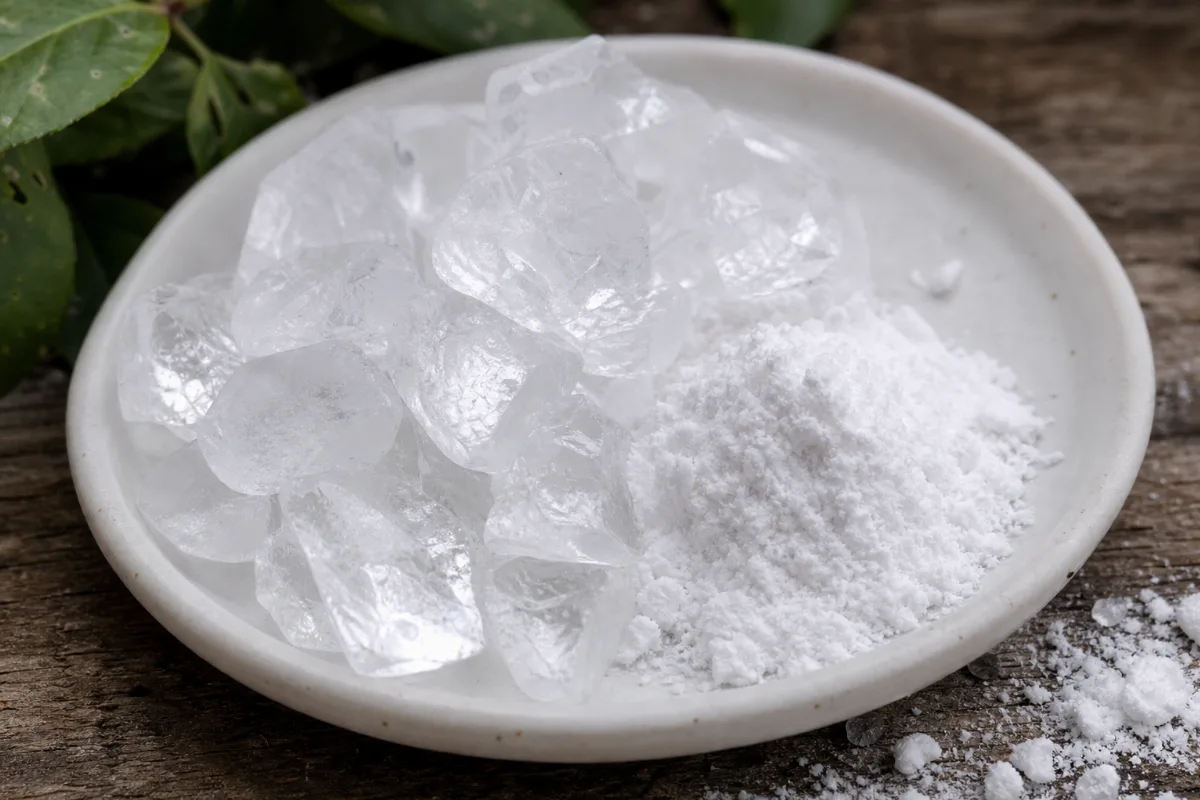
Potassium alum is a double sulfate of potassium and aluminum, usually sold as clear crystals or a white powder. "Alum" is a family word. Poison Control lists aluminum sulfate, potassium aluminum sulfate and sodium aluminum sulfate under it.
Grades differ. A styptic pencil is a regulated over-the-counter drug, a deodorant crystal is a personal-care product, and industrial alum is a different grade. Results for one alum do not carry over to another.
Traditional and current uses
People use alum on small shaving cuts, as a crystal rubbed on the underarm, as an after-shave astringent, and in pickling. The history of these uses comes from an encyclopedia page we could not verify.
Traditional use is not proof that it works or is safe.
What the research shows
Shaving cuts: a US rule allows the claim for aluminum sulfate styptic pencils. We found no trial of potassium alum.
Deodorant: a lab study found 2 percent potash alum slowed underarm bacteria on plates. A 2008 article said no research had been published on how crystal deodorants work. We found no human trial.
Absorption: no study measured aluminum entering the body from alum crystals. In 2014 the EU's consumer safety committee said skin-penetration data were too limited to assess aluminum risk in cosmetics. A 2022 study of a different compound, an antiperspirant, found about 0.00052 percent absorbed in 12 women, and the authors include staff of cosmetic companies.
Swallowing: gut absorption of aluminum is generally low but depends on the form and on food parts such as citrate (reviews and a two-volunteer study of other aluminum compounds).
At a glance
Traditional uses history, not proof
- Used as an astringent and for stopping small bleeds for a very long time (encyclopedia lead only, not verified).
- Used as an underarm deodorant in several countries (encyclopedia lead only, not verified).
- Used in pickling to add crispness (encyclopedia lead only, not verified).
Studied for research
- Stopping bleeding from shaving nicks, low certainty (a regulated styptic claim, no trial of potassium alum)
- Crystal deodorant for odor, very low (test-tube bacteria only)
- Not being absorbed through the skin, insufficient (not measured for alum crystals)
- Breast cancer and Alzheimer's worries, insufficient
- Acne, oily skin and skin whitening, insufficient
- Swallowing as a remedy, evidence against (harm reports only)
Main compounds
- Potassium aluminum sulfate
- Aluminum (Al3+)
Common forms
- Clear crystal or stone
- White powder
- Styptic pencil (aluminum sulfate, a related alum)
Research links: Poison Control: Are styptic pencils poisonous? · US rule for styptic pencils (21 CFR 347.52) · EU consumer safety committee on aluminium in cosmetics, 2014 · Skin absorption of aluminum from an antiperspirant, 2022 (abstract) · Crystal deodorant dermatitis, 1999 (abstract) · NCI: Antiperspirants/deodorants and breast cancer · Research Library · Genes & Biomarkers Library
What it is and its history
- Accepted scientific name
- Potassium alum (potassium aluminum sulfate), a mineral salt
- Synonyms
- Potash alum; Alum stone; Aluminum potassium sulfate; Crystal deodorant (shop name); Tawas; Fitkari
- Common names
- Alum (English); Potash alum (English); Fitkari (Hindi (transliterated))
- Family or group
- Double sulfate of potassium and aluminum; usually found as the hydrate with 12 water molecules (encyclopedia, NOT verified).
- Native range
- Mineral deposits (alunite is a source, per encyclopedia, NOT verified).
- What it looks like
- Colorless to white crystals or white powder (encyclopedia, NOT verified).
- Harvest and processing
- Different grades exist: a styptic pencil is a regulated over-the-counter product, a deodorant crystal is personal care, and industrial alum is used for water treatment and tanning. The grades were not checked.
- Look-alikes and adulterants
- Name: Ammonium alum and aluminum sulfate; Note: Close relatives sold as alum. The fatal case report was of ammonium alum, and the US styptic rule names aluminum sulfate. A result for one does not carry over to another.; Name: Aluminum chlorohydrate; Note: The aluminum compound in many antiperspirants. The skin-absorption figures in this profile are for it, not for alum.
Traditional use and history history, not clinical proof
| Tradition or era | Documented use | Source |
|---|---|---|
| Ancient to modern | Alum is described by an encyclopedia as known in Rome and Greece and used for centuries as a dye fixative in wool, and as a traditional underarm deodorant in several countries. NOT verified. | s-wiki |
| Modern United States | A 1999 report notes alum is an ancient agent with newfound popularity as an alternative health product, and a 2008 article says crystal deodorants of potassium or ammonium alum were recently marketed as all-natural alternatives. | p10431678 |
| Modern United States (regulation) | Aluminum sulfate styptic pencils are an over-the-counter category with a defined shaving-cut claim. | s-cfr-347 |
Traditional use shows how it was used. It does not show that it works or is safe today.
What is inside, and how it may work
What it contains and how those compounds act in cells and animals. Laboratory and animal mechanisms are not proven effects in people.
Main compounds
| Compound | Family | Where it is concentrated | Activity studied | Level of evidence |
|---|---|---|---|---|
| Potassium aluminum sulfate | inorganic salt | The main component of the crystal. | Astringent: tightens the surface of skin and small wounds. Slowed underarm bacteria in a lab at 2 percent. 2 18 | Laboratory |
| Aluminum (as Al3+) | metal | Not given in the sources read. | Poorly absorbed and cleared by the kidneys, but can build up when kidneys are weak or exposure is high. 3 6 18 | Human data |
Mechanisms, receptors and pathways
| Target or pathway | Gene or receptor | What was found | Level |
|---|---|---|---|
| Astringent / protein tightening on the skin surface | None | Alum compounds harden or coagulate the surface of a small wound like a scab (Poison Control description). Not tested on alum crystals in a trial. 18 | Expert description |
| Bacteriostatic action against underarm bacteria | None | Potash alum at 2 percent slowed growth of normal underarm bacteria on agar plates; subculture showed slowing, not killing. 2 | Laboratory |
| Aluminum toxicity proposals | None | A 2026 review lists oxidative stress, mitochondrial dysfunction, disturbed mineral balance and inflammation as proposed mechanisms of aluminum harm. These are proposals for aluminum in general. 6 | Narrative review |
Absorption, metabolism and elimination
- Absorption
- Not studied for potassium alum. Antiperspirant (aluminum chlorohydrate) through skin: about 0.00052 percent in 12 women. Swallowed aluminum: about 5 in 1000 as citrate and 1 in 10,000 as hydroxide in two volunteers; alum was not tested.
- Distribution
- Can slowly build up in bone and the nervous system with long exposure (2026 review).
- Elimination
- The kidneys excrete aluminum (Poison Control).
- Bioavailability
- Depends on the chemical form, food and components such as citrate (2026 review).
Nutritional composition
Alum is not a nutrient and is not sold or studied as one in the sources read. Aluminum has no known role in the body, and the figures in the safety file are about exposure, not benefit.
1 low certainty1 very low certainty4 not enough evidence1 evidence against
What was looked at
The 7 benefits and uses checked for Potassium Alum, each with how strong the evidence is. Tap one to open it.
- Stopping bleeding from small shaving nicks (on the skin)Low certainty
- Crystal deodorant and underarm odorVery low certainty
- "It is not absorbed through the skin" (claim check)Not enough evidence
- Worries about breast cancer and Alzheimer's disease from underarm aluminumNot enough evidence
- Acne, oily skin, toning and skin whiteningNot enough evidence
- Pickling and food useNot enough evidence
- Swallowing alum as a remedyEvidence against
What is Potassium Alum good for?
The uses people ask about and how strong the evidence is for each. Only the shaving-nick use has any regulated backing, and it is for a related alum.
Benefits, one by one
Each card is a research question, not a promise. Tap a goal to filter. Open a card to see the studies, doses and limits.
Stopping bleeding from small shaving nicks (on the skin)
Low certaintyA styptic pencil is the one established use. The US over-the-counter rule lets an aluminum sulfate styptic pencil say it stops bleeding from minor surface cuts during shaving. Poison Control says these pencils harden the surface of a small cut. We found no trial of potassium alum itself for this.
2 studiesNot covered. No use instructions or amounts are given here.
Studies, doses and limits
What the trials found
No clinical trial of potassium alum on cuts was found. The support is a US over-the-counter rule for aluminum sulfate styptic pencils and a poison-centre description.
Results
The rule allows the claim "stops bleeding caused by minor surface cuts and abrasions as may occur during shaving". Labels must say "for external use only" and "avoid contact with eyes".
Effect sizes as reported
No effect sizes in the sources read.
Why this rating
A regulated product category and an expert description support it for small surface cuts, but we found no trial, and the rule names aluminum sulfate, not potassium alum by name.
Form and dose studied
Not covered. No use instructions or amounts are given here.
Who was studied
Not studied in a trial; the rule is about adult shaving cuts.
Limits
No trial data; no comparison with other methods.
Why researchers looked
Shaving nicks bleed, and people want something quick that is already in the bathroom.
Traditional use
Alum has been used as a styptic for a very long time, but the sources we read give no dated history that we could check.
Proposed mechanism Expert description
Alum compounds cause the surface proteins of a small wound to tighten and clot, like a scab (Poison Control description).
A proposed mechanism does not show that the effect happens in people.
On skin only. Stinging is expected. Keep it out of the eyes. It is not for deep cuts or wounds that keep bleeding; those need medical care.
Crystal deodorant and underarm odor
Very low certaintyAlum "crystal deodorant" is sold as a natural way to stop body odor. In a test-tube study a 2 percent potash alum preparation slowed the growth of underarm skin bacteria. A 2008 article said no research had been published on how these crystals work. We found no trial in people.
2 studiesNot covered. No use instructions or amounts are given here.
Studies, doses and limits
What the trials found
No human trial of alum crystals for odor or sweat was found in PubMed or the pages read.
Results
Test tubes: the lowest concentration that stopped growth was 2 percent, and it was bacteriostatic. The same study made lotion, cream and gel and found them stable in storage.
Effect sizes as reported
No effect sizes in the sources read.
Why this rating
Lab results on bacteria in a dish do not show that a crystal rubbed on skin reduces odor in people.
Form and dose studied
Not covered. No use instructions or amounts are given here.
Who was studied
Not studied in people.
Limits
Test-tube only; the lotion was made by the authors, not a store crystal; small academic group.
Why researchers looked
Underarm odor comes from skin bacteria, and alum is an old astringent that is also found to slow some bacteria in the lab.
Traditional use
Alum is described as a traditional underarm deodorant in several countries (encyclopedia lead only, NOT verified).
Proposed mechanism Laboratory
In the lab, potash alum slowed the growth of normal underarm bacteria (bacteriostatic) rather than killing them. This was tested on agar plates, not on skin.
A proposed mechanism does not show that the effect happens in people.
Some people get an irritant or inflamed rash from crystal deodorants (see Safety).
"It is not absorbed through the skin" (claim check)
Not enough evidenceSellers say alum crystals stay on the skin surface and are not absorbed. We found no study that measured aluminum entering the body from alum crystals. Studies of a different aluminum product, an antiperspirant, found very little absorption.
4 studiesNot covered. No use instructions or amounts are given here.
Studies, doses and limits
What the trials found
Two human studies of antiperspirants (not alum) are described. None was done on alum crystals.
Results
Antiperspirant, 12 women: best estimate of the fraction absorbed through skin 0.00052 percent. Antiperspirant, 21 people for 14 days: no measurable rise in blood or urine aluminum. The EU consumer safety committee said in 2014 that, without good skin-penetration data, a risk assessment for aluminum in cosmetics could not be performed.
Effect sizes as reported
No effect sizes in the sources read.
Why this rating
No absorption study of alum crystals exists in the sources read, and the antiperspirant results cannot be carried over to a different compound.
Form and dose studied
Not covered. No use instructions or amounts are given here.
Who was studied
Healthy adults in the antiperspirant studies.
Limits
Different compound; short studies; one of them was linked to industry.
Why researchers looked
People worry about aluminum from underarm products and want to know if crystals are safer.
Proposed mechanism Pharmacokinetic human
Aluminum chlorohydrate in an antiperspirant stayed mostly in the outer layers of skin in one tracer study; alum is a different compound.
A proposed mechanism does not show that the effect happens in people.
Broken skin, newly shaved skin and kidney disease are the situations where more caution is sensible; see Safety.
Worries about breast cancer and Alzheimer's disease from underarm aluminum
Not enough evidenceThe US National Cancer Institute says no scientific evidence links antiperspirants or deodorants to breast cancer. For Alzheimer's disease, a 2017 chapter says it remains controversial whether low doses of aluminum add to the disease. None of this was studied for alum crystals.
4 studiesNot covered. No use instructions or amounts are given here.
Studies, doses and limits
What the trials found
No study of alum crystals. Studies of antiperspirant use and breast cancer found no increased risk in the NCI summary. One study of aluminum deodorants and Alzheimer's (130 matched pairs, odds ratio 1.6) was called inconclusive in a 2008 article.
Results
NCI: no evidence links these products to breast cancer; a 2002 study of 813 women with breast cancer and 793 without found no increase in risk. Reviews call the Alzheimer's question controversial or unresolved.
Effect sizes as reported
No effect sizes in the sources read.
Why this rating
No good evidence of harm or of safety for alum crystals specifically; the question is open and the studies are of other aluminum products.
Form and dose studied
Not covered. No use instructions or amounts are given here.
Who was studied
General adult populations in the antiperspirant studies.
Limits
Questionnaire-based studies; different products; the Alzheimer study used proxy respondents.
Why researchers looked
Aluminum is in many underarm products, and people ask if it can reach the breast or brain.
Proposed mechanism Narrative review
Proposed ideas in the sources include oxidative stress and aluminum build-up in tissues; a 2021 review says it is not yet known whether aluminum can travel from the skin to the brain.
A proposed mechanism does not show that the effect happens in people.
Not a reason to change anything on its own; people with concerns can talk to a doctor or pharmacist.
Acne, oily skin, toning and skin whitening
Not enough evidenceSome sellers use alum as an astringent for oily skin and acne, and in skin-whitening products. A 2026 consumer health article says support for acne and oily skin is anecdotal and that no scientific evidence supports skin whitening.
1 studiesNot covered. No use instructions or amounts are given here.
Studies, doses and limits
What the trials found
No trial of alum for acne, oily skin or skin colour was found.
Results
No results to report. The article says any lightening is likely temporary tightening, not a change in pigment.
Effect sizes as reported
No effect sizes in the sources read.
Why this rating
Only anecdote and a consumer article; no trial.
Form and dose studied
Not covered. No use instructions or amounts are given here.
Who was studied
Not studied.
Limits
No trial data.
Why researchers looked
Alum tightens skin and slows some bacteria, so it is marketed for face and body care.
Traditional use
Not described in a source we could verify.
Proposed mechanism Expert description
Temporary tightening of the skin surface is the likely explanation for any short-lived effect, per the consumer article.
A proposed mechanism does not show that the effect happens in people.
Alum can sting, tighten or dry the skin, especially broken or sensitive skin; see Safety.
Pickling and food use
Not enough evidencePotassium alum is sold as "alum powder" for pickling, where an encyclopedia says it adds crispness. In the US it is listed as generally recognized as safe when used under good manufacturing practice. We found no study of the crisping effect, and that listing does not make it a remedy.
3 studiesNot covered. No use instructions or amounts are given here.
Studies, doses and limits
What the trials found
No human study. The US food status is a legal listing, not a trial.
Results
21 CFR 182.1129 lists aluminum potassium sulfate as generally recognized as safe under good manufacturing practice.
Effect sizes as reported
No effect sizes in the sources read.
Why this rating
Only a legal food status and an unverified encyclopedia statement.
Form and dose studied
Not covered. No use instructions or amounts are given here.
Who was studied
Not studied.
Limits
Dietary aluminum varies by food, and children can approach or exceed tolerable weekly intake from all sources combined (see Safety).
Why researchers looked
Home cooks have used it in pickles for a long time.
Traditional use
The pickling use comes from an encyclopedia page only (NOT verified).
Proposed mechanism None described
Not described in the sources read.
A proposed mechanism does not show that the effect happens in people.
Not a medicine. Alum in pickles is a food-use question, not a remedy; ask a pharmacist or dietitian if you have kidney disease.
Swallowing alum as a remedy
Evidence againstWe found no source that supports drinking or swallowing alum for health. Poison Control says styptic pencils are not meant to be eaten. A hospital case report describes a death after a related alum was swallowed.
2 studiesNot covered. No use instructions or amounts are given here.
Studies, doses and limits
What the trials found
No trial of swallowing alum for any benefit. The human reports are poisoning cases.
Results
A 77-year-old woman who swallowed 5 g of aluminum ammonium sulfate in water died after severe acid imbalance and organ failure. This was a deliberate overdose of a related alum and shows harm can happen, not how often.
Effect sizes as reported
No effect sizes in the sources read.
Why this rating
Only harm signals were found, and no benefit.
Form and dose studied
Not covered. No use instructions or amounts are given here.
Limits
Case reports only.
Why researchers looked
Alum is sold in some places as a household remedy, so people ask if it can be taken by mouth.
Traditional use
Not described in a source we could verify.
Proposed mechanism None described
Not applicable.
A proposed mechanism does not show that the effect happens in people.
We do not advise swallowing it. If someone has swallowed alum, call poison control (US 1-800-222-1222) or your local emergency number.
Connections to the rest of health
How Potassium Alum connects to the rest of our health knowledge graph. Every link says what kind of connection it is. A safety link (for example to the liver) is a warning, not a benefit. A study that merely mentions a topic never creates a benefit link.
Explore every connection: goals, body systems, organs, symptoms, genes
A. Wellness goals
| Connected to | Kind of connection | Evidence status | Context | Studies |
|---|---|---|---|---|
| Healthy Skin | Low certainty | Stopping bleeding from small shaving nicks (on the skin): A styptic pencil is the one established use. The US over-the-counter rule lets an aluminum sulfate styptic pencil say it stops bleeding from minor surface cuts during shaving. Poison Control says these pencils harden the surface of a small cut. We found no trial of potassium alum itself for this. | 17 18 | |
| Healthy Skin | Very low certainty | Crystal deodorant and underarm odor: Alum "crystal deodorant" is sold as a natural way to stop body odor. In a test-tube study a 2 percent potash alum preparation slowed the growth of underarm skin bacteria. A 2008 article said no research had been published on how these crystals work. We found no trial in people. | 2 14 | |
| Healthy Skin | Not enough evidence | "It is not absorbed through the skin" (claim check): Sellers say alum crystals stay on the skin surface and are not absorbed. We found no study that measured aluminum entering the body from alum crystals. Studies of a different aluminum product, an antiperspirant, found very little absorption. Acne, oily skin, toning and skin whitening: Some sellers use alum as an astringent for oily skin and acne, and in skin-whitening products. A 2026 consumer health article says support for acne and oily skin is anecdotal and that no scientific evidence supports skin whitening. | 15 7 16 12 20 |
B. Body systems
L. Active compounds
| Connected to | Kind of connection | Evidence status | Context | Studies |
|---|---|---|---|---|
| Potassium aluminum sulfate | Biological association | Laboratory | Astringent: tightens the surface of skin and small wounds. Slowed underarm bacteria in a lab at 2 percent. | 2 18 |
| Aluminum (as Al3+) | Biological association | Human | Poorly absorbed and cleared by the kidneys, but can build up when kidneys are weak or exposure is high. | 3 6 18 |
Each connection is stored with the ingredient, the connected record, the kind of connection, the evidence status, the supporting studies, the preparation or compound involved, and a review date (last reviewed October 25, 2026).
Evidence at a glance: what the research found for 7 outcomes
Each outcome below is one thing researchers measured. Certainty is how far the evidence can be trusted, not how well it works. The full studies are on the next tab.
The evidence
The research centre for Potassium Alum. Every record here was checked against PubMed or the publisher's page; we never list a study we have not verified.
Evidence by outcome
Bars show how many studies we found for each outcome, not how well it works. People are added up across trials only (reviews are not added, to avoid double counting).
How we rate evidence
High certainty
Several well-run trials or reviews agree; further research is unlikely to change the picture much.
Moderate certainty
Good trials point the same way, but some doubt remains.
Low certainty
Small, short or inconsistent trials. The finding could change with better research.
Very low certainty
Very little or very weak human data. Treat as a possibility only.
Mixed findings
Trials or reviews disagree with each other.
Not enough evidence
Not enough human research to say either way.
Evidence against
Good research found no benefit, or found harm.
We take the reviewers' own risk-of-bias and GRADE statements where they exist, and otherwise judge from study size, design, consistency, directness and whether a product matches what is sold. Many publications do not make evidence high. Method note: We searched PubMed, read the abstract of each cited paper (one letter had no abstract, only its title), and read the US styptic and food rules, the EU consumer safety committee summary, the National Cancer Institute page and Poison Control. Certainty ratings are the compiler's own reading. History and pickling statements come from an encyclopedia page and are not verified. Regulators outside the US and EU were not checked. No study is cited that we could not verify.
Study library: every study we checked 22
| Study | Design | People | Product, dose, length | Result |
|---|---|---|---|---|
| Al-Ghadeer 2020 Corneal thinning induced by self-administered alum substance: a case report and analysis of the active components Middle East African Journal of Ophthalmology · PMID 32549727 · DOI |
Case report |
1 A 56-year-old woman |
An alum substance put in the eye mineral salt (not a plant) |
After she put an alum substance in her left eye she had severe corneal thinning, a scar and reduced vision. The authors say alum put in the eye may cause severe, permanent eye injury. Methods, limits and fundingOutcomes: Eye injury after alum in the eye Limitations: One case. Funding and conflicts: No conflicts declared Read: abstract |
| Alzomor 2014 Formulation and evaluation of potash alum as deodorant lotion and after shaving astringent as cream and gel International Current Pharmaceutical Journal · Source · DOI |
Laboratory study bacteria in the lab |
Normal underarm skin bacteria grown on agar plates in a lab | Potash alum, 0.1 to 9 percent, tested on agar; the authors also made 2 percent lotion, cream and gel mineral salt (not a plant) |
The lowest concentration that stopped growth (MIC) was 2 percent, and subculture showed the effect was bacteriostatic (it slows growth, it does not kill). The test formulations were stable for the storage period tested. Methods, limits and fundingOutcomes: Activity of potash alum against underarm bacteria Limitations: Test-tube study. Not a trial in people and not an alum stone. Small academic group. Funding and conflicts: Not stated in the abstract Read: abstract |
| Colomina 2017 Aluminum and Alzheimer's disease Advances in Neurobiology · PMID 28889268 · DOI |
Narrative review mixed |
Literature on aluminum and brain disease | Aluminum in general mineral salt (not a plant) |
The chapter says humans are protected against aluminum by low absorption and efficient kidney excretion, that aluminum has been shown to cause encephalopathy, anemia and bone disease in dialysed patients, and that it remains controversial whether low doses add to Alzheimer's disease. Methods, limits and fundingOutcomes: Whether aluminum contributes to Alzheimer's disease Limitations: Chapter on aluminum in general, not alum crystals. Funding and conflicts: Not stated in the abstract Read: abstract |
| Gallego 1999 Crystal deodorant dermatitis: irritant dermatitis to alum-containing deodorant Cutis · PMID 10431678 |
Case report |
2 Two people who developed an underarm rash |
An over-the-counter "natural deodorant crystal" product containing alum, used on the underarm mineral salt (not a plant) |
Two patients developed an irritant dermatitis of the underarms shortly after using an over-the-counter "natural deodorant crystal" containing alum. The authors call this a previously unreported reaction to alum. Methods, limits and fundingOutcomes: Skin reaction after using alum deodorant crystal Limitations: Two cases; no rate of how often this happens. The abstract does not say which alum was in the product. Funding and conflicts: Not stated in the abstract Read: abstract |
| Kim 2002 A case of 'alum' intoxication leading to ARDS Tuberculosis and Respiratory Diseases (Korea) · Source · DOI |
Case report |
1 A 77-year-old woman |
Aluminum ammonium sulfate ("alum") powder, 5 g dissolved in water, swallowed on purpose mineral salt (not a plant) |
She was admitted 3 hours after swallowing it, was treated with stomach washing, activated charcoal and supportive care, developed a severe acid imbalance and multiple organ failure including ARDS, then refractory shock and died. Methods, limits and fundingOutcomes: Poisoning and outcome after swallowing alum Limitations: One case; deliberate ingestion; the compound was ammonium alum, a close relative of potassium alum. Funding and conflicts: Not stated Read: abstract |
| Kogut 2026 Dietary aluminium exposure and human health: sources, bioavailability, toxicokinetics, and health risk assessment Nutrients · PMID 42654300 · DOI |
Narrative review mixed |
Literature on aluminium in food and water | Dietary aluminium (including aluminium-containing additives) mineral salt (not a plant) |
Gut absorption is generally low but depends on the chemical form, food and other components such as citrate. Long exposure can lead to slow build-up, especially in bone and the nervous system. Some groups approach or exceed tolerable weekly intake values. The review says current evidence does not establish that typical dietary exposure directly causes chronic disease. Methods, limits and fundingOutcomes: How much aluminium is absorbed from diet Limitations: Narrative review; not specific to potassium alum. Funding and conflicts: No commercial conflicts declared; one author employed by a medical centre Read: abstract |
| Letzel 2020 Impact of daily antiperspirant use on the systemic aluminum exposure: an experimental intervention study Skin Pharmacology and Physiology · PMID 31553995 · DOI |
Before after study |
21 21 healthy people chosen to have a low aluminum background load (some urine samples later excluded) |
A commercial aluminum-containing antiperspirant used daily for 14 days (not alum crystals) mineral salt (not a plant) 14 days |
No significant rise in plasma aluminum or in aluminum excreted per day was measurable after 14 days. No sample went above general-population reference values. The authors say long-term use and higher concentrations are still not studied. Methods, limits and fundingOutcomes: Aluminum in plasma and 24-hour urine before and after use Limitations: Antiperspirant, not alum crystals; 14 days only; small group; no control group. Funding and conflicts: Not stated in the abstract Read: abstract |
| Leventhal 2014 Crystal deodorant-induced axillary granulomatous dermatitis International Journal of Dermatology · PMID 23621443 · DOI |
Case report |
Not stated (letter; PubMed holds no abstract) | Crystal deodorant, used on the underarm mineral salt (not a plant) |
Only the title was read: it reports an underarm granulomatous skin reaction linked to crystal deodorant. No abstract is held in PubMed and the full text was not read. Methods, limits and fundingOutcomes: Granulomatous underarm skin reaction (title only) Limitations: Title only; case numbers, product and outcome not read. Funding and conflicts: Not stated Read: title-only |
| Nakamura 2000 Acute encephalopathy due to aluminum toxicity successfully treated by combined intravenous deferoxamine and hemodialysis Journal of Clinical Pharmacology · PMID 10709159 · DOI |
Case report |
1 One patient with severe aluminum encephalopathy after alum bladder irrigation |
Alum bladder irrigation (hospital procedure) mineral salt (not a plant) |
The authors describe a severe aluminum encephalopathy after alum bladder irrigation, treated with deferoxamine and hemodialysis. They say acute aluminum poisoning is uncommon but can be fatal. Methods, limits and fundingOutcomes: Aluminum encephalopathy and its treatment Limitations: One case; a hospital procedure. Funding and conflicts: Research support from a US public health grant Read: abstract |
| Perazella 1993 Acute aluminum toxicity and alum bladder irrigation in patients with renal failure American Journal of Kidney Diseases · PMID 8418625 · DOI |
Case report and review |
1 A person with kidney failure after bone marrow transplant, plus two similar cases found in the literature |
Alum instilled into the bladder (hospital treatment for bleeding cystitis) mineral salt (not a plant) |
The patient developed acute encephalopathy from apparent aluminum poisoning after alum was instilled in the bladder. The authors found two similar cases in people with kidney failure and suggested other treatments be chosen in such patients. Methods, limits and fundingOutcomes: Aluminum poisoning after alum bladder irrigation Limitations: Case report; a hospital procedure, not home use. Funding and conflicts: Not stated in the abstract Read: abstract |
| Priest 1996 The bioavailability of 26Al-labelled aluminium citrate and aluminium hydroxide in volunteers Biometals · PMID 8696074 · DOI |
Human pharmacokinetic study |
2 Two male volunteers |
Aluminium citrate and aluminium hydroxide labelled with 26Al, put into the stomach in water mineral salt (not a plant) · vs Aluminium hydroxide with and without citrate |
The fraction taken up was about 5.2 in 1000 for aluminium citrate and about 1 in 10,000 for aluminium hydroxide. Adding citrate to the hydroxide raised uptake to about 1.4 in 1000. Methods, limits and fundingOutcomes: Fraction of swallowed aluminium taken up Limitations: Only two volunteers and two aluminium forms; alum was not tested. Funding and conflicts: Not stated in the abstract Read: abstract |
| Sanajou 2021 Aluminium in cosmetics and personal care products Journal of Applied Toxicology · PMID 34396567 · DOI |
Narrative review mixed |
Literature on aluminium-based cosmetics and personal care products | Aluminium salts in cosmetics (general) mineral salt (not a plant) |
The review says the skin absorption of aluminium is not widely understood and that it is not yet known whether aluminium can travel from skin to brain. It says carcinogenicity has not been proved, and that studies of breast cancer relied on questionnaire information that is inconsistent, with conflicting results. Methods, limits and fundingOutcomes: Whether aluminium cosmetics may harm the body Limitations: Narrative review of aluminium salts in general, not alum crystals. Funding and conflicts: Not stated in the abstract Read: abstract |
| Tietz 2019 Aggregated aluminium exposure: risk assessment for the general population Archives of Toxicology · PMID 31659427 · DOI |
Exposure assessment mixed |
General population in Germany; food, additives, cosmetics, medicines and food-contact material | Aluminium from all sources added together mineral salt (not a plant) |
Average adult weekly aluminium from food is about half of the EFSA tolerable weekly intake of 1 mg/kg body weight. For infants and young children the tolerable intake can be reached or slightly exceeded. Adding food contact materials, cosmetics and medicines, a significant exceedance can occur, especially in 11 to 14 year olds. The authors give advice on cutting total exposure. Methods, limits and fundingOutcomes: Total aluminium exposure compared with tolerable intake Limitations: German data; a risk assessment from a federal institute, not an alum study. Funding and conflicts: Government institute (BfR); no conflicts stated in the abstract Read: abstract |
| Zirwas 2008 Antiperspirant and deodorant allergy: diagnosis and management Journal of Clinical and Aesthetic Dermatology · PMID 21203361 |
Narrative review mixed |
Underarm skin allergy to antiperspirants and deodorants | Antiperspirants, deodorants and crystal deodorants (general) mineral salt (not a plant) |
The article says that no research had been published on how crystal deodorants (potassium or ammonium alum) work, and that the maker's claim is that the mineral salts stop bacteria living there. It says one study of aluminum deodorants and Alzheimer's disease (130 matched pairs, odds ratio 1.6) was inconclusive. It suggests crystal products may be useful for people with underarm rash, but says the rash can persist. Methods, limits and fundingOutcomes: Claims about crystal deodorants Limitations: Review article; the suggestion about crystals is the authors' opinion, not a trial result. PubMed holds no abstract so the full text (PMC) was read. Funding and conflicts: Not stated Read: full-text |
| de Ligt 2022 Assessment of dermal absorption of aluminium from a representative antiperspirant formulation using a (26Al)Al microtracer approach: a follow-up study in humans Toxicology Research (Cambridge) · PMID 35782644 · DOI |
Human pharmacokinetic study |
12 12 healthy women |
Aluminium chlorohydrate (an antiperspirant compound, not alum) labelled with 26Al in a roll-on, applied to skin mineral salt (not a plant) · vs Intravenous 26Al citrate used to normalise urine data |
The best estimate of the fraction of aluminium absorbed through the skin from the antiperspirant was 0.00052%. Most of the aluminium stayed in the outer layers of the skin. Methods, limits and fundingOutcomes: Fraction of aluminium absorbed through skin Limitations: Aluminium chlorohydrate in a roll-on, not potassium alum crystals, so it cannot be carried over to alum. Small study of healthy women. Funding and conflicts: Authors include staff from Procter & Gamble, Beiersdorf, Colgate-Palmolive, L'Oreal and Unilever (industry-linked) Read: abstract |
| n/a 2014 EU Scientific Committee on Consumer Safety: Opinion on the safety of aluminium in cosmetic products (SCCS/1525/14, revised 18 June 2014) European Commission, Public Health · Source |
Authoritative guidance n/a |
n/a | n/a |
Says aluminium is a known systemic toxicant at high doses, and that because adequate data on skin penetration were lacking, a risk assessment could not be performed. It asked for a human exposure study under use conditions. It also noted confusion over what counts as a deodorant versus an antiperspirant. Methods, limits and fundingOutcomes: Safety of aluminium in cosmetics Limitations: The 2014 opinion is about aluminium in cosmetics generally. Only the web summary was read, not the full PDF. Read: summary-page |
| n/a 2026 US Code of Federal Regulations, 21 CFR 347.52 (labeling of astringent drug products) and 21 CFR 347.12(b) (aluminum sulfate styptic pencil) e-CFR via Cornell LII · Source |
Regulation n/a |
n/a | n/a |
For aluminum sulfate (46 to 63 percent) used as a styptic pencil, the label may say "Stops bleeding caused by minor surface cuts and abrasions as may occur during shaving." Labels must say "For external use only" and "avoid contact with eyes. If contact occurs, rinse thoroughly with water." Methods, limits and fundingOutcomes: What an over-the-counter styptic pencil may claim Limitations: The rule names aluminum sulfate, not potassium alum. It sets what may be claimed; it is not a trial. Read: full-text |
| n/a 2026 Poison Control: Are styptic pencils poisonous? (page read 2026-10-25; no date shown) Poison Control (National Capital Poison Center) · Source |
Authoritative guidance n/a |
n/a | n/a |
Says styptic pencils are often made with aluminum salts such as aluminum sulfate, potassium aluminum sulfate or sodium aluminum sulfate, and are called alum. They harden the surface of a small cut. The page says the user may feel stinging and that absorption into the body is minimal. A bite may cause stomach upset or nausea. Serious toxicity (sedation, confusion, seizure) has followed alum bladder washing done for 24 hours or more, not styptic pencil use. The kidneys excrete aluminum so people with weak kidneys may accumulate it, yet an accidental taste should be okay. Alum in the eye can injure it: remove contact lenses and rinse with room-temperature water for 15 to 20 minutes. Keep pencils from children and pets. It tells of a man who became dizzy and nauseated after breathing alum powder while making geodes. Poison centre: 1-800-222-1222 (US). Methods, limits and fundingOutcomes: Safety of styptic pencils (alum compounds) Limitations: Authoritative page, not a trial; US numbers; no publication date shown. Read: full-text |
| n/a 2026 National Cancer Institute: Antiperspirants/Deodorants and Breast Cancer (page read 2026-10-25) NCI (US National Institutes of Health) · Source |
Authoritative guidance n/a |
n/a | n/a |
Says no scientific evidence links the use of antiperspirants or deodorants to the development of breast cancer. It describes a 2014 review that found no clear evidence of an increased risk, and a 2002 study of 813 women with breast cancer and 793 without that found no increase in risk. Methods, limits and fundingOutcomes: Link between underarm products and breast cancer Limitations: The page is about antiperspirants and deodorants in general, not alum crystals. The review date of the page was not visible in the text read. Read: full-text |
| n/a 2026 Medical News Today: What is alum and is it safe to use on the skin? (consumer article, updated 20 February 2026) Medical News Today · Source |
Consumer health article n/a |
n/a | n/a |
Says no research shows whether alum works for acne or oily skin and that reports are anecdotal, that no scientific evidence supports skin whitening, and that any lightening is likely temporary tightening. It lists tingling, tightness, dryness and itchiness as possible effects, more likely on sensitive or broken skin, and says eye exposure can cause lasting damage. Methods, limits and fundingOutcomes: Skin uses of alum Limitations: A consumer article, not a study. Used only to describe what sellers and consumers claim. Read: full-text |
| n/a 2026 US Code of Federal Regulations, 21 CFR 182.1129 (aluminum potassium sulfate, substances generally recognized as safe) e-CFR via Cornell LII · Source |
Regulation n/a |
n/a | n/a |
Lists aluminum potassium sulfate as generally recognized as safe when used in accordance with good manufacturing practice. Methods, limits and fundingOutcomes: US food status of aluminum potassium sulfate Limitations: A legal status for food use at good manufacturing practice levels. It does not say how much is safe to swallow, and it is not an endorsement as a remedy. Read: full-text |
| n/a 2026 Wikipedia: Potassium alum (read 2026-10-25; encyclopedia only, NOT verified) Wikipedia · Source |
Encyclopedia n/a |
n/a | n/a |
Describes potassium alum as a double sulfate with the formula KAl(SO4)2, used in water purification, tanning, dyeing and as E522; says its main culinary use is in pickling recipes to add crispness; says it was described by Pliny and Dioscorides, was used in the wool industry as a dye fixative, and is used traditionally as a deodorant in several countries (names include tawas and fitkari). Methods, limits and fundingOutcomes: Identity, history and uses of potassium alum Limitations: Encyclopedia page; several statements carry no citation. Used only as a lead and marked NOT verified wherever it appears. Read: encyclopedia-only |
What we do not know yet
- No skin-absorption study of alum crystals.
- No human trial of alum crystals for odor or sweat.
- No trial of potassium alum on shaving nicks.
- No test of the purity of consumer alum products.
- No data on pregnancy, breastfeeding, children or medicine interactions.
How new research is added
New studies are found by a saved PubMed search and are placed in a review queue. A person reads each one before it changes any evidence rating or safety wording.
Lab markers
What changed in blood or saliva tests during trials. A changed number is not the same as feeling or being healthier, and we give no "normal ranges".
Safety
What studies and official sources say about side effects, medicines and who should check first. Each point shows what kind of evidence it comes from.
Main points to know 5
- Do not swallow it. No source supports swallowing alum for health. Poison Control says styptic pencils are not meant to be eaten and a bite may cause stomach upset or nausea. A hospital case report describes a death after a woman swallowed 5 g of a related alum (ammonium alum) in water. If someone has swallowed alum, call poison control. Case report 18 5
- Keep it out of the eyes. A case report describes severe corneal thinning, a scar and reduced vision after a woman put an alum substance in her eye. Poison Control says to remove contact lenses and rinse with room-temperature water for 15 to 20 minutes. US styptic labels must say to avoid contact with eyes. Case report 1 18 17
- Skin reactions are reported with crystal deodorants. Two people developed an irritant underarm rash soon after using an alum crystal deodorant (1999), and a later report describes a granulomatous underarm reaction (2014; title only was read). Poison Control lists stinging, redness, itching or mild pain after a styptic pencil, and a consumer article adds tightness and dryness on broken or sensitive skin. Case report 4 8 18 20
- Aluminum can build up when the kidneys are weak. The kidneys remove aluminum. Poison Control says people with impaired kidney function might accumulate it. Hospital case reports describe aluminum poisoning with confusion (encephalopathy) after alum washes of the bladder, which are a medical procedure done over many hours, not styptic or deodorant use. Case report 18 10 9 3
- Skin absorption of alum crystals is unmeasured. We found no study measuring aluminum absorption from alum crystals. The EU consumer safety committee said in 2014 that data on skin penetration were inadequate for a risk assessment. Antiperspirant studies (a different compound) found very low absorption. Expert panel review 16 15 7
Side effects 7
| Effect | How often | Severity and recovery | Evidence |
|---|---|---|---|
| Skin irritation: stinging, redness, itching, tightness, dryness No rates found. More likely on sensitive or broken skin. | Not established | mild Poison Control says it should settle after a short period | Authoritative guidance 18 20 |
| Irritant or inflamed underarm rash from crystal deodorant How often this happens is not known. | Two patients in one report; one further report (title only) | unknown Not stated in the abstracts | Case report 4 8 |
| Stomach upset, nausea or vomiting if a small piece is swallowed A small taste only; larger amounts are a different matter. | Not established | mild Poison Control says these symptoms are likely to pass quickly | Authoritative guidance 18 |
| Serious poisoning with organ failure after swallowing a large amount of a related alum A deliberate 5 g overdose of ammonium alum; shows harm can happen, not how often. | One reported death | life-threatening Not reversible in that case | Case report 5 |
| Eye injury (corneal thinning, scar, reduced vision) Alum placed in the eye on purpose. | One case report | serious Scar and reduced vision in the case | Case report 1 |
| Dizziness and nausea after breathing alum dust A man making geodes with alum powder and no mask. | One poison-centre case | mild Recovered in about an hour | Authoritative guidance 18 |
| Aluminum poisoning with encephalopathy after alum bladder irrigation A hospital procedure, not home use; reported mostly in people with kidney failure. | Case reports | serious One case was treated successfully with deferoxamine and hemodialysis; outcomes vary | Case report 10 9 18 |
Liver
No report of liver injury from potassium alum was found in the sources read. LiverTox was not searched.
How often. No rate in people.
Monitoring. No monitoring advice was found.
This is a safety connection. It is not evidence that Potassium Alum supports liver health.
Medicines and supplements 3
| With | Why it matters | Importance | Evidence | What to do |
|---|---|---|---|---|
| Citrate-containing foods and drinks (swallowed aluminum) food | In a two-volunteer tracer study, aluminum taken up from the gut was higher as citrate than as hydroxide, and adding citrate to aluminum hydroxide raised uptake. A 2026 review also lists citrate among the components that change aluminum bioavailability. | Alum was not tested, and the figures come from two volunteers and other aluminum compounds. This is a reason not to assume swallowed alum is poorly absorbed. | Human pharmacokinetic Very low certainty 11 6 | Not advice to swallow alum. Ask a pharmacist if you take aluminum-containing products by mouth. |
| Medicines (in general) prescription | Not described in the sources read. | No interaction study with potassium alum was found. Not found is not proof of safety. | Gap Not enough evidence | Ask a doctor or pharmacist if you take regular medicines and are thinking of swallowing any alum product. |
| Skin medicines and other underarm products topical | Not described in the sources read. | No study found. | Gap Not enough evidence 14 | If you already have an underarm rash, ask a pharmacist or doctor before adding any new product. |
Who should check first 6
| Situation | Advice | Evidence |
|---|---|---|
| Swallowing in pregnancy or breastfeeding | No data on potassium alum were found. We do not advise swallowing alum; ask a clinician. | Gap |
| Babies and children | No data on potassium alum were found. Poison Control advises keeping styptic pencils away from children and pets, sweeping up crumbs and washing hands after use, and notes crumbs can be a choking risk. A 2019 exposure assessment found infants and young children can reach or slightly exceed the tolerable weekly aluminum intake from all sources. | Authoritative guidance 18 13 |
| Kidney disease or dialysis | Aluminum builds up when the kidneys are weak, and aluminum encephalopathy, anemia and bone disease are described in dialysed patients. Ask a clinician before using any aluminum product, and never swallow alum. | Narrative review 18 3 10 |
| Broken, freshly shaved, sensitive or already irritated skin | Stinging, tightness and dryness are more likely. A rash after using crystal deodorant is a reason to stop and ask a pharmacist or doctor. | Case report 20 4 8 |
| Contact lens wearers and anyone with eye disease | Keep alum away from the eyes. If it gets in, remove lenses and rinse with room-temperature water for 15 to 20 minutes, then get medical advice. | Case report 18 1 |
| Asthma or lung conditions | No potassium alum data were found, except one poison-centre case of dizziness and nausea after breathing alum dust. Avoid breathing powder. | Authoritative guidance 18 |
Overdose, product quality and regulators
Summary. Potassium alum is a mineral salt, not a plant. It contains aluminum. Poisoning reports are about swallowing a large amount of a related alum, washing the bladder with alum in hospital, and getting alum in the eye. No toxicity study of potassium alum crystals was found.
Animal. Not searched.
Human doses studied. No dose studies of potassium alum in people were found.
High dose or long term signals. A 2026 review says long exposure to dietary aluminum can slowly build up in bone and the nervous system, and that current evidence does not establish that typical dietary exposure directly causes chronic disease. The EFSA tolerable weekly intake for aluminum from all sources is 1 mg per kg body weight per week (as reported in a 2019 German assessment).
Overdose response. If someone has swallowed alum and feels unwell, or a child has swallowed a piece, call poison control (US 1-800-222-1222) or your local emergency number. Call 911 for collapse, seizure, trouble breathing or inability to wake.
Genotoxicity. Not read.
We found no test of the metal or purity of crystal deodorants or alum powders sold to consumers. Grade matters: a styptic pencil is a regulated over-the-counter drug, a deodorant crystal is a personal-care product, and industrial alum is a different thing.
Total aluminum from all sources. A German assessment found average adult food intake is about half the tolerable weekly intake and that adding cosmetics, medicines and food-contact materials can push intake over it, especially in 11 to 14 year olds. Alum products were not separately counted in the abstract. 13
Crystal vs antiperspirant. Antiperspirant studies show very low skin absorption, but those are a different aluminum compound, and long-term use was not studied. 15 7
| Body | Action | Date |
|---|---|---|
| US FDA (21 CFR 347.52 and 347.12) (United States) | An aluminum sulfate styptic pencil may be sold over the counter with the claim that it stops bleeding from minor surface cuts during shaving. Labels must say it is for external use only and to avoid contact with the eyes. source | |
| US FDA (21 CFR 182.1129) (United States) | Aluminum potassium sulfate is listed as generally recognized as safe when used in accordance with good manufacturing practice. source | |
| EU Scientific Committee on Consumer Safety (European Union) | Aluminium is a known systemic toxicant at high doses; for lack of adequate skin-penetration data a risk assessment for cosmetic use could not be performed, and a human exposure study under use conditions was requested. source | 2014-06-18 |
| US National Cancer Institute (United States) | Says no scientific evidence links antiperspirant or deodorant use to breast cancer. source |
When to get medical help
- Swallowed alum and feeling unwell, vomiting repeatedly, or a child has swallowed a piece: call poison control (US 1-800-222-1222) or your local emergency number.
- Collapse, a seizure, trouble breathing or being impossible to wake: call 911 or your local emergency number.
- Alum in the eye: remove contact lenses, rinse with room-temperature water for 15 to 20 minutes, and get medical advice, especially if vision is blurred or pain continues.
- A spreading, blistering or painful underarm rash after using crystal deodorant: stop and contact a pharmacist or doctor.
- Confusion, drowsiness or seizures in someone with kidney disease who has had aluminum exposure: seek urgent medical care.
Stop using the product and contact a clinician or emergency service. In the US, Poison Control is 1-800-222-1222.
General information only, not medical advice. Ask a clinician or pharmacist before use, especially with medicines, in pregnancy or with a health condition. See the Natural Remedy Safety guide.
Frequently asked questions
What is potassium alum?
Does alum crystal deodorant work?
Is crystal deodorant safer than an aluminum antiperspirant?
Does alum stop bleeding from shaving nicks?
Can alum irritate the skin?
Is alum safe to swallow?
What if alum gets in my eye?
Does aluminum in underarm products cause breast cancer or Alzheimer's disease?
Is alum a problem for people with kidney disease?
Is it used in pickling?
Does alum work for acne, oily skin or skin whitening?
A consumer article says support for acne and oily skin is anecdotal and no evidence supports skin whitening. Any lightening is likely temporary tightening.
Is alum safe for children or in pregnancy?
We found no data for potassium alum. Poison Control advises keeping styptic pencils away from children and pets and sweeping up crumbs. Ask a doctor or pharmacist about pregnancy and breastfeeding.
Explore by health goal
Editorial transparency
- Written by
- AlternativeMed editorial team. Research compiled with AI assistance, then checked against PubMed records.
- Medical review
- None. This page has not been reviewed by a physician or pharmacist.
- First published
- 2026-10-25
- Last substantive update
- 2026-10-25
- How we research
- We searched PubMed, read the abstract of each cited paper (one letter had no abstract, only its title), and read the US styptic and food rules, the EU consumer safety committee summary, the National Cancer Institute page and Poison Control. Certainty ratings are the compiler's own reading. History and pickling statements come from an encyclopedia page and are not verified. Regulators outside the US and EU were not checked. No study is cited that we could not verify.
- How we rate evidence
- See "How we rate evidence" in the Evidence tab.
- Independence
- No product is promoted on this page. No affiliate links are shown.
Sources 22
Each source was opened and checked. Where we read only the abstract, it says so. The small numbers in the text point here.
- Al-Ghadeer H, Al-Amry M. Corneal thinning induced by self-administered alum substance: a case report and analysis of the active components. Middle East African Journal of Ophthalmology. 2020. PMID 32549727. DOI 10.4103/meajo.MEAJO_215_19. (abstract)
- Alzomor AK, Moharram AS, Al Absi NM. Formulation and evaluation of potash alum as deodorant lotion and after shaving astringent as cream and gel. International Current Pharmaceutical Journal. 2014. DOI 10.3329/icpj.v3i2.17512. (abstract)
- Colomina MT, Peris-Sampedro F. Aluminum and Alzheimer's disease. Advances in Neurobiology. 2017. PMID 28889268. DOI 10.1007/978-3-319-60189-2_9. (abstract)
- Gallego H, Lewis EJ, Crutchfield CE 3rd. Crystal deodorant dermatitis: irritant dermatitis to alum-containing deodorant. Cutis. 1999. PMID 10431678. (abstract)
- Kim WJ, Park YH, Kim EK, Lim CM, Koh YS. A case of 'alum' intoxication leading to ARDS. Tuberculosis and Respiratory Diseases (Korea). 2002. DOI 10.4046/trd.2002.53.2.234. (abstract)
- Kogut L, Puchalski C, Jastrzebska J, Zagula G. Dietary aluminium exposure and human health: sources, bioavailability, toxicokinetics, and health risk assessment. Nutrients. 2026. PMID 42654300. DOI 10.3390/nu18162719. (abstract)
- Letzel M, Drexler H, Goen T, Hiller J. Impact of daily antiperspirant use on the systemic aluminum exposure: an experimental intervention study. Skin Pharmacology and Physiology. 2020. PMID 31553995. DOI 10.1159/000502239. (abstract)
- Leventhal JS, Farhadian JA, Miller KE, et al. Crystal deodorant-induced axillary granulomatous dermatitis. International Journal of Dermatology. 2014. PMID 23621443. DOI 10.1111/j.1365-4632.2012.05686.x. (title-only)
- Nakamura H, Rose PG, Blumer JL, Reed MD. Acute encephalopathy due to aluminum toxicity successfully treated by combined intravenous deferoxamine and hemodialysis. Journal of Clinical Pharmacology. 2000. PMID 10709159. DOI 10.1177/00912700022008847. (abstract)
- Perazella M, Brown E. Acute aluminum toxicity and alum bladder irrigation in patients with renal failure. American Journal of Kidney Diseases. 1993. PMID 8418625. DOI 10.1016/s0272-6386(12)80719-0. (abstract)
- Priest ND, Talbot RJ, Austin JG, et al. The bioavailability of 26Al-labelled aluminium citrate and aluminium hydroxide in volunteers. Biometals. 1996. PMID 8696074. DOI 10.1007/BF00817919. (abstract)
- Sanajou S, Sahin G, Baydar T. Aluminium in cosmetics and personal care products. Journal of Applied Toxicology. 2021. PMID 34396567. DOI 10.1002/jat.4228. (abstract)
- Tietz T, Lenzner A, Kolbaum AE, et al. Aggregated aluminium exposure: risk assessment for the general population. Archives of Toxicology. 2019. PMID 31659427. DOI 10.1007/s00204-019-02599-z. (abstract)
- Zirwas MJ, Moennich J. Antiperspirant and deodorant allergy: diagnosis and management. Journal of Clinical and Aesthetic Dermatology. 2008. PMID 21203361. (full-text)
- de Ligt R, Westerhout J, Grossouw D, et al. Assessment of dermal absorption of aluminium from a representative antiperspirant formulation using a (26Al)Al microtracer approach: a follow-up study in humans. Toxicology Research (Cambridge). 2022. PMID 35782644. DOI 10.1093/toxres/tfac029. (abstract)
- n/a. EU Scientific Committee on Consumer Safety: Opinion on the safety of aluminium in cosmetic products (SCCS/1525/14, revised 18 June 2014). European Commission, Public Health. 2014. (summary-page)
- n/a. US Code of Federal Regulations, 21 CFR 347.52 (labeling of astringent drug products) and 21 CFR 347.12(b) (aluminum sulfate styptic pencil). e-CFR via Cornell LII. 2026. (full-text)
- n/a. Poison Control: Are styptic pencils poisonous? (page read 2026-10-25; no date shown). Poison Control (National Capital Poison Center). 2026. (full-text)
- n/a. National Cancer Institute: Antiperspirants/Deodorants and Breast Cancer (page read 2026-10-25). NCI (US National Institutes of Health). 2026. (full-text)
- n/a. Medical News Today: What is alum and is it safe to use on the skin? (consumer article, updated 20 February 2026). Medical News Today. 2026. (full-text)
- n/a. US Code of Federal Regulations, 21 CFR 182.1129 (aluminum potassium sulfate, substances generally recognized as safe). e-CFR via Cornell LII. 2026. (full-text)
- n/a. Wikipedia: Potassium alum (read 2026-10-25; encyclopedia only, NOT verified). Wikipedia. 2026. (encyclopedia-only)
Where to buy
Check the label first. Whatever you buy, look for these:
- Whether it is iodized if you rely on salt for iodine
- The origin and purity statement
- Food grade versus bath or cosmetic grade
- Sodium amount, which matters for blood pressure
Talk to a pharmacist or doctor before you start any supplement, especially if you take medicines. See the Safety tab for interactions.
Support our free guides: as an Amazon Associate we earn from qualifying purchases. Full disclosure.


