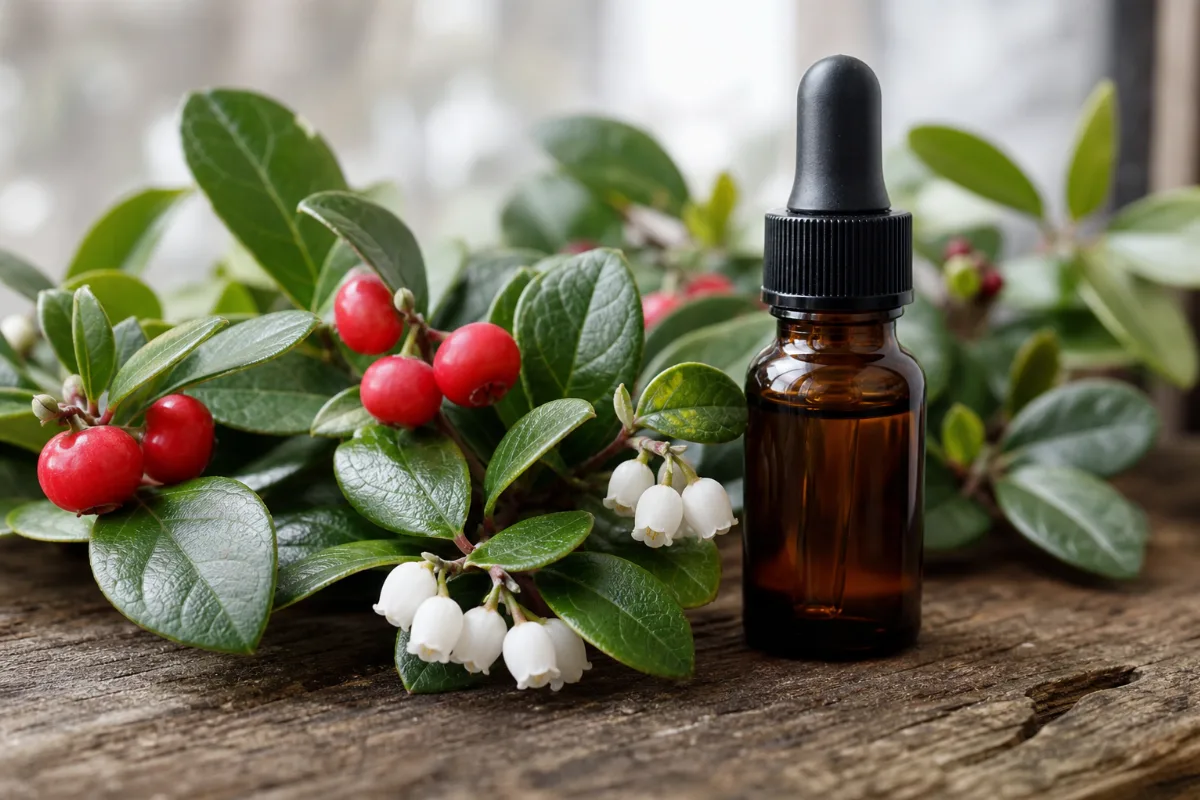
Essential Oils & Aromatherapy · Essential oil (caution)
Wintergreen Oil
Gaultheria procumbens L. (methyl salicylate-rich oil) · also called Oil of wintergreen, methyl salicylate oil.
Wintergreen oil is a strong-smelling oil that is almost pure methyl salicylate, a close chemical relative of aspirin. Swallowing even a teaspoon or less has caused deaths in young children, and the oil goes through the skin into the body. Rubs that contain it have been linked to dangerous bleeding in people on warfarin and to skin burns. Its pain-relief evidence is weak. This page gives no advice to use it.
General information, not medical advice. Last substantive update · Not medically reviewed. A named clinician has not signed off on this page. How this page is made
About Wintergreen Oil
Wintergreen oil is a hazard first and a remedy a distant second. It is almost pure methyl salicylate, so a small swallowed amount is a serious poisoning risk, mainly for young children. It is absorbed through the skin and can raise the effect of warfarin. The evidence for pain relief is weak.
What it is
Wintergreen oil is distilled from Gaultheria procumbens, a low evergreen plant. GBIF accepts the name Gaultheria procumbens L. A 2024 review found methyl salicylate made up 96.9 to 100% of the oil.
Methyl salicylate is also made in factories and is found in many rubs, liniments and medicated oils at various strengths.
How it appears in products
It is an ingredient in liniments, ointments and medicated oils for muscle aches, in essential oil bottles, and in very small amounts as a food flavouring. This page does not give advice on using any of them.
Products differ in strength. Some are sold as herbal remedies, and the label may not make the risk plain.
What the research shows
For pain, two Cochrane works on salicylate rubs are the best evidence. The better acute-pain trials found no difference from placebo. In long-lasting pain, the number needed to treat was 6.2, and the rubs compare poorly with rubs containing anti-inflammatory drugs. Side effects were more common than with placebo.
A small 2024 trial of a wintergreen oil gel in 21 healthy women found short-term skin blood vessel widening. A 2024 review says the plant's lab anti-inflammatory effects come mostly from compounds that are not in the oil, and that no clinical trials exist.
Rules and labels
In the United States, liquid products with more than 5 percent methyl salicylate by weight must be sold in child-resistant packaging, according to the federal rule 16 CFR 1700.14. Packaging does not make the product safe for children.
An industry expert panel affirmed wintergreen oil as safe as a food flavouring in tiny amounts. That finding is about flavouring, not about the bottled oil.
At a glance
Traditional uses history, not proof
- Used in herbal medicine for inflammation, muscle pain and infections, according to a 2024 review. Long use is not proof it works.
- Used in liniments and ointments for muscle aches and to flavour sweets, according to a 2001 paper.
Studied for research
- Muscle and joint pain (salicylate rubs), very low
- Skin warming and blood flow, very low (one small trial)
- Inflammation and germs in the lab, insufficient
Main compounds
- Methyl salicylate (96.9 to 100% of the oil)
- Plant compounds not in the oil: methyl salicylate glycosides, flavonoids, procyanidins
Common forms
- Distilled essential oil (about 98% methyl salicylate)
- Liniments, ointments, balms, lotions and medicated oils with methyl salicylate
- Food flavouring (very small amounts, set by an industry panel)
Research links: Methyl salicylate exposure in toddlers (review, abstract) · Laryngeal oedema from oil of wintergreen (case, abstract) · Poisoning from topical medicines vs aspirin (abstract) · Salicylate poisoning guideline for poison centres (abstract) · Warfarin and topical methyl salicylate (case, abstract) · Topical rubefacients for pain (Cochrane, abstract) · Research Library · Genes & Biomarkers Library
What it is and its history
- Accepted scientific name
- Gaultheria procumbens
- Naming authority
- L.
- Common names
- Wintergreen oil (English); Oil of wintergreen (English)
- Family or group
- Ericaceae (the heather family)
- Classification
- Plantae > Tracheophyta > Magnoliopsida > Ericales > Ericaceae > Gaultheria > Gaultheria procumbens
- Native range
- Not checked.
- Habitat
- Not checked.
- What it looks like
- Roots: Not checked.; Stems: Not checked.; Leaves: Leaves, stems and fruits are used, according to the 2024 review; oil can be distilled from different plant parts.; Flowers: Not checked.; Fruit: Not checked.
- Cultivation
- Not checked.
- Harvest and processing
- Distilled oil. A 2024 review says wintergreen oil has been distilled from different plant organs.
- Look-alikes and adulterants
- Name: Rubs, liniments and medicated oils containing methyl salicylate; Note: A 2007 review says many over-the-counter products contain methyl salicylate in varying strengths, including some sold as Asian herbal remedies.
- Sustainability and conservation
- Not checked.
Traditional use and history history, not clinical proof
| Tradition or era | Documented use | Source |
|---|---|---|
| Herbal medicine | A 2024 review says the plant and its methyl salicylate-rich oil are used in phytotherapy for inflammation, muscular pain and infection-related disorders. Long use is not proof of benefit. | p38203735 |
| Liniments, ointments, essential oils and flavouring | A 2001 paper says oil of wintergreen is a common ingredient in liniments, ointments and essential oils for muscle pain and has been used to flavour confectionery. | p11335011 |
| Poisoning in the medical record | Papers from 1956 and 1961 describe exchange transfusion for oil of wintergreen poisoning (titles only). Poisonings are still reported. | p13335325 |
Traditional use shows how it was used. It does not show that it works or is safe today.
What is inside, and how it may work
What it contains and how those compounds act in cells and animals. Laboratory and animal mechanisms are not proven effects in people.
Main compounds
| Compound | Family | Where it is concentrated | Activity studied | Level of evidence |
|---|---|---|---|---|
| Methyl salicylate PubChem 4133 | salicylate ester | Distilled oil 96.9 to 100% of wintergreen oil (2024 review); about 98% in the oil of wintergreen described by the 2007 poisoning review | Skin irritant and warming agent; absorbed through skin; poisonous if swallowed; interacts with warfarin (case reports). 19 8 7 16 24 | Human data |
| Methyl salicylate glycosides (such as gaultherin) | glycoside | Leaves and stems (not the distilled oil) Not stated | Anti-inflammatory in cell tests and, for gaultherin, in animals (2024 review). 19 | Animal research |
| Flavonoids and procyanidins | polyphenols | Plant parts (not the oil) Not stated | Anti-inflammatory and antioxidant in cell tests. 19 | Laboratory research |
Mechanisms, receptors and pathways
| Target or pathway | Gene or receptor | What was found | Level |
|---|---|---|---|
| Skin blood vessels and heat sensation | Thermosensitive TRP channels (authors' idea) | A wintergreen oil gel widened skin blood vessels for a short time in a small trial; the authors suggest heat-sensing channels as the cause. 28 | Human data |
| Skin penetration | n/a | A methyl salicylate product delivered salicylate into skin and tissue beneath, with tissue levels about 30 times plasma levels in volunteers. 7 | Human data |
| Warfarin effect (vitamin K metabolism, protein binding) | n/a | Authors suggest methyl salicylate may raise warfarin action by affecting vitamin K metabolism or displacing warfarin from protein binding. Not proven. 16 | Expert opinion |
| Inflammation signalling in cells | n/a | Plant compounds other than the oil calm inflammatory signals in cell tests (2024 review). 19 | Laboratory research |
Absorption, metabolism and elimination
- Absorption
- Absorbed through the skin: salicylate found in skin, tissue and blood in human volunteers and in rats. Measurable absorption is also stated in a case report. A cosmetic review says around 10% of applied salicylates can remain in the skin.
- Distribution
- In rats, salicylate spread to deeper tissues on the treated side and untreated side through the blood. In people, tissue levels under the skin were about 30 times plasma levels.
- Metabolism
- The human study looked at how much of the methyl ester was split into salicylate (hydrolysis); the result is not in the abstract.
- Elimination
- Not described in the abstracts read.
- Bioavailability
- Not described.
Isolated compounds versus whole extracts
The oil is nearly all methyl salicylate. A 2024 review says the lab anti-inflammatory activity of the plant comes mainly from other, water-loving compounds that are not in the distilled oil. Results for leaf or stem extracts are not results for the oil.
Nutritional composition
Not a food. A food-industry panel affirmed wintergreen oil as a flavouring for food; this says nothing on swallowing the bottled oil.
2 very low certainty1 not enough evidence
What was looked at
The 3 benefits and uses checked for Wintergreen Oil, each with how strong the evidence is. Tap one to open it.
- Muscle and joint pain (salicylate rubs)Very low certainty
- Skin warming and blood flowVery low certainty
- Inflammation and germs in the lab (plant and oil)Not enough evidence
Lab markers tracked in the studies
Success on pain relief in trials of salicylate rubsSkin blood flow
What is Wintergreen Oil good for?
This is what research has looked at, not advice to use the oil. The evidence is weak and the risks, set out first on the Safety tab, are serious.
Benefits, one by one
Each card is a research question, not a promise. Tap a goal to filter. Open a card to see the studies, doses and limits.
Muscle and joint pain (salicylate rubs)
Very low certaintySalicylate rubs, the family wintergreen oil belongs to, did not beat placebo in the better acute-pain trials. In long-lasting pain they helped a few people, less than rubs with anti-inflammatory drugs. This is not a reason to use the bottled oil.
2 studiesSalicylate rubs (various products); oil strength and amounts not give…
Studies, doses and limits
What the trials found
Cochrane reviews of topical salicylate rubs exist. None of the trials we read tested bottled wintergreen oil on its own.
Results
In acute pain (strains, sprains), the better-quality trials found no difference between salicylate rub and placebo. Counting lower-quality trials too, the number needed to treat for success was 3.2 (95% CI 2.4 to 4.9). In chronic pain, the number was 6.2 (95% CI 4.0 to 13). Side effects and drop-outs were more common than with placebo. A 2017 overview rated topical salicylate evidence in acute pain as very low quality and in chronic pain as limited and low quality, and found withdrawals for side effects of 5% vs 1% with placebo.
Effect sizes as reported
Acute pain: NNT 3.2 (lower-quality trials included); chronic pain: NNT 6.2; side-effect withdrawals 5% vs 1% (NNH 26)
Why this rating
Mostly older, small trials. The better acute trials show no benefit. Publication bias is possible. Products were salicylate rubs of many kinds, not wintergreen oil alone.
Form and dose studied
Salicylate rubs (various products); oil strength and amounts not given here.
Who was studied
Adults with muscle and joint pain
Limits
Most trials were short. Salicylate rubs compare poorly with rubs containing NSAIDs. The risks of the oil (see Safety) are not weighed in these results.
Why researchers looked
Wintergreen oil is almost pure methyl salicylate, which is used in over-the-counter rubs for aches.
Traditional use
Wintergreen oil and the plant are used in herbal medicine for inflammation, muscle pain and infections, according to a 2024 review. Long use is not proof it works.
Proposed mechanism Pharmacological theory
Methyl salicylate irritates the skin and widens its blood vessels (a rubefacient effect). A small trial of a wintergreen oil gel showed this for skin blood flow, not for pain. Whether it dulls pain through the skin or by being absorbed into the body is not settled in the papers read.
A proposed mechanism does not show that the effect happens in people.
Never swallow wintergreen oil: very small amounts have caused child deaths. Keep it away from children. It is absorbed through the skin, and it can raise warfarin effects and cause skin burns or allergy.
Skin warming and blood flow
Very low certaintyIn one small trial in healthy young women, a wintergreen oil gel widened the blood vessels of the skin for a short time. It did not show more blood flow in the muscle underneath, and pain was not measured.
1 studiesCustom-made 12.9% wintergreen oil gel, 1 g, on the upper back
Studies, doses and limits
What the trials found
One small single-blind trial, 21 healthy women, 45 minutes of measurements.
Results
Both gels first cooled the skin. Between 5 and 40 minutes the wintergreen gel (12.9% oil, more than 99% methyl salicylate) gave warmer skin than placebo. Skin blood flow rose with the oil (peak +88.7% at 5 minutes) and fell with placebo (-17.5%). Muscle oxygen did not differ. People felt anything from cool to hot, strongest at 5 minutes.
Effect sizes as reported
Skin blood flow +88.7% vs -17.5% at 5 minutes
Why this rating
One small single-blind study in healthy young women, a short-lived physical effect, no pain outcome. Funding not stated in the abstract.
Form and dose studied
Custom-made 12.9% wintergreen oil gel, 1 g, on the upper back
Who was studied
21 healthy young women
Limits
A change in skin temperature or blood flow is not a health benefit. The study says nothing on safety over longer use.
Why researchers looked
The warm tingle of wintergreen rubs is the basis of their use.
Traditional use
Wintergreen oil and the plant are used in herbal medicine for inflammation, muscle pain and infections, according to a 2024 review. Long use is not proof it works.
Proposed mechanism Pharmacological theory
Authors suggest the sensations may come from changes in heat-sensing channels in the skin (TRP channels). This is their idea, not tested in this trial.
A proposed mechanism does not show that the effect happens in people.
Never swallow wintergreen oil: very small amounts have caused child deaths. Keep it away from children. It is absorbed through the skin, and it can raise warfarin effects and cause skin burns or allergy.
Inflammation and germs in the lab (plant and oil)
Not enough evidenceIn cell and test-tube work, wintergreen leaf extracts calmed inflammation signals and the oil slowed some germs. This has not been shown in animals or people, and most of the effect comes from plant compounds other than the oil.
1 studiesPlant extracts and distilled oil, lab only.
Studies, doses and limits
Results
The review reports lab activity (anti-inflammatory, antioxidant, photoprotective, and for the oil antimicrobial and insecticidal) from cell and cell-free tests.
Effect sizes as reported
No effect sizes in the abstract.
Why this rating
Review of lab-only work; no animal or human data for the oil.
Form and dose studied
Plant extracts and distilled oil, lab only.
Who was studied
Cells, enzymes, microbes
Limits
Lab results often fail to carry over to people. Results for plant extracts are not results for the oil.
Why researchers looked
The plant is traditionally used for inflammation and infection, so researchers tested it in the lab.
Traditional use
Wintergreen oil and the plant are used in herbal medicine for inflammation, muscle pain and infections, according to a 2024 review. Long use is not proof it works.
Proposed mechanism Laboratory research
A 2024 review says mainly water-loving plant compounds (methyl salicylate glycosides, flavonoids, procyanidins) are behind the anti-inflammatory and antioxidant effects in cell tests. The oil itself is reported as anti-inflammatory with moderate antioxidant and antimicrobial activity in vitro.
A proposed mechanism does not show that the effect happens in people.
Never swallow wintergreen oil: very small amounts have caused child deaths. Keep it away from children. It is absorbed through the skin, and it can raise warfarin effects and cause skin burns or allergy.
Connections to the rest of health
How Wintergreen Oil connects to the rest of our health knowledge graph. Every link says what kind of connection it is. A safety link (for example to the liver) is a warning, not a benefit. A study that merely mentions a topic never creates a benefit link.
Explore every connection: goals, body systems, organs, symptoms, genes
A. Wellness goals
| Connected to | Kind of connection | Evidence status | Context | Studies |
|---|---|---|---|---|
| Pain Relief | Very low certainty | Muscle and joint pain (salicylate rubs): Salicylate rubs, the family wintergreen oil belongs to, did not beat placebo in the better acute-pain trials. In long-lasting pain they helped a few people, less than rubs with anti-inflammatory drugs. This is not a reason to use the bottled oil. | 17 9 | |
| Joint Support | Very low certainty | Muscle and joint pain (salicylate rubs): Salicylate rubs, the family wintergreen oil belongs to, did not beat placebo in the better acute-pain trials. In long-lasting pain they helped a few people, less than rubs with anti-inflammatory drugs. This is not a reason to use the bottled oil. | 17 9 | |
| Healthy Circulation | Biological association | Very low certainty | Skin warming and blood flow: In one small trial in healthy young women, a wintergreen oil gel widened the blood vessels of the skin for a short time. It did not show more blood flow in the muscle underneath, and pain was not measured. | 28 |
| Inflammation Balance | Not enough evidence | Inflammation and germs in the lab (plant and oil): In cell and test-tube work, wintergreen leaf extracts calmed inflammation signals and the oil slowed some germs. This has not been shown in animals or people, and most of the effect comes from plant compounds other than the oil. | 19 |
B. Body systems
| Connected to | Kind of connection | Evidence status | Context | Studies |
|---|---|---|---|---|
| Musculoskeletal System | Biological association | Very low certainty | Studied for: Muscle and joint pain (salicylate rubs) | 17 9 |
| Pain Inflammation | Biological association | Very low certainty | Studied for: Muscle and joint pain (salicylate rubs) Studied for: Inflammation and germs in the lab (plant and oil) | 17 9 19 |
| Skin | Biological association | Very low certainty | Studied for: Skin warming and blood flow | 28 |
| Circulatory System | Biological association | Very low certainty | Studied for: Skin warming and blood flow | 28 |
| Immune | Biological association | Not enough evidence | Studied for: Inflammation and germs in the lab (plant and oil) | 19 |
C. Body parts and organs
I. Biomarkers
| Connected to | Kind of connection | Evidence status | Context | Studies |
|---|---|---|---|---|
| Success on pain relief in trials of salicylate rubs | Biological association | Very low certainty | Measured in trials: mixed. A lab change is not the same as a health benefit. | 17 9 |
| Skin blood flow | Biological association | Very low certainty | Measured in trials: increased. A lab change is not the same as a health benefit. | 28 |
L. Active compounds
| Connected to | Kind of connection | Evidence status | Context | Studies |
|---|---|---|---|---|
| Methyl salicylate | Biological association | Human | Skin irritant and warming agent; absorbed through skin; poisonous if swallowed; interacts with warfarin (case reports). Preparation or compound: Distilled oil |
19 8 7 16 24 |
| Methyl salicylate glycosides (such as gaultherin) | Biological association | Animal | Anti-inflammatory in cell tests and, for gaultherin, in animals (2024 review). Preparation or compound: Leaves and stems (not the distilled oil) |
19 |
| Flavonoids and procyanidins | Biological association | In vitro | Anti-inflammatory and antioxidant in cell tests. Preparation or compound: Plant parts (not the oil) |
19 |
Each connection is stored with the ingredient, the connected record, the kind of connection, the evidence status, the supporting studies, the preparation or compound involved, and a review date (last reviewed October 25, 2026).
Evidence at a glance: what changed in 1 lab markers
Tap a number to show only those markers. Counts are markers, not people.
The evidence
The research centre for Wintergreen Oil. Every record here was checked against PubMed or the publisher's page; we never list a study we have not verified.
Evidence by outcome
Bars show how many studies we found for each outcome, not how well it works. People are added up across trials only (reviews are not added, to avoid double counting).
How we rate evidence
High certainty
Several well-run trials or reviews agree; further research is unlikely to change the picture much.
Moderate certainty
Good trials point the same way, but some doubt remains.
Low certainty
Small, short or inconsistent trials. The finding could change with better research.
Very low certainty
Very little or very weak human data. Treat as a possibility only.
Mixed findings
Trials or reviews disagree with each other.
Not enough evidence
Not enough human research to say either way.
Evidence against
Good research found no benefit, or found harm.
We take the reviewers' own risk-of-bias and GRADE statements where they exist, and otherwise judge from study size, design, consistency, directness and whether a product matches what is sold. Many publications do not make evidence high. Method note: We read the PubMed abstracts of 18 sources, saw only the titles of 7 case reports, read the US child-resistant packaging rule on eCFR and the poison.org page, and checked the plant name in GBIF and NCBI Taxonomy and methyl salicylate in PubChem. Certainty ratings are the compiler's own reading. No study is cited that we could not verify.
Study library: every study we checked 29
| Study | Design | People | Product, dose, length | Result |
|---|---|---|---|---|
| Botma 2001 Laryngeal oedema caused by accidental ingestion of Oil of Wintergreen. Int J Pediatr Otorhinolaryngol · PMID 11335011 |
Case report |
1 A reported case of accidental swallowing, plus general information |
Oil of wintergreen (methyl salicylate), swallowed by accident oil Not given here |
The authors state that one teaspoon (5 mL) of oil of wintergreen is equivalent to about 7000 mg of salicylate, or 21.7 adult aspirin tablets (325 mg), and that swallowing as little as 4 mL can be fatal in a child. They describe a case of poisoning with swelling of the voice box (laryngeal oedema) as a complication, and say the oil is used in liniments, ointments and essential oils and to flavour confectionery. They say hospital care is needed for monitoring and treatment, and list prevention steps such as keeping products out of reach, child-resistant bottles, small openings, labelling and lower salicylate content. Aspirin-tablet equivalence stated by the authors Methods, limits and fundingOutcomes: Poisoning with throat swelling Limitations: Single case with general commentary; patient details are not in the abstract. Read: abstract |
| Chan 1996 The risk of severe salicylate poisoning following the ingestion of topical medicaments or aspirin. Postgrad Med J · PMID 8871462 |
Retrospective comparison |
80 80 people who took aspirin tablets (42) or topical medicines containing methyl salicylate or wintergreen oil (38) |
Topical medicines containing methyl salicylate or wintergreen oil, swallowed oil / topical medicines Not given here |
The share of people with symptoms was similar in the two groups. Blood salicylate levels were generally higher after aspirin tablets, but the two highest readings (4.3 and 3.5 mmol/L) came from two people who had taken topical medicines. The author concludes that, being a concentrated, fat-soluble liquid, methyl salicylate can cause severe, rapid-onset salicylate poisoning. Similar share symptomatic; the two highest levels were in the topical group Methods, limits and fundingOutcomes: Blood salicylate level and symptoms on admission Limitations: Retrospective, one centre, small numbers. The abstract does not name the setting or the products. Read: abstract |
| Chan 1996 Potential dangers from topical preparations containing methyl salicylate. Hum Exp Toxicol · PMID 8880210 |
Narrative review |
Review | Over-the-counter liniments, ointments, lotions and medicated oils with methyl salicylate (oil of wintergreen) topical products Not given here |
The author states that swallowing methyl salicylate can cause severe, rapid-onset salicylate poisoning because it is concentrated, liquid and fat-soluble; that heavy use of these products in people on warfarin may cause adverse interactions and bleeding; and that these products may cause irritant or allergic contact dermatitis and anaphylactic reactions. Authors' conclusions; no counts in the abstract Methods, limits and fundingOutcomes: Poisoning, warfarin interaction, skin reactions Limitations: A short review; the abstract gives no case numbers. Read: abstract |
| Chan 2009 Life-threatening retroperitoneal bleeding due to warfarin-drug interactions. Pharmacoepidemiol Drug Saf · PMID 19283775 |
Case report |
1 A 53-year-old man on warfarin after a clot in the lung |
Analgesic balm containing 50% methyl salicylate, about 20 g on one calf over 3 days topical balm 20 g (as reported) 3 days |
His INR rose from 2.46 to about 3.5 to 3.7. After a fall he developed a large bleed behind the abdomen (retroperitoneal haematoma) and in a thigh muscle. Warfarin was held, and he received fresh frozen plasma, red cells and vitamin K. The author says significant topical methyl salicylate can add to the effect of warfarin, and that over-thinning plus poor platelet function raise the risk of severe bleeding. INR 2.46 to 3.49-3.71; large haematoma Methods, limits and fundingOutcomes: INR, bleeding Limitations: A single case with other drugs on board (heparin, enoxaparin), so the cause cannot be isolated. Read: abstract |
| Chyka 2007 Salicylate poisoning: an evidence-based consensus guideline for out-of-hospital management. Clin Toxicol (Phila) · PMID 17364628 |
Guideline |
Consensus panel guideline for poison centre staff | Salicylates including oil of wintergreen (98% methyl salicylate) oil Not given here |
The abstract says US poison centres logged over 40,000 exposures to salicylate products in 2004. For poison centre staff, the panel says that in children under 6, swallowing more than a lick or taste of oil of wintergreen (98% methyl salicylate), and in people 6 and older swallowing more than 4 mL, could cause body-wide salicylate toxicity and warrants referral to an emergency department (Grade C). Typical warning symptoms listed include vomiting blood, fast or deep breathing, trouble breathing, ringing in the ears, deafness, lethargy, seizures and confusion. For skin contact with methyl salicylate without symptoms, the guideline says to wash the skin thoroughly with soap and water and watch for symptoms (Grade C). Expert consensus, graded C or D Methods, limits and fundingOutcomes: Who needs emergency department referral Limitations: A guideline written for poison centre staff, not a home-care guide. It does not replace clinical judgment. Read: abstract |
| Cosmetic Ingredient Review Expert Panel 2003 Safety assessment of Salicylic Acid, Butyloctyl Salicylate, Calcium Salicylate, ... Methyl Salicylate, ... and Tridecyl Salicylate. Int J Toxicol · PMID 14617432 |
Safety assessment mixed (animal and human) |
Review of animal, human and exposure data for cosmetic salicylates | Methyl salicylate and other salicylates in cosmetics cosmetic ingredient Not given here |
The panel states that salicylates are absorbed through the skin, and that methyl salicylate is used in cosmetics at 0.0001% to 0.6%. High blood levels from short-term exposures are linked mainly with liver and kidney damage. Repeated dermal exposure to undiluted methyl salicylate was linked with kidney damage in animals. Dermal exposure to methyl salicylate, and oral exposure, are linked with reproductive and developmental toxicity as a function of blood levels reached. In clinical tests methyl salicylate above 12% produced pain and redness; in people with atopic skin it caused irritation depending on concentration, with none at 15% or less. In normal skin it was not a sensitiser. The panel concluded the cosmetic salicylates are safe as used when formulated to avoid irritation. Cosmetic use levels up to 0.6% Methods, limits and fundingOutcomes: Absorption, toxicity, irritation, reproduction Limitations: About cosmetic products at low concentrations; it does not describe bottled wintergreen oil. Funding is not stated in the abstract (a cosmetic industry review programme). Read: abstract |
| Cross 1998 Topical penetration of commercial salicylate esters and salts using human isolated skin and clinical microdialysis studies. Br J Clin Pharmacol · PMID 9690946 |
Human experiment |
Human volunteers (microdialysis) and isolated human skin | Commercial methyl salicylate product vs a triethanolamine salicylate product topical products Not given here |
With the methyl salicylate product, significant salicylate was found in the dermis and the tissue under the skin of volunteers. With the triethanolamine salicylate product, negligible levels were found. Tissue levels from the methyl salicylate product were about 30 times higher than plasma levels. The authors say the pattern points to direct tissue penetration and not only spread by the blood. About 30-fold higher in tissue than in plasma Methods, limits and fundingOutcomes: Salicylate in skin and deeper tissue, and in blood Limitations: Number of volunteers is not in the abstract. A commercial product, not pure oil. Read: abstract |
| Davis 2007 Are one or two dangerous? Methyl salicylate exposure in toddlers. J Emerg Med · PMID 17239735 |
Narrative review |
Review of the medical literature and US poison centre data | Oil of wintergreen (98% methyl salicylate) and products containing methyl salicylate oil / topical products Not given here |
The authors reviewed the medical literature and poison centre data collected over about two decades by the American Association of Poison Control Centers. They report that serious toxicity can follow small exposures, that methyl salicylate remains a relatively common source of exposures in children, and that persistent reports of life-threatening and fatal toxicity were found. In children under 6, a teaspoon (5 mL) or less of oil of wintergreen has been implicated in several well-documented deaths. Deaths reported with a teaspoon or less in children under 6 Methods, limits and fundingOutcomes: Poisoning in young children Limitations: A narrative review; the abstract gives no counts of cases. Not a trial. Read: abstract |
| Derry 2017 Topical analgesics for acute and chronic pain in adults - an overview of Cochrane Reviews. Cochrane Database Syst Rev · PMID 28497473 |
Overview of reviews |
13 Cochrane reviews, 206 studies, about 30,700 people | Topical analgesics including salicylate rubefacients topical products Not given here |
The overview found good evidence for some topical diclofenac and ketoprofen formulations. It judged evidence for topical salicylate in acute pain conditions to be very low quality, and evidence for salicylate rubefacients in chronic pain to be limited and low quality, possibly affected by publication bias. Withdrawals for side effects were higher with topical salicylate (5%) than placebo (1%) (7 studies, 735 people, NNH 26, very low-quality evidence). Serious adverse events were rare. Salicylate: adverse-event withdrawals 5% vs 1% (NNH 26) Methods, limits and fundingOutcomes: Pain relief and adverse events Limitations: Combines older reviews; salicylate evidence is thin. Read: abstract |
| Desai 2021 From Chemical Burn to Below Knee Amputation: Amputation Secondary to Application of Over-the-Counter Topical Analgesic With Menthol and Methyl Salicylate. Cureus · PMID 35004014 |
Case report |
1 One reported patient |
Over-the-counter analgesic with menthol and methyl salicylate on the skin topical product Not given here |
The authors describe a rare case in which a typical over-the-counter analgesic with menthol and methyl salicylate caused a chemical burn, complicated by a necrotizing infection that was treated with a below-the-knee amputation. They say consumers often overlook harmful effects and consider such products largely harmless. One case, amputation Methods, limits and fundingOutcomes: Chemical burn Limitations: A single rare case; a menthol and methyl salicylate product, not pure oil. Details of use are not in the abstract. Read: abstract |
| Done 1956 Exchange transfusion in the treatment of oil of wintergreen (methyl salicylate) poisoning. Pediatrics · PMID 13335325 |
Case report |
Not available (PubMed record has no abstract) | Wintergreen oil / methyl salicylate oil Not given here |
Only the title was read. The title reports: treatment of oil of wintergreen poisoning by exchange transfusion. Reported Methods, limits and fundingOutcomes: Treatment of oil of wintergreen poisoning by exchange transfusion Limitations: Title only; no abstract in PubMed. Number of people and details not known to us. Read: title-only |
| Dosoky 2021 Maternal Reproductive Toxicity of Some Essential Oils and Their Constituents. Int J Mol Sci · PMID 33673548 |
Narrative review review |
Review of essential oil constituents in pregnancy | Essential oil constituents including methyl salicylate oil constituents Not given here |
The abstract says the review covers effects of some essential oils and constituents (including methyl salicylate) on pregnancy and the developing fetus, with concerns of abortion, hormone changes, maternal toxicity, teratogenicity and fetal toxicity. The abstract gives no specific findings for methyl salicylate. No methyl salicylate finding in the abstract Methods, limits and fundingOutcomes: Reproductive and fetal effects Limitations: Only the abstract was read, so what the full text says about methyl salicylate is not known to us. Read: abstract |
| Franceschi 2022 First report of allergic contact dermatitis caused by Gaultheria procumbens (wintergreen) essential oil. Contact Dermatitis · PMID 35368095 |
Case report |
Not available (PubMed record has no abstract) | Wintergreen oil / methyl salicylate oil Not given here |
Only the title was read. The title reports: allergic contact dermatitis from wintergreen essential oil. Reported Methods, limits and fundingOutcomes: Allergic contact dermatitis from wintergreen essential oil Limitations: Title only; no abstract in PubMed. Number of people and details not known to us. Read: title-only |
| GBIF 2026 GBIF Backbone Taxonomy: Gaultheria procumbens L. GBIF API · Source |
Database n/a |
n/a | n/a |
Match is exact: Gaultheria procumbens L., status ACCEPTED, key 2882753, family Ericaceae, order Ericales. n/a Methods, limits and fundingOutcomes: Accepted name Limitations: Taxonomy only. Read: api |
| Guengerich 2026 FEMA GRAS assessment of natural flavor complexes: Vanilla extract, Bitter almond oil, Wintergreen oil and related flavoring ingredients. Food Chem Toxicol · PMID 41571176 |
Expert panel assessment n/a |
Flavor industry expert panel review of 18 natural flavor complexes | Wintergreen oil (Gaultheria) as a food flavouring oil as flavour Not given here |
The panel (Flavor and Extract Manufacturers Association) affirmed 18 natural flavor complexes, including those from the genus Gaultheria, as generally recognised as safe under their conditions of intended use as flavor ingredients. The scope covers food only and excludes dietary supplements and any other products. GRAS affirmation for flavouring use Methods, limits and fundingOutcomes: Safety as a flavouring Limitations: Written by an industry panel. It covers tiny flavouring amounts in food and says nothing in the abstract about swallowing the bottled oil. Funding and conflicts: Flavor and Extract Manufacturers Association expert panel (industry body); authors' funding statement not read. Read: abstract |
| Joss 2000 Potentiation of warfarin anticoagulation associated with topical methyl salicylate. Ann Pharmacother · PMID 10860133 |
Case report |
1 A 22-year-old woman taking warfarin whose INR had been stable |
Topical pain-relieving gel with low-dose methyl salicylate, applied to the knees daily topical gel Not given here 8 days |
She came in with an INR of 12.2 after about eight days of daily gel on both knees. The authors attribute it to the low-dose methyl salicylate in the product, and say methyl salicylate is absorbed through the skin in measurable amounts and may raise warfarin action by affecting vitamin K metabolism or displacing warfarin from protein binding. They add that earlier reports used high doses and this case shows low topical doses can also interact. INR 12.2 Methods, limits and fundingOutcomes: INR (blood-clotting test) Limitations: A single case; cause is attributed by the authors, not proven by a trial. Read: abstract |
| Matthews 2009 Topical rubefacients for acute and chronic pain in adults. Cochrane Database Syst Rev · PMID 19588430 |
Systematic review |
Adults with acute or chronic muscle and joint pain; 15 trials | Topical salicylate rubefacients (all trials used salicylates) topical products Not given here |
Six placebo and one active-controlled trials (560 and 137 people) in acute pain and seven placebo and two active-controlled trials (489 and 90 people) in chronic pain were included. In acute pain, better-quality trials found no difference from topical placebo; including lower-quality trials the number needed to treat for clinical success was 3.2 (95% CI 2.4 to 4.9). In chronic pain the NNT was 6.2 (95% CI 4.0 to 13). Side effects and withdrawals were more common with rubefacients than placebo, but results were not robust. The authors say the evidence does not support topical salicylate rubefacients for acute injuries, and in chronic conditions they compare poorly with topical NSAIDs. Short-term tolerance seemed fair on limited data. NNT 3.2 (lower-quality trials included) acute; 6.2 chronic (acute NNT 2.4 to 4.9; chronic NNT 4.0 to 13) Methods, limits and fundingOutcomes: Clinical success; adverse events Limitations: Last search December 2008. Products tested were salicylate rubs, not necessarily wintergreen oil. Many trials were small. Read: abstract |
| Megwa 1995 Percutaneous absorption of salicylates from some commercially available topical products containing methyl salicylate or salicylate salts in rats. J Pharm Pharmacol · PMID 8708981 |
Animal research rat |
Male Wistar rats | Commercial products with methyl salicylate or salicylate salts, on the skin topical products Not given here |
Salicylate was found in the blood and in tissues under and away from the treated spot. The authors say the drugs were first absorbed into the bloodstream and then spread to deeper tissues on both the treated and untreated sides. Methyl salicylate and the two salts gave similar tissue levels when the salicylate content was alike. Salicylate found in blood and distant tissue Methods, limits and fundingOutcomes: Salicylate in plasma and tissues Limitations: Rats, not people. Read: abstract |
| Michel 2024 Phytochemistry and Biological Profile of Gaultheria procumbens L. and Wintergreen Essential Oil: From Traditional Application to Molecular Mechanisms and Therapeutic Targets. Int J Mol Sci · PMID 38203735 |
Narrative review review (cells and cell-free tests) |
Review of the plant and its oil | Gaultheria procumbens plant parts and wintergreen essential oil leaves, stems, fruits; distilled oil Not given here |
The review says the plant and its methyl salicylate-rich oil are used in phytotherapy for inflammation, muscle pain and infection-related disorders. Over 130 volatile compounds were found in wintergreen oil, dominated by methyl salicylate (96.9 to 100%). It says mainly water-loving non-volatile compounds in the plant (such as methyl salicylate glycosides, flavonoids and procyanidins) drive the anti-inflammatory, antioxidant and photoprotective activity seen in cell and cell-free tests; the oil is reported as anti-inflammatory with moderate antioxidant and antimicrobial activity in vitro, and insecticidal. The authors note the absence of in vivo studies, especially clinical trials, on effective dose and toxicology. Methyl salicylate 96.9 to 100% of the oil Methods, limits and fundingOutcomes: Chemistry and lab pharmacology Limitations: Review; lab work only. The authors state there are no clinical trials. Read: abstract |
| Millar 1961 Oil of wintergreen (methyl salicylate) poisoning treated by exchange transfusion. Can Med Assoc J · PMID 13770703 |
Case report |
Not available (PubMed record has no abstract) | Wintergreen oil / methyl salicylate oil Not given here |
Only the title was read. The title reports: treatment of oil of wintergreen poisoning by exchange transfusion. Reported Methods, limits and fundingOutcomes: Treatment of oil of wintergreen poisoning by exchange transfusion Limitations: Title only; no abstract in PubMed. Number of people and details not known to us. Read: title-only |
| Moss 2020 Salicylate toxicity from ingestion of an oil of wintergreen containing insecticide. Clin Toxicol (Phila) · PMID 31267790 |
Case report |
Not available (PubMed record has no abstract) | Wintergreen oil / methyl salicylate oil Not given here |
Only the title was read. The title reports: salicylate toxicity from swallowing an insecticide that contained oil of wintergreen. Reported Methods, limits and fundingOutcomes: Salicylate toxicity from swallowing an insecticide that contained oil of wintergreen Limitations: Title only; no abstract in PubMed. Number of people and details not known to us. Read: title-only |
| National Capital Poison Center 2026 Poison Control (National Capital Poison Center): poison.org home page poison.org · Source |
Web page n/a |
n/a | n/a |
The page says: get help online, or call a poison center at 1-800-222-1222, free, expert and confidential. It also says that if the person collapses, has a seizure, has trouble breathing or cannot be woken, call 911 now. Read on 2026-10-25. n/a Methods, limits and fundingOutcomes: Poison help contact Limitations: United States numbers only. Other countries have different numbers; none was read. Read: web |
| Oiso 2004 Allergic contact dermatitis due to methyl salicylate in a compress. Contact Dermatitis · PMID 15291832 |
Case report |
Not available (PubMed record has no abstract) | Wintergreen oil / methyl salicylate oil Not given here |
Only the title was read. The title reports: allergic contact dermatitis from methyl salicylate in a compress. Reported Methods, limits and fundingOutcomes: Allergic contact dermatitis from methyl salicylate in a compress Limitations: Title only; no abstract in PubMed. Number of people and details not known to us. Read: title-only |
| PubChem 2026 PubChem: Methyl Salicylate (CID 4133) PubChem PUG REST · Source |
Database n/a |
n/a | n/a |
Name lookup returned CID 4133, formula C8H8O3, IUPAC name methyl 2-hydroxybenzoate. n/a Methods, limits and fundingOutcomes: Compound identity Limitations: Identity only. Read: api |
| Rivard 2017 Over-the-counter topical musculoskeletal pain relievers used with a heat source: a dangerous combination. Cutis · PMID 29232433 |
Case report |
Not available (PubMed record has no abstract) | Wintergreen oil / methyl salicylate oil Not given here |
Only the title was read. The title reports: skin injury when over-the-counter rubs are used with a heat source. Reported Methods, limits and fundingOutcomes: Skin injury when over-the-counter rubs are used with a heat source Limitations: Title only; no abstract in PubMed. Number of people and details not known to us. Read: title-only |
| Seneviratne 2015 Accidental methyl salicylate poisoning in two adults. Ceylon Med J · PMID 26132187 |
Case report |
2 Not available (PubMed record has no abstract) |
Wintergreen oil / methyl salicylate oil Not given here |
Only the title was read. The title reports: accidental methyl salicylate poisoning in two adults. Reported Methods, limits and fundingOutcomes: Accidental methyl salicylate poisoning in two adults Limitations: Title only; no abstract in PubMed. Number of people and details not known to us. Read: title-only |
| US Consumer Product Safety Commission / eCFR 2026 16 CFR 1700.14: Substances requiring special packaging (methyl salicylate) Electronic Code of Federal Regulations · Source |
Regulation n/a |
n/a | Liquid preparations with more than 5 percent methyl salicylate by weight |
Section 1700.14(a)(3) says liquid preparations containing more than 5 percent by weight of methyl salicylate, other than those in pressurized spray containers, shall be packaged in accordance with the special packaging provisions of 1700.15 (a), (b) and (c). Read from eCFR on 2026-10-25. n/a Methods, limits and fundingOutcomes: Child-resistant packaging rule Limitations: US rule only. Packaging rule; it does not make the product safe for children. Read: web |
| Versteeg 2024 Short-term cutaneous vasodilatory and thermosensory effects of topical methyl salicylate. Front Physiol · PMID 38706945 |
Rct single blind |
21 21 healthy young women (average age 22) |
Custom-made wintergreen oil gel (12.9% oil, more than 99% methyl salicylate) vs placebo gel, 1 g on the upper back topical gel 1 g gel (as reported) 45 minutes of measurement · vs Placebo gel on the other side |
Both gels first cooled the skin; later the methyl salicylate side was warmer than placebo between 5 and 40 minutes (p < .05). Skin blood flow rose with methyl salicylate (peak change +88.7% at 5 minutes) and fell with placebo (-17.5%). Muscle oxygen did not differ. Sensations ranged from cool to hot, strongest at 5 minutes. The authors conclude it causes short-term widening of skin blood vessels but may not increase muscle blood flow. Skin blood flow +88.7% at 5 minutes vs -17.5% placebo Methods, limits and fundingOutcomes: Skin temperature, skin blood flow, muscle oxygen, sensation Limitations: Small, single-blind, healthy young women, 45 minutes. No pain outcome. Funding not stated in the abstract. Read: abstract |
| Yip 1990 Adverse effect of topical methylsalicylate ointment on warfarin anticoagulation: an unrecognized potential hazard. Postgrad Med J · PMID 2371186 |
Case series |
11 11 patients taking warfarin who used methyl salicylate ointment |
Topical methyl salicylate ointment, significant usage topical ointment Not given here |
All 11 had an abnormally raised INR after significant use of the ointment, with a positive blood salicylate level. Three had bleeding: two had bruises and one had gastrointestinal bleeding. The authors conclude the ointment should be used with care in people on warfarin and that excessive use should be avoided. 11 of 11 raised INR; 3 with bleeding Methods, limits and fundingOutcomes: INR and bleeding Limitations: Small uncontrolled series. Read: abstract |
What we do not know yet
- What the evidence supports: very low for muscle and joint pain and skin warming, insufficient for lab claims. The safety evidence is much stronger than the benefit evidence.
- No trial of bottled wintergreen oil for pain or any condition.
- Breastfeeding, pets, aspirin combinations and non-US poison centre numbers were not covered by the sources read.
- Several case reports were seen by title only.
How new research is added
New studies are found by a saved PubMed search and placed in a review queue. A person reads each one before it changes any rating or safety wording.
Lab markers
What changed in blood or saliva tests during trials. A changed number is not the same as feeling or being healthier, and we give no "normal ranges".
Other 2
Success on pain relief in trials of salicylate rubs
Mixed results in trials
In trials, whether people had a clinically useful drop in pain (success as defined by each trial).
Very low certaintyResults and what it means
Why it was measured
This is how trials judge whether a rub works.
Statistical vs. clinical meaning
Weak and not robust; compares poorly with topical NSAIDs.
Safety implication
More side effects than placebo.
| Study | Result | People | Product |
|---|---|---|---|
| 17 | Acute pain: NNT 3.2 (95% CI 2.4 to 4.9) with lower-quality trials included; no difference from placebo in better-quality trials. Chronic pain: NNT 6.2 (95% CI 4.0 to 13). | Adults with acute or chronic muscle and joint pain (15 trials) | Topical salicylate rubefacients vs placebo or active control |
Skin blood flow
Increased in trials
How much blood moves through the small vessels of the skin, measured with laser imaging.
Very low certaintyResults and what it means
Why it was measured
It shows whether the gel widens skin vessels.
Statistical vs. clinical meaning
Short-term physical effect only.
Safety implication
Strong skin sensations were reported; no safety data beyond 45 minutes.
| Study | Result | People | Product |
|---|---|---|---|
| 28 | +88.7% at 5 minutes with wintergreen oil gel vs -17.5% with placebo; higher than placebo for the full 45 minutes. | 21 healthy young women | 12.9% wintergreen oil gel vs placebo gel, 1 g, upper back |
Safety
What studies and official sources say about side effects, medicines and who should check first. Each point shows what kind of evidence it comes from.
Main points to know 7
- Danger: swallowing even a small amount can poison and kill a child. A 2007 review of the medical literature and US poison centre data says that in children under 6, a teaspoon (5 mL) or less of oil of wintergreen has been implicated in several well-documented deaths. A 2001 paper says one teaspoon holds about 7000 mg of salicylate, as much as about 22 adult aspirin tablets, and that as little as 4 mL can be fatal in a child. A poison centre guideline says that for children under 6, more than a lick or taste of oil of wintergreen warrants referral to an emergency department. Case report and review 8 1 5
- Adults can be poisoned too, and fast. In 80 people who swallowed aspirin tablets or topical medicines containing methyl salicylate or wintergreen oil, a similar share had symptoms, and the two highest blood salicylate levels came from two people who had taken the topical medicines. The author says methyl salicylate can cause severe, rapid-onset poisoning because it is a concentrated, fat-soluble liquid. Case reports describe accidental poisoning in two adults (title only) and poisoning from an insecticide that contained wintergreen oil (title only). Retrospective comparison 2 26 21
- Warfarin: reports of dangerous bleeding risk from rubs on the skin. Three reports describe raised INR (a blood-clotting test) in people on warfarin who used methyl salicylate rubs: one woman with an INR of 12.2 after about eight days of a low-dose gel on her knees, 11 patients with raised INR (three with bleeding), and a man with a large bleed behind the abdomen after a balm that was 50% methyl salicylate. Do not use wintergreen oil or rubs containing methyl salicylate with warfarin without asking your doctor or pharmacist. Case report 16 29 4
- It goes through the skin into the body. In human volunteers, a methyl salicylate product put significant salicylate into the skin and tissue under it. Rat work and a case of raised INR show it also reaches the blood. A cosmetic safety panel says salicylates are absorbed through the skin. Human experiment 7 18 16 6
- Skin burns, irritation and allergy. Case reports describe allergic contact dermatitis from wintergreen essential oil (2022, title only) and from methyl salicylate in a compress (2004, title only), and a chemical burn leading to a below-knee amputation after a menthol and methyl salicylate analgesic. A paper on rubs used with a heat source calls the mix dangerous (title only). In a cosmetic safety review, methyl salicylate above 12% produced pain and redness in clinical tests. Case report 13 23 10 25 6
- Pregnancy: a cosmetic safety review links methyl salicylate to developmental toxicity. The Cosmetic Ingredient Review panel says dermal and oral exposures to methyl salicylate are associated with reproductive and developmental toxicity as a function of the blood levels reached. Ask a doctor before any use in pregnancy. No source read covers breastfeeding. Review 6 12
- Pain relief is weak. Salicylate rubs gave no benefit over placebo in the better-quality acute pain trials. The harm shown above is not weighed in those results. Systematic review 17 9
Side effects 4
| Effect | How often | Severity and recovery | Evidence |
|---|---|---|---|
| Salicylate poisoning if swallowed (fast breathing, vomiting blood, ringing in the ears, confusion, seizures, coma) Symptoms listed in the poison centre guideline: vomiting blood, fast or deep breathing, trouble breathing, ringing in the ears, deafness, lethargy, seizures, confusion. Throat swelling was reported in one child case. | Not known; a regular source of child exposures in US poison centre data (2007 review) | Severe to fatal Not stated | Case report 8 1 2 5 |
| Raised INR and bleeding with warfarin Cases of topical use, one with a low-dose gel. | INR raised in 11 of 11 patients in one series; 3 had bleeding | Moderate to life-threatening Not stated | Case report 16 29 4 |
| Allergic or irritant contact dermatitis Two case reports were seen by title only. A review also mentions anaphylactic reactions. | Not known | Mild to moderate Not stated | Case report 13 23 3 |
| Chemical burn Product was a menthol and methyl salicylate rub. | Rare; one case report | Severe in the case reported Not stated | Case report 10 |
Liver
No case report of liver injury from wintergreen oil on the skin was read. LiverTox was not checked. The Cosmetic Ingredient Review panel says short-term exposures that give high blood levels of salicylates are linked mainly with liver and kidney damage, and in dogs on high oral doses of methyl salicylate liver damage was seen in one study. 6
How often. Not known.
This is a safety connection. It is not evidence that Wintergreen Oil supports liver health.
Medicines and supplements 4
| With | Why it matters | Importance | Evidence | What to do |
|---|---|---|---|---|
| Warfarin (blood thinner) prescription | Authors suggest methyl salicylate may increase warfarin action through vitamin K metabolism or by displacing warfarin from protein binding. Not proven. | Raised INR to 12.2 in one patient and bleeding in several others; a large bleed in another. | Case report Low certainty 16 29 4 3 | Do not use wintergreen oil or methyl salicylate rubs with warfarin without asking a doctor or pharmacist. |
| Aspirin and other salicylates (including aspirin-containing medicines) otc | Methyl salicylate is a salicylate, so the amounts add up in the body. No paper read tested a wintergreen rub together with aspirin. | Possible extra salicylate load. Not documented in the sources read. | Insufficient Not enough evidence 2 | Ask a pharmacist before using it with aspirin, bismuth subsalicylate or other salicylate products. |
| Other blood thinners and NSAIDs prescription | Not studied in the sources read. A review suggests heavy use may add to bleeding risk in people on warfarin. | Not documented for other drugs. | Insufficient Not enough evidence 3 | Tell your doctor or pharmacist what you rub on your skin. |
| Heat (heating pads, hot water bottles, hot baths) on the same skin other | Heat may raise absorption and burn risk. One paper's title calls rubs with a heat source a dangerous combination; no abstract was read. | Skin injury reported in case reports. | Case report Very low certainty 25 10 | Do not put heat on skin where a methyl salicylate product has been applied unless a doctor says it is fine. |
Who should check first 8
| Situation | Advice | Evidence |
|---|---|---|
| Children, especially under 6 | Keep the oil out of reach and out of sight. Never give it. A poison centre guideline says more than a lick or taste in a child under 6 needs emergency referral. | Case report 8 1 5 |
| Anyone taking warfarin | Ask a doctor or pharmacist before any wintergreen or methyl salicylate product on the skin. | Case report 16 29 4 |
| Pregnancy | Ask a doctor first. A cosmetic safety review links methyl salicylate to developmental toxicity depending on blood level. | Review 6 12 |
| Breastfeeding | Not described in the sources read. Ask a clinician. | Insufficient |
| Aspirin allergy or salicylate sensitivity | Not covered by the sources read. Methyl salicylate is a salicylate. Ask a doctor or pharmacist. | Insufficient |
| Broken, inflamed or sunburnt skin, or skin under tight bandages or heat | Burns and absorption problems are reported. Ask a doctor. | Case report 10 25 |
| Pets | Not covered by any source read. Ask a vet. | Insufficient |
| Kidney or liver disease | Not covered for wintergreen oil in the sources read. The cosmetic review links high salicylate levels to liver and kidney damage. Ask a doctor. | Review 6 |
Overdose, product quality and regulators
Summary. Wintergreen oil is about 98% methyl salicylate (as a poisoning review describes it). Small amounts swallowed have killed children. The same review says life-threatening and fatal toxicity continues to be reported.
Animal. The cosmetic safety panel reports kidney damage from repeated skin exposure to undiluted methyl salicylate in animals, bone lesions in 2-year rat studies with oral exposure, and liver damage in dogs at high oral doses in one study.
Human doses studied. No human dosing of bottled oil is listed here on purpose. Poison centre thresholds: more than a lick or taste in a child under 6, and more than 4 mL in people 6 and older, warrant emergency referral (guideline for poison centre staff, Grade C).
High dose or long term signals. Cosmetic panel: high blood levels link to liver and kidney damage; methyl salicylate above 12% caused pain and redness on skin in clinical tests.
Overdose response. Poisoning is treated in hospital. Old case reports (1956 and 1961, titles only) describe exchange transfusion for severe poisoning. A guideline for poison centre staff says not to induce vomiting and to refer people with symptoms to hospital. Call a poison centre or emergency service rather than treating at home.
Genotoxicity. The cosmetic panel says genotoxicity studies of methyl salicylate were generally negative, and skin-painting in mice did not induce tumours.
Toxic or hazardous parts. Not checked. The oil is distilled from the plant.
Products with methyl salicylate vary a lot in strength, and labels do not always make the risk clear.
Strength varies by product. A 2007 review says oil of wintergreen is 98% methyl salicylate and that other products have varying amounts, including some sold as Asian herbal remedies. A 2024 review reports 96.9 to 100% methyl salicylate in distilled wintergreen oil. 8 19
Hidden in other products. One reported case followed swallowing an insecticide that contained wintergreen oil (title only). 21
Adulteration, pesticide and heavy-metal data. Not covered by the sources read.
| Body | Action | Date |
|---|---|---|
| US Consumer Product Safety Commission (16 CFR 1700.14) (United States) | Liquid preparations containing more than 5 percent by weight of methyl salicylate (other than pressurized sprays) must have child-resistant special packaging. source | 2026-10-25 |
| Flavor and Extract Manufacturers Association expert panel (International (industry body)) | Affirmed wintergreen oil (genus Gaultheria) among natural flavor complexes as generally recognised as safe for use as a food flavouring. Scope is food only, excluding dietary supplements. It does not mean swallowing the bottled oil is safe. source | 2026 |
| Cosmetic Ingredient Review Expert Panel (United States (industry-funded programme)) | Concluded cosmetic salicylates, including methyl salicylate (used at 0.0001% to 0.6%), are safe as used when formulated to avoid irritation and extra sun sensitivity. source | 2003 |
| National Capital Poison Center (poison.org) (United States) | States a poison centre number of 1-800-222-1222 (free, expert, confidential) and to call 911 if the person collapses, has a seizure, has trouble breathing or cannot be woken. source | 2026-10-25 |
When to get medical help
- A child or anyone has swallowed any wintergreen oil, or a rub or liniment that contains it: call a poison center now. In the United States the number on poison.org is 1-800-222-1222. Do not wait for symptoms. Other countries: use your local poison centre or emergency number (not verified here).
- Collapse, a seizure, trouble breathing or cannot be woken: call emergency services at once (911 in the United States, as poison.org states).
- Fast or deep breathing, vomiting (or vomiting blood), ringing in the ears, confusion or unusual sleepiness after any contact with the oil: get emergency help.
- Swelling of the lips, tongue, throat or face after using the oil: call emergency services now.
- Unusual bruising or bleeding, black stools, or blood in urine in anyone taking warfarin who uses a rub: call a doctor the same day or emergency services if heavy.
- A blistering, burning or oozing area of skin after a rub: stop using it and see a doctor.
Stop using the product and contact a clinician or emergency service. In the US, Poison Control is 1-800-222-1222.
General information only, not medical advice. Ask a clinician or pharmacist before use, especially with medicines, in pregnancy or with a health condition. See the Natural Remedy Safety guide.
Frequently asked questions
What is wintergreen oil?
Why is wintergreen oil dangerous?
Can a small amount hurt a child?
What if a child or adult has swallowed some?
Call a poison center right away. In the United States, poison.org gives 1-800-222-1222, and says to call 911 if the person collapses, has a seizure, has trouble breathing or cannot be woken. Outside the US, use your local poison centre or emergency number. A poison centre guideline says more than a lick or taste in a child under 6 warrants hospital referral.
What are the signs of salicylate poisoning?
Does it go through the skin?
Does it interact with warfarin or aspirin?
Can it burn or irritate the skin?
Does heat make it worse?
A 2017 paper's title calls over-the-counter rubs used with a heat source a dangerous combination. We saw only the title, so we cannot say more.
Does wintergreen oil relieve pain?
Is it safe in pregnancy, while breastfeeding, or for pets?
Explore by health goal
Pain ReliefJoint SupportHealthy CirculationInflammation Balance
Editorial transparency
- Written by
- AlternativeMed editorial team. Research compiled with AI assistance, then checked against PubMed records.
- Medical review
- None. This page has not been reviewed by a physician or pharmacist.
- First published
- 2026-10-25
- Last substantive update
- 2026-10-25
- How we research
- We read the PubMed abstracts of 18 sources, saw only the titles of 7 case reports, read the US child-resistant packaging rule on eCFR and the poison.org page, and checked the plant name in GBIF and NCBI Taxonomy and methyl salicylate in PubChem. Certainty ratings are the compiler's own reading. No study is cited that we could not verify.
- How we rate evidence
- See "How we rate evidence" in the Evidence tab.
- Independence
- No product is promoted on this page. No affiliate links are shown.
Sources 29
Each source was opened and checked. Where we read only the abstract, it says so. The small numbers in the text point here.
- Botma M, Colquhoun-Flannery W, Leighton S. Laryngeal oedema caused by accidental ingestion of Oil of Wintergreen.. Int J Pediatr Otorhinolaryngol. 2001. PMID 11335011. (abstract)
- Chan T. The risk of severe salicylate poisoning following the ingestion of topical medicaments or aspirin.. Postgrad Med J. 1996. PMID 8871462. (abstract)
- Chan T. Potential dangers from topical preparations containing methyl salicylate.. Hum Exp Toxicol. 1996. PMID 8880210. (abstract)
- Chan T. Life-threatening retroperitoneal bleeding due to warfarin-drug interactions.. Pharmacoepidemiol Drug Saf. 2009. PMID 19283775. (abstract)
- Chyka P, Erdman A, Christianson G, Wax P, Booze L, Manoguerra A et al. Salicylate poisoning: an evidence-based consensus guideline for out-of-hospital management.. Clin Toxicol (Phila). 2007. PMID 17364628. (abstract)
- Cosmetic Ingredient Review Expert Panel. Safety assessment of Salicylic Acid, Butyloctyl Salicylate, Calcium Salicylate, ... Methyl Salicylate, ... and Tridecyl Salicylate.. Int J Toxicol. 2003. PMID 14617432. (abstract)
- Cross S, Anderson C, Roberts M. Topical penetration of commercial salicylate esters and salts using human isolated skin and clinical microdialysis studies.. Br J Clin Pharmacol. 1998. PMID 9690946. (abstract)
- Davis J. Are one or two dangerous? Methyl salicylate exposure in toddlers.. J Emerg Med. 2007. PMID 17239735. (abstract)
- Derry S, Wiffen P, Kalso E, Bell R, Aldington D, Phillips T et al. Topical analgesics for acute and chronic pain in adults - an overview of Cochrane Reviews.. Cochrane Database Syst Rev. 2017. PMID 28497473. (abstract)
- Desai R, Gutierrez J, Cherukuri S, Guzman J, Deoker A. From Chemical Burn to Below Knee Amputation: Amputation Secondary to Application of Over-the-Counter Topical Analgesic With Menthol and Methyl Salicylate.. Cureus. 2021. PMID 35004014. (abstract)
- Done A, Otterness L. Exchange transfusion in the treatment of oil of wintergreen (methyl salicylate) poisoning.. Pediatrics. 1956. PMID 13335325. (title-only)
- Dosoky N, Setzer W. Maternal Reproductive Toxicity of Some Essential Oils and Their Constituents.. Int J Mol Sci. 2021. PMID 33673548. (abstract)
- Franceschi J, Darrigade A, Jegou M, Milpied B. First report of allergic contact dermatitis caused by Gaultheria procumbens (wintergreen) essential oil.. Contact Dermatitis. 2022. PMID 35368095. (title-only)
- GBIF. GBIF Backbone Taxonomy: Gaultheria procumbens L.. GBIF API. 2026. (api)
- Guengerich F, Cohen S, Eisenbrand G, Fukushima S, Gooderham N, Hecht S et al. FEMA GRAS assessment of natural flavor complexes: Vanilla extract, Bitter almond oil, Wintergreen oil and related flavoring ingredients.. Food Chem Toxicol. 2026. PMID 41571176. (abstract)
- Joss J, LeBlond R. Potentiation of warfarin anticoagulation associated with topical methyl salicylate.. Ann Pharmacother. 2000. PMID 10860133. (abstract)
- Matthews P, Derry S, Moore R, McQuay H. Topical rubefacients for acute and chronic pain in adults.. Cochrane Database Syst Rev. 2009. PMID 19588430. (abstract)
- Megwa S, Benson H, Roberts M. Percutaneous absorption of salicylates from some commercially available topical products containing methyl salicylate or salicylate salts in rats.. J Pharm Pharmacol. 1995. PMID 8708981. (abstract)
- Michel P, Olszewska M. Phytochemistry and Biological Profile of Gaultheria procumbens L. and Wintergreen Essential Oil: From Traditional Application to Molecular Mechanisms and Therapeutic Targets.. Int J Mol Sci. 2024. PMID 38203735. (abstract)
- Millar R, Bowman J. Oil of wintergreen (methyl salicylate) poisoning treated by exchange transfusion.. Can Med Assoc J. 1961. PMID 13770703. (title-only)
- Moss M. Salicylate toxicity from ingestion of an oil of wintergreen containing insecticide.. Clin Toxicol (Phila). 2020. PMID 31267790. (title-only)
- National Capital Poison Center. Poison Control (National Capital Poison Center): poison.org home page. poison.org. 2026. (web)
- Oiso N, Fukai K, Ishii M. Allergic contact dermatitis due to methyl salicylate in a compress.. Contact Dermatitis. 2004. PMID 15291832. (title-only)
- PubChem. PubChem: Methyl Salicylate (CID 4133). PubChem PUG REST. 2026. (api)
- Rivard S, Brelsford M, Gibbs N. Over-the-counter topical musculoskeletal pain relievers used with a heat source: a dangerous combination.. Cutis. 2017. PMID 29232433. (title-only)
- Seneviratne M, Karunarathne S, de Alwis A, Fernando A, Fernando R. Accidental methyl salicylate poisoning in two adults.. Ceylon Med J. 2015. PMID 26132187. (title-only)
- US Consumer Product Safety Commission / eCFR. 16 CFR 1700.14: Substances requiring special packaging (methyl salicylate). Electronic Code of Federal Regulations. 2026. (web)
- Versteeg N, Wellauer V, Wittenwiler S, Aerenhouts D, Clarys P, Clijsen R. Short-term cutaneous vasodilatory and thermosensory effects of topical methyl salicylate.. Front Physiol. 2024. PMID 38706945. (abstract)
- Yip A, Chow W, Tai Y, Cheung K. Adverse effect of topical methylsalicylate ointment on warfarin anticoagulation: an unrecognized potential hazard.. Postgrad Med J. 1990. PMID 2371186. (abstract)
Where to buy
Check the label first. Whatever you buy, look for these:
- The botanical (Latin) name on the label and 100% pure oil
- A dark glass bottle and a batch number
- Essential oils are strong: dilute for skin, and do not swallow unless a qualified professional directs it
- Keep away from children and pets
Talk to a pharmacist or doctor before you start any supplement, especially if you take medicines. See the Safety tab for interactions.
Support our free guides: as an Amazon Associate we earn from qualifying purchases. Full disclosure.


