Essential Oils & Aromatherapy · Essential oil (caution)
Sweet Birch Oil
Betula lenta L. · also called Sweet birch oil, black birch oil, birch bark oil
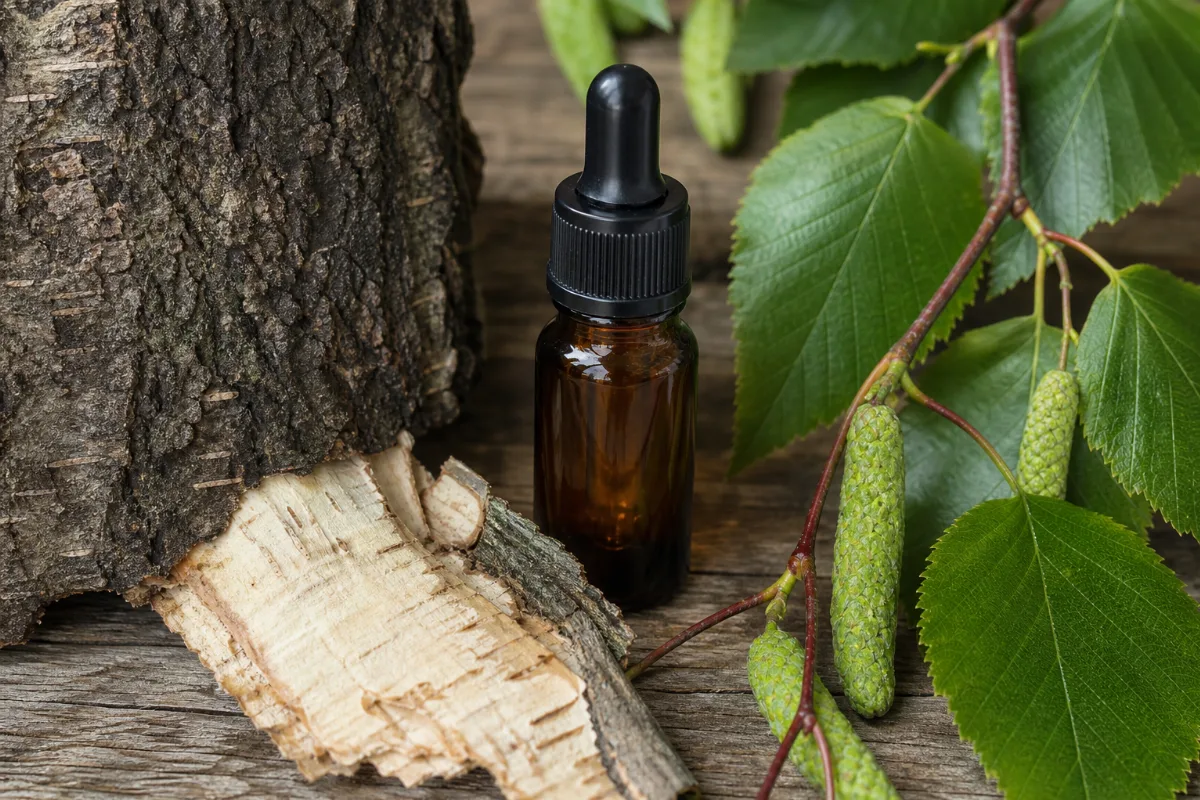
Sweet birch oil is distilled from the bark of a North American tree. It is almost entirely methyl salicylate, the same compound as oil of wintergreen and related to aspirin. Reports describe deaths of young children after a teaspoon or less of this compound, and bleeding in people on warfarin. No trial of the oil itself was found. Keep it away from children and pets, and do not swallow it.
General information, not medical advice. Last substantive update · Not medically reviewed. A named clinician has not signed off on this page. How this page is made
About Sweet Birch Oil
Sweet birch oil is distilled from the bark of Betula lenta and is 93 to 99.8% methyl salicylate in authentic samples. Poisoning reports involve oil of wintergreen, the same compound: a review says a teaspoon or less has been implicated in several deaths of children under 6. Methyl salicylate has also raised warfarin's effect and caused bleeding in case reports. We found no trial of the oil itself for any benefit.
What sweet birch oil is
The oil comes from the bark of Betula lenta, a tree in the birch family (Betulaceae, per GBIF). A 2022 analysis found more than 60 compounds, but the oil was dominated by methyl salicylate (93.24 to 99.84%).
Methyl salicylate is the same main compound as oil of wintergreen, which comes from a different plant. The same 2022 paper found that none of 27 commercial 'sweet birch' oils had the natural birch markers, and signs of added wintergreen oil, synthetic methyl salicylate and castor oil. Two of its three authors work at an essential oil company.
What people use it for, and how strong the evidence is
People use salicylate rubs for muscle and joint aches. A Cochrane review of salicylate rubs found very low quality evidence: older small studies showed benefit and the larger recent ones showed none. The authors say the evidence does not support using them. No trial in it used sweet birch oil on its own.
We found no human study of sweet birch oil for scent, mood, sleep, inflammation or infection.
The research in one view
There are no trials of the oil itself. The safety record comes from case reports and reviews about oil of wintergreen and methyl salicylate products, which is the same main compound. The benefit evidence is a single Cochrane review of rubs, rated very low quality.
Oil, rubs, wintergreen and fake birch are different things
A cream with a small share of methyl salicylate is not the pure oil. In four adults a 15% cream gave about half the salicylate of oil of wintergreen when swallowed. Wintergreen oil comes from another plant, and the 2022 paper says commercial birch oils were often not birch at all. Whichever you have, treat it as a salicylate poison.
At a glance
Traditional uses history, not proof
- No traditional-medicine history was read for this page, so none is claimed.
- A 2022 paper says sweet birch has several economic and medicinal uses, without detail.
Studied for research
- Muscle and joint pain from salicylate rubs (not the oil itself), very-low
- Skin warming feel, insufficient
Main compounds
- Methyl salicylate, 93 to 99.8% of authentic oil
- o-Guaiacol and veratrole, minor marker compounds
Common forms
- Essential oil from the bark
- Pain rubs and liniments that contain methyl salicylate
- Cosmetic and fragrance products
Research links: Poison Control: Essential oils · Methyl salicylate exposure in toddlers, review (abstract) · Salicylate poisoning, out-of-hospital guideline (abstract) · Sweet birch oil authentication, 2022 (abstract) · Topical methyl salicylate and warfarin, case report (abstract) · Salicylate rubs for pain, Cochrane review (abstract) · Pet Poison Helpline: Essential oils · GBIF: Betula lenta · Research Library · Genes & Biomarkers Library
What it is and its history
- Accepted scientific name
- Betula lenta
- Naming authority
- L.
- Common names
- Sweet birch (English); Black birch (English)
- Family or group
- Betulaceae (the birch family), per GBIF.
- Classification
- Plantae > Tracheophyta > Magnoliopsida > Fagales > Betulaceae > Betula > Betula lenta
- Native range
- Not checked in a source read for this page.
- Habitat
- Not checked in a source read.
- What it looks like
- Part used: The 2022 paper analysed oil from the bark by hydro-distillation.
- Look-alikes and adulterants
- Name: Wintergreen (Gaultheria procumbens) oil and synthetic methyl salicylate; Note: A different plant with an oil of the same main compound. The 2022 paper says wintergreen and birch oils are hard to tell apart without marker compounds, and found added wintergreen or synthetic methyl salicylate in commercial 'birch' samples.
- Sustainability and conservation
- Not checked (no IUCN or CITES source read).
Photographs
Traditional use and history history, not clinical proof
| Tradition or era | Documented use | Source |
|---|---|---|
| Not established | No traditional or historical source was read for this page. The 2022 paper says only that sweet birch has several economic and medicinal uses, without detail. | Dosoky 2022 (abstract) |
Traditional use shows how it was used. It does not show that it works or is safe today.
What is inside, and how it may work
What it contains and how those compounds act in cells and animals. Laboratory and animal mechanisms are not proven effects in people.
Main compounds
| Compound | Family | Where it is concentrated | Activity studied | Level of evidence |
|---|---|---|---|---|
| Methyl salicylate PubChem 4133 | salicylate ester | Bark essential oil 93.24 to 99.84% of authentic sweet birch oil (2022 analysis). | Absorbed through the skin and the gut; the poisonous part in oil of wintergreen poisonings. Acts like a salicylate (aspirin family). 17 7 10 12 2 | Human safety reports |
| o-Guaiacol, veratrole and decadienals | minor aroma compounds | Bark essential oil Named as natural marker compounds for authentic birch oil; amounts not read. | Used to check authenticity; no health activity read. 7 | Laboratory |
Mechanisms, receptors and pathways
| Target or pathway | Gene or receptor | What was found | Level |
|---|---|---|---|
| Salicylate effect on blood clotting (warfarin interaction) | Not specified | A case report's authors suggest methyl salicylate may raise warfarin's action by affecting vitamin K metabolism or by displacing warfarin from protein-binding sites. Not tested in the study. 9 | Hypothesis from case report |
| Skin warming | Not specified | Poison Control says wintergreen oil widens blood vessels, creating warmth. 14 | Authoritative guidance |
Absorption, metabolism and elimination
- Absorption
- In four adults, a 15% cream gave about half the salicylate bioavailability of oil of wintergreen when swallowed; no salicylate was detected after holding cream in the mouth for a minute. Case reports describe absorption through damaged, wrapped or genital skin. In 24 adults, 8 commercial patches for 8 hours gave low levels of methyl salicylate.
- Distribution
- Not established.
- Metabolism
- Not established in the sources read.
- Elimination
- Methyl salicylate half-life about 3.0 hours in the patch study.
- Bioavailability
- About 0.5 for the cream compared with oil of wintergreen (4 adults).
Isolated compounds versus whole extracts
Authentic sweet birch oil is nearly one compound, so it behaves like methyl salicylate. A 2022 paper found that bottles sold as sweet birch were not authentic in 27 of 27 samples, with wintergreen oil or synthetic methyl salicylate added.
Nutritional composition
Sweet birch oil is not a nutrient or a food. It is a concentrated salicylate.
1 very low certainty1 not enough evidence
What is Sweet Birch Oil good for?
The uses people ask about and how strong the evidence is. Read the certainty label first: nothing here is better than very low, and no trial tested the oil itself.
Benefits, one by one
Each card is a research question, not a promise. Tap a goal to filter. Open a card to see the studies, doses and limits.
Muscle and joint pain (salicylate rubs, not the oil itself)
Very low certaintySweet birch oil is nearly pure methyl salicylate, the same compound used in some pain rubs. A large Cochrane review of salicylate rubs found the evidence does not support their use for sprains, back pain or arthritis. We found no trial of sweet birch oil itself.
1 studiesNot covered. This page gives no amounts and no way to use the oil.
Studies, doses and limits
What the trials found
One Cochrane systematic review: six placebo-controlled and one active-controlled study in acute pain, seven placebo-controlled and three active-controlled in chronic pain. Products were salicylate rubs, often combined with other ingredients. None was sweet birch oil on its own.
Results
Pooled results favoured salicylate rubs over placebo, but the quality was very low and not robust. Older, smaller studies showed benefit and the larger, more recent studies showed no effect. The authors conclude the evidence does not support using these rubs for acute injuries or chronic conditions.
Effect sizes as reported
Acute pain, success at 7 days: risk ratio 1.9 (95% CI 1.5 to 2.5), not robust. Chronic pain: risk ratio 1.6 (1.2 to 2.0). Both very low quality.
Why this rating
Very low quality evidence by the reviewers' own rating, all studies at risk of bias, benefit seen only in older small studies, and none tested the pure oil.
Form and dose studied
Not covered. This page gives no amounts and no way to use the oil.
Who was studied
Adults with sprains, strains, back pain and osteoarthritis, using commercial rubs.
Limits
Only the abstract was read. A rub with a small share of methyl salicylate is a different product from the pure oil, which sources say is a poison if swallowed.
Why researchers looked
Salicylate rubs irritate the skin and are believed to ease muscle and joint aches.
Traditional use
No traditional-medicine history was read for this page, so none is claimed.
Proposed mechanism Preliminary mechanism
Not established. The Cochrane authors describe the rubs as causing skin irritation and 'believed' to relieve pain.
A proposed mechanism does not show that the effect happens in people.
The oil is almost pure methyl salicylate. Poisoning from small amounts has killed children. See Safety first. The trials here did not test the oil.
Skin warming (a feeling, not a health result)
Not enough evidencePoison Control says wintergreen oil creates a feeling of warmth on the skin because it widens blood vessels. No study was found that measured a health benefit of sweet birch oil from this.
1 studiesNot covered. This page gives no amounts and no way to use the oil.
Studies, doses and limits
What the trials found
None for sweet birch oil.
Results
No human outcome study found.
Effect sizes as reported
None.
Why this rating
A statement on a poison-centre page about wintergreen oil, not a study of benefit.
Form and dose studied
Not covered. This page gives no amounts and no way to use the oil.
Who was studied
n/a
Limits
Poison-centre education page; it names wintergreen, not sweet birch.
Why researchers looked
Warming rubs are sold for aches.
Traditional use
None read.
Proposed mechanism Preliminary mechanism
Poison Control says it dilates blood vessels. No study of sweet birch oil was read.
A proposed mechanism does not show that the effect happens in people.
A warm feeling comes from the same action that lets the skin absorb the compound. See Safety.
Connections to the rest of health
How Sweet Birch Oil connects to the rest of our health knowledge graph. Every link says what kind of connection it is. A safety link (for example to the liver) is a warning, not a benefit. A study that merely mentions a topic never creates a benefit link.
Explore every connection: goals, body systems, organs, symptoms, genes
A. Wellness goals
| Connected to | Kind of connection | Evidence status | Context | Studies |
|---|---|---|---|---|
| Pain Relief | Very low certainty | Muscle and joint pain (salicylate rubs, not the oil itself): Sweet birch oil is nearly pure methyl salicylate, the same compound used in some pain rubs. A large Cochrane review of salicylate rubs found the evidence does not support their use for sprains, back pain or arthritis. We found no trial of sweet birch oil itself. | 6 | |
| Muscle Joint Support | Very low certainty | Muscle and joint pain (salicylate rubs, not the oil itself): Sweet birch oil is nearly pure methyl salicylate, the same compound used in some pain rubs. A large Cochrane review of salicylate rubs found the evidence does not support their use for sprains, back pain or arthritis. We found no trial of sweet birch oil itself. | 6 | |
| Pain Relief | Traditional use | Not enough evidence | Skin warming (a feeling, not a health result): Poison Control says wintergreen oil creates a feeling of warmth on the skin because it widens blood vessels. No study was found that measured a health benefit of sweet birch oil from this. | 14 |
B. Body systems
| Connected to | Kind of connection | Evidence status | Context | Studies |
|---|---|---|---|---|
| Musculoskeletal System | Biological association | Very low certainty | Studied for: Muscle and joint pain (salicylate rubs, not the oil itself) | 6 |
| Integumentary System | Biological association | Not enough evidence | Studied for: Skin warming (a feeling, not a health result) | 14 |
E. Health conditions
| Connected to | Kind of connection | Evidence status | Context | Studies |
|---|---|---|---|---|
| Salicylate poisoning | Adverse effect or risk | Documented risk | Deaths of children under 6 reported from a teaspoon or less of oil of wintergreen. Preparation or compound: Methyl salicylate (oil of wintergreen); sweet birch oil is 93 to 99.8% methyl salicylate |
5 2 7 |
I. Biomarkers
| Connected to | Kind of connection | Evidence status | Context | Studies |
|---|---|---|---|---|
| Pain relief at about 7 days (acute) or 14 days or more (chronic) | Biological association | Very low certainty | Measured in trials: increase (people with good pain relief). A lab change is not the same as a health benefit. | 6 |
L. Active compounds
| Connected to | Kind of connection | Evidence status | Context | Studies |
|---|---|---|---|---|
| Methyl salicylate | Biological association | Human safety reports | Absorbed through the skin and the gut; the poisonous part in oil of wintergreen poisonings. Acts like a salicylate (aspirin family). Preparation or compound: Bark essential oil |
17 7 10 12 2 |
| o-Guaiacol, veratrole and decadienals | Biological association | Laboratory | Used to check authenticity; no health activity read. Preparation or compound: Bark essential oil |
7 |
Each connection is stored with the ingredient, the connected record, the kind of connection, the evidence status, the supporting studies, the preparation or compound involved, and a review date (last reviewed October 25, 2026).
The evidence
The research centre for Sweet Birch Oil. Every record here was checked against PubMed or the publisher's page; we never list a study we have not verified.
Evidence by outcome
Bars show how many studies we found for each outcome, not how well it works. People are added up across trials only (reviews are not added, to avoid double counting).
How we rate evidence
High certainty
Several well-run trials or reviews agree; further research is unlikely to change the picture much.
Moderate certainty
Good trials point the same way, but some doubt remains.
Low certainty
Small, short or inconsistent trials. The finding could change with better research.
Very low certainty
Very little or very weak human data. Treat as a possibility only.
Mixed findings
Trials or reviews disagree with each other.
Not enough evidence
Not enough human research to say either way.
Evidence against
Good research found no benefit, or found harm.
We take the reviewers' own risk-of-bias and GRADE statements where they exist, and otherwise judge from study size, design, consistency, directness and whether a product matches what is sold. Many publications do not make evidence high. Method note: We read the abstracts of 13 PubMed papers and the Poison Control and Pet Poison Helpline pages, and checked the plant name in GBIF and two compounds in PubChem. We did not find or read a regulator statement on sweet birch oil.
Study library: every study we checked 17
| Study | Design | People | Product, dose, length | Result |
|---|---|---|---|---|
| Bell 2002 Acute methyl salicylate toxicity complicating herbal skin treatment for psoriasis. Emerg Med (Fremantle) · PMID 12147116 · DOI |
Case report human (case report) |
1 A 40-year-old man |
A herbal skin cream containing methyl salicylate (oil of wintergreen) with an occlusive dressing n/a Not repeated here n/a · vs n/a |
He became suddenly and acutely unwell with ringing in the ears, vomiting, fast breathing and the typical acid-base disturbance of salicylate poisoning. The authors say absorption through the skin was increased by abnormal skin and the occlusive dressing. He had washed his skin before arriving, which limited the poisoning, and recovered with fluids and good urine flow. Methods, limits and fundingOutcomes: Salicylate toxicity Limitations: One case, from an unregistered practitioner's cream. Funding and conflicts: Not stated in the abstract. Read: abstract |
| Botma 2001 Laryngeal oedema caused by accidental ingestion of Oil of Wintergreen. Int J Pediatr Otorhinolaryngol · PMID 11335011 · DOI |
Case report with review human (case report) |
1 Child (case report) |
Oil of wintergreen (methyl salicylate) n/a Not repeated here n/a · vs n/a |
The authors compare one teaspoon (5 ml) of oil of wintergreen to about 7000 mg of salicylate, or 21.7 adult aspirin tablets of 325 mg. They say ingesting as little as 4 ml in a child can be fatal, that hospital admission is needed for monitoring and treatment after accidental poisoning, and report a case in which throat swelling (laryngeal oedema) complicated the poisoning. They suggest child-resistant bottles, small openings, clear labels and lower salicylate content. Methods, limits and fundingOutcomes: Poisoning, airway swelling Limitations: One case plus general information; the abstract does not give the child's age or outcome. Funding and conflicts: Not stated in the abstract. Read: abstract |
| Chan 1996 Potential dangers from topical preparations containing methyl salicylate. Hum Exp Toxicol · PMID 8880210 · DOI |
Narrative review human (review) |
General | Methyl salicylate products (oil of wintergreen) n/a Not repeated here n/a · vs n/a |
Swallowing methyl salicylate poses a threat of severe, rapid-onset salicylate poisoning because it is a concentrated liquid and dissolves in fat. Excessive use of these preparations in people taking warfarin may cause adverse interactions and bleeding. The compound may cause irritant or allergic contact dermatitis and anaphylactic reactions. Methods, limits and fundingOutcomes: Poisoning, interactions, skin reactions Limitations: A short review from one author. Funding and conflicts: Not stated in the abstract. Read: abstract |
| Chyka 2007 Salicylate poisoning: an evidence-based consensus guideline for out-of-hospital management. Clin Toxicol (Phila) · PMID 17364628 · DOI |
Expert consensus guideline guideline |
People exposed to salicylates (poison-centre triage) | Salicylates including oil of wintergreen (98% methyl salicylate) n/a Not repeated here n/a · vs n/a |
The panel says children under 6 who swallow more than a lick or taste of oil of wintergreen could develop salicylate poisoning and should be referred to an emergency department. Warning signs include vomiting blood, fast or deep breathing, shortness of breath, ringing in the ears, deafness, lethargy, seizures and confusion. Do not induce vomiting. After skin contact, wash thoroughly with soap and water and watch for symptoms; after eye contact, rinse with room-temperature tap water for 15 minutes. People who may have been poisoned on purpose or by someone else should go to an emergency department whatever the reported amount. Poison centres should follow up for about 12 hours after swallowing non-coated products. Methods, limits and fundingOutcomes: Triage and first-aid recommendations Limitations: A guideline for poison-centre staff, graded mostly C and D (expert opinion). It does not substitute for clinical judgment. Funding and conflicts: Panel convened by the American Association of Poison Control Centers with a federal health agency; no commercial funding is stated in the abstract. Read: abstract |
| Davis 2007 Are one or two dangerous? Methyl salicylate exposure in toddlers. J Emerg Med · PMID 17239735 · DOI |
Narrative review plus poison centre data human (review) |
Children, mostly under 6 years | Methyl salicylate products, including oil of wintergreen (98% methyl salicylate) n/a Not repeated here n/a · vs n/a |
Serious toxicity can follow small amounts of methyl salicylate. Methyl salicylate continues to be a relatively common source of pediatric exposures, and persistent reports of life-threatening and fatal toxicity were found. In children under 6, a teaspoon (5 mL) or less of oil of wintergreen has been implicated in several well-documented deaths. Methods, limits and fundingOutcomes: Poisoning severity and deaths Limitations: A review of reports; it is about oil of wintergreen, not sweet birch oil by name. Sweet birch oil is almost entirely the same compound (see the composition paper), which is the reason it is used here. Funding and conflicts: Not stated in the abstract. Read: abstract |
| Derry 2014 Salicylate-containing rubefacients for acute and chronic musculoskeletal pain in adults. Cochrane Database Syst Rev · PMID 25425092 · DOI |
Systematic review (Cochrane) human (systematic review) |
Adults with strains, sprains, back pain and arthritis (about 1,370 people in placebo and active-controlled studies combined) | Topical rubefacients containing salicylates (various products and added ingredients) n/a Not repeated here n/a · vs n/a |
Pooled success rates favoured salicylates, but the evidence was judged very low quality and not robust. The authors say any evidence of efficacy came from older, smaller studies, while the larger, more recent studies showed no effect. They conclude the evidence does not support the use of topical salicylate rubefacients for acute injuries or chronic conditions, and that they seem relatively well tolerated in the short term based on limited data. Methods, limits and fundingOutcomes: Pain relief, adverse events Limitations: No trial in the review used sweet birch oil on its own; the products were salicylate rubs, many with other active ingredients. All studies were at risk of bias. Funding and conflicts: Reviewers declare no conflicts relating to this review. Read: abstract |
| Dosoky 2022 Authentication and Market Survey of Sweet Birch (Betula lenta L.) Essential Oil. Plants (Basel) · PMID 36015435 · DOI |
Laboratory analysis (GC MS) of oils laboratory |
27 Authentic bark oils and 27 commercial samples |
Sweet birch (Betula lenta) bark essential oil, hydro-distilled Bark Not repeated here n/a · vs n/a |
More than 60 compounds were found in natural sweet birch oil, which was dominated by methyl salicylate (93.24 to 99.84%). None of the 27 commercial samples contained any of the identified birch marker compounds. The authors say markers in the commercial samples suggest added wintergreen oil, synthetic methyl salicylate and castor oil. Methods, limits and fundingOutcomes: Composition and authenticity Limitations: Laboratory work on composition only. Two of the three authors work for an essential oil company (see funding line). Funding and conflicts: The authors work at an essential oil company (dōTERRA International); they declare no conflict of interest. Read: abstract |
| Howrie 1985 Candy flavoring as a source of salicylate poisoning. Pediatrics · PMID 3991273 |
Case report human (case report) |
1 A 21-month-old boy |
Methyl salicylate (oil of wintergreen) candy flavoring n/a Not repeated here n/a · vs n/a |
A swallow of the solution was followed by vomiting, lethargy and fast deep breathing. The serum salicylate level was 81 mg/dL six hours after swallowing. He was treated with fluids and sodium bicarbonate and recovered quickly. The authors point to the candy-like smell, parents not knowing the danger, and non-child-resistant packaging with potentially lethal quantities. Methods, limits and fundingOutcomes: Salicylate level, symptoms, recovery Limitations: One case from 1985. It was a flavouring, not sweet birch oil sold for aromatherapy. Funding and conflicts: Not stated in the abstract. Read: abstract |
| Joss 2000 Potentiation of warfarin anticoagulation associated with topical methyl salicylate. Ann Pharmacother · PMID 10860133 · DOI |
Case report human (case report) |
1 A 22-year-old woman on warfarin |
A topical pain-relieving gel containing low-dose methyl salicylate, applied to the knees daily for eight days n/a Not repeated here n/a · vs n/a |
Her INR (a blood-clotting test) was 12.2 after the gel; it had been stable before. The authors say methyl salicylate is absorbed through the skin in measurable amounts and may raise warfarin's action by affecting vitamin K metabolism or by displacing warfarin from protein-binding sites. They say a significant interaction can occur even with lower topical doses. Methods, limits and fundingOutcomes: INR Limitations: One case. A gel, not sweet birch oil. Funding and conflicts: Not stated in the abstract. Read: abstract |
| Martin 2004 Dermal absorption of camphor, menthol, and methyl salicylate in humans. J Clin Pharmacol · PMID 15342616 · DOI |
Pharmacokinetic study |
24 24 healthy adults (3 groups of 8) |
2, 4 or 8 commercial patches (camphor, menthol and methyl salicylate) worn for 8 hours n/a Not repeated here 8 hours · vs n/a |
With 8 patches the average highest plasma level of methyl salicylate was 29.5 ng/mL, and its half-life about 3.0 hours. The authors conclude that low-dose skin application for a long time gave low plasma levels, and that systemic exposure seemed relatively low even with an unrealistically large number of patches for an unusually long time. Methods, limits and fundingOutcomes: Plasma levels, half-life Limitations: Healthy adults, intact skin, commercial patches (not the pure oil). It is the one result here that points to low absorption; the case reports involve damaged skin, wrapping, rubs and the pure oil. Funding and conflicts: Not stated in the abstract. Read: abstract |
| Thompson 2016 Salicylate Toxicity from Genital Exposure to a Methylsalicylate-Containing Rubefacient. West J Emerg Med · PMID 26973745 · DOI |
Case report human (case report) |
1 A male teenager |
A methyl salicylate rubefacient applied to the genital area n/a Not repeated here n/a · vs n/a |
The authors report salicylate poisoning after use on the genital area. They say methyl salicylate can be absorbed through intact skin, that topical salicylates rarely cause whole-body toxicity when used appropriately, and that scrotal skin can absorb up to 40-fold more than other regions. Methods, limits and fundingOutcomes: Salicylate toxicity Limitations: One case, an over-the-counter rub, not sweet birch oil. Funding and conflicts: Not stated in the abstract. Read: abstract |
| Wolowich 2003 Plasma salicylate from methyl salicylate cream compared to oil of wintergreen. J Toxicol Clin Toxicol · PMID 12870876 · DOI |
Open label crossover trial |
4 Four adult volunteers |
1 mL oil of wintergreen (USP) or a 15% methyl salicylate cream, swallowed (cream also held in the mouth and spat out) n/a Not repeated here n/a · vs n/a |
Relative bioavailability of the cream at the low dose was 0.5 compared with oil of wintergreen. No salicylate was detected after holding cream in the mouth for 1 minute. The authors conclude that salicylate levels from cream are not equal to those from the oil and that the product form must be considered when predicting toxicity. Methods, limits and fundingOutcomes: Plasma salicylate Limitations: Four adults only, in a controlled setting. It shows the pure oil is absorbed more fully than a cream; it does not describe harm. Funding and conflicts: Not stated in the abstract. Read: abstract |
| Yip 1990 Adverse effect of topical methylsalicylate ointment on warfarin anticoagulation: an unrecognized potential hazard. Postgrad Med J · PMID 2371186 · DOI |
Case series human (case series) |
11 11 patients on warfarin (Hong Kong) |
Topical methyl salicylate ointment n/a Not repeated here n/a · vs n/a |
All 11 had an abnormally high INR after significant use of the ointment, with a positive blood salicylate level. Three had bleeding: two with bruises and one with gastrointestinal bleeding. The authors say the ointment should be prescribed with care to people on warfarin and excessive use avoided. Methods, limits and fundingOutcomes: INR, bleeding Limitations: A small uncontrolled series of patients picked because they had the problem; it cannot give a rate. Funding and conflicts: Not stated in the abstract. Read: abstract |
| n/a 2026 Poison Control (National Capital Poison Center): Essential oils: Poisonous when misused (page read 2026-10-25) n/a · Source |
Poison centre education page n/a |
n/a | n/a n/a n/a n/a · vs n/a |
General essential-oil page. Says misuse can cause serious poisoning, many oils cause rashes and some are poisonous if absorbed through the skin or swallowed, and children have thin skin and immature livers which may make them more susceptible. Oils may interact with medications, and it can be hard to know the species, concentration or contaminants in a bottle. It says wintergreen oil is very dangerous if more than a tiny amount is swallowed, roughly equal to swallowing a large number of adult aspirin tablets. If someone swallows an essential oil, use its online tool or call a poison center at 1-800-222-1222 (US). Oils at home should be locked up, out of sight and reach of children and pets, or discarded if young children are in the home. Stop using an oil that causes a rash and wash it off; do not use oils on damaged skin. Methods, limits and fundingOutcomes: Essential-oil and wintergreen safety statements Limitations: Page names wintergreen, not sweet birch, and gives no amounts. US number only. Read: full-text |
| n/a 2026 Pet Poison Helpline: Essential Oils (page read 2026-10-25) n/a · Source |
Animal poison centre education page pets |
n/a | n/a n/a n/a n/a · vs n/a |
Essential oil poisoning can affect all species, but cats and birds are at the greatest risk. Common signs are drooling, vomiting, lethargy, loss of appetite, and skin, airway and mucous membrane irritation, usually within 6 to 8 hours. Oral exposure is the highest risk, then skin, then breathing. Its list of oils that can cause poisoning includes 'wintergreen birch'. Do not make a pet vomit. Methods, limits and fundingOutcomes: Essential-oil poisoning in pets Limitations: A general page; the list item reads 'wintergreen birch' and does not say which species or what amount. Read: full-text |
| n/a 2026 GBIF Backbone Taxonomy: Betula lenta L. (match API read 2026-10-25) n/a · Source |
Registry or database n/a |
n/a | n/a n/a n/a n/a · vs n/a |
Accepted species name Betula lenta L., rank species, status ACCEPTED, family Betulaceae, order Fagales, kingdom Plantae (GBIF species key 5331709, match confidence 97). Methods, limits and fundingOutcomes: Accepted name and family Limitations: Taxonomy only. Read: full-text |
| n/a 2026 PubChem: methyl salicylate (CID 4133) and salicylic acid (CID 338) (read 2026-10-25) n/a · Source |
Registry or database n/a |
n/a | n/a n/a n/a n/a · vs n/a |
Methyl salicylate: CID 4133, formula C8H8O3, IUPAC name methyl 2-hydroxybenzoate. Salicylic acid: CID 338, formula C7H6O3. Methods, limits and fundingOutcomes: Compound identity Limitations: Identifiers only. Read: full-text |
What we do not know yet
- No human trial of sweet birch oil itself was found, so no benefit is shown.
- Every poisoning report found names oil of wintergreen or methyl salicylate products, not sweet birch oil by name.
- No study of the oil with aspirin, in pregnancy, breastfeeding or asthma was found.
- No FDA, EFSA, IFRA, NCCIH, LiverTox or LactMed statement was read.
How new research is added
New studies are found by a saved PubMed search and are placed in a review queue. A person reads each one before it is added.
Lab markers
What changed in blood or saliva tests during trials. A changed number is not the same as feeling or being healthier, and we give no "normal ranges".
Other 1
Pain relief at about 7 days (acute) or 14 days or more (chronic)
Increase (people with good pain relief) in trials
The share of people who reported clear improvement in pain.
Very low certaintyResults and what it means
Why it was measured
The main outcome in the Cochrane review of salicylate rubs.
Statistical vs. clinical meaning
Self-reported pain in studies at risk of bias; the benefit faded in larger, newer studies.
Safety implication
Better pain scores do not make the pure oil safe to use. Rubs on skin can still add salicylate to the blood.
| Study | Result | People | Product |
|---|---|---|---|
| 6 | Acute: risk ratio 1.9 (1.5 to 2.5) for salicylate against placebo, not robust, very low quality. Chronic: 1.6 (1.2 to 2.0). Larger, more recent studies showed no effect. |
Safety
What studies and official sources say about side effects, medicines and who should check first. Each point shows what kind of evidence it comes from.
Main points to know 6
- Swallowing: a few drops to a teaspoon of this kind of oil has killed small children.. Sweet birch oil is 93 to 99.8% methyl salicylate in authentic samples (a 2022 analysis). Methyl salicylate is the poisonous part of oil of wintergreen. A 2007 review says a teaspoon (5 mL) or less of oil of wintergreen has been implicated in several well-documented deaths of children under 6. Another paper says one teaspoon equals about 7000 mg of salicylate, or 21.7 adult aspirin tablets, and that as little as 4 ml can be fatal in a child. A poison-centre guideline says a child under 6 who swallows more than a lick or taste should go to an emergency department. A toddler became seriously ill after a single swallow of wintergreen candy flavouring. These reports are about oil of wintergreen, not sweet birch by name; they apply because the compound is the same. Case report and review 5 2 4 8 7 14
- Poisoning can come through the skin too, especially damaged skin, wrapped skin and the genital area.. Case reports describe salicylate poisoning after a methyl salicylate skin cream under an occlusive dressing on abnormal skin, and after use on the genital area, where one paper says absorption can be up to 40-fold greater. A study of healthy adults wearing commercial patches found low blood levels, so the risk depends on the product, the skin and how much covers it. We found no report that names sweet birch oil on the skin. Case report 1 11 10 3
- Blood thinners: methyl salicylate has raised warfarin's effect and caused bleeding.. A woman on warfarin had an INR of 12.2 after eight days of a knee gel with low-dose methyl salicylate. In an 11-patient series from Hong Kong, everyone using methyl salicylate ointment had a raised INR and three had bleeding (two with bruises, one with gastrointestinal bleeding). A review warns that heavy use in people taking warfarin may cause bleeding. Ask a pharmacist before any methyl salicylate product if you take warfarin. Case report 9 13 3
- Aspirin and other salicylate medicines: the same compound family, so the effects can add up.. Sources measure this oil against aspirin tablets because the poisoning is salicylate poisoning. We found no study that tested sweet birch oil together with aspirin or another salicylate medicine. Treat any extra salicylate as something to raise with a pharmacist or doctor first. Inference 2 4 14
- A bottle may not be what the label says.. A 2022 test of 27 commercial 'sweet birch' oils found none had the natural birch marker compounds. Signs of added wintergreen oil, synthetic methyl salicylate and castor oil were found. Either way the main compound is methyl salicylate. The authors work at an essential oil company. Laboratory 7
- Pets: wintergreen/birch oils are on a pet poison list; cats and birds are at greatest risk of essential oils.. Pet Poison Helpline lists 'wintergreen birch' among oils that can cause poisoning and says cats and birds are at greatest risk, with signs such as drooling, vomiting and lethargy. Do not make a pet vomit; call a veterinarian or the helpline. Authoritative guidance 15
Side effects 4
| Effect | How often | Severity and recovery | Evidence |
|---|---|---|---|
| Salicylate poisoning after swallowing (vomiting, fast or deep breathing, ringing in the ears, lethargy, confusion, seizures, airway swelling) The reports name oil of wintergreen or methyl salicylate products, not sweet birch oil. The compound is the same. | No rate found for sweet birch oil | Can be life-threatening or fatal; deaths of young children reported with oil of wintergreen A toddler in a 1985 case recovered quickly with fluids and sodium bicarbonate; deaths have also occurred (review). | Case report and review 5 2 8 4 |
| Salicylate poisoning after skin use (ringing in the ears, vomiting, fast breathing) Occlusive dressing and abnormal skin raised absorption in one case; genital skin in another. | Rare in case reports; no rate found | Hospital care needed in reported cases The 40-year-old man in one case recovered with fluids; he had washed his skin before arriving. | Case report 1 11 |
| Bleeding and raised INR in people on warfarin Products were ointments and gels, not sweet birch oil. | 3 of 11 patients in one series had bleeding | INR of 12.2 in one case; one gastrointestinal bleed in the series Not described in the abstracts. | Case report 9 13 |
| Skin irritation, allergic contact dermatitis and, rarely, severe allergic reactions The 1996 review names methyl salicylate for irritant and allergic contact dermatitis and anaphylactic reactions. | No rate found | Not graded Poison Control says stop and wash the oil off if a rash occurs; any reaction with trouble breathing is an emergency. | Narrative review 3 14 |
Liver
No liver injury linked to sweet birch oil was found in the sources read. LiverTox was not checked. Poison Control says children may have immature livers and be more susceptible to essential oils in general. 14
How often. Not established.
Monitoring. Not applicable.
This is a safety connection. It is not evidence that Sweet Birch Oil supports liver health.
Medicines and supplements 3
| With | Why it matters | Importance | Evidence | What to do |
|---|---|---|---|---|
| Warfarin (blood thinner) drug | Authors suggest methyl salicylate may affect vitamin K metabolism or displace warfarin from protein-binding sites. | Raised INR and bleeding reported with methyl salicylate gels and ointments, including a low-dose gel. | Case report Low certainty 9 13 3 | Do not use methyl salicylate products with warfarin unless a doctor or pharmacist has approved it. |
| Aspirin and other salicylate medicines drug | Same salicylate family; sources compare the oil to aspirin tablets. | Not studied for sweet birch oil. The effects are expected to add up (inference, not stated by a source for this pair). | Inference Very low certainty 2 4 | Ask a pharmacist before combining. |
| Other medicines drug | Poison Control says essential oils may interact with medications and gives no list. | Not specified. | Authoritative guidance Low certainty 14 | Tell a pharmacist about any essential oil you use. |
Who should check first 5
| Situation | Advice | Evidence |
|---|---|---|
| Any swallowing, by anyone | Do not swallow. Poison Control calls wintergreen oil very dangerous if more than a tiny amount is swallowed. | Authoritative guidance 14 5 |
| Households with children under 6 or pets | Reports describe deaths from a teaspoon or less. Poison Control says oils must be locked up out of sight and reach, or discarded if young children are in the home. | Case report and review 5 14 |
| Taking warfarin or another blood thinner | Avoid unless a doctor or pharmacist approves. | Case report 9 13 |
| Broken, rashy or covered skin, or sensitive areas | Do not use. Reports link poisoning to abnormal skin, occlusive dressings and genital skin. | Case report 1 11 14 |
| Allergy to aspirin or salicylates, or past reaction to wintergreen rubs | No sweet birch-specific source was read. Avoid it and ask a pharmacist. | Inference 3 |
Overdose, product quality and regulators
Summary. Salicylate poisoning. Sources say a small amount of oil of wintergreen, the same compound, can kill a young child. This page gives no safe amount, because none is established.
Amounts. No safe amount is established, and this page gives none. For orientation only, a case report compares one teaspoon to 21.7 adult aspirin tablets.
Onset and course. The 1985 toddler vomited and became lethargic with fast breathing; his blood salicylate was measured at 6 hours. A guideline says poison centres follow patients for about 12 hours after swallowing non-coated products.
Repeated use. Repeated skin use with warfarin raised INR in case reports. No long-term study of sweet birch oil was found.
Animal data. No animal data on sweet birch oil were read apart from the Pet Poison Helpline list entry.
Toxic parts. The poisonous part is methyl salicylate, 93 to 99.8% of authentic sweet birch bark oil in a 2022 analysis.
Not read. The full text of the guideline, FDA and EU statements, IFRA and cosmetic limits, Tisserand safety data, LiverTox and LactMed.
A 'sweet birch' bottle may be partly wintergreen oil or synthetic methyl salicylate.
Authenticity. None of 27 commercial samples contained the birch marker compounds; markers of added wintergreen oil, synthetic methyl salicylate and castor oil were found. 7
Unknown species and strength. Poison Control says it can be hard to know the plant species, concentration or contaminants in an essential oil bottle. 14
| Body | Action | Date |
|---|---|---|
| American Association of Poison Control Centers expert panel (United States) | 2007 evidence-based consensus guideline on salicylate poisoning: emergency referral for a child under 6 who swallows more than a lick or taste of oil of wintergreen; do not induce vomiting; wash skin with soap and water after skin contact; rinse eyes for 15 minutes; poison centres to follow up. source | 2007 |
| Poison Control (National Capital Poison Center) (United States) | Says wintergreen oil is very dangerous if more than a tiny amount is swallowed; US poison help line 1-800-222-1222 and an online tool. source | 2026 |
When to get medical help
- If anyone, especially a child or pet, may have swallowed sweet birch or wintergreen oil, call poison control right away (US: 1-800-222-1222, or the online tool at poison.org) or your local emergency number. Do not make them vomit.
- Ringing in the ears, vomiting, fast or deep breathing, drowsiness, confusion or a seizure after swallowing or heavy skin use is an emergency (poison-centre guideline).
- Swelling of the throat or trouble breathing is an emergency.
- After skin contact, wash well with soap and water (guideline); rinse eyes with tap water for 15 minutes, then seek care if pain or blurred vision remains.
- If you take warfarin and notice bruising, black stools or bleeding after using a methyl salicylate product, get medical help.
Stop using the product and contact a clinician or emergency service. In the US, Poison Control is 1-800-222-1222.
General information only, not medical advice. Ask a clinician or pharmacist before use, especially with medicines, in pregnancy or with a health condition. See the Natural Remedy Safety guide.
Frequently asked questions
Is sweet birch oil safe to swallow?
Can a small amount really kill a child?
How is sweet birch oil like aspirin?
Is it dangerous with warfarin?
What about aspirin or other pain medicines?
Can it poison you through the skin?
Does sweet birch oil relieve muscle or joint pain?
Not shown. A Cochrane review of salicylate rubs found very low quality evidence, and the authors say it does not support their use. No trial tested the oil on its own.
Is it safe in pregnancy or while breastfeeding?
We found no study of the oil in pregnancy or breastfeeding, so safety is not shown. Ask a doctor or midwife first.
Is it safe for pets?
Pet Poison Helpline lists 'wintergreen birch' among oils that can cause poisoning, and says cats and birds are at greatest risk of essential oils. If a pet may have licked or swallowed it, call a vet or helpline. Do not make it vomit.
Is sweet birch oil the same as wintergreen oil?
They are different plants but both oils are mostly methyl salicylate. A 2022 test of 27 'birch' oils found none had birch markers, and found signs of wintergreen and synthetic methyl salicylate.
What should I do after a spill on skin or in the eyes?
A poison-centre guideline says wash skin thoroughly with soap and water and watch for symptoms, and rinse eyes with tap water for 15 minutes. Seek care for ringing ears, vomiting, fast breathing or pain that persists.
Has anyone approved sweet birch oil for health use?
We did not find or read an approval or safety statement on sweet birch oil from the FDA, EFSA or similar bodies.
Explore by health goal
Editorial transparency
- Written by
- AlternativeMed editorial team. Research compiled with AI assistance, then checked against PubMed records.
- Medical review
- None. This page has not been reviewed by a physician or pharmacist.
- First published
- 2026-10-25
- Last substantive update
- 2026-10-25
- How we research
- We read the abstracts of 13 PubMed papers and the Poison Control and Pet Poison Helpline pages, and checked the plant name in GBIF and two compounds in PubChem. We did not find or read a regulator statement on sweet birch oil.
- How we rate evidence
- See "How we rate evidence" in the Evidence tab.
- Independence
- No product is promoted on this page. No affiliate links are shown. Industry links are labelled where the abstract gave them.
Sources 17
Each source was opened and checked. Where we read only the abstract, it says so. The small numbers in the text point here.
- Bell AJ, Duggin G. Acute methyl salicylate toxicity complicating herbal skin treatment for psoriasis.. Emerg Med (Fremantle). 2002. PMID 12147116. DOI 10.1046/j.1442-2026.2002.00316.x. (abstract)
- Botma M, Colquhoun-Flannery W, Leighton S. Laryngeal oedema caused by accidental ingestion of Oil of Wintergreen.. Int J Pediatr Otorhinolaryngol. 2001. PMID 11335011. DOI 10.1016/s0165-5876(01)00453-0. (abstract)
- Chan TY. Potential dangers from topical preparations containing methyl salicylate.. Hum Exp Toxicol. 1996. PMID 8880210. DOI 10.1177/096032719601500905. (abstract)
- Chyka PA, Erdman AR, Christianson G, et al. Salicylate poisoning: an evidence-based consensus guideline for out-of-hospital management.. Clin Toxicol (Phila). 2007. PMID 17364628. DOI 10.1080/15563650600907140. (abstract)
- Davis JE. Are one or two dangerous? Methyl salicylate exposure in toddlers.. J Emerg Med. 2007. PMID 17239735. DOI 10.1016/j.jemermed.2006.08.009. (abstract)
- Derry S, Matthews PR, Wiffen PJ, Moore RA. Salicylate-containing rubefacients for acute and chronic musculoskeletal pain in adults.. Cochrane Database Syst Rev. 2014. PMID 25425092. DOI 10.1002/14651858.CD007403.pub3. (abstract)
- Dosoky NS, Poudel A, Satyal P. Authentication and Market Survey of Sweet Birch (Betula lenta L.) Essential Oil.. Plants (Basel). 2022. PMID 36015435. DOI 10.3390/plants11162132. (abstract)
- Howrie DL, Moriarty R, Breit R. Candy flavoring as a source of salicylate poisoning.. Pediatrics. 1985. PMID 3991273. (abstract)
- Joss JD, LeBlond RF. Potentiation of warfarin anticoagulation associated with topical methyl salicylate.. Ann Pharmacother. 2000. PMID 10860133. DOI 10.1345/aph.19309. (abstract)
- Martin D, Valdez J, Boren J, Mayersohn M. Dermal absorption of camphor, menthol, and methyl salicylate in humans.. J Clin Pharmacol. 2004. PMID 15342616. DOI 10.1177/0091270004268409. (abstract)
- Thompson TM, Toerne T, Erickson TB. Salicylate Toxicity from Genital Exposure to a Methylsalicylate-Containing Rubefacient.. West J Emerg Med. 2016. PMID 26973745. DOI 10.5811/westjem.2016.1.29262. (abstract)
- Wolowich WR, Hadley CM, Kelley MT, et al. Plasma salicylate from methyl salicylate cream compared to oil of wintergreen.. J Toxicol Clin Toxicol. 2003. PMID 12870876. DOI 10.1081/clt-120022002. (abstract)
- Yip AS, Chow WH, Tai YT, Cheung KL. Adverse effect of topical methylsalicylate ointment on warfarin anticoagulation: an unrecognized potential hazard.. Postgrad Med J. 1990. PMID 2371186. DOI 10.1136/pgmj.66.775.367. (abstract)
- n/a. Poison Control (National Capital Poison Center): Essential oils: Poisonous when misused (page read 2026-10-25). n/a. 2026. (full-text)
- n/a. Pet Poison Helpline: Essential Oils (page read 2026-10-25). n/a. 2026. (full-text)
- n/a. GBIF Backbone Taxonomy: Betula lenta L. (match API read 2026-10-25). n/a. 2026. (full-text)
- n/a. PubChem: methyl salicylate (CID 4133) and salicylic acid (CID 338) (read 2026-10-25). n/a. 2026. (full-text)