Essential Oils & Aromatherapy · Essential oil (caution)
Nutmeg Oil
Myristica fragrans Houtt. · also called Nutmeg essential oil
Nutmeg oil is the strong, warm, spicy oil distilled from the seed of the nutmeg tree. It is used as a fragrance and a food flavouring. Human research on the oil is almost non-existent. The main caution: swallowing nutmeg can cause hallucinations, a racing heart and coma, and the oil is a concentrated form. Never swallow it, and keep it away from children and pets.
General information, not medical advice. Last substantive update · Not medically reviewed. A named clinician has not signed off on this page. How this page is made
About Nutmeg Oil
Nutmeg oil smells warm and spicy. Safety comes first. Swallowing nutmeg has caused hallucinations, racing heart, agitation, seizures in an infant and coma in a child, and one death with a sleeping medicine in the blood. These reports are about the spice, and we found none about the oil, but the oil is far more concentrated and contains myristicin, the compound named as toxic. Human research on the oil is almost non-existent and what exists is very-low or against.
What nutmeg oil is
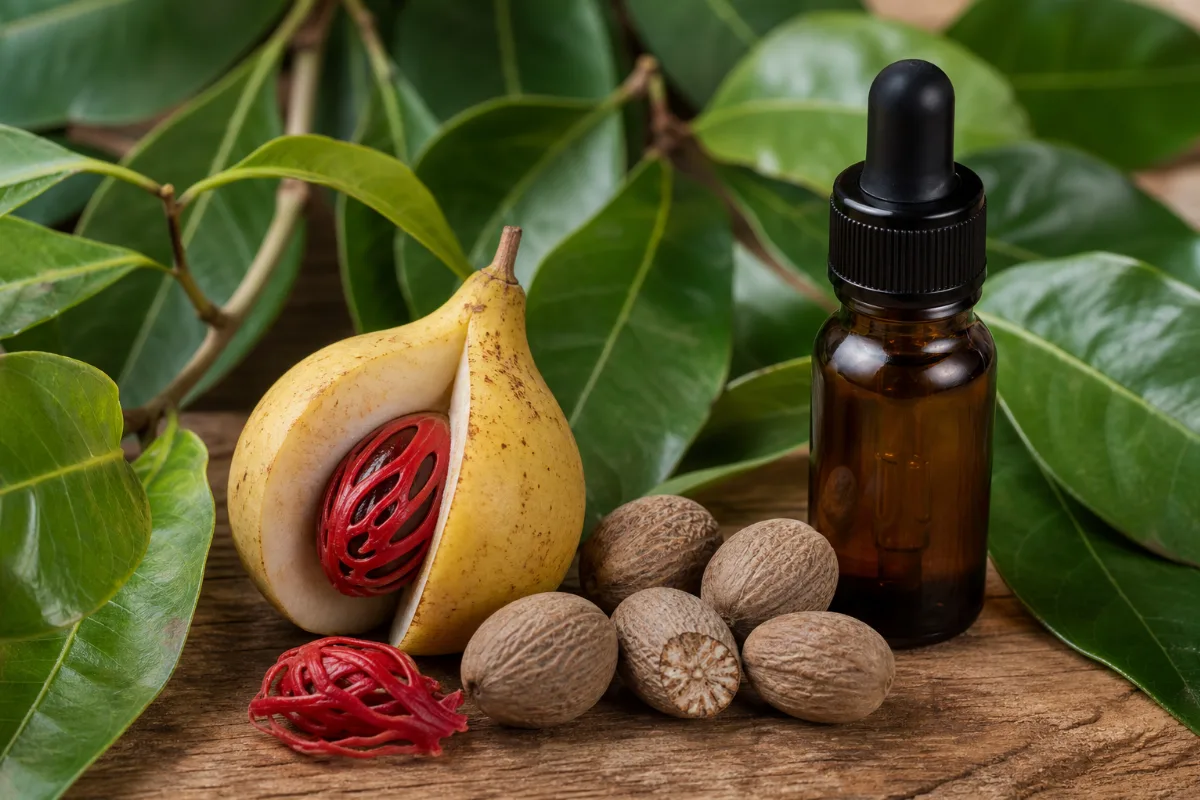
Nutmeg oil is the essential oil of Myristica fragrans Houtt., the nutmeg tree, in the family Myristicaceae. The same tree gives the kitchen spices nutmeg (the seed) and mace (the covering of the seed). The oil can be distilled from the seed, the mace or the leaf, and these differ.
In oils from India, mace oil was mostly sabinene (about 38%), and leaf oil held about 9% myristicin and 17% eugenol. A study of distillation time found myristicin rose in later fractions of seed oil. So two bottles labelled nutmeg oil can differ.
A 2026 review of the plant lists 328 compounds, names macelignan and myristicin as key ones, and calls myristicin a toxic constituent. A 2025 review names myristicin, macelignan, safrole and sabinene as the prime bioactive compounds.
What people use it for, and how strong the evidence is
There are two human trials. In 74 adults with painful diabetic nerve damage, a rub holding nutmeg and mace oils did not beat the same rub without them. In 50 baby teeth, a nutmeg oil filling material placed by a dentist worked as well as the usual material, and nothing was added by the oil.
Everything else is animal, lab or tradition. In rats, the oil lowered inflammation markers in wounds. In mice it protected against some seizures at lower amounts and weakly worsened others at a higher amount. Classical texts use nutmeg for diarrhoea.
We found no trial of nutmeg oil for scent, sleep, mood, pain on the skin alone, digestion or any other use.
The research in one view
Reviews list antioxidant, antimicrobial, anti-inflammatory and anticancer activity in the lab. A reported activity is not a proven benefit. The reviews mix the spice, extracts and isolated compounds, and one rat paper uses both 'nutmeg' and 'mace' for the same oil.
The safety evidence is mostly case reports and poison-centre series about the spice. These cannot give a rate, and they are not about the oil.
Medicines and the oil
Poison Control says essential oils may interact with medicines. For nutmeg we found only case-level information. A man on two mind-acting medicines had a mild course after nutmeg, and in the fatal case a sleeping medicine was also present. In Illinois, mixing nutmeg with other drugs led to more hospital care in teenagers. One review says myristicin may block an enzyme called monoamine oxidase, which could in theory matter with some antidepressants. Ask a pharmacist before using any essential oil by mouth.
What regulators say
In the US, nutmeg is on the FDA's list of essential oils generally recognised as safe for use as a food flavouring. That is a food rule. It is not a finding about aromatherapy, skin use or swallowing bottled oil.
The FDA also treats food with added safrole or sassafras oil as adulterated. That rule does not name nutmeg. LactMed says amounts above food flavouring should be avoided while breastfeeding. We could not read an EMA, EFSA or IFRA assessment of nutmeg oil.
At a glance
Traditional uses history, not proof
- Nutmeg described in classical Chinese texts for warming the middle and calming diarrhoea (2026 review).
- Kernel widely used in Indian traditional medicine; oils used as Ayurvedic medicine and fragrance (2022 review).
- On the US list of essential oils generally recognised as safe as a food flavouring (FDA).
Studied for research
- Filling material for baby-tooth roots (dentist-placed), very-low
- Nerve pain in diabetes (a rub with nutmeg and mace oils), against
- Skin wound healing, rats only, insufficient
- Seizure models, mice only, insufficient
- Gut complaints, traditional use, insufficient
- Antioxidant and antimicrobial, lab only, insufficient
Main compounds
- Myristicin, described as the toxic compound
- Safrole, a compound some reviews class as a genotoxic carcinogen
- Sabinene, the main compound in mace, kernel and seed oils
- Eugenol, mainly in leaf oil
- Elemicin
Common forms
- Essential oil (distilled from seed, mace or leaf)
- Food and fragrance flavouring
- Dentist-placed filling material (one trial)
- Skin rubs with other oils (one trial)
- Ground nutmeg and mace (spice; different product)
Research links: Poison Control: Essential oils · Pet Poison Helpline: Essential oils · LactMed: Nutmeg · FDA 21 CFR 182.20: GRAS essential oils · Swiss poison-centre analysis (abstract) · Mace poisoning in a child (abstract) · Nerve pain trial (abstract) · Research Library · Genes & Biomarkers Library
What it is and its history
- Accepted scientific name
- Myristica fragrans
- Naming authority
- Houtt.
- Synonyms
- Myristica moschata Thunb.; Myristica officinalis L.fil.; Myristica aromatica Lam.
- Common names
- Nutmeg (English); Nutmeg oil (English); Nutmeg essential oil (English)
- Family or group
- Myristicaceae (nutmeg family), per GBIF.
- Classification
- Plantae > Myristicaceae > Myristica > Myristica fragrans
- Native range
- Indigenous to Southeast Asia, with the Maluku Islands of Indonesia named in one review; grown in tropical regions including India and Malaysia, and introduced in southern China (2026 review).
- Habitat
- Not checked.
- What it looks like
- Part used: Oil is distilled from the seed (kernel), the seed covering (mace) or the leaf, and these oils differ.
- Look-alikes and adulterants
- Mace oil and nutmeg oil come from the same tree but different parts. Other spice oils such as clove and cinnamon are a different plant; see the related pages.
Photographs
Traditional use and history history, not clinical proof
| Tradition or era | Documented use | Source |
|---|---|---|
| Traditional Chinese medicine | A 2026 review says nutmeg reached China in about the 3rd to 4th century CE, and classical texts describe its core functions as warming the middle to move qi and astringing the intestines to relieve diarrhoea. | Luo 2026 |
| Indian traditional (Ayurvedic) medicine | A 2022 review says the kernel is widely used in Indian traditional medicine and that oils of leaf, mace, kernel and seed are used worldwide as Ayurvedic medicine and fragrance. | Ashokkumar 2022 |
Traditional use shows how it was used. It does not show that it works or is safe today.
What is inside, and how it may work
What it contains and how those compounds act in cells and animals. Laboratory and animal mechanisms are not proven effects in people.
Main compounds
| Compound | Family | Where it is concentrated | Activity studied | Level of evidence |
|---|---|---|---|---|
| Myristicin PubChem 4276 | phenylpropene (alkenylbenzene) | Seed oil, especially later distillation fractions; also leaf oil 9.12% in one leaf oil; seed-oil figures not read. | Described as the main aromatic compound of nutmeg oil and as a toxic constituent. Moderately blocks monoamine oxidase according to one case report. A lab study found a reactive product linked to toxicity in mouse liver cells. 31 11 16 12 2 24 14 | Human case reports, lab |
| Safrole PubChem 5144 | phenylpropene (alkenylbenzene) | Named as a nutmeg compound; amount in oil not read Not read. | Named with myristicin and elemicin as compounds implicated in nutmeg toxicity. A 2022 review says safrole was classified as a genotoxic carcinogen on extensive evidence. 31 10 22 14 | Review |
| Sabinene PubChem 18818 | monoterpene | Mace, kernel and seed oils 38.37% in one mace oil; main compound in kernel and seed oils. | No safety or effect finding read for sabinene alone. 31 2 22 | Lab analysis |
| Eugenol PubChem 3314 | phenylpropene | Leaf oil 16.60% in one leaf oil. | Listed as a main compound in leaf oil. No allergy finding for eugenol was read for this page. 31 2 | Lab analysis |
| Elemicin PubChem 10248 | phenylpropene (alkenylbenzene) | Nutmeg Not read. | Named with myristicin and safrole as implicated in nutmeg toxicity; reliable cancer and reproductive data are missing. 31 10 14 | Review |
Mechanisms, receptors and pathways
| Target or pathway | Gene or receptor | What was found | Level |
|---|---|---|---|
| Monoamine oxidase and anticholinergic signs | MAO | The mace case authors say myristicin moderately blocks monoamine oxidase and that signs of poisoning are anticholinergic and serotonin-like. This is a proposed explanation for case reports. 14 | Hypothesis from case report |
| Liver activation of myristicin | CYP1A1 | In mouse liver cells and with human enzymes, a reactive product from myristicin was linked to cell toxicity, and CYP1A1 mainly made the first step. 24 | Lab |
| Inflammation signals | IL-1 beta, TNF-alpha | Rat wound tissue had lower levels with the oil. A mechanism claim, not shown in people. 3 | Animal research |
Absorption, metabolism and elimination
- Absorption
- Not described for the oil in any source read.
- Distribution
- One report measured myristicin in blood after nutmeg poisoning, so it is absorbed when swallowed as the spice.
- Metabolism
- Processed by liver enzymes (CYP1A1 in lab tests) into a reactive product linked to toxicity in cells.
- Elimination
- Not established.
- Bioavailability
- Not established for the oil.
Isolated compounds versus whole extracts
Nutmeg oil, ground nutmeg, mace, mace oil, seed extracts and isolated myristicin are different products. Nearly all the poisoning reports are about the spice, the safety reviews often concern isolated compounds, and the two human trials used a dental material and a multi-ingredient rub. None shows what the whole oil does when used as a scent or on the skin.
Nutritional composition
Nutmeg oil is not a nutrient. It is used as a food flavouring and fragrance.
1 very low certainty4 not enough evidence1 evidence against
What is Nutmeg Oil good for?
The uses people ask about and how strong the evidence is for each. Read the certainty label first. No trial of nutmeg oil used as a scent, or alone on the skin, was found. The two human trials used a dental material and a mixed rub, and every other result is from animals, the lab or tradition.
Benefits, one by one
Each card is a research question, not a promise. Tap a goal to filter. Open a card to see the studies, doses and limits.
Filling material for the roots of baby teeth (nutmeg oil mixed with zinc oxide, placed by a dentist)
Very low certaintyIn one small trial in 50 baby teeth, a filling made with nutmeg oil worked as well as the usual material. Success was 100% in both groups over a year. It was a clinic material placed by a dentist, so it says nothing about scent, skin or swallowing the oil.
1 studiesNot covered. This page gives no amounts.
Studies, doses and limits
What the trials found
A triple-blind randomised trial of 50 baby teeth in children aged 4 to 8, followed at 3, 6 and 12 months by a blinded assessor.
Results
Clinical and X-ray success was 100% in both groups. Extra material pushed past the root tip was absorbed over time in the nutmeg group.
Effect sizes as reported
100% versus 100%; no difference.
Why this rating
One small preliminary trial, 12 months, no difference between groups, unclear description of the nutmeg material, funding not stated.
Form and dose studied
Not covered. This page gives no amounts.
Who was studied
Children aged 4 to 8 having dental treatment.
Limits
A single preliminary trial of a dental material. It does not apply to any home use of the oil.
Why researchers looked
Nutmeg oil is described in reviews as having antimicrobial activity in the lab, and dentists look for alternatives to the usual filling.
Traditional use
Nutmeg oil is not a traditional dental material in the sources we read.
Proposed mechanism Preliminary mechanism
Not described in the abstract.
A proposed mechanism does not show that the effect happens in people.
A clinician-placed dental material. This is not a use for bottled oil at home.
Nerve pain in diabetes (a skin rub containing nutmeg oil and mace oil)
Evidence againstA trial in 74 adults with painful diabetic nerve damage compared a rub with nutmeg and mace oils against the same rub without them. Pain fell in both groups and the groups did not differ after 4 weeks. So the nutmeg and mace oils added nothing that the trial could detect.
1 studiesNot covered. This page gives no amounts.
Studies, doses and limits
What the trials found
A randomised, double-blind, placebo-controlled trial in Trinidad: 74 adults with painful diabetic neuropathy.
Results
Pain and quality-of-life scores improved within both groups, with no significant difference between groups at 4 weeks.
Effect sizes as reported
No statistically significant difference between groups for any outcome.
Why this rating
The only human trial of a nutmeg oil product for pain found no added benefit. It used a mixture, so it cannot speak for nutmeg oil alone.
Form and dose studied
Not covered. This page gives no amounts.
Who was studied
Adults aged 30 to 85 with painful diabetic neuropathy.
Limits
One trial; a multi-ingredient rub; 4 weeks.
Why researchers looked
Nutmeg has long been used on the skin for aches in traditional medicine, and people with nerve pain look for skin treatments.
Traditional use
Reviews list pain-easing uses in traditional medicine; no trial was found for the oil alone.
Proposed mechanism Preliminary mechanism
Reviews describe anti-inflammatory activity in lab and animal work. This is a proposed mechanism and was not shown in this trial.
A proposed mechanism does not show that the effect happens in people.
The rub also held menthol and methyl salicylate. Do not copy it at home. Ask your diabetes team about nerve pain.
Skin wound healing (nutmeg oil, tested in rats)
Not enough evidenceIn rats with skin wounds, treatment with nutmeg oil lowered some inflammation markers. No human wound study of the oil was found. Never put undiluted oil on broken skin.
1 studiesNot covered. This page gives no amounts and no way to use the oil.
Studies, doses and limits
What the trials found
No human study found.
Results
Lower IL-1 beta, TNF-alpha and CD68 than the control group in the rats; markers of oxidative stress also fell.
Effect sizes as reported
p under 0.005 for the two cytokines versus control.
Why this rating
Rat work only, oil makeup and naming inconsistent, no safety data.
Form and dose studied
Not covered. This page gives no amounts and no way to use the oil.
Who was studied
See the study.
Limits
Does not show a benefit in people.
Why researchers looked
Reviews describe anti-inflammatory activity in lab work.
Traditional use
Not described in the sources read.
Proposed mechanism Preliminary mechanism
The authors propose effects on inflammation, oxidative stress and cell death. This is a proposal from animal tissue tests.
A proposed mechanism does not show that the effect happens in people.
Poison Control says not to use essential oils on damaged skin.
Seizure models (nutmeg oil, tested in mice)
Not enough evidenceIn mice, nutmeg oil protected against some induced seizures at lower amounts and weakly made others worse at a higher amount. This is not a treatment, and it is a reason for care around seizures.
1 studiesNot covered. This page gives no amounts and no way to use the oil.
Studies, doses and limits
What the trials found
No human study found.
Results
Protective in some tests; a weak proconvulsant at a higher amount in two others.
Effect sizes as reported
Mixed.
Why this rating
Mouse work only.
Form and dose studied
Not covered. This page gives no amounts and no way to use the oil.
Who was studied
See the study.
Limits
Mouse findings cannot be applied to people. See the Safety tab for seizure reports after swallowing nutmeg.
Why researchers looked
Reviews list anticonvulsant activity of the oil.
Traditional use
Not described in the sources read.
Proposed mechanism Preliminary mechanism
Not established.
A proposed mechanism does not show that the effect happens in people.
Seizures have been reported after swallowing nutmeg. See the Safety tab.
Diarrhoea and gut complaints (traditional use of nutmeg)
Not enough evidenceClassical Chinese texts describe nutmeg for warming the middle and calming diarrhoea. We found no trial of the oil for any gut problem.
2 studiesNot covered. This page gives no amounts and no way to use the oil.
Studies, doses and limits
What the trials found
No human trial of nutmeg oil found.
Results
Not applicable.
Effect sizes as reported
Not applicable.
Why this rating
Tradition and lab work only; the texts concern the spice, often after processing.
Form and dose studied
Not covered. This page gives no amounts and no way to use the oil.
Who was studied
See the study.
Limits
Does not show the oil helps the gut. Swallowing essential oils is not advised.
Why researchers looked
Long traditional use of the spice.
Traditional use
A 2026 systematic review quotes classical texts: warming the middle to move qi and astringing the intestines to relieve diarrhoea.
Proposed mechanism Preliminary mechanism
Reviews propose gut-regulating effects of lignans and terpenoids from lab work.
A proposed mechanism does not show that the effect happens in people.
Do not swallow the oil. See the Safety tab.
Antioxidant, antimicrobial and other lab findings
Not enough evidenceReviews list antioxidant, antimicrobial, anti-inflammatory and anticancer activity of nutmeg oil in test tubes and animals. None of this shows a benefit in people.
2 studiesNot covered. This page gives no amounts and no way to use the oil.
Studies, doses and limits
What the trials found
No human trial found for these uses.
Results
Not applicable.
Effect sizes as reported
Not applicable.
Why this rating
Lab and animal work only. One review calls for studies on how the oil works.
Form and dose studied
Not covered. This page gives no amounts and no way to use the oil.
Who was studied
See the study.
Limits
Activity in a dish is not a treatment.
Why researchers looked
Plant oils are often screened in the lab.
Traditional use
Not applicable.
Proposed mechanism Preliminary mechanism
Reviews mention several cell-signalling pathways. These are lab findings.
A proposed mechanism does not show that the effect happens in people.
Lab findings should not guide use at home.
Connections to the rest of health
How Nutmeg Oil connects to the rest of our health knowledge graph. Every link says what kind of connection it is. A safety link (for example to the liver) is a warning, not a benefit. A study that merely mentions a topic never creates a benefit link.
Explore every connection: goals, body systems, organs, symptoms, genes
A. Wellness goals
| Connected to | Kind of connection | Evidence status | Context | Studies |
|---|---|---|---|---|
| Healthy Skin | Not enough evidence | Skin wound healing (nutmeg oil, tested in rats): In rats with skin wounds, treatment with nutmeg oil lowered some inflammation markers. No human wound study of the oil was found. Never put undiluted oil on broken skin. | 3 | |
| Digestive Support | Traditional use | Not enough evidence | Diarrhoea and gut complaints (traditional use of nutmeg): Classical Chinese texts describe nutmeg for warming the middle and calming diarrhoea. We found no trial of the oil for any gut problem. | 16 22 |
B. Body systems
| Connected to | Kind of connection | Evidence status | Context | Studies |
|---|---|---|---|---|
| Pain Inflammation | Biological association | Evidence against | Studied for: Nerve pain in diabetes (a skin rub containing nutmeg oil and mace oil) | 17 |
| Integumentary System | Biological association | Not enough evidence | Studied for: Skin wound healing (nutmeg oil, tested in rats) | 3 |
| Nervous System | Biological association | Not enough evidence | Studied for: Seizure models (nutmeg oil, tested in mice) | 23 |
| Digestive System | Biological association | Not enough evidence | Studied for: Diarrhoea and gut complaints (traditional use of nutmeg) | 16 22 |
E. Health conditions
| Connected to | Kind of connection | Evidence status | Context | Studies |
|---|---|---|---|---|
| Nutmeg poisoning | Documented risk (spice) | Case reports and poison-centre series; no oil-specific report read. Preparation or compound: Nutmeg and mace (spice); myristicin |
4 14 6 21 |
I. Biomarkers
| Connected to | Kind of connection | Evidence status | Context | Studies |
|---|---|---|---|---|
| Clinical and X-ray success of a filled baby tooth | Biological association | Very low certainty | Measured in trials: no change between groups. A lab change is not the same as a health benefit. | 19 |
| Worst and average pain scores (Brief Pain Inventory) | Biological association | Evidence against | Measured in trials: no difference between groups. A lab change is not the same as a health benefit. | 17 |
| Inflammation markers in wound tissue (IL-1 beta, TNF-alpha, CD68) | Biological association | Not enough evidence | Measured in trials: decrease. A lab change is not the same as a health benefit. | 3 |
| Seizure protection in mice | Biological association | Not enough evidence | Measured in trials: mixed. A lab change is not the same as a health benefit. | 23 |
J. Genes, receptors and enzymes
| Connected to | Kind of connection | Evidence status | Context | Studies |
|---|---|---|---|---|
| CYP1A1 | Preliminary mechanism | Lab | Made the first step of myristicin activation in lab tests. | 24 |
L. Active compounds
| Connected to | Kind of connection | Evidence status | Context | Studies |
|---|---|---|---|---|
| Myristicin | Described as toxic | Toxicology reviews and lab work. Preparation or compound: Main aromatic compound of nutmeg oil |
11 24 16 | |
| Myristicin | Biological association | Human case reports, lab | Described as the main aromatic compound of nutmeg oil and as a toxic constituent. Moderately blocks monoamine oxidase according to one case report. A lab study found a reactive product linked to toxicity in mouse liver cells. Preparation or compound: Seed oil, especially later distillation fractions; also leaf oil |
31 11 16 12 2 24 14 |
| Safrole | Biological association | Review | Named with myristicin and elemicin as compounds implicated in nutmeg toxicity. A 2022 review says safrole was classified as a genotoxic carcinogen on extensive evidence. Preparation or compound: Named as a nutmeg compound; amount in oil not read |
31 10 22 14 |
| Sabinene | Biological association | Lab analysis | No safety or effect finding read for sabinene alone. Preparation or compound: Mace, kernel and seed oils |
31 2 22 |
| Eugenol | Biological association | Lab analysis | Listed as a main compound in leaf oil. No allergy finding for eugenol was read for this page. Preparation or compound: Leaf oil |
31 2 |
| Elemicin | Biological association | Review | Named with myristicin and safrole as implicated in nutmeg toxicity; reliable cancer and reproductive data are missing. Preparation or compound: Nutmeg |
31 10 14 |
Each connection is stored with the ingredient, the connected record, the kind of connection, the evidence status, the supporting studies, the preparation or compound involved, and a review date (last reviewed October 25, 2026).
Evidence at a glance: what changed in 1 lab markers
Tap a number to show only those markers. Counts are markers, not people.
The evidence
The research centre for Nutmeg Oil. Every record here was checked against PubMed or the publisher's page; we never list a study we have not verified.
Evidence by outcome
Bars show how many studies we found for each outcome, not how well it works. People are added up across trials only (reviews are not added, to avoid double counting).
How we rate evidence
High certainty
Several well-run trials or reviews agree; further research is unlikely to change the picture much.
Moderate certainty
Good trials point the same way, but some doubt remains.
Low certainty
Small, short or inconsistent trials. The finding could change with better research.
Very low certainty
Very little or very weak human data. Treat as a possibility only.
Mixed findings
Trials or reviews disagree with each other.
Not enough evidence
Not enough human research to say either way.
Evidence against
Good research found no benefit, or found harm.
We take the reviewers' own risk-of-bias and GRADE statements where they exist, and otherwise judge from study size, design, consistency, directness and whether a product matches what is sold. Many publications do not make evidence high. Method note: We read the abstracts of 25 PubMed papers (two of them by title only) and the Poison Control, Pet Poison Helpline and LactMed pages and the US food-additive rules, and checked the plant name in GBIF and the compounds in PubChem. We could not read LiverTox, an EMA or EFSA assessment, or any oil-specific poisoning report.
Study library: every study we checked 32
| Study | Design | People | Product, dose, length | Result |
|---|---|---|---|---|
| Ashokkumar 2022 Nutmeg (Myristica fragrans Houtt.) essential oil: A review on its composition, biological, and pharmacological activities Phytother Res · PMID 35567294 · DOI |
Narrative review of the essential oil mixed |
Oils from leaf, mace, kernel and seed; mostly lab and animal | Nutmeg essential oils from leaf, mace, kernel and seed essential oil n/a n/a · vs n/a |
The oil's main compounds were sabinene, eugenol, myristicin, caryophyllene, beta-myrcene and alpha-pinene. The review says clinical and experimental work has reported antioxidant, antimicrobial, anti-inflammatory, anticancer, anticonvulsant and other activities, and calls for studies on how the oil acts. Not applicable. Methods, limits and fundingOutcomes: Oil yield, makeup and reported activities Limitations: The abstract says 'clinical and experimental' but names no human trial, and the work is mainly lab and animal. A reported activity is not a proven benefit. Funding and conflicts: Not stated in the abstract. Read: abstract |
| Ashokkumar 2022 Compositional variation in the leaf, mace, kernel, and seed essential oil of nutmeg (Myristica fragrans Houtt.) from the Western Ghats, India. Nat Prod Res · PMID 32515616 · DOI |
Lab analysis (GC MS of oils from India) lab |
Oils from leaf, mace, kernel and seed of nutmeg trees from the Western Ghats | Nutmeg essential oils (hydrodistilled) leaf, mace, kernel, seed n/a n/a · vs n/a |
Oil yields were 3.16% (leaf), 8.10% (mace), 6.24% (kernel) and 5.21% (seed). Leaf oil: sabinene 17.17%, eugenol 16.60%, myristicin 9.12%, caryophyllene 8.82%. Mace oil: sabinene 38.37%, alpha-pinene 8.16%, beta-pinene 7.61%, D-limonene 7.07%. Kernel and seed oils were mainly sabinene, alpha-pinene, beta-pinene and D-limonene. Myristicin was 9.12% in leaf oil; seed-oil percentages for myristicin and safrole are not in the abstract. Methods, limits and fundingOutcomes: Oil yield and makeup Limitations: One region, one analysis; no safety outcome. Funding and conflicts: Not stated in the abstract. Read: abstract |
| Asiri 2025 Wound-Healing Potential of Myristica fragrans Essential Oil: A Multi-Targeted Approach Involving Inflammation, Oxidative Stress, and Apoptosis Regulation Pharmaceuticals (Basel) · PMID 40573275 · DOI |
Animal study (rats) rat |
Wistar rats with full-thickness skin wounds | Nutmeg essential oil (called 'mace essential oil' in the conclusion) essential oil Not reported here Not reported here · vs Untreated control group |
Treated wounds had lower inflammation markers (IL-1 beta and TNF-alpha) and lower CD68, a marker of immune cells, than the control. The oil also lowered markers of oxidative stress. Lower inflammation markers than control (p under 0.005 for the two cytokines). Methods, limits and fundingOutcomes: Wound contraction, inflammation and stress markers Limitations: Rats only. The abstract names the main oil components as nitrobenzoate esters, terpenoids and gamma-terpinene, which does not match other nutmeg-oil analyses, and it calls the oil both nutmeg and mace. Safety in the animals is not reported. Funding not stated in the abstract. Funding and conflicts: Not stated in the abstract. Read: abstract |
| Bleisch 2026 Intoxication with nutmeg: A case presentation and analysis of Swiss poisons information center (Tox Info Suisse) enquiries 2014-2023 Toxicol Rep · PMID 42205531 · DOI |
Case report plus analysis of poison centre enquiries |
236 One 23-year-old man; 236 enquiries to the Swiss poison centre (2014 to 2023) |
Ground nutmeg (spice) swallowed seed spice Not reported here n/a · vs n/a |
In the case, a man on fluoxetine and quetiapine who swallowed a large amount of nutmeg had a fast heartbeat and enlarged pupils within 4 hours, became sleepy at about 14 hours, and recovered fully within 26 hours. The authors say nutmeg has psychoactive and hallucinogenic effects at large amounts and that intoxications usually show a mild course. Enquiries for 236 people over 10 years. Methods, limits and fundingOutcomes: Symptoms and course after nutmeg swallowing Limitations: About the spice, not the oil. Enquiries are calls for advice, not confirmed poisonings. The abstract does not give outcomes for all 236. Funding and conflicts: Not stated in the abstract. Read: abstract |
| Casale 2023 Nutmeg Intoxication: A Case Report. Cureus · PMID 37915877 · DOI |
Case report |
1 A young adult |
Nutmeg swallowed in a large amount seed spice Not reported here n/a · vs n/a |
The patient arrived with severe agitation and delirium, was put on a breathing tube in intensive care, pulled it out himself, then reported swallowing a lot of nutmeg and went home after a short observation. Hyperactive delirium with severe agitation. Methods, limits and fundingOutcomes: Presentation and course Limitations: One case; spice. The title says it was hard to recognise at first. Funding and conflicts: Not stated in the abstract. Read: abstract |
| Ehrenpreis 2014 Nutmeg poisonings: a retrospective review of 10 years experience from the Illinois Poison Center, 2001-2011. J Med Toxicol · PMID 24452991 · DOI |
Retrospective poison centre review (Illinois, 2001 to 2011) |
32 32 nutmeg exposures; 17 unintentional, 15 intentional |
Nutmeg (spice) seed spice Not reported here n/a · vs n/a |
Of the 17 unintentional exposures, 10 were in children under 13, and four of those were eye exposures. Of the 15 intentional exposures, five also involved other drugs, all in people aged 15 to 20. One patient who had taken several substances needed breathing support in hospital. The authors advise education about children and about mixing nutmeg with other drugs. 10 of 17 accidental exposures were in children under 13. Methods, limits and fundingOutcomes: Who was exposed and outcomes Limitations: Small series from one state; spice. Funding and conflicts: Not stated in the abstract. Read: abstract |
| Flam 2015 Seizures associated with intentional severe nutmeg intoxication. Clin Toxicol (Phila) · PMID 26294051 · DOI |
Case report letter (title only) |
Not read | Nutmeg, intentional large intake spice Not reported here n/a · vs n/a |
Only the title was read: 'Seizures associated with intentional severe nutmeg intoxication'. There is no abstract. Not read. Methods, limits and fundingOutcomes: Seizures Limitations: Title only; no details could be checked. Funding and conflicts: Not stated in the abstract. Read: title-only |
| Forrester 2005 Nutmeg intoxication in Texas, 1998-2004. Hum Exp Toxicol · PMID 16323572 · DOI |
Retrospective poison centre review (Texas, 1998 to 2004) |
17 17 poison-centre calls about swallowed nutmeg |
Nutmeg (spice) seed spice Not reported here n/a · vs n/a |
None of the ingestions caused more than moderate effects or death. About two thirds of calls were intentional misuse, and most were managed outside a hospital. No death and no more than moderate effects in 17 calls. Methods, limits and fundingOutcomes: Outcomes Limitations: Small; spice; poison-centre calls only. Funding and conflicts: Not stated in the abstract. Read: abstract |
| Futrell 1993 Spice allergy evaluated by results of patch tests. Cutis · PMID 8299390 |
Case series, patch tests |
55 55 patients with suspected contact dermatitis (US clinic, 1991 to 1992) |
Ground spices in petrolatum, applied as patches (nutmeg among 12) spice Not reported here n/a · vs n/a |
Positive reactions at both strengths tested were most common with ginger (seven), nutmeg (five) and oregano (four). Three patients were judged to have relevant spice allergy. The authors say some single-strength reactions could be allergy or mild irritation. 5 of 55 had positive reactions to nutmeg at both strengths. Methods, limits and fundingOutcomes: Skin reactions to spices Limitations: Spice powder, not the oil. People were sent for suspected dermatitis, so the rate for the public is lower. Small, 1993. Funding and conflicts: Not stated in the abstract. Read: abstract |
| Götz 2022 Myristicin and Elemicin: Potentially Toxic Alkenylbenzenes in Food. Foods · PMID 35804802 · DOI |
Review mixed |
Alkenylbenzenes in foods | Myristicin, elemicin, safrole and methyleugenol pure compounds Not reported here n/a · vs n/a |
Says safrole and methyleugenol were classified as genotoxic carcinogens on extensive evidence, while reliable data on genotoxicity, cancer and reproductive toxicity are missing for myristicin and elemicin. These gaps make health risks to people hard to judge. Not applicable. Methods, limits and fundingOutcomes: Toxicity data gaps Limitations: Food exposure review; not specific to the oil. Funding and conflicts: Not stated in the abstract. Read: abstract |
| Hallström 1997 Toxicological evaluation of myristicin. Nat Toxins · PMID 9496377 · DOI |
Toxicology review mixed |
Rodent and human reports on myristicin | Myristicin, the main aromatic compound of nutmeg oil pure compound Not reported here n/a · vs n/a |
Says myristicin is the main aromatic compound in the volatile oil of nutmeg. Poisonings after nutmeg have been ascribed to myristicin, although other nutmeg compounds may also be involved. Acute toxicity looked low in rats and there were no signs of cancer in short mouse tests, but a weak ability to bind DNA was shown. It says a full risk assessment is not possible because studies of genotoxicity, long-term toxicity, reproductive toxicity and cancer are missing. Not applicable. Methods, limits and fundingOutcomes: Toxicity of myristicin Limitations: 1997 review; compound and food amounts, not the concentrated oil. Funding and conflicts: Not stated in the abstract. Read: abstract |
| Ibrahim 2020 Utilization of Nutmeg (Myristica fragrans Houtt.) Seed Hydrodistillation Time to Produce Essential Oil Fractions with Varied Compositions and Pharmacological Effects. Molecules · PMID 32012955 · DOI |
Lab analysis (distillation fractions) lab |
Nutmeg seed oil collected in ten fractions over 4 hours | Nutmeg seed essential oil fractions seed n/a n/a · vs n/a |
Early fractions were richer in sabinene, pinenes, limonene and myrcene. Later fractions were richer in terpinenes, terpinolene and myristicin. The oil showed some antimalarial activity in the lab but no significant antifungal activity. Makeup shifts with distillation time. Methods, limits and fundingOutcomes: Makeup by distillation time; lab antimalarial and antifungal tests Limitations: Lab only; the distillation method changes what is in the bottle. Funding and conflicts: Not stated in the abstract. Read: abstract |
| Ichibayashi 2024 Nutmeg Poisoning With Electrolyte Abnormalities: A Case Report. Cureus · PMID 39559662 · DOI |
Case report |
1 A 33-year-old woman |
Nutmeg swallowed by accident while cooking seed spice Not reported here n/a · vs n/a |
She had dry mouth, tremors, dizziness and anxiety, with abnormal blood salts but normal heart and breathing. Symptoms settled within 24 hours with supportive care. Anticholinergic-type poisoning with salt changes. Methods, limits and fundingOutcomes: Presentation and course Limitations: One case; spice. Funding and conflicts: Not stated in the abstract. Read: abstract |
| Imtiaz 2024 Mace Poisoning: Accidental Toxic Ingestion in a Child Leading to a Reversible Coma. Cureus · PMID 39850188 · DOI |
Case report |
1 A 6-year-old girl |
Mace (the covering of the nutmeg seed) swallowed by accident mace spice Not reported here n/a · vs n/a |
She had an altered level of consciousness and too much acid in the blood from poor breathing, with serotonin-type and anticholinergic signs, after eating six pieces of mace. She recovered with supportive care and left hospital 36 hours later. The authors say myristicin, elemicin and safrole are implicated, and that accidental nutmeg poisoning is more common in children under 13. Reversible coma. Methods, limits and fundingOutcomes: Symptoms and recovery Limitations: One child; mace, not the oil. Funding and conflicts: Not stated in the abstract. Read: abstract |
| Lavy 1987 Nutmeg intoxication in pregnancy. A case report. J Reprod Med · PMID 3560064 |
Case report |
1 A pregnant woman |
Nutmeg swallowed in excess seed spice Not reported here n/a · vs n/a |
The report describes acute anticholinergic over-stimulation in a pregnant woman after swallowing a lot of nutmeg and reviews symptoms, diagnosis and treatment with a focus on pregnancy. The abstract gives no outcome for the baby. Anticholinergic poisoning in pregnancy. Methods, limits and fundingOutcomes: Presentation Limitations: One 1987 case; abstract does not give the outcome; spice. Funding and conflicts: Not stated in the abstract. Read: abstract |
| Luo 2026 Myristica fragrans: A comprehensive review of its botanical characterization, traditional uses, phytochemistry, and pharmacological properties J Ethnopharmacol · PMID 41275940 · DOI |
Systematic review of the plant (not only the oil) mixed |
Plant, extracts and compounds; mostly lab and animal | Nutmeg seed and its extracts and compounds seed n/a n/a · vs n/a |
Classical Chinese texts describe nutmeg as warming the middle and calming diarrhoea. The review reports 328 compounds, names macelignan and myristicin as key ones, and lists neuroprotective, gut-regulating and blood-sugar effects in lab work. It flags myristicin as a toxic constituent and says quality limits for toxic components in processed products need refining. Current clinical use is mainly in compound formulas. Not applicable; a narrative of lab and traditional findings. Methods, limits and fundingOutcomes: History, chemistry, effects and toxicology of the plant Limitations: Mostly lab and animal work. Does not separate the essential oil from the spice and extracts. Funding and conflicts: Not stated in the abstract. Read: abstract |
| Motilal 2013 Nutmeg extracts for painful diabetic neuropathy: a randomized, double-blind, controlled study J Altern Complement Med · PMID 23098698 · DOI |
Randomised double blind placebo controlled trial, Trinidad |
74 Adults with painful diabetic neuropathy (24 men, 50 women, aged 30 to 85) |
A rub applied to the skin that held nutmeg oil and mace oil together with methyl salicylate and menthol in coconut oil nutmeg and mace oils (mixture) Not reported here 4 weeks · vs The same rub without the nutmeg and mace oils (methyl salicylate, menthol, coconut oil, alcohol) |
Pain scores fell in both groups. There was no statistically significant difference between the groups for any outcome after 4 weeks. The authors conclude the nutmeg extracts did not add to the improvement seen with the menthol and methyl salicylate rub. No added benefit from the nutmeg and mace oils over the comparison rub. Methods, limits and fundingOutcomes: Pain and quality of life on two standard questionnaires Limitations: One trial. The product mixed nutmeg oil, mace oil and other active ingredients, so it cannot show what nutmeg oil does alone. Funding not stated in the abstract. Funding and conflicts: Not stated in the abstract. Read: abstract |
| Pecevski 1981 Effect of oil of nutmeg on the fertility and induction of meiotic chromosome rearrangements in mice and their first generation. Toxicol Lett · PMID 7194525 · DOI |
Animal study (mice) mouse |
Male C3H mice | Oil of nutmeg given for 8 weeks essential oil Not reported here n/a · vs n/a |
Fertility fell most in the group given the highest amount. No chromosome translocations were found in the treated mice themselves. The abstract is cut off and mentions chromosome translocations in the male offspring (F1) of mice given lower amounts. Fertility reduction at the highest amount. Methods, limits and fundingOutcomes: Fertility and chromosome changes Limitations: Mice, 1981; the abstract is incomplete, so what happened in the offspring cannot be stated. Not shown in people. Funding and conflicts: Not stated in the abstract. Read: abstract |
| Setty 2023 Comparative Evaluation of Myristica fragrans Essential Oil-Zinc Oxide Mixture with Zinc Oxide Eugenol in Root Canal Filling of Primary Teeth: An In Vivo Study Int J Clin Pediatr Dent · PMID 37519976 · DOI |
Triple blind randomised controlled trial in a dental clinic |
50 Children aged 4 to 8 with primary molars needing pulp treatment (50 teeth in two groups) |
Nutmeg (Myristica fragrans) essential oil mixed with zinc oxide, a dentist-placed root filling material essential oil Not reported here Followed at 3, 6 and 12 months · vs Zinc oxide eugenol, the usual material |
Clinical and X-ray success was 100% in both groups at every follow-up. Material pushed past the root tip was absorbed over time in the nutmeg group. The authors say it can be suggested as a filling material for baby teeth but call for longer studies. Both groups 100%, so no difference was shown. Methods, limits and fundingOutcomes: Clinical and X-ray success of the filled tooth Limitations: Small, preliminary, one clinic, 12 months. The abstract is not clear about exactly what the nutmeg group received (it says both 'M. fragrans with zinc oxide eugenol' and 'oil-zinc oxide mixture'). A material placed by a dentist, not a home-use oil. Cannot be applied to scent, skin or swallowing. Funding and conflicts: Not stated in the abstract. Read: abstract |
| Sivathanu 2014 Myristicin and phenytoin toxicity in an infant. BMJ Case Rep · PMID 24903724 · DOI |
Case report |
1 An infant |
Nutmeg swallowed seed spice Not reported here n/a · vs n/a |
The infant had repeated seizures lasting more than half an hour after swallowing nutmeg. The authors attributed the first seizures to myristicin because of the timing. Later seizures were caused by too much of the seizure medicine phenytoin given as repeated loading doses. Status epilepticus after nutmeg. Methods, limits and fundingOutcomes: Seizures Limitations: One infant; timing only, cause not proven. The authors also report harm from the treatment. Funding and conflicts: Not stated in the abstract. Read: abstract |
| Stein 2001 Nutmeg (myristicin) poisoning--report on a fatal case and a series of cases recorded by a poison information centre. Forensic Sci Int · PMID 11343860 · DOI |
Fatal case report plus poison centre series |
8 One 55-year-old woman who died; seven people recorded by the Erfurt poison centre 1996 to 1998 |
Nutmeg powder (spice) seed spice Not reported here n/a · vs n/a |
Myristicin was found in the blood of the woman who died, together with a sleeping medicine (flunitrazepam), so death was probably due to the combined toxic effect of both. In the seven poison-centre cases, even after large amounts of powder, a life-threatening situation was never seen. One death, probably from nutmeg plus a drug; no life-threatening cases among seven. Methods, limits and fundingOutcomes: Blood levels of myristicin; outcomes Limitations: Tiny series; spice, not the oil. A death with a second drug does not show nutmeg alone is fatal. Funding and conflicts: Not stated in the abstract. Read: abstract |
| Tariq 2025 Nutmeg Beyond Spice: A Review on Its Therapeutic Potential, Safety and Industrial Promise Food Sci Nutr · PMID 41104350 · DOI |
Narrative review mixed |
Plant, extracts and compounds; mostly lab and animal | Nutmeg (Myristica fragrans) and its compounds seed n/a n/a · vs n/a |
The review lists antioxidant, anti-inflammatory, antidiabetic, antimicrobial and anticancer activity in lab and animal work. It names myristicin, macelignan, safrole and sabinene as the main active compounds. It reports that at high doses, stomach and gut and liver and kidney side effects have been seen, and says more clinical research is needed. Not applicable. Methods, limits and fundingOutcomes: Reported activities and safety Limitations: Mostly lab and animal work; mixes spice, extracts and compounds. Funding and conflicts: Not stated in the abstract. Read: abstract |
| Wahab 2009 Anticonvulsant activities of nutmeg oil of Myristica fragrans Phytother Res · PMID 19067329 · DOI |
Animal study (mice, seizure models) mouse |
Mice | Volatile oil of nutmeg seed kernel essential oil Not reported here Single doses at peak effect · vs Untreated or standard comparison groups |
The oil protected mice against some induced seizures at lower amounts, but at a higher amount it was a weak proconvulsant (it made some seizure types slightly worse). The authors say it may not suit some seizure types. Mixed: protective in some tests, weakly seizure-promoting in others at a higher amount. Methods, limits and fundingOutcomes: Protection against induced seizures; acute toxicity Limitations: Mice only; not a treatment for people. The finding that a higher amount worsened some seizures is a safety signal, not a benefit. Funding and conflicts: Not stated in the abstract. Read: abstract |
| Zhu 2019 Metabolic Activation of Myristicin and Its Role in Cellular Toxicity. J Agric Food Chem · PMID 30912427 · DOI |
Lab study (mouse liver cells, human enzymes) mouse cells |
Primary mouse liver cells | Myristicin pure compound Not reported here n/a · vs n/a |
Found that a reactive product formed when myristicin is processed was linked to cell toxicity in mouse liver cells, and that the human enzyme CYP1A1 mainly made the first step. Cell toxicity linked to a processed form of myristicin. Methods, limits and fundingOutcomes: How the body activates myristicin and cell toxicity Limitations: Cells and enzymes only; not shown in people. Funding and conflicts: Not stated in the abstract. Read: abstract |
| n/a 2024 Poison Control (US): Essential oils, poisonous when misused (page read 2026-10-25) n/a · Source |
Poison centre public page n/a |
n/a | n/a n/a n/a n/a · vs n/a |
Says misuse of essential oils can cause serious poisoning. Many oils can cause rashes, and some are poisonous if absorbed through the skin or swallowed. Breathing an oil into the lungs while swallowing it can cause pneumonia. Children have thin skin and immature livers and may be more susceptible. Oils may interact with medicines, and it can be hard to know the species, strength or contaminants in a bottle. On nutmeg it says: used in food but, when misused or abused, it can cause hallucinations and coma. Advises diluting oils in a carrier oil for skin, not using them on damaged skin, stopping and washing off if a rash appears, and locking bottles away from children and pets. Poison help line 1-800-222-1222 (US). Methods, limits and fundingOutcomes: General essential-oil safety, including nutmeg Limitations: General guidance for essential oils; the nutmeg statement is one sentence and does not say whether it is about the spice or the oil. Read: full-text |
| n/a 2025 US FDA, 21 CFR 182.20: essential oils generally recognised as safe (eCFR text dated 2025-01-01, read 2026-10-25) n/a · Source |
US food regulation n/a |
n/a | n/a n/a n/a n/a · vs n/a |
Lists nutmeg (Myristica fragrans Houtt.) among the essential oils, oleoresins and natural extractives generally recognised as safe for their intended use in food. Methods, limits and fundingOutcomes: Nutmeg oil as a food flavouring Limitations: A food-flavouring rule. It is not a finding about aromatherapy, skin use or swallowing bottled oil. Read: full-text |
| n/a 2025 US FDA, 21 CFR 189.180: safrole (eCFR text dated 2025-01-01, read 2026-10-25) n/a · Source |
US food regulation n/a |
n/a | n/a n/a n/a n/a · vs n/a |
Says food containing any added safrole, oil of sassafras, isosafrole or dihydrosafrole, as such, is deemed adulterated. It describes safrole as a natural constituent of the sassafras plant. Methods, limits and fundingOutcomes: Safrole in food Limitations: Concerns added safrole and sassafras. It does not name nutmeg or nutmeg oil. Read: full-text |
| n/a 2026 LactMed (US National Library of Medicine): Nutmeg (entry updated 2026-10, read 2026-10-25) n/a · Source |
Drug and lactation database entry n/a |
n/a | n/a n/a n/a n/a · vs n/a |
Says nutmeg seeds contain myristic acid and an essential oil thought to be responsible for nutmeg intoxication, with myristicin, elemicin, eugenol and safrole. No data exist on the safety and efficacy of nutmeg in nursing mothers or infants. Nutmeg, mace and their oils are generally recognised as safe as food ingredients by the FDA. High amounts of nutmeg can cause intoxication with anticholinergic symptoms, and anticholinergics may reduce milk supply. In lab tests nutmeg may have antiprogesterone activity, which could in theory affect lactation. Nutmeg and mace in amounts higher than food flavouring should be avoided during breastfeeding. Methods, limits and fundingOutcomes: Nutmeg and breastfeeding Limitations: Written about the spice and its oil together; no data on the oil in nursing mothers. Read: full-text |
| n/a 2026 Pet Poison Helpline: Essential oils (page read 2026-10-25) n/a · Source |
Animal poison centre public page n/a |
n/a | n/a n/a n/a n/a · vs n/a |
Says essential oil poisoning can affect all species, but cats and birds are at greatest risk. Common signs are drooling, vomiting, lethargy, loss of appetite and irritation of skin, airways and mouth, usually within 6 to 8 hours; severe cases can take 3 to 7 days to recover. Oral exposure is the highest risk, then skin, then breathing it in. Its list of oils that can cause poisoning does not include nutmeg. Advises not to induce vomiting and to call the helpline (North America 800-213-6680). Methods, limits and fundingOutcomes: Essential-oil poisoning in pets Limitations: General page; nutmeg is not on its list, which is not proof of safety. Read: full-text |
| n/a 2026 GBIF species match API: Myristica fragrans Houtt. (checked 2026-10-25) n/a · Source |
Taxonomy database n/a |
n/a | n/a n/a n/a n/a · vs n/a |
Myristica fragrans Houtt., key 5406817, status ACCEPTED, family Myristicaceae, exact match. Listed synonyms include Myristica moschata Thunb., Myristica officinalis L.fil., Myristica aromatica Lam. and Aruana silvestris Burm.fil. Methods, limits and fundingOutcomes: Accepted name and synonyms Limitations: Name checking only. Read: full-text |
| n/a 2026 PubChem PUG REST: compound names checked 2026-10-25 n/a · Source |
Chemistry database n/a |
n/a | n/a n/a n/a n/a · vs n/a |
Myristicin CID 4276 (C11H12O3); safrole CID 5144 (C10H10O2); sabinene CID 18818 (C10H16); elemicin CID 10248 (C12H16O3); eugenol CID 3314 (C10H12O2). Methods, limits and fundingOutcomes: Compound identifiers Limitations: Identity check only; says nothing about safety. Read: full-text |
| van Joost 1979 [Allergic stomatitis with severe ulceration caused by a condiment (myristical)] Ned Tijdschr Geneeskd · PMID 574620 |
Case report (title only) |
1 Not read |
Nutmeg-type condiment condiment Not reported here n/a · vs n/a |
Only the title was read: a 1979 Dutch report of allergic stomatitis with severe ulceration caused by a condiment ('myristical'). There is no abstract in English. Not read. Methods, limits and fundingOutcomes: Mouth ulceration Limitations: Title only; the substance cannot be confirmed. Funding and conflicts: Not stated in the abstract. Read: title-only |
What we do not know yet
- What the evidence supports: nothing is proven. Human results are very-low (dental filling) or against (nerve pain rub); the rest is animal, lab or tradition.
- No report of poisoning with swallowed nutmeg oil itself was read; all case reports concern the spice or mace.
- No patch test of nutmeg oil on skin; spice patch tests only.
- How much myristicin and safrole retail nutmeg oils hold was not found.
- No source on pets that names nutmeg oil.
- No LiverTox, EMA, EFSA or IFRA statement was read.
- Two reports (a 2015 seizure letter and a 1979 mouth-ulcer report) were read by title only.
How new research is added
New studies are found by a saved PubMed search and are placed in a review queue. A person reads each one before it is added.
Lab markers
What changed in blood or saliva tests during trials. A changed number is not the same as feeling or being healthier, and we give no "normal ranges".
Other 4
Clinical and X-ray success of a filled baby tooth
No change between groups in trials
Whether the treated tooth stayed free of pain, swelling and infection and looked healthy on X-ray.
Very low certaintyResults and what it means
Why it was measured
Main outcome in the dental trial.
Statistical vs. clinical meaning
Judged by a blinded dentist, but both groups scored the same.
Safety implication
Clinic-placed material only.
| Study | Result | People | Product |
|---|---|---|---|
| 19 | 100% success in both the nutmeg oil group and the zinc oxide eugenol group at 3, 6 and 12 months. |
Worst and average pain scores (Brief Pain Inventory)
No difference between groups in trials
A questionnaire where people rate their own pain.
Evidence againstResults and what it means
Why it was measured
Main outcome in the nerve pain trial.
Statistical vs. clinical meaning
Self-rated pain, which is real but easily shaped by expectation; a placebo group was used.
Safety implication
The rub held other active ingredients.
| Study | Result | People | Product |
|---|---|---|---|
| 17 | Scores fell within both groups (p of 0.001 or less) with no significant difference between the nutmeg and comparison rubs after 4 weeks. |
Inflammation markers in wound tissue (IL-1 beta, TNF-alpha, CD68)
Decrease in trials
Chemical signals and cell markers of inflammation measured in healing skin of rats.
Not enough evidenceResults and what it means
Why it was measured
Main outcome in the rat wound study.
Statistical vs. clinical meaning
Animal tissue measures; not shown in people.
Safety implication
No safety data in the abstract.
| Study | Result | People | Product |
|---|---|---|---|
| 3 | Lower than the control group in treated rat wounds (p under 0.005 for IL-1 beta and TNF-alpha). |
Seizure protection in mice
Mixed results in trials
Whether induced seizures were prevented or delayed in mice.
Not enough evidenceResults and what it means
Why it was measured
Main outcome in the mouse seizure study.
Statistical vs. clinical meaning
Animal model only.
Safety implication
The higher-amount worsening is a safety signal.
| Study | Result | People | Product |
|---|---|---|---|
| 23 | Protection in some seizure tests at lower amounts, weak worsening of some seizures at a higher amount. |
Safety
What studies and official sources say about side effects, medicines and who should check first. Each point shows what kind of evidence it comes from.
Main points to know 4
- .
- .
- .
- .
Side effects 7
| Effect | How often | Severity and recovery | Evidence |
|---|---|---|---|
| Poisoning after swallowing nutmeg: fast heartbeat, enlarged pupils, dry mouth, agitation, confusion, hallucinations, sleepiness, coma All the reports are about the spice (ground nutmeg or mace). No report we could read is about swallowed nutmeg oil. The oil is concentrated, and myristicin is described as the toxic compound, so we treat swallowing it as dangerous. | Not known for the oil. For the spice: 236 enquiries in Switzerland over 10 years, 32 cases in Illinois over 10 years, 17 calls in Texas over 7 years. | moderate to severe Usually settled within one to two days with hospital care in the cases read. | Case series 4 14 5 13 6 8 25 |
| Seizures after swallowing nutmeg An infant had repeated seizures after nutmeg, attributed by the authors to myristicin from the timing. A 2015 letter on seizures after severe intentional nutmeg poisoning was read by title only. In mice, nutmeg oil weakly worsened some seizures at a higher amount. | Rare reports | severe Not stated. | Case report 20 7 |
| Death This does not show nutmeg alone is fatal, but it shows poisoning can be serious, especially when mixed with other drugs. | One fatal case with blood myristicin found, together with a sleeping medicine; death probably from the combined effect. No deaths in the Texas, Illinois or Erfurt series. | fatal in one case Not applicable. | Case report 21 8 6 |
| Eye exposure Keep spices and oils away from children's hands and faces. | 4 of the 10 accidental exposures in children under 13 in the Illinois series. | not stated Not stated. | Case series 6 |
| Skin allergy Poison Control says oils can cause rashes and allergic reactions are possible. Allergy to the oil itself is not described in the sources we read. Not described is not proof of none. | Spice patch tests: 5 of 55 clinic patients had positive reactions to nutmeg at both strengths tested. No patch test of the oil was found. | mild to moderate Not stated. | Case series 9 25 |
| Mouth ulceration from an allergic reaction to a condiment Title only was read; it is not confirmed that this was nutmeg. | One 1979 report | severe Not stated. | Case report 32 |
| Breathing the oil into the lungs (pneumonia) Poison Control says choking on a swallowed essential oil so that some enters the lungs can cause pneumonia. | Not described for nutmeg oil | severe Not stated. | Regulatory 25 |
Liver
We found no human case of liver injury linked to nutmeg oil. A 2025 review says that at high doses stomach and gut and liver and kidney side effects have been reported for nutmeg, without giving the cases. A lab study found that myristicin can be turned into a reactive product that is toxic to mouse liver cells. We could not read a LiverTox entry. We do not advise swallowing the oil. 22 24
How often. No oil-specific cases found.
Monitoring. Yellow skin or eyes, dark urine, severe tiredness or pain in the upper right belly after swallowing any oil or supplement needs a doctor.
This is a safety connection. It is not evidence that Nutmeg Oil supports liver health.
Medicines and supplements 4
| With | Why it matters | Importance | Evidence | What to do |
|---|---|---|---|---|
| Fluoxetine and quetiapine in one case; flunitrazepam in a fatal case; mixed drugs in teenagers Medicines that affect the brain and mood (antidepressants, sleeping medicines, other sedatives) | The mace case authors say myristicin moderately blocks monoamine oxidase, which is theory and could in principle matter with serotonin-active medicines. The Swiss case on fluoxetine and quetiapine had a mild course. | Unknown. In Illinois, mixing nutmeg with other drugs was linked to more hospital care in teenagers, and in the fatal case a sleeping medicine was also found. | Case report Not enough evidence 4 21 6 14 | If you take any prescription medicine, ask a pharmacist before using any essential oil by mouth. Swallowing the oil is not advised. |
| Medicines that dry the mouth or speed the heart, such as some allergy, bladder and stomach medicines Anticholinergic medicines (read-across, theory) | Nutmeg poisoning is described as having anticholinergic features, so adding such a medicine could in theory add to them. No study tested this. | Unknown. | Theoretical Not enough evidence 13 28 | Tell your pharmacist about any essential oil you swallow or breathe in heavily. |
| Phenytoin and others Seizure medicines | In one infant, seizures after nutmeg were followed by seizures from phenytoin toxicity after repeated loading doses. | A reminder that seizure treatment in poisoning needs a hospital team. | Case report Not enough evidence 20 | Call poison control rather than giving anything at home. |
| Medicines broken down by CYP1A1 and related enzymes Medicines cleared by the liver (lab only) | In lab tests the human CYP1A1 enzyme made the first reactive step in myristicin activation. | Unknown in people. | Lab Not enough evidence 24 | Ask a pharmacist. |
Who should check first 6
| Situation | Advice | Evidence |
|---|---|---|
| Swallowing the oil, for anyone | Not advised. Poison control: US 1-800-222-1222. | Case series 25 4 14 |
| Babies and children | Keep away. Accidental nutmeg poisoning is reported more in children under 13, and Poison Control says children may be more easily harmed by essential oils. | Case series 6 14 25 |
| Pregnancy and breastfeeding | Avoid. See the pregnancy section; no source supports use of the oil. | Case report 15 28 18 |
| Epilepsy or a history of seizures | Ask a doctor first. We found no study in people with epilepsy, but seizures have been reported after nutmeg and a mouse study found a weak worsening of some seizures at a higher amount. | Case report 20 23 |
| Taking antidepressants, sedatives or other brain-active medicines | Ask a pharmacist first. | Case report 4 21 |
| Known allergy to nutmeg, mace or spices | Avoid skin contact with the oil. | Case series 9 |
Overdose, product quality and regulators
Summary. The toxic effects of nutmeg are credited mainly to myristicin, with possible roles for elemicin, safrole and other compounds. The case reports and poison-centre series are about the spice. Whether swallowed oil is more dangerous is not shown in any source we read, but the oil is a concentrated form.
Amounts. No safe amount is established, and this page gives none.
Onset and course. In the Swiss case, signs began within 4 hours, sleepiness appeared at about 14 hours, and all signs resolved within 26 hours. Poison-centre series describe mostly mild to moderate effects.
Repeated use. Not described for the oil. Myristicin and elemicin lack reliable data on cancer risk and reproductive toxicity, and safrole is classed as a genotoxic carcinogen in a 2022 review of alkenylbenzenes.
Animal data. In mice, oil of nutmeg lowered fertility at the highest amount, and weakly worsened some seizures at a higher amount. In rats, myristicin acute toxicity looked low in an old review. Pet Poison Helpline says cats and birds are at greatest risk from essential oils, and nutmeg is not on its list, which is not proof of safety. The ASPCA plant page for nutmeg could not be read.
Toxic parts. The seed (nutmeg) and its covering (mace). The oil is distilled from these (the oil can also come from leaf in some products).
Not read. LiverTox, an EMA or EFSA assessment, a nutmeg-oil skin-sensitisation or dilution figure, and any IFRA or fragrance-industry assessment were not found or not read.
Essential oil products are not tightly regulated, so what is in the bottle can differ from the label. Nutmeg oil in particular varies by plant part and how long it is distilled.
Unknown species, strength and contaminants. Poison Control says it can be hard to know the species, concentration or contaminants in an essential oil bottle. 25
Makeup differs by plant part and distillation time. In oils from India, leaf oil held about 9% myristicin, while mace oil was mostly sabinene (about 38%). A study of distillation time found myristicin rose in later fractions of seed oil. So two bottles labelled nutmeg oil can differ in myristicin. 2 12
Spice, mace and oil are different products. A review of the plant calls for quality limits on toxic components such as myristicin in processed products. 'Mace oil' and 'nutmeg oil' may be sold as different products; one rat wound paper used both names for one oil. 16 3
| Body | Action | Date |
|---|---|---|
| US FDA, 21 CFR 182.20 (GRAS essential oils) (United States) | Lists nutmeg (Myristica fragrans Houtt.) among essential oils generally recognised as safe for their intended use as food flavourings. This concerns food only. source | 2025-01-01 |
| US FDA, 21 CFR 189.180 (safrole) (United States) | Food containing added safrole, oil of sassafras, isosafrole or dihydrosafrole, as such, is deemed adulterated. The rule is about added safrole and sassafras. It does not name nutmeg. source | 2025-01-01 |
| LactMed (US National Library of Medicine) (United States) | No data on nutmeg in nursing mothers or infants; amounts higher than food flavouring should be avoided while breastfeeding. Notes the FDA GRAS status of nutmeg, mace and their oils as food ingredients. source | 2026-10 |
When to get medical help
Stop using the product and contact a clinician or emergency service. In the US, Poison Control is 1-800-222-1222.
General information only, not medical advice. Ask a clinician or pharmacist before use, especially with medicines, in pregnancy or with a health condition. See the Natural Remedy Safety guide.
Frequently asked questions
Is nutmeg oil poisonous?
Swallowing nutmeg is documented to cause poisoning. Poison Control says it can cause hallucinations and coma when misused. The reports are about the spice, not the oil. We found none about swallowed oil, but the oil is concentrated and we do not advise swallowing it. Call poison control (US 1-800-222-1222) after any swallowing.
Can nutmeg oil kill?
What is myristicin, and what is safrole?
Both are natural compounds found in nutmeg. Myristicin is named as the toxic compound in nutmeg oil. Safrole is a related compound that a 2022 review says was classed as a genotoxic carcinogen. The same review says reliable cancer and reproductive data are missing for myristicin. We could not find how much of either is in retail oils.
Is nutmeg oil safe for babies and children?
No safe use is shown. Accidental nutmeg poisoning is reported more in children under 13. A 6-year-old fell into a reversible coma after eating mace, and an infant had seizures after nutmeg. Poison Control says children may be more easily harmed by essential oils. Keep it locked away and away from faces.
Is nutmeg oil safe in pregnancy or while breastfeeding?
We found no source that supports it. A 1987 report describes poisoning in a pregnant woman after swallowing nutmeg. LactMed says there are no data on nutmeg in nursing mothers and advises avoiding amounts above food flavouring. In mice, the oil lowered fertility at the highest amount. Ask a doctor or midwife.
Is nutmeg oil safe for cats, dogs and other pets?
Keep it away. Pet Poison Helpline says essential oils can poison any species, with cats and birds at greatest risk. Nutmeg is not on its list, which is not proof of safety. We found no source on nutmeg oil in pets. Call your vet or Pet Poison Helpline if a pet may have been exposed.
Can nutmeg oil cause a skin reaction?
Does nutmeg oil help nerve pain, arthritis or other pain?
Not shown. One trial in 74 adults with painful diabetic nerve damage found a rub with nutmeg and mace oils did no better than the same rub without them. We found no trial for other kinds of pain.
Can nutmeg oil trigger seizures?
Seizures have been reported after swallowing nutmeg, in an infant, and a 2015 letter links severe nutmeg poisoning to seizures (we read the title only). In mice, the oil protected against some seizures at lower amounts and weakly worsened others at a higher amount. If you have epilepsy, ask a doctor first.
Is nutmeg oil the same as nutmeg spice or mace?
Does nutmeg oil have any proven benefits?
Can nutmeg oil interact with medicines?
Explore by health goal
Editorial transparency
- Written by
- AlternativeMed editorial team. Research compiled with AI assistance, then checked against PubMed records.
- Medical review
- None. This page has not been reviewed by a physician or pharmacist.
- First published
- 2026-10-25
- Last substantive update
- 2026-10-25
- How we research
- We read the abstracts of 25 PubMed papers (two of them by title only) and the Poison Control, Pet Poison Helpline and LactMed pages and the US food-additive rules, and checked the plant name in GBIF and the compounds in PubChem. We could not read LiverTox, an EMA or EFSA assessment, or any oil-specific poisoning report.
- How we rate evidence
- See "How we rate evidence" in the Evidence tab.
- Independence
- No product is promoted on this page. No affiliate links are shown. Trials or assessments linked to industry are labelled.
Sources 32
Each source was opened and checked. Where we read only the abstract, it says so. The small numbers in the text point here.
- Ashokkumar K, Simal-Gandara J, Murugan M, et al. Nutmeg (Myristica fragrans Houtt.) essential oil: A review on its composition, biological, and pharmacological activities. Phytother Res. 2022. PMID 35567294. DOI 10.1002/ptr.7491. (abstract)
- Ashokkumar K, Vellaikumar S, Muthusamy M, et al. Compositional variation in the leaf, mace, kernel, and seed essential oil of nutmeg (Myristica fragrans Houtt.) from the Western Ghats, India.. Nat Prod Res. 2022. PMID 32515616. DOI 10.1080/14786419.2020.1771713. (abstract)
- Asiri YI, Venkatesan K. Wound-Healing Potential of Myristica fragrans Essential Oil: A Multi-Targeted Approach Involving Inflammation, Oxidative Stress, and Apoptosis Regulation. Pharmaceuticals (Basel). 2025. PMID 40573275. DOI 10.3390/ph18060880. (abstract)
- Bleisch A, Späni S, Schumann R, et al. Intoxication with nutmeg: A case presentation and analysis of Swiss poisons information center (Tox Info Suisse) enquiries 2014-2023. Toxicol Rep. 2026. PMID 42205531. DOI 10.1016/j.toxrep.2026.102274. (abstract)
- Casale MJ, MacDonald LL, Mitra A. Nutmeg Intoxication: A Case Report.. Cureus. 2023. PMID 37915877. DOI 10.7759/cureus.46286. (abstract)
- Ehrenpreis JE, DesLauriers C, Lank P, et al. Nutmeg poisonings: a retrospective review of 10 years experience from the Illinois Poison Center, 2001-2011.. J Med Toxicol. 2014. PMID 24452991. DOI 10.1007/s13181-013-0379-7. (abstract)
- Flam B, Bendz E, Jonsson Fagerlund M, et al. Seizures associated with intentional severe nutmeg intoxication.. Clin Toxicol (Phila). 2015. PMID 26294051. DOI 10.3109/15563650.2015.1079324. (title-only)
- Forrester MB. Nutmeg intoxication in Texas, 1998-2004.. Hum Exp Toxicol. 2005. PMID 16323572. DOI 10.1191/0960327105ht567oa. (abstract)
- Futrell JM, Rietschel RL. Spice allergy evaluated by results of patch tests.. Cutis. 1993. PMID 8299390. (abstract)
- Götz ME, Sachse B, Schäfer B, et al. Myristicin and Elemicin: Potentially Toxic Alkenylbenzenes in Food.. Foods. 2022. PMID 35804802. DOI 10.3390/foods11131988. (abstract)
- Hallström H, Thuvander A. Toxicological evaluation of myristicin.. Nat Toxins. 1997. PMID 9496377. DOI 10.1002/nt.3. (abstract)
- Ibrahim MA, Cantrell CL, Jeliazkova EA, et al. Utilization of Nutmeg (Myristica fragrans Houtt.) Seed Hydrodistillation Time to Produce Essential Oil Fractions with Varied Compositions and Pharmacological Effects.. Molecules. 2020. PMID 32012955. DOI 10.3390/molecules25030565. (abstract)
- Ichibayashi R, Sato T, Ohashi R, et al. Nutmeg Poisoning With Electrolyte Abnormalities: A Case Report.. Cureus. 2024. PMID 39559662. DOI 10.7759/cureus.71840. (abstract)
- Imtiaz A, Almutairy BM, Almutairi TM, et al. Mace Poisoning: Accidental Toxic Ingestion in a Child Leading to a Reversible Coma.. Cureus. 2024. PMID 39850188. DOI 10.7759/cureus.76284. (abstract)
- Lavy G. Nutmeg intoxication in pregnancy. A case report.. J Reprod Med. 1987. PMID 3560064. (abstract)
- Luo J, Yang X, Bai M, et al. Myristica fragrans: A comprehensive review of its botanical characterization, traditional uses, phytochemistry, and pharmacological properties. J Ethnopharmacol. 2026. PMID 41275940. DOI 10.1016/j.jep.2025.120916. (abstract)
- Motilal S, Maharaj RG. Nutmeg extracts for painful diabetic neuropathy: a randomized, double-blind, controlled study. J Altern Complement Med. 2013. PMID 23098698. DOI 10.1089/acm.2012.0016. (abstract)
- Pecevski J, Savković D, Radivojević D, et al. Effect of oil of nutmeg on the fertility and induction of meiotic chromosome rearrangements in mice and their first generation.. Toxicol Lett. 1981. PMID 7194525. DOI 10.1016/0378-4274(81)90075-8. (abstract)
- Setty JV, Srinivasan I, Sathiesh RT. Comparative Evaluation of Myristica fragrans Essential Oil-Zinc Oxide Mixture with Zinc Oxide Eugenol in Root Canal Filling of Primary Teeth: An In Vivo Study. Int J Clin Pediatr Dent. 2023. PMID 37519976. DOI 10.5005/jp-journals-10005-2508. (abstract)
- Sivathanu S, Sampath S, David HS, et al. Myristicin and phenytoin toxicity in an infant.. BMJ Case Rep. 2014. PMID 24903724. DOI 10.1136/bcr-2013-203000. (abstract)
- Stein U, Greyer H, Hentschel H. Nutmeg (myristicin) poisoning--report on a fatal case and a series of cases recorded by a poison information centre.. Forensic Sci Int. 2001. PMID 11343860. DOI 10.1016/s0379-0738(00)00369-8. (abstract)
- Tariq D, Sultan MT, Noman AM, et al. Nutmeg Beyond Spice: A Review on Its Therapeutic Potential, Safety and Industrial Promise. Food Sci Nutr. 2025. PMID 41104350. DOI 10.1002/fsn3.71053. (abstract)
- Wahab A, Ul Haq R, Ahmed A, et al. Anticonvulsant activities of nutmeg oil of Myristica fragrans. Phytother Res. 2009. PMID 19067329. DOI 10.1002/ptr.2548. (abstract)
- Zhu X, Wang YK, Yang XN, et al. Metabolic Activation of Myristicin and Its Role in Cellular Toxicity.. J Agric Food Chem. 2019. PMID 30912427. DOI 10.1021/acs.jafc.9b00893. (abstract)
- n/a. Poison Control (US): Essential oils, poisonous when misused (page read 2026-10-25). n/a. 2024. (full-text)
- n/a. US FDA, 21 CFR 182.20: essential oils generally recognised as safe (eCFR text dated 2025-01-01, read 2026-10-25). n/a. 2025. (full-text)
- n/a. US FDA, 21 CFR 189.180: safrole (eCFR text dated 2025-01-01, read 2026-10-25). n/a. 2025. (full-text)
- n/a. LactMed (US National Library of Medicine): Nutmeg (entry updated 2026-10, read 2026-10-25). n/a. 2026. (full-text)
- n/a. Pet Poison Helpline: Essential oils (page read 2026-10-25). n/a. 2026. (full-text)
- n/a. GBIF species match API: Myristica fragrans Houtt. (checked 2026-10-25). n/a. 2026. (full-text)
- n/a. PubChem PUG REST: compound names checked 2026-10-25. n/a. 2026. (full-text)
- van Joost T, Korthals Altes HR, Lambers JC. [Allergic stomatitis with severe ulceration caused by a condiment (myristical)]. Ned Tijdschr Geneeskd. 1979. PMID 574620. (title-only)