Spices · Spice
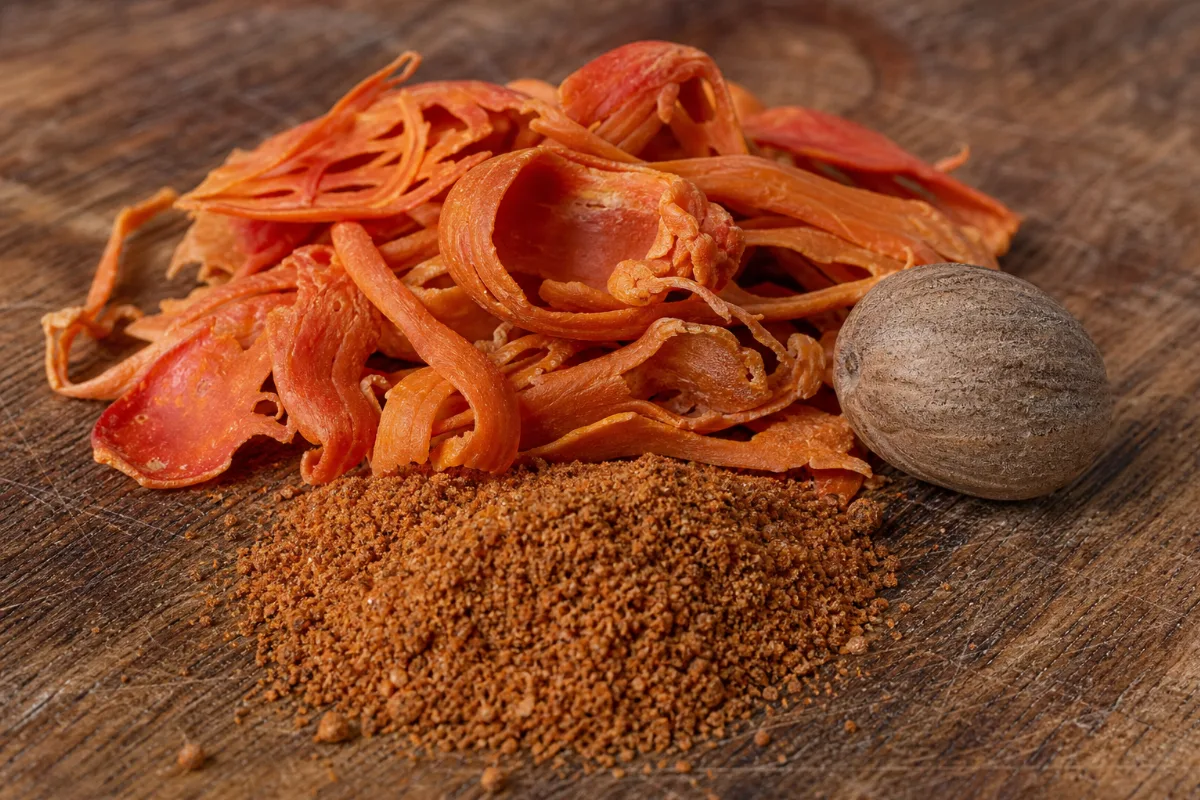
Mace
Myristica fragrans · also called Nutmeg aril, macis (Spanish)
Mace is the lacy red covering around the nutmeg seed, dried and used as a seasoning. One teaspoon gives very little nutrition. We found no human trial showing a health benefit from eating it. In cooking amounts it is a recognised food spice, but swallowing large amounts has poisoned a child, so keep whole pieces away from young children.
General information, not medical advice. Last substantive update · Not medically reviewed. A named clinician has not signed off on this page. How this page is made
About Mace
Mace is a flavouring, not a health food and not a proven remedy. In cooking amounts it is an accepted spice. Large amounts can poison.
What it is
Mace (Myristica fragrans) is the lacy covering of the nutmeg seed. The nutmeg tree gives two spices: nutmeg is the seed and mace is the covering.
USDA data for ground mace: 475 kcal per 100 g, but one teaspoon is only 1.7 g, which gives about 8 kcal, 0.34 g fibre, 4 mg calcium, 0.2 mg iron and 8 mg potassium. It is a flavouring, not a source of nutrients.
What the research shows
We found no human trial of eating mace for any health purpose. Folk uses, such as for the stomach, have only cell and animal findings behind them.
Our searching was limited, so a trial we missed is possible. Most of what is written about mace as a food rests on cooking pages, which we did not re-check here.
Spice versus oil
The oil is concentrated. EFSA classed nutmeg oil as a category 1B carcinogen because of safrole, in an opinion about animal feed. That says nothing about mace used in cooking.
Amounts
This page gives no amounts to eat. Ask a doctor, pharmacist or dietitian if you have questions, especially if you take mood medicines or have a young child at home.
At a glance
Traditional uses history, not proof
- Used as a seasoning in food
- Used in folk medicine for the stomach
- Long use as food is not proof that it treats any condition
Studied for research
- Digestive and other traditional uses, insufficient evidence (no human trial found)
Main compounds
- Myristicin
- Elemicin
- Safrole
Common forms
- Whole dried pieces (blades) and ground spice as food
- Essential oil (a different, concentrated product)
Research links: Case report: mace poisoning in a child · US eCFR 21 CFR 182.10: spices generally recognized as safe · USDA FoodData Central: Spices, mace, ground · Research Library · Genes & Biomarkers Library
What it is and its history
- Accepted scientific name
- Myristica fragrans
- Naming authority
- Houtt. (GBIF accepted)
- Common names
- Mace (English); Nutmeg aril (English); Macis (Spanish)
- Family or group
- Myristicaceae (the nutmeg family), as given by GBIF.
- Classification
- Plantae > Tracheophyta > Magnoliopsida > Magnoliales > Myristicaceae > Myristica > Myristica fragrans
- Native range
- Not verified from a source read.
- Habitat
- Not verified from a source read.
- What it looks like
- Roots: Not verified.; Stems: Not verified.; Leaves: Not verified.; Flowers: Not verified.; Fruit: The case report's figure legend describes a split nutmeg fruit with the seed inside and the surrounding aril, also known as mace. Mace is the lacy red covering of the seed.
- Cultivation
- Not verified from a source read.
- Harvest and processing
- Sold as whole dried pieces (blades) or ground, according to the existing summary; not re-checked. The case report describes fresh mace being peeled off nutmeg that was drying in the sun.
- Look-alikes and adulterants
- Name: Nutmeg; Note: The seed of the same fruit; same compounds in different proportions (case report). Cooking sources call it the closest substitute.; Name: Nutmeg oil and mace oil; Note: Concentrated essential oils. Not the same as the food spice.
- Sustainability and conservation
- Not assessed.
Photographs
What is inside, and how it may work
What it contains and how those compounds act in cells and animals. Laboratory and animal mechanisms are not proven effects in people.
Main compounds
| Compound | Family | Where it is concentrated | Activity studied | Level of evidence |
|---|---|---|---|---|
| Myristicin PubChem 4276 | alkylbenzene | Aril and seed Not given in the sources read | Named in the case report as the main psychoactive compound of nutmeg and mace; it moderately inhibits monoamine oxidase. 3 | Human data |
| Elemicin PubChem 10248 | alkylbenzene | Aril and seed Not given in the sources read | Named in the case report as causing hallucinations and anticholinergic effects. 3 | Human data |
| Safrole PubChem 5144 | alkylbenzene | Aril and seed Not given in the sources read | Named in the case report among the compounds of nutmeg and mace. EFSA's feed opinion on nutmeg oil linked safrole to cancer in rodents (summary-only). 3 4 | Human data |
Mechanisms, receptors and pathways
| Target or pathway | Gene or receptor | What was found | Level |
|---|---|---|---|
| Monoamine oxidase | Not specified | Myristicin moderately inhibits monoamine oxidase, which breaks down serotonin, noradrenaline and dopamine. The case report gives this as the main cause of toxic effects in large amounts. Its psychedelic effects are attributed to a metabolite of myristicin. 3 | Human data |
Absorption, metabolism and elimination
- Absorption
- Not found.
- Distribution
- Not found.
- Metabolism
- The case report says myristicin forms a metabolite (MMDA) thought to cause psychedelic effects.
- Elimination
- The child in the case report recovered and was discharged about 36 hours after eating the mace.
- Bioavailability
- Not established.
Isolated compounds versus whole extracts
The spice, the essential oil and extracts are different products. Safety statements about the oil (EFSA) do not describe mace in cooking, and the poisoning report is about swallowing several whole pieces.
Nutritional composition
Nutrition from USDA FoodData Central (Spices, mace, ground, FDC 170927, SR Legacy; record dated 2019-04-01; read 2026-10-26 from the April 2018 data download). Per 100 g: 475 kcal, 6.71 g protein, 32.38 g fat (9.51 g saturated), 50.5 g carbohydrate, 20.2 g fibre, 252 mg calcium, 13.9 mg iron, 163 mg magnesium, 463 mg potassium, 80 mg sodium, 1.5 mg manganese. Nobody eats 100 g. One teaspoon of ground mace is 1.7 g and gives about 8 kcal, 0.34 g fibre, 4 mg calcium, 0.2 mg iron and 8 mg potassium (calculated from the per-100 g values). It is a flavouring, not a meaningful source of nutrients. Real products vary.
1 not enough evidence
What was looked at
The 1 benefits and uses checked for Mace, each with how strong the evidence is. Tap one to open it.
What is Mace good for?
We found no human trial of eating mace for any health purpose. The one traditional use is listed below with its evidence.
Benefits, one by one
Each card is a research question, not a promise. Tap a goal to filter. Open a card to see the studies, doses and limits.
Digestive and other traditional uses
Not enough evidenceMace has traditional uses for the stomach and as a flavouring. We found no human trial of eating mace for any health purpose. Reviews of nutmeg and mace describe only cell and animal findings, and those do not show a benefit in people.
1 studiesSpice used as food.
Studies, doses and limits
What the trials found
No human trial of mace by mouth was found. This was not a full systematic search: our existing summary reported none, and our own PubMed searches for a trial returned nothing usable.
Results
No benefit shown.
Why this rating
No human trial was found; lab and animal findings do not show a benefit in people.
Form and dose studied
Spice used as food.
Limits
The reviews behind the existing summary were not re-opened for this page.
Why researchers looked
Mace and nutmeg are old kitchen and folk-medicine spices, so people ask if they help digestion.
Traditional use
Mace is the lacy red covering of the nutmeg seed. It has long been used as a flavouring in food. Long use as food is not proof that it treats any condition.
Proposed mechanism Authoritative guidance
Not established in people. The compounds in the oil (myristicin, elemicin, safrole) are known mainly for their toxic effects in large amounts.
A proposed mechanism does not show that the effect happens in people.
Large amounts have caused poisoning; see the Safety tab.
Connections to the rest of health
How Mace connects to the rest of our health knowledge graph. Every link says what kind of connection it is. A safety link (for example to the liver) is a warning, not a benefit. A study that merely mentions a topic never creates a benefit link.
Explore every connection: goals, body systems, organs, symptoms, genes
B. Body systems
| Connected to | Kind of connection | Evidence status | Context | Studies |
|---|---|---|---|---|
| Digestive System | Biological association | Not enough evidence | Studied for: Digestive and other traditional uses | 3 |
E. Health conditions
| Connected to | Kind of connection | Evidence status | Context | Studies |
|---|---|---|---|---|
| Nutmeg or mace poisoning | Adverse effect or risk | Documented risk | A child who ate six pieces of mace became very drowsy and recovered with supportive care. Preparation or compound: Large amounts of mace or nutmeg |
3 |
J. Genes, receptors and enzymes
| Connected to | Kind of connection | Evidence status | Context | Studies |
|---|---|---|---|---|
| Monoamine oxidase | Preliminary mechanism | Human | Myristicin in mace and nutmeg moderately inhibits it; relevant to mood medicines in large amounts. | 3 |
L. Active compounds
| Connected to | Kind of connection | Evidence status | Context | Studies |
|---|---|---|---|---|
| Myristicin | Biological association | Human | Named in the case report as the main psychoactive compound of nutmeg and mace; it moderately inhibits monoamine oxidase. Preparation or compound: Aril and seed |
3 |
| Elemicin | Biological association | Human | Named in the case report as causing hallucinations and anticholinergic effects. Preparation or compound: Aril and seed |
3 |
| Safrole | Biological association | Human | Named in the case report among the compounds of nutmeg and mace. EFSA's feed opinion on nutmeg oil linked safrole to cancer in rodents (summary-only). Preparation or compound: Aril and seed |
3 4 |
Each connection is stored with the ingredient, the connected record, the kind of connection, the evidence status, the supporting studies, the preparation or compound involved, and a review date (last reviewed October 26, 2026).
Evidence at a glance: what the research found for 1 outcome
Each outcome below is one thing researchers measured. Certainty is how far the evidence can be trusted, not how well it works. The full studies are on the next tab.
The evidence
The research centre for Mace. Every record here was checked against PubMed or the publisher's page; we never list a study we have not verified.
Evidence by outcome
Bars show how many studies we found for each outcome, not how well it works. People are added up across trials only (reviews are not added, to avoid double counting).
How we rate evidence
High certainty
Several well-run trials or reviews agree; further research is unlikely to change the picture much.
Moderate certainty
Good trials point the same way, but some doubt remains.
Low certainty
Small, short or inconsistent trials. The finding could change with better research.
Very low certainty
Very little or very weak human data. Treat as a possibility only.
Mixed findings
Trials or reviews disagree with each other.
Not enough evidence
Not enough human research to say either way.
Evidence against
Good research found no benefit, or found harm.
We take the reviewers' own risk-of-bias and GRADE statements where they exist, and otherwise judge from study size, design, consistency, directness and whether a product matches what is sold. Many publications do not make evidence high. Method note: We started from our existing mace summary, re-read the USDA nutrition record and the US food-additive regulation, read the full mace poisoning case report and two nutmeg poison-centre abstracts, and checked the species name at GBIF. Little research exists, so this page is short. Items we could not verify are flagged in the research gaps.
Study library: every study we checked 7
| Study | Design | People | Product, dose, length | Result |
|---|---|---|---|---|
| Ehrenpreis 2014 Nutmeg poisonings: a retrospective review of 10 years experience from the Illinois Poison Center, 2001-2011. J Med Toxicol · PMID 24452991 · DOI |
Case series |
32 32 nutmeg ingestion cases reported to one US poison center over 10 years |
Nutmeg (not mace) Seed spice Not in the abstract 2001-2011 |
17 of 32 exposures (53.1%) were unintentional, and 10 of those 17 were in children under 13. 15 (46.9%) were intentional; 5 of those involved other drugs too, all in people aged 15 to 20. One person who had taken several drugs needed breathing support in hospital. Not applicable (Not applicable) Methods, limits and fundingOutcomes: Who was exposed, whether on purpose, outcomes Limitations: About nutmeg, not mace. Small poison-centre series with no comparison group. Funding and conflicts: Not stated in the abstract. Read: abstract |
| Forrester 2005 Nutmeg intoxication in Texas, 1998-2004. Hum Exp Toxicol · PMID 16323572 · DOI |
Case series |
17 17 nutmeg ingestion calls to Texas poison centers over 7 years |
Nutmeg (not mace) Seed spice Not in the abstract 1998-2004 |
64.7% of the 17 calls involved intentional abuse. None of the ingestions resulted in more than moderate clinical effects or death. Not applicable (Not applicable) Methods, limits and fundingOutcomes: Reason for ingestion, where managed, severity Limitations: About nutmeg, not mace. Only 17 calls. Funding and conflicts: Not stated in the abstract. Read: abstract |
| Imtiaz 2024 Mace Poisoning: Accidental Toxic Ingestion in a Child Leading to a Reversible Coma. Cureus · PMID 39850188 · DOI |
Case report |
1 One previously healthy six-year-old girl |
Mace (aril of nutmeg), six pieces peeled from nutmeg that was drying in the sun and eaten by the child Aril (mace) Six pieces; weight not stated Single ingestion |
The child was very drowsy and hard to wake, with muscle twitching and stiffness and a raised blood carbon dioxide level (respiratory acidosis). A brain scan was normal. She improved with supportive care alone and was discharged about 36 hours after eating the mace. Not applicable (single case) (Not applicable) Methods, limits and fundingOutcomes: Level of consciousness, vital signs, blood gas, recovery Limitations: One child. The article gives no toxic amount for mace. Its statements about myristicin, elemicin and how common nutmeg poisoning is come from other papers it cites, not from this case. Funding and conflicts: Authors declare no financial support and no conflicts. Read: full-text |
| s-efsa-nutmeg-oil-2023 EFSA: Safety and efficacy of nutmeg oil as a feed additive · Source |
Regulatory opinion animal |
Methods, limits and fundingRead: summary-only | ||
| s-fda-cfr-182-10 US eCFR, 21 CFR 182.10: Spices and other natural seasonings and flavorings · Source |
Regulation n/a |
Methods, limits and fundingRead: full-text | ||
| s-gbif-myristica-fragrans GBIF Backbone: Myristica fragrans Houtt. (usageKey 5406817) · Source |
Reference database n/a |
Methods, limits and fundingRead: full-text | ||
| s-usda-fdc-170927 USDA FoodData Central: Spices, mace, ground (FDC 170927, SR Legacy) · Source |
Reference database n/a |
Methods, limits and fundingRead: full-text |
What we do not know yet
- No human trial of eating mace was found, and our PubMed searching was limited.
- No toxic amount for mace was found.
- Allergy, pregnancy, breastfeeding, aflatoxin, heavy metals and adulteration were not researched.
- Kitchen use, storage and history rest on sources we did not re-check, so they are not stated.
How new research is added
New studies are found by a saved PubMed search and placed in a review queue before the page changes.
Lab markers
What changed in blood or saliva tests during trials. A changed number is not the same as feeling or being healthier, and we give no "normal ranges".
Safety
What studies and official sources say about side effects, medicines and who should check first. Each point shows what kind of evidence it comes from.
Main points to know 3
- Large amounts can poison: this is about swallowing mace by the handful, not a pinch in food. A six-year-old girl who ate six pieces of mace peeled from drying nutmeg became very drowsy and hard to wake, with muscle stiffness and twitching and raised carbon dioxide in her blood. She recovered with supportive care alone and went home about 36 hours later. The report gives no toxic amount for mace. It says mace poisoning is reported less often than nutmeg poisoning. Case report 3
- Keep whole mace and nutmeg away from young children. In a 10-year Illinois poison-centre review of nutmeg, 10 of 17 unintentional exposures were in children under 13. This is about nutmeg, the closest relative, not mace itself. Case series 1 3
- Medicines for mood and the brain. The case report says the compound myristicin moderately blocks monoamine oxidase, the enzyme that some antidepressants also act on. Nobody has shown this matters at cooking amounts. If you take a medicine of this kind, ask a pharmacist before using more than the usual seasoning amount. Authoritative guidance 3
Side effects 2
| Effect | How often | Severity and recovery | Evidence |
|---|---|---|---|
| Drowsiness, hard to wake, muscle twitching and stiffness, raised blood carbon dioxide after a child ate six pieces of mace The amount in grams is not given. | One reported case | serious but reversible Recovered with supportive care; discharged about 36 hours after eating it | Case report 3 |
| Nutmeg poisoning from poison-centre records: drowsiness, hallucinations, fast heartbeat, nausea (symptom list from the case report's summary of nutmeg series) These are about nutmeg, not mace, and about large intentional or accidental amounts. | Texas: 17 calls in 7 years, none worse than moderate effects; Illinois: 32 cases in 10 years, one needing breathing support after mixing several drugs | mostly moderate Not stated in the abstracts | Case series 2 1 3 |
Liver
No liver injury from mace was found. Liver tests were normal in the child with mace poisoning. A liver-safety source (such as LiverTox) was not searched. 3
How often. No frequency was found.
Monitoring. No agency monitoring advice was found.
This is a safety connection. It is not evidence that Mace supports liver health.
Medicines and supplements 2
| With | Why it matters | Importance | Evidence | What to do |
|---|---|---|---|---|
| Monoamine oxidase inhibitors and other mood medicines (antidepressants) prescription | Myristicin, a compound in mace and nutmeg, moderately inhibits monoamine oxidase (case report). | Described as the cause of the toxic effects in large amounts. No interaction with cooking amounts was found in the sources read. | Authoritative guidance Very low certainty 3 | If you take a mood medicine, ask a pharmacist before using mace or nutmeg in more than normal seasoning amounts, and never as a supplement or oil. |
| Recreational or other drugs other | Not established. | In the Illinois nutmeg series, 5 of 15 intentional exposures also involved other drugs, and one such patient needed breathing support. This is about nutmeg. | Case series Very low certainty 1 | Do not combine large amounts of these spices with other drugs. |
Who should check first 3
| Situation | Advice | Evidence |
|---|---|---|
| Young children who could swallow whole pieces or large amounts | Keep whole mace blades, ground mace and nutmeg out of reach. If a child swallows a large amount, call a poison centre or emergency services. | Case report 3 1 |
| Taking a monoamine oxidase inhibitor or other mood medicine | Use only normal seasoning amounts and ask a pharmacist. | Authoritative guidance 3 |
| Pregnancy and breastfeeding | We did not find an official statement about mace in pregnancy or breastfeeding. Ordinary amounts in cooking are the usual food use; ask your doctor or midwife before using more. | Insufficient |
Overdose, product quality and regulators
Summary. Large amounts of mace or nutmeg can poison. The compounds named in the case report are myristicin, elemicin and safrole. No toxic amount for mace was found.
Animal. Safrole caused cancer in rodents; EFSA classed nutmeg oil as a category 1B carcinogen for this reason (summary-only, about the oil in animal feed).
High dose or long term signals. The poisoning report is one child. Long-term effects of large amounts were not found.
Overdose response. The child in the report recovered with supportive care in hospital. Call a poison centre or emergency services.
Genotoxicity. Not researched.
Toxic or hazardous parts. Mace and nutmeg seed in large amounts.
Quality problems for mace (adulteration, mould toxins, heavy metals) were not researched, and none were found in the sources read.
Essential oil. EFSA's opinion on nutmeg oil as an animal feed additive classed the oil as a category 1B carcinogen because of safrole. This is about the concentrated oil, not mace used in cooking (summary-only, not re-opened). 4
| Body | Action | Date |
|---|---|---|
| FDA (US Food and Drug Administration), 21 CFR 182.10 (United States) | Lists mace (Myristica fragrans Houtt.) among spices generally recognized as safe for their intended use source | 2025-10-01 |
When to get medical help
- A child who is very drowsy, hard to wake, stiff or twitching after swallowing mace or nutmeg
- Hallucinations, confusion, a very fast heartbeat or trouble breathing after swallowing a large amount
- Trouble breathing or swelling of the face or throat after eating a food containing mace (allergy is not documented in the sources read, but any such reaction is an emergency)
Stop using the product and contact a clinician or emergency service. In the US, Poison Control is 1-800-222-1222.
General information only, not medical advice. Ask a clinician or pharmacist before use, especially with medicines, in pregnancy or with a health condition. See the Natural Remedy Safety guide.
Frequently asked questions
What is mace?
What is mace used for in cooking?
It is a seasoning. Our existing summary says it goes into baking, stews, rice dishes and drinks, but those kitchen details were not re-checked for this page.
Is mace good for you?
Not shown. We found no human trial of eating mace for any health purpose. One teaspoon gives very little of any nutrient, so it is a flavouring, not a food that supplies nutrition.
Is mace safe to eat?
As a seasoning, yes. The US FDA lists mace among spices generally recognized as safe for their intended use. That is a food-use status, not proof of a health benefit, and it says nothing about oils, extracts or large amounts.
Can mace be poisonous?
Yes, in large amounts. A six-year-old who ate six pieces became very drowsy and stiff and needed hospital care. She recovered with supportive care. The report gives no toxic amount.
Is mace dangerous for children?
Does mace cause hallucinations?
Is mace safe with antidepressants?
The case report says myristicin moderately blocks monoamine oxidase, the enzyme some antidepressants act on. This has not been shown to matter at cooking amounts. Ask your pharmacist if you take a mood medicine.
Is mace safe in pregnancy or while breastfeeding?
We did not find an official statement about mace in pregnancy or breastfeeding. Ask your doctor or midwife.
Is mace the same as nutmeg?
They come from the same fruit: nutmeg is the seed and mace is the covering. The case report says their chemicals are similar but in different proportions. Most poisoning reports are about nutmeg.
Is mace essential oil safe to swallow?
No safety case is made for it here. EFSA classed nutmeg oil as a category 1B carcinogen because of safrole, in an opinion about animal feed. This page is about mace as a food spice; ask a pharmacist before using any oil by mouth.
Can I be allergic to mace?
We found no allergy report for mace in the sources read, so we cannot say how common it is. For trouble breathing or swelling of the face or throat, call emergency services.
Explore by health goal
Editorial transparency
- Written by
- AlternativeMed editorial team. Research compiled with AI assistance, then checked against the sources listed.
- Medical review
- None. This page has not been reviewed by a physician or pharmacist.
- First published
- 2026-10-26
- Last substantive update
- 2026-10-26
- How we research
- We started from our existing mace summary, re-read the USDA nutrition record and the US food-additive regulation, read the full mace poisoning case report and two nutmeg poison-centre abstracts, and checked the species name at GBIF. Little research exists, so this page is short. Items we could not verify are flagged in the research gaps.
- How we rate evidence
- See "How we rate evidence" in the Evidence tab.
- Independence
- No product is promoted on this page. No affiliate links are shown.
Sources 7
Each source was opened and checked. Where we read only the abstract, it says so. The small numbers in the text point here.
- Ehrenpreis JE, DesLauriers C, Lank P, Armstrong PK, Leikin JB. Nutmeg poisonings: a retrospective review of 10 years experience from the Illinois Poison Center, 2001-2011.. J Med Toxicol. 2014. PMID 24452991. DOI 10.1007/s13181-013-0379-7. (abstract)
- Forrester MB. Nutmeg intoxication in Texas, 1998-2004.. Hum Exp Toxicol. 2005. PMID 16323572. DOI 10.1191/0960327105ht567oa. (abstract)
- Imtiaz A, Almutairy BM, Almutairi TM, Aloufi MM, Almutairi AH. Mace Poisoning: Accidental Toxic Ingestion in a Child Leading to a Reversible Coma.. Cureus. 2024. PMID 39850188. DOI 10.7759/cureus.76284. (full-text)
- . EFSA: Safety and efficacy of nutmeg oil as a feed additive. . . (summary-only)
- . US eCFR, 21 CFR 182.10: Spices and other natural seasonings and flavorings. . . (full-text)
- . GBIF Backbone: Myristica fragrans Houtt. (usageKey 5406817). . . (full-text)
- . USDA FoodData Central: Spices, mace, ground (FDC 170927, SR Legacy). . . (full-text)
Where to buy
Check the label first. Whatever you buy, look for these:
- Whole or ground: whole spices keep their flavor longer
- The origin and a packed-on or best-by date for freshness
- Organic or non-irradiated labeling if that matters to you
- A resealable, airtight container
Talk to a pharmacist or doctor before you start any supplement, especially if you take medicines. See the Safety tab for interactions.
Support our free guides: as an Amazon Associate we earn from qualifying purchases. Full disclosure.


