Spices · Spice
Allspice
Pimenta dioica · also called Jamaica pepper, pimento, pimenta, pimienta de Jamaica (Spanish)
Allspice is the dried unripe berry of one tree, not a blend. It tastes warm and sweet, a little like clove, cinnamon and nutmeg together, and is used in jerk seasoning, pickling and baking. We found no human trial of allspice for any health use; the lab and animal findings do not show a benefit in people. The main caution is for medicinal amounts, such as supplements or oil, which might slow blood clotting, and for allergy.
General information, not medical advice. Last substantive update · Not medically reviewed. A named clinician has not signed off on this page. How this page is made
About Allspice
Allspice is a spice, not a remedy. It is the dried berry of the tree Pimenta dioica and gives warm, sweet flavor to savory and sweet dishes. We found almost no human research on its health effects.
What it is
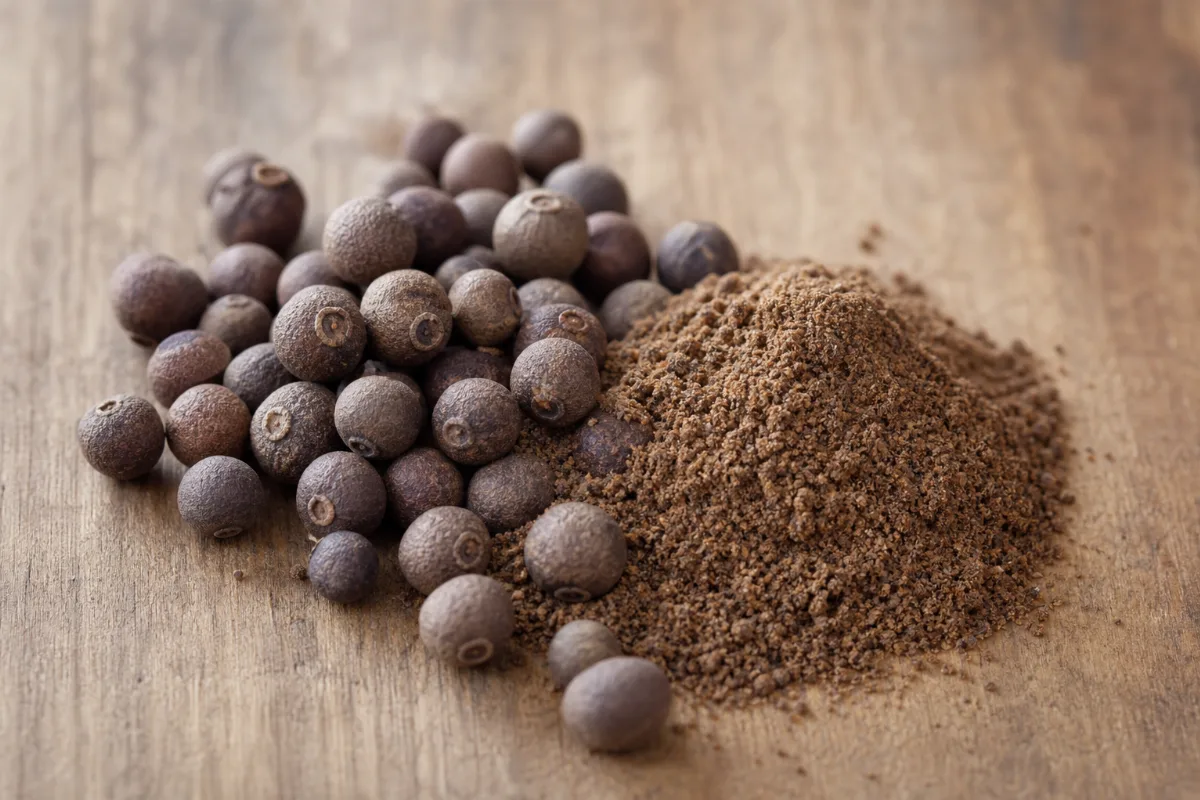
Allspice is the dried, unripe berry of Pimenta dioica, an evergreen tree in the myrtle family (the same family as clove). The berries are picked green and dried in the sun until brown, and look like large peppercorns. It is one spice, not a blend; the name comes from its flavor, which resembles cloves, pepper, cinnamon and nutmeg together.
The tree is native to the Caribbean (Jamaica), southern Mexico and Central America, and Jamaica is the largest producer, according to the review we read. The main flavor compound, eugenol, is also the main compound of clove oil.
In the kitchen
Caribbean cooks use it in jerk seasoning, mole sauces and pickling, and the wood is used to smoke meat. Elsewhere it flavors stews, sausages, sauces, and bakes such as pumpkin pie, gingerbread and spice cake. Jamaicans also soak the berries in rum to make a liqueur. It is sold whole or ground.
Mix-up to know about: the review says commercial allspice can include berries of a related species, Pimenta racemosa, which are larger and less aromatic.
Nutrition in a typical portion
USDA lists 1 teaspoon of ground allspice as 1.9 g. That portion provides about 5 kcal, 0.4 g fiber, 13 mg calcium, 20 mg potassium, 0.13 mg iron and 0.06 mg manganese (worked out from the USDA values per 100 g). Those amounts are small, so allspice is a flavoring, not a meaningful source of nutrients. USDA data are from 2018 and real products vary.
What the research shows
Eating allspice in food has not been studied for health. The research is on extracts and compounds in cells and animals, and the review authors note it does not show an effect of diet or allspice in people.
The one human trial we found tested a pumpkin pie spice mix (four spices, one of them allspice) in 25 people. It cannot be credited to allspice, and an author has a link to a spice-industry group.
Traditional uses for colds, cramps and digestion come from folk medicine, not trials.
Food versus extracts and oil
Allspice essential oil is concentrated, is mostly eugenol and is not a kitchen product. Lab results for extracts and eugenol do not carry over to a pinch in a stew. WHO gives an intake figure for eugenol as a flavoring, but not for allspice.
Amounts
This page gives no amounts to eat. Ask a doctor, pharmacist or dietitian about supplements or oil, especially if you take blood thinners.
At a glance
Traditional uses history, not proof
- Cooking: jerk seasoning, stews, pickling, sausages and baking
- Folk medicine: hot tea for colds, period cramps and upset stomach; crushed berries on sore joints
- Long use is not proof that it treats any condition
Studied for research
- Any health benefit from allspice as food: insufficient evidence, no study found
- Antioxidant activity: very low, lab tests only
- Blood pressure: insufficient, rat studies only
- Cancer cell lines: very low, cell studies only
- Blood vessel widening after a meal: very low, a four-spice mix, not allspice alone
Main compounds
- Eugenol (main aroma compound)
- Gallic acid
- Quercetin
- Ericifolin
Common forms
- Whole dried berries
- Ground allspice
- Essential oil (concentrated, not a kitchen product)
- Leaves, used like bay leaves
Research links: Review: medicinal properties of Pimenta dioica and allspice (2012) · WHO/JECFA: eugenol evaluation · USDA FoodData Central: allspice, ground · Research Library · Genes & Biomarkers Library
What it is and its history
- Accepted scientific name
- Pimenta dioica
- Naming authority
- (L.) Merr. (GBIF accepted)
- Synonyms
- Pimenta officinalis; Eugenia pimenta
- Common names
- Allspice (English); Jamaica pepper (English); Pimento (English); Pimienta de Jamaica (Spanish)
- Family or group
- Myrtaceae (the myrtle family), the same family as clove, per GBIF and the review.
- Classification
- Plantae > Tracheophyta > Magnoliopsida > Myrtales > Myrtaceae > Pimenta > Pimenta dioica
- Native range
- The review says it is native to the Caribbean (Jamaica), southern Mexico and Central America, and grown commercially in Mexico, Honduras, Trinidad, Cuba and Jamaica. It calls Jamaica the world's largest producer.
- Habitat
- Not verified from a source read.
- What it looks like
- Roots: Not verified.; Stems: An evergreen tree, about 22 ft tall and sometimes up to 43 ft, with light gray bark (review).; Leaves: Dark green, 4-8 cm long (review).; Flowers: Small whitish flowers in summer; male and female flowers grow on different trees (review).; Fruit: The berries are picked green and dried in the sun. They turn brown and look like large peppercorns (review).
- Cultivation
- Not verified beyond the commercial growing countries above.
- Harvest and processing
- Berries are picked unripe and dried (review). Sold whole, ground, and as essential oil. Leaves and wood are used for smoking meat and flavouring (review).
- Look-alikes and adulterants
- Name: Pimenta racemosa; Note: A related species. The review says commercial allspice may include its fruit, which is larger and less aromatic.; Name: Black pepper (Piper nigrum); Note: A different plant from South Asia. Allspice only resembles peppercorns in looks and the old name Jamaica pepper.
- Sustainability and conservation
- Not assessed.
Photographs
Traditional use and history history, not clinical proof
| Tradition or era | Documented use | Source |
|---|---|---|
Traditional use shows how it was used. It does not show that it works or is safe today.
What is inside, and how it may work
What it contains and how those compounds act in cells and animals. Laboratory and animal mechanisms are not proven effects in people.
Main compounds
| Compound | Family | Where it is concentrated | Activity studied | Level of evidence |
|---|---|---|---|---|
| Eugenol PubChem 3314 | phenylpropene | Berry and leaf essential oil 60-90% of berry essential oil; over 90% of leaf oil (review table) | Main aroma compound; same as in clove. Antibacterial, antioxidant and anti-inflammatory in lab studies (review). 4 6 | Laboratory research |
| Gallic acid PubChem 370 | phenolic acid | Berry Not given | Antioxidant and slowed growth of cancer cells in the lab (review). 4 | Laboratory research |
| Quercetin PubChem 5280343 | flavonoid | Berry (limited amount per the review) Not given | Antioxidant in lab assays (review). 4 | Laboratory research |
| Ericifolin | phenolic glycoside | Berry (aqueous extract) Not given | Slowed prostate and breast cancer cells in lab and mouse work reported by the review authors' own group (not independently read). 4 | Laboratory research |
Mechanisms, receptors and pathways
| Target or pathway | Gene or receptor | What was found | Level |
|---|---|---|---|
| Antioxidant radical scavenging | An ethyl acetate extract of allspice scavenged the DPPH test radical in lab assays (review). 4 | Laboratory research | |
| Blood vessel relaxation (rats) | Not cholinergic, alpha or beta adrenergic (review) | Aqueous leaf extract lowered blood pressure in rats; the review suggests vessel relaxing activity. 4 | Animal research |
Absorption, metabolism and elimination
- Absorption
- Not found.
- Distribution
- Not found.
- Metabolism
- Not found.
- Elimination
- Not found.
- Bioavailability
- Not established.
Isolated compounds versus whole extracts
Almost all the biology reported is for lab extracts and isolated compounds such as eugenol. Eating the spice in food is not the same. The one human trial used a four-spice mix in a meal.
Nutritional composition
Nutrition from USDA FoodData Central (Spices, allspice, ground, FDC 171315, SR Legacy, last updated 4/1/2019, read 2026-10-26). Per 100 g: 263 kcal, 6.09 g protein, 8.69 g fat, 72.1 g carbohydrate, 21.6 g fibre, 8.46 g water, 661 mg calcium, 7.06 mg iron, 135 mg magnesium, 1040 mg potassium, 77 mg sodium, 2.94 mg manganese, 39.2 mg vitamin C, 36 micrograms folate (DFE), 27 micrograms vitamin A (RAE). USDA household portions: 1 teaspoon ground = 1.9 g and 1 tablespoon ground = 6.0 g. One teaspoon (1.9 g), worked out from the per-100 g values: about 5 kcal, 0.4 g fibre, 13 mg calcium, 20 mg potassium, 0.13 mg iron and 0.06 mg manganese. These amounts are small, so allspice is a flavouring, not a meaningful source of nutrients. Real products vary.
4 very low certainty5 not enough evidence
What was looked at
The 9 benefits and uses checked for Allspice, each with how strong the evidence is. Tap one to open it.
- Health benefit from allspice as foodNot enough evidence
- Antioxidant activity (lab tests)Very low certainty
- Blood pressure (rat studies)Not enough evidence
- Blood vessel widening after a meal with a spice mixVery low certainty
- Cancer cell lines (cell studies)Very low certainty
- Estrogen-like activity in cells (menopause)Not enough evidence
- Pain and infection (eugenol, traditional use)Not enough evidence
- Digestion (traditional use)Not enough evidence
- Insulin after a meal with a spice mixVery low certainty
Lab markers tracked in the studies
Flow-mediated dilation (artery widening)Insulin 30 minutes after a meal
What is Allspice good for?
The studied uses and how strong the human evidence is for each. Almost all of it is lab or animal work, or is about a spice mix, not allspice eaten in food.
Benefits, one by one
Each card is a research question, not a promise. Tap a goal to filter. Open a card to see the studies, doses and limits.
Health benefit from allspice as food
Not enough evidenceNo study we found tested eating allspice for a health result. Allspice is a flavouring, and the usual amounts in cooking are small.
2 studiesWhole berries or ground spice as food.
Studies, doses and limits
What the trials found
The review we read describes cell and animal work and folk use, and describes no human trial of allspice. The Natural Medicines monograph says there is no good scientific evidence for the uses people try.
Results
Nothing about health benefit can be said for allspice in food.
Why this rating
No human trial of allspice itself was found.
Form and dose studied
Whole berries or ground spice as food.
Limits
Absence of a study is not proof of no effect; it means we cannot say.
Why researchers looked
People ask whether a spice that smells like clove, cinnamon and nutmeg also has health effects.
Traditional use
In the Caribbean and Central America the berries are used in teas and rubs for colds, period cramps, upset stomach and sore joints. The review we read calls these uses folk medicine handed down by experience, not trials.
Proposed mechanism Unknown
Not applicable. No human mechanism has been shown for allspice as food.
A proposed mechanism does not show that the effect happens in people.
See the safety section: food amounts are normally used; larger medicinal amounts are not well studied.
Antioxidant activity (lab tests)
Very low certaintyAllspice extracts and compounds from it, such as eugenol and gallic acid, block free radicals in test tubes. That does not show a benefit in people.
1 studiesLaboratory extracts (ethyl acetate extract and isolated compounds), n…
Studies, doses and limits
Results
Strong radical-scavenging activity in lab assays of an extract.
Effect sizes as reported
No figure given in the sources we read.
Why this rating
Test-tube results do not show a benefit in people. The review also says commercial allspice can include a related species, Pimenta racemosa, so lab results may not match every product.
Form and dose studied
Laboratory extracts (ethyl acetate extract and isolated compounds), not food.
Limits
Lab assays only; extracts are far more concentrated than a pinch in food.
Why researchers looked
Spices are often rich in plant compounds called polyphenols, which behave as antioxidants in the lab.
Proposed mechanism Laboratory research
Polyphenols in an ethyl acetate extract of allspice scavenged a test radical (DPPH) in lab assays, as reported in the review.
A proposed mechanism does not show that the effect happens in people.
None specific.
Blood pressure (rat studies)
Not enough evidenceAllspice leaf extracts lowered blood pressure in rats given the extract by injection. One other rat study found no significant change. No human trial was found.
1 studiesLeaf extract given by injection in rats.
Studies, doses and limits
Results
Aqueous Pimenta dioica extract given intravenously to Sprague-Dawley rats lowered blood pressure; an aqueous extract in spontaneously hypertensive rats depressed the nervous system but did not significantly change blood pressure.
Effect sizes as reported
No figures given in the sources we read.
Why this rating
Two rat studies with different results, an injected extract rather than food, and no human data.
Form and dose studied
Leaf extract given by injection in rats.
Who was studied
Rats.
Limits
Animal studies. Not food. Not shown in people.
Why researchers looked
Allspice is used in Central America as a folk remedy for high blood pressure.
Traditional use
Folk use for high blood pressure, obesity and digestion in Central America (as described in the review).
Proposed mechanism Animal research
The review says the effect was not due to cholinergic or adrenergic receptors and that the extract may relax blood vessels. This is an animal finding.
A proposed mechanism does not show that the effect happens in people.
Anyone taking blood pressure medicine should ask a pharmacist before using allspice supplements or oil.
Blood vessel widening after a meal with a spice mix
Very low certaintyIn a small trial, a meal with pumpkin pie spice (cinnamon, ginger, nutmeg and allspice) improved a blood-vessel test 24 hours later compared with the same meal without it. Allspice was only one of four spices.
1 studiesMixed ground spices added to a test meal.
Studies, doses and limits
What the trials found
A randomised crossover trial in 25 adults with overweight or obesity (Front Nutr 2022).
Results
Pumpkin pie spice meal raised flow-mediated dilation (a measure of how well an artery widens) at 24 h versus the salt-and-pepper meal (P = 0.027).
Effect sizes as reported
Only P values are given in the abstract; no effect size for this arm.
Why this rating
A mixture of four spices, 25 people, single meals, a marker and not a health outcome. An author sits on an advisory board of a spice-industry group. Allspice cannot be singled out.
Form and dose studied
Mixed ground spices added to a test meal.
Who was studied
25 adults with overweight or obesity.
Limits
Cannot be credited to allspice. Surrogate marker only. Small.
Why researchers looked
Researchers wanted to know whether common herb and spice mixes change blood-vessel function after a rich meal.
Proposed mechanism Unknown
Not established. The trial did not test why.
A proposed mechanism does not show that the effect happens in people.
None reported in the abstract.
Cancer cell lines (cell studies)
Very low certaintyExtracts and compounds from allspice slowed some cancer cells in dishes. The authors say this does not show that eating allspice affects cancer in people.
1 studiesLaboratory extracts and isolated compounds.
Studies, doses and limits
Results
Cell studies of Pimenta extracts and compounds on breast, prostate and other cell lines. The review says most reports on Pimenta extracts are in cells; it also mentions animal work from the authors’ own group, which was not read.
Why this rating
Cell-line work only. The review itself says eating a diet rich in allspice has not been shown to change cancer in people, and it notes the Caribbean, where allspice is eaten widely, does not have low cancer rates.
Form and dose studied
Laboratory extracts and isolated compounds.
Limits
Lab only. Concentrations in dishes are not what people eat. The review is by researchers who work on allspice extracts.
Why researchers looked
Compounds in allspice such as eugenol, gallic acid, quercetin and ericifolin slow cell growth in lab tests.
Proposed mechanism Laboratory research
Compounds from allspice caused cancer cells to die or stop dividing in dishes. The review says its own group works on an aqueous allspice extract; those reports were not read.
A proposed mechanism does not show that the effect happens in people.
None.
Estrogen-like activity in cells (menopause)
Not enough evidenceA methanol extract of Pimenta dioica showed partial estrogen-like activity in cells. Nothing shows it helps menopause symptoms.
1 studiesMethanol extract in cells.
Studies, doses and limits
Results
Partial estrogen-like activity in a cell study.
Why this rating
One cell study, described only in a review, no human data.
Form and dose studied
Methanol extract in cells.
Limits
Cell-based work only.
Why researchers looked
Women in Central America eat plant-rich diets and use herbal medicine, so researchers tested plant extracts for hormone-like activity.
Proposed mechanism Laboratory research
The extract acted as a partial agonist/antagonist, raising estradiol-stimulated pS2 gene activity and lowering progesterone-linked PTGES activity in cells (as described in the review).
A proposed mechanism does not show that the effect happens in people.
People with hormone-sensitive conditions should ask a clinician before using allspice supplements or oil. We found no source on food amounts.
Pain and infection (eugenol, traditional use)
Not enough evidenceAllspice contains eugenol, which is thought to help with pain and infection, but the reference monograph says there is no good scientific evidence for these uses.
3 studiesTea, oil, berries (traditional); eugenol in the lab.
Studies, doses and limits
Results
No trial result to report.
Why this rating
Only traditional use and lab data on eugenol.
Form and dose studied
Tea, oil, berries (traditional); eugenol in the lab.
Limits
Traditional use is not proof of benefit. Eugenol studies are not allspice studies.
Why researchers looked
Eugenol is the main aroma compound of allspice and clove oil, and clove oil has a long history in dentistry.
Traditional use
Hot allspice tea for colds, period cramps and upset stomach in Jamaica; crushed berries on bruises and sore joints in Guatemala; a pimento oil and water in the British Pharmacopoeia of 1898 (oil dropped in 1914). The review calls most of this folk medicine based on experience.
Proposed mechanism Preliminary mechanism
Eugenol blocks pain signals in nerve tissue and slows microbes in lab studies (per the review). Not shown for allspice as food.
A proposed mechanism does not show that the effect happens in people.
Allspice oil is concentrated and is not a kitchen product. A WHO flavouring figure exists for eugenol, but not for allspice itself.
Digestion (traditional use)
Not enough evidenceAllspice has been used in tea for upset stomach and indigestion in several countries. No trial tested this.
1 studiesTea (traditional).
Studies, doses and limits
Results
No trial result.
Why this rating
Folk use only.
Form and dose studied
Tea (traditional).
Limits
Folk use is not evidence of effect.
Why researchers looked
It is a long-standing folk use in the Caribbean, Costa Rica, Cuba and Europe.
Traditional use
Hot tea for dyspepsia in Jamaica; use for indigestion in Costa Rica and Cuba; anecdotal European use (as described in the review).
Proposed mechanism Hypothesis
The review suggests eugenol may stimulate digestive enzymes. This is a suggestion, not a shown mechanism in people.
A proposed mechanism does not show that the effect happens in people.
None specific.
Insulin after a meal with a spice mix
Very low certaintyIn the same small trial, a meal with a pumpkin pie spice mix (including allspice) was followed by lower insulin 30 minutes later than the plain meal. Blood sugar was lower only after the cinnamon meal.
1 studiesMixed ground spices in a test meal.
Studies, doses and limits
What the trials found
Randomised crossover trial in 25 adults with overweight or obesity (Front Nutr 2022).
Results
Pumpkin pie spice lowered insulin at 0.5 h versus control (P = 0.01). The abstract names the cinnamon meal, not the pumpkin pie spice meal, as lowering glucose.
Effect sizes as reported
P values only.
Why this rating
Four-spice mixture, 25 people, single meals, and a spice-industry advisory-board link for one author. Cannot be credited to allspice.
Form and dose studied
Mixed ground spices in a test meal.
Who was studied
25 adults with overweight or obesity.
Limits
Cannot be credited to allspice. Surrogate marker only.
Why researchers looked
Researchers asked whether spice mixes change blood sugar and insulin after a rich meal.
Proposed mechanism Unknown
Not established.
A proposed mechanism does not show that the effect happens in people.
None reported in the abstract.
Connections to the rest of health
How Allspice connects to the rest of our health knowledge graph. Every link says what kind of connection it is. A safety link (for example to the liver) is a warning, not a benefit. A study that merely mentions a topic never creates a benefit link.
Explore every connection: goals, body systems, organs, symptoms, genes
A. Wellness goals
| Connected to | Kind of connection | Evidence status | Context | Studies |
|---|---|---|---|---|
| Heart Health | Preliminary mechanism | Not enough evidence | Blood pressure (rat studies): Allspice leaf extracts lowered blood pressure in rats given the extract by injection. One other rat study found no significant change. No human trial was found. | 4 |
| Heart Health | Very low certainty | Blood vessel widening after a meal with a spice mix: In a small trial, a meal with pumpkin pie spice (cinnamon, ginger, nutmeg and allspice) improved a blood-vessel test 24 hours later compared with the same meal without it. Allspice was only one of four spices. | 1 | |
| Womens Wellness | Preliminary mechanism | Not enough evidence | Estrogen-like activity in cells (menopause): A methanol extract of Pimenta dioica showed partial estrogen-like activity in cells. Nothing shows it helps menopause symptoms. | 4 |
| Gut Digestive Health | Traditional use | Not enough evidence | Digestion (traditional use): Allspice has been used in tea for upset stomach and indigestion in several countries. No trial tested this. | 4 |
| Healthy Weight Metabolism | Very low certainty | Insulin after a meal with a spice mix: In the same small trial, a meal with a pumpkin pie spice mix (including allspice) was followed by lower insulin 30 minutes later than the plain meal. Blood sugar was lower only after the cinnamon meal. | 1 |
B. Body systems
| Connected to | Kind of connection | Evidence status | Context | Studies |
|---|---|---|---|---|
| Blood And Immune | Biological association | Very low certainty | Studied for: Antioxidant activity (lab tests) Studied for: Cancer cell lines (cell studies) | 4 |
| Cardiovascular System | Biological association | Not enough evidence | Studied for: Blood pressure (rat studies) Studied for: Blood vessel widening after a meal with a spice mix | 4 1 |
| Reproductive System | Biological association | Not enough evidence | Studied for: Estrogen-like activity in cells (menopause) | 4 |
| Nervous System | Biological association | Not enough evidence | Studied for: Pain and infection (eugenol, traditional use) | 4 7 6 |
| Digestive System | Biological association | Not enough evidence | Studied for: Digestion (traditional use) | 4 |
| Metabolism Weight | Biological association | Very low certainty | Studied for: Insulin after a meal with a spice mix | 1 |
I. Biomarkers
| Connected to | Kind of connection | Evidence status | Context | Studies |
|---|---|---|---|---|
| Flow-mediated dilation (artery widening) | Biological association | Very low certainty | Measured in trials: raised. A lab change is not the same as a health benefit. | 1 |
| Insulin 30 minutes after a meal | Biological association | Very low certainty | Measured in trials: lowered. A lab change is not the same as a health benefit. | 1 |
K. Biological pathways
L. Active compounds
| Connected to | Kind of connection | Evidence status | Context | Studies |
|---|---|---|---|---|
| Eugenol | Biological association | In vitro | Main aroma compound; same as in clove. Antibacterial, antioxidant and anti-inflammatory in lab studies (review). Preparation or compound: Berry and leaf essential oil |
4 6 |
| Gallic acid | Biological association | In vitro | Antioxidant and slowed growth of cancer cells in the lab (review). Preparation or compound: Berry |
4 |
| Quercetin | Biological association | In vitro | Antioxidant in lab assays (review). Preparation or compound: Berry (limited amount per the review) |
4 |
| Ericifolin | Biological association | In vitro | Slowed prostate and breast cancer cells in lab and mouse work reported by the review authors' own group (not independently read). Preparation or compound: Berry (aqueous extract) |
4 |
Each connection is stored with the ingredient, the connected record, the kind of connection, the evidence status, the supporting studies, the preparation or compound involved, and a review date (last reviewed October 26, 2026).
Evidence at a glance: what changed in 2 lab markers
Tap a number to show only those markers. Counts are markers, not people.
The evidence
The research centre for Allspice. Every record here was checked against PubMed or the publisher's page; we never list a study we have not verified.
Evidence by outcome
Bars show how many studies we found for each outcome, not how well it works. People are added up across trials only (reviews are not added, to avoid double counting).
How we rate evidence
High certainty
Several well-run trials or reviews agree; further research is unlikely to change the picture much.
Moderate certainty
Good trials point the same way, but some doubt remains.
Low certainty
Small, short or inconsistent trials. The finding could change with better research.
Very low certainty
Very little or very weak human data. Treat as a possibility only.
Mixed findings
Trials or reviews disagree with each other.
Not enough evidence
Not enough human research to say either way.
Evidence against
Good research found no benefit, or found harm.
We take the reviewers' own risk-of-bias and GRADE statements where they exist, and otherwise judge from study size, design, consistency, directness and whether a product matches what is sold. Many publications do not make evidence high. Method note: We started from our existing allspice summary, re-checked nutrition at USDA FoodData Central, read a 2012 review, the WHO/JECFA eugenol summary and the Natural Medicines monograph (a secondary reference), and searched PubMed for trials and allergy reports. Only abstracts were read for PubMed studies, and one allergy report had no abstract. Items we could not verify are flagged in the research gaps.
Study library: every study we checked 8
| Study | Design | People | Product, dose, length | Result |
|---|---|---|---|---|
| Huang 2022 Endothelial Function and Postprandial Glucose Control in Response to Test-Meals Containing Herbs and Spices in Adults With Overweight/Obesity. Front Nutr · PMID 35273988 · DOI |
Controlled trial |
25 25 adults with overweight or obesity (mean age 36.6) |
Pumpkin pie spice mix (cinnamon, ginger, nutmeg and allspice) added to a high-fat, high-carbohydrate challenge meal mixed ground spices About 1 g of herbs or spices per 135 kcal of meal (spice-level detail not repeated here) One meal per visit, 24 h follow-up, visits at least 3 days apart · vs Same meal with salt and pepper only |
Pumpkin pie spice meal raised flow-mediated dilation at 24 h versus control (P = 0.027) and lowered insulin at 0.5 h (P = 0.01). IL-6 and triglycerides rose after all meals with no significant difference between meals. Allspice was one of four spices in the mix, so the result cannot be credited to allspice. Methods, limits and fundingOutcomes: Flow-mediated dilation (blood vessel widening), glucose, insulin, IL-6, triglycerides Limitations: Mixture of four spices; 25 people; single meals; the abstract gives no effect sizes for the pumpkin pie spice arm. Funding and conflicts: One author serves on the advisory board of the McCormick Science Institute (a spice-industry group); others declared none. Registration: ClinicalTrials.gov NCT03926442 Read: abstract |
| Kanerva 1996 Occupational allergic contact dermatitis from spices. Contact Dermatitis · PMID 8930476 · DOI |
Case series |
5 5 chefs, kitchen and restaurant workers among about 1000 patients with work-related skin disease at a Finnish clinic, 1991-1995 |
Spices handled at work: garlic, cinnamon, ginger, allspice and clove spices occupational handling |
Five patients had allergic contact dermatitis from spices. The spices that caused it were garlic, cinnamon, ginger, allspice and clove. The abstract does not say how many reacted to allspice. Methods, limits and fundingOutcomes: Hand dermatitis and patch test reactions Limitations: Very small series of workers; skin contact, not eating; allspice share not given. Funding and conflicts: Not stated in the abstract Read: abstract |
| Regula 2022 Severe allergic reaction to allspice, a hidden food allergen. Ann Allergy Asthma Immunol · PMID 35577235 · DOI |
Case report |
Not available (no abstract) | Title only: a severe allergic reaction to allspice is reported. No abstract, so no detail was read. Methods, limits and fundingLimitations: Only the title and record were read; no details such as symptoms, test results or outcome. Funding and conflicts: Not read Read: title-only | |
| Zhang 2012 Medicinal properties of the Jamaican pepper plant Pimenta dioica and allspice Curr Drug Targets (author manuscript) · Source |
Narrative review cell, animal and traditional-use literature |
Methods, limits and fundingFunding and conflicts: NIH and VA grants; authors state no conflict of interest Read: full-text | ||
| s-gbif-pimenta-dioica GBIF Backbone: Pimenta dioica (L.) Merr. (usageKey 3186061) · Source |
Reference database n/a |
Methods, limits and fundingRead: full-text | ||
| s-jecfa-eugenol WHO/JECFA via INCHEM: Eugenol (JECFA No. 1529) evaluation summary · Source |
Health agency n/a |
Methods, limits and fundingRead: full-text | ||
| s-trc-allspice Natural Medicines (TRC) monograph: Allspice, as licensed to vital.ly · Source |
Secondary reference n/a |
Methods, limits and fundingRead: full-text | ||
| s-usda-fdc-171315 USDA FoodData Central: Spices, allspice, ground (FDC 171315) · Source |
Reference database n/a |
Methods, limits and fundingRead: full-text |
What we do not know yet
- No human trial of allspice by itself was found for any health outcome.
- The cell and animal findings are described through one review; the original papers were not read.
- The only human trial tested a four-spice mix, so allspice cannot be separated out.
- The allergy report from 2022 was read by title only; how common allergy is was not found.
- Contamination data (heavy metals, mould toxins, pesticides) and effects of cooking or grinding were not found in the sources read.
- EMA, EFSA, FDA and NCCIH statements on allspice were not located.
How new research is added
New studies are found by a saved PubMed search and placed in a review queue before the page changes.
Lab markers
What changed in blood or saliva tests during trials. A changed number is not the same as feeling or being healthier, and we give no "normal ranges".
Other 2
Flow-mediated dilation (artery widening)
Raised in trials
An ultrasound test of how much an artery widens when blood flow is restored after a brief squeeze with a cuff.
Very low certaintyResults and what it means
Why it was measured
Often used as a marker of how well blood vessels work.
Statistical vs. clinical meaning
A marker in a small crossover trial of a mixture. Not a health outcome and not about allspice alone.
Safety implication
None reported in the abstract.
| Study | Result | People | Product |
|---|---|---|---|
| 1 | Pumpkin pie spice meal increased %FMD at 24 h versus control (P = 0.027) | 25 adults with overweight or obesity | Meal with a four-spice mix (includes allspice) vs the same meal with salt and pepper |
Insulin 30 minutes after a meal
Lowered in trials
How much insulin is in the blood half an hour after eating.
Very low certaintyResults and what it means
Why it was measured
A marker of the body's response to the carbohydrate in a meal.
Statistical vs. clinical meaning
Small trial of a mixture. Not a health outcome and not about allspice alone.
Safety implication
None reported in the abstract.
| Study | Result | People | Product |
|---|---|---|---|
| 1 | Pumpkin pie spice meal lowered insulin at 0.5 h versus control (P = 0.01) | 25 adults with overweight or obesity | Meal with a four-spice mix (includes allspice) vs the same meal with salt and pepper |
Safety
What studies and official sources say about side effects, medicines and who should check first. Each point shows what kind of evidence it comes from.
Main points to know 3
- Medicinal amounts may slow blood clotting: ask before using allspice supplements or oil with blood thinners. The Natural Medicines monograph (a secondary reference) says allspice might slow blood clotting. It rates the interaction with drugs that slow clotting (anticoagulants and antiplatelet drugs) as moderate and says it might increase bruising and bleeding. It says to stop medicinal allspice at least 2 weeks before planned surgery. This is about medicinal amounts, not cooking. We found no report of bleeding from food amounts. Do not change a prescribed medicine on your own. Secondary reference 7
- Allergy is possible. A 2022 case report in a medical journal describes a severe allergic reaction to allspice. We read only its title, not the details. A small Finnish series of kitchen workers found allergic contact dermatitis from spices that included allspice. The Natural Medicines monograph also says some people are allergic to allspice. Case report 3 2 7
- Food amounts are normal; larger medicinal amounts are not well studied. The monograph says allspice is commonly used as a flavouring but there is not enough reliable information to know if larger medicinal amounts are safe. It advises staying with food amounts in pregnancy and breastfeeding. Secondary reference 7
Side effects 3
| Effect | How often | Severity and recovery | Evidence |
|---|---|---|---|
| Allergic reaction to allspice (including a severe reaction) Only the title of the 2022 report was read. No frequency was found. | Not established | Severe in one report (title only) Not stated | Case report 3 7 |
| Allergic contact dermatitis (hand rash) in kitchen workers handling spices including allspice Skin contact at work. Does not describe eating allspice. | 5 spice-allergic workers among about 1000 patients with work-related skin disease; the share due to allspice is not stated | Not stated Not stated in the abstract | Case series 2 |
| Bleeding or bruising with medicinal amounts A monograph statement that allspice might slow clotting. Not a reported case. | Not established | Not stated Not stated | Secondary reference 7 |
Liver
No liver injury from allspice was found in the sources read. A liver-safety source such as LiverTox was not checked.
How often. No frequency was found.
Monitoring. No monitoring advice was found.
This is a safety connection. It is not evidence that Allspice supports liver health.
Medicines and supplements 3
| With | Why it matters | Importance | Evidence | What to do |
|---|---|---|---|---|
| Anticoagulant and antiplatelet drugs (blood thinners) prescription | The monograph says allspice might slow blood clotting. No human study of the mechanism was read. | Rated moderate in the monograph: might increase bruising and bleeding. Concerns medicinal amounts. | Secondary reference Low certainty 7 | Ask a pharmacist or doctor before using allspice supplements or essential oil if you take a blood thinner. Food amounts: no problem was reported in the sources read. |
| Herbs and supplements that might slow clotting (the monograph names garlic, ginger, ginkgo, nattokinase and Panax ginseng) herb-supplement | Possible additive effect on clotting, per the monograph. | Might increase the chance of bleeding in some people when taken together at supplement amounts. | Secondary reference Low certainty 7 | Tell your pharmacist about all supplements. |
| Foods food | The monograph says there are no known interactions with foods. | Secondary reference Low certainty 7 | None needed. |
Who should check first 4
| Situation | Advice | Evidence |
|---|---|---|
| Taking anticoagulant or antiplatelet medicine and thinking about allspice supplements or essential oil | Ask a pharmacist or doctor first. The monograph rates the interaction as moderate. | Secondary reference 7 |
| Planned surgery | The monograph advises stopping medicinal allspice at least 2 weeks beforehand. It is a secondary reference; ask your surgical team. | Secondary reference 7 |
| Known allergy to allspice | Avoid it and ask an allergist. Call emergency services for trouble breathing or swelling of the face or throat. | Case report 3 7 |
| Pregnancy or breastfeeding | The monograph says there is not enough reliable information on medicinal amounts and to stay with the amounts found in food. | Secondary reference 7 |
Overdose, product quality and regulators
Summary. No toxicity from allspice used as a spice was found in the sources read. There is no reliable information on larger medicinal amounts.
Animal. Not reviewed beyond the extracts described in the review.
Human doses studied. No human dose-finding study of allspice was found. The mixed-spice trial used about 1 g of herbs or spices per 135 kcal of meal and its abstract does not mention any harm.
Overdose response. Not found.
Genotoxicity. Not researched.
Eugenol note. WHO/JECFA gives an acceptable daily intake of 0-2.5 mg per kg of body weight for eugenol as a flavouring (evaluation 1982, maintained 2005). That figure is for eugenol, not for allspice. The review says eugenol makes up 60-90% of the berry oil.
No contamination data for allspice were found in the sources read (for example heavy metals, mould toxins or pesticide residues). Mix-ups with a related species occur.
Species mix-up. The review says commercial allspice (berries and powder) can include fruit of a related species, Pimenta racemosa, which is larger and less aromatic. 4
| Body | Action | Date |
|---|---|---|
| WHO/JECFA (via INCHEM) (International) | Eugenol (the main compound of allspice oil), flavouring agent: acceptable daily intake 0-2.5 mg per kg body weight, set 1982 and maintained at the 2005 evaluation. Not an allspice figure. source | 2005 |
When to get medical help
- Trouble breathing, swelling of the lips, face or throat, or widespread hives after eating allspice
- Signs of serious bleeding if you take a blood thinner and use allspice supplements or oil, such as blood in urine or stool, unexplained bruising or nosebleeds
- A hand rash that returns every time you handle spices at work
Stop using the product and contact a clinician or emergency service. In the US, Poison Control is 1-800-222-1222.
General information only, not medical advice. Ask a clinician or pharmacist before use, especially with medicines, in pregnancy or with a health condition. See the Natural Remedy Safety guide.
Frequently asked questions
What does allspice taste like?
Warm and sweet, with a mild peppery bite. Many cooks compare it to cinnamon, nutmeg and clove together.
Is allspice a mix of spices?
No. It is the dried berry of one tree, Pimenta dioica. The name comes from its flavor.
Is allspice the same as clove?
No, but they share a family and the main flavor compound, eugenol. Eugenol is 60 to 90 percent of allspice berry oil, and clove oil is the main source.
Is allspice good for you?
Does allspice lower blood pressure?
Not shown. Rat studies of leaf extract gave mixed results, and no human trial was found.
Does allspice fight cancer?
Not shown in people. Extracts and compounds slowed some cancer cells in dishes, and the review does not claim an effect of diet or allspice in people.
Can I take allspice with blood thinners?
In food amounts, we found no reported problem. A reference monograph rates a moderate interaction for medicinal amounts, because allspice might slow clotting. Ask a pharmacist before using supplements or oil.
Should I stop it before surgery?
The monograph advises stopping medicinal allspice at least 2 weeks before planned surgery. It is a secondary reference, so ask your surgical team.
Is allspice safe in pregnancy?
Food amounts are normal. For medicinal amounts there is not enough reliable information, and the monograph advises staying with food amounts. Ask your midwife or doctor.
Can you be allergic to allspice?
How much nutrition does allspice have?
Very little in a normal portion. One teaspoon (1.9 g) has about 5 kcal and 0.4 g of fiber, so it is a flavoring rather than a source of nutrients.
Explore by health goal
Heart HealthWomens WellnessGut Digestive HealthHealthy Weight Metabolism
Editorial transparency
- Written by
- AlternativeMed editorial team. Research compiled with AI assistance, then checked against the sources listed.
- Medical review
- None. This page has not been reviewed by a physician or pharmacist.
- First published
- 2026-10-26
- Last substantive update
- 2026-10-26
- How we research
- We started from our existing allspice summary, re-checked nutrition at USDA FoodData Central, read a 2012 review, the WHO/JECFA eugenol summary and the Natural Medicines monograph (a secondary reference), and searched PubMed for trials and allergy reports. Only abstracts were read for PubMed studies, and one allergy report had no abstract. Items we could not verify are flagged in the research gaps.
- How we rate evidence
- See "How we rate evidence" in the Evidence tab.
- Independence
- No product is promoted on this page. No affiliate links are shown.
Sources 8
Each source was opened and checked. Where we read only the abstract, it says so. The small numbers in the text point here.
- Huang Y, Tsai MF, Thorat RS, et al.. Endothelial Function and Postprandial Glucose Control in Response to Test-Meals Containing Herbs and Spices in Adults With Overweight/Obesity.. Front Nutr. 2022. PMID 35273988. DOI 10.3389/fnut.2022.811433. (abstract)
- Kanerva L, Estlander T, Jolanki R.. Occupational allergic contact dermatitis from spices.. Contact Dermatitis. 1996. PMID 8930476. DOI 10.1111/j.1600-0536.1996.tb02334.x. (abstract)
- Regula P, Edelman D, Ferastraoaru D, et al.. Severe allergic reaction to allspice, a hidden food allergen.. Ann Allergy Asthma Immunol. 2022. PMID 35577235. DOI 10.1016/j.anai.2022.04.036. (title-only)
- Zhang L, Lokeshwar BL. Medicinal properties of the Jamaican pepper plant Pimenta dioica and allspice. Curr Drug Targets (author manuscript). 2012. (full-text)
- . GBIF Backbone: Pimenta dioica (L.) Merr. (usageKey 3186061). . . (full-text)
- . WHO/JECFA via INCHEM: Eugenol (JECFA No. 1529) evaluation summary. . . (full-text)
- . Natural Medicines (TRC) monograph: Allspice, as licensed to vital.ly. . . (full-text)
- . USDA FoodData Central: Spices, allspice, ground (FDC 171315). . . (full-text)
Where to buy
Check the label first. Whatever you buy, look for these:
- Whole or ground: whole spices keep their flavor longer
- The origin and a packed-on or best-by date for freshness
- Organic or non-irradiated labeling if that matters to you
- A resealable, airtight container
Talk to a pharmacist or doctor before you start any supplement, especially if you take medicines. See the Safety tab for interactions.
Support our free guides: as an Amazon Associate we earn from qualifying purchases. Full disclosure.


