Spices · Spice
Black pepper
Piper nigrum · also called Peppercorn, pimienta negra (Spanish)
Black pepper is the dried fruit of a climbing plant, ground or whole, and one of the most widely used spices. Its heat comes mainly from a compound called piperine. We found no trial showing that eating pepper in cooking treats or prevents any condition. Studies are mostly of piperine capsules taken with curcumin. The main caution is that concentrated piperine can change how some medicines are absorbed.
General information, not medical advice. Last substantive update · Not medically reviewed. A named clinician has not signed off on this page. How this page is made
About Black pepper
Black pepper is a seasoning, not a proven remedy. Pepper on food is not a concern in the sources we read, but concentrated piperine in capsules is a different thing and can change how medicines are absorbed.
What it is
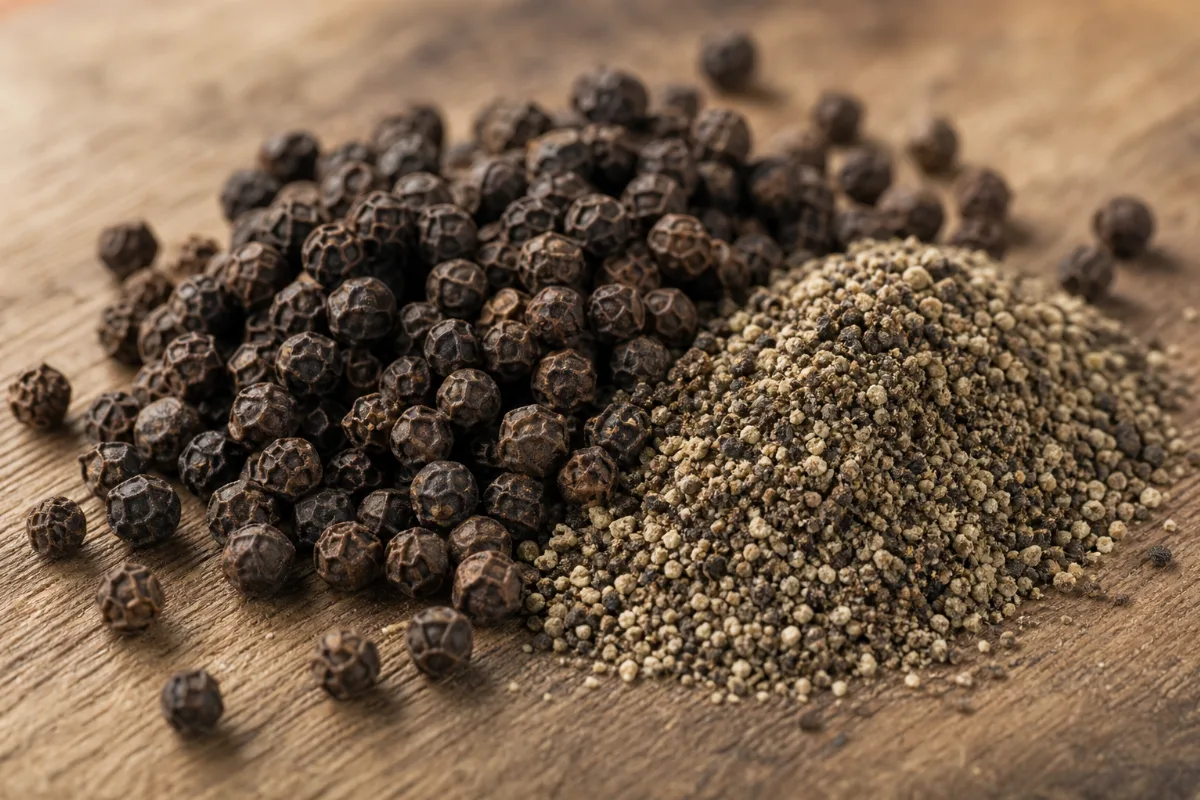
Black pepper is the dried fruit of Piper nigrum, a plant in the pepper family. The hot taste comes mainly from piperine. It is sold whole or ground.
USDA data for ground black pepper per 100 g: 251 kcal, 25.3 g fibre, 443 mg calcium, 9.71 mg iron, 1,330 mg potassium, 12.8 mg manganese and 164 micrograms vitamin K. A teaspoon of ground pepper weighs 2.3 g (USDA) and holds only about 6 kcal, 0.6 g fibre, 10 mg calcium, 0.2 mg iron, 31 mg potassium, 0.3 mg manganese and 4 micrograms vitamin K. A seasoning portion is small, so pepper is a flavour, not a meaningful source of these nutrients.
What the research shows
A 2019 review of black pepper research counted 60 test-tube studies, 21 animal studies and only one clinical trial. So pepper on food has not been shown to treat or prevent anything.
The human studies are mostly of piperine capsules taken with curcumin. Piperine raised curcumin blood levels in a small study, and pooled trials of the combination found lower total and LDL cholesterol and a small fall in fasting glucose. The certainty is low, because the effect of pepper cannot be separated from the effect of curcumin.
One trial of inhaled black pepper oil found a quicker swallowing reflex in older people after stroke. That was an aroma, not food.
Food versus capsules and oil
Nearly all the human trials used piperine capsules, often with curcumin. Results for a capsule or an oil do not carry over to pepper on food, and the interaction and pregnancy cautions are mainly about concentrated piperine.
Amounts
This page gives no amounts to eat or take. Ask a doctor, pharmacist or dietitian what is right for you, especially if you take medicines or are pregnant.
At a glance
Traditional uses history, not proof
- Used as a seasoning
- A review of traditional medicine reports found most were from India, for menstrual and ear, nose and throat problems, using the seeds and fruits as powder, pills or paste
- Long use as food or traditional medicine is not proof that it treats any condition
Studied for research
- Raising curcumin blood levels (isolated piperine), low certainty
- Cholesterol with curcumin plus piperine capsules, low certainty
- Blood sugar with curcumin plus piperine capsules, low certainty
- Eating pepper as a food, insufficient evidence
- Antioxidant and anticancer findings, lab and animal only, insufficient
- Swallowing reflex after stroke (smell of pepper oil), very low certainty
Main compounds
- Piperine
- Dietary fibre
- Manganese
- Vitamin K
Common forms
- Whole peppercorns and ground pepper as a seasoning
- White, green and red pepper (other forms of the same plant)
- Black pepper oil used as an aroma
- Piperine or pepper-extract capsules, often sold with curcumin (these are not the same as food)
Research links: US FDA: spices generally recognised as safe (21 CFR 182.10) · BfR scientists: safety of isolated piperine (2021 review) · 2019 systematic review of black pepper research · Research Library · Genes & Biomarkers Library
What it is and its history
- Accepted scientific name
- Piper nigrum
- Naming authority
- L. (GBIF accepted, usageKey 3086357)
- Common names
- Black pepper (English); Peppercorn (English); Pimienta negra (Spanish)
- Family or group
- Piperaceae (the pepper family), as given by GBIF.
- Classification
- Plantae > Tracheophyta > Magnoliopsida > Piperales > Piperaceae > Piper > Piper nigrum
- Native range
- Not verified from a source read.
- Habitat
- Not verified from a source read.
- What it looks like
- Roots: Not verified.; Stems: Not verified.; Leaves: Not verified.; Flowers: Not verified.; Fruit: The seasoning is the dried fruit and seed (the 2019 review says seeds and fruits are the plant parts most used). Detail on how it is picked and dried was not re-sourced.
- Cultivation
- Not verified from a source read.
- Harvest and processing
- Sold as whole peppercorns or ground; green, red and white forms exist (existing nutrient summary, not re-sourced). Salmonella-reduction treatments for black pepper are reviewed in p41475506.
- Look-alikes and adulterants
- Name: Other 'peppers' (chili peppers, pink peppercorn); Note: Chili peppers belong to a different plant group and pink peppercorns come from a different tree; our earlier notes say so, but this was not re-verified from a source. Evidence for black pepper does not carry over to them.; Name: Long pepper and other Piper species; Note: Other spices in the same genus have their own pages. The existing summary names long pepper as a related plant; findings for Piper nigrum should not be assumed to apply to them.
- Sustainability and conservation
- Not assessed.
Photographs
Traditional use and history history, not clinical proof
| Tradition or era | Documented use | Source |
|---|---|---|
| Traditional medicine reports | A 2019 systematic review of traditional uses found the most reports from India, mostly for menstrual and ear, nose and throat problems in people, using the seeds and fruits as powder, pills, tablets or paste. It calls black pepper the 'King of spices'. | Takooree et al. 2019 (abstract read), PMID 30740986 |
Traditional use shows how it was used. It does not show that it works or is safe today.
What is inside, and how it may work
What it contains and how those compounds act in cells and animals. Laboratory and animal mechanisms are not proven effects in people.
Main compounds
| Compound | Family | Where it is concentrated | Activity studied | Level of evidence |
|---|---|---|---|---|
| Piperine PubChem 638024 | alkaloid | Fruit and seed Not re-verified; the existing summary cites 3.9 to 9.2 percent of the peppercorn (a retail-sample study not re-opened). | The main bioactive compound named by the 2019 review. Slows how the body clears some substances, including curcumin; can change medicine absorption. 20 15 14 17 | Human data |
| Dietary fibre | macronutrient | Dried fruit USDA: 25.3 g per 100 g ground pepper (about 0.6 g per teaspoon) | Nutrient fact. A teaspoon is a small amount. 21 | Reference data |
| Manganese | mineral | Dried fruit USDA: 12.8 mg per 100 g ground pepper (about 0.3 mg per teaspoon) | Nutrient fact only; no trial of pepper for manganese status. 21 | Reference data |
| Vitamin K (phylloquinone) PubChem 5284607 | vitamin | Dried fruit USDA: 164 micrograms per 100 g ground pepper (about 3.8 micrograms per teaspoon) | Needed for blood clotting. The amount in a normal seasoning portion is small. 21 | Reference data |
Mechanisms, receptors and pathways
| Target or pathway | Gene or receptor | What was found | Level |
|---|---|---|---|
| Glucuronidation of curcumin | Not named in the abstract | The 1998 authors describe piperine as a known inhibitor of liver and gut-wall glucuronidation and report much higher curcumin blood levels with piperine in healthy people. A proposed explanation, not directly tested in that abstract. 14 | Human data |
| Drug-metabolising enzymes and drug transporters | Not named in the abstracts read | Reviews say piperine can inhibit or stimulate metabolic enzymes and transporters, depending on dose, timing and duration, changing how much of some medicines reaches the blood. 11 7 17 | Human, animal and in vitro (reviews) |
| Swallowing reflex pathway | Insular and orbitofrontal cortex (named in the abstract) | In one trial, smelling black pepper oil shortened the swallowing reflex delay in post-stroke patients and raised brain blood flow in these regions. Mechanism suggested by the authors. 4 | Human data |
Absorption, metabolism and elimination
- Absorption
- Isolated piperine given with curcumin raised curcumin in blood within an hour in healthy volunteers (p9619120). How much piperine itself is absorbed from pepper on food was not found.
- Distribution
- Not found.
- Metabolism
- Reviews say piperine acts on liver and gut enzymes that clear medicines.
- Elimination
- Not found.
- Bioavailability
- Not established for pepper compounds eaten as seasoning.
Isolated compounds versus whole extracts
Almost all human results here are for isolated piperine combined with curcumin in capsules, not for pepper on food. Findings on cholesterol, blood sugar and absorption cannot be assumed for cooking pepper, and the interaction and pregnancy warnings are mainly about concentrated piperine. Black pepper oil in the swallowing trial was inhaled, not eaten.
Nutritional composition
Nutrition from USDA FoodData Central (Spices, pepper, black, ground; FDC 170931; SR Legacy, last updated 4/1/2019; read 2026-10-26). Per 100 g: 251 kcal, 10.4 g protein, 3.26 g fat, 64.0 g carbohydrate, 25.3 g fibre, about 12.5 g water, 443 mg calcium, 9.71 mg iron, 171 mg magnesium, 1,330 mg potassium, 20 mg sodium, 12.8 mg manganese, 164 micrograms vitamin K, no vitamin C. USDA lists household portions of 2.3 g for one teaspoon of ground pepper, 2.9 g for one teaspoon of whole peppercorns and 6.9 g for one tablespoon of ground pepper. One teaspoon of ground pepper (2.3 g) therefore holds about 6 kcal, 0.6 g fibre, 10 mg calcium, 0.2 mg iron, 4 mg magnesium, 31 mg potassium, 0.3 mg manganese and 4 micrograms vitamin K (our calculation from the per-100 g values). Real products vary, and the USDA values are from older analyses. A seasoning portion is small, so pepper is a flavour, not a meaningful source of these nutrients.
3 low certainty1 very low certainty2 not enough evidence
What was looked at
The 6 benefits and uses checked for Black pepper, each with how strong the evidence is. Tap one to open it.
- Raising curcumin blood levels (isolated piperine)Low certainty
- Cholesterol with curcumin plus piperine supplementsLow certainty
- Blood sugar with curcumin plus piperine supplementsLow certainty
- Eating black pepper as a food (any health effect)Not enough evidence
- Antioxidant, blood sugar, anti-inflammatory and anticancer findings (lab and animal only)Not enough evidence
- Swallowing reflex after stroke (smelling black pepper oil)Very low certainty
Lab markers tracked in the studies
Curcumin level in the bloodLDL and total cholesterolFasting blood glucose and HbA1cSwallowing reflex delay
What is Black pepper good for?
The main studied uses and how strong the human evidence is for each. Most results are for piperine capsules taken with curcumin, or for laboratory and animal studies, not for eating pepper.
Benefits, one by one
Each card is a research question, not a promise. Tap a goal to filter. Open a card to see the studies, doses and limits.
Raising curcumin blood levels (isolated piperine)
Low certaintyPiperine is the hot compound in black pepper. In a small 1998 study, healthy volunteers who took curcumin (the yellow compound in turmeric) with piperine had much higher curcumin in the blood than with curcumin alone. A higher blood level is a measurement, not a health benefit. This was isolated piperine in a capsule, not pepper on food.
1 studiesIsolated piperine given together with curcumin as a single dose. Not …
Studies, doses and limits
What the trials found
Planta Medica 1998 (Shoba et al.), a small study in rats and in healthy human volunteers. In people, serum curcumin after curcumin alone was undetectable or very low; with piperine added it was much higher from 15 minutes to 1 hour after the dose. The authors report a 2000% rise in bioavailability and no adverse effects at the doses used.
Results
Piperine raised blood curcumin in healthy volunteers in this small study.
Effect sizes as reported
Human bioavailability of curcumin up about 2000% with piperine (authors' figure, P<0.01 to P<0.001 at 0.25 to 1 hour). Rats: up 154%.
Why this rating
Low: one small, short study, number of people not given in the abstract, only blood levels were measured, and it has not been shown that higher levels give any health benefit. It also used isolated piperine, not pepper in food.
Form and dose studied
Isolated piperine given together with curcumin as a single dose. Not pepper as a food.
Who was studied
Healthy adult volunteers (number not stated in the abstract).
Limits
Blood levels only, no health outcome. Funding not stated in the abstract. Does not show what ordinary pepper in cooking does.
Why researchers looked
Curcumin is poorly absorbed, so researchers tested whether piperine could help.
Traditional use
Black pepper is a kitchen spice. Long use as a seasoning is not proof that it treats any condition.
Proposed mechanism Human pharmacokinetic
The authors describe piperine as a known inhibitor of glucuronidation in the liver and gut wall, which is one way the body clears curcumin quickly.
A proposed mechanism does not show that the effect happens in people.
Piperine can change how the body absorbs other substances, including medicines; see the Safety tab.
Cholesterol with curcumin plus piperine supplements
Low certaintyCapsules that combine curcumin and piperine lowered total and LDL cholesterol in pooled trials of people with metabolic syndrome. Another small pooling found larger LDL falls when turmeric was taken with piperine than without it. Pepper's own part cannot be separated from curcumin's, and nothing here tests pepper on food.
2 studiesCurcumin or turmeric capsules with piperine, in trials of weeks to mo…
Studies, doses and limits
What the trials found
A 2023 systematic review and meta-analysis of randomised trials in metabolic syndrome and related disorders (Phytotherapy Research) found curcumin plus piperine lowered total cholesterol and LDL cholesterol but not triglycerides. A 2025 review (Pharmaceutics) pooled three trials of about 250 people on turmeric, with or without piperine: LDL fell by 17.0 mg/dL overall and by 29.6 mg/dL with turmeric plus piperine versus 16.2 mg/dL with turmeric alone. That subgroup comparison is the authors' own; the abstract does not say it was tested for a true difference.
Results
Lower total and LDL cholesterol with the curcumin-plus-piperine combination. The two pooled reviews disagree on triglycerides (no change in 2023; lower in 2025).
Effect sizes as reported
2025 review, all turmeric trials: LDL-C -17.0 mg/dL (95% CI -25.2 to -8.8); total cholesterol -14.1 mg/dL (-22.9 to -5.3); triglycerides -25.5 mg/dL (-32.5 to -18.4); HDL-C +5.7 mg/dL (+2.0 to +9.4). The authors rated certainty moderate for triglycerides, total and LDL cholesterol, and low for HDL. 2023 review: effect sizes are not given in the abstract.
Why this rating
Low for any benefit from black pepper. The trials test a supplement combination, so pepper's own effect cannot be separated, the 2025 pooling is small (three trials) and the two reviews disagree on triglycerides. The 2025 reviewer's own GRADE was moderate for the pooled turmeric results, which are mostly about turmeric.
Form and dose studied
Curcumin or turmeric capsules with piperine, in trials of weeks to months (durations not given in the abstracts).
Who was studied
Adults with metabolic syndrome and related cardiometabolic conditions.
Limits
Combination product. Short trials and small samples (authors' words). One author of the 2023 review is affiliated with a supplement company (Sabinsa Corporation); the abstract gives no funding statement. The 2025 review states no conflicts of interest.
Why researchers looked
Curcumin supplements are often sold with piperine, so trials ask whether the pair changes blood fats.
Traditional use
Black pepper is a kitchen spice. Long use as a seasoning is not proof that it treats any condition.
Proposed mechanism Unknown
Not established. Piperine may simply raise curcumin levels (see the first result); the reviews do not show that piperine acts on cholesterol itself.
A proposed mechanism does not show that the effect happens in people.
Do not stop or change a cholesterol medicine on your own. Ask a clinician before adding supplements.
Blood sugar with curcumin plus piperine supplements
Low certaintyPooled trials of curcumin plus piperine capsules found a small drop in fasting blood glucose (about 6 mg/dL) but no clear change in HbA1c, fasting insulin or insulin resistance. A smaller review of people with prediabetes or type 2 diabetes found no statistically significant change.
2 studiesCurcumin plus piperine capsules in randomised trials (details not giv…
Studies, doses and limits
What the trials found
A 2025 meta-analysis of 15 randomised trials (1,020 adults; Journal of Diabetes and Metabolic Disorders) found curcumin plus piperine lowered fasting blood glucose by 5.89 mg/dL (95% CI -9.52 to -2.26) but not HbA1c (-0.34%, 95% CI -0.80 to 0.11), fasting insulin or HOMA-IR. The authors rated certainty low for fasting glucose, HbA1c and insulin, and moderate for HOMA-IR. A 2024 review of three trials in prediabetes and type 2 diabetes (Journal of the ASEAN Federation of Endocrine Societies) found numerical falls in fasting glucose (mean difference -7.61, 95% CI -15.26 to 0.03), HOMA-IR and BMI, none statistically significant, and called the number of studies small.
Results
A small fall in fasting glucose in one review, not confirmed for HbA1c, insulin or insulin resistance; the diabetes-only review found no significant change.
Effect sizes as reported
Fasting glucose -5.89 mg/dL (95% CI -9.52 to -2.26); HbA1c -0.34% (-0.80 to 0.11, not significant). Prediabetes and type 2 diabetes review: fasting plasma glucose MD -7.61 (-15.26 to 0.03, p=0.05).
Why this rating
Low (the 2025 reviewers' own GRADE for fasting glucose). The effect is small, other blood sugar measures did not change, the studies are of capsule combinations and pepper's own part cannot be separated.
Form and dose studied
Curcumin plus piperine capsules in randomised trials (details not given in the abstracts).
Who was studied
Adults, mostly with overweight or metabolic disorders (2025 review); people with prediabetes or type 2 diabetes (2024 review).
Limits
Combination product. The abstracts do not report funding for the trials pooled. Small effect sizes and few trials in the diabetes-only review.
Why researchers looked
Curcumin has been tested for blood sugar, and piperine is added to many curcumin products.
Traditional use
Black pepper is a kitchen spice. Long use as a seasoning is not proof that it treats any condition.
Proposed mechanism Unknown
Not established by the reviews read.
A proposed mechanism does not show that the effect happens in people.
People who take diabetes medicines should ask a clinician before adding supplements.
Eating black pepper as a food (any health effect)
Not enough evidenceWe did not find a trial of eating black pepper in cooking amounts for any health outcome. A 2019 review of the research counted 60 test-tube studies, 21 animal studies and only 1 clinical trial. So the honest answer is that ordinary pepper on food has not been shown to treat or prevent anything.
1 studiesWhole or ground peppercorns eaten as seasoning (food).
Studies, doses and limits
What the trials found
Takooree et al. 2019 (Critical Reviews in Food Science and Nutrition) reviewed traditional uses, chemistry and pharmacology of Piper nigrum. The abstract says most pharmacological studies were in vitro (n=60), with only 21 in vivo and 1 clinical trial. The authors call for more animal and pharmacokinetic work.
Results
Very little human research. No health benefit of pepper as a food is shown.
Why this rating
Insufficient: the evidence base is almost entirely laboratory and animal work, and the review (which searched Science Direct, Google Scholar and Google, per its abstract) did not rate certainty.
Form and dose studied
Whole or ground peppercorns eaten as seasoning (food).
Who was studied
No human population studied for food use in this review.
Limits
A literature compilation, not a pooled analysis of trials. Only the abstract was read. Not a medical claim.
Why researchers looked
Pepper is one of the most widely used spices, so people ask whether eating it does anything for health.
Traditional use
Black pepper is a kitchen spice. A review of traditional use found reports mostly from India, for menstrual and ear, nose and throat problems, using the seeds and fruits as powder, pills or paste. Traditional use is not proof.
Proposed mechanism Laboratory research
Not established for pepper on food. The review names piperine as the main active compound and describes mostly test-tube findings.
A proposed mechanism does not show that the effect happens in people.
Allergy to pepper is rare but reported; see the Safety tab.
Antioxidant, blood sugar, anti-inflammatory and anticancer findings (lab and animal only)
Not enough evidenceIn test tubes and animals, black pepper and piperine showed antioxidant, antimicrobial, blood-sugar, cholesterol-lowering, anti-inflammatory and anticancer-cell effects. These are lab and animal results. They do not show that eating pepper does the same in people.
1 studiesExtracts and isolated compounds in laboratory models, not food.
Studies, doses and limits
Results
Lab and animal results only; no human effect shown.
Effect sizes as reported
Not given in the abstract.
Why this rating
Insufficient for people: cell and animal results often do not carry over to humans.
Form and dose studied
Extracts and isolated compounds in laboratory models, not food.
Who was studied
Cell lines and animals.
Limits
Laboratory concentrations are not the same as what eating pepper delivers. Only the abstract was read.
Why researchers looked
Researchers look for what piperine and other pepper compounds do in cells and animals.
Traditional use
Black pepper is a kitchen spice. A review of traditional use found reports mostly from India, for menstrual and ear, nose and throat problems, using the seeds and fruits as powder, pills or paste. Traditional use is not proof.
Proposed mechanism Laboratory research
Reported lab mechanisms include scavenging of reactive oxygen species, blocking bacterial biofilm and efflux pumps, and cell death in cancer cell lines (breast, colon, cervical, prostate).
A proposed mechanism does not show that the effect happens in people.
Do not use pepper extracts or piperine as a treatment for any disease; ask a doctor.
Swallowing reflex after stroke (smelling black pepper oil)
Very low certaintyIn a one-month trial of 105 older people in Japanese nursing homes after stroke, breathing in the smell of black pepper oil for one minute made the swallowing reflex quicker than lavender oil or plain water. This was the aroma of an oil, not eating pepper, and it was one trial.
1 studiesVolatile black pepper oil inhaled through the nose for a minute (arom…
Studies, doses and limits
What the trials found
Ebihara et al. 2006 (Journal of the American Geriatrics Society), a one-month randomised controlled study in nursing homes in Japan, 105 post-stroke residents. One minute of nasal inhalation of black pepper oil shortened the latency of the swallowing reflex versus lavender oil and distilled water (P<.03). After one month, reflex latency improved with a rise in serum substance P (P<.01), and brain blood flow in some regions rose.
Results
A shorter swallowing-reflex delay with black pepper oil aroma in this one trial.
Effect sizes as reported
Latency of the swallowing reflex shortened vs lavender oil and water, P<.03 (size not given in the abstract).
Why this rating
Very low: a single trial, a surrogate measure (reflex timing, not pneumonia), the abstract does not describe blinding or funding, and the product was an inhaled oil, not food.
Form and dose studied
Volatile black pepper oil inhaled through the nose for a minute (aromatherapy), not eaten.
Who was studied
Older adults after stroke living in long-term care in Japan.
Limits
One trial; did not measure pneumonia or choking; applies to an oil aroma, not cooking with pepper.
Why researchers looked
Slow swallowing reflexes raise the risk of pneumonia in older people after stroke.
Traditional use
Black pepper is a kitchen spice. A review of traditional use found reports mostly from India, for menstrual and ear, nose and throat problems, using the seeds and fruits as powder, pills or paste. Traditional use is not proof.
Proposed mechanism Controlled trial
The authors suggest the smell activates brain areas (insular and orbitofrontal cortex) that help trigger the swallowing reflex; they measured serum substance P and brain blood flow.
A proposed mechanism does not show that the effect happens in people.
Swallowing problems need a doctor or speech therapist; pepper aroma is not a treatment.
Connections to the rest of health
How Black pepper connects to the rest of our health knowledge graph. Every link says what kind of connection it is. A safety link (for example to the liver) is a warning, not a benefit. A study that merely mentions a topic never creates a benefit link.
Explore every connection: goals, body systems, organs, symptoms, genes
B. Body systems
| Connected to | Kind of connection | Evidence status | Context | Studies |
|---|---|---|---|---|
| Digestive System | Biological association | Low certainty | Studied for: Raising curcumin blood levels (isolated piperine) Studied for: Eating black pepper as a food (any health effect) | 14 15 4 |
| Cardiovascular System | Biological association | Low certainty | Studied for: Cholesterol with curcumin plus piperine supplements | 8 5 |
| Endocrine System | Biological association | Low certainty | Studied for: Cholesterol with curcumin plus piperine supplements Studied for: Blood sugar with curcumin plus piperine supplements | 8 5 10 16 15 |
| Immune System | Biological association | Not enough evidence | Studied for: Antioxidant, blood sugar, anti-inflammatory and anticancer findings (lab and animal only) | 15 |
| Nervous System | Biological association | Very low certainty | Studied for: Swallowing reflex after stroke (smelling black pepper oil) | 4 |
E. Health conditions
| Connected to | Kind of connection | Evidence status | Context | Studies |
|---|---|---|---|---|
| Food allergy | Adverse effect or risk | Case reports | Rare allergy to pepper is reported in children and workers. Rare pepper allergy is reported in a child and in a worker exposed to dust. Preparation or compound: Black pepper as a food or dust |
6 12 2 |
I. Biomarkers
| Connected to | Kind of connection | Evidence status | Context | Studies |
|---|---|---|---|---|
| Curcumin level in the blood | Biological association | Low certainty | Measured in trials: raised. A lab change is not the same as a health benefit. | 14 |
| LDL and total cholesterol | Biological association | Low certainty | Measured in trials: lowered. A lab change is not the same as a health benefit. | 8 5 |
| Fasting blood glucose and HbA1c | Biological association | Low certainty | Measured in trials: mixed. A lab change is not the same as a health benefit. | 10 16 |
| Swallowing reflex delay | Biological association | Very low certainty | Measured in trials: lowered. A lab change is not the same as a health benefit. | 4 |
K. Biological pathways
| Connected to | Kind of connection | Evidence status | Context | Studies |
|---|---|---|---|---|
| Piperine | Preliminary mechanism | Human | The main active compound; affects medicine and curcumin absorption. | 14 17 |
| Curcumin | Preliminary mechanism | Human | Piperine raised curcumin blood levels; many curcumin capsules contain both. | 14 8 |
| Drug metabolism and transport | Preliminary mechanism | Review | Piperine can change enzymes and transporters that handle medicines. | 11 7 |
L. Active compounds
| Connected to | Kind of connection | Evidence status | Context | Studies |
|---|---|---|---|---|
| Piperine | Biological association | Human | The main bioactive compound named by the 2019 review. Slows how the body clears some substances, including curcumin; can change medicine absorption. Preparation or compound: Fruit and seed |
20 15 14 17 |
| Dietary fibre | Biological association | Reference data | Nutrient fact. A teaspoon is a small amount. Preparation or compound: Dried fruit |
21 |
| Manganese | Biological association | Reference data | Nutrient fact only; no trial of pepper for manganese status. Preparation or compound: Dried fruit |
21 |
| Vitamin K (phylloquinone) | Biological association | Reference data | Needed for blood clotting. The amount in a normal seasoning portion is small. Preparation or compound: Dried fruit |
21 |
Each connection is stored with the ingredient, the connected record, the kind of connection, the evidence status, the supporting studies, the preparation or compound involved, and a review date (last reviewed October 26, 2026).
Evidence at a glance: what changed in 4 lab markers
Tap a number to show only those markers. Counts are markers, not people.
The evidence
The research centre for Black pepper. Every record here was checked against PubMed or the publisher's page; we never list a study we have not verified.
Evidence by outcome
Bars show how many studies we found for each outcome, not how well it works. People are added up across trials only (reviews are not added, to avoid double counting).
How we rate evidence
High certainty
Several well-run trials or reviews agree; further research is unlikely to change the picture much.
Moderate certainty
Good trials point the same way, but some doubt remains.
Low certainty
Small, short or inconsistent trials. The finding could change with better research.
Very low certainty
Very little or very weak human data. Treat as a possibility only.
Mixed findings
Trials or reviews disagree with each other.
Not enough evidence
Not enough human research to say either way.
Evidence against
Good research found no benefit, or found harm.
We take the reviewers' own risk-of-bias and GRADE statements where they exist, and otherwise judge from study size, design, consistency, directness and whether a product matches what is sold. Many publications do not make evidence high. Method note: We started from our existing black pepper summary, re-checked nutrition at USDA FoodData Central and identity in GBIF and PubChem, read the US FDA spice list and searched PubMed for reviews, trials and case reports. Only abstracts were read for studies. Items we could not verify are flagged in the research gaps.
Study library: every study we checked 21
| Study | Design | People | Product, dose, length | Result |
|---|---|---|---|---|
| Angelon-Gaetz 2023 Lead Levels in Spices From Market Basket and Home Lead Investigation Samples in North Carolina. Public Health Rep · PMID 35060792 · DOI |
Survey n/a |
Methods, limits and fundingRead: abstract | ||
| Berghea 2025 Spices, herbs and allergic reactions in children: myth or reality - a narrative review with scoping elements. Front Allergy · PMID 41306764 · DOI |
Narrative review |
Methods, limits and fundingRead: abstract | ||
| Csuti 2026 Physico-Chemical Treatments and Key Determinants of Salmonella Survival in Black Pepper: A Systematic Review, Meta-Analysis, and Predictive Model Evaluation. J Food Prot · PMID 41475506 · DOI |
Systematic review meta analysis n/a (food microbiology) |
Methods, limits and fundingRead: abstract | ||
| Ebihara 2006 A randomized trial of olfactory stimulation using black pepper oil in older people with swallowing dysfunction. J Am Geriatr Soc · PMID 16970649 · DOI |
Randomised controlled trial |
105 105 post-stroke residents of Japanese nursing homes |
Volatile black pepper oil, inhaled Essential oil One minute of nasal inhalation; one-month intervention 1 month · vs Lavender oil and distilled water |
Inhaling black pepper oil for one minute shortened swallowing reflex latency compared with lavender oil and water (P<.03). After one month latency improved with higher serum substance P (P<.01); swallowing movements and some regional brain blood flow also rose. Shorter swallowing reflex latency (Not given in the abstract) Methods, limits and fundingOutcomes: Latency of the swallowing reflex, swallowing movements, serum substance P, regional cerebral blood flow Limitations: One trial, surrogate outcomes, aroma of an oil rather than food. Blinding and funding not described in the abstract. Funding and conflicts: Not stated in the abstract (the record lists non-US government research support). Read: abstract |
| Epelde 2025 Effects of Turmeric and Turmeric Plus Piperine Supplementation on Lipid Profiles in Adults with Cardiometabolic Risk Conditions: A Systematic Review and Meta-Analysis of Randomized Controlled Trials Following PRISMA Guidelines. Pharmaceutics · PMID 41471123 · DOI |
Systematic review meta analysis |
250 Adults with cardiometabolic risk conditions; three randomised trials pooled (about 250 people), three more described in words |
Turmeric with or without piperine supplements Supplements Not given in the abstract Short trials (the author's word) · vs Control |
Pooled falls in triglycerides, total cholesterol and LDL-C and a rise in HDL-C. A subgroup analysis suggested a larger LDL-C fall with turmeric plus piperine than with turmeric alone. The author rated certainty moderate for triglycerides, total cholesterol and LDL-C and low for HDL-C, and called for larger, longer trials. LDL-C -17.0 mg/dL overall; -29.6 (turmeric plus piperine) vs -16.2 (turmeric alone) (LDL-C -17.0 mg/dL (95% CI -25.2 to -8.8); total cholesterol -14.1 (-22.9 to -5.3); triglycerides -25.5 (-32.5 to -18.4); HDL-C +5.7 (+2.0 to +9.4)) Methods, limits and fundingOutcomes: Triglycerides, total cholesterol, LDL-C, HDL-C Limitations: Only three trials in the pooled analysis, small samples and short duration, mostly turmeric. Subgroup comparison. Funding and conflicts: The author declares no conflicts of interest; the funders had no role (abstract). Read: abstract |
| Gimenez 2011 Severe pepper allergy in a young child. WMJ · PMID 21748999 |
Case report |
Methods, limits and fundingRead: abstract | ||
| Han 2011 The effects of black pepper on the intestinal absorption and hepatic metabolism of drugs. Expert Opin Drug Metab Toxicol · PMID 21434835 · DOI |
Review human, animal and in-vitro |
Methods, limits and fundingRead: abstract | ||
| Hosseini 2023 A systematic review and meta-analysis of randomized controlled trials investigating the effect of the curcumin and piperine combination on lipid profile in patients with metabolic syndrome and related disorders. Phytother Res · PMID 36649934 · DOI |
Systematic review meta analysis |
Adults with metabolic syndrome and related disorders in randomised trials (number not given in the abstract) | Curcumin plus piperine supplements Isolated compounds Varied; the authors say results did not depend on the dose of either compound Varied · vs Placebo or control |
Curcumin plus piperine significantly lowered total cholesterol and LDL-C. There was no significant change in triglycerides. The authors call for longer trials. Significant fall in total and LDL cholesterol (sizes not in the abstract) (Not given in the abstract) Methods, limits and fundingOutcomes: Total cholesterol, LDL-C, HDL-C, triglycerides Limitations: Combination product. Number of trials and people not in the abstract. Funding and conflicts: No statement in the abstract. One author is affiliated with Sabinsa Corporation, a company. Read: abstract |
| Kabak 2017 Mycotoxins in spices and herbs-An update. Crit Rev Food Sci Nutr · PMID 26528824 · DOI |
Narrative review n/a |
Methods, limits and fundingRead: abstract | ||
| Karimi 2025 Effect of curcumin plus piperine co-supplementation on glycemic control in adults: A meta-analysis of randomized controlled trials. J Diabetes Metab Disord · PMID 41393198 · DOI |
Systematic review meta analysis |
1020 Adults in 15 randomised trials (1,020 people; 514 intervention, 506 control) |
Curcumin plus piperine supplements Isolated compounds Not given in the abstract Varied · vs Control |
Fasting glucose fell significantly; HbA1c, fasting insulin and HOMA-IR did not change significantly. Certainty low for glucose, HbA1c and insulin, moderate for HOMA-IR (authors' GRADE). Authors call the clinical relevance limited. Fasting glucose WMD -5.89 mg/dL; HbA1c WMD -0.34% (Glucose -9.52 to -2.26; HbA1c -0.80 to 0.11) Methods, limits and fundingOutcomes: Fasting blood glucose, HbA1c, fasting insulin, HOMA-IR Limitations: Low-quality evidence, small effects, combination product. Funding and conflicts: The authors declare no competing interests (abstract). Read: abstract |
| Lee 2018 Piperine-mediated drug interactions and formulation strategy for piperine: recent advances and future perspectives. Expert Opin Drug Metab Toxicol · PMID 29250980 · DOI |
Review human, animal and in-vitro |
Methods, limits and fundingRead: abstract | ||
| Peric 2023 Occupational rhinitis caused by hypersensitivity to black pepper. Occup Med (Lond) · PMID 36255261 · DOI |
Case report |
Methods, limits and fundingRead: abstract | ||
| Rentz 2026 Rapid Detection of Black Pepper Adulteration with Endogenous and Exogenous Materials: Assessment of Benchtop and Handheld Infrared Spectrometers. Foods · PMID 41750946 · DOI |
Laboratory method n/a |
Methods, limits and fundingRead: abstract | ||
| Shoba 1998 Influence of piperine on the pharmacokinetics of curcumin in animals and human volunteers. Planta Med · PMID 9619120 · DOI |
Clinical trial rat and human |
Rats and healthy human volunteers (human number not stated in the abstract) | Curcumin with and without isolated piperine Isolated compounds Single dose (amounts not repeated here) Hours (blood sampled after one dose) · vs Curcumin alone |
In people, serum curcumin was undetectable or very low with curcumin alone and much higher from 0.25 to 1 hour when piperine was added. The authors report bioavailability up 154% in rats and 2000% in humans, with no adverse effects at the doses used. Human bioavailability up about 2000% (authors' figure) (P<0.02 to P<0.001 for the timed differences) Methods, limits and fundingOutcomes: Serum curcumin concentration and bioavailability Limitations: Small, short, blood levels only, human sample size not in the abstract. Funding and conflicts: Not stated in the abstract. Read: abstract |
| Takooree 2019 A systematic review on black pepper (Piper nigrum L.): from folk uses to pharmacological applications. Crit Rev Food Sci Nutr · PMID 30740986 · DOI |
Systematic review in-vitro, animal and human |
Not applicable (compilation of traditional-use reports and pharmacology studies) | Piper nigrum seeds and fruits, piperine and other compounds Fruit and seed |
Most pharmacological studies were in vitro (60), 21 in vivo and only 1 clinical trial. India had the most traditional-use reports, mostly for menstrual and ear, nose and throat problems in people. Piperine is the main bioactive compound. The authors call for more animal and pharmacokinetic work. Not applicable (Not applicable) Methods, limits and fundingOutcomes: Traditional uses, chemistry, antimicrobial, antioxidant, antidiabetic, lipid, anticancer, anti-inflammatory, analgesic and other effects Limitations: Compilation based on database and Google searches restricted to English; certainty not graded; abstract only. Funding and conflicts: Not stated in the abstract. Read: abstract |
| Widjanarko 2024 Effects of Combination of Curcumin and Piperine Supplementation on Glycemic Profile in Patients with Prediabetes and Type 2 Diabetes Mellitus: A Systematic Review and Meta-analysis. J ASEAN Fed Endocr Soc · PMID 38863920 · DOI |
Systematic review meta analysis |
People with prediabetes or type 2 diabetes in three randomised trials | Curcumin plus piperine supplements Isolated compounds Not given in the abstract Varied · vs Placebo |
Two of the three trials found no significant difference; one found a significant BMI difference. Pooled results showed numerical falls in fasting glucose, HOMA-IR and BMI that were not statistically significant. The authors note very few studies. Fasting plasma glucose MD -7.61 (-15.26 to 0.03 (p=0.05)) Methods, limits and fundingOutcomes: Fasting plasma glucose, HOMA-IR, BMI Limitations: Only three trials; combination product. Funding and conflicts: Not stated in the abstract. Read: abstract |
| Ziegenhagen 2021 Safety Aspects of the Use of Isolated Piperine Ingested as a Bolus. Foods · PMID 34574230 · DOI |
Review human and animal |
Methods, limits and fundingRead: abstract | ||
| s-fda-21cfr182-10 US FDA, 21 CFR 182.10: Spices and other natural seasonings and flavorings (GRAS list) · Source |
Regulation n/a |
Methods, limits and fundingRead: full-text | ||
| s-gbif-piper-nigrum GBIF Backbone: Piper nigrum L. (usageKey 3086357) · Source |
Reference database n/a |
Methods, limits and fundingRead: full-text | ||
| s-pubchem-piperine PubChem: Piperine (CID 638024) · Source |
Reference database n/a |
Methods, limits and fundingRead: full-text | ||
| s-usda-fdc-170931 USDA FoodData Central: Spices, pepper, black (FDC 170931) · Source |
Reference database n/a |
Methods, limits and fundingRead: full-text |
What we do not know yet
- No trial of eating black pepper in cooking amounts was found for any health outcome.
- All cholesterol and blood sugar results come from curcumin plus piperine capsules, so pepper's own effect is unknown.
- The abstracts did not name which medicines interact with piperine or say whether seasoning amounts matter.
- No official statement on pepper as a seasoning in pregnancy or breastfeeding was found, and choking risk for small children, LiverTox, lead and mould toxins in pepper specifically were not researched.
- Kitchen facts such as flavour, forms, storage and where pepper is grown were not re-checked against a source and are left out.
How new research is added
New studies are found by a saved PubMed search and placed in a review queue before the page changes.
Lab markers
What changed in blood or saliva tests during trials. A changed number is not the same as feeling or being healthier, and we give no "normal ranges".
Other 4
Curcumin level in the blood
Raised in trials
How much curcumin (from turmeric) can be measured in blood after a dose.
Low certaintyResults and what it means
Why it was measured
Curcumin is absorbed poorly, so researchers measure blood levels to see if piperine helps.
Statistical vs. clinical meaning
A change in a lab measurement, not a health outcome.
Safety implication
The same effect on absorption may change levels of some medicines; see the Safety tab.
| Study | Result | People | Product |
|---|---|---|---|
| 14 | Serum curcumin undetectable or very low after curcumin alone; much higher from 0.25 to 1 hour when piperine was added (bioavailability up about 2000% by the authors' figure) | Healthy human volunteers (number not stated in the abstract) | Isolated piperine given with curcumin (not pepper as food) |
LDL and total cholesterol
Lowered in trials
Blood fats measured in a standard cholesterol test. LDL is often called 'bad' cholesterol.
Low certaintyResults and what it means
Why it was measured
High LDL is a known risk factor for heart disease.
Statistical vs. clinical meaning
Cholesterol is a risk marker, not a heart-disease outcome. Neither review tested pepper on food.
Safety implication
None specific beyond the medicine-absorption caution.
| Study | Result | People | Product |
|---|---|---|---|
| 8 | Curcumin plus piperine significantly lowered total cholesterol and LDL-C in metabolic syndrome (effect sizes not given in the abstract); triglycerides did not change significantly | Adults with metabolic syndrome and related disorders | Curcumin plus piperine supplements (not pepper as food) |
| 5 | LDL-C -17.0 mg/dL (95% CI -25.2 to -8.8) overall; -29.6 mg/dL with turmeric plus piperine versus -16.2 mg/dL with turmeric alone; total cholesterol -14.1 mg/dL (-22.9 to -5.3) | Adults with cardiometabolic risk conditions (3 trials pooled, about 250 people) | Turmeric with or without piperine supplements |
Fasting blood glucose and HbA1c
Mixed results in trials
Blood sugar after an overnight fast, and HbA1c, the average blood sugar over about three months.
Low certaintyResults and what it means
Why it was measured
Standard markers of blood sugar control.
Statistical vs. clinical meaning
A small fall in fasting glucose in one review and no clear change in the others.
Safety implication
None specific.
| Study | Result | People | Product |
|---|---|---|---|
| 10 | Fasting glucose -5.89 mg/dL (95% CI -9.52 to -2.26); HbA1c -0.34% (-0.80 to 0.11, not significant); fasting insulin and HOMA-IR not significant | Adults in 15 randomised trials (1,020 people) | Curcumin plus piperine supplements (not pepper as food) |
| 16 | Fasting plasma glucose MD -7.61 (95% CI -15.26 to 0.03, p=0.05), not statistically significant | People with prediabetes or type 2 diabetes (3 trials) | Curcumin plus piperine supplements |
Swallowing reflex delay
Lowered in trials
The time between a trigger and the start of the swallowing reflex, measured in a test.
Very low certaintyResults and what it means
Why it was measured
A slow swallowing reflex is linked to a higher risk of pneumonia after stroke.
Statistical vs. clinical meaning
A timing measurement in one trial; no pneumonia outcome reported in the abstract.
Safety implication
None reported in the abstract.
| Study | Result | People | Product |
|---|---|---|---|
| 4 | Shorter reflex latency after one minute of black pepper oil aroma than with lavender oil or water (P<.03); further improvement after one month with higher serum substance P (P<.01) | 105 post-stroke nursing-home residents in Japan | Inhaled black pepper oil (not food) |
Safety
What studies and official sources say about side effects, medicines and who should check first. Each point shows what kind of evidence it comes from.
Main points to know 5
- Pepper on food is not the same as concentrated piperine or pepper extract. Piperine is the hot compound in black pepper. A 2021 review by scientists at the German Federal Institute for Risk Assessment (BfR) separates pepper used as a seasoning from isolated piperine taken as a capsule dose. In human and animal studies of isolated piperine, interactions with several medicines were seen, in most cases raising how much of the medicine reached the blood. The reviewers say such interactions may carry the risk of unintended or increased drug effects. Whether ordinary cooking amounts of pepper matter was not shown in the abstracts we read. Review human and animal 17 11 7
- Pregnancy and breastfeeding: avoid concentrated piperine; no statement found for cooking amounts. In animal studies using higher daily doses of isolated piperine than in the human interaction studies, the BfR review found signs of disturbed sperm production and of effects on the mother's reproduction and on the embryo. These are animal findings about isolated piperine, and the reviewers say the human studies were not designed to look for them. We found no official statement about pepper as a seasoning in pregnancy or breastfeeding. If you are pregnant, breastfeeding or trying to conceive, ask a doctor or pharmacist before using piperine or pepper-extract supplements. Animal research 17
- Allergy to black pepper is rare but real. Case reports describe a 17-month-old with hives, red eyes, facial swelling and cough after a marinade that contained black and cayenne pepper, and a worker with allergic nose and sinus problems and nasal polyps after 10 years of breathing pepper dust. A 2025 review of spice allergy in children lists pepper among the more often involved spices. The reports are single cases and no frequency was found. Case report 6 12 2
- Food safety: pepper can carry Salmonella. A 2026 systematic review says black pepper can easily be contaminated with Salmonella during production or processing, that earlier outbreaks have been linked to spices, and that treatment of the spice is essential. Buy from reputable sellers; the review is about how well treatments work, not about how often home pepper is contaminated. Review 3
- Quality: ground pepper is a target for fraud. A 2026 laboratory study states that black pepper is a target for economically motivated adulteration, with a wide range of bulking materials used. It tested instruments for detecting this. It does not say how common adulterated pepper is in shops. Laboratory method 13
Side effects 4
| Effect | How often | Severity and recovery | Evidence |
|---|---|---|---|
| Hives, conjunctivitis, facial swelling and severe cough after a spice marinade containing black and cayenne pepper One 17-month-old boy with mild eczema. A second, milder reaction followed the same marinade; venison without the marinade caused no reaction. Skin tests to black and cayenne pepper extracts were positive, but blood IgE to black pepper was undetectable, so the cause is not certain. The authors call pepper allergy in children rare and note a lack of studies on its rate. | Not established | severe in one toddler Not stated in the abstract | Case report 6 |
| Allergic rhinitis, chronic sinus inflammation and nasal polyps from workplace pepper dust One 52-year-old woman exposed to black pepper dust for 10 years. This is an occupational exposure, not a seasoning amount. | Not established | needed surgery for the polyps in one worker Specific antibodies were no longer detectable one year after the worker changed jobs | Case report 12 |
| Spice and herb allergy in children, from mild mouth symptoms to anaphylaxis Pepper is named among the more often implicated spices alongside mustard, celery, coriander, fennel, cumin and others. The abstract gives no rate for pepper itself. | Not established | varies Not stated | Narrative review 2 |
| Higher exposure to some medicines taken with isolated piperine The BfR review reports that human studies rarely recorded adverse effects but were not designed to look beyond drug interactions. It concerns isolated piperine, not pepper on food. | Not established | not stated Not stated | Review human and animal 17 |
Liver
No liver injury from eating pepper was found in the sources we read. A liver-safety source such as LiverTox was not searched for pepper or piperine, so this is not a statement that it is safe for the liver.
How often. No frequency was found.
Monitoring. No agency monitoring advice was found.
This is a safety connection. It is not evidence that Black pepper supports liver health.
Medicines and supplements 3
| With | Why it matters | Importance | Evidence | What to do |
|---|---|---|---|---|
| Prescription medicines (when piperine or pepper extract is taken as a supplement) prescription | Piperine can change enzymes and transporters that handle medicines in the liver and gut wall, so more or less of a medicine can reach the blood (reviews). | The BfR review reports interactions with several drugs, in most cases increasing bioavailability, and says this may increase drug effects. The abstracts read do not name the drugs or say how large the effect is for a given medicine. | Review human and animal Moderate certainty 17 11 7 | Ask a pharmacist or doctor before taking piperine or pepper-extract supplements with any prescription medicine. Do not change a medicine on your own. |
| Prescription medicines (pepper as ordinary seasoning) prescription | The 2011 review covers black pepper and piperine together as a possible bioavailability enhancer. | Its abstract says the clinical meaning of food-drug interactions with black pepper needs careful assessment and gives no verdict for cooking amounts. No interaction from seasoning amounts was shown in the sources read. | Review Not enough evidence 7 11 | A pharmacist can check your own medicines. This is not a reason to avoid seasoning food with pepper. |
| Curcumin or turmeric supplements supplement | Piperine slowed the clearance of curcumin; in a small study, curcumin blood levels were far higher with piperine (the authors describe piperine as an inhibitor of glucuronidation). | A laboratory measurement in a small study; the health meaning is not established. | Human pharmacokinetic Low certainty 14 | Many curcumin capsules already contain piperine. Check the label and ask a pharmacist if you take medicines. |
Who should check first 5
| Situation | Advice | Evidence |
|---|---|---|
| Taking prescription medicines and considering piperine or pepper-extract supplements | Ask a pharmacist or doctor first, because piperine can change how much of some medicines reaches the blood. Do not stop or change medicine on your own. | Review human and animal 17 7 |
| Pregnant, breastfeeding or trying to conceive and considering piperine supplements | Ask a doctor or pharmacist before using. Animal studies of high isolated piperine doses suggested effects on sperm production, the mother's reproduction and the embryo. No official statement on pepper as a seasoning was found. | Animal research 17 |
| Known allergy to pepper or other spices | Avoid pepper and read labels, because 'spices' on a label can include it. Ask an allergy specialist about testing and about related spices. | Case report 6 2 |
| Nose or sinus symptoms from handling or breathing pepper dust at work | Tell your doctor about the exposure; one worker developed nasal polyps and the antibodies faded after a change of workplace. | Case report 12 |
| Children | Allergy to spices is reported in children, including a severe reaction in a toddler. For choking risk in small children, ask a paediatrician; this was not researched here. | Narrative review 2 6 |
Overdose, product quality and regulators
Summary. No toxicity from pepper as a seasoning was found in the sources read. The concerns concern isolated piperine in concentrated form.
Animal. The BfR review says animal studies with higher daily piperine bolus doses than in the human interaction studies gave indications of disturbed spermatogenesis and of maternal reproductive and embryotoxic effects.
Human doses studied. Human studies of isolated piperine were single or short-term bolus studies; the reviewers say they rarely reported adverse effects but did not focus on safety beyond drug interactions.
High dose or long term signals. Long-term human safety of isolated piperine was not found in the abstracts read.
Overdose response. Not found.
Genotoxicity. Not researched.
Pepper is a dried agricultural product. Reviews raise Salmonella and adulteration; mould toxins and lead were checked only for spices in general.
Salmonella. A 2026 systematic review and meta-analysis says black pepper can easily be contaminated with Salmonella, that earlier spice outbreaks show treatment is essential, and it groups killing treatments into eight categories. It does not give how often retail pepper is contaminated. 3
Adulteration. The 2026 spectroscopy study says a wide range of organic and inorganic bulking materials has been used to stretch black pepper. Infrared methods detected added material in the lab. The abstract does not say how common this is in shops. 13
Mould toxins (mycotoxins) in spices. A 2017 review of mycotoxins in spices and herbs says spices grown in tropical and subtropical regions can be exposed to toxin-producing fungi and lists black pepper among the most popular spices. The abstract gives no result for pepper alone. 9
Lead in spices. A North Carolina health department study of 423 spice and consumable samples found a median of 0.07 mg/kg (maximum 0.88) in store-bought market-basket samples but a very high value (6504 mg/kg) in turmeric bought in India; products bought in India had more than triple the median lead of those bought in the United States. The abstract does not name black pepper. 1
| Body | Action | Date |
|---|---|---|
| US FDA (21 CFR 182.10) (United States) | Lists pepper, black and pepper, white (Piper nigrum L.) among spices and natural seasonings generally recognised as safe for their intended use. source | 2026-10-01 (eCFR text as of this date; section last amended 1996) |
| German Federal Institute for Risk Assessment (BfR) scientists (Germany) | 2021 published review (Foods) on isolated piperine ingested as a bolus: interactions with several medicines and animal reproductive and embryotoxic signals; advises considering the health risks of isolated piperine supplements. source | 2021 |
When to get medical help
- Trouble breathing, swelling of the lips, face or throat, widespread hives or fainting after eating pepper or a spice mix
- Vomiting, diarrhoea, stomach pain or fever after eating food that may have been contaminated
- Any unexpected symptom, or a strong change in how a prescription medicine seems to work, after starting a piperine or pepper-extract supplement
Stop using the product and contact a clinician or emergency service. In the US, Poison Control is 1-800-222-1222.
General information only, not medical advice. Ask a clinician or pharmacist before use, especially with medicines, in pregnancy or with a health condition. See the Natural Remedy Safety guide.
Frequently asked questions
What is black pepper good for?
It is a seasoning. No trial shows that eating pepper in cooking treats or prevents any condition. Most human studies are of piperine capsules taken with curcumin.
Is black pepper safe with medicines?
Does piperine make curcumin work better?
In a small 1998 study, healthy volunteers had much higher curcumin in the blood with piperine. That is a blood level, and a health benefit has not been shown from it alone.
Does black pepper lower cholesterol?
Does black pepper help with blood sugar or diabetes?
Is black pepper safe in pregnancy or breastfeeding?
We found no official statement on pepper as a seasoning. Animal studies of high doses of isolated piperine raised concerns about sperm production, the mother's reproduction and the embryo, so ask a doctor before using piperine supplements.
Can you be allergic to black pepper?
Can black pepper carry Salmonella?
Yes. A 2026 systematic review says black pepper can easily be contaminated with Salmonella during production or processing and that treatment is essential. It does not say how often shop pepper is contaminated.
Is ground pepper ever fake or mixed with other things?
Black pepper is a target for fraud, and a 2026 study says a wide range of bulking materials has been used. Whole peppercorns make this harder to hide. The study does not say how common it is.
Is black pepper oil the same as pepper in food?
No. The one trial found used the smell of black pepper oil, inhaled for a minute, and measured the swallowing reflex in older people after stroke. It does not tell us about eating pepper.
Is black pepper a good source of nutrients?
Per 100 g, ground pepper has a lot of fibre, manganese and iron (USDA), but a teaspoon weighs only 2.3 g, so it adds very little: about 6 kcal and 0.3 mg manganese.
Do supplements with piperine work the same way as food?
No. The supplement studies used isolated piperine or pepper extract, which the BfR reviewers distinguish from pepper used as a seasoning. Their safety cautions apply to the concentrated form.
Explore by health goal
Editorial transparency
- Written by
- AlternativeMed editorial team. Research compiled with AI assistance, then checked against the sources listed.
- Medical review
- None. This page has not been reviewed by a physician or pharmacist.
- First published
- 2026-10-26
- Last substantive update
- 2026-10-26
- How we research
- We started from our existing black pepper summary, re-checked nutrition at USDA FoodData Central and identity in GBIF and PubChem, read the US FDA spice list and searched PubMed for reviews, trials and case reports. Only abstracts were read for studies. Items we could not verify are flagged in the research gaps.
- How we rate evidence
- See "How we rate evidence" in the Evidence tab.
- Independence
- No product is promoted on this page. No affiliate links are shown.
Sources 21
Each source was opened and checked. Where we read only the abstract, it says so. The small numbers in the text point here.
- Angelon-Gaetz KA, Segule MN, Wilson M, et al.. Lead Levels in Spices From Market Basket and Home Lead Investigation Samples in North Carolina.. Public Health Rep. 2023. PMID 35060792. DOI 10.1177/00333549211066152. (abstract)
- Berghea EC, Feketea G, Cosoreanu MT, et al.. Spices, herbs and allergic reactions in children: myth or reality - a narrative review with scoping elements.. Front Allergy. 2025. PMID 41306764. DOI 10.3389/falgy.2025.1698559. (abstract)
- Csuti A, Xu X, Mishra A. Physico-Chemical Treatments and Key Determinants of Salmonella Survival in Black Pepper: A Systematic Review, Meta-Analysis, and Predictive Model Evaluation.. J Food Prot. 2026. PMID 41475506. DOI 10.1016/j.jfp.2025.100691. (abstract)
- Ebihara T, Ebihara S, Maruyama M, et al.. A randomized trial of olfactory stimulation using black pepper oil in older people with swallowing dysfunction.. J Am Geriatr Soc. 2006. PMID 16970649. DOI 10.1111/j.1532-5415.2006.00840.x. (abstract)
- Epelde F. Effects of Turmeric and Turmeric Plus Piperine Supplementation on Lipid Profiles in Adults with Cardiometabolic Risk Conditions: A Systematic Review and Meta-Analysis of Randomized Controlled Trials Following PRISMA Guidelines.. Pharmaceutics. 2025. PMID 41471123. DOI 10.3390/pharmaceutics17121609. (abstract)
- Gimenez L, Zacharisen M. Severe pepper allergy in a young child.. WMJ. 2011. PMID 21748999. (abstract)
- Han HK. The effects of black pepper on the intestinal absorption and hepatic metabolism of drugs.. Expert Opin Drug Metab Toxicol. 2011. PMID 21434835. DOI 10.1517/17425255.2011.570332. (abstract)
- Hosseini H, Ghavidel F, Panahi G, Majeed M, et al.. A systematic review and meta-analysis of randomized controlled trials investigating the effect of the curcumin and piperine combination on lipid profile in patients with metabolic syndrome and related disorders.. Phytother Res. 2023. PMID 36649934. DOI 10.1002/ptr.7730. (abstract)
- Kabak B, Dobson AD. Mycotoxins in spices and herbs-An update.. Crit Rev Food Sci Nutr. 2017. PMID 26528824. DOI 10.1080/10408398.2013.772891. (abstract)
- Karimi M, Moshrefi S, Bahman AD, et al.. Effect of curcumin plus piperine co-supplementation on glycemic control in adults: A meta-analysis of randomized controlled trials.. J Diabetes Metab Disord. 2025. PMID 41393198. DOI 10.1007/s40200-025-01799-y. (abstract)
- Lee SH, Kim HY, Back SY, et al.. Piperine-mediated drug interactions and formulation strategy for piperine: recent advances and future perspectives.. Expert Opin Drug Metab Toxicol. 2018. PMID 29250980. DOI 10.1080/17425255.2018.1418854. (abstract)
- Peric A, Sotirovic J, Jovancevic L, et al.. Occupational rhinitis caused by hypersensitivity to black pepper.. Occup Med (Lond). 2023. PMID 36255261. DOI 10.1093/occmed/kqac106. (abstract)
- Rentz P, Mihailova A, Heinzen H, et al.. Rapid Detection of Black Pepper Adulteration with Endogenous and Exogenous Materials: Assessment of Benchtop and Handheld Infrared Spectrometers.. Foods. 2026. PMID 41750946. DOI 10.3390/foods15040754. (abstract)
- Shoba G, Joy D, Joseph T, Majeed M, et al.. Influence of piperine on the pharmacokinetics of curcumin in animals and human volunteers.. Planta Med. 1998. PMID 9619120. DOI 10.1055/s-2006-957450. (abstract)
- Takooree H, Aumeeruddy MZ, Rengasamy KRR, Venugopala KN, et al.. A systematic review on black pepper (Piper nigrum L.): from folk uses to pharmacological applications.. Crit Rev Food Sci Nutr. 2019. PMID 30740986. DOI 10.1080/10408398.2019.1565489. (abstract)
- Widjanarko ND, Tamio E, Jusni LFJ, et al.. Effects of Combination of Curcumin and Piperine Supplementation on Glycemic Profile in Patients with Prediabetes and Type 2 Diabetes Mellitus: A Systematic Review and Meta-analysis.. J ASEAN Fed Endocr Soc. 2024. PMID 38863920. DOI 10.15605/jafes.039.01.18. (abstract)
- Ziegenhagen R, Heimberg K, Lampen A, et al.. Safety Aspects of the Use of Isolated Piperine Ingested as a Bolus.. Foods. 2021. PMID 34574230. DOI 10.3390/foods10092121. (abstract)
- . US FDA, 21 CFR 182.10: Spices and other natural seasonings and flavorings (GRAS list). . . (full-text)
- . GBIF Backbone: Piper nigrum L. (usageKey 3086357). . . (full-text)
- . PubChem: Piperine (CID 638024). . . (full-text)
- . USDA FoodData Central: Spices, pepper, black (FDC 170931). . . (full-text)
Where to buy
Check the label first. Whatever you buy, look for these:
- Whole or ground: whole spices keep their flavor longer
- The origin and a packed-on or best-by date for freshness
- Organic or non-irradiated labeling if that matters to you
- A resealable, airtight container
Talk to a pharmacist or doctor before you start any supplement, especially if you take medicines. See the Safety tab for interactions.
Support our free guides: as an Amazon Associate we earn from qualifying purchases. Full disclosure.


