Spices · Spice
Sichuan (Szechuan) pepper
Zanthoxylum bungeanum · also called Szechuan pepper, Sichuan peppercorn, Chinese prickly ash, huajiao, pimienta de Sichuan (Spanish)
Sichuan pepper is the dried husk of the fruit of a citrus-family tree. It tastes of lemon peel and gives a tingling, numbing buzz instead of heat. We found no human trial of eating it for any health use; the lab findings do not show a benefit in people. The main caution is allergy, which can cross-react with cashew, pistachio and citrus seeds.
General information, not medical advice. Last substantive update · Not medically reviewed. A named clinician has not signed off on this page. How this page is made
About Sichuan (Szechuan) pepper
Sichuan pepper is a spice, not a remedy. It is the dried husk of a Zanthoxylum fruit and gives food a citrus taste and a tingling, numbing feel. We found almost no human research on its health effects.
What it is
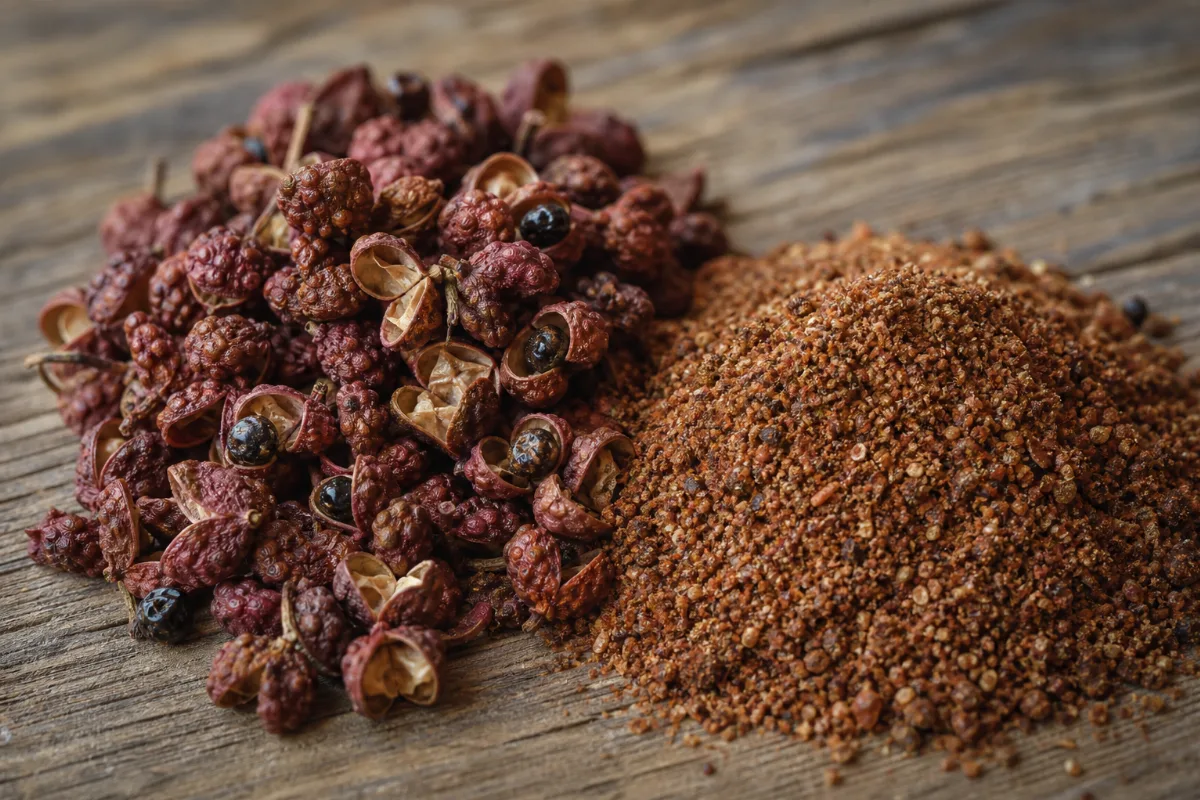
Sichuan pepper is made from the dried husk (the outer shell) of the fruit of Zanthoxylum plants, in the family Rutaceae, which is the citrus family. It is not closely related to black pepper or chili. The shiny black seeds and the stems are thrown away.
Several species are used. Zanthoxylum bungeanum is the main red one in China, Z. schinifolium is the green kind, and Z. armatum grows across the Himalayas. Sichuan province is the best-known growing area.
Flavor and aroma
The taste is lemony and woody, with a biting start that builds into a numbing, buzzing feeling on the tongue. The smell is floral and piney, with citrus peel. The buzz comes mainly from a compound called hydroxy-alpha-sanshool. One lab study of dried husks found linalool and d-limonene were the main aroma compounds.
Long cooking dulls the tingle, so many cooks add the ground spice near the end.
In the kitchen
In Sichuan cooking it is paired with chili for ma la, which means 'numbing and hot'. It appears in mapo tofu, kung pao chicken and Chongqing hot pot, in five-spice powder, in numbing oil made by steeping husks in hot oil, and in salt-and-pepper made by toasting the husks with salt. It is also used in Himalayan dishes such as momo dumplings.
One cooking site suggests toasting the husks in a dry pan until fragrant and grinding them fresh. It goes well with star anise, ginger, garlic and rich meats such as duck and pork. Japanese sansho is the closest substitute. These tips are from a commercial reference site, not measured figures.
Buying: bright red husks with few seeds and stems are preferred. Seeds are gritty, and tough, pointed thorns can be in the product, so pick them out.
Nutrition in a typical portion
We found no USDA nutrient entry for Sichuan pepper and did not re-read USDA for this page, so we give no nutrient table. Cooking amounts are small: one cooking site uses about 1/2 teaspoon of ground husk in a kung pao chicken recipe. A pinch for flavor is unlikely to add meaningful nutrients.
What the research shows
Eating Sichuan pepper has not been studied for health. The research is on extracts and compounds in cells and animals, and the 2025 cancer review says human studies of benefit and toxicity are scarce. A 2024 review of the tingling compounds says their use as a local anaesthetic still needs study.
The few human studies are small and are not about the spice in a meal: a trial of an extract of a related species on thinking speed (82 adults), a capsule product for dry mouth with no control group in its abstract, and a skin cream for crow's feet (20 women). Two have links to the companies that make the products.
Food versus extracts and oil
Most research uses extracts, oils and isolated compounds, which are far more concentrated than a pinch in a dish. The infused oil used in cooking is a kitchen product, but concentrated extracts and essential oil are not.
Amounts
This page gives no amounts to eat. Ask a doctor, pharmacist or dietitian about oils or extracts, especially if you have a food allergy or take regular medicines.
At a glance
Traditional uses history, not proof
- Cooking: mapo tofu, kung pao chicken, hot pot, five-spice powder, numbing oil and salt-and-pepper
- Traditional Chinese medicine: abdominal pain, toothache and eczema
- Long use is not proof that it treats any condition
Studied for research
- Any health benefit from eating it: insufficient evidence, no study found
- Numbing and local pain: insufficient, compound and lab work
- Thinking speed: very low, one trial of an extract of a related species
- Cancer cells: very low, lab and animal work only
- Dry mouth and wrinkles: very low, a capsule product and a skin cream
Main compounds
- Hydroxy-alpha-sanshool (the tingle)
- Linalool (floral aroma)
- d-Limonene (citrus aroma)
Common forms
- Whole dried husks
- Ground Sichuan pepper
- Infused oil (a kitchen oil)
- Salt-and-pepper condiment
- Concentrated extracts and essential oil (not kitchen products)
Research links: Review: alkamides in Zanthoxylum and local anaesthetic activity (2024) · Zan b 2 seed allergen and cross-reactivity (2024) · Review: Zanthoxylum pharmacological activities (2024) · Research Library · Genes & Biomarkers Library
What it is and its history
- Accepted scientific name
- Zanthoxylum bungeanum
- Naming authority
- Maxim. (GBIF accepted)
- Common names
- Sichuan pepper (English); Szechuan pepper (English); Sichuan peppercorn (English); Chinese prickly ash (English); Huajiao (Chinese (pinyin)); Pimienta de Sichuan (Spanish)
- Family or group
- Rutaceae, the citrus and rue family. It is not closely related to black pepper or chili.
- Classification
- Plantae > Tracheophyta > Magnoliopsida > Sapindales > Rutaceae > Zanthoxylum > Zanthoxylum bungeanum
- Native range
- Not fully verified. The cooking source says Z. bungeanum is native from the Himalaya to China (citing Kew), and Sichuan province is the main growing area; Z. armatum grows across the Himalayas.
- Habitat
- Not verified from a source read.
- What it looks like
- Roots: Not verified.; Stems: Not verified. Sources mention thorns in the product.; Leaves: The leaves are also used in soups and fried foods (encyclopedia source).; Flowers: Not verified.; Fruit: The spice is the dried husk (pericarp) of the fruit. The shiny black seeds inside and the stems are discarded.
- Cultivation
- Not verified. The encyclopedia source says farmers in China have cultivated many strains of Z. bungeanum and Z. schinifolium.
- Harvest and processing
- Sold as whole red or green husks, ground, as an infused oil and in salt-and-pepper mixes. Fresh green fruit is sometimes used.
- Look-alikes and adulterants
- Name: Black pepper (Piper nigrum); Note: A different plant. The name is similar only by custom.; Name: Japanese sansho and Korean chopi (other Zanthoxylum species); Note: Related spices with a similar tingle, per the cooking and encyclopedia sources.; Name: Chili; Note: Different plant. Chili gives heat; Sichuan pepper gives tingling and numbness. They are paired in the flavour called ma la.
- Sustainability and conservation
- Not assessed.
Photographs
Traditional use and history history, not clinical proof
| Tradition or era | Documented use | Source |
|---|---|---|
Traditional use shows how it was used. It does not show that it works or is safe today.
What is inside, and how it may work
What it contains and how those compounds act in cells and animals. Laboratory and animal mechanisms are not proven effects in people.
Main compounds
| Compound | Family | Where it is concentrated | Activity studied | Level of evidence |
|---|---|---|---|---|
| Hydroxy-alpha-sanshool | alkamide | Fruit husk Not given | Causes the tingling and numbing feel on the tongue (encyclopedia and cooking sources). Alkamides from 11 Zanthoxylum species are reviewed for local anaesthetic activity. 13 5 | Laboratory research |
| Linalool | terpene alcohol | Fruit husk volatile oil Dominant with d-limonene among 173 volatile compounds in dried Z. bungeanum (one study) | A floral aroma compound; no health claim here. 10 | Unknown |
| d-Limonene | terpene | Fruit husk volatile oil See linalool | A citrus aroma compound; no health claim here. 10 | Unknown |
Mechanisms, receptors and pathways
| Target or pathway | Gene or receptor | What was found | Level |
|---|---|---|---|
| Touch and pain nerve endings | Not specified in the abstract read | Sanshool-type alkamides change sensation on nerve endings, which explains the tingle and numbing; the review links this to local anaesthetic activity. 5 | Laboratory research |
Absorption, metabolism and elimination
- Absorption
- Not found.
- Distribution
- Not found.
- Metabolism
- Not found.
- Elimination
- Not found.
- Bioavailability
- Not established.
Isolated compounds versus whole extracts
Nearly all the biology reported is for extracts, oils and isolated compounds in cells and animals. The few human trials used an extract of a related species, a capsule product and a skin cream. None tested the spice in a meal for a health result.
Nutritional composition
Nutrition: USDA FoodData Central was not re-read for this page (its public search was rate-limited when we tried on 2026-10-26). An earlier check on this site found no USDA SR Legacy entry for Sichuan pepper, so we give no nutrient table and no grams per teaspoon. Cooking amounts are small: one cooking site uses about 1/2 teaspoon of ground husk for a kung pao chicken recipe and about 2 teaspoons for a homemade chili crisp. These are single recipes, not guidance. A pinch used for flavour is unlikely to add meaningful nutrients.
5 very low certainty3 not enough evidence
What was looked at
The 8 benefits and uses checked for Sichuan (Szechuan) pepper, each with how strong the evidence is. Tap one to open it.
- Health benefit from Sichuan pepper as foodNot enough evidence
- Numbing and local pain relief (lab and review findings)Not enough evidence
- Thinking speed and focus (a lipid extract of a related species)Very low certainty
- Cancer cells (cell and animal studies)Very low certainty
- Inflammation, blood sugar, blood fats and infection (genus review)Very low certainty
- Saliva and dry mouth (an encapsulated oil product)Very low certainty
- Crow's feet wrinkles (a 2 percent extract skin cream)Very low certainty
- Toothache, abdominal pain and eczema (traditional use)Not enough evidence
Lab markers tracked in the studies
Frontal brain blood flow during a task (near-infrared spectroscopy)Saliva secretion
What is Sichuan (Szechuan) pepper good for?
The studied uses and how strong the human evidence is for each. Almost all of it is lab work, or an extract or product, not Sichuan pepper eaten in food.
Benefits, one by one
Each card is a research question, not a promise. Tap a goal to filter. Open a card to see the studies, doses and limits.
Health benefit from Sichuan pepper as food
Not enough evidenceWe found no study of people eating Sichuan pepper for a health result. It is a flavouring used in small amounts, and its main effect is a tingling, numbing feel in the mouth.
2 studiesDried husk, whole or ground, used in cooking.
Studies, doses and limits
What the trials found
The encyclopedia source says Sichuan pepper has no accepted use in evidence-based medicine. The reviews we read describe lab and animal work and say human data are scarce.
Results
Nothing about health benefit can be said for Sichuan pepper in food.
Why this rating
No human study of eating the spice for a health outcome was found.
Form and dose studied
Dried husk, whole or ground, used in cooking.
Limits
Absence of a study is not proof of no effect; it means we cannot say.
Why researchers looked
People ask whether a spice with a strong effect on the mouth also does something for health.
Traditional use
In Traditional Chinese medicine the fruit husk has been used for stomach pain, toothache and eczema, and it is listed in the Chinese pharmacopoeia (as the encyclopedia source says). Long use is not proof of benefit.
Proposed mechanism Unknown
Not applicable. No human mechanism has been shown for the spice as food.
A proposed mechanism does not show that the effect happens in people.
See the safety section: allergy is the main concern.
Numbing and local pain relief (lab and review findings)
Not enough evidenceThe tingle and numbness come from compounds called sanshools. A 2024 review of these compounds says they may help as a local anaesthetic, but the effect on patients still needs to be tested.
2 studiesIsolated alkamides and extracts in the lab; not food.
Studies, doses and limits
What the trials found
The review reports no patient results in its abstract and lists a need for full evaluations of how well the compounds work.
Results
The review links alkamides from 11 Zanthoxylum species to numbing and pain relief, and says clinical uses need more study.
Why this rating
Compound and lab work, plus a review; no trial of the spice for pain in people was found.
Form and dose studied
Isolated alkamides and extracts in the lab; not food.
Limits
The tingle you feel when eating the spice is a normal food effect, not proof of pain relief. Only the abstract of the review was read.
Why researchers looked
The numbing feel on the tongue suggested a use in toothache and local pain.
Traditional use
Used in Chinese medicine for toothache and abdominal pain (encyclopedia source).
Proposed mechanism Laboratory research
Alkamides such as hydroxy-alpha-sanshool act on touch nerve endings and change sensation; the review covers structure and how they act. This comes from lab work.
A proposed mechanism does not show that the effect happens in people.
None specific.
Thinking speed and focus (a lipid extract of a related species)
Very low certaintyIn one trial of 82 healthy adults, a lipid extract of Nepalese pepper (Zanthoxylum armatum) gave faster task speed and less mental tiredness than placebo, and a mix of better and worse results on different tests. It was an extract of a related species, not the spice in a meal.
1 studiesA lipid extract of Z. armatum (dose not repeated here). Not Sichuan p…
Studies, doses and limits
What the trials found
One randomised, double-blind, placebo-controlled trial in 82 healthy adults aged 30 to 55 (Nutrients 2019): a single dose and then 56 days.
Results
Day 1: faster attention scores and a better result on one information-processing task, but less accurate name-to-face recall. Day 56: faster overall speed, more correct serial subtractions at 3 hours and less mental fatigue than placebo. Frontal blood flow during the task was lower with the extract.
Effect sizes as reported
Not given in the abstract.
Why this rating
One trial, a different species (Z. armatum), a lipid extract, healthy adults and test scores rather than health outcomes. One author works for an extract-supplying company. Only the abstract was read.
Form and dose studied
A lipid extract of Z. armatum (dose not repeated here). Not Sichuan pepper as sold for cooking.
Who was studied
82 healthy adults aged 30 to 55.
Limits
Not replicated in the sources we read; one result went the wrong way (name-to-face recall); extract not food.
Why researchers looked
Sanshool-type compounds act on nerve channels and brain signals in lab studies, so researchers asked whether an extract changes thinking.
Proposed mechanism Unknown
The trial authors suggest the extract acts on several nerve signalling systems and nerve channels. This was not tested in the trial; the result is a change in task scores and in blood flow in the front of the brain.
A proposed mechanism does not show that the effect happens in people.
The abstract reports no safety findings.
Cancer cells (cell and animal studies)
Very low certaintyExtracts and compounds from Sichuan pepper slowed or killed some cancer cells in the lab. The 2025 review says human studies of benefit and toxicity are scarce.
1 studiesIsolated components and extracts, not food.
Studies, doses and limits
Results
Promising effects against liver, stomach and breast cancer cells are described in the review, in lab settings.
Why this rating
Cell, animal and computer-prediction work only. No human result.
Form and dose studied
Isolated components and extracts, not food.
Limits
Lab concentrations are not what a person eats. Only the abstract was read.
Why researchers looked
The fruit is a 'medicine and food' plant in China, and its compounds were tested on cancer cells.
Proposed mechanism Laboratory research
The review reports effects on cell death, cell-cycle stopping, spread and autophagy through several signalling pathways, based on lab work and computer prediction.
A proposed mechanism does not show that the effect happens in people.
The review notes toxicity in humans is not well studied.
Inflammation, blood sugar, blood fats and infection (genus review)
Very low certaintyA 2024 review lists anti-inflammatory, pain-relieving, blood-sugar-lowering, blood-fat-lowering, antioxidant and anti-infective activities for Zanthoxylum plants. These come from lab work on extracts and compounds.
1 studiesExtracts and isolated compounds from many Zanthoxylum species.
Studies, doses and limits
Results
Activities are listed for the whole genus, not tested in people eating Sichuan pepper.
Why this rating
A genus-wide review of mostly lab work; the authors call for toxicity and mechanism research.
Form and dose studied
Extracts and isolated compounds from many Zanthoxylum species.
Limits
Not specific to the red husk used in cooking. Only the abstract was read.
Why researchers looked
Zanthoxylum plants are rich in oils, alkaloids and amides that show activity in lab tests.
Traditional use
Used in Chinese medicine for abdominal pain, toothache and eczema (encyclopedia source).
Proposed mechanism Laboratory research
The review says the compounds show these activities in cells and animals; it does not claim an effect of the spice as food.
A proposed mechanism does not show that the effect happens in people.
The review says toxicity needs more study.
Saliva and dry mouth (an encapsulated oil product)
Very low certaintyIn a small Japanese trial, an encapsulated food product containing Sichuan pepper oil raised saliva after one intake and eased dry mouth over four weeks. The abstract names no comparison group, and the maker's staff are among the authors.
1 studiesAn encapsulated product containing Sichuan pepper oil (amount not rep…
Studies, doses and limits
What the trials found
One clinical trial in people with a dry mouth (Clin Exp Dent Res 2019); the number of participants is not given in the abstract.
Results
Saliva rose by 39.4 percent (SD 37.6) after one intake, then by 8.7 and 6.3 percent more after 2 and 4 weeks. People reported less dryness.
Effect sizes as reported
Percent changes in saliva as above; no comparison-group figures in the abstract.
Why this rating
No control group or participant number in the abstract, a product made by a company whose staff co-wrote it, and a capsule rather than food.
Form and dose studied
An encapsulated product containing Sichuan pepper oil (amount not repeated here).
Who was studied
People with a dry mouth.
Limits
Cannot be credited to the spice alone; not a dish. Only the abstract was read.
Why researchers looked
The tingling spice makes people salivate, so researchers tested it in people with a dry mouth.
Proposed mechanism Unknown
Not established. The study measured saliva and mouth Candida counts, not the reason.
A proposed mechanism does not show that the effect happens in people.
The abstract reports no safety findings.
Crow's feet wrinkles (a 2 percent extract skin cream)
Very low certaintyIn a split-face trial of 20 women, a cream with 2 percent Sichuan pepper husk extract gave a short-term improvement in crow's feet compared with plain cream over 30 days. It is a skin product, not food.
1 studiesA skin cream with 2 percent husk extract.
Studies, doses and limits
What the trials found
A randomised, vehicle-controlled, double-blind split-face trial in 20 women aged 35 to 60 (Dermatol Ther 2019).
Results
Significant short-term anti-crow's-feet effect vs plain cream; no adverse effect was shown in 30 days.
Effect sizes as reported
No figures in the abstract.
Why this rating
20 women, 30 days, a cosmetic outcome, and a topical extract, not eating the spice.
Form and dose studied
A skin cream with 2 percent husk extract.
Who was studied
20 women aged 35 to 60.
Limits
Tiny and short. It says nothing about eating Sichuan pepper.
Why researchers looked
The extract was thought to relax skin in a way like botulinum toxin, according to the trial's own background.
Proposed mechanism Unknown
The trial background suggests a toxin-like effect; this was not shown by the trial.
A proposed mechanism does not show that the effect happens in people.
No adverse effect reported in the abstract.
Toothache, abdominal pain and eczema (traditional use)
Not enough evidenceChinese medicine has used the husk for toothache, stomach pain and eczema. We found no trial of these uses.
1 studiesNot applicable.
Studies, doses and limits
Results
No result to report.
Why this rating
No trial found; traditional use is not evidence of effect.
Limits
Source is a general encyclopedia.
Why researchers looked
These are traditional uses described in the Chinese pharmacopoeia, as the encyclopedia source states.
Traditional use
Listed in the Pharmacopoeia of the People's Republic of China (encyclopedia source).
Proposed mechanism Unknown
Not applicable.
A proposed mechanism does not show that the effect happens in people.
None.
Connections to the rest of health
How Sichuan (Szechuan) pepper connects to the rest of our health knowledge graph. Every link says what kind of connection it is. A safety link (for example to the liver) is a warning, not a benefit. A study that merely mentions a topic never creates a benefit link.
Explore every connection: goals, body systems, organs, symptoms, genes
A. Wellness goals
| Connected to | Kind of connection | Evidence status | Context | Studies |
|---|---|---|---|---|
| Better Focus | Very low certainty | Thinking speed and focus (a lipid extract of a related species): In one trial of 82 healthy adults, a lipid extract of Nepalese pepper (Zanthoxylum armatum) gave faster task speed and less mental tiredness than placebo, and a mix of better and worse results on different tests. It was an extract of a related species, not the spice in a meal. | 3 | |
| Blood Sugar Balance | Preliminary mechanism | Very low certainty | Inflammation, blood sugar, blood fats and infection (genus review): A 2024 review lists anti-inflammatory, pain-relieving, blood-sugar-lowering, blood-fat-lowering, antioxidant and anti-infective activities for Zanthoxylum plants. These come from lab work on extracts and compounds. | 7 |
| Healthy Skin | Very low certainty | Crow's feet wrinkles (a 2 percent extract skin cream): In a split-face trial of 20 women, a cream with 2 percent Sichuan pepper husk extract gave a short-term improvement in crow's feet compared with plain cream over 30 days. It is a skin product, not food. | 8 |
B. Body systems
| Connected to | Kind of connection | Evidence status | Context | Studies |
|---|---|---|---|---|
| Nervous System | Biological association | Not enough evidence | Studied for: Numbing and local pain relief (lab and review findings) Studied for: Thinking speed and focus (a lipid extract of a related species) | 5 13 3 |
| Blood And Immune | Biological association | Very low certainty | Studied for: Cancer cells (cell and animal studies) | 1 |
| Endocrine System | Biological association | Very low certainty | Studied for: Inflammation, blood sugar, blood fats and infection (genus review) | 7 |
| Digestive System | Biological association | Very low certainty | Studied for: Saliva and dry mouth (an encapsulated oil product) | 6 |
| Integumentary System | Biological association | Very low certainty | Studied for: Crow's feet wrinkles (a 2 percent extract skin cream) | 8 |
E. Health conditions
| Connected to | Kind of connection | Evidence status | Context | Studies |
|---|---|---|---|---|
| Food allergy | Documented risk | Two seed allergens are described, with cross-reaction to cashew, pistachio and citrus seeds, shown in lab tests. | 4 2 |
I. Biomarkers
| Connected to | Kind of connection | Evidence status | Context | Studies |
|---|---|---|---|---|
| Frontal brain blood flow during a task (near-infrared spectroscopy) | Biological association | Very low certainty | Measured in trials: lowered. A lab change is not the same as a health benefit. | 3 |
| Saliva secretion | Biological association | Very low certainty | Measured in trials: raised. A lab change is not the same as a health benefit. | 6 |
K. Biological pathways
L. Active compounds
| Connected to | Kind of connection | Evidence status | Context | Studies |
|---|---|---|---|---|
| Hydroxy-alpha-sanshool | Biological association | In vitro | Causes the tingling and numbing feel on the tongue (encyclopedia and cooking sources). Alkamides from 11 Zanthoxylum species are reviewed for local anaesthetic activity. Preparation or compound: Fruit husk |
13 5 |
| Linalool | Biological association | Unknown | A floral aroma compound; no health claim here. Preparation or compound: Fruit husk volatile oil |
10 |
| d-Limonene | Biological association | Unknown | A citrus aroma compound; no health claim here. Preparation or compound: Fruit husk volatile oil |
10 |
Each connection is stored with the ingredient, the connected record, the kind of connection, the evidence status, the supporting studies, the preparation or compound involved, and a review date (last reviewed October 26, 2026).
Evidence at a glance: what changed in 2 lab markers
Tap a number to show only those markers. Counts are markers, not people.
The evidence
The research centre for Sichuan (Szechuan) pepper. Every record here was checked against PubMed or the publisher's page; we never list a study we have not verified.
Evidence by outcome
Bars show how many studies we found for each outcome, not how well it works. People are added up across trials only (reviews are not added, to avoid double counting).
How we rate evidence
High certainty
Several well-run trials or reviews agree; further research is unlikely to change the picture much.
Moderate certainty
Good trials point the same way, but some doubt remains.
Low certainty
Small, short or inconsistent trials. The finding could change with better research.
Very low certainty
Very little or very weak human data. Treat as a possibility only.
Mixed findings
Trials or reviews disagree with each other.
Not enough evidence
Not enough human research to say either way.
Evidence against
Good research found no benefit, or found harm.
We take the reviewers' own risk-of-bias and GRADE statements where they exist, and otherwise judge from study size, design, consistency, directness and whether a product matches what is sold. Many publications do not make evidence high. Method note: We started from our existing Sichuan pepper summary, re-checked it against PubMed abstracts (searched for trials and safety reports), an encyclopedia article, a spice-reference profile and a GBIF species match. Only abstracts were read for PubMed studies. USDA data were not re-read. Items we could not verify are flagged in the research gaps.
Study library: every study we checked 13
| Study | Design | People | Product, dose, length | Result |
|---|---|---|---|---|
| Du 2025 Antitumor components and mechanisms of Zanthoxylum bungeanum Maxim with medicine and food homology. Front Pharmacol · PMID 40093316 · DOI |
Narrative review cell and animal literature plus network-pharmacology prediction |
Reports that components and extracts of Z. bungeanum promoted cell death and slowed spread in cancer cells, using database and computer-prediction methods as well as lab work. The authors state that clinical studies of anti-tumour effect and toxicity in humans are scarce and that trials should be prioritised. Methods, limits and fundingLimitations: Lab, animal and computer predictions. Not about eating the spice. Only the abstract was read. Funding and conflicts: Authors declare none Read: abstract | ||
| Hu 2024 Identification, Characterization, Cloning, and Cross-Reactivity of Zan b 2, a Novel Pepper Allergen of 11S Legumin. J Agric Food Chem · PMID 38551197 · DOI |
Lab immunology human serum tests (in vitro) |
10 Sera from people allergic to Sichuan pepper (the abstract says six sera, 60 percent, reacted; this implies 10 sera) |
A 55 kDa seed protein, Zan b 2 (11S globulin family), bound IgE in six patients' sera (60 percent) and cross-reacted with cashew nuts, pistachios and citrus seeds. The abstract says Sichuan pepper protein can cause mild to severe allergic reactions. Methods, limits and fundingLimitations: Lab serum tests in a small group. The number of sera (10) is worked out from 6 being 60 percent, not stated directly. No rate of allergy in the public. Funding and conflicts: Authors declare no competing financial interest Read: abstract | |
| Kennedy 2019 The Acute and Chronic Cognitive and Cerebral Blood-Flow Effects of Nepalese Pepper (Zanthoxylum armatum DC.) Extract-A Randomized, Double-Blind, Placebo-Controlled Study in Healthy Humans. Nutrients · PMID 31835620 · DOI |
Controlled trial |
82 82 healthy adults aged 30 to 55 |
Lipid extract of Zanthoxylum armatum (Nepalese pepper) A single dose, then 56 days · vs Placebo |
On Day 1 the extract gave faster attention scores and a better result on a rapid information-processing task than placebo, but participants were less accurate on a name-to-face recall task. On Day 56 speed of performance was faster, more correct serial subtractions were done at 3 hours, and participants felt less mentally fatigued than on placebo. Blood-flow change in the frontal cortex was lower during the information-processing task. Effect sizes are not given in the abstract. Methods, limits and fundingOutcomes: Computerised cognitive tasks, mood and prefrontal blood flow by near-infrared spectroscopy, tested on Day 1 and Day 56 Limitations: A lipid extract of a different species (Z. armatum), not the red spice in food. Healthy adults, cognitive tests rather than health outcomes. Abstract only. One author is at Mibelle Group Biochemistry, a company that makes plant extracts for cosmetics and nutrition. Funding and conflicts: Authors declare no conflict of interest, but one author is affiliated with an extract-supplying company (Mibelle Group). Read: abstract |
| Li 2025 A new pepper allergen Zan b 1.01 of 2S albumins: Identification, cloning, characterization, and cross-reactivity. Asian Pac J Allergy Immunol · PMID 38183644 · DOI |
Lab immunology human proteins and serum tests (in vitro) |
Sichuan pepper seed protein tested against IgE (allergy antibody) tests | A 14 kDa seed protein of Z. bungeanum was confirmed as a major allergen (a 2S albumin, named Zan b 1.01) and was heat-stable. Competitive ELISA showed cross-reactivity with citrus seeds, pistachios and cashew seeds. The abstract also says the plant is a spice used worldwide and is a potentially life-threatening allergenic food, as first reported by the authors' team in 2005. Methods, limits and fundingLimitations: Lab protein work. The abstract gives no number of patients and no rate of allergy in the public. Funding and conflicts: Not stated in the abstract Read: abstract | |
| Lu 2024 Alkamides in Zanthoxylum Species: Phytochemical Profiles and Local Anesthetic Activities. Int J Mol Sci · PMID 39596294 · DOI |
Narrative review plant chemistry, lab and traditional use |
Covers alkamides (the tingling and numbing compounds) from 11 Zanthoxylum species: structure, how they change sensation, and links to pain relief and local anaesthesia. It names research gaps, including full evaluations of how well they work. Methods, limits and fundingLimitations: A review of alkamides, not of the spice as food. Only the abstract was read; it reports no patient results. Funding and conflicts: Authors declare none Read: abstract | ||
| Ryo 2019 Study on the salivation effect of encapsulated food products containing Sichuan pepper oil. Clin Exp Dent Res · PMID 30847228 · DOI |
Clinical trial |
People with a dry mouth (number not given in the abstract) | Encapsulated food product containing Sichuan pepper oil oil A single intake, then 2 and 4 weeks |
Saliva rose by 39.4 percent (standard deviation 37.6) after a single intake, and by a further 8.7 and 6.3 percent after 2 and 4 weeks. Candida colony counts were negatively related to saliva amount. People reported less mouth dryness. The authors conclude the product promotes saliva and eases dry mouth. Methods, limits and fundingOutcomes: Saliva amount, Candida counts in the mouth, mouth-dryness symptoms (interviews) Limitations: The abstract names no control group or number of participants, so effects cannot be separated from expectation or the capsule itself. Encapsulated oil product, not the spice in a dish. Two authors are from the company that makes the product (Aliment Industry Co.), although the authors state no conflict of interest. Funding and conflicts: Stated no specific funding and no conflicts, but two authors work for the product's maker. Read: abstract |
| Wen 2024 Pharmacological activities of Zanthoxylum L. plants and its exploitation and utilization. Heliyon · PMID 39022083 · DOI |
Narrative review plant chemistry, cell and animal literature |
Lists anti-inflammatory, pain-relieving, anti-tumour, blood-sugar-lowering, blood-fat-lowering, antioxidant and anti-infective activities for the genus. The authors say more research on toxicity and on how the compounds act is needed before safe clinical use. Methods, limits and fundingLimitations: A genus-wide review of mostly lab work; not specific to Sichuan pepper eaten as food. Only the abstract was read. Funding and conflicts: Authors declare none Read: abstract | ||
| Zeng 2019 The effect of Zanthoxylum bungeanum maxim extract on crow's feet: A double-blind, split-face trial. Dermatol Ther · PMID 31482633 · DOI |
Controlled trial |
20 20 women aged 35 to 60 |
2 percent Z. bungeanum pericarp (husk) extract in a skin cream, on one side of the face pericarp (husk) 2 percent in the cream 30 days · vs Plain cream (vehicle) on the other side |
The 2 percent extract cream had a significant short-term anti-crow's-feet effect compared with plain cream. No adverse effect was shown during the study. Methods, limits and fundingOutcomes: Skin roughness, hydration and elasticity Limitations: 20 women, 30 days, a cosmetic outcome, and a skin cream, not food. No effect sizes in the abstract. Funding and conflicts: Authors declare none in the abstract (not stated) Read: abstract |
| Zhou 2025 Determination of twelve mycotoxins in red and green Sichuan peppers using QuEChERS method with LC-MS/MS. Food Chem · PMID 39504895 · DOI |
Laboratory analysis dried red and green Sichuan pepper |
Describes a lab method to measure twelve mould toxins in dried red and green Sichuan pepper (detection limits 0.1 to 0.7 micrograms per kg). The abstract reports the method's performance only, not how much mould toxin real products contain. Methods, limits and fundingLimitations: A method paper. It shows that mould toxins are tested for in this spice, not that any product has a problem. Funding and conflicts: Authors declare none Read: abstract | ||
| Zhu 2025 Unveiling the flavor and quality variations in dried Zanthoxylum bungeanum maxim from China's diverse regions. Food Chem X · PMID 39758071 · DOI |
Laboratory analysis dried spice samples |
Dried Z. bungeanum from different regions differed in aroma, pungency and look. GC-MS found 173 volatile compounds, mostly linalool and d-limonene. Microbial contamination was minimal in samples from Hanyuan and Jiangjin, and the lowest heavy-metal levels were in samples from Hanyuan, Hancheng and Jingyang. The abstract gives no numbers for heavy metals or microbes. Methods, limits and fundingLimitations: Abstract only; no figures to compare with any limit. One author is affiliated with a Sichuan food company (Sichuan Yaomazi Food Co., Ltd). Funding and conflicts: Authors declare no competing interests, but the first author's affiliation is a food company. Read: abstract | ||
| s-gbif-zanthoxylum GBIF Backbone species match: Zanthoxylum bungeanum, Z. simulans, Z. armatum, Z. schinifolium · Source |
Reference database n/a |
Methods, limits and fundingRead: full-text | ||
| s-spiceography Spiceography: Szechuan Pepper, the Numbing Spice, Its Species, Chemistry and Uses · Source |
Secondary reference n/a |
Methods, limits and fundingRead: full-text | ||
| s-wiki-sichuan Wikipedia: Sichuan pepper · Source |
Secondary reference n/a |
Methods, limits and fundingRead: full-text |
What we do not know yet
- No human trial of Sichuan pepper eaten as food was found for any health outcome.
- How common allergy to Sichuan pepper is was not found.
- Drug interactions, pregnancy, breastfeeding, children, liver and kidney effects were not found in the sources read.
- The cancer, genus and alkamide reviews were read from abstracts only.
- No USDA nutrient data were read, so there is no nutrient table.
- The contamination papers give no figures in their abstracts.
- EMA, EFSA, FDA, NCCIH, JECFA and LiverTox statements on Sichuan pepper were not located.
- Cooking tips come from a commercial reference site and the encyclopedia, not a standards body.
How new research is added
New studies are found by a saved PubMed search and placed in a review queue before the page changes.
Lab markers
What changed in blood or saliva tests during trials. A changed number is not the same as feeling or being healthier, and we give no "normal ranges".
Other 2
Frontal brain blood flow during a task (near-infrared spectroscopy)
Lowered in trials
A light-based sensor on the forehead that estimates blood-flow changes in the front of the brain while a person does a task.
Very low certaintyResults and what it means
Why it was measured
Used in research as a rough marker of how hard the brain works on a task.
Statistical vs. clinical meaning
A research marker in one trial; the authors read it as more efficient brain use, which the trial did not prove.
Safety implication
None reported in the abstract.
| Study | Result | People | Product |
|---|---|---|---|
| 3 | Lower hemodynamic response in the frontal cortex during a rapid information-processing task on Day 1 and Day 56 with a Z. armatum lipid extract vs placebo | 82 healthy adults aged 30 to 55 | Lipid extract of Z. armatum vs placebo |
Saliva secretion
Raised in trials
The amount of saliva a person produces, measured over a set time.
Very low certaintyResults and what it means
Why it was measured
Used to judge dry mouth.
Statistical vs. clinical meaning
No comparison group is named in the abstract; the product is a capsule from a company whose staff co-wrote the report.
Safety implication
None reported in the abstract.
| Study | Result | People | Product |
|---|---|---|---|
| 6 | Saliva rose 39.4 percent after a single intake of a Sichuan pepper oil capsule product, then a further 8.7 and 6.3 percent after 2 and 4 weeks | People with a dry mouth (number not given in the abstract) | Encapsulated food product containing Sichuan pepper oil |
Safety
What studies and official sources say about side effects, medicines and who should check first. Each point shows what kind of evidence it comes from.
Main points to know 3
- Allergy is possible and can be serious: seed proteins cross-react with cashew, pistachio and citrus seeds. Lab studies found two Sichuan pepper seed proteins (Zan b 1.01 and Zan b 2) that allergy antibodies from allergic people bind to. They cross-reacted with cashew, pistachio and citrus seeds. In one test, 6 of 10 patients' sera reacted to Zan b 2. The authors of one paper describe the spice as a potentially life-threatening allergenic food and say their team first reported this in 2005. We found no estimate of how common allergy is. If you react to cashew, pistachio or citrus seeds, or ever reacted to this spice, talk to an allergy doctor before eating it. Laboratory research 4 2
- No safe upper amount is known, and toxicity data are scarce. The reviews we read say toxicity of Zanthoxylum plants and their compounds needs more research. We found no official upper limit. Normal cooking amounts are small, and we found no report of harm from them, but absence of data is not proof of safety. Concentrated oils and extracts are not the same as the spice. Narrative review 7 1
- Quality varies by where it is grown. A study of dried Sichuan pepper from many Chinese regions found that heavy metals and microbes differed by origin. The abstract gives no figures. The first author works at a food company. Laboratory analysis 10
Side effects 3
| Effect | How often | Severity and recovery | Evidence |
|---|---|---|---|
| Allergic reaction (mild to severe) Based on allergy-antibody tests and on statements in the papers. No case series or rate was read. | Not established | Mild to severe according to one paper; potentially life-threatening Not stated | Laboratory research 4 2 |
| Tingling and numbness of the lips and tongue A normal food effect caused by sanshools. It is not an allergy. | Expected with eating the spice | Mild, temporary Wears off | Secondary reference 13 5 |
| Skin irritation from a 2 percent extract cream A skin cream, not food; 30 days; abstract only. | None reported in 20 women | None reported Not applicable | Controlled trial 8 |
Liver
No liver injury from Sichuan pepper was found in the sources read. A liver-safety source such as LiverTox was not checked.
How often. No frequency was found.
Monitoring. No monitoring advice was found.
This is a safety connection. It is not evidence that Sichuan (Szechuan) pepper supports liver health.
Medicines and supplements 2
| With | Why it matters | Importance | Evidence | What to do |
|---|---|---|---|---|
| Prescription medicines prescription | Not described in the sources read. | Unknown. No interaction was found, which is not proof that none exists, and concentrated extracts and oils are not studied. | Unknown Not enough evidence | If you use Sichuan pepper oil or extracts, ask a pharmacist first, especially if you take regular medicines. |
| Cashew, pistachio and citrus seeds (allergy cross-reaction) food | Shared seed storage proteins; antibodies from allergic people cross-reacted in lab tests. | Could matter to people with those allergies; real-world risk not measured. | Laboratory research Low certainty 4 2 | See an allergy doctor before trying the spice if you are allergic to cashew, pistachio or citrus seeds. |
Who should check first 2
| Situation | Advice | Evidence |
|---|---|---|
| Known allergy to Sichuan pepper | Avoid it and ask an allergist. Call emergency services for trouble breathing, swelling of the face or throat, or faintness. | Laboratory research 4 2 |
| Allergy to cashew, pistachio or citrus seeds | Ask an allergy doctor before trying it, because lab tests showed cross-reaction. | Laboratory research 4 2 |
Overdose, product quality and regulators
Summary. No harm from the spice in food amounts was found in the sources read. Reviews say toxicity data for Zanthoxylum plants and their compounds are scarce.
Animal. Not reviewed beyond the reviews' statements.
Human doses studied. The extract trials gave no safety findings in their abstracts (an extract of a related species and a 2 percent skin cream). Doses are not repeated here.
Overdose response. Not found.
Genotoxicity. Not researched.
Toxic or hazardous parts. Seeds are gritty and thorns can be sharp (cooking source). The seeds contain the allergens studied.
A 2025 study found heavy metals and microbes in dried Sichuan pepper differed by region of origin. A separate method paper shows that twelve mould toxins can be tested for in the dried spice. Neither abstract gives the amounts found in products.
Heavy metals and microbes by origin. Lowest heavy-metal levels were in samples from Hanyuan, Hancheng and Jingyang, and microbial contamination was minimal in samples from Hanyuan and Jiangjin. No numbers in the abstract. 10
Mould toxins. A lab method for twelve mycotoxins in dried red and green Sichuan pepper was set up. The abstract reports the method's accuracy, not levels in products. 9
| Body | Action | Date |
|---|
When to get medical help
- Trouble breathing, wheezing, swelling of the lips, face or throat, widespread hives or feeling faint after eating Sichuan pepper
- Vomiting or stomach cramps soon after eating it, together with a rash, in someone with a nut allergy
- Tingling that spreads beyond the mouth or does not wear off in a few hours
Stop using the product and contact a clinician or emergency service. In the US, Poison Control is 1-800-222-1222.
General information only, not medical advice. Ask a clinician or pharmacist before use, especially with medicines, in pregnancy or with a health condition. See the Natural Remedy Safety guide.
Frequently asked questions
Is Sichuan pepper hot like chili?
Is Sichuan pepper related to black pepper?
No. It is the dried husk of the fruit of Zanthoxylum trees in the citrus and rue family. It is not closely related to black pepper or chili.
Why does it make my mouth tingle?
Is Sichuan pepper good for you?
Does Sichuan pepper fight cancer?
Not shown in people. Extracts slowed or killed some cancer cells in the lab, and the review says human studies are scarce. It is not a treatment.
Can it ease pain or toothache?
Can I be allergic to Sichuan pepper?
I am allergic to cashews. Can I eat it?
Is it safe in pregnancy or while breastfeeding?
The sources we read do not describe this. It is eaten in normal food amounts in the cuisines that use it, but we found no study. Ask your midwife or doctor about oils or extracts.
Can I take it with medicines?
The sources we read describe no interaction, which is not proof that none exists. If you use Sichuan pepper oil or extracts, ask a pharmacist first.
How much nutrition does it have?
We found no USDA entry or nutrient figures, so we give none. A pinch used for flavour is unlikely to add meaningful nutrients.
Does the place it is grown matter?
One study found that aroma, pungency, microbes and heavy metals in dried husks differed by region. It gives no figures in its abstract, and the first author works at a food company.
Explore by health goal
Editorial transparency
- Written by
- AlternativeMed editorial team. Research compiled with AI assistance, then checked against the sources listed.
- Medical review
- None. This page has not been reviewed by a physician or pharmacist.
- First published
- 2026-10-26
- Last substantive update
- 2026-10-26
- How we research
- We started from our existing Sichuan pepper summary, re-checked it against PubMed abstracts (searched for trials and safety reports), an encyclopedia article, a spice-reference profile and a GBIF species match. Only abstracts were read for PubMed studies. USDA data were not re-read. Items we could not verify are flagged in the research gaps.
- How we rate evidence
- See "How we rate evidence" in the Evidence tab.
- Independence
- No product is promoted on this page. No affiliate links are shown.
Sources 13
Each source was opened and checked. Where we read only the abstract, it says so. The small numbers in the text point here.
- Du Y, Duan S, Yang Y, et al.. Antitumor components and mechanisms of Zanthoxylum bungeanum Maxim with medicine and food homology.. Front Pharmacol. 2025. PMID 40093316. DOI 10.3389/fphar.2025.1525313. (abstract)
- Hu J, Zhu LP, Wang RQ, et al.. Identification, Characterization, Cloning, and Cross-Reactivity of Zan b 2, a Novel Pepper Allergen of 11S Legumin.. J Agric Food Chem. 2024. PMID 38551197. DOI 10.1021/acs.jafc.4c00351. (abstract)
- Kennedy D, Wightman E, Khan J, et al.. The Acute and Chronic Cognitive and Cerebral Blood-Flow Effects of Nepalese Pepper (Zanthoxylum armatum DC.) Extract-A Randomized, Double-Blind, Placebo-Controlled Study in Healthy Humans.. Nutrients. 2019. PMID 31835620. DOI 10.3390/nu11123022. (abstract)
- Li H, Zhu L, Wang RQ, et al.. A new pepper allergen Zan b 1.01 of 2S albumins: Identification, cloning, characterization, and cross-reactivity.. Asian Pac J Allergy Immunol. 2025. PMID 38183644. DOI 10.12932/AP-300423-1595. (abstract)
- Lu IC, Hu PY, Lin CH, et al.. Alkamides in Zanthoxylum Species: Phytochemical Profiles and Local Anesthetic Activities.. Int J Mol Sci. 2024. PMID 39596294. DOI 10.3390/ijms252212228. (abstract)
- Ryo K, Kaneko M, Takahashi K, et al.. Study on the salivation effect of encapsulated food products containing Sichuan pepper oil.. Clin Exp Dent Res. 2019. PMID 30847228. DOI 10.1002/cre2.149. (abstract)
- Wen J, Xiang Q, Guo J, et al.. Pharmacological activities of Zanthoxylum L. plants and its exploitation and utilization.. Heliyon. 2024. PMID 39022083. DOI 10.1016/j.heliyon.2024.e33207. (abstract)
- Zeng X, Li X, Wang X, et al.. The effect of Zanthoxylum bungeanum maxim extract on crow's feet: A double-blind, split-face trial.. Dermatol Ther. 2019. PMID 31482633. DOI 10.1111/dth.13079. (abstract)
- Zhou F, Zhou C, Zhang W, et al.. Determination of twelve mycotoxins in red and green Sichuan peppers using QuEChERS method with LC-MS/MS.. Food Chem. 2025. PMID 39504895. DOI 10.1016/j.foodchem.2024.141822. (abstract)
- Zhu X, Wu D, Zhao L, et al.. Unveiling the flavor and quality variations in dried Zanthoxylum bungeanum maxim from China's diverse regions.. Food Chem X. 2025. PMID 39758071. DOI 10.1016/j.fochx.2024.102017. (abstract)
- . GBIF Backbone species match: Zanthoxylum bungeanum, Z. simulans, Z. armatum, Z. schinifolium. . . (full-text)
- . Spiceography: Szechuan Pepper, the Numbing Spice, Its Species, Chemistry and Uses. . . (full-text)
- . Wikipedia: Sichuan pepper. . . (full-text)
Where to buy
Check the label first. Whatever you buy, look for these:
- Whole or ground: whole spices keep their flavor longer
- The origin and a packed-on or best-by date for freshness
- Organic or non-irradiated labeling if that matters to you
- A resealable, airtight container
Talk to a pharmacist or doctor before you start any supplement, especially if you take medicines. See the Safety tab for interactions.
Support our free guides: as an Amazon Associate we earn from qualifying purchases. Full disclosure.


