Spices · Spice blend
Chinese five-spice
Blend of five plants (Illicium verum, Syzygium aromaticum, Cinnamomum cassia, Zanthoxylum spp., Foeniculum vulgare) · also called Five-spice powder, wuxiang fen
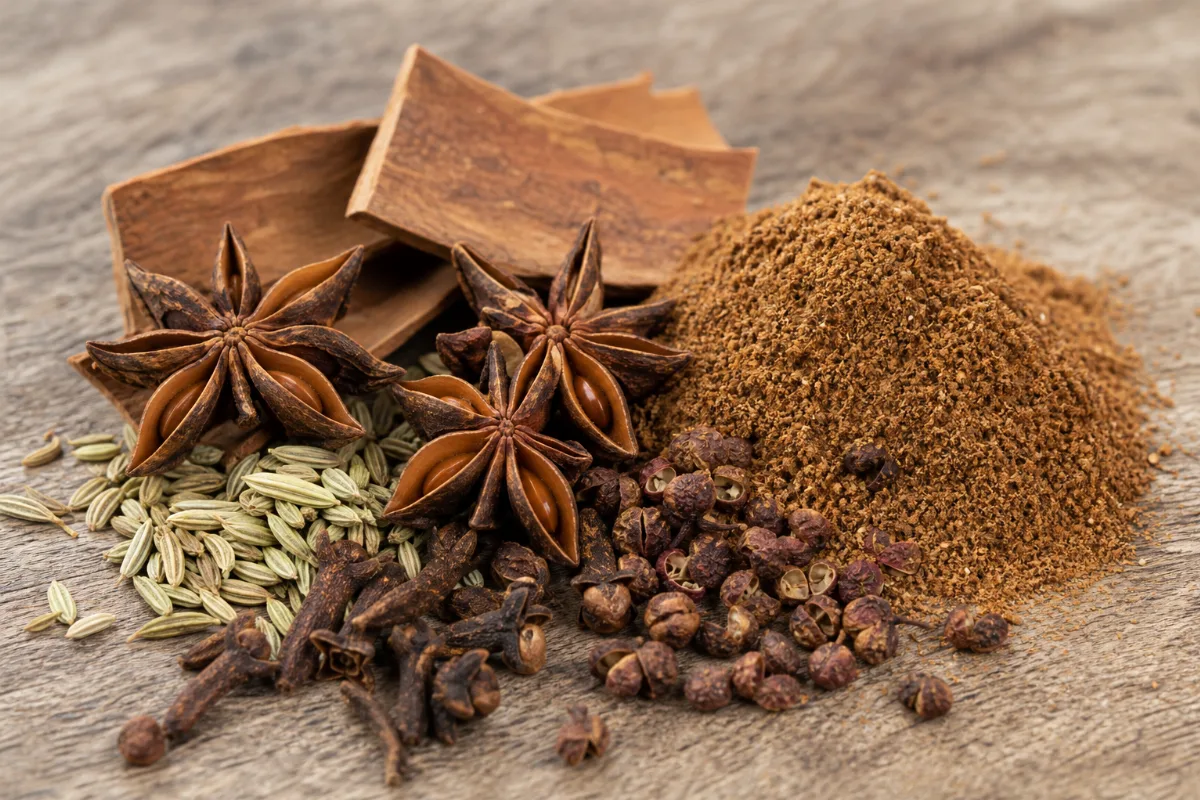
Chinese five-spice is a sweet, warm powder usually made from star anise, cloves, Chinese cinnamon, Sichuan pepper and fennel seed. It is a cooking blend, and almost no research looks at the blend itself. The one study found is a lab test of antioxidant levels. The main cautions come from its ingredients: never brew star anise tea for a baby, and heavy use of cassia cinnamon adds coumarin.
General information, not medical advice. Last substantive update · Not medically reviewed. A named clinician has not signed off on this page. How this page is made
About Chinese five-spice
Five-spice is a flavoring blend, not a proven remedy. The research that exists is about its ingredients, and the cautions are about star anise tea, cassia cinnamon and reading labels.
What it is
Five-spice powder is a spice mixture of five or more spices. Wikipedia says the common mix is star anise, fennel seed, cloves, Chinese cinnamon and Sichuan pepper, used in almost all branches of Chinese cooking.
There is no single recipe. Other versions add anise seed, ginger, nutmeg, turmeric, cardamom-type pods, licorice, mandarin peel or galangal. In southern China, a different cinnamon and mandarin peel are often used in place of cassia and cloves. A larger thirteen-spice powder also exists. Cooking facts come from Wikipedia, a secondary source.
How it is used
It is used as a rub for chicken, duck, goose, pork and seafood, in red-cooked dishes, in Cantonese roast duck and beef stew, and in breading for fried foods. Salt can be dry-roasted with the powder to make a seasoned salt. It has spread into other cuisines, for example a Vietnamese marinade for broiled chicken.
What the research shows
We found no trial in which people ate five-spice and a health result was measured. The one study of the blend is a lab test of antioxidant capacity. It found clove added most of the antioxidant capacity and that the other four spices mainly add flavor.
Lab antioxidant scores are not health results. Studies of single ingredients, such as cinnamon, cloves, fennel and Sichuan pepper, do not tell us what a blend does in a dish. Those are on their own pages.
Cautions that come from the ingredients
Star anise: the FDA advised in 2003 against teas brewed from star anise, after about 40 people, including about 15 infants, became ill. It also worried that Chinese star anise may contain toxic Japanese star anise. These reports are about tea, not a pinch of the blend in a cooked dish.
Cassia cinnamon: Germany's BfR says cassia contains higher levels of coumarin, which in especially sensitive people can harm the liver, and it sets a tolerable daily intake. We did not find how much cassia a typical blend holds.
Labels and lead: read the ingredient list on ready-mixed blends, since sesame must be labeled in the US on packaged foods. A US report found lead in many ground spice samples, but it did not name five-spice.
Nutrition
We found no USDA entry for Chinese five-spice, so we give no calories or nutrient figures. It is used by the pinch, so it adds very little of any nutrient to a meal. If a packaged blend lists sodium, read its label, because some blends are mixed with salt.
Amounts
This page gives no amounts to eat. Follow your recipe or the maker's label, and ask a doctor, pharmacist or dietitian what is right for you.
At a glance
Traditional uses history, not proof
- Used in Chinese cooking as a rub or marinade for duck, pork, chicken and seafood
- Used in red-cooked dishes, roast duck and stews
- Described by Wikipedia as traditionally used for indigestion and as an antiseptic, with no study found
Studied for research
- Antioxidant capacity, insufficient evidence (one lab test of powders; no people)
- Indigestion and germ-killing, insufficient evidence (a traditional claim; no study found)
Main compounds
- Phenolic compounds (clove adds the most, in a lab test)
- Coumarin (from cassia cinnamon)
Common forms
- Ready-mixed ground powder
- Whole spices ground at home
- Tea (do not give to babies: star anise tea is the concern)
- Seasoned salt (check the label for salt)
Research links: Lab study 2015: antioxidant capacity of five-spice ingredients · FDA 2003: advisory on teas made from star anise · BfR 2012: FAQ on coumarin in cinnamon · Research Library · Genes & Biomarkers Library
What it is and its history
- Accepted scientific name
- Not a single plant: a blend. Usual ingredients are Illicium verum, Foeniculum vulgare, Syzygium aromaticum, Cinnamomum cassia and Zanthoxylum species (Sichuan pepper)
- Naming authority
- Names checked at GBIF 2026-10-26
- Common names
- Chinese five-spice (English); Five-spice powder (English); Wuxiang fen (五香粉) (Chinese)
- Native range
- The blend is used in almost all branches of Chinese cooking and has spread with the Chinese diaspora (Wikipedia, secondary).
- What it looks like
- Fruit: Ground brown powder or whole spices to grind.
- Harvest and processing
- Sold as ready-mixed powder, or home-ground from the whole spices (Wikipedia does not describe a standard recipe).
- Look-alikes and adulterants
- Name: Japanese star anise (Illicium anisatum); Note: A toxic look-alike of the star anise ingredient, named by the FDA. See the Safety tab.; Name: Thirteen-spice powder (shisanxiang); Note: A larger blend made by adding eight more spices; used less commonly (Wikipedia).; Name: Other five-spice recipes; Note: There are many variants. Some add anise seed, ginger, nutmeg, turmeric, cardamom-type pods, licorice, mandarin peel or galangal (Wikipedia).
Traditional use and history history, not clinical proof
| Tradition or era | Documented use | Source |
|---|---|---|
Traditional use shows how it was used. It does not show that it works or is safe today.
What is inside, and how it may work
What it contains and how those compounds act in cells and animals. Laboratory and animal mechanisms are not proven effects in people.
Main compounds
| Compound | Family | Where it is concentrated | Activity studied | Level of evidence |
|---|---|---|---|---|
| Phenolic compounds (total phenolic content) | phenolics | Clove contributed most to the blend Not given in the abstract | Rose with clove share and tracked lab antioxidant measures (Bi 2015). 2 | Lab |
| Coumarin | benzopyrone | Cassia cinnamon About 3,000 mg per kg of cassia on average, highest measured about 10,000 mg per kg (BfR) | BfR sets a tolerable daily intake of 0.1 mg per kg body weight. Content in the blend not found. 4 | Authoritative guidance |
Mechanisms, receptors and pathways
| Target or pathway | Gene or receptor | What was found | Level |
|---|---|---|---|
| Lab antioxidant measures | Clove raised the lab antioxidant values of the blend. This is chemistry in a test tube, not an effect in the body. 2 | Lab |
Absorption, metabolism and elimination
- Absorption
- Not found.
- Distribution
- Not found.
- Metabolism
- Not found.
- Elimination
- Not found.
- Bioavailability
- Not found.
Isolated compounds versus whole extracts
There is no research on the blend as eaten. The one study is a lab chemistry test of powders. Evidence about single ingredients (star anise tea, cassia coumarin) belongs to those ingredients and not necessarily to a pinch of the blend in food. Concentrated oils, extracts and supplements of the ingredients are different products and were not assessed.
Nutritional composition
No USDA FoodData Central entry for Chinese five-spice was found. An earlier check of the older page text reported no entry in the USDA Legacy table, and an attempt to search again on 2026-10-26 was blocked by the USDA rate limit, so we give no calories or nutrient figures per teaspoon. Five-spice is used by the pinch, so it adds very little of any nutrient to a meal. If a packaged blend lists sodium, read its label, because some blends are mixed with salt. No amounts to eat are given here.
2 not enough evidence
What was looked at
The 2 benefits and uses checked for Chinese five-spice, each with how strong the evidence is. Tap one to open it.
What is Chinese five-spice good for?
The studied uses and how strong the evidence is for each. Almost nothing has been studied for the blend itself.
Benefits, one by one
Each card is a research question, not a promise. Tap a goal to filter. Open a card to see the studies, doses and limits.
Antioxidant capacity in a lab test
Not enough evidenceOne lab study tested five-spice powders made with different amounts of each spice. In its test-tube measures, clove added most of the antioxidant capacity. This is chemistry in a lab. It does not show a benefit in people.
1 studiesGround spice blends in the lab. Not a supplement and not a food trial.
Studies, doses and limits
Results
Bi 2015 (abstract read) reports that clove was the major contributor to the antioxidant capacity of the blend, and that lab values rose in step with the clove share. The other four ingredients mainly add flavour, in the authors' words. The abstract gives no numbers.
Effect sizes as reported
Not given in the abstract.
Why this rating
Insufficient for people: a test-tube measure of powders, no people studied, and lab antioxidant scores are not a health outcome.
Form and dose studied
Ground spice blends in the lab. Not a supplement and not a food trial.
Limits
Lab chemistry, one study, no health outcome. It compares recipe proportions, not eating.
Why researchers looked
Spices contain plant chemicals called phenolics, which score high in lab antioxidant tests, so researchers compared the five ingredients.
Traditional use
Five-spice powder is a cooking blend. Its tradition is flavour, not treatment.
Proposed mechanism Lab animal
Lab measures only. The authors link the result to total phenolic content, which rose with the clove share. Whether this matters in the body was not tested.
A proposed mechanism does not show that the effect happens in people.
None specific to this finding.
Indigestion and germ-killing (traditional use)
Not enough evidenceAn encyclopedia entry says five-spice has been used traditionally for indigestion and as an antiseptic. We found no study that tested this, so we cannot say it works.
1 studiesCulinary spice blend.
Studies, doses and limits
Results
No results to report.
Why this rating
Insufficient: a traditional claim from a secondary source, with no study found for the blend.
Form and dose studied
Culinary spice blend.
Limits
No research. The claim has not been checked against a primary source.
Why researchers looked
Not studied in people. It appears only as a traditional claim.
Traditional use
Wikipedia, a secondary source, says the blend has a traditional use as an antiseptic and a cure for indigestion. Long use is not proof of effect, and the claim was not checked against a primary source.
Proposed mechanism Unknown
Not shown.
A proposed mechanism does not show that the effect happens in people.
See the Safety tab for allergy, cassia, star anise tea and lead.
Connections to the rest of health
How Chinese five-spice connects to the rest of our health knowledge graph. Every link says what kind of connection it is. A safety link (for example to the liver) is a warning, not a benefit. A study that merely mentions a topic never creates a benefit link.
Explore every connection: goals, body systems, organs, symptoms, genes
B. Body systems
| Connected to | Kind of connection | Evidence status | Context | Studies |
|---|---|---|---|---|
| Nervous system | Adverse effect or risk | Documented risk | Seizures in infants after star anise tea. This is about tea, not the blend in cooking. Seizures in infants after star anise tea, an ingredient of the blend. About tea, not cooking. Preparation or compound: Star anise tea (one ingredient of the blend) |
5 3 |
| Digestive System | Biological association | Not enough evidence | Studied for: Indigestion and germ-killing (traditional use) | 8 |
L. Active compounds
| Connected to | Kind of connection | Evidence status | Context | Studies |
|---|---|---|---|---|
| Phenolic compounds (total phenolic content) | Biological association | Lab | Rose with clove share and tracked lab antioxidant measures (Bi 2015). Preparation or compound: Clove contributed most to the blend |
2 |
| Coumarin | Biological association | Authoritative guidance | BfR sets a tolerable daily intake of 0.1 mg per kg body weight. Content in the blend not found. Preparation or compound: Cassia cinnamon |
4 |
Each connection is stored with the ingredient, the connected record, the kind of connection, the evidence status, the supporting studies, the preparation or compound involved, and a review date (last reviewed October 26, 2026).
Evidence at a glance: what the research found for 2 outcomes
Each outcome below is one thing researchers measured. Certainty is how far the evidence can be trusted, not how well it works. The full studies are on the next tab.
The evidence
The research centre for Chinese five-spice. Every record here was checked against PubMed or the publisher's page; we never list a study we have not verified.
Evidence by outcome
Bars show how many studies we found for each outcome, not how well it works. People are added up across trials only (reviews are not added, to avoid double counting).
How we rate evidence
High certainty
Several well-run trials or reviews agree; further research is unlikely to change the picture much.
Moderate certainty
Good trials point the same way, but some doubt remains.
Low certainty
Small, short or inconsistent trials. The finding could change with better research.
Very low certainty
Very little or very weak human data. Treat as a possibility only.
Mixed findings
Trials or reviews disagree with each other.
Not enough evidence
Not enough human research to say either way.
Evidence against
Good research found no benefit, or found harm.
We take the reviewers' own risk-of-bias and GRADE statements where they exist, and otherwise judge from study size, design, consistency, directness and whether a product matches what is sold. Many publications do not make evidence high. Method note: We started from our earlier five-spice text, then re-opened each source: the Wikipedia entry, the BfR coumarin page, the FDA star anise and sesame pages, and the PubMed records. Little research exists on the blend itself, so this page is shorter than the single-spice pages. Cooking facts come from Wikipedia, a secondary source. Gaps are listed above.
Study library: every study we checked 8
| Study | Design | People | Product, dose, length | Result |
|---|---|---|---|---|
| Angelon-Gaetz 2018 Lead in Spices, Herbal Remedies, and Ceremonial Powders Sampled from Home Investigations for Children with Elevated Blood Lead Levels - North Carolina, 2011-2018. MMWR Morb Mortal Wkly Rep · PMID 30462630 · DOI |
Case series |
59 59 properties where children had raised blood lead, North Carolina |
Spices, herbal remedies and ceremonial powders sampled from homes 2011 to 2018 |
More than one fourth (28.8 percent) of the spices, herbal remedies and ceremonial powders sampled from these homes contained 1 mg/kg of lead or more. The authors say lead in such products might be an important route of childhood lead exposure and suggest a national maximum limit. 28.8 percent of samples at 1 mg/kg or more (n/a) Methods, limits and fundingOutcomes: Lead in the products Limitations: Samples came only from homes of children who already had raised blood lead, so it does not show how common lead is in spices in general. The abstract does not name five-spice. Funding and conflicts: No conflicts of interest disclosed. Read: abstract |
| Bi 2015 Evaluation of antioxidant capacity of Chinese five-spice ingredients. Int J Food Sci Nutr · PMID 25666419 · DOI |
Laboratory study lab |
Spice powders tested in the lab (32 spice samples) | Five-spice powder (Szechuan pepper, fennel seed, cinnamon, star anise, clove) in varying proportions Dried spices · vs Single spices |
The authors report that clove was the major contributor to the antioxidant capacity of the blend, and that the other four ingredients contributed to flavour. The lab values rose linearly with the share of clove in the blend. Total phenolic content and antioxidant capacity were linearly related across the 32 spice samples. Not given as numbers in the abstract (n/a) Methods, limits and fundingOutcomes: Total phenolic content and four lab measures of antioxidant capacity (including FRAP, TEAC, ORAC) Limitations: A test-tube chemistry study. It measures what a powder does in a lab test, not what happens in the body. No people were studied. Funding and conflicts: Not stated in the abstract. Read: abstract |
| Ize-Ludlow 2004 Neurotoxicities in infants seen with the consumption of star anise tea. Pediatrics · PMID 15492355 · DOI |
Case report |
7 7 infants |
Home-made star anise tea Fruit Not given in the abstract Not given in the abstract |
The authors report 7 cases of adverse neurologic reactions in infants after home star anise tea. They also report evidence that Chinese star anise has been contaminated with Japanese star anise, and say the tea should no longer be given to infants. 7 cases (n/a) Methods, limits and fundingOutcomes: Adverse neurologic reactions Limitations: Case reports cannot say how often harm happens. This is about tea, not about star anise in a spice blend. Funding and conflicts: Not stated in the abstract. Read: abstract |
| s-bfr-coumarin BfR (Germany), 27 September 2012: FAQ on coumarin in cinnamon and other foods · Source |
Regulatory statement n/a |
Methods, limits and fundingRead: full-text | ||
| s-fda-2003 FDA, CFSAN 2003: advisory on teas made from star anise · Source |
Regulatory statement n/a |
Methods, limits and fundingRead: full-text | ||
| s-fda-sesame FDA: The FASTER Act - Sesame Is the Ninth Major Food Allergen · Source |
Regulatory statement n/a |
Methods, limits and fundingRead: full-text | ||
| s-gbif-names GBIF Backbone species matches for the five usual ingredients · Source |
Reference database n/a |
Methods, limits and fundingRead: full-text | ||
| s-wikipedia-five-spice Wikipedia: Five-spice powder · Source |
Secondary reference n/a |
Methods, limits and fundingRead: full-text |
What we do not know yet
- No trial of five-spice in people was found for any health outcome.
- The only study of the blend is a lab antioxidant test of powders.
- The share of cassia and star anise in typical blends was not found.
- No USDA nutrition figures, pregnancy or breastfeeding statement or medicine-interaction data for the blend were read.
- Mould toxins and pesticide residues in five-spice were not researched.
How new research is added
New studies are found by a saved PubMed search and placed in a review queue before the page changes.
Lab markers
What changed in blood or saliva tests during trials. A changed number is not the same as feeling or being healthier, and we give no "normal ranges".
Safety
What studies and official sources say about side effects, medicines and who should check first. Each point shows what kind of evidence it comes from.
Main points to know 5
- Never give star anise or five-spice tea to a baby. Star anise is one of the usual ingredients. In 2003 the FDA advised the public not to drink teas brewed from star anise, after about 40 people, including about 15 infants, became ill, with effects from seizures to vomiting, jitteriness and rapid eye movement. A Pediatrics report of 7 infants says star anise tea should no longer be given to infants. These reports are about tea, not about a pinch of the blend in cooked food. Case report 5 3
- A toxic look-alike can be mixed into star anise. The FDA worried that the common Chinese star anise (Illicium verum) may contain Japanese star anise (Illicium anisatum), which has long been recognised as toxic and should be used for decoration only. Pediatrics 2004 reports evidence that Chinese star anise has been contaminated this way. No source read tested five-spice blends for this, so we cannot say how often it affects them. Authoritative guidance 5 3
- Cassia cinnamon contains coumarin. The usual cinnamon in five-spice is Chinese cinnamon (cassia). Germany's BfR says cassia contains higher levels of coumarin than Ceylon cinnamon, and that in especially sensitive people coumarin can cause liver damage, which is usually reversible. It sets a tolerable daily intake of 0.1 mg coumarin per kg of body weight, which it says is reached by about 2 g of cassia a day for a 60 kg adult and 0.5 g for a 15 kg child. BfR says cases of liver damage from eating cinnamon have not been described in the literature. We found no source that gives the share of cassia in five-spice, so we cannot say how close a serving comes to these figures. Authoritative guidance 4
- Mixed blends can hide allergens. Ready-mixed blends can contain other ingredients. The FDA says that since 1 January 2023 sesame must be labelled as an allergen on packaged foods in the US, and its example label shows a spice mix containing sesame and wheat. Read the ingredient list. This is a labelling fact; it does not say five-spice contains sesame. Authoritative guidance 6
- Lead can occur in ground spices. A US report found that 28.8 percent of spices, herbal remedies and ceremonial powders sampled from homes of children with raised blood lead contained 1 mg/kg of lead or more. The abstract does not name five-spice and the samples came only from those homes, so this shows that ground spices in general can carry lead, not that five-spice does. Case series 1
Side effects 2
| Effect | How often | Severity and recovery | Evidence |
|---|---|---|---|
| Seizures, vomiting, jitteriness in infants after star anise tea Linked to tea and to possible Japanese star anise contamination. Not shown for cooked food or for the blend. | FDA 2003: about 40 ill, about 15 infants. Pediatrics 2004: 7 infants. How common it is was not found. | serious (seizures) Not stated in the sources read | Case report 5 3 |
| Liver reaction to coumarin in especially sensitive people (cassia) Based on coumarin used as a medicine and on animal work, not on cinnamon eaten in food. | BfR says no liver damage from eating cinnamon has been described in the literature. | usually reversible, per BfR Usually reversible (BfR) | Authoritative guidance 4 |
Liver
BfR says that coumarin, which is found at high levels in cassia, can cause liver damage in especially sensitive people, usually reversibly, but that no such cases from eating cinnamon have been described. No liver data for five-spice itself were found. A LiverTox entry was not read. 4
How often. No frequency found for the blend.
Monitoring. No agency monitoring advice for the blend was found.
This is a safety connection. It is not evidence that Chinese five-spice supports liver health.
Medicines and supplements 1
| With | Why it matters | Importance | Evidence | What to do |
|---|---|---|---|---|
| No medicine interaction with five-spice in food is described in the sources read general | Unknown | Insufficient Not enough evidence | If you use clove or cinnamon oils, extracts or supplements, or take blood thinners or diabetes medicine, ask a pharmacist. |
Who should check first 3
| Situation | Advice | Evidence |
|---|---|---|
| Babies and young children (any star anise tea or home infusion) | Do not give it. The FDA advises against teas brewed from star anise for infants and children. | Authoritative guidance 5 3 |
| Known allergy to sesame, mustard, celery or any spice | Read the label of any ready-mixed blend, and ask an allergy clinician. | Authoritative guidance 6 |
| Pregnancy and breastfeeding | No official statement about five-spice was found. Culinary use is common, but ask your doctor or midwife. | Insufficient |
Overdose, product quality and regulators
Summary. The sources read describe harm from star anise tea in infants and a coumarin intake limit for cassia. They do not describe harm from five-spice used in cooking.
Animal. Not reviewed.
High dose or long term signals. Cassia coumarin: only if very large amounts of high-coumarin cassia are eaten over a long time, per BfR.
Overdose response. Seek urgent medical help for seizures or breathing trouble.
Genotoxicity. Not researched.
Toxic or hazardous parts. Japanese star anise fruit (Illicium anisatum) is the toxic look-alike named by the FDA.
Three quality issues were found in the sources: a possible toxic star anise mix-up, lead in ground spices, and undeclared ingredients in mixed blends.
Star anise mix-up. FDA could not yet tell Chinese from Japanese star anise at the time of its 2003 advisory. Pediatrics 2004 reports evidence of contamination. 5 3
Lead. 28.8 percent of spices, herbal remedies and ceremonial powders from homes of children with raised blood lead had 1 mg/kg or more. Five-spice was not named. 1
| Body | Action | Date |
|---|---|---|
| FDA (US) (United States) | 10 September 2003 advisory: do not consume teas brewed from star anise; FDA unaware of scientific evidence that they help; Chinese star anise may contain toxic Japanese star anise source | 2003-09-10 |
| BfR (Germany) (Germany) | FAQ on coumarin in cinnamon: tolerable daily intake 0.1 mg per kg body weight; cassia contains higher levels of coumarin than Ceylon; people who often use large amounts of cinnamon should choose Ceylon source | 2012-09-27 |
| FDA (US) (United States) | Sesame must be labelled as an allergen on packaged foods and supplements since 1 January 2023 source | 2023-01-01 |
When to get medical help
- A baby or child with seizures, jerking, stiffening, blue lips or unusual jitteriness after star anise tea: call emergency services and keep the product
- Anyone with seizures or confusion after a star anise product
- Trouble breathing, swelling of the lips, face or throat, or widespread hives after a spice blend
- Yellow skin or eyes, or dark urine, after weeks of heavy cassia cinnamon use
Stop using the product and contact a clinician or emergency service. In the US, Poison Control is 1-800-222-1222.
General information only, not medical advice. Ask a clinician or pharmacist before use, especially with medicines, in pregnancy or with a health condition. See the Natural Remedy Safety guide.
Frequently asked questions
What is Chinese five-spice?
A sweet, warm spice blend used in Chinese cooking. The common mix is star anise, fennel seed, cloves, Chinese cinnamon and Sichuan pepper, but there is no single recipe.
What is in five-spice powder?
Usually star anise, fennel seed, cloves, Chinese cinnamon and Sichuan pepper. Some recipes add anise seed, ginger, nutmeg, turmeric, licorice, mandarin peel or galangal.
Is five-spice good for your health?
Not shown. We found no study of eating the blend. The one study is a lab test of antioxidant capacity. It does not show a health benefit.
Which ingredient adds the most antioxidants?
In one lab study, clove added most of the antioxidant capacity of the blend. That was a test-tube measure, not a result in people.
Is five-spice safe to eat?
Can I give five-spice or star anise tea to a baby?
Does five-spice contain coumarin?
Probably some, because the usual cinnamon is cassia, which contains higher levels of coumarin than Ceylon. We did not find how much cassia a blend holds. BfR advises moderate use of cassia.
Can five-spice contain allergens?
A ready-mixed blend can contain other ingredients. In the US, sesame must be named as an allergen on packaged foods since 2023. Read the label if you have a food allergy.
Is there lead in five-spice?
Not shown for five-spice. A North Carolina report found lead in many ground spice samples from homes of children with raised blood lead, but it did not name five-spice. Choose a seller you trust.
Is five-spice safe in pregnancy or while breastfeeding?
No official statement about the blend was found. Culinary use is common, but ask your doctor or midwife, especially about teas, extracts or oils of its ingredients.
Does five-spice interact with medicines?
No interaction with the blend in food was found in the sources read. That is missing information, not proof of safety. Ask a pharmacist if you use clove or cinnamon oils, extracts or supplements.
Is five-spice the same as garam masala or curry powder?
No. They are different blends with their own ingredients and uses. Five-spice is anise-led and sweet. See the related pages for the others.
Explore by health goal
Editorial transparency
- Written by
- AlternativeMed editorial team. Research compiled with AI assistance, then checked against the sources listed.
- Medical review
- None. This page has not been reviewed by a physician or pharmacist.
- First published
- 2026-10-26
- Last substantive update
- 2026-10-26
- How we research
- We started from our earlier five-spice text, then re-opened each source: the Wikipedia entry, the BfR coumarin page, the FDA star anise and sesame pages, and the PubMed records. Little research exists on the blend itself, so this page is shorter than the single-spice pages. Cooking facts come from Wikipedia, a secondary source. Gaps are listed above.
- How we rate evidence
- See "How we rate evidence" in the Evidence tab.
- Independence
- No product is promoted on this page. No affiliate links are shown.
Sources 8
Each source was opened and checked. Where we read only the abstract, it says so. The small numbers in the text point here.
- Angelon-Gaetz KA, Klaus C, Chaudhry EA, Bean DK. Lead in Spices, Herbal Remedies, and Ceremonial Powders Sampled from Home Investigations for Children with Elevated Blood Lead Levels - North Carolina, 2011-2018.. MMWR Morb Mortal Wkly Rep. 2018. PMID 30462630. DOI 10.15585/mmwr.mm6746a2. (abstract)
- Bi X, Soong YY, Lim SW, Henry CJ. Evaluation of antioxidant capacity of Chinese five-spice ingredients.. Int J Food Sci Nutr. 2015. PMID 25666419. DOI 10.3109/09637486.2015.1007452. (abstract)
- Ize-Ludlow D, Ragone S, Bruck IS, Bernstein JN, Duchowny M, Pena BM. Neurotoxicities in infants seen with the consumption of star anise tea.. Pediatrics. 2004. PMID 15492355. DOI 10.1542/peds.2004-0058. (abstract)
- . BfR (Germany), 27 September 2012: FAQ on coumarin in cinnamon and other foods. . . (full-text)
- . FDA, CFSAN 2003: advisory on teas made from star anise. . . (full-text)
- . FDA: The FASTER Act - Sesame Is the Ninth Major Food Allergen. . . (full-text)
- . GBIF Backbone species matches for the five usual ingredients. . . (full-text)
- . Wikipedia: Five-spice powder. . . (full-text)
Where to buy
Check the label first. Whatever you buy, look for these:
- Whole or ground: whole spices keep their flavor longer
- The origin and a packed-on or best-by date for freshness
- Organic or non-irradiated labeling if that matters to you
- A resealable, airtight container
Talk to a pharmacist or doctor before you start any supplement, especially if you take medicines. See the Safety tab for interactions.
Support our free guides: as an Amazon Associate we earn from qualifying purchases. Full disclosure.


