Spices · Spice blend
Curry powder
Not a single plant: a blend of ground spices · also called Curry spice mix, Madras curry powder, Bombay curry powder, polvo de curry (Spanish)
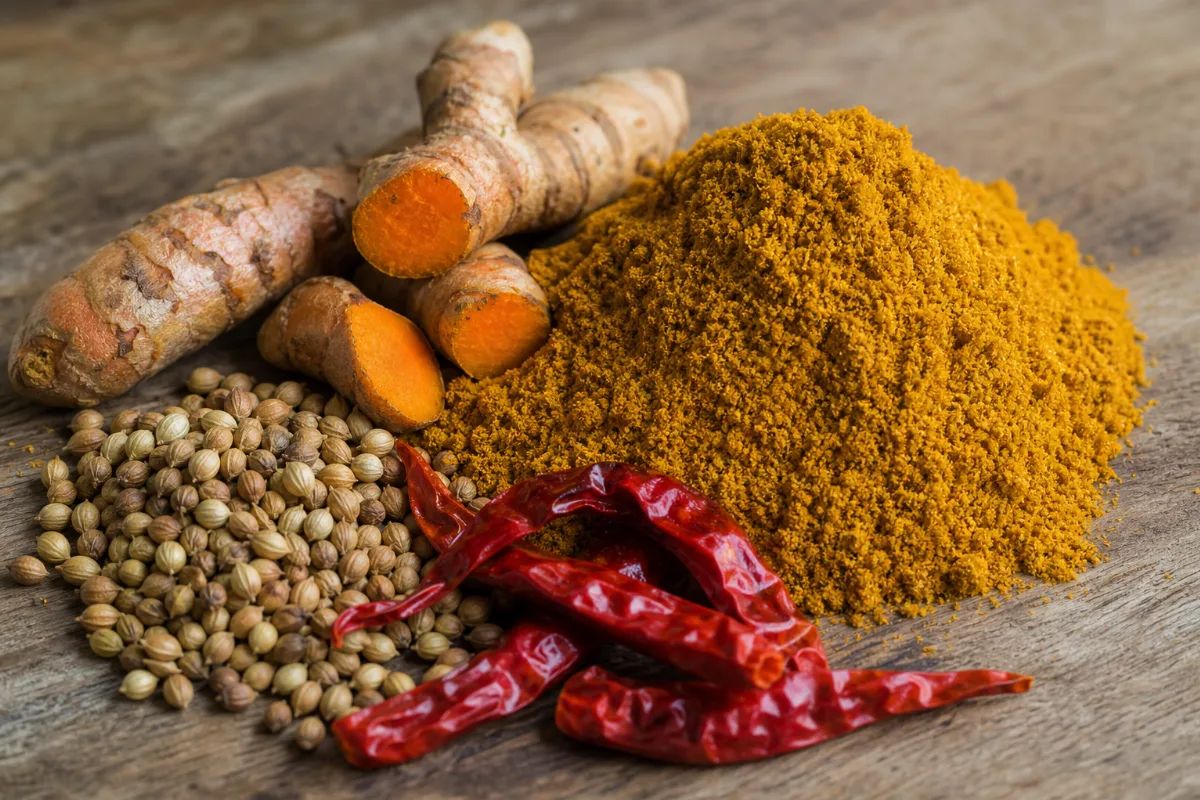
Curry powder is a ready-made mix of ground spices used to give a dish a curry flavor. Recipes differ by maker, but turmeric, coriander, cumin, fenugreek and chili are common. We found no trial of the blend itself, only studies of curry meals in older adults and of single spices. The main cautions are lead in some ground spices and allergens such as mustard or sesame, so read the label.
General information, not medical advice. Last substantive update · Not medically reviewed. A named clinician has not signed off on this page. How this page is made
About Curry powder
Curry powder is a ready-made mix of ground spices with no single recipe. It is a flavoring, not a proven remedy. No trial of the blend was found, and the main cautions are lead in some ground spices, allergens such as mustard and sesame, and germs on dried spices.
What it is
Curry powder is any of several spice mixes made for curry, adapted from garam masala. It was first sold by Indian merchants to British traders, and a London shop advertised a commercial version in 1784. British traders later took it to Japan, where it became the base of Japanese curry.
There is no single recipe. Wikipedia says the Indian, Pakistani and international (ISO) standards do not name required ingredients, so what is in a pack depends on the maker. Three 1895 recipes used coriander, chilli and black pepper in all three, with turmeric, cumin, mustard seed, fenugreek, ginger or saffron in some. It is not a plant: it is a mix, and curry leaf is a separate plant.
Nutrition in a teaspoon
USDA data for one sample of curry powder: 325 kcal per 100 g. A teaspoon is 2.0 g, so it gives about 6.5 kcal, 1.1 g fibre, 10.5 mg calcium, 0.4 mg iron, 23 mg potassium and 1 mg sodium (our arithmetic). A tablespoon is 6.3 g, about 20 kcal and 3.4 g fibre.
These are small shares of any daily need, so curry powder is a flavoring, not a main source of nutrients. The sodium is very low in this one record; the salt in other products was not checked, so read the label.
In the kitchen
Curry powder goes into sauces, stews, soups, rice and vegetable dishes. One old example is a chicken dish where pieces are dusted with curry powder and fried with onions. Taste depends on the maker.
Turmeric gives most blends their yellow color. Whole-spice blends and pastes also exist, but the sources read describe only the ground powder.
What the research shows
A PubMed search found no clinical study of curry powder. What exists is three papers from one Singapore group of older adults who were asked how often they ate curry. More curry was linked to slightly better thinking tests, fewer new cases of mild cognitive impairment or dementia, and a lower death rate over about 11.6 years. The same study found a larger waist, higher fasting glucose and more diabetes with more curry. These are links in a group, not proof, and they are about curry meals rather than the powder.
A 2006 lab study of 28 turmeric and curry powder products found pure turmeric averaged 3.14% curcumin by weight, while curry powders, with one exception, held relatively small and very variable amounts. That is one reason curcumin results from supplements should not be read as results for curry powder.
The blend versus single spices and supplements
Turmeric, cumin, coriander, fenugreek and chili each have their own research, and turmeric and curcumin supplements have the most. That work does not carry over to a pinch of a mixed powder, and supplement warnings are not applied to food.
Amounts
This page gives no amounts to eat or take. Ask a doctor, pharmacist or dietitian what is right for you, especially in pregnancy, if you take medicines, or before using turmeric or curcumin supplements.
At a glance
Traditional uses history, not proof
- Used in cooking to season sauces, stews, rice and vegetable dishes; it is a Western-style ready-made mix adapted from garam masala
- A shop version was first advertised in London in 1784 (Wikipedia); long use as a flavoring is not proof of any health effect
Studied for research
- Curry powder as a blend: no human trial found
- Thinking skills in older adults who eat curry meals (Singapore, observational), very low certainty
- Deaths and health markers in older adults who eat curry meals (Singapore, observational), very low certainty, mixed
Main compounds
- Curcumin (from turmeric; gives the yellow color; far less than in plain turmeric in a 2006 lab study)
- Fibre (53.2 g per 100 g in the USDA record, about 1.1 g per teaspoon)
- Iron (19.1 mg per 100 g in the USDA record)
- Calcium (525 mg per 100 g in the USDA record)
Common forms
- Ground curry powder mix (the usual form)
- Curry meals and sauces made with the powder
- Turmeric or curcumin supplements (a different product, not the same as the blend)
Research links: USDA FoodData Central: Spices, curry powder · CDC MMWR: Lead in spices, herbal remedies and ceremonial powders, North Carolina (2018) · FDA: Sesame is the ninth major food allergen · Curcumin content of turmeric and curry powders (Nutr Cancer, 2006) · NCCIH: Turmeric: Usefulness and Safety · Research Library · Genes & Biomarkers Library
What it is and its history
- Accepted scientific name
- Curry powder (a spice blend, no single species)
- Synonyms
- Curry spice mix
- Common names
- Curry powder (English); Polvo de curry (Spanish); Madras, Bombay or Bengal curry powder (historic recipe names) (English)
- Family or group
- Spice blend (many plant families).
- Harvest and processing
- Ground spices mixed by the maker. Recipes differ; Wikipedia says the Indian (FSSAI), Pakistani and ISO standards do not name required ingredients, while a US description expects turmeric, coriander, fenugreek, cinnamon, cumin, black pepper, ginger and cardamom, and a 2017 Ugandan draft requires turmeric, coriander, cumin, fenugreek and mustard. We did not open the standards.
- Look-alikes and adulterants
- Name: Curry leaf (Murraya koenigii); Note: A different plant: the fresh or dried leaf of a tree, not the spice mix. The USDA record for curry powder tags its plant attribute as Murraya koenigii, which looks like a labelling quirk.; Name: Garam masala; Note: A traditional Indian warm-spice mix. Wikipedia says Western curry powder is comparable to it.; Name: Turmeric; Note: One ingredient, the yellow base of most blends; not the same thing as curry powder.
Photographs
Traditional use and history history, not clinical proof
| Tradition or era | Documented use | Source |
|---|---|---|
Traditional use shows how it was used. It does not show that it works or is safe today.
What is inside, and how it may work
What it contains and how those compounds act in cells and animals. Laboratory and animal mechanisms are not proven effects in people.
Main compounds
| Compound | Family | Where it is concentrated | Activity studied | Level of evidence |
|---|---|---|---|---|
| Curcumin (from turmeric) PubChem 969516 | curcuminoid (polyphenol) | Turmeric root (an ingredient of most blends) Pure turmeric powder averaged 3.14% by weight; most curry powders held much less, and amounts varied widely (a 2006 lab study of 28 products) | Gives turmeric its yellow color (NCCIH). Studied as a supplement; the research is not about curry powder. 11 13 7 | Human data |
| Piperine (from black pepper) PubChem 638024 | alkaloid (amide) | Black pepper fruit (an ingredient of many blends) Not stated for curry powder in any source read | NCCIH says piperine from black pepper is added to some curcumin products because it can improve curcumin absorption. Not shown for curry powder in food. 11 12 | Human data |
Mechanisms, receptors and pathways
| Target or pathway | Gene or receptor | What was found | Level |
|---|---|---|---|
| Curcumin absorption | Not specific | NCCIH says curcumin supplements differ in how well they are absorbed and that piperine is one way to raise absorption. Nothing was found on how much curcumin or piperine a cooked serving of curry powder gives. 11 | Human data |
Absorption, metabolism and elimination
- Absorption
- Not found for curry powder.
- Distribution
- Not found.
- Metabolism
- Not found for the blend.
- Elimination
- Not found.
- Bioavailability
- Not established for the blend. NCCIH says supplement formulations vary.
Isolated compounds versus whole extracts
Almost all the health research is on single spices (such as turmeric or curcumin supplements), or on curry meals reported by how often people eat them. The blend itself has not been tested. Supplement results and cohort results do not carry over to a pinch of curry powder, and safety warnings for supplements are not applied to the food.
Nutritional composition
Nutrition from USDA FoodData Central (Spices, curry powder, FDC 170924, SR Legacy, last updated 4/1/2019, read 2026-10-26). Per 100 g: 325 kcal, 14.3 g protein, 14.0 g fat, 55.8 g carbohydrate, 53.2 g fibre, 525 mg calcium, 19.1 mg iron, 255 mg magnesium, 367 mg phosphorus, 1170 mg potassium, 52 mg sodium, 4.7 mg zinc, 8.3 mg manganese and 99.8 micrograms vitamin K. The record lists a teaspoon as 2.0 g and a tablespoon as 6.3 g. One teaspoon (2.0 g, our arithmetic) holds about 6.5 kcal, 1.1 g fibre, 10.5 mg calcium, 0.4 mg iron, 23 mg potassium, 1 mg sodium, 0.2 mg manganese and 2 micrograms vitamin K, and one tablespoon (6.3 g) about 20 kcal and 3.4 g fibre. A teaspoon is a small part of any nutrient need, so curry powder is a flavoring, not a main source of nutrients. The record shows very little sodium; the salt in other products was not checked. This is one sample, and real products vary. No amount to eat is given.
2 very low certainty1 not enough evidence
What was looked at
The 3 benefits and uses checked for Curry powder, each with how strong the evidence is. Tap one to open it.
- Curry powder as a blend (health effects of kitchen amounts)Not enough evidence
- Thinking skills and memory in older adults who eat curry meals (observational)Very low certainty
- Deaths, life expectancy and health markers in older adults who eat curry meals (observational)Very low certainty
Lab markers tracked in the studies
Memory and thinking test scores (digit span, fluency, block design, screening test)Fasting blood glucose and waist sizeBlood-cell inflammation indices (NLR, PLR, SII)
What is Curry powder good for?
The studied uses and how strong the human evidence is for each. Nothing here is a trial of the blend itself: the results are for curry meals in older adults, which are not the same as using the powder.
Benefits, one by one
Each card is a research question, not a promise. Tap a goal to filter. Open a card to see the studies, doses and limits.
Curry powder as a blend (health effects of kitchen amounts)
Not enough evidenceNo trial of curry powder as a blend was found for any health outcome. What is studied is single spices (mostly turmeric and curcumin supplements) and, in a few groups of older adults, how often people eat curry meals. Those are not the same as a pinch of curry powder in a recipe.
3 studiesGround spice blend used in cooking. Not a supplement. Mixes differ by…
Studies, doses and limits
What the trials found
A PubMed search for curry powder in titles and abstracts found no clinical study of the blend for any health outcome. A 2006 lab study of 28 turmeric and curry powder products found pure turmeric averaged 3.14% curcumin by weight, while the curry powders, with one exception, held relatively small and very variable amounts. A US health agency page on turmeric says we do not know enough to say turmeric or curcumin is beneficial for any health purpose; that page is about supplements.
Results
No result. Insufficient evidence.
Why this rating
No study of the blend; single-spice results depend on which spices and how much the maker used, and curry powders have no fixed recipe.
Form and dose studied
Ground spice blend used in cooking. Not a supplement. Mixes differ by maker.
Who was studied
Not studied.
Limits
Recipes differ: Wikipedia says the Indian, Pakistani and international (ISO) standards do not name required ingredients.
Why researchers looked
Curry powder is a very common mixed spice, so people ask whether it does anything for health.
Traditional use
Curry powder is a Western-style ready-made mix adapted from garam masala, first sold in Britain in 1784 (Wikipedia). Its long use as a flavoring is not proof that it treats any condition.
Proposed mechanism Unknown
Not established for the blend. The sources read do not describe what the mix does at cooking amounts. Turmeric, the usual yellow base, gets its color from curcumin (NCCIH).
A proposed mechanism does not show that the effect happens in people.
See the Safety tab: lead, allergens such as mustard and sesame, and germs in dried spices.
Thinking skills and memory in older adults who eat curry meals (observational)
Very low certaintyIn Singapore, older adults who ate curry more often kept slightly better scores on some memory and thinking tests over about 4.5 years, and had less new mild cognitive impairment or dementia. This is a link seen in a group, not proof that curry or curry powder protects the brain.
2 studiesCurry meals in general. Not curry powder, not a supplement. The abstr…
Studies, doses and limits
What the trials found
Three papers from one Singapore group (the Singapore Longitudinal Ageing Study) asked older adults how often they ate curry. In 2734 adults (mean age 65.9), eating curry more often was linked to higher scores on three tests after 4.5 years, with small effects (Cohen's d 0.130 to 0.186). In 2920 adults, new mild cognitive impairment or dementia was 13.1% in people who never or rarely ate curry and 3.6% in daily curry eaters (adjusted odds ratio 0.21 for daily).
Results
Linked to slightly better scores and fewer new cases of thinking problems. Not a trial.
Effect sizes as reported
Cohen's d 0.130 to 0.186 on three tests; adjusted odds ratio 0.61 (occasional) and 0.21 (daily) for new mild cognitive impairment or dementia versus never or rarely.
Why this rating
Observational, one cohort reported more than once (so not independent), self-reported how often people ate curry, no check of the actual spice or turmeric amount, and healthier or more social people may eat curry more often. The papers are about curry meals, not curry powder.
Form and dose studied
Curry meals in general. Not curry powder, not a supplement. The abstracts do not say what was in the curry.
Who was studied
Community-dwelling adults aged 55 and over in Singapore.
Limits
Same cohort; self-reported; the abstracts do not give funding; cannot show cause; the result may not carry over to other countries or recipes.
Why researchers looked
Curry meals often contain turmeric, and curcumin from turmeric is studied for the brain, so researchers asked whether people who eat curry more often have better thinking skills.
Proposed mechanism Preliminary mechanism
The authors attribute the link to curcumin from turmeric in the curry. That is their idea, not shown by the studies: they only asked how often people ate curry.
A proposed mechanism does not show that the effect happens in people.
The abstracts did not look at harms. See the Safety tab for lead and allergens in spice blends.
Deaths, life expectancy and health markers in older adults who eat curry meals (observational)
Very low certaintyIn 4551 older adults in Singapore followed for about 11.6 years, those who ate curry more often had a lower death rate and a longer associated life expectancy. The same study found mixed signals: more curry went with a larger waist, higher fasting blood sugar and more diabetes, and also with lower blood-cell inflammation measures.
1 studiesCurry meals in general; not curry powder, not a supplement.
Studies, doses and limits
What the trials found
Total death rate hazard ratios were 0.68 (95% CI 0.56 to 0.82), 0.54 (0.43 to 0.69), 0.70 (0.52 to 0.93) and 0.62 (0.41 to 0.95) across the four groups who ate curry more than never or less than once a year, lowest in the middle groups. The authors report an associated 1.0 year longer life expectancy in people with heart, metabolic or vascular disease and 1.9 years in people without. Higher curry frequency also went with a larger waist, higher fasting glucose, more diabetes and lower eGFR (a kidney measure), and with lower blood-cell inflammation indices (NLR, PLR, SII).
Results
Lower death rate; mixed health markers.
Effect sizes as reported
Hazard ratio for death 0.54 to 0.70 in the higher curry groups versus never or less than once a year; see human_evidence for intervals.
Why this rating
Observational, self-reported, one cohort, healthier people may eat curry more often, and some markers pointed the other way. The paper is about curry meals, not curry powder.
Form and dose studied
Curry meals in general; not curry powder, not a supplement.
Who was studied
Adults aged 55 and over in Singapore.
Limits
Cannot show cause. The abstract does not state funding (publication type tags list government research support). The study did not report what was in the curry.
Why researchers looked
The same group that studied curry and thinking skills asked whether curry meals are linked to living longer.
Proposed mechanism Preliminary mechanism
The authors link the results to curcumin from turmeric. The study only asked how often people ate curry, so the cause is not known.
A proposed mechanism does not show that the effect happens in people.
Some markers (waist, glucose, diabetes, kidney measure) were worse with more curry in this study; this is another reason not to read it as a health claim.
Connections to the rest of health
How Curry powder connects to the rest of our health knowledge graph. Every link says what kind of connection it is. A safety link (for example to the liver) is a warning, not a benefit. A study that merely mentions a topic never creates a benefit link.
Explore every connection: goals, body systems, organs, symptoms, genes
B. Body systems
| Connected to | Kind of connection | Evidence status | Context | Studies |
|---|---|---|---|---|
| Digestive System | Biological association | Not enough evidence | Studied for: Curry powder as a blend (health effects of kitchen amounts) | 15 11 7 |
| Nervous System | Biological association | Very low certainty | Studied for: Thinking skills and memory in older adults who eat curry meals (observational) | 4 3 |
| Longevity Aging | Biological association | Very low certainty | Studied for: Deaths, life expectancy and health markers in older adults who eat curry meals (observational) | 5 |
| Cardiovascular System | Biological association | Very low certainty | Studied for: Deaths, life expectancy and health markers in older adults who eat curry meals (observational) | 5 |
| Endocrine System | Biological association | Very low certainty | Studied for: Deaths, life expectancy and health markers in older adults who eat curry meals (observational) | 5 |
E. Health conditions
| Connected to | Kind of connection | Evidence status | Context | Studies |
|---|---|---|---|---|
| Lead exposure from contaminated foods | Documented risk | Lead found in some spice samples; the size of the risk for a given product is unknown. Lead has been found in some ground spices; the risk for any given product is unknown. Preparation or compound: Some ground spices, including turmeric and curry powder samples |
1 2 6 | |
| Food allergy (mustard, sesame, celery) | Label guidance | Check labels. Preparation or compound: Spice mixes that contain these ingredients |
9 10 |
I. Biomarkers
| Connected to | Kind of connection | Evidence status | Context | Studies |
|---|---|---|---|---|
| Memory and thinking test scores (digit span, fluency, block design, screening test) | Biological association | Very low certainty | Measured in trials: raised. A lab change is not the same as a health benefit. | 4 3 |
| Fasting blood glucose and waist size | Biological association | Very low certainty | Measured in trials: raised. A lab change is not the same as a health benefit. | 5 |
| Blood-cell inflammation indices (NLR, PLR, SII) | Biological association | Very low certainty | Measured in trials: lowered. A lab change is not the same as a health benefit. | 5 |
K. Biological pathways
| Connected to | Kind of connection | Evidence status | Context | Studies |
|---|---|---|---|---|
| Curcumin | Preliminary mechanism | Human | Gives turmeric, the usual yellow base of blends, its color. | 11 |
| Dietary fibre | Preliminary mechanism | Human | Ground curry powder is high in fibre by weight in the USDA record (53.2 g per 100 g), though a teaspoon holds about 1 g. | 14 |
L. Active compounds
| Connected to | Kind of connection | Evidence status | Context | Studies |
|---|---|---|---|---|
| Curcumin (from turmeric) | Biological association | Human | Gives turmeric its yellow color (NCCIH). Studied as a supplement; the research is not about curry powder. Preparation or compound: Turmeric root (an ingredient of most blends) |
11 13 7 |
| Piperine (from black pepper) | Biological association | Human | NCCIH says piperine from black pepper is added to some curcumin products because it can improve curcumin absorption. Not shown for curry powder in food. Preparation or compound: Black pepper fruit (an ingredient of many blends) |
11 12 |
Each connection is stored with the ingredient, the connected record, the kind of connection, the evidence status, the supporting studies, the preparation or compound involved, and a review date (last reviewed October 26, 2026).
Evidence at a glance: what changed in 3 lab markers
Tap a number to show only those markers. Counts are markers, not people.
The evidence
The research centre for Curry powder. Every record here was checked against PubMed or the publisher's page; we never list a study we have not verified.
Evidence by outcome
Bars show how many studies we found for each outcome, not how well it works. People are added up across trials only (reviews are not added, to avoid double counting).
How we rate evidence
High certainty
Several well-run trials or reviews agree; further research is unlikely to change the picture much.
Moderate certainty
Good trials point the same way, but some doubt remains.
Low certainty
Small, short or inconsistent trials. The finding could change with better research.
Very low certainty
Very little or very weak human data. Treat as a possibility only.
Mixed findings
Trials or reviews disagree with each other.
Not enough evidence
Not enough human research to say either way.
Evidence against
Good research found no benefit, or found harm.
We take the reviewers' own risk-of-bias and GRADE statements where they exist, and otherwise judge from study size, design, consistency, directness and whether a product matches what is sold. Many publications do not make evidence high. Method note: We re-checked nutrition at USDA FoodData Central, read the North Carolina lead report, FDA, EU allergen and NCCIH pages in full, and read PubMed abstracts. Only abstracts were read for studies. Items we could not verify are flagged in the research gaps. Little research exists on the blend itself, so this page is short on purpose.
Study library: every study we checked 15
| Study | Design | People | Product, dose, length | Result |
|---|---|---|---|---|
| Angelon-Gaetz 2018 Lead in Spices, Herbal Remedies, and Ceremonial Powders Sampled from Home Investigations for Children with Elevated Blood Lead Levels - North Carolina, 2011-2018. MMWR Morb Mortal Wkly Rep · PMID 30462630 · DOI |
Surveillance report (market and home samples) |
386 386 samples of spices, herbal remedies and ceremonial powders from 59 homes of children with raised blood lead in North Carolina, 2011 to 2018 |
Spices and related products tested for lead; two of the samples were curry powder |
28.8% of the 386 samples (111) held 1 mg/kg or more of lead, including 22.0% of food items. Curry powder: 2 samples, mean 1.4 mg/kg (range 0.2 to 2.6). Chili powder or red pepper: 23 samples, mean 12.6, range 0.1 to 170. The report says no US permissible limit for lead in spices existed at that time and that a national limit might reduce lead exposure. Share of samples at 1 mg/kg or more: 28.8%; curry powder mean 1.4 mg/kg from 2 samples Methods, limits and fundingOutcomes: Lead content of products found in homes Limitations: Homes were chosen because a child already had raised blood lead, so the samples are not a random picture of shops. Only two curry powder samples. A report from 2018; rules and products may have changed. Full text read through Europe PMC; the CDC page itself was blocked from our server. Funding and conflicts: US state and federal public health agencies; no industry funding stated. Read: full-text |
| Forsyth 2019 Turmeric means "yellow" in Bengali: Lead chromate pigments added to turmeric threaten public health across Bangladesh. Environ Res · PMID 31550596 · DOI |
Field survey with interviews and lab testing |
152 people interviewed across the turmeric supply chain in Bangladesh; 524 samples of turmeric, pigments, dust and soil | Turmeric powder and yellow pigments, tested for lead and chromium Turmeric root powder |
Highest lead in turmeric powder was 1152 micrograms per gram (690 in the nine main turmeric-growing districts). Lead chromate yellow pigment was added in 7 of the 9 main turmeric-growing districts. Wholesalers said the practice began more than 30 years ago and is driven by demand for bright yellow. Maximum turmeric powder lead 1152 micrograms per gram Methods, limits and fundingOutcomes: Lead and chromium in turmeric; evidence of added lead chromate pigment Limitations: Bangladesh only; says nothing about curry powder sold elsewhere or about any one brand. The abstract does not describe how turmeric reaches blends sold abroad. Funding and conflicts: Not stated in the abstract (publication type tag: non-US government research support). Read: abstract |
| Lu 2025 Curcumin-Rich Curry Consumption Is Associated with Lower Risk of Cognitive Decline and Incidence of Mild Cognitive Impairment or Dementia: An Asian Population-Based Study. Nutrients · PMID 40806073 · DOI |
Prospective cohort (observational) |
2920 Community-dwelling older adults in Singapore, mean age 65.5; 2446 without a thinking disorder at the start were followed for new mild cognitive impairment or dementia |
Curry eaten in meals, reported as how often; not curry powder and not a supplement Frequency of curry meals only (five levels, never or rarely to daily) 3 to 5 years (mean 4.5) · vs Never or rarely eating curry |
A lower rate of decline with more curry (trend p = 0.037). New mild cognitive impairment or dementia was 13.1% in people who never or rarely ate curry and 3.6% in daily curry eaters. Adjusted odds ratio 0.61 for occasional and 0.21 for daily curry eating. Adjusted odds ratio 0.21 for daily versus never or rarely Methods, limits and fundingOutcomes: Drop of 2 or more points on a memory and thinking screening test; new mild cognitive impairment or dementia Limitations: Observational, same Singapore group as the other two curry papers, so these are not three independent studies. Self-reported frequency, and healthier or more social people may eat curry more often. The dish is not the powder. The abstract does not state the funding. Funding and conflicts: Not stated in the abstract. Read: abstract |
| Ng 2022 Curcumin-Rich Curry Consumption and Neurocognitive Function from 4.5-Year Follow-Up of Community-Dwelling Older Adults (Singapore Longitudinal Ageing Study). Nutrients · PMID 35334842 · DOI |
Prospective cohort (observational) |
2734 Community-dwelling adults aged 55 and over in Singapore, mean age 65.9 |
Curry eaten in meals, reported as how often (never or rarely to daily); not curry powder and not a supplement Frequency of curry meals only 4.5 years of follow-up · vs Never or rarely eating curry |
Eating curry more often was linked to higher scores on three tests (digit span backward, animal-naming fluency and block design), with small effect sizes (Cohen's d 0.130 to 0.186). Among people without cardiometabolic disease the effects ranged from d 0.098 to 0.305. The authors say curcumin intake is linked to keeping better function over time. Cohen's d 0.130 to 0.186 (small) Methods, limits and fundingOutcomes: Scores on several memory and thinking tests at the start and after 4.5 years Limitations: Observational: people who eat curry differ from those who do not in many ways. Curry frequency was self-reported; the dish is not the same as curry powder and the abstract does not say how much turmeric or powder was in it. Cannot show cause. Funding and conflicts: Not stated in the abstract. Read: abstract |
| Ng 2024 Curcumin-rich curry consumption and life expectancy: Singapore longitudinal ageing study. Geroscience · PMID 37306893 · DOI |
Prospective cohort (observational) |
4551 Adults aged 55 and over in Singapore followed on average 11.6 years |
Curry eaten in meals, reported as how often; not curry powder and not a supplement Frequency of curry meals only Mean 11.6 years · vs Never or less than once a year |
Total death rate was lower in all four higher curry groups, with hazard ratios of 0.68 (95% CI 0.56 to 0.82), 0.54 (0.43 to 0.69), 0.70 (0.52 to 0.93) and 0.62 (0.41 to 0.95), lowest in the middle groups. More curry was linked to a larger waist, higher fasting glucose and more diabetes, and to lower eGFR, but to lower blood-cell inflammation indices. The authors report an associated 1.0 year longer life expectancy in people with heart, metabolic or vascular disease and 1.9 years in people without. Hazard ratio for death 0.54 to 0.70 across the four higher curry groups (see results) Methods, limits and fundingOutcomes: Deaths from any cause, heart and cancer deaths, blood markers and health conditions at the start Limitations: Observational and self-reported. The pattern is mixed: some health markers were worse with more curry. Healthier people may eat curry more often. The dish is not curry powder. The abstract does not state the funding (publication type tags list government research support). Funding and conflicts: Not stated in the abstract (publication type tags: US and non-US government research support). Read: abstract |
| Senanayake 2013 Spices as a source of lead exposure: a market-basket survey in Sri Lanka. Ceylon Med J · PMID 24385059 · DOI |
Market basket survey |
Curry powder, chili powder and turmeric powder samples from seven provinces of Sri Lanka | Curry powder, chili powder and turmeric powder tested for lead · vs US FDA action level of 0.5 micrograms per gram as named in the abstract |
All samples were below the US FDA action level of 0.5 micrograms per gram named in the abstract; the authors conclude lead was low and within the stated standards. The abstract gives no sample count. All samples under 0.5 micrograms per gram Methods, limits and fundingOutcomes: Lead concentration (atomic absorption spectrometry, results confirmed in two labs) Limitations: Sri Lanka, 2013, and the abstract gives no sample number or brand detail. It contrasts with the turmeric adulteration found in Bangladesh and the home samples in North Carolina. Funding and conflicts: Not stated in the abstract. Read: abstract |
| Tayyem 2006 Curcumin content of turmeric and curry powders. Nutr Cancer · PMID 17044766 · DOI |
Laboratory analysis of retail products n/a |
28 28 spice products sold as turmeric or curry powders, plus two negative controls |
Turmeric and curry powders analysed for curcumin by high performance liquid chromatography · vs Pure turmeric powder |
Pure turmeric powder averaged 3.14% curcumin by weight. The curry powder samples, with one exception, held relatively small amounts of curcumin, and the amount varied a great deal between products. The abstract gives no separate count of curry powders. Turmeric averaged 3.14% curcumin; most curry powders much lower and very variable Methods, limits and fundingOutcomes: Curcumin content by weight Limitations: A lab analysis from 2006 on brands of that time; no health outcome studied and no number of curry powders in the abstract. It cannot say what any product on sale now contains. Funding and conflicts: Not stated in the abstract (publication type tag: non-US government research support). Read: abstract |
| s-fda-salmonella-spices-2018 FDA: FDA Updates Spice Risk Profile, Adds Information About Lower Salmonella Prevalence in Retail Products (15 Feb 2018) · Source |
Health agency n/a |
Methods, limits and fundingRead: full-text | ||
| s-fda-sesame FDA: The FASTER Act: Sesame Is the Ninth Major Food Allergen · Source |
Health agency n/a |
Methods, limits and fundingRead: full-text | ||
| s-fsai-allergens FSAI (Ireland): List of 14 allergens (EU rules) · Source |
Health agency n/a |
Methods, limits and fundingRead: full-text | ||
| s-nccih-turmeric NCCIH (US NIH): Turmeric: Usefulness and Safety · Source |
Health agency n/a |
Methods, limits and fundingRead: full-text | ||
| s-pubchem-638024 PubChem: Piperine (CID 638024) · Source |
Reference database n/a |
Methods, limits and fundingRead: full-text | ||
| s-pubchem-969516 PubChem: Curcumin (CID 969516) · Source |
Reference database n/a |
Methods, limits and fundingRead: full-text | ||
| s-usda-fdc-170924 USDA FoodData Central: Spices, curry powder (FDC 170924) · Source |
Reference database n/a |
Methods, limits and fundingRead: full-text | ||
| s-wiki-curry-powder Wikipedia: Curry powder (article text read 2026-10-26) · Source |
Encyclopedia n/a |
Methods, limits and fundingRead: full-text |
What we do not know yet
- No trial of curry powder as a blend was found for any health outcome.
- The curry-and-health studies are one Singapore cohort reported three times, about curry meals rather than the powder.
- Only two curry powder samples appear in the North Carolina lead report, so no conclusion for a given brand is possible.
- Whether lead-adulterated turmeric reaches curry powders sold elsewhere was not found.
- Pregnancy, breastfeeding, interactions and allergy rates for the blend were not found.
- The only curcumin analysis of curry powders found dates from 2006.
How new research is added
New studies are found by a saved PubMed search and placed in a review queue before the page changes.
Lab markers
What changed in blood or saliva tests during trials. A changed number is not the same as feeling or being healthier, and we give no "normal ranges".
Other 3
Memory and thinking test scores (digit span, fluency, block design, screening test)
Raised in trials
Scores on short paper-and-pencil tests of attention, memory, word finding and visual puzzles, and a screening test of overall thinking.
Very low certaintyResults and what it means
Why it was measured
They show whether thinking skills are kept or decline with age.
Statistical vs. clinical meaning
An association in one group; small effect sizes on the tests; not a trial.
Safety implication
None reported in the abstracts.
| Study | Result | People | Product |
|---|---|---|---|
| 4 | Eating curry more often was linked to higher digit span backward, animal-naming fluency and block design scores after 4.5 years; Cohen's d 0.130 to 0.186. | 2734 community-dwelling adults aged 55 and over in Singapore | Self-reported frequency of eating curry (observational, no intervention) |
| 3 | New mild cognitive impairment or dementia: 13.1% in people who never or rarely ate curry and 3.6% in daily curry eaters (trend p < 0.001); adjusted odds ratio 0.21 for daily. | 2446 adults without thinking problems at the start, followed 3 to 5 years | Self-reported frequency of eating curry (observational, no intervention) |
Fasting blood glucose and waist size
Raised in trials
Blood sugar after not eating overnight, and the measurement around the waist.
Very low certaintyResults and what it means
Why it was measured
They are common markers of metabolic health and diabetes risk.
Statistical vs. clinical meaning
A link seen in one group; may reflect who eats curry and what else is in the meals.
Safety implication
Worth noting honestly: not every marker moved in the helpful direction.
| Study | Result | People | Product |
|---|---|---|---|
| 5 | Linear positive associations of more frequent curry eating with waist circumference, fasting blood glucose, central obesity and diabetes prevalence. | 4551 adults aged 55 and over in Singapore | Self-reported frequency of eating curry (observational) |
Blood-cell inflammation indices (NLR, PLR, SII)
Lowered in trials
Ratios built from routine blood counts that are used as rough signs of body-wide inflammation.
Very low certaintyResults and what it means
Why it was measured
They are cheap, routine markers of inflammation.
Statistical vs. clinical meaning
An association only; these ratios are not a disease outcome.
Safety implication
None reported.
| Study | Result | People | Product |
|---|---|---|---|
| 5 | NLR, PLR and SII decreased linearly with more frequent curry eating. | 4551 adults aged 55 and over in Singapore | Self-reported frequency of eating curry (observational) |
Safety
What studies and official sources say about side effects, medicines and who should check first. Each point shows what kind of evidence it comes from.
Main points to know 5
- Lead can show up in some ground spices, so where a blend comes from matters. In a North Carolina report, 28.8% of 386 spice, herbal remedy and ceremonial powder samples taken from homes of children with raised blood lead held 1 mg/kg or more of lead. Two curry powder samples averaged 1.4 mg/kg (range 0.2 to 2.6). These homes were picked because a child already had raised lead, so this is not a picture of every shop. In Sri Lanka, curry powder, chili powder and turmeric samples were all under a US action level of 0.5 micrograms per gram. In Bangladesh, lead chromate yellow pigment was added to turmeric, with up to 1152 micrograms per gram found in turmeric powder. Turmeric is a usual part of curry powder, but none of these studies traced it into a particular curry powder brand. Children take in lead more easily than adults, so this matters most for them. Observational 1 6 2
- Allergens: a blend can contain mustard or sesame, and the label is the guide. Mustard seed appears in two of three 1895 curry powder recipes (Wikipedia), and in EU rules mustard, celery and sesame are among the 14 allergens that must be declared. In the US, sesame must be declared on packaged foods from January 1, 2023, and it may appear as a line in a Contains statement, in the ingredient list or after a spice entry. If you are allergic, read the label every time, because mixes differ by maker. Authoritative guidance 15 10 9
- Dried spices can carry germs such as Salmonella; the FDA found fewer in retail packs. The FDA reported in 2018 that Salmonella was significantly less common in nine of 11 types of retail packaged dried spices than in imported shipments, consistent with makers treating many spices to reduce germs. Curry powder was not one of the named types on that page. Authoritative guidance 8
- Pregnancy and breastfeeding: curry powder in food is not addressed by the sources read. The sources read do not cover curry powder in pregnancy or breastfeeding. NCCIH says turmeric supplements may be unsafe in pregnancy and that little is known about turmeric above food amounts while breastfeeding; that page is about supplements, not a food blend. Ask a midwife or doctor. Authoritative guidance 11
- Medicines: no interaction study of curry powder was found. No study of the blend and medicines was found. NCCIH says some herbs and medicines interact in harmful ways and advises talking with a health care provider before using any herbal product. Its liver-damage warning is about turmeric or curcumin supplements with boosted absorption, not about the spice in food. Authoritative guidance 11
Side effects 3
| Effect | How often | Severity and recovery | Evidence |
|---|---|---|---|
| Raised lead intake from a contaminated spice A contrasting Sri Lankan survey found all curry powder, chili and turmeric samples under 0.5 micrograms per gram. The risk exists, but its size for any product is not known. | 28.8% of 386 North Carolina home samples (spices, remedies, powders) held 1 mg/kg or more lead; curry powder 2 samples, mean 1.4 mg/kg; no frequency for shop curry powder | Depends on the amount and the person; the report says children absorb ingested lead quickly and it can cause developmental problems Not described in the sources read | Observational 1 2 6 |
| Allergic reaction to an ingredient such as mustard or sesame Applies only to people already allergic to an ingredient; what is in a mix depends on the maker. | Not found for curry powder | From mild to serious in people who are allergic; not described further in the sources read Not stated | Authoritative guidance 9 10 |
| Food poisoning from germs on dried spices General dried-spice finding, not specific to the blend. | Salmonella prevalence in retail spices was lower than in imports for 9 of 11 spice types; no figure for curry powder | Not described on the FDA page Not stated | Authoritative guidance 8 |
Liver
No liver injury from curry powder as a food was found in the sources read. NCCIH reports liver damage in some people who took turmeric or curcumin products made to be absorbed better, which are supplements and not the spice in food. 11
How often. No frequency for the blend. The NCCIH statement concerns supplements.
Monitoring. NCCIH says to stop turmeric or curcumin products and talk with a health care provider if signs such as tiredness, nausea, poor appetite, dark urine or yellow skin or eyes appear.
This is a safety connection. It is not evidence that Curry powder supports liver health.
Medicines and supplements 1
| With | Why it matters | Importance | Evidence | What to do |
|---|---|---|---|---|
| Medicines in general (no blend-specific study) prescription | Not assessed for the blend at food amounts. | Authoritative guidance Not enough evidence 11 | Tell your doctor or pharmacist what supplements and herbal products you use, especially turmeric or curcumin supplements. Do not change a prescribed medicine on your own. |
Who should check first 3
| Situation | Advice | Evidence |
|---|---|---|
| Known allergy to mustard, sesame, celery or another ingredient | Check the label of each mix. Mixes can contain different spices, and a label may list only a few of them. | Authoritative guidance 10 9 |
| Young children and lead | Children take in lead more easily than adults. Buy spices from a source you trust, and ask your doctor about a blood lead test if you have a concern. | Observational 1 |
| Turmeric or curcumin supplements, pregnancy | NCCIH says turmeric supplements may be unsafe in pregnancy. This is about supplements, not food. Ask a midwife or doctor. | Authoritative guidance 11 |
Overdose, product quality and regulators
Summary. No toxicity from curry powder as eaten in food was found in the sources read. The documented concern is contamination of ground spices, such as lead, and germs, not the spices themselves.
Animal. Not researched for this page.
Human doses studied. No safe intake of the blend is set in the sources read. No amount is given as advice here.
High dose or long term signals. No long-term safety study of the blend was found.
Genotoxicity. Not researched for the blend.
Lead and germs are the two contamination topics the sources read raise for dried spices, and turmeric is the spice where deliberate lead adulteration was documented.
Lead in spices (North Carolina, home samples). 28.8% of 386 samples were at or above 1 mg/kg lead (22.0% of food items). Curry powder: 2 samples, mean 1.4 mg/kg, range 0.2 to 2.6. The report said no US permissible limit for lead in spices existed at that time. 1
Lead in curry powder, chili powder and turmeric (Sri Lanka). All samples were below the US FDA action level of 0.5 micrograms per gram named in the abstract. 6
Lead chromate added to turmeric (Bangladesh). Yellow lead chromate pigment was added to turmeric in 7 of the 9 main turmeric-growing districts; turmeric powder reached 1152 micrograms per gram of lead. Wholesalers said it began more than 30 years ago. 2
Salmonella in dried spices. Salmonella was significantly less common in retail packaged spices than in imports for 9 of 11 spice types (not dehydrated garlic and basil). Curry powder was not named on the page. 8
| Body | Action | Date |
|---|---|---|
| US Food and Drug Administration (United States) | Sesame is a major food allergen; packaged foods must declare it from January 1, 2023, including in mixes that contain it. source | 2023-01-01 |
| Food Safety Authority of Ireland (EU rules) (European Union) | Lists celery, mustard and sesame among the 14 allergens that must be declared on foods. source | 2026-10-26 |
| US Food and Drug Administration (United States) | Updated its spice risk profile: Salmonella was less common in retail dried spices than in imports for 9 of 11 spice types. source | 2018-02-15 |
| CDC MMWR (report by North Carolina health staff) (United States) | The report said no US permissible limit for lead in spices existed and suggested a national limit might lower exposure. This was the position in 2018; later changes were not checked. source | 2018-11-23 |
| NCCIH (US National Institutes of Health) (United States) | Turmeric: not enough evidence to say turmeric or curcumin helps any health purpose; liver damage reported with some boosted-absorption curcumin products; supplements may be unsafe in pregnancy. Not about curry powder. source | 2026-10-26 |
When to get medical help
- Swelling of the lips, face or throat, trouble breathing, or widespread hives after eating a spice mix: call your emergency number.
- Fever, strong stomach cramps and diarrhea after eating spiced food that lasts: see a doctor.
- Yellow skin or eyes, dark urine, or unusual tiredness and nausea if you also take turmeric or curcumin supplements: stop the supplement and ask a doctor (NCCIH).
- You are worried a child may have been exposed to lead from a product: ask a doctor about a blood lead test.
Stop using the product and contact a clinician or emergency service. In the US, Poison Control is 1-800-222-1222.
General information only, not medical advice. Ask a clinician or pharmacist before use, especially with medicines, in pregnancy or with a health condition. See the Natural Remedy Safety guide.
Frequently asked questions
What is curry powder?
A ready-made mix of ground spices used to season curry-style dishes. It was adapted from garam masala and has no single recipe.
What is in curry powder?
It depends on the maker. Common spices are turmeric, coriander, cumin, fenugreek and chili, and some mixes add black pepper, ginger or mustard seed. Standards in India, Pakistan and ISO do not name required ingredients, according to Wikipedia.
Is curry powder the same as turmeric?
Is curry powder good for you?
Does eating curry protect the brain?
Does eating curry help you live longer?
One Singapore study found a lower death rate in people who ate curry more often, but also a larger waist and more diabetes. It cannot show that curry caused the difference.
Is there lead in curry powder?
Can curry powder cause an allergic reaction?
Is curry powder safe in pregnancy and breastfeeding?
The sources read do not cover the blend. NCCIH says turmeric supplements may be unsafe in pregnancy, which is about supplements, not food. Ask a midwife or doctor.
Does curry powder interact with medicines?
No study of the blend and medicines was found. NCCIH advises talking with a provider before using any herbal product, and its liver warning is about boosted-absorption curcumin supplements, not the spice.
Can dried spices carry germs?
They can. The FDA found Salmonella significantly less common in nine of 11 types of retail packaged spices than in imports, and curry powder was not named on its page.
Explore by health goal
Editorial transparency
- Written by
- AlternativeMed editorial team. Research compiled with AI assistance, then checked against the sources listed.
- Medical review
- None. This page has not been reviewed by a physician or pharmacist.
- First published
- 2026-10-26
- Last substantive update
- 2026-10-26
- How we research
- We re-checked nutrition at USDA FoodData Central, read the North Carolina lead report, FDA, EU allergen and NCCIH pages in full, and read PubMed abstracts. Only abstracts were read for studies. Items we could not verify are flagged in the research gaps. Little research exists on the blend itself, so this page is short on purpose.
- How we rate evidence
- See "How we rate evidence" in the Evidence tab.
- Independence
- No product is promoted on this page. No affiliate links are shown.
Sources 15
Each source was opened and checked. Where we read only the abstract, it says so. The small numbers in the text point here.
- Angelon-Gaetz KA, Klaus C, Chaudhry EA, et al.. Lead in Spices, Herbal Remedies, and Ceremonial Powders Sampled from Home Investigations for Children with Elevated Blood Lead Levels - North Carolina, 2011-2018.. MMWR Morb Mortal Wkly Rep. 2018. PMID 30462630. DOI 10.15585/mmwr.mm6746a2. (full-text)
- Forsyth JE, Nurunnahar S, Islam SS, et al.. Turmeric means "yellow" in Bengali: Lead chromate pigments added to turmeric threaten public health across Bangladesh.. Environ Res. 2019. PMID 31550596. DOI 10.1016/j.envres.2019.108722. (abstract)
- Lu Y, Lee TS, Lim WS, et al.. Curcumin-Rich Curry Consumption Is Associated with Lower Risk of Cognitive Decline and Incidence of Mild Cognitive Impairment or Dementia: An Asian Population-Based Study.. Nutrients. 2025. PMID 40806073. DOI 10.3390/nu17152488. (abstract)
- Ng TP, Nyunt MSZ, Gao Q, et al.. Curcumin-Rich Curry Consumption and Neurocognitive Function from 4.5-Year Follow-Up of Community-Dwelling Older Adults (Singapore Longitudinal Ageing Study).. Nutrients. 2022. PMID 35334842. DOI 10.3390/nu14061189. (abstract)
- Ng TP, Nyunt SZ, Gao Q, et al.. Curcumin-rich curry consumption and life expectancy: Singapore longitudinal ageing study.. Geroscience. 2024. PMID 37306893. DOI 10.1007/s11357-023-00842-1. (abstract)
- Senanayake MP, Perera R, Liyanaarachchi LA, et al.. Spices as a source of lead exposure: a market-basket survey in Sri Lanka.. Ceylon Med J. 2013. PMID 24385059. DOI 10.4038/cmj.v58i4.6308. (abstract)
- Tayyem RF, Heath DD, Al-Delaimy WK, et al.. Curcumin content of turmeric and curry powders.. Nutr Cancer. 2006. PMID 17044766. DOI 10.1207/s15327914nc5502_2. (abstract)
- . FDA: FDA Updates Spice Risk Profile, Adds Information About Lower Salmonella Prevalence in Retail Products (15 Feb 2018). . . (full-text)
- . FDA: The FASTER Act: Sesame Is the Ninth Major Food Allergen. . . (full-text)
- . FSAI (Ireland): List of 14 allergens (EU rules). . . (full-text)
- . NCCIH (US NIH): Turmeric: Usefulness and Safety. . . (full-text)
- . PubChem: Piperine (CID 638024). . . (full-text)
- . PubChem: Curcumin (CID 969516). . . (full-text)
- . USDA FoodData Central: Spices, curry powder (FDC 170924). . . (full-text)
- . Wikipedia: Curry powder (article text read 2026-10-26). . . (full-text)
Where to buy
Check the label first. Whatever you buy, look for these:
- Whole or ground: whole spices keep their flavor longer
- The origin and a packed-on or best-by date for freshness
- Organic or non-irradiated labeling if that matters to you
- A resealable, airtight container
Talk to a pharmacist or doctor before you start any supplement, especially if you take medicines. See the Safety tab for interactions.
Support our free guides: as an Amazon Associate we earn from qualifying purchases. Full disclosure.


