Spices · Spice
Coriander seed
Coriandrum sativum · also called Coriander, dhania, cilantro seed, semilla de cilantro (Spanish)
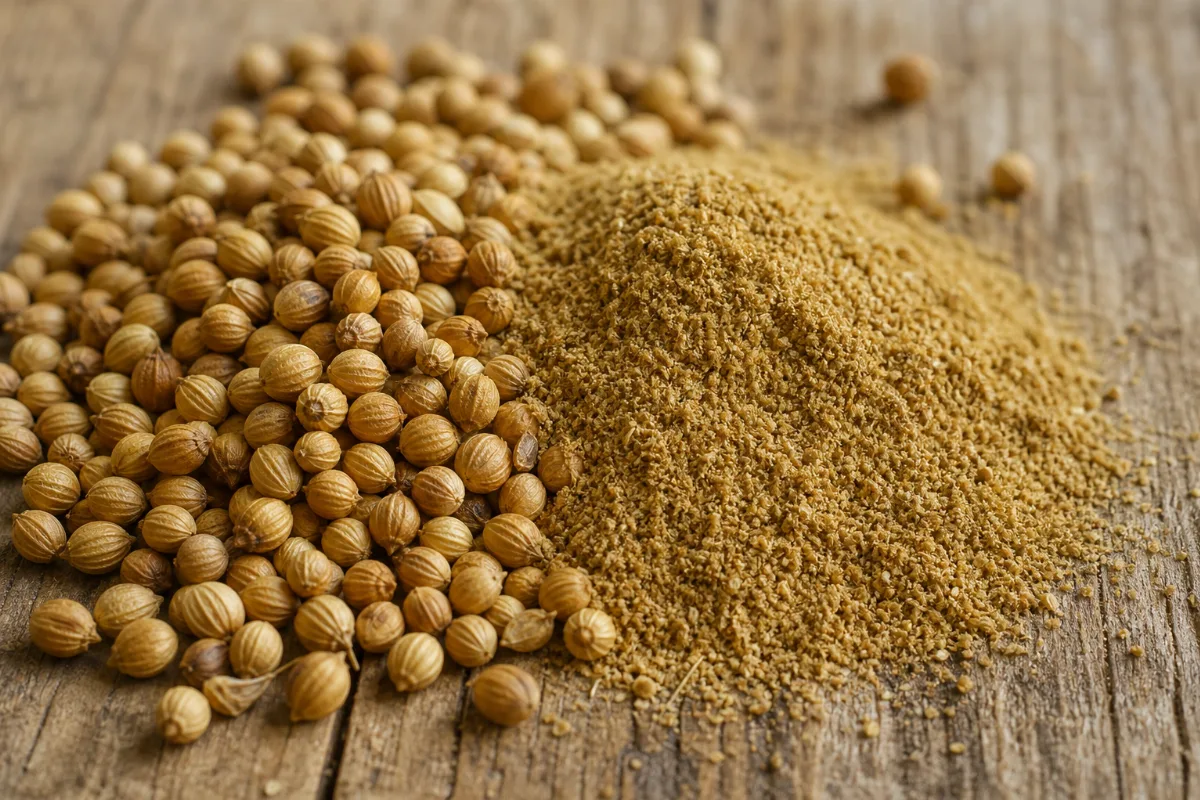
Coriander seed is the dried fruit of the coriander plant, used whole or ground as a spice. A small 2025 trial of seed powder in 40 adults with type 2 diabetes found lower blood sugar and cholesterol, but it is one small supplement trial, not a study of seasoning food. The seed is not a proven remedy for anything. The main cautions are allergy (especially if you react to celery or birch pollen), the irritating essential oil, and strong extracts while breastfeeding.
General information, not medical advice. Last substantive update · Not medically reviewed. A named clinician has not signed off on this page. How this page is made
About Coriander seed
Coriander seed is a common kitchen spice. It is a flavour food, not a proven remedy: the few health findings come from small trials of supplements and syrups, and the seasoning amounts used in cooking have not been tested.
What it is
Coriander seed is the dried fruit of Coriandrum sativum, a plant in the celery and carrot family. The same plant gives cilantro leaves, which are a different food. LactMed says the seed's volatile oil is mainly linalool, which gives it its odor and taste.
USDA data for coriander seed: 298 kcal and 41.9 g fibre per 100 g. Spices are eaten in small amounts: one teaspoon (1.8 g) has about 5 kcal, 0.75 g fibre, 13 mg calcium, 0.3 mg iron and 23 mg potassium, so it adds flavour more than nutrients.
What the research shows
The best human result is a 2025 trial of 40 adults with type 2 diabetes. Seed powder for 6 weeks lowered fasting glucose, insulin resistance, cholesterol and triglycerides compared with placebo. It was small, short and has not been repeated, and it tested a supplement, not seasoning.
A 2016 trial found fewer migraines when coriander fruit syrup was added to valproate. A 2024 indigestion trial used a capsule of two herbs, so the benefit cannot be credited to coriander. Cell and animal studies of inflammation have no human follow-up.
Food versus supplements, syrups and oil
The diabetes trial used a seed powder supplement, the migraine trial a prepared syrup and the indigestion trial a two-herb capsule. The oil warnings from EFSA concern the essential oil. None of these results carries over to cooking with the seed.
Amounts
This page gives no amounts to eat or take. Ask a doctor, pharmacist or dietitian what is right for you, especially if you take diabetes medicines, are pregnant or breastfeeding, or have a spice allergy.
At a glance
Traditional uses history, not proof
- Used whole or ground in cooking
- Used in traditional medicine, for example for headache in Persian medicine and to boost milk supply
- Long traditional use is not proof that it treats any condition
Studied for research
- Blood sugar and insulin resistance in type 2 diabetes, very low certainty (one small seed powder trial)
- Cholesterol and triglycerides in type 2 diabetes, very low certainty (same trial)
- Migraine (fruit syrup added to medicine), very low certainty
- Indigestion (a two-herb capsule), insufficient evidence for coriander alone
- Oxidative stress markers, very low certainty
- Inflammation signals, insufficient evidence (cell and animal studies only)
- Milk supply, insufficient evidence (no trials)
Main compounds
- Linalool (main volatile oil compound)
- 1,8-Cineole
- Dietary fibre
- Calcium, iron, magnesium and potassium (in small culinary portions)
Common forms
- Whole seed
- Ground seed
- Seed powder supplements (used in the diabetes trial)
- Fruit syrup (used in the migraine trial)
- Teas and water extracts
- Essential oil (not a food)
Research links: Seed powder in type 2 diabetes: randomised trial (PubMed) · Spices, herbs and allergic reactions in children (PubMed) · LactMed: Coriander (PubMed record) · Research Library · Genes & Biomarkers Library
What it is and its history
- Accepted scientific name
- Coriandrum sativum
- Naming authority
- L. (GBIF accepted)
- Common names
- Coriander seed (English); Coriander (English); Dhania (Hindi); Cilantro seed (English); Semilla de cilantro (Spanish)
- Family or group
- Apiaceae (the celery and carrot family), per GBIF. Related spices such as cumin, fennel and anise are in the same family (the 1997 allergy study calls them Apiaceae spices).
- Classification
- Plantae > Tracheophyta > Magnoliopsida > Apiales > Apiaceae > Coriandrum > Coriandrum sativum
- Native range
- Not verified from a source read.
- Habitat
- Not verified from a source read.
- What it looks like
- Roots: Not verified.; Stems: Not verified.; Leaves: The leaves (cilantro) are a separate food; USDA lists them in a different entry.; Flowers: Not verified.; Fruit: The spice is the dried fruit, which the migraine trial calls coriander fruit and food labels call seed.
- Cultivation
- Not verified from a source read.
- Harvest and processing
- Sold as whole seed or ground, and made into powders, syrups, extracts and an essential oil (existing summary). Shelf life and toasting were not verified from a source.
- Look-alikes and adulterants
- Name: Cilantro leaves; Note: Same plant, different part and a different USDA entry. Findings about the seed do not carry over to the leaf.; Name: Cumin, fennel and anise seed; Note: Other seed spices in the same plant family, with their own pages; allergy cross-reactivity between them is described.
- Sustainability and conservation
- Not assessed.
Photographs
What is inside, and how it may work
What it contains and how those compounds act in cells and animals. Laboratory and animal mechanisms are not proven effects in people.
Main compounds
| Compound | Family | Where it is concentrated | Activity studied | Level of evidence |
|---|---|---|---|---|
| Linalool PubChem 6549 | monoterpene alcohol (volatile oil) | Seed (volatile oil) Not given in the sources read | LactMed says the seed's volatile oil consists mainly of linalool, which is responsible for its odor and taste. EFSA uses linalool as the marker compound for coriander oil. 10 8 | Authoritative guidance |
| 1,8-Cineole (eucalyptol) PubChem 2758 | monoterpene | Seed (volatile oil) Not given in the sources read | Also present in the volatile oil (LactMed). No effect was tested. 10 | Authoritative guidance |
Mechanisms, receptors and pathways
| Target or pathway | Gene or receptor | What was found | Level |
|---|---|---|---|
| Inflammation signals IL-1 beta, IL-6 and TNF-alpha | Not specified | Lower in most cell and many animal studies of Coriandrum sativum; no human studies. 6 | In vitro animal |
| Cross-reacting pollen allergens (Bet v 1 and profilin-like proteins) | IgE antibodies | Spice allergy in birch and mugwort pollen allergic people was linked to birch pollen related allergens in anise, fennel, coriander and cumin extracts. 5 | Laboratory human sera |
Absorption, metabolism and elimination
- Absorption
- Not found.
- Distribution
- Not found.
- Metabolism
- Not found.
- Elimination
- Not found.
- Bioavailability
- Not established.
Isolated compounds versus whole extracts
The diabetes trial used a seed powder supplement, the migraine trial a prepared fruit syrup and the dyspepsia trial a two-herb capsule. The EFSA warnings concern the essential oil. None of these is the same as using the seed as a seasoning.
Nutritional composition
Nutrition from USDA FoodData Central (Spices, coriander seed, FDC 170922, SR Legacy, record dated 2019-04-01, read 2026-10-26 from the April 2018 data files). Per 100 g: 298 kcal, 12.37 g protein, 17.77 g fat (0.99 g saturated, 13.58 g monounsaturated, 1.75 g polyunsaturated), 54.99 g carbohydrate, 41.9 g fibre, 8.86 g water, 709 mg calcium, 16.32 mg iron, 330 mg magnesium, 409 mg phosphorus, 1,267 mg potassium, 35 mg sodium, 4.7 mg zinc, 1.9 mg manganese, 0.975 mg copper, 21 mg vitamin C. A typical culinary portion is small: one teaspoon (1.8 g) holds about 5 kcal, 0.75 g fibre, 13 mg calcium, 0.3 mg iron and 23 mg potassium; one tablespoon (5 g) about 15 kcal, 2.1 g fibre, 35 mg calcium, 0.8 mg iron and 63 mg potassium. Spices are eaten in small amounts, so they add flavour more than nutrients. Values vary with variety and storage.
4 very low certainty3 not enough evidence
What was looked at
The 7 benefits and uses checked for Coriander seed, each with how strong the evidence is. Tap one to open it.
- Blood sugar and insulin resistance in type 2 diabetes (seed powder)Very low certainty
- Cholesterol and triglycerides in type 2 diabetes (seed powder)Very low certainty
- Migraine (coriander fruit syrup added to usual medicine)Very low certainty
- Indigestion (functional dyspepsia), two-herb capsuleNot enough evidence
- Oxidative stress markers in type 2 diabetes (seed powder)Very low certainty
- Inflammation signals (cell and animal studies only)Not enough evidence
- Breast milk supply (traditional use)Not enough evidence
Lab markers tracked in the studies
Fasting blood glucoseInsulin resistance score (HOMA-IR)Total cholesterol, LDL cholesterol and triglyceridesHDL cholesterolMigraine attacks: frequency, duration and severityOxidative stress markers (MDA and total antioxidant capacity)Dyspepsia symptom severity, frequency and quality of lifeIL-1 beta, IL-6 and TNF-alpha (inflammation signals)
What is Coriander seed good for?
The main studied uses and how strong the human evidence is for each. Almost all results are from supplements or syrups, not from using coriander seed as a seasoning.
Benefits, one by one
Each card is a research question, not a promise. Tap a goal to filter. Open a card to see the studies, doses and limits.
Blood sugar and insulin resistance in type 2 diabetes (seed powder)
Very low certaintyOne small 2025 trial in Iran gave 40 adults with type 2 diabetes either coriander seed powder or a placebo for 6 weeks. Fasting blood glucose and insulin resistance fell more with the seed powder. It is a single small trial of a supplement, not of seasoning food.
1 studiesCoriander seed powder supplement. Not studied as a cooking spice.
Studies, doses and limits
What the trials found
A randomised, double-blind, placebo-controlled trial of 40 adults aged 30 to 60 with type 2 diabetes (20 per group) compared coriander seed powder with placebo for 6 weeks. In the coriander group fasting glucose fell from 156.15 to 130.30 mg/dL and HOMA-IR (an insulin resistance score) from 6.82 to 5.52. Insulin changed only from 17.72 to 17.12 microU/mL. The authors report significant differences between groups after adjusting for starting values (P<0.05).
Results
Fasting glucose and HOMA-IR were lower with seed powder than with placebo after adjustment. The insulin change was tiny. The abstract does not give the placebo group's own numbers.
Effect sizes as reported
Coriander group: fasting glucose 156.15 to 130.30 mg/dL; HOMA-IR 6.82 to 5.52; insulin 17.72 to 17.12 microU/mL. Between-group P<0.05 after baseline adjustment.
Why this rating
Very low: one small trial (40 people), 6 weeks, one centre, abstract read only, no placebo-group numbers in the abstract, and no second trial to confirm it.
Form and dose studied
Coriander seed powder supplement. Not studied as a cooking spice.
Who was studied
Adults aged 30 to 60 with type 2 diabetes.
Limits
Tiny and short. It does not show an effect of coriander used as a seasoning. It does not replace diabetes care.
Why researchers looked
Coriander seed is used in traditional diets and medicine for blood sugar, so researchers tested a powder in people with diabetes.
Traditional use
Seed used as a spice or in preparations. Traditional use of a spice is not proof that it treats any condition.
Proposed mechanism Unknown
Not established. The trial measured blood markers and did not test how the seed might work.
A proposed mechanism does not show that the effect happens in people.
If you take diabetes medicines, ask your doctor or pharmacist before using seed powder supplements; see the Safety tab.
Cholesterol and triglycerides in type 2 diabetes (seed powder)
Very low certaintyIn the same small trial, total cholesterol, LDL cholesterol and triglycerides fell more with coriander seed powder than with placebo. This is early evidence from one trial of a supplement.
1 studiesCoriander seed powder supplement. Not studied as a cooking spice.
Studies, doses and limits
What the trials found
In the 40-person, 6-week trial, the coriander group's total cholesterol fell from 183.85 to 145.20 mg/dL, triglycerides from 152.50 to 130.40 mg/dL and LDL cholesterol from 127.35 to 111.40 mg/dL. Differences between groups after adjustment were reported as significant (P<0.05). HDL cholesterol was measured, but its result is not stated in the abstract.
Results
Total cholesterol, LDL and triglycerides were lower than placebo after adjustment. HDL is unknown from the abstract.
Effect sizes as reported
Coriander group before to after: total cholesterol 183.85 to 145.20; triglycerides 152.50 to 130.40; LDL 127.35 to 111.40 mg/dL. P<0.05 between groups after adjustment.
Why this rating
Very low: the same single small, short trial; no repeat trial; abstract only.
Form and dose studied
Coriander seed powder supplement. Not studied as a cooking spice.
Who was studied
Adults aged 30 to 60 with type 2 diabetes.
Limits
One small trial. Heart events (such as heart attack) were not measured. No trial in people chosen for high cholesterol was found.
Why researchers looked
People with type 2 diabetes often have raised blood fats, so the trial measured them too.
Traditional use
Seed used as a spice or in preparations. Traditional use of a spice is not proof that it treats any condition.
Proposed mechanism Unknown
Not established by the trial.
A proposed mechanism does not show that the effect happens in people.
Ask a doctor or pharmacist before combining a supplement with cholesterol or diabetes medicines.
Migraine (coriander fruit syrup added to usual medicine)
Very low certaintyA 2016 trial in Iran of 68 people with migraine, all taking valproate, found shorter, milder and less frequent attacks with coriander fruit syrup than with placebo syrup over a month. It is one small trial of a prepared syrup, not of seasoning.
1 studiesCoriander fruit syrup. Not a seasoning.
Studies, doses and limits
What the trials found
Triple-blind, placebo-controlled trial of 68 people (66 analysed) with migraine, all also taking sodium valproate. Over one month the abstract says the syrup lowered duration, severity and frequency of attacks (P<0.001), with the syrup group's duration, severity and frequency 5.7 hours, 3.65 units and about 50% less than the control group.
Results
Fewer, shorter and milder migraines with syrup plus valproate than with placebo plus valproate in this trial.
Effect sizes as reported
Duration 5.7 hours less, severity 3.65 units less, frequency about 50% less than control (as worded in the abstract). P<0.001.
Why this rating
Very low: one small, one-month trial, a prepared syrup of unstated full contents, abstract only, and no repeat trial.
Form and dose studied
Coriander fruit syrup. Not a seasoning.
Who was studied
Adults with migraine taking valproate.
Limits
The syrup was an add-on to a prescription medicine, so it says nothing about coriander on its own. Needs repeating.
Why researchers looked
Coriander fruit has been used in traditional Persian medicine for headache.
Traditional use
Coriander fruit is described as one of the most commonly prescribed herbs in Persian medicine for headache (trial abstract). Traditional use is not proof it works.
Proposed mechanism Unknown
Not established.
A proposed mechanism does not show that the effect happens in people.
Do not change migraine medicine on your own.
Indigestion (functional dyspepsia), two-herb capsule
Not enough evidenceA 2024 trial of 90 people with functional dyspepsia found better symptoms and quality of life with a capsule of two herbs (Bunium persicum and coriander) than with placebo. Coriander was not tested alone, so this cannot be credited to coriander.
1 studiesTwo-herb capsule. Not a seasoning.
Studies, doses and limits
What the trials found
Double-blind randomised trial in 90 adults with functional dyspepsia (Rome IV). A capsule of the two-herb formula (taken for 4 weeks in the trial) was compared with placebo, with 4 more weeks of follow-up. 40 per group completed. All clinical outcomes improved significantly versus placebo (p<0.05), without serious side effects.
Results
The two-herb formula beat placebo on symptom severity, frequency and quality of life. Effect sizes are not in the abstract.
Effect sizes as reported
Not given in the abstract; p<0.05 for all outcomes.
Why this rating
Insufficient for coriander: the formula combined two herbs, so the effect of coriander alone is unknown. Evidence about the formula is low at best (one trial, abstract only).
Form and dose studied
Two-herb capsule. Not a seasoning.
Who was studied
Adults with functional dyspepsia.
Limits
Combination product. 10 of 90 did not finish. Abstract only.
Why researchers looked
Seeds like coriander are traditionally used for stomach discomfort.
Traditional use
Seed used as a spice or in preparations. Traditional use of a spice is not proof that it treats any condition.
Proposed mechanism Unknown
Not established.
A proposed mechanism does not show that the effect happens in people.
No serious side effects were reported in the abstract.
Oxidative stress markers in type 2 diabetes (seed powder)
Very low certaintyIn the small 2025 diabetes trial, a blood marker of oxidative damage (MDA) was lower and total antioxidant capacity slightly higher with coriander seed powder than with placebo. The changes were small and the trial was tiny.
1 studiesCoriander seed powder supplement.
Studies, doses and limits
What the trials found
In the 40-person, 6-week trial, MDA (a damage marker) fell from 1.65 to 1.49 nmol/mL and total antioxidant capacity rose from 1.93 to 1.97 mmol/L in the coriander group; group differences after adjustment were reported significant (P<0.05).
Results
Small shifts in two lab markers. Whether they matter for health is not shown.
Effect sizes as reported
MDA 1.65 to 1.49 nmol/mL; total antioxidant capacity 1.93 to 1.97 mmol/L.
Why this rating
Very low: same single small trial; the changes are small; markers are not health outcomes.
Form and dose studied
Coriander seed powder supplement.
Who was studied
Adults with type 2 diabetes.
Limits
Lab markers only. Abstract only.
Why researchers looked
Oxidative stress is thought to contribute to diabetes complications, so the trial measured markers of it.
Traditional use
Seed used as a spice or in preparations. Traditional use of a spice is not proof that it treats any condition.
Proposed mechanism Unknown
Not established.
A proposed mechanism does not show that the effect happens in people.
None specific.
Inflammation signals (cell and animal studies only)
Not enough evidenceA 2022 review of lab and animal studies found coriander lowered inflammation signals in most cell studies and many animal studies. No human study was found, so this does not show an effect in people.
1 studiesVarious coriander preparations in the lab.
Studies, doses and limits
Results
Lower inflammation signals in 7 of 9 cell studies and 10 of 16 animal studies. The authors call coriander hopeful but not yet confirmed.
Effect sizes as reported
7 of 9 in vitro and 10 of 16 animal studies showed lower IL-1 beta, IL-6 and TNF-alpha.
Why this rating
Insufficient for people: lab and animal work only, with mixed counts.
Form and dose studied
Various coriander preparations in the lab.
Who was studied
Cells and animals, not people.
Limits
Lab and animal only. The abstract says 24 papers but counts 9 plus 16 studies.
Why researchers looked
Lab researchers test whether coriander extracts affect inflammation chemicals.
Traditional use
Seed used as a spice or in preparations. Traditional use of a spice is not proof that it treats any condition.
Proposed mechanism In vitro animal
Lower IL-1 beta, IL-6 and TNF-alpha (inflammation signals) in cell and animal experiments. How this happens, and whether it happens in people, is not shown.
A proposed mechanism does not show that the effect happens in people.
None specific.
Breast milk supply (traditional use)
Not enough evidenceCoriander is used in some teas and mixtures to boost milk supply, but the US National Library of Medicine's LactMed database says no scientifically valid clinical trials support this. A case of harm after a strong extract is on the Safety tab.
1 studiesTeas and mixtures in traditional use.
Studies, doses and limits
What the trials found
No valid clinical trial. LactMed says galactogogues should never replace evaluation and counselling on factors that affect milk production.
Results
No evidence of benefit.
Why this rating
No trials exist.
Form and dose studied
Teas and mixtures in traditional use.
Who was studied
Breastfeeding mothers.
Limits
LactMed was read through its Europe PMC record.
Why researchers looked
Seeds like coriander are traditionally given to nursing mothers.
Traditional use
LactMed describes coriander as a purported galactogogue (milk-boosting herb). Tradition is not evidence.
Proposed mechanism Unknown
None established.
A proposed mechanism does not show that the effect happens in people.
See the Safety tab for the case report and for breastfeeding.
Connections to the rest of health
How Coriander seed connects to the rest of our health knowledge graph. Every link says what kind of connection it is. A safety link (for example to the liver) is a warning, not a benefit. A study that merely mentions a topic never creates a benefit link.
Explore every connection: goals, body systems, organs, symptoms, genes
B. Body systems
| Connected to | Kind of connection | Evidence status | Context | Studies |
|---|---|---|---|---|
| Endocrine System | Biological association | Very low certainty | Studied for: Blood sugar and insulin resistance in type 2 diabetes (seed powder) | 7 |
| Cardiovascular System | Biological association | Very low certainty | Studied for: Cholesterol and triglycerides in type 2 diabetes (seed powder) | 7 |
| Nervous System | Biological association | Very low certainty | Studied for: Migraine (coriander fruit syrup added to usual medicine) | 4 |
| Digestive System | Biological association | Not enough evidence | Studied for: Indigestion (functional dyspepsia), two-herb capsule | 2 |
| Blood And Immune | Biological association | Very low certainty | Studied for: Oxidative stress markers in type 2 diabetes (seed powder) Studied for: Inflammation signals (cell and animal studies only) | 7 6 |
| Reproductive System | Biological association | Not enough evidence | Studied for: Breast milk supply (traditional use) | 10 |
C. Body parts and organs
E. Health conditions
| Connected to | Kind of connection | Evidence status | Context | Studies |
|---|---|---|---|---|
| Food allergy | Adverse effect or risk | Documented risk | Coriander is among the spices most often implicated in spice allergy; cross-reactivity with birch and mugwort pollen and celeriac is described. Coriander is a recognised spice allergen; cross-reactivity with birch and mugwort pollen and celeriac is described. Preparation or compound: Coriander seed as food |
3 5 |
| Type 2 diabetes | Preliminary | One small trial of seed powder reported lower glucose and lipids. It does not replace diabetes care. Preparation or compound: Seed powder supplement |
7 |
I. Biomarkers
| Connected to | Kind of connection | Evidence status | Context | Studies |
|---|---|---|---|---|
| Fasting blood glucose | Biological association | Very low certainty | Measured in trials: lowered. A lab change is not the same as a health benefit. | 7 |
| Insulin resistance score (HOMA-IR) | Biological association | Very low certainty | Measured in trials: lowered. A lab change is not the same as a health benefit. | 7 |
| Total cholesterol, LDL cholesterol and triglycerides | Biological association | Very low certainty | Measured in trials: lowered. A lab change is not the same as a health benefit. | 7 |
| HDL cholesterol | Biological association | Not enough evidence | Measured in trials: unknown. A lab change is not the same as a health benefit. | 7 |
| Migraine attacks: frequency, duration and severity | Biological association | Very low certainty | Measured in trials: lowered. A lab change is not the same as a health benefit. | 4 |
| Oxidative stress markers (MDA and total antioxidant capacity) | Biological association | Very low certainty | Measured in trials: lowered. A lab change is not the same as a health benefit. | 7 |
| Dyspepsia symptom severity, frequency and quality of life | Biological association | Not enough evidence | Measured in trials: improved. A lab change is not the same as a health benefit. | 2 |
| IL-1 beta, IL-6 and TNF-alpha (inflammation signals) | Biological association | Not enough evidence | Measured in trials: lowered. A lab change is not the same as a health benefit. | 6 |
K. Biological pathways
| Connected to | Kind of connection | Evidence status | Context | Studies |
|---|---|---|---|---|
| Type 2 diabetes | Preliminary mechanism | Human | One small trial of seed powder reported lower fasting glucose and insulin resistance. | 7 |
| Migraine | Preliminary mechanism | Human | One small trial of fruit syrup added to valproate. | 4 |
| Food allergy | Preliminary mechanism | Human | Coriander is a recognised spice allergen, linked to birch and mugwort pollen allergy. | 3 5 |
L. Active compounds
| Connected to | Kind of connection | Evidence status | Context | Studies |
|---|---|---|---|---|
| Linalool | Biological association | Authoritative guidance | LactMed says the seed's volatile oil consists mainly of linalool, which is responsible for its odor and taste. EFSA uses linalool as the marker compound for coriander oil. Preparation or compound: Seed (volatile oil) |
10 8 |
| 1,8-Cineole (eucalyptol) | Biological association | Authoritative guidance | Also present in the volatile oil (LactMed). No effect was tested. Preparation or compound: Seed (volatile oil) |
10 |
Each connection is stored with the ingredient, the connected record, the kind of connection, the evidence status, the supporting studies, the preparation or compound involved, and a review date (last reviewed October 26, 2026).
Evidence at a glance: what changed in 6 lab markers
Tap a number to show only those markers. Counts are markers, not people.
The evidence
The research centre for Coriander seed. Every record here was checked against PubMed or the publisher's page; we never list a study we have not verified.
Evidence by outcome
Bars show how many studies we found for each outcome, not how well it works. People are added up across trials only (reviews are not added, to avoid double counting).
How we rate evidence
High certainty
Several well-run trials or reviews agree; further research is unlikely to change the picture much.
Moderate certainty
Good trials point the same way, but some doubt remains.
Low certainty
Small, short or inconsistent trials. The finding could change with better research.
Very low certainty
Very little or very weak human data. Treat as a possibility only.
Mixed findings
Trials or reviews disagree with each other.
Not enough evidence
Not enough human research to say either way.
Evidence against
Good research found no benefit, or found harm.
We take the reviewers' own risk-of-bias and GRADE statements where they exist, and otherwise judge from study size, design, consistency, directness and whether a product matches what is sold. Many publications do not make evidence high. Method note: We started from our existing coriander seed summary, re-checked nutrition at USDA FoodData Central, read the LactMed record through Europe PMC and the EFSA opinion in full, and read the PubMed abstracts of every study cited. Full papers were not opened. Items we could not verify are flagged in the research gaps.
Study library: every study we checked 11
| Study | Design | People | Product, dose, length | Result |
|---|---|---|---|---|
| Atamaleki 2021 Accumulation of potentially harmful elements (PHEs) in lettuce (Lactuca sativa L.) and coriander (Coriandrum sativum L.) irrigated with wastewater: a systematic review and meta-analysis and probabilistic health risk assessment. Environ Sci Pollut Res Int · PMID 33486683 · DOI |
Systematic review |
32 articles (41 studies) of lettuce and coriander irrigated with wastewater | Edible part of coriander grown with wastewater irrigation Edible part (leaf or seed not stated) Trial detail, not advice |
Metals such as iron, zinc, copper, nickel, lead and cadmium were measured in the edible part. The authors' risk estimates were above the safe limit for adults in most countries listed and for children in all except Kenya, and the cancer risk estimate was not acceptable in some countries. They conclude that wastewater irrigation can endanger consumers. Total target hazard quotient above 1 in most countries (as stated in the abstract) (Not applicable) Methods, limits and fundingOutcomes: Metal levels and health risk estimates Limitations: Applies to crops irrigated with wastewater, not to ordinary shop-bought spice. The abstract does not say whether coriander leaf or seed was measured and combines lettuce and coriander. Abstract read only. Funding and conflicts: Funding and conflicts not stated in the abstract. Read: abstract |
| Azimi 2024 The Efficacy of the Herbal Formula of Bunium persicum and Coriandrum sativum on Clinical Symptoms of Patients with Functional Dyspepsia: A Double-Blind Randomized Controlled Trial. Complement Med Res · PMID 38981452 · DOI |
Controlled trial |
90 90 adults with functional dyspepsia (Rome IV); 40 per group completed follow-up |
Capsule of an herbal formula of Bunium persicum plus Coriandrum sativum versus placebo capsule Plant parts not stated in the abstract (two-herb formula) Trial detail, not advice 4 weeks plus 4 weeks follow-up · vs Placebo capsule |
All clinical outcomes improved significantly with the herbal formula compared with placebo (p<0.05), with no serious side effects. Significant improvement in symptom severity, frequency and quality of life (sizes not in the abstract) (p<0.05 (intervals not in the abstract)) Methods, limits and fundingOutcomes: Dyspepsia severity, symptom frequency, quality of life Limitations: Two herbs were tested together, so the result cannot be given to coriander. 10 of 90 people did not complete. Abstract read only. Funding and conflicts: Funding and conflicts not stated in the abstract. Read: abstract |
| Berghea 2025 Spices, herbs and allergic reactions in children: myth or reality - a narrative review with scoping elements. Front Allergy · PMID 41306764 · DOI |
Narrative review |
Case reports and studies of spice and herb allergy in children | Spices and herbs including coriander Spices and herbs Trial detail, not advice |
Spice and herb allergies are increasingly recognised in children, from mild mouth reactions to anaphylaxis. Coriander is among the most often implicated spices (with mustard, celery, fennel, cumin, anise, pepper and some mint-family herbs). Both IgE and non-IgE mechanisms are involved, with cross-reactivity to pollens. Management is strict avoidance and emergency preparedness. Not applicable (narrative review) (Not applicable) Methods, limits and fundingOutcomes: Allergic reactions Limitations: Narrative review, not a count of how common coriander allergy is. Abstract read only. Funding and conflicts: No commercial or financial conflicts declared (abstract). Read: abstract |
| Delavar Kasmaei 2016 Effects of Coriandrum sativum Syrup on Migraine: A Randomized, Triple-Blind, Placebo-Controlled Trial. Iran Red Crescent Med J · PMID 26889386 · DOI |
Controlled trial |
68 68 people with migraine (66 analysed), all also taking sodium valproate |
Coriander fruit syrup added to usual valproate versus placebo syrup added to valproate Fruit (syrup) Trial detail, not advice 1 month · vs Placebo syrup |
The abstract reports that the syrup lowered the duration, severity and frequency of migraine (P<0.001): mean duration, severity and frequency in the syrup group were 5.7 hours, 3.65 units and about 50% less than in the control group. Duration 5.7 hours less, severity 3.65 units less, frequency about 50% less than control (as worded in the abstract) (P<0.001 (confidence intervals not in the abstract)) Methods, limits and fundingOutcomes: Migraine attacks per week, duration and severity of attacks Limitations: Small, one month, all took valproate too. The syrup is a prepared product whose full contents are not described in the abstract. The abstract's wording of the effect sizes is not fully clear. Abstract read only. Funding and conflicts: Funding and conflicts not stated in the abstract. Read: abstract |
| Jensen-Jarolim 1997 Characterization of allergens in Apiaceae spices: anise, fennel, coriander and cumin. Clin Exp Allergy · PMID 9420134 |
Laboratory study |
15 15 patients who had adverse reactions to spiced food |
Serum antibody (IgE) binding to spice extracts including coriander Spice extracts Trial detail, not advice |
IgE binding to the spice proteins occurred only in 10 of 15 patients (66%), all with pollen (birch, mugwort) and/or celeriac allergy. In 5 of 15 (33%) with spice reactions but no pollen or celeriac allergy, no IgE binding was found; those reactions were probably intolerance. Birch pollen related allergens (Bet v 1 and profilin) were identified as likely causes of true allergy to anise, fennel, coriander or cumin. IgE binding in 10/15 (66%); none in 5/15 (33%) (Not applicable) Methods, limits and fundingOutcomes: IgE binding to spice proteins Limitations: A small laboratory study from 1997, not a trial. It tested four spices together. Funding and conflicts: Funding and conflicts not stated in the abstract. Read: abstract |
| Malek Mahdavi 2022 Systematic review of preclinical studies about effects of Coriandrum sativum L. on inflammatory mediators. Inflammopharmacology · PMID 35554788 · DOI |
Systematic review animal and in vitro |
24 animal and in vitro papers; no human studies found | Coriandrum sativum preparations in animals and cell studies Trial detail, not advice |
No human study was found. Coriander lowered inflammation signals in 7 of 9 cell studies and 10 of 16 animal studies. The authors call coriander hopeful but not yet a confirmed natural ingredient for lowering inflammation. Lower IL-1 beta, IL-6 and TNF-alpha in 7 of 9 in vitro and 10 of 16 animal studies (Not applicable) Methods, limits and fundingOutcomes: IL-1 beta, IL-6 and TNF-alpha (inflammation signals) Limitations: Lab and animal findings only. The abstract says 24 papers but counts 9 + 16 studies. Abstract read only. Funding and conflicts: Funding and conflicts not stated in the abstract. Read: abstract |
| Zamany 2025 Effects of Dietary Supplementation with Coriander Seed Powder on Serum Lipid Profile, Glycemic Indices, and Oxidative Stress Biomarkers in Patients with Type 2 Diabetes Mellitus: A Randomized, Double-Blind, Placebo-Controlled Trial. Prev Nutr Food Sci · PMID 41492428 · DOI |
Controlled trial |
40 40 adults aged 30 to 60 with type 2 diabetes (20 per group) |
Coriander seed powder supplement versus a placebo Seed (powder) Trial detail, not advice 6 weeks · vs Placebo |
In the coriander group fasting glucose fell from 156.15 to 130.30 mg/dL, HOMA-IR from 6.82 to 5.52, total cholesterol from 183.85 to 145.20 mg/dL, triglycerides from 152.50 to 130.40 mg/dL and LDL cholesterol from 127.35 to 111.40 mg/dL. Insulin changed only from 17.72 to 17.12 microU/mL. Differences between groups after adjusting for baseline were reported as significant (P<0.05) for these measures. Body measures did not differ. Coriander group before to after: fasting glucose 156.15 to 130.30 mg/dL; HOMA-IR 6.82 to 5.52; total cholesterol 183.85 to 145.20; triglycerides 152.50 to 130.40; LDL 127.35 to 111.40; MDA 1.65 to 1.49 nmol/mL; total antioxidant capacity 1.93 to 1.97 mmol/L (P<0.05 between groups after baseline adjustment (exact intervals and the placebo group's before and after values were not in the abstract)) Methods, limits and fundingOutcomes: Blood fats, fasting glucose, insulin, insulin resistance (HOMA-IR), oxidative stress markers (MDA, total antioxidant capacity), body measures Limitations: Only 40 people for 6 weeks, one centre, abstract read only. The placebo group's own values and the placebo contents are not in the abstract. HDL cholesterol was measured but its result is not stated in the abstract. A concentrated seed powder supplement is not the same as seasoning food. Adverse events are not mentioned in the abstract. Funding and conflicts: The authors declare no conflict of interest (abstract). Funding is not stated in the abstract. Read: abstract |
| s-efsa-coriander-oil EFSA FEEDAP Panel 2023: Safety and efficacy of a feed additive consisting of an essential oil obtained from the fruit of Coriandrum sativum L. (coriander oil) · Source |
Health agency n/a |
Methods, limits and fundingRead: full-text | ||
| s-gbif-coriandrum-sativum GBIF Backbone: Coriandrum sativum L. (usageKey 3034871) · Source |
Reference database n/a |
Methods, limits and fundingRead: full-text | ||
| s-lactmed-coriander LactMed (NIH): Coriander · Source |
Health agency n/a |
Methods, limits and fundingRead: abstract | ||
| s-usda-fdc-170922 USDA FoodData Central: Spices, coriander seed (FDC 170922) · Source |
Reference database n/a |
Methods, limits and fundingRead: full-text |
What we do not know yet
- No trial of coriander used as a cooking spice, or in food amounts, was found for any health outcome.
- Only one trial each was found for diabetes and migraine; both were small and have not been repeated, and only abstracts were read.
- No human study of coriander and inflammation was found.
- How common coriander allergy is was not found in the sources read.
- Pregnancy, kidney, surgery and drug interaction safety were not described in the sources read.
- Contamination of coriander seed (aflatoxin, metals) was not researched.
How new research is added
New studies are found by a saved PubMed search and placed in a review queue before the page changes.
Lab markers
What changed in blood or saliva tests during trials. A changed number is not the same as feeling or being healthier, and we give no "normal ranges".
Metabolic 1
HDL cholesterol
Unknown in trials
The so-called good cholesterol.
Not enough evidenceResults and what it means
Other 7
Fasting blood glucose
Lowered in trials
Blood sugar measured after not eating overnight.
Very low certaintyResults and what it means
Why it was measured
It is the basic marker of blood sugar control in diabetes.
Statistical vs. clinical meaning
A lab marker in one small trial. It does not show better health outcomes.
Safety implication
If glucose falls on top of diabetes medicines, ask your doctor.
| Study | Result | People | Product |
|---|---|---|---|
| 7 | Fell from 156.15 to 130.30 mg/dL in the coriander group; significantly lower than placebo after baseline adjustment (P<0.05) | 40 adults with type 2 diabetes | Coriander seed powder for 6 weeks (not seasoning amounts) |
Insulin resistance score (HOMA-IR)
Lowered in trials
A calculated score from fasting glucose and insulin; higher means the body responds less well to insulin.
Very low certaintyResults and what it means
Why it was measured
Insulin resistance is central to type 2 diabetes.
Statistical vs. clinical meaning
Mostly driven by the fall in glucose, since insulin barely moved.
Safety implication
None specific.
| Study | Result | People | Product |
|---|---|---|---|
| 7 | HOMA-IR fell from 6.82 to 5.52; fasting insulin changed only from 17.72 to 17.12 microU/mL; between-group differences P<0.05 | 40 adults with type 2 diabetes | Coriander seed powder for 6 weeks |
Total cholesterol, LDL cholesterol and triglycerides
Lowered in trials
Fats carried in the blood. High LDL and triglycerides go with higher heart risk.
Very low certaintyResults and what it means
Why it was measured
People with type 2 diabetes have higher heart risk.
Statistical vs. clinical meaning
Lab markers in one small trial; heart disease outcomes were not measured.
Safety implication
None specific.
| Study | Result | People | Product |
|---|---|---|---|
| 7 | Total cholesterol 183.85 to 145.20, LDL 127.35 to 111.40, triglycerides 152.50 to 130.40 mg/dL in the coriander group; P<0.05 vs placebo after adjustment | 40 adults with type 2 diabetes | Coriander seed powder for 6 weeks |
Migraine attacks: frequency, duration and severity
Lowered in trials
How often migraines happen, how long they last and how painful they are.
Very low certaintyResults and what it means
Why it was measured
These are the outcomes people with migraine care about.
Statistical vs. clinical meaning
One small one-month trial.
Safety implication
None specific.
| Study | Result | People | Product |
|---|---|---|---|
| 4 | Duration 5.7 hours, severity 3.65 units and frequency about 50% lower than control (abstract wording); P<0.001 | 66 analysed people with migraine taking valproate | Coriander fruit syrup for 1 month |
Oxidative stress markers (MDA and total antioxidant capacity)
Lowered in trials
MDA is a by-product of oxidative damage to fats; total antioxidant capacity measures the blood's ability to neutralise oxidants.
Very low certaintyResults and what it means
Why it was measured
Used as markers of oxidative stress in diabetes.
Statistical vs. clinical meaning
Small changes in lab markers.
Safety implication
None specific.
| Study | Result | People | Product |
|---|---|---|---|
| 7 | MDA 1.65 to 1.49 nmol/mL; total antioxidant capacity 1.93 to 1.97 mmol/L in the coriander group; P<0.05 between groups after adjustment | 40 adults with type 2 diabetes | Coriander seed powder for 6 weeks |
Dyspepsia symptom severity, frequency and quality of life
Improved in trials
Questionnaire scores for stomach discomfort, how often it occurs and its effect on daily life.
Not enough evidenceResults and what it means
Why it was measured
The standard way to follow functional dyspepsia.
Statistical vs. clinical meaning
Coriander was not tested alone.
Safety implication
No serious side effects reported in the abstract.
| Study | Result | People | Product |
|---|---|---|---|
| 2 | All outcomes improved versus placebo (p<0.05); sizes not in the abstract | 90 adults with functional dyspepsia (80 analysed) | Two-herb capsule (Bunium persicum plus coriander) for 4 weeks |
IL-1 beta, IL-6 and TNF-alpha (inflammation signals)
Lowered in trials
Small proteins that cells release during inflammation.
Not enough evidenceResults and what it means
Why it was measured
Lab studies measure them to see whether a plant extract calms inflammation.
Statistical vs. clinical meaning
Lab and animal only.
Safety implication
None specific.
| Study | Result | People | Product |
|---|---|---|---|
| 6 | Lower in 7 of 9 in vitro and 10 of 16 animal studies; no human studies | Cells and animals | Various Coriandrum sativum preparations |
Safety
What studies and official sources say about side effects, medicines and who should check first. Each point shows what kind of evidence it comes from.
Main points to know 4
- Allergy: coriander is a recognised spice allergen, rarely severe. A 2025 review of spice allergy in children lists coriander among the most often implicated spices, with symptoms from mild mouth reactions to anaphylaxis. A 1997 laboratory study of 15 patients found that true IgE allergy to coriander and related spices (anise, fennel, cumin) was linked to birch or mugwort pollen allergy and/or celeriac allergy. If you react to celery, birch pollen or mugwort, ask an allergy specialist before eating coriander. Review and lab 3 5
- Culinary use versus concentrated products. The safety facts on this page come from reviews, an agency database and case reports. Culinary seasoning amounts have not been tested in safety trials. Concentrated supplements, strong extracts and the essential oil are different products with their own cautions. Authoritative guidance 10 8
- Essential oil: irritant and sensitiser. EFSA's 2023 animal-feed opinion says coriander oil should be considered irritant to skin, eyes and the respiratory tract, and a skin and respiratory sensitiser. This is about the oil, not the seed as food. Authoritative guidance 8
- Breastfeeding: one case of harm after a strong extract. LactMed reports a nursing mother who drank a strong water extract of coriander daily for a week to boost milk. She later developed signs diagnosed as adrenal dysfunction and recovered after treatment. It is one case report, with no checks of the extract's contents or contaminants. LactMed says no valid trials support coriander for milk supply. Case report 10
Side effects 5
| Effect | How often | Severity and recovery | Evidence |
|---|---|---|---|
| Allergic reactions (mouth itching to anaphylaxis) No source read says how common coriander allergy is. Reactions can also be intolerance rather than true allergy: in the 1997 study 5 of 15 people with spice reactions had no IgE binding. | Not established | mild to severe Not stated | Review 3 5 |
| Contact dermatitis and light sensitivity LactMed says photosensitivity has been reported and coriander can cause contact dermatitis. | Not established | not stated Not stated | Authoritative guidance 10 |
| Skin, eye and breathing-passage irritation from the essential oil From an EFSA opinion on feed additives. | Not established | not stated Not stated | Authoritative guidance 8 |
| Side effects in the diabetes trial of seed powder The abstract does not mention adverse events, so safety in that trial is unknown from what was read. | Not established | not stated Not stated | Controlled trial 7 |
| Adrenal dysfunction after a strong water extract while breastfeeding (single case) Cause not proven; extract contents were not checked. | One case | moderate (treated with adrenocorticoids) Well and healthy 10 days after treatment (LactMed) | Case report 10 |
Liver
LactMed mentions one woman with raised liver enzymes who was taking a tea mixture (Mother's Milk Tea) that contains coriander among other ingredients. A liver-safety database (such as LiverTox) was not found to have a coriander entry in earlier checks. No liver injury from coriander as a spice was found. 10
How often. Not found.
Monitoring. No agency monitoring advice was found.
- .
This is a safety connection. It is not evidence that Coriander seed supports liver health.
Medicines and supplements 3
| With | Why it matters | Importance | Evidence | What to do |
|---|---|---|---|---|
| Diabetes medicines (insulin, tablets) prescription | The only human trial of coriander seed powder reported lower fasting glucose in people with type 2 diabetes. In theory a supplement could add to the effect of glucose-lowering medicines. This is our reading of the trial, not a tested interaction. | No interaction study was found. | Theoretical Not enough evidence 7 | If you take diabetes medicines, ask your doctor or pharmacist before using seed powder supplements. Do not change medicines on your own. |
| Valproate (epilepsy and migraine medicine) prescription | In the migraine trial the syrup was given on top of valproate and no interaction problems are reported in the abstract. Interactions were not examined. | Not studied. | Controlled trial Not enough evidence 4 | Ask a doctor or pharmacist before combining any herbal syrup with prescription medicine. |
| Other prescription medicines and blood thinners prescription | No interaction with coriander seed was found in the sources read. | No evidence of an interaction was found; absence of evidence is not proof of safety for supplements. | None found Not enough evidence | Ask a pharmacist about supplements and extracts. |
Who should check first 4
| Situation | Advice | Evidence |
|---|---|---|
| Known allergy to coriander, celery, or related spices; or allergy to birch or mugwort pollen with reactions to spices | Avoid coriander if it causes reactions, and ask an allergy specialist. A 2025 review says management is strict avoidance and emergency preparedness. | Review 3 5 |
| Pregnancy and breastfeeding with supplements, strong extracts, teas or oil | No safety data for supplement or extract amounts were found, and a case of adrenal dysfunction is reported after a strong extract while breastfeeding. Ask your doctor or midwife. Ordinary food use is not addressed by the sources read. | Case report 10 |
| Using the essential oil | EFSA says to treat it as an irritant and sensitiser. Do not use it undiluted on skin or near eyes, and ask a professional before using it. | Authoritative guidance 8 |
| Type 2 diabetes treated with medicines | Ask your doctor or pharmacist before using concentrated seed products. | Theoretical 7 |
Overdose, product quality and regulators
Summary. No toxicity from coriander seed as ordinary food was found in the sources read. Cautions concern allergy, concentrated extracts and the essential oil.
Animal. Not reviewed. The EFSA opinion concerns animal feed and found no concern for consumers at the proposed feed use level of the oil.
Human doses studied. A seed powder supplement was given for 6 weeks to 20 adults with diabetes; a fruit syrup for one month to 34 people with migraine; and a two-herb capsule for 4 weeks. The abstracts do not describe side effects, except that the dyspepsia trial reported no serious ones.
High dose or long term signals. A single case of adrenal dysfunction after a strong extract drunk daily for a week while breastfeeding.
Overdose response. Not found.
Genotoxicity. Not researched.
Quality and contamination of coriander seed as a spice were not researched in the sources read. Aflatoxin, heavy metals and adulteration in dried spices were not checked for coriander seed.
Metals in coriander irrigated with wastewater. A 2021 systematic review of lettuce and coriander irrigated with wastewater measured metals such as iron, zinc, copper, nickel, lead and cadmium in the edible part and judged the health risk concerning in many countries. The abstract does not say if coriander leaf or seed was measured, and it concerns wastewater irrigation, not shop-bought spice. 1
Hidden in mixes. A 1997 study notes that allergens in spices are particularly dangerous because they are hidden in many dishes. Spice blends and curry powders can contain coriander. 5
| Body | Action | Date |
|---|---|---|
| LactMed (NIH, US National Library of Medicine) (United States) | No valid clinical trials support coriander for milk supply; allergic reactions, photosensitivity and contact dermatitis reported; one case of adrenal dysfunction after a strong extract. source | 2006 |
| EFSA FEEDAP Panel (European Union) | Coriander oil should be considered irritant to skin, eyes and respiratory tract and a dermal and respiratory sensitiser (opinion on animal feed use). source | 2023-10-30 |
When to get medical help
- Trouble breathing, swelling of the lips, face or throat, or widespread hives after eating coriander or a spice mix (call emergency services)
- Repeated vomiting, fainting or a feeling of collapse after eating spiced food
- Rash that spreads, blisters or burns after skin contact with the oil
Stop using the product and contact a clinician or emergency service. In the US, Poison Control is 1-800-222-1222.
General information only, not medical advice. Ask a clinician or pharmacist before use, especially with medicines, in pregnancy or with a health condition. See the Natural Remedy Safety guide.
Frequently asked questions
What is coriander seed good for?
Does coriander seed lower blood sugar?
One 6-week trial of 40 adults with type 2 diabetes found lower fasting glucose with coriander seed powder than placebo. It was a single small supplement trial. It does not replace diabetes care, and food amounts were not tested.
Does coriander seed lower cholesterol?
The same small trial reported lower total cholesterol, LDL and triglycerides with seed powder in people with type 2 diabetes. No trial in people chosen for high cholesterol was found.
Can coriander help migraine?
A one-month trial of 68 people taking valproate found fewer, shorter and milder migraines with coriander fruit syrup added. It is one small trial of a prepared syrup, and it needs repeating.
Is coriander good for digestion or indigestion?
A trial found a two-herb capsule (Bunium persicum plus coriander) improved functional dyspepsia symptoms against placebo. Coriander alone was not tested, so we cannot say it helps.
Can you be allergic to coriander seed?
Is coriander seed safe while breastfeeding?
Ask your doctor or midwife. LactMed says no valid trials support coriander for milk supply, and reports one nursing mother who developed adrenal dysfunction after a strong water extract daily for a week. Normal food use was not addressed in the sources read.
Is coriander seed safe in pregnancy?
The sources we read do not describe pregnancy safety of coriander seed as a spice. Ask your doctor or midwife about supplements, strong teas or oil.
Is coriander essential oil safe to use on the skin?
EFSA says coriander oil should be considered irritant to skin, eyes and the respiratory tract and a skin and breathing sensitiser. That opinion is about animal feed, but the warning applies to the oil. Ask a professional before using it.
Is coriander seed safe with diabetes medicines?
No interaction study was found. Because one trial of seed powder lowered blood sugar, a supplement could in theory add to your medicine. Ask your doctor or pharmacist before using seed powder supplements, and do not change medicines on your own.
Is the seed the same as cilantro?
They come from the same plant but are different foods. USDA lists the leaves and the seed separately, and findings about the seed do not carry over to the leaves.
How much nutrition does coriander seed give?
In a teaspoon (1.8 g) there is about 5 kcal, 0.75 g fibre, 13 mg calcium and 0.3 mg iron by USDA data. Spices are used in small amounts, so they add flavour more than nutrition.
Explore by health goal
Editorial transparency
- Written by
- AlternativeMed editorial team. Research compiled with AI assistance, then checked against the sources listed.
- Medical review
- None. This page has not been reviewed by a physician or pharmacist.
- First published
- 2026-10-26
- Last substantive update
- 2026-10-26
- How we research
- We started from our existing coriander seed summary, re-checked nutrition at USDA FoodData Central, read the LactMed record through Europe PMC and the EFSA opinion in full, and read the PubMed abstracts of every study cited. Full papers were not opened. Items we could not verify are flagged in the research gaps.
- How we rate evidence
- See "How we rate evidence" in the Evidence tab.
- Independence
- No product is promoted on this page. No affiliate links are shown.
Sources 11
Each source was opened and checked. Where we read only the abstract, it says so. The small numbers in the text point here.
- Atamaleki A, Yazdanbakhsh A, Fallah S, et al.. Accumulation of potentially harmful elements (PHEs) in lettuce (Lactuca sativa L.) and coriander (Coriandrum sativum L.) irrigated with wastewater: a systematic review and meta-analysis and probabilistic health risk assessment.. Environ Sci Pollut Res Int. 2021. PMID 33486683. DOI 10.1007/s11356-020-12105-z. (abstract)
- Azimi M, Esfandiarpour M, Raeiszadeh M, Salajegheh F, Saeidpour Parizi A. The Efficacy of the Herbal Formula of Bunium persicum and Coriandrum sativum on Clinical Symptoms of Patients with Functional Dyspepsia: A Double-Blind Randomized Controlled Trial.. Complement Med Res. 2024. PMID 38981452. DOI 10.1159/000539472. (abstract)
- Berghea EC, Feketea G, Cosoreanu MT, et al.. Spices, herbs and allergic reactions in children: myth or reality - a narrative review with scoping elements.. Front Allergy. 2025. PMID 41306764. DOI 10.3389/falgy.2025.1698559. (abstract)
- Delavar Kasmaei H, Ghorbanifar Z, Zayeri F, et al.. Effects of Coriandrum sativum Syrup on Migraine: A Randomized, Triple-Blind, Placebo-Controlled Trial.. Iran Red Crescent Med J. 2016. PMID 26889386. DOI 10.5812/ircmj.20759. (abstract)
- Jensen-Jarolim E, Leitner A, Hirschwehr R, et al.. Characterization of allergens in Apiaceae spices: anise, fennel, coriander and cumin.. Clin Exp Allergy. 1997. PMID 9420134. (abstract)
- Malek Mahdavi A, Javadivala Z. Systematic review of preclinical studies about effects of Coriandrum sativum L. on inflammatory mediators.. Inflammopharmacology. 2022. PMID 35554788. DOI 10.1007/s10787-022-01000-3. (abstract)
- Zamany S, Barzegar A, Aghapour B, Ferdosi F. Effects of Dietary Supplementation with Coriander Seed Powder on Serum Lipid Profile, Glycemic Indices, and Oxidative Stress Biomarkers in Patients with Type 2 Diabetes Mellitus: A Randomized, Double-Blind, Placebo-Controlled Trial.. Prev Nutr Food Sci. 2025. PMID 41492428. DOI 10.3746/pnf.2025.30.6.529. (abstract)
- . EFSA FEEDAP Panel 2023: Safety and efficacy of a feed additive consisting of an essential oil obtained from the fruit of Coriandrum sativum L. (coriander oil). . . (full-text)
- . GBIF Backbone: Coriandrum sativum L. (usageKey 3034871). . . (full-text)
- . LactMed (NIH): Coriander. . . (abstract)
- . USDA FoodData Central: Spices, coriander seed (FDC 170922). . . (full-text)
Where to buy
Check the label first. Whatever you buy, look for these:
- Whole or ground: whole spices keep their flavor longer
- The origin and a packed-on or best-by date for freshness
- Organic or non-irradiated labeling if that matters to you
- A resealable, airtight container
Talk to a pharmacist or doctor before you start any supplement, especially if you take medicines. See the Safety tab for interactions.
Support our free guides: as an Amazon Associate we earn from qualifying purchases. Full disclosure.


