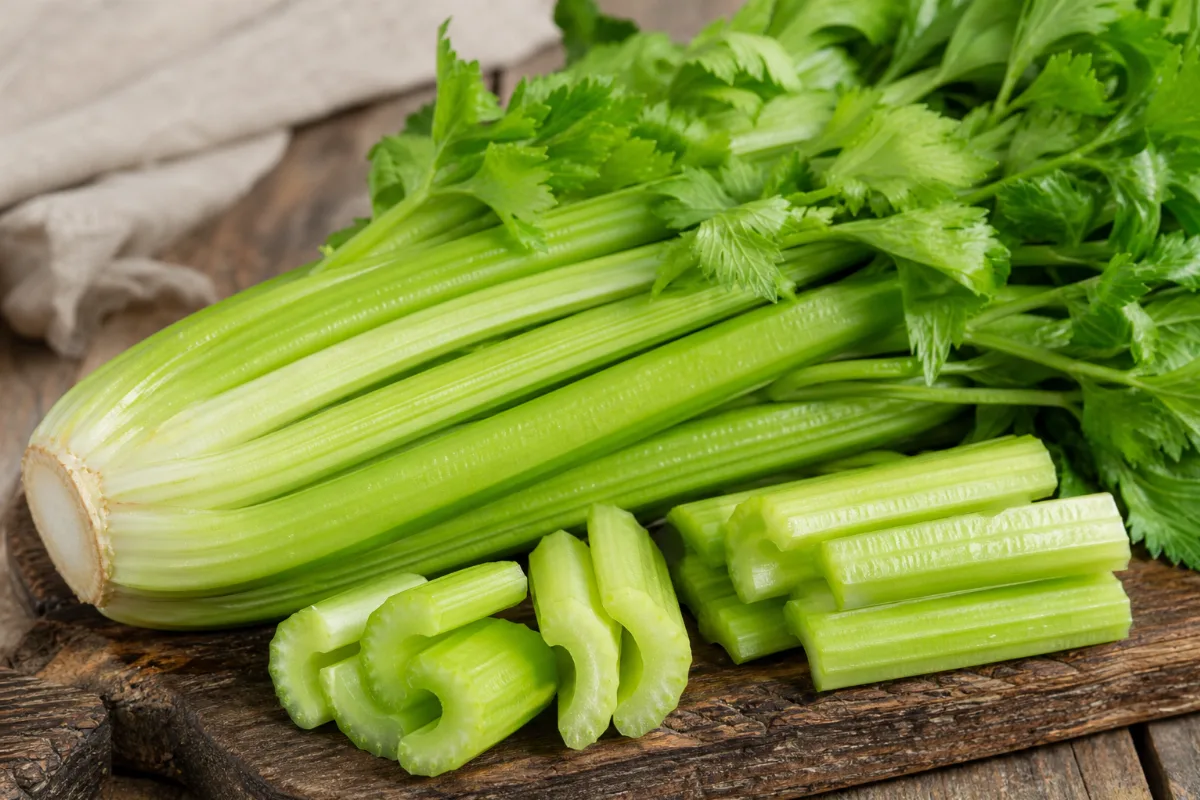
Vegetables · Vegetable
Celery
Apium graveolens · also called Garden celery, apio (Spanish)
Celery is a crunchy stalk vegetable that is about 95% water. It has some vitamin K and potassium. Small trials of celery products, mostly seed, found lower blood pressure, but that does not show the same for eating the stalks, and celery juice claims have no human trials behind them. The main cautions are celery allergy (which can be severe), warfarin (because of vitamin K), potassium for kidney disease, and sun-triggered skin blisters after handling celery.
General information, not medical advice. Last substantive update · Not medically reviewed. A named clinician has not signed off on this page. How this page is made
About Celery
Celery is a light, crunchy vegetable that is mostly water, with some vitamin K and potassium. It is a healthy food, not a proven remedy: the blood pressure results come from celery products such as seed, not the stalks, and the biggest cautions are allergy and warfarin.
What it is
Celery (Apium graveolens) is a vegetable in the carrot family. People eat the stalks and leaves raw or cooked, and the root form is called celeriac.
USDA data for raw celery: 14 kcal per 100 g, and about 95 g of that is water. One cup of chopped celery (101 g) has about 14 kcal, 1.6 g fibre, 263 mg potassium, 81 mg sodium, 36 micrograms folate (DFE), 30 micrograms vitamin K and 3.1 mg vitamin C. One medium stalk (40 g) has about 6 kcal, 104 mg potassium and 12 micrograms vitamin K. Cooked celery values were not read.
What the research shows
The firmest fact is about a nutrient: vitamin K is needed for blood to clot, and celery contains some. This is not a trial of celery.
A 2025 review pooled ten small trials of celery products and found lower blood pressure, fasting blood sugar and triglycerides on average, with no overall change in cholesterol. The products were mostly seed or extracts, heterogeneity was substantial, and the review's abstract does not give a result for the stalk.
Observational studies link more fruit and vegetables overall to less heart disease, but celery was not named. We found no human trial of celery juice.
Food versus seed, extracts and juice
The blood pressure, sugar and blood fat trials used celery preparations, mostly seed. Results for seed or extracts do not carry over to eating the stalks. Celery juice removes much of the fibre and has no human trials. Celeriac and celery seed have their own pages.
Amounts
This page gives no amounts to eat. Ask a doctor, pharmacist or dietitian what is right for you, especially if you take warfarin or have kidney problems or a food allergy.
At a glance
Traditional uses history, not proof
- Eaten as a vegetable, raw in salads and snacks or cooked in soups and stews
- Used at home as a folk remedy for high blood pressure
- Long use as food is not proof that it treats any condition
Studied for research
- Vitamin K for normal blood clotting, high certainty for the nutrient, celery is a modest source
- Blood pressure (celery preparations, mostly seed), low certainty
- Heart disease risk (vegetables as a group), low certainty, observational
- Fasting blood sugar (celery preparations), very low certainty
- Triglycerides (celery preparations), low certainty; no overall change in cholesterol
- Celery juice for detox or disease, insufficient evidence, no human trial found
Main compounds
- Vitamin K (phylloquinone)
- Potassium
- Apigenin
- Lutein and zeaxanthin
- Furocoumarins and psoralens
- Nitrate
- Api g 7 (allergen protein)
Common forms
- Raw stalks and leaves as food
- Cooked celery in soups and stews
- Celery juice
- Celeriac (celery root), the root form of the same plant
- Celery seed, powders and extracts (a separate product; most blood pressure trials used seed or extracts)
Research links: 2025 review: celery and blood pressure, sugar and blood fats · 2024 study: Api g 7 and celery-mugwort allergy · NHS: Warfarin · Research Library · Genes & Biomarkers Library
What it is and its history
- Accepted scientific name
- Apium graveolens
- Naming authority
- L. (GBIF accepted)
- Common names
- Celery (English); Garden celery (English); Apio (Spanish)
- Family or group
- Apiaceae (the carrot family), as given by GBIF and by the 2020 celery genome paper.
- Classification
- Plantae > Tracheophyta > Magnoliopsida > Apiales > Apiaceae > Apium > Apium graveolens
- Native range
- Not verified from a source read.
- Habitat
- Not verified from a source read.
- What it looks like
- Roots: Not verified.; Stems: The stalks are the part usually eaten. USDA gives a household portion of one medium stalk (7.5 to 8 inches long) as 40 g and a small stalk (5 inches) as 17 g.; Leaves: The leaves are used as a herb or garnish (existing nutrient summary; not verified from a source read).; Flowers: Not verified.; Fruit: Not verified. Celery seed is a separate product with its own page.
- Cultivation
- Not verified from a source read.
- Harvest and processing
- Eaten raw or cooked, juiced, or used as a powder or flavouring (existing nutrient summary). Cooking effects on nutrients were not read from a source.
- Look-alikes and adulterants
- Name: Celeriac (celery root); Note: The root form of the same species. Much celery allergy research is on celeriac, so allergy results are not assumed to be identical for the stalk.; Name: Celery seed; Note: A separate product with its own page. Most blood pressure trials of 'celery' used seed or extract products, not the stalk.
- Sustainability and conservation
- Not assessed.
Photographs
What is inside, and how it may work
What it contains and how those compounds act in cells and animals. Laboratory and animal mechanisms are not proven effects in people.
Main compounds
| Compound | Family | Where it is concentrated | Activity studied | Level of evidence |
|---|---|---|---|---|
| Vitamin K (phylloquinone) PubChem 5284607 | vitamin | Stalk USDA: 29.3 micrograms per 100 g raw | Needed for blood-clotting proteins (MedlinePlus). Affects warfarin. 12 16 15 | Human data |
| Potassium | mineral | Stalk USDA: 260 mg per 100 g raw | A mineral relevant to people with kidney disease or on medicines that raise potassium (MedlinePlus). 11 16 | Human data |
| Apigenin PubChem 5280443 | flavone (flavonoid) | Celery plant Not given in the sources read | The celery genome paper calls celery rich in apigenin. No human effect from eating celery was read. 4 | Lab only |
| Furocoumarins and psoralens | furanocoumarin | Stalk (and fungus-infected produce) Not given in the sources read | Make skin sensitive to UV light and can cause blistering after handling celery (Cutis, 2025). 7 | Human data |
| Api g 7 (allergen protein) | defensin protein | Celeriac (root) Not applicable | A celeriac allergen linked to a higher chance of severe reactions and to mugwort allergy (Art v 1). 2 3 | Human data |
| Nitrate PubChem 943 | inorganic anion | Stalk One US retail survey: about 1,496 mg/kg fresh weight (conventional) and 912 mg/kg (organic-labeled) | A natural plant nutrient. The survey abstract draws no health conclusion. 6 | Human data |
| Lutein (with zeaxanthin) PubChem 5281243 | carotenoid | Stalk USDA: 283 micrograms lutein plus zeaxanthin per 100 g raw | Carotenoid plant pigment. No celery-specific health result was read. 16 | Human data |
Mechanisms, receptors and pathways
| Target or pathway | Gene or receptor | What was found | Level |
|---|---|---|---|
| Vitamin K and blood clotting | Clotting factors II, VII, IX and X (named by MedlinePlus) | Vitamin K is used by the liver to make clotting proteins; warfarin works against this, so the vitamin K in food affects the medicine. 12 15 | Human data |
| Celery-mugwort cross-reactivity | Api g 7 (celeriac) and Art v 1 (mugwort); structurally similar defensins | IgE to Api g 7 correlated closely (r = 0.86) with IgE to the mugwort allergen Art v 1, which explains why many celery-allergic people also react to mugwort pollen. 2 3 | Human data |
| Furocoumarins with UV light | Not specified | Furocoumarins and psoralens on the skin plus UV light cause a non-allergic blistering reaction (phytophotodermatitis). 7 | Human data |
Absorption, metabolism and elimination
- Absorption
- Not found.
- Distribution
- Not found.
- Metabolism
- Not found.
- Elimination
- Not found.
- Bioavailability
- Not established for celery nutrients in the sources read.
Isolated compounds versus whole extracts
The blood pressure, blood sugar and blood fat trials used celery preparations, mostly seed or extracts, so they do not tell us about eating celery stalks. Celery juice has no human trials. Celeriac, stalk, seed and juice are different products.
Nutritional composition
Nutrition from USDA FoodData Central (Celery, raw, FDC 169988, SR Legacy, last updated 4/1/2019, read 2026-10-26). Per 100 g: 14 kcal, 0.69 g protein, 0.17 g fat, 2.97 g carbohydrate, 1.6 g fibre, 1.34 g sugars, about 95 g water, 40 mg calcium, 0.2 mg iron, 11 mg magnesium, 260 mg potassium, 80 mg sodium, 3.1 mg vitamin C, 36 micrograms folate (DFE), 22 micrograms vitamin A (RAE), 29.3 micrograms vitamin K, 0.103 mg manganese, 283 micrograms lutein plus zeaxanthin. One cup of chopped raw celery (101 g): about 14 kcal, 1.6 g fibre, 41 mg calcium, 263 mg potassium, 81 mg sodium, 3.1 mg vitamin C, 36 micrograms folate, 30 micrograms vitamin K. One medium stalk (40 g): about 6 kcal, 0.6 g fibre, 104 mg potassium, 32 mg sodium, 12 micrograms vitamin K. Figures vary with variety, ripeness and storage. Cooked celery values were not read.
1 high certainty3 low certainty1 very low certainty2 not enough evidence
What was looked at
The 7 benefits and uses checked for Celery, each with how strong the evidence is. Tap one to open it.
- Vitamin K for normal blood clottingHigh certainty
- Blood pressure (celery preparations, mostly seed)Low certainty
- Heart disease risk (vegetables as a group)Low certainty
- Fasting blood sugar (celery preparations, mostly seed)Very low certainty
- Blood fats: triglycerides and cholesterol (celery preparations, mostly seed)Low certainty
- Celery juice for detox or disease (popular claims)Not enough evidence
- Apigenin and other plant compounds (lab studies)Not enough evidence
Lab markers tracked in the studies
Systolic blood pressureDiastolic blood pressureCardiovascular disease and death from any causeFasting plasma glucoseTriglyceridesTotal, LDL and HDL cholesterol
What is Celery good for?
The main studied uses and how strong the human evidence is for each. Many results are for celery preparations such as seed or extracts, or for vegetables as a group, not for eating celery stalks.
Benefits, one by one
Each card is a research question, not a promise. Tap a goal to filter. Open a card to see the studies, doses and limits.
Vitamin K for normal blood clotting
High certaintyVitamin K is needed for blood to clot. Celery has some: USDA lists about 29 micrograms in one cup (101 g) of chopped raw celery. That makes celery a modest source, not a rich one. If you take warfarin, the same vitamin K matters for another reason: see the Safety tab.
2 studiesRaw stalks as food. Values vary with variety, ripeness and storage.
Studies, doses and limits
What the trials found
MedlinePlus says vitamin K is needed to make clotting factors in the liver and that deficiency is very rare. USDA lists 29.3 micrograms of vitamin K (phylloquinone) per 100 g of raw celery, about 29.6 micrograms in one cup of chopped celery (101 g) and about 12 micrograms in one medium stalk (40 g).
Results
The clotting role of vitamin K is well accepted, and celery contains some. No trial of celery for clotting was read.
Effect sizes as reported
USDA: 29.3 micrograms vitamin K per 100 g raw celery; about 29.6 micrograms per cup chopped (101 g).
Why this rating
High for the nutrient role and for celery containing vitamin K (health-agency statement and USDA data). There is no celery-specific trial, and a varied diet normally supplies vitamin K.
Form and dose studied
Raw stalks as food. Values vary with variety, ripeness and storage.
Who was studied
Anyone eating a varied diet.
Limits
Nutrient fact, not a trial of celery. This page does not show that extra vitamin K from any source adds benefit in someone who already has enough.
Why researchers looked
Celery is often named as a food with vitamin K, so people ask what it adds.
Traditional use
Celery stalks are eaten raw or cooked, and the leaves are used as a herb. Long use as food is not proof that it treats any condition.
Proposed mechanism Authoritative guidance
Vitamin K is used by the liver to make clotting proteins (clotting factors II, VII, IX and X). Without it, blood would not clot (MedlinePlus).
A proposed mechanism does not show that the effect happens in people.
People taking warfarin should keep vitamin K intake steady and ask their clinic; see the Safety tab.
Blood pressure (celery preparations, mostly seed)
Low certaintyA 2025 review pooled ten small trials of celery products and found lower blood pressure on average. Most of the products were celery seed or extracts, and the results varied a lot. It does not show that eating celery stalks lowers blood pressure.
1 studiesCelery preparations of several kinds, mostly seed. Not the stalk as f…
Studies, doses and limits
What the trials found
A 2025 systematic review and meta-analysis of randomised trials of celery (Apium graveolens) included ten studies with 511 adults. Pooled results favoured celery for systolic pressure (standardised mean difference -1.0, 95% CI -1.85 to -0.14) and diastolic pressure (-0.93, 95% CI -1.54 to -0.33). In subgroups, celery seed or preparations did better than other parts of celery. The authors report no significant difference in side effects between celery and placebo, and they call the heterogeneity substantial and the sample sizes limited.
Results
On average, celery products lowered blood pressure in small trials. The abstract does not separate the everyday raw stalk from seed and extract products, and it says other parts of celery did less well.
Effect sizes as reported
Systolic SMD -1.0 (95% CI -1.85 to -0.14); diastolic SMD -0.93 (95% CI -1.54 to -0.33). Ten trials, 511 participants. The abstract gives standardised units, not mm Hg.
Why this rating
Low, because the trials were small, the authors report substantial heterogeneity, the products were mostly seed or extracts rather than the vegetable, and the abstract does not give blood pressure in mm Hg.
Form and dose studied
Celery preparations of several kinds, mostly seed. Not the stalk as food. This page gives no amounts.
Who was studied
Adults in ten randomised trials.
Limits
Results come from celery preparations, mostly seed, so they do not tell us about eating celery stalks. Small trials with substantial heterogeneity. The abstract does not say whether the trials were industry-funded; the authors declare no conflicts of interest.
Why researchers looked
Celery is widely used at home as a food remedy for high blood pressure, so researchers pooled the trials.
Traditional use
Celery is a common folk remedy for high blood pressure. Long use is not proof that it works.
Proposed mechanism Unknown
Not established. The studies read do not show how celery products might lower pressure in people.
A proposed mechanism does not show that the effect happens in people.
Do not stop or change blood pressure medicine because of this. Celery seed products are a different product with their own cautions; ask a doctor or pharmacist.
Heart disease risk (vegetables as a group)
Low certaintyPeople who eat more fruit and vegetables have less heart disease in observational studies. A 2017 review found about 8% lower risk per 200 g a day of fruit and vegetables combined. This cannot prove the vegetables are the cause, and celery was not studied on its own in the abstract read.
1 studiesFruit and vegetables eaten as food. The 200 g/day is the analysis uni…
Studies, doses and limits
What the trials found
A 2017 systematic review and dose-response meta-analysis of 95 prospective studies found, for fruit and vegetables combined, a relative risk of 0.92 for coronary heart disease (95% CI 0.90-0.94), 0.84 for stroke (0.76-0.92), 0.92 for cardiovascular disease (0.90-0.95) and 0.90 for death from any cause (0.87-0.93) per 200 g a day. The abstract names green leafy vegetables, cruciferous vegetables, apples and pears, citrus fruit and salads as having inverse associations with cardiovascular disease and all-cause death. Celery is not named.
Results
Observational studies link more fruit and vegetables to less heart disease. A celery-only figure is not in the abstract.
Effect sizes as reported
Fruit and vegetables combined, per 200 g/day: CVD RR 0.92 (0.90-0.95); stroke RR 0.84 (0.76-0.92); all-cause mortality RR 0.90 (0.87-0.93).
Why this rating
Low, because the evidence is observational: people who eat more vegetables differ from others in many ways, and the figures are for fruit and vegetables combined, not celery.
Form and dose studied
Fruit and vegetables eaten as food. The 200 g/day is the analysis unit, not advice.
Who was studied
Adults in prospective cohort studies.
Limits
Cannot show cause. Celery was not analysed on its own in the abstract read.
Why researchers looked
Vegetables hold fibre, vitamins and plant compounds, and population studies ask whether eating more of them goes with healthier hearts.
Traditional use
Celery is eaten as a vegetable, raw or cooked. Long use as food is not proof that it treats any condition.
Proposed mechanism Unknown
Not established. Which nutrient or plant compound might matter, if any, is not shown by the studies read.
A proposed mechanism does not show that the effect happens in people.
None specific beyond the allergy and warfarin cautions on the Safety tab.
Fasting blood sugar (celery preparations, mostly seed)
Very low certaintyThe same 2025 review of ten small trials found slightly lower fasting blood sugar with celery products. The result only just reached significance, most products were seed or extracts, and it says nothing sure about eating celery stalks.
1 studiesCelery preparations of several kinds, mostly seed. This page gives no…
Studies, doses and limits
What the trials found
In the 2025 systematic review and meta-analysis of randomised trials (ten studies, 511 adults in total), celery was linked to lower fasting plasma glucose (standardised mean difference -0.80, 95% CI -1.58 to -0.01). The upper end of the interval is almost zero. The authors report substantial heterogeneity for most outcomes and limited sample sizes.
Results
A borderline lower fasting glucose on average with celery products. The abstract does not give a stalk-only result or units such as mg/dL.
Effect sizes as reported
Fasting plasma glucose SMD -0.80 (95% CI -1.58 to -0.01).
Why this rating
Very low, because the interval nearly includes no effect, trials were small with substantial heterogeneity, and the products were mostly seed or extracts, not the vegetable.
Form and dose studied
Celery preparations of several kinds, mostly seed. This page gives no amounts.
Who was studied
Adults in randomised trials; the abstract does not say whether they had diabetes.
Limits
Standardised units only. Not a trial of eating celery stalks. Number of trials for this outcome is not given in the abstract.
Why researchers looked
Celery is used at home as a folk remedy for high blood sugar, so the review also pooled blood sugar results.
Traditional use
Celery is a common folk remedy. Long use is not proof that it works.
Proposed mechanism Unknown
Not established. The studies read do not show how celery products might change blood sugar.
A proposed mechanism does not show that the effect happens in people.
People who take diabetes medicine should not change it because of celery. Ask a clinician.
Blood fats: triglycerides and cholesterol (celery preparations, mostly seed)
Low certaintyThe 2025 review found lower triglycerides with celery products but no overall change in total, LDL or HDL cholesterol. Again, the products were mostly seed or extracts, not the stalk.
1 studiesCelery preparations of several kinds, mostly seed. This page gives no…
Studies, doses and limits
What the trials found
In the 2025 meta-analysis of ten randomised trials (511 adults), celery was linked to lower triglycerides (standardised mean difference -1.18, 95% CI -1.45 to -0.91). No overall effect was seen on total cholesterol, LDL cholesterol or HDL cholesterol. The authors report substantial heterogeneity for most outcomes.
Results
Triglycerides were lower on average with celery products; cholesterol did not change overall.
Effect sizes as reported
Triglycerides SMD -1.18 (95% CI -1.45 to -0.91). Total cholesterol, LDL and HDL: no significant overall effect (figures not in the abstract).
Why this rating
Low, because the trials were small, heterogeneity was substantial, results were in standardised units, and the products were mostly seed or extracts.
Form and dose studied
Celery preparations of several kinds, mostly seed. This page gives no amounts.
Who was studied
Adults in randomised trials.
Limits
Not a trial of eating celery stalks. Number of trials for each outcome is not given in the abstract.
Why researchers looked
Celery is used at home as a folk remedy for high cholesterol, so the review pooled blood fat results.
Traditional use
Celery is a common folk remedy. Long use is not proof that it works.
Proposed mechanism Unknown
Not established. The studies read do not show how celery products might change blood fats.
A proposed mechanism does not show that the effect happens in people.
Do not change cholesterol medicine because of celery. Ask a clinician.
Celery juice for detox or disease (popular claims)
Not enough evidenceSocial media claims say celery juice detoxes the body or treats disease. We found no human trial that shows this. Juicing also removes most of the fibre.
1 studiesCelery juice drunk as a beverage. This page gives no amounts.
Studies, doses and limits
What the trials found
A PubMed search on 2026-10-26 for celery juice limited to randomised controlled trials returned two papers, neither about celery juice (one was beetroot juice and one was about learning to like vegetables during breastfeeding). The NHS says that crushing fruit and vegetables into juice releases the sugars they contain, and that vegetable juice counts as at most one portion of 5 A Day.
Results
No human trial of celery juice for detox or disease was found.
Why this rating
Insufficient: no human trial was found. The search was one PubMed query, not a full review.
Form and dose studied
Celery juice drunk as a beverage. This page gives no amounts.
Limits
A single PubMed query. Absence of a trial does not prove celery juice does nothing; it means the claims are untested.
Why researchers looked
Celery juice became a popular drink with many online health claims, so we checked for human studies.
Traditional use
Celery juice is a modern wellness trend, not a long-standing tradition.
Proposed mechanism Unknown
No mechanism has been shown in people.
A proposed mechanism does not show that the effect happens in people.
Celery juice carries the same allergy, warfarin and potassium cautions as the food; see the Safety tab. Do not stop medicine or treatment in favour of juice.
Apigenin and other plant compounds (lab studies)
Not enough evidenceCelery is rich in a plant compound called apigenin. Lab and animal studies of such compounds report effects, but we read no human study showing that eating celery does anything because of them.
1 studiesNot applicable.
Studies, doses and limits
Results
No human results. Any effects reported for apigenin or celery extracts in rats or cells were not re-read for this page and are not claimed.
Why this rating
Insufficient: only a plant-genetics paper was read, and it makes no claim about health.
Limits
A genome paper establishes content, not benefit. Animal and cell studies were not re-read.
Why researchers looked
Researchers study celery's plant compounds in the lab to look for possible effects.
Traditional use
Celery is eaten as a vegetable. Long use as food is not proof that it treats any condition.
Proposed mechanism Lab only
Apigenin is a flavone. A 2020 celery genome paper explains that celery is rich in apigenin and describes the genes behind its making. No human effect from eating celery is shown by it.
A proposed mechanism does not show that the effect happens in people.
None specific.
Connections to the rest of health
How Celery connects to the rest of our health knowledge graph. Every link says what kind of connection it is. A safety link (for example to the liver) is a warning, not a benefit. A study that merely mentions a topic never creates a benefit link.
Explore every connection: goals, body systems, organs, symptoms, genes
B. Body systems
| Connected to | Kind of connection | Evidence status | Context | Studies |
|---|---|---|---|---|
| Cardiovascular System | Biological association | High certainty | Studied for: Vitamin K for normal blood clotting Studied for: Blood pressure (celery preparations, mostly seed) | 12 16 5 1 |
| Blood And Immune | Biological association | High certainty | Studied for: Vitamin K for normal blood clotting | 12 16 |
| Endocrine System | Biological association | Very low certainty | Studied for: Fasting blood sugar (celery preparations, mostly seed) | 5 |
| Metabolism Weight | Biological association | Low certainty | Studied for: Blood fats: triglycerides and cholesterol (celery preparations, mostly seed) | 5 |
E. Health conditions
| Connected to | Kind of connection | Evidence status | Context | Studies |
|---|---|---|---|---|
| Food allergy | Adverse effect or risk | Documented risk | Celery is a declared allergen and can cause severe reactions. Preparation or compound: Celery and celeriac |
8 14 2 |
I. Biomarkers
| Connected to | Kind of connection | Evidence status | Context | Studies |
|---|---|---|---|---|
| Systolic blood pressure | Biological association | Low certainty | Measured in trials: lowered. A lab change is not the same as a health benefit. | 5 |
| Diastolic blood pressure | Biological association | Low certainty | Measured in trials: lowered. A lab change is not the same as a health benefit. | 5 |
| Cardiovascular disease and death from any cause | Biological association | Low certainty | Measured in trials: lowered. A lab change is not the same as a health benefit. | 1 |
| Fasting plasma glucose | Biological association | Very low certainty | Measured in trials: lowered. A lab change is not the same as a health benefit. | 5 |
| Triglycerides | Biological association | Low certainty | Measured in trials: lowered. A lab change is not the same as a health benefit. | 5 |
| Total, LDL and HDL cholesterol | Biological association | Low certainty | Measured in trials: no-change. A lab change is not the same as a health benefit. | 5 |
K. Biological pathways
| Connected to | Kind of connection | Evidence status | Context | Studies |
|---|---|---|---|---|
| Vitamin K | Preliminary mechanism | Human | Celery contains vitamin K; vitamin K is needed for clotting and affects warfarin. | 12 15 |
| Potassium | Preliminary mechanism | Human | Celery has a moderate amount; relevant for kidney disease and some blood pressure medicines. | 11 16 |
| Mugwort pollen (Artemisia vulgaris) | Preliminary mechanism | Human | Celery allergy often goes with mugwort pollen allergy (celery-mugwort syndrome). | 2 3 |
L. Active compounds
| Connected to | Kind of connection | Evidence status | Context | Studies |
|---|---|---|---|---|
| Vitamin K (phylloquinone) | Biological association | Human | Needed for blood-clotting proteins (MedlinePlus). Affects warfarin. Preparation or compound: Stalk |
12 16 15 |
| Potassium | Biological association | Human | A mineral relevant to people with kidney disease or on medicines that raise potassium (MedlinePlus). Preparation or compound: Stalk |
11 16 |
| Apigenin | Biological association | Lab only | The celery genome paper calls celery rich in apigenin. No human effect from eating celery was read. Preparation or compound: Celery plant |
4 |
| Furocoumarins and psoralens | Biological association | Human | Make skin sensitive to UV light and can cause blistering after handling celery (Cutis, 2025). Preparation or compound: Stalk (and fungus-infected produce) |
7 |
| Api g 7 (allergen protein) | Biological association | Human | A celeriac allergen linked to a higher chance of severe reactions and to mugwort allergy (Art v 1). Preparation or compound: Celeriac (root) |
2 3 |
| Nitrate | Biological association | Human | A natural plant nutrient. The survey abstract draws no health conclusion. Preparation or compound: Stalk |
6 |
| Lutein (with zeaxanthin) | Biological association | Human | Carotenoid plant pigment. No celery-specific health result was read. Preparation or compound: Stalk |
16 |
Each connection is stored with the ingredient, the connected record, the kind of connection, the evidence status, the supporting studies, the preparation or compound involved, and a review date (last reviewed October 26, 2026).
The evidence
The research centre for Celery. Every record here was checked against PubMed or the publisher's page; we never list a study we have not verified.
Evidence by outcome
Bars show how many studies we found for each outcome, not how well it works. People are added up across trials only (reviews are not added, to avoid double counting).
How we rate evidence
High certainty
Several well-run trials or reviews agree; further research is unlikely to change the picture much.
Moderate certainty
Good trials point the same way, but some doubt remains.
Low certainty
Small, short or inconsistent trials. The finding could change with better research.
Very low certainty
Very little or very weak human data. Treat as a possibility only.
Mixed findings
Trials or reviews disagree with each other.
Not enough evidence
Not enough human research to say either way.
Evidence against
Good research found no benefit, or found harm.
We take the reviewers' own risk-of-bias and GRADE statements where they exist, and otherwise judge from study size, design, consistency, directness and whether a product matches what is sold. Many publications do not make evidence high. Method note: We started from our existing celery summary, re-checked nutrition at USDA FoodData Central, read the health agency pages (NHS, MedlinePlus, FDA, UK legislation) and searched PubMed for reviews, allergy studies and case articles. Only abstracts were read for studies. Items we could not verify are flagged in the research gaps.
Study library: every study we checked 16
| Study | Design | People | Product, dose, length | Result |
|---|---|---|---|---|
| Aune 2017 Fruit and vegetable intake and the risk of cardiovascular disease, total cancer and all-cause mortality-a systematic review and dose-response meta-analysis of prospective studies. Int J Epidemiol · PMID 28338764 · DOI |
Systematic review meta analysis |
Adults in 95 prospective studies (142 publications) | Fruit and vegetable intake as food Fruit and vegetables Per 200 g/day (analysis unit, not advice) Prospective follow-up · vs Lower intake |
For fruit and vegetables combined, each 200 g/day was linked to lower risk of coronary heart disease, stroke, cardiovascular disease, total cancer and death from any cause. The abstract says inverse associations were seen for apples and pears, citrus fruit, green leafy vegetables, cruciferous vegetables and salads with cardiovascular disease and all-cause mortality. Celery is not named. Combined fruit and vegetables per 200 g/day: CHD RR 0.92; stroke RR 0.84; CVD RR 0.92; total cancer RR 0.97; all-cause mortality RR 0.90 (CHD 0.90-0.94; stroke 0.76-0.92; CVD 0.90-0.95; cancer 0.95-0.99; all-cause 0.87-0.93) Methods, limits and fundingOutcomes: Cardiovascular disease, coronary heart disease, stroke, total cancer, all-cause mortality Limitations: Prospective observational studies cannot show cause; people who eat more vegetables differ in other ways. The figures are not for celery. Funding and conflicts: Not stated in the abstract. Read: abstract |
| Ballmer-Weber 2024 New light on an old syndrome: Role of Api g 7 in mugwort pollen-related celery allergy. J Allergy Clin Immunol · PMID 38763171 · DOI |
Observational cross sectional |
79 79 patients with celery allergy (positive food challenge or clear history of severe anaphylaxis) |
IgE testing with celery and mugwort allergen panels Celery root and extract allergens · vs Api g 7-sensitized versus non-sensitized patients |
30 patients had mild oral or rhinoconjunctival symptoms and 49 had systemic reactions. 68% had IgE to celery extract, 80% to birch pollen and 77% to mugwort pollen. IgE to Api g 7 was found in 52% and correlated closely with the mugwort allergen Art v 1. Odds of a severe reaction were about six times greater in Api g 7-sensitized patients (OR 5.87, 95% CI 1.08-32.0, P=0.041). A combination of five celery allergens raised diagnostic sensitivity to 92%. Api g 7 sensitisation and severe reaction: OR 5.87 (95% CI 1.08-32.0) Methods, limits and fundingOutcomes: IgE to celery and mugwort allergens; severity of reaction Limitations: Selected patients with celery allergy, so it does not give how common allergy is. Very wide confidence interval. Much of the work concerns celery root. Funding and conflicts: Two authors are affiliated with Thermo Fisher Scientific, which makes allergy tests; the abstract does not state funding. Read: abstract |
| Kosztulska 2025 Current State of Celery Allergy: Is Discovering Api g 7 a Milestone in Diagnosing Celeriac-Allergic Patients? Int J Mol Sci · PMID 40565300 · DOI |
Narrative review |
People with celery or celeriac allergy | Celery allergens and diagnostic tests Celeriac |
The review calls celery allergy a common food allergy, particularly among Europeans. Api g 7, a newly identified celeriac allergen in the defensin family, carries a high risk of severe systemic reactions; sensitised patients are often also sensitised to the mugwort allergen Art v 1. None of the commercial tests could detect IgE to Api g 7. Not applicable (Not applicable) Methods, limits and fundingOutcomes: Diagnosis and risk of celery allergy Limitations: Narrative review; abstract only. Funding and conflicts: Authors declare no conflicts of interest. Read: abstract |
| Li 2020 The genome sequence of celery (Apium graveolens L.), an important leaf vegetable crop rich in apigenin in the Apiaceae family. Hortic Res · PMID 31934340 · DOI |
Plant genomics plant |
Not applicable (plant genome) | Celery genome sequence |
The paper reports a celery genome of 2.21 Gb with 34,277 predicted genes and a comparison of apigenin-making genes that might explain celery's high apigenin content. It makes no health claim. Not applicable (Not applicable) Methods, limits and fundingOutcomes: Genome assembly, genes for disease resistance, flavonoid and terpenoid metabolism, apigenin biosynthesis Limitations: A plant-genetics paper. Used only to support the statement that celery is rich in apigenin. Funding and conflicts: Not stated in the abstract. Read: abstract |
| Liu 2025 Effects of celery (Apium graveolens) on blood pressure, glycemic and lipid profile in adults: a systematic review and meta-analysis of randomized controlled trials. Front Nutr · PMID 40765738 · DOI |
Systematic review meta analysis |
511 Adults in ten randomised controlled trials of celery |
Celery preparations (mostly seed, per the authors' subgroup analysis) Seed and other parts Not given as a single figure in the abstract; this page gives no amounts Varied · vs Placebo or control |
Significant effects of celery on systolic and diastolic blood pressure, fasting glucose and triglycerides; no overall effect on total cholesterol, LDL or HDL. Subgroup analysis found celery seed or celery preparations above a higher daily amount more effective than other parts of celery. No significant difference in adverse events versus placebo. The authors note substantial heterogeneity for most outcomes and limited sample sizes. Systolic SMD -1.0; diastolic SMD -0.93; fasting glucose SMD -0.80; triglycerides SMD -1.18 (Systolic -1.85 to -0.14; diastolic -1.54 to -0.33; fasting glucose -1.58 to -0.01; triglycerides -1.45 to -0.91) Methods, limits and fundingOutcomes: Systolic and diastolic blood pressure, fasting plasma glucose, triglycerides, total cholesterol, LDL and HDL cholesterol, adverse events Limitations: Mostly seed or extract products. Substantial heterogeneity, small samples. Standardised mean differences, not mm Hg or mg/dL. Number of trials per outcome not given in the abstract. Funding and conflicts: Authors declare no commercial or financial conflicts of interest. Funding not stated in the abstract. Registration: PROSPERO CRD42025631143 Read: abstract |
| Nunez de Gonzalez 2015 A survey of nitrate and nitrite concentrations in conventional and organic-labeled raw vegetables at retail. J Food Sci · PMID 25850811 · DOI |
Food survey n/a |
194 194 retail samples of broccoli, cabbage, celery, lettuce and spinach from 5 US cities |
Raw vegetables bought at retail Edible parts · vs Conventional versus organic-labeled |
Mean nitrate of conventional broccoli, cabbage, celery, lettuce and spinach was 394, 418, 1496, 851 and 2797 mg/kg fresh weight; organic-labeled 204, 552, 912, 844 and 1318 mg/kg. Nitrite was low (0.1 to 1.2 mg/kg) except conventional spinach (8.0 mg/kg). Organic was numerically lower in most cases. Celery nitrate: conventional 1496 mg/kg; organic-labeled 912 mg/kg (Not given in the abstract) Methods, limits and fundingOutcomes: Nitrate and nitrite concentrations Limitations: One US survey from 2015. No health outcome. Geographic variation noted by the authors. Funding and conflicts: Not stated in the abstract. Read: abstract |
| Pate 2025 Not as Bland as You May Think: Celery (Apium graveolens) Commonly Induces Phytophotodermatitis. Cutis · PMID 40315466 · DOI |
Narrative review |
People exposed to celery | Celery contact with UV light Stalk |
Celery contains furocoumarins and psoralens that make skin sensitive to UV light and can cause blisters in sun-exposed areas. The amount in a typical diet is generally insufficient; people who regularly handle celery, eat produce infected with fungus or use tanning beds are at higher risk. Not applicable (Not applicable) Methods, limits and fundingOutcomes: Phytophotodermatitis Limitations: A short clinical article; abstract only. Funding and conflicts: Not stated in the abstract. Read: abstract |
| s-eu-1169-annex2 Regulation (EU) No 1169/2011, Annex II: substances or products causing allergies or intolerances · Source |
Regulation n/a |
Methods, limits and fundingRead: full-text | ||
| s-fda-produce FDA: Selecting and Serving Produce Safely · Source |
Health agency n/a |
Methods, limits and fundingRead: full-text | ||
| s-gbif-apium-graveolens GBIF Backbone: Apium graveolens L. (usageKey 5371879) · Source |
Reference database n/a |
Methods, limits and fundingRead: full-text | ||
| s-medlineplus-potassium MedlinePlus: Potassium in diet · Source |
Health agency n/a |
Methods, limits and fundingRead: full-text | ||
| s-medlineplus-vitk MedlinePlus: Vitamin K · Source |
Health agency n/a |
Methods, limits and fundingRead: full-text | ||
| s-nhs-5-a-day NHS: 5 A DAY - what counts? · Source |
Health agency n/a |
Methods, limits and fundingRead: full-text | ||
| s-nhs-food-allergy NHS: Food allergy · Source |
Health agency n/a |
Methods, limits and fundingRead: full-text | ||
| s-nhs-warfarin NHS: Warfarin · Source |
Health agency n/a |
Methods, limits and fundingRead: full-text | ||
| s-usda-fdc-169988 USDA FoodData Central: Celery, raw (FDC 169988) · Source |
Reference database n/a |
Methods, limits and fundingRead: full-text |
What we do not know yet
- No trial of eating celery stalks (rather than seed or extract products) was found for blood pressure, blood sugar, blood fats or heart disease.
- The celery trial review gives standardised results, not mm Hg or mg/dL, and does not separate out stalk products.
- No human trial of celery juice was found; only one PubMed search was run.
- How common celery allergy is, and whether cooking changes the risk, were not found.
- Pregnancy, breastfeeding, children, pesticide residues, heavy metals and the effect of cooking were not researched.
How new research is added
New studies are found by a saved PubMed search and placed in a review queue before the page changes.
Lab markers
What changed in blood or saliva tests during trials. A changed number is not the same as feeling or being healthier, and we give no "normal ranges".
Metabolic 1
Triglycerides
Lowered in trials
A type of fat carried in the blood.
Low certaintyResults and what it means
Why it was measured
High triglycerides are one of the blood fats checked for heart risk.
Statistical vs. clinical meaning
A change in a blood marker in small trials, not a proven health benefit.
Safety implication
None specific.
| Study | Result | People | Product |
|---|---|---|---|
| 5 | Celery preparations versus control: SMD -1.18 (95% CI -1.45 to -0.91) | Adults in randomised trials (511 across all outcomes) | Celery preparations, mostly seed (not the stalk as food) |
Other 5
Systolic blood pressure
Lowered in trials
The upper number in a blood pressure reading, the pressure in the arteries when the heart beats.
Low certaintyResults and what it means
Why it was measured
High blood pressure raises the risk of heart attack and stroke, and trials of celery products measure it.
Statistical vs. clinical meaning
A small-trial result for celery products, with substantial heterogeneity. Not a test of eating celery.
Safety implication
Do not change blood pressure medicine without a clinician.
| Study | Result | People | Product |
|---|---|---|---|
| 5 | Celery preparations versus control: systolic SMD -1.0 (95% CI -1.85 to -0.14) | 511 adults in ten randomised trials | Celery preparations, mostly seed (not the stalk as food) |
Diastolic blood pressure
Lowered in trials
The lower number in a blood pressure reading, the pressure in the arteries between heartbeats.
Low certaintyResults and what it means
Why it was measured
It is read together with systolic pressure to judge blood pressure.
Statistical vs. clinical meaning
Same trials and same limits as systolic pressure.
Safety implication
Do not change blood pressure medicine without a clinician.
| Study | Result | People | Product |
|---|---|---|---|
| 5 | Celery preparations versus control: diastolic SMD -0.93 (95% CI -1.54 to -0.33) | 511 adults in ten randomised trials | Celery preparations, mostly seed (not the stalk as food) |
Cardiovascular disease and death from any cause
Lowered in trials
How many people in a study develop heart disease or stroke, or die.
Low certaintyResults and what it means
Why it was measured
These are outcomes that matter most to health, so population studies count them.
Statistical vs. clinical meaning
An association in observational studies, not proof that vegetables prevent disease.
Safety implication
None specific.
| Study | Result | People | Product |
|---|---|---|---|
| 1 | Fruit and vegetables combined, per 200 g/day: CVD RR 0.92 (95% CI 0.90-0.95); all-cause mortality RR 0.90 (0.87-0.93) | Adults in 95 prospective studies | Fruit and vegetables as food (not celery alone) |
Fasting plasma glucose
Lowered in trials
The amount of sugar in the blood after a night without food.
Very low certaintyResults and what it means
Why it was measured
It is a standard measure of blood sugar control.
Statistical vs. clinical meaning
The result only just reached significance and cannot be applied to eating celery.
Safety implication
Do not change diabetes medicine without a clinician.
| Study | Result | People | Product |
|---|---|---|---|
| 5 | Celery preparations versus control: SMD -0.80 (95% CI -1.58 to -0.01) | Adults in randomised trials (511 across all outcomes) | Celery preparations, mostly seed (not the stalk as food) |
Total, LDL and HDL cholesterol
No clear change in trials
Blood cholesterol measures; LDL is often called the unhelpful kind and HDL the helpful kind.
Low certaintyResults and what it means
Why it was measured
They are standard blood fat measures used to judge heart risk.
Statistical vs. clinical meaning
No overall change in cholesterol was seen with celery products.
Safety implication
None specific.
| Study | Result | People | Product |
|---|---|---|---|
| 5 | No overall effect of celery preparations on total cholesterol, LDL or HDL (figures not in the abstract) | Adults in randomised trials (511 across all outcomes) | Celery preparations, mostly seed (not the stalk as food) |
Safety
What studies and official sources say about side effects, medicines and who should check first. Each point shows what kind of evidence it comes from.
Main points to know 3
- Celery is a recognised food allergen and can cause severe reactions. Celery is on the list of allergens that must be declared on food in the UK and EU (the list that came from EU Regulation 1169/2011, Annex II, item 9: celery and products thereof). The NHS says you can be allergic to any food, including celery. In a study of 79 people with celery allergy, 30 had mild mouth or nose symptoms and 49 had reactions in more than one part of the body. Much of the research is on celery root (celeriac), and the abstracts read do not separate stalk from root. If you have had a reaction to celery, avoid it and ask an allergy specialist. Authoritative guidance 8 14 2 3
- Celery allergy often goes with mugwort and birch pollen allergy. In the 79 people with celery allergy, 77% had IgE antibodies to mugwort pollen and 80% to birch pollen. A celery protein called Api g 7 was found in 52% and was linked to a roughly six-fold higher chance of a severe reaction rather than only mild mouth symptoms (odds ratio 5.87, 95% CI 1.08 to 32.0, a wide range). A 2025 review says no commercially available test could yet detect Api g 7. If you have pollen allergy and react to celery, tell an allergy clinic. Observational 2 3
- Warfarin: celery has some vitamin K, so keep your intake steady. The NHS says foods high in vitamin K, such as broccoli, spinach and other green leafy vegetables, can affect how warfarin works. You can still eat them, but talk to your warfarin clinic. MedlinePlus says sudden changes in vitamin K intake can change how the medicine works. Celery is not named by either page; USDA lists 29.3 micrograms of vitamin K per 100 g of raw celery, so it is a modest source, and the same rule of steady intake is the sensible reading. Do not change a prescribed medicine on your own. Authoritative guidance 15 12 16
Side effects 2
| Effect | How often | Severity and recovery | Evidence |
|---|---|---|---|
| Allergic reactions: itchy mouth and throat, rhinitis, and severe whole-body reactions (anaphylaxis) Patients were selected for having celery allergy, so the proportions do not tell us how often reactions occur in the general public. | In a study of 79 people with celery allergy: 30 mild oral or rhinoconjunctival symptoms, 49 systemic reactions. How common celery allergy is in the population was not found in the abstracts read. | mild to severe Not stated in the abstracts | Observational 2 3 |
| Painful blistering and dark patches on skin after handling celery and then sun or tanning-bed light (phytophotodermatitis) Celery contains furocoumarins and psoralens that react with UV light. The abstract says people who regularly handle celery, who eat produce infected with fungus or who use tanning beds are at higher risk. It is a skin reaction to contact plus light, not a food allergy. | Not stated. A 2025 report says the amount in a typical diet is generally not enough to cause it. | painful blisters (vesicles) in sun-exposed areas Not stated in the abstract | Narrative review 7 |
Liver
No liver injury from eating celery was found. A liver-safety source (such as LiverTox) was not searched for this food page.
How often. No frequency was found.
Monitoring. No agency monitoring advice was found.
This is a safety connection. It is not evidence that Celery supports liver health.
Medicines and supplements 2
| With | Why it matters | Importance | Evidence | What to do |
|---|---|---|---|---|
| Warfarin (blood thinner) prescription | Vitamin K helps blood clot, and warfarin works by lowering vitamin K activity. Raw celery has 29.3 micrograms of vitamin K per 100 g (USDA). | The NHS says foods high in vitamin K can be eaten but you should ask your warfarin clinic; MedlinePlus says sudden changes in vitamin K intake can change the effect. Neither names celery, which is a modest source. | Authoritative guidance High certainty 15 12 16 | Ask your warfarin clinic. Keep intake steady and do not change your medicine on your own. The NHS says do not take vitamin K supplements while taking warfarin. |
| ACE inhibitors, ARBs and potassium-sparing diuretics (medicines that can raise blood potassium) prescription | MedlinePlus lists these medicines among common causes of too much potassium in the blood, which can cause dangerous heart rhythms. Raw celery has 260 mg of potassium per 100 g (USDA). | MedlinePlus does not name celery. This is our reading of two facts, and with the potassium in ordinary portions of celery it is a question to raise with a clinician, not a ban. | Authoritative guidance Low certainty 11 16 | If you take these medicines or have kidney disease, ask your clinician how much potassium-rich food is right for you. |
Who should check first 3
| Situation | Advice | Evidence |
|---|---|---|
| Known celery or celeriac allergy | Avoid celery and foods that list it, and ask an allergy specialist. Celery is a declared allergen on UK and EU food labels. | Authoritative guidance 8 14 |
| Taking warfarin | Keep vitamin K intake steady and follow your warfarin clinic's advice. | Authoritative guidance 15 12 |
| Kidney disease or medicines that raise potassium | MedlinePlus says people with kidney problems, particularly those on dialysis, should not eat too many potassium-rich foods; ask your clinician. | Authoritative guidance 11 |
Overdose, product quality and regulators
Summary. No toxicity from celery as ordinary food was found in the sources read. The cautions are allergy, sun-triggered skin reactions after handling, and specific conditions or medicines.
Animal. Not reviewed.
Human doses studied. The review of ten celery trials reported no significant difference in side effects between celery and placebo, but the products were mostly seed or extracts rather than the vegetable.
Overdose response. Not found.
Genotoxicity. Not researched.
Fresh celery is eaten raw, so food-safety handling matters. One US retail survey measured nitrate in celery. Pesticide residues and heavy metals were not researched.
Food safety handling. The FDA says to wash all produce under running water, not to use soap, detergent or commercial produce wash, that washing reduces but does not eliminate bacteria, that pre-washed ready-to-eat packages can be used without more washing, and to keep cut produce cold. 9
Natural nitrate. A 2015 US retail survey of 194 samples of five raw vegetables found average nitrate of 1,496 mg per kg fresh weight in conventional celery and 912 mg per kg in organic-labeled celery. The abstract gives no health judgement. Whether this matters for young infants was not found in sources read. 6
Natural sodium. USDA lists 80 mg of sodium per 100 g of raw celery, about 32 mg in a medium stalk. This is natural sodium in the plant, not added salt. 16
| Body | Action | Date |
|---|---|---|
| UK and EU food labelling law (United Kingdom / European Union) | Celery and products thereof is item 9 on the list of substances causing allergies or intolerances (Regulation (EU) No 1169/2011, Annex II) source | 2011 |
| NHS (UK) (United Kingdom) | Food allergy page: you can be allergic to any type of food, including celery, mustard and sesame seeds source | 2026-08-20 |
| NHS (UK) (United Kingdom) | Warfarin page: foods high in vitamin K such as broccoli, spinach and other green leafy vegetables can affect how warfarin works; you can still eat them but ask your warfarin clinic; do not take vitamin K supplements. Celery is not named. source | 2026-02-24 |
When to get medical help
- Trouble breathing, swelling of the lips, face or throat, dizziness or collapse, or widespread hives after eating celery: call emergency services
- Signs of serious bleeding while taking warfarin, such as blood in urine or stool, unexplained bruising or nosebleeds
- A painful blistering rash in sunlit skin that touched celery (or celery juice) earlier
- Vomiting, diarrhoea, stomach pain or fever after eating raw produce
Stop using the product and contact a clinician or emergency service. In the US, Poison Control is 1-800-222-1222.
General information only, not medical advice. Ask a clinician or pharmacist before use, especially with medicines, in pregnancy or with a health condition. See the Natural Remedy Safety guide.
Frequently asked questions
What is celery good for?
Does celery lower blood pressure?
Not shown for eating the stalks. A 2025 review of ten small trials (511 adults) found lower pressure with celery products, but they were mostly seed or extracts and the results varied a lot. Do not stop blood pressure medicine because of celery.
Can celery cause an allergic reaction?
Why do people with pollen allergy react to celery?
Is celery safe with warfarin?
Does celery juice detox the body or cure disease?
No human trial shows this. Our PubMed search found no celery juice trial. The NHS notes that juicing releases sugars and counts vegetable juice as at most one portion.
Does celery help with blood sugar or cholesterol?
A 2025 review of celery products found slightly lower fasting glucose (only just significant) and lower triglycerides, but no overall change in cholesterol. Products were mostly seed or extracts, so this is not about eating stalks.
Is celery a good choice if I have kidney disease?
Can celery cause sun blisters on the skin?
Yes, in some cases. Celery contains furocoumarins that react with UV light and can cause painful blisters. A 2025 report says a typical diet is generally not enough, but people who regularly handle celery or use tanning beds are at higher risk.
Are celery, celeriac and celery seed the same?
Is celery safe in pregnancy?
No source we read says anything about eating celery in pregnancy. The FDA says pregnant women can be especially vulnerable to foodborne illness, so wash produce and keep it cold. Ask your doctor.
Explore by health goal
Editorial transparency
- Written by
- AlternativeMed editorial team. Research compiled with AI assistance, then checked against the sources listed.
- Medical review
- None. This page has not been reviewed by a physician or pharmacist.
- First published
- 2026-10-26
- Last substantive update
- 2026-10-26
- How we research
- We started from our existing celery summary, re-checked nutrition at USDA FoodData Central, read the health agency pages (NHS, MedlinePlus, FDA, UK legislation) and searched PubMed for reviews, allergy studies and case articles. Only abstracts were read for studies. Items we could not verify are flagged in the research gaps.
- How we rate evidence
- See "How we rate evidence" in the Evidence tab.
- Independence
- No product is promoted on this page. No affiliate links are shown.
Sources 16
Each source was opened and checked. Where we read only the abstract, it says so. The small numbers in the text point here.
- Aune D, Giovannucci E, Boffetta P, et al.. Fruit and vegetable intake and the risk of cardiovascular disease, total cancer and all-cause mortality-a systematic review and dose-response meta-analysis of prospective studies.. Int J Epidemiol. 2017. PMID 28338764. DOI 10.1093/ije/dyw319. (abstract)
- Ballmer-Weber BK, Wangorsch A, Bures P, et al.. New light on an old syndrome: Role of Api g 7 in mugwort pollen-related celery allergy.. J Allergy Clin Immunol. 2024. PMID 38763171. DOI 10.1016/j.jaci.2024.04.030. (abstract)
- Kosztulska B, Bartuzi Z, Ukleja-Sokołowska N. Current State of Celery Allergy: Is Discovering Api g 7 a Milestone in Diagnosing Celeriac-Allergic Patients?. Int J Mol Sci. 2025. PMID 40565300. DOI 10.3390/ijms26125840. (abstract)
- Li MY, Feng K, Hou XL, et al.. The genome sequence of celery (Apium graveolens L.), an important leaf vegetable crop rich in apigenin in the Apiaceae family.. Hortic Res. 2020. PMID 31934340. DOI 10.1038/s41438-019-0235-2. (abstract)
- Liu D, Zhao H, Xu H, et al.. Effects of celery (Apium graveolens) on blood pressure, glycemic and lipid profile in adults: a systematic review and meta-analysis of randomized controlled trials.. Front Nutr. 2025. PMID 40765738. DOI 10.3389/fnut.2025.1597680. (abstract)
- Nunez de Gonzalez MT, Osburn WN, Hardin MD, et al.. A survey of nitrate and nitrite concentrations in conventional and organic-labeled raw vegetables at retail.. J Food Sci. 2015. PMID 25850811. DOI 10.1111/1750-3841.12858. (abstract)
- Pate HF, Hill K, McGovern TW. Not as Bland as You May Think: Celery (Apium graveolens) Commonly Induces Phytophotodermatitis.. Cutis. 2025. PMID 40315466. DOI 10.12788/cutis.1199. (abstract)
- . Regulation (EU) No 1169/2011, Annex II: substances or products causing allergies or intolerances. . . (full-text)
- . FDA: Selecting and Serving Produce Safely. . . (full-text)
- . GBIF Backbone: Apium graveolens L. (usageKey 5371879). . . (full-text)
- . MedlinePlus: Potassium in diet. . . (full-text)
- . MedlinePlus: Vitamin K. . . (full-text)
- . NHS: 5 A DAY - what counts?. . . (full-text)
- . NHS: Food allergy. . . (full-text)
- . NHS: Warfarin. . . (full-text)
- . USDA FoodData Central: Celery, raw (FDC 169988). . . (full-text)


