Vegetables · Vegetable
Cucumbers
Cucumis sativus · also called Cucumber, slicing cucumber, pickling cucumber, pepino (Spanish)
Cucumber is the crisp, mild fruit of a vine, eaten raw as a vegetable. It is about 95% water, low in calories and has a little vitamin K. We found no trial showing that eating cucumber treats or prevents a disease; the health papers are mostly about extracts, powders or animals. The main cautions are Salmonella from contaminated raw cucumbers, steady vitamin K intake if you take warfarin, and allergy in some people with pollen allergy.
General information, not medical advice. Last substantive update · Not medically reviewed. A named clinician has not signed off on this page. How this page is made
About Cucumbers
Cucumber is a light, watery vegetable with small amounts of several nutrients. It is a healthy food, not a proven remedy: the health claims come from powders, extracts, rats or cells, not from trials of eating cucumber.
What it is
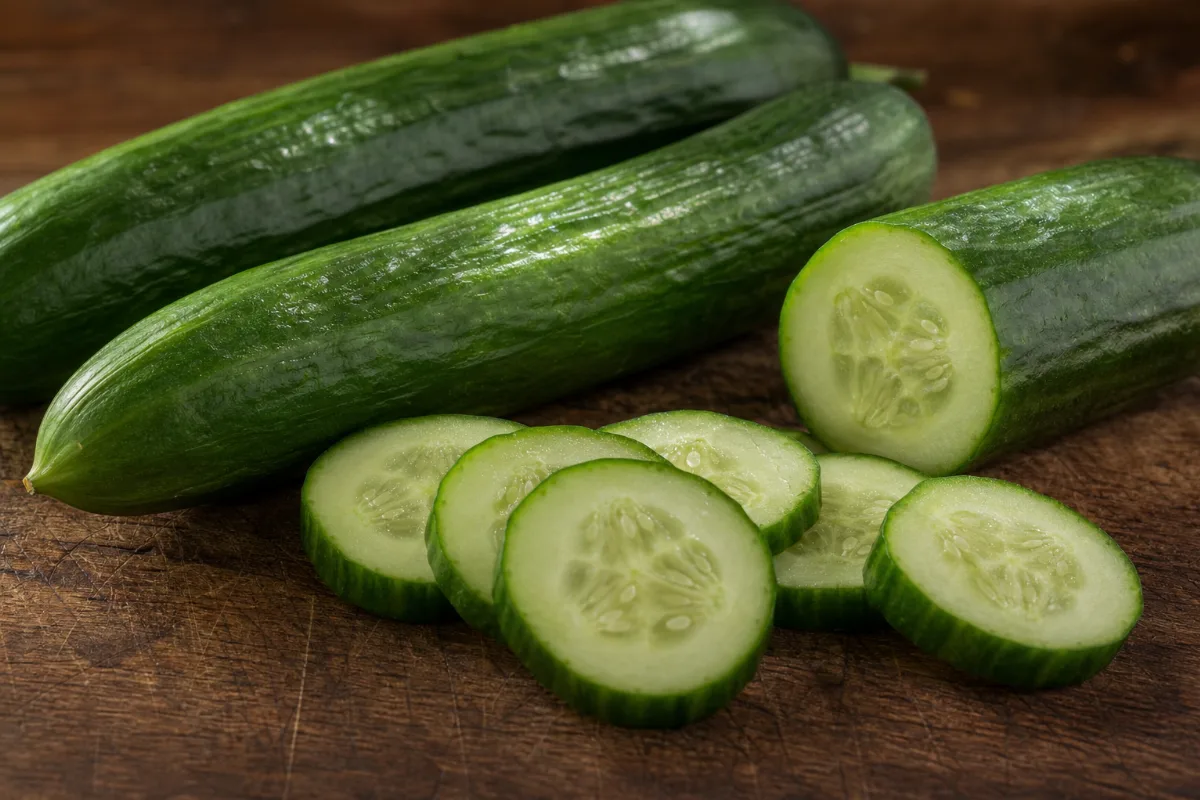
Cucumber (Cucumis sativus) is the fruit of a vine in the gourd family. People eat it raw, with or without the peel, and pickle it.
USDA data for raw cucumber with peel: 15 kcal and 95.2 g water per 100 g. A half cup of slices (52 g) has about 8 kcal, 0.3 g fibre, 76 mg potassium and 8.5 micrograms vitamin K. One whole cucumber (301 g) has about 45 kcal, 1.5 g fibre, 442 mg potassium, 49 micrograms vitamin K and 8.4 mg vitamin C. Peeled, pickled and cooked values were not read.
What the research shows
The firm facts are about composition: cucumber is mostly water and has a modest amount of vitamin K. No trial of eating cucumber slices was found for any disease.
The human trials we found used a powder, a seed extract or a branded extract. A small pilot of cucumber powder saw some blood antioxidant markers change. A six-week trial of seed extract reported better cholesterol. Two trials of a branded extract reported less knee osteoarthritis pain; the first compared it with another supplement and was sponsored by its supplier.
Blood sugar results come from diabetic rats, and cancer results from isolated cucurbitacins in cells and animals. Neither shows an effect of eating cucumber.
Food versus powders and extracts
The cholesterol trial used a seed extract, the osteoarthritis trials a branded extract, the antioxidant pilot a powder, and the blood sugar work rat peel. Results for a powder or extract do not carry over to eating cucumber slices.
Amounts
This page gives no amounts to eat. Ask a doctor, pharmacist or dietitian what is right for you, especially if you take warfarin.
At a glance
Traditional uses history, not proof
- Eaten raw as a vegetable, in salads or pickled
- Cucumber seed has traditional use as a supplement for blood fats (per the trial authors); long use is not proof it works
Studied for research
- Water content and hydration, insufficient evidence for any benefit over drinking water
- Vitamin K, high certainty for the nutrient, a modest amount in cucumber
- Low calories and weight, insufficient evidence
- Blood antioxidant markers (cucumber powder), very low certainty
- Cholesterol (seed extract), very low certainty
- Knee osteoarthritis pain (branded extract), low certainty, industry-linked
- Blood sugar (peel in rats) and cancer cells (cucurbitacins), animal and lab only
Main compounds
- Vitamin K (phylloquinone)
- Vitamin C
- Potassium
- Cucurbitacins
- Beta-carotene, lutein and zeaxanthin
Common forms
- Raw, with or without the peel
- Pickled cucumber (see the pickles page)
- Cucumber powder
- Seed or peel extracts and branded extracts (not the vegetable)
Research links: FDA: Salmonella outbreak linked to cucumbers (2024) · FDA: Selecting and serving produce safely · NHS: Warfarin · Research Library · Genes & Biomarkers Library
What it is and its history
- Accepted scientific name
- Cucumis sativus
- Naming authority
- L. (GBIF accepted)
- Common names
- Cucumber (English); Slicing cucumber (English); Pickling cucumber (English); Pepino (Spanish)
- Family or group
- Cucurbitaceae (the gourd family), as given by GBIF.
- Classification
- Plantae > Tracheophyta > Magnoliopsida > Cucurbitales > Cucurbitaceae > Cucumis > Cucumis sativus
- Native range
- Not verified from a source read.
- Habitat
- Not verified from a source read.
- What it looks like
- Roots: Not verified.; Stems: The Salmonella study describes the plant as having stems and blossoms; no other description was read.; Leaves: Not verified.; Flowers: Cucumber blossoms are mentioned in the Salmonella study; no other description was read.; Fruit: The fruit is the food. USDA gives portions of 52 g for half a cup of slices and 301 g for one cucumber (8-1/4 inch).
- Cultivation
- Not verified from a source read.
- Harvest and processing
- Eaten raw (with or without peel), sliced, in salads or pickled; also sold as powder or extract (existing nutrient summary). Pickles are covered on their own page.
- Look-alikes and adulterants
- Name: Sea cucumber; Note: An animal from the sea, not a plant. Studies of sea cucumber are not about this vegetable and were excluded.; Name: Bottle gourd, melons and other gourd-family fruit; Note: Different plants in the same family. The poisoning report is about bottle gourd juice and the 2026 genus review also covers melons.
- Sustainability and conservation
- Not assessed.
Photographs
What is inside, and how it may work
What it contains and how those compounds act in cells and animals. Laboratory and animal mechanisms are not proven effects in people.
Main compounds
| Compound | Family | Where it is concentrated | Activity studied | Level of evidence |
|---|---|---|---|---|
| Vitamin K (phylloquinone) PubChem 5284607 | vitamin | Fruit (with peel) USDA: 16.4 micrograms per 100 g raw | Needed for blood-clotting proteins (MedlinePlus). Affects warfarin. 15 18 16 | Human data |
| Vitamin C (ascorbic acid) PubChem 54670067 | vitamin | Fruit USDA: 2.8 mg per 100 g raw | Water-soluble vitamin. A small amount in cucumber. 18 | Human data |
| Potassium | mineral | Fruit USDA: 147 mg per 100 g raw | Mineral; a modest amount in cucumber. 18 | Human data |
| Cucurbitacins | triterpenoids | Fruit and other parts of gourd-family plants Not given in the sources read | Bitter-tasting defence compounds of the gourd family. In cells and animals they slow cancer cell growth; high levels in bitter bottle gourd juice caused poisoning. 11 6 3 | Laboratory research |
| Beta-carotene and lutein plus zeaxanthin | carotenoids | Fruit (with peel) USDA: beta-carotene 45 micrograms and lutein plus zeaxanthin 23 micrograms per 100 g raw | Small amounts of plant pigments. 18 | Human data |
Mechanisms, receptors and pathways
| Target or pathway | Gene or receptor | What was found | Level |
|---|---|---|---|
| Vitamin K and blood clotting | Clotting factors II, VII, IX and X (named by MedlinePlus) | Vitamin K is used by the liver to make clotting proteins; warfarin works against this, so vitamin K in food affects the medicine. 15 16 | Human data |
| Cucurbitacins and cancer cells | Not specified in the abstract | In cancer cell lines, cucurbitacins inhibit cell growth and induce cell death (review of cell and animal work). 11 | Laboratory research |
| Peel compounds and alpha-amylase | Alpha-amylase | A computer docking test suggested a fatty acid from peel binds alpha-amylase. This is a prediction, not shown in people. 10 | In silico |
Absorption, metabolism and elimination
- Absorption
- Not found.
- Distribution
- Not found.
- Metabolism
- Not found.
- Elimination
- Not found.
- Bioavailability
- Not established for cucumber nutrients in the sources read.
Isolated compounds versus whole extracts
The cholesterol trial used a seed extract, the osteoarthritis trials used a branded extract, the antioxidant pilot used powder, and the blood sugar work used rat peel powder and extract. The cancer work used isolated cucurbitacins. None of these is eating cucumber slices, and their results do not carry over to the food.
Nutritional composition
Nutrition from USDA FoodData Central (Cucumber, with peel, raw, FDC 168409, SR Legacy, last updated 4/1/2019, read 2026-10-26). Per 100 g: 15 kcal, 95.2 g water, 0.65 g protein, 0.11 g fat, 3.63 g carbohydrate, 0.5 g fibre, 1.67 g total sugars, 16 mg calcium, 0.28 mg iron, 13 mg magnesium, 24 mg phosphorus, 147 mg potassium, 2 mg sodium, 2.8 mg vitamin C, 7 micrograms folate (DFE), 5 micrograms vitamin A (RAE), 16.4 micrograms vitamin K, 0.041 mg copper. A half cup of slices (52 g): about 8 kcal, 49.5 g water, 0.3 g fibre, 76 mg potassium, 8.5 micrograms vitamin K, 1.5 mg vitamin C, 3.6 micrograms folate, 7 mg magnesium. One whole cucumber (8-1/4 inch, 301 g): about 45 kcal, 1.5 g fibre, 442 mg potassium, 49 micrograms vitamin K, 8.4 mg vitamin C, 39 mg magnesium. Figures vary with variety, ripeness and storage. Peeled cucumber, pickled cucumber and cooked cucumber values were not read.
1 high certainty1 low certainty3 very low certainty3 not enough evidence
What was looked at
The 8 benefits and uses checked for Cucumbers, each with how strong the evidence is. Tap one to open it.
- Water content and hydrationNot enough evidence
- Vitamin K from cucumberHigh certainty
- Low calories and weight managementNot enough evidence
- Antioxidant markers in blood (cucumber powder)Very low certainty
- Cholesterol and blood fats (seed extract)Very low certainty
- Knee osteoarthritis pain (branded cucumber extract)Low certainty
- Blood sugar (peel powder and extract in rats)Very low certainty
- Cancer (cucurbitacins in cells and animals)Not enough evidence
Lab markers tracked in the studies
Blood antioxidant markersCholesterol and triglyceridesKnee osteoarthritis pain and function (WOMAC)Fasting blood glucose (rats)
What is Cucumbers good for?
The main studied uses and how strong the human evidence is for each. Most results are for powders, extracts, rats or cells, not for eating cucumber.
Benefits, one by one
Each card is a research question, not a promise. Tap a goal to filter. Open a card to see the studies, doses and limits.
Water content and hydration
Not enough evidenceCucumber is about 95% water (USDA: 95.2 g per 100 g). That is a food fact. The NHS says we get some of our fluids from food but gives no amount, and no study we read compared cucumber with drinking water.
2 studiesRaw cucumber as food.
Studies, doses and limits
What the trials found
USDA lists 95.2 g of water per 100 g of raw cucumber with peel, about 49.5 g in a half cup of slices (52 g). The NHS says people also get some fluids from foods, without an amount. No trial comparing cucumber with water was found.
Results
Cucumber is a very watery food. No source read shows it hydrates better than other fluids or foods.
Effect sizes as reported
USDA: 95.2 g water per 100 g.
Why this rating
The water content is a measured fact. There is no trial of cucumber and hydration, so any added benefit over drinking water is unknown.
Form and dose studied
Raw cucumber as food.
Who was studied
Anyone eating cucumber.
Limits
Composition data, not a trial. NHS page does not name cucumber.
Why researchers looked
People call cucumber hydrating because it is so watery.
Traditional use
Cucumbers are eaten raw as a vegetable, often with the peel. Long use as food is not proof that it treats any condition.
Proposed mechanism Authoritative guidance
The water in the fruit adds to the fluid you take in. No special action beyond that is claimed (USDA composition; NHS fluid advice).
A proposed mechanism does not show that the effect happens in people.
Fresh cucumbers have been linked to Salmonella outbreaks; see the Safety tab.
Vitamin K from cucumber
High certaintyVitamin K is needed for blood to clot. Cucumber with peel has 16.4 micrograms per 100 g (USDA), so a whole cucumber (301 g) has about 49 micrograms. That is a modest amount, much less than leafy greens. If you take warfarin, steady vitamin K intake matters: see the Safety tab.
2 studiesRaw cucumber with peel. Values vary with variety, ripeness and storag…
Studies, doses and limits
What the trials found
MedlinePlus explains the clotting role of vitamin K and lists leafy greens and cabbage-family vegetables as food sources; cucumber is not named there. USDA lists 16.4 micrograms vitamin K (phylloquinone) per 100 g of raw cucumber with peel. MedlinePlus Adequate Intake is 120 micrograms a day for men and 90 for women aged 19 and over.
Results
Cucumber supplies some vitamin K. No trial of cucumber for clotting or bone health was read.
Effect sizes as reported
USDA: 16.4 micrograms per 100 g; about 8.5 micrograms per half cup (52 g); about 49 micrograms per whole cucumber (301 g).
Why this rating
High for the nutrient role and for the USDA amount. Cucumber is not shown to prevent or treat anything through vitamin K, and a varied diet normally supplies it. MedlinePlus says deficiency is very rare.
Form and dose studied
Raw cucumber with peel. Values vary with variety, ripeness and storage.
Who was studied
Anyone eating a varied diet.
Limits
Nutrient fact, not a trial of cucumber. Peeled cucumber was not read.
Why researchers looked
Cucumber is often listed with vitamin K foods, so people ask whether it counts.
Traditional use
Cucumbers are eaten raw as a vegetable, often with the peel. Long use as food is not proof that it treats any condition.
Proposed mechanism Authoritative guidance
The liver uses vitamin K to make clotting proteins (factors II, VII, IX and X). Without it, blood would not clot (MedlinePlus).
A proposed mechanism does not show that the effect happens in people.
People taking warfarin should keep vitamin K intake steady and ask their clinic.
Low calories and weight management
Not enough evidenceCucumber has very few calories (15 kcal per 100 g, USDA). That is a food fact. No trial was found of eating cucumber for weight loss.
1 studiesRaw cucumber as food.
Studies, doses and limits
What the trials found
USDA lists 15 kcal, 0.5 g fibre and 1.67 g total sugars per 100 g of raw cucumber with peel. No trial or cohort study of cucumber and body weight was found.
Results
Low in energy. No source read shows cucumber changes body weight.
Effect sizes as reported
USDA: 15 kcal per 100 g; about 8 kcal per half cup (52 g); about 45 kcal per whole cucumber (301 g).
Why this rating
No study of cucumber and weight was found, so the effect is unknown.
Form and dose studied
Raw cucumber as food.
Who was studied
Not studied.
Limits
Composition data only.
Why researchers looked
Because it is watery and light, cucumber is often suggested for weight control.
Traditional use
Cucumbers are eaten raw as a vegetable, often with the peel. Long use as food is not proof that it treats any condition.
Proposed mechanism Unknown
Not established. Low energy per bite is a composition fact, not a shown effect on body weight.
A proposed mechanism does not show that the effect happens in people.
None specific beyond the food-safety cautions on the Safety tab.
Antioxidant markers in blood (cucumber powder)
Very low certaintyIn one small pilot study, older adults took cucumber powder for 30 days and some blood antioxidant markers rose, while others did not change. There was no placebo group, so the changes cannot be credited to cucumber alone.
1 studiesCucumber powder for 30 days. Not the same as fresh cucumber.
Studies, doses and limits
What the trials found
In a pilot comparison in healthy people over 60, 30 days of cucumber powder (or lotus root powder) was followed by higher plasma glutathione peroxidase, vitamin C and total phenolics and lower uric acid and red cell breakage. Several other markers did not change significantly. Numbers are not given in the abstract.
Results
Some blood markers moved in the expected direction, others did not. These are lab markers, not illness or symptoms.
Effect sizes as reported
Not given in the abstract.
Why this rating
Very low: one small pilot, no placebo group described, powder rather than fresh cucumber, and markers rather than health outcomes. Sample size is not in the abstract.
Form and dose studied
Cucumber powder for 30 days. Not the same as fresh cucumber.
Who was studied
Healthy people over 60.
Limits
No placebo group described, powder not fresh, markers not outcomes, no replication found.
Why researchers looked
Cucumber contains vitamin C and plant compounds, so researchers checked antioxidant markers.
Traditional use
Cucumbers are eaten raw as a vegetable, often with the peel. Long use as food is not proof that it treats any condition.
Proposed mechanism Human data
Not established. The authors suggest the effect may come from a mix of antioxidants in the vegetable.
A proposed mechanism does not show that the effect happens in people.
None reported in the abstract.
Cholesterol and blood fats (seed extract)
Very low certaintyOne small six-week trial gave adults with mild high blood fats a cucumber seed extract capsule or placebo. The extract group had lower total cholesterol, LDL, triglycerides and BMI and higher HDL. This is a seed extract in a capsule, not the cucumber people eat, and it has not been repeated in the work we found.
1 studiesSeed extract in capsules. Not the fruit eaten as food.
Studies, doses and limits
What the trials found
In a randomised, double-blind, placebo-controlled trial of adults with mild hyperlipidemia (24 and 23 finished in the two groups) the seed extract capsule, taken once daily for 6 weeks, was followed by lower total cholesterol (P = 0.016), LDL-C (P < 0.001), triglycerides (P < 0.001) and BMI (P < 0.001) and higher HDL-C (P = 0.012) than placebo.
Results
Favourable changes in blood fats compared with placebo in one small trial of an extract.
Effect sizes as reported
P values only in the abstract (sizes of change not given).
Why this rating
Very low: a single small, short trial of a seed extract, no effect sizes in the abstract, no replication found, and not the food.
Form and dose studied
Seed extract in capsules. Not the fruit eaten as food.
Who was studied
Adults with mild hyperlipidemia.
Limits
Small, 6 weeks, single trial, extract of seed. Funding not stated in the abstract.
Why researchers looked
Cucumber seed is used traditionally as a lipid-lowering supplement.
Traditional use
Cucumber seed has traditional use as a supplement for blood fats (per the trial authors). Traditional use is not proof it works.
Proposed mechanism Unknown
Not established in the abstract.
A proposed mechanism does not show that the effect happens in people.
Do not replace prescribed cholesterol medicines. Ask a clinician before using any extract.
Knee osteoarthritis pain (branded cucumber extract)
Low certaintyTwo trials from one research group tested a branded cucumber extract (Q-Actin) in people with moderate knee osteoarthritis and reported less pain. The extract is a product, not cucumber slices, and the 2018 trial was sponsored by the company that supplied it.
2 studiesBranded extract in capsules (Q-Actin). Not cucumber slices.
Studies, doses and limits
What the trials found
In a 2018 trial of 122 adults with moderate knee osteoarthritis, a 180-day course of the extract (10 mg twice daily) was compared with glucosamine-chondroitin: the WOMAC score fell by 70.29% at day 180 versus 32.81%, with no adverse effect reported. In a 2023 placebo-controlled trial (101 enrolled, 91 finished) the extract at 20 mg and 100 mg improved pain measures compared with placebo, in a dose-dependent way; numbers are not given in the abstract.
Results
Both trials reported less pain with the extract. The first compared it with another supplement, not placebo, and was sponsored by the supplier.
Effect sizes as reported
2018: WOMAC -70.29% (extract) versus -32.81% (glucosamine-chondroitin) at day 180. 2023: not given in the abstract.
Why this rating
Low: two trials by the same group of a branded extract, one sponsored by the supplier and compared with a supplement rather than placebo, one placebo-controlled but with no numbers in the abstract. Independent replication was not found.
Form and dose studied
Branded extract in capsules (Q-Actin). Not cucumber slices.
Who was studied
Adults with moderate knee osteoarthritis.
Limits
Industry-linked, same research group, branded extract, abstracts only.
Why researchers looked
A cucumber extract rich in an iminosugar (idoBR1) was developed as a joint product and tested in people with knee osteoarthritis.
Traditional use
Cucumbers are eaten raw as a vegetable, often with the peel. Long use as food is not proof that it treats any condition.
Proposed mechanism Unknown
The 2023 abstract describes the extract as containing an 'anti-inflammatory iminosugar' (idoBR1). The mechanism is not shown in these abstracts.
A proposed mechanism does not show that the effect happens in people.
The 2018 abstract reports no adverse effect. Ask a clinician before using an extract alongside medicines.
Blood sugar (peel powder and extract in rats)
Very low certaintyIn rats with chemically induced diabetes, cucumber peel powder and peel extract lowered blood glucose and improved blood fats and organ markers over 28 days. This was done in rats, not people.
1 studiesPeel powder and ethanol extract given by gavage to rats.
Studies, doses and limits
What the trials found
No human study of cucumber peel and blood sugar was found.
Results
In 36 alloxan-diabetic rats, peel powder and ethanol extract significantly lowered fasting glucose, raised insulin and normalised lipid, liver and kidney markers after 28 days.
Effect sizes as reported
Not given in the abstract.
Why this rating
Animal study only. It tells us nothing certain about people.
Form and dose studied
Peel powder and ethanol extract given by gavage to rats.
Who was studied
Rats.
Limits
Animal study with chemically induced diabetes; extract, not food.
Why researchers looked
Researchers test food by-products such as peel for anti-diabetic effects.
Traditional use
Not part of the common way cucumber is eaten.
Proposed mechanism In silico
A computer docking test suggested a fatty acid from the peel binds the enzyme alpha-amylase. This is a computer prediction, not shown in people.
A proposed mechanism does not show that the effect happens in people.
People with diabetes should not use cucumber peel or extract in place of medicine.
Cancer (cucurbitacins in cells and animals)
Not enough evidenceCucurbitacins are bitter compounds in the gourd family. In cell and animal studies they slowed cancer cell growth. These were isolated compounds, not cucumber, and no human trial is described. Eating cucumber has not been shown to prevent or treat cancer.
2 studiesIsolated cucurbitacins in the lab. Not cucumber food.
Studies, doses and limits
Results
Promising in the lab for isolated compounds. Nothing about people eating cucumber.
Why this rating
Cell and animal evidence only, on isolated compounds. No human evidence.
Form and dose studied
Isolated cucurbitacins in the lab. Not cucumber food.
Who was studied
Cells and animals.
Limits
Review of preclinical work. A 2026 review of the Cucumis genus likewise reports mostly lab and animal results, with mechanisms 'inadequately elucidated'.
Why researchers looked
Cucurbitacins from gourd-family plants are tested as possible cancer drug leads.
Traditional use
Folk medicine uses gourd-family plants for various illnesses (review). Traditional use is not proof.
Proposed mechanism Laboratory research
In cancer cell lines, cucurbitacins inhibit cell growth and trigger cell death (review of lab and animal work).
A proposed mechanism does not show that the effect happens in people.
Cucurbitacins are also the reason a strongly bitter gourd can be toxic; see the Safety tab.
Connections to the rest of health
How Cucumbers connects to the rest of our health knowledge graph. Every link says what kind of connection it is. A safety link (for example to the liver) is a warning, not a benefit. A study that merely mentions a topic never creates a benefit link.
Explore every connection: goals, body systems, organs, symptoms, genes
B. Body systems
| Connected to | Kind of connection | Evidence status | Context | Studies |
|---|---|---|---|---|
| Urinary System | Biological association | Not enough evidence | Studied for: Water content and hydration | 18 17 |
| Digestive System | Biological association | Not enough evidence | Studied for: Water content and hydration | 18 17 |
| Cardiovascular System | Biological association | High certainty | Studied for: Vitamin K from cucumber Studied for: Antioxidant markers in blood (cucumber powder) | 15 18 4 9 |
| Immune System | Biological association | High certainty | Studied for: Vitamin K from cucumber Studied for: Antioxidant markers in blood (cucumber powder) | 15 18 4 11 3 |
| Metabolism Weight | Biological association | Not enough evidence | Studied for: Low calories and weight management Studied for: Cholesterol and blood fats (seed extract) | 18 9 10 |
| Musculoskeletal System | Biological association | Low certainty | Studied for: Knee osteoarthritis pain (branded cucumber extract) | 7 8 |
| Endocrine System | Biological association | Very low certainty | Studied for: Blood sugar (peel powder and extract in rats) | 10 |
E. Health conditions
| Connected to | Kind of connection | Evidence status | Context | Studies |
|---|---|---|---|---|
| Salmonella infections | Adverse effect or risk | Documented risk | Raw cucumbers have been linked to outbreaks; wash, scrub, keep cold and avoid recalled products. Raw cucumbers have been linked to Salmonella outbreaks. Preparation or compound: Raw cucumbers (outbreak 2024) |
12 13 |
I. Biomarkers
| Connected to | Kind of connection | Evidence status | Context | Studies |
|---|---|---|---|---|
| Blood antioxidant markers | Biological association | Very low certainty | Measured in trials: mixed. A lab change is not the same as a health benefit. | 4 |
| Cholesterol and triglycerides | Biological association | Very low certainty | Measured in trials: improved. A lab change is not the same as a health benefit. | 9 |
| Knee osteoarthritis pain and function (WOMAC) | Biological association | Low certainty | Measured in trials: improved. A lab change is not the same as a health benefit. | 7 8 |
| Fasting blood glucose (rats) | Biological association | Very low certainty | Measured in trials: lowered. A lab change is not the same as a health benefit. | 10 |
K. Biological pathways
L. Active compounds
| Connected to | Kind of connection | Evidence status | Context | Studies |
|---|---|---|---|---|
| Vitamin K (phylloquinone) | Biological association | Human | Needed for blood-clotting proteins (MedlinePlus). Affects warfarin. Preparation or compound: Fruit (with peel) |
15 18 16 |
| Vitamin C (ascorbic acid) | Biological association | Human | Water-soluble vitamin. A small amount in cucumber. Preparation or compound: Fruit |
18 |
| Potassium | Biological association | Human | Mineral; a modest amount in cucumber. Preparation or compound: Fruit |
18 |
| Cucurbitacins | Biological association | In vitro | Bitter-tasting defence compounds of the gourd family. In cells and animals they slow cancer cell growth; high levels in bitter bottle gourd juice caused poisoning. Preparation or compound: Fruit and other parts of gourd-family plants |
11 6 3 |
| Beta-carotene and lutein plus zeaxanthin | Biological association | Human | Small amounts of plant pigments. Preparation or compound: Fruit (with peel) |
18 |
Each connection is stored with the ingredient, the connected record, the kind of connection, the evidence status, the supporting studies, the preparation or compound involved, and a review date (last reviewed October 26, 2026).
Evidence at a glance: what changed in 2 lab markers
Tap a number to show only those markers. Counts are markers, not people.
The evidence
The research centre for Cucumbers. Every record here was checked against PubMed or the publisher's page; we never list a study we have not verified.
Evidence by outcome
Bars show how many studies we found for each outcome, not how well it works. People are added up across trials only (reviews are not added, to avoid double counting).
How we rate evidence
High certainty
Several well-run trials or reviews agree; further research is unlikely to change the picture much.
Moderate certainty
Good trials point the same way, but some doubt remains.
Low certainty
Small, short or inconsistent trials. The finding could change with better research.
Very low certainty
Very little or very weak human data. Treat as a possibility only.
Mixed findings
Trials or reviews disagree with each other.
Not enough evidence
Not enough human research to say either way.
Evidence against
Good research found no benefit, or found harm.
We take the reviewers' own risk-of-bias and GRADE statements where they exist, and otherwise judge from study size, design, consistency, directness and whether a product matches what is sold. Many publications do not make evidence high. Method note: We started from our existing cucumber summary, re-checked nutrition at USDA FoodData Central, read the health agency pages (FDA, NHS, MedlinePlus) and searched PubMed for trials and safety reports. Only abstracts were read for studies. Items we could not verify are flagged in the research gaps.
Study library: every study we checked 18
| Study | Design | People | Product, dose, length | Result |
|---|---|---|---|---|
| Asero 2000 Fennel, cucumber, and melon allergy successfully treated with pollen-specific injection immunotherapy. Ann Allergy Asthma Immunol · PMID 10795656 · DOI |
Case report |
1 One 34-year-old woman with long-standing pollen allergy |
Fresh fennel, cucumber and melon (eaten; allergy shots given to treat) Fruit 36 to 43 months of allergy shots |
The woman had oral allergy syndrome (itchy mouth type reactions) when she ate fennel and cucumber, and her reaction to melon included sudden swelling of the voice box (laryngeal edema). After 36 months of injections with pollen extracts she tolerated fresh fennel and cucumber on a test challenge, and after 43 months fresh melon. Not applicable (Not applicable) Methods, limits and fundingOutcomes: Oral allergy syndrome after eating the foods Limitations: One person. Shows cucumber allergy linked to pollen allergy can happen; says nothing about how common it is. The swelling was after melon, not cucumber. Funding and conflicts: Not stated in the abstract. Read: abstract |
| Burris 2020 Colonization and Internalization of Salmonella enterica and Its Prevalence in Cucumber Plants. Front Microbiol · PMID 32547530 · DOI |
Laboratory study plant (laboratory) |
Cucumber plants grown for the experiment (three cultivars) | Salmonella outbreak strains placed on blossoms or soil Blossom, fruit, stem Three blossom doses and one soil dose Until fruit harvest |
When Salmonella was placed on blossoms, 71% to 84% of slicing cucumbers were colonized and 22% to 68% had Salmonella inside the fruit (depending on dose). When soil was inoculated, 8% (10 of 120) of plants carried it to the lower stem. The authors say blossoms are an important route into the fruit. Internalized in 22.0% to 67.9% of slicing fruit from inoculated blossoms (Not applicable) Methods, limits and fundingOutcomes: Whether Salmonella ended up on or inside cucumber fruit Limitations: A deliberate laboratory contamination, not real farm conditions. Shows how germs can get inside fruit, not how often it happens. Funding and conflicts: Not stated in the abstract. Includes US FDA scientists. Read: abstract |
| El-Sayed 2026 Genus Cucumis: Traditional uses, phytochemistry, pharmacology, clinical application, and toxicology. Chin Herb Med · PMID 41971574 · DOI |
Narrative review mixed |
Cucumis species (melons and cucumbers) in traditional use, lab, animal and limited clinical work | Extracts and compounds from Cucumis species Various |
The review reports over 428 compounds (mostly cucurbitacins, plus flavonoids and others) and activities such as anti-inflammatory, blood pressure lowering, anti-diabetic and anti-cancer in lab, animal and limited clinical studies. It says the mechanisms are inadequately understood and calls for clinical evaluations and rigorous toxicology. Not applicable (Not applicable) Methods, limits and fundingOutcomes: Traditional uses, compounds, activities, toxicology Limitations: Covers the whole genus, not only the cucumber. Mostly lab and animal work. Abstract gives no human results. Funding and conflicts: The authors declare no competing interests. Read: abstract |
| Ji 2015 In Vivo Antioxidant Properties of Lotus Root and Cucumber: A Pilot Comparative Study in Aged Subjects. J Nutr Health Aging · PMID 26193861 · DOI |
Pilot comparative study (listed as randomized controlled trial in PubMed) |
Healthy people over 60 (number not given in the abstract) | Cucumber powder (compared with lotus root powder) Fruit, as powder Not given in the abstract 30 days · vs Lotus root group; no placebo or no-treatment group is described |
After 30 days of cucumber (or lotus root) powder, plasma glutathione peroxidase activity, vitamin C and total phenolics rose, and uric acid and red blood cell breakage (hemolysis) fell. A comet-tail DNA measure also fell in the cucumber group. Other markers (ferric reducing power, reduced glutathione, vitamin E, malondialdehyde, oxidized LDL, carbonyls, superoxide dismutase, catalase) did not change significantly. The authors say the two vegetables were not remarkably different. Several blood markers moved in the expected direction; several others did not change. (Not given in the abstract) Methods, limits and fundingOutcomes: Blood antioxidant markers, oxidation products, red blood cell breakage, DNA damage in blood cells Limitations: Powder, not fresh cucumber. No placebo group is described, so changes cannot be credited to cucumber alone. Small pilot; sample size not in the abstract. Blood markers are not health outcomes. Funding and conflicts: Not stated in the abstract. Read: abstract |
| Jung 2022 Role of Salmonella Newport cell surface structures on bacterial attachment and transfer during cucumber peeling. Lett Appl Microbiol · PMID 35871754 · DOI |
Laboratory study bacteria on cucumbers (laboratory) |
Cucumbers inoculated in the laboratory | Salmonella Newport and mutant strains Peel · vs Wild-type versus mutant strains |
The study measured how much Salmonella moved from the surface to the edible flesh and the peeler. Attachment strength of the wild type was not different from mutants, and transfer to the flesh was not different. The authors say curli and cellulose help Salmonella stick to cucumber but other factors also matter. Not applicable (Not applicable) Methods, limits and fundingOutcomes: Bacterial attachment to the surface and transfer to the flesh and the peeler during peeling Limitations: A laboratory test with one Salmonella type. The abstract gives no figures for how much moved to the flesh. Funding and conflicts: Not stated in the abstract. Read: abstract |
| Khatib 2014 Bottle gourd (Lagenaria siceraria) toxicity: a "bitter" diagnostic dilemma. J Clin Diagn Res · PMID 25653981 · DOI |
Case report |
1 Case report and literature review of bitter bottle gourd juice poisoning |
Bitter bottle gourd juice (a different gourd, not cucumber) Fruit juice |
The report says bottle gourd juice can turn bitter with high levels of cytotoxic cucurbitacins, and that drinking the bitter juice can cause stomach pain, vomiting, vomiting blood and low blood pressure, rarely fatal, especially with existing illness. It describes one case with shock. Not applicable (Not applicable) Methods, limits and fundingOutcomes: Poisoning symptoms Limitations: A different plant (bottle gourd), not cucumber. A case report shows it can happen, not how often. Funding and conflicts: Not stated in the abstract. Read: abstract |
| Nash 2018 Effectiveness of Cucumis sativus extract versus glucosamine-chondroitin in the management of moderate osteoarthritis: a randomized controlled trial. Clin Interv Aging · PMID 30498336 · DOI |
Controlled trial |
122 Adults aged 40 to 75 with moderate knee osteoarthritis (56 men, 66 women) |
Q-Actin, an aqueous extract of Cucumis sativus (branded product) Extract (part not stated in the abstract) 10 mg twice daily (extract) 180 days · vs Glucosamine-chondroitin (no placebo) |
WOMAC score fell by 22.44% at day 30 and 70.29% at day 180 in the extract group, versus 14.80% and 32.81% in the glucosamine-chondroitin group. The abstract says no adverse effect was reported. WOMAC fell 70.29% (extract) versus 32.81% (glucosamine-chondroitin) at day 180 (Not given in the abstract) Methods, limits and fundingOutcomes: Knee pain, stiffness and function (WOMAC, visual analog scale, Lequesne index) Limitations: Compared with another supplement, not with placebo. Branded extract, not the vegetable. Industry-linked: the study was sponsored by IminoTech, which supplied the extract. Funding and conflicts: Sponsored by IminoTech, which supplied Q-Actin. The authors say they were not paid by it and report no conflicts. Read: abstract |
| Nash 2023 Standardised ido-BR1 Cucumber Extract Improved Parameters Linked to Moderate Osteoarthritis in a Placebo-controlled Study. Curr Rheumatol Rev · PMID 36748212 · DOI |
Placebo controlled trial |
101 Adults with moderate knee osteoarthritis (101 enrolled, 91 finished) |
Q-Actin, a cucumber extract standardised to the iminosugar idoBR1 (branded product) Extract (part not stated in the abstract) 20 mg and 100 mg extract groups 180 days · vs Placebo (cellulose capsules) |
The abstract says pain-related measures improved over time and the improvement depended on the dose, compared with placebo. No numbers are given in the abstract. Not given in the abstract (Not given in the abstract) Methods, limits and fundingOutcomes: Pain-related measures of knee osteoarthritis Limitations: Branded extract, not the vegetable. No numbers in the abstract. Same research group and product as the 2018 trial; the abstract does not state who paid for it. Funding and conflicts: Not stated in the abstract. The same product maker sponsored the 2018 trial by the same lead author. Read: abstract |
| Soltani 2017 Evaluation of the Effects of Cucumis sativus Seed Extract on Serum Lipids in Adult Hyperlipidemic Patients: A Randomized Double-Blind Placebo-Controlled Clinical Trial. J Food Sci · PMID 27886382 · DOI |
Controlled trial |
47 Adults with mild hyperlipidemia (24 in the cucumber seed group and 23 in the placebo group completed) |
Cucumis sativus seed extract in a capsule Seed (extract) One capsule a day with food (500 mg daily per the abstract) 6 weeks · vs Placebo capsule |
Compared with placebo, the seed extract group had lower total cholesterol (P = 0.016), LDL-C (P < 0.001), triglycerides (P < 0.001) and BMI (P < 0.001), and higher HDL-C (P = 0.012). Size of the changes is not given in the abstract. Lower total cholesterol, LDL-C, triglycerides and BMI; higher HDL-C versus placebo (P values only in the abstract) Methods, limits and fundingOutcomes: Body mass index, total cholesterol, LDL-C, HDL-C, triglycerides Limitations: Small, short, single trial. Seed extract in a capsule, not the fruit people eat. Effect sizes not in the abstract. Not repeated in the work we found. Funding and conflicts: Not stated in the abstract. Read: abstract |
| Tasleem 2026 Phytochemical Fingerprints by GC-MS, Antidiabetic and Multiorgan Protective Effects of Cucumis sativus Peel: An Integrated In Vitro, In Vivo, and In Silico Study. Chem Biodivers · PMID 42281261 · DOI |
Animal study rat |
36 36 male rats; diabetes was induced with alloxan |
Cucumber peel powder and ethanol extract of peel Peel Peel powder 5 and 10 mg/kg; extract 5 and 10 mL a day, by gavage (rats) 28 days · vs Untreated diabetic rats and normal rats |
Treated rats had significantly lower fasting blood glucose, better insulin levels and lipid profiles and normalised liver and kidney markers. A computer docking test suggested one fatty acid binds the enzyme alpha-amylase. The authors call the peel promising. Significant improvement in rat glucose and lipid markers (sizes not in the abstract) (Not given in the abstract) Methods, limits and fundingOutcomes: Fasting glucose, insulin, lipids, liver and kidney markers, tissue structure Limitations: Rats with chemically induced diabetes, not people. Peel powder and ethanol extract, not slices eaten as food. Says nothing about people. Funding and conflicts: The authors declare no conflicts of interest. Read: abstract |
| Zieniuk 2023 Recent Advances in the Application of Cucurbitacins as Anticancer Agents. Metabolites · PMID 37887406 · DOI |
Narrative review cells and animals |
Cell and animal studies | Isolated cucurbitacins (bitter compounds from the gourd family) Various |
The review says cucurbitacins are bitter compounds that plants use as a defence, that many cell and animal studies show they slow cancer cell growth and cause cell death, and that they are 'promising' for future cancer strategies. It describes lab and animal work, not trials in people. Not applicable (Not applicable) Methods, limits and fundingOutcomes: Cancer cell growth and cell death Limitations: Lab and animal work with isolated compounds. Not about eating cucumber. No human trial is described in the abstract. Funding and conflicts: The authors declare no conflict of interest. Read: abstract |
| s-fda-outbreak-2024 FDA: Outbreak Investigation of Salmonella: Cucumbers (November 2024) · Source |
Health agency n/a |
Methods, limits and fundingRead: full-text | ||
| s-fda-produce FDA: Selecting and Serving Produce Safely · Source |
Health agency n/a |
Methods, limits and fundingRead: full-text | ||
| s-gbif-cucumis-sativus GBIF Backbone: Cucumis sativus L. (usageKey 2874569) · Source |
Reference database n/a |
Methods, limits and fundingRead: full-text | ||
| s-medlineplus-vitk MedlinePlus: Vitamin K · Source |
Health agency n/a |
Methods, limits and fundingRead: full-text | ||
| s-nhs-warfarin NHS: Warfarin · Source |
Health agency n/a |
Methods, limits and fundingRead: full-text | ||
| s-nhs-water NHS: Water, drinks and hydration · Source |
Health agency n/a |
Methods, limits and fundingRead: full-text | ||
| s-usda-fdc-168409 USDA FoodData Central: Cucumber, with peel, raw (FDC 168409) · Source |
Reference database n/a |
Methods, limits and fundingRead: full-text |
What we do not know yet
- No trial of eating cucumber slices was found for hydration, weight, cholesterol, joint pain, blood sugar or any other outcome.
- The human trials used a powder, a seed extract or a branded extract; the osteoarthritis work comes from one group and the first trial was sponsored by the supplier.
- Blood sugar and cancer results come from rats and cells only.
- Allergy was found only in a case report; how common it is was not found.
- Pesticide residues, heavy metals, wax coatings, histamine, FODMAPs, breastfeeding, choking risk and the effect of pickling or peeling on nutrients were not researched.
How new research is added
New studies are found by a saved PubMed search and placed in a review queue before the page changes.
Lab markers
What changed in blood or saliva tests during trials. A changed number is not the same as feeling or being healthier, and we give no "normal ranges".
Other 4
Blood antioxidant markers
Mixed results in trials
Blood levels and enzyme activities that reflect how the body handles oxidising molecules.
Very low certaintyResults and what it means
Why it was measured
Researchers use them to see whether a food changes the body's antioxidant defences.
Statistical vs. clinical meaning
Mixed marker changes in a small pilot without a placebo group. Not proof of any health effect.
Safety implication
None reported in the abstract.
| Study | Result | People | Product |
|---|---|---|---|
| 4 | After 30 days: glutathione peroxidase, vitamin C and total phenolics higher; uric acid and hemolysis lower. Ferric reducing power, glutathione, vitamin E, malondialdehyde, oxidized LDL, carbonyls, SOD and catalase unchanged | Healthy people over 60 (number not in the abstract) | Cucumber powder for 30 days (compared with lotus root powder; no placebo group described) |
Cholesterol and triglycerides
Improved in trials
Fats in the blood: total cholesterol, LDL, HDL and triglycerides.
Very low certaintyResults and what it means
Why it was measured
Measured to assess heart risk.
Statistical vs. clinical meaning
A single small trial of an extract; effect sizes not in the abstract.
Safety implication
None reported in the abstract.
| Study | Result | People | Product |
|---|---|---|---|
| 9 | Versus placebo: total cholesterol, LDL-C, triglycerides lower (P = 0.016, <0.001, <0.001); HDL-C higher (P = 0.012); BMI lower (P < 0.001) | Adults with mild hyperlipidemia (24 and 23 finished) | Cucumber seed extract capsule, 6 weeks (not the food) |
Knee osteoarthritis pain and function (WOMAC)
Improved in trials
A questionnaire score of knee pain, stiffness and difficulty with daily activity.
Low certaintyResults and what it means
Why it was measured
Used to judge symptom change in osteoarthritis.
Statistical vs. clinical meaning
Both trials were of one branded extract by one research group; the first was supplier-sponsored.
Safety implication
No adverse effect reported in the 2018 abstract.
| Study | Result | People | Product |
|---|---|---|---|
| 7 | WOMAC fell 70.29% (extract) versus 32.81% (glucosamine-chondroitin) at day 180 | 122 adults with moderate knee osteoarthritis | Branded cucumber extract for 180 days (industry-linked; no placebo group) |
| 8 | Pain-related measures improved dose-dependently versus placebo (no numbers in the abstract) | 101 adults enrolled, 91 finished | Branded cucumber extract, 20 mg or 100 mg, 180 days |
Fasting blood glucose (rats)
Lowered in trials
Blood sugar after fasting, measured in diabetic rats.
Very low certaintyResults and what it means
Why it was measured
Standard test in animal anti-diabetic studies.
Statistical vs. clinical meaning
Animal data only.
Safety implication
None reported in the abstract.
| Study | Result | People | Product |
|---|---|---|---|
| 10 | Fasting glucose significantly lower and insulin better after 28 days of peel powder or extract | 36 male rats with alloxan-induced diabetes | Cucumber peel powder or ethanol extract (animal study) |
Safety
What studies and official sources say about side effects, medicines and who should check first. Each point shows what kind of evidence it comes from.
Main points to know 4
- Food poisoning: fresh cucumbers have been linked to Salmonella outbreaks. A 2024 outbreak traced to American (slicer) cucumbers grown in Sonora, Mexico made 113 people ill in 23 states; 28 of the 99 people with information were hospitalised and none died. 56 of the 69 people interviewed (81%) said they ate or likely ate cucumbers. Symptoms (diarrhoea, fever, stomach cramps) usually start 12 to 72 hours after eating. Children under five, older adults and people with weakened immune systems are more likely to have severe infections. Wash and scrub cucumbers, keep them cold and do not eat recalled ones. See a health care provider if you think you have a Salmonella infection. Authoritative guidance 12 13
- Warfarin: cucumber has some vitamin K, so keep your intake steady. USDA lists 16.4 micrograms of vitamin K per 100 g of raw cucumber with peel, so a whole cucumber (301 g) has about 49 micrograms. That is modest compared with leafy greens. The NHS says foods high in vitamin K can affect warfarin and to talk to your warfarin clinic; MedlinePlus says sudden changes in vitamin K intake can change how the medicine works. Neither page names cucumber, so this link is our reading of the USDA number and their general advice. Do not change a prescribed medicine on your own. Authoritative guidance 16 15 18
- Allergy is possible, usually with pollen allergy. A published case report describes a woman with long-standing pollen allergy who had oral allergy syndrome when she ate cucumber and fennel, and a more severe reaction (voice box swelling) after melon. This shows it can happen, not how often. For trouble breathing or swelling of the face, lips or throat, call emergency services. Case report 1
- Do not eat or drink anything from the gourd family that tastes strongly bitter. Gourd-family plants can make bitter cucurbitacins. A case report and review describe serious poisoning (stomach pain, vomiting, vomiting blood, low blood pressure, rarely death) after drinking bitter bottle gourd juice. That is a different plant. We did not find a source describing poisoning from bitter cucumber flesh, so we make no claim either way. Case report 6 11
Side effects 3
| Effect | How often | Severity and recovery | Evidence |
|---|---|---|---|
| Salmonella infection from contaminated cucumbers (diarrhoea, fever, stomach cramps) From the FDA outbreak page. The outbreak is closed and the recalled cucumbers are past shelf life. | 2024 outbreak: 113 illnesses, 28 hospitalised, 0 deaths. Common cucumbers are not usually contaminated; the outbreak list shows it can happen. | usually lasts 4 to 7 days; more severe in young children, older adults and people with weakened immunity Most people recover (FDA gives usual duration of 4 to 7 days) | Authoritative guidance 12 |
| Oral allergy syndrome (itchy or tingling mouth) in people with pollen allergy One case report. No source read says how common cucumber allergy is. | Not established | not stated Not stated | Case report 1 |
| No adverse effects reported in a 180-day trial of a branded cucumber extract An extract, not the food. The abstract states no adverse effect was reported; it does not describe how side effects were tracked. The trial was sponsored by the product maker. | None reported (122 people) | not applicable Not applicable | Controlled trial 7 |
Liver
No liver injury from eating cucumber was found. A liver-safety source (such as LiverTox) was not searched for this food page.
How often. No frequency was found.
Monitoring. No agency monitoring advice was found.
This is a safety connection. It is not evidence that Cucumbers supports liver health.
Medicines and supplements 2
| With | Why it matters | Importance | Evidence | What to do |
|---|---|---|---|---|
| Warfarin (blood thinner) prescription | Vitamin K helps blood clot and warfarin works by lowering vitamin K activity. Cucumber with peel has 16.4 micrograms per 100 g (USDA). | The NHS says foods high in vitamin K can affect warfarin and to ask your clinic; MedlinePlus says sudden changes in vitamin K intake can change the effect. Neither page names cucumber. Cucumber's amount is modest, so keeping a steady habit matters more than avoiding it. | Authoritative guidance Low certainty 16 15 18 | Ask your warfarin clinic. Do not change your medicine on your own. |
| Vitamin K supplements supplement | Same vitamin as in cucumber, in concentrated form. | The NHS says not to take vitamin K supplements while on warfarin. | Authoritative guidance High certainty 16 | Ask a clinician or pharmacist first. |
Who should check first 5
| Situation | Advice | Evidence |
|---|---|---|
| Taking warfarin | Keep vitamin K intake steady and follow your warfarin clinic's advice. Do not stop or change medicine on your own. | Authoritative guidance 16 15 |
| Known allergy to cucumber, or pollen allergy with reactions to raw vegetables | Avoid cucumber if it causes a reaction and ask an allergist. Call emergency services for trouble breathing or swelling of the face or throat. | Case report 1 |
| Pregnancy | The FDA says pregnant women can be especially vulnerable to foodborne illness, so wash cucumbers, keep them cold and avoid recalled products. No source read describes any other cucumber-specific concern in pregnancy. | Authoritative guidance 13 |
| Young children, older adults or weakened immunity | The FDA lists these groups as especially vulnerable to foodborne illness; follow produce-safety advice and recall notices. | Authoritative guidance 13 12 |
| Strongly bitter cucumber or gourd-family fruit or juice | Do not eat or drink it. | Case report 6 |
Overdose, product quality and regulators
Summary. No toxicity from cucumber as an ordinary food was found in the sources read. The cautions are germs on raw produce, allergy, warfarin and strongly bitter gourd-family fruit.
Animal. Not reviewed.
Human doses studied. A 180-day trial of a branded extract reported no adverse effect (abstract). No toxicity data were read for the food.
Overdose response. Not found.
Genotoxicity. Not researched.
Toxic or hazardous parts. Bitter fruit of the gourd family can contain high cucurbitacins (bottle gourd case report); a cucumber-specific poisoning source was not found.
Raw cucumbers have been linked to Salmonella outbreaks. Pesticide residues, heavy metals and the wax coating on some cucumbers were not researched.
Outbreak. FDA: a 2024 outbreak linked to slicer cucumbers grown in Sonora, Mexico caused 113 illnesses in 23 states, 28 hospitalisations and no deaths. Recalls ran from 27 November to 9 December 2024 and the outbreak is over. 12
Handling. FDA: wash all produce under running water, scrub firm produce such as cucumbers with a clean produce brush, do not use soap or produce wash, wash before peeling or cutting, keep cut or packaged produce at 40 F (4 C) or below, and note that washing reduces but does not eliminate bacteria. 13
Lab: how germs get in. In a laboratory test, Salmonella placed on cucumber blossoms ended up inside 22% to 68% of slicing fruits depending on dose. This shows surface washing may not remove all germs; it is not a rate seen on farms. 2
Lab: peeling. In a laboratory test with Salmonella Newport, bacteria moved from the surface to the edible flesh and to the peeler during peeling; the abstract gives no figures. This is why the FDA says to wash before peeling. 5 13
| Body | Action | Date |
|---|---|---|
| FDA (US Food and Drug Administration) (United States) | Outbreak investigation page: Salmonella Typhimurium outbreak linked to American/slicer cucumbers; consumers should not use or eat recalled cucumbers and should contact a health care provider about symptoms source | 2025-01-08 |
| FDA (US Food and Drug Administration) (United States) | Produce safety page: scrub firm produce such as cucumbers with a clean produce brush; wash before peeling; no soap or produce wash; some groups are especially vulnerable to foodborne illness source | 2024-03-05 |
| NHS (UK) (United Kingdom) | Warfarin page: foods high in vitamin K can affect warfarin; ask your warfarin clinic; do not take vitamin K supplements. Cucumber is not named. source | 2026-02-24 |
| MedlinePlus (US National Library of Medicine) (United States) | Vitamin K page: sudden changes in vitamin K intake can change warfarin's effect. Cucumber is not named. source | 2025-01-21 |
When to get medical help
- Trouble breathing, swelling of the lips, face or throat, or widespread hives after eating cucumber
- Diarrhoea, fever or stomach cramps after eating cucumber or a salad made with it (possible Salmonella); contact a health care provider
- Severe or bloody vomiting, or fainting, after drinking or eating anything very bitter from the gourd family
- Signs of serious bleeding while taking warfarin, such as blood in urine or stool, unexplained bruising or nosebleeds (NHS)
Stop using the product and contact a clinician or emergency service. In the US, Poison Control is 1-800-222-1222.
General information only, not medical advice. Ask a clinician or pharmacist before use, especially with medicines, in pregnancy or with a health condition. See the Natural Remedy Safety guide.
Frequently asked questions
What is cucumber good for?
Does cucumber hydrate you?
Is cucumber good for weight loss?
It is low in calories (15 kcal per 100 g), but no trial of cucumber and weight was found.
Is cucumber safe with warfarin?
Cucumber has a modest amount of vitamin K (16.4 micrograms per 100 g). The NHS says foods high in vitamin K can affect warfarin and to ask your warfarin clinic, and MedlinePlus says sudden changes in vitamin K intake can change the effect. Neither names cucumber. Keep your habits steady and ask your clinic.
Can cucumbers cause food poisoning?
Does peeling cucumber make it safer?
Can I be allergic to cucumber?
It can happen. A case report describes a woman with pollen allergy who had oral allergy syndrome after eating cucumber and fennel. How common it is was not found. For trouble breathing or swelling of the face or throat, call emergency services.
Is cucumber safe in pregnancy?
No cucumber-specific warning was found. The FDA says pregnant women can be especially vulnerable to foodborne illness, so wash cucumbers, keep them cold and avoid recalled products. Ask your doctor.
Why does a cucumber sometimes taste bitter?
Does cucumber lower cholesterol?
Not shown for the food. One small six-week trial of a seed extract capsule reported better cholesterol than placebo, but it has not been repeated and is not cucumber slices.
Does cucumber extract help knee osteoarthritis?
Explore by health goal
Editorial transparency
- Written by
- AlternativeMed editorial team. Research compiled with AI assistance, then checked against the sources listed.
- Medical review
- None. This page has not been reviewed by a physician or pharmacist.
- First published
- 2026-10-26
- Last substantive update
- 2026-10-26
- How we research
- We started from our existing cucumber summary, re-checked nutrition at USDA FoodData Central, read the health agency pages (FDA, NHS, MedlinePlus) and searched PubMed for trials and safety reports. Only abstracts were read for studies. Items we could not verify are flagged in the research gaps.
- How we rate evidence
- See "How we rate evidence" in the Evidence tab.
- Independence
- No product is promoted on this page. No affiliate links are shown.
Sources 18
Each source was opened and checked. Where we read only the abstract, it says so. The small numbers in the text point here.
- Asero R. Fennel, cucumber, and melon allergy successfully treated with pollen-specific injection immunotherapy.. Ann Allergy Asthma Immunol. 2000. PMID 10795656. DOI 10.1016/S1081-1206(10)62281-8. (abstract)
- Burris KP, Simmons OD, Webb HM, et al.. Colonization and Internalization of Salmonella enterica and Its Prevalence in Cucumber Plants.. Front Microbiol. 2020. PMID 32547530. DOI 10.3389/fmicb.2020.01135. (abstract)
- El-Sayed HM, Mahrous EA, Rasheed DM, et al.. Genus Cucumis: Traditional uses, phytochemistry, pharmacology, clinical application, and toxicology.. Chin Herb Med. 2026. PMID 41971574. DOI 10.1016/j.chmed.2026.02.005. (abstract)
- Ji L, Gao W, Wei J, et al.. In Vivo Antioxidant Properties of Lotus Root and Cucumber: A Pilot Comparative Study in Aged Subjects.. J Nutr Health Aging. 2015. PMID 26193861. DOI 10.1007/s12603-015-0524-x. (abstract)
- Jung J, Schaffner DW. Role of Salmonella Newport cell surface structures on bacterial attachment and transfer during cucumber peeling.. Lett Appl Microbiol. 2022. PMID 35871754. DOI 10.1111/lam.13792. (abstract)
- Khatib KI, Borawake KS. Bottle gourd (Lagenaria siceraria) toxicity: a "bitter" diagnostic dilemma.. J Clin Diagn Res. 2014. PMID 25653981. DOI 10.7860/JCDR/2014/10826.5324. (abstract)
- Nash RJ, Azantsa BK, Sharp H, et al.. Effectiveness of Cucumis sativus extract versus glucosamine-chondroitin in the management of moderate osteoarthritis: a randomized controlled trial.. Clin Interv Aging. 2018. PMID 30498336. DOI 10.2147/CIA.S173227. (abstract)
- Nash RJ, Mafongang A, Singh H, et al.. Standardised ido-BR1 Cucumber Extract Improved Parameters Linked to Moderate Osteoarthritis in a Placebo-controlled Study.. Curr Rheumatol Rev. 2023. PMID 36748212. DOI 10.2174/1573397119666230206105703. (abstract)
- Soltani R, Hashemi M, Farazmand A, et al.. Evaluation of the Effects of Cucumis sativus Seed Extract on Serum Lipids in Adult Hyperlipidemic Patients: A Randomized Double-Blind Placebo-Controlled Clinical Trial.. J Food Sci. 2017. PMID 27886382. DOI 10.1111/1750-3841.13569. (abstract)
- Tasleem H, Abbas A, Afzal MK, et al.. Phytochemical Fingerprints by GC-MS, Antidiabetic and Multiorgan Protective Effects of Cucumis sativus Peel: An Integrated In Vitro, In Vivo, and In Silico Study.. Chem Biodivers. 2026. PMID 42281261. DOI 10.1002/cbdv.71363. (abstract)
- Zieniuk B, Pawelkowicz M. Recent Advances in the Application of Cucurbitacins as Anticancer Agents.. Metabolites. 2023. PMID 37887406. DOI 10.3390/metabo13101081. (abstract)
- . FDA: Outbreak Investigation of Salmonella: Cucumbers (November 2024). . . (full-text)
- . FDA: Selecting and Serving Produce Safely. . . (full-text)
- . GBIF Backbone: Cucumis sativus L. (usageKey 2874569). . . (full-text)
- . MedlinePlus: Vitamin K. . . (full-text)
- . NHS: Warfarin. . . (full-text)
- . NHS: Water, drinks and hydration. . . (full-text)
- . USDA FoodData Central: Cucumber, with peel, raw (FDC 168409). . . (full-text)


