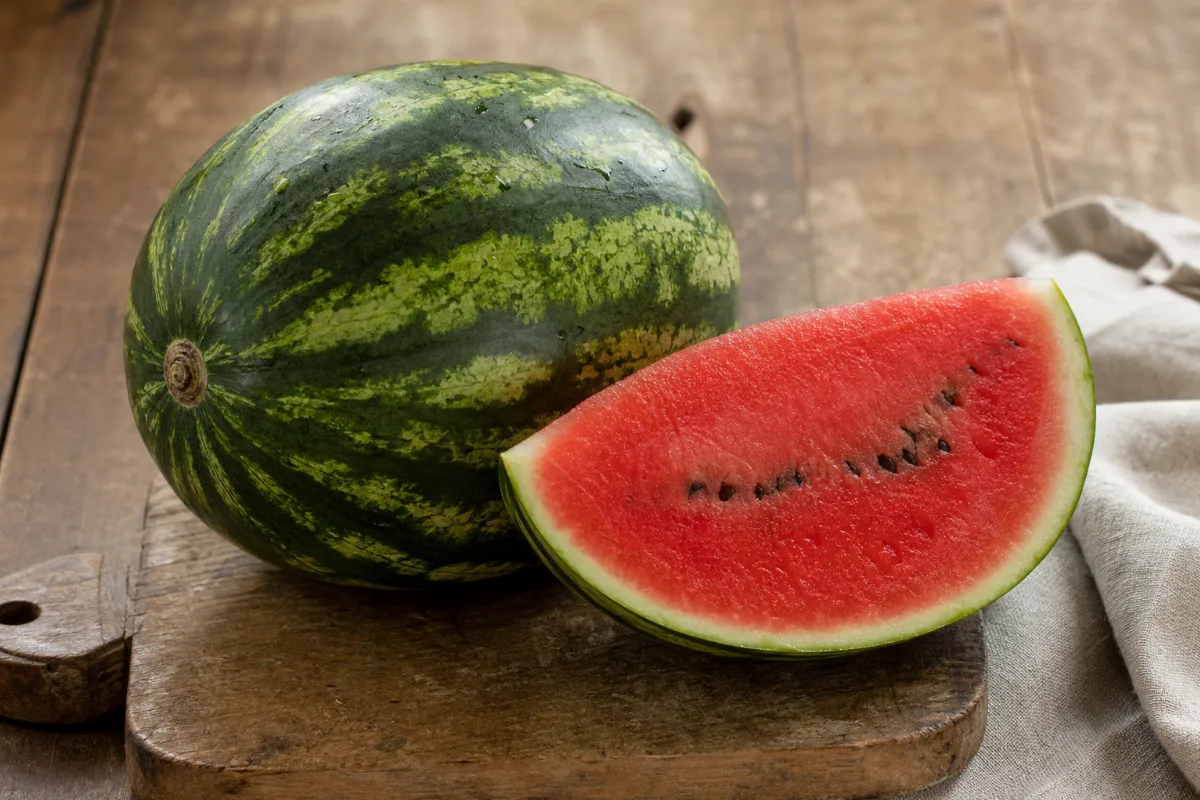
Fruits · Fruit
Watermelon
Citrullus lanatus · also called Sandia (Spanish)
Watermelon is a sweet, juicy fruit that is about 91% water, with some vitamin C and the red pigment lycopene. For blood pressure, artery health and exercise soreness the evidence is small and mixed, and most of it tests citrulline supplements or juice, not slices. The main cautions are rare seed allergy and keeping cut melon cold.
General information, not medical advice. Last substantive update · Not medically reviewed. A named clinician has not signed off on this page. How this page is made
About Watermelon
Watermelon is a sweet, mostly-water fruit with modest vitamin C, vitamin A and potassium, and the red pigment lycopene. It is a refreshing food, not a proven remedy: the health studies are small and often use supplements or juice.
What it is
Watermelon (Citrullus lanatus) is the fruit of a trailing vine in the gourd family. Most people eat the red flesh. It also contains citrulline, an amino acid.
USDA data for raw watermelon: 30 kcal per 100 g. One cup of diced watermelon (152 g) has about 46 kcal, 139 g of water, 9.4 g of sugars, 0.6 g of fibre, 12.3 mg of vitamin C, 170 mg of potassium and 15 mg of magnesium. These USDA figures come from our earlier food summary and were not re-opened this time. The Linus Pauling Institute lists about 6.9 mg of lycopene per cup, and says tomato products supply most of the lycopene in the US diet.
What the research shows
Most research is on blood pressure and artery function. A 2025 pooled analysis found small average falls in blood pressure, but it combined citrulline supplements with watermelon, and the larger falls came from citrulline plus arginine. A 2025 vessel-function analysis found citrulline supplements helped arteries widen, but watermelon did not reach significance.
The only trial of fresh watermelon flesh we read, in 39 adults with raised blood pressure, found no significant change in 24-hour blood pressure. It was funded by the National Watermelon Promotion Board.
One open-label trial of watermelon juice in 42 men found less soreness the day after exercise. A review of plant foods found mixed results. Weight, blood sugar and blood fat results were null, and no study looked at heart attacks, strokes or deaths.
Slices versus juice, rind and supplements
Most blood pressure and artery results come from L-citrulline supplements or processed products such as rind juice. Exercise results come from juice. The one fresh-flesh trial found no significant blood pressure change. Results for one form do not carry over to another.
Amounts
This page gives no amounts to eat or drink. Ask a doctor or pharmacist what is right for you, especially if you take medicine, have kidney disease or manage diabetes.
At a glance
Traditional uses history, not proof
- Eaten fresh as a cooling summer fruit
- Drunk as juice
Studied for research
- Blood pressure, low certainty (mostly citrulline supplements, not the fruit)
- Blood vessel function, insufficient evidence
- Muscle soreness after exercise, very low certainty (juice)
- Blood sugar, blood fats and body weight, no clear effect
- Heart attacks, strokes and deaths, insufficient evidence
Main compounds
- L-citrulline (amino acid)
- Lycopene (red pigment)
- Vitamin C
- Potassium
Common forms
- Fresh flesh as food
- Watermelon juice (used in an exercise trial)
- Rind juice and other processed products (used in some vessel studies)
- L-citrulline supplements (used in most blood pressure analyses; not the same as the fruit)
Research links: Pooled analysis of citrulline and watermelon for blood pressure (2025) · Trial of fresh watermelon and ambulatory blood pressure (2025) · FDA: Selecting and Serving Produce Safely · Research Library · Genes & Biomarkers Library
What it is and its history
- Accepted scientific name
- Citrullus lanatus
- Naming authority
- Not verified from a source read
- Common names
- Watermelon (English); Sandia (Spanish)
- Family or group
- Cucurbitaceae, the gourd family, which also includes cucumber, squash and pumpkin.
- Classification
- Plantae > Not verified > Not verified > Cucurbitaceae (gourd family; stated on our earlier food summary, not re-checked in GBIF) > Citrullus > Citrullus lanatus
- Native range
- Not verified from a source read.
- Habitat
- Not verified from a source read.
- What it looks like
- Roots: Not verified.; Stems: Not verified.; Leaves: Not verified.; Flowers: Not verified.; Fruit: The fruit is the food. The red flesh is the part most people eat.
- Cultivation
- Not verified from a source read.
- Harvest and processing
- Eaten raw as fruit, juiced, or processed into rind and rind-juice products. Studies used fresh flesh, juice, rind juice and citrulline supplements.
- Look-alikes and adulterants
- Name: Cantaloupe and other melons; Note: Different fruits with different nutrients; melon food-safety studies often cover both.; Name: Pumpkin and watermelon seeds; Note: Seeds are a different food from the flesh; the allergy reports are about seeds.
- Sustainability and conservation
- Not assessed.
Photographs
Traditional use and history history, not clinical proof
| Tradition or era | Documented use | Source |
|---|---|---|
| Culinary use | Eaten as a juicy fruit, in juice and in fruit salads (general knowledge; no historical source was read). | Not verified |
Traditional use shows how it was used. It does not show that it works or is safe today.
What is inside, and how it may work
What it contains and how those compounds act in cells and animals. Laboratory and animal mechanisms are not proven effects in people.
Main compounds
| Compound | Family | Where it is concentrated | Activity studied | Level of evidence |
|---|---|---|---|---|
| Water | nutrient | Flesh 91.45 g per 100 g (USDA) | Counts toward fluid intake. 16 | Composition only |
| L-citrulline | amino acid | Flesh and especially rind Not given in the sources read | The body can turn it into arginine and then nitric oxide. Rind-derived citrulline is absorbed in people (2026 review). 2 7 | Human data |
| Lycopene | carotenoid | Red flesh 4,532 micrograms per 100 g (USDA); 6.9 mg per cup (Linus Pauling Institute) | The red pigment. Evidence in people is observational and from supplements, and is mixed. 15 16 | Human data |
| Vitamin C | vitamin | Flesh 8.1 mg per 100 g (USDA) | Essential nutrient. Watermelon is a modest source. 16 | Composition only |
Mechanisms, receptors and pathways
| Target or pathway | Gene or receptor | What was found | Level |
|---|---|---|---|
| Citrulline to arginine to nitric oxide | Endothelial nitric oxide synthase (named in the 2026 rind review) | Citrulline may support nitric oxide production, which relaxes arteries. In the pilot trial, plasma L-arginine and the L-arginine/ADMA ratio rose, but blood pressure did not change significantly. This is a proposed pathway. 12 2 | Human data |
Absorption, metabolism and elimination
- Absorption
- Rind-derived citrulline is absorbed in people (2026 review). Flesh not described in the abstracts read.
- Distribution
- Not found.
- Metabolism
- Citrulline can be converted to arginine (review statement).
- Elimination
- Not found.
- Bioavailability
- Not established for the flesh from the abstracts read.
Isolated compounds versus whole extracts
Most blood pressure and vessel results come from L-citrulline supplements or processed watermelon products, and the larger blood pressure falls came from citrulline combined with arginine. The one fresh-flesh trial found no significant change. Juice and rind products are different from slices, so results do not carry over between forms.
Nutritional composition
Nutrition from USDA FoodData Central, raw watermelon (SR Legacy, FDC 167765). These figures come from our earlier food summary and existing page, which cite this USDA entry; the USDA service refused a fresh request on 2026-10-25, so the numbers were not re-opened (marked summary-only). Per 100 g: 30 kcal, 91.5 g water, 7.55 g carbohydrate, 6.2 g total sugars, 0.4 g fibre, 8.1 mg vitamin C, 28 micrograms vitamin A (RAE), 112 mg potassium, 10 mg magnesium, 0.04 mg copper, 4,532 micrograms lycopene, 303 micrograms beta-carotene. One cup of diced watermelon (152 g): about 46 kcal, 139 g water, 9.4 g sugars, 0.6 g fibre, 12.3 mg vitamin C (about 14% of the Daily Value), 43 micrograms vitamin A, 170 mg potassium (about 4%), 15 mg magnesium, 0.06 mg copper. The Linus Pauling Institute lists about 6.9 mg lycopene per cup. Watermelon is mostly water, with modest vitamin C, vitamin A and potassium. Figures vary with variety and ripeness.
2 low certainty2 very low certainty4 not enough evidence
What was looked at
The 8 benefits and uses checked for Watermelon, each with how strong the evidence is. Tap one to open it.
- Blood pressure (citrulline and watermelon trials)Low certainty
- Blood vessel function (flow-mediated dilation, stiffness)Not enough evidence
- Muscle soreness after exercise (watermelon juice)Very low certainty
- Body weight and body fat (citrulline supplements)Not enough evidence
- Blood sugar, insulin and blood fatsLow certainty
- Lycopene, heart disease and prostate cancerVery low certainty
- Hydration (water content)Not enough evidence
- Heart attacks, strokes and deathsNot enough evidence
Lab markers tracked in the studies
Systolic blood pressureDiastolic blood pressure24-hour ambulatory blood pressurePlasma L-arginine and the L-arginine to ADMA ratioFlow-mediated dilation (FMD)Pulse wave velocity (artery stiffness)Perceived muscle soreness 24 hours after exerciseFasting glucose and insulinBlood fats (lipid profile)Body weight, fat mass and waist size
What is Watermelon good for?
The main studied uses and how strong the human evidence is for each. Many results come from citrulline supplements or juice, not slices of fruit.
Benefits, one by one
Each card is a research question, not a promise. Tap a goal to filter. Open a card to see the studies, doses and limits.
Blood pressure (citrulline and watermelon trials)
Low certaintyA pooled analysis of trials found small average falls in blood pressure with citrulline supplements or watermelon, but it mixed supplements and watermelon products. The one small trial of fresh watermelon flesh in adults with raised blood pressure found no significant difference.
3 studiesMostly L-citrulline supplements and watermelon products. One trial us…
Studies, doses and limits
What the trials found
A 2025 meta-analysis of 15 randomised trials (24 datasets, 415 middle-aged and older adults) of L-citrulline or watermelon found systolic pressure 4.02 mmHg lower and diastolic 2.54 mmHg lower on average. A 2026 review of 12 trials in 360 postmenopausal women found most trials with blood pressure outcomes showed lower systolic pressure, up to 9 mmHg in some. In a 2025 four-week pilot of 39 adults with elevated blood pressure given 1 cup, 2 cups or no watermelon flesh a day, 24-hour blood pressure did not differ significantly between groups.
Results
Small average falls in the pooled citrulline and watermelon trials. No significant fall in the only fresh-watermelon trial read.
Effect sizes as reported
Meta-analysis: systolic -4.02 mmHg (95% CI -6.54 to -1.50), diastolic -2.54 mmHg (-4.27 to -0.81). Pilot trial: 130.2, 130 and 124.9 mmHg, no significant difference.
Why this rating
Pooled results mix citrulline supplements and watermelon products, and the larger falls came from citrulline plus arginine. The one trial of fresh flesh was small, short and null. The pilot was funded by the National Watermelon Promotion Board.
Form and dose studied
Mostly L-citrulline supplements and watermelon products. One trial used fresh flesh. Juice and rind products are not the same as slices.
Who was studied
Middle-aged and older adults; postmenopausal women; adults with elevated blood pressure.
Limits
Short trials. Blood pressure is a stand-in for health, not heart attacks or strokes. Not a test of watermelon as a treatment for high blood pressure.
Why researchers looked
Watermelon is a natural source of citrulline, an amino acid linked to nitric oxide and blood vessel widening.
Traditional use
Watermelon has long been eaten as a juicy, sweet fruit in warm weather; long use is not proof that it treats any condition.
Proposed mechanism Preliminary mechanism
Watermelon flesh contains the amino acid citrulline. The body can turn citrulline into arginine and then into nitric oxide, a molecule that relaxes blood vessels. This is a proposed pathway; it is not proof that eating the fruit changes blood pressure.
A proposed mechanism does not show that the effect happens in people.
Anyone on blood pressure medicine should ask a doctor or pharmacist before relying on food or supplements; see the Safety tab.
Blood vessel function (flow-mediated dilation, stiffness)
Not enough evidenceCitrulline supplements improved how well arteries widen in a pooled analysis, but the watermelon trials in that analysis did not show a significant change. Results for stiffness are mixed.
4 studiesL-citrulline supplements, watermelon intake and rind juice products a…
Studies, doses and limits
What the trials found
A 2025 meta-analysis of 8 trials (176 middle-aged and older adults) found citrulline supplements raised flow-mediated dilation by 1.81 (95% CI 0.76 to 2.85) and did not significantly change pulse wave velocity. The watermelon subgroup did not significantly improve either, and the authors say there is too little research. A 2026 narrative review found improvements mainly in surrogate measures with large differences between studies. A 2026 review of watermelon rind says rind-derived citrulline is absorbed, and a rind juice product improved artery function in studies it describes.
Results
Positive for citrulline supplements; not significant for watermelon intake; mixed overall.
Effect sizes as reported
Citrulline: flow-mediated dilation +1.81 (0.76 to 2.85). Watermelon subgroup: not significant.
Why this rating
The one positive finding is for citrulline supplements. Watermelon-specific trials were few and did not reach significance.
Form and dose studied
L-citrulline supplements, watermelon intake and rind juice products are different things.
Who was studied
Middle-aged and older adults; postmenopausal women (2 of 4 trials showed better dilation).
Limits
Surrogate measures only. Rind products are not normally eaten.
Why researchers looked
Nitric oxide helps arteries relax, so citrulline-rich foods are tested on artery function.
Traditional use
Watermelon has long been eaten as a juicy, sweet fruit in warm weather; long use is not proof that it treats any condition.
Proposed mechanism Preliminary mechanism
Watermelon flesh contains the amino acid citrulline. The body can turn citrulline into arginine and then into nitric oxide, a molecule that relaxes blood vessels. This is a proposed pathway; it is not proof that eating the fruit changes blood pressure.
A proposed mechanism does not show that the effect happens in people.
No side effects were reported in the postmenopausal women review of citrulline trials.
Muscle soreness after exercise (watermelon juice)
Very low certaintyOne small open-label trial in men found less soreness 24 hours after exercise with watermelon juice, and a review of plant foods found mixed results. It tested juice, not slices.
2 studiesWatermelon juice before exercise. Not tested with slices.
Studies, doses and limits
What the trials found
In an 8-week open-label trial, 42 non-athlete men doing endurance training drank 710 mL of watermelon juice or a calorie-matched placebo an hour before exercise. Exercise performance did not differ. Muscle thickness measured by ultrasound rose more with juice (mean differences 2.00 and 1.70) and soreness at 24 hours was lower (p = 0.045). A 2026 systematic review of 36 trials of plant foods, including watermelon, found less soreness in several trials within 24 to 72 hours but no consistent benefit for muscle-function recovery or performance.
Results
Lower soreness at 24 hours in one trial; mixed in the review; no performance gain.
Effect sizes as reported
Soreness at 24 hours: p = 0.045. Muscle thickness: mean difference 2.00 (chest) and 1.70 (thigh).
Why this rating
One small open-label trial (people knew their drink) and a review with mixed results. Juice, not whole fruit.
Form and dose studied
Watermelon juice before exercise. Not tested with slices.
Who was studied
Non-athlete men in training; physically active people in the review.
Limits
Open-label, small, short. The review says no specific food, amount or timing can be recommended.
Why researchers looked
Citrulline-rich juice has been tested before and after exercise for soreness and recovery.
Traditional use
Watermelon has long been eaten as a juicy, sweet fruit in warm weather; long use is not proof that it treats any condition.
Proposed mechanism Preliminary mechanism
Citrulline may increase arginine and nitric oxide and so blood flow to muscle. This is a proposed pathway and was not measured in the studies read.
A proposed mechanism does not show that the effect happens in people.
None reported in the abstracts read.
Body weight and body fat (citrulline supplements)
Not enough evidenceA pooled analysis of 21 trials of citrulline supplements found no overall effect on weight, fat or waist size. No trial of eating watermelon for weight was found.
2 studiesL-citrulline supplements.
Studies, doses and limits
What the trials found
A 2025 systematic review and meta-analysis of 21 randomised trials found citrulline supplements had no substantial overall effect on body mass index, weight, fat mass, waist size, body fat percentage or fat-free mass. Some subgroup differences were exploratory.
Results
No overall effect.
Effect sizes as reported
No overall effect reported in the abstract.
Why this rating
The trials were of citrulline supplements, not watermelon. Nothing was found on eating the fruit for weight.
Form and dose studied
L-citrulline supplements.
Who was studied
Adults in 21 trials.
Limits
Not a test of the fruit. Watermelon is low in calories (30 kcal per 100 g, USDA), which is a fact about the food, not a trial result.
Why researchers looked
Citrulline is found in watermelon and is sold as a supplement, and some people ask whether it affects body fat.
Traditional use
Watermelon has long been eaten as a juicy, sweet fruit in warm weather; long use is not proof that it treats any condition.
Proposed mechanism Authoritative guidance
No mechanism for body fat has been shown in the abstract read.
A proposed mechanism does not show that the effect happens in people.
None specific.
Blood sugar, insulin and blood fats
Low certaintyIn the four-week watermelon trial and in a review of citrulline trials in postmenopausal women, blood sugar, insulin and blood fats did not change consistently.
3 studiesFresh flesh in one trial; citrulline products in the review.
Studies, doses and limits
What the trials found
In the 2025 pilot trial of 39 adults with elevated blood pressure, fasting glucose, insulin and blood fats did not change significantly with 1 or 2 cups of watermelon flesh a day for 4 weeks. In a 2026 review of citrulline trials in postmenopausal women, 6 trials found no consistent effects on weight, glucose, insulin or blood fats.
Results
No significant or consistent change.
Effect sizes as reported
Not significant.
Why this rating
Small and short, and the main trial was funded by the National Watermelon Promotion Board. The null result is plain.
Form and dose studied
Fresh flesh in one trial; citrulline products in the review.
Who was studied
Adults with elevated blood pressure; postmenopausal women.
Limits
Not designed to test blood sugar control, and not done in people with diabetes. USDA lists about 6.2 g of sugars per 100 g.
Why researchers looked
Watermelon is a sweet fruit, so people ask about blood sugar, and the vessel studies also measured blood fats.
Traditional use
Watermelon has long been eaten as a juicy, sweet fruit in warm weather; long use is not proof that it treats any condition.
Proposed mechanism Authoritative guidance
Not studied in the abstracts read.
A proposed mechanism does not show that the effect happens in people.
People managing diabetes should ask their care team about fruit portions.
Lycopene, heart disease and prostate cancer
Very low certaintyWatermelon is a source of the red pigment lycopene. Studies of lycopene are mixed and are not studies of watermelon itself.
1 studiesTomato products are the main source; lycopene supplements are a diffe…
Studies, doses and limits
What the trials found
The Linus Pauling Institute lists 6.9 mg of lycopene in 1 cup of raw watermelon and says about 80% of lycopene in the US diet comes from tomato products. It reports that meta-analyses of observational studies link higher lycopene intake or blood level with lower prostate cancer risk, but it is unclear whether lycopene itself or other food factors explain this, and most small supplement studies found little or no benefit.
Results
Mixed. Observational links; supplement trials mostly null.
Effect sizes as reported
Not given on the page read.
Why this rating
Observational data and supplement trials, not watermelon trials.
Form and dose studied
Tomato products are the main source; lycopene supplements are a different thing.
Who was studied
Men in prostate studies; general adults.
Limits
Not specific to watermelon. Lycopene supplement trials do not show that eating the fruit would help.
Why researchers looked
Lycopene gives watermelon its red colour and is studied for heart and prostate health.
Traditional use
Watermelon has long been eaten as a juicy, sweet fruit in warm weather; long use is not proof that it treats any condition.
Proposed mechanism Preliminary mechanism
Lycopene is a carotenoid pigment. Lab and animal work suggests it may have antioxidant effects; this has not been shown to matter in people.
A proposed mechanism does not show that the effect happens in people.
None specific.
Hydration (water content)
Not enough evidenceWatermelon is about 91% water, so it adds to fluid intake. No trial of whether it hydrates better than other fluids was found.
1 studiesFresh flesh.
Studies, doses and limits
What the trials found
USDA data list 91.45 g of water per 100 g of raw watermelon. No trial on hydration status was found in the sources read.
Results
A composition fact; no trial.
Effect sizes as reported
91.45 g water per 100 g (USDA).
Why this rating
No human trial of hydration with watermelon was found.
Form and dose studied
Fresh flesh.
Limits
Composition only.
Why researchers looked
Its high water content makes watermelon a common summer food.
Traditional use
Watermelon has long been eaten as a juicy, sweet fruit in warm weather; long use is not proof that it treats any condition.
Proposed mechanism Authoritative guidance
Water in food counts toward fluid intake. No special effect was tested.
A proposed mechanism does not show that the effect happens in people.
None specific.
Heart attacks, strokes and deaths
Not enough evidenceNo study read shows that watermelon or citrulline lowers heart attacks, strokes or deaths.
1 studiesNot applicable.
Studies, doses and limits
What the trials found
A 2026 narrative review says evidence that these supplements reduce major cardiovascular events or cardiovascular deaths remains limited. No watermelon outcome trial was found.
Results
No outcome evidence.
Why this rating
Only surrogate measures such as blood pressure have been studied.
Limits
A gap, not a finding of no effect.
Why researchers looked
The blood pressure and vessel studies raise the question of real heart outcomes.
Traditional use
Watermelon has long been eaten as a juicy, sweet fruit in warm weather; long use is not proof that it treats any condition.
Proposed mechanism Authoritative guidance
Not applicable.
A proposed mechanism does not show that the effect happens in people.
None specific.
Connections to the rest of health
How Watermelon connects to the rest of our health knowledge graph. Every link says what kind of connection it is. A safety link (for example to the liver) is a warning, not a benefit. A study that merely mentions a topic never creates a benefit link.
Explore every connection: goals, body systems, organs, symptoms, genes
A. Wellness goals
| Connected to | Kind of connection | Evidence status | Context | Studies |
|---|---|---|---|---|
| Blood Pressure Support | Low certainty | Blood pressure (citrulline and watermelon trials): A pooled analysis of trials found small average falls in blood pressure with citrulline supplements or watermelon, but it mixed supplements and watermelon products. The one small trial of fresh watermelon flesh in adults with raised blood pressure found no significant difference. | 7 4 12 | |
| Healthy Circulation | Not enough evidence | Blood vessel function (flow-mediated dilation, stiffness): Citrulline supplements improved how well arteries widen in a pooled analysis, but the watermelon trials in that analysis did not show a significant change. Results for stiffness are mixed. | 8 6 4 2 | |
| Muscle Recovery | Very low certainty | Muscle soreness after exercise (watermelon juice): One small open-label trial in men found less soreness 24 hours after exercise with watermelon juice, and a review of plant foods found mixed results. It tested juice, not slices. | 11 10 | |
| Weight Management | Not enough evidence | Body weight and body fat (citrulline supplements): A pooled analysis of 21 trials of citrulline supplements found no overall effect on weight, fat or waist size. No trial of eating watermelon for weight was found. | 3 16 | |
| Blood Sugar Balance | Low certainty | Blood sugar, insulin and blood fats: In the four-week watermelon trial and in a review of citrulline trials in postmenopausal women, blood sugar, insulin and blood fats did not change consistently. | 12 4 16 | |
| Hydration | Biological association | Not enough evidence | Hydration (water content): Watermelon is about 91% water, so it adds to fluid intake. No trial of whether it hydrates better than other fluids was found. | 16 |
| Heart Health | Not enough evidence | Heart attacks, strokes and deaths: No study read shows that watermelon or citrulline lowers heart attacks, strokes or deaths. | 6 |
B. Body systems
| Connected to | Kind of connection | Evidence status | Context | Studies |
|---|---|---|---|---|
| Cardiovascular System | Biological association | Low certainty | Studied for: Blood pressure (citrulline and watermelon trials) Studied for: Blood vessel function (flow-mediated dilation, stiffness) | 7 4 12 8 6 2 15 |
| Musculoskeletal System | Biological association | Very low certainty | Studied for: Muscle soreness after exercise (watermelon juice) | 11 10 |
| Metabolism Weight | Biological association | Not enough evidence | Studied for: Body weight and body fat (citrulline supplements) Studied for: Blood sugar, insulin and blood fats | 3 16 12 4 |
| Endocrine System | Biological association | Low certainty | Studied for: Blood sugar, insulin and blood fats | 12 4 16 |
| Urinary System | Biological association | Not enough evidence | Studied for: Hydration (water content) | 16 |
E. Health conditions
| Connected to | Kind of connection | Evidence status | Context | Studies |
|---|---|---|---|---|
| Food allergy | Adverse effect or risk | Documented risk | Reactions to watermelon seed, including anaphylaxis in a few cases, are reported. Preparation or compound: Watermelon seed |
1 5 |
| Food poisoning | Adverse effect or risk | Documented risk | Cut melon needs scrubbing before cutting and cold storage. Preparation or compound: Cut melon |
14 13 |
I. Biomarkers
| Connected to | Kind of connection | Evidence status | Context | Studies |
|---|---|---|---|---|
| Systolic blood pressure | Biological association | Low certainty | Measured in trials: lowered. A lab change is not the same as a health benefit. | 7 4 |
| Diastolic blood pressure | Biological association | Low certainty | Measured in trials: lowered. A lab change is not the same as a health benefit. | 7 |
| 24-hour ambulatory blood pressure | Biological association | Low certainty | Measured in trials: no-change. A lab change is not the same as a health benefit. | 12 |
| Plasma L-arginine and the L-arginine to ADMA ratio | Biological association | Low certainty | Measured in trials: raised. A lab change is not the same as a health benefit. | 12 |
| Flow-mediated dilation (FMD) | Biological association | Not enough evidence | Measured in trials: mixed. A lab change is not the same as a health benefit. | 8 4 |
| Pulse wave velocity (artery stiffness) | Biological association | Not enough evidence | Measured in trials: no-change. A lab change is not the same as a health benefit. | 8 4 |
| Perceived muscle soreness 24 hours after exercise | Biological association | Very low certainty | Measured in trials: lowered. A lab change is not the same as a health benefit. | 11 10 |
| Fasting glucose and insulin | Biological association | Low certainty | Measured in trials: no-change. A lab change is not the same as a health benefit. | 12 4 |
| Blood fats (lipid profile) | Biological association | Low certainty | Measured in trials: no-change. A lab change is not the same as a health benefit. | 12 4 |
| Body weight, fat mass and waist size | Biological association | Not enough evidence | Measured in trials: no-change. A lab change is not the same as a health benefit. | 3 |
K. Biological pathways
| Connected to | Kind of connection | Evidence status | Context | Studies |
|---|---|---|---|---|
| L-citrulline | Preliminary mechanism | Human | A watermelon amino acid studied for blood pressure and vessel function. | 7 8 |
| Lycopene | Preliminary mechanism | Human | The red carotenoid; evidence is observational and from supplements. | 15 |
| Vitamin C | Preliminary mechanism | Composition only | A modest amount per cup. | 16 |
L. Active compounds
| Connected to | Kind of connection | Evidence status | Context | Studies |
|---|---|---|---|---|
| Water | Biological association | Composition only | Counts toward fluid intake. Preparation or compound: Flesh |
16 |
| L-citrulline | Biological association | Human | The body can turn it into arginine and then nitric oxide. Rind-derived citrulline is absorbed in people (2026 review). Preparation or compound: Flesh and especially rind |
2 7 |
| Lycopene | Biological association | Human | The red pigment. Evidence in people is observational and from supplements, and is mixed. Preparation or compound: Red flesh |
15 16 |
| Vitamin C | Biological association | Composition only | Essential nutrient. Watermelon is a modest source. Preparation or compound: Flesh |
16 |
Each connection is stored with the ingredient, the connected record, the kind of connection, the evidence status, the supporting studies, the preparation or compound involved, and a review date (last reviewed October 25, 2026).
Evidence at a glance: what changed in 10 lab markers
Tap a number to show only those markers. Counts are markers, not people.
The evidence
The research centre for Watermelon. Every record here was checked against PubMed or the publisher's page; we never list a study we have not verified.
Evidence by outcome
Bars show how many studies we found for each outcome, not how well it works. People are added up across trials only (reviews are not added, to avoid double counting).
How we rate evidence
High certainty
Several well-run trials or reviews agree; further research is unlikely to change the picture much.
Moderate certainty
Good trials point the same way, but some doubt remains.
Low certainty
Small, short or inconsistent trials. The finding could change with better research.
Very low certainty
Very little or very weak human data. Treat as a possibility only.
Mixed findings
Trials or reviews disagree with each other.
Not enough evidence
Not enough human research to say either way.
Evidence against
Good research found no benefit, or found harm.
We take the reviewers' own risk-of-bias and GRADE statements where they exist, and otherwise judge from study size, design, consistency, directness and whether a product matches what is sold. Many publications do not make evidence high. Method note: We started from our existing watermelon summary, re-opened every study on PubMed and read the abstracts, read the Linus Pauling Institute and FDA pages, and added fresh searches for trials, seed-allergy reports and melon storage. Items we could not verify are flagged in the research gaps.
Study library: every study we checked 16
| Study | Design | People | Product, dose, length | Result |
|---|---|---|---|---|
| Acikalin 2026 Immunoglobulin E-mediated pumpkin seed allergy in children: Case series and narrative review with a structured literature search. Allergy Asthma Proc · PMID 42343505 · DOI |
Case series |
25 25 children with pumpkin seed allergy at a clinic in Turkey (2016 to 2024), plus 14 earlier published cases |
Pumpkin seed (watermelon seed sensitisation was also tested) Seeds |
Anaphylaxis occurred in 64% of the children. Sensitisation to watermelon seed was found in 83%, and six children had clinical reactions after eating watermelon seed. Pumpkin pulp was tolerated by all. 6 children reacted to watermelon seed Methods, limits and fundingOutcomes: Reactions, anaphylaxis, co-allergies Limitations: Children already allergic to pumpkin seed; it says nothing about how common watermelon allergy is in general. Seeds, not flesh. Abstract only. Funding and conflicts: Funding and conflicts are not stated in the abstract. Read: abstract |
| Alvares TS. 2026 Valorization of Beetroot and Watermelon by-Products as Functional Ingredients Targeting Nitric Oxide Pathways: Implications for Cardiovascular Health. Curr Nutr Rep · PMID 42891784 · DOI |
Narrative review |
Narrative review of beetroot and watermelon by-products | Watermelon rind (a by-product) Rind |
Watermelon rind is a natural source of L-citrulline, and human studies show that rind-derived citrulline is absorbed. Studies of a microencapsulated rind juice reported better conduit artery endothelial function. The author says well-controlled clinical studies are still needed. Methods, limits and fundingOutcomes: Citrulline bioavailability and endothelial function Limitations: About the rind, which most people do not eat, and about processed rind products. Abstract only. Funding and conflicts: Funding and conflicts are not stated in the abstract. Read: abstract |
| Ashtary-Larky 2025 Effects of Citrulline or Watermelon Supplementation on Body Composition: A Systematic Review and Dose-Response Meta-Analysis. Nutrients · PMID 41097202 · DOI |
Meta-analysis |
21 randomised trials | L-citrulline supplements (abstract describes citrulline) Supplements Trial detail, not advice Varied · vs Control groups |
Citrulline supplements had no substantial overall effect on body mass index, weight, fat mass, waist size, body fat percentage or fat-free mass. Some subgroup differences (older people, higher amounts, shorter durations) were exploratory. No overall effect Methods, limits and fundingOutcomes: BMI, weight, fat mass, waist, body fat percentage, fat-free mass Limitations: The abstract is about citrulline supplements, not eating watermelon. Subgroup findings are exploratory. Abstract only. Funding and conflicts: Funding and conflicts are not stated in the abstract. Read: abstract |
| Bahari 2026 Citrulline supplementation in postmenopausal women: a systematic review of vascular, muscular, and metabolic effects. BMC Womens Health · PMID 41588439 · DOI |
Systematic review |
360 12 randomised trials in postmenopausal women (all in the United States), 4 to 8 weeks |
Citrulline, given directly or through watermelon products Supplements and watermelon products Trial detail, not advice 4 to 8 weeks · vs Control groups |
Of 7 trials with blood pressure outcomes, most showed lower systolic pressure and mean arterial pressure. Arterial stiffness was mixed. Two of 4 trials showed better flow-mediated dilation. Muscle gains appeared only with resistance training. Six trials found no consistent change in weight, glucose, insulin or blood fats. No side effects were reported. Up to 9 mmHg lower systolic pressure in some trials Methods, limits and fundingOutcomes: Blood pressure, arterial stiffness, endothelial function, muscle, metabolic outcomes, safety Limitations: Narrative review, not pooled. Mixes supplements and watermelon products. Abstract only. Funding and conflicts: Funding and conflicts are not stated in the abstract. Read: abstract |
| Guler 2023 Recurrent Anaphylaxis with Watermelon and Pumpkin Seeds in a Boy Tolerant to Their Pulps. Pediatr Allergy Immunol Pulmonol · PMID 37552845 · DOI |
Case report |
1 One 11-year-old boy with repeated anaphylaxis |
Watermelon seed and pumpkin seed (and poppy seed bread) Seeds |
An 11-year-old boy had repeated episodes of anaphylaxis linked to pumpkin seeds, and one episode after eating watermelon seed and poppy seed bread. He was treated with an adrenaline auto-injector and dietary advice. The title says he tolerated the pulps. Methods, limits and fundingOutcomes: Anaphylaxis episodes Limitations: A single case. Does not say how common the problem is. Funding and conflicts: Funding and conflicts are not stated in the abstract. Read: abstract |
| Katsanaki 2026 Effects of Nutritional Supplements on Vascular Function: A Narrative Review. J Clin Med · PMID 42513607 · DOI |
Narrative review |
Narrative review of supplements for vascular function, including L-citrulline and watermelon-derived citrulline | Many supplements, including citrulline from watermelon Supplements |
Improvements were reported mainly in surrogate measures (flow-mediated dilation, pulse wave velocity, blood pressure), with large differences between studies. Evidence of fewer major cardiovascular events or deaths is limited. Methods, limits and fundingOutcomes: Flow-mediated dilation, pulse wave velocity, blood pressure, major cardiovascular events Limitations: Narrative review covering many supplements; the abstract gives no watermelon-specific numbers. Abstract only. Funding and conflicts: Funding and conflicts are not stated in the abstract. Read: abstract |
| Luo 2025 Does l-citrulline supplementation and watermelon intake reduce blood pressure in middle-aged and older adults? A systematic review and meta-analysis of randomized controlled trials. Clin Nutr ESPEN · PMID 40789388 · DOI |
Meta-analysis |
415 15 randomised trials (24 datasets) in middle-aged and older adults |
L-citrulline supplements and watermelon intake, pooled Mixed: supplements and watermelon products Trial detail, not advice Varied · vs Control groups |
Pooled fall in systolic blood pressure of 4.02 mmHg and in diastolic 2.54 mmHg. Citrulline plus arginine together fell more (systolic 10.44 mmHg). SBP -4.02 mmHg; DBP -2.54 mmHg (SBP -6.54 to -1.50; DBP -4.27 to -0.81) Methods, limits and fundingOutcomes: Systolic and diastolic blood pressure Limitations: Pools supplements with watermelon intake, so it does not show what eating fresh watermelon does. Abstract only. The abstract does not separate watermelon-only trials. Funding and conflicts: Funding and conflicts are not stated in the abstract. Read: abstract |
| Luo 2025 Effects of L-citrulline supplementation and watermelon intake on arterial stiffness and endothelial function in middle-aged and older adults: a systematic review and meta-analysis of randomized controlled trials. Front Nutr · PMID 41323997 · DOI |
Meta-analysis |
176 8 randomised trials in middle-aged and older adults |
L-citrulline supplements and watermelon intake (analysed in subgroups) Mixed Trial detail, not advice Varied · vs Control groups |
L-citrulline supplements improved FMD by 1.81 percentage points. Pulse wave velocity did not change significantly overall. The watermelon subgroup did not significantly improve FMD or PWV; the authors say there is too little research on watermelon. FMD +1.81 (citrulline); watermelon not significant (FMD 0.76 to 2.85; PWV -0.45 to 0.17) Methods, limits and fundingOutcomes: Flow-mediated dilation (FMD) and pulse wave velocity (PWV) Limitations: Small number of trials. The positive result is for citrulline supplements, not watermelon. Abstract only. Funding and conflicts: Funding and conflicts are not stated in the abstract. Read: abstract |
| Marzec 2026 Pollen-Food Allergy Syndrome in Children: Global Prevalence and Pathogenesis. Nutrients · PMID 42514315 · DOI |
Narrative review |
Narrative review in children | Pollen-food allergy syndrome (plant foods in general) |
Pollen-food allergy syndrome comes from cross-reaction between pollen and similar proteins in plant foods. It usually causes itching, burning and swelling of the mouth and throat, and only rarely anaphylaxis. Prevalence ranges from a few percent in children generally to 50 to 80% in children with allergic rhinitis. Methods, limits and fundingOutcomes: Prevalence and symptoms of pollen-food allergy syndrome Limitations: The abstract does not name watermelon. It is used here only as general background on this kind of allergy. Funding and conflicts: Funding and conflicts are not stated in the abstract. Read: abstract |
| Nguyen 2026 Plant-Derived Whole Foods and Food-Based Supplements on Post-Exercise Recovery in Physically Active Individuals: A Systematic Review of Human Intervention Trials. Nutrients · PMID 42797032 · DOI |
Systematic review |
36 human intervention studies in physically active people (covering tart cherry, pomegranate, beetroot, watermelon and others) | Many plant foods, including watermelon Foods and juices Trial detail, not advice Varied · vs Varied |
Several studies reported less perceived soreness within 24 to 72 hours, but not all. The authors found no consistent benefit for muscle-function recovery, later performance or blood markers, and say no specific food, amount or timing can be recommended yet. Methods, limits and fundingOutcomes: Perceived muscle soreness, muscle-function recovery, performance Limitations: Watermelon is one of many foods in this review; the abstract gives no watermelon-specific numbers. Narrative synthesis, no meta-analysis. Abstract only. Funding and conflicts: Funding and conflicts are not stated in the abstract. Read: abstract |
| Norouzzadeh 2025 The Effects of Watermelon Juice on Muscle Hypertrophy, Exercise Performance, and Muscle Soreness in Non-Athlete Men Undergoing Endurance Training: A Randomized Controlled Trial. Food Sci Nutr · PMID 41089757 · DOI |
Controlled trial |
42 42 non-athlete men doing endurance training three days a week |
Watermelon juice Fruit juice 710 mL one hour before exercise, as tested 8 weeks · vs Calorie-matched placebo drink |
No difference in exercise performance. Thickness of the pectoralis major and rectus femoris muscles rose more with juice (mean differences 2.00 and 1.70). Soreness 24 hours after exercise was lower with juice (p = 0.045). Muscle thickness mean difference 2.00 (chest) and 1.70 (thigh); soreness p = 0.045 (Chest 0.87 to 3.13 (the thigh interval printed in the abstract is inconsistent, so it is not quoted)) Methods, limits and fundingOutcomes: Exercise performance, muscle thickness by ultrasound, muscle soreness Limitations: Open-label, so people knew which drink they had, which can bias soreness reports. Juice, not whole fruit. Small and short. Registered with the Iranian Registry of Clinical Trials (IRCT20191105045340N1). Funding and conflicts: Authors declare no conflicts of interest (full text). No funder statement was found in the text read. Registration: IRCT20191105045340N1 Read: abstract |
| Singh 2025 Dose-Response Effect of Watermelon Consumption on Ambulatory Blood Pressure in Adults with Elevated Blood Pressure: A Randomized Controlled Pilot Trial. Nutrients · PMID 41097150 · DOI |
Controlled trial |
39 39 adults with elevated blood pressure (average age 41, average BMI 31) |
Fresh watermelon flesh Flesh 0, 1 cup (152 g) or 2 cups (304 g) a day, as tested 4 weeks · vs No watermelon |
Average 24-hour blood pressure was 130.2 (control), 130 (1 cup) and 124.9 mmHg (2 cups), with no significant difference between groups. Glucose, insulin, blood fats and nitric oxide did not change significantly. Plasma L-arginine and the L-arginine to ADMA ratio rose in the watermelon groups. No significant difference in 24-hour blood pressure (p above 0.05) Methods, limits and fundingOutcomes: 24-hour ambulatory blood pressure; glucose, insulin, blood fats, nitric oxide, L-arginine, ADMA Limitations: Small pilot trial; 4 weeks; not a test of heart attacks or strokes. The rise in L-arginine is a lab marker, not proof of a health benefit. Funding and conflicts: Funded by the National Watermelon Promotion Board (Europe PMC grant record and funding statement in the full text); the authors declare no conflicts and say the funder had no role in the design, analysis or writing. Read: abstract |
| Wang 2026 Fate and Growth Kinetics of Escherichia coli O157:H7, Salmonella enterica, and Listeria monocytogenes on Whole Cantaloupe and Watermelon Surfaces During Storage. J Food Prot · PMID 42551534 · DOI |
Other in-vitro |
Laboratory study: whole mini seedless watermelons spot-inoculated with germs and stored at 4 to 25 degrees C for up to 21 days | Whole watermelon surfaces Rind surface Up to 21 days |
On watermelon surfaces the germs did not grow, except Listeria monocytogenes at 20 and 25 degrees C. The authors conclude that temperature control during storage of whole melons reduces the risk of germ growth and survival. Methods, limits and fundingOutcomes: Growth of E. coli O157:H7, Salmonella and Listeria on the rind Limitations: Laboratory germ-inoculation study, not a study of illness in people. Funding and conflicts: Funding and conflicts are not stated in the abstract. Read: abstract |
| s-fda-produce FDA: Selecting and Serving Produce Safely · Source |
Regulator n/a |
Methods, limits and fundingRead: full-text | ||
| s-lpi-carotenoids Linus Pauling Institute: Carotenoids · Source |
Health agency n/a |
Methods, limits and fundingRead: full-text | ||
| s-usda-fdc-167765 USDA FoodData Central: Watermelon, raw (SR Legacy, FDC 167765) · Source |
Reference database n/a |
Methods, limits and fundingRead: summary-only |
What we do not know yet
- Only one trial of fresh watermelon flesh on blood pressure was found; it was a small, 4-week pilot with no significant change.
- Pooled blood pressure and artery results mix citrulline supplements, juice, rind products and watermelon.
- No study looked at heart attacks, strokes or deaths.
- No source was read on how common allergy to the flesh is, on potassium limits in kidney disease, or on pregnancy.
- USDA figures could not be re-opened this time, and the plant description and native range were not verified.
How new research is added
New studies are found by a saved PubMed search and placed in a review queue before the page changes.
Lab markers
What changed in blood or saliva tests during trials. A changed number is not the same as feeling or being healthier, and we give no "normal ranges".
Other 10
Systolic blood pressure
Lowered in trials
The upper number in a blood pressure reading.
Low certaintyResults and what it means
Why it was measured
High blood pressure raises the long-term risk of heart disease and stroke.
Statistical vs. clinical meaning
Small average falls, mostly from supplements. Blood pressure is a stand-in for health.
Safety implication
People on blood pressure medicine should ask a pharmacist.
| Study | Result | People | Product |
|---|---|---|---|
| 7 | Mean fall of 4.02 mmHg (95% CI -6.54 to -1.50); about 10.44 mmHg with citrulline plus arginine | Middle-aged and older adults, 415 people in 15 trials | L-citrulline supplements and watermelon intake, pooled |
| 4 | Most of 7 trials showed lower systolic pressure; up to 9 mmHg in some | Postmenopausal women, 12 trials | Citrulline directly or via watermelon products |
Diastolic blood pressure
Lowered in trials
The lower number in a blood pressure reading.
Low certaintyResults and what it means
Why it was measured
Used with the systolic number to judge blood pressure.
Statistical vs. clinical meaning
Small pooled fall that mixes supplements and watermelon.
Safety implication
None specific.
| Study | Result | People | Product |
|---|---|---|---|
| 7 | Mean fall of 2.54 mmHg (95% CI -4.27 to -0.81) | Middle-aged and older adults, 415 people | L-citrulline supplements and watermelon intake, pooled |
24-hour ambulatory blood pressure
No clear change in trials
Blood pressure measured by a wearable monitor over a full day.
Low certaintyResults and what it means
Why it was measured
Gives a fuller picture than a single clinic reading.
Statistical vs. clinical meaning
The only fresh-fruit trial read found no significant change. Small pilot, funded by the National Watermelon Promotion Board.
Safety implication
None reported in the abstract.
| Study | Result | People | Product |
|---|---|---|---|
| 12 | 130.2 (none), 130 (1 cup) and 124.9 mmHg (2 cups) after 4 weeks; differences not significant | 39 adults with elevated blood pressure | Fresh watermelon flesh, 0, 152 g or 304 g a day |
Plasma L-arginine and the L-arginine to ADMA ratio
Raised in trials
Blood levels of a nitric oxide building block (L-arginine) and a molecule that blocks nitric oxide production (ADMA).
Low certaintyResults and what it means
Why it was measured
A lab marker of the nitric oxide pathway.
Statistical vs. clinical meaning
A change in a lab marker; blood pressure did not change significantly.
Safety implication
None specific.
| Study | Result | People | Product |
|---|---|---|---|
| 12 | L-arginine and the L-arginine/ADMA ratio were higher in the watermelon groups than control (p = 0.009) | 39 adults with elevated blood pressure | Fresh watermelon flesh for 4 weeks |
Flow-mediated dilation (FMD)
Mixed results in trials
How much an artery widens after a brief blockage of blood flow, a test of artery health.
Not enough evidenceResults and what it means
Why it was measured
Poor dilation is a sign of stiff or unhealthy artery lining.
Statistical vs. clinical meaning
Positive for supplements, not shown for watermelon.
Safety implication
None specific.
| Study | Result | People | Product |
|---|---|---|---|
| 8 | Citrulline supplements raised FMD by 1.81 (95% CI 0.76 to 2.85); the watermelon subgroup was not significant | Middle-aged and older adults, 8 trials, 176 people | L-citrulline supplements and watermelon intake |
| 4 | 2 of 4 trials in postmenopausal women showed significant improvement | Postmenopausal women | Citrulline directly or via watermelon products |
Pulse wave velocity (artery stiffness)
No clear change in trials
How fast the pulse travels along arteries. Faster means stiffer arteries.
Not enough evidenceResults and what it means
Why it was measured
A marker of artery stiffness linked to heart risk.
Statistical vs. clinical meaning
No clear effect.
Safety implication
None specific.
Perceived muscle soreness 24 hours after exercise
Lowered in trials
A rating of how sore muscles feel the day after exercise.
Very low certaintyResults and what it means
Why it was measured
Used to judge exercise recovery.
Statistical vs. clinical meaning
Self-reported, open-label, small.
Safety implication
None specific.
| Study | Result | People | Product |
|---|---|---|---|
| 11 | Lower with watermelon juice than placebo drink (p = 0.045) | 42 non-athlete men in endurance training | 710 mL watermelon juice before exercise, 8 weeks |
| 10 | Several of 36 studies of plant foods, including watermelon, reported less soreness within 24 to 72 hours; not all | Physically active people | Plant foods and juices |
Fasting glucose and insulin
No clear change in trials
Blood sugar and insulin levels after an overnight fast.
Low certaintyResults and what it means
Why it was measured
Markers of blood sugar control.
Statistical vs. clinical meaning
No change seen; small trials.
Safety implication
None specific.
Blood fats (lipid profile)
No clear change in trials
Cholesterol and related blood fats.
Low certaintyResults and what it means
Why it was measured
Markers of heart risk.
Statistical vs. clinical meaning
No change seen; small trials.
Safety implication
None specific.
Body weight, fat mass and waist size
No clear change in trials
Measures of body size and fat.
Not enough evidenceResults and what it means
Why it was measured
Used to judge weight effects.
Statistical vs. clinical meaning
Supplement result; not the fruit.
Safety implication
None specific.
| Study | Result | People | Product |
|---|---|---|---|
| 3 | No substantial overall effect of citrulline supplements on BMI, weight, fat mass, waist, body fat percentage or fat-free mass | 21 randomised trials | L-citrulline supplements |
Safety
What studies and official sources say about side effects, medicines and who should check first. Each point shows what kind of evidence it comes from.
Main points to know 3
- Watermelon seed allergy has been reported. In a 2026 case series of 25 children with pumpkin seed allergy, 6 had clinical reactions after eating watermelon seed, and pumpkin pulp was tolerated by all. A 2023 case report describes an 11-year-old boy with repeated anaphylaxis from pumpkin seeds who also reacted after watermelon seed. These cases involve seeds. We found no source read on how common allergy to watermelon flesh is. Trouble breathing or swelling of the face or throat needs emergency help. Case report 1 5
- Cut melon needs careful handling. The FDA advises scrubbing firm produce such as melons with a clean brush before cutting, keeping cut produce at 40 F (4 C) or below, and buying pre-cut melon only if it is refrigerated or on ice. A 2026 laboratory study found that germs on whole watermelon surfaces mostly did not grow, except Listeria at 20 and 25 degrees C, and that cool storage lowers the risk. Authoritative guidance 14 13
- Pollen-food allergy can cause itchy mouth and throat. A 2026 review explains that pollen-food allergy syndrome comes from cross-reaction between pollen and similar proteins in plant foods. It usually causes itching and swelling of the mouth and throat and rarely anaphylaxis. The abstract read does not name watermelon, so we do not say watermelon is a common trigger. Systematic review 9
Side effects 3
| Effect | How often | Severity and recovery | Evidence |
|---|---|---|---|
| Allergic reaction to watermelon seed, including anaphylaxis in reported cases Seeds in children already allergic to pumpkin seed; flesh was tolerated in the cases that said so. | Not established | moderate to severe Not stated | Case report 1 5 |
| Food poisoning from germs carried from the rind into cut flesh The FDA gives handling advice. The laboratory study is not a study of illness in people. | Not established | varies Not stated | Authoritative guidance 14 13 |
| No side effects reported in trials of citrulline in postmenopausal women Citrulline products, not slices of fruit. The other abstracts do not report on side effects. | Not established | none reported Not applicable | Systematic review 4 |
Liver
No liver injury from eating watermelon was found in the sources read. LiverTox was not checked for watermelon.
How often. No frequency was found.
Monitoring. No agency monitoring advice was found.
This is a safety connection. It is not evidence that Watermelon supports liver health.
Medicines and supplements 2
| With | Why it matters | Importance | Evidence | What to do |
|---|---|---|---|---|
| Blood pressure medicines prescription | Some trials of citrulline or watermelon products saw small falls in blood pressure. Whether eating watermelon adds to the effect of blood pressure medicine was not addressed in any source read. | Unknown. The only fresh-watermelon trial read found no significant change in blood pressure. | Preliminary mechanism Not enough evidence 7 12 | If you take blood pressure medicine and plan to use citrulline supplements or large amounts of watermelon products, ask a pharmacist or doctor. |
| Potassium-restricting medicines and diets (for example in kidney disease) prescription | Watermelon contains potassium (112 mg per 100 g, USDA, about 2% of the Daily Value). We could not read an official source on potassium limits in kidney disease. | Not verified from a source read. | Authoritative guidance Not enough evidence 16 | If your care team has set a potassium limit, ask them how watermelon fits. |
Who should check first 4
| Situation | Advice | Evidence |
|---|---|---|
| Known seed allergy (pumpkin, watermelon or other seeds) | Avoid watermelon seeds and ask an allergist. Call emergency services for trouble breathing or swelling of the face or throat. | Case report 1 5 |
| Itchy mouth or throat after raw fruit (possible pollen-food allergy) | Ask an allergist. The review read does not name watermelon. | Systematic review 9 |
| Kidney disease with a potassium limit | Ask your care team. No official source on this was read. | Authoritative guidance 16 |
| Pregnancy, breastfeeding and young children | No source read warns about normal food amounts of watermelon. Citrulline supplements in pregnancy were not researched. Ask a doctor about supplements. | Authoritative guidance |
Overdose, product quality and regulators
Summary. No toxicity from watermelon as ordinary food was found in the sources read. The concerns are seed allergy and food handling.
Animal. Not reviewed.
Human doses studied. Trials used fresh flesh (1 or 2 cups a day for 4 weeks), juice (710 mL before exercise for 8 weeks) and citrulline products. The abstracts that report on safety found no side effects, and the others do not report on it.
Overdose response. Not found.
Genotoxicity. Not researched.
Toxic or hazardous parts. No toxic part was identified in the sources read. Seed allergy is reported.
Germs on the rind can reach the flesh when a melon is cut. Pesticide residues and heavy metals in watermelon were not researched.
Food safety handling. The FDA says to scrub melons with a clean brush, dry them, keep cut produce at 40 F (4 C) or below, and buy pre-cut melon only if chilled or on ice. 14
Whole melon storage. A 2026 laboratory study found germs on whole watermelon surfaces did not grow, except Listeria monocytogenes at 20 and 25 degrees C; storage temperature control lowers the risk. 13
| Body | Action | Date |
|---|---|---|
| FDA (US Food and Drug Administration) (United States) | Produce safety guidance: choose chilled pre-cut melon, scrub melons, refrigerate cut produce at 40 F or below source | 2024-03-05 |
When to get medical help
- Trouble breathing, swelling of the lips, face or throat, widespread hives or fainting after eating watermelon or its seeds
- Fever, vomiting, stomach cramps or bloody diarrhoea after eating cut melon that was left warm (possible food poisoning)
Stop using the product and contact a clinician or emergency service. In the US, Poison Control is 1-800-222-1222.
General information only, not medical advice. Ask a clinician or pharmacist before use, especially with medicines, in pregnancy or with a health condition. See the Natural Remedy Safety guide.
Frequently asked questions
What is watermelon good for?
Does watermelon lower blood pressure?
What is citrulline and is it the same as eating watermelon?
Does watermelon help blood vessels or artery stiffness?
Does watermelon juice help muscle soreness?
Does watermelon help with weight loss?
No trial of eating watermelon for weight was found. Citrulline supplements had no overall effect on weight or body fat in 21 trials.
Is watermelon bad for blood sugar?
Does the lycopene in watermelon prevent cancer or heart disease?
Not shown. Lycopene findings are observational and mixed, supplement trials show little benefit, and none are watermelon trials.
Does watermelon hydrate you?
It is about 91% water, so it adds to fluid intake. We found no trial showing it hydrates better than other fluids.
Can I be allergic to watermelon?
How do I keep cut watermelon safe?
Is watermelon safe in pregnancy or with kidney disease?
No source read warns about normal food amounts in pregnancy. We could not read an official source on potassium limits in kidney disease, so ask your care team.
Explore by health goal
Blood Pressure SupportHealthy CirculationMuscle RecoveryWeight ManagementBlood Sugar BalanceHydrationHeart Health
Editorial transparency
- Written by
- AlternativeMed editorial team. Research compiled with AI assistance, then checked against the sources listed.
- Medical review
- None. This page has not been reviewed by a physician or pharmacist.
- First published
- 2026-10-25
- Last substantive update
- 2026-10-25
- How we research
- We started from our existing watermelon summary, re-opened every study on PubMed and read the abstracts, read the Linus Pauling Institute and FDA pages, and added fresh searches for trials, seed-allergy reports and melon storage. Items we could not verify are flagged in the research gaps.
- How we rate evidence
- See "How we rate evidence" in the Evidence tab.
- Independence
- No product is promoted on this page. No affiliate links are shown.
Sources 16
Each source was opened and checked. Where we read only the abstract, it says so. The small numbers in the text point here.
- Acikalin B, Ocak M, Sekerel BE.. Immunoglobulin E-mediated pumpkin seed allergy in children: Case series and narrative review with a structured literature search.. Allergy Asthma Proc. 2026. PMID 42343505. DOI 10.2500/aap.2026.47.260028. (abstract)
- Alvares TS.. Valorization of Beetroot and Watermelon by-Products as Functional Ingredients Targeting Nitric Oxide Pathways: Implications for Cardiovascular Health.. Curr Nutr Rep. 2026. PMID 42891784. DOI 10.1007/s13668-026-00807-8. (abstract)
- Ashtary-Larky D, Mohammadi S, Mousavi SAH, Hajizadeh L, Candow DG, Forbes SC.. Effects of Citrulline or Watermelon Supplementation on Body Composition: A Systematic Review and Dose-Response Meta-Analysis.. Nutrients. 2025. PMID 41097202. DOI 10.3390/nu17193126. (abstract)
- Bahari H, Ramezani E, Malekahmadi M.. Citrulline supplementation in postmenopausal women: a systematic review of vascular, muscular, and metabolic effects.. BMC Womens Health. 2026. PMID 41588439. DOI 10.1186/s12905-026-04277-6. (abstract)
- Guler T, Kulhas Celik I, Comert M, Artac H.. Recurrent Anaphylaxis with Watermelon and Pumpkin Seeds in a Boy Tolerant to Their Pulps.. Pediatr Allergy Immunol Pulmonol. 2023. PMID 37552845. DOI 10.1089/ped.2023.0026. (abstract)
- Katsanaki E, Georgiopoulos G, Thymis J, Pavlidis G, Katogiannis K, Nikolaou PE.. Effects of Nutritional Supplements on Vascular Function: A Narrative Review.. J Clin Med. 2026. PMID 42513607. DOI 10.3390/jcm15145693. (abstract)
- Luo P, Chen J, Liu K, Zhang J.. Does l-citrulline supplementation and watermelon intake reduce blood pressure in middle-aged and older adults? A systematic review and meta-analysis of randomized controlled trials.. Clin Nutr ESPEN. 2025. PMID 40789388. DOI 10.1016/j.clnesp.2025.07.1130. (abstract)
- Luo P, Li Z, Liu K, Gao W.. Effects of L-citrulline supplementation and watermelon intake on arterial stiffness and endothelial function in middle-aged and older adults: a systematic review and meta-analysis of randomized controlled trials.. Front Nutr. 2025. PMID 41323997. DOI 10.3389/fnut.2025.1632952. (abstract)
- Marzec A, Mysiorska D, Mlynska J, Nowak-Wegrzyn A, Jedynak-Wasowicz U, Jarocka-Cyrta E.. Pollen-Food Allergy Syndrome in Children: Global Prevalence and Pathogenesis.. Nutrients. 2026. PMID 42514315. DOI 10.3390/nu18142246. (abstract)
- Nguyen DHN, Yu TW, Quach QB, Raja A, Chen CM, Kuo MJ.. Plant-Derived Whole Foods and Food-Based Supplements on Post-Exercise Recovery in Physically Active Individuals: A Systematic Review of Human Intervention Trials.. Nutrients. 2026. PMID 42797032. DOI 10.3390/nu18183049. (abstract)
- Norouzzadeh M, Gholami B, Samari M, Atarod H, Hosseini-Baharanchi FS, Rahideh ST.. The Effects of Watermelon Juice on Muscle Hypertrophy, Exercise Performance, and Muscle Soreness in Non-Athlete Men Undergoing Endurance Training: A Randomized Controlled Trial.. Food Sci Nutr. 2025. PMID 41089757. DOI 10.1002/fsn3.71070. (abstract)
- Singh K, Liao H, Edirisinghe I, Burton-Freeman B, Sandhu AK.. Dose-Response Effect of Watermelon Consumption on Ambulatory Blood Pressure in Adults with Elevated Blood Pressure: A Randomized Controlled Pilot Trial.. Nutrients. 2025. PMID 41097150. DOI 10.3390/nu17193073. (abstract)
- Wang R, Topalcengiz Z, Saha J, Friedrich LM, Goodridge LD, Danyluk MD.. Fate and Growth Kinetics of Escherichia coli O157:H7, Salmonella enterica, and Listeria monocytogenes on Whole Cantaloupe and Watermelon Surfaces During Storage.. J Food Prot. 2026. PMID 42551534. DOI 10.1016/j.jfp.2026.100884. (abstract)
- . FDA: Selecting and Serving Produce Safely. . . (full-text)
- . Linus Pauling Institute: Carotenoids. . . (full-text)
- . USDA FoodData Central: Watermelon, raw (SR Legacy, FDC 167765). . . (summary-only)


