Nuts & Seeds · Seed
Watermelon Seeds
Citrullus lanatus · also called Watermelon seed kernels, semillas de sandia (Spanish)
Watermelon seeds are the dried, usually shelled kernels of the watermelon plant, eaten as a snack. By USDA data they are rich in magnesium, zinc and protein, and energy-dense at about 158 kcal an ounce. We found no human trials of eating them for any health goal; the only health-type study was of extracted oil in rats. The main cautions are seed allergy, choking in young children and hygiene of street-sold seeds.
General information, not medical advice. Last substantive update · Not medically reviewed. A named clinician has not signed off on this page. How this page is made
About Watermelon Seeds
Watermelon seed kernels are a nutrient-dense, energy-dense snack. They are a food, not a proven remedy, and there is very little research on them in people.
What it is
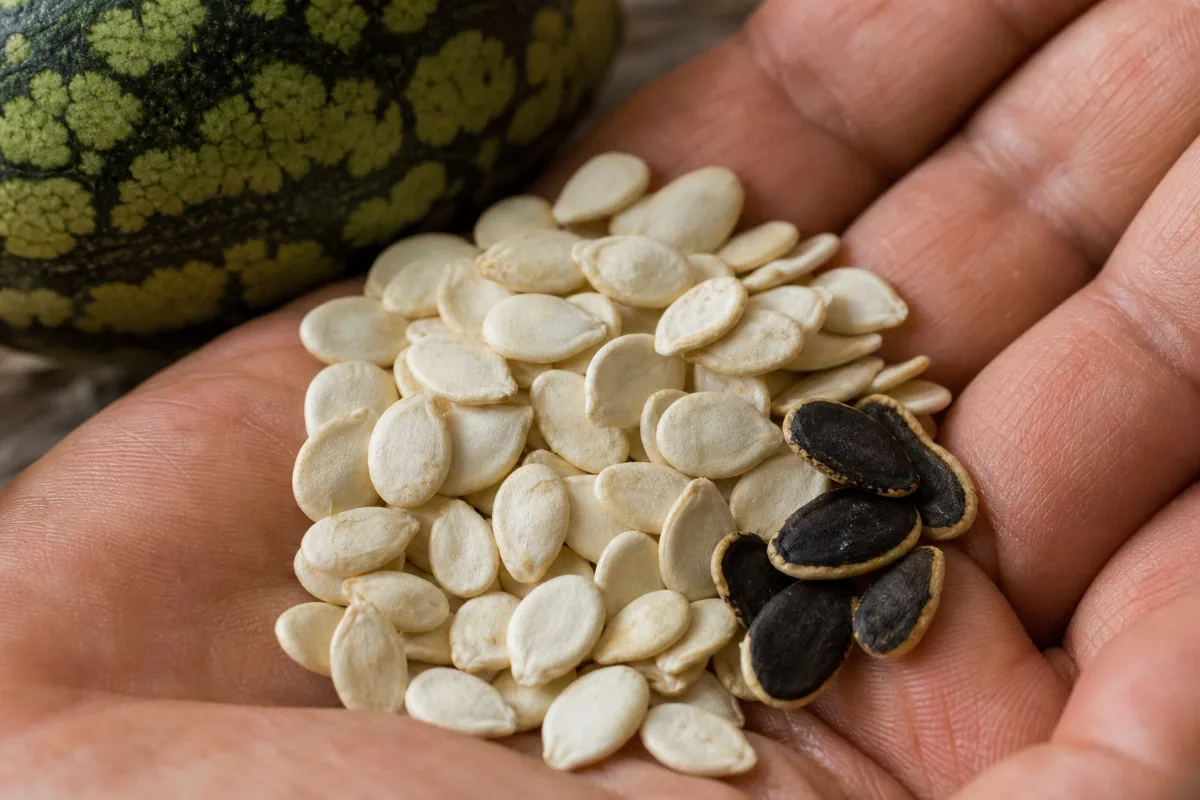
Watermelon seeds come from Citrullus lanatus, a plant in the gourd family. The snack is the dried, usually shelled kernel. It is different from the whole black seeds people swallow when eating the fruit.
USDA data for dried kernels, per 100 g: 557 kcal, 28.3 g protein, 47.4 g fat (9.78 g saturated), 15.3 g carbohydrate, 515 mg magnesium, 10.2 mg zinc, 0.686 mg copper, 1.61 mg manganese, 755 mg phosphorus and 7.28 mg iron. One ounce (28.35 g) has about 158 kcal, 8 g protein and 13.4 g fat. USDA lists no fibre, vitamin E or selenium value, which means no value, not zero.
What the research shows
We found no human trial of eating watermelon seed kernels for any health goal. A PubMed search for watermelon seed reviews and trials returned nothing.
The only health-type study is a 28-day rat study of extracted seed oil. It reported lower cholesterol, triglycerides and LDL, and a glucose-lowering effect. The authors ask for more safety work.
Large reviews link nuts and seeds as a group to less heart disease and say nuts lower LDL cholesterol without weight gain. Their abstracts do not name watermelon seeds, so we cannot say the same holds for them.
Food versus oil and flour
The rat study used extracted oil and the flour study measured composition only. Neither shows what eating the kernels does in people. No trial of a watermelon seed supplement or extract in people was found.
Amounts
This page gives no amounts to eat. Ask a doctor, pharmacist or dietitian what is right for you, especially if you have kidney disease or a seed allergy.
At a glance
Traditional uses history, not proof
- Eaten as a roasted or dried snack
- Long use as food is not proof that it treats any condition
Studied for research
- Magnesium, zinc and protein from the kernels, high certainty for the composition, no trial of the seeds
- Cholesterol and blood fats, very low certainty (seed oil in rats only)
- Heart disease risk, insufficient evidence (nut and seed studies do not name watermelon seeds)
- Body weight, insufficient evidence (nut trials, not watermelon seeds)
- Blood sugar and liver markers, very low certainty (seed oil in rats only)
Main compounds
- Linoleic acid
- Oleic acid
- Magnesium
- Zinc
- Copper
- Melatonin (small amount in pomace)
Common forms
- Dried shelled kernels as food
- Roasted seeds in the shell, salted or flavoured
- Seed oil (studied in rats only)
- Seed flour or pomace (studied for baking)
Research links: USDA FoodData Central: watermelon seed kernels, dried · Pumpkin seed allergy in children (includes watermelon seed reactions) · AAP: Choking prevention · Research Library · Genes & Biomarkers Library
What it is and its history
- Accepted scientific name
- Citrullus lanatus
- Naming authority
- (Thunb.) Matsum. & Nakai (GBIF accepted)
- Common names
- Watermelon seeds (English); Watermelon seed kernels (English); Tasali (Sudanese Arabic (as used in one study)); Semillas de sandia (Spanish)
- Family or group
- Cucurbitaceae (the gourd family), as given by GBIF. Pumpkin seeds come from the same family.
- Classification
- Plantae > Tracheophyta > Magnoliopsida > Cucurbitales > Cucurbitaceae > Citrullus > Citrullus lanatus
- Native range
- Not verified from a source read.
- Habitat
- Not verified from a source read.
- What it looks like
- Roots: Not verified.; Stems: Not verified.; Leaves: Not verified.; Flowers: Not verified.; Fruit: The seeds sit inside the watermelon fruit. The snack is the dried, usually shelled kernel (USDA item: 'Seeds, watermelon seed kernels, dried').
- Cultivation
- Not verified from a source read.
- Harvest and processing
- Sold as dried shelled kernels, roasted seeds in the shell (salted or flavoured), seed oil, and flour or pomace in baking studies. USDA's item is the dried kernel.
- Look-alikes and adulterants
- Name: Whole black seeds swallowed in the fruit; Note: Different from the shelled kernels. No nutrient data for the whole seeds were found.; Name: Pumpkin seeds and other gourd seeds; Note: Same plant family. The allergy series read involved children with pumpkin seed allergy.
- Sustainability and conservation
- Not assessed.
Photographs
What is inside, and how it may work
What it contains and how those compounds act in cells and animals. Laboratory and animal mechanisms are not proven effects in people.
Main compounds
| Compound | Family | Where it is concentrated | Activity studied | Level of evidence |
|---|---|---|---|---|
| Linoleic acid (18:2 polyunsaturated fat) PubChem 5280450 | fatty acid | Kernel USDA: polyunsaturated 18:2 28.1 g per 100 g; the rat-study oil was 52.32% 9,12-octadecadienoic acid | The main fat in the kernels. No human trial of its effect from this food was found. 16 3 15 | Composition |
| Oleic acid (18:1 monounsaturated fat) PubChem 445639 | fatty acid | Kernel USDA: monounsaturated 18:1 7.32 g per 100 g; the rat-study oil was 10.11% | A minor fat in the kernels. Composition only. 16 3 15 | Composition |
| Magnesium | mineral | Kernel USDA: 515 mg per 100 g | Essential mineral. Supplement upper level (350 mg) does not apply to food. 16 13 | Human data |
| Zinc | mineral | Kernel USDA: 10.2 mg per 100 g | Essential mineral. Phytate in plant foods can reduce zinc absorption. 16 14 | Human data |
| Melatonin PubChem 896 | hormone-like indole | Seed pomace (flour by-product) 60 micrograms per kg in pomace (laboratory analysis) | A composition measurement only. No health result from this amount was studied. 6 15 | Composition |
Mechanisms, receptors and pathways
| Target or pathway | Gene or receptor | What was found | Level |
|---|---|---|---|
| Blood fats in rats | Not specified | Seed oil lowered cholesterol, triglycerides and LDL and raised HDL in rats. The authors point to the oil's fatty acids; no mechanism was tested in the abstract. 3 | Animal research |
Absorption, metabolism and elimination
- Absorption
- Not found. Phytate in plant foods can reduce zinc absorption (Linus Pauling Institute).
- Distribution
- Not found.
- Metabolism
- Not found.
- Elimination
- Not found for the kernels. An explainer says swallowed whole seeds usually pass within 20 to 30 hours (not a medical source).
- Bioavailability
- Not established for the nutrients in watermelon seeds.
Isolated compounds versus whole extracts
The only health-type result is for extracted seed oil in rats. The flour study measured composition. Neither tells us what eating the roasted kernels does in people, and the swallowed whole seeds in the fruit are a different thing again.
Nutritional composition
Nutrition from USDA FoodData Central (Seeds, watermelon seed kernels, dried, FDC 169407, SR Legacy, last updated 4/1/2019, read 2026-10-26). Per 100 g: 557 kcal, 28.3 g protein, 47.4 g fat (9.78 g saturated, 7.41 g monounsaturated, 28.1 g polyunsaturated), 15.3 g carbohydrate, about 5 g water, 515 mg magnesium, 10.2 mg zinc, 0.686 mg copper, 1.61 mg manganese, 755 mg phosphorus, 7.28 mg iron, 648 mg potassium, 54 mg calcium, 99 mg sodium, 58 micrograms folate, 3.55 mg niacin, 0.19 mg thiamin. Per 1 ounce (28.35 g, USDA portion; our arithmetic): about 158 kcal, 8 g protein, 13.4 g fat (2.8 g saturated), 4.3 g carbohydrate, 146 mg magnesium, 2.9 mg zinc, 0.19 mg copper, 0.46 mg manganese, 214 mg phosphorus, 2.1 mg iron, 184 mg potassium, 28 mg sodium. As a share of FDA Daily Values per ounce: magnesium 35%, zinc 26%, copper 22%, manganese 20%, phosphorus 17%, protein 16%, iron 11%, total fat 17%, saturated fat 14%. One cup of kernels is 108 g (USDA). USDA lists no fibre, vitamin E or selenium value for this item, which means no value, not zero. Values vary with variety, roasting and storage; salted or flavoured snack seeds vary and no sodium figure for them was found.
1 high certainty2 very low certainty2 not enough evidence
What was looked at
The 5 benefits and uses checked for Watermelon Seeds, each with how strong the evidence is. Tap one to open it.
- Minerals and protein from the kernelsHigh certainty
- Cholesterol and blood fats (seed oil in rats)Very low certainty
- Heart disease risk (nuts and seeds as a group)Not enough evidence
- Body weight (nut trials)Not enough evidence
- Blood sugar and liver markers (seed oil in rats)Very low certainty
Lab markers tracked in the studies
LDL cholesterolBody weight and BMICardiovascular disease events and deathsLiver enzyme (ALT) and glucose tolerance in rats
What is Watermelon Seeds good for?
The main studied uses and how strong the evidence is for each. Almost none of it is about eating watermelon seeds: most is composition data, animal work on the oil, or studies of nuts and seeds as a group.
Benefits, one by one
Each card is a research question, not a promise. Tap a goal to filter. Open a card to see the studies, doses and limits.
Minerals and protein from the kernels
High certaintyDried watermelon seed kernels are rich in magnesium and zinc and also supply copper, manganese, phosphorus, iron and protein. This is a statement about what is in the food, not a result from a trial. USDA lists 515 mg magnesium and 10.2 mg zinc per 100 g.
6 studiesDried, shelled kernels as food (the USDA item). Values vary with vari…
Studies, doses and limits
What the trials found
No trial of eating the kernels was found. The facts come from USDA composition data and a laboratory analysis of seed flour. One ounce (28.35 g) gives about 35% of the Daily Value for magnesium, 26% for zinc, 22% for copper, 20% for manganese, 17% for phosphorus, 16% for protein and 11% for iron (our arithmetic from USDA and FDA Daily Values).
Results
The kernels are a mineral-dense food by USDA values. Whether that changes health in someone who already eats enough was not studied.
Effect sizes as reported
Per 100 g: magnesium 515 mg, zinc 10.2 mg, copper 0.686 mg, manganese 1.61 mg, phosphorus 755 mg, iron 7.28 mg, protein 28.3 g. Per ounce: magnesium 146 mg, zinc 2.9 mg, protein 8 g.
Why this rating
High for the composition (USDA data, and a separate laboratory analysis of seed flour pointing the same way). There is no trial showing a health benefit of these minerals from the kernels.
Form and dose studied
Dried, shelled kernels as food (the USDA item). Values vary with variety, roasting and storage.
Who was studied
Anyone eating a varied diet. Needs differ by age and health; ask a clinician or dietitian.
Limits
A nutrient fact, not a trial of the seeds. USDA lists no fibre, vitamin E or selenium value for this item, which means no value, not zero. No data on the whole black seeds swallowed in the fruit.
Why researchers looked
People eat the kernels as a snack for protein and minerals, so the first question is what they contain.
Traditional use
Shelled, dried and often roasted kernels are eaten as a snack in many places. Long use as food is not proof that they treat any condition.
Proposed mechanism Authoritative guidance
Magnesium, zinc and copper are essential minerals the body needs from food. Phytate in plant foods can reduce zinc absorption (Linus Pauling Institute).
A proposed mechanism does not show that the effect happens in people.
The supplement upper levels for magnesium, zinc and copper are not meant for food, but people with poor kidney function should be careful with supplemental magnesium. See the Safety tab.
Cholesterol and blood fats (seed oil in rats)
Very low certaintyIn a 28-day rat study, watermelon seed oil lowered cholesterol, triglycerides and LDL. That was an extracted oil in rats, so it does not tell us what eating the kernels does in people.
1 studiesExtracted seed oil given to rats (rat dose up to 50 mL/kg; not advice…
Studies, doses and limits
What the trials found
No human trial of watermelon seed kernels, oil or extract was found. A search of PubMed for watermelon seed trials and reviews returned none.
Results
In rats given the oil for 28 days, serum cholesterol, triglyceride and LDL fell and HDL rose. The abstract gives no figures.
Effect sizes as reported
Not given in the abstract.
Why this rating
Animal data only, from one study of extracted oil. No human data.
Form and dose studied
Extracted seed oil given to rats (rat dose up to 50 mL/kg; not advice).
Who was studied
Rats.
Limits
Not people. Oil, not kernels. No numbers in the abstract. One study.
Why researchers looked
The kernels are mostly fat, much of it linoleic acid, so researchers looked at the oil.
Traditional use
Not described in the sources read.
Proposed mechanism Animal research
Not established. The authors point to the fatty acids (linoleic, palmitic and oleic acid) in the oil.
A proposed mechanism does not show that the effect happens in people.
The authors say the oil showed no sign of toxicity in rats at the top dose and call for more safety work before long-term use.
Heart disease risk (nuts and seeds as a group)
Not enough evidenceLarge observational studies link eating more nuts and seeds to less heart disease. Watermelon seeds are not named in the review, so we cannot say the same holds for them.
1 studiesNuts and seeds as food, grouped.
Studies, doses and limits
What the trials found
A 2023 review of 28 cohorts (1,890,573 people) found higher nut and seed intake linked to lower cardiovascular disease (RR 0.81) and heart death (0.77). The abstract does not name watermelon seeds.
Results
Linked to lower risk across nuts and seeds as a group, mainly nuts. Nothing specific to watermelon seeds.
Effect sizes as reported
Total CVD RR 0.81 (95% CI 0.75-0.86); CVD death RR 0.77 (0.72-0.82); CHD RR 0.82 (0.76-0.89).
Why this rating
For watermelon seeds themselves: insufficient, because they were not analysed. For nuts and seeds as a group the reviewers called the link probable, but it rests on observational studies.
Form and dose studied
Nuts and seeds as food, grouped.
Who was studied
Adults in prospective cohorts.
Limits
Observational links cannot show cause. People who eat more nuts differ in other ways. Mainly nuts, not gourd seeds.
Why researchers looked
Nuts and seeds are often grouped together in diet research.
Traditional use
Not described in the sources read.
Proposed mechanism Observational association
The review suggests the link may be partly through blood fats. It does not test this for watermelon seeds.
A proposed mechanism does not show that the effect happens in people.
None specific. Watermelon seeds are energy-dense; see the Safety tab.
Body weight (nut trials)
Not enough evidencePooled trials of nuts found no weight gain from eating them daily. Watermelon seeds were not analysed.
2 studiesNuts and nut-based snacks.
Studies, doses and limits
What the trials found
A 2021 meta-analysis of 55 nut-feeding trials of more than 3 weeks found no change in body weight, BMI or waist circumference.
Results
No weight gain with nuts in trials. Watermelon seeds were not included by name.
Effect sizes as reported
Body weight SMD 0.01 (95% CI -0.07 to 0.08) without substitution instructions; -0.01 (-0.11 to 0.09) with.
Why this rating
Reasonable evidence for nuts, but none for watermelon seeds.
Form and dose studied
Nuts and nut-based snacks.
Who was studied
Adults.
Limits
About nuts, not watermelon seeds. Varying methods between trials.
Why researchers looked
Nuts and seeds are energy-dense, so people ask whether they cause weight gain.
Traditional use
Not described in the sources read.
Proposed mechanism Unknown
Not examined in the abstract.
A proposed mechanism does not show that the effect happens in people.
One ounce of kernels holds about 158 kcal (USDA).
Blood sugar and liver markers (seed oil in rats)
Very low certaintyIn the 28-day rat study, the oil also lowered a liver enzyme (ALT) and showed a glucose-lowering effect. These are rat findings from an extracted oil.
1 studiesExtracted seed oil in rats.
Studies, doses and limits
Results
In rats, ALT fell and oral glucose tolerance showed a glucose-lowering effect. No figures in the abstract.
Effect sizes as reported
Not given in the abstract.
Why this rating
Animal data from one study. No human data.
Form and dose studied
Extracted seed oil in rats.
Who was studied
Rats.
Limits
Not people. Oil, not kernels. One study.
Why researchers looked
The same rat study measured liver enzymes and a glucose tolerance test.
Traditional use
Not described in the sources read.
Proposed mechanism Animal research
Not established.
A proposed mechanism does not show that the effect happens in people.
People with diabetes should not use any food or oil in place of their medicine.
Connections to the rest of health
How Watermelon Seeds connects to the rest of our health knowledge graph. Every link says what kind of connection it is. A safety link (for example to the liver) is a warning, not a benefit. A study that merely mentions a topic never creates a benefit link.
Explore every connection: goals, body systems, organs, symptoms, genes
B. Body systems
| Connected to | Kind of connection | Evidence status | Context | Studies |
|---|---|---|---|---|
| Metabolism Weight | Biological association | High certainty | Studied for: Minerals and protein from the kernels Studied for: Body weight (nut trials) | 16 9 13 14 12 6 4 |
| Cardiovascular System | Biological association | Very low certainty | Studied for: Cholesterol and blood fats (seed oil in rats) Studied for: Heart disease risk (nuts and seeds as a group) | 3 2 |
| Blood Sugar Support | Biological association | Very low certainty | Studied for: Blood sugar and liver markers (seed oil in rats) | 3 |
| Hepatic System | Biological association | Very low certainty | Studied for: Blood sugar and liver markers (seed oil in rats) | 3 |
E. Health conditions
| Connected to | Kind of connection | Evidence status | Context | Studies |
|---|---|---|---|---|
| Food allergy | Adverse effect or risk | Documented risk | Reactions after watermelon seed were seen in a children's clinic series. Preparation or compound: Watermelon seed kernels as food |
1 |
| Choking | Adverse effect or risk | Documented risk | The AAP lists nuts and seeds as a choking hazard for young children. Preparation or compound: Seeds as food for young children |
8 |
I. Biomarkers
| Connected to | Kind of connection | Evidence status | Context | Studies |
|---|---|---|---|---|
| LDL cholesterol | Biological association | Very low certainty | Measured in trials: lowered. A lab change is not the same as a health benefit. | 3 5 |
| Body weight and BMI | Biological association | Not enough evidence | Measured in trials: no-change. A lab change is not the same as a health benefit. | 4 |
| Cardiovascular disease events and deaths | Biological association | Not enough evidence | Measured in trials: lowered. A lab change is not the same as a health benefit. | 2 |
| Liver enzyme (ALT) and glucose tolerance in rats | Biological association | Very low certainty | Measured in trials: lowered. A lab change is not the same as a health benefit. | 3 |
K. Biological pathways
| Connected to | Kind of connection | Evidence status | Context | Studies |
|---|---|---|---|---|
| Magnesium | Preliminary mechanism | Human | Kernels are a rich source by USDA values. | 16 13 |
| Zinc | Preliminary mechanism | Human | Kernels are a rich source by USDA values; phytate can limit absorption. | 16 14 |
| Copper | Preliminary mechanism | Human | Kernels supply copper by USDA values. | 16 12 |
L. Active compounds
| Connected to | Kind of connection | Evidence status | Context | Studies |
|---|---|---|---|---|
| Linoleic acid (18:2 polyunsaturated fat) | Biological association | Composition | The main fat in the kernels. No human trial of its effect from this food was found. Preparation or compound: Kernel |
16 3 15 |
| Oleic acid (18:1 monounsaturated fat) | Biological association | Composition | A minor fat in the kernels. Composition only. Preparation or compound: Kernel |
16 3 15 |
| Magnesium | Biological association | Human | Essential mineral. Supplement upper level (350 mg) does not apply to food. Preparation or compound: Kernel |
16 13 |
| Zinc | Biological association | Human | Essential mineral. Phytate in plant foods can reduce zinc absorption. Preparation or compound: Kernel |
16 14 |
| Melatonin | Biological association | Composition | A composition measurement only. No health result from this amount was studied. Preparation or compound: Seed pomace (flour by-product) |
6 15 |
Each connection is stored with the ingredient, the connected record, the kind of connection, the evidence status, the supporting studies, the preparation or compound involved, and a review date (last reviewed October 26, 2026).
The evidence
The research centre for Watermelon Seeds. Every record here was checked against PubMed or the publisher's page; we never list a study we have not verified.
Evidence by outcome
Bars show how many studies we found for each outcome, not how well it works. People are added up across trials only (reviews are not added, to avoid double counting).
How we rate evidence
High certainty
Several well-run trials or reviews agree; further research is unlikely to change the picture much.
Moderate certainty
Good trials point the same way, but some doubt remains.
Low certainty
Small, short or inconsistent trials. The finding could change with better research.
Very low certainty
Very little or very weak human data. Treat as a possibility only.
Mixed findings
Trials or reviews disagree with each other.
Not enough evidence
Not enough human research to say either way.
Evidence against
Good research found no benefit, or found harm.
We take the reviewers' own risk-of-bias and GRADE statements where they exist, and otherwise judge from study size, design, consistency, directness and whether a product matches what is sold. Many publications do not make evidence high. Method note: We started from our existing watermelon seed summary, re-checked nutrition at USDA FoodData Central and the FDA Daily Values, read the Linus Pauling Institute mineral pages and PubMed abstracts, and searched PubMed for watermelon seed reviews and trials (none found). Only abstracts were read for studies. Items we could not verify are flagged in the research gaps.
Study library: every study we checked 16
| Study | Design | People | Product, dose, length | Result |
|---|---|---|---|---|
| Acikalin 2026 Immunoglobulin E-mediated pumpkin seed allergy in children: Case series and narrative review with a structured literature search. Allergy Asthma Proc · PMID 42343505 · DOI |
Case series with narrative review |
25 children with pumpkin seed allergy Children with IgE-mediated pumpkin seed allergy at one tertiary clinic in Turkey (2016-2024) |
Pumpkin seed (watermelon seed reactions were a secondary finding) Seed Retrospective records review |
All 25 children had immediate reactions to pumpkin seed and 64% had anaphylaxis. Co-allergy was common (tree nuts 76%, other seeds 72%). Watermelon seed sensitisation occurred in 83%, and six children had clinical reactions after eating watermelon seed. Watermelon seed sensitisation 83%; six children reacted after eating it (Not applicable) Methods, limits and fundingOutcomes: Reactions, co-allergies, sensitisation to watermelon seed Limitations: A small clinic series of children already allergic to pumpkin seed, so it cannot show how common watermelon seed allergy is in the general population. The abstract gives anaphylaxis for pumpkin seed, not for watermelon seed. Funding and conflicts: Not stated in the abstract. Read: abstract |
| Arnesen 2023 Nuts and seeds consumption and risk of cardiovascular disease, type 2 diabetes and their risk factors: a systematic review and meta-analysis. Food Nutr Res · PMID 36816545 · DOI |
Systematic review meta analysis |
28 cohorts (1,890,573 people) and 18 RCTs (2,266 people) Adults in prospective cohort studies and trials of at least 12 weeks |
Nuts and seeds as a group (watermelon seeds not named in the abstract) Nuts and seeds Median about 50 g/day of nuts in the trials; analysis unit, not advice Cohorts: long-term follow-up; RCTs: 12 weeks or longer · vs Lower intake or control diets |
In cohorts, higher total nut and seed intake was linked to lower total cardiovascular disease, cardiovascular death and coronary heart disease. For stroke the link was small and for type 2 diabetes no clear link. In trials, nut intake lowered total and LDL cholesterol but not blood pressure; blood sugar findings were conflicting. The authors rated the link with cardiovascular disease and coronary heart disease as probable. Total CVD RR 0.81; CVD death RR 0.77; CHD RR 0.82; stroke RR 0.91; type 2 diabetes RR 0.95; total cholesterol -0.15 mmol/L; LDL -0.13 mmol/L (CVD 0.81 (95% CI 0.75-0.86, I2 67%); CVD death 0.77 (0.72-0.82); CHD 0.82 (0.76-0.89); stroke 0.91 (0.85-0.97); T2D 0.95 (0.75-1.21, I2 82.2%); total cholesterol -0.15 (-0.22 to -0.08); LDL -0.13 (-0.21 to -0.05)) Methods, limits and fundingOutcomes: Cardiovascular disease, coronary heart disease, stroke, type 2 diabetes, LDL cholesterol, blood pressure, blood sugar markers Limitations: Cohort links cannot show cause. The group is nuts and seeds as a whole, mainly nuts; a watermelon seed figure is not in the abstract. Funding and conflicts: Not stated in the abstract. Read: abstract |
| Eke 2021 Evaluation of nutritional composition of Citrullus lanatus Linn. (watermelon) seed and biochemical assessment of the seed oil in rats. J Food Biochem · PMID 34002399 · DOI |
Animal study animal |
Rats given watermelon seed oil by mouth for 28 days | Watermelon seed oil (extracted oil, not kernels) Seed oil Up to 50 mL/kg (rat dose, not advice) 28 days |
The seeds were analysed for composition. The oil showed no sign of toxicity in rats at the maximal dose tested. In rats the oil lowered serum cholesterol, triglyceride, LDL, ALT and MDA and raised HDL, VLDL, SOD and CAT. A positive oral glucose-lowering effect was seen. The main fatty acids were 9,12-octadecadienoic (linoleic) acid 52.32%, hexadecenoic acid 21.23% and oleic acid 10.11%. The authors recommend more work on activity and safety before long-term use. Direction of change only; no numbers for the lipid changes are given in the abstract (Not given in the abstract) Methods, limits and fundingOutcomes: Serum cholesterol, triglycerides, LDL, HDL, ALT, oral glucose tolerance, oxidative-stress markers, fatty acids Limitations: Rats, not people. Extracted oil, not the kernels people eat. Numbers for the changes were not in the abstract. Funding and conflicts: Not stated in the abstract. Read: abstract |
| Guarneiri 2021 Intake of Nuts or Nut Products Does Not Lead to Weight Gain, Independent of Dietary Substitution Instructions: A Systematic Review and Meta-Analysis of Randomized Clinical Trials. Adv Nutr · PMID 32945861 · DOI |
Systematic review meta analysis |
Adults in 55 nut-feeding trials of more than 3 weeks | Nuts and nut-based snacks or meals (watermelon seeds not named in the abstract) Nuts Daily nut intake (amount not given in the abstract) More than 3 weeks · vs Control diets |
No change in body weight, BMI or waist circumference with nut-enriched diets, with or without substitution instructions. A slight fall in body fat percentage may occur when substitution instructions are given. Body weight SMD 0.01 (no substitution instructions) and -0.01 (with); body fat SMD -0.32 with substitution instructions (Body weight SMD 0.01 (95% CI -0.07 to 0.08); -0.01 (-0.11 to 0.09); body fat -0.32 (-0.61 to -0.03)) Methods, limits and fundingOutcomes: Body weight, BMI, waist circumference, body fat percentage Limitations: About nuts, not watermelon seeds. The authors note varying methods between trials and unreported outcomes. Funding and conflicts: Not stated in the abstract. Read: abstract |
| Guasch-Ferre 2023 Effects of Nut Consumption on Blood Lipids and Lipoproteins: A Comprehensive Literature Update. Nutrients · PMID 36771303 · DOI |
Narrative review of meta analyses |
Adults in randomised trials covered by 19 systematic reviews and meta-analyses | Tree nuts and peanuts (total nuts, walnuts, almonds, cashews, peanuts, pistachios); seeds not named Nuts Not given in the abstract Varied · vs Usual diet or control |
Across meta-analyses, nuts lowered total cholesterol (mean difference -0.09 to -0.28 mmol/L), LDL cholesterol (-0.09 to -0.26 mmol/L) and triglycerides (-0.05 to -0.17 mmol/L). No effect on HDL cholesterol was found. Watermelon seeds are not named in the abstract. Total cholesterol MD -0.09 to -0.28 mmol/L; LDL MD -0.09 to -0.26 mmol/L; triglycerides MD -0.05 to -0.17 mmol/L (Not given in the abstract) Methods, limits and fundingOutcomes: Total cholesterol, LDL cholesterol, HDL cholesterol, triglycerides, apolipoprotein B Limitations: A narrative overview of nuts, not of watermelon seeds. Peanuts and tree nuts are different foods from a gourd seed. Funding and conflicts: Not stated in the abstract. Read: abstract |
| Jaroszewska 2023 Mineral, Nutritional, and Phytochemical Composition and Baking Properties of Teff and Watermelon Seed Flours. Molecules · PMID 37050018 · DOI |
Laboratory composition analysis none (laboratory analysis) |
Laboratory analysis of teff flour and watermelon seed flour and pomace added to wheat dough | Watermelon seed flour and pomace (dried and ground) Seed 10%, 20% and 30% added to wheat flour in dough tests · vs Refined wheat flour |
Watermelon seed pomace had the highest phosphorus, magnesium and sodium (7.5, 1.7 and 0.4 g/kg), and iron and zinc of 124 and 27 mg/kg. Protein and fat were higher in watermelon seeds than in teff (about double, and up to 10-fold). Total polyphenols were low in all materials (under 2 mg GAE/g), matching a low antioxidant potential. Watermelon seed pomace held 60 micrograms/kg of melatonin. Dough behaviour improved with the added flours. Composition values only (Not applicable) Methods, limits and fundingOutcomes: Minerals, protein, fat, phenolics, flavonoids, melatonin, antioxidant potential, dough behaviour Limitations: Laboratory measurement of flour and pomace, not of roasted kernels, and no health outcome in people or animals. Funding and conflicts: Not stated in the abstract. Read: abstract |
| Suleiman Mohammed 2021 Frequency of parasitic infections in Arachis hypogaea L (groundnuts), Citrullus lanatus seeds (watermelon seeds), and Ziziphus spina-christi (nabag) sold by street vendors in Khartoum State, Sudan: a cross-sectional study. F1000Res · PMID 35284061 · DOI |
Cross sectional study not applicable |
Roasted groundnuts, nabag and tasali (watermelon seeds) sold by street vendors in Khartoum State, Sudan | Roasted street-vended watermelon seeds (tasali), groundnuts and nabag Seed Samples washed with saline and examined |
Two parasites were found: Entamoeba histolytica (33.3%) and Giardia lamblia (15.6%); mixed contamination was 11.1%; no worm parasites were found. Nabag was the most contaminated crop, then groundnut, and finally tasali (watermelon seeds). No link was found between a positive sample and crop type, city or seller sex. Entamoeba histolytica 33.3%; Giardia lamblia 15.6% across all sampled products (Not applicable) Methods, limits and fundingOutcomes: Parasite contamination of the products Limitations: One region, street vendors only. The percentages are for all products together; a watermelon-seed-only figure is not in the abstract. It says nothing about packaged seeds. Funding and conflicts: Not stated in the abstract. Read: abstract |
| s-aap-choking American Academy of Pediatrics (HealthyChildren.org): Choking Prevention · Source |
Health agency n/a |
Methods, limits and fundingRead: full-text | ||
| s-fda-daily-value FDA: Daily Value on the Nutrition and Supplement Facts Labels · Source |
Health agency n/a |
Methods, limits and fundingRead: full-text | ||
| s-gbif-citrullus-lanatus GBIF species match: Citrullus lanatus · Source |
Taxonomy database n/a |
Methods, limits and fundingRead: full-text | ||
| s-ipm-swallowed-seeds A Moment of Science (Indiana Public Media): Is it OK to swallow watermelon seeds? · Source |
Explainer not medical n/a |
Methods, limits and fundingRead: summary-only | ||
| s-lpi-copper Linus Pauling Institute: Copper · Source |
Reference database n/a |
Methods, limits and fundingRead: full-text | ||
| s-lpi-magnesium Linus Pauling Institute: Magnesium · Source |
Reference database n/a |
Methods, limits and fundingRead: full-text | ||
| s-lpi-zinc Linus Pauling Institute: Zinc · Source |
Reference database n/a |
Methods, limits and fundingRead: full-text | ||
| s-pubchem-fatty-acids PubChem compound records: linoleic acid, oleic acid, melatonin · Source |
Chemistry database n/a |
Methods, limits and fundingRead: full-text | ||
| s-usda-fdc-169407 USDA FoodData Central: Seeds, watermelon seed kernels, dried (FDC 169407) · Source |
Reference database n/a |
Methods, limits and fundingRead: full-text |
What we do not know yet
- No human trial of eating watermelon seed kernels, or taking seed oil or extract, was found for any health goal.
- The cholesterol and blood sugar results are one rat study of extracted oil, and its abstract gives no figures.
- The nut and seed reviews do not name watermelon seeds in their abstracts.
- How common watermelon seed allergy is was not found.
- Pregnancy and breastfeeding statements, medicine interactions, aflatoxin, heavy metals, pesticide residues and the effect of roasting were not found or not researched.
- The swallowed-seed statement rests on a science-radio explainer.
How new research is added
New studies are found by a saved PubMed search and placed in a review queue before the page changes.
Lab markers
What changed in blood or saliva tests during trials. A changed number is not the same as feeling or being healthier, and we give no "normal ranges".
Metabolic 2
LDL cholesterol
Lowered in trials
The 'bad' cholesterol carried in the blood, linked to heart disease risk.
Very low certaintyResults and what it means
Why it was measured
It is a common marker for heart disease risk.
Statistical vs. clinical meaning
For watermelon seeds the only evidence is in rats. The human result is for other foods (nuts) and cannot be assumed for this seed.
Safety implication
None specific.
| Study | Result | People | Product |
|---|---|---|---|
| 3 | LDL, total cholesterol and triglycerides fell and HDL rose in rats given the oil (no figures in the abstract) | Rats | Watermelon seed oil for 28 days |
| 5 | Across meta-analyses of nut trials, LDL cholesterol fell by 0.09 to 0.26 mmol/L; seeds and watermelon seeds not named | Adults in nut trials | Tree nuts and peanuts as food |
Body weight and BMI
No clear change in trials
Weight, or weight relative to height.
Not enough evidenceResults and what it means
Why it was measured
Seeds are energy-dense, so researchers check for weight gain.
Statistical vs. clinical meaning
Applies to nuts. Not shown for watermelon seeds.
Safety implication
None specific.
| Study | Result | People | Product |
|---|---|---|---|
| 4 | No change in body weight, BMI or waist circumference with daily nuts (SMD 0.01, 95% CI -0.07 to 0.08) | Adults in 55 nut trials | Nuts and nut snacks (not watermelon seeds) |
Other 2
Cardiovascular disease events and deaths
Lowered in trials
How many people in a study develop heart disease or stroke, or die of it.
Not enough evidenceResults and what it means
Why it was measured
These are the outcomes that matter most to health.
Statistical vs. clinical meaning
An association for nuts and seeds as a group, not shown for watermelon seeds.
Safety implication
None specific.
| Study | Result | People | Product |
|---|---|---|---|
| 2 | Higher nut and seed intake linked to lower CVD (RR 0.81, 95% CI 0.75-0.86) and CVD death (RR 0.77, 0.72-0.82) | Adults in 28 cohorts | Nuts and seeds as a group |
Liver enzyme (ALT) and glucose tolerance in rats
Lowered in trials
ALT is a liver enzyme in the blood; glucose tolerance shows how well blood sugar is handled after a sugar drink.
Very low certaintyResults and what it means
Why it was measured
Used in the rat study to check the oil's effect and safety.
Statistical vs. clinical meaning
Animal result only.
Safety implication
None specific.
| Study | Result | People | Product |
|---|---|---|---|
| 3 | ALT lowered and a glucose-lowering effect seen in rats (no figures in the abstract) | Rats | Watermelon seed oil for 28 days |
Safety
What studies and official sources say about side effects, medicines and who should check first. Each point shows what kind of evidence it comes from.
Main points to know 4
- Allergy: seed allergy can be severe, mainly reported in children who are allergic to other seeds or nuts. In a clinic series of 25 children with pumpkin seed allergy in Turkey, 83% were sensitised to watermelon seed and six had clear reactions after eating it. Many also had tree nut or other seed allergies. The series is small and cannot say how common watermelon seed allergy is. Case series 1
- Young children: nuts and seeds are a choking hazard. The American Academy of Pediatrics lists nuts and seeds among foods to avoid or modify for young children and says to keep high-risk foods from children until 4 years or older, depending on development. Authoritative guidance 8
- Street-sold roasted seeds carried parasites in one study. In Khartoum State, Sudan, Entamoeba histolytica and Giardia lamblia were found on roasted groundnuts, nabag and watermelon seeds sold by street vendors. This was one region and did not test packaged seeds. Cross sectional 7
- Energy and saturated fat add up. One ounce (28.35 g) of dried kernels has about 158 kcal and 2.8 g of saturated fat (14% of the Daily Value), by USDA data and our arithmetic. Reference data 16 9
Side effects 3
| Effect | How often | Severity and recovery | Evidence |
|---|---|---|---|
| Allergic reactions after eating watermelon seed Children already allergic to pumpkin seed, often also to tree nuts and other seeds. | Six of 25 children with pumpkin seed allergy reacted after eating watermelon seed; how common it is in the general population was not found | Can be serious: the same series reports anaphylaxis in 64% of children for pumpkin seed (not given for watermelon seed) Not stated in the abstract | Case series 1 |
| Intestinal parasite infection from contaminated street-sold seeds One region; the figures are not for watermelon seeds alone. | Entamoeba histolytica 33.3% and Giardia lamblia 15.6% across all sampled street-vended products (nabag, groundnuts, watermelon seeds together) | Not stated in the abstract Not stated in the abstract | Cross sectional 7 |
| Choking in young children AAP lists nuts and seeds among foods to avoid or modify for young children. | Not given | Choking can be life-threatening Not applicable | Authoritative guidance 8 |
Liver
No liver injury from eating watermelon seeds was found in the sources read. A liver-safety source such as LiverTox was not searched for this food page. The rat study of the oil reported a fall in the liver enzyme ALT and no sign of toxicity, which does not show safety in people. 3
How often. No frequency was found.
Monitoring. No agency monitoring advice was found.
This is a safety connection. It is not evidence that Watermelon Seeds supports liver health.
Medicines and supplements 2
| With | Why it matters | Importance | Evidence | What to do |
|---|---|---|---|---|
| Medicines in general prescription | Not described in any source read for watermelon seeds eaten as food. | No medicine interaction with watermelon seeds eaten as food was found. This is absence of information, not proof of safety. | None found Not enough evidence | Ask a pharmacist if you take medicine and eat seeds often. |
| Magnesium supplements and kidney disease supplement | The Linus Pauling Institute says supplemental magnesium (upper level 350 mg a day) can cause adverse effects, especially with impaired kidney function. That upper level applies to supplements, not to food. | Kernels contain magnesium (146 mg per ounce), so people with poor kidney function can ask a clinician about magnesium-rich foods. The source does not say the food is a problem. | Authoritative guidance Low certainty 13 16 | Ask a clinician if you have kidney disease. |
Who should check first 4
| Situation | Advice | Evidence |
|---|---|---|
| Known allergy to watermelon seed, pumpkin seed, other seeds or tree nuts | Avoid watermelon seeds unless an allergist says otherwise. Call emergency services for trouble breathing or swelling of the face or throat. | Case series 1 |
| Children under 4 years (choking) | The AAP says to keep high-risk foods from children until 4 years or older, depending on development, and lists nuts and seeds among foods to avoid or modify. | Authoritative guidance 8 |
| Pregnancy and breastfeeding | No official statement on watermelon seed kernels in pregnancy or breastfeeding was found. Ask your doctor or midwife. | None found |
| Chronic kidney disease | Kernels are rich in magnesium, phosphorus and potassium (USDA). Ask a clinician or dietitian about these foods. | Authoritative guidance 16 13 |
Overdose, product quality and regulators
Summary. No toxicity from eating watermelon seed kernels as food was found in the sources read. Zinc and copper upper levels apply to supplements, and food amounts are far below them.
Animal. A rat study of the extracted oil reported no sign of toxicity at the maximal dose tested (50 mL/kg for 28 days); the authors ask for more safety work.
Human doses studied. No human trial was found.
Overdose response. Not found.
Genotoxicity. Not researched.
Street-sold roasted seeds carried parasites in one study. Aflatoxin, heavy metals, pesticides and rancidity in watermelon seeds were not found in the sources read, so we make no claim.
Street vending hygiene. In Khartoum State, Sudan, Entamoeba histolytica (33.3%) and Giardia lamblia (15.6%) were found on street-vended roasted groundnuts, nabag and watermelon seeds. No link to crop type was found. 7
Swallowed whole seeds from the fruit. A science-radio explainer says a few swallowed seeds usually pass within 20 to 30 hours and that a blockage is very rare. It is not a medical source and the page could not be re-read. 11
| Body | Action | Date |
|---|---|---|
| American Academy of Pediatrics (United States) | Lists nuts and seeds among foods to avoid or modify for young children and advises keeping high-risk foods from children until 4 years or older depending on development. source | 2026-02-27 |
| FDA (United States) | Publishes the Daily Values used for % Daily Value labels (for example magnesium 420 mg, zinc 11 mg). Does not make a statement on watermelon seeds. source | 2024-03-05 |
| Linus Pauling Institute (Oregon State University) (United States) | States an upper level of 350 mg a day for supplemental magnesium, 40 mg for zinc and 10 mg for copper. source | 2026-10-26 |
When to get medical help
- Trouble breathing, wheeze, swelling of the lips, face or throat, widespread hives or faintness after eating watermelon seeds
- A child choking: coughing that does not clear, unable to breathe, speak or cry. Call emergency services
- Severe or long-lasting diarrhoea or stomach pain after eating seeds from a street seller
Stop using the product and contact a clinician or emergency service. In the US, Poison Control is 1-800-222-1222.
General information only, not medical advice. Ask a clinician or pharmacist before use, especially with medicines, in pregnancy or with a health condition. See the Natural Remedy Safety guide.
Frequently asked questions
Are watermelon seeds good for you?
By USDA data the dried kernels are rich in magnesium and zinc and are energy-dense, about 158 kcal an ounce. We found no human trials showing a health benefit from eating them.
Is it safe to swallow watermelon seeds?
Can you be allergic to watermelon seeds?
Yes. In a clinic series of children with pumpkin seed allergy, six reacted after eating watermelon seed. How common it is in the general population was not found. For trouble breathing or swelling of the face or throat, call emergency services.
What is the difference between the kernels and the seeds in the fruit?
The USDA data are for dried, shelled kernels. The black seeds swallowed in the fruit are different, and no nutrient data for them were found.
Do watermelon seeds lower cholesterol?
Are watermelon seeds good for the heart?
Not shown. Observational studies link nuts and seeds as a group to less heart disease (RR 0.81), but the review does not name watermelon seeds and cannot show cause.
Will watermelon seeds make me gain weight?
Do watermelon seeds lower blood sugar?
Not shown in people. The rat study of the oil reported a glucose-lowering effect. Do not use seeds or oil in place of diabetes medicine.
Are watermelon seeds safe in pregnancy?
No official statement on watermelon seed kernels in pregnancy or breastfeeding was found. Ask your doctor or midwife.
Do watermelon seeds interact with medicines?
No interaction with the kernels as food was found in the sources read. That is missing information, not proof of safety. A pharmacist can check.
Is it safe to buy roasted watermelon seeds from street sellers?
In one Sudan study, parasites were found on street-vended roasted seeds, including watermelon seeds. Packaged seeds were not tested. Choose clean sources and wash your hands.
Is watermelon seed oil the same as eating the seeds?
No. The only health-type study used extracted oil in rats. It does not tell us what eating the kernels does in people.
Explore by health goal
Editorial transparency
- Written by
- AlternativeMed editorial team. Research compiled with AI assistance, then checked against the sources listed.
- Medical review
- None. This page has not been reviewed by a physician or pharmacist.
- First published
- 2026-10-26
- Last substantive update
- 2026-10-26
- How we research
- We started from our existing watermelon seed summary, re-checked nutrition at USDA FoodData Central and the FDA Daily Values, read the Linus Pauling Institute mineral pages and PubMed abstracts, and searched PubMed for watermelon seed reviews and trials (none found). Only abstracts were read for studies. Items we could not verify are flagged in the research gaps.
- How we rate evidence
- See "How we rate evidence" in the Evidence tab.
- Independence
- No product is promoted on this page. No affiliate links are shown.
Sources 16
Each source was opened and checked. Where we read only the abstract, it says so. The small numbers in the text point here.
- Acikalin B, Ocak M, Sekerel BE, et al.. Immunoglobulin E-mediated pumpkin seed allergy in children: Case series and narrative review with a structured literature search.. Allergy Asthma Proc. 2026. PMID 42343505. DOI 10.2500/aap.2026.47.260028. (abstract)
- Arnesen EK, Thorisdottir B, Barebring L, et al.. Nuts and seeds consumption and risk of cardiovascular disease, type 2 diabetes and their risk factors: a systematic review and meta-analysis.. Food Nutr Res. 2023. PMID 36816545. DOI 10.29219/fnr.v67.8961. (abstract)
- Eke R, Ejiofor E, Oyedemi S, et al.. Evaluation of nutritional composition of Citrullus lanatus Linn. (watermelon) seed and biochemical assessment of the seed oil in rats.. J Food Biochem. 2021. PMID 34002399. DOI 10.1111/jfbc.13763. (abstract)
- Guarneiri LL, Cooper JA. Intake of Nuts or Nut Products Does Not Lead to Weight Gain, Independent of Dietary Substitution Instructions: A Systematic Review and Meta-Analysis of Randomized Clinical Trials.. Adv Nutr. 2021. PMID 32945861. DOI 10.1093/advances/nmaa113. (abstract)
- Guasch-Ferre M, Tessier AJ, Petersen KS, et al.. Effects of Nut Consumption on Blood Lipids and Lipoproteins: A Comprehensive Literature Update.. Nutrients. 2023. PMID 36771303. DOI 10.3390/nu15030596. (abstract)
- Jaroszewska A, Jedrejek D, Sobolewska M, et al.. Mineral, Nutritional, and Phytochemical Composition and Baking Properties of Teff and Watermelon Seed Flours.. Molecules. 2023. PMID 37050018. DOI 10.3390/molecules28073255. (abstract)
- Suleiman Mohammed A, Abd Alla A, Galander A, et al.. Frequency of parasitic infections in Arachis hypogaea L (groundnuts), Citrullus lanatus seeds (watermelon seeds), and Ziziphus spina-christi (nabag) sold by street vendors in Khartoum State, Sudan: a cross-sectional study.. F1000Res. 2021. PMID 35284061. DOI 10.12688/f1000research.53682.3. (abstract)
- . American Academy of Pediatrics (HealthyChildren.org): Choking Prevention. . . (full-text)
- . FDA: Daily Value on the Nutrition and Supplement Facts Labels. . . (full-text)
- . GBIF species match: Citrullus lanatus. . . (full-text)
- . A Moment of Science (Indiana Public Media): Is it OK to swallow watermelon seeds?. . . (summary-only)
- . Linus Pauling Institute: Copper. . . (full-text)
- . Linus Pauling Institute: Magnesium. . . (full-text)
- . Linus Pauling Institute: Zinc. . . (full-text)
- . PubChem compound records: linoleic acid, oleic acid, melatonin. . . (full-text)
- . USDA FoodData Central: Seeds, watermelon seed kernels, dried (FDC 169407). . . (full-text)
Where to buy
Check the label first. Whatever you buy, look for these:
- Raw or roasted, and salted or unsalted
- A best-by date, since nuts and seeds turn rancid
- Tree nut and peanut allergy warnings
- A resealable bag, and cool storage once opened
Talk to a pharmacist or doctor before you start any supplement, especially if you take medicines. See the Safety tab for interactions.
Support our free guides: as an Amazon Associate we earn from qualifying purchases. Full disclosure.


