Vitamins & Supplements · Mineral
Magnesium
Magnesium (Mg) · also called Mg, magnesio
Magnesium is an essential mineral found in leafy greens, nuts, seeds, beans and whole grains. Large food studies link more magnesium with lower diabetes, stroke and heart failure risk, but those links are not proof. Trials of pills show small or mixed effects on blood pressure and blood sugar, and no benefit for leg cramps in older adults. The most important caution is kidney disease: magnesium laxatives and supplements can build up to dangerous levels.
General information, not medical advice. Last substantive update · Not medically reviewed. A named clinician has not signed off on this page. How this page is made
About Magnesium
Magnesium is an essential mineral that the body uses for nerves, muscles, energy and bones. It is found in many foods. A true shortage is uncommon and is treated by clinicians. Pills show small or mixed effects in trials, and the biggest safety concern is too much magnesium in people with reduced kidney function.
What it is
Magnesium is an essential mineral. The NHS says it helps turn food into energy and keeps the parathyroid glands working normally. MedlinePlus lists nerve and muscle work, a steady heartbeat and strong bones among its roles.
It is sold as supplements of several forms, such as oxide, citrate, glycinate and chloride, and magnesium compounds are also used in laxatives and antacids. Magnesium chloride bath flakes are a different product with their own page.
Food sources (USDA data)
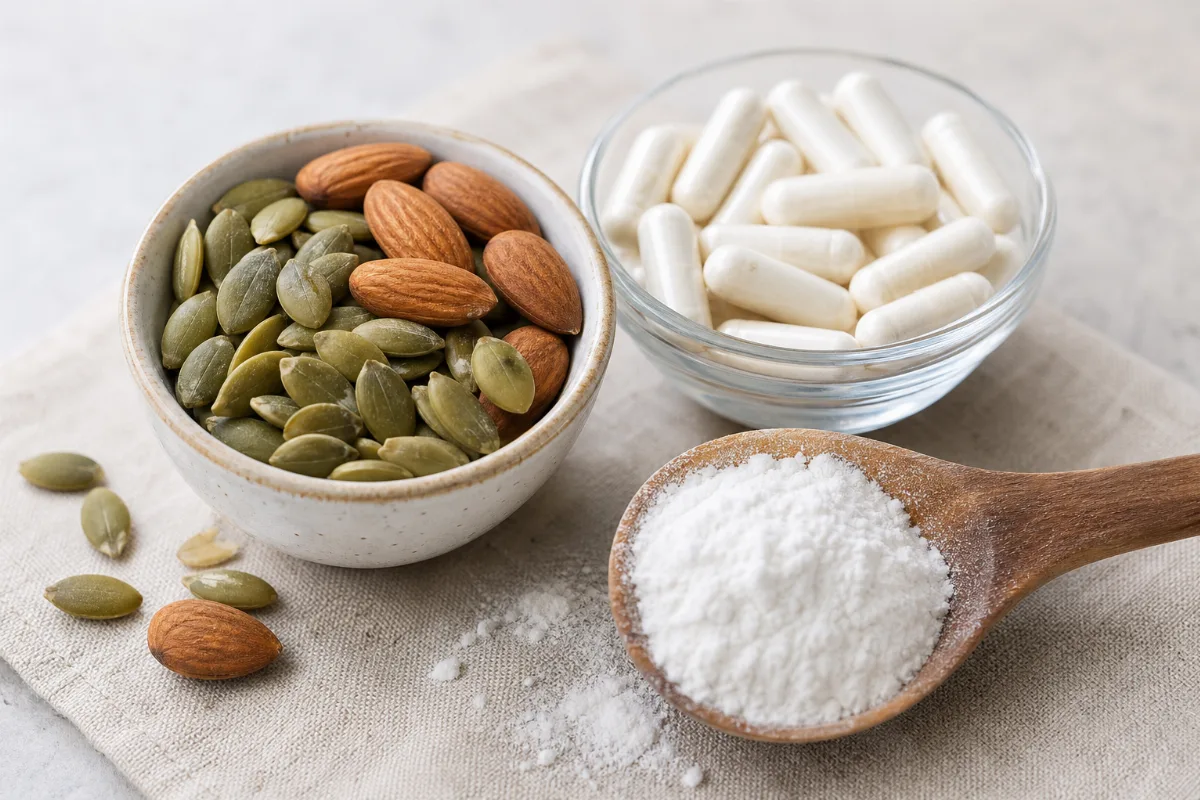
MedlinePlus names dark green leafy vegetables, bananas, dried apricots, avocados, almonds, cashews, peas and beans, seeds, tofu, brown rice, millet and milk as good sources.
USDA values worked out per portion: dried pumpkin seeds about 168 mg in 1 oz (28 g); dried chia seeds about 95 mg in 1 oz; raw cashews about 83 mg in 1 oz; almonds about 77 mg in 1 oz; cooked black beans about 120 mg in 1 cup; cooked brown rice about 79 mg in 1 cup; raw spinach about 24 mg in 1 cup; a medium banana about 32 mg.
These numbers describe foods and are not advice on how much to eat. Foods also carry fibre and other nutrients that pills do not.
What the research shows
Low magnesium: it causes fatigue, spasms, weakness, numbness and in severe cases convulsions, and is treated by clinicians. True shortage is rare and is more likely with alcohol misuse, poor absorption, older age and type 2 diabetes.
Blood pressure: 34 pooled trials found a fall of about 2 mm Hg (systolic) and 1.8 mm Hg (diastolic), while a later 24-week trial of 164 older adults found no change. Blood sugar: a 2025 review of 23 trials in type 2 diabetes found a small fall in fasting glucose and a borderline HbA1c change. Migraine: oral magnesium was linked with fewer attacks in pooled trials with some weak randomisation.
Food and long-term health: in 40 cohort studies, more dietary magnesium went with lower type 2 diabetes, stroke, heart failure and death rates. These are links, not proof.
Cramps, sleep, mood and pregnancy: a Cochrane review found no meaningful benefit for night cramps in older adults. Sleep and depression evidence is thin and very low certainty. Pregnancy trials give no clear benefit.
Food versus pills
The long-term findings are for magnesium eaten in food, together with fibre and other nutrients. The trials on blood pressure, blood sugar, migraine, sleep and mood used pills. One does not prove the other. The Linus Pauling Institute says no harm has been found from magnesium naturally in food.
At a glance
Traditional uses history, not proof
- Eaten in everyday foods such as leafy greens, nuts, seeds, beans and whole grains
- Magnesium compounds are sold as supplements, laxatives and antacids; long use is not proof of benefit
Studied for research
- Blood pressure, low certainty (small pooled fall, one null trial)
- Blood sugar in type 2 diabetes, low certainty
- Long-term health links from food (diabetes, stroke, heart failure), low certainty (observational)
- Migraine prevention, low certainty
- Muscle cramps in older adults, evidence against a benefit
- Sleep in older adults, very low certainty
- Mild to moderate depression, very low certainty (one open-label trial)
- Constipation (magnesium oxide), low certainty
- Pregnancy outcomes, not enough evidence
Main compounds
- Magnesium (the mineral itself)
- Magnesium oxide
- Magnesium citrate
- Magnesium sulfate
- Magnesium chloride
- Magnesium glycinate
Common forms
- Magnesium in food (USDA values read)
- Oral supplements of several forms
- Magnesium laxatives and antacids (medicine use)
- Bath flakes have their own page
Research links: 2016 meta-analysis: magnesium supplements and blood pressure (34 trials) · 2020 Cochrane review: magnesium for muscle cramps · 2016 meta-analysis: dietary magnesium, diabetes, stroke and death · Research Library · Genes & Biomarkers Library
What it is and its history
- Accepted scientific name
- Magnesium (chemical element, symbol Mg; an essential mineral)
- Common names
- Magnesium (English); Mg (chemical symbol); Magnesio (Spanish)
- Family or group
- Major minerals (essential nutrient)
- Harvest and processing
- Supplements and medicines use different magnesium compounds (oxide, citrate, glycinate, chloride, sulfate and others). How they are made was not researched.
- Look-alikes and adulterants
- Name: Magnesium chloride bath flakes; Note: A different product used on the skin; it has its own page. Absorption through the skin was not assessed here.; Name: Epsom salt (magnesium sulfate); Note: A magnesium salt used in baths; not the same as a supplement and not reviewed here.
Photographs
What is inside, and how it may work
What it contains and how those compounds act in cells and animals. Laboratory and animal mechanisms are not proven effects in people.
Main compounds
| Compound | Family | Where it is concentrated | Activity studied | Level of evidence |
|---|---|---|---|---|
| Magnesium (Mg2+ ion) PubChem 888 | mineral | See the food list in the nutrition note | Needed for nerve and muscle function, energy production and bone health (MedlinePlus, NHS). 17 18 | Human data |
| Magnesium oxide PubChem 14792 | inorganic salt | Studied as a laxative in a small trial; used in a head-to-head form trial. 9 11 | Human data | |
| Magnesium citrate PubChem 6099959 | organic salt | Raised plasma and urine magnesium in a form trial. 11 | Human data | |
| Magnesium sulfate PubChem 24083 | inorganic salt | Raised plasma magnesium similarly in the form trial. 11 | Human data | |
| Magnesium chloride PubChem 5360315 | inorganic salt | Used in the depression trial. 12 | Human data | |
| Magnesium glycinate PubChem 84645 | amino acid chelate | Sold as a supplement; no trial read compares it with other forms. 1 | Lab |
Mechanisms, receptors and pathways
| Target or pathway | Gene or receptor | What was found | Level |
|---|---|---|---|
| Nerve and muscle signalling | Not specified in the sources read | MedlinePlus says magnesium helps nerves and muscles work and that shortage causes spasms, weakness, numbness and convulsions. 17 16 | Human data |
| Release from food and supplements | Not specified | In a test-tube digestion model, about 49% to 53% of magnesium was released from three diets; the diet makeup and the chemical form affected release. Not shown in people. 1 | Lab |
| Blood and urine magnesium after different forms | Not specified | In 164 older adults, plasma magnesium rose similarly with citrate, oxide and sulfate; citrate gave a bigger rise in 24-hour urine magnesium. No health benefit was shown. 11 | Human data |
Absorption, metabolism and elimination
- Absorption
- Not studied in the sources read for this page except as a lab model and a form trial.
- Distribution
- Not found.
- Elimination
- The kidneys remove extra magnesium (MedlinePlus); when kidney function is greatly reduced, magnesium can build up.
- Bioavailability
- In a lab model, the share released from three diets was 48.74% to 52.51%; plasma rises were similar across oxide, citrate and sulfate in one trial. No head-to-head human absorption ranking was read.
Isolated compounds versus whole extracts
The long-term health links (diabetes, stroke, heart failure, death) are for magnesium eaten in food, which comes with fibre, other minerals and other nutrients. The trials on blood pressure, blood sugar, migraine, sleep and mood used pills. Food-based findings cannot be assumed to apply to pills, and pill-based findings cannot be assumed to apply to food. The Linus Pauling Institute says no adverse effects have been found from magnesium naturally in food.
Nutritional composition
Magnesium in selected foods, from USDA FoodData Central (SR Legacy, April 2018), read 2026-10-26 from a saved copy, and worked out per typical portion from the USDA portion weights (rounded). Pumpkin and squash seed kernels, dried: about 168 mg in 1 oz (28 g). Chia seeds, dried: about 95 mg in 1 oz. Cashews, raw: about 83 mg in 1 oz. Almonds: about 77 mg in 1 oz. Black beans, cooked: about 120 mg in 1 cup (172 g). Brown rice, long-grain, cooked: about 79 mg in 1 cup (202 g). Spinach, raw: about 24 mg in 1 cup (30 g). Banana, raw: about 32 mg in 1 medium banana (118 g). MedlinePlus names dark green leafy vegetables, bananas, dried apricots, avocados, almonds, cashews, peas and beans, seeds, tofu and soy flour, brown rice, millet and milk as sources. These are nutrient contents of foods, not advice on how much to eat. The US recommended daily intakes are given in the regulator list on the Safety tab.
5 low certainty2 very low certainty2 not enough evidence1 evidence against
What was looked at
The 10 benefits and uses checked for Magnesium, each with how strong the evidence is. Tap one to open it.
- Correcting low magnesium (deficiency)Not enough evidence
- Blood pressureLow certainty
- Blood sugar in type 2 diabetesLow certainty
- Eating more magnesium and long-term health (food, not pills)Low certainty
- Migraine preventionLow certainty
- Muscle crampsEvidence against
- Sleep and insomnia in older adultsVery low certainty
- Mild to moderate depression symptomsVery low certainty
- Constipation (magnesium oxide as a laxative)Low certainty
- Pregnancy outcomes (pre-eclampsia, birth weight)Not enough evidence
Lab markers tracked in the studies
Systolic blood pressureDiastolic blood pressureFasting blood glucoseHbA1c (average blood sugar over about 3 months)Blood (serum) magnesiumMigraine frequency and intensityMuscle cramps per weekTime to fall asleep (sleep onset latency)PHQ-9 depression scoreColonic transit time and stool form
What is Magnesium good for?
The main studied uses and how strong the human evidence is for each. Most results come from trials of pills, and the long-term findings come from food studies that cannot prove cause.
Benefits, one by one
Each card is a research question, not a promise. Tap a goal to filter. Open a card to see the studies, doses and limits.
Correcting low magnesium (deficiency)
Not enough evidenceLow magnesium is a real, treatable condition. Doctors correct it with magnesium by mouth or by vein. It is uncommon in healthy people who eat normally. No trial of correcting deficiency was read here: the source is health-agency guidance.
2 studiesMagnesium by mouth or by vein, chosen by a clinician. Amounts are not…
Studies, doses and limits
What the trials found
MedlinePlus says low blood magnesium causes fatigue, muscle spasms or cramps, weakness, numbness, abnormal eye movements and convulsions, and that treatment depends on severity and may include fluids and magnesium by mouth or vein. It lists the causes: alcohol use, chronic diarrhoea, poor absorption (coeliac disease, inflammatory bowel disease), uncontrolled diabetes, kidney tubule disorders, malnutrition, pancreatitis, burns, heavy sweating and some medicines. The page on diet says true shortage is rare and names older adults, people with type 2 diabetes, people who misuse alcohol and people who absorb poorly as the groups at risk.
Results
Correcting a proven shortage is standard care. This is agency guidance, not a trial we read, and it does not show that extra magnesium helps people who are not low.
Effect sizes as reported
No numbers from trials were read for this use.
Why this rating
Insufficient in the sense of trial evidence: the sources read are two MedlinePlus pages, with no trial or review of deficiency treatment. Clinical practice is not in doubt, but we read no study that measured it.
Form and dose studied
Magnesium by mouth or by vein, chosen by a clinician. Amounts are not covered on this page.
Who was studied
People with a confirmed low blood magnesium.
Limits
Blood magnesium is a poor guide to total body stores in some people. A low result needs a cause found and treated, not only supplements.
Why researchers looked
Magnesium takes part in nerve and muscle work and in making energy, so a shortage causes symptoms.
Traditional use
Magnesium is eaten in everyday foods. Long use as food is not proof that a supplement treats any condition.
Proposed mechanism Established physiology
Not tested in the sources read. Magnesium is a needed part of nerve and muscle function, so low levels cause spasms, weakness, numbness and convulsions.
A proposed mechanism does not show that the effect happens in people.
High magnesium is dangerous too, especially with poor kidney function. See the Safety tab.
Blood pressure
Low certaintyA pooled analysis of 34 trials found magnesium pills lowered blood pressure by about 2 points (systolic) and 1.8 points (diastolic) compared with placebo. That is small. A later 24-week trial in 164 older adults who were overweight found no change in blood pressure.
2 studiesMixed oral forms across the pooled trials; citrate, oxide and sulfate…
Studies, doses and limits
What the trials found
A 2016 meta-analysis of 34 double-blind placebo-controlled trials (2,028 adults) found systolic pressure 2.00 mm Hg lower and diastolic 1.78 mm Hg lower than placebo, with higher blood magnesium. The effect looked bigger in higher-quality trials. A 2022 randomised trial of 164 older adults who were overweight or slightly obese compared magnesium citrate, oxide, sulfate and placebo for 24 weeks and found no change in blood pressure or artery stiffness with any form.
Results
A small average fall in blood pressure in the pooled trials, and a null result in the most recent well-run trial we read. The pooled trials differed a lot from each other.
Effect sizes as reported
Systolic -2.00 mm Hg (95% CI 0.43 to 3.58); diastolic -1.78 mm Hg (95% CI 0.73 to 2.82). Single trial: no difference from placebo.
Why this rating
Low. A small average effect from trials that disagree, remaining heterogeneity, a null well-run trial, and one author of the pooled analysis linked to a magnesium-focused organisation.
Form and dose studied
Mixed oral forms across the pooled trials; citrate, oxide and sulfate in the single trial. Amounts are in the studies table.
Who was studied
Adults with and without high blood pressure; the single trial was older adults who were overweight, not selected for low magnesium.
Limits
A 2 mm Hg change is small and may not matter for health outcomes. No trial read shows fewer heart attacks or strokes from supplements.
Why researchers looked
Magnesium helps blood vessels and heart muscle relax, and people who eat more magnesium tend to have lower blood pressure.
Traditional use
Magnesium is eaten in everyday foods. Long use as food is not proof that a supplement treats any condition.
Proposed mechanism Hypothesis
Not tested in the studies read. The usual explanation is that magnesium helps blood vessel muscle relax. This is a hypothesis here.
A proposed mechanism does not show that the effect happens in people.
Ask a doctor before adding magnesium if you take blood pressure medicine or have kidney disease.
Blood sugar in type 2 diabetes
Low certaintyA 2025 review of 23 trials in 1,345 people with type 2 diabetes found fasting blood sugar fell a little with magnesium pills. The change in HbA1c (average blood sugar) was small and borderline. Trials were mixed in length and size.
1 studiesMagnesium supplements of several forms across trials; details were no…
Studies, doses and limits
What the trials found
The 2025 meta-analysis of 23 randomised trials (1,345 people with type 2 diabetes) found serum magnesium rose, fasting glucose fell (WMD -0.58, 95% CI -0.87 to -0.28; units not given in the abstract) and HbA1c fell slightly (WMD -0.16, 95% CI -0.32 to 0.00). The fall in HbA1c was larger in people aged 65 or older and with longer use. Diastolic blood pressure was lower and blood fats may have improved.
Results
A small fall in fasting glucose; a borderline change in HbA1c. This is not a diabetes treatment and does not replace medicine.
Effect sizes as reported
Fasting glucose WMD -0.58 (95% CI -0.87 to -0.28); HbA1c WMD -0.16 (95% CI -0.32 to 0.00).
Why this rating
Low. One recent pooled analysis with only its abstract read, mixed trials, units and doses missing from the abstract, and a borderline HbA1c result.
Form and dose studied
Magnesium supplements of several forms across trials; details were not in the abstract.
Who was studied
Adults with type 2 diabetes.
Limits
Only the abstract was read. Trials were small and varied. A lower fasting glucose does not show fewer diabetes complications.
Why researchers looked
Magnesium takes part in how the body uses insulin, and low magnesium is common in people with poorly controlled diabetes.
Traditional use
Magnesium is eaten in everyday foods. Long use as food is not proof that a supplement treats any condition.
Proposed mechanism Hypothesis
Not tested in the studies read. Magnesium is involved in insulin signalling; this is a hypothesis here.
A proposed mechanism does not show that the effect happens in people.
People with diabetes should speak with their doctor before adding supplements, especially with kidney problems.
Eating more magnesium and long-term health (food, not pills)
Low certaintyIn large studies that follow people for years, those who ate more magnesium had lower rates of type 2 diabetes, stroke, heart failure and death. These are links, not proof. Foods rich in magnesium also bring fibre and other nutrients.
1 studiesDietary magnesium from ordinary foods. Not a test of pills.
Studies, doses and limits
What the trials found
A 2016 meta-analysis of 40 prospective cohort studies (more than 1 million people, 4 to 30 years of follow-up) found that each 100 mg a day more dietary magnesium went with type 2 diabetes risk 19% lower (RR 0.81), stroke 7% lower (RR 0.93), heart failure 22% lower (RR 0.78) and death from any cause 10% lower (RR 0.90). There was no significant link with total cardiovascular disease or coronary heart disease.
Results
Consistent links for diabetes, stroke, heart failure and death in observational data. The study counts food intake, not supplements.
Effect sizes as reported
Per 100 mg a day more dietary magnesium: type 2 diabetes RR 0.81 (0.77 to 0.86); stroke 0.93 (0.89 to 0.97); heart failure 0.78 (0.69 to 0.89); all-cause death 0.90 (0.81 to 0.99).
Why this rating
Low (observational). Large and consistent, but diet confounding cannot be ruled out and it does not test supplements.
Form and dose studied
Dietary magnesium from ordinary foods. Not a test of pills.
Who was studied
Mostly general adult populations in the 40 cohort studies.
Limits
Cannot show cause. Magnesium intake travels with fibre, whole grains and healthier eating overall.
Why researchers looked
Food surveys can show whether people who eat more of a nutrient stay healthier.
Traditional use
Magnesium is eaten in everyday foods. Long use as food is not proof that a supplement treats any condition.
Proposed mechanism Hypothesis
Not shown. Magnesium-rich foods (leafy greens, nuts, seeds, whole grains, beans) also carry fibre and other nutrients, so the link may reflect the whole diet.
A proposed mechanism does not show that the effect happens in people.
None from food. Magnesium naturally in food has not been linked to harm in the sources read.
Migraine prevention
Low certaintyA 2016 pooled analysis of 10 trials (789 people) found oral magnesium linked with fewer and milder migraines. Some trials were not properly randomised. Intravenous magnesium for attacks is a hospital treatment and is a different thing.
1 studiesOral magnesium of mixed forms. Details are not in the abstract.
Studies, doses and limits
What the trials found
The meta-analysis pooled 10 oral trials (789 people). Oral magnesium was linked with lower migraine frequency (OR 0.20) and intensity (OR 0.27). Eleven trials of intravenous magnesium (948 people) found relief of acute attacks within minutes to 24 hours. The authors note that some trials did not use adequate randomisation. No guideline body statement on migraine was read for this page.
Results
A favourable pooled result with a risk of bias. The abstract does not give confidence intervals or amounts.
Effect sizes as reported
Oral: frequency OR 0.20, intensity OR 0.27 (intervals not in the abstract). Intravenous: ORs 0.20 to 0.25 for relief of acute attacks.
Why this rating
Low. Weak randomisation in some included trials, no confidence intervals in the abstract, a mix of forms and amounts, and only the abstract read.
Form and dose studied
Oral magnesium of mixed forms. Details are not in the abstract.
Who was studied
Adults with migraine.
Limits
Migraine has many causes and treatments; a doctor should be involved. Pills are not the same as the hospital infusion.
Why researchers looked
People with migraine are sometimes found to have low magnesium, so supplements have been tried to prevent attacks.
Traditional use
Magnesium is eaten in everyday foods. Long use as food is not proof that a supplement treats any condition.
Proposed mechanism Hypothesis
Not tested in the studies read. Hypothesis only.
A proposed mechanism does not show that the effect happens in people.
Diarrhoea is the most common side effect of magnesium pills (see Safety).
Muscle cramps
Evidence againstA Cochrane review of 11 trials (735 people) found magnesium pills unlikely to prevent leg cramps in older adults. For cramps in pregnancy the trials conflicted.
1 studiesOral magnesium of mixed forms (one trial used a slow intravenous seri…
Studies, doses and limits
What the trials found
The 2020 Cochrane review pooled 11 trials. In older adults with usual night leg cramps, cramps per week at 4 weeks were no different from placebo (MD -0.18, 5 studies, 307 people, moderate certainty), and the share with a 25% or better fall in cramps was no different (RR 1.04, 3 studies, 177 people, high certainty). For pregnancy cramps (5 trials, 408 people, all at high risk of bias) results conflicted. No trials covered exercise cramps. Minor side effects, mostly diarrhoea, were more common with magnesium.
Results
No useful benefit for cramps in older adults. Unclear in pregnancy.
Effect sizes as reported
Cramps per week MD -0.18 (95% CI -0.84 to 0.49); 25% reduction RR 1.04 (0.84 to 1.29).
Why this rating
Evidence against a benefit in older adults: moderate to high certainty from a Cochrane review. Pregnancy: conflicting and low quality.
Form and dose studied
Oral magnesium of mixed forms (one trial used a slow intravenous series).
Who was studied
Older adults (mean age about 62 to 69) with idiopathic night cramps; pregnant women with leg cramps.
Limits
The pregnancy trials were small and at high risk of bias.
Why researchers looked
Low magnesium can cause cramps, so pills are sold to prevent them.
Traditional use
Magnesium is eaten in everyday foods. Long use as food is not proof that a supplement treats any condition.
Proposed mechanism Hypothesis
Not tested here. Cramps are a symptom of true magnesium deficiency, but most cramps are not caused by it.
A proposed mechanism does not show that the effect happens in people.
Diarrhoea occurred in 11% to 37% of people on magnesium in the trials.
Sleep and insomnia in older adults
Very low certaintyThree small trials in 151 older adults suggest people fell asleep about 17 minutes faster with magnesium. The reviewers called the evidence low to very low quality.
1 studiesOral magnesium; forms and amounts are not in the abstract.
Studies, doses and limits
What the trials found
A 2021 meta-analysis of 3 randomised trials (151 older adults with insomnia) found time to fall asleep 17.36 minutes shorter with magnesium than placebo (95% CI -27.27 to -7.44). Total sleep time rose by 16.06 minutes but not significantly. All trials were at moderate to high risk of bias.
Results
A possible shortening of time to fall asleep in older adults, with weak evidence. Nothing was read for younger people.
Effect sizes as reported
Sleep onset latency -17.36 minutes (95% CI -27.27 to -7.44); total sleep time +16.06 minutes (not significant).
Why this rating
Very low. Three small trials, moderate to high risk of bias, GRADE low to very low as the authors rated it.
Form and dose studied
Oral magnesium; forms and amounts are not in the abstract.
Who was studied
Older adults with insomnia.
Limits
Small trials, older adults only, an erratum was published in 2024.
Why researchers looked
Magnesium is involved in nerve signalling and is sold as a sleep aid.
Traditional use
Magnesium is eaten in everyday foods. Long use as food is not proof that a supplement treats any condition.
Proposed mechanism Hypothesis
Not tested here. Hypothesis only.
A proposed mechanism does not show that the effect happens in people.
Ask a doctor if you take sleep or sedative medicines.
Mild to moderate depression symptoms
Very low certaintyOne open-label trial of 126 adults found depression scores improved with magnesium chloride compared with no treatment. With no placebo, expectation may explain some of it.
1 studiesMagnesium chloride; the amount is in the studies table.
Studies, doses and limits
What the trials found
In a 2017 primary-care trial, 126 adults with mild to moderate depression took magnesium chloride for 6 weeks or no treatment for 6 weeks (cross-over, open label). The net PHQ-9 depression score change was -6.0 points (95% CI -7.9 to -4.2) and the GAD-7 anxiety score change was -4.5 points (-6.6 to -2.4). It was well tolerated, and the authors say it worked within two weeks.
Results
A large improvement in symptom scores, but in a single open-label trial without a placebo.
Effect sizes as reported
PHQ-9 -6.0 (95% CI -7.9 to -4.2); GAD-7 -4.5 (95% CI -6.6 to -2.4).
Why this rating
Very low. One trial, open label, no-treatment control, phone-based questionnaires, no replication read.
Form and dose studied
Magnesium chloride; the amount is in the studies table.
Who was studied
Adults in primary care with mild to moderate depression (PHQ-9 5 to 19).
Limits
Depression needs proper care. This does not replace treatment.
Why researchers looked
Low magnesium has been linked with depression in observational studies.
Traditional use
Magnesium is eaten in everyday foods. Long use as food is not proof that a supplement treats any condition.
Proposed mechanism Hypothesis
Not tested here. Hypothesis only.
A proposed mechanism does not show that the effect happens in people.
If you have low mood or thoughts of harming yourself, speak to a doctor or crisis line. Do not use supplements as a replacement for treatment.
Constipation (magnesium oxide as a laxative)
Low certaintyA small 4-week trial in 34 women with chronic constipation found magnesium oxide improved bowel movements compared with placebo. Magnesium laxatives are also a main route to too much magnesium, so this use needs care.
1 studiesMagnesium oxide in the trial; amounts are in the studies table.
Studies, doses and limits
What the trials found
In a 2019 Japanese trial, 34 women with mild to moderate chronic constipation took magnesium oxide or placebo for 28 days. Overall improvement was 70.6% with magnesium oxide versus 25.0% with placebo (P = 0.015), with more spontaneous bowel movements, better stool form and faster colon transit. The complete spontaneous bowel movement response was not significantly different.
Results
A short-term laxative effect in a small trial.
Effect sizes as reported
Overall improvement 70.6% vs 25.0% (P = 0.015).
Why this rating
Low. One small randomised trial of 4 weeks in one country; no review read.
Form and dose studied
Magnesium oxide in the trial; amounts are in the studies table.
Who was studied
Japanese women with mild to moderate chronic constipation.
Limits
Small and short. Not a statement about long-term use.
Why researchers looked
Magnesium salts draw water into the bowel and are used as laxatives. MedlinePlus lists oxide as an antacid and short-term laxative.
Traditional use
Magnesium salts are long used as laxatives and antacids; this is a medicine use, not a food use.
Proposed mechanism Hypothesis
Not tested here. Magnesium salts that are poorly absorbed draw water into the bowel.
A proposed mechanism does not show that the effect happens in people.
Case reports of high blood magnesium, including deaths, came from magnesium laxative use, especially with poor kidney function. See Safety.
Pregnancy outcomes (pre-eclampsia, birth weight)
Not enough evidenceA Cochrane review of 10 trials (9,090 women and babies) found not enough good evidence that magnesium pills in pregnancy help. Do not confuse this with the hospital magnesium sulfate drip, which is a medical treatment.
1 studiesOxide, citrate, gluconate, aspartate and stearate in different trials…
Studies, doses and limits
What the trials found
The 2014 Cochrane review found no significant difference in perinatal death (RR 1.10, 0.72 to 1.67), small-for-gestational-age babies (RR 0.76, 0.54 to 1.07) or pre-eclampsia (RR 0.87, 0.58 to 1.32). A possible increase in neonatal death came mostly from one trial and disappeared after excluding deaths from severe congenital abnormalities. Only 2 of 10 trials were high quality, and restricted to them nothing was significant. The authors concluded there is not enough high-quality evidence to show benefit.
Results
No clear benefit shown; the evidence is poor.
Effect sizes as reported
Pre-eclampsia RR 0.87 (95% CI 0.58 to 1.32).
Why this rating
Insufficient. The Cochrane authors found not enough high-quality evidence; most trials were low quality.
Form and dose studied
Oxide, citrate, gluconate, aspartate and stearate in different trials; details are not summarised here.
Who was studied
Pregnant women, various countries.
Limits
The review search ended in March 2013. A later pooled analysis reported by another source was not opened.
Why researchers looked
Many women eat little magnesium, and supplements were tried to reduce pre-eclampsia and low birth weight.
Traditional use
Magnesium is eaten in everyday foods. Long use as food is not proof that a supplement treats any condition.
Proposed mechanism Hypothesis
Not tested here. Hypothesis only.
A proposed mechanism does not show that the effect happens in people.
Pregnancy changes how much of many nutrients is needed. Speak to your midwife or doctor before supplements.
Connections to the rest of health
How Magnesium connects to the rest of our health knowledge graph. Every link says what kind of connection it is. A safety link (for example to the liver) is a warning, not a benefit. A study that merely mentions a topic never creates a benefit link.
Explore every connection: goals, body systems, organs, symptoms, genes
A. Wellness goals
| Connected to | Kind of connection | Evidence status | Context | Studies |
|---|---|---|---|---|
| Reduce Fatigue | Not enough evidence | Correcting low magnesium (deficiency): Low magnesium is a real, treatable condition. Doctors correct it with magnesium by mouth or by vein. It is uncommon in healthy people who eat normally. No trial of correcting deficiency was read here: the source is health-agency guidance. | 16 17 | |
| Blood Pressure Support | Low certainty | Blood pressure: A pooled analysis of 34 trials found magnesium pills lowered blood pressure by about 2 points (systolic) and 1.8 points (diastolic) compared with placebo. That is small. A later 24-week trial in 164 older adults who were overweight found no change in blood pressure. | 14 11 | |
| Heart Health | Low certainty | Blood pressure: A pooled analysis of 34 trials found magnesium pills lowered blood pressure by about 2 points (systolic) and 1.8 points (diastolic) compared with placebo. That is small. A later 24-week trial in 164 older adults who were overweight found no change in blood pressure. | 14 11 | |
| Blood Sugar Balance | Low certainty | Blood sugar in type 2 diabetes: A 2025 review of 23 trials in 1,345 people with type 2 diabetes found fasting blood sugar fell a little with magnesium pills. The change in HbA1c (average blood sugar) was small and borderline. Trials were mixed in length and size. | 8 | |
| Heart Health | Low certainty | Eating more magnesium and long-term health (food, not pills): In large studies that follow people for years, those who ate more magnesium had lower rates of type 2 diabetes, stroke, heart failure and death. These are links, not proof. Foods rich in magnesium also bring fibre and other nutrients. | 4 | |
| Blood Sugar Balance | Low certainty | Eating more magnesium and long-term health (food, not pills): In large studies that follow people for years, those who ate more magnesium had lower rates of type 2 diabetes, stroke, heart failure and death. These are links, not proof. Foods rich in magnesium also bring fibre and other nutrients. | 4 | |
| Stress Reduction | Low certainty | Migraine prevention: A 2016 pooled analysis of 10 trials (789 people) found oral magnesium linked with fewer and milder migraines. Some trials were not properly randomised. Intravenous magnesium for attacks is a hospital treatment and is a different thing. | 3 | |
| Muscle Recovery | Evidence against | Muscle cramps: A Cochrane review of 11 trials (735 people) found magnesium pills unlikely to prevent leg cramps in older adults. For cramps in pregnancy the trials conflicted. | 5 | |
| Better Sleep | Very low certainty | Sleep and insomnia in older adults: Three small trials in 151 older adults suggest people fell asleep about 17 minutes faster with magnesium. The reviewers called the evidence low to very low quality. | 6 | |
| Mood Balance | Very low certainty | Mild to moderate depression symptoms: One open-label trial of 126 adults found depression scores improved with magnesium chloride compared with no treatment. With no placebo, expectation may explain some of it. | 12 | |
| Digestive Support | Low certainty | Constipation (magnesium oxide as a laxative): A small 4-week trial in 34 women with chronic constipation found magnesium oxide improved bowel movements compared with placebo. Magnesium laxatives are also a main route to too much magnesium, so this use needs care. | 9 | |
| Womens Wellness | Not enough evidence | Pregnancy outcomes (pre-eclampsia, birth weight): A Cochrane review of 10 trials (9,090 women and babies) found not enough good evidence that magnesium pills in pregnancy help. Do not confuse this with the hospital magnesium sulfate drip, which is a medical treatment. | 7 |
B. Body systems
| Connected to | Kind of connection | Evidence status | Context | Studies |
|---|---|---|---|---|
| Nervous System | Biological association | Not enough evidence | Studied for: Correcting low magnesium (deficiency) Studied for: Migraine prevention | 16 17 3 |
| Bones Joints Muscles | Biological association | Not enough evidence | Studied for: Correcting low magnesium (deficiency) Studied for: Muscle cramps | 16 17 5 |
| Cardiovascular System | Biological association | Low certainty | Studied for: Blood pressure Studied for: Eating more magnesium and long-term health (food, not pills) | 14 11 4 |
| Endocrine System | Biological association | Low certainty | Studied for: Blood sugar in type 2 diabetes Studied for: Eating more magnesium and long-term health (food, not pills) | 8 4 |
| Sleep Recovery | Biological association | Very low certainty | Studied for: Sleep and insomnia in older adults | 6 |
| Stress Mood | Biological association | Very low certainty | Studied for: Mild to moderate depression symptoms | 12 |
| Digestive System | Biological association | Low certainty | Studied for: Constipation (magnesium oxide as a laxative) | 9 |
| Reproductive System | Biological association | Not enough evidence | Studied for: Pregnancy outcomes (pre-eclampsia, birth weight) | 7 |
E. Health conditions
| Connected to | Kind of connection | Evidence status | Context | Studies |
|---|---|---|---|---|
| High blood magnesium (hypermagnesemia) | Adverse effect or risk | Documented risk | Case reports, including deaths, mostly with laxatives, older age and reduced kidney function. Case reports, including deaths, mostly with magnesium laxatives and reduced kidney function. Preparation or compound: Magnesium laxatives and supplements |
2 13 |
| Low blood magnesium (hypomagnesemia) | Documented | Causes include alcohol use, malabsorption and some medicines; symptoms include cramps, weakness and convulsions. Preparation or compound: Magnesium |
16 | |
| Chronic kidney disease | Contraindication | Documented risk | Reduced kidney function raises the risk of high blood magnesium. Preparation or compound: Magnesium supplements, laxatives and antacids |
17 13 |
I. Biomarkers
| Connected to | Kind of connection | Evidence status | Context | Studies |
|---|---|---|---|---|
| Systolic blood pressure | Biological association | Low certainty | Measured in trials: lowered. A lab change is not the same as a health benefit. | 14 11 |
| Diastolic blood pressure | Biological association | Low certainty | Measured in trials: lowered. A lab change is not the same as a health benefit. | 14 |
| Fasting blood glucose | Biological association | Low certainty | Measured in trials: lowered. A lab change is not the same as a health benefit. | 8 |
| HbA1c (average blood sugar over about 3 months) | Biological association | Low certainty | Measured in trials: mixed. A lab change is not the same as a health benefit. | 8 |
| Blood (serum) magnesium | Biological association | Moderate certainty | Measured in trials: raised. A lab change is not the same as a health benefit. | 14 11 |
| Migraine frequency and intensity | Biological association | Low certainty | Measured in trials: lowered. A lab change is not the same as a health benefit. | 3 |
| Muscle cramps per week | Biological association | Moderate certainty | Measured in trials: unchanged. A lab change is not the same as a health benefit. | 5 |
| Time to fall asleep (sleep onset latency) | Biological association | Very low certainty | Measured in trials: lowered. A lab change is not the same as a health benefit. | 6 |
| PHQ-9 depression score | Biological association | Very low certainty | Measured in trials: lowered. A lab change is not the same as a health benefit. | 12 |
| Colonic transit time and stool form | Biological association | Low certainty | Measured in trials: improved. A lab change is not the same as a health benefit. | 9 |
K. Biological pathways
| Connected to | Kind of connection | Evidence status | Context | Studies |
|---|---|---|---|---|
| Calcium | Preliminary mechanism | Human | Severe magnesium deficiency can come with low blood calcium; MedlinePlus says high calcium, protein or vitamin D intakes increase magnesium needs. | 17 |
| Potassium | Preliminary mechanism | Human | Severe magnesium deficiency can come with low blood potassium. | 17 |
| Vitamin D | Preliminary mechanism | Human | MedlinePlus says high vitamin D intake increases magnesium needs. | 17 |
L. Active compounds
| Connected to | Kind of connection | Evidence status | Context | Studies |
|---|---|---|---|---|
| Magnesium (Mg2+ ion) | Biological association | Human | Needed for nerve and muscle function, energy production and bone health (MedlinePlus, NHS). | 17 18 |
| Magnesium oxide | Biological association | Human | Studied as a laxative in a small trial; used in a head-to-head form trial. | 9 11 |
| Magnesium citrate | Biological association | Human | Raised plasma and urine magnesium in a form trial. | 11 |
| Magnesium sulfate | Biological association | Human | Raised plasma magnesium similarly in the form trial. | 11 |
| Magnesium chloride | Biological association | Human | Used in the depression trial. | 12 |
| Magnesium glycinate | Biological association | Lab | Sold as a supplement; no trial read compares it with other forms. | 1 |
Each connection is stored with the ingredient, the connected record, the kind of connection, the evidence status, the supporting studies, the preparation or compound involved, and a review date (last reviewed October 26, 2026).
The evidence
The research centre for Magnesium. Every record here was checked against PubMed or the publisher's page; we never list a study we have not verified.
Evidence by outcome
Bars show how many studies we found for each outcome, not how well it works. People are added up across trials only (reviews are not added, to avoid double counting).
How we rate evidence
High certainty
Several well-run trials or reviews agree; further research is unlikely to change the picture much.
Moderate certainty
Good trials point the same way, but some doubt remains.
Low certainty
Small, short or inconsistent trials. The finding could change with better research.
Very low certainty
Very little or very weak human data. Treat as a possibility only.
Mixed findings
Trials or reviews disagree with each other.
Not enough evidence
Not enough human research to say either way.
Evidence against
Good research found no benefit, or found harm.
We take the reviewers' own risk-of-bias and GRADE statements where they exist, and otherwise judge from study size, design, consistency, directness and whether a product matches what is sold. Many publications do not make evidence high. Method note: We started from our existing magnesium summary and earlier page, re-checked food values against saved USDA FoodData Central data, read MedlinePlus, NHS and Linus Pauling Institute pages, and re-read PubMed abstracts for reviews and trials. Only abstracts were read for studies. Items we could not verify are listed in the research gaps.
Study library: every study we checked 19
| Study | Design | People | Product, dose, length | Result |
|---|---|---|---|---|
| Bawiec 2025 In Vitro Evaluation of Bioavailability of Mg from Daily Food Rations, Dietary Supplements and Medicinal Products from the Polish Market. Nutrients · PMID 40077618 · DOI |
Laboratory study in vitro |
No people: a laboratory digestion model with Polish products | Magnesium from diets, supplements and medicines in a two-stage in vitro digestion model |
Magnesium bioavailability from the three studied diets was 48.74% to 52.51%. The authors conclude that the composition of the diet and the chemical form of magnesium both affected bioavailability. Only the abstract was read, so product-level figures are not reported here. Diets released about 49% to 53% of magnesium in the lab model (Not applicable) Methods, limits and fundingOutcomes: Share of magnesium released for absorption Limitations: Test-tube model, no people. Polish products. Abstract only. Funding and conflicts: No conflicts declared in the record. Read: abstract |
| Bokhari 2018 Fatal Hypermagnesemia Due to Laxative Use. Am J Med Sci · PMID 29661354 · DOI |
Case report |
1 One 53-year-old woman admitted with a lung disease flare, long-term chronic constipation treated with magnesium laxatives |
Magnesium-containing laxatives Regular use (amount not stated in the abstract) Long-term |
Blood magnesium rose from 2.0 to a peak of 10.8 mg/dL despite normal kidney function on admission. Kidney replacement therapy lowered it, but she went into shock and died 2 days later. The authors reviewed the literature: severe high magnesium often ends in death even with normal kidneys. Magnesium 2.0 to 10.8 mg/dL; died (Not applicable) Methods, limits and fundingOutcomes: Blood magnesium and outcome Limitations: A single case. Shows that severe poisoning can happen with laxative use; says nothing about how often. Funding and conflicts: No conflicts stated in the abstract. Read: abstract |
| Chiu 2016 Effects of Intravenous and Oral Magnesium on Reducing Migraine: A Meta-analysis of Randomized Controlled Trials. Pain Physician · PMID 26752497 |
Meta-analysis |
789 21 trials: 11 of intravenous magnesium for acute migraine (948 people) and 10 of oral magnesium to prevent migraine (789 people) |
Oral magnesium (forms vary by trial) versus control for migraine prevention; intravenous magnesium for attacks · vs Control group (placebo or other) |
Oral magnesium was linked with lower migraine frequency (OR 0.20) and intensity (OR 0.27). Intravenous magnesium relieved acute attacks at 15 to 45 minutes, 120 minutes and 24 hours (ORs 0.23, 0.20, 0.25). The authors note some trials did not use adequate randomisation. Frequency OR 0.20 and intensity OR 0.27 (oral prevention) (Not given in the abstract) Methods, limits and fundingOutcomes: Migraine frequency and intensity; relief of acute attacks Limitations: Some included trials used inadequate randomisation. The abstract does not give confidence intervals. The intravenous result applies to hospital treatment, not pills. Funding and conflicts: Funding not stated in the abstract. A Chinese-language database was searched. Read: abstract |
| Fang 2016 Dietary magnesium intake and the risk of cardiovascular disease, type 2 diabetes, and all-cause mortality: a dose-response meta-analysis of prospective cohort studies. BMC Med · PMID 27927203 · DOI |
Meta-analysis |
1000000 40 prospective cohort studies, more than 1 million people, follow-up 4 to 30 years |
Magnesium eaten in the diet (food intake, not supplements), per 100 mg a day higher intake Per 100 mg a day higher dietary intake (observational) 4 to 30 years of follow-up · vs Lower versus higher dietary intake |
Per 100 mg a day higher intake: type 2 diabetes RR 0.81 (95% CI 0.77 to 0.86), stroke RR 0.93 (0.89 to 0.97), heart failure RR 0.78 (0.69 to 0.89), death from any cause RR 0.90 (0.81 to 0.99). No significant link with total cardiovascular disease (RR 0.99, 0.88 to 1.10) or coronary heart disease (RR 0.92, 0.85 to 1.01). Type 2 diabetes RR 0.81 per 100 mg a day more dietary magnesium (RR 0.81, 95% CI 0.77 to 0.86) Methods, limits and fundingOutcomes: Heart disease, stroke, heart failure, type 2 diabetes, death from any cause Limitations: Observational. People who eat more magnesium-rich foods also eat more fibre, whole grains and other foods, so magnesium may be a marker of a healthier diet. It cannot show that supplements work. Funding and conflicts: Funding not stated in the abstract. Read: abstract |
| Garrison 2020 Magnesium for skeletal muscle cramps. Cochrane Database Syst Rev · PMID 32956536 · DOI |
Systematic review |
735 11 trials, 735 people: pregnancy-related leg cramps (5 trials, 408), idiopathic cramps mostly in older adults (5 trials, 271), one small trial in liver cirrhosis |
Magnesium supplements (oral in 10 trials, intravenous in 1) versus placebo, no treatment or other therapy · vs Placebo in 9 trials; no treatment, calcium carbonate, vitamin B, vitamin E or calcium in others |
For idiopathic cramps in older adults, cramp frequency was no different from placebo: change in cramps per week at 4 weeks MD -0.18 (5 studies, 307 people, moderate certainty); 25% or better reduction RR 1.04 (3 studies, 177 people, high certainty). Pregnancy cramp trials were high risk of bias and conflicting. Mostly gastrointestinal side effects (for example diarrhoea) in 11% (control 10%) to 37% (control 14%) of people. Authors: unlikely to give meaningful cramp prevention in older adults. Cramps per week at 4 weeks: MD -0.18 (older adults, vs placebo) (MD -0.18, 95% CI -0.84 to 0.49; RR 1.04, 95% CI 0.84 to 1.29) Methods, limits and fundingOutcomes: Cramp frequency, intensity, duration and adverse events Limitations: Pregnancy trials were all at high risk of bias. No trials for exercise-related cramps. Minor side effects were more common with magnesium (RR 1.51, 95% CI 0.98 to 2.33, low certainty). Funding and conflicts: Cochrane review; one author wrote an included trial (declared). No other conflicts declared. Read: abstract |
| Mah 2021 Oral magnesium supplementation for insomnia in older adults: a Systematic Review & Meta-Analysis. BMC Complement Med Ther · PMID 33865376 · DOI |
Meta-analysis |
151 3 randomised trials, 151 older adults with insomnia (erratum published 2024) |
Oral magnesium versus placebo · vs Placebo |
Sleep onset latency 17.36 minutes shorter with magnesium (95% CI -27.27 to -7.44). Total sleep time 16.06 minutes longer, not statistically significant. All trials were at moderate to high risk of bias and the evidence was low to very low quality. Time to fall asleep 17.36 minutes shorter than placebo (95% CI -27.27 to -7.44) Methods, limits and fundingOutcomes: Sleep onset latency, total sleep time, adverse events Limitations: Only 3 small trials, moderate to high risk of bias, low to very low certainty. Older adults only. Funding and conflicts: No conflicts declared in the record. Read: abstract |
| Makrides 2014 Magnesium supplementation in pregnancy. Cochrane Database Syst Rev · PMID 24696187 · DOI |
Systematic review |
9090 10 trials, 9090 women and babies |
Oral magnesium supplements (oxide, citrate, gluconate, aspartate, stearate across trials) versus placebo or nothing Varied by trial (not summarised here) From early pregnancy until birth in most trials · vs Placebo (8 trials) or no treatment (2 trials) |
No significant difference in perinatal mortality (RR 1.10, 0.72 to 1.67), small-for-gestational-age babies (RR 0.76, 0.54 to 1.07) or pre-eclampsia (RR 0.87, 0.58 to 1.32). A possible increase in neonatal death (RR 2.21, 1.02 to 4.75) came mostly from one trial and disappeared when deaths from severe congenital abnormalities were excluded. Fewer low Apgar scores and fewer hospital stays in some analyses. Only 2 of 10 trials were high quality; restricted to them nothing was significant. Conclusion: not enough high-quality evidence to show benefit. Pre-eclampsia RR 0.87 (no significant difference) (RR 0.87, 95% CI 0.58 to 1.32) Methods, limits and fundingOutcomes: Perinatal death, small-for-gestational-age babies, pre-eclampsia, maternal and infant outcomes Limitations: Only 2 of 10 trials were high quality. Supplement forms and amounts differed widely. Search ended March 2013. Funding and conflicts: Cochrane review; the lead author reported advisory board payments from food companies unrelated to this question. Read: abstract |
| Maqrashi 2025 Effect of Magnesium Supplements on Improving Glucose Control, Blood Pressure and Lipid Profile in Patients With Type 2 Diabetes Mellitus: A systematic review and meta-analysis. Sultan Qaboos Univ Med J · PMID 40641714 · DOI |
Meta-analysis |
1345 23 randomised trials, 1345 people with type 2 diabetes |
Magnesium supplements (forms vary by trial) versus control · vs Control groups |
Serum magnesium rose (WMD 0.69, 95% CI 0.32 to 1.06). Fasting blood glucose fell (WMD -0.58, 95% CI -0.87 to -0.28). HbA1c change was small (WMD -0.16, 95% CI -0.32 to 0.00, borderline). Greater HbA1c fall in people aged 65 or older and with longer use. Diastolic blood pressure was lower and blood fats may have improved. Fasting glucose WMD -0.58 (units not stated in the abstract); HbA1c WMD -0.16 (Fasting glucose -0.87 to -0.28; HbA1c -0.32 to 0.00) Methods, limits and fundingOutcomes: Fasting glucose, HbA1c (average blood sugar), blood pressure, blood fats Limitations: Units and doses not given in the abstract. HbA1c effect borderline. Trials differ in form, length and population. Funding and conflicts: Funding not stated in the abstract. Read: abstract |
| Mori 2019 A Randomized Double-blind Placebo-controlled Trial on the Effect of Magnesium Oxide in Patients With Chronic Constipation. J Neurogastroenterol Motil · PMID 31587548 · DOI |
Randomized trial |
34 34 Japanese women with mild to moderate chronic constipation (33 analysed) |
Magnesium oxide versus placebo 0.5 g three times a day 28 days · vs Placebo |
Overall improvement in 70.6% with magnesium oxide versus 25.0% with placebo (P = 0.015). More spontaneous bowel movements, better stool form and faster colon transit than placebo. No significant difference in complete spontaneous bowel movement response rate. Overall improvement 70.6% vs 25.0% (Not given in the abstract) Methods, limits and fundingOutcomes: Overall improvement, spontaneous bowel movements, stool form, colonic transit time, quality of life Limitations: Only 34 women, 4 weeks, one country. Laxative use of magnesium oxide, not a sign of general benefit. Funding and conflicts: No conflicts declared in the record. Read: abstract |
| Park 2014 The association between the use of proton pump inhibitors and the risk of hypomagnesemia: a systematic review and meta-analysis. PLoS One · PMID 25394217 · DOI |
Meta-analysis |
115455 9 observational studies, 115,455 patients |
Proton pump inhibitor medicines (acid reducers) and low blood magnesium Varied by study · vs People not taking a proton pump inhibitor |
Median 27.1% of people on a proton pump inhibitor had low magnesium versus 18.4% of those not on one. Pooled odds ratio 1.775 (95% CI 1.077 to 2.924). Heterogeneity was very high (I2 98%), so the authors could not reach a definitive conclusion. Pooled OR 1.775 for low magnesium with acid-reducer use (95% CI 1.077 to 2.924) Methods, limits and fundingOutcomes: Low blood magnesium Limitations: Observational and very heterogeneous (I2 98%). It is about medicines lowering magnesium, not about supplements. Funding and conflicts: No competing interests declared. Read: abstract |
| Schutten 2022 Effects of Magnesium Citrate, Magnesium Oxide, and Magnesium Sulfate Supplementation on Arterial Stiffness: A Randomized, Double-Blind, Placebo-Controlled Intervention Trial. J Am Heart Assoc · PMID 35253448 · DOI |
Randomized trial |
164 164 adults who were overweight or slightly obese (mean age 63) |
Magnesium citrate, magnesium oxide or magnesium sulfate versus placebo 450 mg of magnesium a day in total 24 weeks · vs Placebo |
No effect of any form on artery stiffness or blood pressure compared with placebo. Magnesium citrate raised plasma magnesium (+0.04 mmol/L, 95% CI 0.02 to 0.06) and urine magnesium; plasma rises were similar across forms, but citrate led to a bigger rise in 24-hour urine magnesium than oxide or sulfate. No change in artery stiffness or blood pressure vs placebo (Plasma magnesium +0.04 mmol/L (0.02 to 0.06) with citrate) Methods, limits and fundingOutcomes: Artery stiffness (carotid-to-femoral pulse wave velocity), blood pressure, plasma and urine magnesium Limitations: People were not selected for low magnesium. Healthy-ish older adults, 24 weeks. Not a trial of whether one form is better for health. Funding and conflicts: Registered NCT03632590. Funding not stated in the abstract. Read: abstract |
| Tarleton 2017 Role of magnesium supplementation in the treatment of depression: A randomized clinical trial. PLoS One · PMID 28654669 · DOI |
Randomized trial |
126 126 adults with mild to moderate depression (PHQ-9 5 to 19) in primary care; 112 gave usable data |
Magnesium chloride (over the counter) versus no treatment, open-label cross-over 248 mg elemental magnesium a day 6 weeks active and 6 weeks control · vs No treatment (open label, no placebo) |
Net PHQ-9 change -6.0 points (95% CI -7.9 to -4.2) and GAD-7 -4.5 points (95% CI -6.6 to -2.4) compared with no treatment. Well tolerated. The authors conclude it is effective for mild to moderate depression. PHQ-9 -6.0 points versus no treatment (95% CI -7.9 to -4.2) Methods, limits and fundingOutcomes: Depression score (PHQ-9) and anxiety score (GAD-7) Limitations: Open label with no placebo and a no-treatment control, so expectation could account for part of the change. One trial, 6 weeks, symptom questionnaires over the phone. Funding and conflicts: No competing interests declared. Read: abstract |
| Yamaguchi 2019 Severe hypermagnesemia induced by magnesium oxide ingestion: a case series. CEN Case Rep · PMID 30136128 · DOI |
Case series |
4 Four elderly patients with constipation, all over 65 and with reduced kidney function; two had difficulty reporting symptoms |
Magnesium oxide as a laxative |
All four developed symptomatic high blood magnesium after magnesium oxide; one case was fatal. The authors say it may be more likely than previously recognised in older people and people with chronic kidney disease, and recommend blood magnesium monitoring in high-risk patients. Four cases, one death (Not applicable) Methods, limits and fundingOutcomes: Symptomatic high blood magnesium Limitations: A four-case series with no denominator. Cannot give a frequency. Funding and conflicts: No conflicts declared in the record. Read: abstract |
| Zhang 2016 Effects of Magnesium Supplementation on Blood Pressure: A Meta-Analysis of Randomized Double-Blind Placebo-Controlled Trials. Hypertension · PMID 27402922 · DOI |
Meta-analysis |
2028 34 double-blind placebo-controlled trials, 2028 adults with and without high blood pressure |
Oral magnesium supplements (forms vary by trial) versus placebo Median 368 mg a day (pooled across trials) Median 3 months · vs Placebo |
Systolic blood pressure was 2.00 mm Hg lower (95% CI 0.43 to 3.58) and diastolic 1.78 mm Hg lower (95% CI 0.73 to 2.82) than with placebo, with a 0.05 mmol/L rise in serum magnesium. Larger falls in higher-quality trials and trials with fewer dropouts. The authors call it a causal effect and say residual heterogeneity may remain. Systolic -2.00 mm Hg; diastolic -1.78 mm Hg versus placebo (Systolic 0.43 to 3.58; diastolic 0.73 to 2.82) Methods, limits and fundingOutcomes: Systolic and diastolic blood pressure; serum magnesium Limitations: Heterogeneity remained after adjusting for trial features. Small average change. Abstract says further well-designed trials are needed. Funding and conflicts: Funding not stated in the abstract. One author is listed at the Center for Magnesium Education and Research (an organisation named for the mineral); treat as a possible interest. Read: abstract |
| s-lpi-magnesium Linus Pauling Institute (Oregon State University): Magnesium · Source |
University reference n/a |
Methods, limits and fundingRead: full-text | ||
| s-medlineplus-hypomag MedlinePlus: Low blood magnesium (hypomagnesemia) · Source |
Health agency n/a |
Methods, limits and fundingRead: full-text | ||
| s-medlineplus-mg-diet MedlinePlus: Magnesium in diet · Source |
Health agency n/a |
Methods, limits and fundingRead: full-text | ||
| s-nhs-vitamins-others NHS: Vitamins and minerals - others (magnesium) · Source |
Health agency n/a |
Methods, limits and fundingRead: full-text | ||
| s-usda-fdc-magnesium-foods USDA FoodData Central (SR Legacy, April 2018 release): magnesium in selected foods · Source |
Reference database n/a |
Methods, limits and fundingRead: full-text |
What we do not know yet
- No trial of correcting low magnesium was read; the source is health-agency guidance.
- No trial read shows fewer heart attacks, strokes or diabetes cases from magnesium pills.
- No head-to-head human trial ranking forms for absorption or benefit was read.
- The NIH Office of Dietary Supplements fact sheets could not be read (blocked), so interactions and the upper limit rest on the Linus Pauling Institute and MedlinePlus.
- LactMed (breastfeeding), LiverTox and third-party product testing were not checked.
- Bone health, anxiety, premenstrual symptoms and exercise performance were not researched for this page.
How new research is added
New studies are found by a saved PubMed search and placed in a review queue before the page changes.
Lab markers
What changed in blood or saliva tests during trials. A changed number is not the same as feeling or being healthier, and we give no "normal ranges".
Metabolic 1
HbA1c (average blood sugar over about 3 months)
Mixed results in trials
A blood test that reflects average blood sugar over the past two to three months.
Low certaintyResults and what it means
Why it was measured
The usual long-term measure of diabetes control.
Statistical vs. clinical meaning
Borderline; the confidence interval touches zero.
Safety implication
None specific.
| Study | Result | People | Product |
|---|---|---|---|
| 8 | WMD -0.16 (95% CI -0.32 to 0.00), borderline; larger fall in people 65 or older and with longer use | 1,345 people with type 2 diabetes in 23 trials | Magnesium supplements of mixed forms |
Other 9
Systolic blood pressure
Lowered in trials
The top number in a blood pressure reading: the pressure when the heart beats.
Low certaintyResults and what it means
Why it was measured
It is a main measure of blood pressure.
Statistical vs. clinical meaning
A small pooled fall that was not seen in the most recent trial read.
Safety implication
Ask your doctor if you take blood pressure medicine.
| Study | Result | People | Product |
|---|---|---|---|
| 14 | Lower by 2.00 mm Hg (95% CI 0.43 to 3.58) than placebo | 2,028 adults in 34 trials | Oral magnesium of mixed forms, median 3 months |
| 11 | No difference from placebo at 24 weeks with citrate, oxide or sulfate | 164 older adults who were overweight | Magnesium citrate, oxide or sulfate vs placebo |
Diastolic blood pressure
Lowered in trials
The bottom number in a blood pressure reading: the pressure between beats.
Low certaintyResults and what it means
Why it was measured
It is the second main measure of blood pressure.
Statistical vs. clinical meaning
A small pooled fall.
Safety implication
None specific beyond the general cautions.
| Study | Result | People | Product |
|---|---|---|---|
| 14 | Lower by 1.78 mm Hg (95% CI 0.73 to 2.82) than placebo | 2,028 adults in 34 trials | Oral magnesium of mixed forms, median 3 months |
Fasting blood glucose
Lowered in trials
Blood sugar measured after not eating overnight.
Low certaintyResults and what it means
Why it was measured
A standard test for diabetes control.
Statistical vs. clinical meaning
A small fall in a blood test; it does not show fewer complications.
Safety implication
People using diabetes medicine should speak with their doctor.
| Study | Result | People | Product |
|---|---|---|---|
| 8 | WMD -0.58 (95% CI -0.87 to -0.28); units not given in the abstract | 1,345 people with type 2 diabetes in 23 trials | Magnesium supplements of mixed forms |
Blood (serum) magnesium
Raised in trials
The amount of magnesium in the liquid part of the blood.
Moderate certaintyResults and what it means
Why it was measured
It is the usual test for low or high magnesium, though it may not reflect total body stores.
Statistical vs. clinical meaning
Pills raise blood magnesium, which is expected. A higher number does not by itself show a health benefit.
Safety implication
High blood magnesium is dangerous (see Safety).
Migraine frequency and intensity
Lowered in trials
How often migraine attacks happen and how severe they are, usually from a diary.
Low certaintyResults and what it means
Why it was measured
The main outcome in migraine prevention trials.
Statistical vs. clinical meaning
Favourable but weakened by some poorly randomised trials.
Safety implication
Diarrhoea can occur.
| Study | Result | People | Product |
|---|---|---|---|
| 3 | Oral magnesium: frequency OR 0.20, intensity OR 0.27 (intervals not in the abstract) | 789 people in 10 oral trials | Oral magnesium vs control |
Muscle cramps per week
Unchanged in trials
How many cramps a person has in a week, from a diary.
Moderate certaintyResults and what it means
Why it was measured
The main outcome in cramp trials.
Statistical vs. clinical meaning
No meaningful difference from placebo.
Safety implication
More diarrhoea with magnesium.
| Study | Result | People | Product |
|---|---|---|---|
| 5 | MD -0.18 cramps per week (95% CI -0.84 to 0.49) at 4 weeks in older adults | 307 people in 5 trials | Oral magnesium vs placebo |
Time to fall asleep (sleep onset latency)
Lowered in trials
Minutes it takes to fall asleep after going to bed.
Very low certaintyResults and what it means
PHQ-9 depression score
Lowered in trials
A nine-question form that scores depression symptoms.
Very low certaintyResults and what it means
Why it was measured
A common way to track depression symptoms.
Statistical vs. clinical meaning
Large change but open-label with no placebo.
Safety implication
Not a replacement for treatment.
| Study | Result | People | Product |
|---|---|---|---|
| 12 | Net change -6.0 points (95% CI -7.9 to -4.2) versus no treatment | 112 adults with usable data | Magnesium chloride vs no treatment, open label |
Colonic transit time and stool form
Improved in trials
How long food takes to move through the large bowel, and how firm or loose stools are.
Low certaintyResults and what it means
Why it was measured
Objective measures of constipation.
Statistical vs. clinical meaning
A short-term laxative effect.
Safety implication
High blood magnesium can result from laxative use in high-risk people.
| Study | Result | People | Product |
|---|---|---|---|
| 9 | Faster colonic transit time (P < 0.001) and better Bristol stool form (P < 0.001) than placebo; numbers not in the abstract | 33 women analysed | Magnesium oxide vs placebo for 28 days |
Safety
What studies and official sources say about side effects, medicines and who should check first. Each point shows what kind of evidence it comes from.
Main points to know 5
- Kidney disease: too much magnesium can build up and be dangerous. Healthy kidneys remove extra magnesium. When kidney function is reduced, magnesium from supplements, laxatives or antacids can build up. Case reports describe severe and fatal high blood magnesium, mostly with magnesium-containing laxatives such as magnesium oxide in older people with kidney problems. One report describes a death in a woman with normal kidney function on arrival who had used magnesium laxatives for long-term constipation. MedlinePlus says side effects from high intake are uncommon except with greatly reduced kidney function. Case report 2 13 17
- Diarrhoea is the usual side effect of magnesium pills. In the trials in a Cochrane review, stomach and bowel side effects such as diarrhoea happened in 11% to 37% of people taking magnesium (10% to 14% on comparison). The Linus Pauling Institute says diarrhoea is the first sign of too much supplemental magnesium. The NHS says a short-term intake above 400 mg at once can cause diarrhoea. Systematic review 5 15 18
- Medicines: some are affected by magnesium, and some lower magnesium. The Linus Pauling Institute says magnesium can reduce absorption of bisphosphonates (osteoporosis medicines), some antibiotics (quinolones and tetracyclines, nitrofurantoin) and digoxin. Acid-reducing proton pump inhibitors, some diuretics and aminoglycoside antibiotics can lower magnesium. Ask a pharmacist how to space medicines. Authoritative guidance 15 16 10
- Magnesium naturally in food has not been linked to harm. The Linus Pauling Institute says adverse effects have not been identified from magnesium naturally in food. The official upper limit applies to supplements and medicines, not to food. Authoritative guidance 15
- Pregnancy, breastfeeding and children: ask a clinician first. A Cochrane review found not enough high-quality evidence that supplements help in pregnancy. Needs are higher in pregnancy and breastfeeding (US recommended intake figures are on MedlinePlus). The upper limit for children is much lower than for adults (see regulator list). Systematic review 7 17 15
Side effects 2
| Effect | How often | Severity and recovery | Evidence |
|---|---|---|---|
| Diarrhoea, stomach cramps and nausea (bowel effects) Mostly from oral supplements and laxative forms. Magnesium in food was not linked to harm. | In the Cochrane cramp trials, 11% (control 10%) to 37% (control 14%) of people on magnesium had gastrointestinal side effects, mostly diarrhoea. | mild to moderate Not described in the sources read. | Systematic review 5 |
| High blood magnesium (hypermagnesemia): weakness, low blood pressure, heart rhythm problems, shock, death in the worst cases Mostly with magnesium laxatives, older age and kidney problems. The reports are in people on laxatives, not in those eating magnesium-rich food. | No frequency found; the evidence is case reports (a 4-person series with one death, and a single fatal case). | can be fatal Treated in hospital; in the reports kidney replacement therapy was used, and one case still died. | Case report 2 13 |
Liver
No liver injury from magnesium was found in the sources read. A liver-safety source (LiverTox) was not searched for this page.
How often. No frequency was found.
Monitoring. No agency monitoring advice was found.
This is a safety connection. It is not evidence that Magnesium supports liver health.
Medicines and supplements 6
| With | Why it matters | Importance | Evidence | What to do |
|---|---|---|---|---|
| Bisphosphonates (osteoporosis medicines) prescription | Magnesium can bind them in the gut and reduce absorption. The Linus Pauling Institute says they should be taken two hours apart. | Reduced absorption of the medicine; stated as guidance, no trial read. | Authoritative guidance Low certainty 15 | Ask your pharmacist or doctor how to space them. |
| Quinolone and tetracycline antibiotics, and nitrofurantoin prescription | Magnesium can reduce absorption or effect of these antibiotics (stated by the Linus Pauling Institute). | The antibiotic may work less well; no trial read. | Authoritative guidance Low certainty 15 | Ask a pharmacist how to time them. |
| Digoxin prescription | The Linus Pauling Institute says magnesium interferes with absorption of digoxin. | Possible lower absorption; no trial read. | Authoritative guidance Low certainty 15 | Ask your prescriber or pharmacist. |
| Proton pump inhibitors (acid reducers) prescription | These medicines may lower blood magnesium. A pooled analysis of 9 observational studies found an odds ratio of 1.775 (95% CI 1.077 to 2.924) for low magnesium, with very high heterogeneity. | The medicine lowers magnesium; it is not a reason to self-treat with pills. | Observational Low certainty 10 16 | If you take one long term and have cramps, weakness or irregular heartbeat, ask a doctor about a magnesium blood test. |
| Diuretics (water pills) such as furosemide and some thiazides prescription | Long use can waste magnesium through the kidneys (stated by the Linus Pauling Institute and MedlinePlus lists diuretics as a cause of low magnesium). | Can lower magnesium; no trial read. | Authoritative guidance Low certainty 15 16 | Ask your doctor. |
| Other magnesium-containing products (laxatives, antacids) over-the-counter | They add to the total magnesium taken in. MedlinePlus says excess most often comes from supplements or magnesium laxatives. | Higher risk of high blood magnesium when kidney function is reduced. | Case report Low certainty 17 13 | Tell your pharmacist everything you take. |
Who should check first 4
| Situation | Advice | Evidence |
|---|---|---|
| Reduced kidney function or kidney disease | Ask a doctor before any magnesium supplement, laxative or antacid. | Case report 17 13 |
| Older adults who cannot easily report symptoms (for example after a stroke or with dementia) taking magnesium laxatives | The case series authors recommend blood magnesium checks for high-risk patients; ask the prescriber. | Case report 13 |
| Taking bisphosphonates, quinolone or tetracycline antibiotics, nitrofurantoin or digoxin | Ask a pharmacist about timing. | Authoritative guidance 15 |
| Pregnancy or breastfeeding | Ask a midwife or doctor before supplements; food sources count toward needs. | Systematic review 7 17 |
Overdose, product quality and regulators
Summary. Magnesium naturally in food was not linked to harm in the sources read. The toxicity risk is with supplements and laxatives, mainly with reduced kidney function.
Animal. Not reviewed.
Human doses studied. Amounts used in trials are in the studies table, not here.
High dose or long term signals. The NHS says there is not enough evidence on the effects of high doses taken over a long time. Diarrhoea is the first sign of too much.
Overdose response. Case reports show blood magnesium rising from 2.0 to 10.8 mg/dL in one fatal case. Treatment in the reports was hospital care with kidney replacement therapy.
Genotoxicity. Not researched.
No source read reported contaminants or label accuracy in magnesium products. A 2025 laboratory study of Polish products found that the chemical form and the diet changed how much magnesium was released in a test-tube digestion model; it is not a safety finding.
Release of magnesium from products and diets in a lab model. In the lab model, magnesium from the three studied diets was released at 48.74% to 52.51%; the authors say diet composition and chemical form affected bioavailability. Only the abstract was read. 1
| Body | Action | Date |
|---|---|---|
| US National Library of Medicine (MedlinePlus) (United States) | Magnesium in diet: lists the US recommended intakes by age (adult men 400 mg at 19 to 30, 420 mg at 31 and older; adult women 310 mg at 19 to 30, 320 mg at 31 and older; pregnancy 350 to 400 mg; breastfeeding 310 to 360 mg), says true shortage is rare, and says taking magnesium supplements is not currently advised while research on blood pressure, heart disease and diabetes continues. These are the regulator figures, not advice. source | 2025-01-21 |
| US National Library of Medicine (MedlinePlus) (United States) | Low blood magnesium: causes include alcohol use, chronic diarrhoea, malabsorption and some medicines (diuretics, proton pump inhibitors, aminoglycoside antibiotics); treatment depends on severity. source | 2025-05-19 |
| NHS (UK) (United Kingdom) | Reference amounts for ages 19 to 64: 300 mg men, 270 mg women. Says 400 mg or less a day from supplements is unlikely to cause harm, and that more than 400 mg at once can cause diarrhoea. Regulator statement, not advice. source | 2020-08-03 |
| US Food and Nutrition Board (National Academy of Medicine), as reported by the Linus Pauling Institute (United States) | Tolerable upper intake level for supplemental magnesium (supplements and medicines, not food): adults 19 and over 350 mg a day; ages 9 to 18 350 mg; ages 4 to 8 110 mg; ages 1 to 3 65 mg; not set for infants (food and formula only). The limit is the amount unlikely to cause diarrhoea in almost everyone; it is a regulator figure, not a recommendation to take that amount. source | 2025-07 |
When to get medical help
- Severe weakness, very low blood pressure, slow or irregular heartbeat, trouble breathing or confusion after taking magnesium laxatives or supplements, especially with kidney disease: seek emergency care.
- Convulsions, persistent muscle spasms, numbness or an irregular heartbeat: seek urgent medical care (these can be signs of low magnesium).
- Severe or lasting diarrhoea, or vomiting with dehydration.
Stop using the product and contact a clinician or emergency service. In the US, Poison Control is 1-800-222-1222.
General information only, not medical advice. Ask a clinician or pharmacist before use, especially with medicines, in pregnancy or with a health condition. See the Natural Remedy Safety guide.
Frequently asked questions
What is magnesium?
Which foods have magnesium?
Does magnesium lower blood pressure?
Does magnesium help with diabetes?
Does magnesium prevent migraines?
A pooled analysis of 10 oral trials found fewer and milder migraines, but some trials were poorly randomised. Evidence is low certainty. Talk to a doctor about migraine care.
Does magnesium stop leg cramps?
A Cochrane review found it unlikely to give meaningful cramp prevention in older adults. For pregnancy cramps the trials conflicted.
Does magnesium help sleep or low mood?
Who is more likely to be low in magnesium?
What are the side effects?
Can you have too much magnesium?
Does magnesium interact with medicines?
Explore by health goal
Heart HealthBlood Sugar BalanceReduce FatigueBlood Pressure SupportStress ReductionMuscle RecoveryBetter SleepMood BalanceDigestive SupportWomens Wellness
Editorial transparency
- Written by
- AlternativeMed editorial team. Research compiled with AI assistance, then checked against the sources listed.
- Medical review
- None. This page has not been reviewed by a physician or pharmacist.
- First published
- 2026-10-26
- Last substantive update
- 2026-10-26
- How we research
- We started from our existing magnesium summary and earlier page, re-checked food values against saved USDA FoodData Central data, read MedlinePlus, NHS and Linus Pauling Institute pages, and re-read PubMed abstracts for reviews and trials. Only abstracts were read for studies. Items we could not verify are listed in the research gaps.
- How we rate evidence
- See "How we rate evidence" in the Evidence tab.
- Independence
- No product is promoted on this page. No affiliate links are shown. Funding was not stated in most abstracts; one author of the blood pressure analysis is listed at an organisation named for magnesium education and research, and this is flagged where the study is used.
Sources 19
Each source was opened and checked. Where we read only the abstract, it says so. The small numbers in the text point here.
- Bawiec P, Jaworowska A, Sawicki J, Czop M, Szalak R, Koch W. In Vitro Evaluation of Bioavailability of Mg from Daily Food Rations, Dietary Supplements and Medicinal Products from the Polish Market.. Nutrients. 2025. PMID 40077618. DOI 10.3390/nu17050748. (abstract)
- Bokhari SR, Siriki R, Teran FJ, Batuman V. Fatal Hypermagnesemia Due to Laxative Use.. Am J Med Sci. 2018. PMID 29661354. DOI 10.1016/j.amjms.2017.08.013. (abstract)
- Chiu HY, et al.. Effects of Intravenous and Oral Magnesium on Reducing Migraine: A Meta-analysis of Randomized Controlled Trials.. Pain Physician. 2016. PMID 26752497. (abstract)
- Fang X, Wang K, Han D, He X, Wei J, Zhao L, Imam MU, Ping Z, Li Y, Xu Y, Min J, Wang F. Dietary magnesium intake and the risk of cardiovascular disease, type 2 diabetes, and all-cause mortality: a dose-response meta-analysis of prospective cohort studies.. BMC Med. 2016. PMID 27927203. DOI 10.1186/s12916-016-0742-z. (abstract)
- Garrison SR, Korownyk CS, Kolber MR, Allan GM, Musini VM, Sekhon RK, Dugre N. Magnesium for skeletal muscle cramps.. Cochrane Database Syst Rev. 2020. PMID 32956536. DOI 10.1002/14651858.CD009402.pub3. (abstract)
- Mah J, et al.. Oral magnesium supplementation for insomnia in older adults: a Systematic Review & Meta-Analysis.. BMC Complement Med Ther. 2021. PMID 33865376. DOI 10.1186/s12906-021-03297-z. (abstract)
- Makrides M, Crosby D, Shepherd E, Crowther CA. Magnesium supplementation in pregnancy.. Cochrane Database Syst Rev. 2014. PMID 24696187. DOI 10.1002/14651858.CD000937.pub2. (abstract)
- Maqrashi NA, et al.. Effect of Magnesium Supplements on Improving Glucose Control, Blood Pressure and Lipid Profile in Patients With Type 2 Diabetes Mellitus: A systematic review and meta-analysis.. Sultan Qaboos Univ Med J. 2025. PMID 40641714. DOI 10.18295/2075-0528.2848. (abstract)
- Mori S, Tomita T, Fujimura K, Asano H, Ogawa T, Yamasaki T, Kondo T, Kono T, Tozawa K, Oshima T, Fukui H, Kimura T, Watari J, Miwa H. A Randomized Double-blind Placebo-controlled Trial on the Effect of Magnesium Oxide in Patients With Chronic Constipation.. J Neurogastroenterol Motil. 2019. PMID 31587548. DOI 10.5056/jnm18194. (abstract)
- Park CH, Kim EH, Roh YH, Kim HY, Lee SK. The association between the use of proton pump inhibitors and the risk of hypomagnesemia: a systematic review and meta-analysis.. PLoS One. 2014. PMID 25394217. DOI 10.1371/journal.pone.0112558. (abstract)
- Schutten JC, Joris PJ, Groendijk I, Eelderink C, Groothof D, van der Veen Y, Westerhuis R, Goorman F, Danel RM, de Borst MH, Bakker SJL. Effects of Magnesium Citrate, Magnesium Oxide, and Magnesium Sulfate Supplementation on Arterial Stiffness: A Randomized, Double-Blind, Placebo-Controlled Intervention Trial.. J Am Heart Assoc. 2022. PMID 35253448. DOI 10.1161/JAHA.121.021783. (abstract)
- Tarleton EK, et al.. Role of magnesium supplementation in the treatment of depression: A randomized clinical trial.. PLoS One. 2017. PMID 28654669. DOI 10.1371/journal.pone.0180067. (abstract)
- Yamaguchi H, Shimada H, Yoshita K, Tsubata Y, Ikarashi K, Morioka T, Saito N, Sakai S, Narita I. Severe hypermagnesemia induced by magnesium oxide ingestion: a case series.. CEN Case Rep. 2019. PMID 30136128. DOI 10.1007/s13730-018-0359-5. (abstract)
- Zhang X, Li Y, Del Gobbo LC, Rosanoff A, Wang J, Zhang W, Song Y. Effects of Magnesium Supplementation on Blood Pressure: A Meta-Analysis of Randomized Double-Blind Placebo-Controlled Trials.. Hypertension. 2016. PMID 27402922. DOI 10.1161/HYPERTENSIONAHA.116.07664. (abstract)
- . Linus Pauling Institute (Oregon State University): Magnesium. . . (full-text)
- . MedlinePlus: Low blood magnesium (hypomagnesemia). . . (full-text)
- . MedlinePlus: Magnesium in diet. . . (full-text)
- . NHS: Vitamins and minerals - others (magnesium). . . (full-text)
- . USDA FoodData Central (SR Legacy, April 2018 release): magnesium in selected foods. . . (full-text)
Where to buy
Check the label first. Whatever you buy, look for these:
- Elemental magnesium per serving, not the compound weight
- The form used: glycinate is usually gentler on digestion
- A third-party testing mark
- If you have kidney disease or take certain medicines, ask a doctor first
Talk to a pharmacist or doctor before you start any supplement, especially if you take medicines. See the Safety tab for interactions.
Support our free guides: as an Amazon Associate we earn from qualifying purchases. Full disclosure.


