Functional Foods · Seed
Pumpkin Seeds
Cucurbita pepo (also Cucurbita maxima) · also called Pepitas, squash seeds
Pumpkin seeds are the edible seeds of pumpkins and squashes. They are rich in magnesium, zinc, protein and fat. Human research on eating them is small: one tiny meal study on blood sugar, one large trial on urinary symptoms in men, and one small iron study. Much of the rest is about pumpkin seed oil, which is a different product. The main cautions are seed allergy, which can be severe, and choking risk for young children.
General information, not medical advice. Last substantive update · Not medically reviewed. A named clinician has not signed off on this page. How this page is made
About Pumpkin Seeds
Pumpkin seeds are a mineral-rich, calorie-dense food. Human research on eating them is small. The best-known trials are one single-meal blood sugar study and one large prostate symptom trial, and neither is conclusive. Oil and extract results are separate products. The main cautions are seed allergy and choking in young children.
What they are
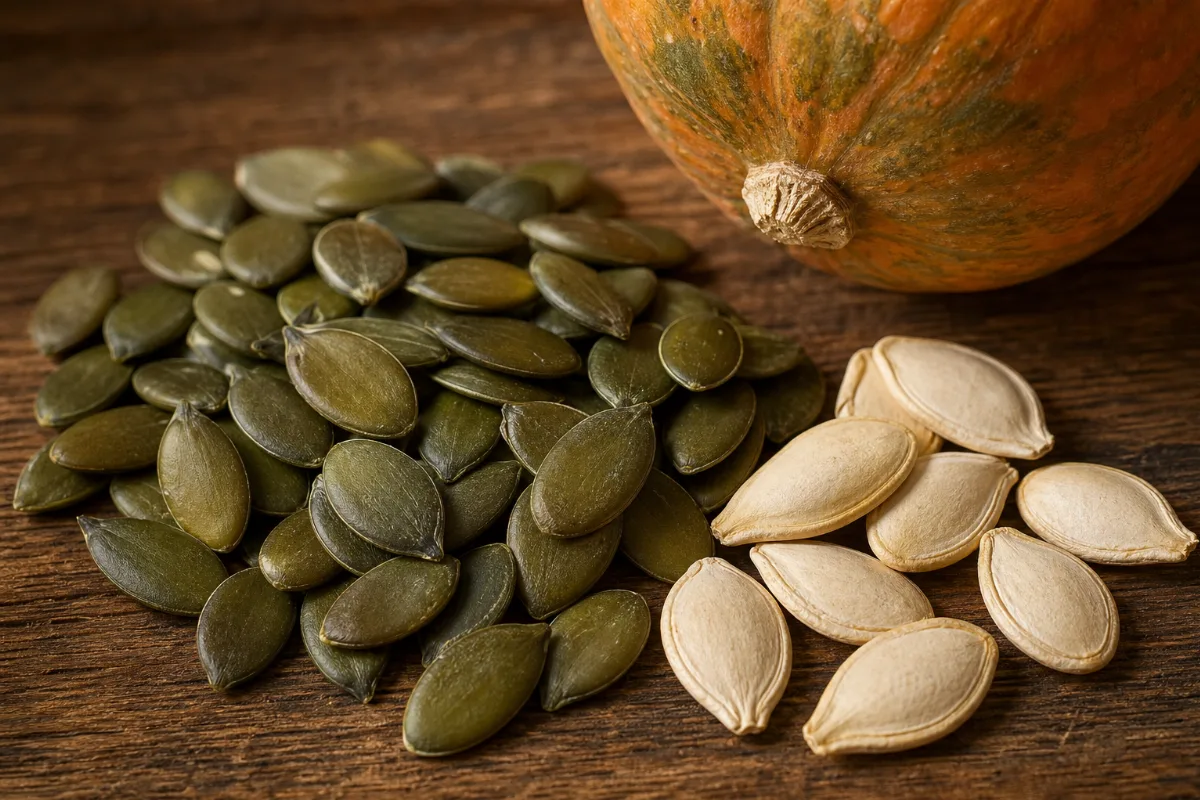
Pumpkin seeds are the seeds of pumpkins and squashes in the genus Cucurbita, in the gourd family. GBIF accepts both Cucurbita pepo and Cucurbita maxima as species. Trial abstracts and most packs do not say which species the seeds came from. Hulled green seeds are often called pepitas.
USDA data for dried kernels, per 100 g: 559 kcal, 30.23 g protein, 49.05 g fat (8.66 g saturated), 10.71 g carbohydrate, 6.0 g fibre, 592 mg magnesium, 7.81 mg zinc, 8.82 mg iron, 1233 mg phosphorus and 809 mg potassium. One ounce (28.35 g) has about 158 kcal, 8.6 g protein, 13.9 g fat, 1.7 g fibre, 168 mg magnesium, 2.2 mg zinc and 2.5 mg iron. The per-ounce numbers are our own arithmetic from the USDA values. Roasted and salted seeds differ.
What the research shows
Eating pumpkin seeds: a single-meal trial in 15 healthy adults found about 35% lower blood sugar rise after a meal with 65 g of seed. In the GRANU trial of 1,431 men with urinary symptoms, 58.5% of those eating seed were symptom responders against 47.3% on placebo, while extract capsules did not differ from placebo. Eight women who ate kernels with a fortified cereal had higher serum iron. Each is a single, small or partly blinded study.
No search turned up a systematic review of pumpkin seeds as food. No trial of the seeds was found for cholesterol, blood pressure, heart disease or weight.
Oil and extracts are a different thing
Trials of pumpkin seed oil in hair loss, prostate symptoms, menopause symptoms, HDL cholesterol and blood pressure are small, mostly lack a placebo or were very short, and cannot be carried over to eating seeds. In the prostate trial that tested both, the extract did not beat placebo but the whole seed did. That is why the two products are kept apart here. A 2026 review links seed compounds to health effects in lab and animal work only.
At a glance
Traditional uses history, not proof
- Eaten as a snack and ingredient in many cuisines
- Used in traditional European herbal medicine for urinary complaints in men (long use only, not trial proof)
Studied for research
- Minerals, protein and healthy fats, high certainty for the nutrient content
- Blood sugar after a meal, low certainty (one tiny single-meal trial)
- Urinary symptoms of an enlarged prostate, low certainty (one trial; the seed arm differed from placebo, the extract did not)
- Iron status, very low certainty (eight women, no control group)
- Hair loss, low certainty (oil, not seeds)
- Menopause symptoms, HDL cholesterol and blood pressure, very low certainty (oil, tiny trials)
- Cholesterol and inflammation from seed compounds, insufficient (lab and animal research only)
Main compounds
- Magnesium
- Zinc
- Unsaturated fats (linoleic and oleic acid)
- Protein
- Vitamin E (tocopherols)
- Phytosterols and lignans
Common forms
- Raw or dried hulled kernels (pepitas), as food (USDA values read)
- Roasted, salted, flavoured and in-shell seeds (nutrient values not read)
- Seed oil and extract capsules are different products and are labelled separately
Research links: Single-meal trial: pumpkin seed and blood sugar · GRANU trial: pumpkin seed and urinary symptoms · 2026 case series: pumpkin seed allergy in children · Research Library · Genes & Biomarkers Library
What it is and its history
- Accepted scientific name
- Cucurbita pepo L.
- Naming authority
- L. (GBIF accepted). Pumpkin seeds sold as food may come from Cucurbita pepo or Cucurbita maxima Duchesne (also GBIF accepted); packs and most trial abstracts do not say which.
- Common names
- Pumpkin seeds (English); Pepitas (English / Spanish); Squash seeds (English)
- Family or group
- Cucurbitaceae (the gourd family), as given by GBIF.
- Classification
- Plantae > Tracheophyta > Magnoliopsida > Cucurbitales > Cucurbitaceae > Cucurbita > Cucurbita pepo (also C. maxima)
- Native range
- Not verified from a source read.
- Habitat
- Not verified from a source read.
- What it looks like
- Roots: Not verified.; Stems: Not verified.; Leaves: Not verified.; Flowers: Not verified.; Fruit: The food is the seed (kernel) of the pumpkin or squash fruit. The existing nutrient summary describes hulled green kernels (pepitas) and in-shell seeds with a white husk (summary-only). USDA lists household portions of 1 ounce (28.35 g) and 1 cup (129 g) of dried kernels.
- Cultivation
- Not verified from a source read.
- Harvest and processing
- The existing nutrient summary lists raw or dried hulled kernels, roasted (often salted or flavoured) seeds, in-shell seeds, seed oil and extract capsules as the forms on sale (summary-only). Only the USDA item for dried kernels was re-read for nutrient values.
- Look-alikes and adulterants
- Name: Pumpkin pulp, pumpkin puree and squash flesh; Note: The flesh is a different food; the allergy case series found children allergic to the seed tolerated pumpkin pulp.; Name: Pumpkin seed oil and extract capsules; Note: Different products, tested separately in trials; not the same as eating the seeds.; Name: Watermelon, sunflower and other seeds; Note: Other seeds with their own nutrient profiles; some allergic children also reacted to watermelon seed.
- Sustainability and conservation
- Not assessed.
Photographs
What is inside, and how it may work
What it contains and how those compounds act in cells and animals. Laboratory and animal mechanisms are not proven effects in people.
Main compounds
| Compound | Family | Where it is concentrated | Activity studied | Level of evidence |
|---|---|---|---|---|
| Protein | protein | Seed kernel USDA dried kernels per 100 g: 30.23 g | A nutrient role only; no trial of pumpkin seed protein was read. 16 | Nutrient database |
| Unsaturated fats (linoleic and oleic acid) | fatty acids | Seed kernel USDA per 100 g: 20.71 g linoleic (18:2), 16.13 g oleic (18:1 c), 0.12 g alpha-linolenic; total saturated 8.66 g | Nutrient role only. Cholesterol-lowering claims for seed fats are from preclinical studies in the 2026 review. 16 5 | Nutrient database |
| Magnesium | mineral | Seed kernel USDA per 100 g: 592 mg | A nutrient role only; absorption from seeds was not studied in the sources read. 16 | Nutrient database |
| Zinc, iron, phosphorus, manganese and copper | minerals | Seed kernel USDA per 100 g: zinc 7.81 mg, iron 8.82 mg, phosphorus 1233 mg, manganese 4.543 mg, copper 1.343 mg | Nutrient roles only. One uncontrolled study of eight women found higher serum iron when kernels were eaten with a fortified cereal. 16 6 | Nutrient database |
| Vitamin E (tocopherols) | vitamin | Seed kernel USDA per 100 g: alpha-tocopherol 2.18 mg, gamma-tocopherol 35.1 mg | Nutrient role. Antioxidant claims are from preclinical studies in the 2026 review. 16 5 | Nutrient database |
| Phytosterols, lignans, cucurbitacins and carotenoids | plant compounds | Seed (per the review) No amounts given in the abstract read. | A 2026 narrative review links them to cholesterol, oxidative stress, inflammation and hormonal effects in preclinical studies only. 5 | Lab and animal |
Mechanisms, receptors and pathways
| Target or pathway | Gene or receptor | What was found | Level |
|---|---|---|---|
| Cholesterol, oxidative stress and inflammation (general) | Not specified in the abstract read | The 2026 review says compounds in pumpkin seeds have been associated with cholesterol reduction, less oxidative stress, anti-inflammatory effects, hormonal regulation and neurochemical effects in preclinical studies. It does not give a tested mechanism, and these effects were not shown in people eating the seeds. 5 | Lab and animal |
| Blood sugar rise after a meal | Not specified | The authors of the single-meal trial suggest pumpkin seed may act as a hypoglycaemic food. The abstract gives no tested mechanism, and flaxseed (more fibre) did not change the glucose rise. 2 | Human (outcome only; mechanism not tested) |
Absorption, metabolism and elimination
- Absorption
- Not found for pumpkin seed nutrients in people.
- Distribution
- Not found.
- Metabolism
- Not found.
- Elimination
- Not found.
- Bioavailability
- Not established for the minerals in pumpkin seeds in the sources read.
Isolated compounds versus whole extracts
Results differ by product. The blood sugar trial and the iron study used whole seed kernels eaten as food. In the 12-month prostate trial, the seed arm differed from placebo and the extract capsules did not. The hair, prostate-versus-tamsulosin, menopause and blood pressure trials used pumpkin seed oil. A result for oil or extract is not evidence for eating the seeds, and the reverse is also true.
Nutritional composition
Nutrition from USDA FoodData Central, SR Legacy April 2018 release, item 'Seeds, pumpkin and squash seed kernels, dried' (FDC 170556). Values were read 2026-10-26 from a saved copy of the data feed, because the public API key was rate-limited. Per 100 g: 559 kcal, 30.23 g protein, 49.05 g fat (8.66 g saturated, 16.24 g monounsaturated, 20.98 g polyunsaturated), 10.71 g carbohydrate, 6.0 g fibre, 1.4 g sugars, 46 mg calcium, 8.82 mg iron, 592 mg magnesium, 1233 mg phosphorus, 809 mg potassium, 7 mg sodium, 7.81 mg zinc, 1.343 mg copper, 4.543 mg manganese, 9.4 micrograms selenium. For a typical portion of 1 ounce (28.35 g, USDA's own household measure), calculated from those values: about 158 kcal, 8.6 g protein, 13.9 g fat (2.5 g saturated), 3.0 g carbohydrate, 1.7 g fibre, 168 mg magnesium, 2.2 mg zinc, 2.5 mg iron, 350 mg phosphorus and 229 mg potassium. The USDA item is for raw dried kernels; roasted, salted, flavoured, in-shell and oil products differ and were not read. Per-ounce numbers are our own arithmetic from the USDA per-100 g values.
1 high certainty4 low certainty2 very low certainty1 not enough evidence
What was looked at
The 8 benefits and uses checked for Pumpkin Seeds, each with how strong the evidence is. Tap one to open it.
- Minerals, protein and healthy fats (nutrient content)High certainty
- Blood sugar after a mealLow certainty
- Urinary symptoms linked to an enlarged prostate (seed as food)Low certainty
- Iron status in womenVery low certainty
- Hair loss (pumpkin seed oil, not the food)Low certainty
- Urinary symptoms of an enlarged prostate (pumpkin seed oil)Low certainty
- Menopause symptoms, HDL cholesterol and blood pressure (pumpkin seed oil)Very low certainty
- Plant compounds and lab or animal findingsNot enough evidence
Lab markers tracked in the studies
Blood glucose after a mealUrinary symptom score (IPSS responders)Serum iron and transferrin saturationHDL cholesterol (oil)Systolic blood pressure (oil)Urinary symptom score, IPSS (oil vs tamsulosin)
What is Pumpkin Seeds good for?
The main studied uses and how strong the human evidence is for each. Results for oil and extracts are labelled and are not the same as eating the seeds.
Benefits, one by one
Each card is a research question, not a promise. Tap a goal to filter. Open a card to see the studies, doses and limits.
Minerals, protein and healthy fats (nutrient content)
High certaintyDried pumpkin seed kernels are rich in magnesium, zinc, phosphorus, protein and unsaturated fat. They are also very high in calories for their weight.
1 studiesRaw dried kernels from USDA tables. Roasted, salted, flavoured, in-sh…
Studies, doses and limits
What the trials found
No trial was read showing that eating pumpkin seeds corrects low magnesium or zinc.
Results
A plain source of minerals, protein and fat. Per 1 ounce (28.35 g) of dried kernels, calculated from USDA per-100 g values: about 158 kcal, 8.6 g protein, 13.9 g fat, 1.7 g fibre, 168 mg magnesium, 2.2 mg zinc, 2.5 mg iron, 350 mg phosphorus and 229 mg potassium.
Effect sizes as reported
USDA, dried kernels per 100 g: 559 kcal, 30.23 g protein, 49.05 g fat (8.66 g saturated, 16.24 g monounsaturated, 20.98 g polyunsaturated), 10.71 g carbohydrate, 6.0 g fibre, 592 mg magnesium, 7.81 mg zinc, 8.82 mg iron, 1233 mg phosphorus, 809 mg potassium, 7 mg sodium.
Why this rating
High that the food contains these nutrients (USDA data). This does not show any health benefit from eating them.
Form and dose studied
Raw dried kernels from USDA tables. Roasted, salted, flavoured, in-shell and oil products differ and were not read.
Who was studied
General adult diet.
Limits
Nutrient facts, not trials. One database entry; brands and roasting change the numbers. Whether the minerals are absorbed as the table suggests was not studied in the sources read.
Why researchers looked
People eat pumpkin seeds as a snack and a source of minerals, protein and fat.
Traditional use
Pumpkin seeds are eaten as a food in many places. Long use as food is not proof that they treat any condition.
Proposed mechanism Nutrient database
These are nutrient amounts in the food, taken from USDA tables.
A proposed mechanism does not show that the effect happens in people.
Seeds are calorie-dense. Seed allergy is possible; see the Safety tab.
Blood sugar after a meal
Low certaintyIn one very small study of healthy adults, adding pumpkin seeds to a high-carbohydrate meal went with a lower blood sugar rise after that meal. It was one meal, not a long-term test.
1 studiesWhole pumpkin seed eaten in a mixed high-carbohydrate meal. The abstr…
Studies, doses and limits
What the trials found
A randomised single-blind crossover trial in healthy adults (15 had glucose measured). Each person ate three meals: no seed, 65 g of pumpkin seed or 65 g of flaxseed.
Results
The blood glucose rise over two hours was about 35% lower with the pumpkin seed meal than with the no-seed meal. Flaxseed did not differ from the no-seed meal. Glucose at each single time point did not differ between meals.
Effect sizes as reported
Glucose iAUC about 35% lower with pumpkin seed than control (P = .025); flaxseed vs control P = .257.
Why this rating
Low: one small acute study in healthy people, with 15 measured. No long-term trial, and no trial in people with diabetes was read.
Form and dose studied
Whole pumpkin seed eaten in a mixed high-carbohydrate meal. The abstract does not name the species.
Who was studied
Healthy adults with normal blood sugar.
Limits
Single-blind. One meal only. Very small. Funding not stated in the abstract. The result may not apply to people with diabetes or to other meals.
Why researchers looked
Seeds add fat, protein and fibre to a meal, and researchers wanted to see whether that changes the blood sugar rise.
Traditional use
Pumpkin seeds are eaten as a food in many places. Long use as food is not proof that they treat any condition.
Proposed mechanism Authors hypothesis
Not tested in this study. The authors suggest pumpkin seed may act as a food that lowers blood sugar, but the abstract gives no mechanism.
A proposed mechanism does not show that the effect happens in people.
People who take diabetes medicines should ask their clinician about changes to food.
Urinary symptoms linked to an enlarged prostate (seed as food)
Low certaintyIn one large 12-month trial, more men eating pumpkin seed had clearly better urinary symptom scores than men on placebo, but the capsule extract did not beat placebo. The authors say the result needs confirming.
1 studiesPumpkin seed eaten (species not named in the abstract) and, separatel…
Studies, doses and limits
What the trials found
GRANU trial: 1,431 men aged 50 to 80 with urinary symptoms suggestive of benign prostatic hyperplasia (BPH). Randomised, only partly blinded, placebo-controlled, 12 months.
Results
The extract did not differ from placebo. With the seed, 58.5% of men were responders (a fall of at least 5 points on the symptom score) against 47.3% on placebo; the authors call this 'descriptively significant'. Products were well tolerated.
Effect sizes as reported
Responders 58.5% (seed, 5 g twice a day) vs 47.3% (placebo). No numbers for the extract in the abstract.
Why this rating
Low: one trial, partly blinded, with a modest difference and no confirming study. The authors themselves call for confirmation.
Form and dose studied
Pumpkin seed eaten (species not named in the abstract) and, separately, pumpkin seed extract capsules. Only the seed arm differed from placebo.
Who was studied
Men 50 to 80 with BPH-type symptoms.
Limits
A seed arm cannot be matched with a look-alike, so blinding was partial. The result is for symptom scores, not for stopping prostate growth. Funding not stated in the abstract.
Why researchers looked
Pumpkin seed has a long traditional use in Europe for urinary complaints in men, and the seed itself was tested in this trial.
Traditional use
Traditional use in Europe is described in the EU herbal monograph (traditional use only, not trial proof).
Proposed mechanism None stated
Not described in the abstract.
A proposed mechanism does not show that the effect happens in people.
Urinary symptoms can have causes that need a clinician to look at them. See the Safety tab.
Iron status in women
Very low certaintyIn a very small before-and-after study, eight women who ate pumpkin seed kernels with an iron-fortified cereal had higher blood iron after four weeks. The seeds cannot be separated from the cereal.
1 studiesPumpkin seed kernels (Cucurbita pepo) plus iron-fortified ready-to-ea…
Studies, doses and limits
What the trials found
Eight healthy women, no control group; before-and-after measures after four weeks of 30 g of kernels plus 30 g of iron-fortified cereal.
Results
Serum iron and transferrin saturation rose and total iron-binding capacity fell. Haemoglobin and ferritin changes are not reported as significant in the abstract.
Effect sizes as reported
Serum iron 60 vs 85 ug/dl; transferrin saturation 16.8% vs 25.6%; TIBC 367 vs 339 ug/dl.
Why this rating
Very low: eight women, no control group, and the seeds were eaten together with a fortified cereal.
Form and dose studied
Pumpkin seed kernels (Cucurbita pepo) plus iron-fortified ready-to-eat cereal.
Who was studied
Healthy women aged 20 to 37.
Limits
No control group; cannot say the seeds caused the change. Funding not stated in the abstract.
Why researchers looked
Pumpkin seeds contain iron, so researchers asked whether adding them to a fortified cereal improves iron levels.
Traditional use
Pumpkin seeds are eaten as a food in many places. Long use as food is not proof that they treat any condition.
Proposed mechanism None stated
Not described beyond the iron the kernels supply (the abstract gives 4.0 mg a day from the kernels).
A proposed mechanism does not show that the effect happens in people.
Iron needs and iron safety are for a clinician to advise on.
Hair loss (pumpkin seed oil, not the food)
Low certaintySmall trials of pumpkin seed oil in people with hair loss found some improvement in hair counts. This is oil used by patients, not seeds eaten as food.
2 studiesPumpkin seed oil (Cucurbita pepo). How the oil was used is not stated…
Studies, doses and limits
What the trials found
One 3-month trial in 60 women compared the oil with 5% minoxidil foam. A 2025 network meta-analysis of 19 supplement trials in androgenetic alopecia included pumpkin seed oil among 16 supplements.
Results
In the 60-woman trial both groups improved on some scalp measures and the abstract gives no direct comparison. In the network meta-analysis pumpkin seed oil was among the supplements that improved hair density versus placebo and had higher blind doctor scores.
Effect sizes as reported
Trial: upright regrowing hairs 0.13 to 0.9 (oil group). Meta-analysis: no pumpkin-specific numbers in the abstract.
Why this rating
Low: small trials, different designs, and the review's abstract gives no pumpkin-specific numbers. All for the oil.
Form and dose studied
Pumpkin seed oil (Cucurbita pepo). How the oil was used is not stated in the trial abstract.
Who was studied
Women with female pattern hair loss; people with androgenetic alopecia.
Limits
Not a trial of eating seeds. No placebo group in the 60-woman trial. Funding not stated in the trial abstract.
Why researchers looked
Pumpkin seed oil contains plant compounds that researchers have tested against hair loss.
Traditional use
Pumpkin seed oil is used traditionally in some places, but the sources read describe no specific tradition.
Proposed mechanism None stated
Not described in the abstracts read.
A proposed mechanism does not show that the effect happens in people.
Hair loss can have medical causes; see a clinician.
Urinary symptoms of an enlarged prostate (pumpkin seed oil)
Low certaintyIn one small trial, pumpkin seed oil eased urinary symptoms over 3 months but not as much as the medicine tamsulosin.
1 studiesPumpkin seed oil 360 mg twice daily (Cucurbita pepo) vs tamsulosin.
Studies, doses and limits
What the trials found
A single-blind randomised trial in 73 men aged 50 or older with benign prostatic hyperplasia compared the oil with tamsulosin for 3 months. There was no placebo group.
Results
Symptom scores improved in both groups. The fall was larger with tamsulosin at 1 and 3 months. The groups did not differ significantly on the main variables at any time point. No side effects were reported with the oil; the medicine group had dizziness, headache and other effects.
Effect sizes as reported
IPSS fall larger with tamsulosin than oil (P = 0.048 at 1 month, 0.020 at 3 months).
Why this rating
Low: one small single-blind trial, no placebo group, retrospectively registered.
Form and dose studied
Pumpkin seed oil 360 mg twice daily (Cucurbita pepo) vs tamsulosin.
Who was studied
Men 50 or older with BPH symptoms.
Limits
Oil, not the seed in the GRANU trial and not food. Do not carry this over to eating seeds.
Why researchers looked
Seed products have a traditional use for urinary complaints, so the oil was compared with a standard medicine.
Traditional use
Pumpkin seed oil is used traditionally in some places, but the sources read describe no specific tradition.
Proposed mechanism None stated
Not described in the abstract.
A proposed mechanism does not show that the effect happens in people.
Do not swap a prescribed medicine for oil without asking the prescriber.
Menopause symptoms, HDL cholesterol and blood pressure (pumpkin seed oil)
Very low certaintyTwo small trials in postmenopausal women gave pumpkin seed oil. One pilot found higher HDL cholesterol and lower symptom scores; the other found lower systolic blood pressure. Both are tiny.
2 studiesPumpkin seed oil capsules or liquid (doses as in the trials); not who…
Studies, doses and limits
What the trials found
2011 pilot: 35 postmenopausal women, 2 g a day for 12 weeks, wheat germ oil as placebo. 2019 trial: 23 postmenopausal women with raised blood pressure, 3 g a day for 6 weeks, placebo.
Results
Pilot: HDL cholesterol and menopausal symptom scores improved and diastolic blood pressure fell with the oil. 2019 trial: augmentation index and brachial and central systolic blood pressure fell with the oil; arterial stiffness and heart rate variability did not change.
Effect sizes as reported
Pilot: HDL 0.92 to 1.07 mmol/l (P = 0.029), symptom score 18.1 to 13.2 (P < 0.030). 2019: systolic BP and AIx fell significantly (P < 0.05) in the oil group only.
Why this rating
Very low: two tiny trials (35 and 23 women), short, many outcomes tested, for the oil only.
Form and dose studied
Pumpkin seed oil capsules or liquid (doses as in the trials); not whole seeds.
Who was studied
Postmenopausal women.
Limits
Small groups, outcomes not corrected for many tests, funding not stated in the abstracts. Not food evidence.
Why researchers looked
The oil contains plant compounds with weak estrogen-like activity in animal studies, so researchers tested it in women after menopause.
Traditional use
Pumpkin seed oil is used traditionally in some places, but the sources read describe no specific tradition.
Proposed mechanism Animal and lab hypothesis
The 2011 pilot's abstract says the oil is rich in phytoestrogens and that animal studies suggest benefit in low-estrogen conditions. The 2019 abstract cites animal studies for blood pressure. Neither mechanism was tested in the trials.
A proposed mechanism does not show that the effect happens in people.
Women with hormone-sensitive conditions should ask a clinician before using oil supplements.
Plant compounds and lab or animal findings
Not enough evidenceLab and animal studies link compounds in pumpkin seeds, such as phytosterols and vitamin E, to effects on cholesterol and inflammation. These effects have not been shown in people eating the seeds.
1 studiesWhole seeds, oil and extracts in preclinical work.
Studies, doses and limits
What the trials found
No human trial is in the review's abstract.
Results
The review says these effects are seen in preclinical (lab and animal) studies and calls for human research.
Effect sizes as reported
No numbers in the abstract.
Why this rating
Insufficient: lab and animal research only; a narrative review, not a systematic search.
Form and dose studied
Whole seeds, oil and extracts in preclinical work.
Limits
Findings from cells and animals often do not hold in people.
Why researchers looked
Researchers look for active compounds that might explain traditional health uses of seeds.
Traditional use
Pumpkin seeds are eaten as a food in many places. Long use as food is not proof that they treat any condition.
Proposed mechanism Narrative review of preclinical studies
A 2026 review lists phytosterols, vitamin E, carotenoids, cucurbitacins, lignans and tryptophan and links them to cholesterol, oxidative stress, anti-inflammatory and hormonal effects in preclinical studies.
A proposed mechanism does not show that the effect happens in people.
None specific.
Connections to the rest of health
How Pumpkin Seeds connects to the rest of our health knowledge graph. Every link says what kind of connection it is. A safety link (for example to the liver) is a warning, not a benefit. A study that merely mentions a topic never creates a benefit link.
Explore every connection: goals, body systems, organs, symptoms, genes
A. Wellness goals
| Connected to | Kind of connection | Evidence status | Context | Studies |
|---|---|---|---|---|
| Balanced Nutrition | High certainty | Minerals, protein and healthy fats (nutrient content): Dried pumpkin seed kernels are rich in magnesium, zinc, phosphorus, protein and unsaturated fat. They are also very high in calories for their weight. | 16 | |
| Blood Sugar Balance | Low certainty | Blood sugar after a meal: In one very small study of healthy adults, adding pumpkin seeds to a high-carbohydrate meal went with a lower blood sugar rise after that meal. It was one meal, not a long-term test. | 2 | |
| Mens Vitality | Low certainty | Urinary symptoms linked to an enlarged prostate (seed as food): In one large 12-month trial, more men eating pumpkin seed had clearly better urinary symptom scores than men on placebo, but the capsule extract did not beat placebo. The authors say the result needs confirming. Urinary symptoms of an enlarged prostate (pumpkin seed oil): In one small trial, pumpkin seed oil eased urinary symptoms over 3 months but not as much as the medicine tamsulosin. | 7 9 | |
| Womens Wellness | Very low certainty | Iron status in women: In a very small before-and-after study, eight women who ate pumpkin seed kernels with an iron-fortified cereal had higher blood iron after four weeks. The seeds cannot be separated from the cereal. | 6 | |
| Hair Support | Low certainty | Hair loss (pumpkin seed oil, not the food): Small trials of pumpkin seed oil in people with hair loss found some improvement in hair counts. This is oil used by patients, not seeds eaten as food. | 4 10 | |
| Menopause Support | Very low certainty | Menopause symptoms, HDL cholesterol and blood pressure (pumpkin seed oil): Two small trials in postmenopausal women gave pumpkin seed oil. One pilot found higher HDL cholesterol and lower symptom scores; the other found lower systolic blood pressure. Both are tiny. | 3 8 | |
| Blood Pressure Support | Very low certainty | Menopause symptoms, HDL cholesterol and blood pressure (pumpkin seed oil): Two small trials in postmenopausal women gave pumpkin seed oil. One pilot found higher HDL cholesterol and lower symptom scores; the other found lower systolic blood pressure. Both are tiny. | 3 8 | |
| Inflammation Balance | Not enough evidence | Plant compounds and lab or animal findings: Lab and animal studies link compounds in pumpkin seeds, such as phytosterols and vitamin E, to effects on cholesterol and inflammation. These effects have not been shown in people eating the seeds. | 5 |
B. Body systems
| Connected to | Kind of connection | Evidence status | Context | Studies |
|---|---|---|---|---|
| Musculoskeletal System | Biological association | High certainty | Studied for: Minerals, protein and healthy fats (nutrient content) | 16 |
| Endocrine System | Biological association | Low certainty | Studied for: Blood sugar after a meal | 2 |
| Urinary System | Biological association | Low certainty | Studied for: Urinary symptoms linked to an enlarged prostate (seed as food) Studied for: Urinary symptoms of an enlarged prostate (pumpkin seed oil) | 7 9 |
| Reproductive System | Biological association | Low certainty | Studied for: Urinary symptoms linked to an enlarged prostate (seed as food) Studied for: Menopause symptoms, HDL cholesterol and blood pressure (pumpkin seed oil) | 7 3 8 |
| Immune System | Biological association | Very low certainty | Studied for: Iron status in women Studied for: Plant compounds and lab or animal findings | 6 5 |
| Integumentary System | Biological association | Low certainty | Studied for: Hair loss (pumpkin seed oil, not the food) | 4 10 |
| Cardiovascular System | Biological association | Very low certainty | Studied for: Menopause symptoms, HDL cholesterol and blood pressure (pumpkin seed oil) | 3 8 |
E. Health conditions
| Connected to | Kind of connection | Evidence status | Context | Studies |
|---|---|---|---|---|
| Food allergy | Adverse effect or risk | Documented risk | Pumpkin seed allergy is uncommon but often causes whole-body reactions in the cases reported; many allergic children also react to other seeds or nuts. Pumpkin seed allergy is uncommon but often causes whole-body reactions in reported cases; many allergic children also react to other seeds or nuts. Preparation or compound: Pumpkin seed protein |
1 |
| Anaphylaxis | Adverse effect or risk | Documented risk | Anaphylaxis occurred in 64% of 25 allergic children in one clinic series and in 57% of 14 earlier cases. Anaphylaxis occurred in 64% of 25 allergic children in one clinic series. Preparation or compound: Pumpkin seed protein |
1 |
I. Biomarkers
| Connected to | Kind of connection | Evidence status | Context | Studies |
|---|---|---|---|---|
| Blood glucose after a meal | Biological association | Low certainty | Measured in trials: lowered. A lab change is not the same as a health benefit. | 2 |
| Urinary symptom score (IPSS responders) | Biological association | Low certainty | Measured in trials: improved (seed arm only). A lab change is not the same as a health benefit. | 7 |
| Serum iron and transferrin saturation | Biological association | Very low certainty | Measured in trials: raised. A lab change is not the same as a health benefit. | 6 |
| HDL cholesterol (oil) | Biological association | Very low certainty | Measured in trials: raised. A lab change is not the same as a health benefit. | 3 |
| Systolic blood pressure (oil) | Biological association | Very low certainty | Measured in trials: lowered. A lab change is not the same as a health benefit. | 8 |
| Urinary symptom score, IPSS (oil vs tamsulosin) | Biological association | Low certainty | Measured in trials: improved (less than tamsulosin). A lab change is not the same as a health benefit. | 9 |
K. Biological pathways
| Connected to | Kind of connection | Evidence status | Context | Studies |
|---|---|---|---|---|
| Magnesium | Preliminary mechanism | Nutrient database | Dried kernels are among the higher-magnesium foods by USDA numbers (592 mg per 100 g). No trial of seeds on magnesium status was read. | 16 |
| Zinc | Preliminary mechanism | Nutrient database | 7.81 mg per 100 g (USDA). No trial of pumpkin seed on zinc status was read. | 16 |
| Benign prostatic hyperplasia (urinary symptoms) | Preliminary mechanism | Human | The GRANU trial found more symptom responders with pumpkin seed than with placebo; the extract did not differ. The EU recognises herbal use based on long use only. | 7 11 |
L. Active compounds
| Connected to | Kind of connection | Evidence status | Context | Studies |
|---|---|---|---|---|
| Protein | Biological association | Nutrient database | A nutrient role only; no trial of pumpkin seed protein was read. Preparation or compound: Seed kernel |
16 |
| Unsaturated fats (linoleic and oleic acid) | Biological association | Nutrient database | Nutrient role only. Cholesterol-lowering claims for seed fats are from preclinical studies in the 2026 review. Preparation or compound: Seed kernel |
16 5 |
| Magnesium | Biological association | Nutrient database | A nutrient role only; absorption from seeds was not studied in the sources read. Preparation or compound: Seed kernel |
16 |
| Zinc, iron, phosphorus, manganese and copper | Biological association | Nutrient database | Nutrient roles only. One uncontrolled study of eight women found higher serum iron when kernels were eaten with a fortified cereal. Preparation or compound: Seed kernel |
16 6 |
| Vitamin E (tocopherols) | Biological association | Nutrient database | Nutrient role. Antioxidant claims are from preclinical studies in the 2026 review. Preparation or compound: Seed kernel |
16 5 |
| Phytosterols, lignans, cucurbitacins and carotenoids | Biological association | Lab and animal | A 2026 narrative review links them to cholesterol, oxidative stress, inflammation and hormonal effects in preclinical studies only. Preparation or compound: Seed (per the review) |
5 |
Each connection is stored with the ingredient, the connected record, the kind of connection, the evidence status, the supporting studies, the preparation or compound involved, and a review date (last reviewed October 26, 2026).
The evidence
The research centre for Pumpkin Seeds. Every record here was checked against PubMed or the publisher's page; we never list a study we have not verified.
Evidence by outcome
Bars show how many studies we found for each outcome, not how well it works. People are added up across trials only (reviews are not added, to avoid double counting).
How we rate evidence
High certainty
Several well-run trials or reviews agree; further research is unlikely to change the picture much.
Moderate certainty
Good trials point the same way, but some doubt remains.
Low certainty
Small, short or inconsistent trials. The finding could change with better research.
Very low certainty
Very little or very weak human data. Treat as a possibility only.
Mixed findings
Trials or reviews disagree with each other.
Not enough evidence
Not enough human research to say either way.
Evidence against
Good research found no benefit, or found harm.
We take the reviewers' own risk-of-bias and GRADE statements where they exist, and otherwise judge from study size, design, consistency, directness and whether a product matches what is sold. Many publications do not make evidence high. Method note: We started from our existing pumpkin seed summary, re-checked nutrition against saved USDA FoodData Central data, read the EU herbal monograph, the FDA and NHS pages and re-read PubMed abstracts for the trials and reviews. Only abstracts were read for studies. Items we could not verify are flagged in the research gaps.
Study library: every study we checked 16
| Study | Design | People | Product, dose, length | Result |
|---|---|---|---|---|
| Acikalin 2026 Immunoglobulin E-mediated pumpkin seed allergy in children: Case series and narrative review with a structured literature search. Allergy Asthma Proc · PMID 42343505 · DOI |
Case series and narrative review |
25 25 children with IgE-mediated pumpkin seed allergy at one tertiary clinic in Turkey (2016 to 2024), plus 14 earlier published cases |
Pumpkin seed (food); species not stated in the abstract Seed |
Reactions were immediate in all 25 children and anaphylaxis occurred in 64%. Co-allergy was common: tree nuts 76%, other seeds 72%; watermelon seed sensitisation 83%, with six children reacting clinically after watermelon seed. Pumpkin pulp was tolerated by all. The 14 earlier cases were mostly adults and 57% had anaphylaxis. The authors call pumpkin seed allergy uncommon but often causing whole-body reactions. Anaphylaxis 64% (children); 57% (14 earlier cases) (Not given in the abstract) Methods, limits and fundingOutcomes: Type of reaction, anaphylaxis, skin-prick tests, specific IgE, co-allergies Limitations: Retrospective records from one clinic; cannot say how common the allergy is. Case review, not a population study. Funding not stated in the abstract. Funding and conflicts: Funding is not stated in the abstract. Read: abstract |
| Cândido 2018 Addition of pooled pumpkin seed to mixed meals reduced postprandial glycemia: a randomized placebo-controlled clinical trial. Nutr Res · PMID 30055778 · DOI |
Randomised controlled trial crossover |
25 Normoglycaemic adults; 25 for food intake, 15 for blood glucose |
Pumpkin seed (65 g) or flaxseed (65 g) added to a meal; the abstract does not name the species Pumpkin seed, as eaten 65 g in a single meal Three meals on three non-consecutive days (acute) · vs Same meal with no seed |
Glucose rise was lower with pumpkin seed than with no seed. Flaxseed did not differ from no seed. Glucose at each single time point did not differ between meals. Appetite, energy and macronutrient intake did not differ. The authors say long-term studies are needed. Glucose iAUC about 35% lower with pumpkin seed than control (P = .025); flaxseed vs control P = .257 (Not given in the abstract) Methods, limits and fundingOutcomes: Glucose rise over 2 hours after the meal (iAUC), appetite, food intake Limitations: Single-blind, very small (15 for glucose), healthy adults, one meal. Seed species not stated in the abstract. Funding not stated in the abstract. Funding and conflicts: Funding is not stated in the abstract. Read: abstract |
| Gossell-Williams 2011 Improvement in HDL cholesterol in postmenopausal women supplemented with pumpkin seed oil: pilot study. Climacteric · PMID 21545273 · DOI |
Randomised controlled trial |
35 35 postmenopausal women (natural or surgical menopause) |
Pumpkin seed oil (21 women) vs wheat germ oil placebo (14 women) Seed oil 2 g a day 12 weeks · vs Wheat germ oil placebo |
HDL cholesterol rose, diastolic blood pressure fell and menopausal symptom scores improved in the pumpkin seed oil group. The authors call it a pilot and say it supports further studies. HDL 0.92 to 1.07 mmol/l (P = 0.029); diastolic BP 81.1 to 75.67 mmHg (P < 0.046); symptom score 18.1 to 13.2 (P < 0.030) (Not given in the abstract) Methods, limits and fundingOutcomes: Blood lipids, fasting glucose, blood pressure, menopausal symptom questionnaire Limitations: Pilot, 35 women, many outcomes tested, small groups. Oil, not seeds as food. Funding not stated in the abstract. Funding and conflicts: Funding is not stated in the abstract. Read: abstract |
| Ibrahim 2021 Pumpkin seed oil vs. minoxidil 5% topical foam for the treatment of female pattern hair loss: A randomized comparative trial. J Cosmet Dermatol · PMID 33544448 · DOI |
Randomised controlled trial |
60 Women with female pattern hair loss |
Pumpkin seed oil (30 women) vs minoxidil 5% foam (30 women); how the oil was used is not stated in the abstract Seed oil 3 months · vs Minoxidil 5% foam (no placebo group) |
Both groups improved on some scalp measures, including hair shaft diversity and vellus hairs. Upright regrowing hairs rose in the oil group (0.13 to 0.9). The abstract gives no direct between-group test and has no placebo group. Hair shaft diversity 30.5 vs 24.0 (oil) and 31.5 vs 21.3 (minoxidil), P < .001 within each group (Not given in the abstract) Methods, limits and fundingOutcomes: Hair shaft diversity, vellus hairs, upright regrowing hairs (clinical and dermoscopic) Limitations: Small, 3 months, no placebo group, no between-group comparison in the abstract. Oil, not seeds as food. Funding not stated in the abstract. Funding and conflicts: Funding is not stated in the abstract. Read: abstract |
| Kassa 2026 Phytochemical Composition, Health Benefits, Functional Properties, and Food Applications of Pumpkin Seeds. Food Sci Nutr · PMID 42110205 · DOI |
Narrative review mixed (mostly lab and animal) |
Review of the pumpkin seed literature (Cucurbita pepo) | Seeds and oil |
The review says pumpkin seeds contain proteins, unsaturated fats and minerals, plus phytosterols, vitamin E, carotenoids, cucurbitacins, lignans and tryptophan. It says these have been associated with cholesterol reduction, less oxidative stress, anti-inflammatory effects, hormonal regulation and neurochemical benefits in preclinical studies. It adds that research on health effects in humans is warranted. No numbers (Not applicable) Methods, limits and fundingOutcomes: Composition, bioactive compounds, health-promoting potential Limitations: Narrative review, not a systematic search; effects are from preclinical (lab and animal) studies. No conflicts declared. Funding and conflicts: The authors declare no conflicts of interest. Read: abstract |
| Naghii 2007 Impact of daily consumption of iron fortified ready-to-eat cereal and pumpkin seed kernels (Cucurbita pepo) on serum iron in adult women. Biofactors · PMID 18198398 · DOI |
Uncontrolled before after trial |
8 Eight healthy non-pregnant women aged 20 to 37 |
30 g of kernels (4.0 mg iron a day) plus 30 g of fortified cereal (7.1 mg iron a day) Kernels, as eaten See substance 4 weeks · vs Before-and-after in the same women (no control group) |
Serum iron and transferrin saturation were higher and total iron-binding capacity was lower after four weeks. The kernels and the fortified cereal were eaten together, so the effect of the seeds alone cannot be separated. Serum iron 60 vs 85 ug/dl; transferrin saturation 16.8% vs 25.6%; TIBC 367 vs 339 ug/dl (Not given in the abstract) Methods, limits and fundingOutcomes: Serum iron, transferrin saturation, total iron-binding capacity, haemoglobin, ferritin and other iron measures Limitations: Eight women, no control group, seeds combined with a fortified cereal. Haemoglobin and ferritin changes are not reported as significant in the abstract. Funding not stated in the abstract. Funding and conflicts: Funding is not stated in the abstract. Read: abstract |
| Vahlensieck 2015 Effects of pumpkin seed in men with lower urinary tract symptoms due to benign prostatic hyperplasia in the one-year, randomized, placebo-controlled GRANU study. Urol Int · PMID 25196580 · DOI |
Randomised controlled trial |
1431 Men aged 50 to 80 with urinary symptoms suggestive of benign prostatic hyperplasia |
Pumpkin seed or seed extract capsules; species not named in the abstract Seed (food form) or extract capsules See substance 12 months · vs Matching placebo |
After 12 months the extract did not differ from placebo. The seed arm had 58.5% responders against 47.3% on placebo; the authors call the difference 'descriptively significant'. Products were well tolerated. The authors say a confirmatory study or systematic review is needed. Responders 58.5% (seed) vs 47.3% (placebo); extract not different from placebo (Not given in the abstract) Methods, limits and fundingOutcomes: Responders (fall of 5 or more points on the International Prostate Symptom Score), quality of life, symptoms, night-time urination Limitations: Only partly blinded (a seed arm cannot be matched like a capsule). 'Descriptively significant' means no firm statistical test claim. Funding not stated in the abstract. Funding and conflicts: Funding is not stated in the abstract. Read: abstract |
| Wong 2019 The effects of pumpkin seed oil supplementation on arterial hemodynamics, stiffness and cardiac autonomic function in postmenopausal women. Complement Ther Clin Pract · PMID 31445363 · DOI |
Randomised controlled trial |
23 Postmenopausal women with elevated blood pressure (12 on oil, 11 on placebo) |
Pumpkin seed oil 3 g a day vs placebo Seed oil 3 g a day 6 weeks · vs Placebo |
Augmentation index and brachial and central systolic blood pressure fell with the oil but not with placebo. Arterial stiffness and heart rate variability did not change. Significant (P < 0.05) falls in AIx, brachial and central systolic BP in the oil group only (Not given in the abstract) Methods, limits and fundingOutcomes: Brachial and central blood pressure, wave reflection (augmentation index), arterial stiffness, heart rate variability Limitations: Very small, 6 weeks, women with raised blood pressure only. Oil, not seeds as food. Funding not stated in the abstract. Funding and conflicts: Funding is not stated in the abstract. Registration: NCT03716960 Read: abstract |
| Zerafatjou 2021 Pumpkin seed oil (Cucurbita pepo) versus tamsulosin for benign prostatic hyperplasia symptom relief: a single-blind randomized clinical trial. BMC Urol · PMID 34666728 · DOI |
Randomised controlled trial |
73 Men aged 50 or older with benign prostatic hyperplasia (34 on tamsulosin, 39 on oil) |
Pumpkin seed oil 360 mg twice daily vs tamsulosin 0.4 mg at night Seed oil See substance 3 months · vs Tamsulosin (no placebo group) |
Symptom scores and quality of life improved in both groups. The fall in symptom score at 1 and 3 months was larger with tamsulosin. The groups did not differ significantly on the main variables at any time point. No side effects with the oil; the tamsulosin group had dizziness (5.9%), headache (2.9%), retrograde ejaculation (2.9%) and a rash with itching. IPSS fall larger with tamsulosin than oil at 1 month (P = 0.048) and 3 months (P = 0.020) (Not given in the abstract) Methods, limits and fundingOutcomes: International Prostate Symptom Score (IPSS), quality of life, prostate-specific antigen, prostate and residual urine volume, urine flow Limitations: Single-blind, no placebo group, 73 men, retrospectively registered trial. Oil, not seeds as food. No competing interests declared. Funding and conflicts: The authors declare no competing interests. Registration: IRCT20120215009014N340 (retrospectively registered) Read: abstract |
| Zhou 2025 Effects of dietary supplements on androgenetic alopecia: a systematic review and network meta-analysis. Front Nutr · PMID 41561175 · DOI |
Systematic review meta analysis |
1658 19 randomised trials in people with androgenetic alopecia (894 on supplements, 764 controls); 16 supplements compared |
Pumpkin seed oil among 16 supplements; the abstract does not say how many trials tested it Seed oil Varied Varied · vs Placebo or conventional treatment |
Compared with placebo, pumpkin seed oil, along with four other supplements, significantly improved hair density. In blinded doctor assessments pumpkin seed oil was among the supplements with higher hair regeneration scores than placebo or conventional treatments. The authors say large high-quality trials are needed. Not given for pumpkin seed oil alone in the abstract (Not given in the abstract) Methods, limits and fundingOutcomes: Hair density, terminal hair density, blind doctor assessment Limitations: Pooled supplements of many kinds; small trials; abstract gives no numbers for pumpkin seed oil. Oil, not seeds as food. No conflict of interest declared. Funding and conflicts: The authors declare no commercial or financial relationships that could be a conflict of interest. Registration: PROSPERO CRD420251130173 Read: abstract |
| s-ema-hmpc-cucurbita-pepo EMA/HMPC: Community herbal monograph on Cucurbita pepo L., semen (EMA/HMPC/136024/2010), final, 20 November 2012 · Source |
Regulator monograph n/a |
Methods, limits and fundingRead: full-text | ||
| s-fda-allergens US FDA: Food Allergies · Source |
Health agency n/a |
Methods, limits and fundingRead: full-text | ||
| s-gbif-cucurbita-maxima GBIF Backbone: Cucurbita maxima Duchesne (usageKey 2874515) · Source |
Reference database n/a |
Methods, limits and fundingRead: full-text | ||
| s-gbif-cucurbita-pepo GBIF Backbone: Cucurbita pepo L. (usageKey 2874508) · Source |
Reference database n/a |
Methods, limits and fundingRead: full-text | ||
| s-nhs-foods-to-avoid NHS: Foods to avoid giving babies and young children · Source |
Health agency n/a |
Methods, limits and fundingRead: full-text | ||
| s-usda-fdc-170556 USDA FoodData Central: Seeds, pumpkin and squash seed kernels, dried (SR Legacy, FDC 170556) · Source |
Food composition database n/a |
Methods, limits and fundingRead: full-text |
What we do not know yet
- No systematic review of pumpkin seeds as food was found.
- The blood sugar finding is one 15-person, one-meal trial in healthy adults; no long-term or diabetes trial was read.
- The prostate finding rests on one partly blinded trial (GRANU); no confirming trial of the seed was read.
- Most other trials are of seed oil, not seeds, and are small.
- No source was read on mould toxins, heavy metals, pesticides or Salmonella in seeds, or on oxalate, purines or FODMAP content.
- Choking guidance that names seeds, and AAP, CDC and kidney-foundation statements, were not re-read.
- The history, native range and cultivation of pumpkin seeds were not read from a source.
How new research is added
New studies are found by a saved PubMed search and placed in a review queue before the page changes.
Lab markers
What changed in blood or saliva tests during trials. A changed number is not the same as feeling or being healthier, and we give no "normal ranges".
Metabolic 2
Blood glucose after a meal
Lowered in trials
How high and for how long blood sugar rises after eating.
Low certaintyResults and what it means
Why it was measured
To see whether a food changes the blood sugar rise after a carbohydrate meal.
Statistical vs. clinical meaning
A short-term change after one meal in healthy people. It does not show a long-term effect or a benefit in diabetes.
Safety implication
None specific.
| Study | Result | People | Product |
|---|---|---|---|
| 2 | Glucose rise over 2 hours (iAUC) about 35% lower with 65 g of pumpkin seed than with no seed (P = .025); no difference at single time points | 15 healthy adults had glucose measured | 65 g pumpkin seed in one high-carbohydrate meal |
HDL cholesterol (oil)
Raised in trials
The 'good' cholesterol carried in the blood.
Very low certaintyResults and what it means
Why it was measured
A common blood fat measure in diet and supplement trials.
Statistical vs. clinical meaning
A small pilot; the abstract does not say whether the placebo group changed. For the oil, not the food.
Safety implication
None specific.
| Study | Result | People | Product |
|---|---|---|---|
| 3 | HDL 0.92 to 1.07 mmol/l (P = 0.029) with pumpkin seed oil | 35 postmenopausal women | Pumpkin seed oil 2 g a day vs wheat germ oil, 12 weeks |
Other 4
Urinary symptom score (IPSS responders)
Improved (seed arm only) in trials
A questionnaire score of urinary symptoms such as weak stream and night-time urination. A 'responder' here means a fall of at least 5 points.
Low certaintyResults and what it means
Why it was measured
It is the usual way to track urinary symptoms of an enlarged prostate.
Statistical vs. clinical meaning
A symptom score that depends on how the men feel. It does not measure prostate size.
Safety implication
Symptoms can come from other conditions; see Safety.
| Study | Result | People | Product |
|---|---|---|---|
| 7 | Responders 58.5% with pumpkin seed vs 47.3% with placebo; extract not different from placebo | 1,431 men aged 50 to 80 with BPH-type symptoms | Pumpkin seed 5 g twice daily, or extract 500 mg twice daily, for 12 months |
Serum iron and transferrin saturation
Raised in trials
Iron circulating in the blood and the share of its carrier protein that holds iron.
Very low certaintyResults and what it means
Why it was measured
To see whether iron status improves after a change in diet.
Statistical vs. clinical meaning
Eight women, no control group, and seeds eaten with a fortified cereal.
Safety implication
None specific.
| Study | Result | People | Product |
|---|---|---|---|
| 6 | Serum iron 60 to 85 ug/dl; transferrin saturation 16.8% to 25.6%; total iron-binding capacity 367 to 339 ug/dl | 8 healthy women aged 20 to 37 | 30 g pumpkin seed kernels plus 30 g iron-fortified cereal daily for 4 weeks |
Systolic blood pressure (oil)
Lowered in trials
The top blood pressure number.
Very low certaintyResults and what it means
Why it was measured
Raised blood pressure raises long-term heart and stroke risk.
Statistical vs. clinical meaning
Very small and short; for the oil, not the food.
Safety implication
People on blood pressure medicines should tell their clinician about supplements.
| Study | Result | People | Product |
|---|---|---|---|
| 8 | Brachial and central systolic BP and augmentation index fell significantly with the oil but not with placebo | 23 postmenopausal women with elevated blood pressure | Pumpkin seed oil 3 g a day vs placebo, 6 weeks |
Urinary symptom score, IPSS (oil vs tamsulosin)
Improved (less than tamsulosin) in trials
A questionnaire score of urinary symptoms.
Low certaintyResults and what it means
Why it was measured
The usual way to track urinary symptoms of an enlarged prostate.
Statistical vs. clinical meaning
Oil helped symptoms less than the medicine; no placebo group.
Safety implication
None specific.
| Study | Result | People | Product |
|---|---|---|---|
| 9 | IPSS fell in both groups; the fall was larger with tamsulosin at 1 month (P = 0.048) and 3 months (P = 0.020) | 73 men with BPH | Pumpkin seed oil 360 mg twice daily vs tamsulosin 0.4 mg nightly, 3 months |
Safety
What studies and official sources say about side effects, medicines and who should check first. Each point shows what kind of evidence it comes from.
Main points to know 4
- Pumpkin seed allergy is uncommon but can be severe. A 2026 case series of 25 children with confirmed pumpkin seed allergy found that every child reacted immediately and 64% had anaphylaxis. Most also reacted to tree nuts (76%) or other seeds (72%). All of them tolerated pumpkin pulp (the flesh). Earlier published cases were mostly adults, and 57% had anaphylaxis. The study comes from one clinic and cannot tell how common the allergy is. The EU monograph lists hypersensitivity as a contraindication. Case series 1 11
- Not one of the nine major US allergens, so labels may not name it. The US FDA lists nine major food allergens: milk, eggs, fish, crustacean shellfish, tree nuts, peanuts, wheat, soybeans and sesame. Pumpkin seed is not on that list, so a packaged food in the US is not required by that law to name it as an allergen. If you react to seeds or nuts, read the ingredient list and ask an allergist. Authoritative guidance 12
- Whole seeds and young children. The NHS page read says whole nuts should not be given to children under 5 because they can choke, and that babies can have nuts if they are crushed or ground. The page does not name seeds. Whole or chopped pumpkin seeds may carry a similar risk for small children; ask your child's health professional. Authoritative guidance 15
- Seeds are a high-calorie food. USDA lists 559 kcal per 100 g of dried kernels, about 158 kcal in an ounce. That is a fact about the food, not a warning against it. Nutrient database 16
Side effects 3
| Effect | How often | Severity and recovery | Evidence |
|---|---|---|---|
| Allergic reactions, from itching and hives to anaphylaxis The children were selected because they were allergic, so the 64% is not a risk for everyone. | Not known. In a clinic series of 25 children, immediate reactions in all and anaphylaxis in 64%; prevalence in the population is not given. | can be severe (anaphylaxis) Not described. | Case series 1 |
| Mild stomach and gut complaints (herbal pumpkin seed preparations) This is for herbal medicine preparations of pumpkin seed, not for eating seeds as a snack. | Common (4%) per the EU monograph | mild Not described. | Authoritative guidance 11 |
| Well tolerated in the trials read No adverse event numbers are in the abstracts. | The GRANU abstract says study products were well tolerated; the pumpkin seed oil trial reported no side effects in the oil group. | not applicable Not applicable. | Randomised trial 7 9 |
Liver
No liver injury from pumpkin seeds as food was found in the sources read. A LiverTox search was not done.
How often. No frequency was found.
Monitoring. No agency monitoring advice was found.
This is a safety connection. It is not evidence that Pumpkin Seeds supports liver health.
Medicines and supplements 2
| With | Why it matters | Importance | Evidence | What to do |
|---|---|---|---|---|
| Medicines in general (herbal pumpkin seed preparations) prescription | The EU monograph lists interactions as 'none reported' for pumpkin seed herbal preparations. | Authoritative guidance Low certainty 11 | Absence of reports is not proof of safety. Ask your pharmacist if you take regular medicines and plan to use seed oil or extract capsules. | |
| Diabetes medicines; prostate medicines such as tamsulosin prescription | Not studied. A single-meal trial in healthy adults lowered the blood sugar rise, and one trial compared seed oil with tamsulosin. | No source read describes an interaction with eating pumpkin seeds. Neither combination was tested. | Not studied Not enough evidence 2 9 | Ask your prescriber or pharmacist if you take these medicines and want to change your diet or add oil or extract products. |
Who should check first 5
| Situation | Advice | Evidence |
|---|---|---|
| Known or suspected allergy to pumpkin seeds, other seeds or tree nuts | Avoid pumpkin seeds until an allergist has reviewed it. Cross-reactions with other seeds and nuts were common in the case series. | Case series 1 11 |
| Pregnancy or breastfeeding, for extracts and herbal preparations | The EU monograph says safety of pumpkin extracts in pregnancy and breastfeeding has not been established and does not recommend them. The same monograph says no concern about malformation has arisen in humans after eating pumpkin seeds and fatty oil. Pregnant or breastfeeding women who want more than normal food amounts should ask their clinician. | Authoritative guidance 11 |
| Children and adolescents under 18, for herbal preparations | The EU monograph does not recommend herbal pumpkin seed preparations under 18, because urinary symptoms in this age group need medical supervision. | Authoritative guidance 11 |
| Urinary symptoms (weak stream, night-time urination, pain, blood in urine, fever or being unable to pass urine) | See a doctor. The EU monograph says the herbal product is for use only after serious conditions have been excluded, and tells people to consult a doctor if symptoms worsen or fever, spasms, blood in the urine, painful urination or urinary retention occur. | Authoritative guidance 11 |
| Kidney disease with a limit on potassium or phosphorus | USDA lists 809 mg potassium and 1233 mg phosphorus per 100 g of dried kernels (about 229 mg and 350 mg in an ounce). Ask your kidney care team whether seeds fit your plan. No kidney guidance was re-read for this page. | Nutrient database 16 |
Overdose, product quality and regulators
Summary. No toxicity from pumpkin seeds as ordinary food was found in the sources read. The EU monograph says no case of overdose has been reported for pumpkin seed herbal preparations.
Animal. Not reviewed. The EU monograph says tests on reproductive toxicity, genotoxicity and carcinogenicity have not been performed.
Overdose response. The EU monograph: no case of overdose reported.
Genotoxicity. Not performed per the EU monograph.
Toxic or hazardous parts. Not researched. The seed kernel is the edible part; other plant parts were not covered.
Mould toxins (aflatoxin), heavy metals, pesticides, rancid oil and Salmonella in raw seeds were not researched for this page. No source read gave findings on them.
| Body | Action | Date |
|---|---|---|
| EMA / HMPC (European Medicines Agency) (European Union) | Community herbal monograph on Cucurbita pepo L., semen: traditional herbal medicinal product for relief of lower urinary tract symptoms related to benign prostatic hyperplasia or an overactive bladder after serious conditions have been excluded by a doctor; based only on long-standing use. Hypersensitivity is a contraindication; use under 18 and in pregnancy and breastfeeding is not recommended for extracts; interactions none reported; mild gastrointestinal complaints common (4%); no overdose reported; no malformation concern after eating seeds and fatty oil. source | 2012-11-20 |
| US FDA (United States) | Food Allergies page: lists nine major food allergens (milk, eggs, fish, crustacean shellfish, tree nuts, peanuts, wheat, soybeans, sesame). Pumpkin seed is not among them. source | 2026-10-26 (page read; the page's own date was not recorded) |
| NHS (United Kingdom) (United Kingdom) | Foods to avoid giving babies and young children: whole nuts should not be given under 5 because of choking; nuts can be given crushed or ground from the start of weaning. Seeds are not named in the text read. source | 2026-10-26 (page read) |
When to get medical help
- Trouble breathing, wheezing, swelling of the lips, face, tongue or throat, widespread hives, repeated vomiting, dizziness or collapse after eating pumpkin seeds or another seed or nut (possible anaphylaxis): use epinephrine if prescribed, then call 911 or your local emergency number
- Choking: get emergency help straight away
- Fever, blood in the urine, painful urination, or being unable to pass urine: see a doctor urgently
Stop using the product and contact a clinician or emergency service. In the US, Poison Control is 1-800-222-1222.
General information only, not medical advice. Ask a clinician or pharmacist before use, especially with medicines, in pregnancy or with a health condition. See the Natural Remedy Safety guide.
Frequently asked questions
What are pumpkin seeds?
What nutrients do pumpkin seeds contain?
USDA lists dried kernels at 30.23 g protein, 49.05 g fat, 6 g fibre, 592 mg magnesium, 7.81 mg zinc and 8.82 mg iron per 100 g. An ounce has about 158 kcal. Roasted or salted seeds differ.
Do pumpkin seeds help with blood sugar?
One small crossover trial in healthy adults found a lower blood sugar rise after a meal that included 65 g of pumpkin seed. It was one meal and 15 people. The authors say long-term studies are needed. No trial in people with diabetes was read.
Are pumpkin seeds good for the prostate?
One 12-month trial in 1,431 men found more symptom responders with whole seed than with placebo, but not with seed extract capsules. The authors say it needs confirming. This is not a treatment recommendation.
Does pumpkin seed oil grow hair?
Is pumpkin seed oil the same as the seeds?
No. Oil, extract capsules and whole seeds were tested separately. In the large prostate trial the seed arm differed from placebo but the extract did not.
Are pumpkin seeds a nut?
Can you be allergic to pumpkin seeds?
Yes. It is uncommon but can be severe: in one clinic series of 25 allergic children, 64% had anaphylaxis. All tolerated pumpkin pulp. If you react to seeds or nuts, ask an allergist.
Will a food label tell me if it contains pumpkin seeds?
Not necessarily. The US FDA's nine major allergens do not include pumpkin seed, so labelling law does not require it to be named as an allergen. Read the ingredient list.
Are pumpkin seeds safe for young children?
The NHS says whole nuts should not be given under 5 because they can choke, and that nuts can be crushed or ground. Seeds are not named in that text, but whole seeds may carry a similar risk. Ask your child's health professional.
Are pumpkin seeds safe in pregnancy?
The EU monograph says safety of pumpkin extracts in pregnancy and breastfeeding is not established and does not recommend them, and also says no concern about malformation has arisen after eating pumpkin seeds and oil. Ask your clinician about amounts above normal food.
Do pumpkin seeds interact with medicines?
The EU monograph lists no reported interactions for herbal pumpkin seed preparations. Interactions with seeds as food were not studied. Ask your pharmacist if you take regular medicines, especially for diabetes or the prostate.
Explore by health goal
Mens VitalityBalanced NutritionBlood Sugar BalanceWomens WellnessHair SupportMenopause SupportBlood Pressure SupportInflammation Balance
Editorial transparency
- Written by
- AlternativeMed editorial team. Research compiled with AI assistance, then checked against the sources listed.
- Medical review
- None. This page has not been reviewed by a physician or pharmacist.
- First published
- 2026-10-26
- Last substantive update
- 2026-10-26
- How we research
- We started from our existing pumpkin seed summary, re-checked nutrition against saved USDA FoodData Central data, read the EU herbal monograph, the FDA and NHS pages and re-read PubMed abstracts for the trials and reviews. Only abstracts were read for studies. Items we could not verify are flagged in the research gaps.
- How we rate evidence
- See "How we rate evidence" in the Evidence tab.
- Independence
- No product is promoted on this page. No affiliate links are shown. Funding is not stated in most trial abstracts.
Sources 16
Each source was opened and checked. Where we read only the abstract, it says so. The small numbers in the text point here.
- Acikalin B, Ocak M, Sekerel BE. Immunoglobulin E-mediated pumpkin seed allergy in children: Case series and narrative review with a structured literature search.. Allergy Asthma Proc. 2026. PMID 42343505. DOI 10.2500/aap.2026.47.260028. (abstract)
- Cândido FG, de Oliveira FCE, Lima MFC, Pinto CA, et al.. Addition of pooled pumpkin seed to mixed meals reduced postprandial glycemia: a randomized placebo-controlled clinical trial.. Nutr Res. 2018. PMID 30055778. DOI 10.1016/j.nutres.2018.04.015. (abstract)
- Gossell-Williams M, Hyde C, Hunter T, Simms-Stewart D, et al.. Improvement in HDL cholesterol in postmenopausal women supplemented with pumpkin seed oil: pilot study.. Climacteric. 2011. PMID 21545273. DOI 10.3109/13697137.2011.563882. (abstract)
- Ibrahim IM, Hasan MS, Elsabaa KI, Elsaie ML. Pumpkin seed oil vs. minoxidil 5% topical foam for the treatment of female pattern hair loss: A randomized comparative trial.. J Cosmet Dermatol. 2021. PMID 33544448. DOI 10.1111/jocd.13976. (abstract)
- Kassa MG, Teferi DA. Phytochemical Composition, Health Benefits, Functional Properties, and Food Applications of Pumpkin Seeds.. Food Sci Nutr. 2026. PMID 42110205. DOI 10.1002/fsn3.71868. (abstract)
- Naghii MR, Mofid M. Impact of daily consumption of iron fortified ready-to-eat cereal and pumpkin seed kernels (Cucurbita pepo) on serum iron in adult women.. Biofactors. 2007. PMID 18198398. DOI 10.1002/biof.5520300103. (abstract)
- Vahlensieck W, Theurer C, Pfitzer E, Patz B, et al.. Effects of pumpkin seed in men with lower urinary tract symptoms due to benign prostatic hyperplasia in the one-year, randomized, placebo-controlled GRANU study.. Urol Int. 2015. PMID 25196580. DOI 10.1159/000362903. (abstract)
- Wong A, Viola D, Bergen D, Caulfield E, et al.. The effects of pumpkin seed oil supplementation on arterial hemodynamics, stiffness and cardiac autonomic function in postmenopausal women.. Complement Ther Clin Pract. 2019. PMID 31445363. DOI 10.1016/j.ctcp.2019.08.003. (abstract)
- Zerafatjou N, Amirzargar M, Biglarkhani M, Shobeirian F, et al.. Pumpkin seed oil (Cucurbita pepo) versus tamsulosin for benign prostatic hyperplasia symptom relief: a single-blind randomized clinical trial.. BMC Urol. 2021. PMID 34666728. DOI 10.1186/s12894-021-00910-8. (abstract)
- Zhou L, Zhu W, Chen Y. Effects of dietary supplements on androgenetic alopecia: a systematic review and network meta-analysis.. Front Nutr. 2025. PMID 41561175. DOI 10.3389/fnut.2025.1719711. (abstract)
- . EMA/HMPC: Community herbal monograph on Cucurbita pepo L., semen (EMA/HMPC/136024/2010), final, 20 November 2012. . . (full-text)
- . US FDA: Food Allergies. . . (full-text)
- . GBIF Backbone: Cucurbita maxima Duchesne (usageKey 2874515). . . (full-text)
- . GBIF Backbone: Cucurbita pepo L. (usageKey 2874508). . . (full-text)
- . NHS: Foods to avoid giving babies and young children. . . (full-text)
- . USDA FoodData Central: Seeds, pumpkin and squash seed kernels, dried (SR Legacy, FDC 170556). . . (full-text)


