Functional Foods · Nut
Almonds
Prunus dulcis (GBIF now lists this as a synonym of Prunus amygdalus) · also called Almond, sweet almond, almendra
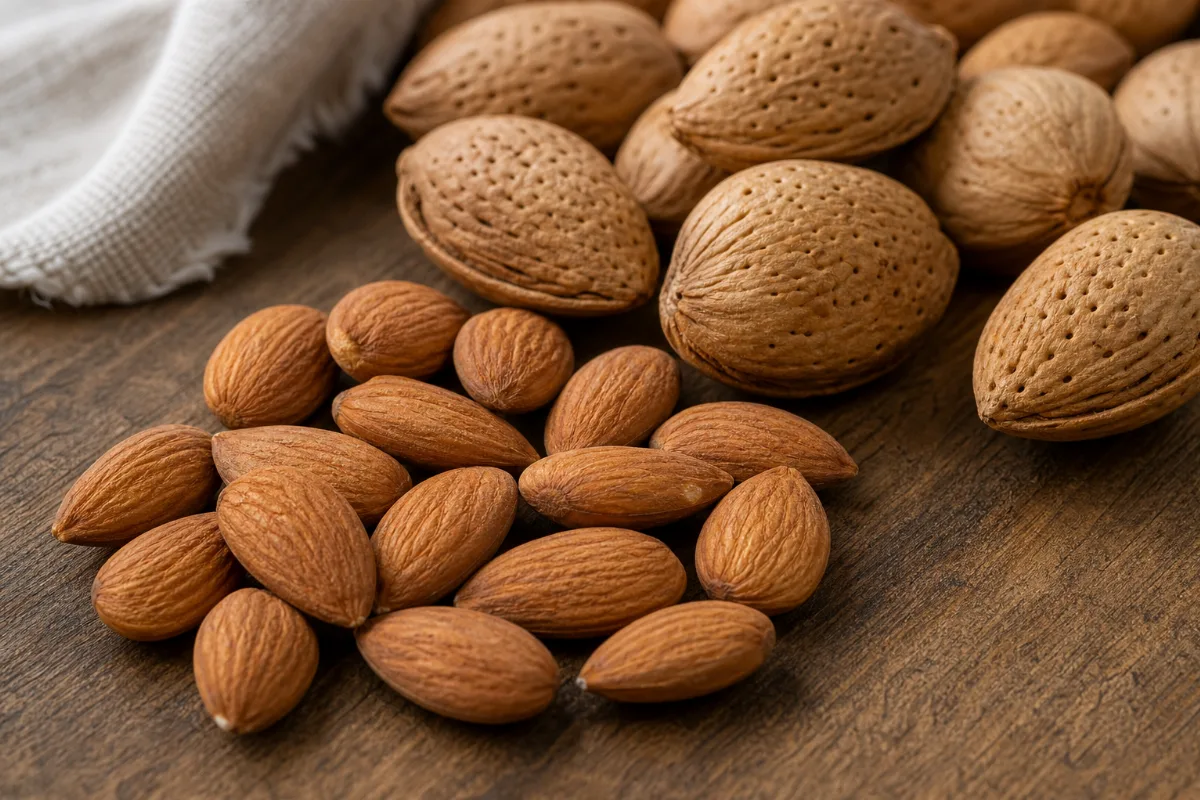
Almonds are the kernels of a tree in the rose family, eaten as a snack and ingredient. They are rich in vitamin E, fiber and magnesium, and most of their fat is unsaturated. In pooled trials they lowered LDL and total cholesterol a little, but the effects on weight and inflammation were tiny or mixed. The main cautions are tree nut allergy, which can be severe, and choking in young children.
General information, not medical advice. Last substantive update · Not medically reviewed. A named clinician has not signed off on this page. How this page is made
About Almonds
Almonds are the kernels of Prunus dulcis, a tree in the rose family. They are a nutrient-dense, energy-dense food. They are not a proven remedy: the cholesterol findings are small changes in blood tests, and the other findings are weaker. The main safety points are tree nut allergy, choking in young children and oxalate.
What they are
The almond eaten as food is the kernel (seed) of a tree in the rose family, Rosaceae. Almonds are usually called Prunus dulcis, the name used by USDA and most nutrition papers. GBIF, a plant name database, now lists Prunus dulcis as a synonym of Prunus amygdalus Batsch. Bitter almonds are a different, poisonous type and are not what this page covers.
This page is about whole almonds eaten as food. Almond milk, almond butter, almond flour and almond oil are different products, and the findings here do not automatically carry over.
What is in them
USDA data for raw almonds, per 100 g: 579 kcal, 21.2 g protein, 49.9 g fat (31.6 g monounsaturated, 12.3 g polyunsaturated, 3.8 g saturated), 21.6 g carbohydrate, 12.5 g fiber, 25.6 mg vitamin E, 270 mg magnesium, 269 mg calcium, 1.03 mg copper and 2.18 mg manganese. There is no cholesterol.
One ounce (28.35 g, about 23 kernels) works out to about 164 kcal, 6.0 g protein, 14.2 g fat, 3.5 g fiber, 7.3 mg vitamin E and 77 mg magnesium. Values vary with variety, roasting and storage. Having these nutrients in the food is not proof of extra benefit if your intake is already enough.
What the research shows
The research is mostly short randomized trials that measure blood markers and body measurements, pooled in meta-analyses. A 2022 analysis of 26 trials (1,750 people) found significantly lower total cholesterol, LDL, non-HDL, VLDL and triglycerides with almonds, and a lower diastolic (but not systolic) blood pressure. A 2015 analysis of 61 trials of tree nuts found LDL about 4.8 mg/dL lower per daily serving, with no clear difference between nut types.
Other results are small or mixed. A 2020 analysis of 28 almond trials found about 0.38 kg less weight and 0.58 kg less fat mass; a bigger analysis of 55 nut trials found no change in weight. A 2023 analysis found no change in C-reactive protein and a tiny fall in interleukin-6. In people with type 2 diabetes, two analyses disagree on LDL, and blood sugar measures did not change significantly.
A 2020 network analysis ranked pistachio and walnut diets above almond diets for some blood fats, but rated its own evidence low quality. None of the almond analyses read looked at heart attacks, strokes or diabetes diagnosis.
Food versus other almond products
The results above are for whole almonds eaten as food, except the tree nut analyses, which pooled several nuts. Almond milk, almond butter, almond flour, almond oil, vitamin E supplements and extracts are different products and were not studied in these trials.
At a glance
Traditional uses history, not proof
- Eaten as a food and ingredient
- Long use as food is not proof that almonds treat any condition
Studied for research
- Nutrient content (vitamin E, fiber, magnesium), high certainty from USDA data
- Cholesterol and blood fats, moderate certainty for small falls in blood markers
- Blood pressure, low certainty (diastolic only, one analysis)
- Body weight and fat, mixed
- Inflammation markers, low
- Type 2 diabetes cholesterol and blood sugar, mixed
Main compounds
- Vitamin E (alpha-tocopherol)
- Dietary fiber
- Unsaturated fats (mostly monounsaturated)
- Magnesium, copper, manganese, riboflavin
- Oxalate
Common forms
- Raw whole almonds as food (USDA values read)
- Almonds in the pooled trials (whole almonds eaten as food)
- Almond milk, almond butter, almond flour and almond oil are different products and are not covered
Research links: 2022 review: almonds and cardiometabolic markers (26 trials) · 2015 review: tree nuts, blood fats and blood pressure (61 trials) · 2018 review: tree nut allergy · Research Library · Genes & Biomarkers Library
What it is and its history
- Accepted scientific name
- Prunus amygdalus Batsch (GBIF accepted name); the name Prunus dulcis (Mill.) D.A.Webb is listed by GBIF as a synonym
- Naming authority
- Batsch (accepted); (Mill.) D.A.Webb (synonym)
- Synonyms
- Prunus dulcis (Mill.) D.A.Webb; Amygdalus communis L.; Amygdalus amygdalus (Batsch) Frye & Rigg
- Common names
- Almond (English); Sweet almond (English); Almendra (Spanish)
- Family or group
- Rosaceae (the rose family), as given by GBIF.
- Classification
- Plantae > Tracheophyta > Magnoliopsida > Rosales > Rosaceae > Prunus > Prunus amygdalus
- Native range
- Not verified from a source read.
- Habitat
- Not verified from a source read.
- What it looks like
- Roots: Not verified.; Stems: Not verified.; Leaves: Not verified.; Flowers: Not verified.; Fruit: The almond eaten as food is the kernel (seed) inside the stone of the fruit. This page covers the kernel, and USDA lists it as a nut and seed product. Details of the fruit were not read.
- Cultivation
- Not verified from a source read.
- Harvest and processing
- Not verified from a source read. USDA lists household measures for whole, sliced, slivered and ground almonds.
- Look-alikes and adulterants
- Name: Bitter almonds; Note: A different type, poisonous when eaten in quantity; a case report describes cyanide poisoning after about 40 bitter almonds. Not the almonds sold as food.; Name: Other tree nuts such as walnuts and pistachios; Note: Studies of tree nuts together are not always specific to almonds.; Name: Almond milk, almond butter, almond flour and almond oil; Note: Made from almonds but are different products.
- Sustainability and conservation
- Not assessed.
Photographs
What is inside, and how it may work
What it contains and how those compounds act in cells and animals. Laboratory and animal mechanisms are not proven effects in people.
Main compounds
| Compound | Family | Where it is concentrated | Activity studied | Level of evidence |
|---|---|---|---|---|
| Vitamin E (alpha-tocopherol) | vitamin | Kernel USDA: 25.6 mg per 100 g (about 7.3 mg per ounce) | A vitamin; almonds are a rich food source. No trial was read showing extra benefit from almond vitamin E when intake is already enough. 19 | Human data |
| Dietary fiber | carbohydrate | Kernel USDA: 12.5 g per 100 g (about 3.5 g per ounce) | Fiber is a nutrient from the food; its role in the cholesterol findings was not tested in the abstracts read. 19 | Human data |
| Unsaturated fats (mostly monounsaturated) | lipid | Kernel USDA per 100 g: 31.6 g monounsaturated, 12.3 g polyunsaturated, 3.8 g saturated | The main fats in the food. Researchers often link nut fat to cholesterol findings, but the abstracts read do not test that. 19 | Human data |
| Magnesium, copper, manganese and riboflavin | minerals and vitamin | Kernel USDA per 100 g: magnesium 270 mg, copper 1.03 mg, manganese 2.18 mg, riboflavin 1.14 mg | Ordinary food nutrients. 19 | Human data |
| Oxalate | organic acid | Kernel Not given in the sources read; a test portion was chosen to supply 120 mg | About 5.9% of almond oxalate was absorbed in 11 healthy volunteers, more than from black beans (1.8%). 2 | Human data |
Mechanisms, receptors and pathways
| Target or pathway | Gene or receptor | What was found | Level |
|---|---|---|---|
| Oxalate absorption and urine oxalate | Not specified | In 11 healthy volunteers about 5.9% of almond oxalate was absorbed; in 7 healthy volunteers a 150 g almond load raised 24-hour urine oxalate. 2 3 | Human data |
| Cholesterol lowering | Not specified | How almonds lower cholesterol was not established in the sources read. | Insufficient |
Absorption, metabolism and elimination
- Absorption
- About 5.9% of the oxalate in almonds was absorbed in 11 healthy volunteers. Absorption of almond vitamin E, minerals and fat was not found.
- Distribution
- Not found.
- Metabolism
- Not found.
- Elimination
- Oxalate was measured in urine over 24 hours.
- Bioavailability
- Not established for almond nutrients in the sources read.
Isolated compounds versus whole extracts
The cholesterol, weight, inflammation and diabetes findings are for whole almonds eaten as food, except the 61-trial and network analyses, which pooled several tree nuts. Almond milk, almond butter, almond flour, almond oil, vitamin E supplements and almond extracts are different products and were not studied in these trials.
Nutritional composition
Nutrition from USDA FoodData Central (SR Legacy, item 'Nuts, almonds', FDC 170567, last updated 4/1/2019; values read 2026-10-26 from the FoodData Central portal data because the public API key was rate-limited). Raw almonds, per 100 g: 579 kcal, 4.41 g water, 21.2 g protein, 49.9 g fat (3.8 g saturated, 31.6 g monounsaturated, 12.3 g polyunsaturated), 21.6 g carbohydrate, 12.5 g fiber, 4.35 g total sugars, 269 mg calcium, 3.71 mg iron, 270 mg magnesium, 481 mg phosphorus, 733 mg potassium, 1 mg sodium, 3.12 mg zinc, 1.03 mg copper, 2.18 mg manganese, 25.6 mg vitamin E (alpha-tocopherol), 1.14 mg riboflavin, 44 micrograms folate, and no cholesterol. One typical USDA portion, 1 ounce (28.35 g, about 23 whole kernels), calculated from the per-100 g values: about 164 kcal, 6.0 g protein, 14.2 g fat (1.1 g saturated, 9.0 g monounsaturated), 6.1 g carbohydrate, 3.5 g fiber, 1.2 g sugars, 76 mg calcium, 1.1 mg iron, 77 mg magnesium, 136 mg phosphorus, 208 mg potassium, 0.29 mg copper, 0.62 mg manganese, 7.3 mg vitamin E and 0.32 mg riboflavin. Other USDA household measures: 1 cup whole almonds is 143 g, 1 cup sliced 92 g, 1 cup slivered 108 g, 1 cup ground 95 g. Values vary with variety, growing place, roasting and storage. Roasted, salted, flavored, blanched, almond butter, almond milk and almond oil were not read.
1 high certainty1 moderate certainty2 mixed findings2 low certainty
What was looked at
The 6 benefits and uses checked for Almonds, each with how strong the evidence is. Tap one to open it.
- Vitamin E, magnesium, copper, manganese, fiber and healthy fats (nutrient content)High certainty
- Cholesterol and blood fats (LDL, total cholesterol, triglycerides)Moderate certainty
- Blood pressureLow certainty
- Body weight and body fatMixed findings
- Inflammation markers (C-reactive protein, interleukin-6)Low certainty
- People with type 2 diabetes: cholesterol and blood sugarMixed findings
Lab markers tracked in the studies
LDL cholesterolTotal cholesterolTriglyceridesDiastolic blood pressureSystolic blood pressureBody weightFat massC-reactive protein (CRP)Interleukin-6 (IL-6)LDL cholesterol in type 2 diabetesFasting glucose and HbA1c
What is Almonds good for?
The main studied uses and how strong the human evidence is for each. All results are for almonds eaten as food, apart from the tree nut analyses that are labelled.
Benefits, one by one
Each card is a research question, not a promise. Tap a goal to filter. Open a card to see the studies, doses and limits.
Vitamin E, magnesium, copper, manganese, fiber and healthy fats (nutrient content)
High certaintyAlmonds are a rich food source of vitamin E, fiber, magnesium, copper, manganese and riboflavin, and most of their fat is unsaturated. They are also energy dense: 579 kcal per 100 g (USDA).
1 studiesRaw whole almonds (USDA item). Roasted, blanched, sliced, ground, alm…
Studies, doses and limits
What the trials found
USDA FoodData Central lists raw almonds per 100 g: 579 kcal, 21.2 g protein, 49.9 g fat (31.6 g monounsaturated, 12.3 g polyunsaturated, 3.8 g saturated), 21.6 g carbohydrate, 12.5 g fiber, 25.6 mg vitamin E, 270 mg magnesium, 269 mg calcium, 1.03 mg copper, 2.18 mg manganese and 1.14 mg riboflavin. No cholesterol. No trial was read showing that eating almonds corrects a low level of any of these nutrients.
Results
Almonds are a nutrient-dense, energy-dense food. Having a nutrient in the food is not proof of extra benefit when your intake is already enough.
Effect sizes as reported
Per 100 g (USDA, raw): protein 21.2 g, fat 49.9 g, fiber 12.5 g, vitamin E 25.6 mg, magnesium 270 mg, copper 1.03 mg, manganese 2.18 mg. See the composition notes for a one-ounce portion.
Why this rating
High that the food contains these nutrients: the numbers come from USDA reference data. This is not a claim about health outcomes.
Form and dose studied
Raw whole almonds (USDA item). Roasted, blanched, sliced, ground, almond butter, almond milk and almond oil were not read and differ.
Who was studied
General adult diet.
Limits
Reference data, not a trial. Values vary with variety, growing place, roasting and storage.
Why researchers looked
People eat almonds as a snack and ingredient, and nutrition tables show what is in them.
Traditional use
Almonds have long been eaten as food. Long use as food is not proof that they treat any condition.
Proposed mechanism Reference data
Not applicable. This is the nutrient content of the food.
A proposed mechanism does not show that the effect happens in people.
Almonds are a tree nut allergen; see the Safety tab.
Cholesterol and blood fats (LDL, total cholesterol, triglycerides)
Moderate certaintyIn pooled trials, eating almonds lowered LDL ('bad') cholesterol, total cholesterol, non-HDL cholesterol, VLDL and triglycerides a little. HDL did not change significantly. These are blood-test markers, not heart attacks or strokes.
3 studiesWhole almonds in the almond analysis; the 61-trial analysis mixes tre…
Studies, doses and limits
What the trials found
A 2022 pooled analysis of 26 randomized trials (1,750 people) found significantly lower total cholesterol, triglycerides, LDL, non-HDL and VLDL cholesterol with almond intake. A 2015 analysis of 61 trials of tree nuts (all kinds together) found LDL about 4.8 mg/dL lower and total cholesterol about 4.7 mg/dL lower per daily serving, with no clear difference between nut types. A 2020 network analysis ranked almond-enriched diets second for LDL lowering, behind pistachios, but only pistachio and walnut diets were clearly better than control and the authors rate the evidence low quality.
Results
A small but fairly consistent fall in cholesterol markers in short trials. It does not show fewer heart attacks.
Effect sizes as reported
Almond trials: significant falls in total cholesterol, triglycerides, LDL, non-HDL and VLDL (sizes not given in the abstract). All tree nuts, per serving a day: LDL -4.8 mg/dL (95% CI -5.5 to -4.2), total cholesterol -4.7 mg/dL (-5.3 to -4.0), triglycerides -2.2 mg/dL (-3.8 to -0.5).
Why this rating
Moderate: several pooled randomized analyses point the same way for LDL and total cholesterol. Not higher because the trials are short, measure blood markers rather than heart disease, differ in design, and no certainty (GRADE) rating is given in the abstracts. The network analysis calls its own evidence low quality.
Form and dose studied
Whole almonds in the almond analysis; the 61-trial analysis mixes tree nuts. Almond milk, oil and extracts were not studied here.
Who was studied
Adults; mostly short trials of 3 to 26 weeks.
Limits
Surrogate markers only. Short trials. Amounts, comparison diets and lengths differ. The larger cholesterol falls in the 61-trial analysis were seen with larger daily amounts of nuts, which is a pattern across trials, not advice. Almonds are energy dense.
Why researchers looked
Nuts are one of the foods most often tested for cholesterol, and almonds have many small trials.
Traditional use
Almonds have long been eaten as food. Long use as food is not proof that they treat any condition.
Proposed mechanism Hypothesis
Not established in the sources read. Researchers often point to the unsaturated fat, fiber and plant compounds in nuts, but the abstracts read do not test why.
A proposed mechanism does not show that the effect happens in people.
See the Safety tab for tree nut allergy.
Blood pressure
Low certaintyOne pooled analysis found a slightly lower diastolic (lower number) blood pressure with almonds. The top number (systolic) did not change significantly.
2 studiesWhole almonds eaten as food.
Studies, doses and limits
What the trials found
The 2022 pooled analysis of 26 trials found significantly lower diastolic blood pressure and no significant change in systolic blood pressure. A separate 2022 analysis in people with type 2 diabetes found no significant change in either.
Results
A small, inconsistent finding. It is not strong enough to say almonds help blood pressure.
Effect sizes as reported
Diastolic blood pressure significantly lower (size not given in the abstract); systolic not significantly different.
Why this rating
Low: one pooled analysis, a small and partial result (one of the two numbers), with no certainty rating in the abstract. The diabetes analysis found no change.
Form and dose studied
Whole almonds eaten as food.
Who was studied
Adults; the diabetes analysis covered people with type 2 diabetes.
Limits
Short trials of blood pressure readings, not heart attacks or strokes.
Why researchers looked
Blood pressure is usually recorded alongside cholesterol in nut trials.
Traditional use
Almonds have long been eaten as food. Long use as food is not proof that they treat any condition.
Proposed mechanism Hypothesis
Not established in the sources read.
A proposed mechanism does not show that the effect happens in people.
Ask your clinician before changing blood pressure care; almonds are not a treatment.
Body weight and body fat
Mixed findingsAlmonds are energy dense, yet in pooled trials people eating them lost no weight to speak of: a very small fall in weight and fat mass in the almond analysis, and no change in a bigger analysis of all nut trials.
3 studiesWhole almonds for the almond analysis; mixed nuts and nut products fo…
Studies, doses and limits
What the trials found
A 2020 pooled analysis of 28 almond trials found body weight 0.38 kg lower and fat mass 0.58 kg lower, with no significant change in BMI, waist or fat-free mass. A 2021 analysis of 55 trials of all kinds of nuts found no change in body weight, BMI or waist, with or without instructions to swap out other foods; body fat percentage dipped slightly when instructions were given.
Results
No weight gain and at most a very small fall. The two analyses disagree slightly on whether weight falls.
Effect sizes as reported
Almonds: weight -0.38 kg (95% CI -0.65 to -0.10); fat mass -0.58 kg (-0.87 to -0.28); BMI, waist and fat-free mass not significant. All nuts: weight SMD 0.01 and -0.01, not significant.
Why this rating
Mixed: the almond analysis found a very small fall, the wider nut analysis found none. Neither says whether almonds replaced other foods. No certainty ratings in the abstracts.
Form and dose studied
Whole almonds for the almond analysis; mixed nuts and nut products for the other.
Who was studied
Adults; trials of at least a few weeks.
Limits
The changes are tiny and may not matter. This is not advice about weight.
Why researchers looked
People worry nuts cause weight gain because they are high in calories, so trials measure weight.
Traditional use
Almonds have long been eaten as food. Long use as food is not proof that they treat any condition.
Proposed mechanism Hypothesis
Not established in the sources read.
A proposed mechanism does not show that the effect happens in people.
Almonds are energy dense (579 kcal per 100 g, USDA).
Inflammation markers (C-reactive protein, interleukin-6)
Low certaintyIn pooled trials almonds did not change C-reactive protein and lowered interleukin-6 by a very small amount. These are blood markers, not symptoms.
2 studiesWhole almonds eaten as food.
Studies, doses and limits
What the trials found
A 2023 pooled analysis of 11 studies found no significant change in C-reactive protein and an interleukin-6 fall of 0.1 pg/ml. The 2022 analysis of 26 trials also found no significant change in C-reactive protein, interleukin-6 or tumor necrosis factor-alpha.
Results
No clear effect on the main marker, and the two analyses disagree on interleukin-6.
Effect sizes as reported
CRP -0.28 mg/L (95% CI -0.81 to 0.25), not significant; IL-6 -0.1 pg/ml (-0.15 to -0.05) in one analysis, not significant in the other.
Why this rating
Low: the two pooled analyses disagree on interleukin-6, effects are tiny, and they are blood markers only.
Form and dose studied
Whole almonds eaten as food.
Who was studied
Adults.
Limits
Blood markers, not symptoms. Small number of studies.
Why researchers looked
Nuts are often said to calm inflammation, so blood markers are measured.
Traditional use
Almonds have long been eaten as food. Long use as food is not proof that they treat any condition.
Proposed mechanism Hypothesis
Not established in the sources read.
A proposed mechanism does not show that the effect happens in people.
None specific.
People with type 2 diabetes: cholesterol and blood sugar
Mixed findingsIn people with type 2 diabetes, two pooled analyses disagree on whether almonds lower LDL cholesterol. Blood sugar measures (fasting glucose, HbA1c) did not change significantly in either the diabetes analysis or the main one.
3 studiesWhole almonds eaten as food.
Studies, doses and limits
What the trials found
A 2022 analysis of 9 trials found LDL 5.28 mg/dL lower with almonds, with no significant change in total cholesterol, triglycerides, HDL, fasting glucose, insulin, HbA1c, weight, blood pressure or C-reactive protein. A separate analysis of 5 trials could not show a benefit for total cholesterol, triglycerides, LDL or HDL. Both found LDL lower in the subgroup of trials above 50 g of almonds a day. The 2022 analysis of 26 trials found no significant change in fasting glucose, insulin or HbA1c either.
Results
Mixed on LDL and no clear effect on blood sugar. Almonds are not a treatment for diabetes.
Effect sizes as reported
T2D, 9 trials: LDL -5.28 mg/dL (95% CI -9.92 to -0.64). T2D, 5 trials: LDL -5.40 mg/dL (-13.30 to 2.50), not significant.
Why this rating
Mixed: two small analyses of overlapping trials disagree. Not rated higher because the trial counts are small and the abstracts give no certainty rating.
Form and dose studied
Whole almonds eaten as food.
Who was studied
Adults with type 2 diabetes.
Limits
Very few trials. The more-than-50-g-a-day pattern is a subgroup result across trials, not advice. People with diabetes should follow their own care team's diet advice.
Why researchers looked
People with type 2 diabetes are at higher heart risk, so almond trials were pooled for them separately.
Traditional use
Almonds have long been eaten as food. Long use as food is not proof that they treat any condition.
Proposed mechanism Hypothesis
Not established in the sources read.
A proposed mechanism does not show that the effect happens in people.
Ask your care team about food and diabetes medicine.
Connections to the rest of health
How Almonds connects to the rest of our health knowledge graph. Every link says what kind of connection it is. A safety link (for example to the liver) is a warning, not a benefit. A study that merely mentions a topic never creates a benefit link.
Explore every connection: goals, body systems, organs, symptoms, genes
A. Wellness goals
| Connected to | Kind of connection | Evidence status | Context | Studies |
|---|---|---|---|---|
| Preventive Wellness | High certainty | Vitamin E, magnesium, copper, manganese, fiber and healthy fats (nutrient content): Almonds are a rich food source of vitamin E, fiber, magnesium, copper, manganese and riboflavin, and most of their fat is unsaturated. They are also energy dense: 579 kcal per 100 g (USDA). | 19 | |
| Cholesterol Balance | Demonstrated clinical effect | Moderate certainty | Cholesterol and blood fats (LDL, total cholesterol, triglycerides): In pooled trials, eating almonds lowered LDL ('bad') cholesterol, total cholesterol, non-HDL cholesterol, VLDL and triglycerides a little. HDL did not change significantly. These are blood-test markers, not heart attacks or strokes. | 11 4 9 |
| Heart Health | Demonstrated clinical effect | Moderate certainty | Cholesterol and blood fats (LDL, total cholesterol, triglycerides): In pooled trials, eating almonds lowered LDL ('bad') cholesterol, total cholesterol, non-HDL cholesterol, VLDL and triglycerides a little. HDL did not change significantly. These are blood-test markers, not heart attacks or strokes. | 11 4 9 |
| Blood Pressure Support | Low certainty | Blood pressure: One pooled analysis found a slightly lower diastolic (lower number) blood pressure with almonds. The top number (systolic) did not change significantly. | 11 10 | |
| Heart Health | Low certainty | Blood pressure: One pooled analysis found a slightly lower diastolic (lower number) blood pressure with almonds. The top number (systolic) did not change significantly. | 11 10 | |
| Weight Management | Mixed findings | Body weight and body fat: Almonds are energy dense, yet in pooled trials people eating them lost no weight to speak of: a very small fall in weight and fat mass in the almond analysis, and no change in a bigger analysis of all nut trials. | 5 6 19 | |
| Inflammation Balance | Low certainty | Inflammation markers (C-reactive protein, interleukin-6): In pooled trials almonds did not change C-reactive protein and lowered interleukin-6 by a very small amount. These are blood markers, not symptoms. | 7 11 | |
| Blood Sugar Balance | Mixed findings | People with type 2 diabetes: cholesterol and blood sugar: In people with type 2 diabetes, two pooled analyses disagree on whether almonds lower LDL cholesterol. Blood sugar measures (fasting glucose, HbA1c) did not change significantly in either the diabetes analysis or the main one. | 10 13 11 | |
| Cholesterol Balance | Mixed findings | People with type 2 diabetes: cholesterol and blood sugar: In people with type 2 diabetes, two pooled analyses disagree on whether almonds lower LDL cholesterol. Blood sugar measures (fasting glucose, HbA1c) did not change significantly in either the diabetes analysis or the main one. | 10 13 11 |
B. Body systems
| Connected to | Kind of connection | Evidence status | Context | Studies |
|---|---|---|---|---|
| Digestive System | Biological association | High certainty | Studied for: Vitamin E, magnesium, copper, manganese, fiber and healthy fats (nutrient content) | 19 |
| Cardiovascular System | Biological association | Moderate certainty | Studied for: Cholesterol and blood fats (LDL, total cholesterol, triglycerides) Studied for: Blood pressure | 11 4 9 10 |
| Metabolic System | Biological association | Mixed findings | Studied for: Body weight and body fat | 5 6 19 |
| Immune System | Biological association | Low certainty | Studied for: Inflammation markers (C-reactive protein, interleukin-6) | 7 11 |
| Endocrine System | Biological association | Mixed findings | Studied for: People with type 2 diabetes: cholesterol and blood sugar | 10 13 11 |
E. Health conditions
| Connected to | Kind of connection | Evidence status | Context | Studies |
|---|---|---|---|---|
| Food allergy | Adverse effect or risk | Documented risk | Tree nuts are a major food allergen; tree nut allergy can be life-threatening and is rarely outgrown. Tree nuts are a major food allergen; tree nut allergy can be life-threatening and is outgrown in fewer than 10% of cases. Preparation or compound: Almonds as food (tree nut) |
15 12 |
| Kidney stones | Adverse effect or risk | Small studies | Almonds raised urine oxalate in a small loading test; no study shows they cause stones in healthy people. Preparation or compound: Almonds as food (oxalate) |
2 3 |
| Choking in young children | Adverse effect or risk | Documented risk | The American Academy of Pediatrics lists nuts and thick nut butter as choking risks for young children. Preparation or compound: Whole almonds and thick almond butter |
14 |
| High cholesterol | Preliminary | Pooled trials of almonds found small falls in LDL and total cholesterol; not a treatment. Preparation or compound: Whole almonds |
11 4 |
I. Biomarkers
| Connected to | Kind of connection | Evidence status | Context | Studies |
|---|---|---|---|---|
| LDL cholesterol | Biological association | Moderate certainty | Measured in trials: lowered. A lab change is not the same as a health benefit. | 11 4 |
| Total cholesterol | Biological association | Moderate certainty | Measured in trials: lowered. A lab change is not the same as a health benefit. | 11 4 |
| Triglycerides | Biological association | Low certainty | Measured in trials: lowered. A lab change is not the same as a health benefit. | 11 4 |
| Diastolic blood pressure | Biological association | Low certainty | Measured in trials: lowered. A lab change is not the same as a health benefit. | 11 |
| Systolic blood pressure | Biological association | Low certainty | Measured in trials: no significant change. A lab change is not the same as a health benefit. | 11 |
| Body weight | Biological association | Mixed findings | Measured in trials: slightly lowered (almond analysis); no change (all nuts). A lab change is not the same as a health benefit. | 5 6 |
| Fat mass | Biological association | Low certainty | Measured in trials: slightly lowered. A lab change is not the same as a health benefit. | 5 |
| C-reactive protein (CRP) | Biological association | Low certainty | Measured in trials: no significant change. A lab change is not the same as a health benefit. | 7 11 |
| Interleukin-6 (IL-6) | Biological association | Low certainty | Measured in trials: slightly lowered. A lab change is not the same as a health benefit. | 7 11 |
| LDL cholesterol in type 2 diabetes | Biological association | Mixed findings | Measured in trials: lowered in one analysis; no significant change in another. A lab change is not the same as a health benefit. | 10 13 |
| Fasting glucose and HbA1c | Biological association | Low certainty | Measured in trials: no significant change. A lab change is not the same as a health benefit. | 10 11 |
K. Biological pathways
| Connected to | Kind of connection | Evidence status | Context | Studies |
|---|---|---|---|---|
| Vitamin E | Preliminary mechanism | Human | Almonds are a rich food source of alpha-tocopherol. | 19 |
| Magnesium | Preliminary mechanism | Human | Almonds are a food source of magnesium. | 19 |
| Dietary fiber | Preliminary mechanism | Human | Almonds are a food source of fiber. | 19 |
| Oxalate | Preliminary mechanism | Human | Almonds are a high-oxalate food; some oxalate is absorbed and appears in urine. | 2 3 |
L. Active compounds
| Connected to | Kind of connection | Evidence status | Context | Studies |
|---|---|---|---|---|
| Vitamin E (alpha-tocopherol) | Biological association | Human | A vitamin; almonds are a rich food source. No trial was read showing extra benefit from almond vitamin E when intake is already enough. Preparation or compound: Kernel |
19 |
| Dietary fiber | Biological association | Human | Fiber is a nutrient from the food; its role in the cholesterol findings was not tested in the abstracts read. Preparation or compound: Kernel |
19 |
| Unsaturated fats (mostly monounsaturated) | Biological association | Human | The main fats in the food. Researchers often link nut fat to cholesterol findings, but the abstracts read do not test that. Preparation or compound: Kernel |
19 |
| Magnesium, copper, manganese and riboflavin | Biological association | Human | Ordinary food nutrients. Preparation or compound: Kernel |
19 |
| Oxalate | Biological association | Human | About 5.9% of almond oxalate was absorbed in 11 healthy volunteers, more than from black beans (1.8%). Preparation or compound: Kernel |
2 |
Each connection is stored with the ingredient, the connected record, the kind of connection, the evidence status, the supporting studies, the preparation or compound involved, and a review date (last reviewed October 26, 2026).
The evidence
The research centre for Almonds. Every record here was checked against PubMed or the publisher's page; we never list a study we have not verified.
Evidence by outcome
Bars show how many studies we found for each outcome, not how well it works. People are added up across trials only (reviews are not added, to avoid double counting).
How we rate evidence
High certainty
Several well-run trials or reviews agree; further research is unlikely to change the picture much.
Moderate certainty
Good trials point the same way, but some doubt remains.
Low certainty
Small, short or inconsistent trials. The finding could change with better research.
Very low certainty
Very little or very weak human data. Treat as a possibility only.
Mixed findings
Trials or reviews disagree with each other.
Not enough evidence
Not enough human research to say either way.
Evidence against
Good research found no benefit, or found harm.
We take the reviewers' own risk-of-bias and GRADE statements where they exist, and otherwise judge from study size, design, consistency, directness and whether a product matches what is sold. Many publications do not make evidence high. Method note: We started from our earlier almonds summary, re-checked nutrition against USDA FoodData Central data, re-read the health agency pages (FDA, MedlinePlus, American Academy of Pediatrics, NHS) and re-read PubMed abstracts for each study. Only abstracts were read for studies. Items we could not verify are flagged in the research gaps.
Study library: every study we checked 19
| Study | Design | People | Product, dose, length | Result |
|---|---|---|---|---|
| Arabizadeh 2024 Cyanide poisoning after bitter almond ingestion: "A rare case report". Clin Case Rep · PMID 38197062 · DOI |
Case report |
One 36-year-old woman who swallowed about 40 bitter almonds in a suicide attempt | Bitter almonds (a different, poisonous type, not the sweet almonds sold as snack food) Kernel (nut) About 40 bitter almonds Single event |
She developed vomiting, confusion, severe acid build-up in the blood and loss of consciousness, and needed breathing support and an antidote (sodium nitrite). She regained consciousness within a day and was discharged after 72 hours. One case (Not applicable) Methods, limits and fundingOutcomes: Cyanide poisoning and its treatment Limitations: A single case after a large deliberate intake of bitter almonds. It says nothing about the sweet almonds sold as food. Funding and conflicts: Funding is not stated in the abstract. Read: abstract |
| Chai 2004 Assessment of oxalate absorption from almonds and black beans with and without the use of an extrinsic label. J Urol · PMID 15311007 · DOI |
Controlled feeding study |
11 healthy volunteers (6 men, 5 women) | Almonds eaten as food, giving 120 mg of oxalate per test Kernel (nut) An amount giving 120 mg oxalate 24-hour urine collection after each test · vs Black beans |
About 5.9% of the oxalate in almonds was absorbed, higher than the 1.8% from black beans. The authors say the split between soluble and insoluble oxalate in a food matters. Oxalate absorption 5.9% from almonds versus 1.8% from black beans (Not given in the abstract) Methods, limits and fundingOutcomes: Oxalate absorption (urine oxalate) Limitations: A small study in healthy volunteers. It measures absorption, not kidney stones. Funding and conflicts: Funding is not stated in the abstract. Read: abstract |
| De Mul 2025 Snacks and urinary oxalate: Which wins, almonds or chocolate? French journal of urology · PMID 41083049 · DOI |
Small intervention study |
7 healthy volunteers | Almonds eaten as a test load, compared with dark chocolate Kernel (nut) 150 g of almonds in the test (a test load, not a serving) 24-hour urine after the test · vs Baseline 24-hour urine; 100 g dark chocolate |
Dark chocolate did not significantly raise urinary oxalate. The almond load did, consistently. The authors suggest informing people with kidney stones about the possible stone-forming effect and propose an almond loading test. Urinary oxalate after almonds 931 umol/24h (range 680-990) versus baseline; p = 0.01 (Not applicable (medians and ranges reported)) Methods, limits and fundingOutcomes: Urinary oxalate over 24 hours Limitations: Seven healthy volunteers, a very large single load. It is a test of feasibility, not evidence that ordinary eating causes stones. Funding and conflicts: Funding is not stated in the abstract. Read: abstract |
| Del Gobbo 2015 Effects of tree nuts on blood lipids, apolipoproteins, and blood pressure: systematic review, meta-analysis, and dose-response of 61 controlled intervention trials. Am J Clin Nutr · PMID 26561616 · DOI |
Systematic review meta analysis |
61 controlled trials, 2,582 adults without existing cardiovascular disease | Tree nuts (walnuts, pistachios, macadamia nuts, pecans, cashews, almonds, hazelnuts, Brazil nuts) eaten as food Kernels (nuts) Results scaled to one 28.4 g serving a day 3 to 26 weeks · vs Control diets |
Tree nut intake lowered total cholesterol, LDL, apolipoprotein B and triglycerides. Other outcomes were not significantly changed. Cholesterol falls looked larger with larger daily amounts of nuts. The authors found no clear difference between nut types. Per serving a day: total cholesterol -4.7 mg/dL; LDL -4.8 mg/dL; ApoB -3.7 mg/dL; triglycerides -2.2 mg/dL (Total cholesterol -5.3 to -4.0; LDL -5.5 to -4.2; ApoB -5.2 to -2.3; triglycerides -3.8 to -0.5) Methods, limits and fundingOutcomes: Blood fats, apolipoproteins, blood pressure, CRP Limitations: All tree nuts together, not almonds alone. Short trials. Supported by a US National Institutes of Health grant (NHLBI), listed in PubMed. Funding and conflicts: Supported by a US National Institutes of Health (NHLBI) grant, listed in PubMed; industry funding not stated in the abstract. Read: abstract |
| Eslampour 2020 The effect of almond intake on anthropometric indices: a systematic review and meta-analysis. Food Funct · PMID 32857083 · DOI |
Systematic review meta analysis |
28 randomized controlled trials (37 arms) in adults | Almonds eaten as food Kernel (nut) Varied between trials Varied between trials · vs Control groups (varied) |
Almond intake slightly lowered body weight and fat mass. BMI, waist circumference and fat-free mass did not change significantly. The authors say more studies are needed. Body weight WMD -0.38 kg; fat mass WMD -0.58 kg; BMI -0.30 kg/m2 (not significant); waist -0.60 cm (not significant); fat-free mass +0.23 kg (not significant) (Body weight -0.65 to -0.10; fat mass -0.87 to -0.28; BMI -0.67 to 0.06; waist -1.28 to 0.06; fat-free mass -0.04 to 0.50) Methods, limits and fundingOutcomes: Body weight, BMI, waist circumference, fat mass, fat-free mass Limitations: Very small average changes. The abstract does not say whether almonds replaced other foods or were added on top. No certainty rating in the abstract. Funding and conflicts: Funding is not stated in the abstract. Read: abstract |
| Guarneiri 2021 Intake of Nuts or Nut Products Does Not Lead to Weight Gain, Independent of Dietary Substitution Instructions: A Systematic Review and Meta-Analysis of Randomized Trials. Adv Nutr · PMID 32945861 · DOI |
Systematic review meta analysis |
55 nut-feeding trials in adults, longer than 3 weeks | Nuts or nut-based snacks and meals (all kinds) Kernels (nuts) Daily nut intake; varied More than 3 weeks · vs Control diets |
Daily nuts did not change body weight, BMI or waist circumference, with or without instructions on what to swap out. A slight fall in body fat percentage was seen when trials gave substitution instructions. The authors say more research is needed. Body weight SMD 0.01 (no instructions) and -0.01 (with instructions), no change; body fat percentage SMD -0.32 with instructions (Body fat % with instructions -0.61 to -0.03) Methods, limits and fundingOutcomes: Body weight, BMI, waist circumference, body fat percentage Limitations: All nuts together, not almonds alone. Methods differed and some outcomes were not reported. Funding and conflicts: Funding is not stated in the abstract. Read: abstract |
| Hariri 2023 A systematic review and meta-analysis of almond effect on C-reactive protein and interleukin-6 in adults. Complement Ther Med · PMID 36535459 · DOI |
Systematic review meta analysis |
11 studies in adults | Almonds eaten as food Kernel (nut) Varied between studies Varied between studies · vs Comparison groups (varied) |
Almond intake did not significantly change CRP. It lowered IL-6 by a very small amount. The authors say better-designed trials are needed. CRP WMD -0.28 mg/L (not significant, p = 0.29); IL-6 WMD -0.1 pg/ml (p < 0.001) (CRP -0.81 to 0.25; IL-6 -0.15 to -0.05) Methods, limits and fundingOutcomes: C-reactive protein (CRP) and interleukin-6 (IL-6) in blood Limitations: Blood markers only, not symptoms. Only 11 studies. No certainty rating in the abstract. Funding and conflicts: Funding is not stated in the abstract. Read: abstract |
| Lemos 2026 Aflatoxin decontamination in tree nuts: a scoping review of physical, chemical, and biological methods. Mycotoxin Res · PMID 42550337 · DOI |
Scoping review n/a |
41 original laboratory and processing studies (2005 to 2025) | Tree nuts (various) Kernels (nuts) |
Aflatoxin contamination of tree nuts is a serious food safety and public health concern because aflatoxin B1 is a potent carcinogen. Several physical, chemical and biological treatments cut aflatoxin, but each has trade-offs and the authors say no single method is currently enough. Reductions of 70% to 95% for some physical methods; near 100% for some chemical methods (processing studies, not consumer exposure) (Not applicable) Methods, limits and fundingOutcomes: Methods to reduce aflatoxin in tree nuts Limitations: About how industry reduces aflatoxin, not how much is in almonds you buy. It gives no consumer-level almond figures. Funding and conflicts: Funding is not stated in the abstract. Read: abstract |
| Liu 2020 Comparative effects of different types of tree nut consumption on blood lipids: a network meta-analysis of clinical trials. Am J Clin Nutr · PMID 31773150 · DOI |
Network meta analysis |
34 trials, 1,677 participants | Diets enriched with walnuts, pistachios, hazelnuts, cashews or almonds Kernels (nuts) Varied between trials Varied between trials · vs Control diets |
Pistachio-enriched diets ranked best for triglycerides, LDL and total cholesterol, with walnut second for triglycerides and total cholesterol. Almond-enriched diets ranked second for LDL. Only pistachio and walnut diets were clearly better than the control diet. The authors rate the evidence as low quality and ask for better studies. Ranking (SUCRA): pistachio 85% for triglycerides, 87% for LDL, 96% for total cholesterol; almond second for LDL (Not given in the abstract) Methods, limits and fundingOutcomes: Triglycerides, LDL, total cholesterol, HDL Limitations: The authors call the evidence low quality with small numbers and poor reporting. It compares nuts, so it says little about almonds alone. Funding and conflicts: Funding is not stated in the abstract. Registration: PROSPERO CRD42019131128 Read: abstract |
| Moosavian 2022 Effects of almond on cardiometabolic outcomes in patients with type 2 diabetes: A systematic review and meta-analysis of randomized controlled trials. Phytother Res · PMID 35443097 · DOI |
Systematic review meta analysis |
9 randomized controlled trials in people with type 2 diabetes | Almonds eaten as food Kernel (nut) Varied; the LDL fall was clearest in trials above 50 g a day (a pattern across trials, not advice) Varied between trials · vs Control groups (varied) |
Almond intake lowered LDL cholesterol by a small amount. Total cholesterol, triglycerides, HDL, fasting glucose, insulin, HbA1c, BMI, weight, body fat, blood pressure and CRP did not change significantly. The authors say further high-quality studies are needed. LDL WMD -5.28 mg/dL (p = 0.026); other outcomes not significant (LDL -9.92 to -0.64) Methods, limits and fundingOutcomes: LDL and other blood fats, blood sugar, insulin, HbA1c, body measures, blood pressure, CRP Limitations: Only 9 trials. Subgroup patterns (more than 50 g a day, baseline LDL under 130 mg/dL) are not proof. No certainty rating in the abstract. Funding and conflicts: Funding is not stated in the abstract. Read: abstract |
| Morvaridzadeh 2022 The effect of almond intake on cardiometabolic risk factors, inflammatory markers, and liver enzymes: A systematic review and meta-analysis. Phytother Res · PMID 36331011 · DOI |
Systematic review meta analysis |
26 randomized controlled trials, 1,750 participants | Almonds eaten as food Kernel (nut) Varied between trials; not stated in the abstract Varied between trials; not stated in the abstract · vs Control diets (varied) |
Almond intake significantly lowered diastolic blood pressure, total cholesterol, triglycerides, LDL, non-HDL and VLDL cholesterol. Systolic blood pressure, fasting glucose, insulin, HbA1c, insulin resistance, liver enzymes, C-reactive protein, interleukin 6, tumor necrosis factor-alpha, HDL, apolipoproteins and several other markers were not significantly different. The authors say more large trials are needed for inflammation, blood sugar control and liver enzymes. Significant falls (p < 0.05) in diastolic blood pressure, total cholesterol, triglycerides, LDL, non-HDL and VLDL cholesterol; no significant change in the other markers named. Effect sizes are standardized mean differences, not given in the abstract. (Not given in the abstract) Methods, limits and fundingOutcomes: Blood pressure, blood fats, blood sugar and insulin measures, inflammation markers, liver enzymes Limitations: Pooled short trials of blood markers, not heart attacks or strokes. Exact amounts, comparison diets and trial lengths varied. No certainty (GRADE) rating in the abstract. Funding and conflicts: Funding is not stated in the abstract. Read: abstract |
| Smeekens 2018 Tree nut allergies: Allergen homology, cross-reactivity, and implications for therapy. Clin Exp Allergy · PMID 29700869 · DOI |
Narrative review n/a |
Review of the tree nut allergy literature | Tree nuts Kernels (nuts) |
Tree nut allergy is potentially life-threatening and affects about 1% of the general US population. Fewer than 10% of cases are outgrown. Because of likely cross-sensitization, the guideline is strict avoidance of all nuts once one tree nut allergy is diagnosed. How far clinical cross-reactivity goes between some nuts is unclear. There are no large randomized trials of treatments for tree nut allergy. About 1% of the US population; outgrown in under 10% of cases (Not applicable) Methods, limits and fundingOutcomes: Prevalence, cross-reactivity, outcome of tree nut allergy Limitations: A narrative review, not a systematic one. It does not single out almond. Funding and conflicts: Funding is not stated in the abstract. Read: abstract |
| Wang 2024 Effects of almond consumption on lipid profile in patients with type 2 diabetes: a systematic review and meta-analysis of randomised controlled trials. Arch Physiol Biochem · PMID 34624199 · DOI |
Systematic review meta analysis |
5 randomized controlled trials in people with type 2 diabetes | Almonds eaten as food Kernel (nut) Varied; LDL fell in the subgroup of trials above 50 g a day Varied between trials · vs Control groups (varied) |
The pooled result could not show a benefit of almonds on total cholesterol, triglycerides, LDL or HDL. In a subgroup of trials using more than 50 g a day, LDL was significantly lower. The authors conclude almonds could not improve the lipid profile overall. Total cholesterol WMD +0.65 mg/dL; triglycerides +1.59 mg/dL; LDL -5.40 mg/dL (p = 0.18); HDL +1.57 mg/dL; none significant (Total cholesterol -7.52 to 8.82; triglycerides -21.77 to 24.96; LDL -13.30 to 2.50; HDL -0.95 to 4.10) Methods, limits and fundingOutcomes: Total cholesterol, triglycerides, LDL, HDL Limitations: Only 5 trials. Disagrees with the 9-trial review on LDL. The journal date in PubMed is 2024; the paper was searched to January 2020. Funding and conflicts: Funding is not stated in the abstract. Read: abstract |
| s-aap-choking American Academy of Pediatrics, HealthyChildren.org: Choking Prevention · Source |
Health agency n/a |
Methods, limits and fundingRead: full-text | ||
| s-fda-allergens US FDA: Food Allergies · Source |
Health agency n/a |
Methods, limits and fundingRead: full-text | ||
| s-gbif-prunus-amygdalus GBIF Backbone: Prunus amygdalus Batsch (usageKey 3020980) and Prunus dulcis (Mill.) D.A.Webb (usageKey 3022502) · Source |
Reference database n/a |
Methods, limits and fundingRead: full-text | ||
| s-medlineplus-foodallergy MedlinePlus: Food allergy · Source |
Health agency n/a |
Methods, limits and fundingRead: full-text | ||
| s-nhs-pregnancy-foods NHS (UK): Foods to avoid in pregnancy · Source |
Health agency n/a |
Methods, limits and fundingRead: full-text | ||
| s-usda-fdc-170567 USDA FoodData Central: Nuts, almonds (FDC 170567, SR Legacy, last updated 4/1/2019) · Source |
Reference database n/a |
Methods, limits and fundingRead: full-text |
What we do not know yet
- No almond trial with heart attack, stroke or death as the outcome was found in the sources read.
- The almond analyses' abstracts do not give cholesterol effect sizes or say whether almonds replaced other foods or were added on top.
- Almond-specific figures for aflatoxin, heavy metals, medicine interactions, breastfeeding and baby introduction for allergy prevention were not found.
- Roasted, salted, flavored almonds, almond butter, almond milk and almond oil values were not read; history, native range and cultivation were not researched.
- Only abstracts of the studies were read, and the individual trials inside the pooled analyses were not checked.
How new research is added
New studies are found by a saved PubMed search and placed in a review queue before the page changes.
Lab markers
What changed in blood or saliva tests during trials. A changed number is not the same as feeling or being healthier, and we give no "normal ranges".
Metabolic 4
LDL cholesterol
Lowered in trials
The 'bad' cholesterol carried in the blood. Higher levels are linked to more heart disease.
Moderate certaintyResults and what it means
Why it was measured
It is the usual blood marker in diet trials for heart risk.
Statistical vs. clinical meaning
A small average fall in short trials; heart attacks were not measured.
Safety implication
None specific.
Total cholesterol
Lowered in trials
All the cholesterol carried in the blood, good and bad together.
Moderate certaintyResults and what it means
Why it was measured
A standard blood fat test.
Statistical vs. clinical meaning
A small average fall.
Safety implication
None specific.
| Study | Result | People | Product |
|---|---|---|---|
| 11 | Total cholesterol significantly lower (size not given in the abstract); HDL and apolipoprotein B not significantly different | 26 randomized trials, 1,750 adults | Almonds eaten as food (whole kernels) |
| 4 | Total cholesterol -4.7 mg/dL (95% CI -5.3 to -4.0) per daily serving | 61 trials of tree nuts | All tree nuts, almonds included |
Triglycerides
Lowered in trials
A type of fat in the blood. High levels go with higher heart risk.
Low certaintyResults and what it means
Why it was measured
A standard blood fat test.
Statistical vs. clinical meaning
A very small fall; the confidence range for tree nuts comes close to zero.
Safety implication
None specific.
Body weight
Slightly lowered (almond analysis); no change (all nuts) in trials
Total weight, in kilograms.
Mixed findingsResults and what it means
Why it was measured
A simple measure to see if nuts cause weight gain.
Statistical vs. clinical meaning
A tiny change at most.
Safety implication
None specific.
Other 7
Diastolic blood pressure
Lowered in trials
The lower number in a blood pressure reading, measured between heartbeats.
Low certaintyResults and what it means
Why it was measured
A standard measure of blood pressure.
Statistical vs. clinical meaning
A small result from one analysis; systolic pressure did not change.
Safety implication
None specific.
| Study | Result | People | Product |
|---|---|---|---|
| 11 | Diastolic blood pressure significantly lower (size not given in the abstract) | 26 randomized trials, 1,750 adults | Almonds eaten as food (whole kernels) |
Systolic blood pressure
No significant change in trials
The upper number in a blood pressure reading, measured as the heart beats.
Low certaintyResults and what it means
Why it was measured
A standard measure of blood pressure.
Statistical vs. clinical meaning
No clear effect in the pooled trials.
Safety implication
None specific.
| Study | Result | People | Product |
|---|---|---|---|
| 11 | Systolic blood pressure not significantly different | 26 randomized trials, 1,750 adults | Almonds eaten as food (whole kernels) |
Fat mass
Slightly lowered in trials
The weight of body fat, in kilograms.
Low certaintyResults and what it means
Why it was measured
Shows whether weight change is fat or muscle.
Statistical vs. clinical meaning
Under 1 kg.
Safety implication
None specific.
| Study | Result | People | Product |
|---|---|---|---|
| 5 | Fat mass WMD -0.58 kg (95% CI -0.87 to -0.28); fat-free mass +0.23 kg, not significant | 28 randomized trials, adults | Almonds eaten as food |
C-reactive protein (CRP)
No significant change in trials
A blood marker that rises with inflammation.
Low certaintyInterleukin-6 (IL-6)
Slightly lowered in trials
A signalling protein in the blood that rises with inflammation.
Low certaintyLDL cholesterol in type 2 diabetes
Lowered in one analysis; no significant change in another in trials
The 'bad' cholesterol, measured in people with type 2 diabetes.
Mixed findingsResults and what it means
Why it was measured
People with diabetes have higher heart risk.
Statistical vs. clinical meaning
The two analyses disagree.
Safety implication
None specific.
Fasting glucose and HbA1c
No significant change in trials
Blood sugar after fasting, and the average blood sugar over about three months.
Low certaintyResults and what it means
Why it was measured
Standard measures of blood sugar control.
Statistical vs. clinical meaning
No clear effect on blood sugar.
Safety implication
None specific.
Safety
What studies and official sources say about side effects, medicines and who should check first. Each point shows what kind of evidence it comes from.
Main points to know 4
- Tree nut allergy can be severe. Almonds are tree nuts, one of the nine major food allergens the US FDA lists. A 2018 review calls tree nut allergy potentially life-threatening and says it affects about 1% of people in the US and is outgrown in under 10% of cases. If you are allergic to almonds, avoid them and read labels. Call 911 or your local emergency number for wheezing, trouble breathing or any whole-body reaction. Authoritative guidance 15 17 12
- Young children can choke on whole almonds and thick almond butter. The American Academy of Pediatrics lists nuts and seeds, and thick chunks of nut butter, among foods to avoid or modify for young children, and says to keep high-risk foods away until age 4 or older depending on the child's development. Nut butter should be spread thinly. Authoritative guidance 14
- Bitter almonds are a different, poisonous type. A case report describes cyanide poisoning after a person swallowed about 40 bitter almonds. This page is about the sweet almonds sold as food. Case report 1
- Almonds are high in oxalate: ask about kidney stones. In two small studies in healthy volunteers, almonds raised urine oxalate (150 g in a test load) and about 5.9% of the oxalate in almonds was absorbed. If you form calcium oxalate kidney stones, ask your clinician or dietitian about almonds. The studies do not show that almonds cause stones in healthy people. Small human studies 2 3
Side effects 4
| Effect | How often | Severity and recovery | Evidence |
|---|---|---|---|
| Allergic reactions to almond, from itching and hives to anaphylaxis The figures are for tree nuts as a group. | Tree nut allergy: about 1% of the US general population (all tree nuts together, not almond alone) | can be severe (anaphylaxis) Tree nut allergy is outgrown in fewer than 10% of cases, and MedlinePlus says allergies to peanuts, tree nuts and shellfish tend to last a lifetime. | Authoritative guidance 12 17 |
| Choking in young children The AAP names nuts and seeds in general. | Not found for almonds | can be life-threatening Not applicable | Authoritative guidance 14 |
| Higher urine oxalate The loading test used 150 g of almonds, a very large single amount, and did not measure stones. | All 7 healthy volunteers in the loading test showed a consistent rise; absorption was about 5.9% in 11 healthy volunteers | Not known for ordinary eating; relevant to people who form oxalate kidney stones Not described | Small human studies 2 3 |
| Bloating or stomach upset No almond-specific digestive side effects were reported in the abstracts read; this was not researched in depth. | Not found | Not found Not found | None found |
Liver
No liver injury from eating almonds was found in the sources read. Aflatoxin, a mold poison, is a known contaminant risk of tree nuts and is described as a potent carcinogen; see Contamination. 8
How often. No frequency was found.
Monitoring. No agency monitoring advice was found.
This is a safety connection. It is not evidence that Almonds supports liver health.
Medicines and supplements 1
| With | Why it matters | Importance | Evidence | What to do |
|---|---|---|---|---|
| Any medicine (none specific found) prescription | No interaction between almonds eaten as food and a medicine was found in the sources read. This is a gap, not proof that none exists. | None found Not enough evidence | Ask your pharmacist about a specific medicine. |
Who should check first 3
| Situation | Advice | Evidence |
|---|---|---|
| Known or suspected tree nut (almond) allergy | Avoid almonds and read labels. Ask an allergist which other nuts are safe: the review advises avoiding all tree nuts once one allergy is diagnosed, because cross-sensitization is likely. | Authoritative guidance 12 15 |
| A history of calcium oxalate kidney stones | Ask your clinician or dietitian whether almonds fit your plan. | Small human studies 2 3 |
| Children under about 4 years, for whole almonds and thick nut butter | Follow the American Academy of Pediatrics advice on choking and spread nut butter thinly. | Authoritative guidance 14 |
Overdose, product quality and regulators
Summary. No toxicity from sweet almonds eaten as food was found in the sources read. Bitter almonds are a different type and can cause cyanide poisoning.
Animal. Not reviewed.
High dose or long term signals. The 150 g almond loading test raised urine oxalate in 7 healthy volunteers. This is a test load, not a normal serving.
Overdose response. For bitter almonds, one case report: vomiting, confusion, severe acid build-up in the blood and loss of consciousness after about 40 kernels, treated in hospital with an antidote.
Genotoxicity. Not researched.
Toxic or hazardous parts. Bitter almond kernels (a different type of almond). Not the sweet almonds sold as food.
Mold and aflatoxin are a recognized concern for tree nuts. Heavy metals and pesticides in almonds were not researched.
Aflatoxin. A 2026 scoping review of 41 studies says aflatoxin contamination of tree nuts is a serious food safety concern because aflatoxin B1 is a potent carcinogen, and that no single removal method is currently enough. It gives no consumer-level almond figures. 8
| Body | Action | Date |
|---|---|---|
| US FDA (United States) | Food Allergies: tree nuts are one of nine major food allergens (milk, eggs, fish, crustacean shellfish, tree nuts, peanuts, wheat, soybeans, sesame). Almonds are not named on this page. source | 2026-03-11 |
| MedlinePlus (US National Library of Medicine) (United States) | Food allergy: tree nuts among the most common food allergies; call 911 for serious or whole-body reactions. source | 2024-10-29 |
| American Academy of Pediatrics (HealthyChildren.org) (United States) | Choking prevention: nuts and seeds, and thick nut butter, are foods to avoid or modify for young children; keep high-risk foods away until age 4 or older depending on development. source | 2026-02-27 |
| NHS (UK) (United Kingdom) | Foods to avoid in pregnancy: peanuts and other nuts are safe to eat unless a doctor or midwife has told you not to, or you have an allergy. source | 2026-06-15 |
When to get medical help
- Trouble breathing, wheezing, swelling of the lips, face, tongue or throat, or trouble swallowing after eating almonds: call 911 or your local emergency number.
- A child who is choking and cannot cough, cry or breathe: call 911 or your local emergency number.
- Vomiting, confusion or collapse after eating bitter almond kernels: call 911 or your local poison center.
Stop using the product and contact a clinician or emergency service. In the US, Poison Control is 1-800-222-1222.
General information only, not medical advice. Ask a clinician or pharmacist before use, especially with medicines, in pregnancy or with a health condition. See the Natural Remedy Safety guide.
Frequently asked questions
What are almonds?
Do almonds lower cholesterol?
Do almonds help blood pressure?
Do almonds cause weight gain or help weight loss?
Do almonds reduce inflammation?
Are almonds good for people with type 2 diabetes?
What nutrients are in almonds?
Per 100 g, USDA lists 21.2 g protein, 12.5 g fiber, 25.6 mg vitamin E, 270 mg magnesium, 1.03 mg copper and 2.18 mg manganese, with mostly unsaturated fat. They have 579 kcal per 100 g.
Is almond milk the same as eating almonds?
No. Almond milk is a different, processed drink. The trials above studied whole almonds eaten as food, so their results do not automatically apply to almond milk, butter or oil.
Who should avoid almonds?
Are almonds a choking risk for children?
Yes for young children. The American Academy of Pediatrics lists nuts and seeds and thick nut butter among foods to avoid or modify, and says to keep high-risk foods away until age 4 or older depending on development.
Are almonds a problem for kidney stones?
Are almonds safe in pregnancy?
The NHS says nuts are safe to eat in pregnancy unless you have an allergy or have been told not to by a doctor or midwife.
Explore by health goal
Cholesterol BalanceHeart HealthPreventive WellnessBlood Pressure SupportWeight ManagementInflammation BalanceBlood Sugar Balance
Editorial transparency
- Written by
- AlternativeMed editorial team. Research compiled with AI assistance, then checked against the sources listed.
- Medical review
- None. This page has not been reviewed by a physician or pharmacist.
- First published
- 2026-10-26
- Last substantive update
- 2026-10-26
- How we research
- We started from our earlier almonds summary, re-checked nutrition against USDA FoodData Central data, re-read the health agency pages (FDA, MedlinePlus, American Academy of Pediatrics, NHS) and re-read PubMed abstracts for each study. Only abstracts were read for studies. Items we could not verify are flagged in the research gaps.
- How we rate evidence
- See "How we rate evidence" in the Evidence tab.
- Independence
- No product is promoted on this page. No affiliate links are shown. None of the abstracts read states its funding for the almond trials, so industry funding is not ruled out. The 61-trial tree nut analysis lists a US National Institutes of Health grant.
Sources 19
Each source was opened and checked. Where we read only the abstract, it says so. The small numbers in the text point here.
- Arabizadeh N, Mahmoudi M, Gandomani LM, Eizadi-Mood N. Cyanide poisoning after bitter almond ingestion: "A rare case report".. Clin Case Rep. 2024. PMID 38197062. DOI 10.1002/ccr3.8418. (abstract)
- Chai W, Liebman M. Assessment of oxalate absorption from almonds and black beans with and without the use of an extrinsic label.. J Urol. 2004. PMID 15311007. DOI 10.1097/01.ju.0000135918.00761.8a. (abstract)
- De Mul A, Acquaviva-Bourdain C, Abid N, Desenclos J, et al.. Snacks and urinary oxalate: Which wins, almonds or chocolate?. French journal of urology. 2025. PMID 41083049. DOI 10.1016/j.fjurol.2025.103003. (abstract)
- Del Gobbo LC, Falk MC, Feldman R, Lewis K, et al.. Effects of tree nuts on blood lipids, apolipoproteins, and blood pressure: systematic review, meta-analysis, and dose-response of 61 controlled intervention trials.. Am J Clin Nutr. 2015. PMID 26561616. DOI 10.3945/ajcn.115.110965. (abstract)
- Eslampour E, Moodi V, Asbaghi O, Ghaedi E, et al.. The effect of almond intake on anthropometric indices: a systematic review and meta-analysis.. Food Funct. 2020. PMID 32857083. DOI 10.1039/d0fo00470g. (abstract)
- Guarneiri LL, Cooper JA. Intake of Nuts or Nut Products Does Not Lead to Weight Gain, Independent of Dietary Substitution Instructions: A Systematic Review and Meta-Analysis of Randomized Trials.. Adv Nutr. 2021. PMID 32945861. DOI 10.1093/advances/nmaa113. (abstract)
- Hariri M, Amirkalali B, Baradaran HR, Gholami A. A systematic review and meta-analysis of almond effect on C-reactive protein and interleukin-6 in adults.. Complement Ther Med. 2023. PMID 36535459. DOI 10.1016/j.ctim.2022.102911. (abstract)
- Lemos H, de Carvalho Couto C, de Oliveira Borges F, Kluczkovski A, et al.. Aflatoxin decontamination in tree nuts: a scoping review of physical, chemical, and biological methods.. Mycotoxin Res. 2026. PMID 42550337. DOI 10.1007/s12550-026-00664-y. (abstract)
- Liu K, Hui S, Wang B, Kaliannan K, et al.. Comparative effects of different types of tree nut consumption on blood lipids: a network meta-analysis of clinical trials.. Am J Clin Nutr. 2020. PMID 31773150. DOI 10.1093/ajcn/nqz280. (abstract)
- Moosavian SP, Rahimlou M, Rezaei Kelishadi M, Moradi S. Effects of almond on cardiometabolic outcomes in patients with type 2 diabetes: A systematic review and meta-analysis of randomized controlled trials.. Phytother Res. 2022. PMID 35443097. DOI 10.1002/ptr.7365. (abstract)
- Morvaridzadeh M, Qorbani M, Shokati Eshkiki Z, Estêvão MD, et al.. The effect of almond intake on cardiometabolic risk factors, inflammatory markers, and liver enzymes: A systematic review and meta-analysis.. Phytother Res. 2022. PMID 36331011. DOI 10.1002/ptr.7622. (abstract)
- Smeekens JM, Bagley K, Kulis M. Tree nut allergies: Allergen homology, cross-reactivity, and implications for therapy.. Clin Exp Allergy. 2018. PMID 29700869. DOI 10.1111/cea.13163. (abstract)
- Wang P, Sheng Y, Samadi M. Effects of almond consumption on lipid profile in patients with type 2 diabetes: a systematic review and meta-analysis of randomised controlled trials.. Arch Physiol Biochem. 2024. PMID 34624199. DOI 10.1080/13813455.2021.1987477. (abstract)
- . American Academy of Pediatrics, HealthyChildren.org: Choking Prevention. . . (full-text)
- . US FDA: Food Allergies. . . (full-text)
- . GBIF Backbone: Prunus amygdalus Batsch (usageKey 3020980) and Prunus dulcis (Mill.) D.A.Webb (usageKey 3022502). . . (full-text)
- . MedlinePlus: Food allergy. . . (full-text)
- . NHS (UK): Foods to avoid in pregnancy. . . (full-text)
- . USDA FoodData Central: Nuts, almonds (FDC 170567, SR Legacy, last updated 4/1/2019). . . (full-text)


