Functional Foods · Nut
Walnuts
Juglans regia · also called English walnut, Persian walnut
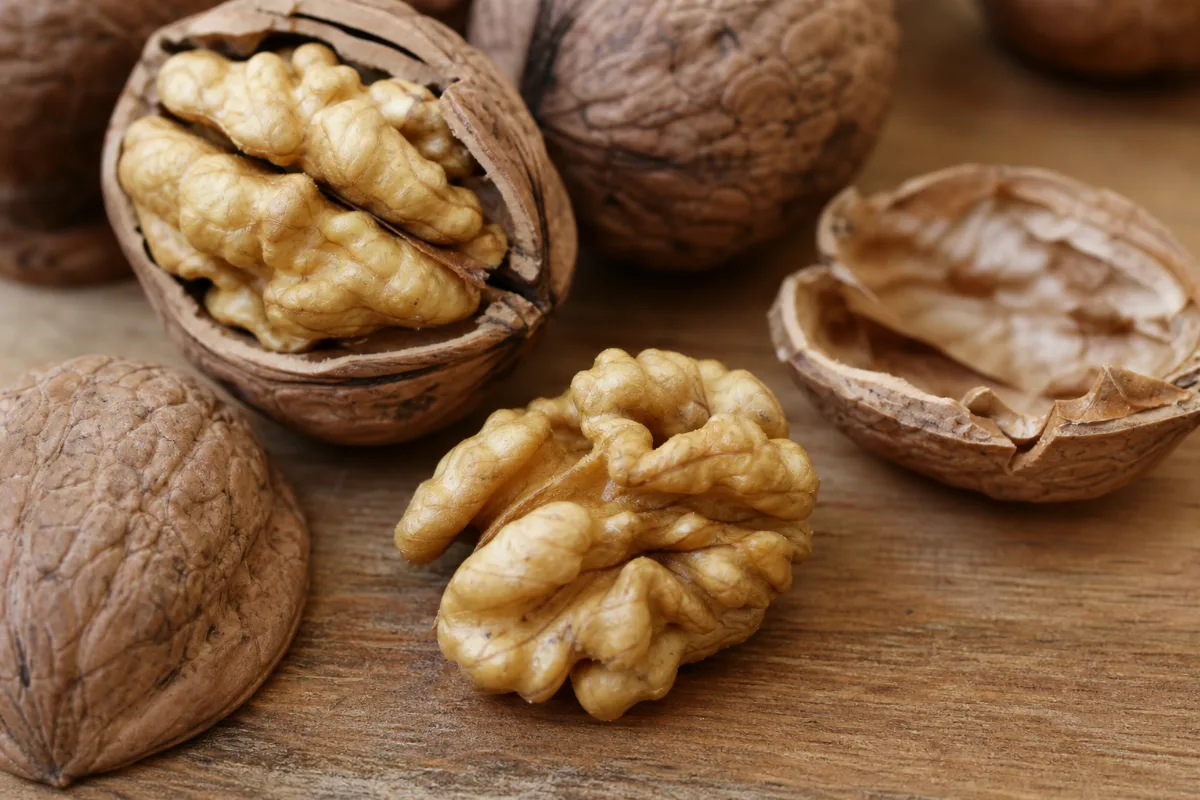
Walnuts are the kernels of the walnut tree and are a tree nut. They are high in unsaturated fat, fibre, copper and manganese, and high in calories. In trials, adding walnuts to the diet lowered LDL cholesterol a little, but did not change blood pressure or body weight, and no trial of walnuts alone has measured heart attacks. The main caution is tree nut allergy, which can be severe and is rarely outgrown.
General information, not medical advice. Last substantive update · Not medically reviewed. A named clinician has not signed off on this page. How this page is made
About Walnuts
Walnuts are the kernels of the walnut tree and a tree nut. They are a food, not a proven remedy: the cholesterol findings are small changes in blood markers, and no trial of walnuts alone has measured heart attacks or strokes.
What they are
The walnut eaten as food is the seed (kernel) of Juglans regia L., a tree in the walnut family, Juglandaceae. It is also called English or Persian walnut. Black walnut is a different species and has its own page.
USDA data for raw shelled walnuts, per 100 g: 654 kcal, 15.23 g protein, 65.21 g fat (47.174 g of it polyunsaturated, 6.126 g saturated), 13.71 g carbohydrate, 6.7 g fibre, 158 mg magnesium, 1.586 mg copper and 3.414 mg manganese. One ounce (28.35 g, about 14 halves) has about 185 kcal. Walnuts are high in calories.
What the research shows
The firmest findings are about blood fats. A 2018 meta-analysis of 26 trials (1,059 people) found walnut diets lowered LDL by 5.51 mg/dL, total cholesterol by 6.99 mg/dL and triglycerides by 4.69 mg/dL, with larger falls against a Western-style diet. A 2022 analysis of 13 trials found similar LDL and total cholesterol falls and a larger triglyceride fall, no change in HDL, and its authors warned of possible bias and considerable heterogeneity. These are blood markers, not heart attacks.
Walnuts did not change blood pressure overall in 18 trials, and trials of walnuts and of nuts in general showed no weight gain. In the 2-year WAHA trial of 708 older adults, walnuts did not improve the main thinking score; an unplanned site result and brain scans were encouraging but not conclusive. One 8-week trial found a walnut diet changed gut bacteria, but not what that means for health, and it was funded by the California Walnut Commission.
For heart events, the nearest evidence is PREDIMED, a large Spanish trial of a Mediterranean diet with mixed nuts, which found fewer major events than a low-fat diet (hazard ratio 0.72). It tested a whole diet, not walnuts alone, and the original report was withdrawn and republished after randomization problems. The FDA allows a qualified claim linking walnuts and coronary heart disease (dated March 9, 2004), which means supportive but not conclusive.
At a glance
Traditional uses history, not proof
- Eaten as a food in many cuisines
- Long use as food is not proof that it treats any condition
Studied for research
- Nutrients, high certainty for the nutrient content
- Blood cholesterol and triglycerides, moderate certainty (blood markers only)
- Heart attacks and strokes, low certainty (whole-diet trial with mixed nuts)
- Blood pressure, evidence against a meaningful effect
- Body weight, moderate certainty of no weight gain in trials
- Thinking and memory, mixed
- Gut bacteria, very low certainty
- Inflammation and blood sugar, mixed
Main compounds
- Polyunsaturated fat
- Fibre
- Copper and manganese
- Magnesium
- Tannins and other polyphenols
Common forms
- Raw shelled walnuts, as food (USDA values read)
- Roasted, salted, in-shell, ground (not compared)
- Walnut oil and extracts are different products and are not covered
Research links: 2018 review: walnuts and blood lipids (26 trials) · 2020 review: walnuts and blood pressure (18 trials) · 2018 review: tree nut allergy · Research Library · Genes & Biomarkers Library
What it is and its history
- Accepted scientific name
- Juglans regia L.
- Naming authority
- L. (GBIF accepted; the tree whose kernel is eaten as walnut)
- Common names
- Walnut (English); English walnut (English); Persian walnut (English); Nuez de nogal (Spanish)
- Family or group
- Juglandaceae (the walnut family), as given by GBIF.
- Classification
- Plantae > Tracheophyta > Magnoliopsida > Fagales > Juglandaceae > Juglans > Juglans regia
- Native range
- Not verified from a source read.
- Habitat
- Not verified from a source read.
- What it looks like
- Roots: Not verified.; Stems: Not verified.; Leaves: Not verified.; Flowers: Not verified.; Fruit: The walnut eaten as food is the seed (kernel) of the tree. USDA gives household portions of 1 oz (14 halves, 28.35 g) and 1 cup shelled halves (100 g).
- Cultivation
- Not verified from a source read.
- Harvest and processing
- Not verified from a source read. USDA lists raw shelled walnuts; roasted, salted, ground and in-shell forms were not read.
- Look-alikes and adulterants
- Name: Black walnut; Note: A different species (Juglans nigra) with its own page; its nutrients and uses differ.; Name: Walnut oil; Note: A different product with its own page; the trials on this page used the nuts, not the oil.; Name: Pecans; Note: A different nut, but highly cross-reactive with walnut in tree nut allergy.
- Sustainability and conservation
- Not assessed.
Photographs
What is inside, and how it may work
What it contains and how those compounds act in cells and animals. Laboratory and animal mechanisms are not proven effects in people.
Main compounds
| Compound | Family | Where it is concentrated | Activity studied | Level of evidence |
|---|---|---|---|---|
| Polyunsaturated fat | fat | Kernel USDA: 47.174 g per 100 g (of 65.21 g total fat) | Replacing other fats with unsaturated fat is the usual explanation offered for lower LDL in diet trials; the walnut trials did not test the mechanism. 20 7 | Human data |
| Fibre | carbohydrate | Kernel USDA: 6.7 g per 100 g | Reaches the gut; its role in the gut-bacteria result was not tested. 20 2 | Human data |
| Copper and manganese | minerals | Kernel USDA: copper 1.586 mg and manganese 3.414 mg per 100 g | Nutrient content only; no trial tested walnut copper or manganese. 20 | Nutrient database |
| Tannins and other plant polyphenols | polyphenols | Kernel Not quantified in the sources read | A 2007 review says natural antioxidants in tree nuts, including tannins, reduced aflatoxin production in lab tests. No effect in people was shown. 11 | Lab |
Mechanisms, receptors and pathways
| Target or pathway | Gene or receptor | What was found | Level |
|---|---|---|---|
| Blood fat handling | Not specified in the sources read | The trials measured blood fats but not how walnuts change them. Because walnuts replaced other foods, part of the effect may come from the swap. 7 1 | Human data |
| Oxidative stress and inflammation | Not specified in the sources read | The WAHA authors cite oxidative stress and inflammation as drivers of cognitive decline that walnuts may counter. The trial did not show that they do. 12 | Human data |
| Gut bacteria | Not specified in the sources read | A walnut diet shifted gut bacteria composition in one trial; the authors say the link to lipid changes still needs to be established. 2 | Human data |
Absorption, metabolism and elimination
- Absorption
- Not found.
- Distribution
- Not found.
- Metabolism
- Not found.
- Elimination
- Not found.
- Bioavailability
- Not established for walnut nutrients in the sources read.
Isolated compounds versus whole extracts
All the blood fat, blood pressure, weight, thinking and gut results on this page are for whole walnuts eaten as food, usually swapped into a diet. The heart-event result is for a whole Mediterranean diet with mixed nuts. Walnut oil, extracts and leaf products are different products and are not covered by these results.
Nutritional composition
Nutrition from USDA FoodData Central (SR Legacy, April 2018 release, FDC 170187 'Nuts, walnuts, english'; values read 2026-10-26 from a saved copy kept in our research folder, because a live fetch was not available). Per 100 g: 654 kcal, 15.23 g protein, 65.21 g fat (6.126 g saturated, 8.933 g monounsaturated, 47.174 g polyunsaturated), 13.71 g carbohydrate (2.61 g sugars), 6.7 g fibre, 98 mg calcium, 2.91 mg iron, 158 mg magnesium, 346 mg phosphorus, 441 mg potassium, 2 mg sodium, 3.09 mg zinc, 3.414 mg manganese, 1.586 mg copper, 4.9 micrograms selenium, 98 micrograms folate (DFE), 0.537 mg vitamin B6. One typical USDA portion of 1 oz (28.35 g, about 14 halves; the 100 g values multiplied by 0.2835): about 185 kcal, 4.3 g protein, 18.5 g fat, 1.9 g fibre, 0.45 mg copper, 0.97 mg manganese and 44.8 mg magnesium. The saved USDA data had no omega-3 (ALA) value, so none is stated. Roasted, salted, in-shell and chopped forms were not compared; check the label for added salt.
1 high certainty2 moderate certainty2 mixed findings1 low certainty1 very low certainty1 evidence against
What was looked at
The 8 benefits and uses checked for Walnuts, each with how strong the evidence is. Tap one to open it.
- Nutrients and healthy fats (nutrient content)High certainty
- Blood cholesterol and triglyceridesModerate certainty
- Heart attacks and strokesLow certainty
- Blood pressureEvidence against
- Body weightModerate certainty
- Thinking and memoryMixed findings
- Gut bacteriaVery low certainty
- Inflammation markers and blood sugarMixed findings
Lab markers tracked in the studies
LDL cholesterolTriglyceridesSystolic blood pressureBody weight
What is Walnuts good for?
The main studied uses and how strong the human evidence is for each. All results are for whole walnuts eaten as food, usually swapped for other foods, not for walnut oil or extracts.
Benefits, one by one
Each card is a research question, not a promise. Tap a goal to filter. Open a card to see the studies, doses and limits.
Nutrients and healthy fats (nutrient content)
High certaintyWalnuts are an energy-dense nut. Per 100 g USDA lists 654 kcal, 15.23 g protein, 65.21 g fat (47.174 g of it polyunsaturated), 6.7 g fibre, and a lot of copper (1.586 mg) and manganese (3.414 mg).
1 studiesRaw shelled walnut halves and pieces (USDA item). Roasted, salted, in…
Studies, doses and limits
What the trials found
No trial was read showing that eating walnuts corrects a nutrient shortage. This is a nutrient fact, not a trial result.
Results
Walnuts are a rich source of polyunsaturated fat, copper and manganese on paper. They are also high in calories.
Effect sizes as reported
USDA per 100 g: 654 kcal; 47.174 g polyunsaturated fat; 6.126 g saturated fat; 6.7 g fibre; 1.586 mg copper; 3.414 mg manganese; 158 mg magnesium. One ounce (28.35 g, 14 halves) is about 185 kcal.
Why this rating
High that the food contains these nutrients (USDA data). Not tested as a treatment for any shortage.
Form and dose studied
Raw shelled walnut halves and pieces (USDA item). Roasted, salted, in-shell, walnut oil and extracts were not read.
Who was studied
General adult diet.
Limits
Nutrient facts from a database, not trials. The saved USDA copy has no omega-3 (ALA) value, so no omega-3 amount is stated here.
Why researchers looked
People eat walnuts for their fat, fibre and minerals, and researchers ask whether swapping them into the diet changes heart risk markers.
Traditional use
Walnuts have been eaten as a food for a long time. Long use as food is not proof that it treats any condition.
Proposed mechanism Nutrient database
These are nutrient amounts in the food, taken from USDA tables.
A proposed mechanism does not show that the effect happens in people.
Tree nut allergy is the main caution; see the Safety tab.
Blood cholesterol and triglycerides
Moderate certaintyIn pooled trials, diets with added walnuts lowered LDL ('bad') cholesterol, total cholesterol and triglycerides a little compared with control diets.
5 studiesWhole walnuts eaten as food. Walnut oil and extracts were not covered.
Studies, doses and limits
What the trials found
Two meta-analyses of walnut trials (26 trials, 1,059 people in 2018; 13 trials in 2022) found lower total cholesterol, LDL and triglycerides. A 2015 analysis of 61 tree nut trials and a 2020 network analysis agree in direction. HDL did not change in the 2022 analysis.
Results
Small average drops in blood fats, larger when walnuts replaced a typical Western diet. These are blood markers, not heart attacks.
Effect sizes as reported
2018: LDL -5.51 mg/dL, total cholesterol -6.99 mg/dL, triglycerides -4.69 mg/dL. 2022: LDL -5.68, total cholesterol -8.58, triglycerides -10.94 mg/dL. Against Western diets (2018): LDL -8.28 mg/dL.
Why this rating
Several meta-analyses of randomized trials agree in direction, but the trials are short, differ in design and comparison diets, and the 2022 authors flag possible bias and considerable heterogeneity. The effect is on markers only.
Form and dose studied
Whole walnuts eaten as food. Walnut oil and extracts were not covered.
Who was studied
Adults, healthy and with other conditions.
Limits
Short trials. Walnuts replaced other foods, so the swap matters. Most abstracts do not state funding; one microbiome trial (see Evidence tab) was part-funded by the California Walnut Commission.
Why researchers looked
Walnuts are rich in unsaturated fat, and blood fats are the usual marker used to judge heart-health effects of a food.
Traditional use
Not a traditional use; this is a modern diet-trial question.
Proposed mechanism Not tested
The trials did not test how this happens. Walnuts replace other foods in the diet, so the effect may come from the swap as much as from the walnuts.
A proposed mechanism does not show that the effect happens in people.
Not for people with tree nut allergy.
Heart attacks and strokes
Low certaintyNo trial of walnuts alone has measured heart attacks or strokes. The nearest evidence is a large Spanish trial of a Mediterranean diet that included mixed nuts.
2 studiesMixed nuts as part of a Mediterranean diet.
Studies, doses and limits
What the trials found
PREDIMED (7,447 people at high heart risk) found fewer major cardiovascular events with a Mediterranean diet plus mixed nuts than with a low-fat control diet. The original 2013 report was withdrawn over randomization problems and republished in 2018.
Results
A Mediterranean diet with mixed nuts had fewer events than the control diet (hazard ratio 0.72). This cannot be credited to walnuts alone.
Effect sizes as reported
Event rate 3.4% (nut group) versus 4.4% (control); hazard ratio 0.72 (95% CI 0.54 to 0.95).
Why this rating
Low for walnuts: the trial tested a whole diet with mixed nuts (the abstract does not say how much was walnuts), had randomization problems, and was stopped early. The FDA label claim (2004) calls the evidence supportive but not conclusive.
Form and dose studied
Mixed nuts as part of a Mediterranean diet.
Who was studied
Spanish adults aged 55 to 80 at high heart risk.
Limits
Not walnut-specific. Randomization problems. Stopped early.
Why researchers looked
Blood fat changes are only markers, so researchers ask whether nut-rich diets change real heart events.
Traditional use
Not a traditional use.
Proposed mechanism Not tested
Not tested. The trial changed a whole diet.
A proposed mechanism does not show that the effect happens in people.
Not for people with tree nut allergy.
Blood pressure
Evidence againstAcross 18 trials, adding walnuts did not change blood pressure overall, and the authors say the evidence does not support walnuts as a way to lower it.
2 studiesWhole walnuts as food.
Studies, doses and limits
What the trials found
A 2020 meta-analysis of 18 trials (1,799 people) found no overall change. A 2018 analysis of 26 trials also found no significant change.
Results
No overall effect. Small subgroup falls (about 0.5 to 1.2 mmHg) were judged too small to matter.
Effect sizes as reported
Systolic +0.08 mmHg (95% CI -0.69 to 0.85); diastolic +0.08 mmHg (-0.26 to 0.42). 2018: systolic -0.72 mmHg, diastolic -0.10 mmHg, neither significant.
Why this rating
Two meta-analyses of trials found no meaningful effect; the authors of the 2020 one say the results do not support walnuts as a blood-pressure strategy.
Form and dose studied
Whole walnuts as food.
Who was studied
Adults.
Limits
Trial designs and comparison diets differed.
Why researchers looked
Unsaturated-fat-rich foods are often tested for blood pressure effects.
Traditional use
Not a traditional use.
Proposed mechanism Not tested
Not applicable: no overall effect was found.
A proposed mechanism does not show that the effect happens in people.
See Safety.
Body weight
Moderate certaintyTrials adding walnuts, and nuts in general, did not make people gain weight, even though walnuts are high in calories.
2 studiesWhole walnuts as food; the 55-trial review is all nuts.
Studies, doses and limits
What the trials found
The 2018 walnut analysis (26 trials) found no significant weight change. A 2021 analysis of 55 trials of nuts in general found no change in weight, BMI or waist size.
Results
No weight gain in trials lasting weeks to months. A small drop in body fat percentage was seen only in nut trials that told people what to swap out.
Effect sizes as reported
Walnuts 2018: weight -0.12 kg (95% CI -2.12 to 1.88). All nuts 2021: weight SMD 0.01 (-0.07 to 0.08) without swap advice; body fat -0.32% (-0.61 to -0.03) with swap advice.
Why this rating
Consistent null findings across two reviews, but trials were short and the larger review pools all nuts.
Form and dose studied
Whole walnuts as food; the 55-trial review is all nuts.
Who was studied
Adults.
Limits
Short trials. Calories still count: this is not a weight-loss claim.
Why researchers looked
Walnuts are energy dense, so people ask whether they cause weight gain.
Traditional use
Not a traditional use.
Proposed mechanism Not tested
Not tested in these trials.
A proposed mechanism does not show that the effect happens in people.
None specific.
Thinking and memory
Mixed findingsThe best trial found no effect of two years of walnuts on a main thinking score in healthy older adults. Observational studies link walnuts to better thinking, which cannot show cause.
2 studiesWhole walnuts as food.
Studies, doses and limits
What the trials found
WAHA (708 healthy older adults, 2 years) found no difference in the global cognition score. A post hoc result at one site and brain scans hinted at benefit in higher-risk groups. A 2021 review found none of 5 cognition trials showed an effect on overall cognition; all 7 observational studies found a link.
Results
No clear effect on thinking in healthy older adults; subgroup hints are unproven.
Effect sizes as reported
WAHA global score change: walnut -0.072 versus control -0.086 (P = 0.491). Barcelona only, post hoc: -0.037 versus -0.097 (P = 0.040).
Why this rating
A well-sized trial was negative on its main outcome; subgroup and observational findings are positive but weaker. Funding of WAHA is not stated in the abstract.
Form and dose studied
Whole walnuts as food.
Who was studied
Cognitively healthy adults aged 63 to 79.
Limits
Post hoc subgroup results are hints. Observational links can be due to other healthy habits.
Why researchers looked
Walnut fats and plant chemicals are linked in lab work to less oxidative stress and inflammation, two drivers of cognitive decline.
Traditional use
Walnuts are sometimes said to resemble the brain. That resemblance is not evidence.
Proposed mechanism Authors suggestion
The WAHA authors suggest oxidative stress and inflammation as pathways; the trial did not prove this.
A proposed mechanism does not show that the effect happens in people.
None specific.
Gut bacteria
Very low certaintyIn one 8-week crossover trial, a walnut diet shifted the make-up of gut bacteria. Whether this changes health was not shown.
1 studiesWhole walnuts as food.
Studies, doses and limits
What the trials found
One randomized crossover trial of 194 healthy adults (stool from 135) found a walnut diet changed bacteria composition by about 5%: Ruminococcaceae and Bifidobacteria rose; Blautia and Anaerostipes fell.
Results
A measurable change in bacteria; no health outcome measured.
Effect sizes as reported
Dissimilarity about 5% (p = 0.02).
Why this rating
One trial, a marker (bacteria) rather than a health result, and funded by the California Walnut Commission (the statement says it had no role in the study).
Form and dose studied
Whole walnuts as food.
Who was studied
Healthy adults, average age 63.
Limits
One trial; effects beyond 8 weeks unknown.
Why researchers looked
Walnut fibre and plant chemicals reach the gut and could feed some bacteria.
Traditional use
Not a traditional use.
Proposed mechanism Authors suggestion
Not tested. The authors suggest the changes may relate to butyric-acid-producing bacteria.
A proposed mechanism does not show that the effect happens in people.
None specific.
Inflammation markers and blood sugar
Mixed findingsTwo reviews disagree a little: one found some inflammation markers fell with walnuts, the other found no significant pooled effect on inflammation or blood sugar control.
2 studiesWhole walnuts as food.
Studies, doses and limits
What the trials found
A 2022 review of 17 trials found lower triglycerides, total cholesterol, LDL and some inflammation markers and no effect on body measurements or blood sugar measures. A 2021 review pooled 27 trials and found no significant effect on glucose control or inflammation.
Results
Mixed for inflammation; no effect on blood sugar measures.
Effect sizes as reported
Sizes not given in the abstracts.
Why this rating
The two reviews differ on inflammation and give no effect sizes in their abstracts.
Form and dose studied
Whole walnuts as food.
Who was studied
Adults, middle-aged and older.
Limits
Abstract-level reading only.
Why researchers looked
Chronic inflammation and blood sugar are linked to heart and brain health.
Traditional use
Not a traditional use.
Proposed mechanism Not tested
Not tested.
A proposed mechanism does not show that the effect happens in people.
None specific.
Connections to the rest of health
How Walnuts connects to the rest of our health knowledge graph. Every link says what kind of connection it is. A safety link (for example to the liver) is a warning, not a benefit. A study that merely mentions a topic never creates a benefit link.
Explore every connection: goals, body systems, organs, symptoms, genes
A. Wellness goals
| Connected to | Kind of connection | Evidence status | Context | Studies |
|---|---|---|---|---|
| Balanced Nutrition | High certainty | Nutrients and healthy fats (nutrient content): Walnuts are an energy-dense nut. Per 100 g USDA lists 654 kcal, 15.23 g protein, 65.21 g fat (47.174 g of it polyunsaturated), 6.7 g fibre, and a lot of copper (1.586 mg) and manganese (3.414 mg). | 20 | |
| Cholesterol Balance | Moderate certainty | Blood cholesterol and triglycerides: In pooled trials, diets with added walnuts lowered LDL ('bad') cholesterol, total cholesterol and triglycerides a little compared with control diets. | 7 1 4 9 10 | |
| Heart Health | Low certainty | Heart attacks and strokes: No trial of walnuts alone has measured heart attacks or strokes. The nearest evidence is a large Spanish trial of a Mediterranean diet that included mixed nuts. | 5 16 | |
| Blood Pressure Support | Evidence against | Blood pressure: Across 18 trials, adding walnuts did not change blood pressure overall, and the authors say the evidence does not support walnuts as a way to lower it. | 8 7 | |
| Weight Management | Moderate certainty | Body weight: Trials adding walnuts, and nuts in general, did not make people gain weight, even though walnuts are high in calories. | 7 6 | |
| Memory Support | Mixed findings | Thinking and memory: The best trial found no effect of two years of walnuts on a main thinking score in healthy older adults. Observational studies link walnuts to better thinking, which cannot show cause. | 12 3 | |
| Gut Health | Very low certainty | Gut bacteria: In one 8-week crossover trial, a walnut diet shifted the make-up of gut bacteria. Whether this changes health was not shown. | 2 | |
| Inflammation Balance | Mixed findings | Inflammation markers and blood sugar: Two reviews disagree a little: one found some inflammation markers fell with walnuts, the other found no significant pooled effect on inflammation or blood sugar control. | 10 3 | |
| Blood Sugar Balance | Mixed findings | Inflammation markers and blood sugar: Two reviews disagree a little: one found some inflammation markers fell with walnuts, the other found no significant pooled effect on inflammation or blood sugar control. | 10 3 |
B. Body systems
| Connected to | Kind of connection | Evidence status | Context | Studies |
|---|---|---|---|---|
| Cardiovascular System | Biological association | High certainty | Studied for: Nutrients and healthy fats (nutrient content) Studied for: Blood cholesterol and triglycerides | 20 7 1 4 9 10 5 16 8 |
| Metabolism Weight | Biological association | Moderate certainty | Studied for: Body weight Studied for: Inflammation markers and blood sugar | 7 6 10 3 |
| Nervous System | Biological association | Mixed findings | Studied for: Thinking and memory | 12 3 |
| Digestive System | Biological association | Very low certainty | Studied for: Gut bacteria | 2 |
E. Health conditions
| Connected to | Kind of connection | Evidence status | Context | Studies |
|---|---|---|---|---|
| Food allergy | Adverse effect or risk | Documented risk | Tree nuts are a major allergen group; allergy is rarely outgrown and walnut and pecan are highly cross-reactive. Preparation or compound: Walnut protein |
15 13 |
| Choking | Adverse effect or risk | Documented risk | Nuts are on the American Academy of Pediatrics list of foods that are a choking risk for young children. Nuts are a choking risk for young children. Preparation or compound: Whole nuts and large pieces |
14 |
| High cholesterol | Preliminary | Walnut-enriched diets lowered LDL a little in pooled trials; not a treatment. Preparation or compound: Whole walnuts |
7 1 |
I. Biomarkers
| Connected to | Kind of connection | Evidence status | Context | Studies |
|---|---|---|---|---|
| LDL cholesterol | Biological association | Moderate certainty | Measured in trials: lowered. A lab change is not the same as a health benefit. | 7 1 |
| Triglycerides | Biological association | Moderate certainty | Measured in trials: lowered. A lab change is not the same as a health benefit. | 7 1 |
| Systolic blood pressure | Biological association | Evidence against | Measured in trials: no meaningful change. A lab change is not the same as a health benefit. | 8 7 |
| Body weight | Biological association | Moderate certainty | Measured in trials: no significant change. A lab change is not the same as a health benefit. | 7 6 |
K. Biological pathways
| Connected to | Kind of connection | Evidence status | Context | Studies |
|---|---|---|---|---|
| Polyunsaturated fat | Preliminary mechanism | Nutrient database | Walnuts are very high in polyunsaturated fat on paper (USDA). | 20 |
| Copper | Preliminary mechanism | Nutrient database | Walnuts are a rich source of copper on paper (USDA). | 20 |
| Manganese | Preliminary mechanism | Nutrient database | Walnuts are a rich source of manganese on paper (USDA). | 20 |
L. Active compounds
| Connected to | Kind of connection | Evidence status | Context | Studies |
|---|---|---|---|---|
| Polyunsaturated fat | Biological association | Human | Replacing other fats with unsaturated fat is the usual explanation offered for lower LDL in diet trials; the walnut trials did not test the mechanism. Preparation or compound: Kernel |
20 7 |
| Fibre | Biological association | Human | Reaches the gut; its role in the gut-bacteria result was not tested. Preparation or compound: Kernel |
20 2 |
| Copper and manganese | Biological association | Nutrient database | Nutrient content only; no trial tested walnut copper or manganese. Preparation or compound: Kernel |
20 |
| Tannins and other plant polyphenols | Biological association | Lab | A 2007 review says natural antioxidants in tree nuts, including tannins, reduced aflatoxin production in lab tests. No effect in people was shown. Preparation or compound: Kernel |
11 |
Each connection is stored with the ingredient, the connected record, the kind of connection, the evidence status, the supporting studies, the preparation or compound involved, and a review date (last reviewed October 26, 2026).
Evidence at a glance: what changed in 2 lab markers
Tap a number to show only those markers. Counts are markers, not people.
The evidence
The research centre for Walnuts. Every record here was checked against PubMed or the publisher's page; we never list a study we have not verified.
Evidence by outcome
Bars show how many studies we found for each outcome, not how well it works. People are added up across trials only (reviews are not added, to avoid double counting).
How we rate evidence
High certainty
Several well-run trials or reviews agree; further research is unlikely to change the picture much.
Moderate certainty
Good trials point the same way, but some doubt remains.
Low certainty
Small, short or inconsistent trials. The finding could change with better research.
Very low certainty
Very little or very weak human data. Treat as a possibility only.
Mixed findings
Trials or reviews disagree with each other.
Not enough evidence
Not enough human research to say either way.
Evidence against
Good research found no benefit, or found harm.
We take the reviewers' own risk-of-bias and GRADE statements where they exist, and otherwise judge from study size, design, consistency, directness and whether a product matches what is sold. Many publications do not make evidence high. Method note: We started from our existing walnuts summary, re-checked nutrition against saved USDA FoodData Central data, read agency pages (FDA, MedlinePlus, NHS, American Academy of Pediatrics) and re-read PubMed abstracts for reviews, a large trial and a few trials. Only abstracts were read for studies. This is a smaller page than some others: items we could not verify are flagged in the research gaps.
Study library: every study we checked 20
| Study | Design | People | Product, dose, length | Result |
|---|---|---|---|---|
| Alshahrani 2022 The Effect of Walnut Intake on Lipids: A Systematic Review and Meta-Analysis of Randomized Controlled Trials. Nutrients · PMID 36364723 · DOI |
Systematic review meta analysis |
13 randomized controlled trials from the US, Europe and Asia (participant total not stated in the abstract) | Walnuts eaten as food Shelled walnut kernels Not given in the abstract Not given in the abstract · vs Control diets |
Walnut intake was linked to lower total cholesterol, LDL and triglycerides and no change in HDL. Overweight or obese people, and people with other conditions, had larger improvements, and longer trials larger changes. Total cholesterol -8.58 mg/dL; LDL -5.68 mg/dL; triglycerides -10.94 mg/dL; HDL no association (Confidence intervals not given in the abstract) Methods, limits and fundingOutcomes: Total cholesterol, LDL, HDL, triglycerides Limitations: The authors say results may be prone to bias from other factors and that heterogeneity was considerable for some outcomes. The 2018 review above found a smaller triglyceride change, so the exact size is uncertain. Funding and conflicts: The abstract states no conflict of interest. Funding is not stated in the abstract. Read: abstract |
| Bamberger 2018 A Walnut-Enriched Diet Affects Gut Microbiome in Healthy Caucasian Subjects: A Randomized, Controlled Trial. Nutrients · PMID 29470389 · DOI |
Randomized crossover trial |
194 Healthy adults (average age 63); stool samples from 135 people |
Walnuts eaten as food, 43 g a day Shelled walnut kernels 43 g a day 8 weeks per diet phase · vs Nut-free diet (crossover) |
Gut bacteria differed by about 5% between the walnut and nut-free diets. Ruminococcaceae and Bifidobacteria rose; Blautia and Anaerostipes fell. Whether this matters for health was not shown. Dissimilarity about 5% (p = 0.02); Ruminococcaceae and Bifidobacteria up (p < 0.02); Clostridium cluster XIVa species down (p < 0.05) (Not given in the abstract) Methods, limits and fundingOutcomes: Gut bacteria make-up and diversity Limitations: Stool samples came from 135 of the 194 people. Changes in bacteria are not health outcomes; the authors say longer-term effects are unknown. Funding and conflicts: Supported by a grant from the California Walnut Commission (industry body), which the statement says had no role in conduct, analysis or writing. Read: abstract |
| Cahoon 2021 Walnut intake, cognitive outcomes and risk factors: a systematic review and meta-analysis. Ann Med · PMID 34132152 · DOI |
Systematic review meta analysis |
32 randomized trial reports and 7 observational reports in adults | Walnuts eaten as food Shelled walnut kernels Varied Varied · vs Control diets or lower intake |
None of 5 cognition trials found an effect on overall cognition (3 found gains in some subgroups). All 7 observational studies linked more walnut intake to better cognition-related outcomes. Pooled results of 27 trials showed no significant effect on glucose control or inflammation markers. No pooled effect size for cognition; tests were too different to combine (Not applicable) Methods, limits and fundingOutcomes: Cognition-related outcomes; glucose control; inflammation Limitations: The authors could not reach a definite conclusion because cognitive tests differed between studies. Observational links cannot show cause. Funding and conflicts: The abstract states no potential conflict of interest. Funding is not stated in the abstract. Read: abstract |
| Del Gobbo 2015 Effects of tree nuts on blood lipids, apolipoproteins, and blood pressure: systematic review, meta-analysis, and dose-response of 61 controlled intervention trials. Am J Clin Nutr · PMID 26561616 · DOI |
Systematic review meta analysis |
2582 61 controlled trials of tree nuts (walnuts, pistachios, macadamia, pecans, cashews, almonds, hazelnuts, Brazil nuts) in adults without cardiovascular disease |
Tree nuts of several kinds eaten as food (walnuts were one of eight) Nut kernels Standardised by the authors to one serving a day (28.4 g); stronger effects reported at higher intakes 3 to 26 weeks · vs Control arms |
Tree nut intake lowered total cholesterol, LDL, ApoB and triglycerides. The authors found the amount mattered more than the type of nut. Per serving a day: total cholesterol -4.7 mg/dL; LDL -4.8 mg/dL; ApoB -3.7 mg/dL; triglycerides -2.2 mg/dL (Total cholesterol -5.3 to -4.0; LDL -5.5 to -4.2; ApoB -5.2 to -2.3; triglycerides -3.8 to -0.5) Methods, limits and fundingOutcomes: Blood lipids, apolipoproteins, blood pressure, C-reactive protein Limitations: All tree nuts pooled, not walnuts alone. Trials were short (3 to 26 weeks). Funding and conflicts: Funding is not stated in the abstract. PubMed lists US NIH extramural support. Read: abstract |
| Estruch 2018 Primary Prevention of Cardiovascular Disease with a Mediterranean Diet Supplemented with Extra-Virgin Olive Oil or Nuts. N Engl J Med · PMID 29897866 · DOI |
Randomized controlled trial corrected republished |
7447 Spanish adults aged 55 to 80 at high cardiovascular risk, without cardiovascular disease at the start |
Mediterranean diet supplemented with mixed nuts (the abstract does not say how much of it was walnuts) Mixed nuts Not given in the abstract Median follow-up 4.8 years · vs Control diet (advice to reduce fat) |
Fewer major cardiovascular events with the Mediterranean diet plus nuts (3.4%) than with the control diet (4.4%). Hazard ratio 0.72 for the nut group versus control (0.54 to 0.95) Methods, limits and fundingOutcomes: Heart attack, stroke or death from cardiovascular causes Limitations: This tests a whole diet with mixed nuts, not walnuts alone. The original 2013 report was withdrawn after problems with randomization and republished in 2018 with analyses that do not rely only on random assignment. The trial was stopped early. Funding and conflicts: Funded by Instituto de Salud Carlos III, the Spanish Ministry of Health and others (per the abstract). Registration: ISRCTN35739639 Read: abstract |
| Guarneiri 2021 Intake of Nuts or Nut Products Does Not Lead to Weight Gain, Independent of Dietary Substitution Instructions: A Systematic Review and Meta-Analysis of Randomized Trials. Adv Nutr · PMID 32945861 · DOI |
Systematic review meta analysis |
55 trials of daily nut intake in adults, longer than 3 weeks (all nuts, not walnuts alone) | Nuts or nut-based snacks and meals Nut kernels Not given in the abstract More than 3 weeks · vs Control diets |
No change in body weight, BMI or waist size, with or without advice to swap nuts for other foods. A small drop in body fat percentage was seen only in trials that gave swap advice. Body weight SMD 0.01 kg (no instructions); -0.01 kg (with instructions); body fat -0.32% with instructions (Weight -0.07 to 0.08 and -0.11 to 0.09; body fat -0.61 to -0.03) Methods, limits and fundingOutcomes: Body weight, BMI, waist, body fat percentage Limitations: All nuts pooled. Trial methods and reporting varied. Funding and conflicts: Funding is not stated in the abstract. PubMed lists non-US government research support. Read: abstract |
| Guasch-Ferre 2018 Effects of walnut consumption on blood lipids and other cardiovascular risk factors: an updated meta-analysis and systematic review of controlled trials. Am J Clin Nutr · PMID 29931130 · DOI |
Systematic review meta analysis |
1059 26 controlled trials of walnut-enriched diets versus control diets in adults |
Walnuts eaten as food, added to the diet Shelled walnut kernels Amounts not given in the abstract Not given in the abstract · vs Control diets (including usual American and Western diets) |
Walnut diets lowered total cholesterol, LDL and triglycerides compared with control diets, with larger falls against American or Western diets. No significant change in weight or blood pressure. Total cholesterol -6.99 mg/dL; LDL -5.51 mg/dL; triglycerides -4.69 mg/dL; versus Western diets LDL -8.28 mg/dL; weight -0.12 kg (not significant); systolic pressure -0.72 mmHg (not significant); diastolic -0.10 mmHg (not significant) (Total cholesterol -9.39 to -4.58; LDL -7.72 to -3.29; triglycerides -8.93 to -0.45; LDL vs Western diets -13.04 to -3.51; weight -2.12 to 1.88; systolic -2.75 to 1.30) Methods, limits and fundingOutcomes: Total and LDL cholesterol, triglycerides, apolipoproteins, body weight, blood pressure Limitations: Pooled trials differ in design and length. Blood markers, not heart attacks or strokes. Walnut diets swapped one food for another, so the effect belongs to the whole swap. Funding and conflicts: Funding is not stated in the abstract. PubMed lists US NIH and non-US government research support; the sponsor is not named in the abstract. Read: abstract |
| Li 2020 Effects of walnut intake on blood pressure: A systematic review and meta-analysis of randomized controlled trials. Phytother Res · PMID 32510725 · DOI |
Systematic review meta analysis |
1799 18 randomized trials comparing walnut-enriched diets with control diets |
Walnuts eaten as food Shelled walnut kernels Subgroups by amount (up to 40 g a day) and length are reported in the abstract 8 weeks or longer in one subgroup · vs Control diets |
Walnuts did not change blood pressure overall. Small subgroup falls were statistically significant but the authors judged them too small to matter clinically. Systolic WMD 0.08 mmHg; diastolic WMD 0.08 mmHg (overall); subgroup falls of about 0.5 to 1.2 mmHg (Systolic -0.69 to 0.85; diastolic -0.26 to 0.42 (overall)) Methods, limits and fundingOutcomes: Systolic and diastolic blood pressure Limitations: Authors conclude the review does not support walnuts as a blood-pressure-lowering strategy. Funding and conflicts: Funding is not stated in the abstract. Read: abstract |
| Liu 2020 Comparative effects of different types of tree nut consumption on blood lipids: a network meta-analysis of clinical trials. Am J Clin Nutr · PMID 31773150 · DOI |
Network meta analysis |
1677 34 trials comparing walnut, pistachio, hazelnut, cashew and almond diets with control diets |
Walnut-enriched and other tree nut diets Nut kernels Not given in the abstract Not given in the abstract · vs Control diets and other nuts |
Pistachio and walnut diets were better than control diets at lowering triglycerides, LDL and total cholesterol. Walnuts ranked second for triglycerides and total cholesterol; almonds ranked second for LDL. Rankings, not single effect sizes, are given in the abstract (Not given in the abstract) Methods, limits and fundingOutcomes: Triglycerides, LDL, total cholesterol, HDL Limitations: The authors rate the evidence quality as low and note the small number and poor reporting of trials. Registered at PROSPERO CRD42019131128. Funding and conflicts: Funding is not stated in the abstract. Registration: PROSPERO CRD42019131128 Read: abstract |
| Mates 2022 Walnut Intake Interventions Targeting Biomarkers of Metabolic Syndrome and Inflammation in Middle-Aged and Older Adults: A Systematic Review and Meta-Analysis of Randomized Controlled Trials. Antioxidants (Basel) · PMID 35883903 · DOI |
Systematic review meta analysis |
17 randomized trials (11 crossover, 6 parallel) in middle-aged and older adults | Walnuts eaten as food Shelled walnut kernels Not given in the abstract Not given in the abstract · vs Control diets |
Walnut diets lowered triglycerides, total cholesterol and LDL and some inflammation markers, with no effect on body measurements or blood sugar measures. Direction of effect only in the abstract (Not given in the abstract) Methods, limits and fundingOutcomes: 22 metabolic syndrome and inflammation markers Limitations: The authors ask for better-designed studies. This review says some inflammation markers fell; the 2021 review above found no significant pooled effect on inflammation, so the picture is mixed. Funding and conflicts: The abstract states no conflict of interest. Funding is not stated in the abstract. Read: abstract |
| Molyneux 2007 Mycotoxins in edible tree nuts. Int J Food Microbiol · PMID 17719114 · DOI |
Narrative review n/a |
Review of mould toxins in almonds, pistachios and walnuts | Tree nuts including walnuts Nut kernels |
Tree nuts including walnuts can be contaminated with aflatoxins or ochratoxins, with aflatoxins the main worry. Natural antioxidants in tree nuts (such as tannins) reduced aflatoxin production in lab tests. No contamination figures in the abstract (Not applicable) Methods, limits and fundingOutcomes: Aflatoxin and ochratoxin contamination Limitations: A 2007 review focused on the California crop and export limits. No walnut-specific contamination figures were in the abstract. Lab findings are not findings in people. Funding and conflicts: Funding is not stated in the abstract. Read: abstract |
| Sala-Vila 2020 Effect of a 2-year diet intervention with walnuts on cognitive decline. The Walnuts And Healthy Aging (WAHA) study: a randomized controlled trial. Am J Clin Nutr · PMID 31912155 · DOI |
Randomized controlled trial |
708 Cognitively healthy older adults aged 63 to 79 in Barcelona and Loma Linda |
Walnuts eaten as food, about 15% of daily energy (30 to 60 g a day) Shelled walnut kernels About 15% of energy (30 to 60 g a day) in the trial 2 years · vs Control diet that avoided walnuts |
No difference between groups in the main cognition score. A post hoc, unplanned result in the Barcelona site favoured walnuts, and brain scans hinted at an effect in higher-risk groups. The authors call this encouraging but inconclusive. Walnut group -0.072 versus control -0.086 on the global score (P = 0.491); Barcelona only (post hoc) -0.037 versus -0.097 (P = 0.040) (Walnut -0.100 to -0.043; control -0.115 to -0.057) Methods, limits and fundingOutcomes: Change in a global cognition score; brain MRI in a subset Limitations: The positive result was a site-by-site, post hoc analysis, so it is a hint only. Participants knew which diet they were on. Funding and conflicts: Funding is not stated in the abstract or the PubMed record. Our earlier notes say the California Walnut Commission supported part of the trial; that was not re-checked here. Registration: ClinicalTrials.gov NCT01634841 Read: abstract |
| Smeekens 2018 Tree nut allergies: Allergen homology, cross-reactivity, and implications for therapy. Clin Exp Allergy · PMID 29700869 · DOI |
Narrative review |
Review of tree nut allergy literature | Tree nuts including walnut Nut kernels |
Tree nut allergy can be life-threatening, affects about 1% of the US population and is outgrown in under 10% of cases. Walnut and pecan are highly cross-reactive, as are cashew and pistachio. Strict avoidance of all tree nuts is the current guideline once one tree nut allergy is diagnosed. About 1% of the US population; outgrown in under 10% (Not applicable) Methods, limits and fundingOutcomes: Tree nut allergy prevalence, outgrowing, cross-reactivity Limitations: A narrative review, not a systematic one. The extent of cross-reaction among other tree nuts is unclear. No large trials of treatments for tree nut allergy. Funding and conflicts: Funding is not stated in the abstract. Read: abstract |
| s-aap-choking American Academy of Pediatrics (HealthyChildren.org): Choking Prevention · Source |
Health agency n/a |
Methods, limits and fundingRead: full-text | ||
| s-fda-allergens US FDA: Food Allergies · Source |
Regulator n/a |
Methods, limits and fundingRead: full-text | ||
| s-fda-qhc US FDA: Qualified Health Claims: Letters of Enforcement Discretion (list) · Source |
Regulator n/a |
Methods, limits and fundingRead: full-text | ||
| s-gbif-juglans-regia GBIF Backbone: Juglans regia L. (usageKey 3054368) · Source |
Reference database n/a |
Methods, limits and fundingRead: full-text | ||
| s-medlineplus-foodallergy MedlinePlus: Food allergy · Source |
Health agency n/a |
Methods, limits and fundingRead: full-text | ||
| s-nhs-foods-to-avoid NHS: Foods to avoid in pregnancy · Source |
Health agency n/a |
Methods, limits and fundingRead: full-text | ||
| s-usda-fdc-170187 USDA FoodData Central: Nuts, walnuts, english (FDC 170187, SR Legacy, April 2018) · Source |
Reference database n/a |
Methods, limits and fundingRead: full-text |
What we do not know yet
- No trial of walnuts alone with heart attacks or strokes as the outcome was found.
- Cholesterol trials were short, and the 2022 authors flag possible bias and considerable heterogeneity.
- The gut bacteria result comes from one industry-funded trial and shows a marker, not a health result.
- The omega-3 (ALA) content, history, cultivation and processing were not read from a source.
- Walnuts and breastfeeding, kidney stones (oxalate), gout, FODMAP and walnut-specific allergy and contamination figures were not researched.
- The FDA claim letter itself was not opened; only its title and date.
How new research is added
New studies are found by a saved PubMed search and placed in a review queue before the page changes.
Lab markers
What changed in blood or saliva tests during trials. A changed number is not the same as feeling or being healthier, and we give no "normal ranges".
Metabolic 3
LDL cholesterol
Lowered in trials
The 'bad' cholesterol carried in the blood. Higher levels are linked to more heart disease.
Moderate certaintyResults and what it means
Why it was measured
It is the usual blood marker used in diet trials for heart risk.
Statistical vs. clinical meaning
A small average fall, from adding walnuts to a diet, in short trials.
Safety implication
None specific except tree nut allergy.
Triglycerides
Lowered in trials
A type of fat carried in the blood.
Moderate certaintyResults and what it means
Why it was measured
High levels are a heart-risk marker.
Statistical vs. clinical meaning
Lower in both reviews, but the size differs between them, so the exact amount is uncertain.
Safety implication
None specific except tree nut allergy.
Body weight
No significant change in trials
Weight in kilograms.
Moderate certaintyResults and what it means
Why it was measured
Walnuts are high in calories, so weight is the obvious thing to watch.
Statistical vs. clinical meaning
No weight gain seen in trials lasting weeks to months.
Safety implication
None.
Other 1
Systolic blood pressure
No meaningful change in trials
The top number of a blood pressure reading.
Evidence againstResults and what it means
Why it was measured
High blood pressure raises the risk of heart attack and stroke.
Statistical vs. clinical meaning
No meaningful change.
Safety implication
None.
Safety
What studies and official sources say about side effects, medicines and who should check first. Each point shows what kind of evidence it comes from.
Main points to know 4
- Walnuts are a tree nut: a major food allergen. The US FDA lists tree nuts among the nine major food allergens and says labels must name the type, for example walnuts. A review says tree nut allergy can be life-threatening, affects about 1% of people in the US and is outgrown in under 10% of cases. If you have a tree nut allergy, walnuts are not safe for you. Authoritative guidance 15 13 18
- Walnut and pecan are highly cross-reactive. The same review says walnut and pecan are highly cross-reactive, as are cashew and pistachio. The guideline it describes is strict avoidance of all tree nuts once one tree nut allergy is diagnosed. Ask an allergist about your own case. Narrative review 13
- Choking risk for young children. The American Academy of Pediatrics lists nuts and seeds among foods to avoid or modify for young children and advises keeping high-risk foods from children until 4 years or older, depending on the child. Authoritative guidance 14
- Mould toxins in stored nuts. A review says tree nuts including walnuts can be contaminated with aflatoxins or ochratoxins, mould toxins, and that aflatoxins are of special concern. It gave no walnut-specific amounts. Throw out nuts that look mouldy, shrivelled or taste bitter or musty. Narrative review 11
Side effects 2
| Effect | How often | Severity and recovery | Evidence |
|---|---|---|---|
| Allergic reactions, from itching and hives to anaphylaxis Prevalence is for tree nuts as a group, not walnuts alone. | Tree nut allergy about 1% of the US population (review). Walnut-specific figures were not found. | can be severe (anaphylaxis) Outgrown in under 10% of tree nut allergy cases (review). | Narrative review 13 18 15 |
| Extra calories if walnuts are added to the diet on top of other foods Walnuts are energy dense (654 kcal per 100 g, USDA). | No weight gain was seen in trials (see Benefits). | mild Not applicable | Meta-analysis 20 7 6 |
Liver
No liver injury from eating walnuts was found in the sources read. A liver-safety source (such as LiverTox) was not searched.
How often. No frequency was found.
Monitoring. No agency monitoring advice was found.
This is a safety connection. It is not evidence that Walnuts supports liver health.
Medicines and supplements 1
| With | Why it matters | Importance | Evidence | What to do |
|---|---|---|---|---|
| Medicines in general prescription | No walnut-medicine interaction was found in the sources read. This is absence of evidence, not proof of safety. Specific medicines (for example blood thinners or thyroid tablets) were not researched for walnuts. | None found Not enough evidence | If you take medicines and eat walnuts often, ask your pharmacist. |
Who should check first 4
| Situation | Advice | Evidence |
|---|---|---|
| Known or suspected tree nut allergy | Avoid walnuts and read labels. Ask an allergist about your own case, including other tree nuts. For trouble breathing or swelling of the face, lips or throat, use prescribed epinephrine and call 911 or your local emergency number. | Authoritative guidance 15 13 18 |
| Young children | Whole nuts and large pieces are a choking risk. Ask your child's doctor about when and how to serve nuts. | Authoritative guidance 14 |
| Pregnancy | The NHS says nuts are safe to eat in pregnancy unless a doctor or midwife has told you not to (for example for allergy). This is about nuts as food, not walnut supplements. | Authoritative guidance 19 |
| Breastfeeding | No source on walnuts and breastfeeding was read. Ask your doctor or midwife if you have questions or a family history of allergy. | None found |
Overdose, product quality and regulators
Summary. No toxicity from walnuts eaten as ordinary food was found in the sources read. The safety points are allergy, choking in young children and mould toxins in poorly stored nuts.
Animal. Not reviewed.
High dose or long term signals. The 2-year WAHA trial reported that walnuts were well tolerated.
Overdose response. Not found.
Genotoxicity. Not researched.
Mould toxins are the contamination topic with a source. Heavy metals, pesticides and rancidity were not researched.
Aflatoxins and ochratoxins. A 2007 review says tree nuts including walnuts can be contaminated with aflatoxins or ochratoxins, with aflatoxins of special concern because of strict regulatory limits. No walnut-specific amounts were in the abstract. 11
| Body | Action | Date |
|---|---|---|
| US FDA (United States) | Food Allergies: tree nuts are one of nine major food allergens; the type of tree nut (for example walnuts) must be named on labels. source | 2026-03-11 |
| US FDA (United States) | Qualified health claim letter 'Walnuts and Coronary Heart Disease', dated March 9, 2004. A 'qualified' claim means the FDA judged the evidence supportive but not conclusive. source | 2004-03-09 |
| NHS (UK) (United Kingdom) | Foods to avoid in pregnancy: peanuts and other nuts are safe to eat unless you have been told not to have them. source | 2026-06-15 |
When to get medical help
- Trouble breathing, wheezing, swelling of the lips, face, tongue or throat, widespread hives, repeated vomiting, dizziness or collapse after eating walnuts or another nut (possible anaphylaxis): use epinephrine if prescribed, then call 911 or your local emergency number
- A young child who is choking on a nut: start choking first aid and call 911 or your local emergency number
Stop using the product and contact a clinician or emergency service. In the US, Poison Control is 1-800-222-1222.
General information only, not medical advice. Ask a clinician or pharmacist before use, especially with medicines, in pregnancy or with a health condition. See the Natural Remedy Safety guide.
Frequently asked questions
What are walnuts?
Do walnuts lower cholesterol?
Do walnuts protect the heart?
Do walnuts lower blood pressure?
A 2020 meta-analysis of 18 trials found no overall change in blood pressure and does not support walnuts as a way to lower it.
Will walnuts make me gain weight?
Do walnuts help memory?
Do walnuts change gut bacteria?
In one 8-week trial of 194 people, a walnut diet changed the make-up of gut bacteria. What this means for health was not shown, and the trial was funded by the California Walnut Commission.
Can I eat walnuts if I have a tree nut allergy?
Is tree nut allergy outgrown?
Rarely. A review says tree nut allergy is outgrown in fewer than 10% of cases and can be life-threatening.
Are walnuts safe for young children?
Whole nuts are a choking risk. The American Academy of Pediatrics advises keeping high-risk foods from children until 4 years or older, depending on the child. Ask your child's doctor.
Are walnuts safe in pregnancy?
The NHS says nuts are safe to eat in pregnancy unless a doctor or midwife has told you not to, for example because of an allergy.
Do walnuts interact with medicines?
No interaction between walnuts as food and medicines was found in the sources we read. That is not proof there is none, so ask your pharmacist if you have a concern.
Is walnut oil or a walnut extract the same as eating walnuts?
No. The trials here used the nuts eaten as food. Walnut oil has its own page, and extracts were not covered.
Explore by health goal
Balanced NutritionCholesterol BalanceHeart HealthBlood Pressure SupportWeight ManagementMemory SupportGut HealthInflammation BalanceBlood Sugar Balance
Editorial transparency
- Written by
- AlternativeMed editorial team. Research compiled with AI assistance, then checked against the sources listed.
- Medical review
- None. This page has not been reviewed by a physician or pharmacist.
- First published
- 2026-10-26
- Last substantive update
- 2026-10-26
- How we research
- We started from our existing walnuts summary, re-checked nutrition against saved USDA FoodData Central data, read agency pages (FDA, MedlinePlus, NHS, American Academy of Pediatrics) and re-read PubMed abstracts for reviews, a large trial and a few trials. Only abstracts were read for studies. This is a smaller page than some others: items we could not verify are flagged in the research gaps.
- How we rate evidence
- See "How we rate evidence" in the Evidence tab.
- Independence
- No product is promoted on this page. No affiliate links are shown. One gut-bacteria trial cited was funded by the California Walnut Commission; this is stated where it is used.
Sources 20
Each source was opened and checked. Where we read only the abstract, it says so. The small numbers in the text point here.
- Alshahrani SM, Mashat RM, Almutairi D, et al.. The Effect of Walnut Intake on Lipids: A Systematic Review and Meta-Analysis of Randomized Controlled Trials.. Nutrients. 2022. PMID 36364723. DOI 10.3390/nu14214460. (abstract)
- Bamberger C, Rossmeier A, Lechner K, et al.. A Walnut-Enriched Diet Affects Gut Microbiome in Healthy Caucasian Subjects: A Randomized, Controlled Trial.. Nutrients. 2018. PMID 29470389. DOI 10.3390/nu10020244. (abstract)
- Cahoon D, Shertukde SP, Avendano EE, et al.. Walnut intake, cognitive outcomes and risk factors: a systematic review and meta-analysis.. Ann Med. 2021. PMID 34132152. DOI 10.1080/07853890.2021.1925955. (abstract)
- Del Gobbo LC, Falk MC, Feldman R, Lewis K, Mozaffarian D. Effects of tree nuts on blood lipids, apolipoproteins, and blood pressure: systematic review, meta-analysis, and dose-response of 61 controlled intervention trials.. Am J Clin Nutr. 2015. PMID 26561616. DOI 10.3945/ajcn.115.110965. (abstract)
- Estruch R, Ros E, Salas-Salvado J, et al.; PREDIMED Study Investigators. Primary Prevention of Cardiovascular Disease with a Mediterranean Diet Supplemented with Extra-Virgin Olive Oil or Nuts.. N Engl J Med. 2018. PMID 29897866. DOI 10.1056/NEJMoa1800389. (abstract)
- Guarneiri LL, Cooper JA. Intake of Nuts or Nut Products Does Not Lead to Weight Gain, Independent of Dietary Substitution Instructions: A Systematic Review and Meta-Analysis of Randomized Trials.. Adv Nutr. 2021. PMID 32945861. DOI 10.1093/advances/nmaa113. (abstract)
- Guasch-Ferre M, Li J, Hu FB, Salas-Salvado J, Tobias DK. Effects of walnut consumption on blood lipids and other cardiovascular risk factors: an updated meta-analysis and systematic review of controlled trials.. Am J Clin Nutr. 2018. PMID 29931130. DOI 10.1093/ajcn/nqy091. (abstract)
- Li J, Jiang B, O Santos H, Santos D, Singh A, Wang L. Effects of walnut intake on blood pressure: A systematic review and meta-analysis of randomized controlled trials.. Phytother Res. 2020. PMID 32510725. DOI 10.1002/ptr.6740. (abstract)
- Liu K, Hui S, Wang B, Kaliannan K, Guo X, Liang L. Comparative effects of different types of tree nut consumption on blood lipids: a network meta-analysis of clinical trials.. Am J Clin Nutr. 2020. PMID 31773150. DOI 10.1093/ajcn/nqz280. (abstract)
- Mates L, Popa DS, Rusu ME, Fizesan I, Leucuta D. Walnut Intake Interventions Targeting Biomarkers of Metabolic Syndrome and Inflammation in Middle-Aged and Older Adults: A Systematic Review and Meta-Analysis of Randomized Controlled Trials.. Antioxidants (Basel). 2022. PMID 35883903. DOI 10.3390/antiox11071412. (abstract)
- Molyneux RJ, Mahoney N, Kim JH, Campbell BC. Mycotoxins in edible tree nuts.. Int J Food Microbiol. 2007. PMID 17719114. DOI 10.1016/j.ijfoodmicro.2007.07.028. (abstract)
- Sala-Vila A, Valls-Pedret C, Rajaram S, et al.. Effect of a 2-year diet intervention with walnuts on cognitive decline. The Walnuts And Healthy Aging (WAHA) study: a randomized controlled trial.. Am J Clin Nutr. 2020. PMID 31912155. DOI 10.1093/ajcn/nqz328. (abstract)
- Smeekens JM, Bagley K, Kulis M. Tree nut allergies: Allergen homology, cross-reactivity, and implications for therapy.. Clin Exp Allergy. 2018. PMID 29700869. DOI 10.1111/cea.13163. (abstract)
- . American Academy of Pediatrics (HealthyChildren.org): Choking Prevention. . . (full-text)
- . US FDA: Food Allergies. . . (full-text)
- . US FDA: Qualified Health Claims: Letters of Enforcement Discretion (list). . . (full-text)
- . GBIF Backbone: Juglans regia L. (usageKey 3054368). . . (full-text)
- . MedlinePlus: Food allergy. . . (full-text)
- . NHS: Foods to avoid in pregnancy. . . (full-text)
- . USDA FoodData Central: Nuts, walnuts, english (FDC 170187, SR Legacy, April 2018). . . (full-text)


