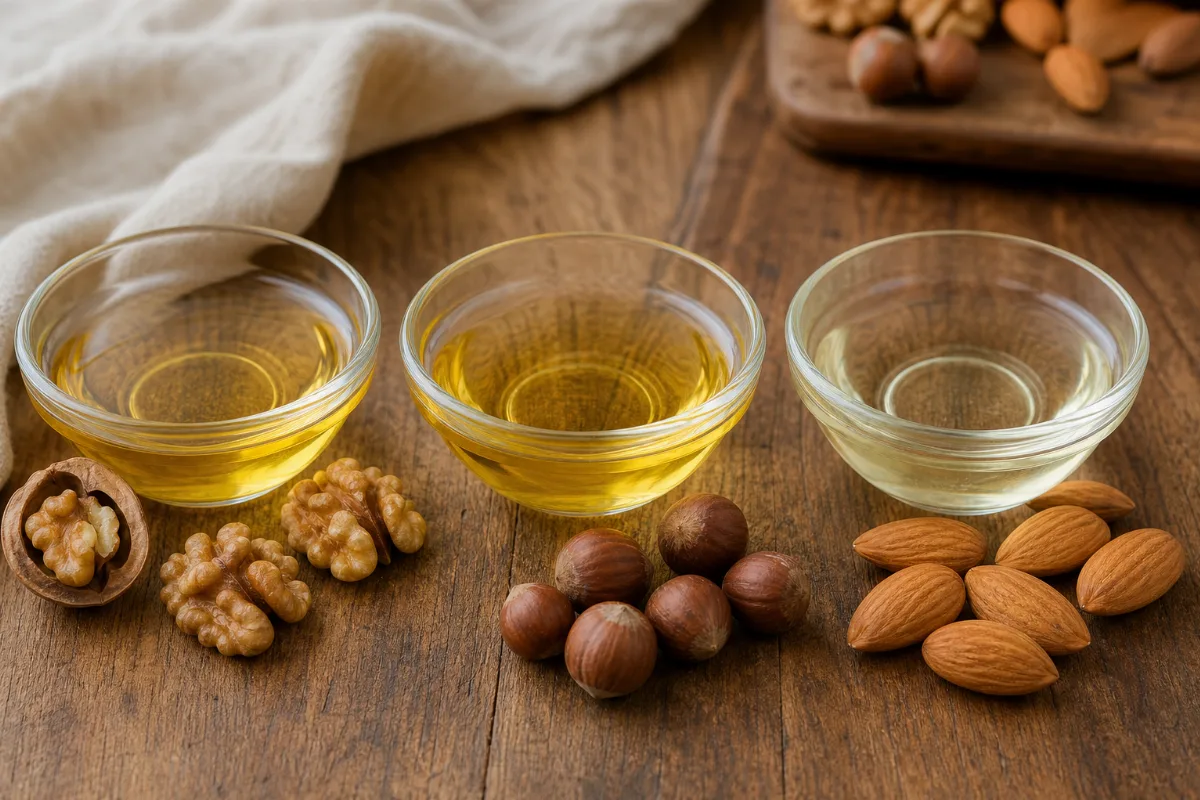
Oils & Fats · Cooking oil
Walnut & Other Nut Oils
Juglans regia, Corylus avellana, Prunus dulcis (nut oils) · also called Walnut oil, hazelnut oil, almond oil, aceite de nuez, aceite de avellana, aceite de almendra
Walnut, hazelnut and almond oils are cooking oils pressed from tree nuts. They are pure fat, about 120 kcal a tablespoon. Small trials of walnut oil found lower cholesterol, triglycerides and blood sugar, but all came from one research group. The main caution is tree nut allergy, which can be severe.
General information, not medical advice. Last substantive update · Not medically reviewed. A named clinician has not signed off on this page. How this page is made
About Walnut & Other Nut Oils
Walnut, hazelnut and almond oils are cooking oils pressed from tree nuts. They are pure fat and very energy dense. They are foods, not proven remedies: the cholesterol and blood sugar findings come from small walnut oil trials, and the main safety issue is tree nut allergy.
What it is
Walnut oil, hazelnut oil and almond oil are pressed from walnuts, hazelnuts and almonds. They are used in dressings, for finishing dishes and in baking. This page covers the oils as foods. Whole nuts, and sweet almond oil sold for skin, are different products.
USDA data per 100 g: 884 kcal and 100 g of fat in each, with no protein, carbohydrate or fibre. Walnut oil has 9.1 g saturated, 22.8 g monounsaturated and 63.3 g polyunsaturated fat. Hazelnut oil has 7.4 g saturated, 78.0 g monounsaturated and 10.2 g polyunsaturated fat, and 47.2 mg vitamin E. Almond oil has 8.2 g saturated, 69.9 g monounsaturated and 17.4 g polyunsaturated fat, and 39.2 mg vitamin E. One tablespoon (13.6 g) of any of them is about 120 kcal.
What the research shows
The best human evidence is for walnut oil, and it is small. In 2003, 60 people with raised blood fats took walnut oil capsules or placebo for 45 days, and triglycerides fell by 19% to 33%. In 2017, 100 people with type 2 diabetes and raised blood fats took walnut oil or placebo for 90 days; total cholesterol, triglycerides and LDL were lower with walnut oil. In 2016, 100 people with type 2 diabetes who added walnut oil for 3 months had lower HbA1c (7.00 to 6.37) and fasting blood sugar, while a group given nothing did not change. All three trials came from the same research centre, and no independent repeat was found.
In 22 healthy adults, almond oil and whole almonds each replacing about half of usual fat gave small falls in triglycerides, total cholesterol and LDL versus baseline. A small trial of hazelnut oil capsules mixed the capsule with a diet change, so the oil's own effect is unclear. A pooled analysis of 36 trials of whole walnuts found no overall change in blood pressure; it was not about the oil. No study of heart attacks, strokes or cancer with these oils was found.
The firmest guidance is about fat in general: the American Heart Association says replacing saturated fat with unsaturated fat lowers LDL cholesterol and cardiovascular disease, and WHO says unsaturated fat is preferable to saturated fat.
Food versus other forms
The cholesterol and blood sugar findings are for walnut oil taken as capsules or added to the diet. The blood pressure and artery results are for whole walnuts, which also bring fibre and protein. Cold-pressed and refined oils differ in what they keep, and sweet almond oil sold for skin is a different product.
At a glance
Traditional uses history, not proof
- Used in dressings, for finishing dishes and in baking
- Long use as food is not proof that it treats any condition
Studied for research
- Nutrient content (fat types, calories, vitamin E), high certainty
- Cholesterol and triglycerides (walnut oil), low certainty
- Blood sugar in type 2 diabetes (walnut oil), low certainty
- Almond oil and blood fats in healthy adults, low certainty
- Swapping saturated fat for unsaturated oil, moderate certainty (not tested with these oils on their own)
- Hazelnut oil capsules, insufficient evidence
- Blood pressure and artery function (whole walnuts, not the oil), insufficient for the oil
Main compounds
- Polyunsaturated fat (walnut oil)
- Monounsaturated fat (hazelnut and almond oils)
- Saturated fat
- Vitamin E (hazelnut and almond oils)
- Plant sterols
Common forms
- Walnut, hazelnut and almond oil as food (USDA values read)
- Cold-pressed versus refined oil (nutrient values not read)
- Walnut and hazelnut oil capsules, used in small trials (not food)
- Whole nuts and sweet almond oil for skin are different products and are not covered
Research links: 2017 randomised trial of walnut oil on blood fats in type 2 diabetes · 2016 randomised trial of walnut oil on blood sugar · 2025 review of tree nut and seed allergies · Research Library · Genes & Biomarkers Library
What it is and its history
- Accepted scientific name
- Walnut oil (Juglans regia L.), hazelnut oil (Corylus avellana) and almond oil (Prunus dulcis)
- Naming authority
- The authority "L." is written for Juglans regia in the walnut abstracts read; no authority was read for hazelnut or almond.
- Common names
- Walnut oil (English); Hazelnut oil (English); Almond oil (English); Tree nut oils (English); Aceite de nuez, aceite de avellana, aceite de almendra (Spanish (our translation))
- Family or group
- Not verified from a source read. These oils are processed foods, not plants.
- Classification
- Juglans regia; Corylus avellana; Prunus dulcis
- Native range
- Not verified from a source read.
- Habitat
- Not verified from a source read.
- What it looks like
- Roots: Not verified.; Stems: Not verified.; Leaves: Not verified.; Flowers: Not verified.; Fruit: The oils are pressed from the nuts (walnuts, hazelnuts, almonds). A walnut abstract calls the walnut a source of bioactive compounds.
- Cultivation
- Not verified from a source read.
- Harvest and processing
- Not read in detail. A 2026 systematic review describes cold pressing as a mechanical method without heat and solvents that keeps more polyunsaturated fat, antioxidants and vitamins than refining. Highly refined oils were not described.
Photographs
What is inside, and how it may work
What it contains and how those compounds act in cells and animals. Laboratory and animal mechanisms are not proven effects in people.
Main compounds
| Compound | Family | Where it is concentrated | Activity studied | Level of evidence |
|---|---|---|---|---|
| Total fat | fat | Nut oil USDA per 100 g: 100 g in all three oils | Gives 884 kcal per 100 g and about 120 kcal per tablespoon. 15 17 16 | Chemistry |
| Saturated fat | fat | Nut oil USDA per 100 g: walnut 9.1 g, hazelnut 7.4 g, almond 8.2 g | The AHA links replacing saturated with unsaturated fat to lower LDL. 15 17 16 9 | Human data |
| Monounsaturated fat | unsaturated fat | Nut oil USDA per 100 g: walnut 22.8 g, hazelnut 78.0 g, almond 69.9 g | Hazelnut and almond oils are mostly monounsaturated. 15 17 16 | Chemistry |
| Polyunsaturated fat | unsaturated fat | Nut oil USDA per 100 g: walnut 63.3 g, hazelnut 10.2 g, almond 17.4 g | Walnut oil is mostly polyunsaturated; oils rich in these fats are prone to oxidation. 15 17 16 2 | Chemistry |
| Vitamin E (alpha-tocopherol) | vitamin | Nut oil USDA per 100 g: walnut 0.4 mg, hazelnut 47.2 mg, almond 39.2 mg | Hazelnut and almond oils are rich sources; walnut oil gives almost none. 15 17 16 | Chemistry |
| Plant sterols (phytosterols) | sterol | Nut oil USDA per 100 g: walnut 176 mg, hazelnut 120 mg, almond 266 mg | Listed by USDA; no trial of their effect from these oils was read. 15 17 16 | Chemistry |
| Vitamin K (phylloquinone) | vitamin | Nut oil USDA per 100 g: walnut 15 micrograms, almond 7 micrograms, hazelnut not listed | Small amounts; see the warfarin precaution on the Safety tab. 15 16 | Chemistry |
Mechanisms, receptors and pathways
| Target or pathway | Gene or receptor | What was found | Level |
|---|---|---|---|
| Replacing saturated fat with unsaturated fat | Not specified | The AHA advisory says replacing saturated with unsaturated fat lowers LDL cholesterol, which it links to atherosclerosis. This is for fats in general, not for these oils tested alone. 9 | Human data |
| Allergen proteins in hazelnut oil bodies (oleosins) | Cor a 12, Cor a 13, Cor a 15 (oleosins) | Hazelnut-allergic children's blood recognised oleosins from the nut's oil bodies, including a new allergen, Cor a 15; roasting raised reactivity. A laboratory finding about nut proteins, not about refined oil. 8 | Laboratory research |
| How walnut oil might change blood fats or blood sugar | Not specified | Not established. The trials report results but not how the oil produces them. 12 11 | Not established |
Absorption, metabolism and elimination
- Absorption
- Not found.
- Distribution
- Not found.
- Metabolism
- Not found.
- Elimination
- Not found.
- Bioavailability
- Not found for compounds in these oils in the sources read.
Isolated compounds versus whole extracts
The blood fat and blood sugar findings are for walnut oil taken as a supplement or added to the diet, and the almond oil finding is for almond oil replacing part of habitual fat. The blood pressure and artery results are for whole walnuts, which also give fibre and protein, so they cannot be assumed for the oils. The allergen findings are for nut proteins; whether the oils carry enough protein to cause reactions was not found. Capsules and cold-pressed oil on a salad are not the same thing.
Nutritional composition
Nutrition from USDA FoodData Central, SR Legacy (April 2018 release), values read 2026-10-26 from the project's saved copy of the USDA data: Oil, walnut (FDC 171030), Oil, hazelnut (FDC 171427) and Oil, almond (FDC 171031). Per 100 g, each oil has 884 kcal and 100 g of fat, with no protein, carbohydrate, fibre or cholesterol. Walnut oil: 9.1 g saturated, 22.8 g monounsaturated, 63.3 g polyunsaturated fat, 0.4 mg vitamin E, 15 micrograms vitamin K, 176 mg plant sterols. Hazelnut oil: 7.4 g saturated, 78.0 g monounsaturated, 10.2 g polyunsaturated fat, 47.2 mg vitamin E, 120 mg plant sterols. Almond oil: 8.2 g saturated, 69.9 g monounsaturated, 17.4 g polyunsaturated fat, 39.2 mg vitamin E, 7 micrograms vitamin K, 266 mg plant sterols. One typical USDA portion of 1 tablespoon (13.6 g, the 100 g values multiplied by 0.136) has about 120 kcal and 13.6 g of fat. Per tablespoon, walnut oil has 1.2 g saturated, 3.1 g monounsaturated and 8.6 g polyunsaturated fat, 0.05 mg vitamin E, 2.0 micrograms vitamin K and 24 mg plant sterols. Hazelnut oil has 1.0 g saturated, 10.6 g monounsaturated and 1.4 g polyunsaturated fat, 6.4 mg vitamin E and 16 mg plant sterols. Almond oil has 1.1 g saturated, 9.5 g monounsaturated and 2.4 g polyunsaturated fat, 5.3 mg vitamin E, 1.0 microgram vitamin K and 36 mg plant sterols. USDA lists no omega-3 (ALA) figure for these records, so none is given. USDA also lists vitamin D values for these items that look implausible for plant oils (our judgement), so they are not stated. Cold-pressed, toasted and refined versions, and sweet almond oil sold for skin, were not read.
1 high certainty1 moderate certainty3 low certainty3 not enough evidence
What was looked at
The 8 benefits and uses checked for Walnut & Other Nut Oils, each with how strong the evidence is. Tap one to open it.
- Calories, fat types and plant sterols (nutrient content)High certainty
- Walnut oil and cholesterol and triglyceridesLow certainty
- Walnut oil and blood sugar in type 2 diabetesLow certainty
- Almond oil and blood fats in healthy adultsLow certainty
- Swapping saturated fat for unsaturated oilModerate certainty
- Hazelnut oil capsules in overweight womenNot enough evidence
- Blood pressure and artery function (whole walnuts, not the oil)Not enough evidence
- Heart attacks, cancer, brain health and long-term outcomesNot enough evidence
Lab markers tracked in the studies
LDL cholesterolTriglyceridesHbA1cFasting blood sugarTotal cholesterolHDL cholesterolFlow-mediated dilation (artery widening)
What is Walnut & Other Nut Oils good for?
The main studied uses and how strong the human evidence is for each. The studies are small, and most are about walnut oil.
Benefits, one by one
Each card is a research question, not a promise. Tap a goal to filter. Open a card to see the studies, doses and limits.
Calories, fat types and plant sterols (nutrient content)
High certaintyThese three oils are pure fat. By USDA data, 1 tablespoon (13.6 g) of any of them has about 120 kcal and 13.6 g of fat. They differ in the type of fat. Walnut oil is mostly polyunsaturated (8.6 g a tablespoon). Hazelnut and almond oils are mostly monounsaturated (10.6 g and 9.5 g) and give a lot of vitamin E (6.4 mg and 5.3 mg). Walnut oil has almost none (0.05 mg).
3 studiesWalnut, hazelnut and almond oil as listed by USDA. Cold-pressed, toas…
Studies, doses and limits
What the trials found
No trial was needed or read for this item. These are database values for walnut oil (USDA FDC 171030), hazelnut oil (FDC 171427) and almond oil (FDC 171031). Cold-pressed, toasted or unrefined versions may differ a little; the labels of your own bottle are the best guide.
Results
Per tablespoon (USDA, multiplying per-100 g values by 0.136): walnut oil has 1.2 g saturated, 3.1 g monounsaturated, 8.6 g polyunsaturated fat, 0.05 mg vitamin E, 2.0 micrograms vitamin K and 24 mg plant sterols. Hazelnut oil has 1.0 g saturated, 10.6 g monounsaturated, 1.4 g polyunsaturated, 6.4 mg vitamin E and 16 mg plant sterols. Almond oil has 1.1 g saturated, 9.5 g monounsaturated, 2.4 g polyunsaturated, 5.3 mg vitamin E, 1.0 microgram vitamin K and 36 mg plant sterols. None has protein, carbohydrate, fibre or cholesterol.
Effect sizes as reported
USDA per 100 g, walnut / hazelnut / almond: 884 kcal each; saturated fat 9.1 / 7.4 / 8.2 g; monounsaturated 22.8 / 78.0 / 69.9 g; polyunsaturated 63.3 / 10.2 / 17.4 g; vitamin E 0.4 / 47.2 / 39.2 mg; phytosterols 176 / 120 / 266 mg.
Why this rating
High that the oils contain these amounts (USDA data). It says nothing about health effects.
Form and dose studied
Walnut, hazelnut and almond oil as listed by USDA. Cold-pressed, toasted, refined or flavoured versions and capsules were not read.
Who was studied
General food use.
Limits
Nutrient facts, not trials. Nuts, pressing, refining and storage change the make-up a little. USDA lists no omega-3 (ALA) figure for these oil records, so none is given here.
Why researchers looked
People use nut oils in dressings, baking and for finishing dishes, so the first question is what each oil contains.
Traditional use
Nut oils have long been used in cooking in many places. Long use as food is not proof that they treat any condition.
Proposed mechanism Nutrient database
These are nutrient amounts in the oils, taken from USDA tables.
A proposed mechanism does not show that the effect happens in people.
Tree nut allergy is the main safety point; see the Safety tab.
Walnut oil and cholesterol and triglycerides
Low certaintyTwo small walnut oil trials in people with raised blood fats found lower triglycerides, and a 100-person placebo trial in people with type 2 diabetes also found lower total cholesterol and LDL cholesterol. All were from the same research centre in Iran and none has been repeated by others in the sources read.
2 studiesWalnut oil (500 mg capsules in the 2003 trial; 15 cc a day in the 201…
Studies, doses and limits
What the trials found
In 2003, 60 people with high blood fats took walnut oil capsules or placebo for 45 days (randomised, double blind). In 2017, 100 people with type 2 diabetes and raised blood fats took walnut oil or placebo for 90 days (randomised, double blind, placebo controlled). The 2016 trial in 100 people with type 2 diabetes (see blood sugar) had a no-treatment control.
Results
2003 trial: triglycerides fell by 19% to 33% from starting values in the walnut oil group; other blood fats did not change significantly. 2017 trial: compared with placebo, total cholesterol, triglycerides, LDL cholesterol and the total-to-HDL ratio were lower; HDL showed a trend to rise that was not statistically significant. More people reached an LDL under 100 (20% vs 0%).
Effect sizes as reported
2017 trial treatment differences vs placebo: total cholesterol -30.04 (p < 0.001), triglycerides -15.04 (p = 0.021), LDL -30.44 (p < 0.001), total/HDL ratio -0.72 (p < 0.001), HDL +2.28 (p = 0.06); units not stated in the abstract. 2003 trial: triglycerides 19% to 33% below baseline.
Why this rating
Low: small, short trials from one research group, no independent repeat found, and the abstracts give little detail on diet or medicines. The 2017 trial was placebo controlled and reported no conflict of interest.
Form and dose studied
Walnut oil (500 mg capsules in the 2003 trial; 15 cc a day in the 2017 trial). These were the amounts used in the trials, not advice.
Who was studied
Adults with raised blood fats; adults with type 2 diabetes and raised blood fats.
Limits
One research centre; short; capsules in one trial; no trial on heart attacks or strokes; effects on people without raised blood fats not tested.
Why researchers looked
Walnuts are linked to better blood fats, so researchers tested the oil on its own.
Proposed mechanism Not established
Not established.
A proposed mechanism does not show that the effect happens in people.
Adverse effects were not reported in the abstracts. People taking medicine for cholesterol or diabetes should tell their care team before big diet changes.
Walnut oil and blood sugar in type 2 diabetes
Low certaintyIn one trial of 100 people with type 2 diabetes, adding walnut oil to the diet for 3 months lowered HbA1c and fasting blood sugar compared with starting values, while a group given nothing did not change. Weight and blood pressure did not change.
1 studiesWalnut oil, 15 g a day for 3 months in the trial (not advice).
Studies, doses and limits
What the trials found
A randomised trial of 100 adults with type 2 diabetes: 50 added walnut oil (15 g a day) for 3 months and 50 had no intervention. There was no placebo.
Results
HbA1c in the walnut oil group fell from 7.00 to 6.37 (p = 0.005) and fasting blood sugar from about 158 to about 138 (p = 0.001); changes in the control group were not significant. Systolic and diastolic blood pressure, weight and BMI did not differ between groups.
Effect sizes as reported
HbA1c -7.86% (7.00 to 6.37); fasting blood sugar -8.24% (158.37 to 137.91). Units for blood sugar not stated in the abstract.
Why this rating
Low: one trial, no placebo, same research centre as the blood fat trials, and no independent repeat found.
Form and dose studied
Walnut oil, 15 g a day for 3 months in the trial (not advice).
Who was studied
Adults with type 2 diabetes.
Limits
Control group got nothing, not a placebo or another oil; medicines and diet during the trial are not described in the abstract; one trial.
Why researchers looked
Polyunsaturated fats may affect diabetes risk and blood fats, and no earlier study had tested walnut oil for blood sugar.
Proposed mechanism Not established
Not established.
A proposed mechanism does not show that the effect happens in people.
This is not a replacement for diabetes care. People on diabetes medicine should tell their care team before changing their diet.
Almond oil and blood fats in healthy adults
Low certaintyIn 22 healthy adults with normal blood fats, replacing about half of their usual fat with almond oil or with whole almonds for 6 weeks gave similar small falls in triglycerides, total cholesterol and LDL compared with baseline. The study was small and had no separate control-fat group.
1 studiesAlmond oil replacing about half of habitual fat (trial design, not ad…
Studies, doses and limits
What the trials found
A randomised crossover trial (2002) of 22 healthy men and women with normal blood fats. Each replaced about half of their habitual fat with whole almonds or almond oil for 6 weeks each.
Results
Both treatments gave a 54% rise in the share of energy from monounsaturated fat. Versus baseline, triglycerides fell 14%, total cholesterol 4% and LDL 6%, and HDL rose 6%, with no difference between almonds and almond oil. LDL oxidisability in the lab did not change.
Effect sizes as reported
Changes vs baseline (almonds and almond oil similar): triglycerides -14%, total cholesterol -4%, LDL -6%, HDL +6%.
Why this rating
Low: 22 healthy people, compared with baseline only, no separate control fat, 2002.
Form and dose studied
Almond oil replacing about half of habitual fat (trial design, not advice).
Who was studied
Healthy adults with normal blood fats.
Limits
Small, short, no independent repeat, and the people already had normal blood fats.
Why researchers looked
Eating nuts is linked to better blood fats, and researchers asked whether the oil part of almonds explains it.
Proposed mechanism Authors suggestion
The authors suggest the favourable effect of almonds may come from components of the oil part; this was not tested directly.
A proposed mechanism does not show that the effect happens in people.
Tree nut allergy; see the Safety tab.
Swapping saturated fat for unsaturated oil
Moderate certaintyThe American Heart Association says replacing saturated fat with unsaturated fat lowers LDL cholesterol and the rate of cardiovascular disease. These three oils are mostly unsaturated (USDA: 7.4 to 9.1 g saturated per 100 g). That makes them options for a swap. It is a general finding, not a trial of walnut, hazelnut or almond oil.
5 studiesNut oils are not the only way to do the swap; the advisory is about u…
Studies, doses and limits
What the trials found
A 2017 American Heart Association presidential advisory reviewed trials and observational studies of dietary fats. A 2026 WHO fact sheet also says unsaturated fat is preferable to saturated fat and advises no more than 10% of energy from saturated fat.
Results
Trials that replaced saturated fat with polyunsaturated vegetable oil reduced cardiovascular disease by about 30%. Replacing saturated fat with mostly refined carbohydrates and sugars did not lower rates. The AHA says the shift should happen within an overall healthful pattern such as DASH or Mediterranean.
Effect sizes as reported
About 30% less cardiovascular disease in trials that swapped saturated fat for polyunsaturated vegetable oil (AHA advisory).
Why this rating
Moderate for the general swap (an expert advisory built on trials and observational studies). Not tested for walnut, hazelnut or almond oil specifically.
Form and dose studied
Nut oils are not the only way to do the swap; the advisory is about unsaturated fat in general.
Who was studied
General population.
Limits
A general finding about fats; not a trial of these oils. All oils are calorie dense (about 120 kcal a tablespoon).
Why researchers looked
Dietary fat quality is a main lever for LDL cholesterol.
Proposed mechanism Review
The advisory links replacing saturated with unsaturated fat to lower LDL cholesterol, a cause of atherosclerosis.
A proposed mechanism does not show that the effect happens in people.
None specific.
Hazelnut oil capsules in overweight women
Not enough evidenceA small trial of 40 overweight or obese women tested a daily hazelnut oil capsule, with or without a folate-rich vegetable diet. Overall, weight did not fall, a gene methylation marker and an oxidative stress marker were lower, and HDL cholesterol and antioxidant capacity were higher. The design cannot separate the capsule from the diet.
1 studiesHazelnut oil capsule, one a day (amount not in the abstract).
Studies, doses and limits
What the trials found
A controlled intervention study of 40 women in four groups, registered as NCT02846025.
Results
In the whole sample after the intervention there was no weight loss, lower ADRB3 methylation and malondialdehyde, and higher HDL cholesterol and total antioxidant capacity. The abstract does not give results by group.
Effect sizes as reported
Numbers are not given in the abstract.
Why this rating
Insufficient: the capsule's own effect is mixed up with the diet change, and it is a capsule, not hazelnut oil as food.
Form and dose studied
Hazelnut oil capsule, one a day (amount not in the abstract).
Who was studied
Overweight and obese adult women.
Limits
Small; diet differed between groups; no group-level numbers in the abstract.
Why researchers looked
Researchers looked at a gene linked to fat breakdown and whether a nut oil capsule changed it.
Proposed mechanism Preliminary mechanism
The authors looked at methylation of the ADRB3 gene; the pathway is not established.
A proposed mechanism does not show that the effect happens in people.
Tree nut allergy; see the Safety tab.
Blood pressure and artery function (whole walnuts, not the oil)
Not enough evidenceA 2026 pooled analysis of 36 trials found no overall change in blood pressure from eating walnuts, and a small rise in artery widening (flow-mediated dilation). These are whole nuts, not walnut oil, so they do not show what the oil does.
1 studiesWhole walnuts, not the oil.
Studies, doses and limits
What the trials found
A systematic review and dose-response meta-analysis of 36 randomised trials of walnuts (searched to February 2026).
Results
Systolic blood pressure -0.65 mmHg and diastolic -0.68 mmHg, neither statistically significant overall (diastolic fell in studies of 12 weeks or more). Flow-mediated dilation rose by 0.93%. ICAM-1 and VCAM-1 did not change overall.
Effect sizes as reported
Systolic -0.65 mmHg (95% CI -1.61 to 0.30); diastolic -0.68 mmHg (-1.56 to 0.19); flow-mediated dilation +0.93% (0.27 to 1.59).
Why this rating
Insufficient for the oil: the trials used whole walnuts, which also give fibre and protein. Mixed for whole walnuts.
Form and dose studied
Whole walnuts, not the oil.
Who was studied
Adults.
Limits
Not tested for walnut oil; abstract only.
Why researchers looked
Whole walnuts are often studied for blood pressure and blood vessel health.
Proposed mechanism Not established
Not established.
A proposed mechanism does not show that the effect happens in people.
Tree nut allergy; see the Safety tab.
Heart attacks, cancer, brain health and long-term outcomes
Not enough evidenceNo trial of walnut, hazelnut or almond oil on heart attacks, strokes, cancer, memory or length of life was found in the sources read.
0 studiesNot applicable.
Studies, doses and limits
Results
No data.
Effect sizes as reported
No data.
Why this rating
No studies found.
Limits
Gap in the evidence.
Why researchers looked
These are the outcomes people care about most.
Proposed mechanism None
Not applicable.
A proposed mechanism does not show that the effect happens in people.
None.
Connections to the rest of health
How Walnut & Other Nut Oils connects to the rest of our health knowledge graph. Every link says what kind of connection it is. A safety link (for example to the liver) is a warning, not a benefit. A study that merely mentions a topic never creates a benefit link.
Explore every connection: goals, body systems, organs, symptoms, genes
A. Wellness goals
| Connected to | Kind of connection | Evidence status | Context | Studies |
|---|---|---|---|---|
| Balanced Nutrition | High certainty | Calories, fat types and plant sterols (nutrient content): These three oils are pure fat. By USDA data, 1 tablespoon (13.6 g) of any of them has about 120 kcal and 13.6 g of fat. They differ in the type of fat. Walnut oil is mostly polyunsaturated (8.6 g a tablespoon). Hazelnut and almond oils are mostly monounsaturated (10.6 g and 9.5 g) and give a lot of vitamin E (6.4 mg and 5.3 mg). Walnut oil has almost none (0.05 mg). | 15 17 16 | |
| Cholesterol Balance | Low certainty | Walnut oil and cholesterol and triglycerides: Two small walnut oil trials in people with raised blood fats found lower triglycerides, and a 100-person placebo trial in people with type 2 diabetes also found lower total cholesterol and LDL cholesterol. All were from the same research centre in Iran and none has been repeated by others in the sources read. Almond oil and blood fats in healthy adults: In 22 healthy adults with normal blood fats, replacing about half of their usual fat with almond oil or with whole almonds for 6 weeks gave similar small falls in triglycerides, total cholesterol and LDL compared with baseline. The study was small and had no separate control-fat group. | 10 12 4 | |
| Heart Health | Low certainty | Walnut oil and cholesterol and triglycerides: Two small walnut oil trials in people with raised blood fats found lower triglycerides, and a 100-person placebo trial in people with type 2 diabetes also found lower total cholesterol and LDL cholesterol. All were from the same research centre in Iran and none has been repeated by others in the sources read. Almond oil and blood fats in healthy adults: In 22 healthy adults with normal blood fats, replacing about half of their usual fat with almond oil or with whole almonds for 6 weeks gave similar small falls in triglycerides, total cholesterol and LDL compared with baseline. The study was small and had no separate control-fat group. | 10 12 4 | |
| Blood Sugar Balance | Low certainty | Walnut oil and blood sugar in type 2 diabetes: In one trial of 100 people with type 2 diabetes, adding walnut oil to the diet for 3 months lowered HbA1c and fasting blood sugar compared with starting values, while a group given nothing did not change. Weight and blood pressure did not change. | 11 | |
| Heart Health | Moderate certainty | Swapping saturated fat for unsaturated oil: The American Heart Association says replacing saturated fat with unsaturated fat lowers LDL cholesterol and the rate of cardiovascular disease. These three oils are mostly unsaturated (USDA: 7.4 to 9.1 g saturated per 100 g). That makes them options for a swap. It is a general finding, not a trial of walnut, hazelnut or almond oil. | 9 18 15 17 16 | |
| Cholesterol Balance | Moderate certainty | Swapping saturated fat for unsaturated oil: The American Heart Association says replacing saturated fat with unsaturated fat lowers LDL cholesterol and the rate of cardiovascular disease. These three oils are mostly unsaturated (USDA: 7.4 to 9.1 g saturated per 100 g). That makes them options for a swap. It is a general finding, not a trial of walnut, hazelnut or almond oil. | 9 18 15 17 16 | |
| Weight Management | Not enough evidence | Hazelnut oil capsules in overweight women: A small trial of 40 overweight or obese women tested a daily hazelnut oil capsule, with or without a folate-rich vegetable diet. Overall, weight did not fall, a gene methylation marker and an oxidative stress marker were lower, and HDL cholesterol and antioxidant capacity were higher. The design cannot separate the capsule from the diet. | 6 | |
| Heart Health | Not enough evidence | Blood pressure and artery function (whole walnuts, not the oil): A 2026 pooled analysis of 36 trials found no overall change in blood pressure from eating walnuts, and a small rise in artery widening (flow-mediated dilation). These are whole nuts, not walnut oil, so they do not show what the oil does. | 7 | |
| Heart Health | Not enough evidence | Heart attacks, cancer, brain health and long-term outcomes: No trial of walnut, hazelnut or almond oil on heart attacks, strokes, cancer, memory or length of life was found in the sources read. |
B. Body systems
| Connected to | Kind of connection | Evidence status | Context | Studies |
|---|---|---|---|---|
| Nutrition | Biological association | High certainty | Studied for: Calories, fat types and plant sterols (nutrient content) | 15 17 16 |
| Cardiovascular System | Biological association | Low certainty | Studied for: Walnut oil and cholesterol and triglycerides Studied for: Almond oil and blood fats in healthy adults | 10 12 4 9 18 15 17 16 7 |
| Endocrine System | Biological association | Low certainty | Studied for: Walnut oil and blood sugar in type 2 diabetes | 11 |
| Metabolism Weight | Biological association | Not enough evidence | Studied for: Hazelnut oil capsules in overweight women | 6 |
E. Health conditions
| Connected to | Kind of connection | Evidence status | Context | Studies |
|---|---|---|---|---|
| Food allergy | Adverse effect or risk | Documented risk | Walnut, hazelnut and almond are tree nuts. Whether refined or cold-pressed nut oil triggers reactions was not shown in the sources read. Preparation or compound: Tree nut proteins |
5 13 |
| Type 2 diabetes | Preliminary | One trial without a placebo found lower HbA1c and fasting blood sugar; not a treatment. Preparation or compound: Walnut oil as food |
11 | |
| High blood fats | Preliminary | Small trials from one research group found lower triglycerides and, in one, lower cholesterol and LDL. Preparation or compound: Walnut oil as food or capsules |
10 12 |
I. Biomarkers
| Connected to | Kind of connection | Evidence status | Context | Studies |
|---|---|---|---|---|
| LDL cholesterol | Biological association | Low certainty | Measured in trials: lowered. A lab change is not the same as a health benefit. | 12 |
| Triglycerides | Biological association | Low certainty | Measured in trials: lowered. A lab change is not the same as a health benefit. | 10 12 |
| HbA1c | Biological association | Low certainty | Measured in trials: lowered. A lab change is not the same as a health benefit. | 11 |
| Fasting blood sugar | Biological association | Low certainty | Measured in trials: lowered. A lab change is not the same as a health benefit. | 11 |
| Total cholesterol | Biological association | Low certainty | Measured in trials: mixed. A lab change is not the same as a health benefit. | 12 4 10 |
| HDL cholesterol | Biological association | Low certainty | Measured in trials: mixed. A lab change is not the same as a health benefit. | 4 12 |
| Flow-mediated dilation (artery widening) | Biological association | Not enough evidence | Measured in trials: raised (whole walnuts, not the oil). A lab change is not the same as a health benefit. | 7 |
K. Biological pathways
| Connected to | Kind of connection | Evidence status | Context | Studies |
|---|---|---|---|---|
| Saturated fat | Preliminary mechanism | Chemistry | About 7% to 9% of these oils' fat is saturated (USDA). | 15 17 16 |
| Vitamin E | Preliminary mechanism | Chemistry | Hazelnut and almond oils give more than 5 mg a tablespoon; walnut oil gives almost none (USDA). | 15 17 16 |
| Polyunsaturated fat | Preliminary mechanism | Chemistry | Walnut oil is mostly polyunsaturated fat (about 63% of its weight). | 15 |
L. Active compounds
| Connected to | Kind of connection | Evidence status | Context | Studies |
|---|---|---|---|---|
| Total fat | Biological association | Chemistry | Gives 884 kcal per 100 g and about 120 kcal per tablespoon. Preparation or compound: Nut oil |
15 17 16 |
| Saturated fat | Biological association | Human | The AHA links replacing saturated with unsaturated fat to lower LDL. Preparation or compound: Nut oil |
15 17 16 9 |
| Monounsaturated fat | Biological association | Chemistry | Hazelnut and almond oils are mostly monounsaturated. Preparation or compound: Nut oil |
15 17 16 |
| Polyunsaturated fat | Biological association | Chemistry | Walnut oil is mostly polyunsaturated; oils rich in these fats are prone to oxidation. Preparation or compound: Nut oil |
15 17 16 2 |
| Vitamin E (alpha-tocopherol) | Biological association | Chemistry | Hazelnut and almond oils are rich sources; walnut oil gives almost none. Preparation or compound: Nut oil |
15 17 16 |
| Plant sterols (phytosterols) | Biological association | Chemistry | Listed by USDA; no trial of their effect from these oils was read. Preparation or compound: Nut oil |
15 17 16 |
| Vitamin K (phylloquinone) | Biological association | Chemistry | Small amounts; see the warfarin precaution on the Safety tab. Preparation or compound: Nut oil |
15 16 |
Each connection is stored with the ingredient, the connected record, the kind of connection, the evidence status, the supporting studies, the preparation or compound involved, and a review date (last reviewed October 26, 2026).
The evidence
The research centre for Walnut & Other Nut Oils. Every record here was checked against PubMed or the publisher's page; we never list a study we have not verified.
Evidence by outcome
Bars show how many studies we found for each outcome, not how well it works. People are added up across trials only (reviews are not added, to avoid double counting).
How we rate evidence
High certainty
Several well-run trials or reviews agree; further research is unlikely to change the picture much.
Moderate certainty
Good trials point the same way, but some doubt remains.
Low certainty
Small, short or inconsistent trials. The finding could change with better research.
Very low certainty
Very little or very weak human data. Treat as a possibility only.
Mixed findings
Trials or reviews disagree with each other.
Not enough evidence
Not enough human research to say either way.
Evidence against
Good research found no benefit, or found harm.
We take the reviewers' own risk-of-bias and GRADE statements where they exist, and otherwise judge from study size, design, consistency, directness and whether a product matches what is sold. Many publications do not make evidence high. Method note: We started from our earlier page on these oils, re-checked nutrition against the saved USDA FoodData Central records, read the FDA, NHS and WHO pages, and re-read the PubMed abstracts for the trials and reviews. The earlier page's statement about refined oils and FDA labeling could not be re-verified, so it was left out. Only abstracts were read for studies. Items we could not verify are flagged in the research gaps.
Study library: every study we checked 18
| Study | Design | People | Product, dose, length | Result |
|---|---|---|---|---|
| Camus-Ela 2025 Update on hazelnut allergy: Allergen characterization, epidemiology, food processing technique and detecting strategy Comprehensive reviews in food science and food safety · PMID 39898897 · DOI |
Narrative review n/a |
Hazelnut allergy: allergens, processing and detection | Not applicable (review) Hazelnut (nut) |
Processing can reduce but does not eliminate exposure to hazelnut allergens. Foods that contain hazelnut must label it. The review covers detection methods and cross-contamination controls. Not applicable. (Not applicable.) Methods, limits and fundingOutcomes: Hazelnut allergens and how food processing changes them Limitations: Review of hazelnut as a food; oils are not the focus of the abstract. Funding and conflicts: Funding not stated in the abstract. Read: abstract |
| Dash 2026 Cold pressed oils: a systematic review on physicochemical properties, nutritional composition and pharmacological activities Frontiers in nutrition · PMID 42459801 · DOI |
Systematic review mixed (reviews lab, animal and human work) |
Cold-pressed oils in general (many oil types) | Cold-pressed versus refined oils Seeds, kernels, fruits and peels · vs Refined oils |
Cold-pressed oils keep more polyunsaturated fatty acids, antioxidants and vitamins than refined oils. Oils rich in monounsaturated and polyunsaturated fats are prone to oxidation, and quality and shelf life depend on raw material, storage and extraction. Not applicable. (Not applicable.) Methods, limits and fundingOutcomes: Extraction, composition, stability and pharmacological activity of cold-pressed oils Limitations: Covers many oils and includes web articles; the abstract does not single out walnut, hazelnut or almond oil. Funding and conflicts: Funding not stated in the abstract. Read: abstract |
| Fediuc 2025 Cold-Pressed Walnut-Oil Adulteration with Edible Oils Detection Using Vis-NIR Spectroscopy Foods (Basel, Switzerland) · PMID 41300035 · DOI |
Laboratory analysis n/a |
Cold-pressed walnut oil samples mixed with rapeseed, sunflower or soybean oil in the lab | Spectroscopy (light-based testing) to detect added cheaper oils Cold-pressed walnut oil Varied percentages of added oil · vs Authentic walnut oil |
A light-based method separated authentic cold-pressed walnut oil from samples mixed with rapeseed, sunflower or soybean oil, with up to 100% accuracy in the best model. Best model 100% overall accuracy (baseline spectra 350 to 1650 nm); 98.48% with another pre-treatment. (Not applicable.) Methods, limits and fundingOutcomes: Whether authentic and adulterated walnut oil can be told apart Limitations: A test method on lab-made mixtures. It does not say how common adulteration is in shops. Funding and conflicts: The authors declare no conflict of interest. Read: abstract |
| Hyson 2002 Almonds and almond oil have similar effects on plasma lipids and LDL oxidation in healthy men and women The Journal of nutrition · PMID 11925464 · DOI |
Randomized crossover trial |
22 22 healthy men and women with normal blood fats (normolipemic) |
Almond oil, compared with whole almonds Nut oil Replaced about half of habitual fat (about 14% of about 29% of energy) Two 6-week periods · vs Whole almonds; effects compared with each person's baseline |
Both almond oil and whole almonds gave similar changes versus baseline: triglycerides -14%, total cholesterol -4%, LDL -6%, HDL +6%. Neither changed how easily LDL oxidised in the test tube. Changes versus baseline with almond oil or whole almonds (reported together): triglycerides -14%, total cholesterol -4%, LDL -6%, HDL +6%. (Not given in the abstract.) Methods, limits and fundingOutcomes: Blood fats (triglycerides, total, LDL and HDL cholesterol) and how easily LDL oxidises in the lab Limitations: Only 22 people, healthy, with normal blood fats; compared with baseline, with no separate control-fat arm described in the abstract; 2002. Funding and conflicts: Funding not stated in the abstract. Read: abstract |
| Jeong 2025 Update on Tree Nut and Seed Allergies: Prevalence, Clinical Characteristics, Diagnosis, and Management Allergy, asthma & immunology research · PMID 41330701 · DOI |
Narrative review n/a |
Tree nut and seed allergies worldwide | Not applicable (review) Tree nuts and seeds |
Tree nut and seed allergies are often severe, typically start in childhood and may last for life. Clinical co-allergy is most often seen between cashew and pistachio and between walnut and pecan. Prompt epinephrine injection is the first-line treatment for anaphylaxis. Not applicable. (Not applicable.) Methods, limits and fundingOutcomes: Prevalence, severity, diagnosis and management of tree nut and seed allergy Limitations: Review; does not say whether nut oils cause reactions. Funding and conflicts: There are no financial or other issues that might lead to conflict of interest (as stated). Read: abstract |
| Lima 2017 Effect of a diet containing folate and hazelnut oil capsule on the methylation level of the ADRB3 gene, lipid profile and oxidative stress in overweight or obese women Clinical epigenetics · PMID 29046732 · DOI |
Controlled intervention trial |
40 40 overweight or obese adult women, randomised to four groups |
Hazelnut oil capsule (one a day) with or without a folate-rich vegetable and legume diet Nut oil, capsule 1 capsule a day (amount of oil not in the abstract) · vs Placebo capsule with vegetables and legumes, or no intervention |
In the whole group after the intervention, weight did not fall, a gene methylation measure and malondialdehyde were lower, and HDL cholesterol and total antioxidant capacity were higher. The abstract does not separate the effect of the hazelnut oil capsule from the folate-rich diet. Numbers are not given in the abstract. (Not given in the abstract.) Methods, limits and fundingOutcomes: ADRB3 gene methylation, blood fats, oxidative stress, weight Limitations: The diet changed in three of four groups, so the capsule's own effect cannot be pulled out; capsule, not oil used as food; group results not in the abstract. Funding and conflicts: The authors declare that they have no competing interests. Registration: ClinicalTrials.gov NCT02846025 Read: abstract |
| Mashayekhi 2026 Effects of Walnut (Juglans regia L.) on Blood Pressure and Endothelial Function in Adults: A Systematic Review and Dose-Response Meta-Analysis Journal of human nutrition and dietetics : the official journal of the British Dietetic Association · PMID 42619581 · DOI |
Systematic review meta analysis |
Adults in 36 randomised trials of whole walnuts (not walnut oil) | Whole walnuts (Juglans regia L.) Whole nut, not the oil Varied Varied; some effects only in studies of 12 weeks or more · vs Control diets |
No overall change in systolic or diastolic blood pressure. Flow-mediated dilation rose a little. Overall ICAM-1 and VCAM-1 did not change. Systolic -0.65 mmHg (95% CI -1.61 to 0.30); diastolic -0.68 mmHg (-1.56 to 0.19); flow-mediated dilation +0.93% (0.27 to 1.59). (See effect.) Methods, limits and fundingOutcomes: Systolic and diastolic blood pressure, flow-mediated dilation (artery widening), ICAM-1 and VCAM-1 Limitations: Whole walnuts also bring fibre and protein, so this cannot be read as a result for walnut oil; abstract only. Funding and conflicts: Funding not stated in the abstract. Registration: PROSPERO registration mentioned in the abstract (number not read) Read: abstract |
| Nebbia 2021 Oleosin Cor a 15 is a novel allergen for Italian hazelnut allergic children Pediatric allergy and immunology : official publication of the European Society of Pediatric Allergy and Immunology · PMID 34146442 · DOI |
Laboratory study human sera human samples (in vitro) |
37 27 children with confirmed hazelnut allergy and 10 tolerant people (blood samples) |
Raw and roasted hazelnut oil-body proteins (oleosins), tested with blood serum Hazelnut oil bodies (nut proteins), not refined oil · vs Serum of 10 hazelnut-tolerant people |
A new hazelnut oleosin allergen, Cor a 15, was found. It was the most often recognised oleosin in the allergic children. Oleosins were the only allergens recognised in a subgroup of allergic patients, and roasting increased oleosin reactivity. Numbers are not given in the abstract. (Not given in the abstract.) Methods, limits and fundingOutcomes: IgE reactivity to hazelnut oleosins Limitations: Laboratory test on proteins from nut oil bodies; it does not show that cold-pressed or refined hazelnut oil causes reactions. Funding and conflicts: Funding not stated in the abstract. Read: abstract |
| Sacks 2017 Dietary Fats and Cardiovascular Disease: A Presidential Advisory From the American Heart Association Circulation · PMID 28620111 · DOI |
Expert advisory review n/a |
General population; trials and observational studies of dietary fats and cardiovascular disease | Replacing saturated fat with unsaturated (especially polyunsaturated) fat Dietary fats in general (not walnut, hazelnut or almond oil specifically) |
The American Heart Association says trials that replaced saturated fat with polyunsaturated vegetable oil reduced cardiovascular disease by about 30%, and that replacing saturated with unsaturated fat lowers LDL cholesterol. Replacing it with mostly refined carbohydrates and sugars did not lower rates. About 30% less cardiovascular disease in trials that swapped saturated fat for polyunsaturated vegetable oil. (Not applicable.) Methods, limits and fundingOutcomes: Cardiovascular disease and LDL cholesterol Limitations: A general finding about fats, not a trial of walnut, hazelnut or almond oil. Written in 2017. Funding and conflicts: Statement by the American Heart Association; conflict-of-interest statement not read in full. Read: abstract |
| Zibaeenezhad 2003 Antihypertriglyceridemic effect of walnut oil Angiology · PMID 12934760 · DOI |
Randomized double blind placebo trial |
60 60 people with high blood fats (hyperlipidemia) in southern Iran; 29 walnut oil, 31 placebo |
Persian walnut (Juglans regia L.) oil in 500 mg capsules Nut oil, capsules 3 g a day (trial amount, not advice) 45 days, with checks to 15 days after stopping · vs Placebo capsules |
Triglycerides fell by 19% to 33% of starting values in the walnut oil group. No other measured blood fat changed significantly. Triglycerides 19% to 33% below baseline (p < 0.05). (Not given in the abstract.) Methods, limits and fundingOutcomes: Blood fat profile (triglycerides and other measures) Limitations: Small; capsules, not oil used in cooking; only triglycerides changed; the abstract does not name the placebo; same research centre as the two later walnut oil trials. Funding and conflicts: Funding not stated in the abstract. Read: abstract |
| Zibaeenezhad 2016 The Effect of Walnut Oil Consumption on Blood Sugar in Patients With Diabetes Mellitus Type 2 International journal of endocrinology and metabolism · PMID 28115966 · DOI |
Randomized controlled trial open |
100 100 adults with type 2 diabetes (50 walnut oil, 50 no intervention) |
Walnut oil added to the diet Nut oil 15 g a day (trial amount, not advice) 3 months · vs No intervention (control group did not undergo any intervention) |
HbA1c fell from 7.00 to 6.37 and fasting blood sugar from about 158 to about 138 in the walnut oil group; changes in the control group were not significant. Blood pressure, body weight and BMI did not differ between groups. HbA1c down 7.86% (from 7.00 to 6.37, p = 0.005); fasting blood sugar down 8.24% (from 158.37 to 137.91, p = 0.001). (Not given in the abstract.) Methods, limits and fundingOutcomes: Blood pressure, fasting blood sugar, HbA1c, weight, BMI Limitations: Controls got no placebo and no oil, so the trial was not blinded in the way a placebo trial is; the abstract does not say whether medicines or diet changed; same research centre as the other walnut oil trials. Funding and conflicts: Funding not stated in the abstract. Read: abstract |
| Zibaeenezhad 2017 Effects of walnut oil on lipid profiles in hyperlipidemic type 2 diabetic patients: a randomized, double-blind, placebo-controlled trial Nutrition & diabetes · PMID 28394361 · DOI |
Randomized double blind placebo trial |
100 100 adults aged 35 to 75 with type 2 diabetes and raised blood fats |
Persian walnut oil Nut oil 15 cc a day (trial amount, not advice) 90 days · vs Placebo |
Compared with placebo, walnut oil lowered total cholesterol, triglycerides, LDL cholesterol and the total-to-HDL ratio. HDL showed a trend to rise that was not statistically significant. More people reached an LDL below 100 with walnut oil (20% vs 0%). Treatment difference: total cholesterol -30.04 (p < 0.001); triglycerides -15.04 (p = 0.021); LDL -30.44 (p < 0.001); total/HDL ratio -0.72 (p < 0.001); HDL +2.28 (p = 0.06). Units not given in the abstract. (Not given in the abstract.) Methods, limits and fundingOutcomes: Blood fat profile (total cholesterol, triglycerides, LDL, HDL, total cholesterol to HDL ratio) Limitations: One centre; 90 days; the abstract does not name the placebo or say whether blood fat medicines were allowed; not independently repeated in the sources read. Funding and conflicts: The authors declare no conflict of interest. Read: abstract |
| s-fda-food-allergies US FDA: Food Allergies · Source |
Regulator page n/a |
Methods, limits and fundingRead: full-text | ||
| s-nhs-vitamin-e NHS (UK): Vitamin E · Source |
Health agency n/a |
Methods, limits and fundingRead: full-text | ||
| s-usda-fdc-171030 USDA FoodData Central: Oil, walnut (FDC 171030, SR Legacy, April 2018) · Source |
Reference database n/a |
Methods, limits and fundingRead: full-text | ||
| s-usda-fdc-171031 USDA FoodData Central: Oil, almond (FDC 171031, SR Legacy, April 2018) · Source |
Reference database n/a |
Methods, limits and fundingRead: full-text | ||
| s-usda-fdc-171427 USDA FoodData Central: Oil, hazelnut (FDC 171427, SR Legacy, April 2018) · Source |
Reference database n/a |
Methods, limits and fundingRead: full-text | ||
| s-who-healthy-diet WHO: Healthy diet (fact sheet) · Source |
Health agency n/a |
Methods, limits and fundingRead: full-text |
What we do not know yet
- All three walnut oil trials are from one research group in Iran; no independent trial was found, and none tested heart attacks or strokes.
- No trial of hazelnut oil or almond oil on blood sugar or blood pressure was found; the almond oil trial had only 22 healthy volunteers and no separate control fat.
- The abstracts do not say whether the oils were cold-pressed or refined.
- Whether refined or cold-pressed nut oil can cause reactions in people with tree nut allergy was not found, and the FDA allergen labeling guidance was not read.
- Omega-3 (ALA) content, smoke points, residues and contamination, pregnancy, children (apart from allergy), kidney and liver disease were not researched.
- Only abstracts were read for the studies; full texts were not.
How new research is added
New studies are found by a saved PubMed search and placed in a review queue before the page changes.
Lab markers
What changed in blood or saliva tests during trials. A changed number is not the same as feeling or being healthier, and we give no "normal ranges".
Metabolic 5
LDL cholesterol
Lowered in trials
The cholesterol carried in low-density lipoprotein particles, often called the "bad" cholesterol.
Low certaintyResults and what it means
Why it was measured
High LDL cholesterol raises the risk of heart attack and stroke.
Statistical vs. clinical meaning
A fall was seen in one placebo-controlled trial. Whether this lowers heart attacks was not measured.
Safety implication
People on cholesterol medicine should tell their clinician about a major oil change.
| Study | Result | People | Product |
|---|---|---|---|
| 12 | LDL treatment difference -30.44 vs placebo (p < 0.001); 20% vs 0% reached an LDL below 100 | 100 adults with type 2 diabetes and raised blood fats | Walnut oil vs placebo, 90 days |
Triglycerides
Lowered in trials
Fats carried in the blood; high levels go with higher heart risk.
Low certaintyResults and what it means
Why it was measured
Raised triglycerides are a risk marker for heart disease.
Statistical vs. clinical meaning
Two small trials from one research group agree. Real-world heart protection was not measured.
Safety implication
None specific found.
| Study | Result | People | Product |
|---|---|---|---|
| 10 | Triglycerides 19% to 33% below starting values (p < 0.05); other lipids unchanged | 60 people with raised blood fats | Walnut oil capsules vs placebo, 45 days |
| 12 | Triglyceride treatment difference -15.04 vs placebo (p = 0.021) | 100 adults with type 2 diabetes and raised blood fats | Walnut oil vs placebo, 90 days |
HbA1c
Lowered in trials
A blood test that shows average blood sugar over the past two to three months.
Low certaintyResults and what it means
Why it was measured
It is the standard measure of long-term blood sugar control in diabetes.
Statistical vs. clinical meaning
A fall in one trial without a placebo. Not a replacement for diabetes care.
Safety implication
People on diabetes medicine should tell their care team before changing their diet.
| Study | Result | People | Product |
|---|---|---|---|
| 11 | HbA1c fell from 7.00 to 6.37 in the walnut oil group (p = 0.005); no significant change in controls | 100 adults with type 2 diabetes | Walnut oil 15 g a day for 3 months vs no intervention |
Total cholesterol
Mixed results in trials
All the cholesterol in the blood, from every type of particle.
Low certaintyResults and what it means
Why it was measured
A common first check of cholesterol balance.
Statistical vs. clinical meaning
Results differ by trial and population. Real-world heart protection was not measured.
Safety implication
None specific.
| Study | Result | People | Product |
|---|---|---|---|
| 12 | Total cholesterol treatment difference -30.04 vs placebo (p < 0.001) with walnut oil | 100 adults with type 2 diabetes and raised blood fats | Walnut oil vs placebo, 90 days |
| 4 | Total cholesterol 4% lower than baseline with almond oil or whole almonds | 22 healthy adults | Almond oil replacing about half of usual fat, 6 weeks |
| 10 | No significant change in total cholesterol with walnut oil capsules | 60 people with raised blood fats | Walnut oil capsules vs placebo, 45 days |
HDL cholesterol
Mixed results in trials
Cholesterol carried in high-density lipoprotein particles, often called the "good" cholesterol.
Low certaintyResults and what it means
Why it was measured
Higher HDL goes with lower heart risk in population studies.
Statistical vs. clinical meaning
Small changes in small trials; one was not statistically significant.
Safety implication
None specific.
| Study | Result | People | Product |
|---|---|---|---|
| 4 | HDL 6% higher than baseline with almond oil or whole almonds | 22 healthy adults | Almond oil replacing about half of usual fat, 6 weeks |
| 12 | Trend to higher HDL with walnut oil (treatment difference +2.28, p = 0.06, not significant) | 100 adults with type 2 diabetes and raised blood fats | Walnut oil vs placebo, 90 days |
Other 2
Fasting blood sugar
Lowered in trials
Blood sugar measured after not eating overnight.
Low certaintyResults and what it means
Why it was measured
High fasting blood sugar is a sign of diabetes or poor control.
Statistical vs. clinical meaning
A fall in one trial without a placebo.
Safety implication
As above.
| Study | Result | People | Product |
|---|---|---|---|
| 11 | Fasting blood sugar fell from 158.37 to 137.91 (p = 0.001); no significant change in controls | 100 adults with type 2 diabetes | Walnut oil 15 g a day for 3 months vs no intervention |
Flow-mediated dilation (artery widening)
Raised (whole walnuts, not the oil) in trials
How well an artery widens after a short blockage of blood flow; a test of blood vessel lining health.
Not enough evidenceResults and what it means
Why it was measured
Poor artery widening is an early sign of vessel problems.
Statistical vs. clinical meaning
Whole walnuts only; not tested for the oil.
Safety implication
Tree nut allergy applies to walnuts.
| Study | Result | People | Product |
|---|---|---|---|
| 7 | +0.93% (95% CI 0.27 to 1.59) with whole walnuts | Adults in 36 randomised trials of whole walnuts | Whole walnuts vs control diets |
Safety
What studies and official sources say about side effects, medicines and who should check first. Each point shows what kind of evidence it comes from.
Main points to know 3
- Tree nut allergy is the main safety point. Walnut, hazelnut and almond are tree nuts. A 2025 review says tree nut allergies are often severe, typically start in childhood and may last for life, and that the clinical overlap between walnut and pecan allergy is among the highest reported. The FDA lists tree nuts among the major food allergens. We did not find a source that measured how much allergen protein stays in cold-pressed or refined nut oils, so if you are allergic to tree nuts, ask your allergist before using any nut oil. Authoritative guidance 5 13
- Hazelnut oil-body proteins are allergens. In a 2021 laboratory study, proteins from hazelnut oil bodies (oleosins) were recognised by the blood of hazelnut-allergic children, and roasting raised their reactivity. That study tested nut proteins, not refined or cold-pressed oil, so it does not show that the oil on a shop shelf causes reactions. Laboratory analysis 8
- Rancidity and heating. A 2026 systematic review says oils rich in monounsaturated and polyunsaturated fats are prone to oxidation and that their quality and shelf life depend on storage and extraction. Walnut oil is mostly polyunsaturated (63.3 g per 100 g by USDA). We did not read a smoke point for any of these oils, so none is given. Review 2 15
Side effects 2
| Effect | How often | Severity and recovery | Evidence |
|---|---|---|---|
| Allergic reactions to walnut, hazelnut or almond, from itching and swelling of the mouth to anaphylaxis Figures and statements are for the nuts. Whether refined oil triggers reactions was not found. | Not stated for nut oils in the sources read | can be severe (anaphylaxis) Tree nut allergy may persist for life, per a 2025 review. | Review 5 1 |
| Weight gain from extra calories All three oils give about 120 kcal a tablespoon (USDA). WHO advises keeping total fat to 30% or less of daily energy. The trials of walnut oil did not report a weight gain in their abstracts (the 2016 trial found no change in weight). | Not studied for these oils | mild Reversible | Nutrient database 15 18 |
Liver
No liver injury from eating these oils was found in the sources read. A liver-safety source such as LiverTox was not searched for this page.
How often. Not known.
This is a safety connection. It is not evidence that Walnut & Other Nut Oils supports liver health.
Medicines and supplements 3
| With | Why it matters | Importance | Evidence | What to do |
|---|---|---|---|---|
| Diabetes medicines (insulin, tablets) and cholesterol medicines prescription | Not established. | The walnut oil trials were in people with raised blood fats or type 2 diabetes, and lipids and blood sugar fell. The abstracts do not say whether medicines changed. No regulator or study states an interaction; this is a precaution, not a documented interaction. | None found Not enough evidence 11 12 | If you take diabetes or cholesterol medicine, tell your clinician or pharmacist before making a nut oil a main part of your diet. |
| Warfarin and other vitamin K-sensitive medicines prescription | Not established for these oils. | USDA lists small amounts of vitamin K: 15 micrograms per 100 g (about 2.0 per tablespoon) in walnut oil and 7 per 100 g (about 1.0 per tablespoon) in almond oil; hazelnut oil is not listed. No source read links these oils to warfarin. | Nutrient database Not enough evidence 15 16 17 | If you take warfarin, keep your diet steady and ask your clinic about any big change in oils. |
| Vitamin E supplements supplement | Hazelnut and almond oils are rich in vitamin E (USDA: 6.4 and 5.3 mg a tablespoon). The NHS says 540 mg a day or less of vitamin E supplements is unlikely to cause harm; that statement is about supplements, not oils. | Authoritative guidance Not enough evidence 14 17 16 | No action needed for normal food use. Ask a pharmacist before combining several vitamin E products. |
Who should check first 3
| Situation | Advice | Evidence |
|---|---|---|
| Known or suspected tree nut allergy (walnut, hazelnut or almond) | Ask an allergist before using any nut oil, especially cold-pressed or unrefined oil. Read every label every time. For trouble breathing or swelling of the lips, face, tongue or throat, call 911 or your local emergency number. | Authoritative guidance 5 13 8 |
| Pregnancy, breastfeeding and children | No official advice restricting culinary nut oils in pregnancy or breastfeeding was found in the sources read, apart from allergy. Tree nut allergy often starts in childhood, so ask a doctor or dietitian about introducing nut foods to a child. Ask your midwife, doctor or dietitian about your own diet. | Not found 5 |
| Kidney disease, liver disease or other long-term conditions | No source read tested these oils in these groups. Ask your care team. | Not found |
Overdose, product quality and regulators
Summary. No poisoning from culinary walnut, hazelnut or almond oil was found in the sources read. Toxicity was not reviewed.
Animal. Not reviewed.
Human doses studied. Walnut oil capsules (3 g a day for 45 days) and 15 g or 15 cc a day for 3 months in trials; the abstracts do not report serious problems and do not list adverse events. These are trial amounts, not advice.
High dose or long term signals. Not found. No long-term safety data were read.
Quality: cold-pressed versus refined oils, oxidation and adulteration. Residues (pesticides, heavy metals, mould toxins) in nut oils were not researched for this page.
Cold-pressed versus refined. A 2026 systematic review says cold-pressed oils keep more polyunsaturated fat, antioxidants and vitamins than refined oils, but are more exposed to oxidation, and quality and shelf life depend on storage and extraction. The review covers many oils. 2
Adulteration of cold-pressed walnut oil. In a 2025 laboratory study, a light-based method told authentic cold-pressed walnut oil from samples mixed with rapeseed, sunflower or soybean oil (100% accuracy in the best model). It is a test method and does not show how often shop oils are mixed. 3
Residues and mould toxins. Not found in the sources read for nut oils.
| Body | Action | Date |
|---|---|---|
| US FDA (United States) | Food allergen labeling: tree nuts are among the major food allergens; the type of tree nut (such as almonds or walnuts) must be declared. The page also points to FDA's January 2025 allergen labeling guidance, which covers highly refined oils; that guidance was not read here. source | 2026-03-11 |
| NHS (UK) (United Kingdom) | Vitamin E: you should be able to get what you need from a varied, balanced diet; 540 mg (800 IU) or less a day of supplements is unlikely to cause harm. source | 2020-08-03 |
| WHO (International) | Healthy diet: total fat 30% or less of energy; saturated fat no more than 10%; unsaturated fat is preferable to saturated fat. source | 2026-01-26 |
When to get medical help
- Trouble breathing, wheezing, swelling of the lips, face, tongue or throat, widespread hives, repeated vomiting, dizziness or fainting after eating a nut or nut oil: call 911 or your local emergency number. Epinephrine is the first-line treatment for anaphylaxis.
- Itching or swelling in the mouth soon after eating: stop eating the food and ask a doctor or allergist.
Stop using the product and contact a clinician or emergency service. In the US, Poison Control is 1-800-222-1222.
General information only, not medical advice. Ask a clinician or pharmacist before use, especially with medicines, in pregnancy or with a health condition. See the Natural Remedy Safety guide.
Frequently asked questions
What are walnut and other nut oils?
Are nut oils healthy?
They are unsaturated fats: walnut oil is mostly polyunsaturated, and hazelnut and almond oils are mostly monounsaturated. Swapping saturated fat for unsaturated fat lowers LDL cholesterol, a general finding. Small trials of walnut oil found lower cholesterol and blood sugar, but they are weak. They are also very high in calories.
Does walnut oil lower cholesterol?
Does walnut oil help with blood sugar?
Possibly a little. In 100 people with type 2 diabetes, adding walnut oil for 3 months lowered HbA1c and fasting blood sugar compared with starting values; a control group given nothing did not change. There was no placebo, and it is not a treatment.
Does almond oil lower cholesterol?
In 22 healthy adults with normal blood fats, almond oil and whole almonds each replacing about half of usual fat gave small falls in triglycerides, total cholesterol and LDL versus baseline. The trial was small and had no separate control fat.
Is walnut oil a good source of omega-3?
The USDA records used here give no omega-3 (ALA) figure for these oils, so we do not state one. By USDA data, walnut oil is mostly polyunsaturated fat (63.3 g per 100 g).
Can I use nut oils if I am allergic to nuts?
Do nut oils get rancid?
Yes, this is a known risk. A 2026 review says oils rich in monounsaturated and polyunsaturated fats are prone to oxidation, and that shelf life depends on storage and extraction. Check the label on your own bottle for storage advice.
Is cold-pressed nut oil better than refined?
A 2026 review says cold-pressed oils keep more polyunsaturated fat, antioxidants and vitamins than refined oils, but are more exposed to oxidation. It covers many oils, not these three specifically. For allergy, we found no data on how much allergen remains in either type.
Is walnut oil sometimes mixed with cheaper oils?
A 2025 lab study showed a light-based method can detect cold-pressed walnut oil mixed with rapeseed, sunflower or soybean oil. It tested lab-made mixtures and does not say how common this is in shops.
Are nut oils safe with diabetes or cholesterol medicines?
Are nut oils safe in pregnancy or for children?
No official advice restricting culinary nut oils in pregnancy or breastfeeding was found in the sources read, apart from allergy. Tree nut allergy often starts in childhood, so ask a doctor or dietitian. Ask your midwife, doctor or dietitian about your own diet.
Explore by health goal
Heart HealthCholesterol BalanceBalanced NutritionBlood Sugar BalanceWeight Management
Editorial transparency
- Written by
- AlternativeMed editorial team. Research compiled with AI assistance, then checked against the sources listed.
- Medical review
- None. This page has not been reviewed by a physician or pharmacist.
- First published
- 2026-10-26
- Last substantive update
- 2026-10-26
- How we research
- We started from our earlier page on these oils, re-checked nutrition against the saved USDA FoodData Central records, read the FDA, NHS and WHO pages, and re-read the PubMed abstracts for the trials and reviews. The earlier page's statement about refined oils and FDA labeling could not be re-verified, so it was left out. Only abstracts were read for studies. Items we could not verify are flagged in the research gaps.
- How we rate evidence
- See "How we rate evidence" in the Evidence tab.
- Independence
- No product is promoted on this page. No affiliate links are shown. Funding is not stated in most abstracts read; this is noted for each study.
Sources 18
Each source was opened and checked. Where we read only the abstract, it says so. The small numbers in the text point here.
- Camus-Ela M, Wang Y, Rennie GH, Raghavan V, Wang J. Update on hazelnut allergy: Allergen characterization, epidemiology, food processing technique and detecting strategy. Comprehensive reviews in food science and food safety. 2025. PMID 39898897. DOI 10.1111/1541-4337.70098. (abstract)
- Dash B, Sarangi A, Nayak A, Das BS, Jena S, Ray A, Panda PC, Nayak S, Sahoo A. Cold pressed oils: a systematic review on physicochemical properties, nutritional composition and pharmacological activities. Frontiers in nutrition. 2026. PMID 42459801. DOI 10.3389/fnut.2026.1747029. (abstract)
- Fediuc G, Spinei M, Oroian M. Cold-Pressed Walnut-Oil Adulteration with Edible Oils Detection Using Vis-NIR Spectroscopy. Foods (Basel, Switzerland). 2025. PMID 41300035. DOI 10.3390/foods14223877. (abstract)
- Hyson DA, Schneeman BO, Davis PA. Almonds and almond oil have similar effects on plasma lipids and LDL oxidation in healthy men and women. The Journal of nutrition. 2002. PMID 11925464. DOI 10.1093/jn/132.4.703. (abstract)
- Jeong K, Lee S. Update on Tree Nut and Seed Allergies: Prevalence, Clinical Characteristics, Diagnosis, and Management. Allergy, asthma & immunology research. 2025. PMID 41330701. DOI 10.4168/aair.2025.17.6.672. (abstract)
- Lima RPA, do Nascimento RAF, Luna RCP, Persuhn DC, da Silva AS, da Conceição Rodrigues Gonçalves M, de Almeida ATC, de Moraes RM, Junior EV, Fouilloux-Meugnier E, Vidal H, Pirola L, Magnani M, de Oliveira NFP, Prada PO, de Carvalho Costa MJ. Effect of a diet containing folate and hazelnut oil capsule on the methylation level of the ADRB3 gene, lipid profile and oxidative stress in overweight or obese women. Clinical epigenetics. 2017. PMID 29046732. DOI 10.1186/s13148-017-0407-6. (abstract)
- Mashayekhi G, Ashtary-Larky D, Karimi M, Asbaghi O, Porkar Rezaeyeh A, Shouhani Z, Hosseini A, Naderian M. Effects of Walnut (Juglans regia L.) on Blood Pressure and Endothelial Function in Adults: A Systematic Review and Dose-Response Meta-Analysis. Journal of human nutrition and dietetics : the official journal of the British Dietetic Association. 2026. PMID 42619581. DOI 10.1111/jhn.70335. (abstract)
- Nebbia S, Lamberti C, Cirrincione S, Acquadro A, Abbà S, Ciuffo M, Torello Marinoni D, Manfredi M, Marengo E, Calzedda R, Monti G, Cavallarin L, Giuffrida MG. Oleosin Cor a 15 is a novel allergen for Italian hazelnut allergic children. Pediatric allergy and immunology : official publication of the European Society of Pediatric Allergy and Immunology. 2021. PMID 34146442. DOI 10.1111/pai.13579. (abstract)
- Sacks FM, Lichtenstein AH, Wu JHY, Appel LJ, Creager MA, Kris-Etherton PM, Miller M, Rimm EB, Rudel LL, Robinson JG, Stone NJ, Van Horn LV, American Heart Association. Dietary Fats and Cardiovascular Disease: A Presidential Advisory From the American Heart Association. Circulation. 2017. PMID 28620111. DOI 10.1161/CIR.0000000000000510. (abstract)
- Zibaeenezhad MJ, Rezaiezadeh M, Mowla A, Ayatollahi SM, Panjehshahin MR. Antihypertriglyceridemic effect of walnut oil. Angiology. 2003. PMID 12934760. DOI 10.1177/000331970305400404. (abstract)
- Zibaeenezhad M, Aghasadeghi K, Hakimi H, Yarmohammadi H, Nikaein F. The Effect of Walnut Oil Consumption on Blood Sugar in Patients With Diabetes Mellitus Type 2. International journal of endocrinology and metabolism. 2016. PMID 28115966. DOI 10.5812/ijem.34889. (abstract)
- Zibaeenezhad MJ, Farhadi P, Attar A, Mosleh A, Amirmoezi F, Azimi A. Effects of walnut oil on lipid profiles in hyperlipidemic type 2 diabetic patients: a randomized, double-blind, placebo-controlled trial. Nutrition & diabetes. 2017. PMID 28394361. DOI 10.1038/nutd.2017.8. (abstract)
- . US FDA: Food Allergies. . . (full-text)
- . NHS (UK): Vitamin E. . . (full-text)
- . USDA FoodData Central: Oil, walnut (FDC 171030, SR Legacy, April 2018). . . (full-text)
- . USDA FoodData Central: Oil, almond (FDC 171031, SR Legacy, April 2018). . . (full-text)
- . USDA FoodData Central: Oil, hazelnut (FDC 171427, SR Legacy, April 2018). . . (full-text)
- . WHO: Healthy diet (fact sheet). . . (full-text)
Where to buy
Check the label first. Whatever you buy, look for these:
- Cold-pressed or refined, to match how you cook
- A harvest or best-by date and a dark glass or tin container
- The oil's origin and any testing statement
- Smoke point for the way you cook
Talk to a pharmacist or doctor before you start any supplement, especially if you take medicines. See the Safety tab for interactions.
Support our free guides: as an Amazon Associate we earn from qualifying purchases. Full disclosure.


