Essential Oils & Aromatherapy · Carrier oil
Sweet Almond Oil
Prunus dulcis (kernel oil) · also called Almond oil, sweet almond kernel oil. Not the same as bitter almond oil.
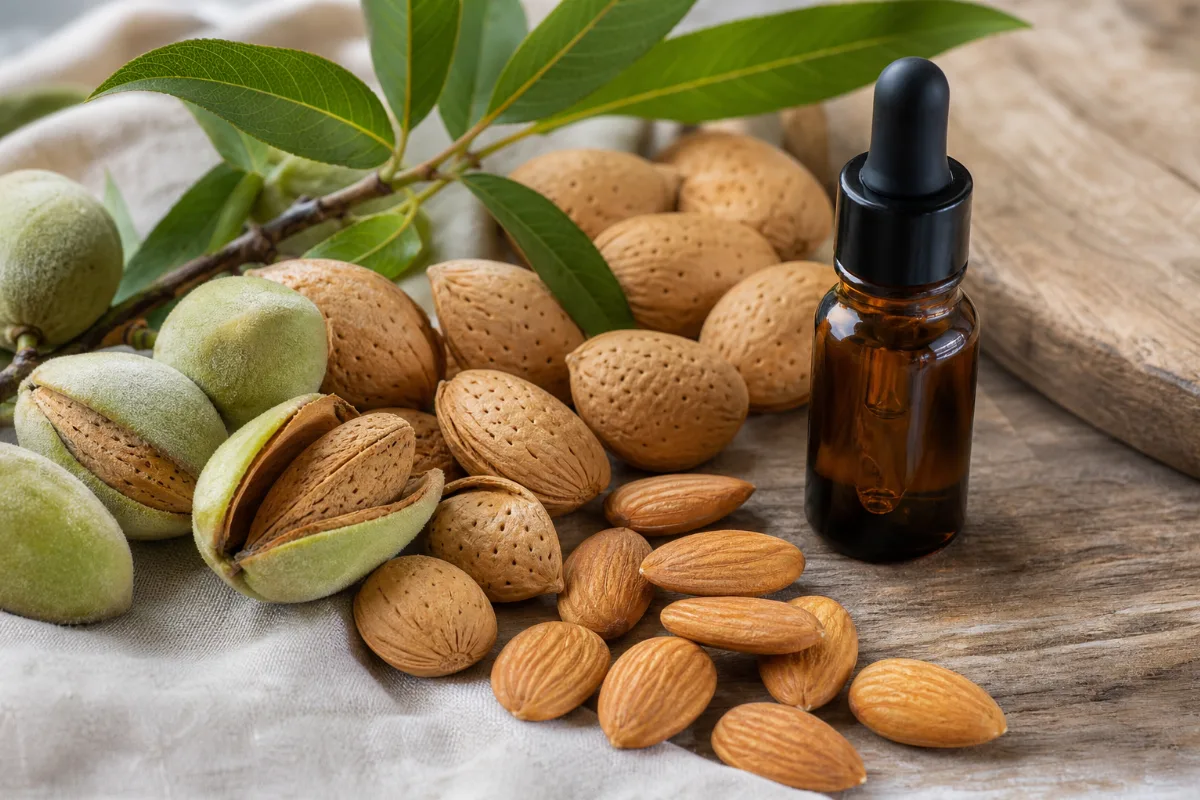
Sweet almond oil is a pale, light carrier oil pressed from almond kernels. It is used on skin and in massage, and to dilute essential oils. Small trials give mixed results for stretch marks, and some hospital trials in preterm babies found better skin hydration. The most important caution is allergy: almond is a tree nut, so ask an allergist first if you have a nut allergy. Do not swallow cosmetic oil.
General information, not medical advice. Last substantive update · Not medically reviewed. A named clinician has not signed off on this page. How this page is made
About Sweet Almond Oil
Sweet almond oil is a light, pale oil pressed from the kernel of the almond tree (Prunus dulcis). It is a carrier oil, not an essential oil. Studies are small and mixed: some help for itching and skin hydration, doubt about stretch marks. The key safety point is tree nut allergy.
What it is
Sweet almond oil is a fatty oil pressed from the kernel, the seed inside the almond stone. NCBI Taxonomy names the tree Prunus dulcis. GBIF uses Prunus amygdalus Batsch as the accepted name. Both mean the almond tree.
A lab analysis of oil from four Moroccan almond varieties found mostly oleic acid (56.64 to 64.03% of the fats) and linoleic acid (24.57 to 29.80%), with vitamin E-type tocopherols (408.99 to 491.77 mg/kg, mostly alpha-tocopherol).
How it is used
Reviews describe it in skin care for dry skin and eczema, as a massage oil, and as a carrier for essential oils. Many body oils sold as "almond" are blended, so read the full ingredient list.
A dermatology review says cold-pressed oil is the preferred kind for skin care because it keeps helpful lipids and limits irritating by-products.
What the research shows
For stretch marks, one trial of 160 first-time mothers found sweet almond oil cream eased itching and spread of marks, but not their width or number. A 2026 review of four newer trials (671 women) said sweet almond oil was not effective while coconut oil was. A Turkish study of BITTER almond oil suggested the massage mattered more than the oil.
In preterm babies, almond oil improved skin hydration over 5 days in a trial of 90 infants. In a French trial of 49 preterm babies, a touch routine with almond oil raised a neurological score, but the weight gain was with a blended oil. A review of 14 newborn trials found 11 favourable, with only two using almond oil.
Smaller trials looked at bed sores, constipation, leg swelling in pregnancy and sleep. All were small, short, and could not separate the oil from the touch or from other ingredients.
Rancidity, purity and pores
A 2022 review warns that quality and stability matter because almond oil can oxidise. Fresh oils from four Moroccan varieties had low acidity and low peroxide values, but no source we read gives a spoilage limit or shelf life.
A Brazilian study found soybean oil added to the samples of 10 sweet almond body oils (8.79% to 99.70%), and only two labels said so.
We found no source that rates sweet almond oil for pore-clogging. A 2006 study of six people found that finished products made with ingredients on pore-clogging lists were not necessarily pore-clogging.
At a glance
Traditional uses history, not proof
- Reviews say sweet almond oil has long been used on skin, including for eczema and psoriasis. These are statements in papers, not tests.
Studied for research
- Skin moisturising and barrier care, low
- Stretch marks in pregnancy, mixed
- Baby (preterm) skin care and massage, low
- Dry skin and eczema in combination creams, very-low
- Pressure injuries in hospital, very-low
- Constipation (swallowed or massage), very-low
- Leg swelling in pregnancy (foot massage), very-low
Main compounds
- Oleic acid (omega-9), the main fat
- Linoleic acid (omega-6)
- Tocopherols (vitamin E type), mostly alpha-tocopherol
Common forms
- Cold-pressed oil
- Refined oil
- Body and massage oils and creams that contain it, often blended with other oils
Research links: FDA: food allergies (tree nuts are a major allergen) · MedlinePlus: food allergy · Review: almond allergy in children and adults (abstract) · Review: sweet almond, evening primrose and jojoba oils in skin care (abstract) · Systematic review: aromatherapy oils and stretch marks (abstract) · Research Library · Genes & Biomarkers Library
What it is and its history
- Accepted scientific name
- Prunus dulcis
- Naming authority
- (Mill.) D.A.Webb
- Synonyms
- Name: Prunus amygdalus Batsch; Note: GBIF treats this as the accepted name and Prunus dulcis as its synonym.; Name: Prunus amygdalus var. dulcis; Note: Older name; not sourced here.
- Common names
- Sweet almond oil (English); Almond oil (English)
- Family or group
- Rosaceae (the rose family; apricot, peach and cherry are in the same genus)
- Classification
- Plantae > Tracheophyta > Magnoliopsida > Rosales > Rosaceae > Prunus > Prunus dulcis
- Native range
- Not checked in the sources read.
- Habitat
- Not checked.
- What it looks like
- Roots: Not checked.; Stems: Not checked.; Leaves: Not checked.; Flowers: Not checked.; Fruit: The oil comes from the kernel (the seed) inside the almond stone.
- Cultivation
- Four almond varieties (Marcona, Fournat, Ferragnes, Ferraduel) were grown in Morocco in the oil analysis we read. No further cultivation details were taken.
- Harvest and processing
- A dermatology review says cold pressing is the preferred extraction method for skin care oils because it keeps beneficial lipids and limits irritating by-products. No source we read describes how any given bottle was made.
- Look-alikes and adulterants
- Name: Bitter almond oil; Note: A different oil. Two studies we cite used it and are labelled. It is not covered by this page's safety statements.; Name: Apricot kernel oil; Note: From a related tree (Prunus armeniaca). See its own page.
- Sustainability and conservation
- Not checked.
Traditional use and history history, not clinical proof
| Tradition or era | Documented use | Source |
|---|---|---|
| Long traditional skin use, as stated by review authors | A cosmetic-science review says the three oils it covers, including sweet almond oil, have been used for hundreds if not thousands of years for skin and other ailments. This is the authors' statement, not a tested fact. | p34957578 |
| Eczema and psoriasis, as stated in a paper | The authors of a hand dermatitis paper say sweet almond oil has been used for centuries for skin diseases such as eczema and psoriasis. They give no source in the abstract. | p29320591 |
| Persian medicine, as stated in a trial | The older adult constipation trial was done by Persian medicine researchers and describes traditional and complementary medicine for constipation. | p35774276 |
Traditional use shows how it was used. It does not show that it works or is safe today.
What is inside, and how it may work
What it contains and how those compounds act in cells and animals. Laboratory and animal mechanisms are not proven effects in people.
Main compounds
| Compound | Family | Where it is concentrated | Activity studied | Level of evidence |
|---|---|---|---|---|
| Oleic acid PubChem 445639 | omega-9 monounsaturated fatty acid | Kernel oil 56.64 to 64.03% of fatty acids in oil from four Moroccan varieties. | Main fat of the oil. 14 26 | Chemistry |
| Linoleic acid PubChem 5280450 | omega-6 polyunsaturated fatty acid | Kernel oil 24.57 to 29.80% of fatty acids in the same oils. | Second main fat. 14 26 | Chemistry |
| Tocopherols (vitamin E type), mostly alpha-tocopherol PubChem 14985 | Vitamin E group | Kernel oil 408.99 to 491.77 mg/kg, mostly alpha-tocopherol. | Natural antioxidants in the oil. 14 26 | Chemistry |
| Phenols (total) | Plant phenols | Kernel oil 85.33 to 141.66 mg/kg in the same oils. | Minor compounds; their effect on skin was not tested. 14 | Chemistry |
Mechanisms, receptors and pathways
| Target or pathway | Gene or receptor | What was found | Level |
|---|---|---|---|
| Skin barrier (outer layer) | n/a | A cosmetic-science review concludes sweet almond oil strengthens stratum corneum integrity, recovery and lipid ratio but asks for more experimental data. A dermatology review proposes that oils with more linoleic acid than oleic acid repair the barrier better, and that oleic-rich oils may be worse. The latter review does not name sweet almond oil. 3 22 | Lab and human (review authors' conclusions) |
| Oxidation of the oil | n/a | The 2022 review notes that oxidation affects product quality and stability. Peroxide values of fresh oils were 1.88 to 3.18 meq O2/kg. 3 14 | Chemistry |
Absorption, metabolism and elimination
- Absorption
- Not described for the oil in the sources read. One drug-patch study used almond oil as a skin-permeation enhancer.
- Distribution
- Not described.
- Metabolism
- Not described.
- Elimination
- Not described.
- Bioavailability
- Not described.
Isolated compounds versus whole extracts
Sweet almond oil is a pressed fat, not the whole almond. Food allergy to almond is about proteins in the nut; whether refined or pressed oil carries enough of them to cause reactions on skin was not tested in the sources we read. Bitter almond oil, apricot kernel oil and blended body oils are different products.
Nutritional composition
The oil is mostly oleic acid, with linoleic acid and vitamin E-type compounds. This page does not discuss it as a food.
1 mixed findings2 low certainty4 very low certainty2 not enough evidence
What was looked at
The 9 benefits and uses checked for Sweet Almond Oil, each with how strong the evidence is. Tap one to open it.
- Skin moisturising and barrier care (general)Low certainty
- Stretch marks in pregnancy (on skin)Mixed findings
- Baby skin care and massage (mostly preterm babies)Low certainty
- Dry skin, hand dermatitis and eczema (in combination creams)Very low certainty
- Pressure injuries (bed sores) in hospitalVery low certainty
- Constipation in older adults (oil swallowed, or massage)Very low certainty
- Leg swelling in pregnancy (foot massage)Very low certainty
- Sleep quality in intensive care (mint plus almond oil massage)Not enough evidence
- Chronic itch (a review that lists it)Not enough evidence
Lab markers tracked in the studies
Skin hydration (outer skin layer)Itching, redness and spread of stretch marksNeonatal Skin Condition ScoreNeurological score in preterm babiesPressure injury incidenceConstipation Assessment Scale scoreFoot circumference (swelling)
What is Sweet Almond Oil good for?
What the research shows for each use, and how strong it is. Most evidence is small and for the oil on skin or in massage, so none of it proves a benefit. Read the Safety tab first if you or your child has a nut allergy.
Benefits, one by one
Each card is a research question, not a promise. Tap a goal to filter. Open a card to see the studies, doses and limits.
Skin moisturising and barrier care (general)
Low certaintyReviews say sweet almond oil can help dry skin and the skin barrier, but the evidence behind that is mixed and the best-known review was written by employees of a skin-care company.
2 studiesCold-pressed or refined sweet almond oil, alone or in creams. Amounts…
Studies, doses and limits
What the trials found
Some trials (below), mostly small, mostly on special groups such as preterm babies or pregnant women.
Results
A 2022 review of sweet almond, evening primrose and jojoba oils says benefits are well documented but also says the clinical data are inconsistent and some study designs are questionable. It concludes the oils strengthen the skin barrier but asks for more data on how. A 2018 dermatology review of natural oils for barrier repair does not name sweet almond oil, and says oils with more oleic acid may be worse for the barrier.
Why this rating
Narrative reviews, one by company employees, one that does not cover this oil. No pooled estimate.
Form and dose studied
Cold-pressed or refined sweet almond oil, alone or in creams. Amounts are not given here.
Who was studied
Adults, children and babies, as the reviews describe.
Limits
Review authors work for a consumer-products company. Mixed clinical data. The oleic acid idea is a general point about oils, not a finding for almond oil.
Why researchers looked
It is a classic soft carrier and body oil, rich in oleic acid.
Traditional use
Reviews say sweet almond oil has been used on skin for a very long time, including for eczema and psoriasis. That is a statement in papers, not a test.
Proposed mechanism Hypothesis
Suggested by composition and some lab and clinical work: the oil may help the outer skin layer hold water. One review also says oils rich in oleic acid might be less good for the barrier than oils rich in linoleic acid. Neither idea was tested for sweet almond oil in the abstracts we read.
A proposed mechanism does not show that the effect happens in people.
Nut allergy comes first: see the Safety tab. Patch test before wider use.
Stretch marks in pregnancy (on skin)
Mixed findingsThe research is mixed. One small trial found creams with sweet almond oil eased itching and the spread of stretch marks. A 2026 review of four newer trials said sweet almond oil did not prevent them.
4 studiesSweet almond oil in a cream; bitter almond oil in the other study. Am…
Studies, doses and limits
What the trials found
One randomized trial of sweet almond oil cream, one systematic review that includes an almond oil trial, and a quasi-experimental study of bitter almond oil (a different product).
Results
160 first-time mothers: creams with sweet almond oil or aloe vera did better than base cream or no treatment for itching, redness and spread of marks, but not for the width or number of marks. The 2026 systematic review (4 trials, 671 women, published 2020 to 2024, so not the trial above) said coconut oil was effective while sweet almond, rose and sesame oils were not. In a Turkish study of BITTER almond oil, stretch marks appeared in 20% with oil and massage, 38.8% with oil alone and 41.2% with no treatment; the authors say the massage, not the oil alone, made the difference.
Effect sizes as reported
Marks in 20% vs 38.8% vs 41.2% (bitter almond oil with massage, oil alone, none). No pooled number for sweet almond oil.
Why this rating
One trial favours it for itching and spread, the newer review says it did not work, and the bitter almond study points at massage rather than the oil.
Form and dose studied
Sweet almond oil in a cream; bitter almond oil in the other study. Amounts are not given here.
Who was studied
Pregnant women, mostly first pregnancies.
Limits
Different oils, products and designs. Neither a 160-woman trial with few reported details nor a quasi-experiment settles the question. The bitter almond oil study is a different oil.
Why researchers looked
Stretch marks are very common in pregnancy and women look for ways to prevent them.
Traditional use
Massage with almond oil is a common home tradition for stretch marks, and two papers here test it.
Proposed mechanism Hypothesis
Not shown. Possible effects of rubbing or massage itself cannot be separated from the oil in these studies.
A proposed mechanism does not show that the effect happens in people.
Do not swallow cosmetic-labelled oil. Ask your midwife or doctor before using any oil in pregnancy; see Safety for allergy.
Baby skin care and massage (mostly preterm babies)
Low certaintyIn hospital trials with preterm babies, almond oil improved skin hydration and skin condition scores over 5 days, with no harm seen. A review of 14 newborn trials found most oils helped but says better studies are needed.
3 studiesAlmond oil put on skin by nurses, with or without a massage routine. …
Studies, doses and limits
What the trials found
Two randomized trials of preterm babies with almond oil, plus one systematic review of newborn oils.
Results
In 90 preterm babies (32 to 37 weeks) in hospital, almond oil and sunflower seed oil gave better skin hydration than no oil over 5 days, with no difference between the two oils, and the authors saw no harm. In a French trial of 49 preterm babies, a touch routine with almond oil raised a nerve-development score versus controls, while the weight gain was seen with a different, blended oil. The 2022 review of 14 trials (5,683 newborns, only 2 with almond oil) says 11 trials found oils improved skin condition and barrier and 3 were equivocal, negative or mixed.
Effect sizes as reported
Hydration better than control (numbers not in the abstract); neurological score higher with almond oil (P = 0.001); 11 of 14 newborn trials favourable.
Why this rating
Small hospital trials with limited detail in the abstracts; the review mostly covers other oils.
Form and dose studied
Almond oil put on skin by nurses, with or without a massage routine. Amounts are not given here.
Who was studied
Preterm babies in neonatal intensive care. Not tested in healthy full-term babies.
Limits
Results are for preterm babies in hospital and may not apply at home or to full-term babies. Touch and massage are mixed with the oil in one trial. No allergy follow-up.
Why researchers looked
Newborn skin is thin and nurses look for gentle ways to protect it.
Traditional use
Oil massage for babies is traditional in many places. Papers here are about hospital care.
Proposed mechanism Hypothesis
Not shown. The oil may reduce water loss from skin, but the abstracts do not test that.
A proposed mechanism does not show that the effect happens in people.
Babies who have eczema or food allergy may react to almond: see Safety, and ask a baby doctor or nurse before using any oil.
Dry skin, hand dermatitis and eczema (in combination creams)
Very low certaintyTwo studies tested creams that contained almond oil along with other ingredients, and both reported improvement. Because the creams mix ingredients, they do not show what the oil did by itself.
2 studiesCreams that contain almond oil, not plain oil. Amounts are not given …
Studies, doses and limits
What the trials found
A cream with 7% sweet almond oil and 2% oatmeal for hand dermatitis; two creams with refined almond oil and lactic acid (one with polidocanol) for dry-skin eczema.
Results
In the hand dermatitis study the authors call the cream safe and effective in moderate to severe hand dermatitis; the abstract gives no numbers or comparison group. In the Swiss study the two creams (left versus right body side) both cut itching within 30 minutes and raised skin moisture and lipids over 14 days, and were well tolerated.
Effect sizes as reported
p < .0001 for improvement at day 14 in the Swiss study; none given for the hand cream.
Why this rating
Combination products without a control that isolates almond oil; abstracts lack numbers. The hand cream study may have a company link.
Form and dose studied
Creams that contain almond oil, not plain oil. Amounts are not given here.
Who was studied
Adults with dermatitis or dry-skin eczema.
Limits
Several active ingredients. No comparison with the same cream without almond oil.
Why researchers looked
Dry, itchy skin is one of the most common reasons people use oils.
Traditional use
Reviews say sweet almond oil has long been used for eczema and psoriasis.
Proposed mechanism Hypothesis
Not shown.
A proposed mechanism does not show that the effect happens in people.
People with eczema are more likely to be sensitized to almond: see Safety. Stop use if the skin gets worse.
Pressure injuries (bed sores) in hospital
Very low certaintyIn one small intensive care trial, bed sores were less frequent with almond oil than with usual care, but almond oil was not clearly better than a liquid paraffin placebo.
2 studiesAlmond oil on skin over bony areas of hospital patients. Amounts are …
Studies, doses and limits
What the trials found
One single-blind trial of 108 patients, and one systematic review of plant agents that included it.
Results
Bed sores occurred in 5.6% with almond oil, 13.9% with paraffin and 25.1% with usual care. The gap from usual care was significant (P = .024) but the gap from paraffin was not (P = .189). A 2025 review of 10 trials of plant-based agents (mostly olive oil, only one with sweet almond oil) found fewer pressure injuries with the plant agents, rated the risk of bias as some concerns or high, and said better trials are needed.
Effect sizes as reported
5.6% vs 13.9% vs 25.1% (almond oil, paraffin, usual care).
Why this rating
One small single-blind trial, 7 days, not different from a placebo oil.
Form and dose studied
Almond oil on skin over bony areas of hospital patients. Amounts are not given here.
Who was studied
Adults in intensive care in Iran.
Limits
Single centre, not clearly better than a placebo oil, risk of bias in the review.
Why researchers looked
Bed sores are a big problem in hospitals and nurses look for cheap skin protection.
Traditional use
No traditional use is described in the sources read.
Proposed mechanism Hypothesis
Not shown. Rubbing or massage of the skin, or oil as a barrier, may play a part.
A proposed mechanism does not show that the effect happens in people.
Do not put oil on broken skin or open sores without nurse or doctor advice.
Constipation in older adults (oil swallowed, or massage)
Very low certaintyOne small trial of 90 older adults found lower constipation scores with swallowed sweet almond oil and with abdominal massage using it than with no treatment.
1 studiesSweet almond oil by mouth in a clinical trial, or the same oil for ab…
Studies, doses and limits
What the trials found
One single-blind trial.
Results
Scores on the Constipation Assessment Scale fell from 7.81 to 1.15 with swallowed oil, from 8 to 2.26 with massage and from 7.73 to 6 with no treatment. Stool form and quality of life also improved most with swallowed oil.
Effect sizes as reported
CAS score fall: 6.66 points swallowed, 5.74 massage, 1.73 control (calculated from the abstract).
Why this rating
One small unblinded-in-practice trial, two weeks, no safety data in the abstract, control group had no treatment.
Form and dose studied
Sweet almond oil by mouth in a clinical trial, or the same oil for abdominal massage. Amounts are not given here.
Who was studied
Adults aged 60 and over with constipation, Iran.
Limits
Swallowed oil carries allergy risk for people allergic to almonds. No long-term data.
Why researchers looked
A traditional home remedy for constipation.
Traditional use
A trial author is from a Persian medicine department, and the trial draws on that tradition.
Proposed mechanism Hypothesis
Not shown. Oils may soften stool or relax the gut, but the abstract does not test it. Massage alone may help the bowels.
A proposed mechanism does not show that the effect happens in people.
This page does not advise swallowing cosmetic or carrier oil. Constipation that does not pass needs a doctor.
Leg swelling in pregnancy (foot massage)
Very low certaintyA small trial found foot massage with sweet almond oil, or with grape seed oil, reduced foot swelling compared with no massage. It did not show the oil did anything beyond the massage.
1 studiesFoot massage with the oil for 20 minutes over 5 days. Amounts are not…
Studies, doses and limits
What the trials found
One randomized trial of 90 women.
Results
Foot circumference changed significantly more with massage using either oil than without massage (P = 0.001). The two oils did not differ (P = 0.865).
Effect sizes as reported
No numbers for the change in the abstract.
Why this rating
One small trial; no group massaged without oil.
Form and dose studied
Foot massage with the oil for 20 minutes over 5 days. Amounts are not given here.
Who was studied
First-time pregnant women, 30 to 40 weeks.
Limits
The control group had no massage, so touch and oil are not separated.
Why researchers looked
Leg swelling is common in the last months of pregnancy.
Traditional use
Foot massage is a common comfort measure in late pregnancy.
Proposed mechanism Hypothesis
Not shown. Massage may improve fluid movement.
A proposed mechanism does not show that the effect happens in people.
Swelling that comes on suddenly, with headache or vision change, can be a sign of a serious pregnancy problem: see a doctor at once.
Sleep quality in intensive care (mint plus almond oil massage)
Not enough evidenceA small trial of patients with brain injury used massage with a mint and sweet almond oil mix and found better sleep scores than sham massage. Almond oil here was only the carrier for mint oil.
1 studiesHand and foot massage with mint and sweet almond oil. Amounts are not…
Studies, doses and limits
What the trials found
One randomized trial of 60 patients.
Results
After three days sleep quality scores were significantly higher in the mint-and-almond-oil group than in the sham (Vaseline) massage group (P < 0.05).
Effect sizes as reported
No numbers in the abstract.
Why this rating
A mixture with an essential oil, tiny trial, short, no scores in the abstract.
Form and dose studied
Hand and foot massage with mint and sweet almond oil. Amounts are not given here.
Who was studied
Adults in intensive care after brain injury.
Limits
Cannot separate mint oil from almond oil. It tells us nothing about almond oil alone.
Why researchers looked
Sleep is often poor in intensive care.
Traditional use
No traditional use described in the abstract.
Proposed mechanism Hypothesis
Not shown.
A proposed mechanism does not show that the effect happens in people.
Not a sleep treatment. Mint oil is a strong essential oil with its own cautions.
Chronic itch (a review that lists it)
Not enough evidenceA 2022 review of 17 trials of herbal and other complementary treatments for itch lists sweet almond oil among the remedies that worked, but the abstract does not say which trial.
1 studiesNot described in the abstract.
Studies, doses and limits
What the trials found
A review abstract only.
Results
The review says sweet almond oil, with several other remedies, was significantly effective in trials, and that few studies exist.
Why this rating
We could not trace the almond oil trial from the abstract.
Form and dose studied
Not described in the abstract.
Who was studied
Not described in the abstract.
Limits
No details about the almond oil trial; the review has a Persian medicine research base and is a narrative review.
Why researchers looked
Chronic itch is hard to treat.
Traditional use
No traditional use described.
Proposed mechanism Hypothesis
Not shown.
A proposed mechanism does not show that the effect happens in people.
Itch that lasts weeks needs a doctor, as it can be a sign of other disease.
Connections to the rest of health
How Sweet Almond Oil connects to the rest of our health knowledge graph. Every link says what kind of connection it is. A safety link (for example to the liver) is a warning, not a benefit. A study that merely mentions a topic never creates a benefit link.
Explore every connection: goals, body systems, organs, symptoms, genes
A. Wellness goals
| Connected to | Kind of connection | Evidence status | Context | Studies |
|---|---|---|---|---|
| Healthy Skin | Preliminary mechanism | Low certainty | Skin moisturising and barrier care (general): Reviews say sweet almond oil can help dry skin and the skin barrier, but the evidence behind that is mixed and the best-known review was written by employees of a skin-care company. | 3 22 |
| Healthy Skin | Mixed findings | Stretch marks in pregnancy (on skin): The research is mixed. One small trial found creams with sweet almond oil eased itching and the spread of stretch marks. A 2026 review of four newer trials said sweet almond oil did not prevent them. Baby skin care and massage (mostly preterm babies): In hospital trials with preterm babies, almond oil improved skin hydration and skin condition scores over 5 days, with no harm seen. A review of 14 newborn trials found most oils helped but says better studies are needed. | 10 9 20 11 5 2 21 23 19 4 13 17 | |
| Womens Wellness | Mixed findings | Stretch marks in pregnancy (on skin): The research is mixed. One small trial found creams with sweet almond oil eased itching and the spread of stretch marks. A 2026 review of four newer trials said sweet almond oil did not prevent them. Leg swelling in pregnancy (foot massage): A small trial found foot massage with sweet almond oil, or with grape seed oil, reduced foot swelling compared with no massage. It did not show the oil did anything beyond the massage. | 10 9 20 11 16 | |
| Digestive Support | Very low certainty | Constipation in older adults (oil swallowed, or massage): One small trial of 90 older adults found lower constipation scores with swallowed sweet almond oil and with abdominal massage using it than with no treatment. | 7 | |
| Better Sleep | Not enough evidence | Sleep quality in intensive care (mint plus almond oil massage): A small trial of patients with brain injury used massage with a mint and sweet almond oil mix and found better sleep scores than sham massage. Almond oil here was only the carrier for mint oil. | 15 |
B. Body systems
| Connected to | Kind of connection | Evidence status | Context | Studies |
|---|---|---|---|---|
| Skin Hair Beauty | Biological association | Low certainty | Studied for: Skin moisturising and barrier care (general) Studied for: Stretch marks in pregnancy (on skin) | 3 22 10 9 20 11 5 2 21 23 19 4 13 17 |
| Reproductive System | Biological association | Mixed findings | Studied for: Stretch marks in pregnancy (on skin) Studied for: Leg swelling in pregnancy (foot massage) | 10 9 20 11 16 |
| Integumentary System | Biological association | Very low certainty | Studied for: Dry skin, hand dermatitis and eczema (in combination creams) | 23 19 |
| Digestive System | Biological association | Very low certainty | Studied for: Constipation in older adults (oil swallowed, or massage) | 7 |
| Nervous System | Biological association | Not enough evidence | Studied for: Sleep quality in intensive care (mint plus almond oil massage) | 15 |
C. Body parts and organs
| Connected to | Kind of connection | Evidence status | Context | Studies |
|---|---|---|---|---|
| Skin | Adverse effect or risk | Low certainty | Sensitization is described in one baby case report; no rate known. Preparation or compound: Sweet almond oil on skin |
8 |
| Skin | Biological association | Low certainty | Small trials of skin hydration and stretch marks, mixed results. Preparation or compound: Sweet almond oil applied to skin |
5 10 |
I. Biomarkers
| Connected to | Kind of connection | Evidence status | Context | Studies |
|---|---|---|---|---|
| Skin hydration (outer skin layer) | Biological association | Low certainty | Measured in trials: improved. A lab change is not the same as a health benefit. | 5 |
| Itching, redness and spread of stretch marks | Biological association | Mixed findings | Measured in trials: improved. A lab change is not the same as a health benefit. | 10 9 |
| Neonatal Skin Condition Score | Biological association | Low certainty | Measured in trials: changed. A lab change is not the same as a health benefit. | 5 |
| Neurological score in preterm babies | Biological association | Very low certainty | Measured in trials: improved. A lab change is not the same as a health benefit. | 21 |
| Pressure injury incidence | Biological association | Very low certainty | Measured in trials: lowered. A lab change is not the same as a health benefit. | 4 |
| Constipation Assessment Scale score | Biological association | Very low certainty | Measured in trials: lowered. A lab change is not the same as a health benefit. | 7 |
| Foot circumference (swelling) | Biological association | Very low certainty | Measured in trials: lowered. A lab change is not the same as a health benefit. | 16 |
L. Active compounds
| Connected to | Kind of connection | Evidence status | Context | Studies |
|---|---|---|---|---|
| Oleic acid | Biological association | Chemistry | Main fat of the oil. Preparation or compound: Kernel oil |
14 26 |
| Linoleic acid | Biological association | Chemistry | Second main fat. Preparation or compound: Kernel oil |
14 26 |
| Tocopherols (vitamin E type), mostly alpha-tocopherol | Biological association | Chemistry | Natural antioxidants in the oil. Preparation or compound: Kernel oil |
14 26 |
| Phenols (total) | Biological association | Chemistry | Minor compounds; their effect on skin was not tested. Preparation or compound: Kernel oil |
14 |
Each connection is stored with the ingredient, the connected record, the kind of connection, the evidence status, the supporting studies, the preparation or compound involved, and a review date (last reviewed October 25, 2026).
Evidence at a glance: what changed in 3 lab markers
Tap a number to show only those markers. Counts are markers, not people.
The evidence
The research centre for Sweet Almond Oil. Every record here was checked against PubMed or the publisher's page; we never list a study we have not verified.
Evidence by outcome
Bars show how many studies we found for each outcome, not how well it works. People are added up across trials only (reviews are not added, to avoid double counting).
How we rate evidence
High certainty
Several well-run trials or reviews agree; further research is unlikely to change the picture much.
Moderate certainty
Good trials point the same way, but some doubt remains.
Low certainty
Small, short or inconsistent trials. The finding could change with better research.
Very low certainty
Very little or very weak human data. Treat as a possibility only.
Mixed findings
Trials or reviews disagree with each other.
Not enough evidence
Not enough human research to say either way.
Evidence against
Good research found no benefit, or found harm.
We take the reviewers' own risk-of-bias and GRADE statements where they exist, and otherwise judge from study size, design, consistency, directness and whether a product matches what is sold. Many publications do not make evidence high. Method note: We read PubMed abstracts of 23 papers and the FDA and MedlinePlus food allergy pages. We checked the plant name in GBIF and NCBI Taxonomy and compounds in PubChem. Certainty ratings are the compiler's own reading. Funding is not stated in most abstracts. No study is cited that we could not verify.
Study library: every study we checked 28
| Study | Design | People | Product, dose, length | Result |
|---|---|---|---|---|
| Akhlaq 2016 Formulation and evaluation of anti-rheumatic dexibuprofen transdermal patches: a quality-by-design approach. J Drug Target · PMID 26586147 · DOI |
Lab/animal rabbit/lab |
Lab and rabbit study of a drug patch | Almond oil used as a skin-penetration enhancer in a dexibuprofen patch almond oil Not given here · vs Commercial oral tablet |
Almond oil was used as a conventional skin-permeation enhancer in the patch; drug permeation changed with the amount of enhancer. This is a pharmacy formulation study with a rabbit model. Not relevant to people. Methods, limits and fundingOutcomes: Patch properties and drug release Limitations: Lab and rabbit work on a drug patch. It does not show interactions in people. Funding and conflicts: Funding and conflicts of interest are not stated in the abstract. Read: abstract |
| Aksucu 2022 Effects of Topical Oils on Neonatal Skin: A Systematic Review. Adv Skin Wound Care · PMID 36409192 · DOI |
Systematic review |
5683 5,683 newborns (mostly preterm) in 14 randomized trials |
Topical oils: blended sunflower (8 trials), coconut (5), almond (2), olive (1), mustard (1), vegetable (1) various oils Not given here · vs Varied |
Eleven of 14 trials concluded the oils improved skin condition and barrier function. Three found equivocal, negative or mixed results. Only two trials used almond oil. The authors say the evidence points to a potential benefit but that studies with a higher level of evidence are needed. 11 of 14 trials favourable; 3 equivocal, negative or mixed. Methods, limits and fundingOutcomes: Skin barrier function and skin integrity Limitations: Mostly sunflower and coconut oil; the almond oil results are not given separately in the abstract. Some trials counted use of more than one oil. Funding and conflicts: Authors from Istanbul nursing faculties; funding not stated in the abstract. Read: abstract |
| Blaak 2022 An updated review on efficacy and benefits of sweet almond, evening primrose and jojoba oils in skin care applications. Int J Cosmet Sci · PMID 34957578 · DOI |
Narrative review human + lab |
n/a (review of cosmetic oils for dry, ageing, juvenile and atopic skin and scalp) | Sweet almond, evening primrose and jojoba oils on skin oils Not given here |
The authors say benefits of the three oils are "well documented" both in the lab and in people, but they also note discrepancies in the clinical data and questionable study designs. They conclude the oils strengthen the skin barrier, and ask for more experimental data on the skin barrier itself. They warn that quality and stability of these oils matter because of oxidation. Descriptive; no pooled numbers in the abstract. Methods, limits and fundingOutcomes: Skin care uses; formulation, oxidation, skin penetration, barrier Limitations: A narrative review, not a systematic one. Both authors work in research and regulatory affairs at Kneipp GmbH, a company that makes natural consumer products. The review pools three oils, so almond-specific results are not separated in the abstract. Funding and conflicts: Authors are employees of a consumer-product company (Kneipp GmbH, Germany). Industry-linked. Read: abstract |
| Borzou 2020 Topical Almond Oil for Prevention of Pressure Injuries: A Single-Blinded Comparison Study. J Wound Ostomy Continence Nurs · PMID 32379165 · DOI |
Randomized controlled trial |
108 108 intensive care patients, Iran |
Almond oil on sacrum, heels and shoulders almond oil Not given here 7 days · vs Liquid paraffin (placebo) or standard care |
Pressure injuries occurred in 2 patients (5.6%) with almond oil, 5 (13.9%) with paraffin and 9 (25.1%) with standard care alone. The difference from standard care was significant (P = .024); the difference from paraffin was not (P = .189). Injuries began about 5.4 days in with almond oil versus 4.22 days in controls (P = .023). 5.6% vs 13.9% vs 25.1%; vs paraffin P = .189, vs standard care P = .024. Methods, limits and fundingOutcomes: Pressure injuries (bed sores) Limitations: Single-blind; 36 per group; only 7 days; the almond oil was no better than the paraffin placebo by the usual test. The abstract says "almond oil" without saying sweet almond. The abstract says 25.1% for the control group where 9 of 36 would be 25.0%, so treat the percentages as approximate. Funding and conflicts: Funding and conflicts of interest are not stated in the abstract. Read: abstract |
| Caglar 2020 The Effect of Sunflower Seed and Almond Oil on Preterm Infant Skin: A Randomized Controlled Trial. Adv Skin Wound Care · PMID 32697476 · DOI |
Randomized controlled trial |
90 90 preterm infants (32 to 37 weeks), neonatal intensive care unit, Turkey |
Almond oil (and, in another group, sunflower seed oil) applied to the body by a nurse almond oil Not given here 5 days · vs No oil (control) |
Infants in the almond oil and sunflower oil groups had better skin hydration than the control group. The skin condition scores in the control group were significantly higher than in the oil groups (the abstract does not say which direction is better, but the authors conclude the oils did not harm the skin and may improve hydration). There was no difference between the two oils. Better hydration with oil than control; no difference between almond and sunflower oil. Numbers are not in the abstract. Methods, limits and fundingOutcomes: Skin condition score (NSCS) and skin hydration (moisture meter) Limitations: Hospital preterm infants only, 5 days, no numbers in the abstract. The authors report no financial relationships. Funding and conflicts: The authors disclosed no financial relationships. Read: abstract |
| Draelos 2006 A re-evaluation of the comedogenicity concept. J Am Acad Dermatol · PMID 16488305 · DOI |
Human assay |
6 6 people with prominent follicles |
Finished cosmetic products on patches on the back finished products Not given here 4 weeks |
Finished products using ingredients on "comedogenic" lists were not necessarily comedogenic. The authors say lists of ingredients to avoid came from animal tests of raw materials. Finished products with listed ingredients are not necessarily comedogenic. Methods, limits and fundingOutcomes: Pore-clogging (comedone) formation Limitations: Only six people and a limited number of products. It does not name sweet almond oil. Funding and conflicts: Funding and conflicts of interest are not stated in the abstract. Read: abstract |
| Faghihi 2022 Comparison of the Effects of Abdominal Massage and Oral Administration of Sweet Almond Oil on Constipation and Quality of Life among Elderly Individuals: A Single-Blind Clinical Trial. Biomed Res Int · PMID 35774276 · DOI |
Randomized controlled trial |
90 90 older adults with constipation (Rome IV), Iran |
Sweet almond oil swallowed, or the same oil used for abdominal massage sweet almond oil Not given here 2 weeks (7 sessions) · vs No treatment |
Constipation scores fell in both oil groups more than in the control group: swallowed oil from 7.81 to 1.15, massage from 8 to 2.26, control from 7.73 to 6. Stool consistency and quality-of-life scores improved most in the swallowed-oil group. The authors recommend both as add-ons to other treatment. Scale scores fell more with oil than with no treatment; best with swallowed oil. Methods, limits and fundingOutcomes: Constipation Assessment Scale, Bristol stool form, constipation quality of life Limitations: Single-blind; control group received nothing, so expectation effects are possible; 30 per group; two weeks; no safety data given in the abstract. The swallowed-oil arm was a clinical trial setting, and this page gives no advice to swallow cosmetic oil. Funding and conflicts: No conflicts of interest declared in the abstract. Read: abstract |
| Guillet 2000 [Percutaneous sensitization to almond oil in infancy and study of ointments in 27 children with food allergy]. Allerg Immunol (Paris) · PMID 11244925 |
Case report |
27 One 5-month-old with atopic dermatitis (case); 27 food-sensitized atopic children (ointment study) |
Almond oil applied to the cheeks and buttocks of one baby almond oil on skin Not given here 2 months |
A 5-month-old with atopic dermatitis developed contact dermatitis to almond, with a positive patch test, a positive prick test and a high almond antibody level (class 4 anti-almond IgE), after two months of almond oil on the cheeks and buttocks. The baby had not eaten almond, and the mother reported no almond in her diet while breastfeeding. The authors say this points to possible sensitization through the skin and that the choice of ointment for broken skin matters in food-sensitized children. One case; no rate. Methods, limits and fundingOutcomes: Almond sensitization after skin exposure; ointments in children with food allergy Limitations: A single case plus a small ointment survey, in French, read as an English-translated abstract only (the abstract is brief). It shows a possibility, not how often it happens. Funding and conflicts: Not stated in the abstract. Read: abstract |
| Güner Emül 2026 Effect of Aromatherapy Oil Applications on Striae Gravidarum: A Systematic Review. Skin Res Technol · PMID 41988841 · DOI |
Systematic review |
671 671 pregnant women in four randomized trials |
Aromatherapy oils (coconut, rose, sesame, sweet almond, olive oil) on the skin various oils Not given here · vs Varied |
Four randomized trials, 671 women. The review says coconut oil was effective for preventing stretch marks, while rose, sesame and sweet almond oils were not. Two trials were published in 2024, one in 2022 and one in 2020, so the 2018 trial of sweet almond oil cream was not among them. The authors ask for larger, higher-quality, blinded trials. Qualitative: sweet almond oil "not effective" in the included trial(s). Methods, limits and fundingOutcomes: Prevention of stretch marks in pregnancy Limitations: Only four trials; the abstract does not give the sweet almond oil trial separately, its size, or a pooled number. Sweet almond oil is called an "essential oil" in the abstract, which it is not (it is a carrier oil). Funding and conflicts: No conflicts of interest declared in the abstract. Read: abstract |
| Hajhashemi 2018 The effect of Aloe vera gel and sweet almond oil on striae gravidarum in nulliparous women. J Matern Fetal Neonatal Med · PMID 28521546 · DOI |
Randomized controlled trial |
160 160 first-time pregnant women (nulliparous), Iran |
Sweet almond oil cream applied to the abdomen kernel oil (in a cream) Not given here · vs Aloe vera cream, base cream, or no treatment |
The abstract says both the aloe vera and the sweet almond oil creams did better than the base cream and than no treatment for itching, redness and the spread of marks (p < .05). All three creams had a similar effect on the width and number of marks (p > .05). Significant for itching, redness and spread (p < .05); no difference for width or number of marks. Methods, limits and fundingOutcomes: Itching, redness (erythema), spread of stretch marks, and the number and width of marks Limitations: The abstract describes it as double-blind but gives few details (who was blinded, how the marks were measured, size of each group). Described as a cream, so the effect of the oil alone is not separated from the cream. Four groups, no placebo oil. Funding and conflicts: Funding and conflicts of interest are not stated in the abstract. Read: abstract |
| Korgavkar 2015 Stretch marks during pregnancy: a review of topical prevention. Br J Dermatol · PMID 25255817 · DOI |
Narrative review |
n/a (review of topical products for stretch marks in pregnancy) | Topical products (centella, bitter almond oil, hyaluronic acid, tretinoin, cocoa butter, olive oil) various Not given here |
The reviewers found limited evidence that centella, and possibly massage with bitter almond oil, may prevent stretch marks or reduce their severity. They say reliable methods for preventing them are scarce and that strong randomized trials are lacking. Descriptive. Methods, limits and fundingOutcomes: Prevention or reduced severity of stretch marks Limitations: Review of mostly small studies from before 2015. It names bitter almond oil, not sweet almond oil. Funding and conflicts: Funding and conflicts of interest are not stated in the abstract. Read: abstract |
| Laura 2026 Almond Allergy in Children and Adults: A Narrative Review of Current Knowledge, Clinical Challenges, and Research Gaps. Nutrients · PMID 41830001 · DOI |
Narrative review |
n/a (review of almond allergy studies in children and adults) | Almonds (food); processed almond products whole almond Not given here |
Clinically confirmed almond allergy appears uncommon even though many people are sensitized (test positive), especially people with atopic dermatitis and other tree nut allergy. In sensitized people, a food challenge was positive in 4% to 33%, and severe reactions including anaphylaxis occurred in 0.5% to 12.2% of those challenged. Skin prick and blood tests have limited predictive value. Reactions were lower with processed almond products. Challenge positive 4 to 33% of sensitized people; severe reactions 0.5 to 12.2% of those challenged. Methods, limits and fundingOutcomes: How common almond allergy is; how it is diagnosed Limitations: A narrative review of almond as a FOOD. It does not cover almond oil on the skin. Funding and conflicts: No conflicts of interest declared in the abstract. Read: abstract |
| Lin 2025 The effectiveness of plant-based topical agents for the prevention of pressure injuries: Systematic review of randomised controlled trials. Int J Nurs Stud · PMID 40210517 · DOI |
Systematic review |
2364 2,364 patients in 10 randomized trials |
Plant-based topical agents (olive oil 6 trials, sweet almond oil 1, aloe vera gel 2, aloe-olive combination 1, peppermint gel 1, henna 1) various Not given here · vs Varied |
Pressure injuries were less frequent with the plant agents than in controls, but time to injury was inconsistent. No or mild adverse events were reported. Risk of bias was "some concerns" in 5 trials and "high" in 5. Only one trial used sweet almond oil. The authors call for higher-quality studies. Lower incidence overall; no pooled number (meta-analysis not possible). Methods, limits and fundingOutcomes: Pressure injury incidence and time to injury Limitations: Mostly olive oil; the almond oil result is not given separately in the abstract. Funding and conflicts: No conflicts of interest declared in the abstract. Registration: PROSPERO CRD42024567522 Read: abstract |
| Melhaoui 2021 Characterization of Sweet Almond Oil Content of Four European Cultivars (Ferragnes, Ferraduel, Fournat, and Marcona) Recently Introduced in Morocco. Scientifica (Cairo) · PMID 34497732 · DOI |
Product analysis lab |
4 Oil from four almond varieties grown in Morocco |
Sweet almond oil from four cultivars (lab analysis) kernel oil Not given here |
Acidity was 0.32 to 0.36% and peroxide values 1.88 to 3.18 meq O2/kg. Oleic acid was 56.64 to 64.03% and linoleic acid 24.57 to 29.80% of the fatty acids. Total phenols were 85.33 to 141.66 mg/kg and tocopherols 408.99 to 491.77 mg/kg, mostly alpha-tocopherol. Quality figures for freshly analysed oils. Methods, limits and fundingOutcomes: Oil quality (acidity, peroxide), fatty acids, phenols, tocopherols Limitations: Four varieties of one region, freshly made oil. The abstract gives no limit for what counts as spoiled and no shelf life. Funding and conflicts: No conflicts of interest declared in the abstract. Read: abstract |
| Motlagh 2025 The effects of aromatherapy massage with mint and sweet almond oils on the sleep quality of patients with traumatic brain injury admitted to intensive care unit: a randomized clinical trial. Sleep Breath · PMID 40056322 · DOI |
Randomized controlled trial |
60 60 intensive care patients with traumatic brain injury, Iran |
Hand and foot massage with a mix of mint oil and sweet almond oil sweet almond oil mixed with mint oil Not given here 3 days · vs Sham massage with Vaseline |
Sleep quality scores in the mint-and-almond-oil group were significantly higher than in the sham group after three days (P < 0.05). The abstract gives no scores. Significant (P < 0.05); no numbers in the abstract. Methods, limits and fundingOutcomes: Sleep quality (Richards-Campbell Sleep Questionnaire) Limitations: A combination (mint oil is the likely active part), 3 days, no numbers in the abstract, patients in intensive care. It does not show sweet almond oil alone helps sleep. Funding and conflicts: No conflicts of interest declared in the abstract. Registration: IRCT20151107024919N12 Read: abstract |
| Navaee 2020 Comparing the Effect of Foot Massage with Grape Seed Oil and Sweet Almond Oil on Physiological Leg Edema in Primigravidae: A Randomized Clinical Trial. Evid Based Complement Alternat Med · PMID 32419817 · DOI |
Randomized controlled trial |
90 90 first-time pregnant women, 30 to 40 weeks, Iran |
Foot massage with sweet almond oil (20 minutes) or with grape seed oil sweet almond oil Not given here 5 days · vs No intervention |
Foot circumference changed significantly more in both massage groups than in controls (P = 0.001), with no difference between the two oils (P = 0.865). The authors say foot massage with suitable oils can be used by trained midwives. Significant versus control (P = 0.001); almond versus grape seed no difference. Methods, limits and fundingOutcomes: Foot circumference (leg swelling) Limitations: The control group had no massage, so the effect of the touch cannot be separated from the oil. Numbers for the size of the change are not in the abstract. Registered IRCT2015072723370N1. Funding and conflicts: No conflicts of interest declared in the abstract. Registration: IRCT2015072723370N1 Read: abstract |
| Parvizi 2022 Complementary and integrative remedies in the treatment of chronic pruritus: A review of clinical trials. J Cosmet Dermatol · PMID 35579366 · DOI |
Narrative review |
17 clinical trials of herbal and complementary treatments for chronic itch | Herbal and complementary remedies (turmeric, oats, capsaicin, sweet almond oil, peppermint oil, violet oil, and others) various Not given here · vs Varied |
The review lists sweet almond oil among remedies that were "significantly effective" in the trials it found, and says only a few studies exist and more are needed. Descriptive. Methods, limits and fundingOutcomes: Chronic itch Limitations: The abstract does not say which trial of sweet almond oil, how big it was, or how it was designed. This cannot be traced to a specific study from the abstract. Funding and conflicts: Funding and conflicts of interest are not stated in the abstract. Read: abstract |
| Pizzo 2023 First report on quality and purity assessment of sweet almond oil in Brazilian body oils by gas chromatography and mass spectrometry. J Mass Spectrom · PMID 36688359 · DOI |
Product analysis product |
10 10 body oils sold as sweet almond oil in Brazil |
Commercial body oils based on sweet almond oil body oils Not given here |
Soybean oil had been added to the products, from 8.79% to 99.70%. Only two of the labels mentioned soybean oil. The authors call for better oversight of quality and authenticity. Added soybean oil in the samples from 8.79% to 99.70%. Methods, limits and fundingOutcomes: Purity and authenticity Limitations: Ten products in one country; may not describe other markets. The abstract does not say how many products were adulterated. Funding and conflicts: Funding and conflicts of interest are not stated in the abstract. Read: abstract |
| Simon 2018 Short- and long-term effects of two emollients on itching and skin restoration in xerotic eczema. Dermatol Ther · PMID 30246910 · DOI |
Randomized controlled trial |
People with dry-skin (xerotic) eczema with itching on both sides of the body, Switzerland | Two emollient creams containing lactic acid and refined almond oil, one with polidocanol refined almond oil in a combination cream Not given here 14 days · vs One cream on the left side versus the other on the right side |
Itching fell 30 minutes after the first use of both creams and was lower at day 14. Skin moisture and skin lipid content rose after the first use and kept improving over 14 days. Both creams were well tolerated with few side effects. Itch and moisture improved on both sides (p < .0001 reported for day 14). Methods, limits and fundingOutcomes: Itch severity, skin moisture, skin lipids, pH Limitations: There is no comparison with a cream that lacks almond oil, so the oil's own part is unknown. One cream also had polidocanol, an itch-relieving ingredient. The group size is not in the abstract. Funding and conflicts: Funding and conflicts of interest are not stated in the abstract. Read: abstract |
| Timur Taşhan 2012 The effect of bitter almond oil and massaging on striae gravidarum in primiparaous women. J Clin Nurs · PMID 22594386 · DOI |
Quasi experimental |
First-time pregnant women, Turkey | BITTER almond oil, with or without 15-minute massage bitter almond oil (a different product from sweet almond oil) Not given here · vs No treatment (control, n = 46) |
Stretch marks appeared in 20% of women who used bitter almond oil with massage, 38.8% of those who used the oil without massage and 41.2% of controls. The difference was significant only for the oil-with-massage group. The authors conclude that the massage, not the bitter almond oil by itself, made the difference. 20% vs 38.8% vs 41.2% (p < 0.05 for oil with massage versus the others). Methods, limits and fundingOutcomes: How often stretch marks appeared Limitations: A "posttest-only quasi-experimental" design (women were not randomly assigned). This was BITTER almond oil, not sweet almond oil. Group sizes other than the control are missing from the abstract. Funding and conflicts: Funding and conflicts of interest are not stated in the abstract. Read: abstract |
| Vaivre-Douret 2009 The effect of multimodal stimulation and cutaneous application of vegetable oils on neonatal development in preterm infants: a randomized controlled trial. Child Care Health Dev · PMID 18991972 · DOI |
Randomized controlled trial |
49 49 low-risk preterm infants born at 31 to 34 weeks, France |
Sweet almond oil used during a gentle touch and massage routine (STM) sweet almond oil Not given here 10 days · vs Same touch routine with a blended oil (ISIO4) or with saline, or no intervention |
The blended-oil group gained more weight than controls (+57%, 95% CI 37 to 76, P = 0.030). All touch groups had shorter hospital stays and gained body length. Both oil groups (almond and the blend) had a higher neurological score than controls (P = 0.001). The psychomotor and other gains were reported for the blended oil, not for almond oil. No adverse skin events were seen. Weight gain +57% (blended oil group only); neurological score higher with almond oil (P = 0.001). (Weight gain 57% (95% CI 37 to 76) for the blended oil) Methods, limits and fundingOutcomes: Weight gain (main), length, nerve maturation, development, length of hospital stay, skin Limitations: Small trial. The touch routine and the oil are mixed together, and the abstract does not separate what the oil did from what the touch did (a saline group helps but the abstract does not give its results). The main weight result is for the blended oil, not for almond oil. Funding and conflicts: Funding and conflicts of interest are not stated in the abstract. Read: abstract |
| Vaughn 2018 Natural Oils for Skin-Barrier Repair: Ancient Compounds Now Backed by Modern Science. Am J Clin Dermatol · PMID 28707186 · DOI |
Narrative review human + lab |
n/a (review of natural plant oils in dermatology) | Natural plant oils on skin (the abstract names olive, sunflower seed, coconut, jojoba, oat and argan oil) oils Not given here |
Oils with more linoleic acid relative to oleic acid have better barrier repair potential, while oils with more oleic acid, which the authors call irritating, may be harmful to the skin barrier. Cold pressing is the preferred extraction method because it keeps helpful lipids and limits irritating by-products. Sweet almond oil is not among the oils the abstract names. Descriptive. Methods, limits and fundingOutcomes: Skin barrier repair Limitations: Sweet almond oil is not named in the abstract, so it is used here only for the general oleic-to-linoleic idea and for the point about cold pressing. Almond oil is high in oleic acid (see the composition data), but this review did not test it. Funding and conflicts: Funding and conflicts of interest are not stated in the abstract. Read: abstract |
| Zeichner 2018 The Use of an Over-the-Counter Hand Cream With Sweet Almond Oil for the Treatment of Hand Dermatitis. J Drugs Dermatol · PMID 29320591 |
Open study |
People with moderate to severe hand dermatitis | Moisturiser containing 7% sweet almond oil and 2% colloidal oatmeal sweet almond oil in a cream with oatmeal Not given here · vs Not described in the abstract |
The abstract says the moisturiser with 7% sweet almond oil and 2% colloidal oatmeal was found "safe and effective" in people with moderate to severe hand dermatitis. It gives no numbers, no group sizes and no comparison group. No numbers in the abstract. Methods, limits and fundingOutcomes: Hand dermatitis Limitations: A combination product (oatmeal is also a skin soother), so the oil cannot be credited alone. Abstract gives no size, comparator or results. It is a commercial over-the-counter cream. Funding is not stated in the abstract and the authors may be linked to the maker, which should be checked. Funding and conflicts: Not stated in the abstract. A commercial product was tested; possible industry link is unconfirmed. Read: abstract |
| n/a 2026 U.S. FDA: Food Allergies (page current as of 11 March 2026) n/a · Source |
Authoritative guidance n/a |
n/a | n/a Not given here |
The major food allergens in the US are milk, eggs, fish, crustacean shellfish, tree nuts, peanuts, wheat, soybeans and sesame. The law requires the type of tree nut (for example almonds) to be declared on packaged food. The page says the food allergen labelling law does not cover, among other things, highly refined oils, drugs and cosmetics. Symptoms of allergic reaction can include hives, flushed skin or rash, swelling of face, tongue or lips, wheezing, and a severe whole-body reaction (anaphylaxis). Methods, limits and fundingOutcomes: Major food allergens and food allergen labelling Limitations: About food labelling. It does not say whether almond oil on skin can cause a reaction. Read: full-text |
| n/a 2026 MedlinePlus: Food allergy n/a · Source |
Authoritative guidance n/a |
n/a | n/a Not given here |
Lists tree nuts among common food allergens for people of all ages. Says allergies to peanuts, tree nuts and shellfish tend to last a lifetime. Says to call 911 or the local emergency number for serious or whole-body reactions such as wheezing or trouble breathing, and that food allergies can trigger or worsen asthma and eczema. Methods, limits and fundingOutcomes: Food allergy facts Limitations: About food allergy generally; not about oils or skin use. Read: full-text |
| n/a 2026 PubChem: oleic acid (CID 445639), linoleic acid (CID 5280450), alpha-tocopherol (CID 14985) n/a · Source |
Database record n/a |
n/a | n/a Not given here |
Oleic acid C18H34O2 (CID 445639), linoleic acid C18H32O2 (CID 5280450), alpha-tocopherol C29H50O2 (CID 14985), checked by name through the PubChem API. Methods, limits and fundingOutcomes: Compound identity Limitations: Identity check only. Read: database |
| n/a 2026 GBIF Backbone Taxonomy: Prunus amygdalus Batsch (species record and synonyms) n/a · Source |
Database record n/a |
n/a | n/a Not given here |
GBIF lists Prunus amygdalus Batsch as ACCEPTED (key 3020980), family Rosaceae, order Rosales. It lists Prunus dulcis (Mill.) D.A.Webb (key 3022502) as a heterotypic synonym of that name. Methods, limits and fundingOutcomes: Accepted name and classification Limitations: Taxonomy only. Retrieved 2026-10-25 through the GBIF API. Other authorities (NCBI) use Prunus dulcis as the accepted name. Read: database |
| n/a 2026 NCBI Taxonomy: Prunus dulcis (taxid 3755) n/a · Source |
Database record n/a |
n/a | n/a Not given here |
NCBI Taxonomy lists Prunus dulcis as a species, taxid 3755, status active. Methods, limits and fundingOutcomes: Name and rank in NCBI Taxonomy Limitations: Taxonomy only. Retrieved 2026-10-25 through the NCBI Taxonomy API. Read: database |
What we do not know yet
- What the evidence supports: low to mixed for skin and stretch marks, very-low for the others.
- No large trial of plain sweet almond oil against a neutral oil on adult skin.
- No study of how often almond oil on skin triggers reactions in nut-allergic people.
- No spoilage limit, shelf life or pore-clogging rating in the sources we read.
- No data on pets, asthma, epilepsy or medicine interactions for this oil.
- The Cosmetic Ingredient Review, EMA and LactMed were not read.
How new research is added
New studies are found by a saved PubMed search and placed in a review queue. A person reads each one before it changes any rating or safety wording.
Lab markers
What changed in blood or saliva tests during trials. A changed number is not the same as feeling or being healthier, and we give no "normal ranges".
Other 7
Skin hydration (outer skin layer)
Improved in trials
How much water the outer layer of skin holds, measured by a moisture meter.
Low certaintyResults and what it means
Why it was measured
Dry skin is one sign of a weak skin barrier.
Statistical vs. clinical meaning
Short hospital trial in preterm babies.
Safety implication
The authors say neither oil had harmful effects on the skin.
| Study | Result | People | Product |
|---|---|---|---|
| 5 | Hydration was better in the almond oil and sunflower oil groups than in the control group after 5 days. Numbers are not in the abstract. | 90 preterm infants | Almond oil on skin |
Itching, redness and spread of stretch marks
Improved in trials
How itchy and red the stretch marks were and whether they spread across the abdomen.
Mixed findingsResults and what it means
Why it was measured
Itching and spreading are the main complaints of women with stretch marks.
Statistical vs. clinical meaning
A single trial and a later review disagree.
Safety implication
None reported in the abstracts.
| Study | Result | People | Product |
|---|---|---|---|
| 10 | Sweet almond oil cream reduced itching, redness and spread compared with base cream and no treatment (p < .05) but not the width or number of marks. | 160 first-time mothers | Sweet almond oil cream |
| 9 | Review of four newer trials: sweet almond oil was not effective for preventing stretch marks. | 671 pregnant women in four trials | Various oils including sweet almond oil |
Neonatal Skin Condition Score
Changed in trials
A nurse-rated score of dryness, redness and skin breakdown in newborns.
Low certaintyResults and what it means
Why it was measured
Used to check skin health in hospital babies.
Statistical vs. clinical meaning
Short trial.
Safety implication
No harmful effect on skin was reported.
| Study | Result | People | Product |
|---|---|---|---|
| 5 | Scores in the control group were significantly higher than in the almond and sunflower oil groups; no difference between the two oils. The abstract does not state which direction is better. | 90 preterm infants | Almond oil on skin |
Neurological score in preterm babies
Improved in trials
A score of nerve maturation in premature infants.
Very low certaintyResults and what it means
Why it was measured
Used to follow how premature babies develop.
Statistical vs. clinical meaning
The touch routine and the oil are not separated in the abstract.
Safety implication
No adverse skin events were seen.
| Study | Result | People | Product |
|---|---|---|---|
| 21 | Babies given a touch routine with almond oil (and with the blended oil) had a higher neurological score than controls (P = 0.001). | 49 preterm infants | Touch routine with sweet almond oil |
Pressure injury incidence
Lowered in trials
The share of patients who developed a bed sore.
Very low certaintyResults and what it means
Why it was measured
A key hospital outcome.
Statistical vs. clinical meaning
Significant against standard care only.
Safety implication
None reported in the abstract.
| Study | Result | People | Product |
|---|---|---|---|
| 4 | 5.6% with almond oil versus 13.9% with paraffin and 25.1% with standard care. | 108 intensive care patients | Almond oil on skin |
Constipation Assessment Scale score
Lowered in trials
A questionnaire of constipation symptoms.
Very low certaintyResults and what it means
Why it was measured
Used to track constipation severity.
Statistical vs. clinical meaning
Single trial.
Safety implication
No safety data in the abstract.
| Study | Result | People | Product |
|---|---|---|---|
| 7 | 7.81 to 1.15 with swallowed oil; 8 to 2.26 with massage; 7.73 to 6 with no treatment. | 90 older adults | Swallowed or massage use of sweet almond oil |
Foot circumference (swelling)
Lowered in trials
Tape measure around the foot.
Very low certaintyResults and what it means
Why it was measured
A simple measure of leg swelling in pregnancy.
Statistical vs. clinical meaning
Touch effect not separated from oil.
Safety implication
None reported in the abstract.
| Study | Result | People | Product |
|---|---|---|---|
| 16 | Greater reduction with massage using either oil than with no massage (P = 0.001); no difference between oils. | 90 first-time pregnant women | Foot massage with sweet almond oil |
Safety
What studies and official sources say about side effects, medicines and who should check first. Each point shows what kind of evidence it comes from.
Main points to know 4
- Tree nut allergy comes first. Almond is a tree nut, one of the major food allergens. FDA and MedlinePlus say tree nut allergy often lasts for life, and reactions can be severe. Whether sweet almond oil on skin can trigger a reaction in people with almond allergy is not settled in the sources we read. A 2026 review of almond allergy as a food says sensitization is common but proven allergy is uncommon, and that reactions were less common with processed almond products. One French case describes a baby with eczema who became sensitized to almond after two months of almond oil on the skin. If you or your child has a nut allergy, ask an allergist before using it, and do a small patch test. Authoritative guidance 24 25 12 8
- Babies with eczema or food allergy need extra care. The French case report describes sensitization to almond after almond oil was used on the skin of a baby with atopic dermatitis, with positive skin and blood tests. It is one case, so it shows a possibility, not how often it happens. Trials in preterm babies in hospital reported no harm, but they did not follow allergy over time. Ask a baby doctor or nurse first. Case report 8 5 21
- Oil quality: rancidity and mixing with other oils. A 2022 review warns that the quality and stability of sweet almond oil matter, because its fats can oxidise (spoil). Fresh oils from four Moroccan almond varieties had low acidity and peroxide values, but no source we read gives a spoilage limit or shelf life. A Brazilian study of 10 sweet almond body oils found soybean oil added in the samples (8.79% to 99.70%), and only two labels mentioned it. Bottles sold as almond oil may therefore not be pure almond oil. Product analysis 3 14 18
- Cosmetic oil is not made for eating. One trial gave sweet almond oil by mouth to older adults. This page gives no advice to swallow carrier or cosmetic oil. Cosmetics are outside the food allergen labelling law, and labels for skin products may not warn about nuts the way food labels do. Authoritative guidance 7 24
Side effects 3
| Effect | How often | Severity and recovery | Evidence |
|---|---|---|---|
| Allergic reaction or skin sensitization in people allergic to almond or other tree nuts The case report is from 2000; the review is about food. Neither measures how often almond oil on skin causes a reaction. | Not known for almond oil on skin | Can be severe (food allergy); skin effects described as contact dermatitis in one case Not described | Case report 8 12 |
| No harm to skin seen in small trials Trials in preterm infants reported no harmful effects or no adverse skin events. The systematic review of plant agents for bed sores reported no or mild adverse events. These abstracts are short and the trials were not designed to find rare reactions. | Not given in abstracts | None reported n/a | Controlled trial 5 21 7 13 |
| Well tolerated in creams that contain almond oil Mixed-ingredient creams, so the cause of any reaction cannot be assigned to the oil. | A few adverse events reported | Mild Not described | Controlled trial 19 23 |
Liver
No source we read describes liver injury from sweet almond oil used on the skin. A quick PubMed Books check found no LiverTox entry for almond oil. Liver effects of swallowing the oil were not studied in the trial that used it. 7
How often. Not known.
This is a safety connection. It is not evidence that Sweet Almond Oil supports liver health.
Medicines and supplements 2
| With | Why it matters | Importance | Evidence | What to do |
|---|---|---|---|---|
| Medicines or other skin products drug | No interaction is described in the sources we read. A drug-patch study used almond oil as a skin-penetration enhancer, so oils may change how much of a medicine passes through skin; this is untested in people. | Unknown. Ask a pharmacist before putting oil on skin that has a medicated patch or cream. | Lab Not enough evidence 1 | Ask a pharmacist. |
| Other nut-containing products and cross-reactive nuts allergy | Almond is a tree nut. Sensitization patterns across nuts were described in the almond allergy review, which says people with atopic dermatitis and other tree nut allergy are more often sensitized. | People allergic to other tree nuts need an allergist before using almond oil. | Narrative review Low certainty 12 | Ask an allergist. |
Who should check first 5
| Situation | Advice | Evidence |
|---|---|---|
| Known almond or tree nut allergy | Ask an allergist first; many people avoid almond oil. Do not test it on a child without medical advice. | Authoritative guidance 24 25 12 |
| Babies with eczema or food allergy | Ask a baby doctor or nurse before using. A French case describes sensitization after almond oil on the skin of an eczema baby. | Case report 8 |
| Open wounds, bed sores or broken skin | Only on nurse or doctor advice. The trial in hospital patients applied oil to unbroken skin to prevent sores. | Controlled trial 4 |
| Pregnancy and breastfeeding | Trials in pregnant women used almond oil on skin and for massage, and the abstracts do not report safety findings. A quick PubMed Books check found no LactMed entry for almond oil. Ask your midwife or doctor. | Insufficient 10 16 |
| Swallowing cosmetic or carrier oil | Not advised. Almond oil sold for skin is not made or tested for eating. | Insufficient 7 |
Overdose, product quality and regulators
Summary. The sources we read describe no poisoning from sweet almond oil. The main danger is allergy. BITTER almond oil is a different product and was not studied for safety here.
Animal. Not reviewed.
Human doses studied. Trials used it on skin and, in one, by mouth. Amounts are not given here.
Overdose response. Not described.
Genotoxicity. Not read.
Toxic or hazardous parts. Not described in the sources we read.
Quality depends on freshness, how the oil is made and what else is in the bottle.
Spoilage (rancidity). A 2022 review says the quality and stability of sweet almond oil must be watched because of oxidation. Fresh oils from four Moroccan varieties had peroxide values from 1.88 to 3.18 meq O2/kg. No source we read gives a limit for what counts as rancid or how long a bottle keeps. 3 14
Mixing with soybean oil. Ten sweet almond body oils from Brazil had added soybean oil in amounts from 8.79% to 99.70%, and only two labels said so. 18
Refined versus cold-pressed. A dermatology review says cold pressing is the preferred extraction method for skin care because it keeps beneficial lipids and limits irritating by-products. It does not compare almond oils. 22
Pore-clogging (comedogenicity). We found no source that rates sweet almond oil for pore-clogging. A 2006 study of six people found that finished products made with ingredients on pore-clogging lists were not necessarily pore-clogging, so list scores do not settle the question for a product. 6
| Body | Action | Date |
|---|---|---|
| US Food and Drug Administration (United States) | Names tree nuts (and says almonds must be named as the type of tree nut) among the nine major food allergens; its food allergen labelling law does not cover cosmetics or highly refined oils, among others. source | 2026-03-11 |
| MedlinePlus (US National Library of Medicine) (United States) | Lists tree nuts among common food allergens; allergies to tree nuts tend to last a lifetime. source | 2026-10-25 |
When to get medical help
- Swelling of the lips, tongue or face, wheezing, trouble breathing or hives after using almond oil or any almond product: get emergency help now (call your local emergency number).
- A baby or child has a spreading rash, blistering or weeping skin after oil use: stop and get medical advice.
- Someone has swallowed a large amount of any oil and has trouble breathing, cough or choking: call emergency services or a poison centre.
Stop using the product and contact a clinician or emergency service. In the US, Poison Control is 1-800-222-1222.
General information only, not medical advice. Ask a clinician or pharmacist before use, especially with medicines, in pregnancy or with a health condition. See the Natural Remedy Safety guide.
Frequently asked questions
Is sweet almond oil an essential oil?
No. It is a carrier oil, a fatty oil pressed from almond kernels. Essential oils are strongly scented plant extracts. Carrier oils are often used to dilute them.
Can I use sweet almond oil if I have a nut allergy?
Is sweet almond oil safe for babies?
Does sweet almond oil prevent stretch marks?
Does sweet almond oil clog pores?
We found no source that rates it. Online scores come from older ingredient lists, and a small 2006 study found finished products made with listed ingredients were not necessarily pore-clogging.
How can I tell if sweet almond oil has gone rancid?
Is every bottle labelled almond oil pure?
Not always. A Brazilian study found soybean oil added to the samples of sweet almond body oils (8.79% to 99.70%), and only two of 10 labels mentioned it. Read the full ingredient list.
What is the difference between sweet and bitter almond oil?
Can sweet almond oil be swallowed?
One trial gave it by mouth to older adults with constipation. This page does not advise swallowing carrier or cosmetic oil, which is not made or tested for eating. Constipation that lasts needs a doctor.
Is sweet almond oil safe in pregnancy?
Does sweet almond oil heal eczema or dry skin?
Explore by health goal
Editorial transparency
- Written by
- AlternativeMed editorial team. Research compiled with AI assistance, then checked against PubMed records.
- Medical review
- None. This page has not been reviewed by a physician or pharmacist.
- First published
- 2026-10-25
- Last substantive update
- 2026-10-25
- How we research
- We read PubMed abstracts of 23 papers and the FDA and MedlinePlus food allergy pages. We checked the plant name in GBIF and NCBI Taxonomy and compounds in PubChem. Certainty ratings are the compiler's own reading. Funding is not stated in most abstracts. No study is cited that we could not verify.
- How we rate evidence
- See "How we rate evidence" in the Evidence tab.
- Independence
- No product is promoted on this page. No affiliate links are shown.
Sources 28
Each source was opened and checked. Where we read only the abstract, it says so. The small numbers in the text point here.
- Akhlaq M, Arshad MS, Mudassir AM et al. Formulation and evaluation of anti-rheumatic dexibuprofen transdermal patches: a quality-by-design approach.. J Drug Target. 2016. PMID 26586147. DOI 10.3109/1061186X.2015.1116538. (abstract)
- Aksucu G, Azak M, Çağlar S. Effects of Topical Oils on Neonatal Skin: A Systematic Review.. Adv Skin Wound Care. 2022. PMID 36409192. DOI 10.1097/01.ASW.0000891088.69828.2e. (abstract)
- Blaak J, Staib P. An updated review on efficacy and benefits of sweet almond, evening primrose and jojoba oils in skin care applications.. Int J Cosmet Sci. 2022. PMID 34957578. DOI 10.1111/ics.12758. (abstract)
- Borzou SR, Amiri S, Azizi A et al. Topical Almond Oil for Prevention of Pressure Injuries: A Single-Blinded Comparison Study.. J Wound Ostomy Continence Nurs. 2020. PMID 32379165. DOI 10.1097/WON.0000000000000648. (abstract)
- Caglar S, Yildiz GK, Bakoglu I et al. The Effect of Sunflower Seed and Almond Oil on Preterm Infant Skin: A Randomized Controlled Trial.. Adv Skin Wound Care. 2020. PMID 32697476. DOI 10.1097/01.ASW.0000672500.18525.2e. (abstract)
- Draelos ZD, DiNardo JC. A re-evaluation of the comedogenicity concept.. J Am Acad Dermatol. 2006. PMID 16488305. DOI 10.1016/j.jaad.2005.11.1058. (abstract)
- Faghihi A, Zohalinezhad ME, Najafi Kalyani M. Comparison of the Effects of Abdominal Massage and Oral Administration of Sweet Almond Oil on Constipation and Quality of Life among Elderly Individuals: A Single-Blind Clinical Trial.. Biomed Res Int. 2022. PMID 35774276. DOI 10.1155/2022/9661939. (abstract)
- Guillet G, Guillet MH. [Percutaneous sensitization to almond oil in infancy and study of ointments in 27 children with food allergy].. Allerg Immunol (Paris). 2000. PMID 11244925. (abstract)
- Güner Emül T, Kaplan Serin E. Effect of Aromatherapy Oil Applications on Striae Gravidarum: A Systematic Review.. Skin Res Technol. 2026. PMID 41988841. DOI 10.1111/srt.70354. (abstract)
- Hajhashemi M, Rafieian M, Rouhi Boroujeni HA et al. The effect of Aloe vera gel and sweet almond oil on striae gravidarum in nulliparous women.. J Matern Fetal Neonatal Med. 2018. PMID 28521546. DOI 10.1080/14767058.2017.1325865. (abstract)
- Korgavkar K, Wang F. Stretch marks during pregnancy: a review of topical prevention.. Br J Dermatol. 2015. PMID 25255817. DOI 10.1111/bjd.13426. (abstract)
- Laura T, Giorgio C, Sonia I et al. Almond Allergy in Children and Adults: A Narrative Review of Current Knowledge, Clinical Challenges, and Research Gaps.. Nutrients. 2026. PMID 41830001. DOI 10.3390/nu18050831. (abstract)
- Lin HC, Yang LY, Su YC et al. The effectiveness of plant-based topical agents for the prevention of pressure injuries: Systematic review of randomised controlled trials.. Int J Nurs Stud. 2025. PMID 40210517. DOI 10.1016/j.ijnurstu.2025.105069. (abstract)
- Melhaoui R, Kodad S, Houmy N et al. Characterization of Sweet Almond Oil Content of Four European Cultivars (Ferragnes, Ferraduel, Fournat, and Marcona) Recently Introduced in Morocco.. Scientifica (Cairo). 2021. PMID 34497732. DOI 10.1155/2021/9141695. (abstract)
- Motlagh MA, Tirgari B, Rashtabadi OR et al. The effects of aromatherapy massage with mint and sweet almond oils on the sleep quality of patients with traumatic brain injury admitted to intensive care unit: a randomized clinical trial.. Sleep Breath. 2025. PMID 40056322. DOI 10.1007/s11325-025-03295-2. (abstract)
- Navaee M, Rakhshkhorshid M. Comparing the Effect of Foot Massage with Grape Seed Oil and Sweet Almond Oil on Physiological Leg Edema in Primigravidae: A Randomized Clinical Trial.. Evid Based Complement Alternat Med. 2020. PMID 32419817. DOI 10.1155/2020/6835814. (abstract)
- Parvizi MM, Salami MH, Moini Jazani A et al. Complementary and integrative remedies in the treatment of chronic pruritus: A review of clinical trials.. J Cosmet Dermatol. 2022. PMID 35579366. DOI 10.1111/jocd.15094. (abstract)
- Pizzo JS, Cruz VHM, Manin LP et al. First report on quality and purity assessment of sweet almond oil in Brazilian body oils by gas chromatography and mass spectrometry.. J Mass Spectrom. 2023. PMID 36688359. DOI 10.1002/jms.4900. (abstract)
- Simon D, Nobbe S, Nägeli M et al. Short- and long-term effects of two emollients on itching and skin restoration in xerotic eczema.. Dermatol Ther. 2018. PMID 30246910. DOI 10.1111/dth.12692. (abstract)
- Timur Taşhan S, Kafkasli A. The effect of bitter almond oil and massaging on striae gravidarum in primiparaous women.. J Clin Nurs. 2012. PMID 22594386. DOI 10.1111/j.1365-2702.2012.04087.x. (abstract)
- Vaivre-Douret L, Oriot D, Blossier P et al. The effect of multimodal stimulation and cutaneous application of vegetable oils on neonatal development in preterm infants: a randomized controlled trial.. Child Care Health Dev. 2009. PMID 18991972. DOI 10.1111/j.1365-2214.2008.00895.x. (abstract)
- Vaughn AR, Clark AK, Sivamani RK et al. Natural Oils for Skin-Barrier Repair: Ancient Compounds Now Backed by Modern Science.. Am J Clin Dermatol. 2018. PMID 28707186. DOI 10.1007/s40257-017-0301-1. (abstract)
- Zeichner JA, Berson D, Donald A. The Use of an Over-the-Counter Hand Cream With Sweet Almond Oil for the Treatment of Hand Dermatitis.. J Drugs Dermatol. 2018. PMID 29320591. (abstract)
- n/a. U.S. FDA: Food Allergies (page current as of 11 March 2026). n/a. 2026. (full-text)
- n/a. MedlinePlus: Food allergy. n/a. 2026. (full-text)
- n/a. PubChem: oleic acid (CID 445639), linoleic acid (CID 5280450), alpha-tocopherol (CID 14985). n/a. 2026. (database)
- n/a. GBIF Backbone Taxonomy: Prunus amygdalus Batsch (species record and synonyms). n/a. 2026. (database)
- n/a. NCBI Taxonomy: Prunus dulcis (taxid 3755). n/a. 2026. (database)
Where to buy
Check the label first. Whatever you buy, look for these:
- The botanical (Latin) name on the label and 100% pure oil
- A dark glass bottle and a batch number
- Essential oils are strong: dilute for skin, and do not swallow unless a qualified professional directs it
- Keep away from children and pets
Talk to a pharmacist or doctor before you start any supplement, especially if you take medicines. See the Safety tab for interactions.
Support our free guides: as an Amazon Associate we earn from qualifying purchases. Full disclosure.


