Coconut Oil and Fractionated Coconut Oil: Evidence, Safety and How It Is Used
Coconut oil and "fractionated" coconut oil as carrier oils, not essential oils: skin trials in eczema, rare coconut allergy, and what we could not find for fractionated oil.
Content last updated . This page has not been medically reviewed.
Safety first. Natural products can cause side effects and interact with medicines. Read essential oil safety before you use anything on this page.
Safety first: coconut is not risk-free and "fractionated" oil is barely studied. Coconut allergy is described as infrequent, but one report describes anaphylaxis in a child after eating coconut, and in that child coconut cross-reacted with walnut and hazelnut. [8] The FDA and MedlinePlus pages we read list tree nuts as common allergens but do not mention coconut. [9][10] FDA's January 2025 labeling guidance no longer includes coconut in its list of tree nuts treated as major allergens; coconut allergy still exists. [15] Poison Control (US) says allergy to an essential oil product is a real possibility, which includes its carrier ingredient, and to stop use and wash off if a rash appears. [1] We found no safety or trial source on "fractionated" coconut oil at all. If anyone swallows an essential oil, call Poison Help at 1-800-222-1222 (US) or your local emergency number. [1]
Coconut oil is a plain plant fat used to dilute essential oils and in massage and skin care. This page keeps apart lab claims, human trials and the route studied. Eating coconut oil, putting it on skin and using it on hair are different questions.
What coconut oil and fractionated coconut oil are
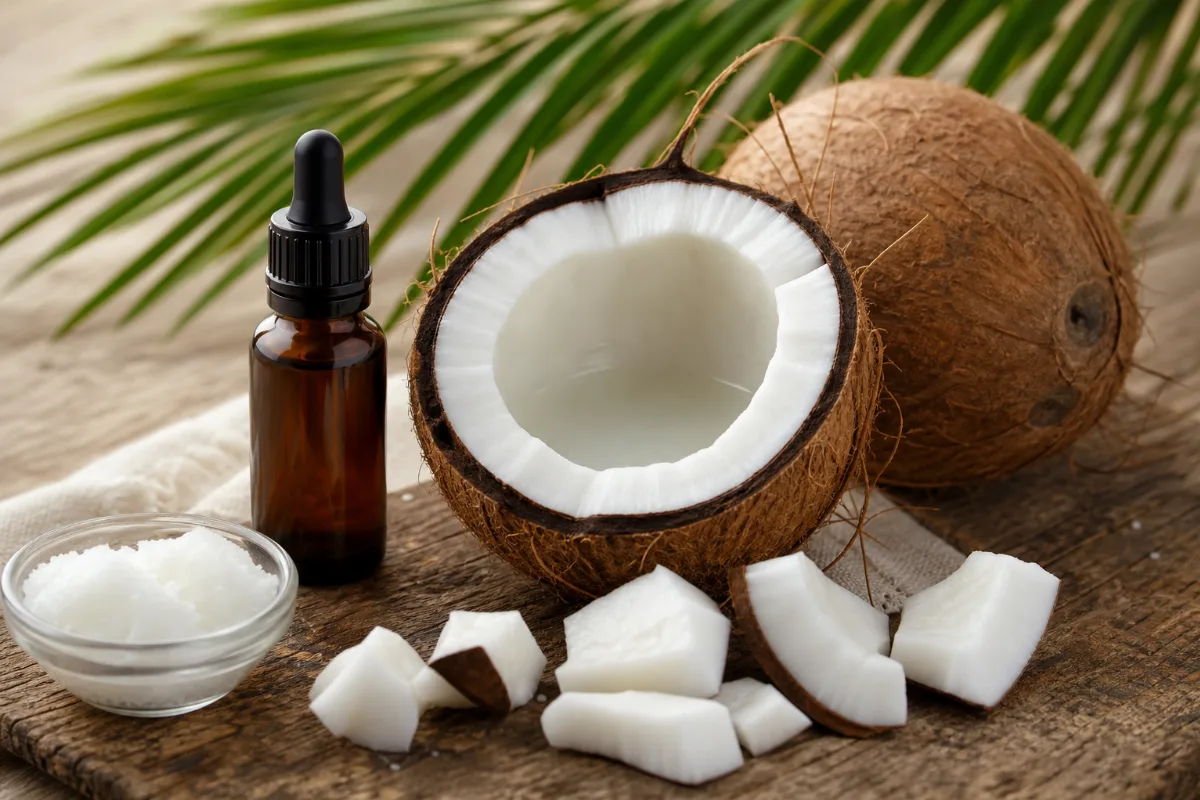
Coconut oil is a fixed oil from the kernel of the coconut palm, Cocos nucifera. It is not an essential oil. A 2019 review says the two main types, copra oil and virgin coconut oil, have similar fatty-acid profiles, with lauric acid the main one. [4] Virgin coconut oil is described there as having more vitamin E and plant polyphenols. [4] Extraction in the sources we read: cold pressing is the method preferred for plant oils used on skin. [13]"Fractionated" coconut oil is sold as a liquid version that stays runny. Proper evidence not found: the sources we read do not describe how it is made, what is in it, or whether trials on coconut oil apply to it. Do not assume the results below carry over. See carrier oils explained and essential oils versus carrier oils.
Safety by group
- Allergy: see above. A preterm-infant follow-up found no child sensitized to coconut among 90 tested at about 15 months after coconut oil skin care; this was a small study. [11] We found no source on how common allergic contact dermatitis to coconut oil is.
- Comedogenicity (clogging pores): Proper evidence not found. The sources we read did not measure it.
- Old or air-exposed oil: not described in the sources we read. NCI says essential oils change as they age; it does not speak of carrier oils. [2] See storing essential oils and shelf life.
- Sun: not described in the sources we read.
- Dilution: no mixing figure is given and we could not verify one. Charts differ; see dilution: what sources say and why charts differ. This is information, not a prescription.
- Pets: the sources we read give no coconut-oil pet safety statement. Poison Control says to lock oils away from pets and children. [1]
- Pregnancy and breastfeeding: used in belly-skin trials, not safety studies (below). See essential oils in pregnancy and breastfeeding.
- Babies and children: coconut oil was used in several newborn skin trials, mostly in preterm infants, and the reviewers asked for better studies. [7] Poison Control says children have thinner skin and immature livers. [1] Ask a pediatric clinician. See essential oils around babies and children.
- Swallowing and cholesterol: eating coconut oil raised LDL ("bad") cholesterol in a 2020 meta-analysis of 16 trials compared with non-tropical vegetable oils. [3] That is about food, not about carrier use. For a swallowed essential oil blend, call a poison center. [1]
- Medicines, seizures, asthma, hormones: not described for coconut oil in the sources we read.
What research shows
| Question | What the source found | Strength of evidence | Route, form and who was studied |
|---|---|---|---|
| Child eczema | In 117 children with mild to moderate atopic dermatitis, virgin coconut oil lowered the severity score by 68.23% over 8 weeks versus 38.13% with mineral oil. [5] | Promising but limited | Virgin coconut oil on skin, compared with mineral oil |
| Adult eczema | In 52 adults, 1 of 20 (5%) on virgin coconut oil still had Staphylococcus aureus after 4 weeks versus 6 of 12 (50%) on virgin olive oil. [6] | Promising but limited | Virgin oils on skin twice daily |
| Newborn skin | In 14 trials (5,683 mostly preterm newborns), 11 judged oils helpful, 3 equivocal, negative or mixed; coconut was used in 5. [7] | Promising but limited | Several oils; mostly preterm infants |
| Stretch marks | A 2026 review of four trials (671 pregnant women) said coconut oil was effective, while rose, sesame and sweet almond oils were not. [12] | Promising but limited | Belly skin |
| Eczema overall | A 2019 review says evidence is limited but consistent for eczema, and limited evidence does not support use for Alzheimer's disease, bone loss or blood sugar control. [4] | Promising but limited (eczema); No good evidence of benefit (others) | Narrative review |
| Fractionated coconut oil, acne, hair growth | Proper evidence not found in the studies we read. | Insufficient evidence | Not tested in what we read |
Limits: trials were small, usually compared with an oil rather than a placebo, and people can see and feel oil. A trial of olive oil in adults found it weakened the skin barrier, so oils are not interchangeable. [14] Results for virgin coconut oil on skin do not carry over to swallowing or to other oils.
How it is used and what the sources say about quality
- Common uses: carrier for massage oils and rollers, and as a moisturizer. NCI describes aromatherapy massage as essential oils mixed into a carrier oil. [2] See aromatherapy massage.
- Check labels for "virgin" versus "refined", and for what "fractionated" means for that product. See reading an essential oil label and essential oil purity and adulteration.
Related pages
Uses studied and safety checks for Coconut Oil and Fractionated Coconut Oil
Read the safety checks first. Each card says whether a finding comes from people or only from the lab, which way the oil was used (scent, on skin or swallowed) and how strong the evidence is. A finding for one way of using an oil does not carry over to another.
Check before you use (3)
- Coconut allergy. Coconut allergy is described as infrequent, but one child had anaphylaxis after eating it, and cross-reaction with walnut and hazelnut was shown in that child. The FDA and MedlinePlus pages we read do not mention coconut. We found no data on skin reactions to the oil.
- Eating coconut oil and LDL cholesterol. In a 2020 meta-analysis of 16 trials, eating coconut oil raised LDL cholesterol by 10.47 mg/dL and HDL by 4.00 mg/dL versus non-tropical vegetable oils. This is about food, not carrier use.
- Children, pets, pregnancy, swallowing of essential oils. No coconut-oil pet information found. Poison Control says children have thinner skin and immature livers and to lock oils away from children and pets. If an essential oil blend is swallowed call Poison Help 1-800-222-1222 (US) or local emergency number.
Child eczema (virgin coconut oil on skin)
Preliminary or mixedIn 117 children with mild to moderate atopic dermatitis, virgin coconut oil lowered the severity score by 68.23% over 8 weeks versus 38.13% with mineral oil.
Supplements: Applies to the oil on skin as studied; results do not carry over to other routes, oils or products.
Adult eczema and skin bacteria (on skin)
Preliminary or mixedIn 52 adults, 5% of the coconut oil group still had Staphylococcus aureus after 4 weeks versus 50% on virgin olive oil.
Supplements: Applies to the oil on skin as studied; results do not carry over to other routes, oils or products.
Newborn and preterm infant skin
Preliminary or mixedIn 14 trials of oils on newborn skin (5,683 mostly preterm infants), 11 judged oils helpful and 3 were equivocal, negative or mixed; coconut was used in 5. The authors ask for better studies.
Supplements: Applies to the oil on skin as studied; results do not carry over to other routes, oils or products.
Stretch marks in pregnancy
Preliminary or mixedA 2026 review of four trials (671 pregnant women) said coconut oil was effective, while rose, sesame and sweet almond oils were not.
Supplements: Applies to the oil on skin as studied; results do not carry over to other routes, oils or products.
Fractionated coconut oil as a carrier
Not enough evidenceProper evidence not found: the sources we read do not describe how fractionated coconut oil is made, what is in it or whether results for coconut oil apply to it.
Supplements: No evidence found.
Using a carrier oil to dilute essential oils
Not enough evidenceNCI describes aromatherapy massage as essential oils mixed into a carrier oil. Poison Control says diluting is the best way to avoid a bad reaction from direct contact; charts differ and no figure was verified.
Supplements: Information, not a prescription.
Hair, acne and comedogenicity
Not enough evidenceProper evidence not found in sources read for hair growth or acne; pore-clogging (comedogenicity) was not measured in the sources read.
Supplements: No evidence found.
Connected topics
Open a group to see how each topic connects and how strong the evidence is.
Health goals (2)
- Cholesterol BalanceDocumented risk
Eating coconut oil raised LDL cholesterol compared with non-tropical vegetable oils; food route only.
- Healthy SkinPreliminary or mixed
Trials of virgin coconut oil on skin (child and adult eczema, newborn skin, stretch marks) were mostly favorable but small and usually compared with other oils.
Body systems (2)
- Integumentary SystemPreliminary or mixed
Trials of virgin coconut oil on skin (child and adult eczema, newborn skin, stretch marks) were mostly favorable but small and usually compared with other oils.
- Skin, Hair & BeautyPreliminary or mixed
Trials of virgin coconut oil on skin (child and adult eczema, newborn skin, stretch marks) were mostly favorable but small and usually compared with other oils.
Body parts (1)
- SkinPreliminary or mixed
Trials of virgin coconut oil on skin (child and adult eczema, newborn skin, stretch marks) were mostly favorable but small and usually compared with other oils.
Biomarkers (1)
- LDL CholesterolDocumented risk
Eating coconut oil raised LDL cholesterol in a 2020 meta-analysis of 16 trials. This is about eating it, not about carrier use.
Conditions & symptoms (2)
- Dermatitis, AtopicPreliminary or mixed
One double-blind trial in 117 children and one in 52 adults favored virgin coconut oil over mineral and olive oil; limited but consistent per a 2019 review.
- HypercholesterolemiaDocumented risk
Eating coconut oil raised LDL cholesterol in a 2020 meta-analysis; food route.
Frequently asked questions
Is fractionated coconut oil the same as coconut oil?
Proper evidence not found. The sources we read do not describe fractionated coconut oil, so do not assume trial results for virgin coconut oil apply to it.
Does coconut oil work for eczema?
One trial in 117 children found virgin coconut oil beat mineral oil on a severity score, and a 2019 review calls the evidence limited but consistent. [5][4] Weeping, infected or worsening eczema needs a clinician.
Can you be allergic to coconut oil?
Coconut allergy is described as infrequent but real; one child had anaphylaxis after eating it. [8] Call 911 or your local emergency number for throat swelling or trouble breathing. We found no data on skin reactions to the oil.
Is it safe for babies and pets?
Newborn trials were mostly favorable but the authors asked for better studies. [7] We found no pet-specific information. Poison Control says to lock oils away from children and pets. [1]
Can I swallow essential oil mixed in coconut oil?
We give no directions. If an essential oil is swallowed, call Poison Help at 1-800-222-1222 (US) or your local emergency number. [1]
References
- Poison Control (National Capital Poison Center). Essential oils: Poisonous when misused. Read 2026-10-23.
- National Cancer Institute. Aromatherapy and Essential Oils (PDQ). Last updated September 11, 2023. Read 2026-10-23.
- Neelakantan N, Seah JYH, van Dam RM. Circulation. 2020. The Effect of Coconut Oil Consumption on Cardiovascular Risk Factors: A Systematic Review and Meta-Analysis of Clinical Trials. PubMed 31928080 (abstract read via Europe PMC). Read 2026-10-23.
- Wallace TC. J Am Coll Nutr. 2019. Health Effects of Coconut Oil: A Narrative Review of Current Evidence. PubMed 30395784 (abstract read via Europe PMC). Read 2026-10-23.
- Evangelista MT, et al. Int J Dermatol. 2014. Effect of topical virgin coconut oil on SCORAD index, TEWL and skin capacitance in pediatric atopic dermatitis. PubMed 24320105 (abstract read via Europe PMC). Read 2026-10-23.
- Verallo-Rowell VM, et al. Dermatitis. 2008. Novel antibacterial and emollient effects of coconut and virgin olive oils in adult atopic dermatitis. PubMed 19134433 (abstract read via Europe PMC). Read 2026-10-23.
- Effects of Topical Oils on Neonatal Skin: A Systematic Review. Adv Skin Wound Care. 2022. PubMed 36409192 (abstract read via Europe PMC). Read 2026-10-23.
- Identification of a 7S globulin as a novel coconut allergen. Ann Allergy Asthma Immunol. 2007. PubMed 17601273 (abstract read via Europe PMC). Two patients. Read 2026-10-23.
- U.S. Food and Drug Administration. Food Allergies. The page we read does not mention coconut. Read 2026-10-23.
- MedlinePlus (US National Library of Medicine). Food allergy. The page we read does not mention coconut. Read 2026-10-23.
- Routine Emollient Therapy with Coconut Oil in Preterm Infants and Allergic Sensitization at 1-Year Corrected Age. 2025. PubMed 40472816 (abstract read via Europe PMC). Read 2026-10-23.
- Effect of Aromatherapy Oil Applications on Striae Gravidarum: A Systematic Review. 2026. PubMed 41988841 (abstract read via Europe PMC). Read 2026-10-23.
- Vaughn AR, Clark AK, Sivamani RK, Shi VY. Am J Clin Dermatol. 2018. Natural Oils for Skin-Barrier Repair: Ancient Compounds Now Backed by Modern Science. PubMed 28707186 (abstract read via Europe PMC). Read 2026-10-23.
- Danby SG, et al. Pediatr Dermatol. 2013. Effect of olive and sunflower seed oil on the adult skin barrier: implications for neonatal skin care. PubMed 22995032 (abstract read via Europe PMC). Read 2026-10-23.
- FDA Questions and Answers Regarding Food Allergen Labeling (Edition 5), guidance for industry, January 2025 (nonbinding). Full PDF read 2026-10-24: Table 1 of tree nuts does not list coconut.