Essential Oils & Aromatherapy · Carrier oil
Argan Oil
Argania spinosa (also Sideroxylon spinosum), kernel oil · also called Moroccan argan oil, huile d'argan, aceite de argan.
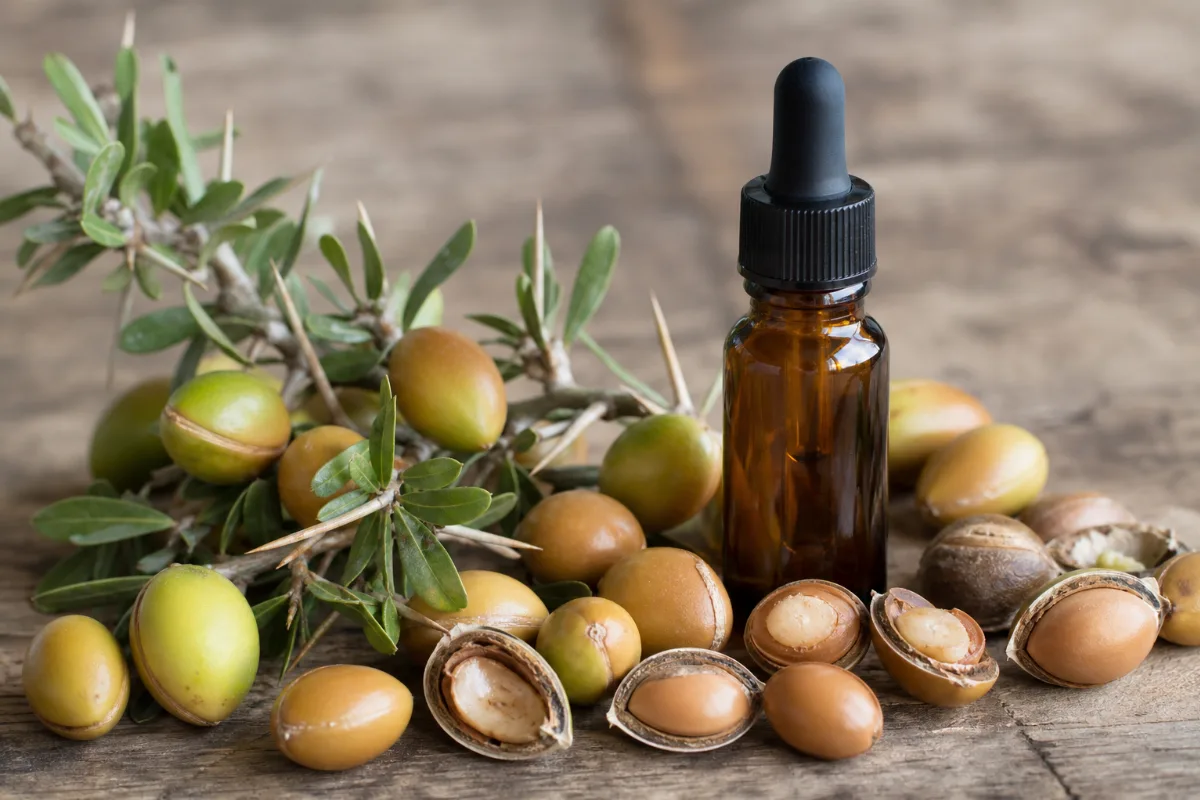
Argan oil is pressed from the kernels of the argan tree of south-west Morocco. It is used as a food oil and as a skin and hair oil. The research is small: one 60-woman trial on skin elasticity, small trials that lowered cholesterol a little, and no good evidence for hair. The main cautions are allergy, which has been reported (including a baby and two cases of anaphylaxis), and bottles blended with cheaper oils.
General information, not medical advice. Last substantive update · Not medically reviewed. A named clinician has not signed off on this page. How this page is made
About Argan Oil
Argan oil is a pale golden oil pressed from the kernels of the argan tree of south-west Morocco. It is eaten and used on skin and hair. Evidence for health benefits is thin to modest, the main caution is allergy, and expensive bottles can be blended with cheaper oils.
What it is
Argan oil comes from the kernels of the argan tree. GBIF treats Argania spinosa (L.) Skeels as a synonym of the accepted name Sideroxylon spinosum L., in the Sapotaceae family. Labels and research papers still use Argania spinosa.
It is mostly oleic and linoleic acid, with tocopherols (vitamin E family), plant sterols and polyphenols. One review says the tree is found only in Morocco.
How it is used
It is eaten in Morocco, used as a skin and hair oil, and sold as a carrier oil for blending. A review lists traditional uses for nutrition and for skin and hair hydration, among others. Those are reports of use, not tested benefits.
It is a plant oil, not an essential oil. It is used to dilute essential oils, not as a scent.
What the research shows
Skin: one randomised trial of 60 postmenopausal women reported better elasticity readings after 60 days of eating and/or applying argan oil. The comparison with an oil-free skin area is unclear and no sizes are given.
Blood fats: a meta-analysis of 5 trials found modest falls in cholesterol and triglycerides. Small trials in healthy men and in hemodialysis patients pointed the same way, but olive oil did about as well on many markers in the trials that compared them.
Hair: a systematic review found no significant evidence. Blood pressure: only rat studies. Male hormones rose similarly with argan and olive oil.
Where it comes from and who makes it
A review says argan oil is mainly produced by women's cooperatives in Morocco, and that food oil was previously made exclusively by women by a laborious ancestral process.
The Arganeraie in south-west Morocco became a UNESCO biosphere reserve (nominated 1998). UNESCO says the argan tree matters for conservation, research and local livelihoods. A review adds that the argan vegetation is threatened by clearance and overgrazing. We did not find a source describing the Amazigh tradition in detail, so we do not describe it here.
Forms, quality and buying
Cosmetic argan oil is made from unroasted kernels. Food argan oil is cold pressed from kernels roasted for a few minutes.
Lab tests can detect olive and soybean oil in argan oil, and oils from different provinces can be told apart only in part. So claims about purity or origin on a bottle are hard to check yourself. Look for the botanical name, the grade and one ingredient only.
At a glance
Traditional uses history, not proof
- A review lists uses in Morocco for nutrition, rheumatism, high cholesterol, atherosclerosis, lung infections, newborn gut problems, diabetes, and skin and hair hydration. These are reports of use, not proof.
Studied for research
- Skin elasticity after menopause, very low
- Dry skin and skin barrier, insufficient
- Hair growth and quality, insufficient
- Blood cholesterol and triglycerides (eaten), low
- Blood pressure, insufficient (rat studies only)
- Blood vitamin E and antioxidant markers, very low
- Male hormone levels, insufficient
Main compounds
- Oleic acid (omega-9), the most abundant fatty acid
- Linoleic acid (omega-6)
- Tocopherols (vitamin E family)
- Plant sterols (schottenol, spinasterol) and polyphenols
Common forms
- Cosmetic argan oil, from unroasted kernels
- Food argan oil, cold pressed from lightly roasted kernels
- Ingredient in creams, hair products and balms (label: Argania spinosa kernel oil)
Research links: Skin elasticity trial in postmenopausal women (abstract) · Argan oil and blood fats, meta-analysis (abstract) · Hair oils systematic review (abstract) · Anaphylaxis to argan oil, case report · Authentication of argan oil, quality review (abstract) · UNESCO: Arganeraie biosphere reserve · Research Library · Genes & Biomarkers Library
What it is and its history
- Accepted scientific name
- Sideroxylon spinosum
- Naming authority
- L.
- Synonyms
- Name: Argania spinosa; Authority: (L.) Skeels
- Common names
- Argan oil (English); Moroccan argan oil (English); Huile d'argan (French); Aceite de argan (Spanish)
- Family or group
- Sapotaceae
- Classification
- Plantae > Sapotaceae > Sideroxylon > Sideroxylon spinosum
- Native range
- One review says the tree is endemic only to Morocco; another places the Arganeraie in the south-west of the country.
- Habitat
- Arid south-west Morocco; UNESCO calls the argan forest unique for its resilience in arid conditions.
- What it looks like
- Roots: Not checked.; Stems: Not checked.; Leaves: Leaves and fruits are used as forage (Msanda 2021).; Flowers: Not checked.; Fruit: Argan fruits are collected for their oily kernels; the oil is pressed from the kernels.
- Cultivation
- Not checked in detail. Msanda 2021 reports clearance, overgrazing and overexploitation in the argan region.
- Harvest and processing
- Cosmetic oil is made from unroasted kernels; food oil from kernels roasted for a few minutes and cold pressed. Women's cooperatives produce most of the oil, as one review states.
- Look-alikes and adulterants
- Name: Blended or imitation argan oil; Note: Argan oil can be blended with cheaper vegetable oils, such as olive or soybean oil.; Name: Other carrier oils; Note: Jojoba, olive, sweet almond and rosehip oils are different oils with different fatty acids.
- Sustainability and conservation
- Msanda 2021 describes the vegetation as vulnerable and degraded by clearance, overgrazing and overexploitation. UNESCO lists the Arganeraie as a biosphere reserve, nominated 1998.
Traditional use and history history, not clinical proof
| Tradition or era | Documented use | Source |
|---|---|---|
| Traditional use in south-west Morocco | A review states the tree is fully used by native populations for nutrition, medicine and cosmetics, and lists uses of the oil for rheumatism, high cholesterol, atherosclerosis, lung infections, newborn gut problems, diabetes, and skin and hair hydration. These are reports of use, not proof. | p34418509 |
| Women's work and cooperatives | A review says food argan oil was previously made exclusively by women by a laborious ancestral process, and that the oil is now mainly produced by women's cooperatives using a semi-industrial mechanical process. | p35187023 |
| UNESCO biosphere reserve | The Arganeraie in south-west Morocco was nominated as a UNESCO biosphere reserve in 1998 (UNESCO page; Msanda 2021 says declared in 1998). The Amazigh (Berber) tradition of argan was not described in the sources read and is not verified here. | s-unesco-arganeraie |
Traditional use shows how it was used. It does not show that it works or is safe today.
What is inside, and how it may work
What it contains and how those compounds act in cells and animals. Laboratory and animal mechanisms are not proven effects in people.
Main compounds
| Compound | Family | Where it is concentrated | Activity studied | Level of evidence |
|---|---|---|---|---|
| Oleic acid PubChem 445639 | omega-9 monounsaturated fatty acid | Kernel oil The most abundant fatty acid in cosmetic argan oils from five provinces (no percentage stated in the abstract). | Main fat in the oil; no activity tested in the sources read. 16 15 | Lab analysis |
| Linoleic acid PubChem 5280450 | omega-6 polyunsaturated fatty acid | Kernel oil The second most abundant fatty acid, after oleic acid. | Reviewers link a higher linoleic-to-oleic ratio to better skin-barrier repair in plant oils generally. 16 23 | Lab analysis and review |
| Tocopherols (vitamin E family), mainly gamma-tocopherol | vitamin E | Kernel oil Not given in the abstracts. | Antioxidant in the lab; blood vitamin E rose in small trials. 19 6 | Lab and human markers |
| Phytosterols (schottenol, spinasterol), polyphenols | plant sterols and phenols | Kernel oil Not given in the abstracts. | Named in a 2025 review as part of the oil's antioxidant profile; effects shown in lab and animal work only. 19 | Lab |
Mechanisms, receptors and pathways
| Target or pathway | Gene or receptor | What was found | Level |
|---|---|---|---|
| Blood vessels and blood pressure (rats) | Nitric oxide, thromboxane A2 | In hypertensive rats, 7 weeks of argan oil improved artery relaxation, with a larger role of nitric oxide and lower thromboxane release; lower oxidative stress may contribute. 4 | Animal research |
| Oxidative stress and inflammation | Nrf2, NF-kB | Lab and animal work suggests components of the oil may switch on antioxidant defences (Nrf2) and dampen inflammation (NF-kB). The review says direct evidence remains limited. 19 | Animal and in vitro (review) |
Absorption, metabolism and elimination
- Absorption
- Not described in the sources read.
- Distribution
- Not described.
- Metabolism
- Not described.
- Elimination
- Not described.
- Bioavailability
- Not described, apart from blood vitamin E rising in trials of eaten oil.
Isolated compounds versus whole extracts
Argan oil eaten as food, argan oil on skin, cosmetic argan oil and the shell, cake and leaves of the tree are different things. Most clinical trials used eaten oil. The skin trial used both eaten and cosmetic oil together.
Nutritional composition
Argan oil is a plant oil, mostly oleic and linoleic acid with tocopherols. It is eaten in Morocco and used on skin and hair elsewhere. In small trials it was compared with olive oil, which often did about as well on blood markers.
1 low certainty2 very low certainty5 not enough evidence
What was looked at
The 8 benefits and uses checked for Argan Oil, each with how strong the evidence is. Tap one to open it.
- Skin elasticity after menopause (eaten and on the skin)Very low certainty
- Dry skin and the skin barrierNot enough evidence
- Hair growth, hair quality and scalpNot enough evidence
- Blood cholesterol and triglycerides (eaten argan oil)Low certainty
- Blood pressureNot enough evidence
- Blood vitamin E and antioxidant markersVery low certainty
- Male hormone levels (testosterone, LH)Not enough evidence
- Inflammation and oxidative stress (lab and animal work)Not enough evidence
Lab markers tracked in the studies
Skin elasticity readings (R2, R5, R7) and resonance running timeBlood fats: total cholesterol, LDL, HDL, triglyceridesBlood vitamin ETestosterone and luteinising hormone (LH)Arterial blood pressure
What is Argan Oil good for?
What the research shows for each use, and how strong it is. None of it is proven. Read the Safety tab too.
Benefits, one by one
Each card is a research question, not a promise. Tap a goal to filter. Open a card to see the studies, doses and limits.
Skin elasticity after menopause (eaten and on the skin)
Very low certaintyOne 60-day trial in 60 postmenopausal women reported better skin elasticity readings after eating argan oil and after putting it on the skin.
1 studiesArgan oil eaten and argan oil put on the skin, both in the same trial…
Studies, doses and limits
What the trials found
One randomised trial in 60 postmenopausal women compared eating argan oil with eating olive oil; both groups also put argan oil on one forearm.
Results
Elasticity readings (R2, R5, R7) rose and resonance running time fell (P<0.001 to 0.002). The abstract gives no sizes of change.
Effect sizes as reported
Not given in the abstract.
Why this rating
One small trial, 60 days, no sizes in the abstract, and no clear oil-free comparison for the skin part. Not repeated.
Form and dose studied
Argan oil eaten and argan oil put on the skin, both in the same trial. Amounts are in the paper and are not given here.
Who was studied
Postmenopausal women.
Limits
Both groups put argan oil on the skin. Compared against olive oil, not against no oil. Short follow-up.
Why researchers looked
Skin loses elasticity after menopause, and argan oil is sold as a skin oil.
Traditional use
A review of the argan tree lists traditional uses of the oil in Morocco, including for skin and hair hydration. These are reports of use, not proof that it works.
Proposed mechanism Pharmacological theory
Not tested in this trial. The authors link elasticity to falling oestrogen after menopause, which is background, not a result.
A proposed mechanism does not show that the effect happens in people.
Argan oil can cause allergic skin reactions in some people. See the Safety tab.
Dry skin and the skin barrier
Not enough evidenceWe found no trial of argan oil on dry skin or eczema. A skin review lists it among plant oils but gives no argan result in its abstract.
1 studiesNot applicable.
Studies, doses and limits
What the trials found
No trial of argan oil on dry skin, eczema or skin-barrier measures was found.
Why this rating
No trial found. Only a general review that lists the oil.
Limits
Nothing to weigh.
Why researchers looked
Plant oils are used to soften skin and seal in water.
Traditional use
A review of the argan tree lists traditional uses of the oil in Morocco, including for skin and hair hydration. These are reports of use, not proof that it works.
Proposed mechanism Pharmacological theory
Reviewers suggest oils with more linoleic acid and less oleic acid repair the barrier better. Whether that applies to argan oil was not tested in the sources read.
A proposed mechanism does not show that the effect happens in people.
Allergic contact dermatitis from argan oil has been reported. Stop and ask a doctor if a rash appears.
Hair growth, hair quality and scalp
Not enough evidenceA 2022 systematic review of hair oils found argan oil has no significant evidence for hair growth, hair quality or hair infestation.
1 studiesNot applicable.
Studies, doses and limits
What the trials found
A systematic review of 22 articles on coconut, castor and argan oils for hair; the reviewers judged the argan evidence not significant.
Results
No significant evidence for argan oil on hair growth, quality or infestation.
Why this rating
The review found no significant evidence. This is not proof that it does nothing, only that good studies are missing.
Limits
The abstract does not say how many articles were about argan oil.
Why researchers looked
Argan oil is a popular hair oil.
Traditional use
A review of the argan tree lists traditional uses of the oil in Morocco, including for skin and hair hydration. These are reports of use, not proof that it works.
Proposed mechanism Pharmacological theory
Not tested.
A proposed mechanism does not show that the effect happens in people.
Allergic reactions on the skin are possible, including on the scalp.
Blood cholesterol and triglycerides (eaten argan oil)
Low certaintyA 2018 meta-analysis of 5 small trials (292 people) found eating argan oil lowered total and LDL cholesterol and triglycerides and raised HDL a little compared with controls.
4 studiesArgan oil eaten, for at least 2 weeks in the pooled trials. Amounts a…
Studies, doses and limits
What the trials found
A meta-analysis of 5 trials found falls in total cholesterol, LDL and triglycerides and a rise in HDL. Individual small trials in healthy people (Algeria, Morocco) and in hemodialysis patients point the same way.
Results
Total cholesterol 16.85 mg/dl lower, LDL 11.67 lower, triglycerides 13.69 lower, HDL 4.14 higher (pooled).
Effect sizes as reported
See studies.
Why this rating
Pooled result from only 5 small trials; the abstract does not give the trials, their length, controls or quality. No heart attack or stroke outcomes. One dialysis trial abstract contradicts itself on total cholesterol.
Form and dose studied
Argan oil eaten, for at least 2 weeks in the pooled trials. Amounts are in the papers and are not given here.
Who was studied
Mostly healthy adults, plus 37 hemodialysis patients.
Limits
Small and short trials; blood fats are markers, not heart disease.
Why researchers looked
Argan oil is rich in oleic and linoleic acid and vitamin E, which could affect blood fats.
Traditional use
A review lists traditional use of the oil for high cholesterol and clogged arteries. This is a report of use, not proof.
Proposed mechanism Pharmacological theory
Not established in the sources read.
A proposed mechanism does not show that the effect happens in people.
Argan oil is not a medicine. Do not stop or change heart medicines because of it. Ask your doctor.
Blood pressure
Not enough evidenceWe found no trial in people with high blood pressure. Rats with high blood pressure had lower pressure after 7 weeks of argan oil. In healthy men, 3 weeks of argan or olive oil did not change arterial pressure.
2 studiesNot applicable.
Studies, doses and limits
What the trials found
No human trial in people with high blood pressure. One trial in healthy men measured pressure as a side outcome.
Results
Healthy men: no significant change in arterial pressure with argan or olive oil. Rats: lower pressure after the fifth week.
Why this rating
The blood pressure result comes from rats. The human data are a side outcome in healthy men.
Who was studied
Rats; healthy men.
Limits
Animal results do not predict human results.
Why researchers looked
Rat studies suggested argan oil might help blood pressure.
Traditional use
A review lists traditional use of the oil for heart and artery problems. This is a report of use, not proof.
Proposed mechanism Animal research
In rats, effects on artery relaxation, nitric oxide, thromboxane and oxidative stress were reported.
A proposed mechanism does not show that the effect happens in people.
Do not use argan oil in place of blood pressure medicine.
Blood vitamin E and antioxidant markers
Very low certaintySeveral small trials found blood vitamin E was higher after eating argan oil, and some antioxidant markers improved. These are lab markers, not health results.
3 studiesArgan oil eaten.
Studies, doses and limits
What the trials found
In three small trials (healthy men, healthy adults, postmenopausal women) blood vitamin E was higher with argan oil; in men, olive oil improved several other markers equally.
Results
Vitamin E rose with argan oil in each trial; sizes not in the abstracts.
Effect sizes as reported
Not given.
Why this rating
Markers only, small trials, short follow-up. Olive oil gave similar gains in the other markers.
Form and dose studied
Argan oil eaten.
Who was studied
Healthy men and adults; postmenopausal women.
Limits
No health outcome; a marker rise is not proof of benefit.
Why researchers looked
Argan oil contains tocopherols (vitamin E family), which can raise blood levels.
Traditional use
A review lists antioxidant activity among the reported properties of the oil.
Proposed mechanism Laboratory research
Tocopherols and other compounds are antioxidants in the lab. Whether that gives a health benefit in people was not shown.
A proposed mechanism does not show that the effect happens in people.
None specific. Higher blood vitamin E is not itself a proven benefit.
Male hormone levels (testosterone, LH)
Not enough evidenceIn 60 healthy men, testosterone and LH rose after 3 weeks of eating argan oil or olive oil. The rise was similar with both oils.
1 studiesArgan oil eaten.
Studies, doses and limits
What the trials found
One randomised comparison of argan and olive oil in 60 healthy men.
Results
Testosterone +19.9% (argan) and +17.4% (olive); LH +18.5% and +42.6% as the abstract reads; DHEAS unchanged.
Effect sizes as reported
See results.
Why this rating
One small, short trial in healthy men. The same change with olive oil means it may not be due to argan oil. Meaning for health is not known.
Form and dose studied
Argan oil eaten.
Who was studied
Healthy men aged 23 to 40.
Limits
No oil-free group. Single trial.
Why researchers looked
Researchers wanted to see whether the oil changes hormones.
Traditional use
Not described in the sources read.
Proposed mechanism Pharmacological theory
Not tested.
A proposed mechanism does not show that the effect happens in people.
Hormone changes are not a proven benefit or harm. Ask a doctor if you have a hormone condition.
Inflammation and oxidative stress (lab and animal work)
Not enough evidenceA 2025 review says cell and animal studies found argan oil lowered inflammation and oxidative stress markers. The authors say direct evidence for its components is limited.
1 studiesNot applicable.
Studies, doses and limits
What the trials found
No human trial of inflammation outcomes was found for this page.
Why this rating
Lab and animal work only.
Who was studied
Cells and animals.
Limits
Does not predict results in people.
Why researchers looked
Its fats, tocopherols and plant sterols are active in the lab.
Traditional use
A review lists anti-inflammatory and antioxidant activity among the reported properties.
Proposed mechanism Animal research
Reported effects on the Nrf2 and NF-kB pathways in lab and animal work.
A proposed mechanism does not show that the effect happens in people.
Lab and animal results do not show a benefit in people.
Connections to the rest of health
How Argan Oil connects to the rest of our health knowledge graph. Every link says what kind of connection it is. A safety link (for example to the liver) is a warning, not a benefit. A study that merely mentions a topic never creates a benefit link.
Explore every connection: goals, body systems, organs, symptoms, genes
A. Wellness goals
| Connected to | Kind of connection | Evidence status | Context | Studies |
|---|---|---|---|---|
| Healthy Skin | Very low certainty | Skin elasticity after menopause (eaten and on the skin): One 60-day trial in 60 postmenopausal women reported better skin elasticity readings after eating argan oil and after putting it on the skin. | 5 | |
| Healthy Aging | Very low certainty | Skin elasticity after menopause (eaten and on the skin): One 60-day trial in 60 postmenopausal women reported better skin elasticity readings after eating argan oil and after putting it on the skin. | 5 | |
| Healthy Skin | Not enough evidence | Dry skin and the skin barrier: We found no trial of argan oil on dry skin or eczema. A skin review lists it among plant oils but gives no argan result in its abstract. | 23 | |
| Skin Health | Not enough evidence | Dry skin and the skin barrier: We found no trial of argan oil on dry skin or eczema. A skin review lists it among plant oils but gives no argan result in its abstract. | 23 | |
| Hair Support | Not enough evidence | Hair growth, hair quality and scalp: A 2022 systematic review of hair oils found argan oil has no significant evidence for hair growth, hair quality or hair infestation. | 18 | |
| Cholesterol Balance | Low certainty | Blood cholesterol and triglycerides (eaten argan oil): A 2018 meta-analysis of 5 small trials (292 people) found eating argan oil lowered total and LDL cholesterol and triglycerides and raised HDL a little compared with controls. | 22 20 10 6 | |
| Heart Health | Low certainty | Blood cholesterol and triglycerides (eaten argan oil): A 2018 meta-analysis of 5 small trials (292 people) found eating argan oil lowered total and LDL cholesterol and triglycerides and raised HDL a little compared with controls. | 22 20 10 6 | |
| Blood Pressure Support | Not enough evidence | Blood pressure: We found no trial in people with high blood pressure. Rats with high blood pressure had lower pressure after 7 weeks of argan oil. In healthy men, 3 weeks of argan or olive oil did not change arterial pressure. | 4 7 | |
| Cellular Protection | Very low certainty | Blood vitamin E and antioxidant markers: Several small trials found blood vitamin E was higher after eating argan oil, and some antioxidant markers improved. These are lab markers, not health results. | 6 20 9 | |
| Preventive Wellness | Not enough evidence | Male hormone levels (testosterone, LH): In 60 healthy men, testosterone and LH rose after 3 weeks of eating argan oil or olive oil. The rise was similar with both oils. | 7 | |
| Inflammation Balance | Not enough evidence | Inflammation and oxidative stress (lab and animal work): A 2025 review says cell and animal studies found argan oil lowered inflammation and oxidative stress markers. The authors say direct evidence for its components is limited. | 19 | |
| Cellular Protection | Not enough evidence | Inflammation and oxidative stress (lab and animal work): A 2025 review says cell and animal studies found argan oil lowered inflammation and oxidative stress markers. The authors say direct evidence for its components is limited. | 19 |
B. Body systems
| Connected to | Kind of connection | Evidence status | Context | Studies |
|---|---|---|---|---|
| Skin Hair Beauty | Biological association | Very low certainty | Studied for: Skin elasticity after menopause (eaten and on the skin) Studied for: Dry skin and the skin barrier | 5 23 18 |
| Cardiovascular System | Biological association | Low certainty | Studied for: Blood cholesterol and triglycerides (eaten argan oil) Studied for: Blood pressure | 22 20 10 6 4 7 9 |
| Endocrine System | Biological association | Not enough evidence | Studied for: Male hormone levels (testosterone, LH) | 7 |
| Pain Inflammation | Biological association | Not enough evidence | Studied for: Inflammation and oxidative stress (lab and animal work) | 19 |
C. Body parts and organs
E. Health conditions
| Connected to | Kind of connection | Evidence status | Context | Studies |
|---|---|---|---|---|
| Allergic contact dermatitis | Low certainty | Case reports, including an infant; details not available. Preparation or compound: Argan oil on skin |
11 3 14 | |
| Anaphylaxis | Low certainty | Two case reports with titles only available. Preparation or compound: Argan oil |
24 2 |
I. Biomarkers
| Connected to | Kind of connection | Evidence status | Context | Studies |
|---|---|---|---|---|
| Skin elasticity readings (R2, R5, R7) and resonance running time | Biological association | Very low certainty | Measured in trials: improved (R2, R5, R7 up; RRT down). A lab change is not the same as a health benefit. | 5 |
| Blood fats: total cholesterol, LDL, HDL, triglycerides | Biological association | Low certainty | Measured in trials: improved (total, LDL, triglycerides down; HDL up). A lab change is not the same as a health benefit. | 22 20 10 |
| Blood vitamin E | Biological association | Very low certainty | Measured in trials: higher. A lab change is not the same as a health benefit. | 6 9 20 |
| Testosterone and luteinising hormone (LH) | Biological association | Not enough evidence | Measured in trials: higher with both argan and olive oil. A lab change is not the same as a health benefit. | 7 |
| Arterial blood pressure | Biological association | Not enough evidence | Measured in trials: no clear change in healthy men. A lab change is not the same as a health benefit. | 7 |
L. Active compounds
| Connected to | Kind of connection | Evidence status | Context | Studies |
|---|---|---|---|---|
| Oleic acid | Biological association | Lab analysis | Main fat in the oil; no activity tested in the sources read. Preparation or compound: Kernel oil |
16 15 |
| Linoleic acid | Biological association | Lab analysis and review | Reviewers link a higher linoleic-to-oleic ratio to better skin-barrier repair in plant oils generally. Preparation or compound: Kernel oil |
16 23 |
| Tocopherols (vitamin E family), mainly gamma-tocopherol | Biological association | Lab and human markers | Antioxidant in the lab; blood vitamin E rose in small trials. Preparation or compound: Kernel oil |
19 6 |
| Phytosterols (schottenol, spinasterol), polyphenols | Biological association | Lab | Named in a 2025 review as part of the oil's antioxidant profile; effects shown in lab and animal work only. Preparation or compound: Kernel oil |
19 |
Each connection is stored with the ingredient, the connected record, the kind of connection, the evidence status, the supporting studies, the preparation or compound involved, and a review date (last reviewed October 25, 2026).
Evidence at a glance: what the research found for 8 outcomes
Each outcome below is one thing researchers measured. Certainty is how far the evidence can be trusted, not how well it works. The full studies are on the next tab.
The evidence
The research centre for Argan Oil. Every record here was checked against PubMed or the publisher's page; we never list a study we have not verified.
Evidence by outcome
Bars show how many studies we found for each outcome, not how well it works. People are added up across trials only (reviews are not added, to avoid double counting).
How we rate evidence
High certainty
Several well-run trials or reviews agree; further research is unlikely to change the picture much.
Moderate certainty
Good trials point the same way, but some doubt remains.
Low certainty
Small, short or inconsistent trials. The finding could change with better research.
Very low certainty
Very little or very weak human data. Treat as a possibility only.
Mixed findings
Trials or reviews disagree with each other.
Not enough evidence
Not enough human research to say either way.
Evidence against
Good research found no benefit, or found harm.
We take the reviewers' own risk-of-bias and GRADE statements where they exist, and otherwise judge from study size, design, consistency, directness and whether a product matches what is sold. Many publications do not make evidence high. Method note: We read the PubMed abstracts of 17 papers, the titles of 5 more, and the UNESCO page in full text, checked the plant name in GBIF and compounds in PubChem. Five allergy case reports have no abstract, so only their titles were used. Certainty ratings are the compiler's own reading. Funding is not stated in most abstracts; some authors appear on several argan papers.
Study library: every study we checked 24
| Study | Design | People | Product, dose, length | Result |
|---|---|---|---|---|
| Amaral 2022 Authentication of Argan (Argania spinosa L.) Oil Using Novel DNA-Based Approaches: Detection of Olive and Soybean Oils as Potential Adulterants. Foods · PMID 36010499 · DOI |
Lab analysis lab |
Lab test mixtures of argan oil with olive or soybean oil | Argan oil mixed with olive or soybean oil oil Not given here |
The authors say argan oil is very prone to adulteration with cheaper vegetable oils because of its high price. Their new PCR tests detected and measured olive oil at 50 to 1% and soybean oil at 25 to 1% in argan oil. Methods, limits and fundingOutcomes: Detecting adulteration with cheaper oils Limitations: A lab method paper. It does not say how common adulteration is in shops. Funding and conflicts: EU and Portuguese science-foundation grants; authors declare no conflict of interest. One author also co-wrote the cooperatives review and other argan papers. Read: abstract |
| Astier 2010 Anaphylaxis to argan oil. Allergy · PMID 19839978 · DOI |
Case report |
1 Case report (details not available) |
Argan oil oil Not given here |
Title and PubMed record only; no abstract is available. The title states a case of anaphylaxis to argan oil. Methods, limits and fundingOutcomes: Anaphylaxis Limitations: Title only; the route (eaten or on skin), the person and the outcome are not known from the sources read. Funding and conflicts: Not stated. Read: title-only |
| Barrientos 2014 Allergic contact dermatitis caused by argan oil in an infant. Contact Dermatitis · PMID 25345797 · DOI |
Case report |
1 Case report of an infant (details not available) |
Argan oil on skin oil Not given here |
Title and PubMed record only; no abstract is available. The title states that argan oil caused allergic contact dermatitis in an infant. Methods, limits and fundingOutcomes: Allergic contact dermatitis Limitations: Title only; the age, how the cause was confirmed and outcome are not known from the sources read. Funding and conflicts: Not stated. Read: title-only |
| Berrougui 2004 Argan (Argania spinosa) oil lowers blood pressure and improves endothelial dysfunction in spontaneously hypertensive rats. Br J Nutr · PMID 15613254 · DOI |
Animal research animal |
Spontaneously hypertensive rats and normal rats | Argan oil given to rats seed oil Not given here 7 weeks · vs Untreated rats |
Argan oil lowered mean blood pressure in the hypertensive rats after the fifth week and improved the relaxing response of their arteries. Methods, limits and fundingOutcomes: Blood pressure, artery relaxation, thromboxane Limitations: Rats only. Not evidence of an effect on human blood pressure. Funding and conflicts: No conflict of interest stated in the abstract. Read: abstract |
| Boucetta 2015 The effect of dietary and/or cosmetic argan oil on postmenopausal skin elasticity. Clin Interv Aging · PMID 25673976 · DOI |
Controlled trial |
60 Sixty postmenopausal women |
Argan oil eaten daily, plus cosmetic argan oil on one forearm (treatment group); olive oil eaten daily plus argan on the forearm (control group) kernel oil, eaten and applied to skin Not given here 60 days (visits at start, 30 and 60 days) · vs Eaten olive oil (30 women); both groups applied argan oil to the left forearm |
In the abstract, eating argan oil raised R2, R5 and R7 (P<0.001 for each) and lowered RRT (P=0.002). Applying argan oil raised R2 and R5 (P<0.001), R7 (P=0.001) and lowered RRT (P<0.001). The authors conclude that eating and/or applying argan oil improved skin elasticity. Improved elasticity readings; size of change not given in the abstract Methods, limits and fundingOutcomes: Skin elasticity readings R2, R5, R7 and resonance running time (RRT) on both forearms Limitations: Only 60 women and 60 days. The abstract gives no sizes of change. Both groups put argan oil on the skin, and the abstract does not say whether the other forearm was an untreated comparison, so the skin effect has no clear oil-free comparison. The diet comparison is against olive oil, not against no oil. One trial, not repeated. Funding and conflicts: No conflict of interest or funding stated in the abstract. Read: abstract |
| Cherki 2005 Consumption of argan oil may have an antiatherogenic effect by improving paraoxonase activities and antioxidant status: Intervention study in healthy men. Nutr Metab Cardiovasc Dis · PMID 16216721 · DOI |
Controlled trial |
60 Sixty healthy young men |
Virgin argan oil eaten daily kernel oil, eaten Not given here 3 weeks after 2 weeks of baseline diet · vs Extra virgin olive oil |
PON1 activity and resistance of LDL to oxidation improved in both the argan and olive oil groups. Blood vitamin E rose only in the argan group (P=0.007). Similar gains in both oils, except vitamin E (argan only) Methods, limits and fundingOutcomes: Paraoxonase (PON1) activity, vitamin E, LDL oxidation Limitations: Short study of healthy men; markers, not heart disease. No group without oil. Funding and conflicts: No conflict of interest stated in the abstract. Read: abstract |
| Derouiche 2013 Effect of argan and olive oil consumption on the hormonal profile of androgens among healthy adult Moroccan men. Nat Prod Commun · PMID 23472458 |
Controlled trial |
60 Sixty healthy men aged 23 to 40 |
Virgin argan oil eaten kernel oil, eaten Not given here 3 weeks after a 2-week butter period · vs Extra virgin olive oil |
Testosterone rose by 19.9% with argan oil and 17.4% with olive oil; LH rose by 18.5% (argan) and 42.6% (olive), as the abstract reads. DHEAS, weight, BMI, arterial pressure and energy intake did not change with either oil. Hormone levels rose in both groups; no argan-versus-olive difference reported in the abstract Methods, limits and fundingOutcomes: Testosterone, LH, DHEAS, weight, BMI, blood pressure Limitations: Short study of healthy men; the same rises with olive oil suggest the change is not specific to argan. No group without oil. Meaning of the hormone change for health is not stated. Funding and conflicts: No conflict of interest stated in the abstract. Read: abstract |
| El Maouardi 2023 Quality Control and Authentication of Argan Oils: Application of Advanced Analytical Techniques. Molecules · PMID 36838806 · DOI |
Narrative review lab (review) |
Studies of quality testing of Moroccan argan oil | Argan oil oil Not given here |
The review says falsifiers deliberately blend argan oil with cheaper vegetable oils for profit, which lowers quality and might cause health issues for consumers. It covers lab methods used to detect this. Methods, limits and fundingOutcomes: Quality and authenticity testing Limitations: A review of lab methods. The abstract does not say how common blending is or what the health issues are. Funding and conflicts: No conflict of interest declared. Read: abstract |
| El Monfalouti 2013 Argan oil and postmenopausal Moroccan women: impact on the vitamin E profile. Nat Prod Commun · PMID 23472459 |
Controlled trial |
151 151 postmenopausal women |
Edible argan oil kernel oil, eaten Not given here Not given in the abstract · vs Olive oil |
Serum vitamin E was higher in the argan oil group. The authors say an argan-enriched diet can be recommended to help prevent some postmenopausal disorders. Higher vitamin E; no numbers in the abstract Methods, limits and fundingOutcomes: Serum vitamin E Limitations: The abstract is very short. A blood vitamin level is not a health outcome, and the claim about preventing disorders is not tested here. Funding and conflicts: No conflict of interest stated in the abstract. Read: abstract |
| Eljaoudi 2015 Consumption of Argan Oil Improves Anti-Oxidant and Lipid Status in Hemodialysis Patients. Phytother Res · PMID 26101142 · DOI |
Controlled trial |
37 37 adults with kidney failure on hemodialysis |
Virgin argan oil eaten kernel oil, eaten Not given here 4 weeks · vs Crossover with a control period |
The abstract reports lower triglycerides (p=0.03) and LDL (p=0.03), higher HDL (p=0.01) and higher vitamin E, and a smaller rise in MDA after dialysis. It also says there was no significant change in total cholesterol and oxidised LDL, yet lists total cholesterol as lower (p=0.02); the abstract contradicts itself on total cholesterol. Lower LDL and triglycerides, higher HDL; total cholesterol unclear Methods, limits and fundingOutcomes: Blood lipids, vitamin E, oxidised LDL, malondialdehyde (MDA) Limitations: Small crossover trial in a special patient group. Self-contradictory abstract on total cholesterol. Funding and conflicts: No conflict of interest stated in the abstract. Read: abstract |
| Foti 2014 Allergic contact dermatitis caused by argan oil. Contact Dermatitis · PMID 25155076 · DOI |
Case report |
1 Case report (details not available) |
Argan oil on skin oil Not given here |
Title and PubMed record only; no abstract is available. The title states that argan oil caused allergic contact dermatitis. Methods, limits and fundingOutcomes: Allergic contact dermatitis Limitations: Title only; patient details, how the cause was confirmed and outcome are not known from the sources read. Funding and conflicts: Not stated. Read: title-only |
| GBIF Secretariat 2026 GBIF Backbone Taxonomy: Argania spinosa (L.) Skeels / Sideroxylon spinosum L. api.gbif.org · Source |
Database record n/a |
n/a | n/a Not given here |
GBIF API match on 2026-10-25: Argania spinosa (L.) Skeels (key 5333832) is a SYNONYM of the accepted species Sideroxylon spinosum L. (key 2886244), family Sapotaceae, genus Sideroxylon, order Ericales. Methods, limits and fundingOutcomes: Accepted name and family Limitations: Name check only. Read: full-text |
| Gharby 2022 Argan Oil: Chemical Composition, Extraction Process, and Quality Control. Front Nutr · PMID 35187023 · DOI |
Narrative review n/a |
Review of argan oil composition and production | Argan oil kernel oil Not given here |
The review says argan oil is mainly produced by women's cooperatives in Morocco using a semi-industrial mechanical extraction process. Cosmetic argan oil is prepared from unroasted kernels, and food argan oil is made by cold pressing kernels roasted for a few minutes. Food argan oil was previously prepared exclusively by women by a laborious ancestral process. The argan tree is described as socially and economically important and as able to stand against desert progression. Methods, limits and fundingOutcomes: Production, composition and quality control Limitations: A review whose co-author also appears on several clinical papers about argan oil. It does not give health evidence. Funding and conflicts: No conflict of interest declared. Read: abstract |
| Lauriola 2016 Allergic contact dermatitis caused by argan oil, neem oil, and Mimosa tenuiflora. Contact Dermatitis · PMID 27870098 · DOI |
Case report |
Case report or letter (details not available) | Argan oil, neem oil and Mimosa tenuiflora on skin oil and plant extract Not given here |
Title and PubMed record only; no abstract is available. The title states that argan oil, neem oil and Mimosa tenuiflora caused allergic contact dermatitis. Methods, limits and fundingOutcomes: Allergic contact dermatitis Limitations: Title only; number of people and how the cause was confirmed are not known from the sources read. Funding and conflicts: Not stated. Read: title-only |
| Mechqoq 2021 Ethnobotany, phytochemistry and biological properties of Argan tree (Argania spinosa (L.) Skeels) (Sapotaceae) - A review. J Ethnopharmacol · PMID 34418509 · DOI |
Narrative review human, animal and lab (review) |
Literature 1972 to 2021 on the argan tree | Argan oil and other tree parts seed oil, fruit pulp, leaves, cake Not given here |
The argan is described as the only representative of the Sapotaceae family and Argania genus in Morocco. Traditional uses of the oil include nutrition and treatment of rheumatism, high cholesterol, atherosclerosis, lung infections, newborn gut problems, diabetes, and skin and hair hydration. The oil is mainly oleic and linoleic acids. Reported activities (antioxidant, skin water retention, cholesterol, antidiabetic, anticancer, antibacterial) come from this broad review, not from proven treatment. Methods, limits and fundingOutcomes: Traditional uses, composition, reported biological activities Limitations: Broad review mixing lab, animal and traditional-use reports. Funding and conflicts: No conflict of interest stated in the abstract. Read: abstract |
| Miklavcic 2020 Fatty Acid Composition of Cosmetic Argan Oil: Provenience and Authenticity Criteria. Molecules · PMID 32906680 · DOI |
Lab analysis lab |
Cosmetic argan oils collected in 2017 from five provinces of Morocco | Cosmetic argan oil kernel oil Not given here |
Oleic acid was the most abundant fatty acid, then linoleic and palmitic. Trans-oleic and trans-linoleic isomers were 0.02 to 0.03%. Oils from different provinces could be told apart only partly: 51.6% of oils were assigned to the right region overall (90.0% for Chtouka-Ait Baha, 14.3% for Sidi Ifni). Methods, limits and fundingOutcomes: Fatty acid profile, trans fatty acids, origin and purity Limitations: Cosmetic oils from one year; origin claims on a bottle are hard to check by fatty acids alone. Funding and conflicts: No conflict of interest declared. Read: abstract |
| Msanda 2021 Floristic biodiversity, biogeographical significance, and importance of Morocco's Arganeraie Biosphere Reserve. Environ Sci Pollut Res Int · PMID 33405131 · DOI |
Narrative review n/a |
Vegetation of west-central Morocco | Argan tree and its habitat tree Not given here |
The review says the Argan region was declared a UNESCO Biosphere Reserve in 1998 and that argan fruits are collected for their oily constituents. It describes the vegetation as vulnerable, with high levels of degradation from clearance, overgrazing and overexploitation, and calls for conservation priority. Methods, limits and fundingOutcomes: Ecology and conservation Limitations: Ecology, not health. Funding and conflicts: No competing interests declared. Read: abstract |
| Phong 2022 Coconut, Castor, and Argan Oil for Hair in Skin of Color Patients: A Systematic Review. J Drugs Dermatol · PMID 35816075 · DOI |
Systematic review |
22 articles on coconut, castor and argan oil for hair | Argan, coconut and castor oils Oil on hair or scalp Not given here |
The reviewers say argan oil does not have any significant evidence supporting its use to improve hair growth, hair quality or treatment of infestation. Coconut oil had evidence for brittle hair and infestation; castor oil had weaker evidence for hair shine. No significant evidence found for argan oil on hair Methods, limits and fundingOutcomes: Hair growth, hair quality and treatment of hair infestation Limitations: The abstract does not say how many of the 22 articles were about argan oil. Systematic review; no pooled numbers. Funding and conflicts: No conflict of interest stated in the abstract. Read: abstract |
| Rabbaa 2025 Argan Oil: A Natural Bioactive Lipid Modulating Oxidative Stress and Inflammation. Antioxidants (Basel) · PMID 40427397 · DOI |
Narrative review animal and lab (review) |
Lab, animal and some human studies of argan oil | Argan oil and its components kernel oil Not given here |
Mostly cell and animal studies found argan oil reduced oxidative stress and inflammation markers. The review itself says direct evidence for how its components act remains limited. Methods, limits and fundingOutcomes: Oxidative stress and inflammation markers Limitations: Review of mostly lab and animal work; the authors say direct evidence is limited. Funding and conflicts: No conflicts of interest declared. Read: abstract |
| Sour 2012 Argan oil improves surrogate markers of CVD in humans. Br J Nutr · PMID 22082585 · DOI |
Controlled trial |
40 Forty healthy Algerian adults (20 per group) |
Argan oil eaten with bread at breakfast kernel oil, eaten Not given here 4 weeks · vs Matched people eating their usual diet without argan oil |
After the study the argan group had higher blood vitamin E, lower total and LDL cholesterol, lower triglycerides and a better antioxidant profile than the controls. The abstract gives no numbers. Better lipid and antioxidant markers; no numbers in the abstract Methods, limits and fundingOutcomes: Blood lipids, vitamin E, antioxidant markers Limitations: Small, short. Controls did not receive a placebo oil. The abstract does not say people were randomised. Healthy people, so no illness outcome. Funding and conflicts: No conflict of interest stated in the abstract. Read: abstract |
| UNESCO 2026 Arganeraie - Man and the Biosphere Programme (MAB), UNESCO unesco.org · Source |
Authoritative guidance n/a |
n/a | n/a Not given here |
Page text read 2026-10-25. The Arganeraie in south-west Morocco is a biosphere reserve with year of nomination 1998 and area 2,499,970 ha. The page says the argan (Argania spinosa) is important for conservation, research and socio-economic development, that argan oil has multiple uses in cooking, medicines and cosmetics, and that most residents make a living from sheep herding and agriculture, including cultivation of the argan tree and production of its oil. It does not mention cooperatives or women. Methods, limits and fundingOutcomes: Biosphere reserve description Limitations: Describes the reserve, not the health evidence for the oil. Read: full-text |
| Ursoniu 2018 The impact of argan oil on plasma lipids in humans: Systematic review and meta-analysis of randomized controlled trials. Phytother Res · PMID 29130532 · DOI |
Meta-analysis |
292 5 randomised trials, 292 participants |
Argan oil taken by mouth kernel oil, eaten Not given here At least 2 weeks · vs Control treatments in each trial |
Argan oil lowered total cholesterol by 16.85 mg/dl, LDL cholesterol by 11.67 mg/dl and triglycerides by 13.69 mg/dl compared with control, and raised HDL cholesterol by 4.14 mg/dl. Total cholesterol WMD -16.85; LDL -11.67; triglycerides -13.69; HDL +4.14 (mg/dl) (Total cholesterol -25.10 to -8.60; LDL -17.32 to -6.01; triglycerides -25.80 to -1.58; HDL 0.86 to 7.41) Methods, limits and fundingOutcomes: Plasma total cholesterol, LDL, HDL and triglycerides Limitations: Only 5 small trials. The abstract does not list the trials, their length or controls, or how reliable they were. The authors say larger trials are needed and that effects on heart disease itself are unknown. Funding and conflicts: No conflict of interest stated in the abstract. Read: abstract |
| Vaughn 2018 Natural Oils for Skin-Barrier Repair: Ancient Compounds Now Backed by Modern Science. Am J Clin Dermatol · PMID 28707186 · DOI |
Narrative review human and lab (review) |
Dermatology literature on plant oils for skin-barrier repair | Plant oils including olive, sunflower, coconut, jojoba, oat and argan oil Topical oils Not given here |
The review lists argan oil among the plant oils it covers. In general it says oils with a higher linoleic-to-oleic acid ratio have better barrier-repair potential, and oils high in oleic acid may harm the barrier. The abstract gives no argan-specific finding. Methods, limits and fundingOutcomes: Skin-barrier repair and dry skin Limitations: Narrative review; the abstract does not describe what was found for argan oil in particular. Funding and conflicts: No conflict of interest stated in the abstract. Read: abstract |
| de Las Marinas Alvarez 2021 Anaphylaxis After Cutaneous Application of Argan Oil. J Investig Allergol Clin Immunol · PMID 32938575 · DOI |
Case report |
1 Case report (details not available) |
Argan oil on skin oil Not given here |
Title and PubMed record only; no abstract is available. The title states that anaphylaxis followed putting argan oil on the skin. Methods, limits and fundingOutcomes: Anaphylaxis Limitations: Title only; the person, what tests were done and the outcome are not known from the sources read. Funding and conflicts: Not stated. Read: title-only |
What we do not know yet
- What the evidence supports: very low for skin elasticity, low for blood fats, insufficient for dry skin, hair, blood pressure, hormones and inflammation.
- No trial compares argan oil on skin with an oil-free product, and no trial covers dry skin, eczema, acne or scars.
- Details of the allergy case reports could not be read, and no figure for how common allergy is was found.
- No data on pregnancy, breastfeeding, pets or medicine interactions. SCCS, CIR, FDA, LiverTox and LactMed were not searched.
How new research is added
New studies are found by a saved PubMed search and placed in a review queue. A person reads each one before it changes any rating or safety wording.
Lab markers
What changed in blood or saliva tests during trials. A changed number is not the same as feeling or being healthier, and we give no "normal ranges".
Other 5
Skin elasticity readings (R2, R5, R7) and resonance running time
Improved (R2, R5, R7 up; RRT down) in trials
Numbers from a skin-measuring device. R2, R5 and R7 describe how stretchy the skin is and how well it springs back. Resonance running time (RRT) is a related reading; a lower value goes with firmer skin.
Very low certaintyResults and what it means
Why it was measured
A quick, non-invasive way to compare skin before and after a product.
Statistical vs. clinical meaning
One small trial; readings are a surface measure and not a health outcome.
Safety implication
None reported in the abstract.
| Study | Result | People | Product |
|---|---|---|---|
| 5 | R2, R5, R7 higher and RRT lower after eating argan oil (P<0.001 to 0.002) and after applying it (P<0.001 to 0.001). Sizes not given in the abstract. | 60 postmenopausal women | Eaten argan oil versus eaten olive oil; argan oil on the left forearm in both groups, 60 days |
Blood fats: total cholesterol, LDL, HDL, triglycerides
Improved (total, LDL, triglycerides down; HDL up) in trials
Fats carried in the blood. High LDL cholesterol and triglycerides go with more risk of heart disease; HDL is called the protective type.
Low certaintyResults and what it means
Why it was measured
Standard blood tests in diet trials.
Statistical vs. clinical meaning
Statistically significant in a pooled analysis of small trials; surrogate markers only.
Safety implication
None reported in the abstract.
| Study | Result | People | Product |
|---|---|---|---|
| 22 | Pooled: total cholesterol -16.85 mg/dl, LDL -11.67, triglycerides -13.69, HDL +4.14, all statistically significant. | 5 trials, 292 participants | Argan oil eaten for at least 2 weeks versus control |
| 20 | Argan group had lower total and LDL cholesterol and triglycerides than controls; no numbers in the abstract. | 40 healthy adults | Argan oil with breakfast for 4 weeks |
| 10 | Lower LDL (p=0.03) and triglycerides (p=0.03), higher HDL (p=0.01); the abstract contradicts itself on total cholesterol. | 37 hemodialysis patients | Virgin argan oil for 4 weeks, crossover |
Blood vitamin E
Higher in trials
The level of vitamin E (tocopherols) in blood, an antioxidant vitamin.
Very low certaintyResults and what it means
Why it was measured
Argan oil contains tocopherols; the level shows whether they reach the blood.
Statistical vs. clinical meaning
A higher level is expected from a vitamin E-rich oil; it does not show better health.
Safety implication
None reported in the abstract.
Testosterone and luteinising hormone (LH)
Higher with both argan and olive oil in trials
Hormones that control male sex-hormone production.
Not enough evidenceResults and what it means
Why it was measured
Measured to see if the oil changes hormone balance.
Statistical vs. clinical meaning
Rises were seen with both oils, so the change may not be specific to argan oil.
Safety implication
None reported in the abstract.
| Study | Result | People | Product |
|---|---|---|---|
| 7 | Testosterone +19.9% with argan and +17.4% with olive oil; LH +18.5% and +42.6%. | 60 healthy men | Argan or olive oil, 3 weeks |
Arterial blood pressure
No clear change in healthy men in trials
The pressure of blood in the arteries.
Not enough evidenceResults and what it means
Why it was measured
Measured as a side outcome in a healthy-men trial.
Statistical vs. clinical meaning
Healthy men only; no trial in people with high blood pressure.
Safety implication
None reported in the abstract.
| Study | Result | People | Product |
|---|---|---|---|
| 7 | Arterial pressure did not change significantly with argan or olive oil. | 60 healthy men | Argan or olive oil, 3 weeks |
Safety
What studies and official sources say about side effects, medicines and who should check first. Each point shows what kind of evidence it comes from.
Main points to know 4
- Allergy: reactions to argan oil have been reported, including severe ones. Case reports in the medical literature describe allergic contact dermatitis (an itchy, red, sometimes blistering rash) from argan oil, including in an infant, and two reports of anaphylaxis, one after putting the oil on the skin. For these reports we could read only the titles; the details are not available to us. We found no figure for how often it happens. If you have a nut or seed allergy, or have reacted to a skin oil before, ask an allergy doctor before using argan oil. We did not find a source that says whether argan oil is related to tree nuts for allergy purposes. Case report 11 3 14 24 2
- Adulteration: bottles may be blended with cheaper oils. Argan oil is expensive, and researchers say it is prone to blending with cheaper vegetable oils. A review says this lowers quality and might cause health issues, without describing them. Lab tests can detect olive and soybean oil in argan oil, but we found no study of how often shop bottles are blended. Lab analysis 1 8 16
- Cosmetic and food argan oil are made differently. A review describes cosmetic argan oil as made from unroasted kernels and food argan oil as cold-pressed from kernels roasted for a few minutes. Check which one you are buying and use it for that purpose. Do not eat an oil sold for cosmetic use unless the label says it is food grade. Review 13
- Medical claims are not proven. Eating argan oil lowered cholesterol a little in small trials, and hair claims are not supported. Argan oil should not replace cholesterol or blood pressure medicine. Ask your doctor. Meta-analysis 22 18
Side effects 3
| Effect | How often | Severity and recovery | Evidence |
|---|---|---|---|
| Allergic contact dermatitis (rash where the oil was applied) Titles of case reports state argan oil caused it; one concerns an infant. Details are not available. | Not known | mild to moderate Not described in the sources read | Case report 11 3 14 |
| Anaphylaxis Titles state anaphylaxis to argan oil, one after application to skin. Details are not available. | Not known; reported in case reports | life-threatening Not described in the sources read | Case report 24 2 |
| Side effects in the trials of eating argan oil The abstracts read do not describe side effects. This does not show there were none. | Not reported in the abstracts read | Not described Not described | Controlled trial 22 5 |
Liver
No source read describes liver injury from argan oil. LiverTox was not searched for this page.
How often. Not known.
This is a safety connection. It is not evidence that Argan Oil supports liver health.
Medicines and supplements 2
| With | Why it matters | Importance | Evidence | What to do |
|---|---|---|---|---|
| Cholesterol-lowering and blood pressure medicines prescription | No interaction was described in the sources read. Eating argan oil lowered cholesterol in small trials, so an added effect is possible but untested. | Not known. | Insufficient Not enough evidence 22 | Tell your doctor or pharmacist you use argan oil, and do not stop a medicine because of it. |
| Other prescription and over-the-counter medicines prescription | No interaction mechanism was described in the sources read. | None documented in the sources read. | Insufficient Not enough evidence | Tell your pharmacist or doctor you use it, as for any supplement or food product. |
Who should check first 5
| Situation | Advice | Evidence |
|---|---|---|
| Past allergic reaction to argan oil, or allergy to nuts or seeds | Do not use argan oil on skin or in food until an allergy doctor has advised you. Keep your emergency plan to hand. | Case report 11 3 14 24 2 |
| Eczema, broken or inflamed skin | Ask a doctor first. We found no trial of argan oil in eczema, and allergic contact dermatitis has been reported. | Case report 11 14 |
| Babies and young children | An infant case of allergic contact dermatitis from argan oil is reported. Ask a paediatrician before using it on a child. | Case report 3 |
| Pregnancy and breastfeeding | We found no safety data for argan oil in pregnancy or breastfeeding in the sources read. LactMed was not searched. Ask your doctor or midwife. | Insufficient |
| Taking medicine for cholesterol, blood pressure or diabetes | Ask your doctor before eating argan oil regularly for these reasons. | Meta-analysis 22 |
Overdose, product quality and regulators
Summary. No poisoning from argan oil is described in the sources read. Pets were not checked.
Animal. Rat studies of argan oil are about benefit, not toxicity; toxicity was not assessed here.
Human doses studied. Eaten daily for 3 to 8 weeks in small trials, and applied to the forearm for 60 days in one trial. Amounts are in the papers.
High dose or long term signals. Not found in the sources read.
Overdose response. Not described.
Genotoxicity. Not read.
Toxic or hazardous parts. Not described for people. The kernel is the part pressed for oil.
Quality and purity are the main concern: argan oil is expensive and may be blended with cheaper oils. No study of pesticides, heavy metals or rancidity in shop bottles was read.
Blending with cheaper oils. Researchers say argan oil is prone to blending. PCR tests could detect olive oil at 50 to 1% and soybean oil at 25 to 1% in argan oil in the lab. 1 8
Origin claims. In a fatty-acid study of Moroccan cosmetic oils, only 51.6% were assigned to the right province, so region claims are hard to verify. 16
Food versus cosmetic grade. Cosmetic oil is made from unroasted kernels and food oil from lightly roasted, cold-pressed kernels. 13
| Body | Action | Date |
|---|
When to get medical help
- Swelling of the lips, tongue or face, wheezing, throat tightness, dizziness or trouble breathing after eating or using argan oil: use epinephrine if prescribed and call emergency services now.
- Spreading rash, hives or blistering after using it: stop and get medical advice.
- A rash around the eyes or in a baby after using it: stop and ask a doctor.
Stop using the product and contact a clinician or emergency service. In the US, Poison Control is 1-800-222-1222.
General information only, not medical advice. Ask a clinician or pharmacist before use, especially with medicines, in pregnancy or with a health condition. See the Natural Remedy Safety guide.
Frequently asked questions
Is argan oil good for skin?
It is widely used on skin. One small trial in postmenopausal women reported better elasticity readings, but the comparison was unclear. We found no trials for dry skin, eczema or acne.
Does argan oil help hair grow?
A 2022 systematic review found no significant evidence that argan oil improves hair growth, hair quality or lice.
Does argan oil lower cholesterol?
In a meta-analysis of 5 small trials, eating argan oil lowered total and LDL cholesterol and triglycerides modestly. The trials were small and short, and no heart disease outcomes were measured. It is not a replacement for medicine.
Does argan oil lower blood pressure?
Can argan oil cause an allergic reaction?
Is argan oil a nut allergen?
Is argan oil the same as essential oil?
No. Argan oil is a plant (fixed) oil pressed from kernels. It is used as a carrier to dilute essential oils.
What is the difference between cosmetic and food argan oil?
Cosmetic oil is made from unroasted kernels. Food oil is cold pressed from kernels roasted for a few minutes. Use each for its stated purpose.
How can I tell if argan oil is fake?
Is argan oil safe in pregnancy or for children?
We found no safety data for pregnancy or breastfeeding, and an infant case of allergic contact dermatitis was reported. Ask your doctor, midwife or paediatrician.
Does eating argan oil raise testosterone?
In one trial in 60 healthy men, testosterone rose after 3 weeks with argan oil and also with olive oil. The meaning for health is not known.
Explore by health goal
Healthy SkinCellular ProtectionHealthy AgingSkin HealthHair SupportCholesterol BalanceHeart HealthBlood Pressure SupportPreventive WellnessInflammation Balance
Editorial transparency
- Written by
- AlternativeMed editorial team. Research compiled with AI assistance, then checked against PubMed records.
- Medical review
- None. This page has not been reviewed by a physician or pharmacist.
- First published
- 2026-10-25
- Last substantive update
- 2026-10-25
- How we research
- We read the PubMed abstracts of 17 papers, the titles of 5 more, and the UNESCO page in full text, checked the plant name in GBIF and compounds in PubChem. Five allergy case reports have no abstract, so only their titles were used. Certainty ratings are the compiler's own reading. Funding is not stated in most abstracts; some authors appear on several argan papers.
- How we rate evidence
- See "How we rate evidence" in the Evidence tab.
- Independence
- No product is promoted on this page. No affiliate links are shown.
Sources 24
Each source was opened and checked. Where we read only the abstract, it says so. The small numbers in the text point here.
- Amaral JS, Raja FZ, Costa J et al. Authentication of Argan (Argania spinosa L.) Oil Using Novel DNA-Based Approaches: Detection of Olive and Soybean Oils as Potential Adulterants.. Foods. 2022. PMID 36010499. DOI 10.3390/foods11162498. (abstract)
- Astier C, Benchad Yel A, Moneret-Vautrin DA et al. Anaphylaxis to argan oil.. Allergy. 2010. PMID 19839978. DOI 10.1111/j.1398-9995.2009.02200.x. (title-only)
- Barrientos N, Moreno de Vega M, Dominguez J. Allergic contact dermatitis caused by argan oil in an infant.. Contact Dermatitis. 2014. PMID 25345797. DOI 10.1111/cod.12292. (title-only)
- Berrougui H, Alvarez de Sotomayor M, Perez-Guerrero C et al. Argan (Argania spinosa) oil lowers blood pressure and improves endothelial dysfunction in spontaneously hypertensive rats.. Br J Nutr. 2004. PMID 15613254. DOI 10.1079/bjn20041293. (abstract)
- Boucetta KQ, Charrouf Z, Aguenaou H et al. The effect of dietary and/or cosmetic argan oil on postmenopausal skin elasticity.. Clin Interv Aging. 2015. PMID 25673976. DOI 10.2147/CIA.S71684. (abstract)
- Cherki M, Derouiche A, Drissi A et al. Consumption of argan oil may have an antiatherogenic effect by improving paraoxonase activities and antioxidant status: Intervention study in healthy men.. Nutr Metab Cardiovasc Dis. 2005. PMID 16216721. DOI 10.1016/j.numecd.2004.08.005. (abstract)
- Derouiche A, Jafri A, Driouch I et al. Effect of argan and olive oil consumption on the hormonal profile of androgens among healthy adult Moroccan men.. Nat Prod Commun. 2013. PMID 23472458. (abstract)
- El Maouardi M, Kharbach M, Cherrah Y et al. Quality Control and Authentication of Argan Oils: Application of Advanced Analytical Techniques.. Molecules. 2023. PMID 36838806. DOI 10.3390/molecules28041818. (abstract)
- El Monfalouti H, Charrouf Z, El Hamdouchi A et al. Argan oil and postmenopausal Moroccan women: impact on the vitamin E profile.. Nat Prod Commun. 2013. PMID 23472459. (abstract)
- Eljaoudi R, Elkabbaj D, Bahadi A et al. Consumption of Argan Oil Improves Anti-Oxidant and Lipid Status in Hemodialysis Patients.. Phytother Res. 2015. PMID 26101142. DOI 10.1002/ptr.5405. (abstract)
- Foti C, Romita P, Ranieri LD et al. Allergic contact dermatitis caused by argan oil.. Contact Dermatitis. 2014. PMID 25155076. DOI 10.1111/cod.12233. (title-only)
- GBIF Secretariat. GBIF Backbone Taxonomy: Argania spinosa (L.) Skeels / Sideroxylon spinosum L.. api.gbif.org. 2026. (full-text)
- Gharby S, Charrouf Z. Argan Oil: Chemical Composition, Extraction Process, and Quality Control.. Front Nutr. 2022. PMID 35187023. DOI 10.3389/fnut.2021.804587. (abstract)
- Lauriola MM, Corazza M. Allergic contact dermatitis caused by argan oil, neem oil, and Mimosa tenuiflora.. Contact Dermatitis. 2016. PMID 27870098. DOI 10.1111/cod.12665. (title-only)
- Mechqoq H, El Yaagoubi M, El Hamdaoui A et al. Ethnobotany, phytochemistry and biological properties of Argan tree (Argania spinosa (L.) Skeels) (Sapotaceae) - A review.. J Ethnopharmacol. 2021. PMID 34418509. DOI 10.1016/j.jep.2021.114528. (abstract)
- Miklavcic MB, Taous F, Valencic V et al. Fatty Acid Composition of Cosmetic Argan Oil: Provenience and Authenticity Criteria.. Molecules. 2020. PMID 32906680. DOI 10.3390/molecules25184080. (abstract)
- Msanda F, Mayad EH, Furze JN. Floristic biodiversity, biogeographical significance, and importance of Morocco's Arganeraie Biosphere Reserve.. Environ Sci Pollut Res Int. 2021. PMID 33405131. DOI 10.1007/s11356-020-11936-0. (abstract)
- Phong C, Lee V, Yale K et al. Coconut, Castor, and Argan Oil for Hair in Skin of Color Patients: A Systematic Review.. J Drugs Dermatol. 2022. PMID 35816075. DOI 10.36849/JDD.6972. (abstract)
- Rabbaa S, Bouchab H, Laaziouez Y et al. Argan Oil: A Natural Bioactive Lipid Modulating Oxidative Stress and Inflammation.. Antioxidants (Basel). 2025. PMID 40427397. DOI 10.3390/antiox14050515. (abstract)
- Sour S, Belarbi M, Khaldi D et al. Argan oil improves surrogate markers of CVD in humans.. Br J Nutr. 2012. PMID 22082585. DOI 10.1017/S0007114511004958. (abstract)
- UNESCO. Arganeraie - Man and the Biosphere Programme (MAB), UNESCO. unesco.org. 2026. (full-text)
- Ursoniu S, Sahebkar A, Serban MC et al. The impact of argan oil on plasma lipids in humans: Systematic review and meta-analysis of randomized controlled trials.. Phytother Res. 2018. PMID 29130532. DOI 10.1002/ptr.5959. (abstract)
- Vaughn AR, Clark AK, Sivamani RK et al. Natural Oils for Skin-Barrier Repair: Ancient Compounds Now Backed by Modern Science.. Am J Clin Dermatol. 2018. PMID 28707186. DOI 10.1007/s40257-017-0301-1. (abstract)
- de Las Marinas Alvarez MD, Martorell Calatayud C, Castillo Fernandez M et al. Anaphylaxis After Cutaneous Application of Argan Oil.. J Investig Allergol Clin Immunol. 2021. PMID 32938575. DOI 10.18176/jiaci.0596. (title-only)
Where to buy
Check the label first. Whatever you buy, look for these:
- The botanical (Latin) name on the label and 100% pure oil
- A dark glass bottle and a batch number
- Essential oils are strong: dilute for skin, and do not swallow unless a qualified professional directs it
- Keep away from children and pets
Talk to a pharmacist or doctor before you start any supplement, especially if you take medicines. See the Safety tab for interactions.
Support our free guides: as an Amazon Associate we earn from qualifying purchases. Full disclosure.


