Nuts & Seeds · Nut
Black Walnuts
Juglans nigra · also called Eastern black walnut, nogal negro (Spanish)
Black walnuts are the kernels of a North American tree, eaten as a tree nut. An ounce has about 175 kcal, 6.8 g protein and a lot of manganese and copper. Almost all the nut research we found is about English walnuts, not black walnuts, so health claims for them are unproven. The main caution is tree nut allergy, which can be life-threatening, and whole nuts are a choking risk for children under 5.
General information, not medical advice. Last substantive update · Not medically reviewed. A named clinician has not signed off on this page. How this page is made
About Black Walnuts
Black walnuts are a nutritious tree nut, rich in fat, protein, manganese and copper. They are a food, not a proven remedy, and little research has been done on them in particular.
What it is
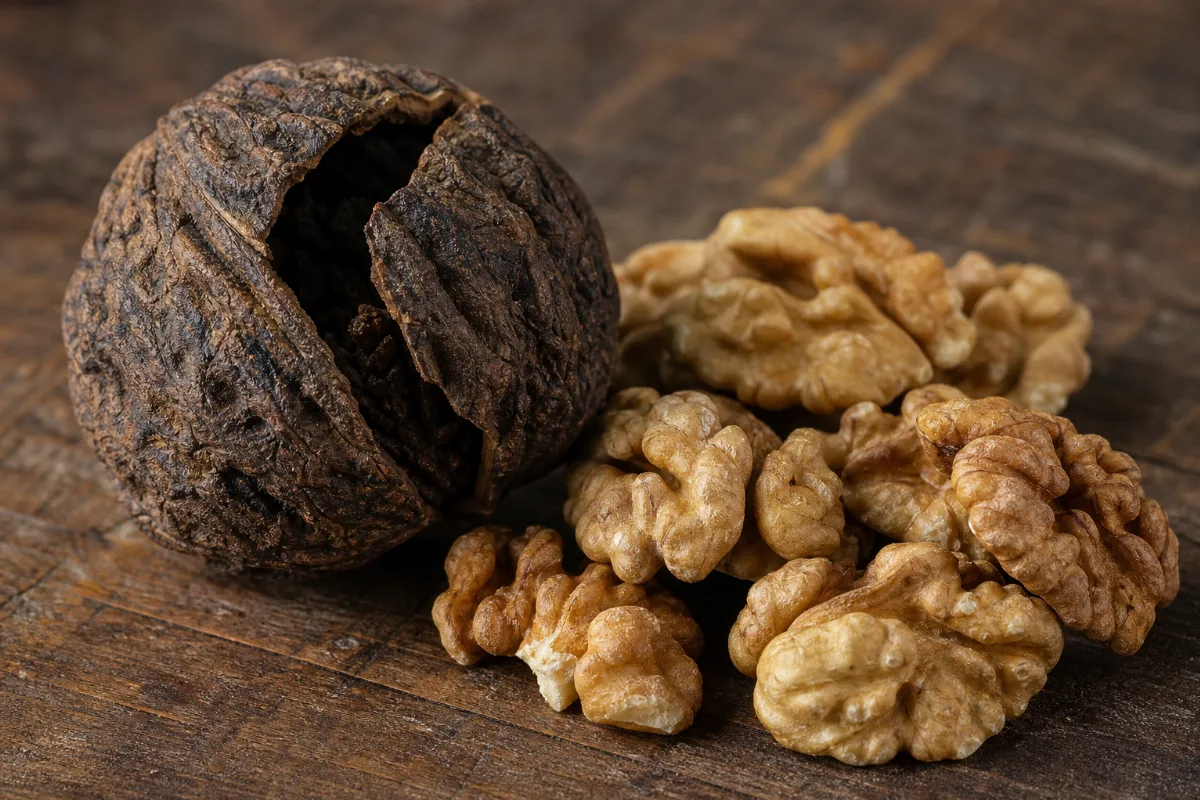
Black walnuts are the kernels of Juglans nigra, a tree in the walnut family. The kernel sits inside a very hard shell.
USDA data for dried black walnuts: 619 kcal per 100 g. One ounce (28.35 g) has about 175 kcal, 6.8 g protein, 16.8 g fat, 1.9 g fibre, 57 mg magnesium, 1.1 mg manganese, 0.39 mg copper and 0.76 g of the plant omega-3 fat ALA. The main fat is polyunsaturated. Roasted, salted or flavoured nuts differ.
What the research shows
We found no trial of black walnuts as food. Pooled trials of English walnuts and of tree nuts overall found lower total and LDL cholesterol on blood tests. Black walnuts were not among the nuts named, and these trials do not show fewer heart attacks.
Pooled nut trials found no significant weight change, and the walnut trials found no change in blood pressure.
The only black walnut research read is a 2024 lab study of bark, leaf and husk, which says nothing about eating the nut.
Food versus hull, bark and leaf products
The cholesterol trials used whole nuts as food. Hull, bark and leaf products and extracts come from other parts of the tree and were not studied as food here. This page gives no advice on them.
Amounts
This page gives no amounts to eat. Ask a doctor, pharmacist or dietitian what is right for you, especially if you have allergies.
At a glance
Traditional uses history, not proof
- Eaten as a tree nut
- Long use as food is not proof that it treats any condition
Studied for research
- Blood cholesterol, insufficient evidence for black walnuts (trials were of English walnuts and tree nuts)
- Body weight, low certainty (mixed nuts, not black walnuts)
- Blood pressure, low certainty of no change (English walnuts)
- Plant compounds in bark, leaf and husk, very low certainty, lab only
Main compounds
- Polyunsaturated fat (linoleic acid)
- Alpha-linolenic acid (omega-3)
- Protein
- Manganese
- Copper
- Magnesium
Common forms
- Shelled kernels, dried
- Nuts in the shell
- Chopped pieces for baking
- Roasted, salted or flavoured nuts
- Hull, bark and leaf products (different from the nut, not covered)
Research links: NHS: Food allergy · Review: tree nut allergies and cross-reactivity · USDA FoodData Central: black walnuts, dried · Research Library · Genes & Biomarkers Library
What it is and its history
- Accepted scientific name
- Juglans nigra
- Naming authority
- L. (GBIF accepted)
- Common names
- Black walnut (English); Eastern black walnut (English); Nogal negro (Spanish)
- Family or group
- Juglandaceae (the walnut family), as given by GBIF.
- Classification
- Plantae > Tracheophyta > Magnoliopsida > Fagales > Juglandaceae > Juglans > Juglans nigra
- Native range
- Not verified from a source read. Our existing summary says the tree grows in North America.
- Habitat
- Not verified from a source read.
- What it looks like
- Roots: Not verified.; Stems: Not verified.; Leaves: Not verified.; Flowers: Not verified.; Fruit: The kernel is the food. USDA gives household portions of 1 oz = 28.35 g and 1 cup chopped = 125 g.
- Cultivation
- Not verified from a source read.
- Harvest and processing
- Sold as shelled kernels, in shell, as pieces for baking, or roasted or flavoured. Hull, bark and leaf products also exist and are different from the nut.
- Look-alikes and adulterants
- Name: English walnut (Juglans regia); Note: A different species, and the walnut nearly all nut research is about. Results for English walnut should not be assumed to hold for black walnut.
- Sustainability and conservation
- Not assessed.
Photographs
What is inside, and how it may work
What it contains and how those compounds act in cells and animals. Laboratory and animal mechanisms are not proven effects in people.
Main compounds
| Compound | Family | Where it is concentrated | Activity studied | Level of evidence |
|---|---|---|---|---|
| Total fat | macronutrient | Kernel USDA: 59.3 g per 100 g | Mostly polyunsaturated (36.4 g), then monounsaturated (15.4 g); saturated fat is 3.48 g per 100 g. 11 | Human data |
| Linoleic acid (omega-6) | fatty acid | Kernel USDA: 33.8 g per 100 g | The main fat in the kernel. 11 | Human data |
| Alpha-linolenic acid (ALA, omega-3) | fatty acid | Kernel USDA: 2.68 g per 100 g | A plant omega-3 fat. 11 | Human data |
| Protein | macronutrient | Kernel USDA: 24.1 g per 100 g | Protein supplies part of the energy in the kernel. 11 | Human data |
| Manganese, copper, magnesium | mineral | Kernel USDA: manganese 3.9 mg, copper 1.36 mg, magnesium 201 mg per 100 g | Composition fact only; no health claim is made here. 11 | Human data |
| Juglone and other polyphenols | polyphenol | Bark, leaf and pericarp (not shown for kernel) Not given for the kernel | Tested only on human cancer cells in the lab. No kernel measurement was read. 5 | Laboratory research |
Mechanisms, receptors and pathways
| Target or pathway | Gene or receptor | What was found | Level |
|---|---|---|---|
| Cell growth (lab) | Not specified | In dishes, juglone from the pericarp slowed growth of three human cancer cell lines. This is a lab finding about the husk, not about eating the nut. 5 | Laboratory research |
Absorption, metabolism and elimination
- Absorption
- Not found.
- Distribution
- Not found.
- Metabolism
- Not found.
- Elimination
- Not found.
- Bioavailability
- Not established.
Isolated compounds versus whole extracts
The cholesterol trials used whole nuts as food. The only black walnut research read is a lab study of bark, leaf and husk, which says nothing about the kernel. Hull, bark and leaf products are not the same as the nut.
Nutritional composition
Nutrition from USDA FoodData Central (Nuts, walnuts, black, dried, FDC 170186, SR Legacy, last updated 4/1/2019, re-read 2026-10-26). Per 100 g: 619 kcal, 24.1 g protein, 59.3 g fat (3.48 g saturated, 15.4 g monounsaturated, 36.4 g polyunsaturated), 9.58 g carbohydrate, 6.8 g fibre, 1.1 g sugars, about 4.6 g water, 61 mg calcium, 3.12 mg iron, 201 mg magnesium, 513 mg phosphorus, 523 mg potassium, 2 mg sodium, 3.37 mg zinc, 1.36 mg copper, 3.9 mg manganese, 17 micrograms selenium, 31 micrograms folate, 2.08 mg vitamin E (alpha-tocopherol). One ounce (28.35 g, USDA portion): about 175 kcal, 6.8 g protein, 16.8 g fat, 1.9 g fibre, 57 mg magnesium, 1.1 mg manganese, 0.39 mg copper and 0.76 g ALA. Values vary with variety, growing place, roasting and storage. Roasted, salted or flavoured nuts differ.
2 low certainty1 very low certainty1 not enough evidence
What was looked at
The 4 benefits and uses checked for Black Walnuts, each with how strong the evidence is. Tap one to open it.
- Blood cholesterol and fats (evidence is for English walnuts and tree nuts in general)Not enough evidence
- Body weight (nuts in general)Low certainty
- Blood pressure (English walnuts)Low certainty
- Plant compounds in black walnut bark, leaf and husk (lab only)Very low certainty
Lab markers tracked in the studies
LDL cholesterolTotal cholesterolTriglyceridesApolipoprotein B (ApoB)Body weight, BMI and waistBlood pressure
What is Black Walnuts good for?
The main studied uses and how strong the human evidence is for each. Almost all results are for English walnuts or tree nuts in general, not black walnuts.
Benefits, one by one
Each card is a research question, not a promise. Tap a goal to filter. Open a card to see the studies, doses and limits.
Blood cholesterol and fats (evidence is for English walnuts and tree nuts in general)
Not enough evidenceNo trial of black walnuts as food was found. Two pooled analyses of trials of other nuts found lower LDL ("bad") cholesterol: one of 26 English-type walnut trials and one of 61 tree nut trials. These measured blood tests, not heart attacks, and black walnuts were not named in either.
2 studiesWhole nuts eaten as food in the trials. Not black walnuts, not extrac…
Studies, doses and limits
What the trials found
Guasch-Ferre 2018 pooled 26 trials (1,059 people) of walnut-enriched diets against control diets. Del Gobbo 2015 pooled 61 trials (2,582 adults, 3 to 26 weeks) of tree nuts (walnuts, pistachios, macadamia, pecans, cashews, almonds, hazelnuts and Brazil nuts), standardised to one 1-oz (28.4 g) serving a day.
Results
Walnut-enriched diets lowered total cholesterol, LDL cholesterol, triglycerides and apolipoprotein B compared with control diets. In the tree nut analysis, total cholesterol, LDL, ApoB and triglycerides were lower, with stronger effects at 60 g or more a day. Black walnuts as food were not tested in either.
Effect sizes as reported
Walnut analysis: total cholesterol -6.99 mg/dL (95% CI -9.39 to -4.58), LDL -5.51 mg/dL (-7.72 to -3.29), triglycerides -4.69 mg/dL (-8.93 to -0.45), ApoB -3.74 mg/dL (-6.51 to -0.97). Tree nut analysis, per daily serving: total cholesterol -4.7 mg/dL, LDL -4.8 mg/dL, ApoB -3.7 mg/dL, triglycerides -2.2 mg/dL.
Why this rating
Insufficient for black walnuts because no trial of them was found. For English walnuts and tree nuts as a group, the pooled randomised trials are consistent, so that evidence would be moderate for those nuts; it does not transfer to black walnuts.
Form and dose studied
Whole nuts eaten as food in the trials. Not black walnuts, not extracts, not hull or bark products.
Who was studied
Adults. The tree nut analysis covered adults without existing heart disease.
Limits
Blood tests, not heart attacks or strokes. Trials were short (3 to 26 weeks in the tree nut analysis). Funding statements were not in the abstracts, so industry funding cannot be ruled out. Walnut species was not stated in the abstract.
Why researchers looked
Black walnuts are a walnut, and walnuts and other tree nuts are the best-studied nuts for cholesterol, so people ask whether the result carries over.
Traditional use
Black walnut kernels are eaten as a nut. Long use as food is not proof that it treats any condition.
Proposed mechanism Human data
The walnut analysis does not explain how. The authors of the 61-trial analysis found that nut dose mattered more than nut type.
A proposed mechanism does not show that the effect happens in people.
Black walnuts are a tree nut: see the Safety tab for allergy.
Body weight (nuts in general)
Low certaintyBlack walnuts are energy dense: about 175 kcal in one ounce. A pooled analysis of 33 trials of mixed nuts found that nut-enriched diets did not raise body weight, BMI or waist size compared with control diets. A walnut analysis likewise found no significant weight change. Black walnuts were not tested.
3 studiesWhole nuts eaten as food in controlled diets.
Studies, doses and limits
What the trials found
Flores-Mateo 2013 pooled 33 randomised nut-feeding trials. Guasch-Ferre 2018 reported weight change in its 26 walnut trials.
Results
No significant increase in weight, BMI or waist circumference with nut-enriched diets. Black walnuts were not among the nuts named.
Effect sizes as reported
Nuts: weight -0.47 kg (95% CI -1.17 to 0.22), BMI -0.40 kg/m2 (-0.97 to 0.17), waist -1.25 cm (-2.82 to 0.31); all not significant. Walnuts: weight -0.12 kg (-2.12 to 1.88), not significant.
Why this rating
Randomised trials pooled, but short, of mixed nuts, and not black walnuts. A "no significant effect" result does not prove there is no effect.
Form and dose studied
Whole nuts eaten as food in controlled diets.
Who was studied
Adults in trials.
Limits
Not black-walnut specific. Trials differed in length and design; funding not stated in the abstracts.
Why researchers looked
Nuts are rich in energy, so people ask whether eating them adds weight.
Traditional use
Black walnut kernels are eaten as a nut. Long use as food is not proof that it treats any condition.
Proposed mechanism Human data
Not explained in the abstracts read.
A proposed mechanism does not show that the effect happens in people.
None specific.
Blood pressure (English walnuts)
Low certaintyA pooled analysis of walnut trials found no significant change in systolic or diastolic blood pressure. Black walnuts were not tested.
1 studiesWhole walnuts as food.
Studies, doses and limits
What the trials found
Guasch-Ferre 2018, 26 trials, 1,059 people, walnut-enriched diets against control diets.
Results
No significant difference in blood pressure.
Effect sizes as reported
Systolic -0.72 mm Hg (95% CI -2.75 to 1.30); diastolic -0.10 mm Hg (-1.49 to 1.30); both not significant.
Why this rating
Randomised trials pooled; the result is a null finding for English-type walnuts, and nothing was found for black walnuts.
Form and dose studied
Whole walnuts as food.
Who was studied
Adults in trials.
Limits
Species not stated in the abstract. Short trials.
Why researchers looked
Nuts are often said to be good for the heart, so blood pressure is a common question.
Traditional use
Black walnut kernels are eaten as a nut. Long use as food is not proof that it treats any condition.
Proposed mechanism Human data
Not explained in the abstract.
A proposed mechanism does not show that the effect happens in people.
None specific.
Plant compounds in black walnut bark, leaf and husk (lab only)
Very low certaintyA 2024 laboratory study listed 161 compounds in extracts of black walnut bark, leaf and outer husk, and tested eight on human cancer cells in dishes. This is not the kernel and not a human study. It says nothing about eating the nut.
1 studiesExtracts of bark, leaf and pericarp. Not a food.
Studies, doses and limits
What the trials found
No human study of these compounds was read.
Results
Lab chemistry and cell tests only.
Why this rating
Lab-only evidence is very low. It does not show any effect in people.
Form and dose studied
Extracts of bark, leaf and pericarp. Not a food.
Limits
Cells in dishes, not people; parts of the tree that are not the edible kernel.
Why researchers looked
Black walnut trees are rich in plant chemicals, so researchers profile them.
Traditional use
Black walnut kernels are eaten as a nut. Long use as food is not proof that it treats any condition.
Proposed mechanism Laboratory research
In cell tests, a compound called juglone slowed growth of three human cancer cell lines (lab result).
A proposed mechanism does not show that the effect happens in people.
Hull, bark and leaf products are different from the nut; this page gives no advice on them.
Connections to the rest of health
How Black Walnuts connects to the rest of our health knowledge graph. Every link says what kind of connection it is. A safety link (for example to the liver) is a warning, not a benefit. A study that merely mentions a topic never creates a benefit link.
Explore every connection: goals, body systems, organs, symptoms, genes
B. Body systems
| Connected to | Kind of connection | Evidence status | Context | Studies |
|---|---|---|---|---|
| Cardiovascular System | Biological association | Not enough evidence | Studied for: Blood cholesterol and fats (evidence is for English walnuts and tree nuts in general) Studied for: Blood pressure (English walnuts) | 2 4 |
| Metabolic System | Biological association | Low certainty | Studied for: Body weight (nuts in general) | 1 4 11 |
E. Health conditions
| Connected to | Kind of connection | Evidence status | Context | Studies |
|---|---|---|---|---|
| Food Allergy | Adverse effect or risk | Documented risk | Tree nut allergy can be severe and tends to last a lifetime; walnut and pecan are highly cross-reactive. Preparation or compound: Black walnut as a tree nut |
3 9 8 |
| Food Anaphylaxis | Adverse effect or risk | Documented risk | Call emergency services for trouble breathing or swelling after eating nuts. Preparation or compound: Black walnut as a tree nut |
9 8 |
I. Biomarkers
| Connected to | Kind of connection | Evidence status | Context | Studies |
|---|---|---|---|---|
| LDL cholesterol | Biological association | Not enough evidence | Measured in trials: lowered. A lab change is not the same as a health benefit. | 4 2 |
| Total cholesterol | Biological association | Not enough evidence | Measured in trials: lowered. A lab change is not the same as a health benefit. | 4 2 |
| Triglycerides | Biological association | Not enough evidence | Measured in trials: lowered. A lab change is not the same as a health benefit. | 4 2 |
| Apolipoprotein B (ApoB) | Biological association | Not enough evidence | Measured in trials: lowered. A lab change is not the same as a health benefit. | 4 2 |
| Body weight, BMI and waist | Biological association | Low certainty | Measured in trials: unchanged. A lab change is not the same as a health benefit. | 1 4 |
| Blood pressure | Biological association | Low certainty | Measured in trials: unchanged. A lab change is not the same as a health benefit. | 4 |
K. Biological pathways
| Connected to | Kind of connection | Evidence status | Context | Studies |
|---|---|---|---|---|
| Magnesium | Preliminary mechanism | Human | A mineral present in the kernel (USDA 201 mg per 100 g). | 11 |
| Manganese | Preliminary mechanism | Human | A mineral present in the kernel (USDA 3.9 mg per 100 g). | 11 |
| Copper | Preliminary mechanism | Human | A mineral present in the kernel (USDA 1.36 mg per 100 g). | 11 |
L. Active compounds
| Connected to | Kind of connection | Evidence status | Context | Studies |
|---|---|---|---|---|
| Total fat | Biological association | Human | Mostly polyunsaturated (36.4 g), then monounsaturated (15.4 g); saturated fat is 3.48 g per 100 g. Preparation or compound: Kernel |
11 |
| Linoleic acid (omega-6) | Biological association | Human | The main fat in the kernel. Preparation or compound: Kernel |
11 |
| Alpha-linolenic acid (ALA, omega-3) | Biological association | Human | A plant omega-3 fat. Preparation or compound: Kernel |
11 |
| Protein | Biological association | Human | Protein supplies part of the energy in the kernel. Preparation or compound: Kernel |
11 |
| Manganese, copper, magnesium | Biological association | Human | Composition fact only; no health claim is made here. Preparation or compound: Kernel |
11 |
| Juglone and other polyphenols | Biological association | In vitro | Tested only on human cancer cells in the lab. No kernel measurement was read. Preparation or compound: Bark, leaf and pericarp (not shown for kernel) |
5 |
Each connection is stored with the ingredient, the connected record, the kind of connection, the evidence status, the supporting studies, the preparation or compound involved, and a review date (last reviewed October 26, 2026).
The evidence
The research centre for Black Walnuts. Every record here was checked against PubMed or the publisher's page; we never list a study we have not verified.
Evidence by outcome
Bars show how many studies we found for each outcome, not how well it works. People are added up across trials only (reviews are not added, to avoid double counting).
How we rate evidence
High certainty
Several well-run trials or reviews agree; further research is unlikely to change the picture much.
Moderate certainty
Good trials point the same way, but some doubt remains.
Low certainty
Small, short or inconsistent trials. The finding could change with better research.
Very low certainty
Very little or very weak human data. Treat as a possibility only.
Mixed findings
Trials or reviews disagree with each other.
Not enough evidence
Not enough human research to say either way.
Evidence against
Good research found no benefit, or found harm.
We take the reviewers' own risk-of-bias and GRADE statements where they exist, and otherwise judge from study size, design, consistency, directness and whether a product matches what is sold. Many publications do not make evidence high. Method note: We started from our existing black walnut summary, re-read nutrition at USDA FoodData Central, read the health agency pages (NHS, MedlinePlus, FDA) and re-read the PubMed abstracts of the studies cited. Little research exists on black walnuts, so this page is short. The CDC choking page could not be opened, so the NHS is cited instead. Items we could not verify are flagged in the research gaps.
Study library: every study we checked 11
| Study | Design | People | Product, dose, length | Result |
|---|---|---|---|---|
| p23595878 Flores-Mateo G et al. Nut intake and adiposity: meta-analysis of clinical trials. Am J Clin Nutr 2013 · Source |
Meta-analysis human (mixed nuts) |
Methods, limits and fundingRead: abstract | ||
| p26561616 Del Gobbo LC et al. Effects of tree nuts on blood lipids, apolipoproteins, and blood pressure: systematic review, meta-analysis, and dose-response of 61 controlled intervention trials. Am J Clin Nutr 2015 · Source |
Meta-analysis human (tree nuts: walnuts, pistachios, macadamia, pecans, cashews, almonds, hazelnuts, Brazil nuts) |
Methods, limits and fundingRead: abstract | ||
| p29700869 Smeekens JM, Bagley K, Kulis M. Tree nut allergies: allergen homology, cross-reactivity, and implications for therapy. Clin Exp Allergy 2018 · Source |
Narrative review |
Methods, limits and fundingRead: abstract | ||
| p29931130 Guasch-Ferre M et al. Effects of walnut consumption on blood lipids and other cardiovascular risk factors: an updated meta-analysis and systematic review of controlled trials. Am J Clin Nutr 2018 · Source |
Meta-analysis human (walnuts, species not stated in the abstract, presumably English walnut) |
Methods, limits and fundingRead: abstract | ||
| p39000038 Osztie R et al. Comprehensive characterization of phytochemical composition, membrane permeability, and antiproliferative activity of Juglans nigra polyphenols. Int J Mol Sci 2024 · Source |
Laboratory research Juglans nigra bark, leaf and pericarp (not kernel) |
Methods, limits and fundingRead: abstract | ||
| s-fda-food-allergies FDA: Food allergies · Source |
Health agency n/a |
Methods, limits and fundingRead: full-text | ||
| s-gbif-juglans-nigra GBIF Backbone: Juglans nigra L. (usageKey 3054357) · Source |
Reference database Juglans nigra |
Methods, limits and fundingRead: full-text | ||
| s-medlineplus-food-allergy MedlinePlus: Food allergy · Source |
Health agency n/a |
Methods, limits and fundingRead: full-text | ||
| s-nhs-food-allergy NHS: Food allergy · Source |
Health agency n/a |
Methods, limits and fundingRead: full-text | ||
| s-nhs-foods-to-avoid NHS: Foods to avoid giving babies and young children · Source |
Health agency n/a |
Methods, limits and fundingRead: full-text | ||
| s-usda-fdc-170186 USDA FoodData Central: Nuts, walnuts, black, dried (FDC 170186) · Source |
Reference database Juglans nigra |
Methods, limits and fundingRead: full-text |
What we do not know yet
- No trial of black walnuts as food was found for cholesterol, heart disease, blood pressure, weight, blood sugar or any other outcome.
- The walnut meta-analysis abstract does not state the species; English walnut is our assumption.
- No study of black walnut allergens was found.
- Pregnancy, breastfeeding, medicine interactions, mould and aflatoxin were not found in any source read.
- Funding statements were not in the abstracts read, so industry funding is unknown.
- Plant compounds in the kernel itself, and the history and range of the tree, were not researched.
How new research is added
New studies are found by a saved PubMed search and placed in a review queue before the page changes.
Lab markers
What changed in blood or saliva tests during trials. A changed number is not the same as feeling or being healthier, and we give no "normal ranges".
Metabolic 3
LDL cholesterol
Lowered in trials
The cholesterol carried in low-density particles in the blood, often called "bad" cholesterol.
Not enough evidenceResults and what it means
Why it was measured
LDL is a standard blood marker linked to heart disease risk.
Statistical vs. clinical meaning
A modest blood-test change for other nuts. It is not shown for black walnuts and is not proof of fewer heart attacks.
Safety implication
None specific.
| Study | Result | People | Product |
|---|---|---|---|
| 4 | Walnut-enriched diets lowered LDL by 5.51 mg/dL (95% CI -7.72 to -3.29) compared with control diets | Adults in 26 trials (1,059 people) | Walnuts as food (species not stated in the abstract; English walnut assumed) |
| 2 | Tree nuts lowered LDL by 4.8 mg/dL per daily serving (95% CI -5.5 to -4.2); stronger at 60 g or more a day | Adults without prevalent heart disease in 61 trials (2,582 people) | Tree nuts (not black walnuts) as food |
Total cholesterol
Lowered in trials
All the cholesterol in the blood.
Not enough evidenceResults and what it means
Why it was measured
A routine blood test.
Statistical vs. clinical meaning
Same limits as LDL.
Safety implication
None specific.
Triglycerides
Lowered in trials
A type of fat in the blood.
Not enough evidenceResults and what it means
Why it was measured
A routine blood test.
Statistical vs. clinical meaning
Small changes; not tested in black walnuts.
Safety implication
None specific.
Other 3
Apolipoprotein B (ApoB)
Lowered in trials
A protein on the particles that carry "bad" cholesterol.
Not enough evidenceResults and what it means
Why it was measured
Used as another measure of cholesterol-carrying particles.
Statistical vs. clinical meaning
Small changes; not tested in black walnuts.
Safety implication
None specific.
Body weight, BMI and waist
Unchanged in trials
Weight, body mass index and waist size.
Low certaintyResults and what it means
Why it was measured
Nuts are energy dense, so researchers check whether they add weight.
Statistical vs. clinical meaning
A reassuring null result for other nuts; not black walnuts.
Safety implication
None specific.
Blood pressure
Unchanged in trials
Pressure in the arteries, as systolic and diastolic readings.
Low certaintyResults and what it means
Why it was measured
A standard heart health measure.
Statistical vs. clinical meaning
No evidence of change for walnuts; nothing for black walnuts.
Safety implication
None specific.
| Study | Result | People | Product |
|---|---|---|---|
| 4 | No significant change: systolic -0.72 mm Hg (95% CI -2.75 to 1.30), diastolic -0.10 mm Hg (-1.49 to 1.30) | Adults in 26 trials | Walnuts as food |
Safety
What studies and official sources say about side effects, medicines and who should check first. Each point shows what kind of evidence it comes from.
Main points to know 3
- Tree nut allergy can be life-threatening: black walnut is a walnut. The NHS lists walnuts among the tree nuts that can cause food allergy, and MedlinePlus says tree nut allergies tend to last a lifetime and that severe reactions can start at once or within two hours. A review says tree nut allergies are outgrown in less than 10% of cases and that walnut and pecan are highly cross-reactive. We found no study of black walnut allergens, so we cannot say how closely it matches English walnut. If you have any tree nut allergy, ask an allergist before trying black walnuts. Authoritative guidance 9 8 3
- Emergency signs after eating nuts. Call 999 (UK) or 911 (US), or your local emergency number, for swelling of the lips, mouth, throat or tongue, fast or difficult breathing, a tight throat or trouble swallowing, or blue, grey or pale skin. If a doctor has prescribed epinephrine (adrenaline), use it first and then call. Authoritative guidance 9 8
- Choking risk for young children. The NHS says whole nuts should not be given to children under 5 because they can choke on them. Crushed or ground nuts can be added to food from weaning, if the child is not allergic and a clinician has not advised otherwise. Authoritative guidance 10
Side effects 2
| Effect | How often | Severity and recovery | Evidence |
|---|---|---|---|
| Allergic reactions to tree nuts, from hives and swelling to anaphylaxis Not a black walnut study. Black walnut allergens were not found in any source read. | Tree nut allergy affects about 1% of the general US population (review abstract) | can be serious or life-threatening Rarely outgrown: less than 10% of cases (review abstract) | Authoritative guidance 3 9 8 |
| Choking in young children (whole nuts) The NHS advice is about whole nuts in general. | Not established | can be serious Not applicable | Authoritative guidance 10 |
Liver
No liver injury from eating black walnuts was found. A liver-safety source (such as LiverTox) was not searched for this food page.
How often. No frequency was found.
Monitoring. No agency monitoring advice was found.
This is a safety connection. It is not evidence that Black Walnuts supports liver health.
Medicines and supplements 2
| With | Why it matters | Importance | Evidence | What to do |
|---|---|---|---|---|
| Other tree nuts (cross-reactive allergy) food | A review says walnut and pecan are highly cross-reactive, as are cashew and pistachio, and that the extent of cross-reactivity among other tree nuts is unclear. | After one tree nut allergy is diagnosed, the current guideline is strict avoidance of all tree nuts, because that is a safe approach. | Authoritative guidance Moderate certainty 3 | Ask an allergist which nuts are safe. This is a review of tree nuts in general, not a black walnut study. |
| Prescription medicines prescription | No source read describes an interaction between eating black walnuts and any medicine. | Not established. Absence of a finding is not proof of safety. | None found Not enough evidence | Ask a pharmacist if you are unsure about food and your medicines. |
Who should check first 2
| Situation | Advice | Evidence |
|---|---|---|
| Known tree nut allergy (especially walnut or pecan) | Avoid black walnuts unless an allergist says otherwise. Call emergency services for trouble breathing or swelling. | Authoritative guidance 3 9 8 |
| Children under 5 | Do not give whole nuts. The NHS allows crushed or ground nuts in food from weaning. | Authoritative guidance 10 |
Overdose, product quality and regulators
Summary. No toxicity from black walnut kernels eaten as food was found in the sources read. Hull, bark and leaf products are different and were not assessed.
Animal. Not reviewed.
Human doses studied. No human study of black walnut kernels was found.
Overdose response. Not found.
Genotoxicity. Not researched.
Toxic or hazardous parts. Not assessed. A lab study found the compound juglone in the pericarp (husk); it is not a statement about the kernel.
We did not read an official source on mould, aflatoxin or rancidity in black walnuts, so we make no claim either way.
Allergen labelling. The FDA says US law requires the type of tree nut (for example almonds, pecans, walnuts) to be declared on food labels. Whether products made from black walnuts are labelled "walnuts" was not read. 6
| Body | Action | Date |
|---|---|---|
| NHS (UK) (United Kingdom) | Food allergy page: tree nuts such as walnuts are common allergic foods; emergency signs and adrenaline use source | 2026-08-20 |
| MedlinePlus (US National Library of Medicine) (United States) | Food allergy page: tree nut allergies tend to last a lifetime; severe reactions can occur at once or within two hours source | 2024-10-29 |
| FDA (US Food and Drug Administration) (United States) | Tree nuts are a major food allergen; labels must declare the type of tree nut source | 2026-03-11 |
| NHS (UK) (United Kingdom) | Whole nuts should not be given to children under 5 (choking) source | 2026-02-18 |
When to get medical help
- Swelling of the lips, mouth, throat or tongue after eating nuts
- Fast or difficult breathing, wheezing, a tight throat or trouble swallowing
- Skin, tongue or lips turning blue, grey or pale
- A child choking on a nut (call emergency services)
Stop using the product and contact a clinician or emergency service. In the US, Poison Control is 1-800-222-1222.
General information only, not medical advice. Ask a clinician or pharmacist before use, especially with medicines, in pregnancy or with a health condition. See the Natural Remedy Safety guide.
Frequently asked questions
How are black walnuts different from regular walnuts?
Do black walnuts lower cholesterol?
If I am allergic to walnuts or pecans, can I eat black walnuts?
Not without advice from an allergist. A review says walnut and pecan are highly cross-reactive and that the current guideline after one tree nut allergy is to avoid all tree nuts. No black walnut allergen study was found.
Is black walnut allergy serious?
Are black walnuts high in calories?
Are black walnuts safe for toddlers?
The NHS says whole nuts should not be given to children under 5 because of choking. Crushed or ground nuts can be added to food from weaning if the child is not allergic. Ask your health visitor or doctor.
Do black walnuts lower blood pressure?
Not shown. A pooled analysis of walnut trials found no significant change in blood pressure. Black walnuts were not tested.
Are black walnuts good for weight loss?
No evidence either way. A pooled analysis of 33 nut trials found no significant change in weight, BMI or waist size. This was for mixed nuts, not black walnuts.
Is a black walnut hull, bark or leaf product the same as the nut?
No. They are different parts of the tree. The only research read on them is a 2024 lab study on bark, leaf and husk extracts and cancer cells in dishes. It does not show any effect in people and says nothing about eating the nut.
Do black walnuts interact with medicines?
No source read describes an interaction between eating black walnuts and medicines. That is not proof of safety. A pharmacist can check your own medicines.
Is black walnut safe in pregnancy?
No official statement about black walnuts in pregnancy was found in the sources read. Ask your doctor or midwife, especially if you or your family have allergies.
How should the label read?
The FDA says US law requires the type of tree nut, such as walnuts, to be declared on food labels. Whether black walnut products are labelled "walnuts" was not read, so check labels and allergy warnings.
Explore by health goal
Editorial transparency
- Written by
- AlternativeMed editorial team. Research compiled with AI assistance, then checked against the sources listed.
- Medical review
- None. This page has not been reviewed by a physician or pharmacist.
- First published
- 2026-10-26
- Last substantive update
- 2026-10-26
- How we research
- We started from our existing black walnut summary, re-read nutrition at USDA FoodData Central, read the health agency pages (NHS, MedlinePlus, FDA) and re-read the PubMed abstracts of the studies cited. Little research exists on black walnuts, so this page is short. The CDC choking page could not be opened, so the NHS is cited instead. Items we could not verify are flagged in the research gaps.
- How we rate evidence
- See "How we rate evidence" in the Evidence tab.
- Independence
- No product is promoted on this page. No affiliate links are shown.
Sources 11
Each source was opened and checked. Where we read only the abstract, it says so. The small numbers in the text point here.
- . Flores-Mateo G et al. Nut intake and adiposity: meta-analysis of clinical trials. Am J Clin Nutr 2013. . . (abstract)
- . Del Gobbo LC et al. Effects of tree nuts on blood lipids, apolipoproteins, and blood pressure: systematic review, meta-analysis, and dose-response of 61 controlled intervention trials. Am J Clin Nutr 2015. . . (abstract)
- . Smeekens JM, Bagley K, Kulis M. Tree nut allergies: allergen homology, cross-reactivity, and implications for therapy. Clin Exp Allergy 2018. . . (abstract)
- . Guasch-Ferre M et al. Effects of walnut consumption on blood lipids and other cardiovascular risk factors: an updated meta-analysis and systematic review of controlled trials. Am J Clin Nutr 2018. . . (abstract)
- . Osztie R et al. Comprehensive characterization of phytochemical composition, membrane permeability, and antiproliferative activity of Juglans nigra polyphenols. Int J Mol Sci 2024. . . (abstract)
- . FDA: Food allergies. . . (full-text)
- . GBIF Backbone: Juglans nigra L. (usageKey 3054357). . . (full-text)
- . MedlinePlus: Food allergy. . . (full-text)
- . NHS: Food allergy. . . (full-text)
- . NHS: Foods to avoid giving babies and young children. . . (full-text)
- . USDA FoodData Central: Nuts, walnuts, black, dried (FDC 170186). . . (full-text)
Where to buy
Check the label first. Whatever you buy, look for these:
- Raw or roasted, and salted or unsalted
- A best-by date, since nuts and seeds turn rancid
- Tree nut and peanut allergy warnings
- A resealable bag, and cool storage once opened
Talk to a pharmacist or doctor before you start any supplement, especially if you take medicines. See the Safety tab for interactions.
Support our free guides: as an Amazon Associate we earn from qualifying purchases. Full disclosure.


