Nuts & Seeds · Nut
Pecans
Carya illinoinensis · also called Pecan nut, nuez pecana (Spanish)
Pecans are the kernels of the pecan tree, a tree nut in the walnut family. They are rich in healthy fats, manganese, copper and fibre, and high in calories. In small to medium trials, eating pecans every day lowered LDL cholesterol and triglycerides on blood tests, but no trial measured heart attacks. The main cautions are tree nut allergy (which can be severe, and often goes with walnut allergy) and choking in young children.
General information, not medical advice. Last substantive update · Not medically reviewed. A named clinician has not signed off on this page. How this page is made
About Pecans
Pecans are a nutritious, calorie-dense tree nut. The best evidence is that daily pecans modestly lower LDL cholesterol and triglycerides on blood tests. They are a food, not a proven remedy, and they are a major allergy concern for people allergic to tree nuts.
What it is
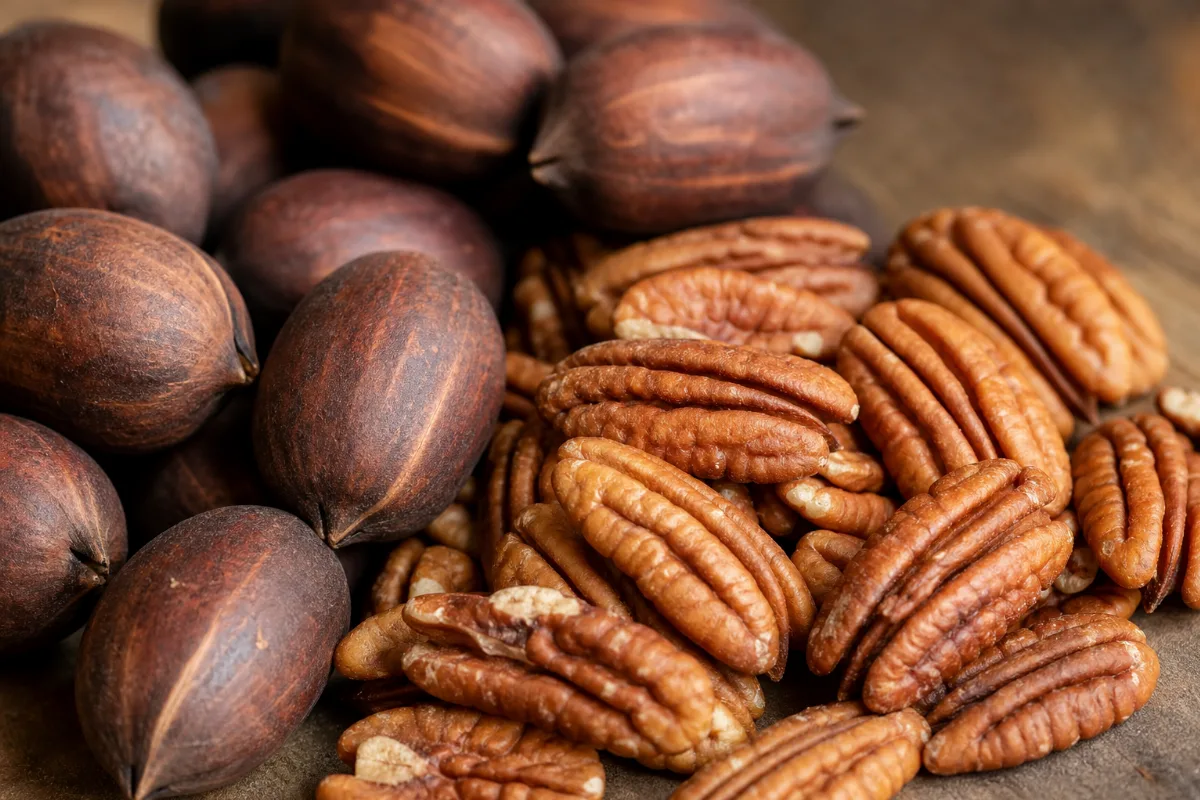
Pecans are the kernels of the pecan tree, Carya illinoinensis, in the walnut family (Juglandaceae). The part we eat is the kernel inside the hard shell, usually sold shelled as halves or pieces.
USDA data for raw pecans: 691 kcal per 100 g. One ounce (28.35 g, about 19 halves) has about 196 kcal, 20.4 g fat (1.75 g saturated), 2.6 g protein, 2.7 g fibre, 1.28 mg manganese, 0.34 mg copper, 34 mg magnesium, 1.28 mg zinc and 116 mg potassium. Roasted, salted or coated pecans differ, so check the label.
What the research shows
Several small to medium trials, and a 2026 pooled analysis of 10 of them, found lower total cholesterol, LDL cholesterol and triglycerides with daily pecans. HDL cholesterol, blood sugar, weight and blood pressure did not change clearly.
These are blood tests. No pecan trial counted heart attacks or strokes. Large observational studies link eating nuts in general to less heart disease and longer life, but they cannot prove cause and they do not look at pecans alone.
Funding matters here. The 12-week trial of 138 adults was supported by a grant from the American Pecan Council. Funding is not shown in the abstracts of two other pecan trials.
Food versus oils and supplements
All the health trials read used whole pecans as food. None tested pecan oil, extracts or supplements, so these results say nothing about those products.
Amounts
This page gives no amounts to eat. Ask a doctor, pharmacist or dietitian what is right for you, especially if you have a food allergy, diabetes or are watching your weight.
At a glance
Traditional uses history, not proof
- Eaten as a nut or snack and used in baking and cooking
- Long use as food is not proof that it treats any condition
Studied for research
- LDL cholesterol and triglycerides (blood tests), moderate certainty, small and short trials
- Heart disease and early death (nuts as a group), low certainty, observational
- Manganese, copper and fibre source, high certainty for the food content
- Blood vessel function and blood pressure, insufficient evidence
- Blood sugar, mixed findings
- Body weight, low certainty of no clear change
Main compounds
- Monounsaturated fat
- Polyunsaturated fat
- Dietary fibre
- Manganese
- Copper
- Thiamin (vitamin B1)
- Plant sterols
Common forms
- Raw shelled halves and pieces
- Roasted, salted, candied or coated pecans
- In-shell pecans
- Pecan butter and meal
- Every health trial read used whole pecans as food, not oil or extracts
Research links: 2026 pooled analysis of pecan trials · NHS: Food allergy · Walnut and pecan allergy study (NUT CRACKER) · Research Library · Genes & Biomarkers Library
What it is and its history
- Accepted scientific name
- Carya illinoinensis
- Naming authority
- (Wangenh.) K.Koch (GBIF accepted)
- Common names
- Pecan (English); Pecan nut (English); Nuez pecana (Spanish)
- Family or group
- Juglandaceae (the walnut family), as given by GBIF.
- Classification
- Plantae > Tracheophyta > Magnoliopsida > Fagales > Juglandaceae > Carya > Carya illinoinensis
- Native range
- Not verified from a source read.
- Habitat
- Not verified from a source read.
- What it looks like
- Roots: Not verified.; Stems: Not verified.; Leaves: Not verified.; Flowers: Not verified.; Fruit: The part eaten is the kernel, usually sold shelled as halves or pieces. USDA gives a household portion of 1 ounce (28.35 g, 19 halves), 1 cup of halves as 99 g and 1 cup chopped as 109 g.
- Cultivation
- Not verified from a source read.
- Harvest and processing
- Sold raw, roasted, salted or coated, in shell, as halves or pieces, or as pecan butter and meal (existing nutrient summary). USDA values are for raw pecans. Effects of roasting on nutrients or health were not read from a source.
- Look-alikes and adulterants
- Name: Walnut; Note: A close relative in the same family. People allergic to walnut often also react to pecan (see the Safety tab).; Name: Other tree nuts and peanut; Note: Different foods with their own pages. Peanut is a legume, not a tree nut; trials of nuts in general pool several of these.
- Sustainability and conservation
- Not assessed.
Photographs
What is inside, and how it may work
What it contains and how those compounds act in cells and animals. Laboratory and animal mechanisms are not proven effects in people.
Main compounds
| Compound | Family | Where it is concentrated | Activity studied | Level of evidence |
|---|---|---|---|---|
| Monounsaturated fat | fat | Kernel USDA: 40.8 g per 100 g raw | The main fat in pecans. Authors of the 2026 review say pecans' unsaturated fats may explain the cholesterol results; this was not tested. 19 12 | Human data |
| Polyunsaturated fat | fat | Kernel USDA: 21.6 g per 100 g raw | The second main fat group in pecans. 19 | Human data |
| Saturated fat | fat | Kernel USDA: 6.18 g per 100 g raw (about 1.75 g per ounce) | A small share of the total fat. 19 | Human data |
| Dietary fibre | fibre | Kernel USDA: 9.6 g per 100 g raw (about 2.7 g per ounce) | Listed by the 2026 review authors as a possible reason for pecans' effects; not tested. 19 12 | Human data |
| Manganese PubChem 23930 | mineral | Kernel USDA: 4.5 mg per 100 g raw (about 1.28 mg per ounce) | A mineral nutrient; pecans are a rich source. 19 | Human data |
| Copper PubChem 23978 | mineral | Kernel USDA: 1.2 mg per 100 g raw (about 0.34 mg per ounce) | A mineral nutrient; pecans are a rich source. 19 | Human data |
| Thiamin (vitamin B1) PubChem 1130 | vitamin | Kernel USDA: 0.66 mg per 100 g raw (about 0.19 mg per ounce) | A B vitamin found in the kernel. 19 | Human data |
| Plant sterols (phytosterols) | sterol | Kernel USDA footnote: 'other phytosterols' 32.8 mg per 100 g (unroasted) | Named by the 2026 review authors as a possible reason for the cholesterol effects; not tested in the trials. 19 12 | Human data |
Mechanisms, receptors and pathways
| Target or pathway | Gene or receptor | What was found | Level |
|---|---|---|---|
| Blood fats | Not specified | The pecan trials measured blood fats but did not test why they change. The 2026 review authors list pecans' unsaturated fats, plant sterols, fibre and polyphenols as possible reasons. 12 9 | Human data |
| Gut hormones after a snack | PYY and GLP-1 | In a crossover of one snack, PYY and GLP-1 were higher after pecans than after tortilla chips. Whether this matters over time was not tested. 10 | Human data |
| Shared allergy triggers with walnut | Not specified in the abstracts | Lab tests in 76 walnut-sensitised patients suggested pecan carries a subset of walnut's allergy triggers; mice sensitised to walnut also reacted to pecan. 5 11 | Human data |
Absorption, metabolism and elimination
- Absorption
- Not found.
- Distribution
- Not found.
- Metabolism
- Not found.
- Elimination
- Not found.
- Bioavailability
- Not established.
Isolated compounds versus whole extracts
Every health trial read used whole pecans eaten as food. None used pecan oil, extract or a supplement, so the results say nothing about those products. The 2015 and 2013 pooled analyses mix several nuts and are not pecan-only.
Nutritional composition
Nutrition from USDA FoodData Central (Nuts, pecans, raw, FDC 170182, SR Legacy, last updated 4/1/2019, read 2026-10-26). Per 100 g: 691 kcal, 9.17 g protein, 72.0 g fat (6.18 g saturated, 40.8 g monounsaturated, 21.6 g polyunsaturated), 13.9 g carbohydrate, 9.6 g fibre, 3.52 g water, 0 mg cholesterol, 0 mg sodium, 70 mg calcium, 2.53 mg iron, 121 mg magnesium, 277 mg phosphorus, 410 mg potassium, 4.53 mg zinc, 1.2 mg copper, 4.5 mg manganese, 3.8 micrograms selenium, 0.66 mg thiamin, 1.4 mg vitamin E (alpha-tocopherol), 22 micrograms folate, 3.5 micrograms vitamin K. One ounce (28.35 g, about 19 halves): about 196 kcal, 2.6 g protein, 20.4 g fat, 1.75 g saturated fat, 2.7 g fibre, 20 mg calcium, 0.72 mg iron, 34 mg magnesium, 79 mg phosphorus, 116 mg potassium, 1.28 mg zinc, 0.34 mg copper, 1.28 mg manganese, 0.19 mg thiamin. Values vary with variety, growing place, roasting and storage. Roasted, salted or coated pecans differ, so check the label.
1 high certainty1 moderate certainty1 mixed findings3 low certainty1 not enough evidence
What was looked at
The 7 benefits and uses checked for Pecans, each with how strong the evidence is. Tap one to open it.
- Blood cholesterol and triglyceridesModerate certainty
- Heart disease and early death (nuts as a group)Low certainty
- A source of manganese, copper and fibreHigh certainty
- Blood vessel function and blood pressureNot enough evidence
- Blood sugar and insulinMixed findings
- Body weight and appetiteLow certainty
- Overall diet quality scoreLow certainty
Lab markers tracked in the studies
LDL cholesterolTotal cholesterolTriglyceridesHDL cholesterolCardiovascular disease events and deathsFasting blood glucoseBlood pressureBody weightAfter-meal glucose and insulin
What is Pecans good for?
The main studied uses and how strong the human evidence is for each. Every pecan trial used whole pecans eaten as food. Heart-disease results are for nuts as a group.
Benefits, one by one
Each card is a research question, not a promise. Tap a goal to filter. Open a card to see the studies, doses and limits.
Blood cholesterol and triglycerides
Moderate certaintyIn small to medium trials, people who ate pecans every day for 4 to 12 weeks had lower LDL ('bad') cholesterol and lower triglycerides on blood tests. A 2026 pooled analysis of 10 trials found LDL about 7 mg/dL lower. These are blood-test changes only. No trial measured heart attacks or strokes, and one of the larger trials was paid for by the American Pecan Council.
5 studiesWhole pecans eaten as food in the trials (57 to 68 g a day in the thr…
Studies, doses and limits
What the trials found
The 2026 meta-analysis pooled 10 randomised trials: total cholesterol fell by 8.49 mg/dL (95% CI 4.37 to 12.61), LDL by 7.42 mg/dL (4.01 to 10.83) and triglycerides by 14.06 mg/dL (5.75 to 22.37), with no variation between studies (I2 0%). HDL ('good') cholesterol showed little change. A 12-week trial in 138 adults with a feature of metabolic syndrome (pecans replaced usual snacks) found LDL 7.2 mg/dL lower and triglycerides 16.4 mg/dL lower than usual diet. An 8-week trial in 56 adults at risk found falls in total and LDL cholesterol and triglycerides in both pecan groups and no change in controls. A 4-week trial in 44 older adults found LDL 15 mg/dL lower with pecans versus a nut-free diet. A 2015 pooled analysis of 61 trials of eight tree nuts, pecans included, also found lower LDL, apolipoprotein B and triglycerides.
Results
Pecans lowered LDL cholesterol and triglycerides in several trials. HDL did not change much. The effect on actual heart disease is not tested for pecans.
Effect sizes as reported
Pecan meta-analysis: LDL -7.42 mg/dL, total cholesterol -8.49 mg/dL, triglycerides -14.06 mg/dL. Hart 2025: LDL -7.2 mg/dL (95% CI -12.3 to -2.1). All tree nuts, per serving a day: LDL -4.8 mg/dL.
Why this rating
Moderate for the blood-test effect: results agree across trials with no variation between studies (I2 0%). It is not higher because trials are few, small and short (4 to 12 weeks), the comparison diets differ (usual diet or a nut-free diet, not a placebo), and at least one trial was funded by the pecan industry. It says nothing about heart attacks or strokes.
Form and dose studied
Whole pecans eaten as food in the trials (57 to 68 g a day in the three trials above). Not advice. No trial used pecan oil, extract or a supplement.
Who was studied
Adults at higher cardiometabolic risk (overweight, high cholesterol or a feature of metabolic syndrome) and older adults in the trials. Healthy younger adults are less studied.
Limits
Blood tests, not health events. Short trials. Pecans were added to or swapped into the diet, and the trials do not say which swap mattered. Funding is not shown in some abstracts.
Why researchers looked
Pecans are rich in unsaturated fats and fibre, and tree nuts in general have been linked to better blood fats, so researchers tested pecans on their own.
Traditional use
Pecans are eaten as a nut or snack and in baking. Long use as food is not proof that it treats any condition.
Proposed mechanism Unknown
Not established. The 2026 review authors point to pecans' unsaturated fats, plant sterols, fibre and polyphenols as possible reasons, but the trials did not test which one matters.
A proposed mechanism does not show that the effect happens in people.
Pecans are a tree nut: see the allergy warning on the Safety tab. They are also energy-dense (about 196 kcal in an ounce).
Heart disease and early death (nuts as a group)
Low certaintyPeople who eat more nuts have less heart disease and live longer in large observational studies. A 2016 review pooled 20 studies of tree nuts and peanuts together. It cannot show that nuts caused the difference, and pecans were not analysed on their own.
1 studiesNuts eaten as food.
Studies, doses and limits
What the trials found
The 2016 meta-analysis of 20 prospective studies found that for each 28 g a day of nuts, the relative risk of coronary heart disease was 0.71 (95% CI 0.63 to 0.80), of cardiovascular disease 0.79 (0.70 to 0.88), of total cancer 0.85 (0.76 to 0.94) and of death from any cause 0.78 (0.72 to 0.84). Stroke was not significantly lower (0.93, 0.83 to 1.05). The abstract says results were similar for tree nuts and peanuts.
Results
Higher nut intake goes with lower heart disease and lower overall death in observational data. No trial of pecans measured these outcomes.
Effect sizes as reported
Per 28 g a day of nuts: CHD RR 0.71, CVD RR 0.79, all-cause death RR 0.78 (all with moderate to high variation between studies, I2 47% to 66%).
Why this rating
Low because the evidence is observational: people who eat nuts regularly tend to differ from others in many ways, variation between studies is moderate to high, and the studies pool several nuts rather than pecans alone.
Form and dose studied
Nuts eaten as food.
Who was studied
Adults in prospective cohort studies.
Limits
Cannot show cause. Not pecan-specific. Intake amounts and nut types differ between studies.
Why researchers looked
Nuts are a long-standing part of the Mediterranean-style diets linked to heart health, so population studies ask whether eating them goes with fewer heart problems.
Traditional use
Pecans are eaten as a nut or snack and in baking. Long use as food is not proof that it treats any condition.
Proposed mechanism Unknown
Not established. Blood-fat changes (see above) are one possible route, but observational studies cannot show why.
A proposed mechanism does not show that the effect happens in people.
Not for anyone with a tree nut allergy; see the Safety tab.
A source of manganese, copper and fibre
High certaintyPecans are a nutrient-dense food. By USDA data, one ounce (about 19 halves) has about 1.28 mg of manganese, 0.34 mg of copper and 2.7 g of fibre. This is a description of what is in the food, not a trial of pecans.
1 studiesRaw shelled pecans. Roasting, salting or coating changes the numbers,…
Studies, doses and limits
What the trials found
USDA FoodData Central lists, per 100 g of raw pecans, 4.5 mg manganese, 1.2 mg copper, 9.6 g fibre, 121 mg magnesium, 4.53 mg zinc, 0.66 mg thiamin (vitamin B1) and 410 mg potassium. A 28.35 g ounce holds about 28% of those figures. No trial of pecans for a deficiency of any of these was read.
Results
Pecans are a rich plant source of manganese and copper. Whether eating them changes a person's mineral status was not studied in the sources read.
Effect sizes as reported
USDA per 28.35 g (1 oz): about 1.28 mg manganese, 0.34 mg copper, 2.7 g fibre, 34 mg magnesium, 1.28 mg zinc, 0.19 mg thiamin, 116 mg potassium.
Why this rating
High for the food composition (USDA analytical data). This is a nutrient fact, not evidence that pecans improve health or fix a shortage.
Form and dose studied
Raw shelled pecans. Roasting, salting or coating changes the numbers, so check the label.
Who was studied
General adult diet.
Limits
Values vary with variety, growing place, roasting and storage. Nutrient content is not a health outcome.
Why researchers looked
People ask what pecans give the body besides fat and calories.
Traditional use
Pecans are eaten as a nut or snack and in baking. Long use as food is not proof that it treats any condition.
Proposed mechanism Authoritative guidance
Pecans contain minerals and fibre in the amounts given by USDA. What these nutrients do in the body was not covered by the sources read for this page.
A proposed mechanism does not show that the effect happens in people.
Pecans are high in calories and a tree nut allergen.
Blood vessel function and blood pressure
Not enough evidenceThe 12-week pecan trial's main measure, how well an artery widens, did not differ between groups, and blood pressure did not change. The pooled analysis also found little effect on blood pressure, with results that varied a lot between studies. One small trial saw better after-meal small-vessel reactivity, but fasting vessel function was unchanged.
3 studiesWhole pecans as food in the trials.
Studies, doses and limits
What the trials found
Hart 2025 (138 adults, 12 weeks): no between-group differences in flow-mediated dilation (the main outcome), pulse wave velocity or blood pressure. Cogan 2023 (44 older adults, 4 weeks): fasting macro- and micro-vessel function unaffected; some after-meal small-vessel measures differed. Pooled analysis 2026: little evidence of an effect on systolic or diastolic blood pressure (4 studies each, I2 about 89%).
Results
No clear effect of pecans on vessel function or blood pressure.
Effect sizes as reported
No significant differences in the primary vessel measure in Hart 2025; blood pressure pooled estimates not significant (I2 88.8% systolic, 89.6% diastolic).
Why this rating
Insufficient: few trials, mixed measures and very high variation between studies for blood pressure. No clear benefit seen.
Form and dose studied
Whole pecans as food in the trials.
Who was studied
Adults at higher cardiometabolic risk and older adults.
Limits
Small trials. Many outcomes were tested, so a lone significant result may be chance.
Why researchers looked
If pecans improve how vessels work, that could explain a benefit for the heart beyond cholesterol.
Traditional use
Pecans are eaten as a nut or snack and in baking. Long use as food is not proof that it treats any condition.
Proposed mechanism Unknown
Not established.
A proposed mechanism does not show that the effect happens in people.
None specific.
Blood sugar and insulin
Mixed findingsStudies are mixed. The 2026 pooled analysis found little evidence of an effect on fasting glucose, insulin or insulin resistance. A trial in people with heart disease found no difference in glucose measures. In two small studies, glucose after a meal or snack was lower with pecans, but one compared pecans with tortilla chips, which says little about pecans against other foods.
4 studiesWhole pecans as food.
Studies, doses and limits
What the trials found
Pooled analysis 2026: little evidence of an effect on fasting glucose (4 studies, I2 71.2%), insulin or HOMA-IR. Dos Santos 2022 (204 people with coronary artery disease, 30 g a day for 12 weeks): no differences in glucose profile. Peters 2024 (20 adults with overweight, one 250 kcal snack): glucose and insulin rose more after tortilla chips than after pecans. Guarneiri 2021: after-meal glucose fell in the group that swapped pecans for other foods.
Results
No clear effect on fasting blood sugar. Some small drops in after-meal glucose, with unclear meaning.
Effect sizes as reported
Not significant in pooled analysis; no numbers given in the Peters abstract.
Why this rating
Mixed: pooled and longer trials found little, while two small short studies found lower after-meal glucose. High variation for fasting glucose (I2 71%).
Form and dose studied
Whole pecans as food.
Who was studied
Adults at risk, people with heart disease, adults with overweight.
Limits
A chips-versus-pecans comparison is not a test of pecans against nothing. Single-meal results do not predict long-term control.
Why researchers looked
Nuts contain little digestible sugar and may slow after-meal glucose rises.
Traditional use
Pecans are eaten as a nut or snack and in baking. Long use as food is not proof that it treats any condition.
Proposed mechanism Human data
Not established. In the crossover trial, gut hormones PYY and GLP-1 were higher after pecans, which is a possible route that was not tested further.
A proposed mechanism does not show that the effect happens in people.
People with diabetes should ask their care team before changing meals.
Body weight and appetite
Low certaintyPecans are energy-dense, about 196 kcal in an ounce, yet trials did not show clear weight gain. The pooled pecan analysis found little effect on weight, BMI or waist. In the 12-week trial weight tended to rise by 0.7 kg, which was not statistically significant. A one-snack crossover found no difference in hunger ratings or lunch intake.
4 studiesWhole pecans as food.
Studies, doses and limits
What the trials found
Pooled pecan analysis 2026: little evidence of an effect on body weight (4 studies), BMI (3) or waist (4). Hart 2025: weight +0.7 kg (95% CI -0.1 to 1.4). A 2013 meta-analysis of 33 trials of nuts in general found no significant change in weight (-0.47 kg, 95% CI -1.17 to 0.22), BMI or waist. Peters 2024: hunger ratings and lunch intake did not differ between a pecan snack and tortilla chips.
Results
No clear weight gain or loss in trials. Hunger ratings did not differ in a single-snack test.
Effect sizes as reported
Nuts overall: weight -0.47 kg (-1.17 to 0.22); pecan trial: +0.7 kg (-0.1 to 1.4).
Why this rating
Low: pecan trials are few and short (up to 12 weeks), and the larger weight analysis covers nuts of all kinds.
Form and dose studied
Whole pecans as food.
Who was studied
Adults at higher risk and adults with overweight.
Limits
Weight was a secondary outcome and trials were short. Salted, sweetened or coated pecans were not studied.
Why researchers looked
Nuts are high in calories, so people ask if eating them leads to weight gain or helps fullness.
Traditional use
Pecans are eaten as a nut or snack and in baking. Long use as food is not proof that it treats any condition.
Proposed mechanism Unknown
Not established.
A proposed mechanism does not show that the effect happens in people.
Calories add up; see the Safety tab.
Overall diet quality score
Low certaintyTwo trials found that adding pecans or swapping them in for usual snacks went with a higher diet quality score on a standard rating. This is a score of the whole diet, not a health outcome.
2 studiesWhole pecans as food.
Studies, doses and limits
What the trials found
Hart 2025: the Healthy Eating Index-2020 rose by 9.4 points (95% CI 5.0 to 13.7) with pecans versus usual diet. Dos Santos 2022: the modified Alternate Healthy Eating Index was 26 with pecans versus 19 in the control group (P<0.001).
Results
Diet quality scores were higher with pecans.
Effect sizes as reported
HEI-2020 +9.4 points (5.0 to 13.7); mAHEI 26 vs 19.
Why this rating
Low: the score is a rating of foods eaten, not a health result, and nuts are part of how the score is built. Two trials, one of them industry-funded.
Form and dose studied
Whole pecans as food.
Who was studied
Adults at cardiometabolic risk; people with coronary artery disease.
Limits
Not a health outcome. Scores come from self-reported food recalls.
Why researchers looked
Trials ask whether a snack swap improves the rest of the diet too.
Traditional use
Pecans are eaten as a nut or snack and in baking. Long use as food is not proof that it treats any condition.
Proposed mechanism Unknown
The score counts nuts and fatty acid balance as part of a healthy eating pattern, so adding pecans raises it by design; the abstracts do not discuss why.
A proposed mechanism does not show that the effect happens in people.
None specific.
Connections to the rest of health
How Pecans connects to the rest of our health knowledge graph. Every link says what kind of connection it is. A safety link (for example to the liver) is a warning, not a benefit. A study that merely mentions a topic never creates a benefit link.
Explore every connection: goals, body systems, organs, symptoms, genes
A. Wellness goals
| Connected to | Kind of connection | Evidence status | Context | Studies |
|---|---|---|---|---|
| Cholesterol Balance | Potential benefit | Moderate certainty | Blood cholesterol and triglycerides: In small to medium trials, people who ate pecans every day for 4 to 12 weeks had lower LDL ('bad') cholesterol and lower triglycerides on blood tests. A 2026 pooled analysis of 10 trials found LDL about 7 mg/dL lower. These are blood-test changes only. No trial measured heart attacks or strokes, and one of the larger trials was paid for by the American Pecan Council. | 12 8 9 2 3 |
| Heart Health | Potential benefit | Moderate certainty | Blood cholesterol and triglycerides: In small to medium trials, people who ate pecans every day for 4 to 12 weeks had lower LDL ('bad') cholesterol and lower triglycerides on blood tests. A 2026 pooled analysis of 10 trials found LDL about 7 mg/dL lower. These are blood-test changes only. No trial measured heart attacks or strokes, and one of the larger trials was paid for by the American Pecan Council. | 12 8 9 2 3 |
| Heart Health | Biological association | Low certainty | Heart disease and early death (nuts as a group): People who eat more nuts have less heart disease and live longer in large observational studies. A 2016 review pooled 20 studies of tree nuts and peanuts together. It cannot show that nuts caused the difference, and pecans were not analysed on their own. | 1 |
| Blood Pressure Support | Biological association | Not enough evidence | Blood vessel function and blood pressure: The 12-week pecan trial's main measure, how well an artery widens, did not differ between groups, and blood pressure did not change. The pooled analysis also found little effect on blood pressure, with results that varied a lot between studies. One small trial saw better after-meal small-vessel reactivity, but fasting vessel function was unchanged. | 9 2 12 |
| Blood Sugar Balance | Biological association | Mixed findings | Blood sugar and insulin: Studies are mixed. The 2026 pooled analysis found little evidence of an effect on fasting glucose, insulin or insulin resistance. A trial in people with heart disease found no difference in glucose measures. In two small studies, glucose after a meal or snack was lower with pecans, but one compared pecans with tortilla chips, which says little about pecans against other foods. | 12 4 10 8 |
| Weight Management | Biological association | Low certainty | Body weight and appetite: Pecans are energy-dense, about 196 kcal in an ounce, yet trials did not show clear weight gain. The pooled pecan analysis found little effect on weight, BMI or waist. In the 12-week trial weight tended to rise by 0.7 kg, which was not statistically significant. A one-snack crossover found no difference in hunger ratings or lunch intake. | 12 9 6 10 |
B. Body systems
| Connected to | Kind of connection | Evidence status | Context | Studies |
|---|---|---|---|---|
| Immune system | Adverse effect or risk | Documented risk | Tree nut allergy is an immune reaction to proteins in the nut. Preparation or compound: Pecan as a tree nut |
17 15 |
| Cardiovascular System | Biological association | Moderate certainty | Studied for: Blood cholesterol and triglycerides Studied for: Heart disease and early death (nuts as a group) | 12 8 9 2 3 1 |
| Digestive System | Biological association | High certainty | Studied for: A source of manganese, copper and fibre Studied for: Overall diet quality score | 19 9 4 |
| Heart Circulation | Biological association | Not enough evidence | Studied for: Blood vessel function and blood pressure | 9 2 12 |
| Endocrine System | Biological association | Mixed findings | Studied for: Blood sugar and insulin | 12 4 10 8 |
| Metabolism Weight | Biological association | Mixed findings | Studied for: Blood sugar and insulin Studied for: Body weight and appetite | 12 4 10 8 9 6 |
E. Health conditions
| Connected to | Kind of connection | Evidence status | Context | Studies |
|---|---|---|---|---|
| Food allergy | Adverse effect or risk | Documented risk | Pecan is a tree nut; allergy can be severe and tends to last a lifetime. Walnut allergy often goes with pecan allergy. Pecan is a tree nut; allergy can be severe, tends to last a lifetime, and often goes with walnut allergy. Preparation or compound: Pecan as a tree nut |
17 15 5 |
| Food anaphylaxis | Adverse effect or risk | Documented risk | Severe allergic reactions to nuts need emergency care. Preparation or compound: Pecan as a tree nut |
17 15 |
I. Biomarkers
| Connected to | Kind of connection | Evidence status | Context | Studies |
|---|---|---|---|---|
| LDL cholesterol | Biological association | Moderate certainty | Measured in trials: lowered. A lab change is not the same as a health benefit. | 12 9 2 8 3 |
| Total cholesterol | Biological association | Moderate certainty | Measured in trials: lowered. A lab change is not the same as a health benefit. | 12 9 8 2 |
| Triglycerides | Biological association | Moderate certainty | Measured in trials: lowered. A lab change is not the same as a health benefit. | 12 9 8 2 |
| HDL cholesterol | Biological association | Low certainty | Measured in trials: no-change. A lab change is not the same as a health benefit. | 12 |
| Cardiovascular disease events and deaths | Biological association | Low certainty | Measured in trials: lowered. A lab change is not the same as a health benefit. | 1 |
| Fasting blood glucose | Biological association | Low certainty | Measured in trials: no-change. A lab change is not the same as a health benefit. | 12 4 |
| Blood pressure | Biological association | Not enough evidence | Measured in trials: no-change. A lab change is not the same as a health benefit. | 12 9 |
| Body weight | Biological association | Low certainty | Measured in trials: no-change. A lab change is not the same as a health benefit. | 12 9 6 |
| After-meal glucose and insulin | Biological association | Very low certainty | Measured in trials: lowered. A lab change is not the same as a health benefit. | 10 8 |
K. Biological pathways
| Connected to | Kind of connection | Evidence status | Context | Studies |
|---|---|---|---|---|
| Manganese | Preliminary mechanism | Human | Pecans are a rich manganese food by USDA data. | 19 |
| Copper | Preliminary mechanism | Human | Pecans are a rich copper food by USDA data. | 19 |
| Dietary fiber | Preliminary mechanism | Human | About 2.7 g of fibre per ounce. | 19 |
L. Active compounds
| Connected to | Kind of connection | Evidence status | Context | Studies |
|---|---|---|---|---|
| Monounsaturated fat | Biological association | Human | The main fat in pecans. Authors of the 2026 review say pecans' unsaturated fats may explain the cholesterol results; this was not tested. Preparation or compound: Kernel |
19 12 |
| Polyunsaturated fat | Biological association | Human | The second main fat group in pecans. Preparation or compound: Kernel |
19 |
| Saturated fat | Biological association | Human | A small share of the total fat. Preparation or compound: Kernel |
19 |
| Dietary fibre | Biological association | Human | Listed by the 2026 review authors as a possible reason for pecans' effects; not tested. Preparation or compound: Kernel |
19 12 |
| Manganese | Biological association | Human | A mineral nutrient; pecans are a rich source. Preparation or compound: Kernel |
19 |
| Copper | Biological association | Human | A mineral nutrient; pecans are a rich source. Preparation or compound: Kernel |
19 |
| Thiamin (vitamin B1) | Biological association | Human | A B vitamin found in the kernel. Preparation or compound: Kernel |
19 |
| Plant sterols (phytosterols) | Biological association | Human | Named by the 2026 review authors as a possible reason for the cholesterol effects; not tested in the trials. Preparation or compound: Kernel |
19 12 |
Each connection is stored with the ingredient, the connected record, the kind of connection, the evidence status, the supporting studies, the preparation or compound involved, and a review date (last reviewed October 26, 2026).
The evidence
The research centre for Pecans. Every record here was checked against PubMed or the publisher's page; we never list a study we have not verified.
Evidence by outcome
Bars show how many studies we found for each outcome, not how well it works. People are added up across trials only (reviews are not added, to avoid double counting).
How we rate evidence
High certainty
Several well-run trials or reviews agree; further research is unlikely to change the picture much.
Moderate certainty
Good trials point the same way, but some doubt remains.
Low certainty
Small, short or inconsistent trials. The finding could change with better research.
Very low certainty
Very little or very weak human data. Treat as a possibility only.
Mixed findings
Trials or reviews disagree with each other.
Not enough evidence
Not enough human research to say either way.
Evidence against
Good research found no benefit, or found harm.
We take the reviewers' own risk-of-bias and GRADE statements where they exist, and otherwise judge from study size, design, consistency, directness and whether a product matches what is sold. Many publications do not make evidence high. Method note: We started from our existing pecan summary, re-checked nutrition at USDA FoodData Central, read the health agency pages (NHS, MedlinePlus, FDA) and searched PubMed for reviews and trials. Only abstracts were read for studies. The CDC choking page could not be opened, so the NHS page is used instead. Items we could not verify are flagged in the research gaps.
Study library: every study we checked 19
| Study | Design | People | Product, dose, length | Result |
|---|---|---|---|---|
| Aune 2016 Nut consumption and risk of cardiovascular disease, total cancer, all-cause and cause-specific mortality: a systematic review and dose-response meta-analysis of prospective studies. BMC Med · PMID 27916000 · DOI |
Meta-analysis |
20 studies Adults in 20 prospective studies (29 publications) |
Nuts (tree nuts and peanuts) eaten as food Kernel Per 28 g a day increase (analysis unit, not advice) Prospective follow-up · vs Lower nut intake |
Higher nut intake was linked to lower risk of coronary heart disease, cardiovascular disease, total cancer and death from any cause. For stroke the link was not significant. The abstract says results were similar for tree nuts and peanuts. Per 28 g a day: coronary heart disease RR 0.71; stroke RR 0.93; cardiovascular disease RR 0.79; total cancer RR 0.85; all-cause death RR 0.78 (CHD 0.63-0.80 (I2 47%); stroke 0.83-1.05; CVD 0.70-0.88 (I2 60%); cancer 0.76-0.94; all-cause 0.72-0.84 (I2 66%)) Methods, limits and fundingOutcomes: Coronary heart disease, stroke, cardiovascular disease, cancer, all-cause and cause-specific death Limitations: Observational: people who eat more nuts differ in many ways from people who eat fewer, so this cannot show that nuts caused the difference. Nuts pooled; pecans alone not analysed in the abstract. Funding and conflicts: Funding not stated in the abstract. Read: abstract |
| Cogan 2023 Pecan-enriched diet improves cholesterol profiles and enhances postprandial microvascular reactivity in older adults. Nutr Res · PMID 36822079 · DOI |
Controlled trial |
44 44 older adults (average age 59) |
Pecans eaten as food Kernel 68 g a day (trial amount, not advice) 4 weeks · vs Avoiding all nuts |
LDL cholesterol, total cholesterol, non-HDL cholesterol and LDL particle number fell more with pecans than with a nut-free diet. Triglycerides after a meal were lower with pecans. Small-vessel reactivity after a meal differed between groups, but fasting vessel function was unaffected. LDL -15 vs +1.9 mg/dL (P=0.01); total cholesterol -14 vs -0.2 mg/dL (P=0.04) (P values given; confidence intervals not in the abstract) Methods, limits and fundingOutcomes: Fasting and after-meal blood lipids, vessel function (flow-mediated dilation and near-infrared measures of small-vessel reactivity) Limitations: Small and short (4 weeks). The comparison group was told to avoid all nuts, which may exaggerate the gap. Several measures were tested. Funding not shown in the abstract. Funding and conflicts: Funding not stated in the abstract. Registration: NCT04385537 Read: abstract |
| Del Gobbo 2015 Effects of tree nuts on blood lipids, apolipoproteins, and blood pressure: systematic review, meta-analysis, and dose-response of 61 controlled intervention trials. Am J Clin Nutr · PMID 26561616 · DOI |
Meta-analysis |
2582 2,582 adults without heart disease in 61 trials |
Tree nuts (walnuts, pistachios, macadamias, pecans, cashews, almonds, hazelnuts, Brazil nuts) as food Kernel Results standardised to one 28.4 g serving a day 3 to 26 weeks · vs Control diets |
Tree nut intake lowered total cholesterol, LDL cholesterol, apolipoprotein B and triglycerides, with no significant effect on the other outcomes. The size of the effect depended more on the amount of nuts than on the type of nut. Per serving a day: total cholesterol -4.7 mg/dL; LDL -4.8 mg/dL; apolipoprotein B -3.7 mg/dL; triglycerides -2.2 mg/dL (TC -5.3 to -4.0; LDL -5.5 to -4.2; ApoB -5.2 to -2.3; TG -3.8 to -0.5) Methods, limits and fundingOutcomes: Total, LDL and HDL cholesterol, apolipoproteins, triglycerides, blood pressure, C-reactive protein Limitations: Many nut types pooled, pecans among them; a pecan-only result is not given in the abstract. Blood-test outcomes only. Funding and conflicts: Abstract lists NIH extramural research support; no industry funding stated. Read: abstract |
| Dos Santos 2022 Effect of pecan nuts and extra-virgin olive oil on glycemic profile and nontraditional anthropometric indexes in patients with coronary artery disease: a randomized clinical trial. Eur J Clin Nutr · PMID 34811509 · DOI |
Controlled trial |
204 204 people with stable coronary artery disease |
Pecans eaten as food (one arm); extra-virgin olive oil in another arm Kernel 30 g a day (trial amount, not advice) 12 weeks · vs Healthy diet alone |
No differences between groups in glucose or body measurements. The pecan group had a higher diet quality score. Diet quality score 26 (pecans) vs 19 (control) vs 18.9 (olive oil) (P<0.001 for the diet quality difference; no confidence intervals in the abstract) Methods, limits and fundingOutcomes: Triglyceride-glucose index (main outcome), other glucose markers, body-fat measures, diet quality score Limitations: People with existing heart disease; 12 weeks. Pecan and olive oil arms were separate comparisons. Funding and conflicts: Funding not stated in the abstract. Registration: NCT02202265 Read: abstract |
| Elizur 2020 Clinical and Molecular Characterization of Walnut and Pecan Allergy (NUT CRACKER Study). J Allergy Clin Immunol Pract · PMID 31513892 · DOI |
Cohort study |
76 76 walnut-sensitised patients; 61 were walnut-allergic |
Challenge with walnut and pecan (food challenge test) Kernel Supervised food challenge Single clinic study |
Of 61 walnut-allergic patients, 49 were also allergic to pecan and 12 tolerated pecan. None of the 15 walnut-tolerant patients was allergic to pecan. People allergic to both reacted to a lower dose of walnut. Lab tests suggested pecan shares a subset of walnut's allergy triggers. 49 of 61 walnut-allergic patients (80%) were also pecan-allergic (Not applicable) Methods, limits and fundingOutcomes: Walnut and pecan allergy on challenge; blood IgE tests Limitations: Single centre; patients already sensitised to walnut, so the 80% is not a rate for the general population. One author is affiliated with Thermo Fisher Scientific, which makes allergy tests. Funding and conflicts: Abstract lists a test-maker affiliation (Thermo Fisher Scientific); funding not otherwise stated. Read: abstract |
| Flores-Mateo 2013 Nut intake and adiposity: meta-analysis of clinical trials. Am J Clin Nutr · PMID 23595878 · DOI |
Meta-analysis |
33 RCTs Adults in 33 randomised trials of nut-enriched diets |
Nuts of several kinds eaten as food Kernel Varied Varied · vs Control diets |
Diets with nuts did not significantly change body weight, BMI or waist circumference compared with control diets. Weight WMD -0.47 kg; BMI WMD -0.40 kg/m2; waist WMD -1.25 cm (none significant) (Weight -1.17 to 0.22 kg (I2 7%); BMI -0.97 to 0.17 (I2 49%); waist -2.82 to 0.31 cm (I2 28%)) Methods, limits and fundingOutcomes: Body weight, BMI, waist circumference Limitations: Mixed nuts, not pecans alone. Trials were published before December 2012. Funding and conflicts: Abstract lists non-US-government research support; industry funding not stated. Read: abstract |
| Goldberg 2021 A Prospective Validation of the NUT CRACKER Diagnostic Algorithm for Walnut and Pecan Allergy with Prediction of Severity. J Allergy Clin Immunol Pract · PMID 33039644 · DOI |
Cohort study |
183 183 children (median age 8) with suspected tree nut allergy |
Walnut and pecan allergy tests and food challenges Kernel Supervised food challenge Single clinic study |
Pecan-allergic patients were all also allergic to walnut. A test called the basophil activation test tracked how much walnut or pecan triggered a reaction, and predicted need for epinephrine during walnut challenges. The testing method cut the need for food challenges by 78.8%. Pecan allergy always came with walnut allergy in this cohort; diagnostic accuracy (AUC) 0.87 to 0.93 (Not applicable) Methods, limits and fundingOutcomes: Accuracy of skin and blood tests; link to severity Limitations: Children at one hospital with suspected allergy; the algorithm awaits wider testing, as the authors say. Funding and conflicts: Funding not stated in the abstract. Read: abstract |
| Guarneiri 2021 Pecan-Enriched Diets Alter Cholesterol Profiles and Triglycerides in Adults at Risk for Cardiovascular Disease in a Randomized, Controlled Trial. J Nutr · PMID 34383903 · DOI |
Controlled trial |
56 56 adults with BMI 28 or more, or high cholesterol, at risk of cardiovascular disease |
Pecans eaten as food Kernel 68 g a day (trial amount, not advice) 8 weeks · vs Control group (usual diet); one pecan group added pecans, the other swapped pecans for other foods |
Fasting total cholesterol, LDL cholesterol, triglycerides, non-HDL cholesterol and apolipoprotein B fell significantly from baseline in both pecan groups, with no change in the control group. Triglycerides after the high-fat meal fell in the group that added pecans; glucose after the meal fell in the group that swapped. LDL 143 to 129 mg/dL (added) and 144 to 135 mg/dL (swapped); total cholesterol 204 to 195 and 205 to 195 mg/dL; triglycerides 139 to 125 and 133 to 120 mg/dL (P 0.05 or less for the changes in the pecan groups (group means given with standard errors in the abstract)) Methods, limits and fundingOutcomes: Fasting cholesterol, triglycerides, apolipoprotein B, glucose; blood after a high-fat meal Limitations: Small trial; group sizes 18 (control), 16 (added) and 18 (swapped) as reported. Blood tests only. Funding not shown in the abstract. Funding and conflicts: Funding not stated in the abstract. Registration: NCT04376632 Read: abstract |
| Hart 2025 Consuming pecans as a snack improves lipids/lipoproteins and diet quality compared with usual diet in adults at increased risk of cardiometabolic diseases: a randomized controlled trial. Am J Clin Nutr · PMID 39880306 · DOI |
Controlled trial |
138 138 adults (mean age 46) with at least one feature of metabolic syndrome, free of heart disease and type 2 diabetes |
Pecans eaten as food, replacing usual snacks Kernel 57 g a day (trial amount, not advice) 12 weeks · vs Usual diet |
No differences between groups in flow-mediated dilation, pulse wave velocity or blood pressure. Pecans lowered total cholesterol, LDL cholesterol, non-HDL cholesterol and triglycerides. Weight tended to rise by 0.7 kg (not significant). The diet quality score rose. LDL -7.2 mg/dL; total cholesterol -8.1 mg/dL; non-HDL -9.5 mg/dL; triglycerides -16.4 mg/dL; weight +0.7 kg; diet quality score +9.4 points (LDL -12.3 to -2.1; TC -14.5 to -1.7; non-HDL -15.3 to -3.7; TG -30.0 to -2.9; weight -0.1 to 1.4; diet quality 5.0 to 13.7) Methods, limits and fundingOutcomes: Flow-mediated dilation (main outcome), pulse wave velocity, blood pressure, lipids, glucose control, diet quality Limitations: Single-blinded; the control group got no snack, so it was not a placebo. Participants were at higher risk, not the general public. Blood tests, not heart events. Funding and conflicts: Two authors received a grant from the American Pecan Council to run this research (industry-funded). The abstract also lists NIH extramural support. Registration: NCT05071807 Read: abstract |
| Peters 2024 A Randomized, Crossover Trial Assessing Appetite, Energy Metabolism, Blood Biomarkers, and Ad Libitum Food Intake Responses to a Mid-Morning Pecan Snack vs. an Equicaloric High-Carbohydrate Snack in Healthy Volunteers with Overweight/Obesity. Nutrients · PMID 38999832 · DOI |
Controlled trial |
20 20 adults with overweight or obesity |
Pecans eaten as a single 250 kcal snack Kernel One 250 kcal snack (trial amount, not advice) One test day per snack · vs 250 kcal of tortilla chips |
Hunger ratings and lunch intake did not differ. Glucose and insulin rose more after tortilla chips than after pecans. Triglycerides, free fatty acids and the gut hormones PYY and GLP-1 were higher after pecans. Glucose and insulin higher after chips; PYY and GLP-1 higher after pecans (numbers not given in the abstract) (Not given in the abstract) Methods, limits and fundingOutcomes: Hunger ratings, food eaten at lunch, blood glucose, insulin and gut hormones, energy use Limitations: Single meal in 20 people; the comparison was a refined-carbohydrate snack, so it does not show pecans beat other snacks. Long-term effects not tested. Funding and conflicts: Authors declare no conflict of interest; funders had no role in design, analysis or publication. Registration: NCT04484974 Read: abstract |
| Smeekens 2020 Model of Walnut Allergy in CC027/GeniUnc Mice Recapitulates Key Features of Human Disease. Yale J Biol Med · PMID 33380927 |
Animal research mouse |
Mice of the CC027/GeniUnc strain | Walnut sensitisation then walnut and pecan challenge Kernel Oral challenge by gavage 4 weeks of sensitisation |
Walnut-sensitised mice were also sensitised to pecan, and a pecan challenge caused severe allergic reactions, which the authors read as cross-reactivity to pecan. Not applicable (animal study) (Not applicable) Methods, limits and fundingOutcomes: Allergy signs in mice Limitations: Mouse study only; it supports the idea but does not show how often people react. Funding and conflicts: Abstract lists NIH extramural support; funding otherwise not stated. Read: abstract |
| Zhang 2026 The effect of pecan consumption on cardiometabolic risk factors: a systematic review and meta-analysis of randomized controlled trials. Diabetol Metab Syndr · PMID 42298717 · DOI |
Meta-analysis |
10 RCTs Adults in 10 randomised trials of pecans versus control diets |
Pecans eaten as food Kernel Varied; not given in the abstract Varied · vs Control diets |
Pecans lowered total cholesterol, LDL cholesterol and triglycerides. Little evidence of an effect on HDL cholesterol, fasting glucose, insulin, HOMA-IR, body weight, BMI, waist or blood pressure. LDL fell across all doses and durations; triglycerides fell only in interventions longer than 4 weeks. Total cholesterol WMD -8.49 mg/dL; LDL WMD -7.42 mg/dL; triglycerides WMD -14.06 mg/dL (7 studies each) (TC -12.61 to -4.37; LDL -10.83 to -4.01; TG -22.37 to -5.75 (I2 0% for all three). Glucose I2 71.2% (4 studies); systolic BP I2 88.8% and diastolic BP I2 89.6% (4 studies each)) Methods, limits and fundingOutcomes: Total, LDL and HDL cholesterol, triglycerides, fasting glucose, insulin, HOMA-IR, body weight, BMI, waist, blood pressure Limitations: Few trials per outcome (3 to 7). Trials were short and mostly in adults at higher risk. Blood-test outcomes, not heart attacks. High variation between studies for glucose and blood pressure. Funding of the included trials not given in the abstract. Funding and conflicts: Authors declare no competing interests. Read: abstract |
| s-fda-mycotoxins FDA: Mycotoxins · Source |
Authoritative guidance n/a |
Methods, limits and fundingRead: full-text | ||
| s-gbif-carya-illinoinensis GBIF Backbone: Carya illinoinensis (Wangenh.) K.Koch (usageKey 3054289) · Source |
Registry or database n/a |
Methods, limits and fundingRead: full-text | ||
| s-medlineplus-food-allergy MedlinePlus: Food allergy · Source |
Authoritative guidance n/a |
Methods, limits and fundingRead: full-text | ||
| s-nhs-baby-foods NHS: Foods to avoid giving babies and young children · Source |
Authoritative guidance n/a |
Methods, limits and fundingRead: full-text | ||
| s-nhs-food-allergy NHS: Food allergy · Source |
Authoritative guidance n/a |
Methods, limits and fundingRead: full-text | ||
| s-nhs-pregnancy-foods NHS: Foods to avoid in pregnancy · Source |
Authoritative guidance n/a |
Methods, limits and fundingRead: full-text | ||
| s-usda-fdc-170182 USDA FoodData Central: Nuts, pecans (FDC 170182) · Source |
Registry or database n/a |
Methods, limits and fundingRead: full-text |
What we do not know yet
- No pecan trial measured heart attacks, strokes or death; those results are for nuts as a group.
- Pecan trials lasted 12 weeks or less, and two abstracts do not show who paid for them.
- Which part of the pecan might lower cholesterol (fats, sterols, fibre, polyphenols) was not tested.
- No source read says how common pecan allergy is; the walnut-pecan figures come from clinic patients already sensitised to walnut.
- Breastfeeding, pesticide residues, heavy metals, rancidity, oxalate and the effect of roasting were not researched.
How new research is added
New studies are found by a saved PubMed search and placed in a review queue before the page changes.
Lab markers
What changed in blood or saliva tests during trials. A changed number is not the same as feeling or being healthier, and we give no "normal ranges".
Metabolic 6
LDL cholesterol
Lowered in trials
The cholesterol carried in low-density lipoprotein particles, often called 'bad' cholesterol because high levels are linked to heart disease.
Moderate certaintyResults and what it means
Why it was measured
It is the standard blood-test marker for heart-disease risk, and lipid trials report it first.
Statistical vs. clinical meaning
A small fall on a blood test, in short trials. It does not show pecans prevent heart disease.
Safety implication
None specific beyond allergy and calories.
| Study | Result | People | Product |
|---|---|---|---|
| 12 | LDL WMD -7.42 mg/dL (95% CI -10.83 to -4.01), I2 0%, 7 studies | Adults in 10 randomised trials | Pecans as food |
| 9 | LDL -7.2 mg/dL (95% CI -12.3 to -2.1) vs usual diet | 138 adults with a feature of metabolic syndrome | Pecans replacing usual snacks, 12 weeks |
| 2 | LDL -15 mg/dL with pecans vs +1.9 mg/dL nut-free (P=0.01) | 44 older adults | Pecans, 4 weeks |
Total cholesterol
Lowered in trials
All the cholesterol in the blood, mainly LDL plus HDL plus part of the triglycerides.
Moderate certaintyResults and what it means
Why it was measured
It is part of a standard blood-fat panel.
Statistical vs. clinical meaning
A modest fall in short trials.
Safety implication
None specific.
Triglycerides
Lowered in trials
A type of fat in the blood. High levels add to heart-disease risk.
Moderate certaintyResults and what it means
Why it was measured
It is part of a standard blood-fat panel, and nuts may lower it.
Statistical vs. clinical meaning
A small fall on a blood test.
Safety implication
None specific.
HDL cholesterol
No clear change in trials
The cholesterol carried in high-density lipoprotein particles, often called 'good' cholesterol.
Low certaintyResults and what it means
Why it was measured
Reported in every lipid trial; a fall would be unwelcome.
Statistical vs. clinical meaning
HDL did not clearly rise or fall. The abstract gives no number.
Safety implication
None specific.
| Study | Result | People | Product |
|---|---|---|---|
| 12 | Little evidence of an effect on HDL cholesterol (7 studies, I2 0%) | Adults in 10 randomised trials | Pecans as food |
Fasting blood glucose
No clear change in trials
Blood sugar after an overnight fast.
Low certaintyResults and what it means
Why it was measured
A basic check of blood sugar control.
Statistical vs. clinical meaning
No clear change; results varied between studies.
Safety implication
None specific.
Body weight
No clear change in trials
Weight on the scale, usually tracked with BMI and waist size.
Low certaintyResults and what it means
Why it was measured
Nuts are calorie-dense, so trials check for weight gain.
Statistical vs. clinical meaning
No clear gain or loss over up to 12 weeks.
Safety implication
Calories still count.
Other 3
Cardiovascular disease events and deaths
Lowered in trials
How many people in a study develop heart disease or stroke, or die of it.
Low certaintyResults and what it means
Why it was measured
These are the outcomes that matter most to health, so population studies count them.
Statistical vs. clinical meaning
An association in observational studies, not proof that nuts prevent disease.
Safety implication
None specific.
| Study | Result | People | Product |
|---|---|---|---|
| 1 | Per 28 g a day of nuts: cardiovascular disease RR 0.79 (95% CI 0.70-0.88); coronary heart disease RR 0.71 (0.63-0.80); stroke RR 0.93 (0.83-1.05, not significant) | Adults in 20 prospective studies | Nuts as a group (not pecans alone) |
Blood pressure
No clear change in trials
The force of blood on vessel walls, reported as systolic (top) and diastolic (bottom) numbers.
Not enough evidenceResults and what it means
Why it was measured
High blood pressure raises the risk of heart disease and stroke.
Statistical vs. clinical meaning
No clear change, and results varied a lot between studies.
Safety implication
None specific.
After-meal glucose and insulin
Lowered in trials
How high blood sugar and insulin rise after eating.
Very low certaintyResults and what it means
Why it was measured
Big after-meal rises are linked to worse blood sugar control.
Statistical vs. clinical meaning
One small single-snack comparison against a refined-carbohydrate snack.
Safety implication
None specific.
| Study | Result | People | Product |
|---|---|---|---|
| 10 | Glucose and insulin rose more after tortilla chips than after a pecan snack; PYY and GLP-1 higher after pecans | 20 adults with overweight or obesity | A 250 kcal pecan snack versus 250 kcal tortilla chips |
Safety
What studies and official sources say about side effects, medicines and who should check first. Each point shows what kind of evidence it comes from.
Main points to know 5
- Tree nut allergy can be severe: pecans are a tree nut. The NHS lists pecans among the tree nuts that commonly cause food allergy. Symptoms can start straight away or days later and can affect many parts of the body at once, such as hives, swelling of the lips, face or eyes, wheezing or breathlessness. MedlinePlus says allergies to tree nuts tend to last a lifetime and that a serious reaction needs emergency care. Check labels, and ask an allergist before trying a nut you have not eaten. Authoritative guidance 17 15
- If you are allergic to walnut, pecan may not be safe either. In a clinic study of 76 walnut-sensitised patients, 49 of the 61 who were walnut-allergic were also allergic to pecan. None of the 15 walnut-tolerant patients reacted to pecan. A second study of 183 children found everyone with pecan allergy was also allergic to walnut. A mouse study found the same cross-reaction. An allergist can test which nuts are safe for you. Human data 5 7 11
- Young children: whole nuts are a choking risk. The NHS says whole nuts should not be given to children under 5 because they can choke on them. Crushed or ground nuts can go into a baby's food from about 6 months, and nut butter should not be given on its own. If there is a history of food allergy in the family, the NHS says to talk to a GP or health visitor before introducing any nut. Authoritative guidance 16
- Pecans are high in calories. USDA lists 691 kcal per 100 g, about 196 kcal in one ounce (19 halves). Trials did not show clear weight gain, but the 12-week trial saw a non-significant rise of 0.7 kg. Roasted, salted, candied or coated pecans have different numbers, so read the label. Authoritative guidance 19 9
- Mould and aflatoxin in stored nuts. The FDA says aflatoxins are toxins from moulds that can grow on crops and in storage, and that tree nuts such as Brazil nuts and pistachios are among the foods most susceptible. The FDA page does not name pecans, so no pecan-specific risk is stated here. Do not eat nuts that look mouldy or smell musty. Authoritative guidance 13
Side effects 4
| Effect | How often | Severity and recovery | Evidence |
|---|---|---|---|
| Allergic reactions (hives, swelling, wheezing, anaphylaxis) General tree nut allergy information. No source read gives a rate of pecan allergy in the general population. | Not established | can be serious or life-threatening Not applicable; allergy tends to last a lifetime (MedlinePlus) | Authoritative guidance 17 15 |
| Allergic reaction to pecan in people allergic to walnut Clinic patients already sensitised to walnut, so the 80% is not a rate for the public. | 49 of 61 walnut-allergic patients (80%) in one clinic study | not stated in the abstract (dual-allergic patients reacted to lower doses of walnut) Not stated | Human data 5 7 |
| Choking in young children The NHS advises against whole nuts under 5. | Not established | serious Not applicable | Authoritative guidance 16 |
| Small weight rise (+0.7 kg, not significant) in a 12-week trial The pooled analysis found little effect on weight. | Mean group difference | mild Not stated | Controlled trial 9 |
Liver
No liver injury from eating pecans was found in the sources read. A liver-safety source such as LiverTox was not searched for this food page. Aflatoxin, a mould toxin that can affect the liver, is covered under contamination. 13
How often. No frequency was found.
Monitoring. No agency monitoring advice was found.
This is a safety connection. It is not evidence that Pecans supports liver health.
Medicines and supplements 3
| With | Why it matters | Importance | Evidence | What to do |
|---|---|---|---|---|
| Walnut and other tree nuts (allergy cross-reaction) food | Walnut and pecan share allergy triggers; lab tests in one study suggested pecan carries a subset of walnut's triggers. | Most walnut-allergic patients in one clinic study also reacted to pecan; all pecan-allergic children in another study were also walnut-allergic. | Human data Moderate certainty 5 7 | If you have a walnut allergy, ask an allergist before eating pecans. |
| Prescription medicines prescription | No pecan-specific interaction was found in the sources read. | Not established either way. | Unknown Not enough evidence | No source read gives medicine interactions for pecans. A pharmacist can check your own list. |
| Supplements and herbs supplement | No pecan-specific interaction was found in the sources read. | Not established either way. | Unknown Not enough evidence | Ask a pharmacist if you use supplements. |
Who should check first 3
| Situation | Advice | Evidence |
|---|---|---|
| Known tree nut allergy, or allergy to walnut | Avoid pecans unless an allergist says otherwise. For swelling of the lips, face, tongue or throat, or trouble breathing, call emergency services (999 in the UK, 911 in the US). | Authoritative guidance 17 15 5 |
| Children under 5 (whole pecans) | Do not give whole nuts. The NHS says crushed or ground nuts can be added to food from about 6 months. Talk to a GP or health visitor first if the family has food allergies. | Authoritative guidance 16 |
| Pregnancy | The NHS says peanuts and other nuts are safe to eat in pregnancy unless you have an allergy or a doctor or midwife has told you not to have them. | Authoritative guidance 18 |
Overdose, product quality and regulators
Summary. No toxicity from pecans as ordinary food was found in the sources read. The cautions are allergy, choking in young children and mould in poorly stored nuts.
Animal. Not reviewed.
Human doses studied. Trials gave 30 to 68 g a day for 4 to 12 weeks; the abstracts do not report side effects, because safety was not the main question.
Overdose response. Not found.
Genotoxicity. Not researched.
Nuts stored badly can grow mould. The FDA lists tree nuts among foods susceptible to aflatoxin but does not name pecans. Pesticide residues, heavy metals and rancidity in pecans were not researched.
Aflatoxin (mould toxin). The FDA says aflatoxins come from Aspergillus moulds, that warm humid conditions help them grow, and that regularly eating foods with aflatoxins can raise the risk of liver cancer. Tree nuts such as Brazil nuts and pistachios are named as susceptible; pecans are not named. The FDA publishes action levels and tests foods. 13
| Body | Action | Date |
|---|---|---|
| NHS (UK) (United Kingdom) | Food allergy page lists pecans among tree nuts that commonly cause allergy; call 999 for swelling of lips, mouth or throat or trouble breathing source | 2026-02-24 |
| MedlinePlus (US National Library of Medicine) (United States) | Food allergy page: tree nuts among the most common food allergies; allergies to peanuts, tree nuts and shellfish tend to last a lifetime; call 911 for severe symptoms source | 2024-10-29 |
| NHS (UK) (United Kingdom) | Foods to avoid for babies and young children: whole nuts should not be given under 5; crushed or ground nuts can be given from about 6 months source | 2026-02-18 |
| NHS (UK) (United Kingdom) | Pregnancy foods to avoid: peanuts and other nuts are safe to eat unless you have an allergy or were told not to by a doctor or midwife source | 2026-06-15 |
| FDA (US Food and Drug Administration) (United States) | Mycotoxins page: aflatoxin-susceptible foods include peanuts, corn and tree nuts such as Brazil nuts and pistachios; pecans are not named source | 2026-07-06 |
When to get medical help
- Swelling of the lips, face, tongue or throat, a tight throat or hoarse voice, wheezing or trouble breathing after eating pecans or any nut: call emergency services right away (999 in the UK, 911 in the US)
- Widespread hives, dizziness, vomiting or faintness soon after eating a nut, especially if you have had a nut reaction before
- A child who is choking on a nut: follow first-aid steps and call emergency services
Stop using the product and contact a clinician or emergency service. In the US, Poison Control is 1-800-222-1222.
General information only, not medical advice. Ask a clinician or pharmacist before use, especially with medicines, in pregnancy or with a health condition. See the Natural Remedy Safety guide.
Frequently asked questions
What are pecans good for?
Do pecans lower cholesterol?
Are pecans good for the heart?
Do pecans raise blood sugar or help diabetes?
Will pecans make me gain weight?
Do pecans lower blood pressure?
Is pecan a tree nut allergy risk?
If I am allergic to walnuts, can I eat pecans?
Are pecans safe for babies and young children?
The NHS says whole nuts should not be given to children under 5 because they can choke. Crushed or ground nuts can go into food from about 6 months. Talk to a GP or health visitor first if the family has food allergies.
Are pecans safe in pregnancy?
The NHS says nuts are safe to eat in pregnancy unless you have an allergy or a doctor or midwife has told you not to. Breastfeeding was not covered by the sources read. Ask your doctor.
Can pecans grow mould or aflatoxin?
The FDA says tree nuts, such as Brazil nuts and pistachios, are among the foods susceptible to aflatoxin from moulds. It does not name pecans. Store nuts cool and dry and throw away any that look mouldy or smell musty.
Explore by health goal
Heart HealthCholesterol BalanceBlood Pressure SupportBlood Sugar BalanceWeight Management
Editorial transparency
- Written by
- AlternativeMed editorial team. Research compiled with AI assistance, then checked against the sources listed.
- Medical review
- None. This page has not been reviewed by a physician or pharmacist.
- First published
- 2026-10-26
- Last substantive update
- 2026-10-26
- How we research
- We started from our existing pecan summary, re-checked nutrition at USDA FoodData Central, read the health agency pages (NHS, MedlinePlus, FDA) and searched PubMed for reviews and trials. Only abstracts were read for studies. The CDC choking page could not be opened, so the NHS page is used instead. Items we could not verify are flagged in the research gaps.
- How we rate evidence
- See "How we rate evidence" in the Evidence tab.
- Independence
- No product is promoted on this page. No affiliate links are shown. One pecan trial cited was funded by an industry body, and this is stated where it is used.
Sources 19
Each source was opened and checked. Where we read only the abstract, it says so. The small numbers in the text point here.
- Aune D, Keum N, Giovannucci E, et al.. Nut consumption and risk of cardiovascular disease, total cancer, all-cause and cause-specific mortality: a systematic review and dose-response meta-analysis of prospective studies.. BMC Med. 2016. PMID 27916000. DOI 10.1186/s12916-016-0730-3. (abstract)
- Cogan B, Pearson RC, Paton CM, et al.. Pecan-enriched diet improves cholesterol profiles and enhances postprandial microvascular reactivity in older adults.. Nutr Res. 2023. PMID 36822079. DOI 10.1016/j.nutres.2023.01.001. (abstract)
- Del Gobbo LC, Falk MC, Feldman R, et al.. Effects of tree nuts on blood lipids, apolipoproteins, and blood pressure: systematic review, meta-analysis, and dose-response of 61 controlled intervention trials.. Am J Clin Nutr. 2015. PMID 26561616. DOI 10.3945/ajcn.115.110965. (abstract)
- Dos Santos JL, Portal VL, Markoski MM, et al.. Effect of pecan nuts and extra-virgin olive oil on glycemic profile and nontraditional anthropometric indexes in patients with coronary artery disease: a randomized clinical trial.. Eur J Clin Nutr. 2022. PMID 34811509. DOI 10.1038/s41430-021-01045-7. (abstract)
- Elizur A, Appel MY, Nachshon L, et al.. Clinical and Molecular Characterization of Walnut and Pecan Allergy (NUT CRACKER Study).. J Allergy Clin Immunol Pract. 2020. PMID 31513892. DOI 10.1016/j.jaip.2019.08.038. (abstract)
- Flores-Mateo G, Rojas-Rueda D, Basora J, et al.. Nut intake and adiposity: meta-analysis of clinical trials.. Am J Clin Nutr. 2013. PMID 23595878. DOI 10.3945/ajcn.111.031484. (abstract)
- Goldberg MR, Appel MY, Nega R, et al.. A Prospective Validation of the NUT CRACKER Diagnostic Algorithm for Walnut and Pecan Allergy with Prediction of Severity.. J Allergy Clin Immunol Pract. 2021. PMID 33039644. DOI 10.1016/j.jaip.2020.09.041. (abstract)
- Guarneiri LL, Paton CM, Cooper JA. Pecan-Enriched Diets Alter Cholesterol Profiles and Triglycerides in Adults at Risk for Cardiovascular Disease in a Randomized, Controlled Trial.. J Nutr. 2021. PMID 34383903. DOI 10.1093/jn/nxab248. (abstract)
- Hart TL, Kris-Etherton PM, Petersen KS. Consuming pecans as a snack improves lipids/lipoproteins and diet quality compared with usual diet in adults at increased risk of cardiometabolic diseases: a randomized controlled trial.. Am J Clin Nutr. 2025. PMID 39880306. DOI 10.1016/j.ajcnut.2025.01.024. (abstract)
- Peters JC, Breen JA, Pan Z, et al.. A Randomized, Crossover Trial Assessing Appetite, Energy Metabolism, Blood Biomarkers, and Ad Libitum Food Intake Responses to a Mid-Morning Pecan Snack vs. an Equicaloric High-Carbohydrate Snack in Healthy Volunteers with Overweight/Obesity.. Nutrients. 2024. PMID 38999832. DOI 10.3390/nu16132084. (abstract)
- Smeekens JM, Orgel KA, Kesselring J, et al.. Model of Walnut Allergy in CC027/GeniUnc Mice Recapitulates Key Features of Human Disease.. Yale J Biol Med. 2020. PMID 33380927. (abstract)
- Zhang Z, Sohouli MH. The effect of pecan consumption on cardiometabolic risk factors: a systematic review and meta-analysis of randomized controlled trials.. Diabetol Metab Syndr. 2026. PMID 42298717. DOI 10.1186/s13098-026-02212-1. (abstract)
- . FDA: Mycotoxins. . . (full-text)
- . GBIF Backbone: Carya illinoinensis (Wangenh.) K.Koch (usageKey 3054289). . . (full-text)
- . MedlinePlus: Food allergy. . . (full-text)
- . NHS: Foods to avoid giving babies and young children. . . (full-text)
- . NHS: Food allergy. . . (full-text)
- . NHS: Foods to avoid in pregnancy. . . (full-text)
- . USDA FoodData Central: Nuts, pecans (FDC 170182). . . (full-text)
Where to buy
Check the label first. Whatever you buy, look for these:
- Raw or roasted, and salted or unsalted
- A best-by date, since nuts and seeds turn rancid
- Tree nut and peanut allergy warnings
- A resealable bag, and cool storage once opened
Talk to a pharmacist or doctor before you start any supplement, especially if you take medicines. See the Safety tab for interactions.
Support our free guides: as an Amazon Associate we earn from qualifying purchases. Full disclosure.


