Nuts & Seeds · Nut
Macadamia Nuts
Macadamia integrifolia, Macadamia tetraphylla · also called Macadamia, Queensland nut, nuez de macadamia (Spanish)
Macadamia nuts are creamy tree-nut kernels, very rich in fat that is mostly monounsaturated. In small trials they lowered LDL cholesterol in most studies, but the newest trial found no significant change and none looked at heart attacks. They did not cause weight gain in the trials read. The main cautions are tree nut allergy, choking in children under 5, and poisoning of dogs.
General information, not medical advice. Last substantive update · Not medically reviewed. A named clinician has not signed off on this page. How this page is made
About Macadamia Nuts
Macadamia nuts are a rich, creamy tree nut and the most energy-dense of the common nuts. They are a food, not a proven remedy: the cholesterol evidence is small and mixed, and the main cautions are allergy, choking and dog poisoning.
What it is
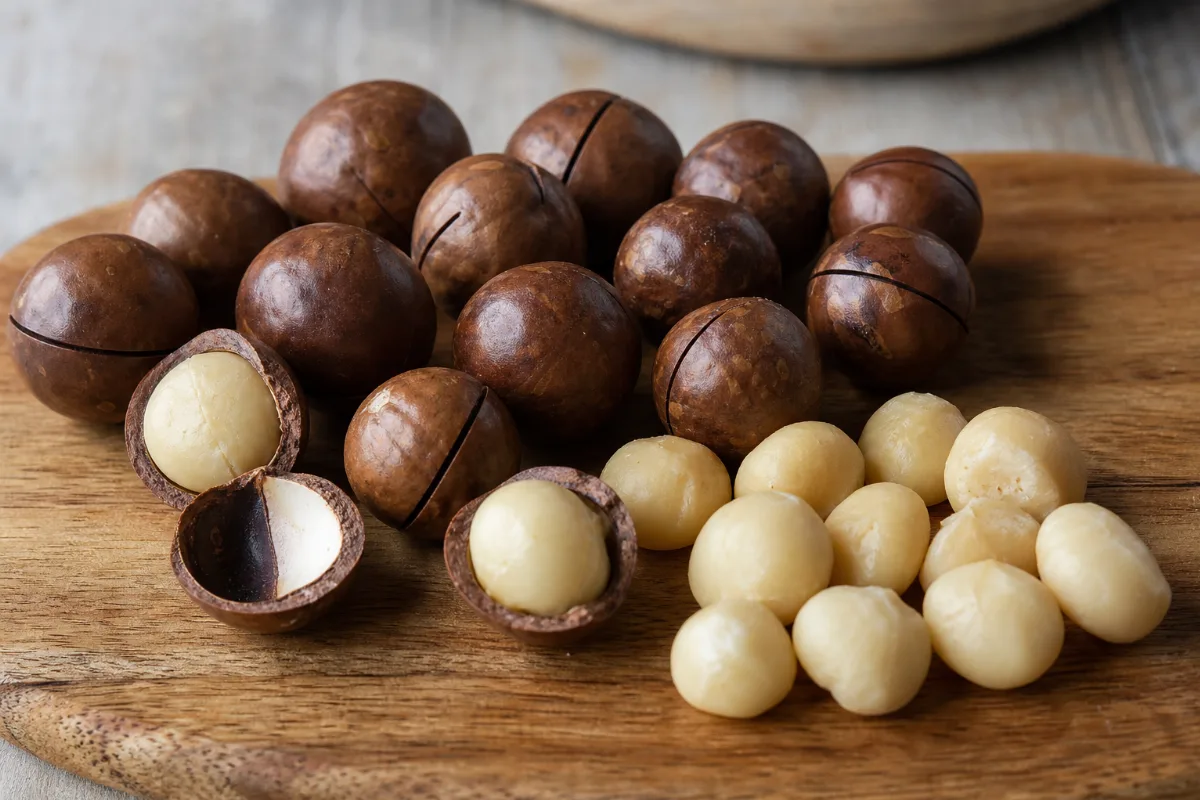
Macadamia nuts are the kernels of Macadamia integrifolia and Macadamia tetraphylla, trees in the protea family. People eat them raw, roasted, salted or in baking.
USDA data for raw macadamia nuts: 718 kcal per 100 g. One ounce (28.35 g, about 10 to 12 kernels) has about 204 kcal, 21.5 g of fat (3.4 g saturated and 16.7 g monounsaturated), 2.2 g of protein and 2.4 g of fibre. It also has 1.17 mg of manganese, 0.34 mg of thiamin, 0.21 mg of copper and 37 mg of magnesium. Salted or flavoured nuts add sodium or sugar.
What the research shows
Four small trials from 2000 to 2008 and one from 2023 tested macadamias on cholesterol. Most found lower LDL, usually compared with a diet higher in saturated fat. The 2023 trial in adults with abdominal obesity found a small drop that was not statistically significant.
A review of 61 tree nut trials found a modest LDL fall per daily serving with no clear difference between nut types, so it supports nuts in general more than macadamia alone.
Reviews of nut trials found no weight gain, and the one macadamia trial that measured blood sugar found no change. Studies that follow people over time link more nut eating with fewer heart deaths, but they cannot show cause.
The FDA heart claim
In 2017 the FDA said it would allow food labels to say that "supportive but not conclusive research" shows macadamias may reduce the risk of coronary heart disease, as part of a diet low in saturated fat and cholesterol. The claim followed a petition filed by a macadamia company. A qualified claim does not meet the stricter standard of significant scientific agreement.
Whole nuts versus oil and other products
The trials used whole macadamia kernels eaten as food. No trial of macadamia oil, butter or flour was read, so these results do not apply to those products.
Amounts
This page gives no amounts to eat. Ask a doctor or dietitian what is right for you, especially if you have high cholesterol, take medicine or need to watch calories.
At a glance
Traditional uses history, not proof
- Eaten as a snack, in baking and as nut butter
- Valued as a rich, creamy nut; long use is not proof that it treats any condition
Studied for research
- LDL cholesterol, low certainty for macadamia trials (small and short)
- Tree nuts as a group and LDL, moderate certainty (macadamia included)
- US FDA qualified claim on heart disease, low certainty (industry petition)
- Weight and body fat, low certainty (no weight gain found)
- Blood sugar, insufficient evidence
Main compounds
- Monounsaturated fat (58.9 g per 100 g)
- Saturated fat (12.1 g per 100 g)
- Plant sterols (116 mg per 100 g)
- Manganese, thiamin, copper and magnesium (USDA)
Common forms
- Raw or roasted kernels as food
- Salted or flavoured nuts (check the label)
- Macadamia oil and butter (not studied here)
Research links: USDA FoodData Central: raw macadamia nuts · FDA: macadamia qualified health claim (2017) · Jones 2023 macadamia trial (J Nutr Sci) · Del Gobbo 2015 tree nut meta-analysis · Research Library · Genes & Biomarkers Library
What it is and its history
- Accepted scientific name
- Macadamia integrifolia
- Naming authority
- Maiden & Betche (GBIF accepted; usageKey 2891785). The second species used for nuts is Macadamia tetraphylla L.A.S.Johnson (GBIF usageKey 2891787).
- Common names
- Macadamia nut (English); Queensland nut (English); Nuez de macadamia (Spanish)
- Family or group
- Proteaceae (the protea family)
- Classification
- Plantae > Tracheophyta > Magnoliopsida > Proteales > Proteaceae > Macadamia > Macadamia integrifolia
- Native range
- Not verified from a source read.
- Habitat
- Not verified from a source read.
- What it looks like
- Roots: Not verified.; Stems: Not verified.; Leaves: Not verified.; Flowers: Not verified.; Fruit: The nut kernel is the food. The shell is very hard (earlier site summary; not verified here). USDA lists the kernel in portions of 1 oz (10 to 12 kernels, 28.35 g) and 1 cup (134 g).
- Cultivation
- The MSD Veterinary Manual says Macadamia integrifolia is the nut grown in the continental US and M. tetraphylla in Hawaii and Australia. Other cultivation facts were not verified.
- Harvest and processing
- Eaten raw, roasted, salted or flavoured, or in baking and nut butter. USDA's record is for raw, unroasted kernels.
- Look-alikes and adulterants
- Name: Macadamia oil and butter; Note: Products made from the kernel. They are not the whole food and no trial of them was read.; Name: Other tree nuts (hazelnut, cashew, pecan, Brazil nut); Note: Different nuts; hazelnut may cross-react with macadamia in allergic people (lab study).
- Sustainability and conservation
- Not assessed.
Photographs
Traditional use and history history, not clinical proof
| Tradition or era | Documented use | Source |
|---|---|---|
| Culinary use | Macadamia kernels are eaten raw, roasted, salted or in baking (general knowledge; no historical source was read for this page). | Not verified |
Traditional use shows how it was used. It does not show that it works or is safe today.
What is inside, and how it may work
What it contains and how those compounds act in cells and animals. Laboratory and animal mechanisms are not proven effects in people.
Main compounds
| Compound | Family | Where it is concentrated | Activity studied | Level of evidence |
|---|---|---|---|---|
| Monounsaturated fat | fatty acid | Kernel USDA: 58.9 g per 100 g (16.7 g per ounce), most of the 75.8 g of fat | The main fat in macadamias. Trials that used macadamia diets compared them with higher-saturated-fat diets (see the benefits). 23 5 | Human data |
| Saturated fat | fatty acid | Kernel USDA: 12.1 g per 100 g (3.4 g per ounce) | Relevant to why the FDA claim is conditional on the rest of the diet. 23 14 | Human data |
| Plant sterols (phytosterols) | sterols | Kernel USDA: 116 mg per 100 g (33 mg per ounce) | A lab measurement here. No trial reading tested the sterols in macadamias on their own. 23 | Human data |
| Manganese | mineral | Kernel USDA: 4.13 mg per 100 g (1.17 mg per ounce) | A nutrient present in notable amounts in macadamias (USDA). No role was read from a second source for this page. 23 | Human data |
Mechanisms, receptors and pathways
| Target or pathway | Gene or receptor | What was found | Level |
|---|---|---|---|
| Cholesterol and fat balance | Not specified | Authors of the macadamia trials suggest the monounsaturated fat and replacing saturated fat may explain lower LDL. The trials did not test mechanisms. 5 2 | Human data |
Absorption, metabolism and elimination
- Absorption
- Not studied for macadamia.
- Distribution
- Not found.
- Metabolism
- Not found.
- Elimination
- Not found.
- Bioavailability
- Not established for macadamia.
Isolated compounds versus whole extracts
The trials used whole macadamia kernels eaten as part of the diet. No trial of macadamia oil, flour, butter or supplements was read, so nothing here applies to those products.
Nutritional composition
Nutrition from USDA FoodData Central (raw macadamia nuts, FDC 170178, SR Legacy, read 2026-10-26; the record notes the nuts are unroasted). Per 100 g: 718 kcal, 75.8 g fat (12.1 g saturated, 58.9 g monounsaturated, 1.5 g polyunsaturated), 7.91 g protein, 13.8 g carbohydrate, 8.6 g fibre, 0 mg cholesterol, 116 mg plant sterols (phytosterols), 5 mg sodium, 368 mg potassium, 130 mg magnesium, 188 mg phosphorus, 85 mg calcium, 3.69 mg iron, 1.3 mg zinc, 4.13 mg manganese, 0.756 mg copper, 1.2 mg thiamin (vitamin B1), 0.275 mg vitamin B6, 0.54 mg vitamin E (alpha-tocopherol), 3.6 micrograms selenium, about 1.4 g water. One ounce (28.35 g, 10 to 12 kernels): about 204 kcal, 21.5 g fat (3.4 g saturated, 16.7 g monounsaturated), 2.2 g protein, 2.4 g fibre, 1.17 mg manganese, 0.34 mg thiamin, 0.21 mg copper, 37 mg magnesium, 1.05 mg iron, 104 mg potassium and about 1.4 mg sodium (scaled from per-100 g values). One cup of whole or halved kernels is 134 g. USDA lists almost no vitamin C. Macadamias are the richest common nut in fat and energy. Values vary with variety, growing place, roasting and storage; salted or flavoured nuts add sodium or sugar.
1 moderate certainty5 low certainty1 not enough evidence
What was looked at
The 7 benefits and uses checked for Macadamia Nuts, each with how strong the evidence is. Tap one to open it.
- LDL cholesterol (macadamia trials)Low certainty
- LDL cholesterol (tree nuts as a group, macadamia included)Moderate certainty
- US FDA qualified health claim on heart diseaseLow certainty
- Heart disease and early death (all nuts, observational)Low certainty
- Body weight and body fatLow certainty
- Blood sugar controlNot enough evidence
- Blood pressure and other blood measures (tree nuts as a group)Low certainty
Lab markers tracked in the studies
LDL cholesterolTotal cholesterolBody weight and body fatBlood sugar measures
What is Macadamia Nuts good for?
The main studied uses and how strong the human evidence is for each. Macadamia-only trials are small, and several results come from all tree nuts together.
Benefits, one by one
Each card is a research question, not a promise. Tap a goal to filter. Open a card to see the studies, doses and limits.
LDL cholesterol (macadamia trials)
Low certaintySeveral small trials found lower LDL cholesterol when macadamia nuts replaced a higher saturated-fat diet. The newest trial, in adults with abdominal obesity, found only a small drop that was not statistically significant. Trials were small and short.
5 studiesWhole macadamia kernels eaten as food in the trial diets. This is tri…
Studies, doses and limits
What the trials found
In a 5-week controlled-feeding crossover trial (n=25), a macadamia diet gave lower total (4.94 vs 5.45 mmol/L) and LDL cholesterol (3.14 vs 3.44 mmol/L) than an average American diet, but that diet had more saturated fat. In a 30-day crossover (n=30), the macadamia diet lowered LDL to 3.22 from 3.37 mmol/L, about the same as a low-fat diet (3.21). A 4-week before-and-after study of 17 men saw LDL fall 5.3%. A 3-week study in young Japanese women found significant falls in LDL (numbers not in the abstract). In the 2023 trial of 35 adults, macadamias for 8 weeks gave a non-significant LDL drop of 4%.
Results
Lower LDL in most small trials, mainly against a higher-saturated-fat diet. The 2023 trial did not reach significance.
Effect sizes as reported
LDL 3.14 vs 3.44 mmol/L (2008); 3.22 vs 3.37 mmol/L (2000); -5.3% (2003); -4%, non-significant (2023).
Why this rating
Five small, short trials of 17 to 35 people with different designs and comparison diets, one with no control group and one non-significant. The comparison was often a higher-saturated-fat diet.
Form and dose studied
Whole macadamia kernels eaten as food in the trial diets. This is trial detail, not advice.
Who was studied
Adults with mildly raised cholesterol or abdominal obesity, healthy young women.
Limits
Small samples; short; the comparison diet often differed in saturated fat; the macadamia diet did not beat a low-fat diet in 2000.
Why researchers looked
Macadamias are mostly monounsaturated fat, so researchers asked whether they behave like other nuts that lower LDL.
Traditional use
Macadamia nuts have long been eaten as a food; long use is not proof that they treat any condition.
Proposed mechanism Preliminary mechanism
Authors suggest the high monounsaturated fat content, and swapping out saturated fat, may help. The trials did not test this directly.
A proposed mechanism does not show that the effect happens in people.
Macadamias are high in calories and a tree nut allergen (see the Safety tab).
LDL cholesterol (tree nuts as a group, macadamia included)
Moderate certaintyA review of 61 trials found that tree nuts lowered LDL cholesterol by about 4.8 mg/dL per one-ounce serving a day. The authors found no clear difference between nut types. Macadamia was one of eight nut types pooled.
1 studiesWhole tree nuts. Dose was standardised by the authors; this is analys…
Studies, doses and limits
What the trials found
The 2015 meta-analysis (61 controlled trials, 2,582 adults, 3 to 26 weeks) found per serving a day: total cholesterol -4.7 mg/dL, LDL -4.8 mg/dL (95% CI -5.5 to -4.2), ApoB -3.7 mg/dL and triglycerides -2.2 mg/dL. Effects were stronger at 60 g or more a day. It found no significant heterogeneity by nut type.
Results
Small but consistent LDL lowering by tree nuts as a group.
Effect sizes as reported
LDL -4.8 mg/dL per 1-oz serving a day (95% CI -5.5 to -4.2).
Why this rating
A systematic review of controlled trials with little publication bias, but short trials, small effects, and macadamia not analysed on its own.
Form and dose studied
Whole tree nuts. Dose was standardised by the authors; this is analysis detail, not advice.
Who was studied
Adults without cardiovascular disease.
Limits
Mixed nut types; surrogate marker (LDL), not heart events; trials up to 26 weeks.
Why researchers looked
Nut eaters tend to have lower heart disease rates, so trials tested whether nuts change blood fats.
Traditional use
Macadamia nuts have long been eaten as a food; long use is not proof that they treat any condition.
Proposed mechanism Systematic review
Not tested in the review. The authors found dose, not nut type, was the main driver.
A proposed mechanism does not show that the effect happens in people.
Not for anyone with a tree nut allergy.
US FDA qualified health claim on heart disease
Low certaintyIn 2017 the FDA said it would allow a label claim that "supportive but not conclusive research" shows macadamia nuts may reduce the risk of coronary heart disease. The claim followed a petition from a macadamia company. It is a regulatory wording, not proof.
1 studiesWhole macadamia nuts within a defined diet. This is label wording, no…
Studies, doses and limits
What the trials found
The FDA update of July 24, 2017 says it intends to use enforcement discretion for a qualified claim: "Supportive but not conclusive research shows that eating 1.5 ounces per day of macadamia nuts, as part of a diet low in saturated fat and cholesterol and not resulting in increased intake of saturated fat or calories may reduce the risk of coronary heart disease." It says the claim answered a petition filed by Royal Hawaiian Macadamia Nut, Inc., and that qualified claims do not meet the stricter "significant scientific agreement" standard.
Results
A conditional label claim, not a proven benefit.
Why this rating
The FDA itself calls the research supportive but not conclusive, and the claim came from an industry petition.
Form and dose studied
Whole macadamia nuts within a defined diet. This is label wording, not advice for you.
Who was studied
General US population.
Limits
Industry petition; the claim depends on the rest of the diet.
Why researchers looked
A company asked the FDA to allow the claim.
Traditional use
Macadamia nuts have long been eaten as a food; long use is not proof that they treat any condition.
Proposed mechanism Authoritative guidance
Not described in the FDA update.
A proposed mechanism does not show that the effect happens in people.
None specific.
Heart disease and early death (all nuts, observational)
Low certaintyIn studies that follow people over time, those who ate more nuts had lower rates of coronary heart disease and death. These studies pooled all nuts and cannot prove cause. Macadamia was not studied alone.
1 studiesAll nut types, mostly eaten as food.
Studies, doses and limits
What the trials found
A 2016 meta-analysis of 20 prospective studies found, per 28 g a day of nuts, coronary heart disease RR 0.71 (95% CI 0.63 to 0.80), cardiovascular disease RR 0.79 (0.70 to 0.88), total cancer RR 0.85 (0.76 to 0.94) and all-cause death RR 0.78 (0.72 to 0.84). Stroke was not clearly lower (RR 0.93, 0.83 to 1.05). Results were similar for tree nuts and peanuts.
Results
Lower rates of heart disease and death with more nut intake, as an association.
Effect sizes as reported
CHD RR 0.71; all-cause death RR 0.78 per 28 g a day.
Why this rating
Observational data with possible confounding; all nuts pooled; macadamia not separated.
Form and dose studied
All nut types, mostly eaten as food.
Who was studied
Adults in prospective cohorts.
Limits
Cannot show cause; macadamia not analysed alone.
Why researchers looked
Large cohort studies have long linked nut eating with better heart health.
Traditional use
Macadamia nuts have long been eaten as a food; long use is not proof that they treat any condition.
Proposed mechanism Hypothesis
Not tested. People who eat nuts may differ in diet and lifestyle in other ways.
A proposed mechanism does not show that the effect happens in people.
None specific.
Body weight and body fat
Low certaintyMacadamias are the most energy-dense common nut, but trials did not find weight gain. A 35-adult macadamia trial and a review of 55 nut trials both found no change in weight, BMI or waist size. This does not show nuts cause weight loss.
4 studiesWhole nuts in the trials. This is trial detail, not advice.
Studies, doses and limits
What the trials found
In the 2023 crossover trial of 35 adults with abdominal obesity, macadamias at about 15% of daily calories for 8 weeks gave no significant change in weight, BMI, waist or percent body fat. A 2021 meta-analysis of 55 nut-feeding trials found no change in body weight, BMI or waist; a small fall in body fat percentage (SMD -0.32, 95% CI -0.61 to -0.03) appeared only where people were told how to fit the nuts into their diet. A 3-week study in young Japanese women reported falls in weight and BMI in the macadamia group (no numbers in the abstract).
Results
No weight gain found; not a weight-loss food.
Effect sizes as reported
No significant change in weight (2023 trial). Body weight SMD 0.01 kg (95% CI -0.07 to 0.08) in nut trials without substitution instructions (2021 review).
Why this rating
The review is of all nuts; the one macadamia trial of this kind was small and short; the 3-week study gives no numbers.
Form and dose studied
Whole nuts in the trials. This is trial detail, not advice.
Who was studied
Adults, including adults with abdominal obesity.
Limits
Short trials; all-nut review; self-reported intake.
Why researchers looked
Macadamias are very high in fat and calories, so people ask if they add weight.
Traditional use
Macadamia nuts have long been eaten as a food; long use is not proof that they treat any condition.
Proposed mechanism Systematic review
Not tested. The authors of the 55-trial review note that results did not depend on whether people were told to swap nuts for other foods.
A proposed mechanism does not show that the effect happens in people.
Macadamias are high in calories: about 204 kcal in a 1-oz portion (USDA).
Blood sugar control
Not enough evidenceThe one macadamia trial that measured it, in 35 adults with abdominal obesity, found no significant change in blood sugar measures. There is not enough evidence to say more.
1 studiesWhole nuts at about 15% of daily calories in the trial. Trial detail,…
Studies, doses and limits
What the trials found
In the 2023 crossover trial (n=35), eating macadamias for 8 weeks gave no significant change in glycaemic parameters. The abstract does not list the individual measures.
Results
No change seen in one small trial.
Effect sizes as reported
Not significant (values not in the abstract).
Why this rating
One small trial in adults with abdominal obesity; no trial in people with diabetes.
Form and dose studied
Whole nuts at about 15% of daily calories in the trial. Trial detail, not advice.
Who was studied
Adults with abdominal obesity.
Limits
One trial; no diabetes patients.
Why researchers looked
Nuts have little starch and are often suggested as a snack for blood sugar.
Traditional use
Macadamia nuts have long been eaten as a food; long use is not proof that they treat any condition.
Proposed mechanism None found
Not tested.
A proposed mechanism does not show that the effect happens in people.
None specific.
Blood pressure and other blood measures (tree nuts as a group)
Low certaintyA review of 61 tree nut trials, macadamia among them, found no significant effect of nuts on blood pressure or HDL cholesterol. It found modest falls only in LDL, total cholesterol, ApoB and triglycerides.
1 studiesTree nuts as food.
Studies, doses and limits
What the trials found
The 2015 meta-analysis examined blood lipids, apolipoproteins, blood pressure and C-reactive protein. It reports significant falls in total cholesterol, LDL, ApoB and triglycerides and "no statistically significant effects on other outcomes".
Results
No clear effect on blood pressure was reported for tree nuts overall; macadamia alone was not analysed.
Effect sizes as reported
Not given in the abstract for blood pressure.
Why this rating
All tree nuts pooled; the abstract gives no blood pressure figures.
Form and dose studied
Tree nuts as food.
Who was studied
Adults without cardiovascular disease.
Limits
Abstract only; macadamia not separated.
Why researchers looked
Blood pressure is another heart risk factor that nuts might change.
Traditional use
Macadamia nuts have long been eaten as a food; long use is not proof that they treat any condition.
Proposed mechanism None found
Not tested.
A proposed mechanism does not show that the effect happens in people.
None specific.
Connections to the rest of health
How Macadamia Nuts connects to the rest of our health knowledge graph. Every link says what kind of connection it is. A safety link (for example to the liver) is a warning, not a benefit. A study that merely mentions a topic never creates a benefit link.
Explore every connection: goals, body systems, organs, symptoms, genes
A. Wellness goals
| Connected to | Kind of connection | Evidence status | Context | Studies |
|---|---|---|---|---|
| Cholesterol Balance | Low certainty | LDL cholesterol (macadamia trials): Several small trials found lower LDL cholesterol when macadamia nuts replaced a higher saturated-fat diet. The newest trial, in adults with abdominal obesity, found only a small drop that was not statistically significant. Trials were small and short. | 5 2 4 8 9 | |
| Heart Health | Low certainty | LDL cholesterol (macadamia trials): Several small trials found lower LDL cholesterol when macadamia nuts replaced a higher saturated-fat diet. The newest trial, in adults with abdominal obesity, found only a small drop that was not statistically significant. Trials were small and short. | 5 2 4 8 9 | |
| Cholesterol Balance | Demonstrated clinical effect | Moderate certainty | LDL cholesterol (tree nuts as a group, macadamia included): A review of 61 trials found that tree nuts lowered LDL cholesterol by about 4.8 mg/dL per one-ounce serving a day. The authors found no clear difference between nut types. Macadamia was one of eight nut types pooled. | 3 |
| Heart Health | Demonstrated clinical effect | Moderate certainty | LDL cholesterol (tree nuts as a group, macadamia included): A review of 61 trials found that tree nuts lowered LDL cholesterol by about 4.8 mg/dL per one-ounce serving a day. The authors found no clear difference between nut types. Macadamia was one of eight nut types pooled. | 3 |
| Heart Health | Potential benefit | Low certainty | US FDA qualified health claim on heart disease: In 2017 the FDA said it would allow a label claim that "supportive but not conclusive research" shows macadamia nuts may reduce the risk of coronary heart disease. The claim followed a petition from a macadamia company. It is a regulatory wording, not proof. | 14 |
| Heart Health | Low certainty | Heart disease and early death (all nuts, observational): In studies that follow people over time, those who ate more nuts had lower rates of coronary heart disease and death. These studies pooled all nuts and cannot prove cause. Macadamia was not studied alone. | 1 | |
| Weight Management | Low certainty | Body weight and body fat: Macadamias are the most energy-dense common nut, but trials did not find weight gain. A 35-adult macadamia trial and a review of 55 nut trials both found no change in weight, BMI or waist size. This does not show nuts cause weight loss. | 9 6 8 22 | |
| Blood Sugar Balance | Not enough evidence | Blood sugar control: The one macadamia trial that measured it, in 35 adults with abdominal obesity, found no significant change in blood sugar measures. There is not enough evidence to say more. | 9 | |
| Heart Health | Low certainty | Blood pressure and other blood measures (tree nuts as a group): A review of 61 tree nut trials, macadamia among them, found no significant effect of nuts on blood pressure or HDL cholesterol. It found modest falls only in LDL, total cholesterol, ApoB and triglycerides. | 3 |
B. Body systems
| Connected to | Kind of connection | Evidence status | Context | Studies |
|---|---|---|---|---|
| Cardiovascular System | Biological association | Low certainty | Studied for: LDL cholesterol (macadamia trials) Studied for: LDL cholesterol (tree nuts as a group, macadamia included) | 5 2 4 8 9 3 14 1 |
| Metabolism Weight | Biological association | Low certainty | Studied for: Body weight and body fat Studied for: Blood sugar control | 9 6 8 22 |
E. Health conditions
| Connected to | Kind of connection | Evidence status | Context | Studies |
|---|---|---|---|---|
| Food allergy | Adverse effect or risk | Documented risk | Macadamia is a tree nut allergen; reactions can be severe. Preparation or compound: Macadamia kernel |
10 11 19 |
| Choking | Adverse effect or risk | Documented risk | Whole nuts are a choking risk for children under 5. Preparation or compound: Whole nuts |
21 |
I. Biomarkers
| Connected to | Kind of connection | Evidence status | Context | Studies |
|---|---|---|---|---|
| LDL cholesterol | Small trials | Most small macadamia trials found lower LDL; the 2023 trial did not reach significance. Preparation or compound: Whole macadamia nuts |
5 9 | |
| LDL cholesterol | Biological association | Low certainty | Measured in trials: lowered (mixed). A lab change is not the same as a health benefit. | 5 2 4 8 9 3 |
| Total cholesterol | Biological association | Low certainty | Measured in trials: lowered (mixed). A lab change is not the same as a health benefit. | 5 4 9 2 |
| Body weight and body fat | Biological association | Low certainty | Measured in trials: no clear change. A lab change is not the same as a health benefit. | 9 6 8 |
| Blood sugar measures | Biological association | Not enough evidence | Measured in trials: no clear change. A lab change is not the same as a health benefit. | 9 |
K. Biological pathways
L. Active compounds
| Connected to | Kind of connection | Evidence status | Context | Studies |
|---|---|---|---|---|
| Monounsaturated fat | Biological association | Human | The main fat in macadamias. Trials that used macadamia diets compared them with higher-saturated-fat diets (see the benefits). Preparation or compound: Kernel |
23 5 |
| Saturated fat | Biological association | Human | Relevant to why the FDA claim is conditional on the rest of the diet. Preparation or compound: Kernel |
23 14 |
| Plant sterols (phytosterols) | Biological association | Human | A lab measurement here. No trial reading tested the sterols in macadamias on their own. Preparation or compound: Kernel |
23 |
| Manganese | Biological association | Human | A nutrient present in notable amounts in macadamias (USDA). No role was read from a second source for this page. Preparation or compound: Kernel |
23 |
Each connection is stored with the ingredient, the connected record, the kind of connection, the evidence status, the supporting studies, the preparation or compound involved, and a review date (last reviewed October 26, 2026).
Evidence at a glance: what the research found for 7 outcomes
Each outcome below is one thing researchers measured. Certainty is how far the evidence can be trusted, not how well it works. The full studies are on the next tab.
The evidence
The research centre for Macadamia Nuts. Every record here was checked against PubMed or the publisher's page; we never list a study we have not verified.
Evidence by outcome
Bars show how many studies we found for each outcome, not how well it works. People are added up across trials only (reviews are not added, to avoid double counting).
How we rate evidence
High certainty
Several well-run trials or reviews agree; further research is unlikely to change the picture much.
Moderate certainty
Good trials point the same way, but some doubt remains.
Low certainty
Small, short or inconsistent trials. The finding could change with better research.
Very low certainty
Very little or very weak human data. Treat as a possibility only.
Mixed findings
Trials or reviews disagree with each other.
Not enough evidence
Not enough human research to say either way.
Evidence against
Good research found no benefit, or found harm.
We take the reviewers' own risk-of-bias and GRADE statements where they exist, and otherwise judge from study size, design, consistency, directness and whether a product matches what is sold. Many publications do not make evidence high. Method note: We started from our existing macadamia summary, re-checked nutrition at USDA FoodData Central, and searched PubMed for human trials, reviews and case reports. We read the abstracts, and pages from the FDA, NHS, WHO, MedlinePlus, the ASPCA and the MSD Veterinary Manual. Items we could not verify are flagged in the research gaps.
Study library: every study we checked 24
| Study | Design | People | Product, dose, length | Result |
|---|---|---|---|---|
| Aune 2016 Nut consumption and risk of cardiovascular disease, total cancer, all-cause and cause-specific mortality: a systematic review and dose-response meta-analysis of prospective studies. BMC Med · PMID 27916000 |
Systematic review meta analysis |
20 prospective studies (29 publications) in adults | Nut intake (all nuts, tree nuts and peanuts) Kernel (nut) Per 28 g a day increase; analysis detail, not advice Long-term follow-up · vs Lower nut intake |
Per 28 g a day: coronary heart disease RR 0.71 (95% CI 0.63 to 0.80), stroke RR 0.93 (0.83 to 1.05), cardiovascular disease RR 0.79 (0.70 to 0.88), total cancer RR 0.85 (0.76 to 0.94), all-cause death RR 0.78 (0.72 to 0.84). Results were similar for tree nuts and peanuts. Coronary heart disease RR 0.71 per 28 g a day (95% CI 0.63 to 0.80) Methods, limits and fundingOutcomes: Cardiovascular disease, cancer and death Limitations: Observational, so it shows association, not cause. All nuts pooled; macadamia not analysed alone. Nut eaters may differ in other ways. Funding and conflicts: None listed in the record. Read: abstract |
| Curb 2000 Serum lipid effects of a high-monounsaturated fat diet based on macadamia nuts. Arch Intern Med · PMID 10789609 |
Controlled trial |
30 30 volunteers aged 18 to 53 from a free-living population |
Macadamia-nut-based diet high in monounsaturated fat (37% of energy from fat) Kernel (nut) Diet-level trial; amounts of nuts not given in the abstract Three 30-day diets in random order (crossover) · vs Typical American diet (high saturated fat) and an American Heart Association Step 1 diet (30% fat) |
Total cholesterol 5.20 mmol/L on the typical diet, 4.99 on Step 1 and 4.95 on the macadamia diet. LDL cholesterol 3.37, 3.21 and 3.22 mmol/L. HDL 1.43, 1.34 and 1.37 mmol/L. Both the Step 1 and macadamia diets differed from the typical diet (P<.05). LDL 3.22 vs 3.37 mmol/L (macadamia vs typical diet) Methods, limits and fundingOutcomes: Serum total cholesterol, LDL, HDL, triglycerides Limitations: Small, 30-day diets. The macadamia diet did about the same as a low-fat diet, so it was not better than that diet. The abstract does not state who paid. Funding and conflicts: Not stated in the abstract. Read: abstract |
| Del Gobbo 2015 Effects of tree nuts on blood lipids, apolipoproteins, and blood pressure: systematic review, meta-analysis, and dose-response of 61 controlled intervention trials. Am J Clin Nutr · PMID 26561616 |
Systematic review meta analysis |
2582 Adults without cardiovascular disease; 61 trials of 3 to 26 weeks |
Tree nuts as a group (walnuts, pistachios, macadamia nuts, pecans, cashews, almonds, hazelnuts, Brazil nuts) Kernel (nut) Standardised by the authors to one 1-oz (28.4 g) serving a day; analysis detail, not advice 3 to 26 weeks · vs Control diets |
Per serving a day: total cholesterol -4.7 mg/dL, LDL cholesterol -4.8 mg/dL (95% CI -5.5 to -4.2), ApoB -3.7 mg/dL and triglycerides -2.2 mg/dL. No statistically significant effects on other outcomes. The effect depended mostly on dose, not nut type, and was stronger at 60 g or more a day. LDL -4.8 mg/dL per 1-oz serving a day (LDL 95% CI -5.5 to -4.2 mg/dL) Methods, limits and fundingOutcomes: Blood lipids, apolipoproteins, blood pressure, C-reactive protein Limitations: Eight kinds of tree nut pooled; macadamia was one of them and was not analysed alone in the abstract. Trials were short. Funding and conflicts: NHLBI (NIH) grant listed in the record. Read: abstract |
| Garg 2003 Macadamia nut consumption lowers plasma total and LDL cholesterol levels in hypercholesterolemic men. J Nutr · PMID 12672919 |
Clinical trial |
17 Men (mean age 54) with raised cholesterol |
Whole macadamia nuts Kernel (nut) 40 to 90 g a day, about 15% of energy; trial detail, not advice 4 weeks · vs Before-and-after comparison; no control group is mentioned in the abstract |
Total cholesterol fell 3.0%, LDL cholesterol fell 5.3% and HDL cholesterol rose 7.9%. Triglycerides and homocysteine did not change. LDL -5.3%; total cholesterol -3.0%; HDL +7.9% Methods, limits and fundingOutcomes: Plasma lipids, homocysteine, fatty acids Limitations: Small, short, and the abstract describes a before-and-after comparison with no control group. Funding and conflicts: Not stated in the abstract. Read: abstract |
| Griel 2008 A macadamia nut-rich diet reduces total and LDL-cholesterol in mildly hypercholesterolemic men and women. J Nutr · PMID 18356332 |
Controlled trial |
25 Adults (15 women, 10 men) with mildly raised cholesterol |
Controlled-feeding diet rich in macadamia nuts Kernel (nut) 1.5 ounces (42.5 g) per 2100 kcal; trial detail, not advice 5-week diet periods, crossover · vs Average American diet (more saturated fat: 13% versus 7% of energy) |
Total cholesterol 4.94 versus 5.45 mmol/L and LDL cholesterol 3.14 versus 3.44 mmol/L, lower on the macadamia diet (P<0.05). Non-HDL cholesterol 3.83 versus 4.26 mmol/L (P<0.05). No change in triglycerides. LDL 3.14 vs 3.44 mmol/L; total cholesterol 4.94 vs 5.45 mmol/L Methods, limits and fundingOutcomes: Serum total, LDL and non-HDL cholesterol, triglycerides Limitations: Small; fully controlled feeding, so not everyday eating. The comparison diet was higher in saturated fat, so part of the effect is swapping saturated fat for unsaturated fat. Funding and conflicts: NIH (NCRR) grant listed in the record; no industry funding stated in the abstract. Read: abstract |
| Guarneiri 2021 Intake of Nuts or Nut Products Does Not Lead to Weight Gain, Independent of Dietary Substitution Instructions: A Systematic Review and Meta-Analysis of Randomized Trials. Adv Nutr · PMID 32945861 |
Systematic review meta analysis |
Adults in 55 nut-feeding trials lasting more than 3 weeks | Daily nuts or nut-based snacks and meals (all nut types) Kernel (nut) Varied More than 3 weeks · vs Control diets, with or without substitution instructions |
No change in body weight, BMI or waist circumference with or without substitution instructions. Body fat percentage fell slightly (SMD -0.32, 95% CI -0.61 to -0.03) only in studies with substitution instructions. Body weight SMD 0.01 kg (95% CI -0.07 to 0.08) without substitution instructions (-0.07 to 0.08) Methods, limits and fundingOutcomes: Body weight, BMI, waist circumference, body fat percentage Limitations: All nuts pooled; varied methods; many outcomes not reported in every study. Funding and conflicts: None listed in the record. Read: abstract |
| Gutierrez-Diaz 2024 Identification of New Allergens in Macadamia Nut and Cross-Reactivity with Other Tree Nuts in a Spanish Cohort. Nutrients · PMID 38612981 |
Lab study human samples (lab) |
7 7 people in Spain with macadamia nut allergy |
Macadamia, hazelnut and walnut protein extracts tested against patient blood Kernel (nut) Lab test · vs Hazelnut and walnut extracts |
Three new allergens were identified (an oleosin, a pectin acetylesterase and an aspartyl protease). Hazelnut extract, but not walnut extract, blocked IgE binding to the macadamia oleosin, suggesting macadamia-hazelnut cross-reactivity. The pattern differed from earlier Australian and Japanese groups. Qualitative lab finding Methods, limits and fundingOutcomes: IgE-binding proteins and cross-reactivity Limitations: Seven people; laboratory binding test, not food challenges. Funding and conflicts: Ministry of Science, Innovation and Universities (Spain) grant listed. Read: abstract |
| Hiraoka-Yamamoto 2004 Serum lipid effects of a monounsaturated (palmitoleic) fatty acid-rich diet based on macadamia nuts in healthy, young Japanese women. Clin Exp Pharmacol Physiol · PMID 15649284 |
Clinical trial |
Healthy young Japanese female students | Diets based on macadamia nuts, coconut or butter Kernel (nut) Not given in the abstract 3 weeks per intervention · vs Coconut and butter diets |
Total cholesterol and LDL cholesterol fell significantly on the macadamia and coconut diets. Body weight and BMI fell in the macadamia group. There were no significant changes on the butter diet. Significant falls in total and LDL cholesterol (numbers not in the abstract) Methods, limits and fundingOutcomes: Serum lipids, body weight, BMI Limitations: The abstract gives no numbers or sample size; healthy young women only; short. Funding and conflicts: Not stated in the abstract. Read: abstract |
| Jones 2023 Macadamia nut effects on cardiometabolic risk factors: a randomised trial. J Nutr Sci · PMID 37180485 |
Controlled trial |
35 Adults with abdominal obesity (overweight or obese) at raised cardiometabolic risk |
Whole macadamia nuts added to the usual diet Kernel (nut) About 15% of daily calories; trial detail, not advice 8 weeks, with an 8-week no-nut control period and a 2-week washout (crossover) · vs Usual diet without nuts |
No significant change in weight, BMI, waist, percent body fat or glycaemic measures. Non-significant falls in total cholesterol (2.1%, -4.3 mg/dL, 95% CI -14.8 to 6.1) and LDL cholesterol (4%, -4.7 mg/dL, 95% CI -14.3 to 4.8). Saturated fat intake did not change. Lipid lowering was greater in those with overweight (versus obesity) and with less body fat. LDL -4% (-4.7 mg/dL); total cholesterol -2.1% (-4.3 mg/dL); both non-significant (LDL 95% CI -14.3 to 4.8 mg/dL) Methods, limits and fundingOutcomes: Body weight and composition, plasma lipids, glycaemic measures Limitations: Small, short, free-living trial; no significant lipid change; the abstract does not state who paid for it. Funding and conflicts: Not stated in the abstract. Registration: NCT03801837 Read: abstract |
| Kiyama 2024 Macadamia Nut-Induced Anaphylactic Shock Requiring Repeated Intramuscular Adrenaline Administration in a Three-Year-Old Girl. Cureus · PMID 38910662 |
Case report |
1 One 3-year-old girl |
Macadamia nuts eaten Kernel (nut) Single exposure |
Generalised redness of the skin two hours after eating macadamia nuts, then anaphylactic shock needing two doses of intramuscular adrenaline. Allergy was confirmed by a prick-by-prick skin test and raised macadamia-specific IgE. Case report Methods, limits and fundingOutcomes: Allergic reaction Limitations: A single case; cannot say how common this is. Funding and conflicts: None listed. Read: abstract |
| Kubota 2022 Macadamia nut-specific IgE levels for predicting anaphylaxis. Pediatr Allergy Immunol · PMID 36156824 |
Cohort study |
41 41 children (median age 7.7) with suspected macadamia allergy; 21 were diagnosed with macadamia allergy |
3-g macadamia oral food challenge, or clear immediate symptoms after eating Kernel (nut) 3 g challenge (hospital test; not advice) Single challenge · vs Children who passed the challenge |
Of 21 children with macadamia allergy, 8 had anaphylaxis. Their macadamia-specific IgE was higher (7.97 versus 1.92 kUA/L). The authors say a cut-off of 3.76 kUA/L predicted anaphylaxis (AUC 0.92). 8 of 21 allergic children had anaphylaxis (AUC 95% CI 0.83 to 1.00) Methods, limits and fundingOutcomes: Anaphylaxis and macadamia-specific IgE Limitations: Small single-hospital study in children who attended an allergy clinic. Funding and conflicts: None listed. Read: abstract |
| s-aspca-macadamia ASPCA: Macadamia Nut (toxic and non-toxic plants) · Source |
Health agency dog |
Methods, limits and fundingRead: full-text | ||
| s-fda-food-allergies FDA: Food Allergies · Source |
Regulator n/a |
Methods, limits and fundingRead: full-text | ||
| s-fda-qhc-macadamia FDA: FDA Completes Review of Qualified Health Claim Petition for Macadamia Nuts and the Risk of Coronary Heart Disease · Source |
Regulator n/a |
Methods, limits and fundingRead: full-text | ||
| s-gbif-macadamia-integrifolia GBIF Backbone: Macadamia integrifolia Maiden & Betche (usageKey 2891785) · Source |
Reference database n/a |
Methods, limits and fundingRead: full-text | ||
| s-gbif-macadamia-tetraphylla GBIF Backbone: Macadamia tetraphylla L.A.S.Johnson (usageKey 2891787) · Source |
Reference database n/a |
Methods, limits and fundingRead: full-text | ||
| s-medlineplus-aflatoxin MedlinePlus: Aflatoxin · Source |
Health agency n/a |
Methods, limits and fundingRead: full-text | ||
| s-msd-macadamia MSD Veterinary Manual: Macadamia Nut Toxicosis in Dogs · Source |
Health agency dog |
Methods, limits and fundingRead: full-text | ||
| s-nhs-food-allergy NHS: Food allergy · Source |
Health agency n/a |
Methods, limits and fundingRead: full-text | ||
| s-nhs-pregnancy-foods NHS: Foods to avoid in pregnancy · Source |
Health agency n/a |
Methods, limits and fundingRead: full-text | ||
| s-nhs-young-children NHS: Foods to avoid giving babies and young children · Source |
Health agency n/a |
Methods, limits and fundingRead: full-text | ||
| s-usda-fdc-170178 USDA FoodData Central: Nuts, macadamia nuts, raw (FDC 170178) · Source |
Reference database n/a |
Methods, limits and fundingRead: full-text | ||
| s-usda-fdc-170178-d USDA FoodData Central: Nuts, macadamia nuts, raw (FDC 170178) · Source |
Reference database n/a |
Methods, limits and fundingRead: full-text | ||
| s-who-mycotoxins WHO: Mycotoxins fact sheet · Source |
Health agency n/a |
Methods, limits and fundingRead: full-text |
What we do not know yet
- No trial of macadamia nuts has followed heart attacks, strokes or death.
- Macadamia-only trials are small (17 to 35 people) and short (3 to 8 weeks).
- Macadamia has not been analysed on its own in the tree nut or observational reviews read.
- No trial in people with diabetes or high blood pressure, and none of macadamia oil, butter or flour.
- Medicine interactions, heavy metals, pesticide residues and kidney or gout questions were not researched.
How new research is added
New studies are found by a saved PubMed search and placed in a review queue before the page changes.
Lab markers
What changed in blood or saliva tests during trials. A changed number is not the same as feeling or being healthier, and we give no "normal ranges".
Metabolic 4
LDL cholesterol
Lowered (mixed) in trials
The "bad" cholesterol carried in the blood. High levels are linked to heart disease risk.
Low certaintyResults and what it means
Why it was measured
Used as a stand-in marker for heart disease risk.
Statistical vs. clinical meaning
Most small macadamia trials found lower LDL, but the newest one did not reach significance. A change in a blood marker is not the same as fewer heart attacks.
Safety implication
None specific.
| Study | Result | People | Product |
|---|---|---|---|
| 5 | 3.14 versus 3.44 mmol/L lower on the macadamia diet (P<0.05) | 25 adults with mildly raised cholesterol | Macadamia-rich controlled diet, 5 weeks, versus an average American diet |
| 2 | 3.22 versus 3.37 mmol/L (macadamia versus typical diet); about the same as a low-fat diet (3.21) | 30 volunteers | Macadamia-based diet, 30 days |
| 4 | Fell 5.3% (before and after) | 17 men with raised cholesterol | Macadamia nuts, 4 weeks |
| 8 | Fell significantly (numbers not in the abstract) | Healthy young Japanese women | Macadamia diet, 3 weeks |
| 9 | Non-significant fall of 4% (-4.7 mg/dL; 95% CI -14.3 to 4.8) | 35 adults with abdominal obesity | Macadamias at about 15% of calories, 8 weeks |
| 3 | About 4.8 mg/dL lower per 1-oz serving a day (95% CI -5.5 to -4.2) | Adults in 61 trials | Tree nuts as a group, macadamia among them |
Total cholesterol
Lowered (mixed) in trials
All the cholesterol carried in the blood.
Low certaintyResults and what it means
Why it was measured
A common blood test used with LDL and HDL.
Statistical vs. clinical meaning
Small falls in most trials, not significant in the most recent one.
Safety implication
None specific.
| Study | Result | People | Product |
|---|---|---|---|
| 5 | 4.94 versus 5.45 mmol/L (P<0.05) | 25 adults with mildly raised cholesterol | Macadamia-rich controlled diet, 5 weeks |
| 4 | Fell 3.0% (before and after) | 17 men with raised cholesterol | Macadamia nuts, 4 weeks |
| 9 | Non-significant fall of 2.1% (-4.3 mg/dL; 95% CI -14.8 to 6.1) | 35 adults with abdominal obesity | Macadamias at about 15% of calories, 8 weeks |
Body weight and body fat
No clear change in trials
Body weight, BMI, waist size and the share of the body that is fat.
Low certaintyResults and what it means
Why it was measured
Macadamias are very energy dense, so people ask whether eating them adds weight.
Statistical vs. clinical meaning
No weight gain was found for macadamias or for nuts in general. That is not the same as a weight-loss effect.
Safety implication
None specific.
| Study | Result | People | Product |
|---|---|---|---|
| 9 | No significant change in weight, BMI, waist or percent body fat | 35 adults with abdominal obesity | Macadamias at about 15% of calories, 8 weeks |
| 6 | No change in body weight, BMI or waist across trials; a small fall in body fat percentage only with substitution instructions | Adults in 55 nut trials | All nut types |
| 8 | Body weight and BMI fell in the macadamia group (numbers not in the abstract) | Healthy young Japanese women | Macadamia diet, 3 weeks |
Blood sugar measures
No clear change in trials
Blood glucose and related measures of blood sugar control.
Not enough evidenceResults and what it means
Why it was measured
Used to watch blood sugar control.
Statistical vs. clinical meaning
One small trial found no change. It does not show an effect in people with diabetes.
Safety implication
None specific.
| Study | Result | People | Product |
|---|---|---|---|
| 9 | No significant change in glycaemic parameters | 35 adults with abdominal obesity | Macadamias at about 15% of calories, 8 weeks |
Safety
What studies and official sources say about side effects, medicines and who should check first. Each point shows what kind of evidence it comes from.
Main points to know 4
- Macadamias are a tree nut, a major food allergen. Tree nuts are one of the nine major food allergens in US law and the NHS lists tree nuts among common allergic foods. Macadamia allergy can be severe: a 3-year-old girl had anaphylactic shock after eating macadamia nuts, and in a children's hospital study 8 of 21 allergic children had anaphylaxis. Call emergency services for trouble breathing or swelling of the lips, mouth, throat or tongue. Case report 19 13 10 11
- Toxic to dogs. The ASPCA lists macadamia nuts as toxic to dogs. Signs include vomiting, weakness (especially of the back legs), tremors and depression. The MSD Veterinary Manual says signs usually start within 12 hours and clear in 12 to 48 hours, and that dogs are the only species with reported signs. Call a vet or poison line if a dog eats some. Authoritative guidance 12 18
- Choking risk for children under 5. The NHS says whole nuts should not be given to children under 5 because they can choke on them. Authoritative guidance 21
- Cross-reaction with hazelnut. In a lab study of 7 allergic people in Spain, hazelnut extract, but not walnut extract, blocked IgE binding to a macadamia protein, suggesting macadamia and hazelnut can cross-react. Ask an allergist about testing. Laboratory research 7
Side effects 3
| Effect | How often | Severity and recovery | Evidence |
|---|---|---|---|
| Allergic reaction to macadamia, from skin redness and vomiting to anaphylaxis In the children's study, 8 of 21 children with macadamia allergy had anaphylaxis. How common macadamia allergy is in the general population was not found in the sources read. | Not established | mild to life-threatening Anaphylaxis needs emergency treatment with adrenaline | Case report 10 11 19 |
| Choking on whole nuts in young children NHS advice is to avoid whole nuts under age 5; crushed or ground nuts can be added to food from weaning. | Not established | can be severe Not stated | Authoritative guidance 21 |
| Dogs: vomiting, weakness, tremors, high temperature Pet safety, not human safety. | Not established | usually self-limiting in dogs Usually clear in 12 to 48 hours | Authoritative guidance 18 12 |
Liver
No liver injury from eating macadamia nuts was found in the sources read. LiverTox was not searched for this page.
How often. No frequency was found.
Monitoring. No agency monitoring advice was found.
This is a safety connection. It is not evidence that Macadamia Nuts supports liver health.
Medicines and supplements 2
| With | Why it matters | Importance | Evidence | What to do |
|---|---|---|---|---|
| Prescription medicines prescription | No source read describes a medicine that interacts with macadamia nuts. | The absence of a finding is not proof of safety. Nothing was found in the sources read; no drug-interaction database was searched. | None found Not enough evidence | If you take medicine and eat nuts often, ask a pharmacist. |
| Other tree nuts (hazelnut) in allergic people food | A lab study found hazelnut extract blocked IgE binding to a macadamia protein (oleosin), suggesting cross-reaction. | Seven allergic people in one Spanish group; a lab binding test, not a food challenge. | Laboratory research Very low certainty 7 | Ask an allergist which nuts you can eat. |
Who should check first 3
| Situation | Advice | Evidence |
|---|---|---|
| Known tree nut allergy | Avoid macadamias and ask an allergist which other nuts are safe. Call emergency services for trouble breathing or swelling of the lips, mouth, throat or tongue. | Authoritative guidance 19 13 |
| Children under 5 | Do not give whole nuts. The NHS says crushed or ground nuts can be added to food from about 6 months unless advised otherwise by a clinician. | Authoritative guidance 21 |
| Dogs and other pets | Keep macadamias and foods that contain them (cookies, trail mix) away from dogs. | Authoritative guidance 12 18 |
Overdose, product quality and regulators
Summary. No toxicity from macadamia nuts as ordinary food was found in the sources read for people. The clear concerns are allergy, choking in young children, and poisoning of dogs.
Animal. Dogs are the only species with reported signs (MSD Veterinary Manual). The cause is not known.
Human doses studied. Trials fed macadamias at about 15% of calories or 1.5 oz (42.5 g) a day for 3 to 8 weeks. The abstracts do not report serious adverse effects.
Overdose response. Not found for people.
Genotoxicity. Not researched.
Toxic or hazardous parts. No toxic part was identified for people. Raw nuts as sold are the form studied.
Aflatoxin is a mould toxin that can grow on nuts. WHO names several nuts but not macadamia in the text read; its inspection advice applies to nuts in general.
Mould and aflatoxin. WHO advises inspecting nuts for mould and discarding any that look mouldy, discoloured or shrivelled, buying nuts as fresh as possible and storing them dry and not too warm. MedlinePlus says the FDA allows low levels of aflatoxin in nuts as unavoidable, and believes occasional small amounts pose little risk over a lifetime. 24 17
| Body | Action | Date |
|---|---|---|
| FDA (US Food and Drug Administration) (United States) | Allowed a qualified health claim on macadamia nuts and coronary heart disease ("supportive but not conclusive research"), after a petition from a macadamia company source | 2017-07-24 |
| FDA (US Food and Drug Administration) (United States) | Tree nuts are one of the nine major food allergens that must be declared on labels source | 2026-03-11 |
| NHS (UK) (United Kingdom) | Whole nuts should not be given to children under 5 source | 2026-02-18 |
| NHS (UK) (United Kingdom) | Nuts are safe in pregnancy unless you have an allergy or have been told otherwise source | 2026-06-15 |
| WHO (International) | Mycotoxin advice: discard mouldy, discoloured or shrivelled nuts; buy fresh; store dry source |
When to get medical help
- Trouble breathing, a tight throat or trouble swallowing after eating macadamias
- Swelling of the lips, mouth, tongue or throat, or the skin turning blue, grey or pale
- A child under 5 choking on a nut
- A dog that has eaten macadamias and is vomiting, weak, wobbly or trembling: call a vet or poison line
Stop using the product and contact a clinician or emergency service. In the US, Poison Control is 1-800-222-1222.
General information only, not medical advice. Ask a clinician or pharmacist before use, especially with medicines, in pregnancy or with a health condition. See the Natural Remedy Safety guide.
Frequently asked questions
Do macadamia nuts lower cholesterol?
Are macadamia nuts good for the heart?
Will macadamia nuts make me gain weight?
Do macadamia nuts help with weight loss?
Do macadamias lower blood sugar?
Not shown. The one macadamia trial found no significant change in blood sugar measures, and nothing is known for people with diabetes.
Do macadamia nuts lower blood pressure?
Not shown. A review of tree nut trials found no significant effect on blood pressure.
Are macadamia nuts bad for dogs?
Is macadamia allergy the same as peanut allergy?
How serious is macadamia allergy?
Can young children eat macadamia nuts?
The NHS says whole nuts should not be given to children under 5 because of choking. Crushed or ground nuts can be added to food from about 6 months. Ask your doctor about allergy.
Can I eat macadamias in pregnancy?
The NHS says nuts are safe in pregnancy unless you have an allergy or a doctor or midwife has told you not to eat them. It does not name macadamia.
Explore by health goal
Heart HealthCholesterol BalanceWeight ManagementBlood Sugar Balance
Editorial transparency
- Written by
- AlternativeMed editorial team. Research compiled with AI assistance, then checked against the sources listed.
- Medical review
- None. This page has not been reviewed by a physician or pharmacist.
- First published
- 2026-10-26
- Last substantive update
- 2026-10-26
- How we research
- We started from our existing macadamia summary, re-checked nutrition at USDA FoodData Central, and searched PubMed for human trials, reviews and case reports. We read the abstracts, and pages from the FDA, NHS, WHO, MedlinePlus, the ASPCA and the MSD Veterinary Manual. Items we could not verify are flagged in the research gaps.
- How we rate evidence
- See "How we rate evidence" in the Evidence tab.
- Independence
- No product is promoted on this page. No affiliate links are shown.
Sources 24
Each source was opened and checked. Where we read only the abstract, it says so. The small numbers in the text point here.
- Aune D, Keum N, Giovannucci E, et al.. Nut consumption and risk of cardiovascular disease, total cancer, all-cause and cause-specific mortality: a systematic review and dose-response meta-analysis of prospective studies.. BMC Med. 2016. PMID 27916000. (abstract)
- Curb JD, Wergowske G, Dobbs JC, et al.. Serum lipid effects of a high-monounsaturated fat diet based on macadamia nuts.. Arch Intern Med. 2000. PMID 10789609. (abstract)
- Del Gobbo LC, Falk MC, Feldman R, et al.. Effects of tree nuts on blood lipids, apolipoproteins, and blood pressure: systematic review, meta-analysis, and dose-response of 61 controlled intervention trials.. Am J Clin Nutr. 2015. PMID 26561616. (abstract)
- Garg ML, Blake RJ, Wills RB.. Macadamia nut consumption lowers plasma total and LDL cholesterol levels in hypercholesterolemic men.. J Nutr. 2003. PMID 12672919. (abstract)
- Griel AE, Cao Y, Bagshaw DD, et al.. A macadamia nut-rich diet reduces total and LDL-cholesterol in mildly hypercholesterolemic men and women.. J Nutr. 2008. PMID 18356332. (abstract)
- Guarneiri LL, Cooper JA.. Intake of Nuts or Nut Products Does Not Lead to Weight Gain, Independent of Dietary Substitution Instructions: A Systematic Review and Meta-Analysis of Randomized Trials.. Adv Nutr. 2021. PMID 32945861. (abstract)
- Gutierrez-Diaz G, Betancor D, Parron-Ballesteros J, et al.. Identification of New Allergens in Macadamia Nut and Cross-Reactivity with Other Tree Nuts in a Spanish Cohort.. Nutrients. 2024. PMID 38612981. (abstract)
- Hiraoka-Yamamoto J, Ikeda K, Negishi H, et al.. Serum lipid effects of a monounsaturated (palmitoleic) fatty acid-rich diet based on macadamia nuts in healthy, young Japanese women.. Clin Exp Pharmacol Physiol. 2004. PMID 15649284. (abstract)
- Jones JL, Sabate J, Heskey C, et al.. Macadamia nut effects on cardiometabolic risk factors: a randomised trial.. J Nutr Sci. 2023. PMID 37180485. (abstract)
- Kiyama S, Kitazawa H, et al.. Macadamia Nut-Induced Anaphylactic Shock Requiring Repeated Intramuscular Adrenaline Administration in a Three-Year-Old Girl.. Cureus. 2024. PMID 38910662. (abstract)
- Kubota K, Nagakura KI, Itonaga T, et al.. Macadamia nut-specific IgE levels for predicting anaphylaxis.. Pediatr Allergy Immunol. 2022. PMID 36156824. (abstract)
- . ASPCA: Macadamia Nut (toxic and non-toxic plants). . . (full-text)
- . FDA: Food Allergies. . . (full-text)
- . FDA: FDA Completes Review of Qualified Health Claim Petition for Macadamia Nuts and the Risk of Coronary Heart Disease. . . (full-text)
- . GBIF Backbone: Macadamia integrifolia Maiden & Betche (usageKey 2891785). . . (full-text)
- . GBIF Backbone: Macadamia tetraphylla L.A.S.Johnson (usageKey 2891787). . . (full-text)
- . MedlinePlus: Aflatoxin. . . (full-text)
- . MSD Veterinary Manual: Macadamia Nut Toxicosis in Dogs. . . (full-text)
- . NHS: Food allergy. . . (full-text)
- . NHS: Foods to avoid in pregnancy. . . (full-text)
- . NHS: Foods to avoid giving babies and young children. . . (full-text)
- . USDA FoodData Central: Nuts, macadamia nuts, raw (FDC 170178). . . (full-text)
- . USDA FoodData Central: Nuts, macadamia nuts, raw (FDC 170178). . . (full-text)
- . WHO: Mycotoxins fact sheet. . . (full-text)
Where to buy
Check the label first. Whatever you buy, look for these:
- Raw or roasted, and salted or unsalted
- A best-by date, since nuts and seeds turn rancid
- Tree nut and peanut allergy warnings
- A resealable bag, and cool storage once opened
Talk to a pharmacist or doctor before you start any supplement, especially if you take medicines. See the Safety tab for interactions.
Support our free guides: as an Amazon Associate we earn from qualifying purchases. Full disclosure.


