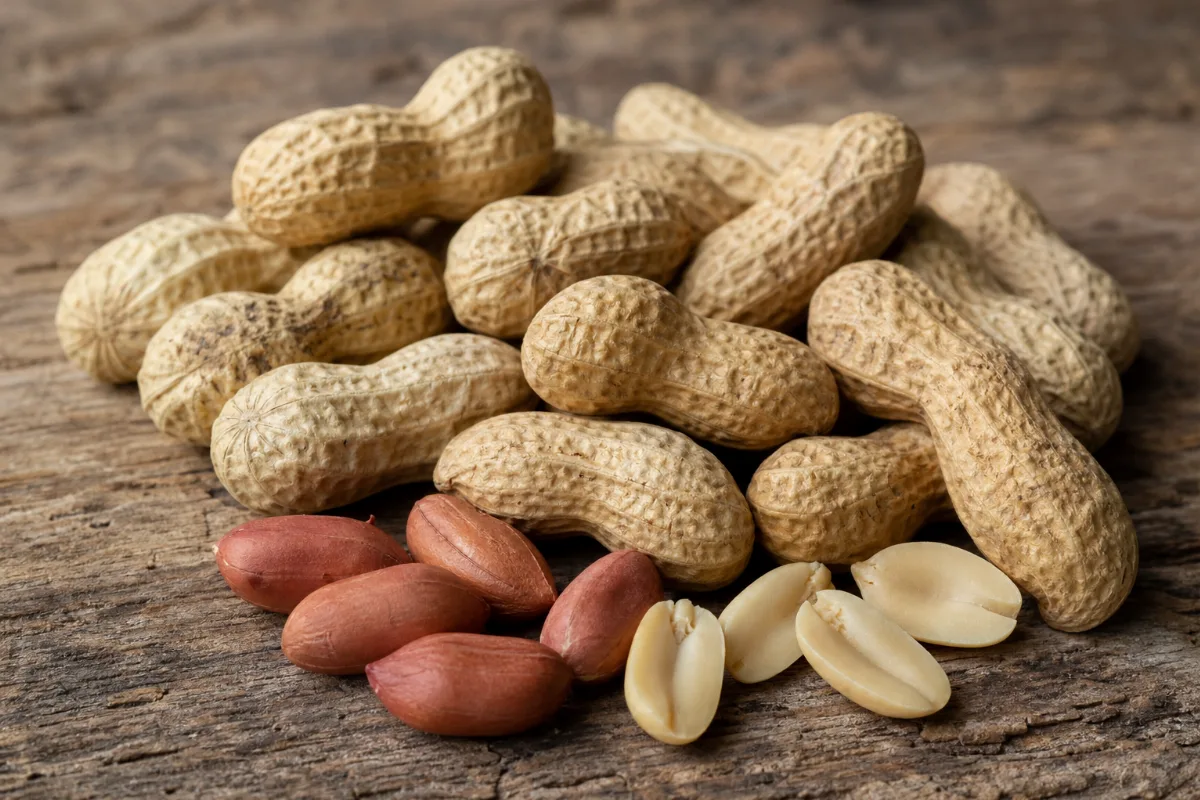
Nuts & Seeds · Legume (eaten like a nut)
Peanuts
Arachis hypogaea · also called Peanut, groundnut, cacahuate (Spanish)
The peanut is a legume that is eaten like a nut, roasted, boiled or ground into peanut butter. It is a dense source of protein, fibre and mostly unsaturated fat. Early peanut food lowered peanut allergy in one large trial of high-risk babies, while heart and weight findings are weak or mixed. The main cautions are peanut allergy, which can be severe, mould toxin (aflatoxin), and choking in young children.
General information, not medical advice. Last substantive update · Not medically reviewed. A named clinician has not signed off on this page. How this page is made
About Peanuts
The peanut is a legume, not a tree nut. It is a nutritious food with one clear health finding, early introduction to prevent allergy in high-risk babies, and several weak or mixed findings. Peanut allergy is the main safety issue.
What it is
The peanut (Arachis hypogaea) is the seed of a plant in the legume family, the same family as beans, lentils and chickpeas. We eat the seeds roasted, boiled or ground into peanut butter.
USDA data for raw peanuts: 567 kcal per 100 g. One ounce (28.35 g) has about 161 kcal, 7.3 g protein, 2.4 g fibre, 14.0 g fat, 48 mg magnesium and 0.32 mg copper. About half of the fat is monounsaturated. These are raw, unsalted peanuts; salted, sweetened or honey-roasted peanuts differ.
What the research shows
The clearest result is in babies at high risk of allergy. In the LEAP trial, babies with severe eczema, egg allergy or both who ate peanut food from early infancy had far less peanut allergy at age 5. A records study found peanut allergy diagnoses fell after early-introduction guidelines.
Large follow-up studies link more nuts, peanuts included, with less heart disease and fewer deaths. Pooled peanut trials, however, found no clear effect on LDL cholesterol, weight or blood pressure. One found a small rise in HDL and another lower triglycerides.
A blood-fat pattern from eating peanuts was modestly linked to lower type 2 diabetes risk, mostly through body weight. A small trial found no muscle gain advantage from peanut butter after workouts.
Peanuts versus oil, butter and treatment
Some pooled analyses mix whole peanuts with peanut oil, high-oleic peanuts and sprouts. Peanut butter trials are small. Oral immunotherapy uses medical peanut protein to treat people who are already allergic; it is a clinic treatment, not food. Results from one form do not carry over to another.
Amounts
This page gives no amounts to eat. Ask a doctor, dietitian or pharmacist what is right for you, especially if you have allergies, kidney problems or a baby with eczema.
At a glance
Traditional uses history, not proof
- Eaten as a snack and protein food, roasted, boiled or as peanut butter
- Used as a cooking ingredient; long use is not proof of any health effect
Studied for research
- Preventing peanut allergy in high-risk babies, moderate certainty
- Heart disease and early death (nut intake), low certainty
- Cholesterol and blood fats, mixed
- Body weight, mixed
- Blood pressure and muscle gains, against
- Type 2 diabetes risk, very low certainty
Main compounds
- Oleic acid and linoleic acid (the main fats)
- Protein and fibre
- Minerals including magnesium, copper and manganese
- Peanut proteins that cause allergy in some people
- Aflatoxin, a contaminant when peanuts are mouldy
Common forms
- Raw and roasted peanuts as food
- Peanut butter (used in several trials)
- Boiled fresh peanuts (a lab study)
- Peanut oil, high-oleic peanuts and sprouts (mixed into some pooled analyses)
- Medical peanut protein for oral immunotherapy (a clinic treatment, not food)
Research links: NHS: Food allergy · LEAP trial of early peanut eating (NEJM 2015) · Peanut oral immunotherapy: a systematic review (Lancet 2019) · Research Library · Genes & Biomarkers Library
What it is and its history
- Accepted scientific name
- Arachis hypogaea
- Naming authority
- L. (GBIF accepted; usageKey 5353770)
- Common names
- Peanut (English); Groundnut (English); Cacahuate (Mexico) / mani (many countries) (Spanish)
- Family or group
- Fabaceae, the legume family, which also includes beans, lentils, chickpeas and soybeans.
- Classification
- Plantae > Tracheophyta > Magnoliopsida > Fabales > Fabaceae > Arachis > Arachis hypogaea
- Native range
- Not verified from a source read.
- Habitat
- Not verified from a source read.
- What it looks like
- Roots: Not verified.; Stems: Not verified.; Leaves: Not verified.; Flowers: Not verified.; Fruit: The seed (kernel) is the food. USDA lists 1 ounce as 28.35 g and 1 cup as 146 g.
- Cultivation
- Not verified from a source read. A 2024 review calls the peanut the fourth most cultivated oilseed in the world.
- Harvest and processing
- Eaten raw, roasted, boiled or ground into peanut butter or paste. A lab study found boiling fresh peanuts lowered fat, sucrose and hardness.
- Look-alikes and adulterants
- Name: Tree nuts (almond, walnut, cashew and others); Note: A different group of foods. Peanut is a legume. Peanut allergy and tree nut allergy are different, but can occur together.; Name: Other legumes (soybean, lentil, chickpea, pea); Note: Related plants. The NHS lists peanuts, soybeans, peas and chickpeas among common allergic foods.
- Sustainability and conservation
- Not assessed.
Photographs
Traditional use and history history, not clinical proof
| Tradition or era | Documented use | Source |
|---|---|---|
| Modern food use | The peanut is a legume eaten like a nut: roasted, boiled, or ground into peanut butter. No historical source was read. | Not verified |
Traditional use shows how it was used. It does not show that it works or is safe today.
What is inside, and how it may work
What it contains and how those compounds act in cells and animals. Laboratory and animal mechanisms are not proven effects in people.
Main compounds
| Compound | Family | Where it is concentrated | Activity studied | Level of evidence |
|---|---|---|---|---|
| Oleic acid PubChem 445639 | monounsaturated fatty acid | Seed USDA: 23.8 g per 100 g raw peanuts (18:1) | The main monounsaturated fat in peanuts. About half of the fat is monounsaturated. 33 34 | Composition only |
| Linoleic acid PubChem 5280450 | polyunsaturated fatty acid | Seed USDA: 15.6 g per 100 g raw peanuts (18:2); omega-3 ALA about 0.003 g per 100 g | The main polyunsaturated fat. Peanuts have almost no omega-3 ALA. 32 34 | Composition only |
| Very long-chain saturated fatty acids | fatty acids | Seed | The authors of a 2026 study say peanuts are rich in these fats, and eating peanuts for 6 months changed 51 blood fat measures, mostly those containing them. 7 | Human data |
| Protein, fibre and minerals | nutrients | Seed USDA per 100 g: 25.8 g protein, 8.5 g fibre, 168 mg magnesium, 1.14 mg copper, 1.93 mg manganese, 240 micrograms folate (DFE) | A dense source of plant protein, fibre and several minerals. 34 | Composition only |
| Peanut proteins | allergenic proteins | Seed | These cause peanut allergy in sensitive people; not detailed in the abstracts read. 9 4 | Human data |
| Aflatoxin B1 (a contaminant, not part of the peanut) PubChem 186907 | mould toxin | Seed (when mouldy) Peanut paste in Cote d'Ivoire: up to 4535 micrograms per kg aflatoxin B1 (review) | A liver toxin and carcinogen linked to liver cancer. 31 2 | Human data |
| Polyphenols, stilbenes and phytosterols | plant compounds | Seed and skin | Named in a 2024 review abstract. No trial of these compounds from peanuts was read, so no claim is made. 19 | Not assessed |
Mechanisms, receptors and pathways
| Target or pathway | Gene or receptor | What was found | Level |
|---|---|---|---|
| Immune tolerance to peanut | Peanut-specific IgG4 and IgE | In the LEAP trial, peanut-specific IgG4 rose mainly in babies who ate peanut, while elevated IgE was more common in those who avoided it. The authors link these to the lower rate of allergy. 8 | Human data |
| Blood fat pattern | Very long-chain saturated fatty acid lipids | Eating peanuts shifted a set of blood fats; a score from that set was modestly linked to lower diabetes risk, largely through body mass index. Hypothesis-generating. 7 | Human data |
| Aflatoxin and the liver | Not specified | A review attributes 4.6% to 28.2% of global liver cancer cases to aflatoxin exposure. 2 | Human data |
Absorption, metabolism and elimination
- Absorption
- Not studied for peanuts in the sources read.
- Distribution
- Not found.
- Metabolism
- Not found.
- Elimination
- Not found.
- Bioavailability
- Not established.
Isolated compounds versus whole extracts
Heart and blood-fat trials mixed whole peanuts, peanut butter, peanut oil, high-oleic peanuts and sprouts, and tree nuts are a separate group. Allergy prevention used peanut-containing baby food. Oral immunotherapy uses medical peanut protein, which is a treatment, not food. Results from one form do not carry over to another.
Nutritional composition
Nutrition from USDA FoodData Central (Peanuts, all types, raw, FDC 172430, SR Legacy, last updated 4/1/2019, read 2026-10-26). Per 100 g: 567 kcal, 25.8 g protein, 49.2 g fat (6.28 g saturated, 24.4 g monounsaturated, 15.6 g polyunsaturated, no trans fat), 16.1 g carbohydrate, 8.5 g fibre, 4.72 g sugars, 705 mg potassium, 168 mg magnesium, 92 mg calcium, 4.58 mg iron, 3.27 mg zinc, 1.14 mg copper, 1.93 mg manganese, 240 micrograms folate (DFE), 8.33 mg vitamin E, 12.1 mg niacin, 18 mg sodium, and no cholesterol, vitamin C or vitamin K. One ounce (28.35 g, USDA household portion; scaled from per-100-g values and rounded): about 161 kcal, 7.3 g protein, 14.0 g fat, 1.8 g saturated fat, 4.6 g carbohydrate, 2.4 g fibre, 1.3 g sugars, 200 mg potassium, 48 mg magnesium, 0.32 mg copper, 0.55 mg manganese, 68 micrograms folate, 2.4 mg vitamin E and 5 mg sodium. One cup (146 g) is about 828 kcal. These are raw, unsalted peanuts. Roasted, salted, honey-roasted and boiled peanuts and peanut butter with added sugar or salt differ; check the label.
1 high certainty1 moderate certainty3 mixed findings1 low certainty2 very low certainty2 evidence against
What was looked at
The 10 benefits and uses checked for Peanuts, each with how strong the evidence is. Tap one to open it.
- Preventing peanut allergy in high-risk babies (early introduction)Moderate certainty
- Heart disease and early death (nut intake, peanuts included)Low certainty
- Cholesterol and blood fats (peanut trials)Mixed findings
- Body weight and body fatMixed findings
- Muscle and fitness gains with exerciseEvidence against
- Type 2 diabetes risk (blood-fat pattern)Very low certainty
- Blood pressureEvidence against
- Metabolic syndrome (a wider review)Very low certainty
- Treating peanut allergy with peanut oral immunotherapy (specialist treatment)Mixed findings
- Protein, fibre and minerals as a foodHigh certainty
Lab markers tracked in the studies
LDL cholesterolHDL cholesterolTriglyceridesBody weightSystolic blood pressureFasting blood sugarBody fat and lean mass
What is Peanuts good for?
The main studied uses and how strong the human evidence is for each. Heart and blood fat results often mix peanuts with tree nuts, peanut oil or peanut butter.
Benefits, one by one
Each card is a research question, not a promise. Tap a goal to filter. Open a card to see the studies, doses and limits.
Preventing peanut allergy in high-risk babies (early introduction)
Moderate certaintyIn one large trial of babies with severe eczema, egg allergy or both, those who ate peanut food from early infancy were much less likely to be allergic to peanut at age 5 than those who avoided it. The NHS says delaying peanut beyond 6 to 12 months may raise the risk. This is for babies, not a reason to feed peanut without advice.
4 studiesPeanut-containing food (the trial used peanut food suited to babies).…
Studies, doses and limits
What the trials found
The LEAP trial randomised 640 babies, aged 4 to under 11 months, with severe eczema, egg allergy or both to eat or avoid peanut until age 5. Among 530 babies with a negative skin test, peanut allergy at age 5 was 13.7% with avoidance and 1.9% with eating. Among 98 with a positive skin test it was 35.3% and 10.6%. A US records study found peanut allergy diagnoses fell after early-introduction guidelines were published (0.79% to 0.53%, then 0.45%). The NHS tells parents to introduce allergy-causing foods one at a time from about 6 months and to talk to a GP or health visitor first if the baby has eczema, an allergy or a family history of allergy.
Results
Peanut-containing food from early infancy lowered peanut allergy in high-risk babies. The records study fits this but cannot prove cause.
Effect sizes as reported
LEAP: 13.7% to 1.9% (negative skin test); 35.3% to 10.6% (positive skin test). Records study: HR 0.65 after guidelines (95% CI 0.55 to 0.77).
Why this rating
One large randomised trial with a clear result, backed by a records study and NHS guidance. It was done only in high-risk babies, and one trial carries most of the weight.
Form and dose studied
Peanut-containing food (the trial used peanut food suited to babies). This page does not give amounts or timing.
Who was studied
Babies aged 4 to under 11 months with severe eczema and/or egg allergy (trial); the NHS guidance covers all babies.
Limits
Not every baby was tested. The records study cannot prove the guidelines caused the fall. Babies with eczema or allergy need a doctor's advice first.
Why researchers looked
Peanut allergy has become common in children, so researchers tested whether eating peanut early could stop it from starting.
Traditional use
Peanuts have long been eaten as a snack and a protein food; long use is not proof that they treat any condition.
Proposed mechanism Controlled trial
In the trial, the babies who ate peanut made more peanut-specific IgG4 antibody, while the avoidance group more often had raised IgE antibody (the allergy antibody). The authors link this to a changed immune response.
A proposed mechanism does not show that the effect happens in people.
A baby with trouble breathing, swelling of the face or lips, or collapse after a new food needs emergency help. Whole peanuts are a choking risk for young children.
Heart disease and early death (nut intake, peanuts included)
Low certaintyLarge studies that follow people over time link eating more nuts, peanuts included, with less heart disease and fewer deaths. The authors say peanuts and tree nuts looked similar. These studies cannot prove peanuts are the cause.
1 studiesPeanuts and tree nuts as foods. Peanut butter and oil were not analys…
Studies, doses and limits
What the trials found
A review of 20 prospective studies found that for each extra 28 g a day of nuts, coronary heart disease was lower (RR 0.71), cardiovascular disease was lower (0.79), total cancer was lower (0.85) and death from any cause was lower (0.78). Stroke was not clearly lower (0.93, confidence range 0.83 to 1.05). The authors say results were similar for tree nuts and peanuts.
Results
Higher nut intake, peanuts included, was linked to lower heart disease and death from any cause in observational studies.
Effect sizes as reported
Per 28 g a day: CHD RR 0.71 (0.63 to 0.80); CVD 0.79 (0.70 to 0.88); all-cause death 0.78 (0.72 to 0.84).
Why this rating
Pooled observational studies only. People who eat nuts often live differently, and the abstract does not give peanut-only numbers.
Form and dose studied
Peanuts and tree nuts as foods. Peanut butter and oil were not analysed separately in the abstract.
Who was studied
Adults in prospective cohort studies.
Limits
Observational. Moderate to high differences between studies. No peanut-only trial of heart disease or death was found.
Why researchers looked
Nuts are a common part of diets linked to long life, so researchers pooled the follow-up studies.
Traditional use
Peanuts have long been eaten as a snack and a protein food; long use is not proof that they treat any condition.
Proposed mechanism Preliminary mechanism
Possible routes are the fat quality, fibre and minerals in nuts, but this review did not test a mechanism.
A proposed mechanism does not show that the effect happens in people.
Peanut allergy rules peanuts out for the person who is allergic.
Cholesterol and blood fats (peanut trials)
Mixed findingsTrials of peanuts give a mixed picture. One pooled analysis of 13 peanut trials found no clear change in LDL or total cholesterol but a small rise in HDL. A newer pooled analysis found lower triglycerides and a better cholesterol ratio in healthy people. Larger nut analyses that mix in tree nuts lower LDL, but that is not peanut proof.
4 studiesRoasted peanuts, peanut butter and some peanut oil or high-oleic form…
Studies, doses and limits
What the trials found
A 2020 analysis of 13 randomised trials of peanuts found no significant change in LDL cholesterol (-3.31 mg/dl, P=0.472), triglycerides (-7.59 mg/dl, P=0.180) or total cholesterol (+3.15 mg/dl), and HDL cholesterol rose by 2.72 mg/dl (P=0.001), mainly with peanut oil, high-oleic peanuts and sprouts. A 2022 trial and meta-analysis (ARISTOTLE plus 11 studies) found lower triglycerides (MD -0.13, p<0.0001) and, in healthy people, lower total cholesterol (MD -0.40) and a lower LDL/HDL ratio (MD -0.19). A 2023 analysis of 139 studies of tree nuts and peanuts together found lower LDL, total cholesterol and triglycerides, but certainty was low to very low for most. A 61-trial analysis of tree nuts (no peanuts) found LDL lower by 4.8 mg/dL per serving.
Results
Mixed. Some analyses show small improvements in triglycerides and the cholesterol ratio; others show no change in LDL.
Effect sizes as reported
HDL +2.72 mg/dl; LDL -3.31 mg/dl (not significant); triglycerides MD -0.13 (95% CI -0.20 to -0.07) in the 2022 analysis.
Why this rating
Analyses disagree. Many mix peanut oil, high-oleic peanuts and tree nuts with whole peanuts. GRADE certainty for the combined nut analysis was low to very low for LDL and total cholesterol.
Form and dose studied
Roasted peanuts, peanut butter and some peanut oil or high-oleic forms (labelled where the analysis used them). The tree nut analysis is not a peanut result.
Who was studied
Healthy adults and adults at higher cardiometabolic risk.
Limits
Different peanut products pooled together; short trials (months).
Why researchers looked
High cholesterol is a heart risk, so trials checked whether peanuts change it.
Traditional use
Peanuts have long been eaten as a snack and a protein food; long use is not proof that they treat any condition.
Proposed mechanism Preliminary mechanism
Peanut fat is mostly unsaturated (about half monounsaturated, a third polyunsaturated, USDA). Peanuts also have an unusual share of very long-chain saturated fats; the authors link these to blood-fat changes.
A proposed mechanism does not show that the effect happens in people.
Peanut butter with added sugar and salt, and salted peanuts, differ from plain peanuts.
Body weight and body fat
Mixed findingsPeanuts are rich in calories, but trials do not show they add weight in most people. A pooled analysis of 13 trials found no change in weight, BMI or waist. A pooled analysis that included people at high heart-disease risk found they gained about 1 kg. Two small trials of peanut butter found no change in body composition.
3 studiesRoasted peanuts, peanut butter and peanut oil (labelled in each trial…
Studies, doses and limits
What the trials found
In 13 randomised trials of peanuts, weight changed by -0.11 kg (P=0.773), BMI by -0.14 (P=0.428) and waist by -1.41 cm (P=0.139), none significant. In a 2022 analysis, people at high cardiometabolic risk gained 0.97 kg (95% CI 0.54 to 1.41) after peanut interventions, with no change in body fat or BMI; weight rose slightly with higher doses. A 7-week pilot of peanut butter before bed in 40 firefighters found no difference in body fat or lean mass from usual diet.
Results
No clear effect on weight in most trials; a small gain in people at high cardiometabolic risk in one analysis.
Effect sizes as reported
Weight -0.11 kg (not significant); high-risk group +0.97 kg (95% CI 0.54 to 1.41); firefighter pilot: fat mass change -0.73 kg (not significant).
Why this rating
Small trials with different designs and different peanut products. The firefighter trial had 40 people and ran 7 weeks.
Form and dose studied
Roasted peanuts, peanut butter and peanut oil (labelled in each trial).
Who was studied
Healthy adults, adults at high cardiometabolic risk, and firefighters.
Limits
Short follow-up. Diet was not tightly controlled.
Why researchers looked
People worry that a calorie-dense food will add weight, so trials measured it.
Traditional use
Peanuts have long been eaten as a snack and a protein food; long use is not proof that they treat any condition.
Proposed mechanism Established physiology
Energy balance. Peanuts hold about 161 kcal in an ounce (USDA); whether weight changes depends on what else people eat.
A proposed mechanism does not show that the effect happens in people.
Salted, sweetened or honey-roasted peanuts add salt, sugar and calories.
Muscle and fitness gains with exercise
Evidence againstIn one small trial of 17 middle-aged adults doing 16 weeks of training, a peanut smoothie after each workout gave the same gains in muscle, strength and fitness as a carbohydrate smoothie with the same calories.
1 studiesPeanut-containing smoothie (peanut butter).
Studies, doses and limits
What the trials found
Seventeen sedentary adults aged 30 to 55 trained for 16 weeks and had a peanut smoothie or a matched carbohydrate smoothie after workouts. Lean mass rose about 4% with training, and gains did not differ between groups (p=0.97). Strength and fitness improved in both with no group difference.
Results
No extra gain from peanut butter over a matched-calorie snack.
Effect sizes as reported
Lean mass: no group difference (p=0.97).
Why this rating
One small trial with 17 people. The result says peanut butter neither added nor took away from training gains.
Form and dose studied
Peanut-containing smoothie (peanut butter).
Who was studied
Sedentary adults aged 30 to 55.
Limits
Very small trial; a smoothie, not peanuts alone.
Why researchers looked
Peanuts hold protein, so researchers asked whether they help people build muscle.
Traditional use
Peanuts have long been eaten as a snack and a protein food; long use is not proof that they treat any condition.
Proposed mechanism Established physiology
Protein supports muscle repair after training (general physiology; this trial did not test it).
A proposed mechanism does not show that the effect happens in people.
None specific.
Type 2 diabetes risk (blood-fat pattern)
Very low certaintyEating peanuts for 6 months changed the pattern of fats in the blood of 63 healthy young adults. A score built from that pattern was modestly linked to lower type 2 diabetes risk in a large European cohort, mostly through body weight. It is a blood-marker link, not proof that eating peanuts prevents diabetes.
2 studiesSkin-roasted peanuts and peanut butter (trial); observational cohort …
Studies, doses and limits
What the trials found
In the ARISTOTLE trial, 25 g a day of skin-roasted peanuts or 32 g a day of peanut butter for 6 months changed 51 blood fat measures. In the EPIC-Potsdam case-cohort (774 diabetes cases), a score built from those changes was linked to a lower risk of type 2 diabetes (HR 0.89 per 1-SD, 95% CI 0.80 to 0.99) but not heart disease (HR 1.01), and body mass index could explain most of the link (89%). A pooled analysis of 13 peanut trials found no significant effect on fasting glucose (+0.57 mg/dl) or insulin.
Results
A modest link between a peanut-related blood pattern and lower diabetes risk, but no trial of peanuts and diabetes itself.
Effect sizes as reported
HR 0.89 (95% CI 0.80 to 0.99) per 1-SD higher peanut lipid score.
Why this rating
The outcome is an indirect blood marker, and the authors call the BMI analysis hypothesis-generating.
Form and dose studied
Skin-roasted peanuts and peanut butter (trial); observational cohort for the diabetes link.
Who was studied
Healthy young adults (trial); a European adult cohort.
Limits
Not a diabetes trial. Peanut oil was in the control butter.
Why researchers looked
Researchers wanted to know whether peanut fats leave a trace in the blood that tracks with later diabetes.
Traditional use
Peanuts have long been eaten as a snack and a protein food; long use is not proof that they treat any condition.
Proposed mechanism Preliminary mechanism
Peanuts are rich in very long-chain saturated fats. The authors suggest these may relate to lower diabetes risk (hypothesis).
A proposed mechanism does not show that the effect happens in people.
None specific.
Blood pressure
Evidence againstPooled peanut trials found no change in blood pressure, and a 7-week peanut butter trial in firefighters also found none.
2 studiesPeanuts, peanut oil, peanut butter.
Studies, doses and limits
What the trials found
Thirteen randomised trials found systolic blood pressure changed by -0.09 mmHg (P=0.939) and diastolic by +0.60 mmHg (P=0.652), neither significant. The firefighter pilot found no group difference (p 0.619 to 0.650).
Results
No effect on blood pressure was found.
Effect sizes as reported
Systolic -0.09 mmHg; diastolic +0.60 mmHg (both not significant).
Why this rating
Consistent null results in a pooled analysis and a small trial. The pooled analysis gives no overall GRADE rating.
Form and dose studied
Peanuts, peanut oil, peanut butter.
Who was studied
Healthy adults, adults with risk factors, firefighters.
Limits
Pooled products differ; trials are short.
Why researchers looked
Nuts are often said to help blood pressure, so peanut trials checked it.
Traditional use
Peanuts have long been eaten as a snack and a protein food; long use is not proof that they treat any condition.
Proposed mechanism Preliminary mechanism
No mechanism was tested in the trials read.
A proposed mechanism does not show that the effect happens in people.
None specific.
Metabolic syndrome (a wider review)
Very low certaintyOne review of 19 clinical studies says peanuts and peanut products may improve several metabolic measures. The abstract gives no numbers and mixes whole peanuts with products and plant compounds, so the larger trial analyses above are a better guide.
1 studiesRaw peanuts, processed peanut foods and peanut compounds, all mixed t…
Studies, doses and limits
What the trials found
A 2024 systematic review of 19 clinical studies says raw peanuts and processed peanut products could improve glucose, insulin, HbA1c, lipids, BMI, waist circumference, atherogenic indices and endothelial function, and calls for larger, longer trials.
Results
Possible benefits suggested; not quantified in the abstract.
Effect sizes as reported
No numbers in the abstract.
Why this rating
Optimistic conclusions from mixed small studies, in contrast to the pooled trial analysis that found no clear effect on most measures.
Form and dose studied
Raw peanuts, processed peanut foods and peanut compounds, all mixed together.
Who was studied
Adults with or at risk of metabolic syndrome.
Limits
No effect sizes in the abstract. Mixed products.
Why researchers looked
Metabolic syndrome is a cluster of heart and blood sugar risks, so a review asked if peanuts help the cluster.
Traditional use
Peanuts have long been eaten as a snack and a protein food; long use is not proof that they treat any condition.
Proposed mechanism Preliminary mechanism
The authors point to peanut plant compounds such as phenolic acids, stilbenes, flavonoids and phytosterols (their description, not tested here).
A proposed mechanism does not show that the effect happens in people.
None specific.
Treating peanut allergy with peanut oral immunotherapy (specialist treatment)
Mixed findingsIn clinics, people with peanut allergy can be given tiny, rising amounts of peanut protein to build tolerance. It works for desensitising, but it also raises the risk of severe allergic reactions. It is a supervised medical treatment, never a home experiment.
2 studiesMedical peanut protein schedules, not eating peanuts as food.
Studies, doses and limits
What the trials found
A 2019 Lancet analysis of 12 trials (1,041 people, median age 8.7) found oral immunotherapy raised the risk of anaphylaxis (RR 3.12), adrenaline use (RR 2.21) and serious adverse events (RR 1.92), and made passing a supervised challenge much more likely (RR 12.42). Quality of life did not differ. A 2026 analysis of 20 trials (2,161 people) found desensitisation RR 7.25, anaphylaxis RR 2.27, adrenaline use RR 2.05, and more stopped treatment (RR 2.50).
Results
It builds tolerance in a clinic but raises the risk of anaphylaxis, so benefits and harms must be weighed with a specialist.
Effect sizes as reported
Anaphylaxis RR 3.12 (95% CI 1.76 to 5.55; high certainty); passing a challenge RR 12.42 (6.82 to 22.61).
Why this rating
High certainty for both the benefit (desensitisation) and the harm (anaphylaxis). Quality of life did not improve.
Form and dose studied
Medical peanut protein schedules, not eating peanuts as food.
Who was studied
Mostly children with peanut allergy (median age about 8.7).
Limits
Done in clinics with supervision; not a food result.
Why researchers looked
Strict avoidance is the standard care, so researchers tested treatments that might make accidental exposure less dangerous.
Traditional use
Peanuts have long been eaten as a snack and a protein food; long use is not proof that they treat any condition.
Proposed mechanism Controlled trial
The treatment trains the immune system to tolerate peanut protein gradually (general description).
A proposed mechanism does not show that the effect happens in people.
Anyone with peanut allergy should avoid peanuts unless their allergy team says otherwise. Never try this at home.
Protein, fibre and minerals as a food
High certaintyPeanuts are a dense source of protein, fibre, healthy fats and several minerals. An ounce (28.35 g) of raw peanuts has about 161 kcal, 7.3 g protein, 2.4 g fibre, 14.0 g fat, 48 mg magnesium and 0.32 mg copper (USDA).
1 studiesRaw unsalted peanuts (USDA). Roasted, salted or sweetened peanuts dif…
Studies, doses and limits
What the trials found
USDA lists raw peanuts per 100 g as 567 kcal, 25.8 g protein, 49.2 g fat (6.28 g saturated, 24.4 g monounsaturated, 15.6 g polyunsaturated), 8.5 g fibre, 4.72 g sugars, 705 mg potassium, 168 mg magnesium, 1.14 mg copper, 1.93 mg manganese, 240 micrograms folate (DFE) and 8.33 mg vitamin E. It lists no vitamin C or vitamin K and no cholesterol.
Results
A nutrient-dense food; values depend on type and preparation.
Effect sizes as reported
Per ounce: 161 kcal, 7.3 g protein, 2.4 g fibre, 14.0 g fat.
Why this rating
Food-composition data from analytical values (USDA). It describes what is in the food, not a health result.
Form and dose studied
Raw unsalted peanuts (USDA). Roasted, salted or sweetened peanuts differ.
Who was studied
General.
Limits
Values differ by variety, roasting and storage.
Why researchers looked
People ask what peanuts provide besides calories.
Traditional use
Peanuts have long been eaten as a snack and a protein food; long use is not proof that they treat any condition.
Proposed mechanism Established physiology
Peanuts are seeds of a legume plant, so they carry plant protein, fibre and fat.
A proposed mechanism does not show that the effect happens in people.
Peanut allergy applies.
Connections to the rest of health
How Peanuts connects to the rest of our health knowledge graph. Every link says what kind of connection it is. A safety link (for example to the liver) is a warning, not a benefit. A study that merely mentions a topic never creates a benefit link.
Explore every connection: goals, body systems, organs, symptoms, genes
B. Body systems
| Connected to | Kind of connection | Evidence status | Context | Studies |
|---|---|---|---|---|
| Immune System | Biological association | Moderate certainty | Studied for: Preventing peanut allergy in high-risk babies (early introduction) Studied for: Treating peanut allergy with peanut oral immunotherapy (specialist treatment) | 8 10 27 9 3 21 |
| Cardiovascular System | Biological association | Low certainty | Studied for: Heart disease and early death (nut intake, peanuts included) Studied for: Cholesterol and blood fats (peanut trials) | 1 15 20 12 5 16 |
| Metabolism Weight | Biological association | Mixed findings | Studied for: Body weight and body fat Studied for: Type 2 diabetes risk (blood-fat pattern) | 15 20 16 7 19 34 |
| Musculoskeletal System | Biological association | Evidence against | Studied for: Muscle and fitness gains with exercise | 17 |
| Blood Sugar Support | Biological association | Very low certainty | Studied for: Type 2 diabetes risk (blood-fat pattern) Studied for: Metabolic syndrome (a wider review) | 7 15 19 |
E. Health conditions
| Connected to | Kind of connection | Evidence status | Context | Studies |
|---|---|---|---|---|
| Peanut allergy | Adverse effect or risk | Documented risk | Peanut is a common allergic food and can cause anaphylaxis in allergic people. A common food allergy that can cause anaphylaxis. Preparation or compound: Peanut protein, eaten |
28 18 |
| Peanut allergy (prevention in babies) | Potential benefit | Clinical trial | One large trial found much less peanut allergy at age 5. Preparation or compound: Peanut-containing food for high-risk infants |
8 |
| Peanut allergy (prevention in babies) | Randomised trial | Early peanut food lowered allergy at age 5 in high-risk babies. Preparation or compound: Peanut-containing food for infants |
8 |
I. Biomarkers
| Connected to | Kind of connection | Evidence status | Context | Studies |
|---|---|---|---|---|
| LDL cholesterol | Biological association | Mixed findings | Measured in trials: no clear change. A lab change is not the same as a health benefit. | 15 12 5 |
| HDL cholesterol | Biological association | Low certainty | Measured in trials: raised. A lab change is not the same as a health benefit. | 15 |
| Triglycerides | Biological association | Mixed findings | Measured in trials: mixed. A lab change is not the same as a health benefit. | 20 15 |
| Body weight | Biological association | Mixed findings | Measured in trials: no clear change. A lab change is not the same as a health benefit. | 15 20 |
| Systolic blood pressure | Biological association | Evidence against | Measured in trials: no clear change. A lab change is not the same as a health benefit. | 15 16 |
| Fasting blood sugar | Biological association | Low certainty | Measured in trials: no clear change. A lab change is not the same as a health benefit. | 15 19 |
| Body fat and lean mass | Biological association | Not enough evidence | Measured in trials: no clear change. A lab change is not the same as a health benefit. | 16 17 |
K. Biological pathways
L. Active compounds
| Connected to | Kind of connection | Evidence status | Context | Studies |
|---|---|---|---|---|
| Oleic acid | Biological association | Composition only | The main monounsaturated fat in peanuts. About half of the fat is monounsaturated. Preparation or compound: Seed |
33 34 |
| Linoleic acid | Biological association | Composition only | The main polyunsaturated fat. Peanuts have almost no omega-3 ALA. Preparation or compound: Seed |
32 34 |
| Very long-chain saturated fatty acids | Biological association | Human | The authors of a 2026 study say peanuts are rich in these fats, and eating peanuts for 6 months changed 51 blood fat measures, mostly those containing them. Preparation or compound: Seed |
7 |
| Protein, fibre and minerals | Biological association | Composition only | A dense source of plant protein, fibre and several minerals. Preparation or compound: Seed |
34 |
| Peanut proteins | Biological association | Human | These cause peanut allergy in sensitive people; not detailed in the abstracts read. Preparation or compound: Seed |
9 4 |
| Aflatoxin B1 (a contaminant, not part of the peanut) | Biological association | Human | A liver toxin and carcinogen linked to liver cancer. Preparation or compound: Seed (when mouldy) |
31 2 |
| Polyphenols, stilbenes and phytosterols | Biological association | Not assessed | Named in a 2024 review abstract. No trial of these compounds from peanuts was read, so no claim is made. Preparation or compound: Seed and skin |
19 |
Each connection is stored with the ingredient, the connected record, the kind of connection, the evidence status, the supporting studies, the preparation or compound involved, and a review date (last reviewed October 26, 2026).
Evidence at a glance: what changed in 2 lab markers
Tap a number to show only those markers. Counts are markers, not people.
The evidence
The research centre for Peanuts. Every record here was checked against PubMed or the publisher's page; we never list a study we have not verified.
Evidence by outcome
Bars show how many studies we found for each outcome, not how well it works. People are added up across trials only (reviews are not added, to avoid double counting).
How we rate evidence
High certainty
Several well-run trials or reviews agree; further research is unlikely to change the picture much.
Moderate certainty
Good trials point the same way, but some doubt remains.
Low certainty
Small, short or inconsistent trials. The finding could change with better research.
Very low certainty
Very little or very weak human data. Treat as a possibility only.
Mixed findings
Trials or reviews disagree with each other.
Not enough evidence
Not enough human research to say either way.
Evidence against
Good research found no benefit, or found harm.
We take the reviewers' own risk-of-bias and GRADE statements where they exist, and otherwise judge from study size, design, consistency, directness and whether a product matches what is sold. Many publications do not make evidence high. Method note: We started from our existing peanut summary, re-checked nutrition at USDA FoodData Central, the species name at GBIF, and searched PubMed for trials, reviews and safety evidence. Only abstracts were read for studies. Items we could not verify are flagged in the research gaps.
Study library: every study we checked 34
| Study | Design | People | Product, dose, length | Result |
|---|---|---|---|---|
| Aune 2016 Nut consumption and risk of cardiovascular disease, total cancer, all-cause and cause-specific mortality: a systematic review and dose-response meta-analysis of prospective studies. BMC Med · PMID 27916000 · DOI |
Systematic review meta analysis |
20 prospective studies (29 publications) in adults | Total nut intake (tree nuts and peanuts) Nuts including peanuts (food) Per 28 g a day higher intake (analysis unit) Observational follow-up · vs Lower intake |
Per 28 g a day: coronary heart disease RR 0.71, stroke RR 0.93 (not significant), cardiovascular disease RR 0.79, total cancer RR 0.85, all-cause death RR 0.78. The authors say results were similar for tree nuts and peanuts. RR 0.71 (coronary heart disease); 0.79 (CVD); 0.78 (all-cause death) (95% CI 0.63 to 0.80; 0.70 to 0.88; 0.72 to 0.84) Methods, limits and fundingOutcomes: Heart disease, stroke, total cancer, death from any cause Limitations: Observational: people who eat nuts may differ in other habits. Peanut-only numbers are not given in the abstract. Heterogeneity moderate to high (I2 47% to 66%). Funding and conflicts: Not stated in the abstract. Read: abstract |
| Bereda 2026 Aflatoxin exposure and health impacts: global burden and advances in detection technologies. Genes Environ · PMID 42538527 · DOI |
Narrative review |
Narrative review of global aflatoxin exposure | Aflatoxin contamination of food (including peanut paste) |
In Cote d'Ivoire every peanut paste sample had aflatoxin B1 (100%), and 99% of samples exceeded EU limits. Aflatoxin exposure is responsible for 4.6% to 28.2% of global liver cancer cases and about 250,000 deaths a year, and is linked to a 2-4-fold higher cancer risk in children. Methods, limits and fundingOutcomes: Exposure levels, health effects, detection Limitations: Narrative review; figures come from other studies; peanut paste data are from one country. Funding and conflicts: Not stated in the abstract. Read: abstract |
| Chu 2019 Oral immunotherapy for peanut allergy (PACE): a systematic review and meta-analysis of efficacy and safety. Lancet · PMID 31030987 · DOI |
Systematic review meta analysis |
1041 12 randomised trials; median age 8.7 years |
Peanut oral immunotherapy (medical treatment for allergic people) Peanut protein Medical build-up schedules Varied · vs Avoidance or placebo |
Oral immunotherapy raised the risk of anaphylaxis (RR 3.12, high certainty), adrenaline use (RR 2.21, high certainty), serious adverse events (RR 1.92, moderate certainty), vomiting and angioedema. Passing a supervised challenge was much more likely (RR 12.42, high certainty). Quality of life did not differ (low certainty). RR 3.12 (anaphylaxis); RR 12.42 (passing a challenge) (95% CI 1.76 to 5.55; 6.82 to 22.61) Methods, limits and fundingOutcomes: Anaphylaxis, serious adverse events, adrenaline use, passing a supervised challenge, quality of life Limitations: Treatment for people who are already allergic. Not about eating peanut as food. Funding and conflicts: The abstract says funding: none; the PubMed record also lists NIH extramural research support. Read: abstract |
| Cox 2021 Clinical Relevance of Cross-Reactivity in Food Allergy. J Allergy Clin Immunol Pract · PMID 33429724 · DOI |
Narrative review |
Review of cross-reactivity between foods, including legumes (peanut, soy, chickpea, lentil) and tree nuts | Cross-reactivity and co-allergy (not a food trial) |
The review says many people test positive to related foods without reacting, cross-reactivity rates vary between food groups, and it discusses the risk of being allergic to both peanut and tree nuts. Methods, limits and fundingOutcomes: Whether sensitised people react to related foods Limitations: Narrative review; no numbers in the abstract. Funding and conflicts: Not stated in the abstract. Read: abstract |
| Del Gobbo 2015 Effects of tree nuts on blood lipids, apolipoproteins, and blood pressure: systematic review, meta-analysis, and dose-response of 61 controlled intervention trials. Am J Clin Nutr · PMID 26561616 · DOI |
Systematic review meta analysis |
2582 61 trials in adults without heart disease; tree nuts only (peanuts were not included) |
Tree nuts (walnuts, pistachios, macadamia, pecans, cashews, almonds, hazelnuts, Brazil nuts) Nuts (food) Standardised to one 28.4 g serving a day (analysis unit) 3 to 26 weeks · vs Control diets |
Per serving a day: LDL cholesterol fell by 4.8 mg/dL, total cholesterol by 4.7 mg/dL, triglycerides by 2.2 mg/dL. The authors found the effect depended on nut amount more than nut type. LDL -4.8 mg/dL (95% CI -5.5 to -4.2) Methods, limits and fundingOutcomes: Total and LDL cholesterol, ApoB, triglycerides, blood pressure Limitations: Tree nuts only. The result is not a peanut result. Funding and conflicts: NIH extramural support listed in the PubMed record; the abstract does not mention industry funding. Read: abstract |
| Doamekpor MAEM 2026 Oxalate as an Emerging Contributor to Cardiovascular Disease: Links to Inflammation, Immunity, and Oxidative Stress. Nutrients · PMID 42075003 · DOI |
Narrative review |
Narrative review of dietary oxalate | Oxalate in plant foods (peanuts are named as an example) |
The review names spinach, potatoes, almonds and peanuts as plant foods that contain oxalate. It is about oxalate and heart disease, not about eating peanuts. Methods, limits and fundingOutcomes: Oxalate and heart disease mechanisms Limitations: Peanut is only named as an example; no peanut amount of oxalate or kidney-stone data are given in the abstract. Funding and conflicts: Not stated in the abstract. Read: abstract |
| Dominguez-Lopez 2026 Peanuts-derived plasma lipids and lower risk of type 2 diabetes: association mediated by body mass index-an intervention and case-cohort study. Am J Clin Nutr · PMID 42754169 · DOI |
Rct plus case cohort |
63 ARISTOTLE trial (63 healthy young adults) plus EPIC-Potsdam case-cohort (774 type 2 diabetes cases, 547 heart disease cases) |
Skin-roasted peanuts, peanut butter or control butter with peanut oil Peanut seed (food) 25 g a day of peanuts or 32 g a day of peanut butter (trial design) 6 months · vs Control butter with peanut oil |
Eating peanuts changed 51 blood fat measures, mostly very long-chain saturated fats. A score built from them was modestly linked to lower type 2 diabetes risk (HR 0.89 per 1-SD) but not heart disease (HR 1.01). Body mass index could explain most of the link (89%). HR 0.89 (type 2 diabetes) (95% CI 0.80 to 0.99) Methods, limits and fundingOutcomes: Blood fat molecules (lipidome) and later type 2 diabetes and heart disease Limitations: The outcome is a blood-fat pattern, not diabetes in people eating peanuts. The authors call the BMI analysis hypothesis-generating. Funding and conflicts: Not stated in the abstract. Registration: NCT04324749 Read: abstract |
| Du Toit 2015 Randomized trial of peanut consumption in infants at risk for peanut allergy. N Engl J Med · PMID 25705822 · DOI |
Controlled trial |
640 Infants aged 4 to under 11 months with severe eczema, egg allergy or both |
Peanut-containing food eaten regularly (versus avoiding peanut) Peanut seed (food) Not given in the abstract Until 60 months of age · vs Peanut avoidance |
Negative skin test (530 infants): peanut allergy 13.7% with avoidance versus 1.9% with eating (P<0.001). Positive skin test (98 infants): 35.3% versus 10.6% (P=0.004). No significant difference in serious adverse events. Eating peanut raised peanut-specific IgG4; avoiding it was linked to more elevated IgE. Absolute risk: 13.7% to 1.9% (negative test); 35.3% to 10.6% (positive test) (Not given in the abstract) Methods, limits and fundingOutcomes: Peanut allergy at 60 months, assessed separately in infants with a negative and a positive skin-prick test Limitations: Only babies at high risk (severe eczema and/or egg allergy); the result does not automatically apply to every baby. One trial (LEAP). Funding and conflicts: Funded by the National Institute of Allergy and Infectious Diseases and others (abstract). Not industry-led. Registration: NCT00329784 Read: abstract |
| Dumycz 2025 Decoding Early Clues: Immune Mechanisms, Prevention, Diagnosis, and Treatment of IgE-Mediated Peanut and Tree Nut Allergy in Children. Biomedicines · PMID 41153664 · DOI |
Narrative review |
Review of peanut and tree nut allergy in children | Peanut and tree nut allergy (not a food trial) |
The review says peanuts and tree nuts are among the leading causes of severe allergic reactions including anaphylaxis, often starting in early life, and that early allergen introduction is among prevention strategies it evaluates. Methods, limits and fundingOutcomes: Immune mechanisms, early introduction, diagnosis and treatment Limitations: Narrative review; the abstract gives no numbers. Funding and conflicts: Not stated in the abstract. Read: abstract |
| Gabryszewski 2025 Guidelines for Early Food Introduction and Patterns of Food Allergy. Pediatrics · PMID 41110838 · DOI |
Observational cohort (health records) |
Children aged 0 to 3 years in a US primary-care records network, compared before and after early-introduction guidelines | Early peanut introduction guidelines (population level, not a trial) Peanut Records from 2012 to 2019 · vs Before-guideline cohort |
Peanut allergy diagnosis fell from 0.79% to 0.53% after the guidelines (HR 0.65) and to 0.45% after the addendum guidelines (HR 0.55). Any food allergy fell from 1.46% to 1.02% and 0.93%. HR 0.65 (guidelines); HR 0.55 (addendum) (95% CI 0.55 to 0.77; 0.46 to 0.66) Methods, limits and fundingOutcomes: Rate of diagnosed peanut and any IgE-mediated food allergy Limitations: Records-based, so it cannot prove the guidelines caused the fall. It does not say how many families followed the advice. Funding and conflicts: Not stated in the abstract. Read: abstract |
| Gaworowski 2026 Balancing Nutritional Value and Food Safety in Peanut Butter: The Role of Food Matrix Characteristics in Hazard Behavior and Risk Management. Foods · PMID 42650521 · DOI |
Narrative review |
Structured narrative review of peanut butter hazards | Peanut butter (Salmonella and aflatoxin) Peanut butter (food) |
The evidence is strongest for long survival and heat resistance of Salmonella in peanut butter, for uneven spread of aflatoxin among kernels, and for roasting having limited ability to fix a contaminated lot. The authors say aflatoxin should be controlled before grinding. Methods, limits and fundingOutcomes: Pathogen survival and aflatoxin behaviour Limitations: Narrative review; the authors say direct studies that measure nutrition and safety together are scarce. Funding and conflicts: Not stated in the abstract. Read: abstract |
| Houston 2023 Tree Nut and Peanut Consumption and Risk of Cardiovascular Disease: A Systematic Review and Meta-Analysis of Randomized Controlled Trials. Adv Nutr · PMID 37149262 · DOI |
Systematic review meta analysis |
139 randomised studies (129 in the meta-analysis) of tree nuts and peanuts | Tree nuts and peanuts combined Nuts including peanuts (food) Any dose Varied · vs Control diets |
Nut consumption lowered LDL cholesterol, total cholesterol, triglycerides, TC:HDL, LDL:HDL and ApoB. GRADE certainty was moderate for TC:HDL, LDL:HDL and ApoB, low for triglycerides, and very low for LDL and total cholesterol. Methods, limits and fundingOutcomes: LDL, total cholesterol, triglycerides, ratios, ApoB Limitations: Tree nuts and peanuts are pooled, so the peanut share is unclear from the abstract. Certainty is low to very low for the main cholesterol measures. Funding and conflicts: Research support from a non-US government source listed; industry funding not stated in the abstract. Read: abstract |
| Huang 2026 Multiple Aflatoxins Drive Cumulative Dietary Exposure and Hepatocellular Carcinoma Risk: An Age-Stratified Study in Guangzhou, China. Foods · PMID 42279626 · DOI |
Cross sectional exposure modelling |
1,179 food samples plus consumption data for five age groups in Guangzhou, China | Aflatoxins in foods including roasted peanuts Roasted peanuts (food) |
Roasted peanuts contributed most to aflatoxin exposure, particularly in children aged 3 to 6 (margin of exposure 900 to 1206). Bulk products were more contaminated than pre-packaged foods, and samples from farmers' markets and grocery stores more than from other sites. Rice and grains were the main contributors to modelled liver cancer risk. Methods, limits and fundingOutcomes: Dietary aflatoxin exposure (margin of exposure) and modelled liver cancer risk Limitations: Modelled risk in one Chinese city; may not apply elsewhere. Funding and conflicts: Not stated in the abstract. Read: abstract |
| Huang 2026 Effect of boiling on quality, microstructure and flavor of fresh peanuts. Food Chem X · PMID 41717372 · DOI |
Laboratory study plant |
Fresh peanut varieties in the lab (Jihuatian 1 judged best) | Boiled fresh peanuts Peanut seed (boiled) · vs Raw fresh peanuts |
Boiling lowered fat (19.73%), sucrose (42.21%) and hardness (49.11%), raised brittleness and aldehyde flavour compounds, and damaged cell walls. Methods, limits and fundingOutcomes: Nutrients, texture, flavour compounds, microscopic structure Limitations: Food-quality study; it did not measure health effects or allergen content. Funding and conflicts: Not stated in the abstract. Read: abstract |
| Jafari Azad 2020 Peanut and cardiovascular disease risk factors: A systematic review and meta-analysis. Crit Rev Food Sci Nutr · PMID 30638042 · DOI |
Systematic review meta analysis |
13 randomised controlled trials of peanuts (searched to November 2018) | Peanuts, including peanut oil, high-oleic peanut and peanut sprout in some trials Peanut seed, oil, sprout Varied Varied; subgroup of more than 12 weeks · vs Control diets |
No significant effect on weight (-0.11 kg), BMI, waist, blood pressure (systolic -0.09 mmHg, diastolic +0.60 mmHg), LDL (-3.31 mg/dl, P=0.472), triglycerides (-7.59 mg/dl, P=0.180), total cholesterol (+3.15 mg/dl), fasting glucose or insulin. HDL cholesterol rose by 2.72 mg/dl (P=0.001), mainly with peanut oil, high-oleic peanut and peanut sprout, in healthy people and for more than 12 weeks. HDL +2.72 mg/dl; LDL -3.31 mg/dl (not significant) (Not given in the abstract (P values only)) Methods, limits and fundingOutcomes: Weight, waist, BMI, blood pressure, LDL, triglycerides, total cholesterol, HDL, fasting glucose, insulin Limitations: Mixed forms (oil, high-oleic peanut, sprout) are pooled with whole peanuts. The abstract gives no overall certainty rating. Funding and conflicts: Not stated in the abstract. Read: abstract |
| Kohler 2026 A Pilot Randomized, Controlled Trial of Nighttime Peanut Butter Supplementation in Firefighters: Blood Pressure and Body Composition Outcomes. Diseases · PMID 42041627 · DOI |
Rct (pilot) |
40 40 full-time firefighters (1 woman) |
Peanut butter, one serving before bed at least 5 days a week Peanut seed (butter) One serving before bed (trial design) 7 weeks · vs Usual diet |
No difference between groups in blood pressure (p 0.619 to 0.650) or body composition (fat mass change -0.73 kg, body fat -0.53 percentage points, lean mass +0.04 kg; p 0.067 or higher). No significant difference (Not given in the abstract) Methods, limits and fundingOutcomes: Blood pressure, body fat percent, fat mass, lean mass Limitations: Pilot trial, 7 weeks, almost all men, diet not tightly tracked. Funding and conflicts: Not stated in the abstract. Registration: NCT06364202 Read: abstract |
| Moon 2026 Concurrent Exercise Training Adaptations Over 16 Weeks in Sedentary, Middle-Aged Adults With and Without Post-Exercise Peanut Butter Consumption. Int J Exerc Sci · PMID 42516258 · DOI |
Rct (small) |
17 17 sedentary adults aged 30 to 55 doing 16 weeks of aerobic and strength training |
Peanut-containing smoothie after each workout Peanut seed (butter in a smoothie) After each workout (trial design) 16 weeks · vs Matched-calorie non-peanut carbohydrate smoothie |
Training improved lean mass (about 4%), strength and fitness in both groups, with no difference between the peanut and carbohydrate smoothie groups. Fat mass did not change. No group difference (lean mass p=0.97) (Not given in the abstract) Methods, limits and fundingOutcomes: Lean mass, strength, fitness Limitations: Only 17 people; a smoothie, not peanuts alone. Funding and conflicts: Not stated in the abstract. Read: abstract |
| Muraro 2021 Incidence of anaphylaxis and accidental peanut exposure: A systematic review. Clin Transl Allergy · PMID 34708943 · DOI |
Systematic review meta analysis |
8 studies of children and adolescents with peanut allergy | Accidental peanut exposure and anaphylaxis (not a food trial) Person-years of follow-up |
Pooled anaphylaxis incidence was 2.74 cases per 100 person-years in children and adolescents with peanut allergy (3.72 in those with any food allergy). Accidental peanut exposure occurred at 12.28 cases per 100 person-years. 2.74 per 100 person-years (anaphylaxis); 12.28 (accidental exposure) (95% CI 1.42 to 4.05; 11.51 to 13.05) Methods, limits and fundingOutcomes: Incidence of anaphylaxis and accidental exposure Limitations: Children and adolescents only; small number of studies. Funding not stated in the abstract. Funding and conflicts: Not stated in the abstract. Read: abstract |
| Nunes 2024 Peanut (Arachis hypogaea L.) seeds and by-products in metabolic syndrome and cardiovascular disorders: A systematic review of clinical studies. Phytomedicine · PMID 38000103 · DOI |
Systematic review |
19 clinical studies indexed in MEDLINE, Cochrane and Embase | Raw peanuts and processed peanut products and peanut plant compounds Seed and by-products Varied Varied · vs Varied |
The authors say raw peanuts or processed peanut products could improve several metabolic measures, and call for larger, longer studies in more varied people. Methods, limits and fundingOutcomes: Blood sugar, insulin, HbA1c, lipids, BMI, waist, endothelial function Limitations: The abstract gives no numbers, mixes whole food with products and compounds, and uses optimistic wording. Read with the larger meta-analysis above, which found no clear effect on most measures. Funding and conflicts: Not stated in the abstract. Read: abstract |
| Parilli-Moser 2022 Effect of Peanut Consumption on Cardiovascular Risk Factors: A Randomized Clinical Trial and Meta-Analysis. Front Nutr · PMID 35433776 · DOI |
Rct plus meta analysis |
63 ARISTOTLE: 63 healthy adults; plus a meta-analysis of 11 trials in healthy people and people at high cardiometabolic risk |
Skin-roasted peanuts, peanut butter, or control butter made with peanut oil Peanut seed (food) 25 g a day of peanuts or 32 g a day of peanut butter (trial design) 6 months · vs Control butter based on peanut oil |
ARISTOTLE: lower total/HDL and LDL/HDL cholesterol ratios in the peanut group than with control butter (p=0.019, p=0.008). Meta-analysis: peanuts lowered triglycerides (MD -0.13, p<0.0001); healthy people had lower total cholesterol (MD -0.40) and LDL/HDL ratio (MD -0.19). People at high cardiometabolic risk gained about 0.97 kg after peanut interventions (not body fat or BMI). Triglycerides MD -0.13; weight (high-risk) MD +0.97 kg (95% CI -0.20 to -0.07; 0.54 to 1.41) Methods, limits and fundingOutcomes: Cholesterol ratios, triglycerides, body weight Limitations: Units of the meta-analysis differences are not stated in the abstract. The comparison butter contained peanut oil. Small trial. Funding and conflicts: Not stated in the abstract. Registration: OSF 10.17605/OSF.IO/MK35Y (review) Read: abstract |
| Waaiz 2026 Oral immunotherapy for peanut allergy: a systematic review and meta-analysis. Ann Med Surg (Lond) · PMID 42433751 · DOI |
Systematic review meta analysis |
2161 20 double-blind trials; median age 8.6 years |
Peanut oral immunotherapy (medical treatment for allergic people) Peanut protein Medical build-up schedules Varied · vs Placebo or avoidance |
Desensitisation was much more likely (RR 7.25). Anaphylaxis was more likely (RR 2.27), adrenaline use was more likely (RR 2.05), and more people stopped treatment (RR 2.50). The abstract says peanut allergy affects 2% of children and 1% of adults. RR 7.25 (desensitisation); RR 2.27 (anaphylaxis) (95% CI 2.66 to 19.79; 1.48 to 3.47) Methods, limits and fundingOutcomes: Desensitisation, anaphylaxis, adrenaline (epinephrine) use, stopping treatment Limitations: Treatment for people who are already allergic, given by specialists. It is not the same as eating peanut as food. Funding and conflicts: Not stated in the abstract. Read: abstract |
| Whitney 2025 An Investigation of Salmonella Senftenberg Illnesses in the United States Linked to Peanut Butter-2022. Foodborne Pathog Dis · PMID 39620923 · DOI |
Outbreak investigation |
21 21 illnesses and 4 hospitalisations in 17 US states, 2022 |
Peanut butter from one manufacturer Peanut butter (food) |
FDA, CDC and states traced the outbreak to peanut butter from one firm. The firm recalled all implicated products. The authors call it the first major US multistate outbreak linked to peanut butter since 2012 and caution against relying on finished-product testing alone. Methods, limits and fundingOutcomes: Source of a Salmonella outbreak Limitations: Single outbreak report; exact route of contamination was not found. Funding and conflicts: Government investigators (FDA, CDC). Read: abstract |
| Zohud 2026 Tracheobronchial foreign body aspiration in Palestinian children in the West Bank: a 10-year retrospective analysis. BMC Pediatr · PMID 41814223 · DOI |
Retrospective case series |
292 292 children with airway foreign bodies at hospitals in the West Bank, 2014 to 2024 |
Airway foreign bodies (not specific to peanut) Seeds and nuts |
75% of cases were children under 3. Seeds (41.1%) and nuts (10.3%) were the commonest objects. Pneumonia occurred in 13.7%. Rigid bronchoscopy removed the object in 92.1%. Seeds 41.1%, nuts 10.3% (Not given) Methods, limits and fundingOutcomes: Type of object, age, complications Limitations: Retrospective records from one region; peanut is not separately counted in the abstract. Funding and conflicts: Not stated in the abstract. Read: abstract |
| s-fda-cpg-570375 FDA: CPG Sec 570.375 Aflatoxins in Peanuts and Peanut Products · Source |
Regulator n/a |
Methods, limits and fundingRead: title-only | ||
| s-gbif-arachis-hypogaea GBIF species match: Arachis hypogaea L. · Source |
Reference database n/a |
Methods, limits and fundingRead: full-text | ||
| s-nhs-anaphylaxis NHS: Anaphylaxis · Source |
Health agency n/a |
Methods, limits and fundingRead: full-text | ||
| s-nhs-baby-allergy NHS: Food allergies in babies and young children · Source |
Health agency n/a |
Methods, limits and fundingRead: full-text | ||
| s-nhs-food-allergy NHS: Food allergy · Source |
Health agency n/a |
Methods, limits and fundingRead: full-text | ||
| s-nhs-foods-to-avoid NHS: Foods to avoid giving babies and young children · Source |
Health agency n/a |
Methods, limits and fundingRead: full-text | ||
| s-nhs-pregnancy-foods NHS: Foods to avoid in pregnancy · Source |
Health agency n/a |
Methods, limits and fundingRead: full-text | ||
| s-pubchem-aflatoxin-b1 PubChem: Aflatoxin B1 (CID 186907) · Source |
Reference database n/a |
Methods, limits and fundingRead: full-text | ||
| s-pubchem-linoleic-acid PubChem: Linoleic acid (CID 5280450) · Source |
Reference database n/a |
Methods, limits and fundingRead: full-text | ||
| s-pubchem-oleic-acid PubChem: Oleic acid (CID 445639) · Source |
Reference database n/a |
Methods, limits and fundingRead: full-text | ||
| s-usda-fdc-172430 USDA FoodData Central: Peanuts, all types, raw (FDC 172430) · Source |
Reference database n/a |
Methods, limits and fundingRead: full-text |
What we do not know yet
- Early introduction was tested mainly in babies at high risk; the abstracts read do not describe lower-risk babies.
- No peanut-only trial of heart attacks, stroke or diabetes outcomes was found.
- Pooled analyses often mix whole peanuts, peanut butter and oil.
- How often peanut allergy and tree nut allergy occur together was not found.
- Peanut plant compounds, breastfeeding, medicine interactions and kidney stone risk were not researched beyond what is stated.
How new research is added
New studies are found by a saved PubMed search and placed in a review queue before the page changes.
Lab markers
What changed in blood or saliva tests during trials. A changed number is not the same as feeling or being healthier, and we give no "normal ranges".
Metabolic 5
LDL cholesterol
No clear change in trials
The cholesterol carried in low-density particles, the type linked to clogged arteries.
Mixed findingsResults and what it means
Why it was measured
Used as a stand-in for heart risk.
Statistical vs. clinical meaning
Peanut-only trials did not clearly change LDL. A change in a blood marker is not the same as fewer heart attacks.
Safety implication
None specific.
| Study | Result | People | Product |
|---|---|---|---|
| 15 | -3.31 mg/dl, not significant (P=0.472) | 13 randomised peanut trials | Peanuts, peanut oil, high-oleic peanuts, sprouts |
| 12 | Lower with nuts overall; certainty very low | 139 studies of tree nuts and peanuts together | Tree nuts and peanuts pooled |
| 5 | -4.8 mg/dL per daily serving (tree nuts only) | 61 tree nut trials | Tree nuts (no peanuts) |
HDL cholesterol
Raised in trials
The cholesterol carried in high-density particles, often called 'good' cholesterol.
Low certaintyResults and what it means
Why it was measured
Used as a heart-risk marker.
Statistical vs. clinical meaning
One pooled analysis found a rise. The change was seen mostly with peanut oil, high-oleic peanuts and sprouts, not plain peanuts.
Safety implication
None specific.
| Study | Result | People | Product |
|---|---|---|---|
| 15 | +2.72 mg/dl (P=0.001), mainly with peanut oil, high-oleic peanuts and sprouts, in healthy people and after more than 12 weeks | 13 randomised peanut trials | Peanuts and peanut products |
Triglycerides
Mixed results in trials
Fats carried in the blood after meals.
Mixed findingsResults and what it means
Why it was measured
High levels add to heart risk.
Statistical vs. clinical meaning
Two analyses disagree.
Safety implication
None specific.
Body weight
No clear change in trials
The person's weight in kilograms.
Mixed findingsResults and what it means
Why it was measured
A basic check of whether a calorie-dense food adds weight.
Statistical vs. clinical meaning
Most trials show no change; one analysis showed a small gain in a high-risk group.
Safety implication
None specific.
Fasting blood sugar
No clear change in trials
Blood sugar after not eating overnight.
Low certaintyResults and what it means
Why it was measured
A marker of diabetes risk.
Statistical vs. clinical meaning
A pooled analysis found no change; a wider review suggests possible benefits without numbers.
Safety implication
None specific.
| Study | Result | People | Product |
|---|---|---|---|
| 15 | +0.57 mg/dl, not significant (P=0.604); insulin -0.40, not significant (P=0.582) | 13 randomised peanut trials | Peanuts and peanut products |
Other 2
Systolic blood pressure
No clear change in trials
The upper number in a blood pressure reading.
Evidence againstResults and what it means
Why it was measured
A heart-risk marker.
Statistical vs. clinical meaning
No effect found.
Safety implication
None specific.
Body fat and lean mass
No clear change in trials
The share of the body that is fat, and the weight of muscle and other lean tissue.
Not enough evidenceResults and what it means
Why it was measured
Shows whether extra calories become fat or muscle.
Statistical vs. clinical meaning
Two small trials, both showing no difference.
Safety implication
None specific.
| Study | Result | People | Product |
|---|---|---|---|
| 16 | Fat mass -0.73 kg and body fat -0.53 percentage points, not significant; lean mass +0.04 kg | 40 firefighters | Peanut butter before bed, 7 weeks |
| 17 | Lean mass rose about 4% with training in both groups, no group difference (p=0.97); fat mass did not change | 17 adults | Peanut smoothie after exercise, 16 weeks |
Safety
What studies and official sources say about side effects, medicines and who should check first. Each point shows what kind of evidence it comes from.
Main points to know 5
- Peanut allergy can be severe and sudden. Peanut is one of the most common allergic foods (NHS). Reactions can include hives, swelling of the lips, face or throat, trouble breathing and collapse (anaphylaxis). In children and teenagers with peanut allergy, a pooled analysis found about 2.7 anaphylaxis cases per 100 person-years, and accidental peanut exposure at about 12 per 100 person-years. If you are allergic, avoid peanuts. For trouble breathing or swelling of the face or throat, use an adrenaline auto-injector if you have one and call emergency services at once. Systematic review 28 26 18 9
- Peanut allergy is not the same as tree nut allergy, but the two can occur together. A peanut is a legume, not a tree nut. Many people test positive to related foods without reacting, and the risk of being allergic to both peanut and tree nuts is real. A review says cross-reactivity rates vary between food groups. The NHS lists peanuts, soybeans, peas and chickpeas among the most common allergic foods. Ask an allergist which foods to avoid. We found no source that says how often the two allergies occur together. Narrative review 4 28
- Aflatoxin: a mould poison that can be in peanuts. Aflatoxins are toxins made by mould that can contaminate peanuts. In a study of 1,179 food samples in Guangzhou, roasted peanuts contributed most to aflatoxin exposure, especially in children aged 3 to 6, and bulk products were more contaminated than pre-packaged foods. A review says aflatoxin exposure is responsible for 4.6% to 28.2% of global liver cancer cases. The amounts in everyday peanut products depend on where they are grown, stored and sold. Aflatoxin is unevenly spread among kernels and roasting has limited ability to fix a contaminated lot. Observational 13 2 11 24
- Whole peanuts are a choking risk for young children. The NHS says whole nuts should not be given to children under 5 because they can choke on them. Peanut butter should be spread on food such as toast, not given on its own. In a hospital study of 292 children with airway foreign bodies, 75% were under 3, and seeds (41.1%) and nuts (10.3%) were the most common objects. Authoritative guidance 29 23
- Peanut butter can carry Salmonella. Peanut butter is a dry, fatty food, and Salmonella can survive in it. In 2022 FDA, CDC and states traced 21 illnesses and 4 hospitalisations in 17 US states to peanut butter from one manufacturer, which recalled the products. This is a rare event, but it shows why recalls matter. Outbreak report 22 11
Side effects 4
| Effect | How often | Severity and recovery | Evidence |
|---|---|---|---|
| Allergic reaction, from itchy mouth and hives to anaphylaxis, in people with peanut allergy Applies only to people who are allergic. Older adults: blood-test sensitisation to peanut was 3% in a pooled analysis, but that is not the same as a true allergy. | Pooled anaphylaxis incidence of 2.74 cases per 100 person-years in children and adolescents with peanut allergy (95% CI 1.42 to 4.05) | mild to life-threatening Mild reactions pass; anaphylaxis needs emergency treatment | Systematic review 18 28 |
| Choking in young children The hospital study counts seeds and nuts together, not peanut alone. | Not established | potentially severe Depends on how fast the airway is cleared | Authoritative guidance 29 23 |
| Small weight gain in people at high cardiometabolic risk in one analysis A larger analysis of 13 peanut trials found no weight change; findings differ. | Mean +0.97 kg (95% CI 0.54 to 1.41) | mild Not stated | Systematic review 20 |
| Severe allergic reactions and stomach upset during peanut oral immunotherapy (a clinic treatment, not food) Only for people already allergic, under a specialist. | Anaphylaxis RR 3.12 versus avoidance or placebo (95% CI 1.76 to 5.55) | serious Needs supervised care | Systematic review 3 21 |
Liver
No liver injury from eating peanuts themselves was found in the sources read. The liver concern is aflatoxin, a mould toxin; a review says aflatoxin exposure is responsible for 4.6% to 28.2% of global liver cancer cases. LiverTox was not checked for peanuts. 2
How often. No frequency for peanut-related liver harm was found.
Monitoring. No agency monitoring advice for peanut eaters was found.
This is a safety connection. It is not evidence that Peanuts supports liver health.
Medicines and supplements 3
| With | Why it matters | Importance | Evidence | What to do |
|---|---|---|---|---|
| Medicines in general prescription | No source read describes peanuts changing how a medicine works. | No interaction was found, which is not proof that none exists. | None found Not enough evidence | If you take medicine and eat a lot of peanuts or peanut products, mention it to your pharmacist. |
| Warfarin and other vitamin K-sensitive medicines prescription | Vitamin K foods can change warfarin's effect. USDA lists 0 micrograms of vitamin K in raw peanuts. | A food-composition fact only. No source read tested peanuts with warfarin. | Nutrient database Low certainty 34 | Follow your clinic's advice on keeping your diet steady while on warfarin. |
| Antihistamines, adrenaline and other allergy medicines prescription | People with peanut allergy may carry an adrenaline auto-injector. The NHS says to use it straight away in a serious allergic reaction and to call for an ambulance even if the person seems better. | This is emergency guidance, not an interaction with peanuts. | Authoritative guidance High certainty 28 26 | Do not wait to see if symptoms pass; use the injector and call emergency services. |
Who should check first 4
| Situation | Advice | Evidence |
|---|---|---|
| Known or suspected peanut allergy | Avoid peanuts and check labels. Ask an allergist about peanut-containing foods and about related foods. Boiling or roasting has not been shown to make peanuts safe for allergic people. | Authoritative guidance 28 3 |
| Babies with severe eczema, egg allergy or a family history of allergy | Talk to a GP or health visitor before first giving peanut. The NHS says this group may need to be particularly careful. | Authoritative guidance 27 8 |
| Children under 5 | Do not give whole peanuts; use ground peanuts or peanut butter spread thinly on food. | Authoritative guidance 29 |
| Kidney stones or kidney disease | A 2026 review names peanuts among plant foods that contain oxalate. We did not read a source on how much oxalate peanuts add to kidney stone risk. Ask your clinician. | Narrative review 6 |
Overdose, product quality and regulators
Summary. No toxicity from peanuts as an ordinary food was found in the sources read apart from allergy and contamination (aflatoxin, Salmonella in peanut butter).
Animal. Not reviewed.
Human doses studied. Trials gave 25 g a day of peanuts or 32 g a day of peanut butter for 6 months, one serving of peanut butter before bed for 7 weeks, and a peanut smoothie after workouts for 16 weeks.
Overdose response. Not found.
Genotoxicity. Not researched for peanuts. Aflatoxin is a separate contaminant, not part of the peanut.
The main food-safety concerns are aflatoxin in peanuts and peanut products and Salmonella in peanut butter.
Aflatoxin in roasted peanuts and bulk products. In a Guangzhou study of 1,179 food samples, roasted peanuts contributed most to aflatoxin exposure, particularly in children aged 3 to 6. Bulk products were more contaminated than pre-packaged foods. 13
Aflatoxin in peanut paste. In Cote d'Ivoire every peanut paste sample was contaminated with aflatoxin B1 and 99% exceeded EU limits (reported in a review). 2
How aflatoxin behaves. A review says aflatoxin is unevenly spread among kernels, roasting has limited ability to fix a contaminated lot, and it should be controlled before grinding. 11
Salmonella in peanut butter. Salmonella can survive for a long time in peanut butter (review). A 2022 outbreak made 21 people ill in 17 US states and was traced to one manufacturer. 11 22
| Body | Action | Date |
|---|---|---|
| NHS (UK) (United Kingdom) | Food allergy page: peanuts among the most common allergic foods; emergency signs; use an adrenaline auto-injector straight away if prescribed source | 2026-08-20 |
| NHS (UK) (United Kingdom) | Babies: introduce allergy foods including nuts and peanuts one at a time from about 6 months; serve ground or as nut butter; talk to GP first if eczema, allergy or family history; delaying peanut beyond 6 to 12 months may raise allergy risk source | 2024-10-22 |
| NHS (UK) (United Kingdom) | No whole nuts for children under 5 (choking); nut butter spread on food, not on its own source | 2026-02-18 |
| NHS (UK) (United Kingdom) | Pregnancy: peanuts and other nuts are safe to eat unless told not to by a doctor or midwife, or you have an allergy source | 2026-06-15 |
| NHS (UK) (United Kingdom) | Anaphylaxis page: symptoms, use adrenaline auto-injector, call 999 source | 2023-06-21 |
| FDA (US Food and Drug Administration) (United States) | Compliance Policy Guide Sec 570.375: aflatoxins in peanuts and peanut products (guidance for FDA staff) source | 2021-06-01 |
When to get medical help
- Trouble breathing, swelling of the lips, tongue, face or throat, or collapse after eating peanut or a peanut product (use an adrenaline auto-injector if prescribed, then call emergency services)
- A child who is choking, coughing suddenly or wheezing after eating nuts
- Hives, repeated vomiting or dizziness soon after eating peanut
- Fever, vomiting and diarrhoea after eating peanut butter that has been recalled
Stop using the product and contact a clinician or emergency service. In the US, Poison Control is 1-800-222-1222.
General information only, not medical advice. Ask a clinician or pharmacist before use, especially with medicines, in pregnancy or with a health condition. See the Natural Remedy Safety guide.
Frequently asked questions
What are peanuts good for?
Are peanuts nuts?
Can eating peanut early prevent peanut allergy in babies?
Do peanuts lower cholesterol?
Are peanuts good for the heart?
Follow-up studies link more nuts, peanuts included, with less heart disease. They cannot prove cause, and no peanut-only trial of heart attacks was found.
Do peanuts make you gain weight?
Are peanuts safe in pregnancy?
The NHS says peanuts and other nuts are safe to eat in pregnancy unless you have been told not to by a doctor or midwife, or you have an allergy.
What is aflatoxin and is it in peanuts?
Are peanuts a choking risk?
Can peanut butter make you sick?
Are boiled peanuts safe if I am allergic?
Explore by health goal
Editorial transparency
- Written by
- AlternativeMed editorial team. Research compiled with AI assistance, then checked against the sources listed.
- Medical review
- None. This page has not been reviewed by a physician or pharmacist.
- First published
- 2026-10-26
- Last substantive update
- 2026-10-26
- How we research
- We started from our existing peanut summary, re-checked nutrition at USDA FoodData Central, the species name at GBIF, and searched PubMed for trials, reviews and safety evidence. Only abstracts were read for studies. Items we could not verify are flagged in the research gaps.
- How we rate evidence
- See "How we rate evidence" in the Evidence tab.
- Independence
- No product is promoted on this page. No affiliate links are shown.
Sources 34
Each source was opened and checked. Where we read only the abstract, it says so. The small numbers in the text point here.
- Aune D, Keum N, Giovannucci E, et al.. Nut consumption and risk of cardiovascular disease, total cancer, all-cause and cause-specific mortality: a systematic review and dose-response meta-analysis of prospective studies.. BMC Med. 2016. PMID 27916000. DOI 10.1186/s12916-016-0730-3. (abstract)
- Bereda G. Aflatoxin exposure and health impacts: global burden and advances in detection technologies.. Genes Environ. 2026. PMID 42538527. DOI 10.1186/s41021-026-00363-1. (abstract)
- Chu DK, Wood RA, French S, et al.. Oral immunotherapy for peanut allergy (PACE): a systematic review and meta-analysis of efficacy and safety.. Lancet. 2019. PMID 31030987. DOI 10.1016/S0140-6736(19)30420-9. (abstract)
- Cox AL, Eigenmann PA, Sicherer SH. Clinical Relevance of Cross-Reactivity in Food Allergy.. J Allergy Clin Immunol Pract. 2021. PMID 33429724. DOI 10.1016/j.jaip.2020.09.030. (abstract)
- Del Gobbo LC, Falk MC, Feldman R, et al.. Effects of tree nuts on blood lipids, apolipoproteins, and blood pressure: systematic review, meta-analysis, and dose-response of 61 controlled intervention trials.. Am J Clin Nutr. 2015. PMID 26561616. DOI 10.3945/ajcn.115.110965. (abstract)
- Doamekpor MAEM, Verma V, Wright CM, et al.. Oxalate as an Emerging Contributor to Cardiovascular Disease: Links to Inflammation, Immunity, and Oxidative Stress.. Nutrients. 2026. PMID 42075003. DOI 10.3390/nu18081190. (abstract)
- Dominguez-Lopez I, Eichelmann F, Parilli-Moser I, et al.. Peanuts-derived plasma lipids and lower risk of type 2 diabetes: association mediated by body mass index-an intervention and case-cohort study.. Am J Clin Nutr. 2026. PMID 42754169. DOI 10.1016/j.ajcnut.2026.101527. (abstract)
- Du Toit G, Roberts G, Sayre PH, et al.. Randomized trial of peanut consumption in infants at risk for peanut allergy.. N Engl J Med. 2015. PMID 25705822. DOI 10.1056/NEJMoa1414850. (abstract)
- Dumycz K, Szczukocka A, Wawszczak M, et al.. Decoding Early Clues: Immune Mechanisms, Prevention, Diagnosis, and Treatment of IgE-Mediated Peanut and Tree Nut Allergy in Children.. Biomedicines. 2025. PMID 41153664. DOI 10.3390/biomedicines13102377. (abstract)
- Gabryszewski SJ, Dudley J, Faerber JA, et al.. Guidelines for Early Food Introduction and Patterns of Food Allergy.. Pediatrics. 2025. PMID 41110838. DOI 10.1542/peds.2024-070516. (abstract)
- Gaworowski W, Ostrzycki J, Sperkowska B, et al.. Balancing Nutritional Value and Food Safety in Peanut Butter: The Role of Food Matrix Characteristics in Hazard Behavior and Risk Management.. Foods. 2026. PMID 42650521. DOI 10.3390/foods15162827. (abstract)
- Houston L, Probst YC, Chandra Singh M, Neale EP. Tree Nut and Peanut Consumption and Risk of Cardiovascular Disease: A Systematic Review and Meta-Analysis of Randomized Controlled Trials.. Adv Nutr. 2023. PMID 37149262. DOI 10.1016/j.advnut.2023.05.004. (abstract)
- Huang Q, Wang Y, Li Y, et al.. Multiple Aflatoxins Drive Cumulative Dietary Exposure and Hepatocellular Carcinoma Risk: An Age-Stratified Study in Guangzhou, China.. Foods. 2026. PMID 42279626. DOI 10.3390/foods15111839. (abstract)
- Huang X, Li Z, Zhao G, et al.. Effect of boiling on quality, microstructure and flavor of fresh peanuts.. Food Chem X. 2026. PMID 41717372. DOI 10.1016/j.fochx.2026.103632. (abstract)
- Jafari Azad B, Daneshzad E, Azadbakht L. Peanut and cardiovascular disease risk factors: A systematic review and meta-analysis.. Crit Rev Food Sci Nutr. 2020. PMID 30638042. DOI 10.1080/10408398.2018.1558395. (abstract)
- Kohler AA, Shuler DH, Adeleye LO, et al.. A Pilot Randomized, Controlled Trial of Nighttime Peanut Butter Supplementation in Firefighters: Blood Pressure and Body Composition Outcomes.. Diseases. 2026. PMID 42041627. DOI 10.3390/diseases14040135. (abstract)
- Moon Z, Chiella R, Otto E, et al.. Concurrent Exercise Training Adaptations Over 16 Weeks in Sedentary, Middle-Aged Adults With and Without Post-Exercise Peanut Butter Consumption.. Int J Exerc Sci. 2026. PMID 42516258. DOI 10.70252/IJES2026213. (abstract)
- Muraro A, Sublett JW, Haselkorn T, et al.. Incidence of anaphylaxis and accidental peanut exposure: A systematic review.. Clin Transl Allergy. 2021. PMID 34708943. DOI 10.1002/clt2.12064. (abstract)
- Nunes YC, Santos GO, Machado NM, et al.. Peanut (Arachis hypogaea L.) seeds and by-products in metabolic syndrome and cardiovascular disorders: A systematic review of clinical studies.. Phytomedicine. 2024. PMID 38000103. DOI 10.1016/j.phymed.2023.155170. (abstract)
- Parilli-Moser I, Hurtado-Barroso S, Guasch-Ferre M, Lamuela-Raventos RM. Effect of Peanut Consumption on Cardiovascular Risk Factors: A Randomized Clinical Trial and Meta-Analysis.. Front Nutr. 2022. PMID 35433776. DOI 10.3389/fnut.2022.853378. (abstract)
- Waaiz M, Khan WB, Adnan R, et al.. Oral immunotherapy for peanut allergy: a systematic review and meta-analysis.. Ann Med Surg (Lond). 2026. PMID 42433751. DOI 10.1097/MS9.0000000000004974. (abstract)
- Whitney BM, Palacios A, Warren B, et al.. An Investigation of Salmonella Senftenberg Illnesses in the United States Linked to Peanut Butter-2022.. Foodborne Pathog Dis. 2025. PMID 39620923. DOI 10.1089/fpd.2024.0089. (abstract)
- Zohud A, Khuffash H, Hamarsheh Q, et al.. Tracheobronchial foreign body aspiration in Palestinian children in the West Bank: a 10-year retrospective analysis.. BMC Pediatr. 2026. PMID 41814223. DOI 10.1186/s12887-026-06686-w. (abstract)
- . FDA: CPG Sec 570.375 Aflatoxins in Peanuts and Peanut Products. . . (title-only)
- . GBIF species match: Arachis hypogaea L.. . . (full-text)
- . NHS: Anaphylaxis. . . (full-text)
- . NHS: Food allergies in babies and young children. . . (full-text)
- . NHS: Food allergy. . . (full-text)
- . NHS: Foods to avoid giving babies and young children. . . (full-text)
- . NHS: Foods to avoid in pregnancy. . . (full-text)
- . PubChem: Aflatoxin B1 (CID 186907). . . (full-text)
- . PubChem: Linoleic acid (CID 5280450). . . (full-text)
- . PubChem: Oleic acid (CID 445639). . . (full-text)
- . USDA FoodData Central: Peanuts, all types, raw (FDC 172430). . . (full-text)
Where to buy
Check the label first. Whatever you buy, look for these:
- Raw or roasted, and salted or unsalted
- A best-by date, since nuts and seeds turn rancid
- Tree nut and peanut allergy warnings
- A resealable bag, and cool storage once opened
Talk to a pharmacist or doctor before you start any supplement, especially if you take medicines. See the Safety tab for interactions.
Support our free guides: as an Amazon Associate we earn from qualifying purchases. Full disclosure.


