Nuts & Seeds · Nut and seed butter
Nut and Seed Butters
Arachis hypogaea, Prunus dulcis, Anacardium occidentale, Sesamum indicum · also called Peanut butter, almond butter, cashew butter, tahini (sesame paste)
Nut and seed butters are roasted nuts or seeds ground into a paste. They give about 178 to 196 calories in 2 tablespoons, but differ in minerals. Large studies link eating nuts with lower diabetes and heart disease, but that is an association, and the studies of butters themselves are few. Peanut allergy prevention in babies is the best-supported finding. The main cautions are peanut, tree nut and sesame allergy, choking in young children, and aflatoxin from moldy nuts.
General information, not medical advice. Last substantive update · Not medically reviewed. A named clinician has not signed off on this page. How this page is made
About Nut and Seed Butters
Nut and seed butters are energy-dense foods that give protein, fat, fibre and minerals. Research on nuts is mostly observational, research on the butters themselves is small, and the best-supported finding is that early peanut introduction lowers peanut allergy in high-risk infants.
What they are
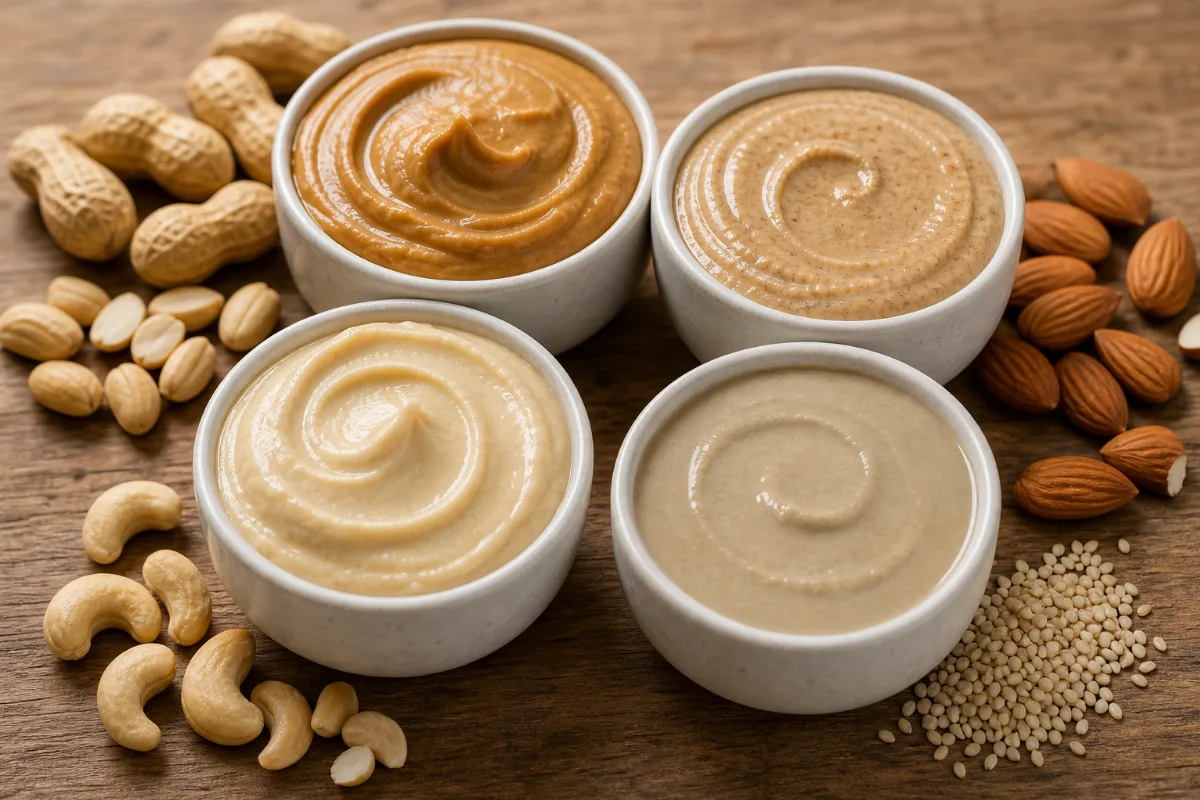
Peanut butter, almond butter, cashew butter and tahini are made by grinding shelled, usually roasted, nuts or seeds into a paste. Peanut is botanically a legume, not a tree nut. Tahini is made from sesame seeds.
USDA lists 178 to 196 calories in 2 tablespoons of plain butter. Almond butter has the most fibre and vitamin E and the least saturated fat of the four. Cashew butter is highest in copper and zinc. Tahini is highest in calcium, iron and selenium. Peanut butter is highest in protein. Brands, salt and sugar vary, so the jar label is the guide.
What the research shows
The best evidence is for peanut allergy prevention. In the LEAP trial of 640 high-risk infants, peanut allergy at 5 years was much lower in those who ate peanut from infancy than in those who avoided it. A pooled analysis of two trials found a 75% reduction, and a 2017 US expert panel set out guidelines by risk level.
Large cohort studies link regular nut eating with lower type 2 diabetes and heart disease. For butters, only peanut butter was reported, with a lower diabetes risk in US women, but it did not show the frailty link that nuts did. These are links, not proof.
Two small peanut butter trials found no change in blood pressure or body fat, and mixed results for physical function. We found no trial of almond, cashew or sesame butter on a health outcome.
Butters versus whole nuts, and what is on the label
Most large studies are about whole nuts. In the frailty study peanuts and walnuts showed a link but peanut butter did not, and we found no study that compared butters with whole nuts for heart disease, so the nut findings should not be assumed to apply to butters.
The US standard for peanut butter lets seasoning and stabilizing ingredients make up to 10% of its weight and requires any oil stabilizer to be a hydrogenated vegetable oil. It does not cover almond, cashew or seed butters. Butters are rich in unsaturated fats, and a review says they can separate and go rancid in storage. We read no study of the health effects of added sugar, salt or oil in butters, so check the label's sugar and sodium lines.
At a glance
Traditional uses history, not proof
- Eaten as spreads, in sauces and in baking
- No source we read documents traditional medicine uses of nut or seed butters
Studied for research
- Preventing peanut allergy in infants, moderate certainty
- Type 2 diabetes risk with nuts and peanut butter, low certainty
- Heart disease risk with whole nuts, low certainty
- Frailty in older women, low certainty
- Physical function in older adults, low certainty
- Blood pressure and body composition, very low certainty
Main compounds
- Fat, mostly unsaturated, about 49 to 56 g per 100 g
- Protein, 17 to 22 g per 100 g
- Fibre, 2 to 10 g per 100 g depending on the butter
- Magnesium, copper, zinc, calcium, iron and selenium, in different amounts
Common forms
- Plain peanut, almond and cashew butter and tahini (the forms the nutrition figures describe)
- Salted, sweetened or flavoured butters
- Butters with stabilizing oils added
- Natural butters where the oil separates
Research links: NHS: Foods to avoid giving babies and young children · FDA: Food allergies · Randomized trial of peanut consumption in infants (NEJM, 2015) · Nut and peanut butter and type 2 diabetes in women (JAMA, 2002) · Research Library · Genes & Biomarkers Library
What it is and its history
- Accepted scientific name
- Arachis hypogaea L. (peanut); Prunus dulcis (almond); Anacardium occidentale L. (cashew); Sesamum indicum L. (sesame, for tahini)
- Naming authority
- GBIF accepted for peanut (5353770), cashew (5421368) and sesame (3172622); almond species record listed as accepted in Rosaceae (see notes)
- Common names
- Nut butter (English); Seed butter (English); Peanut butter, almond butter, cashew butter (English); Tahini (sesame paste) (English); Mantequilla de cacahuate (mani), de almendra; tahini (Spanish)
- Family or group
- A butter is a food form, not one plant. Peanut belongs to the legume family (Fabaceae), almond to the rose family, cashew to the cashew family and sesame to Pedaliaceae (GBIF).
- Classification
- Plantae > Tracheophyta > Magnoliopsida > Fabales (peanut); Rosales (almond); Sapindales (cashew); Lamiales (sesame) > Fabaceae (peanut), Rosaceae (almond), Anacardiaceae (cashew), Pedaliaceae (sesame) > Arachis; Prunus; Anacardium; Sesamum > Arachis hypogaea; Prunus dulcis; Anacardium occidentale; Sesamum indicum
- Native range
- Not verified from a source read.
- Habitat
- Not verified.
- What it looks like
- Roots: Not verified.; Stems: Not verified.; Leaves: Not verified.; Flowers: Not verified.; Fruit: The butters are made by grinding the shelled, usually roasted, nuts or seeds into a paste. Details of the plant parts were not verified.
- Cultivation
- Not verified from a source read.
- Harvest and processing
- Under the US standard, peanut butter is ground roasted peanuts, with up to 10% seasoning and stabilizing ingredients and at most 55% fat (21 CFR 164.150). Rules for other butters were not read.
- Look-alikes and adulterants
- Name: Other nut and seed butters (walnut, hazelnut, sunflower seed, pumpkin seed butter); Note: Not covered here; each carries its own allergen.; Name: Chocolate-hazelnut spreads and sweetened nut spreads; Note: Different products with added sugar and oil; they are not nut butters in the sense used on this page.
- Sustainability and conservation
- Not assessed.
Photographs
Traditional use and history history, not clinical proof
| Tradition or era | Documented use | Source |
|---|---|---|
| Everyday food | Eaten as spreads and in cooking. No source we read documents their history or traditional medicine uses. | NOT verified (no source read) |
Traditional use shows how it was used. It does not show that it works or is safe today.
What is inside, and how it may work
What it contains and how those compounds act in cells and animals. Laboratory and animal mechanisms are not proven effects in people.
Main compounds
| Compound | Family | Where it is concentrated | Activity studied | Level of evidence |
|---|---|---|---|---|
| Fat (mostly unsaturated) | lipid | Whole ground nut or seed About 49 to 56 g per 100 g; saturated fat 4.2 g (almond) to 10.3 g (peanut) per 100 g (USDA) | Provides most of the calories. Not tested here as a treatment. 21 | Composition data |
| Protein | protein | Whole ground nut or seed 17 to 22 g per 100 g (USDA) | Provides protein in the diet. Also the source of allergy. 21 | Composition data |
| Dietary fibre | carbohydrate | Whole ground nut or seed 2.0 g (cashew) to 10.3 g (almond) per 100 g (USDA) | Provides fibre. Not tested here as a treatment. 21 | Composition data |
| Minerals (magnesium, calcium, iron, zinc, copper, selenium) | minerals | Whole ground nut or seed Differs by butter; see the composition table (USDA) | Food sources of minerals. No supplement claim made. 21 | Composition data |
| Vitamin E (alpha-tocopherol) | vitamin | Whole ground nut or seed 24.2 mg per 100 g in almond butter, 9.1 in peanut butter, 0.25 in tahini; not listed for cashew butter (USDA) | Composition data only. 21 | Composition data |
Mechanisms, receptors and pathways
| Target or pathway | Gene or receptor | What was found | Level |
|---|---|---|---|
| Immune recognition of peanut protein (tolerance versus allergy) | In the LEAP trial, peanut-specific IgG4 antibody rose mainly in infants who ate peanut, while more of the infants who avoided peanut had raised IgE. The authors link this to the immune system learning tolerance. This is the paper's interpretation. 1 | Human data |
Absorption, metabolism and elimination
- Absorption
- Not researched.
- Distribution
- Not found.
- Metabolism
- Not found.
- Elimination
- Not found.
- Bioavailability
- Not established.
Isolated compounds versus whole extracts
Everything on this page is about the foods (nuts and seeds ground to a paste). Large studies are mostly about whole nuts; the frailty study found a link for peanuts and walnuts but not peanut butter. We read no trial of oils, extracts or capsules made from these butters.
Nutritional composition
USDA FoodData Central (SR Legacy) values for plain butters in a typical 2-tablespoon portion: peanut butter (32 g): 191 kcal, 7.1 g protein, 16.4 g fat of which 3.3 g saturated, 7.1 g carbohydrate, 1.6 g fibre, 5 mg sodium, 16 mg calcium, 0.6 mg iron, 54 mg magnesium, 0.8 mg zinc, 0.14 mg copper; almond butter (32 g): 196 kcal, 6.7 g protein, 17.8 g fat of which 1.3 g saturated, 6 g carbohydrate, 3.3 g fibre, 2 mg sodium, 111 mg calcium, 1.1 mg iron, 89 mg magnesium, 1.1 mg zinc, 0.3 mg copper; cashew butter (32 g): 188 kcal, 5.6 g protein, 15.8 g fat of which 3.1 g saturated, 8.8 g carbohydrate, 0.6 g fibre, 5 mg sodium, 14 mg calcium, 1.6 mg iron, 83 mg magnesium, 1.7 mg zinc, 0.7 mg copper; tahini (30 g): 178 kcal, 5.1 g protein, 16.1 g fat of which 2.3 g saturated, 6.4 g carbohydrate, 2.8 g fibre, 34 mg sodium, 128 mg calcium, 2.7 mg iron, 28 mg magnesium, 1.4 mg zinc, 0.48 mg copper. Total sugars are 3.4 g in the peanut butter portion, 1.4 g in almond butter and 0.1 g in tahini; USDA lists no sugar value for cashew butter. Almond butter has the most fibre and the most vitamin E (7.7 mg) of the four and the least saturated fat; cashew butter the most copper and zinc; tahini the most calcium and iron; peanut butter the most protein. Selenium is highest in tahini (10.3 micrograms). Figures for a portion are calculated from the USDA per-100 g values (32 g for peanut, almond and cashew butter, 30 g for tahini). Plain records are used; salted, sweetened or flavoured jars differ, so the label on your jar is the guide.
1 moderate certainty4 low certainty1 very low certainty1 not enough evidence
What was looked at
The 7 benefits and uses checked for Nut and Seed Butters, each with how strong the evidence is. Tap one to open it.
- Preventing peanut allergy in infants (peanut foods)Moderate certainty
- Type 2 diabetes risk (nuts and peanut butter)Low certainty
- Heart disease risk (nuts, not butters)Low certainty
- Frailty in older women (nuts and peanut butter)Low certainty
- Physical function in older adults (daily peanut butter)Low certainty
- Blood pressure and body composition (peanut butter before bed)Very low certainty
- Cholesterol and body weight (nut and seed butters)Not enough evidence
Lab markers tracked in the studies
Peanut allergy at age 5New cases of type 2 diabetesFive times sit-to-stand time and leg powerBlood pressure
What is Nut and Seed Butters good for?
The main studied uses and how strong the human evidence is for each. Most results are links seen in eating habits or small changes in tests, not proof that butters prevent or treat a disease.
Benefits, one by one
Each card is a research question, not a promise. Tap a goal to filter. Open a card to see the studies, doses and limits.
Preventing peanut allergy in infants (peanut foods)
Moderate certaintyIn a large trial of infants at high risk, those who ate peanut foods from infancy had far less peanut allergy at age 5 than those who avoided peanut. Expert guidance now recommends introducing peanut-containing foods early, with timing set by a clinician.
3 studiesPeanut-containing foods eaten from infancy as part of the diet. Other…
Studies, doses and limits
What the trials found
The LEAP trial randomised 640 infants aged 4 to 11 months with severe eczema, egg allergy or both to eat or avoid peanut until age 5. Among 530 infants with a negative skin test, peanut allergy was 13.7% with avoidance and 1.9% with eating peanut. Among 98 with a small positive skin test it was 35.3% and 10.6%. A pooled analysis of LEAP and a second trial (EAT) found a 75% lower rate of peanut allergy with early introduction, including in children without eczema. A 2017 US expert panel turned this into three guidelines by risk level.
Results
Large reductions in peanut allergy with early peanut introduction in two randomised trials.
Effect sizes as reported
LEAP, negative skin test: 13.7% vs 1.9% (P<0.001). Positive skin test: 35.3% vs 10.6% (P=0.004). Pooled LEAP and EAT, intention to treat: 75% reduction (P<0.0001).
Why this rating
Randomised trials with large effects, funded mainly by public bodies. But there are only two trials, the infants were studied under supervision, and the abstracts do not say which peanut foods were used or whether thinned peanut butter specifically was tested. Peanut butter is not the only way to introduce peanut.
Form and dose studied
Peanut-containing foods eaten from infancy as part of the diet. Other nut and seed butters were not tested for this.
Who was studied
Infants, mostly at high risk because of eczema or egg allergy.
Limits
The trials tested peanut foods, not specifically peanut butter. Tree nut and sesame butters were not covered by these results. Starting is decided with a clinician, especially for infants with severe eczema or egg allergy.
Why researchers looked
Peanut allergy has risen in children, and researchers asked whether avoiding peanut early was making it worse.
Proposed mechanism Preliminary mechanism
The LEAP authors report that peanut-specific IgG4 antibody rose mainly in the group that ate peanut and IgE antibody rose more in the avoidance group, which they link to the immune system learning to tolerate peanut. This is the paper's own interpretation.
A proposed mechanism does not show that the effect happens in people.
See the Safety tab: thick spoonfuls of nut butter are a choking hazard for young children, and anyone who has had an allergic reaction should not try peanut without medical advice.
Type 2 diabetes risk (nuts and peanut butter)
Low certaintyIn a large study of US women followed for 16 years, those who ate nuts or peanut butter often had a lower chance of developing type 2 diabetes. This shows a link, not that the foods prevent it.
1 studiesUsual dietary intake of nuts and of peanut butter. No seed butters (t…
Studies, doses and limits
What the trials found
The Nurses' Health Study followed 83,818 women for 16 years, with 3,206 new cases of type 2 diabetes. Compared with women who never or almost never ate nuts, those eating a 28 g serving 5 or more times a week had a relative risk of 0.73. For peanut butter 5 or more times a week the relative risk was 0.79.
Results
Lower diabetes risk in women who ate nuts or peanut butter often.
Effect sizes as reported
Nuts 5 or more times a week: RR 0.73 (95% CI 0.60-0.89). Peanut butter 5 or more times a week: RR 0.79 (95% CI 0.68-0.91).
Why this rating
One large observational cohort based on food questionnaires, in women only, from 2002. People who eat nuts regularly may differ in other ways. No trial of nut butters on diabetes was found in the sources read.
Form and dose studied
Usual dietary intake of nuts and of peanut butter. No seed butters (tahini) or almond or cashew butter were reported separately.
Who was studied
Women aged 34 to 59 at the start.
Limits
Association, not cause. Only peanut butter among the butters was reported.
Why researchers looked
Nuts and peanuts are rich in unsaturated fat, fibre and magnesium, which researchers thought could help blood sugar.
Proposed mechanism Unknown
Not established in the abstract. The authors suggest nuts may improve how the body handles glucose and insulin.
A proposed mechanism does not show that the effect happens in people.
Allergy: see the Safety tab.
Heart disease risk (nuts, not butters)
Low certaintyLarge studies link eating nuts regularly with lower heart disease. The study we read reports whole nuts, not nut butters, so it does not show the same for butters.
1 studiesWhole nuts in the diet. Butters were not reported separately.
Studies, doses and limits
What the trials found
Three US cohorts (about 211,000 people; 14,136 cardiovascular disease cases) found that 28 g of nuts 5 or more times a week went with a hazard ratio of 0.86 for cardiovascular disease and 0.80 for coronary heart disease. Peanuts and tree nuts 2 or more times a week went with 13% to 19% lower cardiovascular disease risk. The abstract does not report peanut butter separately.
Results
Lower heart disease risk with regular nut intake; butters not reported in the abstract.
Effect sizes as reported
Total nuts 5 or more times a week: cardiovascular disease HR 0.86 (95% CI 0.79-0.93), coronary heart disease HR 0.80 (0.72-0.89).
Why this rating
Observational data from food questionnaires. The result is about whole nuts, so it is only indirectly about butters.
Form and dose studied
Whole nuts in the diet. Butters were not reported separately.
Who was studied
US women and men without heart disease at the start.
Limits
Association, not cause. We found no study that compared nut butters with whole nuts for heart disease.
Why researchers looked
Nuts supply unsaturated fat, fibre and minerals, and researchers asked whether eating them is linked to heart disease.
Proposed mechanism Unknown
Not examined in the abstract.
A proposed mechanism does not show that the effect happens in people.
None specific to this finding.
Frailty in older women (nuts and peanut butter)
Low certaintyIn older women, eating nuts often went with less frailty. Peanuts and walnuts showed the same link, but peanut butter did not.
1 studiesUsual intake of peanuts, peanut butter, walnuts and other nuts.
Studies, doses and limits
What the trials found
Among 71,704 women aged 60 or older in the Nurses' Health Study (14,195 new frailty cases), 5 or more servings of nuts a week went with a hazard ratio of 0.80 for frailty compared with under 1 serving a month. Peanuts and walnuts, but not peanut butter, were also linked to lower frailty.
Results
Lower frailty with nuts overall; no link for peanut butter.
Effect sizes as reported
Total nuts 5 or more servings a week: HR 0.80 (95% CI 0.73-0.87). Peanut butter: no significant inverse association reported.
Why this rating
One observational cohort, women only, food questionnaires. For peanut butter specifically the finding was null.
Form and dose studied
Usual intake of peanuts, peanut butter, walnuts and other nuts.
Who was studied
US women aged 60 and older.
Limits
Association, not cause. Funding other than a National Cancer Institute grant was not shown in the abstract record read.
Why researchers looked
Researchers wanted to know whether a nut-rich diet is linked to staying strong and well in older age.
Proposed mechanism Unknown
Not examined in the abstract.
A proposed mechanism does not show that the effect happens in people.
None specific.
Physical function in older adults (daily peanut butter)
Low certaintyIn a 6-month trial of 120 older adults at risk of falls, daily peanut butter did not change walking speed, the main outcome. It improved one chair-stand test and leg power.
1 studiesPeanut butter eaten daily for 6 months.
Studies, doses and limits
What the trials found
Adults aged 65 or older at risk of falls were randomised to peanut butter every day or usual care for 6 months. There was no significant effect on gait speed, handgrip, knee strength, weight or body composition. Time for 5 sit-to-stands was 1.23 seconds faster and leg power was 22.0 W higher with peanut butter.
Results
Main outcome unchanged; two secondary measures improved.
Effect sizes as reported
Sit-to-stand time -1.23 s (95% CI -2.09 to -0.37); absolute power +22.0 W (7.1 to 36.9); gait speed not significant.
Why this rating
One randomised trial, not blinded, with a null main outcome and many secondary outcomes. Funding listed includes the Peanut Institute, a peanut industry body.
Form and dose studied
Peanut butter eaten daily for 6 months.
Who was studied
Community-living adults 65 or older at risk of falls, in Australia.
Limits
One trial. Peanut butter only; other butters not tested.
Why researchers looked
Nut eating is linked to less decline in function, so researchers tested it in a randomised trial.
Proposed mechanism Unknown
Not established.
A proposed mechanism does not show that the effect happens in people.
Allergy and choking cautions on the Safety tab.
Blood pressure and body composition (peanut butter before bed)
Very low certaintyA small 7-week pilot trial in firefighters found no change in blood pressure or body fat with peanut butter before bed.
1 studiesOne serving of peanut butter at bedtime, 5 or more days a week.
Studies, doses and limits
What the trials found
Forty full-time firefighters (39 men) were randomised to one serving of peanut butter before bed on at least 5 days a week for 7 weeks, or their usual diet. Blood pressure, body fat percentage, fat mass and lean mass did not differ between groups.
Results
No difference in blood pressure or body composition.
Effect sizes as reported
Blood pressure group-by-time interaction P = 0.619 to 0.650. Peanut butter group changes: body fat -0.53 percentage points, fat mass -0.73 kg, lean mass +0.04 kg, not significantly different from controls.
Why this rating
A small pilot of 7 weeks, almost all men, not blinded. Funding listed includes the Peanut Institute, a peanut industry body.
Form and dose studied
One serving of peanut butter at bedtime, 5 or more days a week.
Who was studied
Healthy male firefighters.
Limits
Short, small, one product.
Why researchers looked
Researchers wanted to know whether a regular peanut butter snack changes heart risk factors and body composition.
Proposed mechanism Unknown
Not established.
A proposed mechanism does not show that the effect happens in people.
None specific.
Cholesterol and body weight (nut and seed butters)
Not enough evidenceWe did not find trials of almond, cashew or tahini butter on cholesterol or weight, and the peanut butter trials read measured other outcomes.
2 studiesn/a
Studies, doses and limits
Results
No evidence found.
Why this rating
No butter trial on cholesterol was read.
Limits
Evidence about whole nuts and cholesterol exists on other pages but was not part of this review of butters.
Why researchers looked
Butters are energy-dense, so people ask whether they affect cholesterol or weight.
Proposed mechanism Unknown
Not examined.
A proposed mechanism does not show that the effect happens in people.
None specific.
Connections to the rest of health
How Nut and Seed Butters connects to the rest of our health knowledge graph. Every link says what kind of connection it is. A safety link (for example to the liver) is a warning, not a benefit. A study that merely mentions a topic never creates a benefit link.
Explore every connection: goals, body systems, organs, symptoms, genes
A. Wellness goals
| Connected to | Kind of connection | Evidence status | Context | Studies |
|---|---|---|---|---|
| Immune Wellness | Moderate certainty | Preventing peanut allergy in infants (peanut foods): In a large trial of infants at high risk, those who ate peanut foods from infancy had far less peanut allergy at age 5 than those who avoided peanut. Expert guidance now recommends introducing peanut-containing foods early, with timing set by a clinician. | 1 8 10 | |
| Blood Sugar Balance | Low certainty | Type 2 diabetes risk (nuts and peanut butter): In a large study of US women followed for 16 years, those who ate nuts or peanut butter often had a lower chance of developing type 2 diabetes. This shows a link, not that the foods prevent it. | 4 | |
| Heart Health | Low certainty | Heart disease risk (nuts, not butters): Large studies link eating nuts regularly with lower heart disease. The study we read reports whole nuts, not nut butters, so it does not show the same for butters. | 3 | |
| Healthy Aging | Low certainty | Frailty in older women (nuts and peanut butter): In older women, eating nuts often went with less frailty. Peanuts and walnuts showed the same link, but peanut butter did not. Physical function in older adults (daily peanut butter): In a 6-month trial of 120 older adults at risk of falls, daily peanut butter did not change walking speed, the main outcome. It improved one chair-stand test and leg power. | 11 2 | |
| Healthy Weight Metabolism | Very low certainty | Blood pressure and body composition (peanut butter before bed): A small 7-week pilot trial in firefighters found no change in blood pressure or body fat with peanut butter before bed. | 6 |
B. Body systems
| Connected to | Kind of connection | Evidence status | Context | Studies |
|---|---|---|---|---|
| Immune System | Biological association | Moderate certainty | Studied for: Preventing peanut allergy in infants (peanut foods) | 1 8 10 |
| Endocrine System | Biological association | Low certainty | Studied for: Type 2 diabetes risk (nuts and peanut butter) | 4 |
| Cardiovascular System | Biological association | Low certainty | Studied for: Heart disease risk (nuts, not butters) Studied for: Blood pressure and body composition (peanut butter before bed) | 3 6 |
| Musculoskeletal System | Biological association | Low certainty | Studied for: Frailty in older women (nuts and peanut butter) Studied for: Physical function in older adults (daily peanut butter) | 11 2 |
E. Health conditions
| Connected to | Kind of connection | Evidence status | Context | Studies |
|---|---|---|---|---|
| Food allergy | Adverse effect or risk | Documented risk | Each butter carries the allergen of its source; sesame has been a US major allergen since 2023. Peanut, tree nut and sesame butters can trigger allergic reactions. Preparation or compound: Peanut, tree nut and sesame butters |
15 18 |
| Choking | Adverse effect or risk | Documented risk | The NHS advises young children not have nut butter on its own. Preparation or compound: Nut butter on a spoon or in lumps |
19 |
I. Biomarkers
| Connected to | Kind of connection | Evidence status | Context | Studies |
|---|---|---|---|---|
| Peanut allergy at age 5 | Biological association | Moderate certainty | Measured in trials: lowered with early peanut eating. A lab change is not the same as a health benefit. | 1 8 |
| New cases of type 2 diabetes | Biological association | Low certainty | Measured in trials: lower with higher nut and peanut butter intake (association). A lab change is not the same as a health benefit. | 4 |
| Five times sit-to-stand time and leg power | Biological association | Low certainty | Measured in trials: improved. A lab change is not the same as a health benefit. | 2 |
| Blood pressure | Biological association | Very low certainty | Measured in trials: no change. A lab change is not the same as a health benefit. | 6 |
L. Active compounds
| Connected to | Kind of connection | Evidence status | Context | Studies |
|---|---|---|---|---|
| Fat (mostly unsaturated) | Biological association | Composition data | Provides most of the calories. Not tested here as a treatment. Preparation or compound: Whole ground nut or seed |
21 |
| Protein | Biological association | Composition data | Provides protein in the diet. Also the source of allergy. Preparation or compound: Whole ground nut or seed |
21 |
| Dietary fibre | Biological association | Composition data | Provides fibre. Not tested here as a treatment. Preparation or compound: Whole ground nut or seed |
21 |
| Minerals (magnesium, calcium, iron, zinc, copper, selenium) | Biological association | Composition data | Food sources of minerals. No supplement claim made. Preparation or compound: Whole ground nut or seed |
21 |
| Vitamin E (alpha-tocopherol) | Biological association | Composition data | Composition data only. Preparation or compound: Whole ground nut or seed |
21 |
Each connection is stored with the ingredient, the connected record, the kind of connection, the evidence status, the supporting studies, the preparation or compound involved, and a review date (last reviewed October 26, 2026).
Evidence at a glance: what the research found for 7 outcomes
Each outcome below is one thing researchers measured. Certainty is how far the evidence can be trusted, not how well it works. The full studies are on the next tab.
The evidence
The research centre for Nut and Seed Butters. Every record here was checked against PubMed or the publisher's page; we never list a study we have not verified.
Evidence by outcome
Bars show how many studies we found for each outcome, not how well it works. People are added up across trials only (reviews are not added, to avoid double counting).
How we rate evidence
High certainty
Several well-run trials or reviews agree; further research is unlikely to change the picture much.
Moderate certainty
Good trials point the same way, but some doubt remains.
Low certainty
Small, short or inconsistent trials. The finding could change with better research.
Very low certainty
Very little or very weak human data. Treat as a possibility only.
Mixed findings
Trials or reviews disagree with each other.
Not enough evidence
Not enough human research to say either way.
Evidence against
Good research found no benefit, or found harm.
We take the reviewers' own risk-of-bias and GRADE statements where they exist, and otherwise judge from study size, design, consistency, directness and whether a product matches what is sold. Many publications do not make evidence high. Method note: We started from our existing summary, used the saved USDA FoodData Central records, and read PubMed abstracts and the FDA, WHO, NHS and eCFR pages. Only abstracts were read for studies. Items we could not verify are flagged in the research gaps.
Study library: every study we checked 22
| Study | Design | People | Product, dose, length | Result |
|---|---|---|---|---|
| Du Toit 2015 Randomized trial of peanut consumption in infants at risk for peanut allergy. N Engl J Med · PMID 25705822 · DOI |
Randomised controlled trial (LEAP) |
640 640 infants aged 4 to 11 months with severe eczema, egg allergy or both |
Eating peanut versus avoiding peanut peanut (food) Until 60 months (5 years) of age · vs Avoiding peanut |
In infants with a negative skin test, peanut allergy at 5 years was 13.7% with avoidance and 1.9% with eating peanut. In infants with a small positive skin test it was 35.3% with avoidance and 10.6% with eating peanut. Serious side effects did not differ between groups. Negative skin test group: 13.7% vs 1.9% (P<0.001). Positive skin test group: 35.3% vs 10.6% (P=0.004). Methods, limits and fundingOutcomes: Peanut allergy at 60 months of age Limitations: One trial, in infants already at high risk. Done under study supervision. The abstract does not say which peanut foods were used. Funding and conflicts: Funded by the US National Institute of Allergy and Infectious Diseases and others (UK Medical Research Council, Department of Health) Registration: NCT00329784 Read: abstract |
| Feyesa 2026 Effects of Peanut Butter Supplementation on Older Adults' Physical Function: A 6-Month Randomised Controlled Trial. J Cachexia Sarcopenia Muscle · PMID 41632974 · DOI |
Randomised controlled trial |
120 120 community-living adults aged 65 or older at risk of falls (mean age 76; 70% women), Australia |
Daily peanut butter added to the usual diet peanut butter Per trial schedule (not advice) 6 months · vs Usual care |
No significant effect on gait speed (primary outcome), handgrip, knee strength, weight, fat mass or lean mass. Five-times sit-to-stand time was 1.23 seconds faster and leg power higher in the peanut butter group. Sit-to-stand time -1.23 s; absolute power +22.0 W; relative power +0.27 W/kg. Gait speed: no significant difference. (Sit-to-stand time -2.09 to -0.37; power 7.1 to 36.9) Methods, limits and fundingOutcomes: Gait speed (primary); sit-to-stand time and power, strength, balance, body composition Limitations: Not blinded (usual care control). Main outcome was null; the two improved measures were among many tested. Adults at risk of falls only. Funding and conflicts: Funding listed in PubMed includes the Peanut Institute (USA), a peanut industry body, plus Australian research grants Registration: ACTRN12622001291774 Read: abstract |
| Guasch-Ferré 2017 Nut Consumption and Risk of Cardiovascular Disease. J Am Coll Cardiol · PMID 29145952 · DOI |
Pooled prospective cohorts |
76,364 women (Nurses' Health Study), 92,946 women (Nurses' Health Study II) and 41,526 men (Health Professionals Follow-Up Study), free of heart disease, stroke and cancer at the start; 14,136 cardiovascular disease cases over 5,063,439 person-years | Usual intake of total and specific nuts (peanuts, tree nuts, walnuts) from food questionnaires nuts (whole) Follow-up up to about 30 years · vs Never or almost never eating nuts |
1 serving (28 g) of nuts 5 or more times a week went with lower cardiovascular disease and coronary heart disease. Peanuts and tree nuts 2 or more times a week went with 13% to 19% lower cardiovascular disease risk. The abstract does not report peanut butter on its own. Total nuts 5 or more times a week versus never: cardiovascular disease hazard ratio 0.86, coronary heart disease 0.80. (Cardiovascular disease 0.79-0.93; coronary heart disease 0.72-0.89) Methods, limits and fundingOutcomes: Cardiovascular disease, coronary heart disease, stroke Limitations: Observational: shows a link, not cause. Whole nuts, not butters. Food questionnaires. Funding and conflicts: Research funded by US National Cancer Institute grants (listed in PubMed) Read: abstract |
| Jiang 2002 Nut and peanut butter consumption and risk of type 2 diabetes in women. JAMA · PMID 12444862 · DOI |
Prospective cohort |
83818 83,818 US women (Nurses' Health Study), aged 34 to 59, free of diabetes, heart disease and cancer at the start, followed 16 years |
Usual intake of nuts and of peanut butter from a food questionnaire nuts; peanut butter 16 years of follow-up · vs Never or almost never eating nuts or peanut butter |
Eating nuts more often went with lower diabetes risk. Eating peanut butter 5 or more times a week also went with lower risk. Nuts, 5 or more servings (28 g) a week versus never: relative risk 0.73. Peanut butter 5 or more times a week versus never: relative risk 0.79. (Nuts 0.60-0.89; peanut butter 0.68-0.91) Methods, limits and fundingOutcomes: New cases of type 2 diabetes (3,206 documented) Limitations: Observational: shows a link, not cause. Food questionnaires. Women only, 1980 to 1996. Funding and conflicts: Research funded by US National Cancer Institute and National Institute of Diabetes and Digestive and Kidney Diseases grants (listed in PubMed) Read: abstract |
| Kaman 2022 A practical focus on sesame allergy and a brief review of other seed allergies. J Food Allergy · PMID 39021852 · DOI |
Narrative review |
People with sesame and other seed allergies | n/a |
Sesame allergy has been increasing worldwide and usually lasts. Allergen labelling laws until recently did not require sesame to be declared. Skin and blood tests are of limited use; history and an oral food challenge are used to diagnose it. Oral immunotherapy looked safe and effective in case reports and one controlled study. Review, no pooled numbers in the abstract Methods, limits and fundingOutcomes: Trends, labelling, diagnosis and treatment of sesame allergy Limitations: Narrative review. Little is known about other seed allergies. Funding and conflicts: Not stated in the abstract read Read: abstract |
| Kohler 2026 A Pilot Randomized, Controlled Trial of Nighttime Peanut Butter Supplementation in Firefighters: Blood Pressure and Body Composition Outcomes. Diseases · PMID 42041627 · DOI |
Pilot randomised controlled trial |
40 40 full-time firefighters (39 men, 1 woman) |
One serving of peanut butter before bed at least 5 days a week peanut butter One serving (per trial schedule) 7 weeks · vs Usual diet |
No difference between groups in blood pressure or in body fat, fat mass or lean mass. No significant group-by-time effects (blood pressure P = 0.619 to 0.650). Methods, limits and fundingOutcomes: Blood pressure, body fat percentage, fat mass, lean mass Limitations: Pilot trial, 7 weeks, 40 people, almost all men. Not blinded. Funding and conflicts: Funding listed in PubMed includes the Peanut Institute, a peanut industry body Registration: NCT06364202 Read: abstract |
| Liu 2025 Recent Advances in the Mechanisms of Quality Degradation and Control Technologies for Peanut Butter: A Literature Review. Foods · PMID 39796395 · DOI |
Narrative review n/a (food science) |
Food-science literature on peanut butter | n/a |
Peanut butter's high fat, especially unsaturated fat, makes it likely to lose quality in storage: oil separates, fat oxidises and it can go rancid, which changes texture, flavour and aroma and shortens shelf life. Review, no numbers in the abstract Methods, limits and fundingOutcomes: Fat separation, lipid oxidation and rancidity of peanut butter Limitations: Food-science review about quality. The abstract does not say whether rancid butter is harmful to health. Funding and conflicts: Funded by Chinese research programmes (listed in PubMed) Read: abstract |
| Logan 2023 Early introduction of peanut reduces peanut allergy across risk groups in pooled and causal inference analyses. Allergy · PMID 36435990 · DOI |
Pooled analysis of two randomised trials (LEAP and EAT) |
Children from the LEAP and EAT trials, including children with and without eczema | Early peanut introduction versus later introduction peanut (food) Follow-up to the trials' endpoints · vs Later introduction |
Pooled intention-to-treat analysis showed a 75% reduction in peanut allergy with early introduction, in all eczema severity groups. Earlier introduction went with better results. 75% reduction (intention-to-treat); P<0.0001 Methods, limits and fundingOutcomes: Peanut allergy Limitations: Two trials. Pooled per-protocol and modelling estimates are larger but can be biased, as the authors note. Funding and conflicts: Funded in part by the EU iFAAM project, US NIAID and UK Medical Research Council (listed in PubMed) Read: abstract |
| Njoroge 2016 A Case for Regular Aflatoxin Monitoring in Peanut Butter in Sub-Saharan Africa: Lessons from a 3-Year Survey in Zambia. J Food Prot · PMID 27296427 · DOI |
Laboratory survey of products n/a (food samples) |
954 954 containers of 24 local and imported peanut butter brands bought in shops in Zambia, 2012 to 2014 |
Peanut butter as sold in shops peanut butter 3-year survey |
73% of brands in 2012, 80% in 2013 and 53% in 2014 had aflatoxin B1 above 20 micrograms per kilogram, with highest values from 130 up to 10,740 micrograms per kilogram. None of the 8 brands tested every year stayed at or below 20 on average. Share of brands above 20 micrograms per kilogram: 73% (2012), 80% (2013), 53% (2014). Methods, limits and fundingOutcomes: Aflatoxin B1 level in peanut butter Limitations: Zambia only; does not describe products sold in the US or EU. Testing used an ELISA kit. Funding and conflicts: Not stated in the abstract read Read: abstract |
| Togias 2017 Addendum guidelines for the prevention of peanut allergy in the United States: Report of the National Institute of Allergy and Infectious Diseases-sponsored expert panel. J Allergy Clin Immunol · PMID 28065278 · DOI |
Expert panel guideline |
Infants at different levels of risk for peanut allergy | n/a |
The panel's addendum gives 3 separate guidelines, by infant risk level, for introducing peanut-containing foods starting in infancy, in the clinic or at home. Guidance, not a trial Methods, limits and fundingOutcomes: Guidance on risk groups, allergy testing, and timing and approach for introducing peanut-containing foods Limitations: Guidance written in 2017. The abstract does not list the ages or foods; talk to a paediatrician. Funding and conflicts: Facilitated by the US National Institute of Allergy and Infectious Diseases with 25 professional, federal and patient groups Read: abstract |
| Wang 2023 Long-Term Consumption of Nuts (Including Peanuts, Peanut Butter, Walnuts, and Other Nuts) in Relation to Risk of Frailty in Older Women: Evidence From the Nurses' Health Study. J Nutr · PMID 36931754 · DOI |
Prospective cohort |
71704 71,704 women aged 60 or older, not frail at the start (Nurses' Health Study); 14,195 new cases of frailty over 1,165,290 person-years |
Total nut intake (peanuts, peanut butter, walnuts, other nuts) from food questionnaires, and each separately nuts; peanut butter Frailty assessed every 4 years from 1992 to 2016 · vs Fewer than 1 serving a month |
5 or more servings of nuts a week went with lower frailty. Peanuts and walnuts also went with lower frailty, but peanut butter did not. 5 or more servings a week of total nuts versus under 1 serving a month: hazard ratio 0.80. (0.73-0.87) Methods, limits and fundingOutcomes: New frailty (3 or more of: fatigue, lower strength, reduced aerobic capacity, multiple chronic conditions, weight loss) Limitations: Observational: shows a link, not cause. Food questionnaires. Women only. Funding and conflicts: Research funded by a US National Cancer Institute grant (listed in PubMed). Other funders were not shown in the abstract record read. Read: abstract |
| s-cdc-choking CDC: Choking hazards (infant and toddler nutrition) · Source |
Official health guidance n/a |
Methods, limits and fundingRead: not-read | ||
| s-ecfr-164-150 US eCFR: 21 CFR 164.150, Peanut butter · Source |
Federal regulation n/a |
Methods, limits and fundingRead: full-text | ||
| s-fda-action-levels FDA: Action Levels for Poisonous or Deleterious Substances in Human Food and Animal Feed (August 2000) · Source |
Regulator guidance n/a |
Methods, limits and fundingRead: full-text | ||
| s-fda-food-allergies FDA: Food Allergies · Source |
Regulator page n/a |
Methods, limits and fundingRead: full-text | ||
| s-gbif-butter-plants GBIF Backbone: Arachis hypogaea L. (usageKey 5353770), Anacardium occidentale L. (5421368), Sesamum indicum L. (3172622), Prunus dulcis · Source |
Reference database n/a |
Methods, limits and fundingRead: full-text | ||
| s-nhs-anaphylaxis NHS: Anaphylaxis · Source |
Official health guidance n/a |
Methods, limits and fundingRead: full-text | ||
| s-nhs-food-allergy NHS: Food allergy · Source |
Official health guidance n/a |
Methods, limits and fundingRead: full-text | ||
| s-nhs-foods-avoid-children NHS: Foods to avoid giving babies and young children · Source |
Official health guidance n/a |
Methods, limits and fundingRead: full-text | ||
| s-nhs-pregnancy-foods NHS: Foods to avoid in pregnancy · Source |
Official health guidance n/a |
Methods, limits and fundingRead: full-text | ||
| s-usda-fdc-butters USDA FoodData Central (SR Legacy): peanut butter smooth without salt (172470), almond butter plain without salt (168588), cashew butter plain without salt (170163), tahini from roasted and toasted kernels (170189) · Source |
Food composition database n/a |
Methods, limits and fundingRead: full-text | ||
| s-who-mycotoxins WHO: Mycotoxins fact sheet · Source |
Regulator page n/a |
Methods, limits and fundingRead: full-text |
What we do not know yet
- No trial of almond, cashew or sesame butter on a health outcome was found.
- The large nut studies report whole nuts; only the peanut butter results were reported separately, in two cohorts.
- The two peanut butter trials are small and list peanut industry funding.
- Breastfeeding, medicine interactions, cross-contact rates on shared equipment and the health effects of added sugar, salt and oils in butters were not researched.
- The CDC choking page could not be opened, so choking advice rests on the NHS.
How new research is added
New studies are found by a saved PubMed search and placed in a review queue before the page changes.
Lab markers
What changed in blood or saliva tests during trials. A changed number is not the same as feeling or being healthier, and we give no "normal ranges".
Other 4
Peanut allergy at age 5
Lowered with early peanut eating in trials
Whether a child has a confirmed peanut allergy at 60 months of age.
Moderate certaintyResults and what it means
Why it was measured
The main outcome of the LEAP trial.
Statistical vs. clinical meaning
A large drop in a real health outcome, not just a blood marker.
Safety implication
Early introduction in high-risk infants is decided with a clinician.
| Study | Result | People | Product |
|---|---|---|---|
| 1 | Negative skin test group: 13.7% with avoidance vs 1.9% with eating peanut. Positive skin test group: 35.3% vs 10.6%. | 640 infants at high risk | Eating peanut vs avoiding peanut until age 5 |
New cases of type 2 diabetes
Lower with higher nut and peanut butter intake (association) in trials
How many people in a group are newly diagnosed with type 2 diabetes over time.
Low certaintyResults and what it means
Why it was measured
Used to see whether eating habits go with later diabetes.
Statistical vs. clinical meaning
A link seen in a cohort; it does not show the food prevents diabetes.
Safety implication
None specific.
| Study | Result | People | Product |
|---|---|---|---|
| 4 | Nuts 5 or more times a week: RR 0.73. Peanut butter 5 or more times a week: RR 0.79. | 83,818 US women over 16 years | Usual food intake, not a trial |
Five times sit-to-stand time and leg power
Improved in trials
How quickly a person can stand up from a chair five times; leg power is estimated from that test.
Low certaintyResults and what it means
Why it was measured
A simple test of lower-body function in older adults.
Statistical vs. clinical meaning
A small improvement in one test; the main outcome was null.
Safety implication
None specific.
| Study | Result | People | Product |
|---|---|---|---|
| 2 | -1.23 s time (95% CI -2.09 to -0.37); +22.0 W power (7.1 to 36.9). Gait speed, the main outcome, did not change significantly. | 120 older adults at risk of falls | Peanut butter every day vs usual care, 6 months |
Blood pressure
No change in trials
The force of blood in the arteries.
Very low certaintyResults and what it means
Safety
What studies and official sources say about side effects, medicines and who should check first. Each point shows what kind of evidence it comes from.
Main points to know 4
- Each butter carries the allergy of what it is made from. Peanut butter can cause peanut allergy reactions, almond and cashew butter can cause tree nut reactions, and tahini can cause sesame reactions. The FDA names peanuts, tree nuts and sesame among nine major US allergens that labels must declare. Sesame joined the list on January 1, 2023, so some older stock may not say so. Reactions can be severe. Authoritative guidance 15 18 5
- Thick spoonfuls and lumps of nut butter can cause choking in young children. The NHS says nut butter such as peanut butter can be given to babies from the start of weaning if it is spread on food such as toast, but not on its own, because the child could choke. Whole nuts should not be given to children under 5. Authoritative guidance 19
- Moldy nuts can carry aflatoxin, a liver poison. The WHO says aflatoxins are among the most poisonous mycotoxins, large doses can cause acute poisoning through liver damage, and there is evidence they can cause liver cancer in humans. The US FDA has an action level of 20 parts per billion for peanuts and peanut products. A 3-year survey in Zambia found many peanut butter brands above 20 micrograms per kilogram, which is a different market from the US. Authoritative guidance 22 14 9
- Pregnancy and breastfeeding. The NHS says peanuts and other nuts are safe to eat in pregnancy unless a doctor or midwife has said not to, or you have an allergy. We did not read an official source on breastfeeding and nut butters. Authoritative guidance 20
Side effects 4
| Effect | How often | Severity and recovery | Evidence |
|---|---|---|---|
| Allergic reaction to peanut, tree nut or sesame (hives, swelling, wheeze, vomiting; at worst anaphylaxis) No frequency was given in the pages read. The Kaman review says sesame allergy has been increasing worldwide and usually lasts. | Not established | mild to life-threatening Mild reactions settle; anaphylaxis needs emergency treatment | Authoritative guidance 15 18 17 |
| Choking on spoonfuls or lumps of nut butter (young children) The NHS advises spreading butter thinly on food rather than giving it on its own. | Not established | potentially serious n/a | Authoritative guidance 19 |
| Liver harm and liver cancer risk from long-term exposure to aflatoxin in contaminated nuts WHO describes large doses causing acute poisoning and evidence of liver cancer in humans. It does not give a risk figure for peanut butter. | Not established | serious (with high or long exposure) Not stated | Authoritative guidance 22 |
| Rancid taste and smell after long storage A food-science review says peanut butter's fats can oxidise and go rancid in storage. It does not say whether eating rancid butter harms health. | Not established | quality issue n/a | Narrative review 7 |
Liver
No liver injury from eating nut butters as normal food was found in the sources read. The liver concern is aflatoxin from moldy nuts, which the WHO links to acute liver damage at large doses and to liver cancer. 22
How often. No frequency found.
This is a safety connection. It is not evidence that Nut and Seed Butters supports liver health.
Medicines and supplements 1
| With | Why it matters | Importance | Evidence | What to do |
|---|---|---|---|---|
| Prescription and over-the-counter medicines prescription | No source read describes a medicine interaction with eating nut or seed butters. This is absence of evidence, not proof of none. | None found Not enough evidence | A pharmacist can check your own medicines, especially if you have a nut or seed allergy and carry emergency medicine. |
Who should check first 3
| Situation | Advice | Evidence |
|---|---|---|
| Known allergy to peanut, the specific tree nut, or sesame | Avoid the matching butter and check labels for peanut, tree nuts and sesame. Follow your own allergy action plan. Cross-contact on shared equipment was not quantified in the sources read, so check the 'Contains' statement or ask the maker. | Authoritative guidance 15 18 |
| Babies and young children: nut butter on a spoon or in lumps | The NHS advises thin spreading on food rather than giving butter on its own. A family history of food allergy is a reason to talk to a GP or health visitor first. | Authoritative guidance 19 |
| Infants with severe eczema or egg allergy and peanut introduction | Early peanut introduction was tested in high-risk infants; the timing and need for allergy testing are decided with a clinician. | Rct and guideline 1 10 |
Overdose, product quality and regulators
Summary. Nut and seed butters are ordinary foods. The toxicity concern in the sources read is aflatoxin from mold on peanuts and some other nuts and seeds.
Animal. Aflatoxins are genotoxic and cause cancer in animals (WHO).
Human doses studied. Trials of peanut butter used it as a daily food for 7 weeks to 6 months and the abstracts report no safety problem.
High dose or long term signals. WHO notes evidence aflatoxins can cause liver cancer in humans. No figure for butters was given.
Overdose response. Not found.
Genotoxicity. Aflatoxins are genotoxic (WHO). Not reviewed for butters themselves.
Aflatoxin is the main contaminant concern. Labels also vary in added salt, sweeteners and oils, and fats in butters can go rancid.
Aflatoxin in peanut butter, Zambia 2012 to 2014. 954 containers of 24 brands were tested. 73% of brands in 2012, 80% in 2013 and 53% in 2014 had aflatoxin B1 above 20 micrograms per kilogram, with values up to 10,740. No repeatedly tested brand stayed at or below 20 on average. 9
US limit on aflatoxin. The FDA action level for peanuts and peanut products for people is 20 parts per billion. An action level is a point at which the FDA may act, not a guarantee of safety below it. 14
Processing does not remove most mycotoxins. The WHO says most mycotoxins are chemically stable and survive food processing. 22
What the US peanut butter standard allows. Under 21 CFR 164.150 'peanut butter' may include seasoning and stabilizing ingredients up to 10% of its weight, fat up to 55%, and oil stabilizers must be hydrogenated vegetable oils. Artificial sweeteners and chemical preservatives are not allowed. The standard does not cover almond, cashew or seed butters. 13
Fat separation and rancidity in storage. A review says peanut butter's high unsaturated fat makes it prone to oil separation, oxidation and rancidity, which change texture, flavour and aroma. 7
Added salt and sugar. USDA's records are for plain butters (no salt added; tahini 115 mg sodium per 100 g). Sweetened or salted products were not surveyed, and no source read tested health effects of the added salt, sugar or oil in butters. The label's sodium and sugar lines show what a given jar contains. 21
| Body | Action | Date |
|---|---|---|
| FDA (US Food and Drug Administration) (United States) | Peanuts, tree nuts and sesame are among nine major food allergens that must be declared on labels source | Page read 2026-10-26; sesame effective January 1, 2023 |
| FDA (United States) | Action level of 20 ppb for aflatoxin in peanuts and peanut products intended for people (CPG 570.375) source | Guidance dated August 2000; CPG page content current as of 06/01/2021 |
| US Code of Federal Regulations (United States) | 21 CFR 164.150 standard of identity for peanut butter source | Amended 2023 (88 FR 53773) |
| WHO (International) | Mycotoxins fact sheet: aflatoxins and liver cancer evidence source | Page read 2026-10-26 |
| NHS (United Kingdom) | Nut butter for babies spread on food, not on its own; whole nuts not under 5 source | Page read 2026-10-26 |
When to get medical help
- Swelling of the lips, face, tongue or throat
- Trouble breathing, wheezing or a tight throat
- Hives with vomiting, dizziness or fainting after eating
- A child who is choking and cannot cough, cry or breathe
Stop using the product and contact a clinician or emergency service. In the US, Poison Control is 1-800-222-1222.
General information only, not medical advice. Ask a clinician or pharmacist before use, especially with medicines, in pregnancy or with a health condition. See the Natural Remedy Safety guide.
Frequently asked questions
What are nut and seed butters good for?
Does peanut butter lower the risk of type 2 diabetes?
In US women followed for 16 years, eating peanut butter 5 or more times a week went with a relative risk of 0.79 for type 2 diabetes. This was from food questionnaires and shows a link, not cause.
Do nut butters help the heart?
Large studies link whole nuts with lower heart disease. The abstract we read reports nuts, not nut butter, so it does not show the same for butters.
Are nut butters as healthy as whole nuts?
We found no direct comparison. In one large frailty study peanuts and walnuts showed a link with less frailty but peanut butter did not. That does not prove butters are worse.
How many calories and what nutrients are in nut and seed butters?
USDA lists 178 to 196 calories in 2 tablespoons of plain butter. Almond butter has the most fibre and vitamin E, cashew butter the most copper and zinc, tahini the most calcium, iron and selenium, and peanut butter the most protein.
Is peanut butter a tree nut?
Is tahini a common allergen?
Can babies have peanut butter?
The NHS says babies can have peanut butter from the start of weaning if it is spread on food, not given on its own. Trials in high-risk infants found early peanut eating lowered peanut allergy. Ask a paediatrician or GP first, especially with eczema, egg allergy or a family history of allergy.
Is nut butter a choking risk for children?
Yes, for young children. The NHS says not to give nut butter on its own, because a child could choke, and not to give whole nuts under 5.
Is there aflatoxin in peanut butter?
Is natural peanut butter, where the oil separates, healthier?
Are nut butters safe in pregnancy?
The NHS says peanuts and other nuts are safe in pregnancy unless you have an allergy or a doctor or midwife has told you not to eat them. We did not read an official source on breastfeeding.
Explore by health goal
Healthy AgingImmune WellnessBlood Sugar BalanceHeart HealthHealthy Weight Metabolism
Editorial transparency
- Written by
- AlternativeMed editorial team. Research compiled with AI assistance, then checked against the sources listed.
- Medical review
- None. This page has not been reviewed by a physician or pharmacist.
- First published
- 2026-10-26
- Last substantive update
- 2026-10-26
- How we research
- We started from our existing summary, used the saved USDA FoodData Central records, and read PubMed abstracts and the FDA, WHO, NHS and eCFR pages. Only abstracts were read for studies. Items we could not verify are flagged in the research gaps.
- How we rate evidence
- See "How we rate evidence" in the Evidence tab.
- Independence
- No product is promoted on this page. No affiliate links are shown.
Sources 22
Each source was opened and checked. Where we read only the abstract, it says so. The small numbers in the text point here.
- Du Toit G, et al.. Randomized trial of peanut consumption in infants at risk for peanut allergy.. N Engl J Med. 2015. PMID 25705822. DOI 10.1056/NEJMoa1414850. (abstract)
- Feyesa I, et al.. Effects of Peanut Butter Supplementation on Older Adults' Physical Function: A 6-Month Randomised Controlled Trial.. J Cachexia Sarcopenia Muscle. 2026. PMID 41632974. DOI 10.1002/jcsm.70221. (abstract)
- Guasch-Ferré M, et al.. Nut Consumption and Risk of Cardiovascular Disease.. J Am Coll Cardiol. 2017. PMID 29145952. DOI 10.1016/j.jacc.2017.09.035. (abstract)
- Jiang R, et al.. Nut and peanut butter consumption and risk of type 2 diabetes in women.. JAMA. 2002. PMID 12444862. DOI 10.1001/jama.288.20.2554. (abstract)
- Kaman K, Factor JM. A practical focus on sesame allergy and a brief review of other seed allergies.. J Food Allergy. 2022. PMID 39021852. DOI 10.2500/jfa.2022.4.220008. (abstract)
- Kohler AA, et al.. A Pilot Randomized, Controlled Trial of Nighttime Peanut Butter Supplementation in Firefighters: Blood Pressure and Body Composition Outcomes.. Diseases. 2026. PMID 42041627. DOI 10.3390/diseases14040135. (abstract)
- Liu X, et al.. Recent Advances in the Mechanisms of Quality Degradation and Control Technologies for Peanut Butter: A Literature Review.. Foods. 2025. PMID 39796395. DOI 10.3390/foods14010105. (abstract)
- Logan K, et al.. Early introduction of peanut reduces peanut allergy across risk groups in pooled and causal inference analyses.. Allergy. 2023. PMID 36435990. DOI 10.1111/all.15597. (abstract)
- Njoroge SMC, et al.. A Case for Regular Aflatoxin Monitoring in Peanut Butter in Sub-Saharan Africa: Lessons from a 3-Year Survey in Zambia.. J Food Prot. 2016. PMID 27296427. DOI 10.4315/0362-028X.JFP-15-542. (abstract)
- Togias A, et al.. Addendum guidelines for the prevention of peanut allergy in the United States: Report of the National Institute of Allergy and Infectious Diseases-sponsored expert panel.. J Allergy Clin Immunol. 2017. PMID 28065278. DOI 10.1016/j.jaci.2016.10.010. (abstract)
- Wang R, et al.. Long-Term Consumption of Nuts (Including Peanuts, Peanut Butter, Walnuts, and Other Nuts) in Relation to Risk of Frailty in Older Women: Evidence From the Nurses' Health Study.. J Nutr. 2023. PMID 36931754. DOI 10.1016/j.tjnut.2023.01.003. (abstract)
- . CDC: Choking hazards (infant and toddler nutrition). . . (not-read)
- . US eCFR: 21 CFR 164.150, Peanut butter. . . (full-text)
- . FDA: Action Levels for Poisonous or Deleterious Substances in Human Food and Animal Feed (August 2000). . . (full-text)
- . FDA: Food Allergies. . . (full-text)
- . GBIF Backbone: Arachis hypogaea L. (usageKey 5353770), Anacardium occidentale L. (5421368), Sesamum indicum L. (3172622), Prunus dulcis. . . (full-text)
- . NHS: Anaphylaxis. . . (full-text)
- . NHS: Food allergy. . . (full-text)
- . NHS: Foods to avoid giving babies and young children. . . (full-text)
- . NHS: Foods to avoid in pregnancy. . . (full-text)
- . USDA FoodData Central (SR Legacy): peanut butter smooth without salt (172470), almond butter plain without salt (168588), cashew butter plain without salt (170163), tahini from roasted and toasted kernels (170189). . . (full-text)
- . WHO: Mycotoxins fact sheet. . . (full-text)
Where to buy
Check the label first. Whatever you buy, look for these:
- Raw or roasted, and salted or unsalted
- A best-by date, since nuts and seeds turn rancid
- Tree nut and peanut allergy warnings
- A resealable bag, and cool storage once opened
Talk to a pharmacist or doctor before you start any supplement, especially if you take medicines. See the Safety tab for interactions.
Support our free guides: as an Amazon Associate we earn from qualifying purchases. Full disclosure.


