Oils & Fats · Cooking oil
Peanut Oil
Arachis hypogaea (seed oil) · also called Groundnut oil, refined peanut oil, crude or cold-pressed peanut oil, aceite de cacahuate (Spanish)
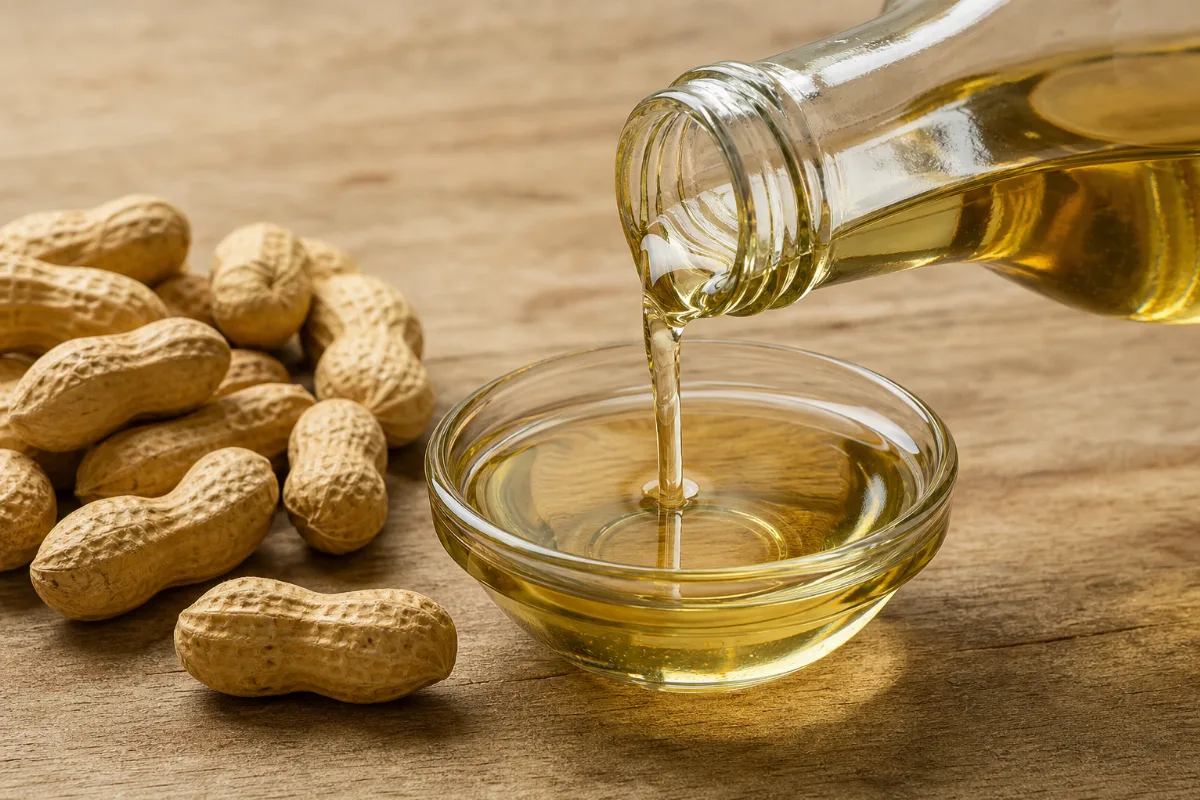
Peanut oil is pressed or extracted from peanuts and used for frying and stir-frying. A tablespoon has about 119 calories and no protein, carbohydrate or fibre. The main caution is peanut allergy: in one challenge study none of 60 allergic people reacted to refined oil, but 10% reacted to crude oil. We found no human trial of peanut oil on heart attacks or strokes.
General information, not medical advice. Last substantive update · Not medically reviewed. A named clinician has not signed off on this page. How this page is made
About Peanut Oil
Peanut oil is a common frying oil that is almost all fat. The big question is allergy, and the main studied benefit concerns swapping saturated for unsaturated fat in general. Little research exists on peanut oil itself.
What it is
Peanut oil is pressed or extracted from peanuts, the seeds of Arachis hypogaea, in the legume family. A peanut is a legume, not a tree nut. The oil is used for frying, stir-frying and some dressings.
A tablespoon (13.5 g) has about 119 calories, 2.3 g of saturated fat, 6.2 g of monounsaturated fat, 4.3 g of polyunsaturated fat and 2.1 mg of vitamin E, with no carbohydrate, protein or fibre (USDA values from an earlier read).
Refined and crude oil
Highly refined oil has very little peanut protein. Crude, cold-pressed or gourmet oil has about 100 times more, according to a 2007 review.
In the 1997 challenge study of 60 peanut-allergic people, none reacted to refined oil and 6 reacted to crude oil. Check how an oil is made before use if you have a peanut allergy.
What the research shows
The best evidence concerns allergy, not benefits. The heart evidence is about swapping saturated fat for unsaturated oils in general, and we found no trial of peanut oil alone on heart attacks or strokes.
Monkey and hamster studies found lower cholesterol with peanut oil, but animal results are not proof for people. In an 8-week human trial, a very large daily oil load led overweight adults to gain weight.
At a glance
Traditional uses history, not proof
- Used for frying, stir-frying and some dressings
- Long use as a cooking oil is not proof that it treats any condition
Studied for research
- Allergy risk in peanut-allergic people, mixed evidence (refined versus crude oil)
- LDL cholesterol and heart events when unsaturated oil replaces saturated fat, low certainty for peanut oil itself
- Weight and energy intake with a large oil load, low certainty
- Cholesterol and artery plaque in monkeys and hamsters, very low certainty (animal only)
- Skin products with refined peanut oil, insufficient evidence
- Peanut products and HDL cholesterol, low certainty (not oil alone)
Main compounds
- Oleic acid, the largest fat (about 46 g per 100 g)
- Linoleic acid (about 32 g polyunsaturated fat per 100 g)
- Saturated fat (about 17 g per 100 g)
- Vitamin E (about 2.1 mg per tablespoon)
- Plant sterols, and traces of peanut protein
Common forms
- Refined, bleached, deodorized oil (very little protein)
- Crude, cold-pressed or gourmet oil (far more protein)
- Whole peanuts are a different food
- Skin products with peanut oil are not food
Research links: FDA guidance on labeling oils from major allergens · BMJ 1997: allergenicity of crude and refined peanut oil · Review: allergy to peanut oil (2007) · American Heart Association advisory on dietary fats (2017) · Research Library · Genes & Biomarkers Library
What it is and its history
- Accepted scientific name
- Arachis hypogaea
- Naming authority
- L. (GBIF accepted, usageKey 5353770)
- Common names
- Peanut oil (English); Groundnut oil (English); Aceite de cacahuate (Spanish); Aceite de mani (Spanish)
- Family or group
- Fabaceae (legume family). Botanically the peanut is a legume, not a tree nut (existing summary; not re-sourced).
- Classification
- Plantae > Tracheophyta > Magnoliopsida > Fabales > Fabaceae > Arachis > Arachis hypogaea
- Native range
- Not verified from a source read.
- Habitat
- Not verified.
- What it looks like
- Roots: Not verified.; Stems: Not verified.; Leaves: Not verified.; Flowers: Not verified.; Fruit: The oil is pressed or extracted from the seeds (peanuts) (existing summary; not re-sourced).
- Cultivation
- Not verified from a source read.
- Harvest and processing
- Crude (cold-pressed) oil keeps more protein; refined (refined, bleached, deodorized) oil keeps very little. This is the key difference for allergy (Ring 2007; FDA guidance).
- Look-alikes and adulterants
- Name: Peanuts (the whole food); Note: Whole peanuts carry protein, fibre and minerals the oil lacks.; Name: Tree nut oils; Note: Peanut allergy and tree nut allergy are different conditions.
- Sustainability and conservation
- Not assessed.
Photographs
Traditional use and history history, not clinical proof
| Tradition or era | Documented use | Source |
|---|---|---|
| Cooking oil | Used for frying, stir-frying and some dressings. No source read documents its history. | NOT verified (no source read) |
Traditional use shows how it was used. It does not show that it works or is safe today.
What is inside, and how it may work
What it contains and how those compounds act in cells and animals. Laboratory and animal mechanisms are not proven effects in people.
Main compounds
| Compound | Family | Where it is concentrated | Activity studied | Level of evidence |
|---|---|---|---|---|
| Oleic acid (monounsaturated fat) | fatty acid | Seed oil About 46.2 g monounsaturated fat per 100 g (USDA, earlier read) | The largest fat group in the oil. The AHA advisory concerns polyunsaturated oils, not this fat specifically. 17 | Composition data |
| Linoleic acid (polyunsaturated fat) | fatty acid | Seed oil About 32 g polyunsaturated fat per 100 g (USDA, earlier read) | Polyunsaturated vegetable oil in place of saturated fat lowered cardiovascular disease in trials reviewed by the AHA. 17 7 | Composition data and authoritative review |
| Saturated fat | fat | Seed oil About 16.9 g per 100 g (USDA, earlier read) | USDA lists it in the record; no trial was read on this fat in peanut oil alone. 17 | Composition data |
| Vitamin E (alpha-tocopherol) | vitamin | Seed oil 15.7 mg per 100 g; about 2.1 mg per tablespoon (USDA, earlier read) | A fat-soluble vitamin; MedlinePlus lists peanuts and vegetable oils as food sources. 17 14 | Composition data |
| Plant sterols (phytosterols) | sterols | Seed oil About 207 mg per 100 g (USDA, earlier read) | No trial was read showing an effect at the amount in cooking oil. 17 | Composition data |
| Residual peanut proteins (allergens) | protein | Seed oil About 0.1-0.2 microgram per gram in a commercial refined oil (1998 study); crude oils about 100 times more than refined (2007 review) | These proteins bound IgE and triggered skin tests in allergic patients in the laboratory study. 5 6 | Laboratory |
Mechanisms, receptors and pathways
| Target or pathway | Gene or receptor | What was found | Level |
|---|---|---|---|
| Allergic reaction to residual peanut protein | IgE antibodies | A refined oil extract bound IgE from allergic patients and gave positive skin-prick and histamine-release tests in a laboratory setting. This does not show that eating the oil causes reactions, and challenge trials of refined oil found none in 70 people. 5 3 9 | Human samples (lab) |
| LDL cholesterol lowering when unsaturated fat replaces saturated fat | The AHA advisory says replacing saturated with unsaturated fat lowers LDL cholesterol, linking the biology to events in trials. 7 | Human data |
Absorption, metabolism and elimination
- Absorption
- Not researched.
- Distribution
- Not found.
- Metabolism
- Not researched.
- Elimination
- Not found.
- Bioavailability
- Not established.
Isolated compounds versus whole extracts
This page is about the oil as food. Whole peanuts also carry protein, fibre and minerals; a 2020 meta-analysis of peanut products is not specific to oil. Skin products with peanut oil are not food.
Nutritional composition
Peanut oil, salad or cooking (USDA FoodData Central item 171410, SR Legacy): per 100 g, 884 kcal and 100 g of fat, of which 16.9 g saturated, 46.2 g monounsaturated and 32 g polyunsaturated. A tablespoon (13.5 g) gives about 119 kcal, 2.3 g saturated fat, 2.1 mg vitamin E (about 14% of a 15 mg reference) and no carbohydrate, protein or fibre. Per-portion figures are the per-100 g values multiplied by 0.135. Values come from an earlier read of the USDA record and were not re-opened today.
1 mixed findings3 low certainty1 very low certainty1 not enough evidence
What was looked at
The 6 benefits and uses checked for Peanut Oil, each with how strong the evidence is. Tap one to open it.
- Allergy risk in people with peanut allergy (refined versus crude peanut oil)Mixed findings
- LDL cholesterol and heart disease (unsaturated oil replacing saturated fat)Low certainty
- Body weight and appetite (a large daily peanut oil load)Low certainty
- Cholesterol and artery plaque in animals (monkeys and hamsters)Very low certainty
- Skin products containing refined peanut oilNot enough evidence
- Blood fats and weight (peanut products in trials, not oil alone)Low certainty
Lab markers tracked in the studies
LDL cholesterolBody weightHDL cholesterol
What is Peanut Oil good for?
The studied uses and how strong the evidence is. Most are about allergy safety or about swapping saturated for unsaturated fat, not proven benefits of peanut oil.
Benefits, one by one
Each card is a research question, not a promise. Tap a goal to filter. Open a card to see the studies, doses and limits.
Allergy risk in people with peanut allergy (refined versus crude peanut oil)
Mixed findingsThis is a safety question, not a benefit. In a 1997 double-blind challenge of 60 peanut-allergic people, none reacted to refined peanut oil and 6 (10%) reacted to crude peanut oil. An older trial of 10 people found no reaction to peanut oil. But laboratory work has found traces of allergenic protein even in refined oil, so the answer is not simple.
4 studiesRefined and crude peanut oil eaten as food (the trials used swallowed…
Studies, doses and limits
What the trials found
A 1997 randomised, double-blind crossover challenge (60 people), a 1981 double-blind crossover challenge (10 people), a 1998 laboratory study of refined oil and a 2007 review.
Results
Refined oil: 0 of 60 reacted (1997). Crude oil: 6 of 60 reacted. 1981: no reaction to peanut oil in 10 people, and negative skin tests. 1998: protein found in refined oil at about 0.1-0.2 microgram per gram, and the extract triggered positive tests in allergic patients.
Effect sizes as reported
Refined 0/60 and crude 6/60 (10%); 1981 trial 0/10.
Why this rating
Two small clinical challenges found no reactions to refined oil, but laboratory work found allergenic protein in refined oil, and a review notes symptoms can start at very small amounts of peanut allergen. The trials are decades old, tested a few oils, and cannot prove safety for every allergic person.
Form and dose studied
Refined and crude peanut oil eaten as food (the trials used swallowed oil in a clinic).
Who was studied
People with a confirmed peanut allergy.
Limits
No trial tested cold-pressed or gourmet oils other than as 'crude'. 'No reaction in 60' does not prove no one reacts. The 1981 abstract does not say how refined the oil was.
Why researchers looked
Peanut is a major allergen, and people with peanut allergy ask whether the oil is safe.
Proposed mechanism Review statement
Allergens in peanut oil are leftover peanut proteins. Crude oil holds about 100 times more protein than refined oil (a 2007 review).
A proposed mechanism does not show that the effect happens in people.
Crude, cold-pressed or unrefined oils carry far more protein. People with peanut allergy should ask their allergist before using any peanut oil, and call emergency services for trouble breathing or swelling of the face or throat.
LDL cholesterol and heart disease (unsaturated oil replacing saturated fat)
Low certaintyTrials that replaced saturated fat with polyunsaturated vegetable oil found about 30% fewer cardiovascular events, according to a 2017 American Heart Association advisory. That is a finding about the swap. We found no trial of peanut oil alone against heart attacks or strokes, and peanut oil is mostly monounsaturated fat.
1 studiesPolyunsaturated vegetable oils in general.
Studies, doses and limits
What the trials found
The 2017 AHA presidential advisory, which reviews trials and cohort studies of fats in general.
Results
The advisory concludes strongly that lowering saturated fat and replacing it with unsaturated fat, especially polyunsaturated fat, lowers cardiovascular disease. Replacing with mostly refined carbohydrates and sugars did not help.
Effect sizes as reported
About 30% fewer cardiovascular events in the trials it reviewed (polyunsaturated vegetable oil).
Why this rating
Strong evidence for the general swap, but it was not about peanut oil. The trials used polyunsaturated oils, and peanut oil has about 46 g monounsaturated and 32 g polyunsaturated fat per 100 g (USDA values, earlier read). Certainty for peanut oil itself is low.
Form and dose studied
Polyunsaturated vegetable oils in general.
Who was studied
Adults.
Limits
The advisory does not single out peanut oil. Peanut oil has about 17 g saturated fat per 100 g, so a swap helps only if it replaces something higher in saturated fat.
Why researchers looked
Heart disease is a leading cause of death and the type of fat in the diet changes LDL cholesterol.
Proposed mechanism Authoritative interpretation
Replacing saturated with unsaturated fat lowers LDL cholesterol, which the AHA advisory links to fewer cardiovascular events.
A proposed mechanism does not show that the effect happens in people.
None specific.
Body weight and appetite (a large daily peanut oil load)
Low certaintyIn an 8-week study, 48 adults had peanut oil in a milk shake every day. Overweight adults ate more overall and gained a median 2.35 kg. Lean adults did not gain. This tested a very large oil load on purpose and was not about normal cooking.
1 studiesPeanut oil as part of a milk shake (food).
Studies, doses and limits
What the trials found
An 8-week parallel-arm feeding trial in Brazil and the US: 24 lean and 24 overweight adults who finished.
Results
Energy intake rose in overweight adults but not in lean adults. Weight rose a median of 2.35 kg in overweight adults, about 43% of the theoretical gain. Resting energy expenditure was 5% higher in the overweight group. No marked appetite changes.
Effect sizes as reported
Median +2.35 kg in overweight adults.
Why this rating
Small, no group without the oil, and the oil dose was set at 30% of resting energy expenditure, far above what most people cook with.
Form and dose studied
Peanut oil as part of a milk shake (food).
Who was studied
Lean and overweight adults.
Limits
It cannot show what happens with ordinary cooking. The results are about extra calories, not anything special in peanut oil.
Why researchers looked
Researchers wanted to know whether the body offsets the extra calories from oil.
Proposed mechanism None
Not tested.
A proposed mechanism does not show that the effect happens in people.
Oil is dense in calories, so adding it on top of the usual diet can add weight.
Cholesterol and artery plaque in animals (monkeys and hamsters)
Very low certaintyIn monkeys fed peanut oil for 15 months and hamsters fed a high-fat diet for 24 weeks, more peanut oil or peanut products went with lower cholesterol and less artery fat. This is animal research only and does not show the same in people.
2 studiesPeanut oil in animal diets.
Studies, doses and limits
What the trials found
A 1986 monkey study and a 2010 hamster study. No human trial of peanut oil on plaque was found.
Results
Monkeys: more peanut oil went with lower total cholesterol and total/HDL ratio, higher HDL, and thinner, less fatty aortic lining. Hamsters: peanut, peanut oil and peanut flour diets had lower total and non-HDL cholesterol and slowed aortic cholesterol build-up.
Effect sizes as reported
Significant (P<0.05 and smaller) in both studies; no human figure.
Why this rating
Animal studies only. The hamster study tested three peanut products together.
Form and dose studied
Peanut oil in animal diets.
Who was studied
Cynomolgus monkeys and Syrian golden hamsters.
Limits
The authors of the monkey study do not claim an effect in people. Results from animals are often not repeated in people.
Why researchers looked
Animal studies were used to test whether peanut oil clogs arteries.
Proposed mechanism Animal study
Not established; the monkey authors link the artery findings to the cholesterol ratio.
A proposed mechanism does not show that the effect happens in people.
None specific.
Skin products containing refined peanut oil
Not enough evidenceIn 14 peanut-sensitive people, a skin medicine with refined peanut oil caused no skin-test reaction. A 2007 review said some reports of reactions to skin products exist, and that whether skin contact can cause peanut allergy is speculation.
2 studiesSkin product with refined peanut oil (not food).
Studies, doses and limits
What the trials found
A 2001 skin-test study of 14 people and a 2007 review.
Results
No immediate or delayed skin-test reaction in any of the 14. The review calls sensitization through the skin a matter of speculation.
Effect sizes as reported
0 of 14 reacted.
Why this rating
One small study of a single branded product, and a review that found no reliable dose data.
Form and dose studied
Skin product with refined peanut oil (not food).
Who was studied
Peanut-sensitive adults and children as tested.
Limits
A skin product is not food and does not show that eating the oil is safe.
Why researchers looked
Peanut oil is used in some skin and baby products, so people ask if it is safe for allergic people.
Proposed mechanism None
Not tested.
A proposed mechanism does not show that the effect happens in people.
People with peanut allergy should ask an allergist before using skin products with peanut oil.
Blood fats and weight (peanut products in trials, not oil alone)
Low certaintyA 2020 pooled analysis of 13 trials of peanut products found no significant change in weight, blood pressure, LDL, triglycerides or blood sugar. HDL ("good") cholesterol rose about 2.7 mg/dl. The authors say the HDL rise was clearest with the peanut oil type, high-oleic peanuts and sprouts.
1 studiesPeanuts, high-oleic peanuts, sprouts and peanut oil (subgroups).
Studies, doses and limits
What the trials found
A systematic review and meta-analysis of 13 randomised trials (2020).
Results
No significant effect on weight, waist, BMI, blood pressure, LDL (-3.31 mg/dl, P=0.472), triglycerides, total cholesterol, blood sugar or insulin. HDL +2.72 mg/dl (P=0.001).
Effect sizes as reported
HDL +2.72 mg/dl; LDL -3.31 mg/dl (not significant).
Why this rating
This is about peanuts and peanut products, not oil alone. The abstract does not say how many of the 13 trials used oil.
Form and dose studied
Peanuts, high-oleic peanuts, sprouts and peanut oil (subgroups).
Who was studied
Adults in 13 trials.
Limits
Whole peanuts bring protein and fibre that the oil lacks, so these results should not be applied to the oil.
Why researchers looked
Researchers pooled peanut trials to see whether the food changes heart risk factors.
Proposed mechanism None
Not tested.
A proposed mechanism does not show that the effect happens in people.
None specific.
Connections to the rest of health
How Peanut Oil connects to the rest of our health knowledge graph. Every link says what kind of connection it is. A safety link (for example to the liver) is a warning, not a benefit. A study that merely mentions a topic never creates a benefit link.
Explore every connection: goals, body systems, organs, symptoms, genes
A. Wellness goals
| Connected to | Kind of connection | Evidence status | Context | Studies |
|---|---|---|---|---|
| Food Allergy Safety | Adverse effect or risk | Mixed findings | Allergy risk in people with peanut allergy (refined versus crude peanut oil): This is a safety question, not a benefit. In a 1997 double-blind challenge of 60 peanut-allergic people, none reacted to refined peanut oil and 6 (10%) reacted to crude peanut oil. An older trial of 10 people found no reaction to peanut oil. But laboratory work has found traces of allergenic protein even in refined oil, so the answer is not simple. | 3 9 5 6 |
| Heart Health | Potential benefit | Low certainty | LDL cholesterol and heart disease (unsaturated oil replacing saturated fat): Trials that replaced saturated fat with polyunsaturated vegetable oil found about 30% fewer cardiovascular events, according to a 2017 American Heart Association advisory. That is a finding about the swap. We found no trial of peanut oil alone against heart attacks or strokes, and peanut oil is mostly monounsaturated fat. | 7 |
| Cholesterol Balance | Potential benefit | Low certainty | LDL cholesterol and heart disease (unsaturated oil replacing saturated fat): Trials that replaced saturated fat with polyunsaturated vegetable oil found about 30% fewer cardiovascular events, according to a 2017 American Heart Association advisory. That is a finding about the swap. We found no trial of peanut oil alone against heart attacks or strokes, and peanut oil is mostly monounsaturated fat. | 7 |
| Healthy Weight | Adverse effect or risk | Low certainty | Body weight and appetite (a large daily peanut oil load): In an 8-week study, 48 adults had peanut oil in a milk shake every day. Overweight adults ate more overall and gained a median 2.35 kg. Lean adults did not gain. This tested a very large oil load on purpose and was not about normal cooking. | 2 |
| Heart Health | Very low certainty | Cholesterol and artery plaque in animals (monkeys and hamsters): In monkeys fed peanut oil for 15 months and hamsters fed a high-fat diet for 24 weeks, more peanut oil or peanut products went with lower cholesterol and less artery fat. This is animal research only and does not show the same in people. | 1 8 | |
| Skin Hair Health | Not enough evidence | Skin products containing refined peanut oil: In 14 peanut-sensitive people, a skin medicine with refined peanut oil caused no skin-test reaction. A 2007 review said some reports of reactions to skin products exist, and that whether skin contact can cause peanut allergy is speculation. | 10 6 | |
| Cholesterol Balance | Low certainty | Blood fats and weight (peanut products in trials, not oil alone): A 2020 pooled analysis of 13 trials of peanut products found no significant change in weight, blood pressure, LDL, triglycerides or blood sugar. HDL ("good") cholesterol rose about 2.7 mg/dl. The authors say the HDL rise was clearest with the peanut oil type, high-oleic peanuts and sprouts. | 4 |
B. Body systems
| Connected to | Kind of connection | Evidence status | Context | Studies |
|---|---|---|---|---|
| Immune System | Biological association | Mixed findings | Studied for: Allergy risk in people with peanut allergy (refined versus crude peanut oil) | 3 9 5 6 |
| Cardiovascular System | Biological association | Low certainty | Studied for: LDL cholesterol and heart disease (unsaturated oil replacing saturated fat) Studied for: Cholesterol and artery plaque in animals (monkeys and hamsters) | 7 1 8 4 |
| Metabolic System | Biological association | Low certainty | Studied for: Body weight and appetite (a large daily peanut oil load) | 2 |
| Integumentary System | Biological association | Not enough evidence | Studied for: Skin products containing refined peanut oil | 10 6 |
E. Health conditions
| Connected to | Kind of connection | Evidence status | Context | Studies |
|---|---|---|---|---|
| Allergy to peanuts | Adverse effect or risk | Documented risk | Crude oil caused reactions in 10% of 60 allergic people; refined oil caused none, but traces of allergenic protein have been found in refined oil. Preparation or compound: Crude and refined peanut oil |
3 5 |
I. Biomarkers
| Connected to | Kind of connection | Evidence status | Context | Studies |
|---|---|---|---|---|
| LDL cholesterol | Biological association | Very low certainty | Measured in trials: mixed. A lab change is not the same as a health benefit. | 2 7 |
| Body weight | Biological association | Low certainty | Measured in trials: raised. A lab change is not the same as a health benefit. | 2 |
| HDL cholesterol | Biological association | Low certainty | Measured in trials: raised. A lab change is not the same as a health benefit. | 4 |
L. Active compounds
| Connected to | Kind of connection | Evidence status | Context | Studies |
|---|---|---|---|---|
| Oleic acid (monounsaturated fat) | Biological association | Composition data | The largest fat group in the oil. The AHA advisory concerns polyunsaturated oils, not this fat specifically. Preparation or compound: Seed oil |
17 |
| Linoleic acid (polyunsaturated fat) | Biological association | Composition data and authoritative review | Polyunsaturated vegetable oil in place of saturated fat lowered cardiovascular disease in trials reviewed by the AHA. Preparation or compound: Seed oil |
17 7 |
| Saturated fat | Biological association | Composition data | USDA lists it in the record; no trial was read on this fat in peanut oil alone. Preparation or compound: Seed oil |
17 |
| Vitamin E (alpha-tocopherol) | Biological association | Composition data | A fat-soluble vitamin; MedlinePlus lists peanuts and vegetable oils as food sources. Preparation or compound: Seed oil |
17 14 |
| Plant sterols (phytosterols) | Biological association | Composition data | No trial was read showing an effect at the amount in cooking oil. Preparation or compound: Seed oil |
17 |
| Residual peanut proteins (allergens) | Biological association | Laboratory | These proteins bound IgE and triggered skin tests in allergic patients in the laboratory study. Preparation or compound: Seed oil |
5 6 |
Each connection is stored with the ingredient, the connected record, the kind of connection, the evidence status, the supporting studies, the preparation or compound involved, and a review date (last reviewed October 26, 2026).
Evidence at a glance: what changed in 3 lab markers
Tap a number to show only those markers. Counts are markers, not people.
The evidence
The research centre for Peanut Oil. Every record here was checked against PubMed or the publisher's page; we never list a study we have not verified.
Evidence by outcome
Bars show how many studies we found for each outcome, not how well it works. People are added up across trials only (reviews are not added, to avoid double counting).
How we rate evidence
High certainty
Several well-run trials or reviews agree; further research is unlikely to change the picture much.
Moderate certainty
Good trials point the same way, but some doubt remains.
Low certainty
Small, short or inconsistent trials. The finding could change with better research.
Very low certainty
Very little or very weak human data. Treat as a possibility only.
Mixed findings
Trials or reviews disagree with each other.
Not enough evidence
Not enough human research to say either way.
Evidence against
Good research found no benefit, or found harm.
We take the reviewers' own risk-of-bias and GRADE statements where they exist, and otherwise judge from study size, design, consistency, directness and whether a product matches what is sold. Many publications do not make evidence high. Method note: We started from our existing peanut oil summary, re-read the PubMed abstracts, the FDA guidance, MedlinePlus, two NHS pages and GBIF. USDA nutrient values come from an earlier read and were not re-opened. Items we could not verify are flagged in the research gaps.
Study library: every study we checked 17
| Study | Design | People | Product, dose, length | Result |
|---|---|---|---|---|
| Alderson 1986 Peanut oil reduces diet-induced atherosclerosis in cynomolgus monkeys. Arteriosclerosis · PMID 3767691 · DOI |
Animal feeding study monkey |
Cynomolgus monkeys, four groups of six plus a comparison group | Peanut oil at 0%, 5%, 10% or 20% of the diet oil (food) 0-20% of the diet 15 months · vs Diets with less peanut oil |
More peanut oil went with lower total cholesterol and total/HDL ratio, higher HDL and thinner, less fatty aortic lining. The authors conclude peanut oil was not atherogenic in these monkeys at human-equivalent cholesterol intake. Significant falls in total cholesterol and aortic lipid (p<0.05 to p<0.001) Methods, limits and fundingOutcomes: Blood cholesterol and artery wall changes Limitations: Animal study. Does not show an effect in people. Funding and conflicts: Not stated in the abstract read. Read: abstract |
| Coelho 2006 Effects of peanut oil load on energy expenditure, body composition, lipid profile, and appetite in lean and overweight adults. Nutrition · PMID 16704951 · DOI |
Parallel arm feeding trial |
48 48 adults who finished: 24 lean and 24 overweight |
Peanut oil in a milk shake oil (food) Daily, equal to 30% of resting energy expenditure (as stated in the abstract) 8 weeks · vs Compared lean with overweight; no control group |
Energy intake rose in overweight people but not in lean people. Overweight people gained a median 2.35 kg, about 43% of the theoretical gain. In the overweight group HDL cholesterol rose and LDL fell at week 4, but neither differed from the start at week 8. Resting energy expenditure was 5% higher in the overweight group. No marked appetite changes. Median +2.35 kg in overweight adults Methods, limits and fundingOutcomes: Appetite, energy expenditure, body weight, blood fats Limitations: Small, no control group without the oil, and a very large oil load by design. Not a test of normal cooking use. Funding and conflicts: Not stated in the abstract read. Read: abstract |
| Hourihane 1997 Randomised, double blind, crossover challenge study of allergenicity of peanut oils in subjects allergic to peanuts. BMJ · PMID 9133891 · DOI |
Randomised, double blind, crossover food challenge |
60 60 people with peanut allergy confirmed by challenge tests |
Crude peanut oil and refined peanut oil oil (food challenge) Not given in the abstract Challenge sessions · vs Crude versus refined oil |
None of the 60 reacted to the refined oil. Six (10%) reacted to the crude oil. The authors say crude peanut oil should continue to be avoided, that refined oil did not pose a risk to any of the 60, and that labels should tell refined from crude. Refined 0/60; crude 6/60 (10%) Methods, limits and fundingOutcomes: Allergic reaction to each oil Limitations: A single study from 1997 in one clinic. 'No reaction in 60' does not prove no one reacts to refined oil. Funding and conflicts: Not stated in the abstract read. Research support from a non-US government source is listed in the record. Read: abstract |
| Jafari Azad 2020 Peanut and cardiovascular disease risk factors: A systematic review and meta-analysis. Crit Rev Food Sci Nutr · PMID 30638042 · DOI |
Systematic review and meta analysis of randomised trials |
13 randomised trials of peanut products | Peanuts (whole, high-oleic, sprouts and peanut oil subgroups) peanut products Varied Varied · vs Control diets |
Peanuts had no significant effect on weight, waist, body mass index, blood pressure, LDL, triglycerides, total cholesterol, blood sugar or insulin. HDL cholesterol rose by 2.72 mg/dl, with the authors noting the effect was clearest for the peanut oil type, high-oleic peanut and sprouts, in healthy people and over 12 weeks. HDL +2.72 mg/dl (WMD, P=0.001); LDL -3.31 mg/dl (P=0.472) Methods, limits and fundingOutcomes: Weight, blood pressure, blood fats, blood sugar Limitations: Mostly whole peanuts, not oil alone. The abstract does not say how many trials tested peanut oil. Funding and conflicts: Not stated in the abstract read. Read: abstract |
| Olszewski 1998 Isolation and characterization of proteic allergens in refined peanut oil. Clin Exp Allergy · PMID 9720819 · DOI |
Laboratory study with patient samples human samples (lab) |
Commercial refined peanut oil; blood samples and skin tests from allergic patients | Protein extracted from refined peanut oil oil |
Protein was found in commercial refined oil at about 0.1-0.2 microgram per gram. The extract gave positive IgE, histamine-release and skin-prick tests in allergic patients. The authors say reactions to peanut oil are much debated, and that allergenic proteins are present in crude and refined oil. 0.1-0.2 microgram protein per gram of oil Methods, limits and fundingOutcomes: Presence of allergenic protein in the oil Limitations: Laboratory and skin tests. It does not show that eating the oil causes reactions. Funding and conflicts: Not stated in the abstract read. Read: abstract |
| Ring 2007 Allergy to peanut oil--clinically relevant? J Eur Acad Dermatol Venereol · PMID 17373969 · DOI |
Narrative review |
Literature on peanut oil and allergy | Peanut oil in food and skin products oil |
Crude oils contain about 100 times more protein than refined oils. Symptoms can start at 0.1-1 mg of peanut allergen in oral tests. Some reports describe reactions to skin products; whether skin contact causes sensitization is described as speculation. About 100 times more protein in crude than refined oil Methods, limits and fundingOutcomes: Allergy risk from peanut oil Limitations: A review, not new data. Much of it concerns skin products. Funding and conflicts: Not stated in the abstract read. Read: abstract |
| Sacks 2017 Dietary Fats and Cardiovascular Disease: A Presidential Advisory From the American Heart Association. Circulation · PMID 28620111 · DOI |
Expert advisory review |
Trials and cohort studies of dietary fat and cardiovascular disease | Polyunsaturated vegetable oil in place of saturated fat polyunsaturated vegetable oils · vs Saturated fat |
Trials that lowered saturated fat and replaced it with polyunsaturated vegetable oil reduced cardiovascular disease by about 30%. Replacing it with mostly refined carbohydrates and sugars did not lower rates. Replacing saturated with unsaturated fat lowers LDL cholesterol. The advisory recommends the shift within an overall healthful pattern such as DASH or a Mediterranean diet. About 30% fewer cardiovascular events in the trials it reviewed Methods, limits and fundingOutcomes: Cardiovascular disease Limitations: An advisory about fat swaps in general. It does not single out peanut oil. Funding and conflicts: Issued by the American Heart Association. Author disclosures were not read. Read: abstract |
| Stephens 2010 Peanuts, peanut oil, and fat free peanut flour reduced cardiovascular disease risk factors and the development of atherosclerosis in Syrian golden hamsters. J Food Sci · PMID 20546405 · DOI |
Animal feeding study hamster |
Male Syrian golden hamsters on a high-fat, high-cholesterol diet | Peanuts, peanut oil or fat-free peanut flour replacing parts of the control diet oil, nuts and flour Not given in the abstract 24 weeks · vs Control high-fat diet |
All peanut diets had lower total and non-HDL cholesterol from about week 12 on, HDL was not different, and the rise in aortic cholesterol and cholesteryl ester was slowed. Lower total plasma and non-HDL cholesterol (P<0.05) Methods, limits and fundingOutcomes: Plasma cholesterol, aortic cholesterol and cholesteryl ester Limitations: Animal study of three peanut products together; the oil effect cannot be separated from the abstract alone. Funding and conflicts: Not stated in the abstract read. Read: abstract |
| Taylor 1981 Peanut oil is not allergenic to peanut-sensitive individuals. J Allergy Clin Immunol · PMID 7299001 · DOI |
Double blind crossover challenge trial |
10 10 peanut-sensitive patients with earlier reactions to peanut (hives, swelling, cramps, vomiting, diarrhea, wheeze or shock) |
Peanut oil (type not stated in the abstract) in capsules, olive oil as control oil (food, capsules) 1, 2 and 5 ml at 30-minute intervals (as stated in the abstract) One session per oil, two weeks apart · vs Olive oil |
No reactions were seen with either peanut oil or olive oil, and skin-prick tests to both oils were negative. The authors conclude peanut oil does not pose a risk to peanut-sensitive people. 0 of 10 reacted Methods, limits and fundingOutcomes: Allergic reactions after swallowing the oil; skin-prick tests Limitations: Only 10 people. The abstract does not say how refined the oil was. Reasoning for the whole allergic population is limited. Later work found traces of protein in refined oil. Funding and conflicts: Not stated in the abstract read. Read: abstract |
| Yunginger 2001 Investigation of the allergenicity of a refined peanut oil-containing topical dermatologic agent in persons who are sensitive to peanuts. Cutis · PMID 11534917 |
Skin test study |
14 14 peanut-sensitive people |
A skin medicine containing refined peanut oil (0.01% fluocinolone topical oil) topical product, not food 15 minutes and 72 hours after testing |
No immediate or delayed skin test reaction in any of the 14 people. The authors say the product is safe to use even in people sensitive to peanuts. 0 of 14 reacted Methods, limits and fundingOutcomes: Immediate and delayed skin test reactions Limitations: Small, a skin product, not food. The abstract does not name the funder; the product's trade name is in the abstract. Funding and conflicts: Not stated in the abstract read. The abstract names a branded product. Read: abstract |
| s-fda-allergens FDA: The FASTER Act: Sesame Is the Ninth Major Food Allergen · Source |
Official guidance n/a |
Methods, limits and fundingRead: full-text | ||
| s-fda-qa FDA: Questions and Answers Regarding Food Allergens, Including the Food Allergen Labeling Requirements (Edition 5), question D.9 · Source |
Regulator guidance n/a |
Methods, limits and fundingRead: full-text | ||
| s-gbif-arachis-hypogaea GBIF Backbone: Arachis hypogaea L. (usageKey 5353770) · Source |
Reference database n/a |
Methods, limits and fundingRead: full-text | ||
| s-medlineplus-vitamin-e MedlinePlus: Vitamin E · Source |
Official encyclopedia n/a |
Methods, limits and fundingRead: full-text | ||
| s-nhs-fats NHS: Different fats in our diet · Source |
Official guidance n/a |
Methods, limits and fundingRead: full-text | ||
| s-nhs-pregnancy NHS: Foods to avoid in pregnancy (peanuts and other nuts) · Source |
Official guidance n/a |
Methods, limits and fundingRead: full-text | ||
| s-usda-fdc-171410 USDA FoodData Central: Oil, peanut, salad or cooking (SR Legacy, FDC 171410) · Source |
Food composition database n/a |
Methods, limits and fundingRead: summary-only |
What we do not know yet
- No human trial has tested peanut oil alone against heart disease events.
- The allergy challenge trials are decades old and tested a few oils, so they cannot settle safety for every allergic person.
- Heating, smoke point, rancidity, storage and contaminants were not researched.
- Breastfeeding and young children were not checked in an official source.
- Nutrient values were reused from an earlier USDA read and were not re-opened on 2026-10-26.
How new research is added
New studies are found by a saved PubMed search and placed in a review queue before the page changes.
Lab markers
What changed in blood or saliva tests during trials. A changed number is not the same as feeling or being healthier, and we give no "normal ranges".
Metabolic 3
LDL cholesterol
Mixed results in trials
The so-called bad cholesterol carried in the blood.
Very low certaintyResults and what it means
Why it was measured
A common heart-risk marker.
Statistical vs. clinical meaning
From a small feeding trial with no control group and a very large oil load by design. The advisory's swap finding is separate.
Safety implication
None specific.
| Study | Result | People | Product |
|---|---|---|---|
| 2 | Fell at week 4 in overweight adults but was not different from the start at week 8 | 24 overweight adults (24 lean adults also took part) | Peanut oil in a milk shake, 8 weeks |
Body weight
Raised in trials
How heavy a person is.
Low certaintyResults and what it means
HDL cholesterol
Raised in trials
The so-called good cholesterol carried in the blood.
Low certaintyResults and what it means
Why it was measured
A common heart-risk marker.
Statistical vs. clinical meaning
Peanut products, not oil alone.
Safety implication
None specific.
| Study | Result | People | Product |
|---|---|---|---|
| 4 | +2.72 mg/dl (P=0.001) | Adults in 13 trials of peanut products | Peanuts and peanut products, with the oil type listed among the subgroups |
Safety
What studies and official sources say about side effects, medicines and who should check first. Each point shows what kind of evidence it comes from.
Main points to know 5
- Peanut allergy is the main safety point. Highly refined peanut oil contains very little protein, and in a 1997 challenge of 60 peanut-allergic people none reacted to it. But 6 of the 60 (10%) reacted to crude peanut oil, and laboratory work has found traces of allergenic protein even in refined oil. If you have a peanut allergy, ask your allergist before using any peanut oil. Human trial 3 9 5 6
- Cold-pressed, gourmet or unrefined oil is the higher-risk kind. A 2007 review says crude oils contain about 100 times more protein than refined oils, and that symptoms can start at 0.1-1 mg of peanut allergen. Check the label and ask the maker how the oil is made. Review 6 3
- Labels do not always flag refined oil. In the US, highly refined oils (refined, bleached, deodorized) are exempt from the major-allergen labeling law, but the source must still be in the oil's name, such as 'peanut oil'. An oil that is not highly refined must declare peanut. Authoritative guidance 12
- A serious allergic reaction is an emergency. Swelling of the lips, face, tongue or throat, wheezing or trouble breathing after eating needs emergency help. Call 911 (999 in the UK). General first aid
- It is pure fat and dense in calories. USDA lists about 119 calories in a tablespoon (13.5 g) and no carbohydrate, protein or fibre. In an 8-week trial with a very large daily oil load, overweight adults gained a median 2.35 kg. Composition data and human trial 17 2
Side effects 2
| Effect | How often | Severity and recovery | Evidence |
|---|---|---|---|
| Allergic reaction in a person with peanut allergy Supervised reactions in this trial were less severe than people had reported before. The sources do not settle whether every allergic person can use refined oil. | 6 of 60 (10%) reacted to crude oil; 0 of 60 to refined oil (1997 challenge) | mild to severe Varies | Human trial 3 |
| Weight gain if the oil adds to total calories That trial used a very large oil load by design. | Median +2.35 kg in overweight adults in one 8-week trial | mild Reversible | Human trial 2 |
Liver
No liver injury linked to peanut oil as a food was found in the sources read. LiverTox was not checked.
How often. No frequency found.
This is a safety connection. It is not evidence that Peanut Oil supports liver health.
Medicines and supplements 1
| With | Why it matters | Importance | Evidence | What to do |
|---|---|---|---|---|
| Prescription and over-the-counter medicines prescription | No source read links peanut oil as a food to a medicine interaction. High-dose vitamin E supplements are a different matter (MedlinePlus). Concentrated products were not checked. | None found Not enough evidence 14 | A pharmacist can check your own medicines, especially blood thinners if you also use vitamin E supplements. |
Who should check first 1
Overdose, product quality and regulators
Summary. No toxicity concern for ordinary food use was found in the sources read.
Animal. Monkeys fed up to 20% of the diet as peanut oil for 15 months had lower cholesterol, and the authors found the oil not atherogenic at human-equivalent cholesterol intake.
Human doses studied. Trials used swallowed oil in small clinic challenges and a daily oil load in a milk shake for 8 weeks, with no toxicity reported in the abstracts read.
High dose or long term signals. Weight gain from extra calories in the 8-week trial.
Overdose response. Not found.
Genotoxicity. Not reviewed.
Contaminants (such as mould toxins), heating by-products, rancidity and storage were not researched in the sources read.
Refined versus crude oil. A review states crude oils contain about 100 times more protein than refined oils. 6
Heating and frying. We did not find a study of heated peanut oil in the sources read, so we make no claim about smoke point or fumes.
Cross-contact from fryers. We did not read a source on peanut oil used in restaurant fryers.
| Body | Action | Date |
|---|---|---|
| FDA (US Food and Drug Administration) (United States) | Highly refined oils from major allergens are exempt from major-allergen labeling, but the oil's source must be in its name; oils that are not highly refined must declare the source source | Edition 5 guidance (read 2026-10-26) |
| FDA (United States) | Lists nine major food allergens, including peanuts source | 2026-10-26 (page read) |
| NHS (UK) (United Kingdom) | Peanuts are safe in pregnancy unless you have an allergy or were told otherwise; saturated fat advice is no more than 30 g a day for men and 20 g for women source | 2026-10-26 (pages read) |
When to get medical help
- Swelling of the lips, face, tongue or throat
- Trouble breathing, wheezing or a tight throat
- Feeling faint, dizzy or collapsing after eating
- Spreading hives or a swollen face after eating
Stop using the product and contact a clinician or emergency service. In the US, Poison Control is 1-800-222-1222.
General information only, not medical advice. Ask a clinician or pharmacist before use, especially with medicines, in pregnancy or with a health condition. See the Natural Remedy Safety guide.
Frequently asked questions
Is peanut oil safe if I have a peanut allergy?
What is the difference between refined and crude peanut oil?
Does peanut oil have to be labeled as an allergen?
In the US, highly refined oils are exempt from major-allergen labeling, but the source must be in the oil's name. An oil that is not highly refined must declare peanut.
Is peanut oil good for your heart?
Does peanut oil lower cholesterol?
Is peanut oil a tree nut oil?
Does peanut oil make you gain weight?
Oil is dense in calories. In an 8-week trial with a very large daily oil load, overweight adults gained a median 2.35 kg and lean adults did not gain.
How many calories are in peanut oil?
About 119 calories in a tablespoon (13.5 g) and 884 per 100 g, according to USDA values from an earlier read.
How much vitamin E is in peanut oil?
Are skin products with peanut oil safe for people with peanut allergy?
Is peanut oil safe in pregnancy?
The NHS says peanuts and other nuts are safe to eat in pregnancy unless you have an allergy or were told otherwise. That page is about nuts, not peanut oil, and we found no official statement restricting culinary peanut oil.
Is it safe to heat or fry with peanut oil?
We did not find a study of heated peanut oil in the sources read, so we make no claim. See the linked page on smoke points and cooking with oil.
Explore by health goal
Heart HealthCholesterol BalanceFood Allergy SafetyHealthy WeightSkin Hair Health
Editorial transparency
- Written by
- AlternativeMed editorial team. Research compiled with AI assistance, then checked against the sources listed.
- Medical review
- None. This page has not been reviewed by a physician or pharmacist.
- First published
- 2026-10-26
- Last substantive update
- 2026-10-26
- How we research
- We started from our existing peanut oil summary, re-read the PubMed abstracts, the FDA guidance, MedlinePlus, two NHS pages and GBIF. USDA nutrient values come from an earlier read and were not re-opened. Items we could not verify are flagged in the research gaps.
- How we rate evidence
- See "How we rate evidence" in the Evidence tab.
- Independence
- No product is promoted on this page. No affiliate links are shown.
Sources 17
Each source was opened and checked. Where we read only the abstract, it says so. The small numbers in the text point here.
- Alderson LM, Hayes KC, Nicolosi RJ.. Peanut oil reduces diet-induced atherosclerosis in cynomolgus monkeys.. Arteriosclerosis. 1986. PMID 3767691. DOI 10.1161/01.atv.6.5.465. (abstract)
- Coelho SB, de Sales RL, Iyer SS, Bressan J, Costa NM, Lokko P, Mattes R.. Effects of peanut oil load on energy expenditure, body composition, lipid profile, and appetite in lean and overweight adults.. Nutrition. 2006. PMID 16704951. DOI 10.1016/j.nut.2006.03.012. (abstract)
- Hourihane JO, Bedwani SJ, Dean TP, Warner JO.. Randomised, double blind, crossover challenge study of allergenicity of peanut oils in subjects allergic to peanuts.. BMJ. 1997. PMID 9133891. DOI 10.1136/bmj.314.7087.1084. (abstract)
- Jafari Azad B, Daneshzad E, Azadbakht L.. Peanut and cardiovascular disease risk factors: A systematic review and meta-analysis.. Crit Rev Food Sci Nutr. 2020. PMID 30638042. DOI 10.1080/10408398.2018.1558395. (abstract)
- Olszewski A, Pons L, Moutete F, Aimone-Gastin I, Kanny G, Moneret-Vautrin DA, Gueant JL.. Isolation and characterization of proteic allergens in refined peanut oil.. Clin Exp Allergy. 1998. PMID 9720819. DOI 10.1046/j.1365-2222.1998.00325.x. (abstract)
- Ring J, Mohrenschlager M.. Allergy to peanut oil--clinically relevant?. J Eur Acad Dermatol Venereol. 2007. PMID 17373969. DOI 10.1111/j.1468-3083.2006.02133.x. (abstract)
- Sacks FM, Lichtenstein AH, Wu JHY, et al.. Dietary Fats and Cardiovascular Disease: A Presidential Advisory From the American Heart Association.. Circulation. 2017. PMID 28620111. DOI 10.1161/CIR.0000000000000510. (abstract)
- Stephens AM, Dean LL, Davis JP, Osborne JA, Sanders TH.. Peanuts, peanut oil, and fat free peanut flour reduced cardiovascular disease risk factors and the development of atherosclerosis in Syrian golden hamsters.. J Food Sci. 2010. PMID 20546405. DOI 10.1111/j.1750-3841.2010.01569.x. (abstract)
- Taylor SL, Busse WW, Sachs MI, Parker JL, Yunginger JW.. Peanut oil is not allergenic to peanut-sensitive individuals.. J Allergy Clin Immunol. 1981. PMID 7299001. DOI 10.1016/0091-6749(81)90135-4. (abstract)
- Yunginger JW, Calobrisi SD.. Investigation of the allergenicity of a refined peanut oil-containing topical dermatologic agent in persons who are sensitive to peanuts.. Cutis. 2001. PMID 11534917. (abstract)
- . FDA: The FASTER Act: Sesame Is the Ninth Major Food Allergen. . . (full-text)
- . FDA: Questions and Answers Regarding Food Allergens, Including the Food Allergen Labeling Requirements (Edition 5), question D.9. . . (full-text)
- . GBIF Backbone: Arachis hypogaea L. (usageKey 5353770). . . (full-text)
- . MedlinePlus: Vitamin E. . . (full-text)
- . NHS: Different fats in our diet. . . (full-text)
- . NHS: Foods to avoid in pregnancy (peanuts and other nuts). . . (full-text)
- . USDA FoodData Central: Oil, peanut, salad or cooking (SR Legacy, FDC 171410). . . (summary-only)
Where to buy
Check the label first. Whatever you buy, look for these:
- Cold-pressed or refined, to match how you cook
- A harvest or best-by date and a dark glass or tin container
- The oil's origin and any testing statement
- Smoke point for the way you cook
Talk to a pharmacist or doctor before you start any supplement, especially if you take medicines. See the Safety tab for interactions.
Support our free guides: as an Amazon Associate we earn from qualifying purchases. Full disclosure.


