Oils & Fats · Cooking oil
Canola Oil
Brassica napus and Brassica rapa (seed oil) · also called Low erucic acid rapeseed oil, rapeseed oil (UK)
Canola oil is a cooking oil pressed from rapeseed varieties bred to be low in erucic acid. It is low in saturated fat and has some plant omega-3. In trials, using it in place of saturated fat or sunflower oil lowered LDL cholesterol by a small amount, but heart-attack trials of canola oil were not found. The main cautions are calories, erucic acid limits for young children across all foods, and allergy as with any food.
General information, not medical advice. Last substantive update · Not medically reviewed. A named clinician has not signed off on this page. How this page is made
About Canola Oil
Canola oil is a cooking oil from low-erucic rapeseed. It is a food, not a proven remedy: the best evidence is a small fall in LDL cholesterol when it replaces saturated fat, and the heart-disease evidence is limited.
What it is
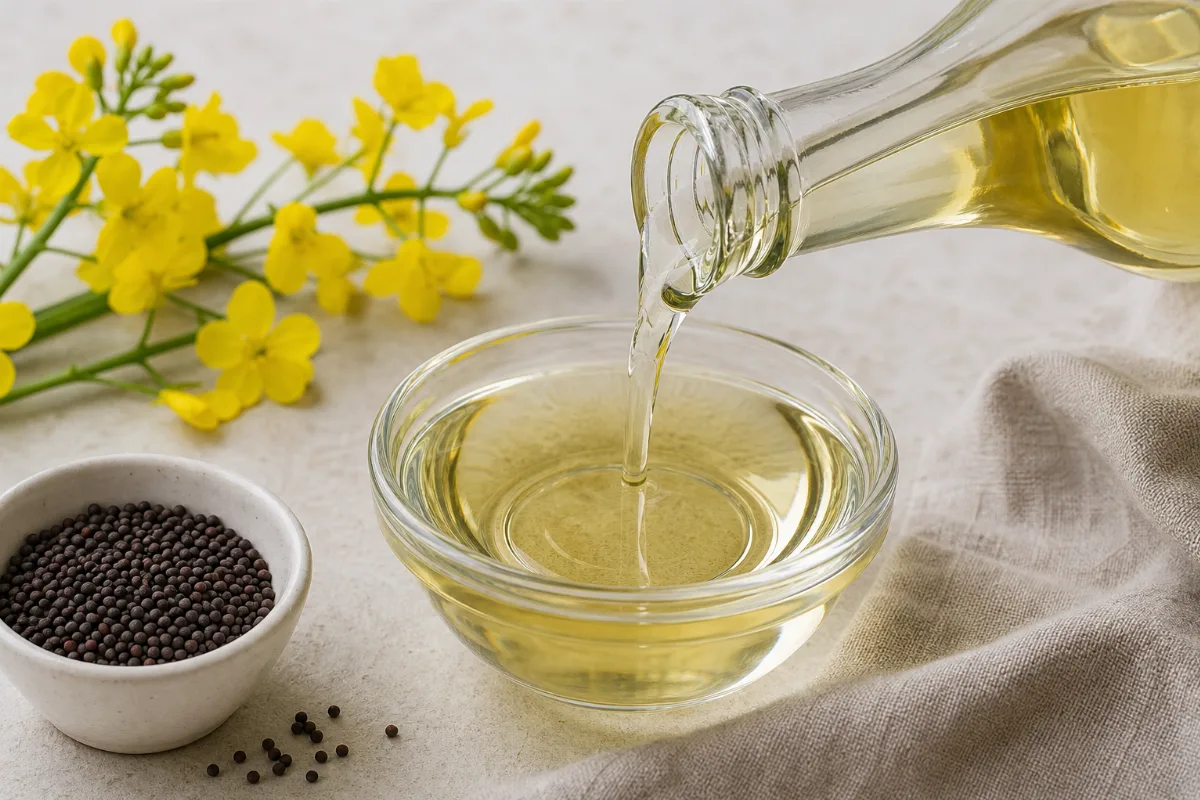
Canola oil is pressed from the seeds of rapeseed plants (Brassica napus and Brassica rapa) bred to be low in erucic acid. In US law it is called low erucic acid rapeseed oil, 'also known as canola oil', fully refined, bleached and deodorized, with no more than 2% erucic acid among its fatty acids.
USDA data for canola oil, per 100 g: 884 kcal, 100 g fat (7.37 g saturated, 63.28 g monounsaturated, 28.14 g polyunsaturated), 9.14 g ALA, 17.46 mg vitamin E, 71.3 mcg vitamin K and 0.395 g trans fat. One tablespoon (14 g) has about 124 kcal, 1.03 g saturated fat and 1.28 g ALA. These numbers come from the existing USDA summary and were not re-opened on the USDA site when this page was built.
What the research shows
Cholesterol is the best-studied use. A 2019 pooled analysis of 27 trials found canola oil lowered LDL by about 6.4 mg/dL and total cholesterol by about 7.2 mg/dL, with no effect on HDL or triglycerides. The drop was seen against sunflower oil and saturated fat. A 2023 analysis of 13 trials found canola oil lowered LDL by 6.13 mg/dL more than olive oil. These are small changes in blood tests.
For heart disease itself the evidence is thinner. The FDA's 2006 letter allows a qualified claim and describes the evidence as limited and not conclusive. The American Heart Association says swapping saturated fat for unsaturated fats, especially polyunsaturated, lowers cardiovascular disease, but that is about fats in general.
Body weight changed very little (about 0.3 kg lower in 2019; slightly lower BMI but higher waist-to-hip ratio in 2025). Inflammation was not tested for canola oil; a pooled analysis of ALA trials found no effect on inflammation markers.
At a glance
Traditional uses history, not proof
- Used as an everyday cooking and salad oil
- Long use as a food is not proof that it treats any condition
Studied for research
- Fat and nutrient content, high certainty for the numbers (USDA)
- Cholesterol, moderate certainty for a small LDL fall when it replaces saturated fat
- Canola versus olive oil, low certainty (blood measures only)
- Heart disease, low certainty (FDA: limited and not conclusive)
- Body weight, mixed (tiny changes)
- Inflammation, insufficient evidence
Main compounds
- Monounsaturated fat
- Polyunsaturated fat (linoleic acid and ALA)
- Vitamin E
- Vitamin K
- Erucic acid (kept very low)
Common forms
- Refined canola oil as a food fat (USDA values read)
- Cold-pressed or virgin canola oil and canola in processed foods were not read
- ALA or vitamin E supplements are different products and are not covered
Research links: 2019 review: canola oil and blood fats (27 trials) · 2023 review: canola oil versus olive oil (13 trials) · EFSA: erucic acid and highly exposed children · Research Library · Genes & Biomarkers Library
What it is and its history
- Accepted scientific name
- Brassica napus L. and Brassica rapa L. (rapeseed varieties bred for canola oil)
- Naming authority
- (L.)
- Common names
- Canola oil (en); Low erucic acid rapeseed oil (en); Rapeseed oil (UK usage) (en)
- Family or group
- Brassicaceae (mustard family); family name not re-verified from a source on this page.
- Classification
- Plantae > Brassicaceae > Brassica > Brassica napus
- Native range
- Not verified from a source read.
- Habitat
- Not verified from a source read.
- What it looks like
- Fruit: Oil is pressed from the seeds. Details not verified from a source read.
- Cultivation
- Not verified from a source read.
- Harvest and processing
- US law describes canola oil as fully refined, bleached and deodorized oil from low-erucic varieties (21 CFR 184.1555). Pressing methods and solvent extraction were not read.
- Look-alikes and adulterants
- Name: High-erucic rapeseed oil; Note: Natural forms of rapeseed and mustard can exceed 40% erucic acid; food-grade rapeseed is typically under 0.5% (EFSA summary).
- Sustainability and conservation
- Not assessed.
Photographs
What is inside, and how it may work
What it contains and how those compounds act in cells and animals. Laboratory and animal mechanisms are not proven effects in people.
Main compounds
| Compound | Family | Where it is concentrated | Activity studied | Level of evidence |
|---|---|---|---|---|
| Monounsaturated fat (mostly oleic acid) | fatty acid | Seed oil USDA: 63.28 g per 100 g | Part of the unsaturated fat that replaces saturated fat in the swap studies. 13 1 | Human data |
| Polyunsaturated fat (linoleic acid and ALA) | fatty acid | Seed oil USDA: 28.14 g per 100 g, of which linoleic acid 18.64 g and ALA 9.14 g | ALA is an essential plant omega-3. Only a part is turned into EPA and DHA in the body (Linus Pauling Institute). 13 12 | Human data |
| Saturated fat | fatty acid | Seed oil USDA: 7.37 g per 100 g | Low compared with many cooking fats; the AHA advisory links swapping it for unsaturated fat with lower LDL. 13 5 | Human data |
| Vitamin E (alpha-tocopherol) | vitamin | Seed oil USDA: 17.46 mg per 100 g | A nutrient present in the oil; no trial of canola oil as a vitamin E source was read. 13 | Nutrient database |
| Vitamin K (phylloquinone) | vitamin | Seed oil USDA: 71.3 mcg per 100 g | A nutrient present in the oil; see the warfarin note on the Safety tab. 13 | Nutrient database |
| Erucic acid | fatty acid | Seed oil No more than 2% of fatty acids by US law | Caused a temporary, reversible heart fat build-up in animals at high intake (EFSA). 8 7 | Animal research |
| Trans fat | fatty acid | Seed oil USDA: 0.395 g per 100 g | A trace in the refined oil. 13 11 | Nutrient database |
Mechanisms, receptors and pathways
| Target or pathway | Gene or receptor | What was found | Level |
|---|---|---|---|
| LDL cholesterol (swap of saturated for unsaturated fat) | Not specified in the sources read | The AHA advisory says replacing saturated with unsaturated fats lowers LDL, a cause of atherosclerosis. 5 | Human data |
| Heart muscle fat build-up (erucic acid) | Not specified | Animal tests with erucic acid-containing oils caused a temporary, reversible heart condition (myocardial lipidosis). 8 | Animal research |
Absorption, metabolism and elimination
- Absorption
- Not researched on this page, except that only part of dietary ALA is converted to EPA and DHA.
- Distribution
- Not found.
- Metabolism
- Linus Pauling Institute: about 8% of dietary ALA became EPA and 0 to 4% DHA in young men; about 21% and 9% in young women.
- Elimination
- Not found.
- Bioavailability
- Not established on this page.
Isolated compounds versus whole extracts
The trials are on canola oil used as a food fat, mostly replacing another fat. They do not cover ALA or vitamin E supplements, and the ALA inflammation analysis covers ALA from many sources.
Nutritional composition
Nutrition from USDA FoodData Central, Oil, canola (FDC 172336, SR Legacy). Per 100 g: 884 kcal; 100 g total fat; 7.37 g saturated, 63.28 g monounsaturated, 28.14 g polyunsaturated (18.64 g linoleic acid, 9.14 g ALA); 17.46 mg vitamin E; 71.3 mcg vitamin K; 0.395 g trans fat. One tablespoon (14 g) is the same numbers times 0.14: about 124 kcal, 1.03 g saturated fat, 8.86 g monounsaturated, 3.94 g polyunsaturated, 1.28 g ALA, 2.44 mg vitamin E and 10 mcg vitamin K. Source note: copied from the existing page's summary of that USDA record; the record was not re-opened on 2026-10-26 because the USDA service was rate-limited. Oil has no protein, carbohydrate or fibre.
1 high certainty1 moderate certainty1 mixed findings2 low certainty1 not enough evidence
What was looked at
The 6 benefits and uses checked for Canola Oil, each with how strong the evidence is. Tap one to open it.
- Fat profile, vitamin E and plant omega-3 (nutrient content)High certainty
- Cholesterol (canola oil replacing other fats)Moderate certainty
- Canola oil compared with olive oilLow certainty
- Heart disease (regulator wording and fat-swap advice)Low certainty
- Body weight and body shapeMixed findings
- Inflammation (markers in the blood)Not enough evidence
Lab markers tracked in the studies
LDL cholesterolTotal cholesterolHDL cholesterol and triglyceridesBody weight and BMIC-reactive protein (CRP) and other inflammation markers
What is Canola Oil good for?
The main studied uses and how strong the human evidence is for each. Most results are about canola oil replacing other fats in the diet, and most are blood tests, not health events.
Benefits, one by one
Each card is a research question, not a promise. Tap a goal to filter. Open a card to see the studies, doses and limits.
Fat profile, vitamin E and plant omega-3 (nutrient content)
High certaintyBy USDA data, canola oil is 100% fat, with 7.37 g of saturated fat per 100 g (about 1 g in a tablespoon). Most of the rest is monounsaturated (63.3 g) and polyunsaturated (28.1 g) fat, including 9.14 g of the plant omega-3 called ALA. One tablespoon (14 g) has about 124 kcal.
2 studiesRefined canola oil, as listed by USDA. Cold-pressed or virgin canola …
Studies, doses and limits
What the trials found
No trial was read showing that the vitamin E or ALA in canola oil corrects a shortfall. The Linus Pauling Institute page gives adult Adequate Intakes for ALA of 1.6 g a day for men and 1.1 g for women, and reports that only part of dietary ALA is turned into the long-chain omega-3s found in fish (about 8% to EPA in young men and about 21% in young women in the studies it cites).
Results
Canola oil is low in saturated fat and a source of ALA and vitamin E on paper. What your body does with the ALA is limited, so it is not a replacement for the omega-3s in fish.
Effect sizes as reported
USDA per 100 g: 884 kcal; saturated fat 7.37 g; monounsaturated 63.28 g; polyunsaturated 28.14 g; linoleic acid (omega-6) 18.64 g; ALA 9.14 g; vitamin E 17.46 mg; vitamin K 71.3 mcg; trans fat 0.395 g. One tablespoon (14 g) is the same numbers times 0.14.
Why this rating
High that the oil contains these amounts (USDA data). The values were copied from the existing summary of the USDA record, not re-opened on the USDA site on the day this page was built. No health effect is claimed from the numbers alone.
Form and dose studied
Refined canola oil, as listed by USDA. Cold-pressed or virgin canola oil and canola in spreads or dressings were not read.
Who was studied
General adult diet.
Limits
Nutrient facts, not trials. A tablespoon is a household portion used by USDA, not a recommendation.
Why researchers looked
Oils are judged first on their fat mix, because swapping saturated fat for unsaturated fat is the main diet advice for heart health.
Traditional use
Canola oil was bred from rapeseed to be low in erucic acid. Long use as a cooking oil is not proof of any health effect.
Proposed mechanism Nutrient database
These are nutrient amounts in the oil, from a USDA table.
A proposed mechanism does not show that the effect happens in people.
Oils are energy dense: about 124 kcal in a tablespoon.
Cholesterol (canola oil replacing other fats)
Moderate certaintyIn a pooled analysis of 27 trials, canola oil lowered LDL ('bad') cholesterol by about 6.4 mg/dL and total cholesterol by about 7.2 mg/dL, with no change in HDL or triglycerides. The drop was seen against sunflower oil and saturated fat. It is a small change in a blood test, not a heart outcome.
1 studiesCanola oil as a food fat in trials (amounts differed between trials a…
Studies, doses and limits
What the trials found
A 2019 pooled analysis of 27 randomized trials (1,359 people) found canola oil lowered total cholesterol by 7.24 mg/dL and LDL by 6.4 mg/dL, and had no effect on HDL, triglycerides, apo B or apo A1. Total cholesterol and LDL were lower than with sunflower oil and with saturated fat. The effect was seen in people over 50 and in trials longer than 30 days.
Results
A small, fairly consistent fall in LDL when canola oil replaces saturated fat or sunflower oil.
Effect sizes as reported
Total cholesterol -7.24 mg/dL (95% CI -12.1 to -2.7); LDL -6.4 mg/dL (95% CI -10.8 to -2).
Why this rating
Moderate for a small LDL fall, based on a pooled analysis of randomized trials. It is a blood marker, and the abstract does not give the authors' own quality rating or how much the trials differed. The rating here is ours.
Form and dose studied
Canola oil as a food fat in trials (amounts differed between trials and are not given here).
Who was studied
Adults, with larger effects in people over 50.
Limits
Comparison fats differed. Blood measures, not heart attacks or deaths. Only the abstract was read.
Why researchers looked
Canola oil is low in saturated fat and high in unsaturated fat, so researchers tested whether using it in place of other fats changes blood cholesterol.
Traditional use
Not a traditional remedy. It is a modern food oil.
Proposed mechanism Authoritative guidance
Not tested in these analyses. The usual explanation is that unsaturated fat replacing saturated fat lowers LDL, which the American Heart Association advisory describes.
A proposed mechanism does not show that the effect happens in people.
None specific beyond calories.
Canola oil compared with olive oil
Low certaintyIn 13 trials that compared canola oil directly with olive oil, canola gave a slightly bigger drop in LDL (6.13 mg/dL) and total cholesterol (8.92 mg/dL). This does not make olive oil a poor choice. Only blood fats were compared.
1 studiesCanola oil and olive oil as food fats in trials.
Studies, doses and limits
What the trials found
A 2023 pooled analysis of 13 randomized trials found canola oil lowered LDL by 6.13 mg/dL, total cholesterol by 8.92 mg/dL and the LDL/HDL ratio by 0.30 more than olive oil. Other blood lipids did not change significantly.
Results
Canola oil had a small edge on LDL and total cholesterol in head-to-head trials. No long-term outcome comparison was read.
Effect sizes as reported
LDL -6.13 mg/dL (95% CI -9.79 to -2.46); total cholesterol -8.92 mg/dL (95% CI -13.52 to -4.33); LDL/HDL ratio -0.30 (95% CI -0.53 to -0.06).
Why this rating
Low because it is one pooled analysis of 13 trials, the abstract does not say which type of olive oil was used, and the outcomes are blood measures. Olive oil's other evidence was not reviewed here.
Form and dose studied
Canola oil and olive oil as food fats in trials.
Who was studied
Adults.
Limits
Blood measures only. Only the abstract was read.
Why researchers looked
Olive oil and canola oil are both low in saturated fat, and trials disagreed on which lowers cholesterol more.
Traditional use
Olive oil has a long food tradition. Canola oil is a modern oil.
Proposed mechanism Nutrient database
Not tested. The two oils have different fat mixes; canola has more polyunsaturated fat and ALA.
A proposed mechanism does not show that the effect happens in people.
None specific.
Heart disease (regulator wording and fat-swap advice)
Low certaintyNo trial was read that tested canola oil against heart attacks. The FDA allowed a cautious label wording in 2006 saying the evidence is limited and not conclusive. The American Heart Association says swapping saturated fat for unsaturated fats, especially polyunsaturated, lowers heart disease.
2 studiesCanola oil as a replacement for saturated fat.
Studies, doses and limits
What the trials found
In 2006 the FDA said it would use enforcement discretion for a qualified claim about unsaturated fat from canola oil and coronary heart disease, if the label describes the evidence as limited and not conclusive. The petition's model wording said canola oil should replace a similar amount of saturated fat without increasing calories. The 2017 AHA advisory concludes that replacing saturated fat with unsaturated fats lowers cardiovascular disease, and notes the trials with the large effect used polyunsaturated vegetable oil.
Results
Supportive of a swap away from saturated fat, but not proof that canola oil on its own prevents heart disease.
Effect sizes as reported
AHA advisory: about 30% fewer cardiovascular events in trials that replaced saturated fat with polyunsaturated vegetable oil (not canola specifically).
Why this rating
Low for canola oil itself. The FDA letter calls the evidence limited and not conclusive, and the AHA figure is for polyunsaturated oils in general. Canola is mostly monounsaturated.
Form and dose studied
Canola oil as a replacement for saturated fat.
Who was studied
General adult population.
Limits
The FDA letter is from 2006 and later changes were not checked. A heart-event trial of canola oil was not found in the sources read.
Why researchers looked
Lower LDL is expected to lower heart disease risk, so regulators looked at canola oil's unsaturated fat.
Proposed mechanism Authoritative guidance
The AHA advisory links replacing saturated with unsaturated fat to lower LDL, and lower LDL to less atherosclerosis.
A proposed mechanism does not show that the effect happens in people.
Replacing saturated fat with refined carbohydrates and sugars was not linked to benefit in the AHA advisory.
Body weight and body shape
Mixed findingsPooled trials found tiny and mixed changes. A 2019 analysis of 25 studies found about 0.3 kg lower body weight with canola oil. A 2025 update of 32 trials found a slightly lower BMI but a slightly higher waist-to-hip ratio. Neither shows canola oil is a way to lose weight.
3 studiesCanola oil compared with other oils or fats.
Studies, doses and limits
What the trials found
The 2019 analysis (25 studies) found body weight 0.30 kg lower on average, mostly in people with type 2 diabetes, in parallel-design trials, in non-feeding trials and when canola was compared with saturated fat; other body measures did not change significantly. The 2025 analysis (32 randomized trials) found BMI 0.127 kg/m2 lower and waist-to-hip ratio 0.003 higher overall, with waist circumference higher in some subgroups such as people with high blood fats.
Results
Changes were very small and pointed in different directions for different measures. The effect depends on what canola oil is compared with.
Effect sizes as reported
2019: body weight -0.30 kg (95% CI -0.52 to -0.08). 2025: BMI -0.127 kg/m2 (95% CI -0.231 to -0.024); waist-to-hip ratio +0.003 (95% CI 0.001 to 0.005).
Why this rating
Mixed because the two analyses agree on a very small change in some measures and disagree in direction on others, and neither studied weight as the main goal of most trials.
Form and dose studied
Canola oil compared with other oils or fats.
Who was studied
Adults; subgroups with type 2 diabetes and high blood fats.
Limits
Authors of the 2019 analysis call for trials aimed at body weight. Only abstracts were read.
Why researchers looked
Oils are high in calories, so researchers checked whether canola oil changes body weight when it replaces other fats.
Proposed mechanism Not assessed
Not shown. The analyses report averages only.
A proposed mechanism does not show that the effect happens in people.
One tablespoon is about 124 kcal (USDA).
Inflammation (markers in the blood)
Not enough evidenceNo trial of canola oil and inflammation was found in the sources read. A pooled analysis of 25 trials of the plant omega-3 ALA, from various foods, found no effect on inflammation markers.
1 studiesALA from various food and supplement sources.
Studies, doses and limits
What the trials found
The ALA analysis (25 trials) found no significant effect on TNF, IL-6, CRP, sICAM-1 or sVCAM-1. In healthy people, ALA might raise CRP slightly. It covers ALA from many sources, not canola oil alone.
Results
No benefit and no clear harm for inflammation markers was shown for canola oil in the sources read.
Effect sizes as reported
CRP SMD -0.06 (95% CI -0.24 to 0.12); IL-6 SMD -0.17 (95% CI -0.46 to 0.12); TNF SMD -0.03 (95% CI -0.36 to 0.29).
Why this rating
Insufficient because no canola-specific trial was read and the ALA analysis is indirect.
Form and dose studied
ALA from various food and supplement sources.
Who was studied
Adults.
Limits
Indirect evidence; the large 'seed oils' question was not reviewed on this page.
Why researchers looked
Online claims say 'seed oils' cause inflammation, and canola oil is often named. Researchers have measured inflammation markers in ALA and fat trials.
Proposed mechanism Not assessed
Not shown for canola oil.
A proposed mechanism does not show that the effect happens in people.
None specific.
Connections to the rest of health
How Canola Oil connects to the rest of our health knowledge graph. Every link says what kind of connection it is. A safety link (for example to the liver) is a warning, not a benefit. A study that merely mentions a topic never creates a benefit link.
Explore every connection: goals, body systems, organs, symptoms, genes
A. Wellness goals
| Connected to | Kind of connection | Evidence status | Context | Studies |
|---|---|---|---|---|
| Preventive Wellness | High certainty | Fat profile, vitamin E and plant omega-3 (nutrient content): By USDA data, canola oil is 100% fat, with 7.37 g of saturated fat per 100 g (about 1 g in a tablespoon). Most of the rest is monounsaturated (63.3 g) and polyunsaturated (28.1 g) fat, including 9.14 g of the plant omega-3 called ALA. One tablespoon (14 g) has about 124 kcal. | 13 12 | |
| Cholesterol Balance | Moderate certainty | Cholesterol (canola oil replacing other fats): In a pooled analysis of 27 trials, canola oil lowered LDL ('bad') cholesterol by about 6.4 mg/dL and total cholesterol by about 7.2 mg/dL, with no change in HDL or triglycerides. The drop was seen against sunflower oil and saturated fat. It is a small change in a blood test, not a heart outcome. | 1 | |
| Heart Health | Moderate certainty | Cholesterol (canola oil replacing other fats): In a pooled analysis of 27 trials, canola oil lowered LDL ('bad') cholesterol by about 6.4 mg/dL and total cholesterol by about 7.2 mg/dL, with no change in HDL or triglycerides. The drop was seen against sunflower oil and saturated fat. It is a small change in a blood test, not a heart outcome. | 1 | |
| Cholesterol Balance | Low certainty | Canola oil compared with olive oil: In 13 trials that compared canola oil directly with olive oil, canola gave a slightly bigger drop in LDL (6.13 mg/dL) and total cholesterol (8.92 mg/dL). This does not make olive oil a poor choice. Only blood fats were compared. | 3 | |
| Heart Health | Low certainty | Heart disease (regulator wording and fat-swap advice): No trial was read that tested canola oil against heart attacks. The FDA allowed a cautious label wording in 2006 saying the evidence is limited and not conclusive. The American Heart Association says swapping saturated fat for unsaturated fats, especially polyunsaturated, lowers heart disease. | 10 5 | |
| Weight Management | Mixed findings | Body weight and body shape: Pooled trials found tiny and mixed changes. A 2019 analysis of 25 studies found about 0.3 kg lower body weight with canola oil. A 2025 update of 32 trials found a slightly lower BMI but a slightly higher waist-to-hip ratio. Neither shows canola oil is a way to lose weight. | 4 2 13 | |
| Inflammation Balance | Not enough evidence | Inflammation (markers in the blood): No trial of canola oil and inflammation was found in the sources read. A pooled analysis of 25 trials of the plant omega-3 ALA, from various foods, found no effect on inflammation markers. | 6 |
B. Body systems
| Connected to | Kind of connection | Evidence status | Context | Studies |
|---|---|---|---|---|
| Cardiovascular System | Biological association | High certainty | Studied for: Fat profile, vitamin E and plant omega-3 (nutrient content) Studied for: Cholesterol (canola oil replacing other fats) | 13 12 1 3 10 5 6 |
| Metabolism Weight | Biological association | Mixed findings | Studied for: Body weight and body shape | 4 2 13 |
I. Biomarkers
| Connected to | Kind of connection | Evidence status | Context | Studies |
|---|---|---|---|---|
| LDL cholesterol | Clinically supported (blood measure) | Lower by about 6.4 mg/dL in a pooled analysis of 27 trials, when canola oil replaced other fats. Preparation or compound: Canola oil as food |
1 3 | |
| LDL cholesterol | Biological association | Moderate certainty | Measured in trials: lowered. A lab change is not the same as a health benefit. | 1 3 |
| Total cholesterol | Biological association | Moderate certainty | Measured in trials: lowered. A lab change is not the same as a health benefit. | 1 3 |
| HDL cholesterol and triglycerides | Biological association | Moderate certainty | Measured in trials: no clear change. A lab change is not the same as a health benefit. | 1 |
| Body weight and BMI | Biological association | Mixed findings | Measured in trials: slightly lowered. A lab change is not the same as a health benefit. | 4 2 |
| C-reactive protein (CRP) and other inflammation markers | Biological association | Not enough evidence | Measured in trials: no clear change. A lab change is not the same as a health benefit. | 6 |
K. Biological pathways
| Connected to | Kind of connection | Evidence status | Context | Studies |
|---|---|---|---|---|
| Alpha-linolenic acid (ALA) | Preliminary mechanism | Human | Canola oil supplies ALA; only part is converted to long-chain omega-3s. | 13 12 |
| LDL cholesterol | Preliminary mechanism | Human | Lower with canola oil replacing saturated fat or sunflower oil in pooled trials. | 1 |
L. Active compounds
| Connected to | Kind of connection | Evidence status | Context | Studies |
|---|---|---|---|---|
| Monounsaturated fat (mostly oleic acid) | Biological association | Human | Part of the unsaturated fat that replaces saturated fat in the swap studies. Preparation or compound: Seed oil |
13 1 |
| Polyunsaturated fat (linoleic acid and ALA) | Biological association | Human | ALA is an essential plant omega-3. Only a part is turned into EPA and DHA in the body (Linus Pauling Institute). Preparation or compound: Seed oil |
13 12 |
| Saturated fat | Biological association | Human | Low compared with many cooking fats; the AHA advisory links swapping it for unsaturated fat with lower LDL. Preparation or compound: Seed oil |
13 5 |
| Vitamin E (alpha-tocopherol) | Biological association | Nutrient database | A nutrient present in the oil; no trial of canola oil as a vitamin E source was read. Preparation or compound: Seed oil |
13 |
| Vitamin K (phylloquinone) | Biological association | Nutrient database | A nutrient present in the oil; see the warfarin note on the Safety tab. Preparation or compound: Seed oil |
13 |
| Erucic acid | Biological association | Animal | Caused a temporary, reversible heart fat build-up in animals at high intake (EFSA). Preparation or compound: Seed oil |
8 7 |
| Trans fat | Biological association | Nutrient database | A trace in the refined oil. Preparation or compound: Seed oil |
13 11 |
Each connection is stored with the ingredient, the connected record, the kind of connection, the evidence status, the supporting studies, the preparation or compound involved, and a review date (last reviewed October 26, 2026).
Evidence at a glance: what changed in 2 lab markers
Tap a number to show only those markers. Counts are markers, not people.
The evidence
The research centre for Canola Oil. Every record here was checked against PubMed or the publisher's page; we never list a study we have not verified.
Evidence by outcome
Bars show how many studies we found for each outcome, not how well it works. People are added up across trials only (reviews are not added, to avoid double counting).
How we rate evidence
High certainty
Several well-run trials or reviews agree; further research is unlikely to change the picture much.
Moderate certainty
Good trials point the same way, but some doubt remains.
Low certainty
Small, short or inconsistent trials. The finding could change with better research.
Very low certainty
Very little or very weak human data. Treat as a possibility only.
Mixed findings
Trials or reviews disagree with each other.
Not enough evidence
Not enough human research to say either way.
Evidence against
Good research found no benefit, or found harm.
We take the reviewers' own risk-of-bias and GRADE statements where they exist, and otherwise judge from study size, design, consistency, directness and whether a product matches what is sold. Many publications do not make evidence high. Method note: We started from our existing canola oil summary, re-read the FDA, EFSA, US regulation, FDA allergen, FDA trans fat and Linus Pauling Institute pages, and re-checked six PubMed records by summary and abstract. Items we could not verify are flagged in the research gaps.
Study library: every study we checked 13
| Study | Design | People | Product, dose, length | Result |
|---|---|---|---|---|
| Ghobadi 2019 Effects of Canola Oil Consumption on Lipid Profile: A Systematic Review and Meta-Analysis of Randomized Controlled Clinical Trials. J Am Coll Nutr · PMID 30381009 · DOI |
Meta analysis of randomized trials |
27 trials, 1,359 participants Adults in 27 randomized trials (searched to December 2017) |
Canola oil lowered total cholesterol and LDL; no effect on HDL, triglycerides, apo B or apo A1. Total cholesterol and LDL were lower than with sunflower oil and with saturated fat. Effects were seen in people over 50 and in trials longer than 30 days. Total cholesterol -7.24 mg/dL; LDL -6.4 mg/dL (Total cholesterol 95% CI -12.1 to -2.7; LDL 95% CI -10.8 to -2) Methods, limits and fundingOutcomes: Total cholesterol, LDL, HDL, triglycerides, apo A1, apo B Limitations: Blood-measure outcomes, not heart disease events. Comparison fats differed between trials. Only the abstract was read, so heterogeneity and bias ratings were not checked. Funding and conflicts: Funding not stated in the abstract. Read: abstract | |
| Mohtashamian 2025 Effects of canola oil on body weight and composition in adults: an updated systematic review and meta-analysis of 32 randomized controlled trials. Nutr J · PMID 40200305 · DOI |
Meta analysis of randomized trials |
32 trials Adults in randomized trials (searched to September 2024) |
Overall, BMI was slightly lower and waist-to-hip ratio slightly higher with canola oil; other measures did not change significantly. Subgroups showed lower body weight in type 2 diabetes and higher waist circumference in some groups. BMI -0.127 kg/m2; waist-to-hip ratio +0.003 (BMI 95% CI -0.231 to -0.024; waist-to-hip ratio 95% CI 0.001 to 0.005) Methods, limits and fundingOutcomes: Body weight, BMI, waist circumference, waist-to-hip ratio Limitations: Tiny average changes in opposite directions for two measures. Comparison oils differed. Only the abstract was read. Funding and conflicts: Funding not stated in the abstract. Read: abstract | |
| Pourrajab 2023 Comparison of canola oil and olive oil consumption on the serum lipid profile in adults: a systematic review and meta-analysis of randomized controlled trials. Crit Rev Food Sci Nutr · PMID 35866510 · DOI |
Meta analysis of randomized trials |
13 trials Adults in 13 randomized trials (searched to 4 February 2022) |
Canola oil lowered LDL, total cholesterol and the LDL/HDL ratio compared with olive oil. No significant change in the other blood lipids. LDL -6.13 mg/dL; total cholesterol -8.92 mg/dL; LDL/HDL ratio -0.30 (LDL 95% CI -9.79 to -2.46; total cholesterol 95% CI -13.52 to -4.33; ratio 95% CI -0.53 to -0.06) Methods, limits and fundingOutcomes: LDL, total cholesterol, LDL/HDL ratio, HDL, triglycerides, VLDL Limitations: Blood-measure outcomes only. The abstract does not say which olive oil type (extra virgin or refined) was used. Only the abstract was read. Funding and conflicts: Funding not stated in the abstract. Read: abstract | |
| Raeisi-Dehkordi 2019 The Effect of Canola Oil on Body Weight and Composition: A Systematic Review and Meta-Analysis of Randomized Controlled Clinical Trials. Adv Nutr · PMID 30809634 · DOI |
Meta analysis of randomized trials |
25 studies (23 effect sizes for body weight) Adults in randomized controlled trials (searched to February 2018) |
Canola oil lowered body weight a little, most clearly in people with type 2 diabetes, in parallel-design trials, in non-feeding trials and when compared with saturated fat. No significant effect on the other body measures. Body weight -0.30 kg (95% CI -0.52 to -0.08 kg) Methods, limits and fundingOutcomes: Body weight, BMI, waist, hip, waist-to-hip ratio, lean and fat mass Limitations: A very small average change. The authors call for better trials aimed at body weight. Only the abstract was read. Funding and conflicts: Listed as 'Research Support, Non-U.S. Gov't' in PubMed; funding details not in the abstract. Read: abstract | |
| Sacks 2017 Dietary Fats and Cardiovascular Disease: A Presidential Advisory From the American Heart Association. Circulation · PMID 28620111 · DOI |
Expert advisory (review of trials and cohorts) |
General population evidence on dietary fats and cardiovascular disease | The advisory concludes strongly that lowering saturated fat and replacing it with unsaturated fats, especially polyunsaturated, lowers the incidence of cardiovascular disease. It says trials that swapped saturated fat for polyunsaturated vegetable oil reduced CVD by about 30%, and that replacing saturated fat with refined carbohydrates and sugars did not help. About 30% fewer CVD events in trials of saturated-for-polyunsaturated swaps (as stated in the abstract) (Not given in the abstract) Methods, limits and fundingOutcomes: Cardiovascular disease Limitations: A general advisory about fats, not a test of canola oil. Canola is mostly monounsaturated, so the 30% figure for polyunsaturated vegetable oil is not a promise for canola. Only the abstract was read. Funding and conflicts: An American Heart Association advisory; funding not stated in the abstract. Read: abstract | |
| Su 2018 Effect of dietary alpha-linolenic acid on blood inflammatory markers: a systematic review and meta-analysis of randomized controlled trials. Eur J Nutr · PMID 28275869 · DOI |
Meta analysis of randomized trials |
25 trials Adults in 25 randomized trials of dietary ALA |
No significant effect on any marker. In healthy people, ALA might raise CRP slightly. CRP SMD -0.06; IL-6 SMD -0.17; TNF SMD -0.03 (CRP 95% CI -0.24 to 0.12; IL-6 -0.46 to 0.12; TNF -0.36 to 0.29) Methods, limits and fundingOutcomes: TNF, IL-6, CRP, sICAM-1, sVCAM-1 Limitations: About ALA from many sources, not canola oil alone. Only the abstract was read. Funding and conflicts: Funding not stated in the abstract. Read: abstract | |
| s-cfr-184-1555 21 CFR 184.1555 Rapeseed oil (Cornell Legal Information Institute copy) · Source |
Regulation n/a |
Methods, limits and fundingRead: full-text | ||
| s-efsa-erucic-2016 EFSA news story: Erucic acid in food: health risk for highly exposed children (9 November 2016) · Source |
Regulator news summary n/a |
Methods, limits and fundingRead: full-text | ||
| s-fda-allergens FDA: Food Allergies · Source |
Regulator page n/a |
Methods, limits and fundingRead: full-text | ||
| s-fda-canola-qhc FDA: Qualified Health Claims, Letter of Enforcement Discretion, Unsaturated Fatty Acids from Canola Oil and Reduced Risk of Coronary Heart Disease (Docket 2006Q-0091), 6 October 2006 · Source |
Regulator letter n/a |
Methods, limits and fundingRead: full-text | ||
| s-fda-trans-fat FDA: Trans Fat · Source |
Regulator page n/a |
Methods, limits and fundingRead: full-text | ||
| s-lpi-efa Linus Pauling Institute, Oregon State University: Essential Fatty Acids · Source |
University reference n/a |
Methods, limits and fundingRead: full-text | ||
| s-usda-fdc-172336 USDA FoodData Central: Oil, canola (FDC 172336, SR Legacy) · Source |
Food composition database n/a |
Methods, limits and fundingRead: summary-only |
What we do not know yet
- No trial of canola oil and heart attacks, strokes or deaths was found; the heart findings are blood measures and regulator wording.
- The USDA record was not re-opened on the day this page was built; nutrient numbers come from the existing summary.
- Canola allergy, pregnancy, breastfeeding, smoke point, heating, solvent extraction, pesticide residues and genetic modification were not researched.
- Cold-pressed canola oil and canola in processed foods were not researched.
- Only abstracts were read for the studies, and EFSA and FDA statements come from a news summary and an archived 2006 letter.
How new research is added
New studies are found by a saved PubMed search and placed in a review queue before the page changes.
Lab markers
What changed in blood or saliva tests during trials. A changed number is not the same as feeling or being healthier, and we give no "normal ranges".
Metabolic 3
LDL cholesterol
Lowered in trials
The 'bad' cholesterol carried in the blood. Higher levels are linked to more heart disease.
Moderate certaintyResults and what it means
Why it was measured
It is the usual blood marker used in diet trials for heart risk.
Statistical vs. clinical meaning
A small average fall from a fat swap.
Safety implication
None specific.
Total cholesterol
Lowered in trials
All the cholesterol carried in the blood, including LDL and HDL.
Moderate certaintyResults and what it means
Why it was measured
It is reported in almost every diet trial of fats.
Statistical vs. clinical meaning
A small average fall from a fat swap.
Safety implication
None specific.
Body weight and BMI
Slightly lowered in trials
Body weight in kilograms and body mass index (weight relative to height).
Mixed findingsResults and what it means
Why it was measured
It is the standard outcome in weight and diet trials.
Statistical vs. clinical meaning
Very small averages that go in different directions for different measures.
Safety implication
None specific.
Inflammatory 1
C-reactive protein (CRP) and other inflammation markers
No clear change in trials
CRP is a blood protein that rises with inflammation.
Not enough evidenceResults and what it means
Why it was measured
Used as a general sign of inflammation in diet trials.
Statistical vs. clinical meaning
ALA overall did not change the markers. Canola oil itself was not tested.
Safety implication
None specific.
| Study | Result | People | Product |
|---|---|---|---|
| 6 | CRP SMD -0.06 (95% CI -0.24 to 0.12) with higher dietary ALA; IL-6 and TNF also not significant | Adults in 25 trials | Dietary ALA from various sources |
Other 1
HDL cholesterol and triglycerides
No clear change in trials
HDL is the 'good' cholesterol; triglycerides are another blood fat.
Moderate certaintyResults and what it means
Safety
What studies and official sources say about side effects, medicines and who should check first. Each point shows what kind of evidence it comes from.
Main points to know 3
- Erucic acid: canola is the low-erucic type, but EFSA flags highly exposed children. Canola oil is defined in US law as rapeseed oil with no more than 2% erucic acid among its fatty acids, and it may not be used in infant formula. EFSA set a tolerable daily intake of 7 mg per kg of body weight for erucic acid from all foods and said some highly exposed infants and children could reach 7.4 mg/kg a day, probably an overestimate. EFSA's news summary names pastries, cakes and biscuits as the main sources for young children and infant formula for infants; it does not give canola oil's share. Authoritative guidance 7 8
- High in calories. One tablespoon (14 g) has about 124 kcal by USDA data, like other oils. Nutrient database 13
- Trace trans fat. USDA lists 0.395 g of trans fat per 100 g, about 0.06 g in a tablespoon. The FDA determined in 2015 that partially hydrogenated oils are no longer generally recognized as safe, and most uses ended in 2018. Check labels on processed foods. Authoritative guidance 13 11
Side effects 2
| Effect | How often | Severity and recovery | Evidence |
|---|---|---|---|
| No harm from eating canola oil as an ordinary food was found in the sources read. Absence of findings in the few sources read is not proof of safety. Allergy and heated-oil questions are covered below. | No frequency data found. | not applicable Not applicable. | Not assessed 10 |
| Weight gain if oil adds calories on top of an unchanged diet (general to all oils). The FDA claim wording and the pooled trials describe canola oil replacing another fat, not adding to the diet. | Not quantified for canola oil. | mild Not described. | Nutrient database 13 |
Liver
No liver injury from eating canola oil as food was found in the sources read. EFSA's animal tests with high-erucic oils also reported weight changes in liver, kidney and skeletal muscle at slightly higher doses than the heart changes. 8
How often. No frequency was found.
Monitoring. No agency monitoring advice was found.
This is a safety connection. It is not evidence that Canola Oil supports liver health.
Medicines and supplements 2
| With | Why it matters | Importance | Evidence | What to do |
|---|---|---|---|---|
| Warfarin and other vitamin K-sensitive blood thinners prescription | USDA lists 71.3 mcg of vitamin K per 100 g of canola oil, about 10 mcg in a tablespoon. | No source read links ordinary canola oil intake with a change in warfarin control. | Nutrient database Not enough evidence 13 | If you take warfarin, keep your diet steady and tell your clinic about big changes in oils or leafy foods. |
| Cholesterol medicines (statins and others) prescription | Both lower LDL by different routes. | No interaction or added effect was found in the sources read. | Not assessed Not enough evidence | Ask your clinician or pharmacist before changing your fats if you are on cholesterol medicine. |
Who should check first 1
| Situation | Advice | Evidence |
|---|---|---|
| Infant formula | US rules do not permit low erucic acid rapeseed oil in infant formula. This is a regulatory limit, not a finding of harm. | Regulation 7 |
Overdose, product quality and regulators
Summary. No toxicity from canola oil as an ordinary food was found. The toxic effect studied is that of erucic acid (heart fat build-up in animals), which canola is bred to keep very low.
Animal. EFSA's summary reports a temporary, reversible heart condition (myocardial lipidosis) in animals fed oils containing erucic acid, and changes in liver, kidney and skeletal muscle weight at slightly higher doses.
High dose or long term signals. EFSA found the tolerable daily intake could be exceeded by highly exposed infants and children from erucic acid-containing foods overall.
Overdose response. Not found.
Genotoxicity. Not researched.
Toxic or hazardous parts. Natural rapeseed can have over 40% erucic acid; food-grade rapeseed is typically under 0.5% (EFSA summary).
Contamination (pesticides, solvent residues, oxidation when heated, genetic modification) was not researched for this page.
Heating. No source on canola oil's behaviour when heated was read. A kitchen-simulation study in the earlier notes tested other oils, not canola, so nothing is claimed.
| Body | Action | Date |
|---|---|---|
| US FDA (United States) | Qualified health claim letter (enforcement discretion): unsaturated fatty acids from canola oil and reduced risk of coronary heart disease, with wording that the evidence is limited and not conclusive. source | 2006-10-06 |
| US Code of Federal Regulations (United States) | 21 CFR 184.1555: low erucic acid rapeseed oil (canola oil) has no more than 2% erucic acid among its fatty acids; permitted as an edible oil except in infant formula. source | |
| EFSA (EU) (European Union) | Tolerable daily intake of 7 mg/kg body weight for erucic acid; highly exposed infants and children may exceed it. source | 2016-11-09 |
| US FDA (United States) | Partially hydrogenated oils no longer generally recognized as safe (2015); manufacturers could not add them to most foods after 18 June 2018. source | 2024-04-30 |
| US FDA (United States) | Food allergies: lists nine major allergens (milk, eggs, fish, crustacean shellfish, tree nuts, peanuts, wheat, soybeans, sesame). Canola is not on the list. source | 2026-03-11 |
When to get medical help
- Trouble breathing, wheezing, or swelling of the lips, face, tongue or throat after eating any food: call 911 or your local emergency number.
- Hives spreading over the body with vomiting or dizziness after a meal.
Stop using the product and contact a clinician or emergency service. In the US, Poison Control is 1-800-222-1222.
General information only, not medical advice. Ask a clinician or pharmacist before use, especially with medicines, in pregnancy or with a health condition. See the Natural Remedy Safety guide.
Frequently asked questions
What is canola oil?
Canola oil is a cooking oil pressed from the seeds of rapeseed plants (Brassica napus and Brassica rapa) bred to be low in erucic acid. US law defines it as low erucic acid rapeseed oil with no more than 2% erucic acid among its fatty acids.
What fats are in canola oil?
By USDA data, per 100 g it has 7.37 g of saturated fat, 63.28 g of monounsaturated fat and 28.14 g of polyunsaturated fat, including 9.14 g of the plant omega-3 ALA. A tablespoon (14 g) has about 124 kcal.
Does canola oil lower cholesterol?
A little, in trials where it replaced other fats. A pooled analysis of 27 trials found LDL about 6.4 mg/dL lower and total cholesterol about 7.2 mg/dL lower, mainly against sunflower oil and saturated fat. It did not change HDL or triglycerides. These are blood measures, not heart attacks.
Is canola oil better than olive oil for cholesterol?
In 13 head-to-head trials canola oil lowered LDL by 6.13 mg/dL and total cholesterol by 8.92 mg/dL more than olive oil. That is a small difference in blood tests only, and the abstract does not say which type of olive oil was used. Olive oil has other evidence that was not reviewed here.
Is canola oil good for the heart?
The evidence is limited. The FDA allowed a cautious label wording in 2006 and calls the evidence limited and not conclusive. The American Heart Association says replacing saturated fat with unsaturated fats lowers heart disease, but its strongest figure is for polyunsaturated oils in general, not canola oil specifically.
Does canola oil cause inflammation?
No canola-specific trial was found. A pooled analysis of 25 trials of dietary ALA, the plant omega-3 that canola oil contains, found no effect on blood markers of inflammation. That is indirect evidence, so the question is not settled for canola oil.
Will canola oil help me lose weight?
What is erucic acid and is it a problem in canola oil?
Erucic acid is a fat found in natural rapeseed, where it can be over 40% of fatty acids. In animals, high intake caused a temporary heart fat build-up. Canola was bred to be low in it: US law caps it at 2%, and food-grade rapeseed is typically under 0.5% per EFSA. EFSA's concern was highly exposed young children across all foods, mainly pastries, cakes and biscuits.
Does canola oil have trans fat?
Is canola oil a source of omega-3?
Is canola a common food allergen?
Canola is not one of the nine major food allergens listed by the US FDA (milk, eggs, fish, crustacean shellfish, tree nuts, peanuts, wheat, soybeans, sesame). Canola allergy itself was not researched here. For trouble breathing or swelling of the face or throat after any food, call 911 or your local emergency number.
Does canola oil interact with medicines?
No interaction was found in the sources read, either way. Canola oil does contain vitamin K (about 10 mcg per tablespoon by USDA), so people on warfarin should keep their diet steady and ask their clinic or pharmacist.
Explore by health goal
Cholesterol BalanceHeart HealthPreventive WellnessWeight ManagementInflammation Balance
Editorial transparency
- Written by
- AlternativeMed editorial team. Research compiled with AI assistance, then checked against the sources listed.
- Medical review
- None. This page has not been reviewed by a physician or pharmacist.
- First published
- 2026-10-26
- Last substantive update
- 2026-10-26
- How we research
- We started from our existing canola oil summary, re-read the FDA, EFSA, US regulation, FDA allergen, FDA trans fat and Linus Pauling Institute pages, and re-checked six PubMed records by summary and abstract. Items we could not verify are flagged in the research gaps.
- How we rate evidence
- See "How we rate evidence" in the Evidence tab.
- Independence
- No product is promoted on this page. No affiliate links are shown. Funding is not stated in the abstracts read.
Sources 13
Each source was opened and checked. Where we read only the abstract, it says so. The small numbers in the text point here.
- Ghobadi S, Hassanzadeh-Rostami Z, Mohammadian F, et al.. Effects of Canola Oil Consumption on Lipid Profile: A Systematic Review and Meta-Analysis of Randomized Controlled Clinical Trials.. J Am Coll Nutr. 2019. PMID 30381009. DOI 10.1080/07315724.2018.1475270. (abstract)
- Mohtashamian A, Mahabady M, Bagheri F, et al.. Effects of canola oil on body weight and composition in adults: an updated systematic review and meta-analysis of 32 randomized controlled trials.. Nutr J. 2025. PMID 40200305. DOI 10.1186/s12937-025-01117-5. (abstract)
- Pourrajab B, Sharifi-Zahabi E, Soltani S, et al.. Comparison of canola oil and olive oil consumption on the serum lipid profile in adults: a systematic review and meta-analysis of randomized controlled trials.. Crit Rev Food Sci Nutr. 2023. PMID 35866510. DOI 10.1080/10408398.2022.2100314. (abstract)
- Raeisi-Dehkordi H, Amiri M, Humphries KH, et al.. The Effect of Canola Oil on Body Weight and Composition: A Systematic Review and Meta-Analysis of Randomized Controlled Clinical Trials.. Adv Nutr. 2019. PMID 30809634. DOI 10.1093/advances/nmy108. (abstract)
- Sacks FM, Lichtenstein AH, Wu JHY, et al.. Dietary Fats and Cardiovascular Disease: A Presidential Advisory From the American Heart Association.. Circulation. 2017. PMID 28620111. DOI 10.1161/CIR.0000000000000510. (abstract)
- Su H, Liu R, Chang M, et al.. Effect of dietary alpha-linolenic acid on blood inflammatory markers: a systematic review and meta-analysis of randomized controlled trials.. Eur J Nutr. 2018. PMID 28275869. DOI 10.1007/s00394-017-1386-2. (abstract)
- . 21 CFR 184.1555 Rapeseed oil (Cornell Legal Information Institute copy). . . (full-text)
- . EFSA news story: Erucic acid in food: health risk for highly exposed children (9 November 2016). . . (full-text)
- . FDA: Food Allergies. . . (full-text)
- . FDA: Qualified Health Claims, Letter of Enforcement Discretion, Unsaturated Fatty Acids from Canola Oil and Reduced Risk of Coronary Heart Disease (Docket 2006Q-0091), 6 October 2006. . . (full-text)
- . FDA: Trans Fat. . . (full-text)
- . Linus Pauling Institute, Oregon State University: Essential Fatty Acids. . . (full-text)
- . USDA FoodData Central: Oil, canola (FDC 172336, SR Legacy). . . (summary-only)
Where to buy
Check the label first. Whatever you buy, look for these:
- Cold-pressed or refined, to match how you cook
- A harvest or best-by date and a dark glass or tin container
- The oil's origin and any testing statement
- Smoke point for the way you cook
Talk to a pharmacist or doctor before you start any supplement, especially if you take medicines. See the Safety tab for interactions.
Support our free guides: as an Amazon Associate we earn from qualifying purchases. Full disclosure.


