Oils & Fats · Cooking oil
Flaxseed Oil
Linum usitatissimum (seed oil) · also called Flax oil, linseed oil, aceite de linaza, aceite de lino
Flaxseed oil is pressed from the seeds of the flax plant. It is the richest common food source of ALA, a plant omega-3 fat. Large reviews found that eating more ALA probably makes little or no difference to deaths and may slightly lower heart and blood-vessel events. The body turns very little ALA into DHA, so it is not a swap for fish oil. Main cautions: it may interact with blood thinners, allergy is possible, and it goes off quickly.
General information, not medical advice. Last substantive update · Not medically reviewed. A named clinician has not signed off on this page. How this page is made
About Flaxseed Oil
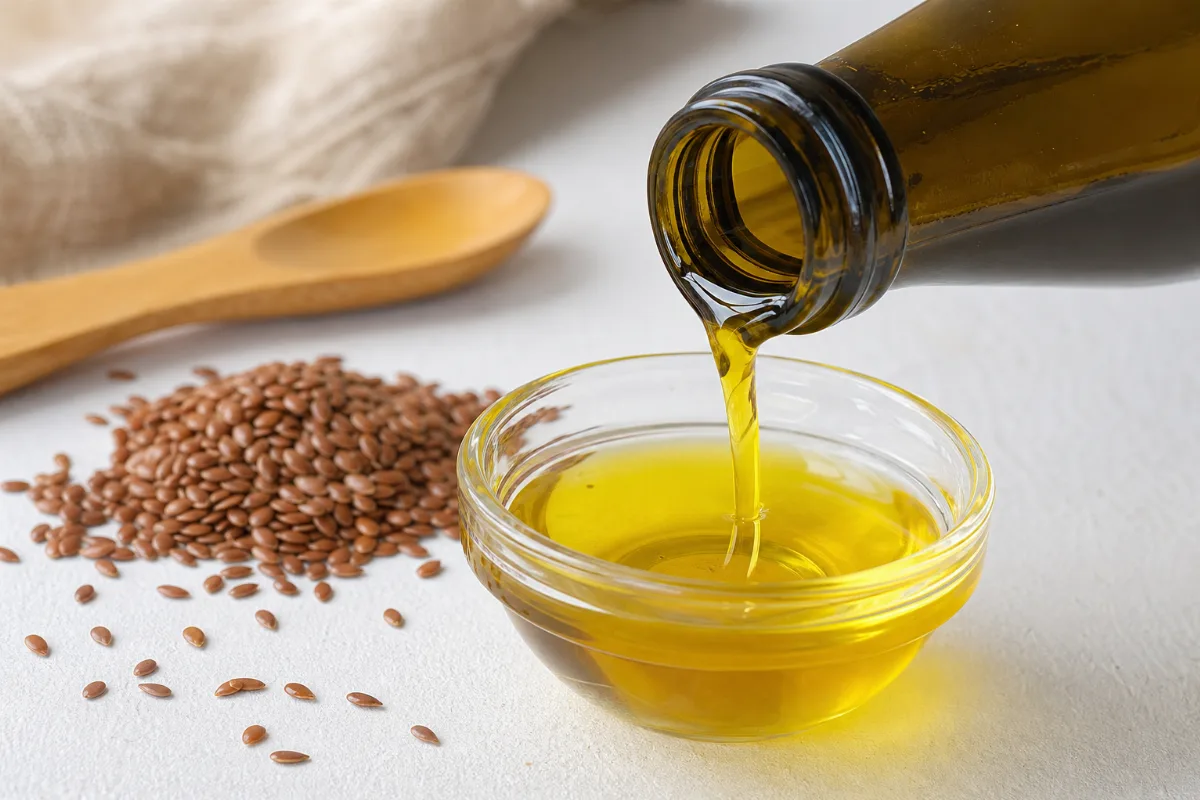
Flaxseed oil is a pale golden oil pressed from flax seeds (Linum usitatissimum). It has more ALA, a plant omega-3 fat, than any other common food oil in the sources read. The research is about ALA in general: it probably changes deaths little, may slightly lower heart events, and does not make much DHA. The key cautions are a theoretical blood-thinner interaction, allergy, loose stools at higher amounts, and spoiling quickly.
What it is
Flaxseed oil, also called flax oil or linseed oil, comes from the seeds of Linum usitatissimum L. (GBIF accepts this name; family Linaceae). Industrial linseed oil used in paints is a different product.
The Linus Pauling Institute lists 7.3 g of ALA in a tablespoon of flaxseed oil, against 1.3 g for canola oil and 0.9 g for soybean oil. USDA FoodData Central (item 167702, cold-pressed flaxseed oil) is reported to give about 120 kcal and 13.6 g of fat per tablespoon; those USDA figures could not be re-opened, so treat them as unconfirmed. The oil has no fiber: that is in the seed.
What the research shows
Heart: a Cochrane review found that more ALA probably makes little or no difference to deaths and may slightly lower cardiovascular events (low certainty, interval includes no effect). In adults with overweight, pooled trials found lower triglycerides, CRP and systolic pressure but slightly higher LDL.
Blood pressure and inflammation: pooled reviews found no significant effect, though only 3 of 17 blood pressure trials used flaxseed oil.
Cohorts link higher ALA intake to fewer deaths and slightly more cancer deaths. These are links, not proof.
NCCIH says flaxseed oil supplements do not seem to help weight loss.
Not a swap for fish oil
A review of human studies found that extra ALA raises blood EPA and DPA but has little effect on DHA, while preformed DHA raises blood DHA. Flaxseed oil gives ALA, not EPA or DHA.
Food, capsule or seed
Most trials gave ALA as capsules or in mixed foods, often in people with a health condition. We found no trial that isolates flaxseed oil used as a food oil in healthy people. Ground flaxseed, flaxseed lignan extract and mucilage are separate products; their results do not carry over to the oil.
Rancidity and cooking
Polyunsaturated fats go rancid more easily than saturated fats, and flaxseed oil is very high in them. Follow the bottle's storage line and do not use oil that smells sharp, bitter or unpleasant.
We read no source giving a smoke point for flaxseed oil, so none is given. In one frying test of other oils, aldehyde fumes rose with the share of ALA in the oil; flaxseed oil was not tested.
At a glance
Traditional uses history, not proof
- The sources read describe flaxseed (the seed) as used for linen, stews and laxatives in the past, and the oil for paints in North America. They do not describe a traditional use of the food oil, so none is claimed.
Studied for research
- Heart and circulation events (more plant omega-3), low
- Blood fats and blood pressure in adults with overweight or obesity (plant ALA), low; LDL went up slightly
- Blood pressure (flaxseed or olive oil supplements), low; no significant effect
- Inflammation markers (plant ALA), moderate; no effect
- Turning into EPA and DHA, moderate; EPA and DPA up, DHA little changed
- Blood fats and CRP in dialysis patients (flaxseed oil), very-low
- Death in cohort studies of ALA intake, very-low (observational)
- Prostate cancer risk (dietary ALA), very-low; no clear link
- Weight loss, low; no help per NCCIH
Main compounds
- Alpha-linolenic acid (ALA, omega-3), the main fat
- Linoleic acid (omega-6)
- Oleic acid (omega-9), a smaller part
Common forms
- Bottled oil (cold-pressed or refined)
- Capsules (a supplement, not the same as the food)
- Ground flaxseed (a different food with fibre; not covered here)
Research links: Cochrane review of omega-3 and heart disease (abstract) · ALA and heart risk markers in overweight adults (abstract) · ALA conversion to EPA and DHA (abstract) · ALA intake and death in cohort studies (abstract) · NCCIH: flaxseed and flaxseed oil · Linus Pauling Institute: essential fatty acids · Research Library · Genes & Biomarkers Library
What it is and its history
- Accepted scientific name
- Linum usitatissimum
- Naming authority
- L.
- Common names
- Flaxseed oil (English); Flax oil (English); Linseed oil (English (also used for industrial oil)); Aceite de linaza (Spanish); Aceite de lino (Spanish)
- Family or group
- Linaceae (the flax family)
- Classification
- Plantae > Tracheophyta > Magnoliopsida > Malpighiales > Linaceae > Linum > Linum usitatissimum
- Native range
- NCCIH says flaxseed was originally cultivated near the Middle East.
- Habitat
- Not checked.
- What it looks like
- Roots: Not checked.; Stems: Not checked.; Leaves: Not checked.; Flowers: Not checked.; Fruit: The oil is pressed from the seeds.
- Cultivation
- Not checked.
- Harvest and processing
- Not checked. The sources read do not describe how the oil is pressed or refined.
- Look-alikes and adulterants
- Name: Ground flaxseed; Note: A different food with fibre; its results do not transfer to the oil.; Name: Industrial linseed oil; Note: Used in paints; not a food.; Name: Fish oil; Note: Supplies EPA and DHA directly; flaxseed oil supplies ALA instead.
- Sustainability and conservation
- Not checked.
Traditional use and history history, not clinical proof
| Tradition or era | Documented use | Source |
|---|---|---|
| Ancient Egypt, Ethiopia, ancient Greece, European settlers in North America (as described by NCCIH) | NCCIH says flaxseed was used to make linen cloths in ancient Egypt, stews in Ethiopia and laxatives in ancient Greece, and that European settlers in North America used it for poultices and the oil for paints. These describe the seed and its products in general, not the food oil. | s-nccih-flaxseed |
Traditional use shows how it was used. It does not show that it works or is safe today.
What is inside, and how it may work
What it contains and how those compounds act in cells and animals. Laboratory and animal mechanisms are not proven effects in people.
Main compounds
| Compound | Family | Where it is concentrated | Activity studied | Level of evidence |
|---|---|---|---|---|
| Alpha-linolenic acid (ALA) PubChem 5280934 | omega-3 polyunsaturated fatty acid | Seed oil 7.3 g per tablespoon (Linus Pauling Institute table); USDA FoodData Central item 167702 is reported to give 53.4 g per 100 g (not re-opened). | The main fat; the richest common food source of ALA per the sources read. 5 | Chemistry |
| Linoleic acid PubChem 5280450 | omega-6 polyunsaturated fatty acid | Seed oil USDA item 167702 is reported to give 14.25 g per 100 g (not re-opened). | Second polyunsaturated fat in the oil. | Chemistry |
| Oleic acid PubChem 445639 | omega-9 monounsaturated fatty acid | Seed oil Monounsaturated fat in total was 18.44 g per 100 g per USDA item 167702 (not re-opened); oleic acid itself was not separated. | Minor part of the oil. | Chemistry |
Mechanisms, receptors and pathways
| Target or pathway | Gene or receptor | What was found | Level |
|---|---|---|---|
| Conversion of ALA to longer omega-3 fats | Not specified in the abstract | In healthy adults, extra ALA raised blood EPA and DPA but had little effect on DHA. 2 | Human studies review |
Absorption, metabolism and elimination
- Absorption
- Not described in the sources read.
- Distribution
- Not described.
- Metabolism
- Some ALA is converted to EPA and DPA; little to DHA.
- Elimination
- Not described.
- Bioavailability
- Not described.
Isolated compounds versus whole extracts
Flaxseed oil, ground flaxseed, flaxseed lignan extract, flaxseed mucilage and ALA capsules are different things. NCCIH treats them separately. Fiber, lignans and mucilage are in the seed, not (in meaningful amounts, as far as the sources read say) in the pressed oil, and results for one cannot be applied to another.
Nutritional composition
A tablespoon of flaxseed oil is a fat, with no fiber or protein. By the Linus Pauling Institute table it gives about 7.3 g of ALA per tablespoon, far more than canola oil (1.3 g) or soybean oil (0.9 g). USDA FoodData Central item 167702 (cold-pressed flaxseed oil) is reported to give about 120 kcal and 13.6 g of fat per tablespoon (13.6 g of oil), with about 1.2 g saturated fat, 2.5 g monounsaturated fat and 9.2 g polyunsaturated fat. The USDA service was rate-limited when checked on 2026-10-26, so only the ALA figure was confirmed against a second source. The US Adequate Intake for ALA is 1.6 g a day for men and 1.1 g for women (Linus Pauling Institute); this is a whole-diet reference figure, not advice to use the oil.
2 moderate certainty4 low certainty3 very low certainty
What was looked at
The 9 benefits and uses checked for Flaxseed Oil, each with how strong the evidence is. Tap one to open it.
- Heart and circulation events (more plant omega-3, ALA)Low certainty
- Blood fats and blood pressure in adults with overweight or obesity (plant ALA)Low certainty
- Blood pressure (flaxseed oil or olive oil supplements)Low certainty
- Inflammation markers in the blood (plant ALA)Moderate certainty
- Turning into fish-type omega-3s (EPA, DPA, DHA)Moderate certainty
- Blood fats and CRP in people on hemodialysis (flaxseed oil)Very low certainty
- Long-term health: deaths in people who eat more ALA (cohort studies)Very low certainty
- Prostate cancer risk (dietary ALA)Very low certainty
- Weight lossLow certainty
Lab markers tracked in the studies
LDL cholesterolTriglyceridesSystolic blood pressureC-reactive protein (CRP)Blood DHA and EPA
What is Flaxseed Oil good for?
What the research shows for each use, and how strong it is. Most of it is about plant omega-3 (ALA) from several sources or supplements, not flaxseed oil used as a food. Read the Safety tab too.
Benefits, one by one
Each card is a research question, not a promise. Tap a goal to filter. Open a card to see the studies, doses and limits.
Heart and circulation events (more plant omega-3, ALA)
Low certaintyA large Cochrane review of long trials found that eating more plant omega-3 (ALA) probably makes little or no difference to deaths, and may slightly lower heart and blood-vessel events.
1 studiesTrials used ALA from foods, enriched foods, advice or supplements. Fl…
Studies, doses and limits
What the trials found
One Cochrane review of 86 trials; 5 of them tested ALA (19,327 people). They used several ALA sources, not only flaxseed oil.
Results
Deaths from any cause, heart deaths and coronary deaths: probably little or no difference (moderate certainty). Cardiovascular events: RR 0.95 (95% CI 0.83 to 1.07), possibly a slight reduction (low certainty). Irregular heartbeat (arrhythmia): RR 0.73 (0.55 to 0.97) from 2 trials, probably slightly reduced (moderate). Stroke effects are unclear.
Effect sizes as reported
RR 0.95 for cardiovascular events; RR 0.73 for arrhythmia.
Why this rating
The Cochrane authors rate the event result as low certainty and the interval includes no effect. Only 5 trials, mixed ALA sources.
Form and dose studied
Trials used ALA from foods, enriched foods, advice or supplements. Flaxseed oil as a cooking or table oil was not singled out.
Who was studied
Adults at varying cardiovascular risk, mainly in high-income countries.
Limits
Not flaxseed oil alone; confidence interval includes no effect; the review's main finding is about fish-oil omega-3s, not ALA.
Why researchers looked
Flaxseed oil is the richest common food source of ALA, so it is studied as a plant omega-3 option.
Proposed mechanism Review
ALA is a plant omega-3 fat. The body can turn a small part of it into EPA and DPA. How this might affect the heart in people is not settled.
A proposed mechanism does not show that the effect happens in people.
These trials mostly used capsules or ALA-rich foods, not the oil as a food. Anyone on blood thinners should read the Safety tab.
Blood fats and blood pressure in adults with overweight or obesity (plant ALA)
Low certaintyPooled small trials found plant ALA lowered triglycerides, C-reactive protein, TNF-alpha and systolic blood pressure a little, and raised LDL cholesterol a little.
1 studiesPlant ALA from supplements, foods or both; a subgroup using flaxseed …
Studies, doses and limits
What the trials found
Meta-analysis of 19 randomized trials, 1,183 adults with overweight or obesity. Sources were plant ALA from supplements or foods; flaxseed and flaxseed oil were among them.
Results
Triglycerides, CRP, TNF-alpha and systolic pressure were lower than with placebo; LDL cholesterol was higher (SMD 1.32 mg/dL). Total cholesterol, HDL, diastolic pressure and IL-6 did not change. The effect looked more prominent with flaxseed and flaxseed oil used for 12 weeks or longer.
Effect sizes as reported
Triglycerides SMD -4.41 mg/dL (95% CI -5.99 to -2.82); systolic pressure SMD -0.37 mm Hg (-0.66 to -0.08); LDL SMD +1.32 mg/dL (0.05 to 2.59).
Why this rating
Short trials of markers, mixed sources, mixed direction (LDL went up).
Form and dose studied
Plant ALA from supplements, foods or both; a subgroup using flaxseed and flaxseed oil looked clearer.
Who was studied
Adults with overweight or obesity.
Limits
Markers, not events. Mixed sources. Does not show benefit for healthy people.
Why researchers looked
Heart disease risk markers are common in people carrying extra weight.
Proposed mechanism Review
Not established. The paper discusses ALA effects on blood fats and inflammation but this is not proof of how it works.
A proposed mechanism does not show that the effect happens in people.
LDL cholesterol was slightly higher in this analysis, so a doctor can advise anyone watching cholesterol.
Blood pressure (flaxseed oil or olive oil supplements)
Low certaintyA review of 17 trials, only 3 of flaxseed oil, found no significant change in blood pressure.
1 studiesOil taken as a supplement.
Studies, doses and limits
What the trials found
17 randomized trials (14 olive oil, 3 flaxseed oil) in healthy adults and adults at risk of high blood pressure.
Results
Systolic pressure mean difference -0.48 (95% CI -1.76 to 0.80); diastolic -0.47 (-1.33 to 0.39). Not significant.
Effect sizes as reported
No significant change.
Why this rating
Null pooled result, but mostly olive oil trials and few flaxseed oil trials.
Form and dose studied
Oil taken as a supplement.
Who was studied
Healthy adults and adults at risk of high blood pressure (not people already treated for high pressure).
Limits
Only 3 flaxseed oil trials; the review does not give a separate flaxseed result in the abstract.
Why researchers looked
Fats such as oleic and omega-3 types are thought to help blood vessels.
Proposed mechanism Review
The authors cite reports of better blood-vessel function and less inflammation, but their pooled result did not show a blood pressure change.
A proposed mechanism does not show that the effect happens in people.
No safety signal reported in the abstract.
Inflammation markers in the blood (plant ALA)
Moderate certaintyPooled trials of plant ALA found no effect on common inflammation markers, and a possible small CRP rise in healthy people.
1 studiesALA from various sources.
Studies, doses and limits
What the trials found
Meta-analysis of 25 randomized trials in adults, ALA from various sources.
Results
TNF SMD -0.03 (95% CI -0.36 to 0.29), IL-6 -0.17 (-0.46 to 0.12), CRP -0.06 (-0.24 to 0.12): none significant. In healthy subjects ALA tended to raise CRP.
Effect sizes as reported
No significant change.
Why this rating
A pooled analysis of 25 trials with a stable null result; the compiler's rating. Not specific to flaxseed oil.
Form and dose studied
ALA from various sources.
Who was studied
Adults.
Limits
Blood markers only; various ALA sources. A different pooled analysis of overweight adults (the heart group above) found lower CRP, so results are mixed.
Why researchers looked
Omega-3 fats are often said to calm inflammation.
Proposed mechanism Review
Not established for ALA in people.
A proposed mechanism does not show that the effect happens in people.
In healthy people ALA tended to raise CRP slightly in one analysis.
Turning into fish-type omega-3s (EPA, DPA, DHA)
Moderate certaintyThe body turns some ALA into EPA and DPA, but very little into DHA.
1 studiesALA supplements in general, not flaxseed oil only.
Studies, doses and limits
What the trials found
Narrative review (2009) of studies in healthy adults eating Western diets, and of infant studies.
Results
Extra ALA raised blood EPA and DPA but had little effect on DHA. Preformed DHA raised blood DHA; ALA did not.
Why this rating
A review of many human studies, but a narrative one and 17 years old. It measures blood levels, not health results.
Form and dose studied
ALA supplements in general, not flaxseed oil only.
Who was studied
Healthy adults, plus infants.
Limits
Blood levels do not tell us about health benefits.
Why researchers looked
Vegetarians and others ask whether flaxseed oil can stand in for fish oil.
Proposed mechanism Review
The body converts ALA step by step into longer omega-3 fats. The review says supplemental ALA raises EPA and DPA but has little effect on DHA.
A proposed mechanism does not show that the effect happens in people.
Flaxseed oil is not a replacement for fish oil or fish for the long-chain omega-3s EPA and DHA.
Blood fats and CRP in people on hemodialysis (flaxseed oil)
Very low certaintyPooled trials in dialysis patients found lower triglycerides and CRP with flaxseed oil, but the trials disagreed hugely.
1 studiesFlaxseed oil as a supplement.
Studies, doses and limits
What the trials found
Meta-analysis of randomized trials in people on hemodialysis (patient numbers not given in the abstract).
Results
Triglycerides WMD -85.78 mg/dL (95% CI -155.24 to -16.32); CRP WMD -2.66 mg/L (-4.07 to -1.24). The trials differed a great deal (I2 98% and 92%). No significant effect on body measures.
Effect sizes as reported
TG -85.78 mg/dL; CRP -2.66 mg/L.
Why this rating
Very high heterogeneity, a special patient group and the compiler's rating.
Form and dose studied
Flaxseed oil as a supplement.
Who was studied
Adults on hemodialysis.
Limits
Does not apply to healthy people. Not a treatment recommendation.
Why researchers looked
People on dialysis often have high blood fats and inflammation.
Proposed mechanism Review
Not established.
A proposed mechanism does not show that the effect happens in people.
This applies to people on dialysis only and should be handled with their kidney team.
Long-term health: deaths in people who eat more ALA (cohort studies)
Very low certaintyLarge follow-up studies link higher ALA intake to fewer deaths overall and from heart disease, and to slightly more cancer deaths. This cannot show cause.
1 studiesWhole-diet ALA intake.
Studies, doses and limits
What the trials found
Meta-analysis of 41 prospective cohorts, 1,197,564 people.
Results
High vs low ALA intake: all-cause death RR 0.90 (0.83 to 0.97), cardiovascular death 0.92 (0.86 to 0.99), coronary death 0.89 (0.81 to 0.97), cancer death 1.06 (1.02 to 1.11).
Effect sizes as reported
RR 0.90 all-cause; RR 1.06 cancer death.
Why this rating
Observational and from all dietary ALA, not flaxseed oil; the compiler rates this as very low for any claim about the oil.
Form and dose studied
Whole-diet ALA intake.
Who was studied
General adult cohorts.
Limits
Cannot show cause; flaxseed oil is not isolated.
Why researchers looked
To see if people who eat more plant omega-3 live longer.
Proposed mechanism Observational
Not established; these are observational links.
A proposed mechanism does not show that the effect happens in people.
Associations only. See the cancer line below.
Prostate cancer risk (dietary ALA)
Very low certaintyA pooled analysis could not confirm that dietary ALA raises or lowers prostate cancer risk.
1 studiesWhole-diet ALA.
Studies, doses and limits
What the trials found
Meta-analysis of 5 prospective and 7 case-control studies.
Results
RR 1.08 (95% CI 0.90 to 1.29), not significant, with large differences between studies (I2 85%). The authors say the analysis failed to confirm an association.
Effect sizes as reported
RR 1.08, not significant.
Why this rating
Observational and very inconsistent.
Form and dose studied
Whole-diet ALA.
Who was studied
Men in observational studies.
Limits
Not flaxseed oil alone.
Why researchers looked
Some early studies suggested ALA might raise prostate cancer risk.
Proposed mechanism Observational
Not established.
A proposed mechanism does not show that the effect happens in people.
Men with prostate concerns can ask their clinician.
Weight loss
Low certaintyThe US National Institutes of Health says flaxseed oil supplements do not seem to help with weight loss.
2 studiesSupplements.
Studies, doses and limits
What the trials found
A short NCCIH summary page; it does not list the trials.
Results
Flaxseed lignan extract and flaxseed oil supplements don't seem to help with weight loss. The dialysis meta-analysis also found no significant effect on body measures.
Why this rating
An official summary without the underlying numbers.
Form and dose studied
Supplements.
Who was studied
Adults.
Limits
No trial details were read.
Why researchers looked
Marketed for weight control.
Proposed mechanism Authoritative guidance
None described.
A proposed mechanism does not show that the effect happens in people.
Connections to the rest of health
How Flaxseed Oil connects to the rest of our health knowledge graph. Every link says what kind of connection it is. A safety link (for example to the liver) is a warning, not a benefit. A study that merely mentions a topic never creates a benefit link.
Explore every connection: goals, body systems, organs, symptoms, genes
A. Wellness goals
| Connected to | Kind of connection | Evidence status | Context | Studies |
|---|---|---|---|---|
| Heart Health | Low certainty | Heart and circulation events (more plant omega-3, ALA): A large Cochrane review of long trials found that eating more plant omega-3 (ALA) probably makes little or no difference to deaths, and may slightly lower heart and blood-vessel events. Blood fats and blood pressure in adults with overweight or obesity (plant ALA): Pooled small trials found plant ALA lowered triglycerides, C-reactive protein, TNF-alpha and systolic blood pressure a little, and raised LDL cholesterol a little. | 1 11 10 | |
| Cholesterol Balance | Low certainty | Blood fats and blood pressure in adults with overweight or obesity (plant ALA): Pooled small trials found plant ALA lowered triglycerides, C-reactive protein, TNF-alpha and systolic blood pressure a little, and raised LDL cholesterol a little. Blood fats and CRP in people on hemodialysis (flaxseed oil): Pooled trials in dialysis patients found lower triglycerides and CRP with flaxseed oil, but the trials disagreed hugely. | 11 10 | |
| Heart Health | Low certainty | Blood pressure (flaxseed oil or olive oil supplements): A review of 17 trials, only 3 of flaxseed oil, found no significant change in blood pressure. | 6 | |
| Inflammation Balance | Moderate certainty | Inflammation markers in the blood (plant ALA): Pooled trials of plant ALA found no effect on common inflammation markers, and a possible small CRP rise in healthy people. | 9 | |
| Heart Health | Demonstrated clinical effect | Moderate certainty | Turning into fish-type omega-3s (EPA, DPA, DHA): The body turns some ALA into EPA and DPA, but very little into DHA. | 2 |
| Preventive Wellness | Very low certainty | Long-term health: deaths in people who eat more ALA (cohort studies): Large follow-up studies link higher ALA intake to fewer deaths overall and from heart disease, and to slightly more cancer deaths. This cannot show cause. | 8 | |
| Preventive Wellness | Very low certainty | Prostate cancer risk (dietary ALA): A pooled analysis could not confirm that dietary ALA raises or lowers prostate cancer risk. | 3 | |
| Weight Management | Low certainty | Weight loss: The US National Institutes of Health says flaxseed oil supplements do not seem to help with weight loss. | 7 10 |
B. Body systems
| Connected to | Kind of connection | Evidence status | Context | Studies |
|---|---|---|---|---|
| Cardiovascular System | Biological association | Low certainty | Studied for: Heart and circulation events (more plant omega-3, ALA) Studied for: Blood fats and blood pressure in adults with overweight or obesity (plant ALA) | 1 11 6 9 2 10 |
| Longevity Aging | Biological association | Very low certainty | Studied for: Long-term health: deaths in people who eat more ALA (cohort studies) | 8 |
| Reproductive System | Biological association | Very low certainty | Studied for: Prostate cancer risk (dietary ALA) | 3 |
| Metabolism Weight | Biological association | Low certainty | Studied for: Weight loss | 7 10 |
C. Body parts and organs
D. Symptoms
E. Health conditions
| Connected to | Kind of connection | Evidence status | Context | Studies |
|---|---|---|---|---|
| Food allergy | Adverse effect or risk | Documented reports | Allergic and anaphylactic reactions reported. Preparation or compound: Flaxseed oil |
5 |
I. Biomarkers
| Connected to | Kind of connection | Evidence status | Context | Studies |
|---|---|---|---|---|
| LDL cholesterol | Biological association | Low certainty | Measured in trials: slightly higher (plant ALA, overweight adults). A lab change is not the same as a health benefit. | 11 |
| Triglycerides | Biological association | Low certainty | Measured in trials: lowered (plant ALA, overweight adults). A lab change is not the same as a health benefit. | 11 |
| Systolic blood pressure | Biological association | Low certainty | Measured in trials: mixed (lower in one analysis; no change in another). A lab change is not the same as a health benefit. | 11 6 |
| C-reactive protein (CRP) | Biological association | Mixed findings | Measured in trials: mixed (no change in 25 trials; lower in overweight adults and in dialysis patients). A lab change is not the same as a health benefit. | 9 10 |
| Blood DHA and EPA | Biological association | Moderate certainty | Measured in trials: EPA and DPA up; DHA little changed. A lab change is not the same as a health benefit. | 2 |
L. Active compounds
| Connected to | Kind of connection | Evidence status | Context | Studies |
|---|---|---|---|---|
| Alpha-linolenic acid (ALA) | Biological association | Chemistry | The main fat; the richest common food source of ALA per the sources read. Preparation or compound: Seed oil |
5 |
| Linoleic acid | Biological association | Chemistry | Second polyunsaturated fat in the oil. Preparation or compound: Seed oil |
|
| Oleic acid | Biological association | Chemistry | Minor part of the oil. Preparation or compound: Seed oil |
Each connection is stored with the ingredient, the connected record, the kind of connection, the evidence status, the supporting studies, the preparation or compound involved, and a review date (last reviewed October 26, 2026).
Evidence at a glance: what the research found for 9 outcomes
Each outcome below is one thing researchers measured. Certainty is how far the evidence can be trusted, not how well it works. The full studies are on the next tab.
The evidence
The research centre for Flaxseed Oil. Every record here was checked against PubMed or the publisher's page; we never list a study we have not verified.
Evidence by outcome
Bars show how many studies we found for each outcome, not how well it works. People are added up across trials only (reviews are not added, to avoid double counting).
How we rate evidence
High certainty
Several well-run trials or reviews agree; further research is unlikely to change the picture much.
Moderate certainty
Good trials point the same way, but some doubt remains.
Low certainty
Small, short or inconsistent trials. The finding could change with better research.
Very low certainty
Very little or very weak human data. Treat as a possibility only.
Mixed findings
Trials or reviews disagree with each other.
Not enough evidence
Not enough human research to say either way.
Evidence against
Good research found no benefit, or found harm.
We take the reviewers' own risk-of-bias and GRADE statements where they exist, and otherwise judge from study size, design, consistency, directness and whether a product matches what is sold. Many publications do not make evidence high. Method note: We re-opened and read the PubMed abstracts of 9 papers and read the NCCIH and Linus Pauling Institute pages. We checked the plant name in GBIF and NCBI Taxonomy and compounds in PubChem. Certainty ratings are the compiler's own reading. Funding is not stated in most abstracts. No study is cited that we could not verify.
Study library: every study we checked 12
| Study | Design | People | Product, dose, length | Result |
|---|---|---|---|---|
| Abdelhamid 2020 Omega-3 fatty acids for the primary and secondary prevention of cardiovascular disease. Cochrane Database Syst Rev · PMID 32114706 |
Systematic review meta analysis review |
162796 86 randomized trials (162,796 adults, mainly in high-income countries) lasting 12 to 88 months. The ALA part had 5 trials and 19,327 people. |
Extra plant omega-3 (ALA) from foods, enriched foods, advice or supplements; not only flaxseed oil seed oil and other ALA-rich foods Varied; see the review 12 months or longer · vs Usual or lower intake |
For ALA, increasing intake probably made little or no difference to all-cause death (RR 1.01, 95% CI 0.84 to 1.20; moderate certainty), cardiovascular death (RR 0.96, 0.74 to 1.25; moderate) or coronary heart disease death (RR 0.95, 0.72 to 1.26; moderate). It may slightly reduce cardiovascular events (RR 0.95, 0.83 to 1.07; low certainty; RR 0.91, 0.79 to 1.04 in the trials at low risk of bias) and probably slightly reduces arrhythmia (RR 0.73, 0.55 to 0.97; 2 trials; moderate). Effects on stroke are unclear. ALA had little or no effect on serious adverse events, body fat, blood fats or blood pressure. Little or no difference in deaths; a possible small reduction in cardiovascular events and in irregular heartbeat. Methods, limits and fundingOutcomes: All-cause death, cardiovascular death, cardiovascular events, coronary events, stroke, arrhythmia, blood fats, blood pressure Limitations: Only 5 trials tested ALA, and they used many ALA sources, not only flaxseed oil. The confidence interval for events includes no effect. The review's main message is about fish-oil omega-3s. Funding and conflicts: Cochrane review; funding and conflicts are not stated in the abstract. Read: abstract |
| Brenna 2009 alpha-Linolenic acid supplementation and conversion to n-3 long-chain polyunsaturated fatty acids in humans. Prostaglandins Leukot Essent Fatty Acids · PMID 19269799 |
Narrative review review |
Review of studies of ALA supplements in healthy adults and infants. | ALA supplements plant sources Varied Varied |
In healthy adults eating Western diets, extra ALA raised EPA and DPA in the blood and breast milk but had little effect on DHA. Preformed DHA raised blood DHA; ALA, EPA or other precursors did not. ALA raises EPA and DPA but barely DHA. Methods, limits and fundingOutcomes: Blood and breast-milk levels of EPA, DPA and DHA Limitations: A 2009 narrative review, not a pooled analysis. It measures blood levels, not health outcomes. Funding and conflicts: Funding and conflicts of interest are not stated in the abstract. Read: abstract |
| Carleton 2013 Case-control and prospective studies of dietary alpha-linolenic acid intake and prostate cancer risk: a meta-analysis. BMJ Open · PMID 23674441 |
Systematic review meta analysis observational human-observational |
5 prospective and 7 case-control studies. | Dietary ALA intake (all sources) all dietary sources Highest versus lowest group Varied · vs Lowest intake group |
ALA intake was positively but not significantly linked to prostate cancer (RR 1.08, 95% CI 0.90 to 1.29; I2 85%). The authors say this analysis failed to confirm an association; one sensitivity analysis of prospective studies found a weak protective link (0.91, 0.83 to 0.99). No clear link; results varied widely between studies. Methods, limits and fundingOutcomes: Prostate cancer risk Limitations: Observational, large differences between studies, and it covers all dietary ALA, not flaxseed oil alone. Funding and conflicts: Funding and conflicts of interest are not stated in the abstract. Read: abstract |
| Chiang 2022 Particulate matters, aldehydes, and polycyclic aromatic hydrocarbons produced from deep-frying emissions: comparisons of three cooking oils with distinct fatty acid profiles. NPJ Sci Food · PMID 35660737 |
Lab study lab |
Simulated kitchen deep-frying with palm, olive and soybean oils. Flaxseed oil was not tested. | Palm, olive and soybean oils (not flaxseed oil) oil · vs Between the three oils |
Soybean oil gave off the most gaseous aldehydes, and total aldehydes rose with the share of alpha-linolenic acid in the oil (rs = 0.78, p < 0.01). Palm oil gave off the most particles and PAHs. Lab finding about frying emissions; flaxseed oil itself was not tested. Methods, limits and fundingOutcomes: Particles, aldehydes and PAHs given off while frying Limitations: Three other oils, simulated kitchen. It says nothing direct about flaxseed oil, only that ALA-rich oils gave off more aldehydes in this test. Funding and conflicts: Funding and conflicts of interest are not stated in the abstract. Read: abstract |
| Linus Pauling Institute 2026 Essential Fatty Acids (Micronutrient Information Center, Linus Pauling Institute, Oregon State University) lpi.oregonstate.edu · Source |
Reference page n/a |
Reference page | Omega-3 and omega-6 fats incl. flaxseed oil oil |
Table of food sources: flaxseed oil 7.3 g ALA per tablespoon (canola oil 1.3 g, soybean oil 0.9 g). Adequate Intake for ALA: 1.6 g a day for men and 1.1 g for women aged 19 and over (pregnancy 1.4 g, breastfeeding 1.3 g). Flaxseed oil is generally well tolerated; high doses may cause loose stools or diarrhea. Allergic and anaphylactic reactions have been reported with flaxseed and flaxseed oil. High doses of flaxseed oil and fish oil may inhibit platelet aggregation, so use cautiously with anticoagulants. The safety of supplemental flaxseed oil in pregnancy or breastfeeding has not been established. Polyunsaturated fats go rancid more easily than saturated fats; vitamin E helps protect them. No tolerable upper intake level was set for omega-3 fats. Reference data. Methods, limits and fundingOutcomes: Food sources, adequate intakes, safety Limitations: A reference page, not a primary study. The Adequate Intake is a reference figure for the whole diet, not a target for the oil. Funding and conflicts: University institute; not stated. Read: full-page |
| McNabb 2024 Supplementation of Olive Oil and Flaxseed Oil on Blood Pressure and Inflammation in Healthy and At-Risk Adults: A Systematic Literature Review and Meta-Analysis. Curr Hypertens Rev · PMID 39558500 |
Systematic review meta analysis review |
17 randomized trials (14 olive oil, 3 flaxseed oil) in healthy adults and adults at risk of high blood pressure. | Olive oil or flaxseed oil as a supplement seed oil Varied Varied · vs Control |
No significant effect on systolic pressure (mean difference -0.48; 95% CI -1.76 to 0.80), diastolic pressure (-0.47; -1.33 to 0.39) or the inflammation markers CRP, IL-6 and TNF-alpha. The authors call for longer, higher-dose, larger trials. No clear blood-pressure effect; only 3 of the 17 trials used flaxseed oil. Methods, limits and fundingOutcomes: Systolic and diastolic blood pressure; CRP, interleukin-6, TNF-alpha Limitations: Mostly olive oil trials, so the flaxseed oil answer is thin. Pooled results mix two oils. Funding and conflicts: Funding and conflicts of interest are not stated in the abstract. Read: abstract |
| NCCIH 2026 Flaxseed and Flaxseed Oil: Usefulness and Safety (NCCIH, US National Institutes of Health) nccih.nih.gov · Source |
Regulator page n/a |
Public information page | Flaxseed and flaxseed oil supplements seed and seed oil Short term (up to 6 months) mentioned |
Says flaxseed lignan extract and flaxseed oil supplements do not seem to help with weight loss. In pregnancy with gestational diabetes, some research suggests flaxseed oil supplements with ALA might improve fasting measures and insulin resistance. Limited amounts of oral flaxseed oil supplements may be safe short term (up to 6 months). Higher amounts may cause bloating, fullness and diarrhea. There are theoretical reasons it might interact with anticoagulant or antiplatelet drugs. Little is known about safety in pregnancy or breastfeeding. Do not eat raw or unripe flaxseeds (they may contain potentially toxic compounds). Official summary; no numbers. Methods, limits and fundingOutcomes: Usefulness and safety statements Limitations: A short public summary of supplements, not of the oil as a cooking food. Does not list the studies it relied on. Funding and conflicts: US government agency. Read: full-page |
| Naghshi 2021 Dietary intake and biomarkers of alpha linolenic acid and risk of all cause, cardiovascular, and cancer mortality: systematic review and dose-response meta-analysis of cohort studies. BMJ · PMID 34645650 |
Systematic review meta analysis cohorts human-observational |
1197564 41 prospective cohort studies, 1,197,564 people followed 2 to 32 years. |
Dietary ALA intake from the whole diet (not flaxseed oil alone) all dietary sources Highest versus lowest group 2 to 32 years of follow-up · vs Lowest intake group |
High versus low ALA intake was linked to lower risk of death from all causes (RR 0.90, 95% CI 0.83 to 0.97), cardiovascular disease (0.92, 0.86 to 0.99) and coronary heart disease (0.89, 0.81 to 0.97), and a slightly higher risk of cancer death (1.06, 1.02 to 1.11). Associations only: lower all-cause and heart death, slightly higher cancer death. Methods, limits and fundingOutcomes: Death from all causes, cardiovascular disease, coronary heart disease and cancer Limitations: Observational, so it cannot show cause. ALA intake comes from many foods, and people who eat them may differ in other ways. The study does not isolate flaxseed oil. Funding and conflicts: Funding and conflicts are not stated in the abstract (the paper lists research-body support). Read: abstract |
| Su 2018 Effect of dietary alpha-linolenic acid on blood inflammatory markers: a systematic review and meta-analysis of randomized controlled trials. Eur J Nutr · PMID 28275869 |
Systematic review meta analysis review |
25 randomized trials in adults. | Dietary ALA from various sources, including flaxseed products mixed Varied Varied · vs Control |
No significant effect on TNF (SMD -0.03; 95% CI -0.36 to 0.29), IL-6 (-0.17; -0.46 to 0.12), CRP (-0.06; -0.24 to 0.12), sICAM-1 or sVCAM-1. In healthy people ALA tended to raise CRP. No benefit on inflammation markers; a possible small rise in CRP in healthy people. Methods, limits and fundingOutcomes: TNF, IL-6, CRP, sICAM-1, sVCAM-1 Limitations: ALA from many sources, not only the oil. Blood markers, not symptoms. Funding and conflicts: Funding and conflicts of interest are not stated in the abstract. Read: abstract |
| Tabrizi 2024 The impact of flaxseed oil on lipid profiles, weight loss, and inflammatory markers in hemodialysis patients: A systematic review and meta-analysis of randomized controlled trials. Ther Apher Dial · PMID 38726572 |
Systematic review meta analysis review |
Randomized trials in people on hemodialysis (number of people not given in the abstract). | Flaxseed oil seed oil Subgroups above 10 g a day are discussed in the paper Varied · vs Control |
Flaxseed oil lowered triglycerides (WMD -85.78 mg/dL; 95% CI -155.24 to -16.32; I2 98%) and CRP (WMD -2.66 mg/L; -4.07 to -1.24; I2 92%). No significant effect on body measures. Other lipid changes appeared only in some subgroups. Lower triglycerides and CRP in dialysis patients, with huge differences between trials. Methods, limits and fundingOutcomes: Triglycerides, CRP, LDL, HDL, total cholesterol, body measures Limitations: A special patient group, so it does not apply to healthy people. I2 above 90% means the trials disagree widely. Funding and conflicts: Funding and conflicts of interest are not stated in the abstract. Read: abstract |
| Yin 2023 Effect of Alpha-Linolenic Acid Supplementation on Cardiovascular Disease Risk Profile in Individuals with Obesity or Overweight: A Systematic Review and Meta-Analysis of Randomized Controlled Trials. Adv Nutr · PMID 37778442 |
Systematic review meta analysis review |
1183 19 randomized trials, 1,183 adults with overweight or obesity. |
Plant ALA from supplements, foods or both; flaxseed and flaxseed oil were among the sources seed oil and other plant sources Subgroup at 3 g a day or more from flaxseed and flaxseed oil looked clearer Subgroup at 12 weeks or longer looked clearer · vs Placebo |
Compared with placebo, plant ALA lowered CRP (SMD -0.38; 95% CI -0.72 to -0.04), TNF-alpha (SMD -0.45; -0.73 to -0.17), triglycerides (SMD -4.41 mg/dL; -5.99 to -2.82) and systolic blood pressure (SMD -0.37 mm Hg; -0.66 to -0.08), but raised LDL cholesterol (SMD 1.32 mg/dL; 0.05 to 2.59). No significant effect on interleukin-6, diastolic pressure, total cholesterol or HDL. The effect looked more prominent with flaxseed and flaxseed oil at 3 g a day or more, for 12 weeks or longer, and where the starting profile was poor. Small average changes in several risk markers, with slightly higher LDL. Methods, limits and fundingOutcomes: C-reactive protein, TNF-alpha, triglycerides, blood pressure, LDL cholesterol, total and HDL cholesterol, interleukin-6 Limitations: Markers, not heart attacks or deaths. Mixes foods and supplements and several plant sources. Only adults with overweight or obesity. Funding and conflicts: Funding and conflicts of interest are not stated in the abstract. Read: abstract |
| n/a 2026 GBIF Backbone Taxonomy: Linum usitatissimum L. (species) GBIF API · Source |
Database record n/a |
n/a | n/a |
Match 'Linum usitatissimum L.', status ACCEPTED, key 2873861, family Linaceae, order Malpighiales. NCBI Taxonomy returns one record (id 4006) for the name. Methods, limits and fundingOutcomes: Accepted name and classification Limitations: Name database; says nothing about oil safety or use. Read: database |
What we do not know yet
- What the evidence supports: low for heart events and for blood fats in overweight adults; moderate for no effect on inflammation markers and for poor conversion to DHA; very-low for dialysis, cohort and prostate results.
- No large trial tests flaxseed oil as a food oil in healthy people for heart attacks, stroke or deaths.
- Most trials mix ALA sources or use capsules; only 3 of the 17 blood pressure trials used flaxseed oil.
- Pregnancy, breastfeeding and children: only 'little is known' statements were read.
- No smoke point, storage rule, contaminant data, EFSA, FDA, EMA or LiverTox statement was read. USDA nutrient figures could not be re-opened. Only abstracts were read for the studies.
How new research is added
New studies are found by a saved PubMed search and placed in a review queue. A person reads each one before it changes any rating or safety wording.
Lab markers
What changed in blood or saliva tests during trials. A changed number is not the same as feeling or being healthier, and we give no "normal ranges".
Metabolic 2
LDL cholesterol
Slightly higher (plant ALA, overweight adults) in trials
The 'bad' cholesterol carried in the blood; higher levels are linked to heart risk.
Low certaintyResults and what it means
Why it was measured
A standard marker of heart risk.
Statistical vs. clinical meaning
A small average rise; the clinical meaning is not stated in the abstract.
Safety implication
People watching cholesterol can ask a doctor.
| Study | Result | People | Product |
|---|---|---|---|
| 11 | SMD +1.32 mg/dL (95% CI 0.05 to 2.59), a small rise. | 1,183 adults with overweight or obesity | Plant ALA from supplements or foods |
Triglycerides
Lowered (plant ALA, overweight adults) in trials
A type of fat in the blood; high levels are linked to heart risk.
Low certaintyResults and what it means
Why it was measured
A standard blood fat test.
Statistical vs. clinical meaning
Marker only; not shown to prevent heart disease.
Safety implication
None reported in the abstract.
| Study | Result | People | Product |
|---|---|---|---|
| 11 | SMD -4.41 mg/dL (95% CI -5.99 to -2.82). | 1,183 adults with overweight or obesity | Plant ALA from supplements or foods |
Other 3
Systolic blood pressure
Mixed (lower in one analysis; no change in another) in trials
The top number of a blood pressure reading.
Low certaintyResults and what it means
Why it was measured
High blood pressure raises heart and stroke risk.
Statistical vs. clinical meaning
Very small or no change.
Safety implication
None reported.
C-reactive protein (CRP)
Mixed (no change in 25 trials; lower in overweight adults and in dialysis patients) in trials
A blood marker that rises with inflammation.
Mixed findingsResults and what it means
Why it was measured
A general inflammation marker.
Statistical vs. clinical meaning
A blood marker, not a symptom.
Safety implication
A possible small CRP rise in healthy people in one analysis.
Blood DHA and EPA
EPA and DPA up; DHA little changed in trials
Long-chain omega-3 fats made in the body from ALA or eaten in fish.
Moderate certaintyResults and what it means
Safety
What studies and official sources say about side effects, medicines and who should check first. Each point shows what kind of evidence it comes from.
Main points to know 3
- Blood thinners: talk to a pharmacist or doctor first. NCCIH says there are theoretical reasons flaxseed oil might interact with anticoagulant or antiplatelet drugs. The Linus Pauling Institute says high doses of flaxseed oil and fish oil may inhibit platelet aggregation, so use them with caution in people on anticoagulants. This is a theoretical risk from reference pages, not a reported case. Authoritative guidance 7 5
- Allergy is possible. Allergic and anaphylactic reactions have been reported with flaxseed and flaxseed oil. For trouble breathing or swelling of the face or throat, call emergency services. Authoritative guidance 5
- It spoils easily. Polyunsaturated fats go rancid more easily than saturated fats. Flaxseed oil is very high in the polyunsaturated omega-3 ALA, so follow the storage line on the bottle and do not use oil that smells sharp or bad. Authoritative guidance 5
Side effects 3
| Effect | How often | Severity and recovery | Evidence |
|---|---|---|---|
| Loose stools, diarrhea, bloating and fullness Both sources link this to higher amounts. | Not stated | Mild, per the sources Not stated | Authoritative guidance 7 5 |
| Allergic reaction, including anaphylaxis Reported with flaxseed and flaxseed oil; the case reports themselves were not read. | Not known | Can be serious Not stated | Authoritative guidance 5 |
| Slightly higher LDL cholesterol Overweight adults; mixed plant ALA sources. | Average rise of 1.32 mg/dL in one pooled analysis of plant ALA | Small Not stated | Systematic review 11 |
Liver
No liver injury linked to flaxseed oil was found in the sources read. LiverTox was not read.
How often. Not known.
This is a safety connection. It is not evidence that Flaxseed Oil supports liver health.
Medicines and supplements 2
| With | Why it matters | Importance | Evidence | What to do |
|---|---|---|---|---|
| Anticoagulant and antiplatelet drugs (blood thinners) drug | Theoretical: high doses of flaxseed oil may inhibit platelet aggregation (clumping). | Theoretical. No case report was read. | Theoretical Very low certainty 7 5 | Ask a pharmacist or doctor, especially before surgery. |
| Other medicines in general drug | NCCIH says there are theoretical reasons it might interact with other drugs. | Not specified. | Authoritative guidance Not enough evidence 7 | Tell your pharmacist or doctor about any supplement oil you take. |
Who should check first 1
| Situation | Advice | Evidence |
|---|---|---|
| Known allergy to flaxseed or linseed | Avoid until an allergist says otherwise. | Authoritative guidance 5 |
Overdose, product quality and regulators
Summary. No poisoning from flaxseed oil as a food was found in the sources read. NCCIH warns against eating raw or unripe flaxseeds, which may contain potentially toxic compounds; that is about the seeds, not the pressed oil.
Animal. Not reviewed.
Human doses studied. Trials in the reviews used supplement amounts that this page does not repeat; no serious harm is reported in the abstracts read, but none of them was designed to measure safety.
High dose or long term signals. NCCIH says limited amounts of oral flaxseed oil supplements may be safe up to 6 months.
Genotoxicity. Not read.
Toxic or hazardous parts. Raw or unripe flaxseeds (NCCIH). Not a feature of the refined or cold-pressed oil, but the sources do not say how much remains in each oil.
Quality and freshness matter most for this oil. No contaminant data for flaxseed oil were read.
Going rancid. Polyunsaturated fats oxidize (go off) more easily than saturated fats; vitamin E helps protect them. No official storage rule was read, so follow the bottle label. 5
Heating. In a simulated-kitchen deep-frying test of palm, olive and soybean oils, gaseous aldehydes rose with the share of alpha-linolenic acid in the oil. Flaxseed oil was not tested. No smoke point is given here because no source was read for it. 4
| Body | Action | Date |
|---|---|---|
| NCCIH (US National Institutes of Health) (US) | Says oral flaxseed oil may be safe short term (up to 6 months) in limited amounts, may cause digestive symptoms at higher amounts, may interact with anticoagulant or antiplatelet drugs in theory, and that little is known about safety in pregnancy or breastfeeding. source | 2026-10-26 |
| Linus Pauling Institute (Oregon State University) (US) | Reference page: adequate intake figures, allergy and diarrhea notes, caution with anticoagulants, safety in pregnancy and breastfeeding not established. source | 2026-10-26 |
When to get medical help
- Hives, swelling of the lips, face or throat, wheeze or trouble breathing after taking flaxseed oil: call emergency services.
- Black stools, blood in vomit or unusual bleeding or bruising in someone on blood thinners: seek urgent medical help.
Stop using the product and contact a clinician or emergency service. In the US, Poison Control is 1-800-222-1222.
General information only, not medical advice. Ask a clinician or pharmacist before use, especially with medicines, in pregnancy or with a health condition. See the Natural Remedy Safety guide.
Frequently asked questions
Is flaxseed oil as good as fish oil?
Does flaxseed oil help the heart?
A Cochrane review found that more plant omega-3 (ALA) probably makes little or no difference to deaths and may slightly lower cardiovascular events (low certainty). The trials did not test flaxseed oil alone.
Does it lower cholesterol?
In one pooled analysis of plant ALA in adults with overweight, LDL cholesterol was slightly higher, while triglycerides were lower. It is not a cholesterol treatment.
Does it lower blood pressure?
Does it reduce inflammation?
A pooled analysis of 25 trials found no effect on TNF, IL-6 or CRP, and CRP may rise slightly in healthy people.
Can I take it with blood thinners?
Can it cause an allergic reaction?
Yes, allergic reactions including anaphylaxis have been reported with flaxseed and flaxseed oil. Seek urgent help for trouble breathing or swelling of the face or throat.
Is it safe in pregnancy or breastfeeding?
Does it help with weight loss?
NCCIH says flaxseed oil supplements do not seem to help with weight loss.
Can you cook with flaxseed oil?
How do I know if it has gone off?
Polyunsaturated oils oxidize easily. If it smells sharp, bitter or unpleasant, do not use it, and follow the storage line on the label.
Is flaxseed oil the same as ground flaxseed?
No. The oil has no fiber; the seed has fiber, lignans and mucilage. Results for one do not carry over to the other.
Explore by health goal
Heart HealthCholesterol BalancePreventive WellnessInflammation BalanceWeight Management
Editorial transparency
- Written by
- AlternativeMed editorial team. Research compiled with AI assistance, then checked against PubMed records.
- Medical review
- None. This page has not been reviewed by a physician or pharmacist.
- First published
- 2026-10-26
- Last substantive update
- 2026-10-26
- How we research
- We re-opened and read the PubMed abstracts of 9 papers and read the NCCIH and Linus Pauling Institute pages. We checked the plant name in GBIF and NCBI Taxonomy and compounds in PubChem. Certainty ratings are the compiler's own reading. Funding is not stated in most abstracts. No study is cited that we could not verify.
- How we rate evidence
- See "How we rate evidence" in the Evidence tab.
- Independence
- No product is promoted on this page. No affiliate links are shown.
Sources 12
Each source was opened and checked. Where we read only the abstract, it says so. The small numbers in the text point here.
- Abdelhamid AS, Brown TJ, Brainard JS et al. Omega-3 fatty acids for the primary and secondary prevention of cardiovascular disease.. Cochrane Database Syst Rev. 2020. PMID 32114706. (abstract)
- Brenna JT, Salem N Jr, Sinclair AJ et al. alpha-Linolenic acid supplementation and conversion to n-3 long-chain polyunsaturated fatty acids in humans.. Prostaglandins Leukot Essent Fatty Acids. 2009. PMID 19269799. (abstract)
- Carleton AJ, Sievenpiper JL, de Souza R et al. Case-control and prospective studies of dietary alpha-linolenic acid intake and prostate cancer risk: a meta-analysis.. BMJ Open. 2013. PMID 23674441. (abstract)
- Chiang KM, Xiu L, Peng CY et al. Particulate matters, aldehydes, and polycyclic aromatic hydrocarbons produced from deep-frying emissions: comparisons of three cooking oils with distinct fatty acid profiles.. NPJ Sci Food. 2022. PMID 35660737. (abstract)
- Linus Pauling Institute. Essential Fatty Acids (Micronutrient Information Center, Linus Pauling Institute, Oregon State University). lpi.oregonstate.edu. 2026. (full-page)
- McNabb TB, Young I, Newman RG et al. Supplementation of Olive Oil and Flaxseed Oil on Blood Pressure and Inflammation in Healthy and At-Risk Adults: A Systematic Literature Review and Meta-Analysis.. Curr Hypertens Rev. 2024. PMID 39558500. (abstract)
- NCCIH. Flaxseed and Flaxseed Oil: Usefulness and Safety (NCCIH, US National Institutes of Health). nccih.nih.gov. 2026. (full-page)
- Naghshi S, Aune D, Beyene J et al. Dietary intake and biomarkers of alpha linolenic acid and risk of all cause, cardiovascular, and cancer mortality: systematic review and dose-response meta-analysis of cohort studies.. BMJ. 2021. PMID 34645650. (abstract)
- Su H, Liu R, Chang M et al. Effect of dietary alpha-linolenic acid on blood inflammatory markers: a systematic review and meta-analysis of randomized controlled trials.. Eur J Nutr. 2018. PMID 28275869. (abstract)
- Tabrizi R, Azizi Z, Bazmi S et al. The impact of flaxseed oil on lipid profiles, weight loss, and inflammatory markers in hemodialysis patients: A systematic review and meta-analysis of randomized controlled trials.. Ther Apher Dial. 2024. PMID 38726572. (abstract)
- Yin S, Xu H, Xia J et al. Effect of Alpha-Linolenic Acid Supplementation on Cardiovascular Disease Risk Profile in Individuals with Obesity or Overweight: A Systematic Review and Meta-Analysis of Randomized Controlled Trials.. Adv Nutr. 2023. PMID 37778442. (abstract)
- n/a. GBIF Backbone Taxonomy: Linum usitatissimum L. (species). GBIF API. 2026. (database)
Where to buy
Check the label first. Whatever you buy, look for these:
- Cold-pressed or refined, to match how you cook
- A harvest or best-by date and a dark glass or tin container
- The oil's origin and any testing statement
- Smoke point for the way you cook
Talk to a pharmacist or doctor before you start any supplement, especially if you take medicines. See the Safety tab for interactions.
Support our free guides: as an Amazon Associate we earn from qualifying purchases. Full disclosure.


