Extra Virgin Olive Oil in the Diet: Research and Cautions
What cohort studies, a major Mediterranean-diet trial and reviews of trials found about olive oil as a food, where results are mixed, and why it is not proven alone.
Content last updated . This page has not been medically reviewed.
Safety first. Natural products can cause side effects and interact with medicines. Read functional food safety before you use anything on this page.
What olive oil is
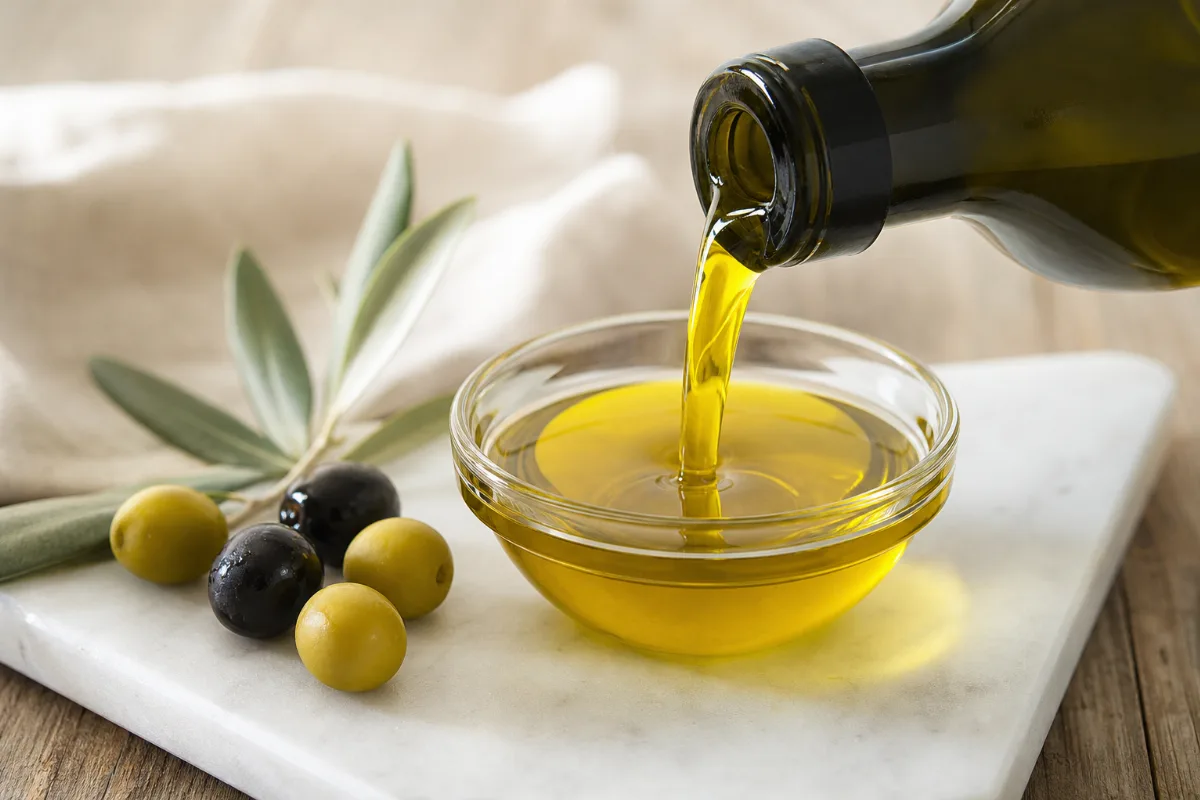
Olive oil is the oil from the fruit of Olea europaea L. (family Oleaceae). [1] "Extra virgin" is a grade of olive oil. The studies below say whether they tested extra virgin oil or olive oil in general, and results for one do not automatically apply to the other.What the research found
| Question | What the source found | Strength of evidence | Design and people |
|---|---|---|---|
| Heart events on a Mediterranean diet | In the PREDIMED trial, 7,447 people at high heart risk got a Mediterranean diet with free extra virgin olive oil, one with mixed nuts, or advice to cut dietary fat. The hazard ratio for major cardiovascular events was 0.69 (95% CI 0.53 to 0.91) with olive oil versus the control diet. [2] | Promising but limited | Randomized, Spain, ages 55-80, median 4.8 years |
| Olive oil intake and disease in cohorts | A 2024 review of 30 articles (about 2.7 million people) linked higher olive oil intake to lower risk of cardiovascular disease (RR 0.85) and all-cause death (RR 0.85), with no link to cancer. [3] | Promising but limited (observational) | Prospective cohorts |
| Amount in cohorts | Another review estimated 16% lower cardiovascular risk and 22% lower type 2 diabetes risk for each additional 25 g a day, again with no link to cancer. [4] | Promising but limited (observational) | 24 cohorts and one trial |
| Extra virgin oil alone, in trials | A 2024 review of 33 trials (2,020 people) found lower insulin and insulin resistance scores, and no significant effect on blood sugar, cholesterol, blood pressure, body weight measures or inflammation markers. [5] | Mixed | Randomized trials |
| Olive oil compared with avocado oil | Proper evidence not found. | Insufficient evidence | We searched Europe PMC for studies naming both oils and found only a rat study, a laboratory heating study and a newsletter question |
Reading the results
- PREDIMED has a caveat. The authors withdrew their first 2013 report after finding protocol deviations, including some people who were not randomized, and published revised estimates. [2] The control group was told to reduce dietary fat, so the trial compares diets, not oil against no oil.
- Cohort studies cannot prove cause. People who use more olive oil may also eat and live differently. The 2024 review began by noting that earlier reports on these links were inconsistent. [3]
- Official recognition. The US FDA's list of qualified health claims includes an entry titled "Monounsaturated Fatty Acids from Olive Oil and Coronary Heart Disease", dated November 1, 2004. We read the title and date only, not the wording. [6]
Related
Avocado: research and cautions · Studied dietary patterns · Seed oils and inflammation claims checkedHealth connections for Extra Virgin Olive Oil
What research links to eating or drinking this food, and how strong the evidence is. Many studies are observational or use juice, powder, oil or extracts rather than the food as eaten; each card says which.
Olive oil in a Mediterranean-style diet and heart events
Preliminary or mixedIn the PREDIMED trial, 7,447 people at high heart risk got a Mediterranean diet with free extra virgin olive oil, one with mixed nuts, or advice to reduce dietary fat. Major cardiovascular events occurred in 96 people (3.8 percent) in the olive oil group, 83 (3.4 percent) in the nuts group and 109 (4.4 percent) in the control group.
Supplements: Compares whole diets; cannot isolate the oil.
Olive oil intake and cardiovascular disease and death (cohorts)
Preliminary or mixedA 2024 meta-analysis of 30 articles (2.7 million people) linked higher olive oil intake to lower cardiovascular disease (relative risk 0.85) and all-cause death (0.85), with no link to cancer incidence or mortality.
Supplements: Observational association, not proof of cause.
Olive oil and type 2 diabetes risk (cohorts)
Preliminary or mixedAn outcome-wide review of cohorts and one trial estimated 22 percent lower relative risk of type 2 diabetes and 16 percent lower cardiovascular risk for each additional 25 g a day.
Supplements: Observational association.
Extra virgin olive oil and cholesterol or blood pressure in trials
Not enough evidenceA 2024 meta-analysis of 33 trials (2,020 people) found no significant effect of extra virgin olive oil on cholesterol fractions, triglycerides, blood pressure, body mass index or inflammation markers.
Supplements: No good evidence of benefit for these markers.
Extra virgin olive oil and insulin resistance in trials
Preliminary or mixedThe same meta-analysis found lower insulin and insulin resistance (HOMA-IR) scores, but no effect on fasting blood glucose.
Supplements: Markers, not diabetes outcomes.
Olive oil replacing saturated fat (FDA qualified claim)
Preliminary or mixedThe FDA (2004) allows a qualified claim that limited and not conclusive evidence suggests about 2 tablespoons (23 g) of olive oil daily may reduce coronary heart disease risk if it replaces a similar amount of saturated fat without adding calories.
Supplements: Cautious regulatory wording.
Olive oil compared with canola oil for LDL
Preliminary or mixedA pooled analysis of 13 trials found canola oil lowered LDL by 6.13 mg/dL and total cholesterol by 8.92 mg/dL more than olive oil.
Supplements: Blood measures only.
Olive oil and cancer
Not enough evidenceTwo cohort meta-analyses found no significant link between olive oil intake and cancer incidence.
Supplements: No good evidence of benefit.
Connected topics
Open a group to see how each topic connects and how strong the evidence is.
Health goals (4)
- Heart HealthPreliminary or mixed
Cohorts link more olive oil to fewer heart events; PREDIMED tested a whole diet; trials of the oil alone found no change in cholesterol or blood pressure.
- Blood Sugar BalancePreliminary or mixed
Lower insulin and HOMA-IR in trials; lower type 2 diabetes risk in cohorts; no change in fasting glucose.
- Metabolic HealthPreliminary or mixed
Lower insulin resistance scores in trials.
- Preventive WellnessPreliminary or mixed
Part of the Mediterranean-style diet pattern studied in PREDIMED.
Body systems (3)
- Cardiovascular SystemPreliminary or mixed
Same as heart and circulation.
- Heart & CirculationPreliminary or mixed
Cohort and diet-trial signals; oil-alone trials mixed.
- Blood Sugar SupportPreliminary or mixed
Lower insulin resistance scores in trials.
Body parts (1)
- HeartPreliminary or mixed
Observational and diet-trial signals only.
Functional actions (1)
- Cardiovascular SupportPreliminary or mixed
FDA qualified claim is limited and not conclusive.
Root causes (1)
- Poor DietPreliminary or mixed
Replacing saturated fat with olive oil is the swap the FDA claim and official advice describe.
Habits (1)
- Balanced NutritionPreliminary or mixed
The 2025 to 2030 US Dietary Guidelines say to prioritize oils with essential fatty acids, such as olive oil.
Biomarkers (1)
- InsulinPreliminary or mixed
Lower insulin in pooled trials.
Conditions & symptoms (2)
- Coronary Heart DiseasePreliminary or mixed
Cohort links, a revised diet trial and a cautious FDA claim; not proof for the oil alone.
- Type 2 Diabetes Mellitus Without ComplicationPreliminary or mixed
Cohort meta-analysis: 22 percent lower relative risk per 25 g a day; observational.
Documented risks and interactions (1)
- Calories from olive oil. One tablespoon (13.5 g) has about 119 kcal by USDA.
Frequently asked questions
Is extra virgin olive oil good for you?
Observational studies link more olive oil to lower cardiovascular risk. [3] Trials of extra virgin oil alone found changes in insulin measures but not in cholesterol or blood pressure. [5]
Did the PREDIMED trial prove olive oil prevents heart disease?
It found fewer major cardiovascular events with a Mediterranean diet plus extra virgin olive oil than with a reduced-fat diet, but the first report was withdrawn and revised. [2] It tested a whole diet.
Does olive oil reduce cancer risk?
Two cohort reviews found no link between olive oil intake and cancer incidence. [3][4]
Is olive oil better than avocado oil?
Proper evidence not found. We searched for studies comparing the two in people and found none.
Does olive oil cause weight gain?
The 2024 review of trials found no significant effect of extra virgin oil on body mass index or waist measures. [5] Weight advice is outside this page.
More details: evidence, limits and cautions
The details behind this page: cautions, limits of the evidence and where sources disagree. Open any note to read it.
Safety and who should ask
References
- GBIF Secretariat. Olea europaea L., accepted name, family Oleaceae. Read 2026-10-23 (GBIF species match API).
- Estruch R et al. Primary Prevention of Cardiovascular Disease with a Mediterranean Diet Supplemented with Extra-Virgin Olive Oil or Nuts. N Engl J Med 2018. PMID 29897866. Read 2026-10-23.
- Olive oil intake and cardiovascular disease, cancer, and all-cause mortality: a systematic review and dose-response meta-analysis of prospective cohort studies. Food Funct 2024. Read 2026-10-23 (abstract via Europe PMC).
- Effect of olive oil consumption on cardiovascular disease, cancer, type 2 diabetes, and all-cause mortality: A systematic review and meta-analysis. Clin Nutr 2022. Read 2026-10-23 (abstract via Europe PMC).
- Effect of Extra Virgin Olive Oil on Anthropometric Indices, Inflammatory and Cardiometabolic Markers: a Systematic Review and Meta-Analysis of Randomized Clinical Trials. J Nutr 2024. Read 2026-10-23 (abstract via Europe PMC).
- U.S. Food and Drug Administration. Qualified Health Claims: Letters of Enforcement Discretion (list of claim titles and dates; letters not read). Read 2026-10-23.