Oils & Fats · Cooking oil
Sesame Oil
Sesamum indicum (seed oil) · also called Gingelly oil, aceite de sésamo
Sesame oil is a cooking oil pressed from sesame seeds. It is pure fat, about 120 kcal a tablespoon. Small studies found lower blood pressure and blood sugar, but they are weak. The main cautions are sesame allergy, a major food allergen, and effects with blood pressure and diabetes medicines.
General information, not medical advice. Last substantive update · Not medically reviewed. A named clinician has not signed off on this page. How this page is made
About Sesame Oil
Sesame oil is a cooking oil pressed from sesame seeds. It is pure fat and very energy dense. It is a food, not a proven remedy: the blood pressure and blood sugar findings come from small studies, and the main safety issue is sesame allergy.
What it is
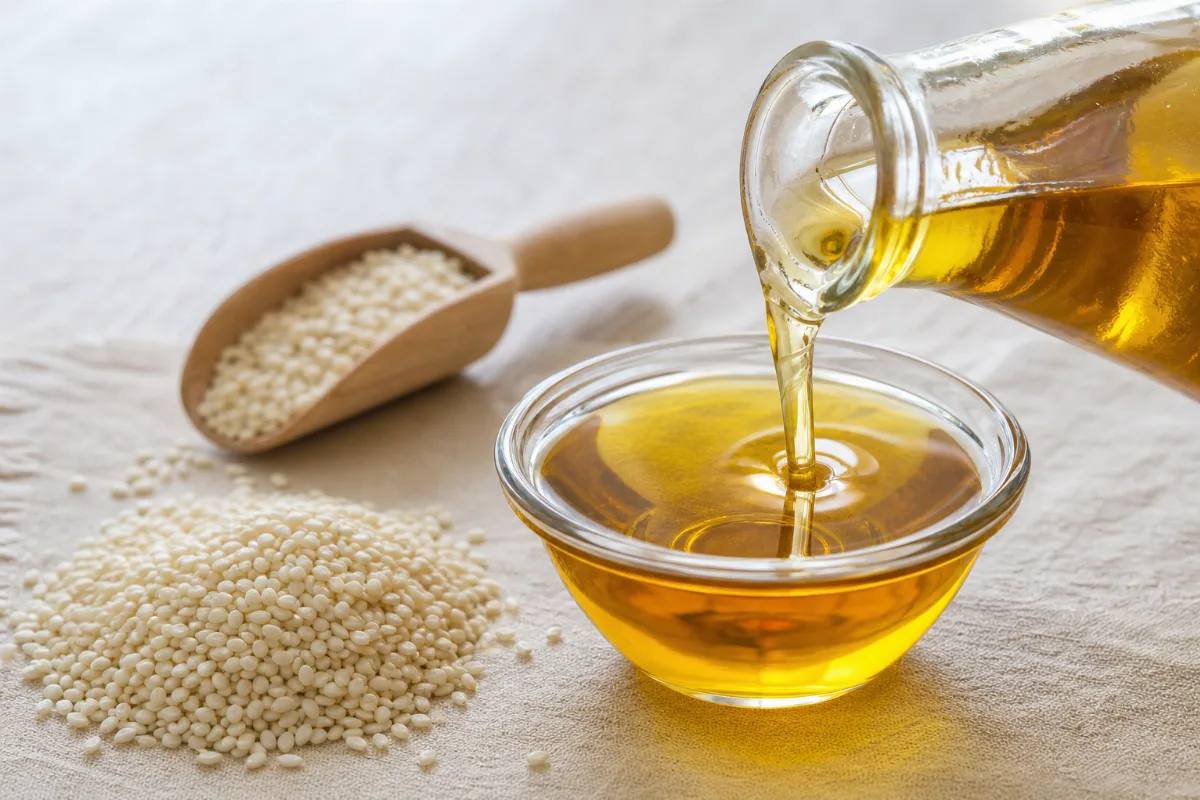
Sesame oil is pressed from the seeds of the sesame plant (Sesamum indicum, family Pedaliaceae). A 2026 review calls sesame an ancient oilseed crop. It is used in cooking, dressings and finishing dishes. The USDA entry on this page is sesame oil for salad or cooking. Toasted sesame oil is a different, darker and stronger product, and no nutrient data were read for it.
USDA data per 100 g: 884 kcal, 100 g fat (14.2 g saturated, 39.7 g monounsaturated, 41.7 g polyunsaturated), no protein, carbohydrate or fibre, 1.4 mg vitamin E, 13.6 micrograms vitamin K and 865 mg plant sterols. One tablespoon (13.6 g) has about 120 kcal and 13.6 g of fat, of which 1.9 g is saturated.
What the research shows
The studies are small. In 50 people with high blood pressure who were already on a diuretic or a beta-blocker, using sesame oil as the only oil for 45 days brought blood pressure to normal and it rose again after stopping; no control group is described. In 30 men with high blood pressure, 35 g a day for 2 months improved artery widening while a control oil did not. A 2022 pooled analysis found small falls in systolic and diastolic blood pressure, fasting glucose, HbA1c, body weight and BMI, but several of the confidence intervals only just excluded no effect.
In an open-label study of 60 people with type 2 diabetes, sesame oil plus glibenclamide lowered glucose more than either alone. Cholesterol results are mixed: no change in one study, large falls from starting values in another with no control oil. A 2024 review of reviews graded the sesame oil findings for blood sugar as very low certainty and for body weight as moderate to very low.
The firmest guidance is about fat in general: replacing saturated fat with unsaturated oils lowers LDL cholesterol, and the American Heart Association says this will lower cardiovascular disease. Sesame oil is about 14% saturated fat. Its own effect on heart attacks was not studied.
Food versus other forms
The blood pressure, blood sugar and artery results are for sesame oil used as the main cooking oil. The pain and vein irritation results are for sesame oil rubbed on the skin, which is a different use. Sesame seeds, tahini, sesame lignan supplements and toasted sesame oil are different products and were not covered.
At a glance
Traditional uses history, not proof
- Used in cooking, dressings and finishing dishes in many cuisines
- Long use as food is not proof that it treats any condition
Studied for research
- Nutrient content (fat types, calories), high certainty
- Blood pressure and artery function, low certainty
- Blood sugar in type 2 diabetes, low certainty
- Cholesterol and blood fats, mixed
- Swapping saturated fat for unsaturated oil, moderate certainty (not tested with sesame oil on its own)
- Body weight, very low certainty
- Antioxidant markers, low certainty
- On the skin, low certainty (not food use)
Main compounds
- Monounsaturated fat
- Polyunsaturated fat
- Saturated fat
- Plant sterols
- Vitamin E (small amount)
Common forms
- Sesame oil for salad or cooking, as food (USDA values read)
- Toasted, cold-pressed and unrefined sesame oil (nutrient values not read)
- Sesame oil on the skin, studied in small trials (not food)
- Sesame seeds, tahini and sesame lignan supplements are different products and are not covered
Research links: 2022 pooled analysis of sesame oil trials on blood pressure, glucose and weight · 2011 trial: sesame oil with a diabetes medicine · FDA: sesame as the ninth major food allergen · Research Library · Genes & Biomarkers Library
What it is and its history
- Accepted scientific name
- Sesamum indicum L.
- Naming authority
- L., as written in the 2026 sesame review abstract; the oil is pressed from the seeds of this plant
- Common names
- Sesame oil (English); Gingelly oil (English (a brand label in the 2006 trial abstract)); Aceite de sésamo (Spanish)
- Family or group
- Pedaliaceae (as given in the 2025 abstract). Sesame oil is a processed food, not a plant.
- Classification
- Plantae > Pedaliaceae > Sesamum > Sesamum indicum
- Native range
- Not verified from a source read.
- Habitat
- Not verified from a source read.
- What it looks like
- Roots: Not verified.; Stems: Not verified.; Leaves: Not verified.; Flowers: Not verified.; Fruit: The oil comes from the seed. A 2026 review calls sesame an ancient oilseed crop.
- Cultivation
- Not verified from a source read.
- Harvest and processing
- Not verified from a source read. The FDA labeling guidance distinguishes highly refined (refined, bleached, deodorized) oils from other oils. Toasted sesame oil is described as a different product by USDA coverage; its processing was not read.
Photographs
What is inside, and how it may work
What it contains and how those compounds act in cells and animals. Laboratory and animal mechanisms are not proven effects in people.
Main compounds
| Compound | Family | Where it is concentrated | Activity studied | Level of evidence |
|---|---|---|---|---|
| Total fat | fat | Seed oil USDA per 100 g: 100 g | Gives 884 kcal per 100 g and about 120 kcal per tablespoon. 15 | Chemistry |
| Monounsaturated fat | unsaturated fat | Seed oil USDA per 100 g: 39.7 g | Unsaturated fats can replace saturated fat to lower LDL (AHA). 15 6 | Human data |
| Polyunsaturated fat | unsaturated fat | Seed oil USDA per 100 g: 41.7 g | Trials that replaced saturated fat with polyunsaturated vegetable oil reduced cardiovascular disease by about 30% (AHA advisory); not tested with sesame oil on its own. 15 6 | Human data |
| Saturated fat | saturated fat | Seed oil USDA per 100 g: 14.2 g | Saturated fat can raise LDL cholesterol (NHS). 15 14 | Human data |
| Phytosterols (plant sterols) | plant sterol | Seed oil USDA per 100 g: 865 mg | A food-composition value only; no health effect of sesame oil's sterols was read. 15 | Chemistry |
| Vitamin E (alpha-tocopherol) | vitamin | Seed oil USDA per 100 g: 1.4 mg | A small amount compared with the daily need; not a vitamin E source. 15 | Chemistry |
| Vitamin K (phylloquinone) | vitamin | Seed oil USDA per 100 g: 13.6 micrograms | A small amount; no study of sesame oil and warfarin was read. 15 | Chemistry |
Mechanisms, receptors and pathways
| Target or pathway | Gene or receptor | What was found | Level |
|---|---|---|---|
| Replacing saturated fat with unsaturated fat | Not specified | The AHA advisory says replacing saturated with unsaturated fat lowers LDL cholesterol, which it links to atherosclerosis. This is a general fat finding, not shown for sesame oil specifically. 6 | Human data |
| Endothelial function and nitric oxide pathway | Not specified | The 2013 trial measured nitric oxide synthase inhibition and an adhesion marker alongside artery widening; the abstract reports artery widening and ICAM changes but does not state how the oil produced them. 3 | Human data |
| Oxidative stress markers | Not specified | Markers of oxidative stress fell and antioxidant enzymes rose in small studies. This is an observed marker change, not a tested mechanism. 7 8 1 | Human data |
Absorption, metabolism and elimination
- Absorption
- Not found.
- Distribution
- Not found.
- Metabolism
- Not found.
- Elimination
- Not found.
- Bioavailability
- Not found for sesame oil's compounds in the sources read.
Isolated compounds versus whole extracts
The blood pressure, blood sugar and artery results are for sesame oil used as the main cooking or salad oil. The skin-use results are for sesame oil applied to the skin. The allergy figures are for sesame seed in general. Sesame seeds, tahini, sesame lignan supplements and toasted sesame oil are different products and were not covered by the food results here.
Nutritional composition
Nutrition from USDA FoodData Central: Oil, sesame, salad or cooking (FDC 171016, SR Legacy, April 2018 release), values read 2026-10-26 from the saved copy of the USDA data in the project. Per 100 g: 884 kcal, 100 g fat (14.2 g saturated, 39.7 g monounsaturated, 41.7 g polyunsaturated), 0 g protein, 0 g carbohydrate, 0 g fibre, 0 mg cholesterol, 0 mg sodium, 1.4 mg vitamin E (alpha-tocopherol), 13.6 micrograms vitamin K and 865 mg plant sterols. One typical USDA portion of 1 tablespoon (13.6 g, the 100 g values multiplied by 0.136) has about 120 kcal, 13.6 g fat, 1.9 g saturated fat, 5.4 g monounsaturated fat, 5.7 g polyunsaturated fat, 0.19 mg vitamin E, 1.8 micrograms vitamin K and 118 mg plant sterols. USDA also lists a vitamin D value for this record, which is not stated here because a plant oil is not expected to contain it and it looks like a database artifact. USDA lists zero protein, carbohydrate, fibre and minerals. Toasted sesame oil, cold-pressed and unrefined oils were not read.
1 high certainty1 moderate certainty1 mixed findings4 low certainty1 very low certainty
What was looked at
The 8 benefits and uses checked for Sesame Oil, each with how strong the evidence is. Tap one to open it.
- Calories, fat types and plant sterols (nutrient content)High certainty
- Blood pressure and artery functionLow certainty
- Blood sugar in type 2 diabetesLow certainty
- Cholesterol and blood fatsMixed findings
- Swapping saturated fat for unsaturated oilModerate certainty
- Body weight and BMIVery low certainty
- Antioxidant and oxidative stress markersLow certainty
- On the skin: drip-site vein irritation and minor injury pain (not food use)Low certainty
Lab markers tracked in the studies
Systolic blood pressureFlow-mediated dilatation (artery widening)Fasting blood glucoseHbA1cLDL cholesterolBody weightMalondialdehyde (MDA)
What is Sesame Oil good for?
The main studied uses and how strong the human evidence is for each. The studies are small and mostly use sesame oil as the main cooking oil.
Benefits, one by one
Each card is a research question, not a promise. Tap a goal to filter. Open a card to see the studies, doses and limits.
Calories, fat types and plant sterols (nutrient content)
High certaintySesame oil is pure fat. By USDA data, 1 tablespoon (13.6 g) has about 120 kcal and 13.6 g of fat: about 1.9 g saturated, 5.4 g monounsaturated and 5.7 g polyunsaturated. It has no protein, carbohydrate or fibre, little vitamin E, and about 118 mg of plant sterols.
2 studiesSesame oil for salad or cooking, as listed by USDA. Toasted, cold-pre…
Studies, doses and limits
What the trials found
No trial was needed or read for this item. It is a database value for sesame oil for salad or cooking (USDA FDC 171016). Toasted sesame oil, a darker and stronger-flavoured product, is not covered by this item.
Results
Sesame oil is an energy-dense fat that is roughly 14% saturated, 40% monounsaturated and 42% polyunsaturated. It is a poor source of vitamins compared with some other oils (1.4 mg vitamin E per 100 g).
Effect sizes as reported
USDA per 100 g: 884 kcal; fat 100 g (saturated 14.2 g, monounsaturated 39.7 g, polyunsaturated 41.7 g); vitamin E 1.4 mg; vitamin K 13.6 micrograms; phytosterols 865 mg; cholesterol 0 mg. Per 1 tablespoon (13.6 g, the 100 g values multiplied by 0.136): about 120 kcal, 13.6 g fat, 1.9 g saturated fat, 5.4 g monounsaturated, 5.7 g polyunsaturated, 0.19 mg vitamin E, 1.8 micrograms vitamin K, 118 mg phytosterols.
Why this rating
High that the oil contains these amounts (USDA data). It does not say anything about health effects.
Form and dose studied
Sesame oil for salad or cooking, as listed by USDA. Toasted, cold-pressed or unrefined oils were not read.
Who was studied
General food use.
Limits
Nutrient facts, not trials. Brands, pressing and refining change the make-up a little; the label of your own bottle is the best guide.
Why researchers looked
People use sesame oil as a cooking, dressing and finishing oil, so the first question is what the oil contains.
Traditional use
Sesame oil has long been used in cooking in many cuisines. Long use as food is not proof that it treats any condition.
Proposed mechanism Nutrient database
These are nutrient amounts in the oil, taken from a USDA table.
A proposed mechanism does not show that the effect happens in people.
Sesame is a major food allergen; see the Safety tab.
Blood pressure and artery function
Low certaintySmall studies of sesame oil used as the main cooking oil found lower blood pressure and better artery widening in people with high blood pressure. A pooled analysis found small average falls of about 2.7 mmHg (top number) and 2 mmHg (bottom number). The studies are small and the effect is modest.
3 studiesSesame oil used as the main cooking or salad oil, about 35 g a day in…
Studies, doses and limits
What the trials found
In 50 adults with high blood pressure who were already on a diuretic or a beta-blocker, using sesame oil as the only edible oil for 45 days brought blood pressure down to normal, and it returned to the starting values 45 days after stopping. There was no separate control group in the abstract. In 30 men with high blood pressure, 35 g of sesame oil a day for 2 months improved flow-mediated dilatation (how well the arm artery widens) while a control oil did not, and one adhesion marker (ICAM) fell. A 2022 pooled analysis of trials found small falls in systolic and diastolic blood pressure.
Results
A small, fairly consistent fall in blood pressure and better artery function in people with high blood pressure. It was not tested against a placebo oil for blood pressure itself in the abstracts read.
Effect sizes as reported
Pooled analysis: systolic pressure -2.68 mmHg (95% CI -5.26 to -0.10), diastolic -1.98 mmHg (-3.92 to -0.05). Artery widening test (flow-mediated dilatation) improved after one meal (p = 0.001) and after 15, 30 and 60 days (p = 0.015, 0.005, 0.011). The 2006 abstract gives no numbers.
Why this rating
Low: small studies, one without a control group, one in men only, and a pooled result whose confidence intervals only just exclude no effect. No heart attack or stroke outcomes.
Form and dose studied
Sesame oil used as the main cooking or salad oil, about 35 g a day in the two trials that state an amount. That is a trial amount, not advice.
Who was studied
Adults with high blood pressure (the 2006 trial: men and women aged 35 to 60 on blood pressure medicines; the 2013 trial: men only).
Limits
Small studies from a few research groups. The oil was swapped in for other oils, so the result may partly reflect what was swapped out. Short follow-up (45 days and 2 months).
Why researchers looked
Researchers asked whether using sesame oil as the main cooking oil changes blood pressure in people with high blood pressure.
Traditional use
Sesame oil has long been used in cooking in many cuisines. Long use as food is not proof that it treats any condition.
Proposed mechanism Not established
Not established. The abstracts report measured markers (oxidative stress, nitric oxide pathway, adhesion), not proof of how it works.
A proposed mechanism does not show that the effect happens in people.
If you take blood pressure medicines, tell your clinician before making a big change to your cooking oil; see the Safety tab.
Blood sugar in type 2 diabetes
Low certaintyIn one open-label study of 60 people with type 2 diabetes, sesame oil added to the diabetes medicine glibenclamide lowered blood glucose more than either alone. A pooled analysis found a small fall in fasting glucose of about 3 mg/dL. The evidence is weak.
3 studiesSesame oil as cooking or salad oil, about 35 g a day in the trial, wi…
Studies, doses and limits
What the trials found
In an open-label study, 60 people with mild to moderate type 2 diabetes used about 35 g of sesame oil a day, or took 5 mg of glibenclamide, or both, for 60 days. The combination lowered glucose and HbA1c more than either alone. A 2022 pooled analysis of trials found fasting glucose 3.27 mg/dL lower with sesame oil than control and a fall in HbA1c, but no change in insulin. A 2024 review of reviews rated the evidence for blood sugar benefit as very low certainty.
Results
Hints of a small benefit, mostly in studies where the oil was added to a diabetes medicine. Not tested as a replacement for treatment.
Effect sizes as reported
Open-label study (combination group): glucose -36% and HbA1c -43% from before treatment. Pooled analysis: fasting glucose -3.27 mg/dL (95% CI -4.68 to -1.86); HbA1c -2.06 (-3.47 to -0.65), insulin no significant change. The HbA1c figure is large next to the glucose change and is not explained in the abstract, so it is treated with caution.
Why this rating
Low for the pooled analysis and very low in the review of reviews. The 60-person trial was open label (no blinding) and short. Combining it with a medicine means any extra effect on glucose could matter for low blood sugar.
Form and dose studied
Sesame oil as cooking or salad oil, about 35 g a day in the trial, with or without glibenclamide 5 mg a day. Trial amounts, not advice.
Who was studied
Adults with type 2 diabetes.
Limits
Open label, short, and a few small trials sharing the same research group in places. The pooled HbA1c result looks too large to trust without more detail.
Why researchers looked
Researchers asked whether a swap to sesame oil could help blood sugar control, alone or alongside medicine.
Traditional use
Sesame oil has long been used in cooking in many cuisines. Long use as food is not proof that it treats any condition.
Proposed mechanism Not established
Not established. The 2011 authors measured antioxidant enzymes but the abstract does not show how the oil would lower glucose.
A proposed mechanism does not show that the effect happens in people.
Tell your care team before changing your oil if you take diabetes medicines; see the Safety tab.
Cholesterol and blood fats
Mixed findingsThe studies of sesame oil give mixed answers on cholesterol. In people on blood pressure medicines, blood fats did not change except triglycerides. In people with type 2 diabetes, cholesterol and LDL fell compared with their own starting values. No study compared sesame oil with another oil for cholesterol in the abstracts read.
3 studiesSesame oil as cooking or salad oil; the diabetes study used about 35 …
Studies, doses and limits
What the trials found
The 2006 study of 50 people with high blood pressure found no significant change in blood fats except triglycerides after 45 days with sesame oil as the only oil. The 2011 open-label study of 60 people with type 2 diabetes found total cholesterol down 20%, LDL down 33.8%, triglycerides down 14% and HDL up 15.7% with sesame oil alone, compared with the person's own readings before treatment. A 2024 review of reviews did not list sesame oil among the oils with a cholesterol-lowering effect.
Results
Mixed and unproven. The large percentages in the diabetes study have no control oil to compare against, so they cannot be taken as a sesame oil effect.
Effect sizes as reported
Diabetes study, sesame oil alone, change from before treatment: total cholesterol -20%, LDL -33.8%, triglycerides -14%, HDL +15.7%. The 2006 abstract gives no numbers.
Why this rating
Mixed: one study found no change, another found large changes with no control oil. Neither compared sesame oil with another oil.
Form and dose studied
Sesame oil as cooking or salad oil; the diabetes study used about 35 g a day (trial amount, not advice).
Who was studied
Adults with high blood pressure, and adults with type 2 diabetes.
Limits
Before-and-after comparisons without a control oil. Lipid results come from open-label, short studies.
Why researchers looked
Cholesterol is the usual measure when oils are compared for heart health.
Traditional use
Sesame oil has long been used in cooking in many cuisines. Long use as food is not proof that it treats any condition.
Proposed mechanism Not established
Not established.
A proposed mechanism does not show that the effect happens in people.
None specific.
Swapping saturated fat for unsaturated oil
Moderate certaintyHealth bodies say that replacing saturated fat (butter, lard, coconut or palm oil) with unsaturated oils lowers LDL cholesterol. Sesame oil is about 14% saturated fat, so using it in place of a saturated fat follows that advice. This is a general finding about unsaturated oils, not a trial of sesame oil.
3 studiesPolyunsaturated and unsaturated vegetable oils in general.
Studies, doses and limits
What the trials found
The American Heart Association advisory says trials that replaced saturated fat with polyunsaturated vegetable oil reduced cardiovascular disease by about 30%, and that the swap lowers LDL. The NHS gives the same direction: replace some saturated fat with unsaturated fat. Neither source names sesame oil in the text read.
Results
A swap result. It describes replacing saturated fat, not adding oil to an unchanged diet.
Effect sizes as reported
About 30% fewer cardiovascular events in trials of saturated fat replaced by polyunsaturated vegetable oil (AHA advisory). Sesame oil: 14.2 g saturated fat per 100 g (USDA).
Why this rating
Moderate for the general swap, which comes from a major scientific advisory. Indirect for sesame oil, which is not named in the abstract and was not tested for heart events.
Form and dose studied
Polyunsaturated and unsaturated vegetable oils in general.
Who was studied
Adults in trials and cohorts reviewed by the advisory.
Limits
Sesame oil is mixed unsaturated (about 40% mono and 42% poly), so the exact trial results for pure polyunsaturated oils do not transfer one for one.
Why researchers looked
Large trials and cohorts compared different kinds of fat for heart disease.
Traditional use
Sesame oil has long been used in cooking in many cuisines. Long use as food is not proof that it treats any condition.
Proposed mechanism Authoritative guidance
Replacing saturated with unsaturated fat lowers LDL cholesterol, which the American Heart Association links to atherosclerosis.
A proposed mechanism does not show that the effect happens in people.
All oils are very energy dense: 9 kcal per gram.
Body weight and BMI
Very low certaintyA pooled analysis found very small falls in body weight (about 0.35 kg) and BMI after people ate sesame oil. A review of reviews gave the evidence for sesame oil and weight a moderate to very low certainty. This is a tiny effect, and oil is high in calories.
3 studiesSesame oil as food.
Studies, doses and limits
What the trials found
In the 2006 trial, body weight and BMI fell significantly with sesame oil as the only edible oil for 45 days. The 2022 pooled analysis found body weight 0.35 kg lower and BMI 0.39 lower than control. The 2024 review of reviews says canola oil and sesame oil may reduce body weight, with moderate to very low certainty.
Results
A tiny average fall, probably reflecting what was swapped out of the diet. Not a weight-loss method.
Effect sizes as reported
Pooled analysis: body weight -0.35 kg (95% CI -0.64 to -0.05); BMI -0.39 kg/m2 (-0.72 to -0.05).
Why this rating
Very low: the effect is tiny and its confidence interval only just excludes zero. The authors of the review of reviews grade the sesame oil weight findings moderate to very low.
Form and dose studied
Sesame oil as food.
Who was studied
Adults in trials, mostly with high blood pressure or diabetes.
Limits
Small changes can come from many diet details. One tablespoon of oil is about 120 kcal (USDA).
Why researchers looked
A weight fall was noticed in the 2006 trial, and later pooled analyses looked at it.
Traditional use
Sesame oil has long been used in cooking in many cuisines. Long use as food is not proof that it treats any condition.
Proposed mechanism Not established
Not established.
A proposed mechanism does not show that the effect happens in people.
None specific.
Antioxidant and oxidative stress markers
Low certaintyIn small studies, blood markers of oxidative stress (malondialdehyde) fell and antioxidant enzymes rose after people used sesame oil. These are lab markers, not health outcomes, and they do not show that sesame oil prevents any disease.
4 studiesSesame oil as food.
Studies, doses and limits
What the trials found
The 2006 trial in 50 people found lower lipid peroxidation (TBARS) and higher antioxidant enzymes and vitamins C and E, beta-carotene and glutathione. The 2011 diabetes study found improved antioxidant enzymes. The 2022 pooled analysis found malondialdehyde 4.85 nmol/dL lower.
Results
Marker changes that are consistent across the studies but are not clinical outcomes.
Effect sizes as reported
Pooled analysis: malondialdehyde -4.85 nmol/dL (95% CI -7.05 to -2.70).
Why this rating
Low: marker changes only, from small studies, and not tied to illness or recovery.
Form and dose studied
Sesame oil as food.
Who was studied
Adults with high blood pressure or type 2 diabetes.
Limits
Markers are indirect.
Why researchers looked
Researchers measured oxidative stress markers alongside blood pressure and blood sugar in small trials.
Traditional use
Sesame oil has long been used in cooking in many cuisines. Long use as food is not proof that it treats any condition.
Proposed mechanism Not established
Not established. The abstracts report marker changes, not a tested mechanism.
A proposed mechanism does not show that the effect happens in people.
None specific.
On the skin: drip-site vein irritation and minor injury pain (not food use)
Low certaintyRubbing sesame oil on the skin has been studied in hospital and clinic patients. A pooled analysis found less drip-related vein irritation (phlebitis) and another found lower pain after minor limb injuries when sesame oil was added to standard care. This is not about eating the oil.
2 studiesSesame oil applied to skin, as in the trials. Not a food use.
Studies, doses and limits
What the trials found
A 2025 pooled analysis of 8 trials (6 after chemotherapy, 2 after amiodarone) found phlebitis less likely when sesame oil was applied to the skin over the drip site (risk ratio 0.54). A 2024 pooled analysis of 4 trials found pain scores fell 1.10 points more with sesame oil massage added to standard care after minor limb injuries. Both sets of authors rate the evidence quality as moderate and ask for better trials.
Results
Possible small benefits as an add-on to standard care. Not a replacement for it, and not evidence about eating the oil.
Effect sizes as reported
Phlebitis risk ratio 0.54 (95% CI 0.32 to 0.92). Pain score change -1.10 (95% CI -1.62 to -0.57) versus comparison.
Why this rating
The authors of both pooled analyses rate the evidence quality as moderate, but only two of the four injury trials had good methods, and most trials did not report safety or check the purity of the oil. Placed at low here for those reasons.
Form and dose studied
Sesame oil applied to skin, as in the trials. Not a food use.
Who was studied
Adult patients on chemotherapy or amiodarone drips; adult outpatients with minor limb injuries.
Limits
Skin use of an allergen: sesame allergy can also affect the skin. The trials did not report enough on safety or on the purity of the oil.
Why researchers looked
Sesame oil is a traditional massage oil in several countries, and small trials tested it on the skin.
Traditional use
Sesame oil has long been used in massage in many traditions. Long use is not proof that it treats any condition.
Proposed mechanism Not established
Not established. Massage itself may play a part in the pain results.
A proposed mechanism does not show that the effect happens in people.
Do not use on the skin if you are allergic to sesame. Do not use over a drip site without asking your nurse or doctor.
Connections to the rest of health
How Sesame Oil connects to the rest of our health knowledge graph. Every link says what kind of connection it is. A safety link (for example to the liver) is a warning, not a benefit. A study that merely mentions a topic never creates a benefit link.
Explore every connection: goals, body systems, organs, symptoms, genes
A. Wellness goals
| Connected to | Kind of connection | Evidence status | Context | Studies |
|---|---|---|---|---|
| Balanced Nutrition | High certainty | Calories, fat types and plant sterols (nutrient content): Sesame oil is pure fat. By USDA data, 1 tablespoon (13.6 g) has about 120 kcal and 13.6 g of fat: about 1.9 g saturated, 5.4 g monounsaturated and 5.7 g polyunsaturated. It has no protein, carbohydrate or fibre, little vitamin E, and about 118 mg of plant sterols. | 15 14 | |
| Blood Pressure Support | Low certainty | Blood pressure and artery function: Small studies of sesame oil used as the main cooking oil found lower blood pressure and better artery widening in people with high blood pressure. A pooled analysis found small average falls of about 2.7 mmHg (top number) and 2 mmHg (bottom number). The studies are small and the effect is modest. | 7 3 1 | |
| Heart Health | Low certainty | Blood pressure and artery function: Small studies of sesame oil used as the main cooking oil found lower blood pressure and better artery widening in people with high blood pressure. A pooled analysis found small average falls of about 2.7 mmHg (top number) and 2 mmHg (bottom number). The studies are small and the effect is modest. | 7 3 1 | |
| Blood Sugar Balance | Low certainty | Blood sugar in type 2 diabetes: In one open-label study of 60 people with type 2 diabetes, sesame oil added to the diabetes medicine glibenclamide lowered blood glucose more than either alone. A pooled analysis found a small fall in fasting glucose of about 3 mg/dL. The evidence is weak. | 8 1 9 | |
| Metabolic Health | Low certainty | Blood sugar in type 2 diabetes: In one open-label study of 60 people with type 2 diabetes, sesame oil added to the diabetes medicine glibenclamide lowered blood glucose more than either alone. A pooled analysis found a small fall in fasting glucose of about 3 mg/dL. The evidence is weak. Body weight and BMI: A pooled analysis found very small falls in body weight (about 0.35 kg) and BMI after people ate sesame oil. A review of reviews gave the evidence for sesame oil and weight a moderate to very low certainty. This is a tiny effect, and oil is high in calories. | 8 1 9 7 | |
| Cholesterol Balance | Mixed findings | Cholesterol and blood fats: The studies of sesame oil give mixed answers on cholesterol. In people on blood pressure medicines, blood fats did not change except triglycerides. In people with type 2 diabetes, cholesterol and LDL fell compared with their own starting values. No study compared sesame oil with another oil for cholesterol in the abstracts read. | 7 8 9 | |
| Heart Health | Mixed findings | Cholesterol and blood fats: The studies of sesame oil give mixed answers on cholesterol. In people on blood pressure medicines, blood fats did not change except triglycerides. In people with type 2 diabetes, cholesterol and LDL fell compared with their own starting values. No study compared sesame oil with another oil for cholesterol in the abstracts read. | 7 8 9 | |
| Cholesterol Balance | Moderate certainty | Swapping saturated fat for unsaturated oil: Health bodies say that replacing saturated fat (butter, lard, coconut or palm oil) with unsaturated oils lowers LDL cholesterol. Sesame oil is about 14% saturated fat, so using it in place of a saturated fat follows that advice. This is a general finding about unsaturated oils, not a trial of sesame oil. | 6 14 15 | |
| Heart Health | Moderate certainty | Swapping saturated fat for unsaturated oil: Health bodies say that replacing saturated fat (butter, lard, coconut or palm oil) with unsaturated oils lowers LDL cholesterol. Sesame oil is about 14% saturated fat, so using it in place of a saturated fat follows that advice. This is a general finding about unsaturated oils, not a trial of sesame oil. | 6 14 15 | |
| Weight Management | Very low certainty | Body weight and BMI: A pooled analysis found very small falls in body weight (about 0.35 kg) and BMI after people ate sesame oil. A review of reviews gave the evidence for sesame oil and weight a moderate to very low certainty. This is a tiny effect, and oil is high in calories. | 1 9 7 | |
| Cellular Protection | Low certainty | Antioxidant and oxidative stress markers: In small studies, blood markers of oxidative stress (malondialdehyde) fell and antioxidant enzymes rose after people used sesame oil. These are lab markers, not health outcomes, and they do not show that sesame oil prevents any disease. | 7 8 1 15 | |
| Pain Relief | Low certainty | On the skin: drip-site vein irritation and minor injury pain (not food use): Rubbing sesame oil on the skin has been studied in hospital and clinic patients. A pooled analysis found less drip-related vein irritation (phlebitis) and another found lower pain after minor limb injuries when sesame oil was added to standard care. This is not about eating the oil. | 4 5 |
B. Body systems
| Connected to | Kind of connection | Evidence status | Context | Studies |
|---|---|---|---|---|
| Nutrition | Biological association | High certainty | Studied for: Calories, fat types and plant sterols (nutrient content) | 15 14 |
| Cardiovascular System | Biological association | Low certainty | Studied for: Blood pressure and artery function Studied for: Cholesterol and blood fats | 7 3 1 8 9 6 14 15 |
| Heart Circulation | Biological association | Low certainty | Studied for: Blood pressure and artery function | 7 3 1 |
| Blood Sugar Support | Biological association | Low certainty | Studied for: Blood sugar in type 2 diabetes | 8 1 9 |
| Metabolic System | Biological association | Low certainty | Studied for: Blood sugar in type 2 diabetes | 8 1 9 |
| Metabolism Weight | Biological association | Very low certainty | Studied for: Body weight and BMI | 1 9 7 |
| Cellular | Biological association | Low certainty | Studied for: Antioxidant and oxidative stress markers | 7 8 1 15 |
| Integumentary System | Biological association | Low certainty | Studied for: On the skin: drip-site vein irritation and minor injury pain (not food use) | 4 5 |
| Pain Inflammation | Biological association | Low certainty | Studied for: On the skin: drip-site vein irritation and minor injury pain (not food use) | 4 5 |
E. Health conditions
| Connected to | Kind of connection | Evidence status | Context | Studies |
|---|---|---|---|---|
| Food allergy | Adverse effect or risk | Documented risk | Sesame is a major US food allergen. Whether refined sesame oil triggers reactions was not shown in the sources read. Preparation or compound: Sesame protein |
12 2 |
| Type 2 diabetes | Preliminary | An open-label study found stronger glucose lowering when sesame oil was added to glibenclamide; reviews rate the evidence low to very low. Preparation or compound: Sesame oil as food |
8 9 | |
| High blood pressure | Preliminary | Small studies and a pooled analysis found small falls in blood pressure; not a treatment. Preparation or compound: Sesame oil as food |
7 1 |
I. Biomarkers
| Connected to | Kind of connection | Evidence status | Context | Studies |
|---|---|---|---|---|
| Systolic blood pressure | Biological association | Low certainty | Measured in trials: lowered. A lab change is not the same as a health benefit. | 1 7 |
| Flow-mediated dilatation (artery widening) | Biological association | Low certainty | Measured in trials: improved. A lab change is not the same as a health benefit. | 3 |
| Fasting blood glucose | Biological association | Low certainty | Measured in trials: lowered. A lab change is not the same as a health benefit. | 1 8 |
| HbA1c | Biological association | Very low certainty | Measured in trials: lowered. A lab change is not the same as a health benefit. | 1 8 |
| LDL cholesterol | Biological association | Mixed findings | Measured in trials: mixed. A lab change is not the same as a health benefit. | 8 7 |
| Body weight | Biological association | Very low certainty | Measured in trials: lowered. A lab change is not the same as a health benefit. | 1 |
| Malondialdehyde (MDA) | Biological association | Low certainty | Measured in trials: lowered. A lab change is not the same as a health benefit. | 1 |
K. Biological pathways
| Connected to | Kind of connection | Evidence status | Context | Studies |
|---|---|---|---|---|
| Saturated fat | Preliminary mechanism | Chemistry | About 14% of sesame oil's fat is saturated. | 15 |
| Blood pressure | Preliminary mechanism | Human | Small studies and a pooled analysis found small falls. | 7 1 |
| Fasting glucose and HbA1c | Preliminary mechanism | Human | Small falls in pooled data; larger in an open-label trial with a diabetes medicine. | 1 8 |
L. Active compounds
| Connected to | Kind of connection | Evidence status | Context | Studies |
|---|---|---|---|---|
| Total fat | Biological association | Chemistry | Gives 884 kcal per 100 g and about 120 kcal per tablespoon. Preparation or compound: Seed oil |
15 |
| Monounsaturated fat | Biological association | Human | Unsaturated fats can replace saturated fat to lower LDL (AHA). Preparation or compound: Seed oil |
15 6 |
| Polyunsaturated fat | Biological association | Human | Trials that replaced saturated fat with polyunsaturated vegetable oil reduced cardiovascular disease by about 30% (AHA advisory); not tested with sesame oil on its own. Preparation or compound: Seed oil |
15 6 |
| Saturated fat | Biological association | Human | Saturated fat can raise LDL cholesterol (NHS). Preparation or compound: Seed oil |
15 14 |
| Phytosterols (plant sterols) | Biological association | Chemistry | A food-composition value only; no health effect of sesame oil's sterols was read. Preparation or compound: Seed oil |
15 |
| Vitamin E (alpha-tocopherol) | Biological association | Chemistry | A small amount compared with the daily need; not a vitamin E source. Preparation or compound: Seed oil |
15 |
| Vitamin K (phylloquinone) | Biological association | Chemistry | A small amount; no study of sesame oil and warfarin was read. Preparation or compound: Seed oil |
15 |
Each connection is stored with the ingredient, the connected record, the kind of connection, the evidence status, the supporting studies, the preparation or compound involved, and a review date (last reviewed October 26, 2026).
The evidence
The research centre for Sesame Oil. Every record here was checked against PubMed or the publisher's page; we never list a study we have not verified.
Evidence by outcome
Bars show how many studies we found for each outcome, not how well it works. People are added up across trials only (reviews are not added, to avoid double counting).
How we rate evidence
High certainty
Several well-run trials or reviews agree; further research is unlikely to change the picture much.
Moderate certainty
Good trials point the same way, but some doubt remains.
Low certainty
Small, short or inconsistent trials. The finding could change with better research.
Very low certainty
Very little or very weak human data. Treat as a possibility only.
Mixed findings
Trials or reviews disagree with each other.
Not enough evidence
Not enough human research to say either way.
Evidence against
Good research found no benefit, or found harm.
We take the reviewers' own risk-of-bias and GRADE statements where they exist, and otherwise judge from study size, design, consistency, directness and whether a product matches what is sold. Many publications do not make evidence high. Method note: We started from our existing sesame oil summary, re-checked nutrition against the saved USDA FoodData Central record, read the FDA and NHS pages and the FDA allergen labeling guidance, and re-read PubMed abstracts for the trials, pooled analyses and reviews. A new search added a 2022 pooled analysis the earlier page did not cite. Only abstracts were read for studies. Items we could not verify are flagged in the research gaps.
Study library: every study we checked 15
| Study | Design | People | Product, dose, length | Result |
|---|---|---|---|---|
| Atefi 2022 The effects of sesame oil on metabolic biomarkers: a systematic review and meta-analysis of clinical trials. J Diabetes Metab Disord · PMID 35673414 · DOI |
Systematic review meta analysis |
Clinical trials in adults (the number of trials is not given in the abstract) | Sesame oil eaten as food Seed oil Not given in the abstract Not given in the abstract · vs Control groups in the trials |
Sesame oil gave small but statistically significant falls in fasting glucose, HbA1c, systolic and diastolic blood pressure, body weight and BMI, and in malondialdehyde. Insulin did not change significantly. Fasting glucose -3.27 mg/dL; HbA1c -2.06 (the abstract gives the unit as %); systolic BP -2.68 mmHg; diastolic BP -1.98 mmHg; body weight -0.35 kg; BMI -0.39 kg/m2; MDA -4.85 nmol/dL; insulin no significant change. (Fasting glucose -4.68 to -1.86; HbA1c -3.47 to -0.65; systolic BP -5.26 to -0.10; diastolic BP -3.92 to -0.05; body weight -0.64 to -0.05; BMI -0.72 to -0.05) Methods, limits and fundingOutcomes: Fasting glucose, HbA1c, blood pressure, body weight, BMI, malondialdehyde (an oxidative stress marker), insulin Limitations: The blood pressure and weight results only just exclude 'no effect'. The HbA1c fall of 2.06 is much larger than the fasting glucose fall suggests, and the abstract does not explain it, so it should be treated with caution. Number of trials, their size, doses and quality are not in the abstract. The authors say more studies are needed. Funding and conflicts: Funding is not stated in the abstract. Read: abstract |
| Kaman 2022 A practical focus on sesame allergy and a brief review of other seed allergies. J Food Allergy · PMID 39021852 · DOI |
Narrative review n/a |
Review of sesame and other seed allergies | Sesame as an allergen Seed |
Seed allergies are relatively rare, but sesame allergy has been increasing worldwide and typically lasts. Blood and skin tests have limited predictive value; a careful history and an oral food challenge should be used to diagnose it. Oral immunotherapy has been safe and effective in case reports and at least one controlled study. Not applicable. (Not applicable.) Methods, limits and fundingOutcomes: Sesame allergy: trend, persistence, diagnosis and treatment Limitations: A narrative review. The abstract does not mention sesame oil. Funding and conflicts: Funding is not stated in the abstract. Read: abstract |
| Karatzi 2013 Sesame oil consumption exerts a beneficial effect on endothelial function in hypertensive men. Eur J Prev Cardiol · PMID 22345690 · DOI |
Controlled trial |
30 30 men with high blood pressure (26 in the one-meal phase) |
Sesame oil versus a control oil Seed oil, in a standard meal and daily 35 g of oil, once with a meal and then daily (trial amount, not advice) One meal, then 2 months · vs Control oil |
Flow-mediated dilatation improved after a single meal with sesame oil and after 15, 30 and 60 days of daily use. ICAM fell only after 60 days. The control oil group showed no change in either phase. p = 0.001 (one meal); p = 0.015, 0.005 and 0.011 at 15, 30 and 60 days; ICAM p = 0.014 at 60 days. (Not given in the abstract.) Methods, limits and fundingOutcomes: Flow-mediated dilatation (how well the arm artery widens), inflammation marker ICAM, nitric oxide pathway markers Limitations: Small, men only, all with high blood pressure. The abstract does not name the control oil or say whether blood pressure itself changed. Results are for an artery test, not heart attacks or strokes. Funding and conflicts: Listed as US National Institutes of Health extramural support plus non-US government support. Read: abstract |
| Nasiri 2025 Is the topical application of sesame oil (Sesamum indicum L.) combined with standard care valuable and safe for managing infusion-related phlebitis: Evidence from a systematic review with meta-analysis of randomized controlled trials. Complement Ther Med · PMID 39743002 · DOI |
Systematic review meta analysis |
Adults with drip-related vein irritation (phlebitis): 6 studies after chemotherapy and 2 after amiodarone (8 studies) | Sesame oil rubbed on the skin over the infusion site, plus standard care Seed oil, on the skin Not given in the abstract Not given in the abstract · vs Standard care or another comparison |
Adults who also had sesame oil on the skin over the drip site were less likely to get phlebitis than the comparison group. The authors say it may delay symptoms and reduce pain, but that evidence quality was moderate, some trials were weak, and most did not report safety or check the purity of the oil. Risk ratio 0.54 for phlebitis. (0.32 to 0.92) Methods, limits and fundingOutcomes: Occurrence and severity of infusion-related phlebitis Limitations: This is use on the skin, not eating the oil. Moderate-quality evidence, with weak trials and little safety reporting. The authors call for trials with an active placebo. Funding and conflicts: Funding is not stated in the abstract. Registration: PROSPERO CRD42024542497 Read: abstract |
| Razani 2024 Alleviating severity of limb trauma pain with coadministration of topical sesame oil and standard treatments: A GRADE-assessed systematic review and meta-analysis of randomised controlled trials. Int Wound J · PMID 38822706 · DOI |
Systematic review meta analysis |
Adult outpatients with minor limb injuries (4 randomised trials) | Sesame oil massaged over the injured area, plus standard treatment Seed oil, on the skin Daily massage (amount not given in the abstract) Second or third day of treatment · vs Standard treatment alone or with a placebo |
Pain scores fell more with daily sesame oil massage added to standard care. The authors rate the evidence quality as moderate and say only two of the four studies had good methods. Pain score change -1.10 points more than the comparison. (-1.62 to -0.57) Methods, limits and fundingOutcomes: Change in pain score Limitations: This is use on the skin, not eating the oil. Only 4 trials, only 2 with good methods. Massage itself may play a part. Funding and conflicts: Funding is not stated in the abstract. Read: abstract |
| Sacks 2017 Dietary Fats and Cardiovascular Disease: A Presidential Advisory From the American Heart Association. Circulation · PMID 28620111 · DOI |
Guideline advisory n/a |
Randomised trials and prospective observational studies reviewed by the advisory | Saturated fat replaced by unsaturated (mainly polyunsaturated) vegetable fat Dietary fats Trials of varied length · vs Saturated fat or refined carbohydrates |
Trials that replaced saturated fat with polyunsaturated vegetable oil reduced cardiovascular disease by about 30%, similar to a statin. Replacing saturated fat with unsaturated fat lowers LDL cholesterol. Replacing it with refined carbohydrates and sugars did not lower rates. The advisory concludes strongly that this shift will lower cardiovascular disease. About 30% fewer cardiovascular events in the trials that swapped saturated for polyunsaturated vegetable oil. (Not given in the abstract.) Methods, limits and fundingOutcomes: Cardiovascular disease, LDL cholesterol Limitations: A general statement about unsaturated fats, not about sesame oil. Sesame oil is not named in the abstract. Funding and conflicts: A scientific advisory of the American Heart Association; funding is not stated in the abstract. Read: abstract |
| Sankar 2006 Effect of sesame oil on diuretics or Beta-blockers in the modulation of blood pressure, anthropometry, lipid profile, and redox status. Yale J Biol Med · PMID 17876372 |
Before after trial |
50 32 men and 18 women aged 35 to 60 with high blood pressure, already taking a diuretic (hydrochlorothiazide) or a beta-blocker (atenolol) |
Sesame oil (a named brand of gingelly oil) used as the only edible oil Seed oil, cooking use Only edible oil (amount not given in the abstract) 45 days on sesame oil, then 45 days off · vs Their own readings before starting and after stopping |
Blood pressure came down to normal on sesame oil and went back to the starting values after the oil was stopped. Body weight and BMI fell. Blood fats did not change significantly except triglycerides. Blood sodium fell and potassium rose. Markers of oxidative stress improved. Numbers are not given in the abstract. (Not given in the abstract.) Methods, limits and fundingOutcomes: Blood pressure, body weight and BMI, blood fats, markers of oxidative stress, blood sodium and potassium Limitations: No separate control group is described in the abstract: each person was compared with their own earlier readings. Patients stayed on their blood pressure medicines. Short. Numbers are not in the abstract. Whether the brand was refined or not is not stated. Funding and conflicts: Funding is not stated in the abstract. Read: abstract |
| Sankar 2011 Sesame oil exhibits synergistic effect with anti-diabetic medication in patients with type 2 diabetes mellitus. Clin Nutr · PMID 21163558 · DOI |
Open label trial |
60 60 people with mild to moderate type 2 diabetes, split into three groups (sesame oil 18, glibenclamide 20, both 22) |
Sesame oil as cooking or salad oil, with or without glibenclamide 5 mg a day Seed oil, cooking use About 35 g of oil a day (trial amount, not advice) 60 days · vs Sesame oil alone, glibenclamide alone, and their own readings before treatment |
Sesame oil plus glibenclamide lowered glucose and HbA1c more than either alone. Sesame oil alone and the combination also lowered total cholesterol, LDL and triglycerides and raised HDL compared with the person's own starting values. Antioxidant markers improved. Combination: glucose down 36% and HbA1c down 43% from before treatment. Sesame oil alone: total cholesterol down 20%, LDL down 33.8%, triglycerides down 14%, HDL up 15.7% from before treatment. (Not given in the abstract.) Methods, limits and fundingOutcomes: Fasting glucose, HbA1c, blood fats, antioxidant enzymes Limitations: Open label (no blinding). The lipid changes are compared with the person's own starting values, not with a control oil. Only 18 to 22 people per group. The authors' wording that the oil is a 'safe and effective option' goes further than a 60-day open-label study can show. Funding and conflicts: Listed as non-US government research support; no further funding detail in the abstract. Read: abstract |
| Voon 2024 Health Effects of Various Edible Vegetable Oil: An Umbrella Review. Adv Nutr · PMID 39053603 · DOI |
Umbrella review |
48 systematic reviews with 206 meta-analyses of vegetable oils in adults (searched to 31 July 2023) | Many vegetable oils, including sesame oil Seed, nut and fruit oils Varies Varies · vs Varies |
Canola, virgin olive and rice bran oils (rich in unsaturated fats) lowered total and LDL cholesterol; coconut and palm oil (high in saturated fat) raised them. Olive, sesame and coconut oil might improve blood sugar control (very low certainty). Canola and sesame oil might reduce body weight (moderate to very low certainty). Sesame oil: very low certainty for blood sugar; moderate to very low certainty for body weight. (Not applicable (review of reviews)) Methods, limits and fundingOutcomes: Cholesterol, blood sugar, body weight, cancer and other outcomes Limitations: A review of reviews: the sesame oil findings rest on the same few small trials. Certainty is graded very low to moderate by the authors. Sesame oil is not named among the oils that improved cholesterol. Funding and conflicts: Funding is not stated in the abstract. Registration: PROSPERO CRD42021239210 Read: abstract |
| Zhao 2026 A systematic review on the nutrition, health benefits, and allergy risks of sesame seeds. Food Chem · PMID 41391419 · DOI |
Systematic review n/a |
Review of sesame seed nutrition, health benefits and allergy | Sesame seed (Sesamum indicum L.) Seed |
Sesame is an ancient oilseed crop. The authors say sesame IgE-mediated reactions affect approximately 0.1 to 0.2% of the population, and that sesame has emerged as a growing allergen concern. They ask for work on how its compounds act, dose effects, and hypoallergenic processing. Allergic reactions in about 0.1 to 0.2% of the population (authors' statement). (Not applicable.) Methods, limits and fundingOutcomes: Nutrition, bioactive compounds, health benefits, allergy Limitations: About the seed, not the oil. The abstract gives no details on oil. Funding and conflicts: Funding is not stated in the abstract. Read: abstract |
| s-fda-allergen-qa US FDA: Questions and Answers Regarding Food Allergens, Including the Food Allergen Labeling Requirements (Edition 5, guidance for industry, January 2025), question D.9 · Source |
Regulator n/a |
Methods, limits and fundingRead: full-text | ||
| s-fda-faster US FDA: The FASTER Act: Sesame Is the Ninth Major Food Allergen · Source |
Regulator n/a |
Methods, limits and fundingRead: full-text | ||
| s-fda-voices-sesame US FDA (FDA Voices): An Update on Sesame Allergen Labeling on Food Packages · Source |
Regulator n/a |
Methods, limits and fundingRead: full-text | ||
| s-nhs-fats NHS (UK): Fat: the facts · Source |
Health agency n/a |
Methods, limits and fundingRead: full-text | ||
| s-usda-fdc-171016 USDA FoodData Central: Oil, sesame, salad or cooking (FDC 171016, SR Legacy, April 2018) · Source |
Reference database n/a |
Methods, limits and fundingRead: full-text |
What we do not know yet
- No large, blinded trial of sesame oil for blood pressure, blood sugar or cholesterol was found; the studies read were small, open label or without a control group.
- No study compared sesame oil with other healthy oils such as olive or canola, and no study of heart attacks or strokes with sesame oil was read.
- The abstracts do not say whether the oil in each trial was refined, cold-pressed or toasted. Toasted sesame oil nutrient values were not read.
- Whether refined sesame oil can cause a reaction in people allergic to sesame was not found.
- Pregnancy, breastfeeding, children, kidney, liver, heating and smoke point, storage, and contamination were not researched beyond what is stated.
- The 2022 pooled analysis abstract does not give the number or quality of trials; its full text was not read.
How new research is added
New studies are found by a saved PubMed search and placed in a review queue before the page changes.
Lab markers
What changed in blood or saliva tests during trials. A changed number is not the same as feeling or being healthier, and we give no "normal ranges".
Metabolic 4
Fasting blood glucose
Lowered in trials
The sugar level in the blood after not eating overnight.
Low certaintyResults and what it means
Why it was measured
A basic test used to check blood sugar control in diabetes.
Statistical vs. clinical meaning
A small average fall in pooled data; a larger fall in an open-label trial where the oil was added to a drug.
Safety implication
Added to a diabetes medicine the effect on glucose may be stronger; tell your care team.
| Study | Result | People | Product |
|---|---|---|---|
| 1 | -3.27 mg/dL (95% CI -4.68 to -1.86) | Adults in clinical trials | Sesame oil eaten as food versus control |
| 8 | Glucose down 36% from before treatment with sesame oil plus glibenclamide; more than either alone | 60 people with type 2 diabetes | About 35 g sesame oil a day, glibenclamide 5 mg a day, or both, for 60 days |
HbA1c
Lowered in trials
A blood test that reflects average blood sugar over about the last 2 to 3 months.
Very low certaintyResults and what it means
Why it was measured
The standard long-term measure of diabetes control.
Statistical vs. clinical meaning
These falls are large for an oil and are not explained in the abstracts, so they should be treated with caution.
Safety implication
See interactions with diabetes medicines on the Safety tab.
| Study | Result | People | Product |
|---|---|---|---|
| 1 | -2.06 (95% CI -3.47 to -0.65), unit given as % in the abstract | Adults in clinical trials | Sesame oil eaten as food versus control |
| 8 | HbA1c down 43% from before treatment with sesame oil plus glibenclamide | 60 people with type 2 diabetes | About 35 g sesame oil a day plus glibenclamide, 60 days |
LDL cholesterol
Mixed results in trials
The 'bad' cholesterol carried in the blood. Higher levels are linked to more heart disease.
Mixed findingsResults and what it means
Why it was measured
The usual blood marker for heart risk in diet studies.
Statistical vs. clinical meaning
Two small studies disagree and neither used a control oil.
Safety implication
None specific.
| Study | Result | People | Product |
|---|---|---|---|
| 8 | LDL down 33.8% from before treatment with sesame oil alone (no control oil) | 18 people with type 2 diabetes in the sesame oil group | About 35 g sesame oil a day for 60 days |
| 7 | No significant change in lipid profile except triglycerides | 50 adults with high blood pressure on medicines | Sesame oil as the only edible oil for 45 days |
Body weight
Lowered in trials
Weight in kilograms.
Very low certaintyResults and what it means
Why it was measured
A simple measure used in diet trials.
Statistical vs. clinical meaning
Tiny average fall, only just beyond chance.
Safety implication
None specific.
| Study | Result | People | Product |
|---|---|---|---|
| 1 | -0.35 kg (95% CI -0.64 to -0.05); BMI -0.39 kg/m2 | Adults in clinical trials | Sesame oil eaten as food versus control |
Other 3
Systolic blood pressure
Lowered in trials
The top number of a blood pressure reading: the pressure in the arteries when the heart beats.
Low certaintyResults and what it means
Why it was measured
High blood pressure is a main risk factor for heart attack and stroke.
Statistical vs. clinical meaning
A small average fall. Real-world heart protection was not measured.
Safety implication
People already on blood pressure medicines should tell their clinician about a major oil change.
| Study | Result | People | Product |
|---|---|---|---|
| 1 | Systolic -2.68 mmHg (95% CI -5.26 to -0.10) | Adults in clinical trials (number of trials not in the abstract) | Sesame oil eaten as food versus control |
| 7 | Systolic and diastolic pressure came down to normal on sesame oil and went back up after stopping (numbers not in the abstract) | 50 adults with high blood pressure on a diuretic or beta-blocker | Sesame oil as the only edible oil for 45 days |
Flow-mediated dilatation (artery widening)
Improved in trials
An ultrasound test of how well the lining of an arm artery widens when blood flow rises. Better widening is a sign of healthier artery lining.
Low certaintyResults and what it means
Why it was measured
A common research test of artery health, used instead of waiting years for heart events.
Statistical vs. clinical meaning
A promising marker change in 30 men. It does not show fewer heart attacks.
Safety implication
None specific.
| Study | Result | People | Product |
|---|---|---|---|
| 3 | Improved after a single meal (p = 0.001) and after 15, 30 and 60 days (p = 0.015, 0.005, 0.011); control oil showed no change | 30 men with high blood pressure | 35 g sesame oil versus control oil, once and then daily for 2 months |
Malondialdehyde (MDA)
Lowered in trials
A chemical in the blood that rises with oxidative stress, the wear on cells from reactive oxygen.
Low certaintyResults and what it means
Why it was measured
A common research marker, not a diagnostic test.
Statistical vs. clinical meaning
A marker change only; it does not show disease prevention.
Safety implication
None specific.
| Study | Result | People | Product |
|---|---|---|---|
| 1 | -4.85 nmol/dL (95% CI -7.05 to -2.70) | Adults in clinical trials | Sesame oil eaten as food versus control |
Safety
What studies and official sources say about side effects, medicines and who should check first. Each point shows what kind of evidence it comes from.
Main points to know 4
- Sesame is a major food allergen. Since January 1, 2023, the US FDA lists sesame as the ninth major food allergen. A 2022 review says sesame allergy has been increasing worldwide and usually lasts. A 2026 review puts allergic (IgE-mediated) reactions at about 0.1 to 0.2% of people. Sesame oil comes from sesame seeds. No source read says how much sesame protein stays in sesame oil, or whether refined oil can still cause a reaction, so if you are allergic ask your allergist before using it. Authoritative guidance 12 2 10
- Labels: refined oil may not carry a sesame warning. FDA guidance says highly refined oils (refined, bleached, deodorized) from a major allergen are exempt from the allergen labeling law, but the oil's source must still appear in its name in the ingredient list, such as 'sesame oil'. An oil that is not highly refined must declare its source. Toasted, cold-pressed or unrefined oils may not be highly refined. Sesame can also be hidden in spice mixes: if it is part of one, it must be declared. The FDA tells people to check the label every time, because ingredients can change. Authoritative guidance 11 13 12
- If you take medicines for blood pressure or diabetes. The sesame oil studies were done in people already taking a diuretic, a beta-blocker or glibenclamide. In those studies blood pressure fell further and glucose fell more than with the medicine alone. These are trial findings, not warnings from a regulator. If you take such medicines, tell your clinician before you make sesame oil your main oil. Clinical trial 7 8
- It is pure fat and very energy dense. One tablespoon has about 120 kcal (USDA), and a gram of any fat gives 9 kcal (NHS). The UK government advises men to keep saturated fat below 30 g a day and women below 20 g. One tablespoon of sesame oil has about 1.9 g of saturated fat. Authoritative guidance 15 14
Side effects 1
| Effect | How often | Severity and recovery | Evidence |
|---|---|---|---|
| Allergic reactions to sesame, from itching and hives to anaphylaxis Figures are for sesame in general. Whether refined sesame oil triggers reactions was not found in the sources read. | About 0.1 to 0.2% of the population have IgE-mediated sesame reactions, per a 2026 review's statement | can be severe (anaphylaxis) Sesame allergy typically persists, per a 2022 review. | Review 10 2 12 |
Liver
No liver injury from eating sesame oil was found in the sources read. A liver-safety source such as LiverTox was not searched.
How often. Not known.
This is a safety connection. It is not evidence that Sesame Oil supports liver health.
Medicines and supplements 3
| With | Why it matters | Importance | Evidence | What to do |
|---|---|---|---|---|
| Blood pressure medicines (a diuretic such as hydrochlorothiazide, or a beta-blocker such as atenolol) prescription | Not established. | In 50 people already taking these medicines, using sesame oil as the only edible oil for 45 days brought blood pressure down to normal, and it rose again after the oil was stopped. The authors count this as a benefit. It also means blood pressure may fall further than expected when the oil is added. | Clinical trial Low certainty 7 | If you take blood pressure medicines, tell your clinician or pharmacist before making sesame oil your main oil, so your readings can be watched. |
| Glibenclamide (a sulfonylurea diabetes medicine) prescription | Not established. | In an open-label study of 60 people with type 2 diabetes, sesame oil plus glibenclamide lowered glucose and HbA1c more than either alone. Lower blood sugar could mean a risk of low blood sugar if the medicine dose is not adjusted, but the abstract does not report any low blood sugar episodes. | Clinical trial Low certainty 8 | Tell your care team before changing your main cooking oil if you take diabetes medicines. |
| Other medicines and herbs other | Not found. | No other interaction with culinary sesame oil was found in the sources read. This is not proof that none exists. | Not found Not enough evidence | Ask a pharmacist if you take several medicines. |
Who should check first 3
| Situation | Advice | Evidence |
|---|---|---|
| Known or suspected sesame allergy | Ask an allergist before using sesame oil, especially unrefined, cold-pressed or toasted oil. Read every label every time. For trouble breathing or swelling of the face or throat, call 911 or your local emergency number. | Authoritative guidance 12 11 13 |
| Pregnancy, breastfeeding and children | No official advice restricting culinary sesame oil in pregnancy, breastfeeding or childhood was found in the sources read, apart from allergy. Ask your midwife, doctor or dietitian about your own diet. | Not found |
| Taking blood pressure or diabetes medicines | Tell your clinician before making sesame oil your main oil; see interactions. | Clinical trial 7 8 |
Overdose, product quality and regulators
Summary. No poisoning from culinary sesame oil was found in the sources read. Toxicity of the oil was not reviewed.
Animal. Not reviewed.
Human doses studied. About 35 g a day for 60 days or 2 months in small trials; the abstracts do not report serious problems, and they were not designed to measure safety.
High dose or long term signals. Not found in the abstracts. No long-term safety data were read.
Quality, adulteration, heating, oxidation, storage and residues (pesticides, heavy metals, mould toxins) in sesame oil were not researched. No smoke point source was read.
Toasted versus plain oil. The USDA data are for sesame oil for salad or cooking. Toasted sesame oil is a different, stronger product and no nutrient data were read for it. 15
Purity of oils in skin-use trials. The authors of the 2025 pooled analysis note that most skin-use trials did not check the purity or strength of the sesame oil used. 4
| Body | Action | Date |
|---|---|---|
| US FDA (United States) | FASTER Act: sesame is the ninth major food allergen; since January 1, 2023, packaged foods and supplements that contain sesame, or an ingredient made from sesame, must declare it as an allergen. source | 2024-04-12 |
| US FDA (United States) | Allergen labeling Q&A (guidance, Edition 5): highly refined oils from major allergens are exempt from allergen labeling, but the oil's source must be in its name; oils not highly refined must declare the source. source | 2025-01 |
| US FDA (FDA Voices) (United States) | Tells consumers to check the label every time they buy a food, because ingredients can change at any time. source | 2023-07-27 |
| NHS (UK) (United Kingdom) | Government saturated-fat guidance: men no more than 30 g and women no more than 20 g a day; children less. Sesame oil is not named. source | 2023-04-14 |
When to get medical help
- Trouble breathing, wheezing, swelling of the lips, face, tongue or throat, widespread hives, repeated vomiting, dizziness or collapse after eating sesame oil or any sesame food (possible anaphylaxis): use epinephrine if prescribed, then call 911 or your local emergency number
- Shakiness, sweating, confusion or faintness if you take diabetes medicine and have changed your diet (possible low blood sugar): follow your care team's plan and seek medical help
Stop using the product and contact a clinician or emergency service. In the US, Poison Control is 1-800-222-1222.
General information only, not medical advice. Ask a clinician or pharmacist before use, especially with medicines, in pregnancy or with a health condition. See the Natural Remedy Safety guide.
Frequently asked questions
What is sesame oil?
Is sesame oil healthy?
It is a mix of unsaturated fats (about 40% monounsaturated and 42% polyunsaturated) with about 14% saturated fat. Swapping saturated fat for unsaturated oils lowers LDL cholesterol, a general finding. Small studies of sesame oil itself found lower blood pressure and blood sugar, but they are weak. It is also very high in calories.
Can sesame oil lower blood pressure?
A little, in small studies. In 50 people with high blood pressure on medicines, using it as the only oil for 45 days brought pressure down to normal, with no control group described. A pooled analysis found average falls of about 2.7 mmHg (top number) and 2 mmHg (bottom number). It is not a treatment.
Does sesame oil lower blood sugar?
Does sesame oil lower cholesterol?
Can I use sesame oil if I am allergic to sesame?
Does a sesame allergy warning appear on sesame oil?
Is toasted sesame oil the same as plain sesame oil?
No. It is a darker, stronger product. The USDA numbers on this page are for sesame oil for salad or cooking, and no nutrient data were read for toasted oil.
Is sesame oil safe with blood pressure or diabetes medicines?
Does sesame oil help with weight?
Is sesame oil safe in pregnancy or for children?
No official advice restricting culinary sesame oil in pregnancy, breastfeeding or childhood was found in the sources read, apart from allergy. Ask your midwife, doctor or dietitian.
Does sesame oil work on the skin?
Explore by health goal
Heart HealthMetabolic HealthCholesterol BalanceBalanced NutritionBlood Pressure SupportBlood Sugar BalanceWeight ManagementCellular ProtectionPain Relief
Editorial transparency
- Written by
- AlternativeMed editorial team. Research compiled with AI assistance, then checked against the sources listed.
- Medical review
- None. This page has not been reviewed by a physician or pharmacist.
- First published
- 2026-10-26
- Last substantive update
- 2026-10-26
- How we research
- We started from our existing sesame oil summary, re-checked nutrition against the saved USDA FoodData Central record, read the FDA and NHS pages and the FDA allergen labeling guidance, and re-read PubMed abstracts for the trials, pooled analyses and reviews. A new search added a 2022 pooled analysis the earlier page did not cite. Only abstracts were read for studies. Items we could not verify are flagged in the research gaps.
- How we rate evidence
- See "How we rate evidence" in the Evidence tab.
- Independence
- No product is promoted on this page. No affiliate links are shown. Funding is not stated in most abstracts read; this is noted for each study.
Sources 15
Each source was opened and checked. Where we read only the abstract, it says so. The small numbers in the text point here.
- Atefi M, Entezari MH, Vahedi H, Hassanzadeh A. The effects of sesame oil on metabolic biomarkers: a systematic review and meta-analysis of clinical trials.. J Diabetes Metab Disord. 2022. PMID 35673414. DOI 10.1007/s40200-022-00997-2. (abstract)
- Kaman K, Factor JM. A practical focus on sesame allergy and a brief review of other seed allergies.. J Food Allergy. 2022. PMID 39021852. DOI 10.2500/jfa.2022.4.220008. (abstract)
- Karatzi K, Stamatelopoulos K, Lykka M, Mantzouratou P, et al.. Sesame oil consumption exerts a beneficial effect on endothelial function in hypertensive men.. Eur J Prev Cardiol. 2013. PMID 22345690. DOI 10.1177/2047487312437625. (abstract)
- Nasiri M, Amirmohseni L, Abbasi MF, Yarahmadi F. Is the topical application of sesame oil (Sesamum indicum L.) combined with standard care valuable and safe for managing infusion-related phlebitis: Evidence from a systematic review with meta-analysis of randomized controlled trials.. Complement Ther Med. 2025. PMID 39743002. DOI 10.1016/j.ctim.2024.103122. (abstract)
- Razani O, Nasiri M, Yarahmadi F, Zonoori S. Alleviating severity of limb trauma pain with coadministration of topical sesame oil and standard treatments: A GRADE-assessed systematic review and meta-analysis of randomised controlled trials.. Int Wound J. 2024. PMID 38822706. DOI 10.1111/iwj.14907. (abstract)
- Sacks FM, Lichtenstein AH, Wu JHY, Appel LJ, et al.. Dietary Fats and Cardiovascular Disease: A Presidential Advisory From the American Heart Association.. Circulation. 2017. PMID 28620111. DOI 10.1161/CIR.0000000000000510. (abstract)
- Sankar D, Rao MR, Sambandam G, Pugalendi KV. Effect of sesame oil on diuretics or Beta-blockers in the modulation of blood pressure, anthropometry, lipid profile, and redox status.. Yale J Biol Med. 2006. PMID 17876372. (abstract)
- Sankar D, Ali A, Sambandam G, Rao R. Sesame oil exhibits synergistic effect with anti-diabetic medication in patients with type 2 diabetes mellitus.. Clin Nutr. 2011. PMID 21163558. DOI 10.1016/j.clnu.2010.11.005. (abstract)
- Voon PT, Ng CM, Ng YT, Wong YJ, et al.. Health Effects of Various Edible Vegetable Oil: An Umbrella Review.. Adv Nutr. 2024. PMID 39053603. DOI 10.1016/j.advnut.2024.100276. (abstract)
- Zhao J, Fan J, Tang J, Yin C. A systematic review on the nutrition, health benefits, and allergy risks of sesame seeds.. Food Chem. 2026. PMID 41391419. DOI 10.1016/j.foodchem.2025.147516. (abstract)
- . US FDA: Questions and Answers Regarding Food Allergens, Including the Food Allergen Labeling Requirements (Edition 5, guidance for industry, January 2025), question D.9. . . (full-text)
- . US FDA: The FASTER Act: Sesame Is the Ninth Major Food Allergen. . . (full-text)
- . US FDA (FDA Voices): An Update on Sesame Allergen Labeling on Food Packages. . . (full-text)
- . NHS (UK): Fat: the facts. . . (full-text)
- . USDA FoodData Central: Oil, sesame, salad or cooking (FDC 171016, SR Legacy, April 2018). . . (full-text)
Where to buy
Check the label first. Whatever you buy, look for these:
- Cold-pressed or refined, to match how you cook
- A harvest or best-by date and a dark glass or tin container
- The oil's origin and any testing statement
- Smoke point for the way you cook
Talk to a pharmacist or doctor before you start any supplement, especially if you take medicines. See the Safety tab for interactions.
Support our free guides: as an Amazon Associate we earn from qualifying purchases. Full disclosure.


