Natural Oils & Butters · Carrier oil
Macadamia Oil
Macadamia integrifolia (kernel oil) · also called Macadamia nut oil.
Macadamia oil is pressed from the kernel of the macadamia nut and used as a skin oil and a food oil. The research is thin: one small study of two creams that both held the oil, and none on hair, scars, eczema or acne. The 'omega-7' claim is not proven in people. The key caution is that macadamia is a tree nut, so ask an allergy doctor first if you are nut-allergic.
General information, not medical advice. Last substantive update · Not medically reviewed. A named clinician has not signed off on this page. How this page is made
About Macadamia Oil
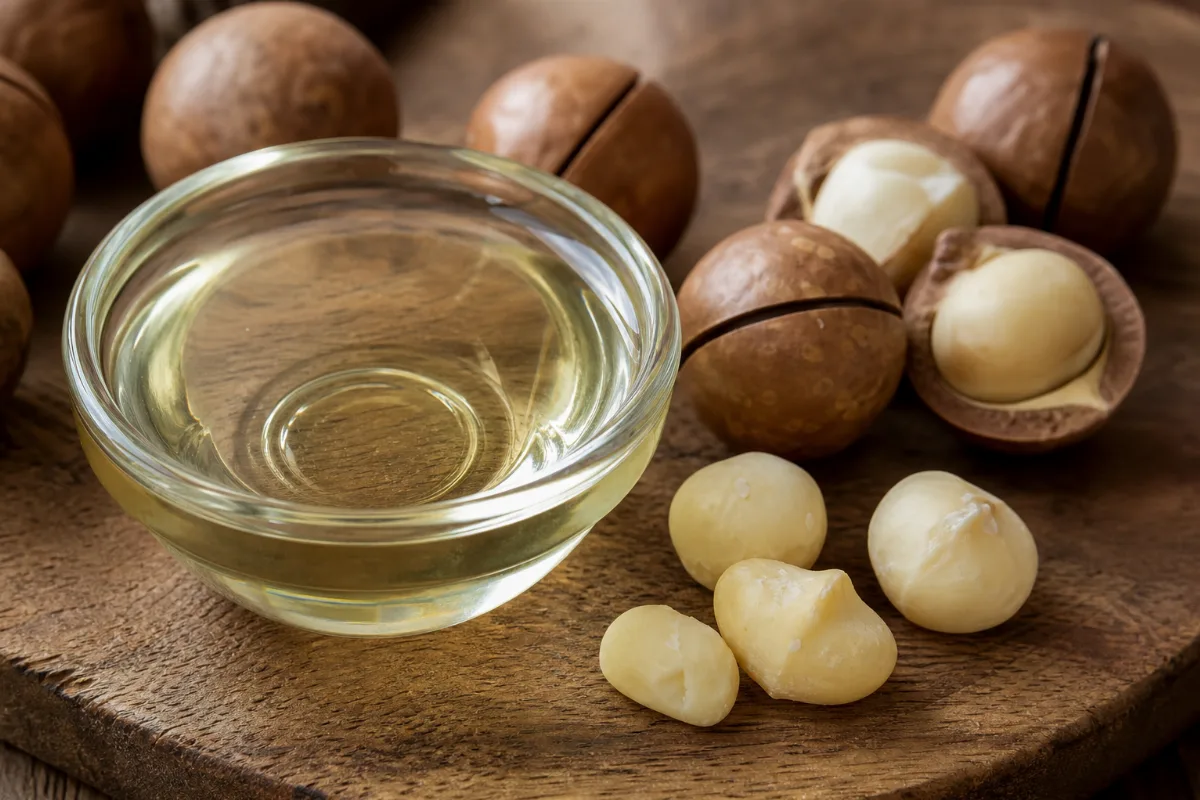
Macadamia oil is a pale, mild oil from the kernel of Macadamia integrifolia. It is used on skin, on hair, and in cooking. The evidence for any health or beauty benefit is very thin, and the main thing to know is that macadamia is a tree nut.
What it is
Macadamia oil comes from the kernel of Macadamia integrifolia Maiden & Betche, a tree in the Proteaceae family (GBIF accepts this name).
In 15 cultivars grown in China, pressed oils were mostly oleic acid (about 57 to 63%) and palmitoleic acid (about 12 to 19%), with small amounts of tocopherols, squalene and polyphenols. Growing region shaped the oil more than cultivar. Commercial oils held about 21.5 to 23% palmitoleic acid in another analysis.
How it is used
It is used as a plain skin oil, in creams, lotions and balms, on hair, as a massage oil and as a cooking oil. For the nuts as food, see the macadamia nuts page.
Culinary oil and cosmetic oil are not the same product. Check the label.
What the research shows
The only human study of the oil on skin compared two creams that both contained 10% oil. It cannot show the oil works better than no oil.
The omega-7 claim is not shown in people. Reviews say benefits of purified palmitoleic acid remain unproven, and two of them are by authors employed by a company that sells palmitoleic-acid oils. In that company's analysis, algal oil and fish-oil concentrates had far more palmitoleic acid than macadamia oil, and avocado oil had less.
Eating whole macadamia nuts did not change weight in a small trial, and the cholesterol drop was not significant.
We found nothing on pore-clogging for this oil. Ratings you see online are not backed by a source we read.
Forms, quality and storage
Researchers describe macadamia oil as rich in monounsaturated fat but prone to oxidation. In a lab comparison, oil made by water-and-enzyme extraction had lower spoilage markers than pressed oil, so how the oil is made matters.
No source we read gives a shelf life. Keep the bottle closed, cool and out of sunlight.
At a glance
Traditional uses history, not proof
- The sources read describe no traditional medicinal use of the oil. Skin and hair uses today are mostly cosmetic and marketing use.
Studied for research
- Skin moisture and ageing signs in a cream with 10% oil, very low
- Dry skin and skin barrier, insufficient
- Hair, scars, eczema, acne, wounds, insufficient
- Palmitoleic acid (omega-7) and metabolic health, insufficient
- Eating whole macadamia nuts for LDL cholesterol and weight (nuts, not oil), mixed
Main compounds
- Oleic acid (omega-9), about 57 to 63% in one set of pressed oils
- Palmitoleic acid (omega-7), about 12 to 23% depending on source
- Tocopherols (vitamin E family)
- Squalene
- Polyphenols
Common forms
- Pressed or cold-pressed oil
- Refined oil
- Ingredient in creams, lotions and balms (label: Macadamia integrifolia seed oil)
- Culinary oil
Research links: Tree nut and seed allergies, review (abstract) · Cream study with 10% macadamia oil (abstract) · Nut ingredients in eczema skincare, survey (abstract) · Palmitoleic acid and metabolic health, review (abstract) · ASPCA: macadamia nut · FDA: major food allergen definition · Research Library · Genes & Biomarkers Library
What it is and its history
- Accepted scientific name
- Macadamia integrifolia
- Naming authority
- Maiden & Betche
- Common names
- Macadamia oil (English); Macadamia nut oil (English); Queensland nut oil / Australia nut oil (ASPCA lists these names for the nut) (English)
- Family or group
- Proteaceae
- Classification
- Plantae > Proteaceae > Macadamia > Macadamia integrifolia
- Native range
- Not checked in the sources read.
- Habitat
- Not checked.
- What it looks like
- Roots: Not checked.; Stems: Not checked.; Leaves: Not checked.; Flowers: Not checked.; Fruit: The kernel (nut meat) is pressed for the oil.
- Cultivation
- Grown in several regions; one study analysed 15 cultivars from Yunnan, Guangxi and Guangdong in China.
- Harvest and processing
- Kernels are pressed; water-and-enzyme extraction is also studied in the lab. Refined and unrefined oils exist.
- Look-alikes and adulterants
- Name: Other nut or seed oils (almond, sunflower, avocado); Note: Different oils with different fatty acids; avocado oil held less palmitoleic acid than macadamia oil in one analysis.
- Sustainability and conservation
- Not checked.
Traditional use and history history, not clinical proof
| Tradition or era | Documented use | Source |
|---|---|---|
| Traditional medicine | The sources read do not describe a traditional medicinal use of macadamia oil. Current skin and hair uses appear to be cosmetic and marketing use. This is not verified history. | p32128005 |
Traditional use shows how it was used. It does not show that it works or is safe today.
What is inside, and how it may work
What it contains and how those compounds act in cells and animals. Laboratory and animal mechanisms are not proven effects in people.
Main compounds
| Compound | Family | Where it is concentrated | Activity studied | Level of evidence |
|---|---|---|---|---|
| Oleic acid PubChem 445639 | omega-9 monounsaturated fatty acid | Kernel oil 56.66 to 62.75% in pressed oils from 15 Chinese cultivars. | Main fat in the oil; no activity tested in the sources read. 15 | Lab analysis |
| Palmitoleic acid (omega-7) PubChem 445638 | omega-7 monounsaturated fatty acid | Kernel oil 12.24 to 18.73% in 15 Chinese cultivars; 21.5 to 23.0% in commercial macadamia oils. | Called a lipokine in mouse and cell studies; benefits of purified supplements unproven in people. 15 4 5 2 | Human, animal and lab (reviews) |
| Tocopherols, squalene and polyphenols | minor components (vitamin E family, hydrocarbon, plant phenols) | Kernel oil In the best cultivar, squalene 329.01 mg/kg and tocopherols 64.10 mg/kg. Amounts depended on growing region. | Antioxidant activity in the lab tracked these amounts. 15 | Lab analysis |
Mechanisms, receptors and pathways
| Target or pathway | Gene or receptor | What was found | Level |
|---|---|---|---|
| Insulin signalling and fat handling | n/a | In mice and cell lines palmitoleic acid raised insulin sensitivity in muscle and affected fat cells; human results are mixed. None tested for macadamia oil. 2 | Animal and in vitro (review) |
| Oxidation of the oil | n/a | The oil is rich in monounsaturated fat but prone to oxidation; extraction method changed peroxide and acid values. 7 12 | Lab analysis |
Absorption, metabolism and elimination
- Absorption
- Not described for macadamia oil in the sources read.
- Distribution
- Not described.
- Metabolism
- Not described.
- Elimination
- Not described.
- Bioavailability
- Not described. The cream study speculates a nano-sized cream carries oil better, but did not measure it.
Isolated compounds versus whole extracts
Whole macadamia nuts (eaten), macadamia oil (food or skin) and purified palmitoleic acid are different things. Results for one do not carry over to the others.
Nutritional composition
Macadamia oil is a food and cosmetic oil, mostly oleic and palmitoleic acid. The nuts themselves are covered on the macadamia nuts page.
1 mixed findings1 very low certainty3 not enough evidence
What was looked at
The 5 benefits and uses checked for Macadamia Oil, each with how strong the evidence is. Tap one to open it.
- Skin moisture and ageing signs (cream with 10% oil)Very low certainty
- Dry skin and the skin barrierNot enough evidence
- Hair, scars, stretch marks, eczema, acne and woundsNot enough evidence
- Palmitoleic acid (omega-7) and metabolic healthNot enough evidence
- Eating whole macadamia nuts: LDL cholesterol and body weightMixed findings
Lab markers tracked in the studies
Skin-analyser readings (water content, pore size, melanin, wrinkles)LDL cholesterolBody weight and body fat
What is Macadamia Oil good for?
What the research shows for each use, and how strong it is. None of it is proven. Read the Safety tab too.
Benefits, one by one
Each card is a research question, not a promise. Tap a goal to filter. Open a card to see the studies, doses and limits.
Skin moisture and ageing signs (cream with 10% oil)
Very low certaintyOne 4-week study compared two creams that both held 10% macadamia oil. The nanocream did better than the ordinary cream on skin-analyser readings. It never compared the oil with a cream without oil.
1 studiesCream with 10% oil, applied to skin. Amounts and timing are in the pa…
Studies, doses and limits
What the trials found
A 4-week comparison of a macadamia oil nanocream with a conventional cream, both with 10% macadamia nut oil, read with a skin-analyser device. The number of people is not in the abstract.
Results
The nanocream was reported to do better than the conventional cream on water content, pore size, melanin and wrinkles. No numbers are given in the abstract.
Effect sizes as reported
No effect sizes in the abstract.
Why this rating
One small study, number of people not stated, no oil-free group. It tests a cream design, not the oil.
Form and dose studied
Cream with 10% oil, applied to skin. Amounts and timing are in the paper and are not given here.
Who was studied
Volunteers; ages and skin type not given in the abstract.
Limits
Compares two creams that both contained the oil. No placebo cream. Authors tested their own formulation. Not repeated.
Why researchers looked
Macadamia oil is rich in oleic and palmitoleic acid and is sold as a skin and 'anti-ageing' oil.
Traditional use
The sources read do not describe a traditional medicinal use of macadamia oil.
Proposed mechanism Pharmacological theory
Not tested. The authors suggest the nano-sized cream carries the oil into the skin better. That is an idea, not a result.
A proposed mechanism does not show that the effect happens in people.
Macadamia is a tree nut. Ask an allergy doctor before using the oil if you have a tree nut allergy.
Dry skin and the skin barrier
Not enough evidenceNo trial of macadamia oil on dry skin or on a damaged skin barrier was found. A safety panel says plant oils like this one are used as softening, sealing (occlusive) and moisturizing ingredients, which describes the use, not a proven result.
1 studiesNot applicable.
Studies, doses and limits
Results
The Cosmetic Ingredient Review panel judged 244 plant oils safe as used in cosmetics and said they are used for conditioning, occlusive, emollient and moisturizing properties. The abstract does not list the oils.
Why this rating
No human trial of macadamia oil on dry skin or the skin barrier was found.
Limits
The safety review is about safety, not benefit, and we could not confirm macadamia oil is in its list.
Why researchers looked
Plant oils are widely used to soften and seal dry skin.
Traditional use
The sources read do not describe a traditional medicinal use of macadamia oil.
Proposed mechanism Pharmacological theory
Not tested for macadamia oil. Oils in general form a layer on skin that can slow water loss; this was not measured for this oil in the sources read.
A proposed mechanism does not show that the effect happens in people.
Skin made for eczema often holds nut ingredients; see the Safety tab.
Hair, scars, stretch marks, eczema, acne and wounds
Not enough evidenceNo trial of macadamia oil for hair growth, scars, stretch marks, eczema, acne or wound healing was found. Claims online do not have trial evidence behind them. For eczema, the only data found is a warning.
1 studiesNot applicable.
Studies, doses and limits
Results
A Polish store survey found macadamia nut derivatives among the most common food-allergen ingredients in 396 skincare products for atopic dermatitis, and the authors warned that food derivatives on inflamed skin may promote sensitisation. That is a caution, not a benefit.
Why this rating
No trials. The survey only counts ingredients on labels.
Limits
Absence of trials is not proof the oil does nothing. It means we cannot say.
Why researchers looked
The oil is sold for these uses in cosmetics.
Traditional use
The sources read do not describe a traditional medicinal use of macadamia oil. Hair and scalp use today is mostly cosmetic and marketing use.
Proposed mechanism None found
None shown.
A proposed mechanism does not show that the effect happens in people.
Eczema skin and broken skin are where nut ingredients worry researchers most; ask a clinician.
Palmitoleic acid (omega-7) and metabolic health
Not enough evidenceMacadamia oil does contain palmitoleic acid, often called omega-7. Whether that does anything good for people is not shown. Short trials of purified palmitoleic acid mostly found no effect on blood fats, blood sugar or inflammation markers.
4 studiesContent figures are for the oil. No trial amounts are given here.
Studies, doses and limits
What the trials found
A 2026 narrative review found short trials of purified palmitoleic acid mostly neutral. Observational studies link higher palmitoleic acid in blood fats with body fat, high triglycerides and fatty liver, which is not a benefit signal. A 2022 review reports diverse effects in cells, animals and humans.
Results
Macadamia oil held 12.2 to 18.7% palmitoleic acid in 15 Chinese-grown cultivars and 21.5 to 23.0% in commercial oils. Algal oil (67.3%) and fish-oil concentrates (54.8 to 57.0%) held far more; avocado oil held 5.6 to 10.0%.
Why this rating
No trial of macadamia oil on these outcomes. Purified-acid trials were mostly neutral. Two of the sources are by authors employed by a company selling palmitoleic-acid oils.
Form and dose studied
Content figures are for the oil. No trial amounts are given here.
Limits
Composition studies are not health trials. The review authors have a commercial interest. Eaten oil is not the same as oil on skin.
Why researchers looked
Mouse and cell studies suggested palmitoleic acid might help insulin signalling and fat handling, so researchers looked for effects in people.
Traditional use
The sources read do not describe a traditional medicinal use of macadamia oil.
Proposed mechanism Laboratory research
In mice and cell lines, palmitoleic acid acted as a 'lipokine' that raised insulin sensitivity in muscle and affected fat cells. Its role in humans is not fully understood and is sometimes controversial (cell and animal work).
A proposed mechanism does not show that the effect happens in people.
Review authors work for a palmitoleic-acid company; read the claims with care.
Eating whole macadamia nuts: LDL cholesterol and body weight
Mixed findingsThis is about the nut, not the oil. In one small crossover trial, eating macadamia nuts for 8 weeks did not change weight, and cholesterol fell slightly but not by a meaningful margin in the statistics. A review says macadamia diets can lower LDL when they replace saturated fat.
2 studiesWhole nuts added to the usual diet. Amounts are in the paper.
Studies, doses and limits
What the trials found
A randomised crossover trial in 35 overweight or obese adults, with nuts supplying about 15% of daily calories for 8 weeks versus no nuts. The 2026 review cites macadamia diets that improved LDL when they replaced saturated fat.
Results
No significant change in weight, BMI, waist, body fat or blood sugar markers. Total cholesterol fell 2.1% (not significant) and LDL 4% (not significant). Greater lowering was seen in people with overweight (not obesity) and less body fat.
Effect sizes as reported
LDL -4.7 mg/dl (95% CI -14.3 to 4.8); total cholesterol -4.3 mg/dl (95% CI -14.8 to 6.1).
Why this rating
One small trial with non-significant cholesterol change; a review reports better results in other diets. Whole nuts are not oil.
Form and dose studied
Whole nuts added to the usual diet. Amounts are in the paper.
Who was studied
Adults with overweight or obesity.
Limits
Small, 35 people; funding not stated in the abstract. Results for nuts do not carry over to cosmetic or cooking oil.
Why researchers looked
Macadamia nuts are mostly monounsaturated fat, and replacing saturated fat with it can change cholesterol.
Traditional use
Macadamia nuts are a food. The sources read describe no traditional medicinal use of the oil.
Proposed mechanism Pharmacological theory
Likely the swap of fats in the diet; the nut also holds other substances, so the effect cannot be pinned on palmitoleic acid (review authors' reading).
A proposed mechanism does not show that the effect happens in people.
This is about the whole nut eaten as food, not the oil. Nut allergy applies.
Connections to the rest of health
How Macadamia Oil connects to the rest of our health knowledge graph. Every link says what kind of connection it is. A safety link (for example to the liver) is a warning, not a benefit. A study that merely mentions a topic never creates a benefit link.
Explore every connection: goals, body systems, organs, symptoms, genes
A. Wellness goals
| Connected to | Kind of connection | Evidence status | Context | Studies |
|---|---|---|---|---|
| Healthy Skin | Very low certainty | Skin moisture and ageing signs (cream with 10% oil): One 4-week study compared two creams that both held 10% macadamia oil. The nanocream did better than the ordinary cream on skin-analyser readings. It never compared the oil with a cream without oil. | 8 | |
| Anti Aging Support | Very low certainty | Skin moisture and ageing signs (cream with 10% oil): One 4-week study compared two creams that both held 10% macadamia oil. The nanocream did better than the ordinary cream on skin-analyser readings. It never compared the oil with a cream without oil. | 8 | |
| Healthy Skin | Not enough evidence | Dry skin and the skin barrier: No trial of macadamia oil on dry skin or on a damaged skin barrier was found. A safety panel says plant oils like this one are used as softening, sealing (occlusive) and moisturizing ingredients, which describes the use, not a proven result. Hair, scars, stretch marks, eczema, acne and wounds: No trial of macadamia oil for hair growth, scars, stretch marks, eczema, acne or wound healing was found. Claims online do not have trial evidence behind them. For eczema, the only data found is a warning. | 3 13 | |
| Hair Support | Not enough evidence | Hair, scars, stretch marks, eczema, acne and wounds: No trial of macadamia oil for hair growth, scars, stretch marks, eczema, acne or wound healing was found. Claims online do not have trial evidence behind them. For eczema, the only data found is a warning. | 13 | |
| Metabolic Health | Not enough evidence | Palmitoleic acid (omega-7) and metabolic health: Macadamia oil does contain palmitoleic acid, often called omega-7. Whether that does anything good for people is not shown. Short trials of purified palmitoleic acid mostly found no effect on blood fats, blood sugar or inflammation markers. | 5 2 4 15 | |
| Cholesterol Balance | Not enough evidence | Palmitoleic acid (omega-7) and metabolic health: Macadamia oil does contain palmitoleic acid, often called omega-7. Whether that does anything good for people is not shown. Short trials of purified palmitoleic acid mostly found no effect on blood fats, blood sugar or inflammation markers. | 5 2 4 15 | |
| Cholesterol Balance | Mixed findings | Eating whole macadamia nuts: LDL cholesterol and body weight: This is about the nut, not the oil. In one small crossover trial, eating macadamia nuts for 8 weeks did not change weight, and cholesterol fell slightly but not by a meaningful margin in the statistics. A review says macadamia diets can lower LDL when they replace saturated fat. | 11 5 | |
| Heart Health | Mixed findings | Eating whole macadamia nuts: LDL cholesterol and body weight: This is about the nut, not the oil. In one small crossover trial, eating macadamia nuts for 8 weeks did not change weight, and cholesterol fell slightly but not by a meaningful margin in the statistics. A review says macadamia diets can lower LDL when they replace saturated fat. | 11 5 | |
| Weight Management | Mixed findings | Eating whole macadamia nuts: LDL cholesterol and body weight: This is about the nut, not the oil. In one small crossover trial, eating macadamia nuts for 8 weeks did not change weight, and cholesterol fell slightly but not by a meaningful margin in the statistics. A review says macadamia diets can lower LDL when they replace saturated fat. | 11 5 |
B. Body systems
| Connected to | Kind of connection | Evidence status | Context | Studies |
|---|---|---|---|---|
| Skin Hair Beauty | Biological association | Very low certainty | Studied for: Skin moisture and ageing signs (cream with 10% oil) Studied for: Dry skin and the skin barrier | 8 3 13 |
| Metabolism Weight | Biological association | Not enough evidence | Studied for: Palmitoleic acid (omega-7) and metabolic health | 5 2 4 15 |
| Cardiovascular System | Biological association | Mixed findings | Studied for: Eating whole macadamia nuts: LDL cholesterol and body weight | 11 5 |
C. Body parts and organs
E. Health conditions
| Connected to | Kind of connection | Evidence status | Context | Studies |
|---|---|---|---|---|
| Food allergy | Low certainty | Tree nut allergy can be severe; whether the oil carries enough protein to react was not shown. Preparation or compound: Macadamia nut (oil not measured) |
10 9 14 | |
| Eczema | Not enough evidence | Label survey and authors' warning about sensitisation on inflamed skin. Preparation or compound: Nut-derived skincare ingredients |
13 |
I. Biomarkers
| Connected to | Kind of connection | Evidence status | Context | Studies |
|---|---|---|---|---|
| Skin-analyser readings (water content, pore size, melanin, wrinkles) | Biological association | Very low certainty | Measured in trials: improved (nanocream versus conventional cream). A lab change is not the same as a health benefit. | 8 |
| LDL cholesterol | Biological association | Mixed findings | Measured in trials: no clear change. A lab change is not the same as a health benefit. | 11 5 |
| Body weight and body fat | Biological association | Low certainty | Measured in trials: no change. A lab change is not the same as a health benefit. | 11 |
L. Active compounds
| Connected to | Kind of connection | Evidence status | Context | Studies |
|---|---|---|---|---|
| Oleic acid | Biological association | Lab analysis | Main fat in the oil; no activity tested in the sources read. Preparation or compound: Kernel oil |
15 |
| Palmitoleic acid (omega-7) | Biological association | Human, animal and lab (reviews) | Called a lipokine in mouse and cell studies; benefits of purified supplements unproven in people. Preparation or compound: Kernel oil |
15 4 5 2 |
| Tocopherols, squalene and polyphenols | Biological association | Lab analysis | Antioxidant activity in the lab tracked these amounts. Preparation or compound: Kernel oil |
15 |
Each connection is stored with the ingredient, the connected record, the kind of connection, the evidence status, the supporting studies, the preparation or compound involved, and a review date (last reviewed October 25, 2026).
Evidence at a glance: what the research found for 5 outcomes
Each outcome below is one thing researchers measured. Certainty is how far the evidence can be trusted, not how well it works. The full studies are on the next tab.
The evidence
The research centre for Macadamia Oil. Every record here was checked against PubMed or the publisher's page; we never list a study we have not verified.
Evidence by outcome
Bars show how many studies we found for each outcome, not how well it works. People are added up across trials only (reviews are not added, to avoid double counting).
How we rate evidence
High certainty
Several well-run trials or reviews agree; further research is unlikely to change the picture much.
Moderate certainty
Good trials point the same way, but some doubt remains.
Low certainty
Small, short or inconsistent trials. The finding could change with better research.
Very low certainty
Very little or very weak human data. Treat as a possibility only.
Mixed findings
Trials or reviews disagree with each other.
Not enough evidence
Not enough human research to say either way.
Evidence against
Good research found no benefit, or found harm.
We take the reviewers' own risk-of-bias and GRADE statements where they exist, and otherwise judge from study size, design, consistency, directness and whether a product matches what is sold. Many publications do not make evidence high. Method note: We read the PubMed abstracts of 12 papers, the FDA and ASPCA pages in full text, checked the plant name in GBIF and compounds in PubChem. Certainty ratings are the compiler's own reading. Funding is not stated in most abstracts; two papers are by employees of a palmitoleic-acid company and are marked.
Study library: every study we checked 15
| Study | Design | People | Product, dose, length | Result |
|---|---|---|---|---|
| ASPCA Animal Poison Control ASPCA: Macadamia Nut (toxic and non-toxic plants) aspca.org · Source |
Authoritative guidance dog |
Dogs | n/a Not given here |
Listed as toxic to dogs. Toxic principle: unknown. Signs in dogs: depression, weakness (especially in the rear limbs), vomiting and tremors. The page tells owners to call ASPCA Poison Control or a vet if they suspect poisoning. Methods, limits and fundingOutcomes: Toxicity of macadamia nut to pets Limitations: Covers the nut. The page does not mention the oil. Date not shown on the page. Read: full-text |
| Bermudez 2022 Roles of Palmitoleic Acid and Its Positional Isomers, Hypogeic and Sapienic Acids, in Inflammation, Metabolic Diseases and Cancer. Cells · PMID 35883589 · DOI |
Narrative review cell, animal and human (review) |
Cell, animal and human studies of palmitoleic acid | Palmitoleic acid Not given here |
Results differ between studies in cell lines, animals and humans. In mice and cells palmitoleic acid acted as a 'lipokine', for example raising insulin sensitivity in muscle. Its role in humans is not fully understood and is sometimes controversial. Methods, limits and fundingOutcomes: Effects on diabetes, cardiovascular disease, fatty liver and cancer Limitations: Mostly cell and animal work; not about macadamia oil or skin. Funding and conflicts: The authors declare no conflict of interest. Read: abstract |
| Burnett 2017 Safety Assessment of Plant-Derived Fatty Acid Oils. Int J Toxicol · PMID 29243540 · DOI |
Safety assessment review of safety data |
244 plant-derived fatty acid oils as used in cosmetics | Plant oils used in cosmetics various Not given here |
The panel concluded that the 244 oils are safe as used in cosmetics. It says oils are used for skin conditioning, occlusive, emollient and moisturizing properties, and that because many are edible and systemic toxicity is low, the review focused on skin effects. Methods, limits and fundingOutcomes: Safety of the oils as used in cosmetics, with focus on effects on skin Limitations: Only the abstract was read. It does not list the oils, so we could not confirm macadamia oil is among them, and it does not say whether people with nut allergy were considered. Funding and conflicts: Funding is not stated in the abstract. Read: abstract |
| Correa 2026 Palmitoleic acid content and composition-based nutritional quality of commercial omega-7 oils and supplements. Front Nutr · PMID 42459804 · DOI |
Product analysis lab-analysis |
Commercial omega-7 oils and supplements (algal, fish-oil concentrates, sea buckthorn, macadamia, avocado) | Commercial macadamia oils and other omega-7 products oils and supplements Not given here |
Macadamia oil held 21.5 to 23.0% POA (24.8 to 27.0% total omega-7). Algal oil had the highest POA (67.3%), fish-oil ethyl ester concentrates 54.8 to 57.0%, avocado oil 5.6 to 10.0%, and sea buckthorn from 0.2 to 35.5%. Methods, limits and fundingOutcomes: Palmitoleic acid (POA) and total omega-7 in each product, by gas chromatography Limitations: Composition only; no health outcome. Number of macadamia samples is not in the abstract. Funding and conflicts: INDUSTRY-LINKED: all authors were employees of Checkerspot, Inc., a company developing algae oils rich in palmitoleic acid, which the paper ranks highest. Read: abstract |
| Destaillats 2026 Palmitoleic (16:1 n-7) acid and metabolic health: integrating observational, clinical, and mechanistic evidence. Front Nutr · PMID 42245547 · DOI |
Narrative review human, animal and lab (review) |
Observational, clinical and lab studies of palmitoleic acid | Palmitoleic acid (purified supplements and food sources such as macadamia) Not given here |
Higher palmitoleic acid in blood fats often goes with fat-making in the liver, high triglycerides, body fat, insulin resistance and fatty liver. Macadamia-based diets can improve LDL cholesterol when they replace saturated fat, but these studies cannot separate palmitoleic acid from the rest of the fat in the food. Short trials of purified palmitoleic acid mostly found neutral effects on blood fats, blood sugar and inflammation markers. Benefits of purified supplements remain unproven. Methods, limits and fundingOutcomes: Blood fats, blood sugar, inflammation, body fat and liver markers Limitations: A narrative review (not systematic). Authors work for a company selling a palmitoleic-acid product line. Funding and conflicts: INDUSTRY-LINKED: all authors were employed by Checkerspot, Inc., a company developing algae oils enriched in palmitoleic acid. Read: abstract |
| GBIF Secretariat 2026 GBIF Backbone Taxonomy: Macadamia integrifolia Maiden & Betche api.gbif.org · Source |
Database record n/a |
n/a | n/a Not given here |
GBIF API match on 2026-10-25: accepted species, family Proteaceae, usage key 2891785. Macadamia tetraphylla L.A.S.Johnson is also an accepted species. Methods, limits and fundingOutcomes: Accepted name and family Limitations: Name check only. Read: full-text |
| Gao 2025 Development and characterization of high-performance macadamia oil-based oleogel emulsions. Food Chem X · PMID 41399772 · DOI |
Lab study lab-analysis |
Macadamia oil made into gels and emulsions | Macadamia oil with added plant sterols (a food-science test) kernel oil Not given here |
The authors describe macadamia oil as rich in monounsaturated fats and valued in food, but with high fluidity and susceptibility to oxidation. They made gels from it to improve stability. Methods, limits and fundingOutcomes: Gel strength, stability and oxidation during storage Limitations: Food-science paper; not about health or skin. Funding and conflicts: The authors declare no competing interests. Read: abstract |
| Hanum 2019 Macadamia Nuts Oil in Nanocream and Conventional Cream as Skin Anti-Aging: A Comparative Study. Open Access Maced J Med Sci · PMID 32128005 · DOI |
Comparative study |
Volunteers (number not given in the abstract) | Two creams, each with 10% macadamia nut oil (a nanocream and a conventional cream) kernel oil, applied to skin Not given here 4 weeks · vs The conventional cream (both creams contained the oil) |
The nanocream was reported to do better than the conventional cream on water content, pore size, melanin and wrinkles. Nanocream better than conventional cream; no numbers in the abstract Methods, limits and fundingOutcomes: Skin-analyser readings: moisture (water content), evenness, pore size, black spot (melanin) and wrinkles Limitations: Compares two cream types that both held the oil, so it does not show the oil works better than no oil. No oil-free (placebo) group in the abstract. Number of people not stated. Authors are from a pharmacy faculty and tested their own formulation. Funding and conflicts: Funding and conflicts of interest are not stated in the abstract. Read: abstract |
| Inaba 2007 [Allergy to macadamia nut] Arerugi · PMID 17671413 |
Case report human (case report) |
1 One 23-year-old woman with atopic dermatitis |
Macadamia nuts eaten; skin scratch test with an extract oil nuts Not given here |
After eating macadamia nuts she had mouth discomfort and hives, and once breathlessness. A scratch test with an 'extract oil' used as is was positive and immediate allergy to macadamia nuts was diagnosed. She avoided macadamia completely and had no further reactions. Methods, limits and fundingOutcomes: Reaction to macadamia nuts and skin test result Limitations: One case, written in Japanese (English abstract). The abstract does not say how the test oil was made, so it does not show that cosmetic macadamia oil causes reactions. Funding and conflicts: Not stated. Read: abstract |
| Jeong 2025 Update on Tree Nut and Seed Allergies: Prevalence, Clinical Characteristics, Diagnosis, and Management. Allergy Asthma Immunol Res · PMID 41330701 · DOI |
Narrative review |
People with tree nut and seed allergy | n/a Not given here |
Tree nut and seed allergies are often severe, typically start in childhood and may last for life. Prompt intramuscular epinephrine is first-line treatment for anaphylaxis. Many people are sensitised to several nuts, but fewer are clinically allergic to several; the highest overlap reported was cashew-pistachio and walnut-pecan. Methods, limits and fundingOutcomes: Reviews how common tree nut and seed allergies are, how they show up, how they are diagnosed and managed Limitations: A review of nuts in general. The abstract does not name macadamia or say anything about nut oils. Funding and conflicts: No conflict of interest stated. Read: abstract |
| Jones 2023 Macadamia nut effects on cardiometabolic risk factors: a randomised trial. J Nutr Sci · PMID 37180485 · DOI |
Controlled trial |
35 35 overweight or obese adults with abdominal obesity |
Whole macadamia nuts eaten daily (about 15% of daily calories) added to the usual diet whole nuts (not the oil) Not given here 8 weeks per phase, crossover, 2-week washout · vs Usual diet without nuts |
No significant change in weight, BMI, waist, body fat or blood sugar markers. Total cholesterol fell 2.1% and LDL cholesterol 4%, both not significant. Non-significant lower cholesterol; no weight gain Methods, limits and fundingOutcomes: Weight, body composition, blood fats and blood sugar markers Limitations: Whole nuts eaten, not oil. Small trial. Funding is not stated in the abstract. Funding and conflicts: Funding and conflicts of interest are not stated in the abstract. Registration: NCT03801837 Read: abstract |
| Lan 2026 Aqueous enzymatic extraction of macadamia oil: Effects on physicochemical properties, composition and antioxidant activity. Food Chem X · PMID 42205556 · DOI |
Lab study lab-analysis |
Macadamia oil made by water-and-enzyme extraction versus pressing | Macadamia oil, two extraction methods kernel oil Not given here · vs Pressed oil |
The water-and-enzyme oil had lower peroxide and acid values and a higher iodine value than the pressed oil. All oils showed high antioxidant activity. Methods, limits and fundingOutcomes: Peroxide and acid values, fatty acids, aroma compounds, antioxidant activity Limitations: Lab comparison of two methods; does not show how long any oil keeps or what it does on skin. Funding and conflicts: The authors declare no competing interests. Read: abstract |
| Ryczaj 2023 Prevalence of major food allergens in skincare products for atopic dermatitis. Postepy Dermatol Alergol · PMID 38282883 · DOI |
Product survey product-label survey |
396 396 skincare products for atopic dermatitis from three online shops in Poland |
n/a Not given here |
127 of 396 products (32.1%) held at least one major food allergen derivative. The most common were almonds, macadamia nuts, soya and cereals. There was no significant difference between leave-on and rinse-off products, or between products for infants and children and adult-only products. Methods, limits and fundingOutcomes: Share of products with a derivative of an EU major food allergen, found by searching ingredient (INCI) names Limitations: A label survey, not a reaction study. It does not say how many people reacted, and it does not measure nut protein in any product. Funding and conflicts: No conflict of interest stated. Read: abstract |
| US Food and Drug Administration 2024 FDA: Inventory of Petitions Received under 21 U.S.C. 343(w)(6) for Exemptions from Food Allergen Labeling fda.gov · Source |
Authoritative guidance n/a |
n/a | n/a Not given here |
Tree nuts are one of eight major food allergen groups. The page says a 'major food allergen' does not include a highly refined oil derived from one of the eight foods, or any ingredient derived from such an oil. Methods, limits and fundingOutcomes: Definition of a major food allergen for US food labels Limitations: A food-labeling definition. It says nothing about cosmetics, and it does not say that refined oil is safe for people with nut allergy. Read: full-text |
| Yan 2026 Compositional Characteristics of Macadamia Nuts and Oils from Major Growing Regions in China: A Static Evaluation. Foods · PMID 42587856 · DOI |
Product analysis lab-analysis |
15 Pressed oils from 15 macadamia cultivars grown in Yunnan, Guangxi and Guangdong |
Pressed macadamia nut oil kernel oil Not given here |
Oleic acid 56.66 to 62.75% and palmitoleic acid 12.24 to 18.73% were the main fatty acids. Growing region shaped the oil more than cultivar, especially minor components such as squalene and tocopherols. Antioxidant activity tracked polyphenol, squalene and tocopherol content. Methods, limits and fundingOutcomes: Fatty acids, tocopherols, squalene, polyphenols and antioxidant activity Limitations: Lab analysis of Chinese-grown nuts; says nothing about effects on people. Funding and conflicts: The authors state no conflicts of interest. Read: abstract |
What we do not know yet
- What the evidence supports: very low for skin signs in one cream study, insufficient for dry skin, hair, scars, eczema, acne and omega-7, mixed for eaten nuts.
- No trial of the oil against a plain or oil-free product.
- No measurement of nut protein in the oil, and no reported skin reaction to it was found.
- No data on pregnancy, breastfeeding or medicine interactions. SCCS, Health Canada, LiverTox and shelf life were not checked.
How new research is added
New studies are found by a saved PubMed search and placed in a review queue. A person reads each one before it changes any rating or safety wording.
Lab markers
What changed in blood or saliva tests during trials. A changed number is not the same as feeling or being healthier, and we give no "normal ranges".
Metabolic 1
LDL cholesterol
No clear change in trials
The cholesterol carried in LDL particles; higher levels go with more risk of heart disease.
Mixed findingsResults and what it means
Why it was measured
A standard blood-fat marker used in diet trials.
Statistical vs. clinical meaning
Not significant in the one randomised trial read.
Safety implication
None reported in the abstract.
| Study | Result | People | Product |
|---|---|---|---|
| 11 | LDL 4% lower (-4.7 mg/dl, 95% CI -14.3 to 4.8), not significant. | 35 adults with abdominal obesity | Whole macadamia nuts versus no nuts, 8 weeks each |
| 5 | Review: macadamia diets can improve LDL when replacing saturated fat; purified palmitoleic acid trials mostly neutral. | Various | Macadamia-rich diets; purified palmitoleic acid |
Other 2
Skin-analyser readings (water content, pore size, melanin, wrinkles)
Improved (nanocream versus conventional cream) in trials
Numbers read from a skin-measuring device: how much water the skin holds, how big the pores look, how much pigment, and how deep the wrinkles are.
Very low certaintyResults and what it means
Why it was measured
A quick way to compare cosmetic products on the skin surface.
Statistical vs. clinical meaning
Difference between two creams that both held the oil; not a test of the oil against no oil.
Safety implication
None reported in the abstract.
| Study | Result | People | Product |
|---|---|---|---|
| 8 | Nanocream reported better than conventional cream on water content, pore size, melanin and wrinkles. No numbers in the abstract. | Volunteers (number not stated) | Two creams with 10% macadamia nut oil, 4 weeks |
Body weight and body fat
No change in trials
Weight, BMI, waist size and percent body fat.
Low certaintyResults and what it means
Why it was measured
To see whether adding nuts adds weight.
Statistical vs. clinical meaning
No weight gain in one small trial.
Safety implication
None reported.
| Study | Result | People | Product |
|---|---|---|---|
| 11 | No significant change in weight, BMI, waist or percent body fat. | 35 adults with abdominal obesity | Whole macadamia nuts versus no nuts, 8 weeks each |
Safety
What studies and official sources say about side effects, medicines and who should check first. Each point shows what kind of evidence it comes from.
Main points to know 5
- Tree nut allergy: macadamia is a tree nut. Tree nut allergies are often severe, usually start in childhood and may last for life. Prompt epinephrine is the first-line treatment for anaphylaxis. One case report describes a woman with hives and breathlessness after eating macadamia nuts, and a positive skin scratch test with an extract oil. We found no source that measured nut protein in macadamia oil, so we cannot say whether the oil is safe or unsafe for a nut-allergic person. If you have a tree nut allergy, ask your allergy doctor before using it on skin or eating it. Review 10 9
- 'Highly refined' does not mean 'safe for nut allergy'. US food law says a 'major food allergen' does not include a highly refined oil made from one of the eight allergen foods. That is a rule for food labels. It is not a cosmetic rule and it is not a safety test. No source we read measured nut protein in refined or unrefined macadamia oil. Authoritative guidance 14
- Eczema skin and nut ingredients. In a survey of 396 skincare products for atopic dermatitis sold in Poland, 32.1% held a derivative of a major food allergen, and macadamia nuts were among the most common. The authors say food derivatives on inflamed skin can promote sensitisation through the skin. Products for infants and children were no different from adult products. This is a label survey, not proof that any product caused a reaction. Product analysis 13
- Dogs: macadamia nuts are toxic. The ASPCA lists macadamia nut as toxic to dogs, with depression, weakness (especially in the back legs), vomiting and tremors. The toxic substance is unknown. The page does not mention the oil, so we cannot say if the oil is toxic. Keep nuts and oily nut products away from dogs and call a vet or poison control if a dog eats some. Authoritative guidance 1
- The oil can spoil. Researchers describe macadamia oil as rich in monounsaturated fat but prone to oxidation (spoiling in contact with air). A lab comparison found the extraction method changed peroxide and acid values, which are signs of spoilage. No source we read gives a shelf life. Lab analysis 7 12
Side effects 3
| Effect | How often | Severity and recovery | Evidence |
|---|---|---|---|
| Allergic reaction to macadamia nut (hives, mouth and throat symptoms, breathlessness, anaphylaxis) The case report and review are about nuts. No case of reaction to cosmetic macadamia oil was found in the sources read. | Not known for the oil; tree nut allergy in general is common and often severe | mild to life-threatening Allergy may last for life | Case report 10 9 |
| Skin sensitisation on inflamed skin (theoretical) Authors' warning from a label survey; no reactions were counted. | Not known | not stated Not stated | Expert opinion 13 |
| Skin irritation or contact allergy to the oil A safety panel judged 244 plant oils safe as used in cosmetics, but we could not confirm macadamia is on its list. A small skin patch test is a sensible step with any new product. | Not found in the sources read | unknown Unknown | Insufficient 3 |
Liver
No source read describes liver injury from macadamia oil. LiverTox was not searched for this page.
How often. Not known.
This is a safety connection. It is not evidence that Macadamia Oil supports liver health.
Medicines and supplements 3
| With | Why it matters | Importance | Evidence | What to do |
|---|---|---|---|---|
| Prescription and over-the-counter medicines prescription | No interaction mechanism was described in the sources read. | None documented in the sources read. | Insufficient Not enough evidence | Tell your pharmacist or doctor you use it, as for any supplement or food product. |
| Other tree nuts (cross-reaction) food | People are often sensitised to several nuts, but fewer are clinically allergic to several; the highest overlap reported was cashew-pistachio and walnut-pecan. | The abstract does not say whether macadamia cross-reacts with other nuts. | Review Low certainty 10 | If you react to any nut, ask an allergist which others to avoid. |
| Other skincare or food products containing nut ingredients other | Several products can add up to more nut exposure. | Not measured. | Theoretical Not enough evidence 13 | Read ingredient lists; macadamia oil can be listed as Macadamia integrifolia seed oil. |
Who should check first 5
| Situation | Advice | Evidence |
|---|---|---|
| Tree nut allergy, or a past reaction to macadamia | Ask an allergy doctor before using the oil on skin or eating it. Have your emergency plan to hand. | Review 10 9 |
| Eczema or broken, inflamed skin | Check the label for nut ingredients and ask a clinician first. | Product analysis 13 |
| Babies and young children | Nut-derived ingredients were just as common in products for infants and children in the survey. Check the label and ask a clinician. | Product analysis 13 |
| Pregnancy and breastfeeding | Not described in the sources read, which is not the same as safe. Ask a clinician before swallowing it as a supplement. | Insufficient |
| Homes with dogs | Keep nuts and oily nut products out of reach; see Dogs above. | Authoritative guidance 1 |
Overdose, product quality and regulators
Summary. No poisoning in people from macadamia oil is described in the sources read. Macadamia nuts are toxic to dogs; the oil was not addressed.
Animal. Dogs: nuts listed as toxic by ASPCA; toxic substance unknown.
Human doses studied. A cream with 10% oil on skin for 4 weeks, and whole nuts (about 15% of daily calories) for 8 weeks. Amounts are in the papers.
High dose or long term signals. Not found in the sources read.
Overdose response. Not described.
Genotoxicity. Not read.
Toxic or hazardous parts. Not described for people. Kernel is the part pressed for oil.
Oils vary by origin, method and product, and spoilage is the main quality issue found. No study of adulteration, pesticides or heavy metals in macadamia oil was found.
Palmitoleic acid varies. 12.24 to 18.73% in pressed oils from 15 Chinese cultivars; 21.5 to 23.0% in commercial macadamia oils in another analysis. Origin shaped the oil more than cultivar. 15 4
Oxidation and extraction method. Water-and-enzyme extraction gave lower peroxide and acid values than pressing in a lab comparison; macadamia oil is described as prone to oxidation. 12 7
| Body | Action | Date |
|---|---|---|
| US Food and Drug Administration (United States) | Definition of 'major food allergen' for food labels: tree nuts are one of eight groups; the definition does not include a highly refined oil derived from them. source | 2024-01-22 |
| Cosmetic Ingredient Review Expert Panel (United States) | Concluded 244 plant-derived fatty acid oils are safe as used in cosmetics (2017). source | 2017-12 |
| ASPCA Animal Poison Control (United States) | Lists macadamia nut as toxic to dogs. source |
When to get medical help
- Swelling of the lips, tongue or face, wheezing, throat tightness, or trouble breathing after eating or using macadamia oil: use epinephrine if prescribed and call emergency services now.
- Spreading rash, hives or blistering after using it: stop and get medical advice.
- A dog that has eaten macadamia nuts and shows weakness, vomiting or tremors: call a vet or ASPCA Poison Control (888-426-4435).
Stop using the product and contact a clinician or emergency service. In the US, Poison Control is 1-800-222-1222.
General information only, not medical advice. Ask a clinician or pharmacist before use, especially with medicines, in pregnancy or with a health condition. See the Natural Remedy Safety guide.
Frequently asked questions
Is macadamia oil good for skin?
It is used as a moisturizing oil, but the only human study we found compared two creams that both held it. That does not show the oil works better than no oil.
Does macadamia oil contain omega-7?
Is it the best source of omega-7?
Not in the one comparison we read: algal oil and fish-oil concentrates had far more, and avocado oil had less. That paper is from a company selling algae oils.
Can I use it if I am allergic to tree nuts?
Ask your allergy doctor first. Tree nut allergy can be severe. We found no measurement of nut protein in the oil.
Does 'refined' make it safe for nut allergy?
Not necessarily. The FDA wording leaves highly refined oil out of the 'major food allergen' label definition, but that is a food-labeling rule, not a safety test.
Is it safe for eczema or a baby's skin?
We found no trial. A survey warned that nut ingredients on inflamed skin may promote sensitisation, and found them in products for infants and children too. Check the label and ask a clinician.
Does it help hair growth, scars or stretch marks?
No trial was found for any of these.
Will it clog my pores?
We found no source that tested macadamia oil for pores or acne, so we cannot say.
Is macadamia oil safe for dogs?
The ASPCA says macadamia nuts are toxic to dogs. It does not address the oil, so we cannot say. Keep both out of reach and call a vet if a dog eats some.
How do I tell if it has gone off?
Is the cooking oil the same as the cosmetic oil?
They can be the same oil, but grades and additives differ. Read the label, and see our page on cosmetic and food grade oils.
Explore by health goal
Healthy SkinCholesterol BalanceAnti Aging SupportHair SupportMetabolic HealthHeart HealthWeight Management
Editorial transparency
- Written by
- AlternativeMed editorial team. Research compiled with AI assistance, then checked against PubMed records.
- Medical review
- None. This page has not been reviewed by a physician or pharmacist.
- First published
- 2026-10-25
- Last substantive update
- 2026-10-25
- How we research
- We read the PubMed abstracts of 12 papers, the FDA and ASPCA pages in full text, checked the plant name in GBIF and compounds in PubChem. Certainty ratings are the compiler's own reading. Funding is not stated in most abstracts; two papers are by employees of a palmitoleic-acid company and are marked.
- How we rate evidence
- See "How we rate evidence" in the Evidence tab.
- Independence
- No product is promoted on this page. No affiliate links are shown.
Sources 15
Each source was opened and checked. Where we read only the abstract, it says so. The small numbers in the text point here.
- ASPCA Animal Poison Control. ASPCA: Macadamia Nut (toxic and non-toxic plants). aspca.org. . (full-text)
- Bermudez MA, Pereira L, Fraile C et al. Roles of Palmitoleic Acid and Its Positional Isomers, Hypogeic and Sapienic Acids, in Inflammation, Metabolic Diseases and Cancer.. Cells. 2022. PMID 35883589. DOI 10.3390/cells11142146. (abstract)
- Burnett CL, Fiume MM, Bergfeld WF et al (Cosmetic Ingredient Review Expert Panel). Safety Assessment of Plant-Derived Fatty Acid Oils.. Int J Toxicol. 2017. PMID 29243540. DOI 10.1177/1091581817740569. (abstract)
- Correa M, Zhou X, Athanasiadis D et al. Palmitoleic acid content and composition-based nutritional quality of commercial omega-7 oils and supplements.. Front Nutr. 2026. PMID 42459804. DOI 10.3389/fnut.2026.1871452. (abstract)
- Destaillats F, Oliveira M, Zhou X et al. Palmitoleic (16:1 n-7) acid and metabolic health: integrating observational, clinical, and mechanistic evidence.. Front Nutr. 2026. PMID 42245547. DOI 10.3389/fnut.2026.1801946. (abstract)
- GBIF Secretariat. GBIF Backbone Taxonomy: Macadamia integrifolia Maiden & Betche. api.gbif.org. 2026. (full-text)
- Gao P, Liu Y, Wang S et al. Development and characterization of high-performance macadamia oil-based oleogel emulsions.. Food Chem X. 2025. PMID 41399772. DOI 10.1016/j.fochx.2025.103326. (abstract)
- Hanum TI, Laila L, Sumaiyah S et al. Macadamia Nuts Oil in Nanocream and Conventional Cream as Skin Anti-Aging: A Comparative Study.. Open Access Maced J Med Sci. 2019. PMID 32128005. DOI 10.3889/oamjms.2019.533. (abstract)
- Inaba Y, Yagami A, Suzuki K et al. [Allergy to macadamia nut]. Arerugi. 2007. PMID 17671413. (abstract)
- Jeong K, Lee S. Update on Tree Nut and Seed Allergies: Prevalence, Clinical Characteristics, Diagnosis, and Management.. Allergy Asthma Immunol Res. 2025. PMID 41330701. DOI 10.4168/aair.2025.17.6.672. (abstract)
- Jones JL, Sabate J, Heskey C et al. Macadamia nut effects on cardiometabolic risk factors: a randomised trial.. J Nutr Sci. 2023. PMID 37180485. DOI 10.1017/jns.2023.39. (abstract)
- Lan X, Xu W, Miao F et al. Aqueous enzymatic extraction of macadamia oil: Effects on physicochemical properties, composition and antioxidant activity.. Food Chem X. 2026. PMID 42205556. DOI 10.1016/j.fochx.2026.103974. (abstract)
- Ryczaj K, Chojnowska-Wojtowicz M, Dumycz K et al. Prevalence of major food allergens in skincare products for atopic dermatitis.. Postepy Dermatol Alergol. 2023. PMID 38282883. DOI 10.5114/ada.2023.133819. (abstract)
- US Food and Drug Administration. FDA: Inventory of Petitions Received under 21 U.S.C. 343(w)(6) for Exemptions from Food Allergen Labeling. fda.gov. 2024. (full-text)
- Yan C, Liu Y, Li J et al. Compositional Characteristics of Macadamia Nuts and Oils from Major Growing Regions in China: A Static Evaluation.. Foods. 2026. PMID 42587856. DOI 10.3390/foods15152596. (abstract)
Where to buy
Check the label first. Whatever you buy, look for these:
- 100% pure with no added fragrance or fillers
- Cold-pressed or unrefined if you want the most natural form
- For skin use, do a small patch test first
- Cosmetic or food grade, matched to how you will use it
Talk to a pharmacist or doctor before you start any supplement, especially if you take medicines. See the Safety tab for interactions.
Support our free guides: as an Amazon Associate we earn from qualifying purchases. Full disclosure.


