Nuts & Seeds · Nut
Chestnuts
Castanea sativa, Castanea mollissima · also called Sweet chestnut, European chestnut, Chinese chestnut, castaña (Spanish)
Chestnuts are starchy, low-fat nuts, usually roasted or boiled. They give some vitamin C and copper. One small trial found bread made with chestnut flour lowered blood sugar after a meal in healthy adults. Most other health claims rest on lab work. The main cautions are allergy (often linked with latex allergy), and never eating poisonous horse chestnuts (conkers).
General information, not medical advice. Last substantive update · Not medically reviewed. A named clinician has not signed off on this page. How this page is made
About Chestnuts
Chestnuts are the starchy, low-fat kernels of Castanea trees, usually roasted or boiled. They are a nutritious food, not a proven remedy. The most important safety points are allergy and not confusing them with poisonous horse chestnuts.
What it is
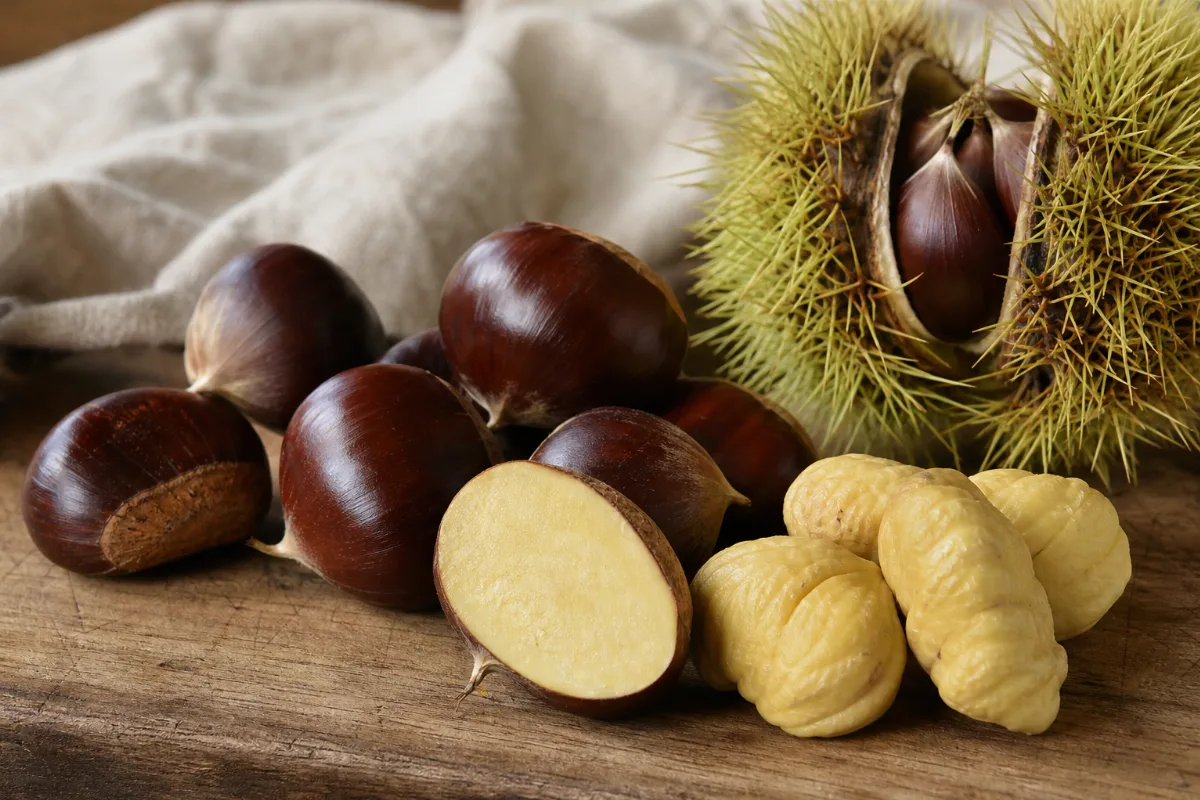
Chestnuts are the nuts of trees in the genus Castanea, mainly European or sweet chestnut (Castanea sativa) and Chinese chestnut (Castanea mollissima). People eat the soft kernel inside the spiny burr and glossy shell, roasted, boiled, dried or ground into flour.
USDA data for raw peeled European chestnuts: 196 kcal, 44.2 g carbohydrate, 1.3 g fat and 1.6 g protein per 100 g. One ounce (28 g) has about 56 kcal, 11 mg vitamin C, 0.12 mg copper and 137 mg potassium. Roasted chestnuts have about 245 kcal and 26 mg vitamin C per 100 g, and ten roasted kernels (84 g) have about 206 kcal. USDA lists fibre for some chestnut items (5.1 g per 100 g roasted) but not for raw peeled. Raw Chinese chestnuts are listed at 224 kcal and 4.2 g protein per 100 g. Cooking and storage can lower vitamin C.
What the research shows
The firmest facts are the nutrient amounts in food databases. For health effects, the evidence is thin. One 2026 trial in 14 healthy adults found a lower blood sugar rise after bread made half with chestnut flour. Total insulin was no different. It was one meal and not whole chestnuts.
We found no trial of eating chestnuts for cholesterol, blood pressure, weight or the gut. Reviews describe antioxidant and other effects of chestnut tannins in the lab, mostly from extracts and by-products. A 2025 trial of a tannin supplement in irritable bowel syndrome was positive, but it mixed chestnut with quebracho and one author works for a company.
The food versus extracts and supplements
The blood sugar trial used bread with chestnut flour. The tannin findings come from extracts and by-products, and the bowel trial used a capsule mixing two trees. Results for one form do not carry over to roasted or boiled whole chestnuts.
Amounts
This page gives no amounts to eat. Ask a doctor, dietitian or pharmacist what is right for you, especially if you have allergies, kidney disease or diabetes.
At a glance
Traditional uses history, not proof
- Eaten roasted, boiled or ground into flour as a starchy food
- Long use as food is not proof that chestnuts treat any condition
Studied for research
- Vitamin C, copper and carbohydrate as a food, high certainty for the amounts, no health trial
- Blood sugar after a starchy meal, low certainty (chestnut flour bread, 14 healthy adults)
- Cholesterol and heart disease, insufficient evidence
- Plant tannins and phenolics, very low certainty (lab work)
- Irritable bowel symptoms, very low certainty (a tannin supplement, not the food)
Main compounds
- Starch and other carbohydrate
- Vitamin C (ascorbic acid)
- Copper and manganese
- Phenolics and hydrolyzable tannins (ellagitannins)
Common forms
- Roasted or boiled whole kernels
- Dried chestnuts
- Chestnut flour (used in a 2026 bread trial)
- Candied or sweetened purée (may have added sugar)
- Tannin capsules with chestnut and quebracho (used in an IBS trial; not food)
Research links: NCCIH: Horse chestnut · USDA FoodData Central: chestnuts, European, raw, peeled · Chestnut flour bread and blood sugar trial (2026) · Research Library · Genes & Biomarkers Library
What it is and its history
- Accepted scientific name
- Castanea sativa
- Naming authority
- Mill. (GBIF accepted, exact match, usageKey 5333294); Castanea mollissima Blume (GBIF accepted, usageKey 5333237)
- Common names
- Chestnut (English); Sweet chestnut (English); European chestnut (English); Chinese chestnut (English); Marron (French); Castaña (Spanish)
- Family or group
- Fagaceae, the beech family, which also includes oaks and beeches.
- Classification
- Plantae > Fagales > Fagaceae > Castanea > Castanea sativa; Castanea mollissima
- Native range
- Not verified from a source read.
- Habitat
- Not verified from a source read.
- What it looks like
- Roots: Not verified.; Stems: Not verified.; Leaves: Not verified.; Flowers: Not verified.; Fruit: The edible part is the kernel inside the shell. USDA lists 1 oz as 28.35 g for the raw peeled item and 10 roasted kernels as 84 g.
- Cultivation
- Not verified from a source read.
- Harvest and processing
- Eaten roasted, boiled or steamed, dried, or ground into flour; a 2010 review lists boiled, roasted, frozen and marron glace products and says processing changes composition.
- Look-alikes and adulterants
- Name: Horse chestnut (Aesculus hippocastanum); Note: Different plant, family Sapindaceae (GBIF). Its raw seeds are unsafe by mouth (NCCIH). A man ate one by mistake for an edible chestnut and was treated in an emergency department.; Name: Water chestnut; Note: A different plant sold as a vegetable; it is not a chestnut and was not covered here.
- Sustainability and conservation
- Not assessed.
Photographs
Traditional use and history history, not clinical proof
| Tradition or era | Documented use | Source |
|---|---|---|
| Food use | A 2010 review says chestnut fruits are widely eaten across Europe, America and Asia, mostly as processed products. | p20564434 |
| Culinary use | Roasting, boiling and grinding to flour are common ways to eat chestnuts (general knowledge; no historical source was read). | Not verified |
Traditional use shows how it was used. It does not show that it works or is safe today.
What is inside, and how it may work
What it contains and how those compounds act in cells and animals. Laboratory and animal mechanisms are not proven effects in people.
Main compounds
| Compound | Family | Where it is concentrated | Activity studied | Level of evidence |
|---|---|---|---|---|
| Starch and other carbohydrate | macronutrient | Kernel USDA: 44.17 g carbohydrate per 100 g raw peeled European; 52.96 g roasted | Main source of energy in chestnut. 21 19 | Human data |
| Ascorbic acid (vitamin C) PubChem 54670067 | vitamin | Kernel USDA: 40.2 mg per 100 g raw peeled European; 26 mg roasted | Essential nutrient; helps absorb iron from plant foods and make collagen (MedlinePlus). Cooking can lower it. 21 14 | Human data |
| Copper and manganese | minerals | Kernel USDA: copper 0.418 mg and manganese 0.336 mg per 100 g raw peeled European; Chinese raw manganese 1.601 mg | Trace minerals the body needs in small amounts. 21 18 | Human data |
| Phenolics and hydrolyzable tannins (ellagitannins) | polyphenols | Fruit; also wood and by-products Chestnut flour bread had about 480 mg total polyphenols versus about 100 mg in wheat bread (one trial); (+)-catechin, myricetin, gallic, gentisic and p-coumaric acids were named | Antioxidant and other effects in the lab (reviews). Not shown for eating the nut. 5 1 3 | Laboratory research |
Mechanisms, receptors and pathways
| Target or pathway | Gene or receptor | What was found | Level |
|---|---|---|---|
| Starch digestion and blood glucose | Not specified | The trial authors suggest chestnut fibre, resistant starch and polyphenols may change how carbohydrate is digested. The trial measured late blood sugar being lower but did not test the mechanism. 3 | Human data |
| Oxidative stress and fat build-up (tannins) | Superoxide dismutase (named in the review) | A 2023 review reports antioxidant, antimicrobial, fat-lowering and cancer-cell effects of chestnut tannins from laboratory work. Not shown in people who eat the nut. 5 | Laboratory research |
| Allergen cross-reaction | Hev b 8 profilin; Cas s 8 lipid transfer protein; class I chitinases | Chestnut and latex allergies may be true cross-reactions (mainly via latex profilin Hev b 8) or separate allergies. In chestnut allergy without latex allergy the main allergen was Cas s 8. In latex-chestnut allergy class I chitinases were involved. 7 8 2 | Human data |
Absorption, metabolism and elimination
- Absorption
- Not studied for chestnut.
- Distribution
- Not found.
- Metabolism
- Not found.
- Elimination
- Not found.
- Bioavailability
- Not established for chestnut vitamin C or polyphenols.
Isolated compounds versus whole extracts
The only food trial used bread with 50% chestnut flour, not whole nuts. The tannin and phenolic findings come from extracts, isolated compounds, wood and by-products. The IBS trial used a capsule mixing chestnut and quebracho tannins. Results for one form do not carry over to another, including roasted or boiled whole chestnuts.
Nutritional composition
Nutrition from USDA FoodData Central SR Legacy (release 2019-04-01), read 2026-10-26 from the downloaded data set because the live web service was rate-limited. Raw peeled European chestnuts (FDC 170575), per 100 g: 196 kcal, 44.17 g carbohydrate, 1.63 g protein, 1.25 g fat (0.235 g saturated), about 52 g water, 40.2 mg vitamin C, 0.418 mg copper, 0.352 mg vitamin B6, 0.336 mg manganese, 58 micrograms folate (DFE), 484 mg potassium, 30 mg magnesium, 19 mg calcium, 0.94 mg iron, 38 mg phosphorus, 2 mg sodium. One ounce (28.35 g): about 56 kcal, 11.4 mg vitamin C, 0.12 mg copper and 137 mg potassium. USDA lists no fibre, sugar or vitamin K value for this item. Roasted European chestnuts (FDC 170190), per 100 g: 245 kcal, 52.96 g carbohydrate, 5.1 g fibre, 10.6 g sugars, 2.2 g fat, 3.17 g protein, 26 mg vitamin C, 592 mg potassium. Ten roasted kernels (84 g) are about 206 kcal and 21.8 mg vitamin C. Raw unpeeled (FDC 170574): 213 kcal, 8.1 g fibre per 100 g. Raw Chinese chestnuts (FDC 170164): 224 kcal, 4.2 g protein, 1.601 mg manganese per 100 g. Chestnuts are starchy and low in fat, unlike most nuts. Values vary with variety, growing place, roasting and storage, and cooking can lower vitamin C (MedlinePlus). Candied or puréed forms may have added sugar; check the label.
1 high certainty1 low certainty2 very low certainty2 not enough evidence
What was looked at
The 6 benefits and uses checked for Chestnuts, each with how strong the evidence is. Tap one to open it.
- Everyday nutrients: vitamin C, copper and carbohydrateHigh certainty
- Blood sugar after a starchy meal (chestnut flour bread)Low certainty
- Cholesterol, blood pressure and heart diseaseNot enough evidence
- Plant compounds (tannins and phenolics): antioxidant and other lab effectsVery low certainty
- Irritable bowel symptoms (chestnut and quebracho tannin supplement)Very low certainty
- Weight, fullness and bowel health from eating chestnutsNot enough evidence
Lab markers tracked in the studies
Blood glucose after a meal (incremental area under the curve)Insulin after a mealIBS Severity Scoring System
What is Chestnuts good for?
The main studied uses and how strong the human evidence is for each. Only one trial used a chestnut food, and it used bread with chestnut flour. Other results come from labs, reviews or a supplement.
Benefits, one by one
Each card is a research question, not a promise. Tap a goal to filter. Open a card to see the studies, doses and limits.
Everyday nutrients: vitamin C, copper and carbohydrate
High certaintyChestnuts are a starchy, low-fat nut. Raw peeled European chestnuts have 40.2 mg of vitamin C and 0.418 mg of copper in 100 g (USDA). They are mostly carbohydrate, not fat. This is about what is in the food, not a treatment for any illness.
4 studiesRaw peeled, roasted, boiled and steamed, and dried European chestnuts…
Studies, doses and limits
What the trials found
USDA lists, per 100 g of raw peeled European chestnuts: 196 kcal, 44.17 g carbohydrate, 1.25 g fat, 1.63 g protein, 40.2 mg vitamin C, 0.418 mg copper, 0.352 mg vitamin B6, 0.336 mg manganese, 58 micrograms folate and 484 mg potassium. One ounce (28 g) gives about 56 kcal. Roasted European chestnuts are listed at 245 kcal and 26 mg vitamin C per 100 g. MedlinePlus says cooking and long storage can lower vitamin C. A 2010 review says processing clearly changes the nutrient content. No trial of eating chestnuts for a health outcome was used for this row.
Results
Nutrient amounts are measured and listed. No health outcome was tested here.
Effect sizes as reported
USDA, raw peeled European: vitamin C 40.2 mg and copper 0.418 mg per 100 g; roasted: vitamin C 26 mg per 100 g.
Why this rating
High only for the nutrient amounts (a measured food database). There is no trial, so nothing is claimed about health effects.
Form and dose studied
Raw peeled, roasted, boiled and steamed, and dried European chestnuts have different values in USDA. Chinese chestnuts differ again (raw: 224 kcal, 36 mg vitamin C per 100 g). Candied and puréed forms can contain added sugar.
Who was studied
General food database values; not a study of people.
Limits
Values vary with variety, growing place, roasting and storage. USDA lists no fibre value for the raw peeled item; the raw unpeeled item lists 8.1 g and the roasted item 5.1 g per 100 g. USDA SR Legacy data are from 2019.
Why researchers looked
People ask what chestnuts add to a meal, since they look like other nuts but are very different in fat and starch.
Traditional use
Chestnuts have long been roasted, boiled and ground into flour as a starchy food; long use is not proof that they treat any condition.
Proposed mechanism Authoritative guidance
Vitamin C helps the body make collagen and take up iron from plant foods (MedlinePlus). Copper is a trace mineral. Neither is specific to chestnut.
A proposed mechanism does not show that the effect happens in people.
See the Safety tab for allergy, horse chestnut and kidney disease cautions.
Blood sugar after a starchy meal (chestnut flour bread)
Low certaintyIn one small 2026 trial in 14 healthy adults, bread made half with chestnut flour led to a lower blood sugar rise than ordinary wheat bread. It was one meal, and the food was bread with chestnut flour, not whole chestnuts.
1 studiesBread with 50% chestnut flour. Not the same as roasted or boiled whol…
Studies, doses and limits
What the trials found
In a randomised crossover trial, 14 healthy adults ate, after an overnight fast, either bread made with 50% chestnut flour and 50% wheat flour or bread made with 100% wheat flour. Both meals had 50 g of available carbohydrate. Over 180 minutes, the glucose area under the curve was 27% lower after the chestnut bread (p = 0.0319). Glucose was 16% lower at 120 minutes and 14% lower at 150 minutes. Total insulin did not differ, and insulin peaked about 24 minutes sooner.
Results
A lower late blood sugar rise after one meal with chestnut flour bread, in healthy adults. Not shown for whole chestnuts, for people with diabetes, or over weeks.
Effect sizes as reported
Glucose iAUC 27% lower (p = 0.0319); 16% lower at 120 min (p = 0.0131); 14% lower at 150 min (p = 0.0071). Total insulin no difference.
Why this rating
One small crossover trial (14 people), one meal, abstract read only, flour in bread rather than the nut. The authors call chestnut human evidence limited.
Form and dose studied
Bread with 50% chestnut flour. Not the same as roasted or boiled whole chestnuts.
Who was studied
Healthy adults.
Limits
No people with diabetes. Short follow-up (180 minutes). Funding was not stated in the abstract.
Why researchers looked
Chestnut flour contains fibre-type carbohydrates and plant chemicals (polyphenols) that might slow how starch is digested.
Traditional use
Chestnuts have long been roasted, boiled and ground into flour as a starchy food; long use is not proof that they treat any condition.
Proposed mechanism Preliminary mechanism
The authors suggest polyphenols, fibre and resistant starch in chestnut may change how carbohydrate is digested. The trial did not test this directly. The chestnut bread had about 480 mg of total polyphenols, the wheat bread about 100 mg.
A proposed mechanism does not show that the effect happens in people.
People who take medicine for diabetes should ask their clinician about food and blood sugar.
Cholesterol, blood pressure and heart disease
Not enough evidenceNo trial of eating chestnuts for cholesterol, blood pressure or heart disease was found. Well-known nut and heart studies are mostly about other nuts, which are much higher in fat. Chestnut results should not be assumed from them.
2 studiesNot applicable.
Studies, doses and limits
What the trials found
No human trial of eating chestnuts for cholesterol, blood pressure or heart events was found in the searches done for this page. USDA lists 1.25 g fat per 100 g of raw peeled European chestnuts, far below most tree nuts.
Results
Nothing to report: not studied in the sources read.
Why this rating
No human studies of chestnuts for this use were found.
Limits
A PubMed search for chestnut trials (done 2026-10-26) found one food trial, on blood sugar, and a tannin supplement trial. A small search can miss papers.
Why researchers looked
Many nuts are linked with heart health, so people ask whether chestnuts do the same.
Traditional use
Chestnuts have long been roasted, boiled and ground into flour as a starchy food; long use is not proof that they treat any condition.
Proposed mechanism Preliminary mechanism
A 2023 review says tannins from chestnut relax blood vessel muscle and reduce fat build-up in laboratory work. This has not been shown for eating the nut.
A proposed mechanism does not show that the effect happens in people.
None specific.
Plant compounds (tannins and phenolics): antioxidant and other lab effects
Very low certaintyChestnut contains plant chemicals called phenolics and hydrolyzable tannins. Reviews describe antioxidant, anti-germ, fat-lowering and cancer-cell effects in cells and animals. These results are from laboratory work and mostly from extracts or by-products, so they do not show that eating chestnuts treats anything.
2 studiesIsolated tannins and extracts, not the cooked nut.
Studies, doses and limits
What the trials found
No human trial of eating chestnuts for these effects was used. Both reviews are narrative reviews, and the abstracts do not give numbers.
Results
Lab and animal effects only. Not shown in people who eat chestnuts.
Why this rating
Lab and animal research, mostly on extracts, wood and by-products; narrative reviews with no stated method.
Form and dose studied
Isolated tannins and extracts, not the cooked nut.
Who was studied
Cells and animals; not people eating the food.
Limits
Extract results do not transfer to the food. Processing changes phenolic content (2010 review).
Why researchers looked
Tannins and phenolics are common plant chemicals, and chestnut wood and fruit are rich in some of them.
Traditional use
Chestnuts have long been roasted, boiled and ground into flour as a starchy food; long use is not proof that they treat any condition.
Proposed mechanism Laboratory research
The 2023 review lists lowering oxidative stress, mopping up free radicals, stopping microbial growth and cancer-cell effects. It reports these from laboratory studies. A 2010 review says there is far more data on nutrients than on phenolics in the fruit.
A proposed mechanism does not show that the effect happens in people.
None specific.
Irritable bowel symptoms (chestnut and quebracho tannin supplement)
Very low certaintyA 2025 trial of 156 people with irritable bowel syndrome tested capsules of chestnut and quebracho tannin extract. The capsule group scored better than placebo on symptoms after 56 days. This was a supplement mixing two trees, not chestnuts as food, and one author works for a company named Silvateam.
1 studiesA capsule supplement with chestnut and quebracho tannins. Not the foo…
Studies, doses and limits
What the trials found
In a single-centre, randomised, double-blind, placebo-controlled trial, 156 adults with irritable bowel syndrome took two capsules a day of a food supplement (480 mg of tannin extracts, chestnut plus quebracho) or placebo for 56 days. The supplement group improved more on the IBS severity score, quality of life and specific symptoms (p < 0.05). The authors reported no side effects.
Results
Better symptom scores than placebo on a combination tannin supplement.
Effect sizes as reported
IBS Severity Scoring System improved versus placebo, p < 0.05; exact figures not in the abstract.
Why this rating
One single-centre trial of a two-tree combination supplement, an author employed by a company, abstract read only, and no link to eating chestnuts.
Form and dose studied
A capsule supplement with chestnut and quebracho tannins. Not the food.
Who was studied
Adults 18 to 70 with irritable bowel syndrome.
Limits
Cannot say whether chestnut or quebracho caused the effect. No replication was found. Not a chestnut-as-food result.
Why researchers looked
Tannin extracts are sold as gut supplements, and the trial tested whether this one eased irritable bowel symptoms.
Traditional use
Not a traditional food use.
Proposed mechanism Unknown
The abstract does not give a mechanism for the result.
A proposed mechanism does not show that the effect happens in people.
Tannin supplements were not reviewed for safety on this page. Ask a clinician or pharmacist before using one.
Weight, fullness and bowel health from eating chestnuts
Not enough evidenceNo study of eating chestnuts for weight, fullness or bowel health was found. USDA lists fibre only for some chestnut items (raw unpeeled 8.1 g and roasted 5.1 g per 100 g), and none for raw peeled.
3 studiesNot applicable.
Studies, doses and limits
What the trials found
No human study was found. Per 100 g, USDA lists raw peeled European chestnuts at 196 kcal and 1.25 g fat, and roasted ones at 245 kcal and 2.2 g fat.
Results
Not studied in the sources read.
Why this rating
No human studies were found.
Limits
Energy and fibre values are food-database numbers, not results of a study.
Why researchers looked
Chestnuts are lower in fat and energy than most nuts, which makes people ask about weight and gut effects.
Traditional use
Chestnuts have long been roasted, boiled and ground into flour as a starchy food; long use is not proof that they treat any condition.
Proposed mechanism Unknown
No mechanism was read for this use.
A proposed mechanism does not show that the effect happens in people.
None specific.
Connections to the rest of health
How Chestnuts connects to the rest of our health knowledge graph. Every link says what kind of connection it is. A safety link (for example to the liver) is a warning, not a benefit. A study that merely mentions a topic never creates a benefit link.
Explore every connection: goals, body systems, organs, symptoms, genes
A. Wellness goals
| Connected to | Kind of connection | Evidence status | Context | Studies |
|---|---|---|---|---|
| Blood Sugar Balance | Low certainty | Blood sugar after a starchy meal (chestnut flour bread): In one small 2026 trial in 14 healthy adults, bread made half with chestnut flour led to a lower blood sugar rise than ordinary wheat bread. It was one meal, and the food was bread with chestnut flour, not whole chestnuts. | 3 | |
| Heart Health | Not enough evidence | Cholesterol, blood pressure and heart disease: No trial of eating chestnuts for cholesterol, blood pressure or heart disease was found. Well-known nut and heart studies are mostly about other nuts, which are much higher in fat. Chestnut results should not be assumed from them. | 21 5 | |
| Weight Management | Not enough evidence | Weight, fullness and bowel health from eating chestnuts: No study of eating chestnuts for weight, fullness or bowel health was found. USDA lists fibre only for some chestnut items (raw unpeeled 8.1 g and roasted 5.1 g per 100 g), and none for raw peeled. | 21 20 19 |
B. Body systems
| Connected to | Kind of connection | Evidence status | Context | Studies |
|---|---|---|---|---|
| Digestive System | Biological association | High certainty | Studied for: Everyday nutrients: vitamin C, copper and carbohydrate Studied for: Irritable bowel symptoms (chestnut and quebracho tannin supplement) | 21 19 14 1 6 20 |
| Immune System | Biological association | High certainty | Studied for: Everyday nutrients: vitamin C, copper and carbohydrate Studied for: Plant compounds (tannins and phenolics): antioxidant and other lab effects | 21 19 14 1 5 |
| Metabolism Weight | Biological association | Low certainty | Studied for: Blood sugar after a starchy meal (chestnut flour bread) Studied for: Weight, fullness and bowel health from eating chestnuts | 3 21 20 19 |
| Blood Sugar Support | Biological association | Low certainty | Studied for: Blood sugar after a starchy meal (chestnut flour bread) | 3 |
| Cardiovascular System | Biological association | Not enough evidence | Studied for: Cholesterol, blood pressure and heart disease | 21 5 |
| Heart Circulation | Biological association | Not enough evidence | Studied for: Cholesterol, blood pressure and heart disease | 21 5 |
C. Body parts and organs
| Connected to | Kind of connection | Evidence status | Context | Studies |
|---|---|---|---|---|
| Kidneys | Adverse effect or risk | Guidance | People with kidney disease may need to limit potassium; ask a dietitian. People with kidney disease may need to limit potassium; chestnuts contain some. Preparation or compound: Chestnut as a potassium source |
17 21 |
E. Health conditions
| Connected to | Kind of connection | Evidence status | Context | Studies |
|---|---|---|---|---|
| Latex-fruit syndrome | Adverse effect or risk | Documented risk | Latex allergy and chestnut allergy are often found together; severe reactions are documented. Preparation or compound: Chestnut as food |
2 7 |
I. Biomarkers
| Connected to | Kind of connection | Evidence status | Context | Studies |
|---|---|---|---|---|
| Blood glucose after a meal (incremental area under the curve) | Biological association | Low certainty | Measured in trials: lowered. A lab change is not the same as a health benefit. | 3 |
| Insulin after a meal | Biological association | Low certainty | Measured in trials: no clear change. A lab change is not the same as a health benefit. | 3 |
| IBS Severity Scoring System | Biological association | Very low certainty | Measured in trials: lowered. A lab change is not the same as a health benefit. | 6 |
K. Biological pathways
L. Active compounds
| Connected to | Kind of connection | Evidence status | Context | Studies |
|---|---|---|---|---|
| Starch and other carbohydrate | Biological association | Human | Main source of energy in chestnut. Preparation or compound: Kernel |
21 19 |
| Ascorbic acid (vitamin C) | Biological association | Human | Essential nutrient; helps absorb iron from plant foods and make collagen (MedlinePlus). Cooking can lower it. Preparation or compound: Kernel |
21 14 |
| Copper and manganese | Biological association | Human | Trace minerals the body needs in small amounts. Preparation or compound: Kernel |
21 18 |
| Phenolics and hydrolyzable tannins (ellagitannins) | Biological association | In vitro | Antioxidant and other effects in the lab (reviews). Not shown for eating the nut. Preparation or compound: Fruit; also wood and by-products |
5 1 3 |
Each connection is stored with the ingredient, the connected record, the kind of connection, the evidence status, the supporting studies, the preparation or compound involved, and a review date (last reviewed October 26, 2026).
Evidence at a glance: what changed in 2 lab markers
Tap a number to show only those markers. Counts are markers, not people.
The evidence
The research centre for Chestnuts. Every record here was checked against PubMed or the publisher's page; we never list a study we have not verified.
Evidence by outcome
Bars show how many studies we found for each outcome, not how well it works. People are added up across trials only (reviews are not added, to avoid double counting).
How we rate evidence
High certainty
Several well-run trials or reviews agree; further research is unlikely to change the picture much.
Moderate certainty
Good trials point the same way, but some doubt remains.
Low certainty
Small, short or inconsistent trials. The finding could change with better research.
Very low certainty
Very little or very weak human data. Treat as a possibility only.
Mixed findings
Trials or reviews disagree with each other.
Not enough evidence
Not enough human research to say either way.
Evidence against
Good research found no benefit, or found harm.
We take the reviewers' own risk-of-bias and GRADE statements where they exist, and otherwise judge from study size, design, consistency, directness and whether a product matches what is sold. Many publications do not make evidence high. Method note: We started from our existing chestnut summary, re-read nutrition from USDA FoodData Central data, and searched PubMed for human trials, reviews and allergy reports. Mostly abstracts were read; the latex-fruit review was read in full. Items we could not verify are flagged in the research gaps.
Study library: every study we checked 22
| Study | Design | People | Product, dose, length | Result |
|---|---|---|---|---|
| De Vasconcelos 2010 Composition of European chestnut (Castanea sativa Mill.) and association with health effects: fresh and processed products. J Sci Food Agric · PMID 20564434 · DOI |
Narrative review mixed |
Review of European chestnut composition and health effects, fresh and processed | European chestnut fruit, fresh and processed (boiled, roasted, frozen, marron glace) Fruit (kernel) |
The review says there is a lot of data on nutrients in fresh chestnuts but less on phenolics. It says processing clearly changes both nutrient and non-nutrient content, and that chestnuts are mostly eaten processed. Methods, limits and fundingOutcomes: Composition and associated health effects Limitations: A 2010 narrative review; the abstract gives no trial results. Funding and conflicts: Not stated in the abstract. Read: abstract |
| Gromek 2024 Revisiting Latex-Fruit Syndrome after 30 Years of Research: A Comprehensive Literature Review and Description of Two Cases. J Clin Med · PMID 39064262 · DOI |
Systematic review |
Review of studies of people with latex allergy plus two case reports | Latex-fruit syndrome (cross-reaction between latex and some fruit allergens) |
Reported prevalence of latex-fruit syndrome in latex-allergic people ranged from 4% to 88% depending on the tests and place. In the authors own analysis of 14 studies, banana, avocado, kiwi and papaya were the most common foods. Of fruit reactions, 73% were systemic. Full text (read through Europe PMC): a cited series of 25 latex-allergic patients found fruit symptoms triggered by avocado (9), chestnut (9), banana (7), kiwi (5) and papaya (3); one of the two new cases was a 45-year-old woman with anaphylaxis within 15 minutes of eating chestnut (blood pressure 60/40, loss of consciousness, epinephrine, 2 days in hospital). Prevalence 4% to 88% Methods, limits and fundingOutcomes: How common latex-fruit syndrome is, which foods are involved, how severe reactions are Limitations: Chestnut is not among the foods the authors rank highest in their own analysis; chestnut details come from the full text, not the abstract. Wide variation in methods. Funding and conflicts: The authors declare no conflicts of interest. Read: full-text |
| Houghton 2026 Chestnut flour-enriched bread reduces postprandial glycaemic response in healthy adults: a randomised, controlled crossover study. Food Funct · PMID 42696025 · DOI |
Controlled trial |
14 Healthy adults, overnight fasted |
Bread made with 50% chestnut flour and 50% wheat flour (Castanea spp.) Chestnut flour Meals gave 50 g of available carbohydrate (trial detail, not advice) One meal, blood tested for 180 minutes · vs Bread made with 100% wheat flour |
Glucose area under the curve was 27% lower after the chestnut bread. Glucose was 16% lower at 120 minutes and 14% lower at 150 minutes. Total insulin did not differ, and insulin peaked about 24 minutes sooner. The chestnut bread had about 480 mg of total polyphenols and the control about 100 mg. Glucose iAUC 27% lower (p = 0.0319, paired t-test) (p value only; no confidence interval in the abstract) Methods, limits and fundingOutcomes: Blood glucose and insulin over 180 minutes (incremental area under the curve) Limitations: Fourteen healthy people, one meal, capillary blood samples. Chestnut flour in bread, not whole chestnuts. Not tested in people with diabetes. Abstract read only. Funding and conflicts: Funding and conflicts were not stated in the abstract. Authors are from Monash University and the Australian Wine Research Institute. Read: abstract |
| Jeong 2025 Update on Tree Nut and Seed Allergies: Prevalence, Clinical Characteristics, Diagnosis, and Management. Allergy Asthma Immunol Res · PMID 41330701 · DOI |
Narrative review |
Review of tree nut and seed allergy | Tree nut and seed allergy |
These allergies are often severe, usually start in childhood and may last for life. Co-sensitization among nuts is common, but true co-allergy is less common; the most overlap is for cashew-pistachio and walnut-pecan. Prompt epinephrine injected into muscle is first-line treatment for anaphylaxis. The abstract does not mention chestnut. Methods, limits and fundingOutcomes: Prevalence, severity, co-allergy, diagnosis, treatment Limitations: Abstract read only; chestnut is not named in it. Funding and conflicts: The authors state no financial or other conflict of interest. Read: abstract |
| Marrone 2023 Possible Beneficial Effects of Hydrolyzable Tannins Deriving from Castanea sativa L. in Internal Medicine. Nutrients · PMID 38201875 · DOI |
Narrative review mixed |
Review of studies on tannins from chestnut | Hydrolyzable tannins from Castanea sativa (isolated compounds and extracts) Mostly wood and by-products; fruit is mentioned |
The authors say chestnut tannins show antioxidant, antimicrobial, fat-lowering, anti-cancer-cell and blood-vessel-relaxing effects, and call the field one of growing interest. The abstract does not describe human trials of eating chestnuts. Methods, limits and fundingOutcomes: Antioxidant, antimicrobial, fat-metabolism, anti-cancer and blood-pressure effects of chestnut tannins Limitations: A narrative review with no stated method. The abstract does not separate lab, animal and human work. Tannin results are not results for eating the nut. Funding and conflicts: The authors declare no conflict of interest. Read: abstract |
| Molino 2025 Improving Irritable Bowel Syndrome (IBS) Symptoms and Quality of Life with Quebracho and Chestnut Tannin-Based Supplementation: A Single-Centre, Randomised, Double-Blind, Placebo-Controlled Clinical Trial. Nutrients · PMID 39940411 · DOI |
Controlled trial |
156 Adults aged 18 to 70 with irritable bowel syndrome (79 women, 77 men) |
Food supplement of chestnut and quebracho tannin extracts (not chestnut as food) Tannin extract Two capsules a day containing 480 mg of tannin extracts (trial detail, not advice) 56 days · vs Placebo |
The supplement group improved more than placebo on the IBS severity score and on quality of life and specific symptoms (p < 0.05). The authors report no side effects. IBS-SSS improved versus placebo (p < 0.05) (Exact figures not given in the abstract) Methods, limits and fundingOutcomes: IBS Severity Scoring System (main), IBS quality of life, bloating, pain, bowel habits Limitations: A combination product of two tannins, so the effect cannot be put down to chestnut. Single centre. A supplement, not the food. Abstract read only. Funding and conflicts: One author is an employee of a company named Silvateam; the others declare no commercial or financial relationship. Treat as industry-linked. Read: abstract |
| Raulf-Heimsoth 2007 Natural rubber latex and chestnut allergy: cross-reactivity or co-sensitization? Allergy · PMID 17919142 · DOI |
Lab study human samples |
19 Blood samples from 19 patients with antibodies to both chestnut and natural rubber latex |
Chestnut and latex allergen tests (IgE inhibition) Chestnut extract |
Many patients had antibodies to both. True cross-reaction was shown mainly in patients with antibodies to a latex protein called Hev b 8 (profilin). In most others, the antibodies to latex were not affected by chestnut extract, which points to separate sensitizations. Cross-reactivity mainly in the Hev b 8 group Methods, limits and fundingOutcomes: Whether chestnut and latex allergies are true cross-reactions or two separate sensitizations Limitations: Blood tests on 19 selected patients, not a study of eating chestnut. Shows lab reactivity, not how severe reactions are. Funding and conflicts: Not stated in the abstract. Read: abstract |
| Sanchez-Monge 2006 Differential allergen sensitization patterns in chestnut allergy with or without associated latex-fruit syndrome. J Allergy Clin Immunol · PMID 16950291 · DOI |
Lab study human samples |
15 12 patients sensitized to chestnut but not latex, plus 3 control patients with latex and chestnut allergy |
Chestnut allergen tests (IgE immunoblot, ELISA, skin prick tests) Chestnut extract |
In chestnut-allergic patients without latex allergy, the main allergen was a small lipid transfer protein named Cas s 8. IgE to it was found in 91% (immunoblot) and 58% (ELISA) of patients, and 66% had a positive skin prick test. Peach and mugwort pollen lipid transfer proteins also reacted. Patients with latex-chestnut allergy showed a different pattern (class I chitinases). Cas s 8 IgE 91% (immunoblot), 58% (ELISA); skin prick 66% Methods, limits and fundingOutcomes: Which chestnut allergens patients react to Limitations: Very small groups. The authors say chestnut allergy was mostly looked at only in the latex setting before. Diagnostic markers, not a food trial. Funding and conflicts: Not stated in the abstract. Read: abstract |
| Xu 2026 Identification of Fungal Pathogens of Chinese Chestnut Fruit Rot and Analysis of Resistance Differences Among Major Cultivars. Microorganisms · PMID 41597631 · DOI |
Lab study mixed |
Chinese chestnut kernels (Castanea mollissima) from healthy and rotten fruit in China | Fungi isolated from stored chestnut kernels Kernel 180 days of storage · vs Different cultivars |
Of 220 fungal isolates from healthy and diseased kernels, six genera were found, the commonest being Diaporthe (48.6%), Talaromyces (22.3%) and Alternaria (10.5%). After 180 days of storage, one susceptible cultivar had 47.71% of nuts decayed and three resistant cultivars had 1.67% to 5.27%. Decay 47.71% (susceptible) versus 1.67% to 5.27% (resistant) Methods, limits and fundingOutcomes: Which fungi cause rot and how much rot different cultivars show Limitations: It measured rot, not toxins. Part of the species list was not read in the abstract text here. Funding and conflicts: The authors declare no conflicts of interest. Read: abstract |
| Yi 2021 Poisoning due to consumption of horse chestnut seed. Clin Exp Emerg Med · PMID 35000361 · DOI |
Case report |
1 A 46-year-old man |
Horse chestnut seed (Aesculus hippocastanum), eaten by mistake for edible Korean chestnut (Castanea crenata) Seed Single meal |
He had stomach pain, nausea and sweating, then palpitations. Blood tests showed slightly raised liver enzymes and amylase, and the heart tracing showed atrial fibrillation. After conservative treatment, tests and heart tracing were normal the next day and he went home. Methods, limits and fundingOutcomes: Symptoms, tests and recovery after eating horse chestnut seed Limitations: One case. How much he ate is not given in the abstract. Funding and conflicts: No conflict of interest reported. Read: abstract |
| s-fda-food-allergies FDA: Food Allergies · Source |
Regulator n/a |
Methods, limits and fundingRead: full-text | ||
| s-gbif-aesculus GBIF Backbone: Aesculus hippocastanum L. (usageKey 3189815) · Source |
Reference database n/a |
Methods, limits and fundingRead: full-text | ||
| s-gbif-castanea GBIF Backbone: Castanea sativa Mill. (usageKey 5333294) and Castanea mollissima Blume (usageKey 5333237) · Source |
Reference database n/a |
Methods, limits and fundingRead: full-text | ||
| s-medlineplus-vitc MedlinePlus: Vitamin C · Source |
Health agency n/a |
Methods, limits and fundingRead: full-text | ||
| s-nccih-horse-chestnut NCCIH: Horse Chestnut · Source |
Regulator n/a |
Methods, limits and fundingRead: full-text | ||
| s-nhs-foods-to-avoid NHS: Foods to avoid giving babies and young children · Source |
Health agency n/a |
Methods, limits and fundingRead: full-text | ||
| s-niddk-ckd-eating NIDDK: Healthy eating for adults with chronic kidney disease · Source |
Regulator n/a |
Methods, limits and fundingRead: full-text | ||
| s-usda-fdc-170164 USDA FoodData Central: Nuts, chestnuts, chinese, raw (FDC 170164, SR Legacy) · Source |
Reference database n/a |
Methods, limits and fundingRead: full-text | ||
| s-usda-fdc-170190 USDA FoodData Central: Nuts, chestnuts, european, roasted (FDC 170190, SR Legacy) · Source |
Reference database n/a |
Methods, limits and fundingRead: full-text | ||
| s-usda-fdc-170574 USDA FoodData Central: Nuts, chestnuts, european, raw, unpeeled (FDC 170574, SR Legacy) · Source |
Reference database n/a |
Methods, limits and fundingRead: full-text | ||
| s-usda-fdc-170575 USDA FoodData Central: Nuts, chestnuts, european, raw, peeled (FDC 170575, SR Legacy) · Source |
Reference database n/a |
Methods, limits and fundingRead: full-text | ||
| s-who-mycotoxins WHO: Mycotoxins (fact sheet) · Source |
Regulator n/a |
Methods, limits and fundingRead: full-text |
What we do not know yet
- No trial has tested eating whole chestnuts for blood sugar, cholesterol, blood pressure or any other health outcome.
- The blood sugar trial was one meal in 14 healthy adults using bread, and its funding was not stated in the abstract.
- No source read gives how common chestnut allergy is, and how chestnut is classed on US allergen labels was not confirmed.
- Gluten content, oxalate content and fibre in raw peeled chestnuts were not verified.
- Interactions with medicines, pregnancy and breastfeeding were not found in the sources read.
How new research is added
New studies are found by a saved PubMed search and placed in a review queue before the page changes.
Lab markers
What changed in blood or saliva tests during trials. A changed number is not the same as feeling or being healthier, and we give no "normal ranges".
Other 3
Blood glucose after a meal (incremental area under the curve)
Lowered in trials
How much blood sugar rises above the starting level and for how long after eating, added up over the test period.
Low certaintyResults and what it means
Why it was measured
Large rises in blood sugar after meals are linked with heart and metabolic risk; the trial used it as a stand-in.
Statistical vs. clinical meaning
A change in a blood test after one meal is not the same as better health over time.
Safety implication
None specific.
| Study | Result | People | Product |
|---|---|---|---|
| 3 | 27% lower after chestnut flour bread than wheat bread (p = 0.0319); 16% lower at 120 min and 14% lower at 150 min | 14 healthy adults | Bread with 50% chestnut flour, one meal |
Insulin after a meal
No clear change in trials
The hormone the body releases to move sugar from the blood into cells.
Low certaintyResults and what it means
Why it was measured
To see whether a lower blood sugar rise needed more or less insulin.
Statistical vs. clinical meaning
Total insulin was the same, so the lower blood sugar was not bought with extra insulin in this small trial.
Safety implication
None specific.
| Study | Result | People | Product |
|---|---|---|---|
| 3 | Total insulin exposure did not differ; the insulin peak came about 24 minutes sooner (p = 0.0430) | 14 healthy adults | Bread with 50% chestnut flour, one meal |
IBS Severity Scoring System
Lowered in trials
A questionnaire score for how bad irritable bowel symptoms are.
Very low certaintyResults and what it means
Why it was measured
It is the main symptom measure in irritable bowel trials.
Statistical vs. clinical meaning
A self-reported score from one trial of a combined supplement.
Safety implication
No side effects reported in the abstract.
| Study | Result | People | Product |
|---|---|---|---|
| 6 | Improved versus placebo (p < 0.05) after 56 days; exact numbers not in the abstract | 156 adults with irritable bowel syndrome | Chestnut and quebracho tannin capsules (480 mg of extracts daily in the trial), not chestnut food |
Safety
What studies and official sources say about side effects, medicines and who should check first. Each point shows what kind of evidence it comes from.
Main points to know 6
- Horse chestnut (conkers) is a different, poisonous plant. Conkers look like chestnuts but come from horse chestnut trees (Aesculus), a different plant family. NCCIH says the raw seeds, bark, flowers and leaves of horse chestnut are unsafe by mouth because they contain a toxic component. A case report describes a man who ate horse chestnut seed thinking it was an edible chestnut: stomach pain, nausea, sweating, palpitations and atrial fibrillation, with normal tests the next day after treatment. Buy chestnuts from a food seller. Do not eat conkers. Authoritative guidance 15 10 12
- Chestnut allergy can be severe. Chestnut allergy can cause anaphylaxis. A 2024 review describes a 45-year-old woman with a latex allergy who had anaphylaxis within 15 minutes of eating chestnut, with very low blood pressure and loss of consciousness; she needed epinephrine and 2 days in hospital. Trouble breathing, swelling of the face or throat, or fainting is an emergency. Case report 2
- Latex allergy and chestnut allergy often go together. People with latex allergy may react to some foods (latex-fruit syndrome). In a series of 25 latex-allergic patients cited in a 2024 review, avocado and chestnut were each the trigger in 9 patients. In the review's own analysis of 14 studies, banana, avocado, kiwi and papaya were named most often. Prevalence in latex-allergic people ranged from 4% to 88% depending on how it was measured. Lab work found true cross-reaction in some patients and separate allergies in others. If you have latex allergy, ask an allergist before eating chestnut. Systematic review 2 7
- Chestnut allergy can also happen without latex allergy. In a small study of 12 chestnut-allergic patients without latex allergy, the main allergen was a lipid transfer protein named Cas s 8, and peach and mugwort pollen proteins also reacted. This points to a different allergy pattern that may link chestnut with peach or some pollens. It is a lab and diagnostic finding in a very small group. Laboratory research 8
- Small children can choke on whole nuts. The NHS says whole nuts should not be given to children under 5 because they can choke, and that from about 6 months nuts may be given crushed or ground. The NHS page does not name chestnuts, so applying it to whole chestnuts is a cautious reading, not a chestnut-specific rule. Authoritative guidance 16
- Kidney disease: potassium. NIDDK says kidney disease can make it harder to clear potassium from the blood, so a dietitian should guide food choices. Raw peeled European chestnuts have 484 mg potassium per 100 g and roasted ones 592 mg (USDA). NIDDK does not name chestnuts. Authoritative guidance 17 21 19
Side effects 2
| Effect | How often | Severity and recovery | Evidence |
|---|---|---|---|
| Allergic reaction to chestnut, from mouth itching to anaphylaxis No source read gives how common chestnut allergy is. | Not established | mild to life-threatening Anaphylaxis needs emergency treatment | Case report 2 8 |
| Poisoning after eating horse chestnut seed by mistake: stomach pain, nausea, sweating, palpitations, atrial fibrillation, slightly raised liver enzymes This is horse chestnut, not edible chestnut. | Not established | moderate in the one case Normal tests and heart tracing the next day after conservative treatment | Case report 10 15 |
Liver
No liver injury from eating chestnuts was found in the sources read. The one horse chestnut poisoning case had slightly raised liver enzymes that were normal after a day. LiverTox was not checked. 10
How often. No frequency was found.
Monitoring. No agency monitoring advice was found.
This is a safety connection. It is not evidence that Chestnuts supports liver health.
Medicines and supplements 2
| With | Why it matters | Importance | Evidence | What to do |
|---|---|---|---|---|
| Medicines for diabetes prescription | Chestnuts are mostly starch, and chestnut flour bread lowered the blood sugar rise after one meal in 14 healthy adults. | No source read reports an interaction between eating chestnuts and diabetes medicine. The trial was in healthy people, so it says nothing about people on treatment. | None found Not enough evidence 3 | If you take medicine for diabetes, ask your clinician or pharmacist how starchy foods fit your plan. |
| Medicines in general prescription | No source read describes an interaction between eating chestnuts and any medicine. Horse chestnut and tannin extracts are different products and were not reviewed. | None found Not enough evidence 15 | Ask a pharmacist if you take regular medicine and eat chestnuts often or take a chestnut extract. |
Who should check first 4
| Situation | Advice | Evidence |
|---|---|---|
| Known chestnut allergy, or allergy to tree nuts where an allergist has not cleared chestnut | Avoid chestnut until an allergist advises. No source read settles how chestnut allergy relates to other nut allergies, so do not assume it is safe or unsafe. The 2025 tree nut review says co-allergy is best documented for cashew-pistachio and walnut-pecan. | Systematic review 4 2 |
| Latex allergy, especially with past reactions to banana, avocado, kiwi or chestnut | Ask an allergist before eating chestnut. | Systematic review 2 7 |
| Chronic kidney disease with potassium limits | Ask your dietitian or kidney team about chestnuts. | Authoritative guidance 17 |
| Children under 5: whole nuts | Follow NHS guidance on whole nuts; crushed, ground or puréed forms are treated differently by the NHS. | Authoritative guidance 16 |
Overdose, product quality and regulators
Summary. No toxicity from edible chestnut as ordinary food was found in the sources read. The serious poisoning risk is from mistaking horse chestnut for chestnut.
Animal. Not reviewed.
Human doses studied. The bread trial gave one meal. The tannin supplement trial gave 480 mg of extracts daily for 56 days and reported no side effects in the abstract.
Overdose response. Not found.
Genotoxicity. Not researched.
Toxic or hazardous parts. Horse chestnut raw seeds, bark, flowers and leaves are unsafe by mouth (NCCIH). This is a different plant, not Castanea.
Stored chestnuts can rot with moulds. The rot study measured decay, not toxins. WHO gives general advice on nuts and moulds.
Mould and rot in storage. A 2026 study of Chinese chestnut kernels found 220 fungal isolates in six genera. After 180 days of storage one susceptible cultivar had 47.71% of nuts decayed; three resistant cultivars had 1.67% to 5.27%. The study did not measure toxins. 9
Mycotoxins in nuts. WHO says moulds that make mycotoxins grow on foods including nuts, mostly in warm damp conditions, and advises people to inspect nuts such as peanuts, pistachio, almond, walnut, coconut, Brazil nuts and hazelnuts for mould and discard any that look mouldy, discoloured or shrivelled. Chestnut is not named in the WHO text. 22
| Body | Action | Date |
|---|---|---|
| NCCIH (US National Center for Complementary and Integrative Health) (United States) | Horse chestnut: raw seeds, bark, flowers and leaves are unsafe by mouth because of a toxic component; standardized seed extract with it removed is likely safe short term; little is known in pregnancy or breastfeeding source | |
| NHS (UK) (United Kingdom) | Whole nuts should not be given to children under 5 because they can choke; crushed or ground nuts can be given from about 6 months source | 2026-02-18 |
| WHO (World Health Organization) (International) | Mycotoxin fact sheet: inspect nuts and discard any that look mouldy, discoloured or shrivelled; chestnut not named source | 2023-10-02 |
| NIDDK (US National Institute of Diabetes and Digestive and Kidney Diseases) (United States) | In kidney disease, potassium can build up in the blood; a dietitian should help set food limits source | |
| MedlinePlus (US National Library of Medicine) (United States) | Large vitamin C supplement doses are not recommended during pregnancy; cooking vitamin C foods can lower their vitamin C source |
When to get medical help
- Trouble breathing, wheezing, swelling of the lips, face or throat, widespread hives, or fainting after eating chestnut: call emergency services
- Stomach pain, vomiting, palpitations or an irregular heartbeat after eating what may have been a conker (horse chestnut): seek urgent medical care
- A child choking on a nut: follow first-aid steps and call emergency services if needed
Stop using the product and contact a clinician or emergency service. In the US, Poison Control is 1-800-222-1222.
General information only, not medical advice. Ask a clinician or pharmacist before use, especially with medicines, in pregnancy or with a health condition. See the Natural Remedy Safety guide.
Frequently asked questions
What are chestnuts good for?
They are a starchy, low-fat nut that gives some vitamin C and copper. USDA lists 40.2 mg vitamin C per 100 g raw peeled. Health claims beyond nutrition are thinly supported.
Are chestnuts really a nut?
Do chestnuts lower blood sugar?
One small trial found bread made half with chestnut flour lowered the blood sugar rise after one meal in 14 healthy adults. It was not whole chestnuts and not people with diabetes.
Are chestnuts good for the heart or cholesterol?
Not shown. We found no trial of eating chestnuts for cholesterol or heart disease, and studies of other nuts do not apply to this low-fat nut.
Do chestnut tannins or polyphenols treat disease?
Do chestnuts help irritable bowel syndrome?
One trial of capsules with chestnut and quebracho tannins helped symptoms versus placebo in 156 people. It was a supplement, not the food, and one author works for a company.
Is horse chestnut the same as a chestnut?
Can I be allergic to chestnuts?
Yes. A 2024 review describes anaphylaxis after eating chestnut in a latex-allergic woman. For trouble breathing or swelling of the face or throat, call emergency services.
What is the link between latex allergy and chestnut?
Can young children eat whole chestnuts?
The NHS says whole nuts should not be given to children under 5 because they can choke. The NHS page does not name chestnuts, so this is a cautious reading.
Are chestnuts safe with kidney disease?
Are chestnuts safe in pregnancy?
No source read warns about eating chestnuts as food. MedlinePlus does not recommend large vitamin C supplement doses in pregnancy. Ask your doctor.
Explore by health goal
Editorial transparency
- Written by
- AlternativeMed editorial team. Research compiled with AI assistance, then checked against the sources listed.
- Medical review
- None. This page has not been reviewed by a physician or pharmacist.
- First published
- 2026-10-26
- Last substantive update
- 2026-10-26
- How we research
- We started from our existing chestnut summary, re-read nutrition from USDA FoodData Central data, and searched PubMed for human trials, reviews and allergy reports. Mostly abstracts were read; the latex-fruit review was read in full. Items we could not verify are flagged in the research gaps.
- How we rate evidence
- See "How we rate evidence" in the Evidence tab.
- Independence
- No product is promoted on this page. No affiliate links are shown.
Sources 22
Each source was opened and checked. Where we read only the abstract, it says so. The small numbers in the text point here.
- De Vasconcelos MC, Bennett RN, Rosa EA, Ferreira-Cardoso JV.. Composition of European chestnut (Castanea sativa Mill.) and association with health effects: fresh and processed products.. J Sci Food Agric. 2010. PMID 20564434. DOI 10.1002/jsfa.4016. (abstract)
- Gromek W, Kołdej N, Świtała S, et al.. Revisiting Latex-Fruit Syndrome after 30 Years of Research: A Comprehensive Literature Review and Description of Two Cases.. J Clin Med. 2024. PMID 39064262. DOI 10.3390/jcm13144222. (full-text)
- Houghton MJ, Peiris DR, Sulaimani N, et al.. Chestnut flour-enriched bread reduces postprandial glycaemic response in healthy adults: a randomised, controlled crossover study.. Food Funct. 2026. PMID 42696025. DOI 10.1039/d6fo02120d. (abstract)
- Jeong K, Lee S. Update on Tree Nut and Seed Allergies: Prevalence, Clinical Characteristics, Diagnosis, and Management.. Allergy Asthma Immunol Res. 2025. PMID 41330701. DOI 10.4168/aair.2025.17.6.672. (abstract)
- Marrone G, Di Lauro M, Izzo F, et al.. Possible Beneficial Effects of Hydrolyzable Tannins Deriving from Castanea sativa L. in Internal Medicine.. Nutrients. 2023. PMID 38201875. DOI 10.3390/nu16010045. (abstract)
- Molino S, De Lellis LF, Morone MV, et al.. Improving Irritable Bowel Syndrome (IBS) Symptoms and Quality of Life with Quebracho and Chestnut Tannin-Based Supplementation: A Single-Centre, Randomised, Double-Blind, Placebo-Controlled Clinical Trial.. Nutrients. 2025. PMID 39940411. DOI 10.3390/nu17030552. (abstract)
- Raulf-Heimsoth M, Kespohl S, Crespo JF, et al.. Natural rubber latex and chestnut allergy: cross-reactivity or co-sensitization?. Allergy. 2007. PMID 17919142. DOI 10.1111/j.1398-9995.2007.01489.x. (abstract)
- Sanchez-Monge R, Blanco C, Lopez-Torrejon G, et al.. Differential allergen sensitization patterns in chestnut allergy with or without associated latex-fruit syndrome.. J Allergy Clin Immunol. 2006. PMID 16950291. DOI 10.1016/j.jaci.2006.04.058. (abstract)
- Xu H, Zhao W, Guo Y, et al.. Identification of Fungal Pathogens of Chinese Chestnut Fruit Rot and Analysis of Resistance Differences Among Major Cultivars.. Microorganisms. 2026. PMID 41597631. DOI 10.3390/microorganisms14010113. (abstract)
- Yi HY, Lee JY. Poisoning due to consumption of horse chestnut seed.. Clin Exp Emerg Med. 2021. PMID 35000361. DOI 10.15441/ceem.20.004. (abstract)
- . FDA: Food Allergies. . . (full-text)
- . GBIF Backbone: Aesculus hippocastanum L. (usageKey 3189815). . . (full-text)
- . GBIF Backbone: Castanea sativa Mill. (usageKey 5333294) and Castanea mollissima Blume (usageKey 5333237). . . (full-text)
- . MedlinePlus: Vitamin C. . . (full-text)
- . NCCIH: Horse Chestnut. . . (full-text)
- . NHS: Foods to avoid giving babies and young children. . . (full-text)
- . NIDDK: Healthy eating for adults with chronic kidney disease. . . (full-text)
- . USDA FoodData Central: Nuts, chestnuts, chinese, raw (FDC 170164, SR Legacy). . . (full-text)
- . USDA FoodData Central: Nuts, chestnuts, european, roasted (FDC 170190, SR Legacy). . . (full-text)
- . USDA FoodData Central: Nuts, chestnuts, european, raw, unpeeled (FDC 170574, SR Legacy). . . (full-text)
- . USDA FoodData Central: Nuts, chestnuts, european, raw, peeled (FDC 170575, SR Legacy). . . (full-text)
- . WHO: Mycotoxins (fact sheet). . . (full-text)
Where to buy
Check the label first. Whatever you buy, look for these:
- Raw or roasted, and salted or unsalted
- A best-by date, since nuts and seeds turn rancid
- Tree nut and peanut allergy warnings
- A resealable bag, and cool storage once opened
Talk to a pharmacist or doctor before you start any supplement, especially if you take medicines. See the Safety tab for interactions.
Support our free guides: as an Amazon Associate we earn from qualifying purchases. Full disclosure.


