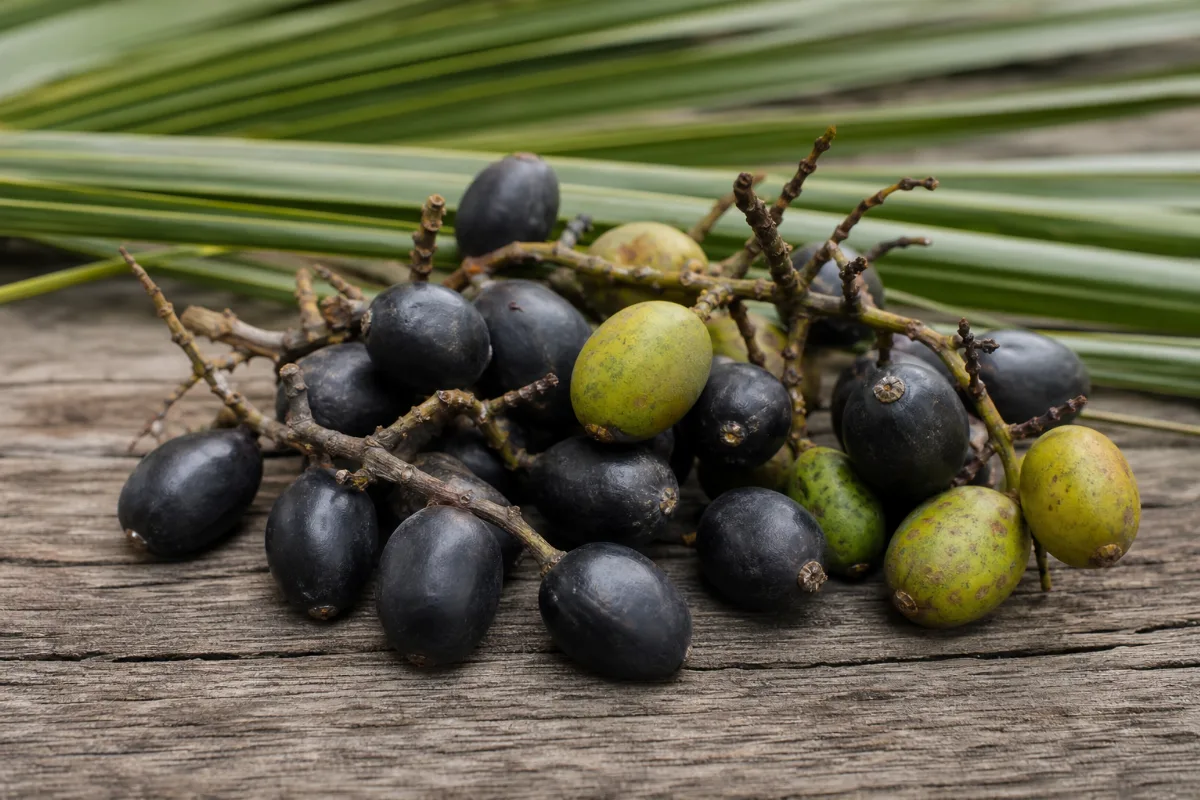
Herbs & Botanicals · Herbs · Palm berry extract taken for the prostate, with weak evidence of benefit
Saw Palmetto
Serenoa repens (W.Bartram) Small · also called Scrub palmetto, dwarf palmetto, American dwarf palm, palmier de Floride (French), Sägepalme (German), palma enana americana (Spanish, common usage, not verified)
Saw palmetto is a low, creeping palm of the south-eastern United States. The ripe berries are pressed or dissolved into oily extracts that are sold as capsules, mostly to men with an enlarged prostate who pass urine often, weakly or at night. The best evidence says it does not work better than a dummy pill for those symptoms. Reviews that find a benefit lean on one branded extract and on trials with no placebo group. Side effects in trials looked like placebo, but rare liver and pancreas problems have been reported. Ask a doctor or pharmacist before using it, and see a doctor first about urinary symptoms.
General information, not medical advice. Last substantive update · Not medically reviewed. A named clinician has not signed off on this page. How this page is made
About Saw Palmetto
Saw palmetto (Serenoa repens) is a low, creeping palm from the south-eastern United States. Extracts of its berries are sold mainly for prostate and urinary symptoms in men. The honest headline is that the best evidence is against it for that use: a 2023 Cochrane review of 27 trials (4,656 men) found little to no difference from placebo and rated that finding high-certainty. Positive reviews rely on one branded extract and on comparisons with drugs that had no placebo group, and several of their authors work for the maker. Evidence for hair loss and other uses is low, very low or insufficient. In trials side effects were similar to placebo, but there are rare liver and pancreas case reports. Ask a doctor or pharmacist before use, and have urinary symptoms checked first.
What it is
Saw palmetto is a palm with fan-shaped leaves that creeps along the ground and spreads by sprouts. It grows on dunes, in pine forests and in scrub in the south-eastern United States. It is the only species in its genus. The part used is the ripe berry, and the full Latin name, Serenoa repens, is what to look for on a label.
Supplements are oily extracts made with hexane, ethanol or pressurised carbon dioxide, not the whole berry. They are sold as capsules and soft gels, alone or mixed with other plants, and the supply is wild-gathered. This profile covers it as a herb and supplement.
Why products differ
Extracts are not interchangeable. In a study of 57 commercial products the fatty acid content differed greatly between them. Lab work found that potency varied several-fold between brands and batches. Trials rarely check what is actually in the capsule.
The EU regulator accepted only the hexane extract for well-established use in men with prostate symptoms, and ethanol extracts for traditional use. Most positive reviews are about one branded hexane extract, so a result for one product cannot be assumed for another.
Historical and current uses
The European regulator reports that Native peoples of the south-eastern United States used the plant for infertility and impotence, and that colonists later took the berries as a tonic. The first reports of use for urinary complaints date from the early 20th century. These history points are second-hand and were not checked against original sources.
Today it is one of the most widely used herbal products for the prostate. In the EU the hexane extract has a well-established-use label for symptoms of benign prostatic hyperplasia (BPH) and ethanol extracts a traditional-use label, with a doctor first ruling out serious conditions. In the US it is sold as a dietary supplement, not an approved medicine.
What the research shows
For BPH urinary symptoms, the 2023 Cochrane review (27 trials, 4,656 men) found little to no difference from placebo on symptom scores and quality of life at 3 to 6 months and at 12 to 17 months, rated high-certainty. The two big placebo-controlled trials, one in 225 men over a year and one in 369 men over 72 weeks with up to triple the usual dose, were negative. The earlier Cochrane update and later pooled analyses agree.
Why do some reviews look positive? The most favourable results come from one branded extract, from small and open studies, and from comparisons with tamsulosin or finasteride with no placebo group. Several authors of those reviews work for the maker. The lab effects, such as slowing an enzyme that makes DHT and calming inflammation, have not turned into benefit in these big trials. PSA is not changed.
Hair loss has small, short trials, many run by makers, so the evidence is low. Other uses (prostatitis, bladder frequency, hormones) are low or very low, and for prostate cancer and excess hair in women there is not enough evidence.
At a glance
Traditional uses history, not proof
- Native peoples of the south-eastern United States: the European regulator says the berries were used for infertility and impotence (a second-hand statement, not checked against an original source)
- Colonists later took the whole berries as a tonic
- Early 20th century onward: use for urinary complaints, above all an enlarged prostate
- Traditional European and North American water and alcohol extracts were also used for cystitis and other complaints, but the EU regulator notes there is no scientific support for these older uses
Studied for research
- Urinary symptoms from an enlarged prostate (BPH): evidence against benefit (high-certainty finding of little to no difference from placebo)
- Night-time urination, prostate size and sexual function: low certainty
- Male pattern hair loss: low certainty; thinning hair in women: very low
- Chronic prostatitis and bladder frequency: low certainty, each from a few trials
- Prostate cancer, excess body hair in women (hirsutism, PCOS): insufficient evidence
Main compounds
- Fatty acids (lauric, oleic, myristic, palmitic and others), about 90% of a hexane extract
- Plant sterols such as beta-sitosterol, campesterol and stigmasterol
- Flavonoids such as rutin and isoquercitrin
- A complex sugar (polysaccharide) and sugar alcohols such as mannitol
Common forms
- Oily berry extracts made with hexane (the type behind the best-known branded trials), ethanol or pressurised carbon dioxide
- Capsules and soft gels, alone or in mixed products with nettle, pumpkin seed, lycopene or selenium
- Dried berry, tea and tincture (traditional use; not trial-tested)
- Scalp lotions and oils in a few hair-loss studies
Research links: NIH NCCIH: Saw Palmetto · EU herbal monograph on Serenoa repens fruit (EMA, 2015) · Cochrane review 2023: Serenoa repens for lower urinary tract symptoms from BPH (PubMed) · Research Library · Genes & Biomarkers Library
The plant and its history
- Accepted scientific name
- Serenoa repens (W.Bartram) Small
- Naming authority
- (W.Bartram) Small, published in J. New York Bot. Gard. 27: 193 (1926) (GBIF). The name rests on Corypha repens W.Bartram, so Bartram's name is in brackets.
- Synonyms
- Brahea serrulata (Michx.) H.Wendl.; Chamaerops serrulata Michx.; Corypha obliqua W.Bartram; Corypha repens W.Bartram; Diglossophyllum serrulatum (Michx.) H.Wendl.; Sabal dealbata hort. ex L.H.Bailey; Sabal serrulata (Michx.) Schult.f.; Serenoa repens f. glauca Moldenke; Serenoa serrulata (Michx.) G.Nicholson; Serenoa serrulata (Michx.) Hook.f.
- Common names
- Saw palmetto (English); Scrub palmetto (English); Dwarf palmetto (EMA and papers use 'American dwarf palm') (English); Palmier de Floride (French); Sägepalme; Sägezahnpalme; Strauchpalmettopalme (German); Serenoa (Portuguese); Palma enana americana (not in GBIF; common Spanish usage, not verified here) (Spanish); Fűrészpálma (Hungarian); Sagpalmetto (Swedish); ノコギリヤシ (Japanese); Ju zong (锯棕) (Chinese)
- Botanical family
- Arecaceae (palm family, order Arecales). Serenoa is a single-species genus in GBIF's record (only one accepted species found; not checked against other databases).
- Classification
- Plantae > Tracheophyta > Liliopsida > Arecales > Arecaceae > Serenoa > Serenoa repens
- Native range
- Coastal south-eastern USA: studies sample Florida scrub, and EMA says it grows on dunes and in pine forests of the southern states of the USA and also names tropical Middle and South America (a claim not confirmed here and probably an over-statement). Not otherwise verified.
- Habitat
- Coastal dunes, pine forests and Florida scrub (EMA; p21848843). The plant is a foundation species in south-eastern US ecosystems (p21848843).
- What the plant looks like
- Roots: Not described in the sources read.; Stems: EMA: a bush; the stem creeps, so the plant spreads by underground and surface sprouts (p21848843 found vegetative sprouting is the main way it spreads).; Leaves: Fan-shaped leaves with 18 to 24 sharp-ending segments (EMA). The common name refers to the saw-like toothed leaf stalks; that detail is not in the sources read.; Flowers: Flowers sit on short branches (EMA). Colour and size not given.; Fruit: An ovoid or nearly round drupe (berry-like), dark brown or blackish, up to 2.5 cm long and 1.5 cm across (EMA).
- Cultivation
- The sources read say the supply is wild-gathered: the authors of p30886216 state the plant 'only grows in the wild'. Not verified independently. A small number of cultivation details was not found.
- Harvest and processing
- Herbal substance is the dried ripe fruit, containing at least 11% total fatty acids in the dried material (European Pharmacopoeia, quoted by EMA). Extracts are made with hexane, ethanol or supercritical CO2 (EMA). Typical hexane specification: 85-95% fatty acids and 1.8-3.5% non-saponifiable matter (EMA, Austrian product).
- Look-alikes and adulterants
- Name: Sabal minor and other palmettos; Note: EMA says confusion with Sabal minor (Jacq.) Pers. seldom occurs. In one Florida study a second palmetto, Sabal etonia, grows alongside Serenoa, and small plants could not be told apart in the field by sight, so the authors used DNA (p21848843). Dried berries are bought as ground fruit or oil where visual identification is not possible.; Name: Related species in supplements; Note: A DNA barcode test on 37 supplements found 29 (85%) contained saw palmetto, 2 (6%) held related species that cannot legally be sold as herbal supplements in the USA, and 3 (9%) could not be identified; 3 had no usable DNA (p24343362). Extract products with little DNA may be missed.; Name: Olive oil and other oils added to products; Note: EMA, quoting Habib & Wyllie 2004, says some marketed products contain olive oil, which confuses the measured lipid make-up. Another study showed oleic acid is present in saw palmetto anyway, so a fatty acid profile alone does not prove identity.; Name: Silver form (forma glauca); Note: A bluish-silver form of Serenoa repens, listed as a synonym in GBIF. One study proposed it as a substitute for the usual green wild form, but this is a single early proposal (p30886216).; Name: Pygeum africanum (Prunus africana) and pumpkin seed; Note: Other fat-rich prostate remedies. They are different plants with different fatty acid patterns; a gas chromatography method can tell them apart from saw palmetto (p19281408).
- Sustainability and conservation
- Not verified. No IUCN assessment was retrieved. The authors of p30886216 write that over-harvest and habitat use threaten the plant; the claim was not checked against a conservation source. By contrast, p21848843 found extreme persistence (clones up to about 10,000 years old) in one Florida site, so local persistence and supply pressure should not be confused.
Traditional use and history history, not clinical proof
| Tradition or era | Documented use | Source |
|---|---|---|
| Native peoples of the south-eastern USA (before European settlement) | EMA states that Native Americans used the plant for infertility and impotence. The details of who used it, how and which part were not found in a primary source, so the statement is secondary. | s-ema-ar-serenoa-2015 |
| Colonists, 18th to 19th centuries | EMA says the whole berries were later adopted by colonists as a tonic. No dates or original sources were found here. | s-ema-ar-serenoa-2015 |
| Early 20th century | EMA (citing Verhelst, 2010) says the first literature reports of use for urinary complaints date from the start of the 20th century. Earlier American medical books may exist but were not read. | s-ema-ar-serenoa-2015 |
| Traditional use in Europe and North America (water and ethanol preparations) | Used as water and ethanol extracts for cystitis, catarrh of the genitourinary tract, testicular wasting, sex-hormone disorders and above all prostate enlargement; also listed for breast gland inflammation, eczema, bronchial problems and cough, and to raise sexual desire. EMA, quoting Barnes 2007 and Hansel 1994, states there is no scientific support for these traditional uses. | s-ema-ar-serenoa-2015 |
| Traditional dosing recorded by reference books | Mother tincture 3 x 5 drops a day (some sources 3 x 25 drops); dried fruit 0.5 to 1.0 g as a decoction three times a day. Recorded by EMA for history only; not a recommendation. | s-ema-ar-serenoa-2015 |
| Modern Europe (market history) | EMA says one hexane extract and several ethanolic extracts have been on the market in the EU for at least 30 years, and gives start years from 1994 to 2013 for individual products. Exact first dates for the first extract were not found. | s-ema-ar-serenoa-2015 |
| Regulatory conclusion, EMA/HMPC 2015, addendum 2021 | The HMPC accepted only the hexane extract for 'well-established use' and ethanolic extracts for 'traditional use' for urinary symptoms of BPH in men; supercritical CO2 extract was not accepted (one 12-week study, less than 30 years on market). It did not recommend an EU list entry because Ames mutagenicity data were missing. A 2021 addendum exists but was not read. | s-ema-ar-serenoa-2015 |
| American palm ethnomedicine overview | A 2009 literature analysis found 106 of 730 American palm species have known medicinal uses and names Serenoa repens as the source of a drug approved for medicinal use. | p20034398 |
Traditional use shows how a plant was used. It does not show that a supplement works or is safe today.
What is inside, and how it may work
What the plant contains and how those compounds act in cells and animals. Laboratory and animal mechanisms are not proven effects in people.
Main compounds
| Compound | Family | Where it is concentrated | Activity studied | Level of evidence |
|---|---|---|---|---|
| Lauric acid PubChem 3893 | saturated fatty acid (C12) | Fruit, in the oil Main fatty acid; with oleic acid about 65% of the free fatty acids in Permixon (p12477490). | Inhibited both 5-alpha-reductase types in test-tube enzymes (IC50 17 and 19 ug/ml); bound alpha-1, muscarinic and calcium-channel receptors. 78 1 76 | Laboratory research |
| Oleic acid PubChem 445639 | monounsaturated fatty acid (C18:1) | Fruit, in the oil Main fatty acid; see lauric acid. | Strong type 1 inhibitor (IC50 4 ug/ml) but weak on type 2; bound receptors; carried to the prostate most in rats. 78 1 25 76 | Laboratory research |
| Myristic acid PubChem 11005 | saturated fatty acid (C14) | Fruit, in the oil Together with linoleic acid about 15% of free fatty acids in Permixon (p12477490). | Active on type 2 5-alpha-reductase in the test tube (IC50 4 ug/ml); type 1 not tested. 78 30 76 | Laboratory research |
| Linoleic acid PubChem 5280450 | polyunsaturated fatty acid (C18:2) | Fruit, in the oil Part of the 15% with myristic acid (p12477490). | No separate activity reported in the abstract read. 78 76 | Laboratory research |
| Linolenic acid PubChem 5280934 | polyunsaturated fatty acid (C18:3) | Fruit (not on the EMA constituent list) Not given. | Tested in the enzyme study: active on type 1 (IC50 13 ug/ml), weaker on type 2 (35). Whether it is present in notable amounts was not checked. 78 76 | Laboratory research |
| Palmitic acid PubChem 985 | saturated fatty acid (C16) | Fruit, in the oil Listed by EMA as a constituent; amount not given. | Inactive on both 5-alpha-reductase types in the enzyme study. 78 30 76 | Laboratory research |
| Caproic, caprylic and capric acids PubChem 2969 | short-chain saturated fatty acids (C6, C8, C10) | Fruit, in the oil Listed by EMA; amounts not given. | No activity data found in the sources read. 30 76 | Laboratory research |
| Myristoleic acid PubChem 5281119 | monounsaturated fatty acid (C14:1) | Fruit, in the oil Listed by EMA as an oleic-type acid; amount not given. | No activity data found in the sources read. 30 76 | Laboratory research |
| Beta-sitosterol PubChem 222284 | plant sterol (phytosterol) | Fruit, unsaponifiable part The extract has 1.8 to 3.5% non-saponifiable matter in one hexane specification (EMA); sterol share not given. | Inactive on 5-alpha-reductase in the enzyme study; the labelled form went to the prostate in rats; a sterol-enriched oil did better than standard oil in rats. 78 25 93 76 | Animal research |
| Campesterol PubChem 173183 | plant sterol | Fruit, unsaponifiable part Measurable by an AOAC method; typical amounts not given in abstracts. | No separate activity found. 91 30 76 | Laboratory research |
| Stigmasterol PubChem 5280794 | plant sterol | Fruit, unsaponifiable part As above. | No separate activity found. 91 30 76 | Laboratory research |
| Beta-sitosterol glucoside (sitogluside) PubChem 5742590 | sterol glycoside | Fruit Listed by EMA; amount not given. | No activity data found. 30 76 | Laboratory research |
| Isoquercitrin PubChem 5484006 | flavonoid (flavonol glycoside) | Fruit Listed by EMA; amount not given. | No activity data found for saw palmetto. Ethanol extracts hold more polyphenols than hexane extracts (p31200456). 30 64 76 | Laboratory research |
| Rutin PubChem 5280805 | flavonoid | Fruit Listed by EMA; amount not given. | No activity data found for saw palmetto. 30 76 | Laboratory research |
| Kaempferol 3-glucoside (astragalin) PubChem 5282102 | flavonoid | Fruit Listed by EMA; amount not given. Astragalin is the usual name for kaempferol-3-O-glucoside; matching was by name. | No activity data found. 30 76 | Laboratory research |
| Rhoifolin PubChem 5282150 | flavonoid | Fruit Listed by EMA; amount not given. | No activity data found. 30 76 | Laboratory research |
| Acidic polysaccharide | complex sugar (about 10,000 molecular mass) | Fruit EMA quotes galactose 38.4%, arabinose 18.7% and uronic acid 14% of the polysaccharide (secondary citation). | Not extracted into the oily products; no activity data found. 30 | Laboratory research |
| Mannitol PubChem 6251 | sugar alcohol | Fruit Listed by EMA with invert sugar (28.2%, secondary citation). | Not carried into the oily extract; no activity data. 30 76 | Laboratory research |
| Anthranilic acid PubChem 227 | aromatic acid | Fruit Listed by EMA under minor substances. | No activity data found. 30 76 | Laboratory research |
| Lipidosterolic (lipid-sterol) extract | extract type, not a single compound | Fruit Hexane extract ('Permixon'): 85 to 95% fatty acids, 1.8 to 3.5% non-saponifiable matter; one source says 90% (+/-5) with 80% as free fatty acids (p12477490). Free acids vary 41 to 81% of lipids across products (EMA, quoting Habib & Wyllie 2004). | Ethanol, supercritical CO2 and hexane extracts differ chemically (p31200456) though a second study found CO2 and hexane alike (p25707588). 78 64 116 83 30 | Laboratory research |
Mechanisms, receptors and pathways
| Target or pathway | Gene or receptor | What was found | Level |
|---|---|---|---|
| 5-alpha-reductase (conversion of testosterone to DHT) | SRD5A1 / SRD5A2 (type 1 and type 2 enzymes) | Several cell and enzyme studies found the extract and its free fatty acids inhibit both enzyme types (lauric acid IC50 17-19 ug/ml; oleic 4 on type 1; myristic 4 on type 2). Two cell studies of commercial extracts found every product inhibited, but potency differed several-fold between brands and batches. One lab found only weak type 2 inhibition compared with finasteride. 78 82 83 72 15 49 21 | Laboratory research |
| Prostate tissue DHT in men | Not applicable (hormone level) | A herbal blend containing saw palmetto lowered prostate tissue DHT by 32% in 40 men in a randomized trial. In contrast, Permixon did not change blood DHT in healthy young men over one week, unlike finasteride (which fell 52-65%). So any enzyme effect in people appears local and modest, not a drug-like drop in blood DHT. 63 92 | Controlled trial |
| Androgen receptor signalling (antiandrogen effect) | AR | In androgen-dependent LNCaP prostate cancer cells a saw palmetto fraction lowered nuclear androgen receptor and PSA expression and slowed xenograft tumours in mice. EMA lists influence on androgen-receptor binding among in-vitro findings but notes extract amounts used were up to 1000 times higher than for pure drugs. Evidence is from cancer models, not from BPH or healthy men. 111 30 | Laboratory research |
| Inflammation: cytokines, COX-2 / 5-LOX, NF-kB | IL1B, IL6, PTGS2 (COX-2), ALOX5, NFKB1 | In human BPH and prostate cancer cells the lipid extract changed expression of inflammation genes within 3 hours and lowered IL-6, COX-2 and iNOS expression with interference in NF-kB activation. In a small open pilot in men awaiting surgery, tissue TNF-alpha and IL-1 beta were lower after 3 months of Permixon. 90 87 40 101 | Laboratory research |
| Smooth-muscle relaxation (prostate and bladder) | Alpha-1 adrenoceptors, muscarinic receptors, calcium channels, thromboxane receptor | Isolated oleic and lauric acids bound alpha-1, muscarinic and calcium-channel receptors. In human prostate and bladder tissue in organ baths, Permixon blocked alpha-1 and thromboxane-induced contractions. In rat prostate the fatty-acid fraction relaxed muscle through a non-specific action. 1 99 26 96 | Laboratory research |
| Growth and cell death (apoptosis) of prostate cells | Caspase-3, Bcl-2, STAT3, p21 and p53 | Results conflict: one study found apoptosis rose in prostate cells (epithelial +35%), another found no apoptosis and growth loss only at high doses, and a third found growth loss without cell death in stromal cells. Treat apoptosis as unsettled. 15 49 99 87 111 | Laboratory research |
| Testosterone synthesis (opposite direction) | CYP17A1 (17,20-desmolase), HSD3B4 | In aged rats and Leydig cells under oxidative stress, a standardised extract raised expression of testosterone-making genes, sperm count and muscle endurance. This sits oddly beside the antiandrogen findings above and shows that effects depend on model and dose. 112 | Animal research |
| Sterol-enriched oil in testosterone-induced prostate overgrowth | Inflammatory and apoptotic proteins (not named in abstract) | In rats given testosterone, a beta-sitosterol enriched CO2 oil lowered prostate weight ratio and serum testosterone more than standard oil. Sponsor-funded. 93 | Animal research |
Absorption, metabolism and elimination
- Absorption
- Human data are very thin. EMA reports one old study (12 healthy men, 320 mg of a lipid extract) in which an unidentified HPLC peak reached about 2.6 ug/ml at 1.5 hours, with a half-life of 1.73 hours; EMA calls it of limited value because the compound was not identified. No study of absorption of the individual fatty acids or sterols in people was found. Oil-based extracts depend on fat digestion, and a company study found a fat-matrix formulation raised uptake in a lab gut model (p30720739).
- Distribution
- In rats, radioactive oleic acid given with the hexane extract reached the prostate at higher levels than the seminal vesicles, bladder or liver (p9179563; EMA gives 2.5 times the seminal vesicles and 10 times the bladder, 7 rats). No human tissue distribution data found.
- Metabolism
- Not studied for the individual constituents in people. In healthy volunteers, 14 to 28 days of saw palmetto did not change the activity of CYP2D6, CYP3A4, CYP1A2 or CYP2E1 as measured by probe drugs (p14663456, p15536458). EMA notes a hexane extract inhibited CYP2D6, CYP2C9 and CYP3A4 in test tubes, but that this does not seem to matter in people.
- Elimination
- Only the single unidentified-peak half-life of 1.73 hours from the old study quoted by EMA. Excretion routes not found.
- Bioavailability
- Not established. There is no human study of absolute or relative bioavailability of any named constituent. Free fatty acids and esters may be absorbed differently (EMA).
Isolated compounds versus whole extracts
The 5-alpha-reductase effect in the test tube comes from free fatty acids: when the fatty acids were separated out, only the free acids worked, while esters, alcohols and sterols did not (p12477490). Yet the sterol-enriched oil beat the standard oil in rats (p31623582), so sterols may add something in a whole oil. Different solvents give chemically different extracts (p31200456), and brands and batches differ in lab potency (p22774395, p18849646), though two other studies found hexane and ethanol alike in the cell assay or the NMR fingerprint (p30362688, p25707588). EMA accepts only the hexane extract for well-established use and ethanol extracts for traditional use, because the evidence is by extract, not by plant. The oily products are not the same as the whole berry or tea: the active acids are fat-soluble, so a water tea would carry little of them (reasoning, not a tested result). In people, the large placebo-controlled trials of standard extracts found no benefit for urinary symptoms (p16467543, p21954478, p22551330), which shows that lab effects on an enzyme do not guarantee a patient benefit.
Nutritional composition
A nutrient table is not meaningful for saw palmetto. It is taken as a small amount of oily extract (or occasionally dried fruit) and not as a food. The ripe fruit contains fatty acids, plant sterols, flavonoids and sugars, but the sources read give no vitamin or mineral content, so none is claimed here. The plant sterol and fat content matters only for how extracts differ from each other.
10 low certainty2 very low certainty2 not enough evidence2 evidence against
What was looked at
The 16 benefits and uses checked for Saw Palmetto, each with how strong the evidence is. Tap one to open it.
- Prostate urinary symptoms (BPH) compared with placeboEvidence against
- Prostate urinary symptoms: the hexanic (Permixon) extractLow certainty
- Compared with tamsulosin (an alpha-blocker drug)Low certainty
- Compared with finasteride (a 5-alpha-reductase inhibitor drug)Low certainty
- Added to tamsulosin or alfuzosin, or in mixed productsVery low certainty
- Night-time urination (nocturia) and sleepLow certainty
- Prostate sizeLow certainty
- Sexual and erectile functionLow certainty
- Longer-term use (1 to 2 years)Evidence against
- Male pattern hair loss (androgenetic alopecia)Low certainty
- Thinning hair in women and in men and women togetherVery low certainty
- Excess body hair (hirsutism) and PCOSNot enough evidence
- Chronic prostatitis and pelvic pain (CP/CPPS)Low certainty
- Prostate cancerNot enough evidence
- Bladder frequency and overactive bladder symptoms (women and people without BPH)Low certainty
- Testosterone and other hormonesLow certainty
Lab markers tracked in the studies
International Prostate Symptom Score (IPSS) / AUA symptom indexPeak urine flow (Qmax)Night-time urinations (nocturia)Prostate volumeProstate-specific antigen (PSA)Post-void residual urine volumeSexual and erectile function scores (IIEF, BSFI, MSF-4)Prostate inflammation markers (MIF, MCP-1/CCL2, IP-10/CXCL10)Terminal hair countHair densityHair fall (shedding)Dihydrotestosterone (DHT) in bloodTestosterone in bloodNIH-CPSI score (chronic prostatitis symptom index)Daytime urinary frequency
What is Saw Palmetto good for?
The main proposed uses and how strong the human evidence is for each. "Against" means the best trials found no benefit over placebo. "Low", "very low" and "insufficient" mean few, small, branded or conflicting trials. Many positive studies used one specific extract or had no placebo group, so they cannot show that saw palmetto beats a dummy pill. Nothing here is a proven treatment for you, and the ratings are this profile's reading of the reviews, not formal grades unless stated.
Benefits, one by one
Each card is a research question, not a promise. Tap a goal to filter. Open a card to see the studies, doses and limits.
Prostate urinary symptoms (BPH) compared with placebo
Evidence againstSaw palmetto is mostly taken by men whose prostate has grown with age (benign prostatic hyperplasia, BPH) and who pass urine often, weakly or at night. The best and newest reviews, including Cochrane, say that saw palmetto extract works about the same as a dummy pill for these symptoms. Two large, carefully run American trials, including one that used three times the usual dose, found no benefit. A few smaller trials, mostly of particular brand extracts, did report gains.
13 studiesMost trials used 320 mg a day of an oil-based berry extract (160 mg t…
Studies, doses and limits
What the trials found
Cochrane 2023 (Franco, 27 trials, 4,656 men) concluded saw palmetto alone gives little to no benefit: in the trials at low risk of bias the symptom score difference at 3 to 6 months was MD -0.90 IPSS points (95% CI -1.74 to -0.07; 9 studies, 1,681 men) and at 12 to 17 months MD 0.07 (-0.75 to 0.88), both rated high-certainty by the reviewers as 'little to no difference'. Quality of life and side effects also did not differ from placebo. The earlier Cochrane update (Tacklind 2012, 32 trials, 5,666 men) and a 2021 re-analysis by the same group (Trivisonno, 27 trials) agree. A network meta-analysis (Russo 2021, 22 trials, 8,564 men) found no clinically meaningful gain. Two large trials stand out. Bent 2006 (225 men, 160 mg twice a day, 1 year) found symptom score MD 0.04 (-0.93 to 1.01) versus placebo. Barry 2011 (CAMUS, 369 men, 320 then 640 then 960 mg a day over 72 weeks) found the placebo group improved slightly more (difference 0.79 points; most favourable bound for saw palmetto 1.77 points). Smaller or older trials were more positive: Gerber 2001 (85 men, 6 months) symptom score 16.7 to 12.3 vs 15.8 to 13.6 on placebo (P=0.038); Shi 2008 (92 Chinese men, 12 weeks, a branded soft gel) higher peak flow and 39.1% vs 2.2% symptom responders. Willetts 2003 (100 men, 12 weeks) found no difference. The older Wilt 1998 review (18 trials, 2,939 men, mean 9 weeks) was more favourable, and a meta-analysis of the branded hexanic extract Permixon found extra benefit (see the separate hexanic extract entry). Recent narrative or systematic summaries (Schwartzmann 2026, De Nunzio 2026) are more favourable, but they include open and observational studies and are not placebo-only.
Results
Placebo-controlled evidence overall: no meaningful benefit for urinary symptom scores, quality of life or (in most high-quality trials) peak flow. Men in the placebo groups often improve noticeably, which is why uncontrolled studies look good.
Effect sizes as reported
Cochrane 2023 IPSS MD -0.90 (95% CI -1.74 to -0.07) at 3-6 months; MD 0.07 (-0.75 to 0.88) at 12-17 months. Cochrane 2012 AUA score MD 0.25 (-0.58 to 1.07; 2 trials, n=582). Bent 2006: MD 0.04 (-0.93 to 1.01). CAMUS: 0.79 points in favour of placebo.
Why this rating
Cochrane rates the 'little to no difference from placebo' finding as high-certainty for symptoms and quality of life, and the two largest placebo-controlled trials (including one at triple dose) were negative. Positive results come mostly from smaller, older or branded-extract trials, and the more favourable recent summaries include non-placebo designs. 'Against' here means the evidence says it does not work better than placebo, not that it is proven harmful.
Form and dose studied
Most trials used 320 mg a day of an oil-based berry extract (160 mg twice a day or 320 mg once a day); one trial went up to 960 mg a day.
Who was studied
Men aged about 45 to 80 with moderate urinary symptoms from BPH (IPSS about 8 to 19 on average).
Limits
Extracts differ between trials (hexanic, ethanolic, CO2, branded blends), which makes pooling hard. Many trials are short (about 3 months). BPH symptoms improve a lot on placebo. Only abstracts were read for this profile.
Why researchers looked
Saw palmetto berry extract is one of the most widely used herbal products in the world for the prostate and is sold in Europe as a medicine and in North America as a supplement. It is the herb's main studied use, with dozens of trials.
Traditional use
Native peoples of the south-eastern United States ate the berries of the saw palmetto palm as food and used them for urinary and reproductive complaints; the modern fat-soluble berry extracts used in the trials are 20th-century products, not the whole berry. Not verified here from a primary source.
Proposed mechanism Preliminary mechanism
Laboratory and animal work suggests the extract may block the enzyme 5-alpha-reductase (which turns testosterone into a stronger form), calm inflammation in the prostate and relax the muscle around the urine tube. Not enough human work exists to say any of these explains a benefit. Mechanisms are covered in more detail elsewhere on this profile.
A proposed mechanism does not show that the effect happens in people.
Side effects in trials were similar to placebo, mostly stomach upset, nausea and headache. See the safety file for details.
Prostate urinary symptoms: the hexanic (Permixon) extract
Low certaintyOne specific brand of extract, made with the solvent hexane (sold as Permixon in Europe), has the most positive research. Its manufacturer-linked trials and the reviews built on them suggest it helps with night-time urination and urine flow compared with placebo, and works about as well as tamsulosin. These reviews include small and open studies and some authors work for the maker. The independent Cochrane reviews do not find a benefit for saw palmetto as a whole.
7 studies320 mg a day of the hexanic extract in the trials.
Studies, doses and limits
What the trials found
Vela-Navarrete 2018 (meta-analysis of 15 randomised and 12 observational studies, 5,800 men, Permixon only) found, against placebo, 0.64 fewer night-time urinations (95% CI -0.98 to -0.31) and an extra 2.75 mL/s peak flow (0.57 to 4.93); against alpha-blockers, symptom scores were similar (WMD 0.57, -0.27 to 1.42). Boyle 2004 (14 randomised and 3 open trials, 4,280 men) found a further 0.38 fewer night-time voids than placebo (P<0.001) and an extra 1.02 mL/s peak flow (P=0.042), but a 2-year, 396-man trial that found no difference pulled the nocturia effect down. In the Russo 2021 network meta-analysis, hexanic extract at 3 months gave an IPSS change against placebo of +0.48 (no gain) and at 12 months -3.30, with the authors concluding no clinically meaningful improvement overall. A French urology guideline (2025) says the hexanic extract may be considered for mild to moderate symptoms. The Cochrane reviews pool all extracts together and include the trials at low risk of bias only in their main analysis; they find little to no benefit.
Results
Hexanic extract is the one form where reviews report modest gains over placebo in night-time urination and peak flow, but the evidence is weaker (mixed designs, manufacturer ties) than the Cochrane placebo-only analysis.
Effect sizes as reported
Nocturia -0.64 voids/night (95% CI -0.98 to -0.31); Qmax +2.75 mL/s (0.57 to 4.93) vs placebo (Vela-Navarrete 2018). Boyle 2004: nocturia -0.38 (SEM 0.07) and Qmax +1.02 (SEM 0.50) mL/s beyond placebo.
Why this rating
Pooled reviews of this one extract are more positive, but they mix randomised and observational studies, several authors work for the maker, and a large independent trial of ethanolic extract at triple dose and Cochrane reviews of all extracts find no gain. Low certainty: possible small benefit for one brand, not shown to be repeatable.
Form and dose studied
320 mg a day of the hexanic extract in the trials.
Who was studied
Men with mild to severe BPH-related symptoms.
Limits
Branded product with manufacturer-linked studies; observational designs pooled with trials; results do not apply to other saw palmetto products.
Why researchers looked
Because saw palmetto products vary so much, researchers have tested whether one well-defined extract works better than generic ones. Permixon is the most studied extract.
Traditional use
Native peoples of the south-eastern United States ate the berries of the saw palmetto palm as food and used them for urinary and reproductive complaints; the modern fat-soluble berry extracts used in the trials are 20th-century products, not the whole berry. Not verified here from a primary source.
Proposed mechanism Preliminary mechanism
Lab and animal work (and one small human study measuring inflammation markers) suggests the hexanic extract may reduce inflammation signals in the prostate and block 5-alpha-reductase. Whether this explains any symptom relief in men is not shown.
A proposed mechanism does not show that the effect happens in people.
Most common reaction in the pooled data was stomach upset (mean incidence 3.8%).
Compared with tamsulosin (an alpha-blocker drug)
Low certaintyIn head-to-head trials, saw palmetto (mostly the hexanic extract) improved urinary symptoms about as much as tamsulosin, a standard prostate drug, and caused fewer sexual and blood-pressure side effects. There was no placebo group in these comparisons, so they cannot show that saw palmetto beats a dummy pill, only that it was close to what the drug achieved in the same men.
6 studiesHexanic or lipidosterolic extract 320 mg a day vs tamsulosin 0.4 mg a…
Studies, doses and limits
What the trials found
PERMAL (Debruyne 2002; 704 randomised, 542 analysed; 320 mg Permixon vs tamsulosin 0.4 mg; 12 months): symptom scores fell 4.4 points in both groups, peak flow rose 1.8 vs 1.9 mL/s, ejaculation problems were more common with tamsulosin. Cai 2020 (4 trials, 1,080 men, 6 months or more): IPSS MD 0.63 (-0.33 to 1.59), peak flow MD 0.27 (-0.15 to 0.68), with tamsulosin shrinking prostate volume slightly more; the authors report fewer ejaculation problems and less loss of libido with saw palmetto. Vela-Navarrete 2018 (hexanic extract only): IPSS WMD 0.57 (-0.27 to 1.42), peak flow WMD -0.02 (-0.71 to 0.66) versus alpha-blockers. Alcaraz 2021 (737 matched men from a 6-month real-world study): IPSS improved 4.5 with the extract vs 5.0 with tamsulosin (p=0.117) and adverse effects were 2.1% vs 14.7%. Hizli 2007 (60 men, 3 arms) found no difference. The Russo 2021 network meta-analysis ranked saw palmetto below alfuzosin, tamsulosin and silodosin and found no clinically meaningful gain over placebo. Importantly, because these comparisons lack placebo arms, 'equal to tamsulosin' mainly shows how much both improve in the same kind of men, and does not by itself prove either works better than placebo.
Results
Similar symptom and flow improvements to tamsulosin over 6 to 12 months in these studies; fewer reported side effects with the extract.
Effect sizes as reported
Cai 2020 IPSS MD 0.63 (-0.33 to 1.59). Vela-Navarrete 2018 WMD 0.57 (-0.27 to 1.42). PERMAL IPSS -4.4 in both arms. Alcaraz 2021 -4.5 vs -5.0 (p=0.117).
Why this rating
Several trials and meta-analyses agree on similarity, but most use one brand, several authors have manufacturer ties, designs are open or non-randomised in part, and without placebo arms similarity does not prove benefit (and it is compatible with both working poorly, given the Cochrane placebo-only result).
Form and dose studied
Hexanic or lipidosterolic extract 320 mg a day vs tamsulosin 0.4 mg a day in the main trials.
Who was studied
Men with moderate to severe BPH symptoms; 6 to 12 months.
Limits
No placebo arm; equivalence designs; industry-linked authors in several papers; the tolerability difference is partly from real-world data.
Why researchers looked
Tamsulosin is a first-choice drug for prostate symptoms, so it is the natural yardstick.
Proposed mechanism Pharmacological theory
Tamsulosin relaxes muscle at the bladder outlet. Saw palmetto's proposed actions are different (see the main entry). Not shown in humans.
A proposed mechanism does not show that the effect happens in people.
Fewer ejaculation problems and orthostatic hypotension reported with the extract than with tamsulosin in these studies.
Compared with finasteride (a 5-alpha-reductase inhibitor drug)
Low certaintyIn a large 6-month trial, the Permixon extract and finasteride cut urinary symptom scores by about the same amount. Finasteride shrank the prostate and lowered PSA, which Permixon did not, and men on the extract reported fewer sexual side effects. Again there was no placebo group.
4 studies320 mg a day Permixon vs 5 mg a day finasteride.
Studies, doses and limits
What the trials found
Carraro 1996 (1,098 men, 6 months, 320 mg Permixon vs 5 mg finasteride): symptom score fell 37% vs 39%, quality of life improved 38% vs 41%, peak flow rose 25% vs 30% (P=0.035), prostate volume fell 6% vs 18%, PSA was unchanged vs -41%. Permixon did better on a sexual function questionnaire with fewer complaints of reduced libido and impotence. Wilt 1998 (2 trials) found IPSS WMD 0.37 (-0.45 to 1.19) and peak flow WMD -0.74 (-1.66 to 0.18) vs finasteride, with erectile problems in 4.9% on finasteride vs 1.1% on saw palmetto. Vela-Navarrete 2018 reported similar IPSS to 5-ARIs at 6 months. A 2022 real-world matched study (136 men) found tamsulosin plus extract similar to tamsulosin plus a 5-ARI (IPSS -6.7 vs -7.7, p=0.272) with fewer side effects (10.3% vs 26.5%).
Results
Similar symptom relief over 6 months; finasteride acts more on prostate size and PSA; fewer sexual side effects reported with saw palmetto.
Effect sizes as reported
Carraro 1996: IPSS -37% vs -39%; prostate volume -6% vs -18%; PSA no change vs -41%. Wilt 1998 IPSS WMD 0.37 (-0.45 to 1.19).
Why this rating
One large equivalence trial of a single brand plus small older ones; no placebo arm; 6-month duration; finasteride needs about a year to show full effect, so a 6-month comparison favours the extract.
Form and dose studied
320 mg a day Permixon vs 5 mg a day finasteride.
Who was studied
Men with moderate BPH.
Limits
No placebo; 1996 trial; one maker's extract; finasteride's full effect takes longer than 6 months.
Why researchers looked
Finasteride is the standard 5-alpha-reductase inhibitor; saw palmetto is claimed to act through the same enzyme.
Proposed mechanism Preliminary mechanism
Finasteride blocks 5-alpha-reductase strongly. The extract does this weakly in the lab; the fact that PSA and prostate size barely changed in the trial suggests it acts differently in men (or less). Not established.
A proposed mechanism does not show that the effect happens in people.
Finasteride has its own sexual and mood side effects; fewer sexual complaints were reported on the extract. See the sexual function entry for a recent case series of problems after saw palmetto.
Added to tamsulosin or alfuzosin, or in mixed products
Very low certaintySome trials, mostly open-label or real-world, found that adding saw palmetto to an alpha-blocker gave a bit more symptom relief than the drug alone, and trials of three-ingredient products (saw palmetto, lycopene, selenium) were also positive. The independent Cochrane review is cautious about mixed plant products (low-certainty, small gains). These studies cannot say whether saw palmetto, the other ingredients or the placebo effect did the work.
6 studiesHexanic extract 320 mg a day with alpha-blocker; or branded three-ing…
Studies, doses and limits
What the trials found
Alcaraz 2020 (QUALIPROST subset, 709 men, 6 months, real-world): symptom scores improved 7.2 with tamsulosin plus hexanic extract vs 5.7 tamsulosin alone and 5.4 extract alone (p<0.001). Bevilacqua 2026 (300 men, 12 months, randomised, open): hexanic extract plus alfuzosin gave consistently lower symptom scores than alfuzosin alone (interaction p=0.007); nocturia and flow improved more mildly with the combination. Ryu 2015 (140 men recruited, 103 analysed, 12 months, open-label): total IPSS -5.8 vs -5.5 (p=0.693) but urgency/frequency (storage) scores improved more with the combination (-1.7 vs -0.8; p=0.024). Hizli 2007 (60 men) found no benefit from adding saw palmetto. PROCOMB (Morgia 2014, 225 men): saw palmetto plus lycopene plus selenium plus tamsulosin beat single therapies at 1 year. Cochrane 2023: saw palmetto combined with other plant products IPSS MD -2.41 (-4.54 to -0.29; 4 studies, 460 men), low-certainty, little to no difference. Zong 2019 (Chinese meta-analysis of saw palmetto plus alpha-blocker) was found in the search but its abstract was not read here.
Results
Mixed: some studies show added benefit, others do not; none can separate saw palmetto's own contribution.
Effect sizes as reported
Alcaraz 2020: IPSS -7.2 vs -5.7 vs -5.4. Ryu 2015: storage score -1.7 vs -0.8 (p=0.024). Cochrane 2023 mixed products: MD -2.41 (-4.54 to -0.29).
Why this rating
Open-label or observational designs, three-ingredient mixes, and industry ties; the independent review calls the evidence low-certainty and the effect small.
Form and dose studied
Hexanic extract 320 mg a day with alpha-blocker; or branded three-ingredient products.
Who was studied
Men with moderate to severe LUTS/BPH.
Limits
Open-label, no placebo in most; confounding by who gets which treatment in real-world data.
Why researchers looked
Doctors often combine treatments, and some trials ask whether saw palmetto adds to a standard drug.
Proposed mechanism Pharmacological theory
The idea is that a drug that relaxes the bladder outlet and an extract that may calm prostate inflammation could complement each other. Not established.
A proposed mechanism does not show that the effect happens in people.
Side effects with the combination were about the same as with the drug alone in these studies.
Night-time urination (nocturia) and sleep
Low certaintyWaking to pass urine is one of the most bothersome BPH symptoms. Older pooled analyses and the Permixon reviews found slightly fewer night-time trips than with placebo. The largest and best trial (CAMUS) found no effect on nocturia, even at triple dose, and Cochrane found no significant change. Sleep quality moved with urinary symptoms but did not differ between saw palmetto and placebo.
8 studies320 mg a day in most trials; up to 960 mg a day in CAMUS.
Studies, doses and limits
What the trials found
Wilt 1998 (10 studies): nocturia WMD -0.76 per evening (95% CI -1.22 to -0.32) versus placebo. Boyle 2004 (Permixon): placebo reduced night voids by 0.63 and the extract a further 0.38 (P<0.001); a 2-year 396-man trial with no difference weakened the result. Vela-Navarrete 2018: -0.64 voids per night (-0.98 to -0.31) versus placebo. Against these, Cochrane 2012 reports that in the high-quality CAMUS trial (n=369) saw palmetto did not significantly decrease nightly urination on the AUA nocturia scale at 72 weeks (one-sided P=0.19), and Barry 2011 found saw palmetto no better than placebo for any secondary outcome. Helfand 2011 and 2012 (CAMUS participants): sleep disturbance was linked to urinary symptom severity, but sleep and urinary symptom improvements did not differ between saw palmetto and placebo arms; a 3-point better symptom score went with a 0.73-point better sleep score. Bevilacqua 2026 (open trial, 300 men): nocturia improved over time in both arms, more with extract plus alfuzosin from month 3 (p=0.006), though the main treatment effect was not significant (p=0.076).
Results
Small possible benefit in older and branded-extract analyses; no benefit in the best placebo-controlled trial.
Effect sizes as reported
Wilt 1998 -0.76 per evening (-1.22 to -0.32). Vela-Navarrete 2018 -0.64 voids/night (-0.98 to -0.31). CAMUS nocturia scale: one-sided P=0.19.
Why this rating
Positive pooled results are from older, shorter or branded-extract trials with varying nocturia definitions; the highest-quality trial found no effect. Low certainty and leaning towards no meaningful effect.
Form and dose studied
320 mg a day in most trials; up to 960 mg a day in CAMUS.
Who was studied
Men with BPH symptoms.
Limits
Nocturia was usually a secondary outcome. Counts of night voids are self-reported. Only abstracts read.
Why researchers looked
Nocturia is a main reason men seek treatment, and sleep disturbance often follows.
Traditional use
Native peoples of the south-eastern United States ate the berries of the saw palmetto palm as food and used them for urinary and reproductive complaints; the modern fat-soluble berry extracts used in the trials are 20th-century products, not the whole berry. Not verified here from a primary source.
Proposed mechanism Preliminary mechanism
Laboratory and animal work suggests the extract may block the enzyme 5-alpha-reductase (which turns testosterone into a stronger form), calm inflammation in the prostate and relax the muscle around the urine tube. Not enough human work exists to say any of these explains a benefit. Mechanisms are covered in more detail elsewhere on this profile.
A proposed mechanism does not show that the effect happens in people.
No specific safety issue for this outcome.
Prostate size
Low certaintySaw palmetto does not clearly shrink the prostate. The best trial found no difference from placebo. Some small studies and open studies show a slight reduction with the Permixon extract, much less than finasteride.
8 studies320 mg a day in most.
Studies, doses and limits
What the trials found
Cochrane 2012: in one high-quality 12-month trial (n=225, Bent 2006) prostate size change MD -1.22 cc (95% CI -3.91 to 1.47) versus placebo. Carraro 1996: Permixon -6% vs finasteride -18%. Cai 2020: tamsulosin shrank prostate volume slightly more than saw palmetto (MD -0.29, -0.41 to -0.17; units not given in abstract). Sinescu 2011 (120 men, open, 24 months): 39.8 ml to 36 ml. Shi 2008 and Marks 2000 found no change in prostate volume; Marks 2000 biopsies showed the epithelium shrank (17.8% to 10.7% in the transition zone), a tissue change that has not been linked to clinical benefit. Vela-Navarrete 2018 reported that prostate volume decreased slightly with Permixon.
Results
No significant shrinkage versus placebo in the best trial; small reductions in uncontrolled or branded-extract studies.
Effect sizes as reported
Cochrane 2012 prostate size MD -1.22 cc (-3.91 to 1.47). Carraro 1996 -6% (Permixon) vs -18% (finasteride).
Why this rating
Prostate size was a secondary outcome, measured in few high-quality trials; the one placebo-controlled estimate has a wide interval that includes no effect.
Form and dose studied
320 mg a day in most.
Who was studied
Men with BPH.
Limits
Measured by different methods (ultrasound, MRI); small studies.
Why researchers looked
If saw palmetto blocked 5-alpha-reductase like finasteride, it should shrink the prostate.
Traditional use
Native peoples of the south-eastern United States ate the berries of the saw palmetto palm as food and used them for urinary and reproductive complaints; the modern fat-soluble berry extracts used in the trials are 20th-century products, not the whole berry. Not verified here from a primary source.
Proposed mechanism Preliminary mechanism
If it blocked 5-alpha-reductase strongly, the prostate would shrink and PSA would fall, as with finasteride. Neither happened clearly in trials, so any effect is likely to be weak or work another way. Lab and tissue findings only.
A proposed mechanism does not show that the effect happens in people.
None specific.
Sexual and erectile function
Low certaintySaw palmetto has not been shown to improve erections or sexual desire in placebo-controlled trials. What the research does show is that it generally does not seem to harm sexual function (unlike finasteride or tamsulosin), but a 2026 case series reported long-lasting sexual and mood problems in some men, mostly from a forum for people with post-finasteride syndrome.
11 studies320 mg a day in most trials.
Studies, doses and limits
What the trials found
Paulis 2021 (20 papers): no significant difference in sexual function between saw palmetto and placebo (SMD 0.43, 95% CI 0.18 to 1.05; I2 95%) or tamsulosin (SMD -0.31, -0.82 to 0.19; I2 90%). Willetts 2003 (100 men, 12 weeks): no difference from placebo on the erectile function questionnaire (IIEF). Gerber 2001 (85 men, 6 months): no change in sexual function in either group. Barry 2011 (CAMUS): no benefit on sexual function indices. Carraro 1996: fewer complaints of reduced libido and impotence than finasteride. Vela-Navarrete 2018: no negative effect on sexual function. Open or uncontrolled studies reported gains: Sinescu 2011 (120 men, 24 months) IIEF +6.4; Pytel 2002 (155 men, 2 years) sexual function improved in year two (P=.001); Suter 2013 (82 men, 8 weeks) brief sexual function score 22.4 to 31.4; these cannot separate saw palmetto from the placebo effect. Bevilacqua 2026: IIEF-5 declined mildly in both arms over 12 months. Against these reassuring data, Firenzuoli 2026 reported a case series of sexual and psychiatric symptoms (e.g. persistent sexual dysfunction) after taking saw palmetto, with onset within 1 month in 61% and causality rated 'probable' in 54%; the cases were self-selected from a post-finasteride-syndrome forum, and the number of cases was not given in the abstract. A related 2022 letter (Gallo) on saw palmetto-induced erectile dysfunction was found, but it has no abstract and was not reviewed.
Results
No proven improvement in erections or desire; no excess harm to sexual function in controlled trials; rare reports of persistent problems that remain unquantified.
Effect sizes as reported
Paulis 2021: SMD 0.43 (0.18 to 1.05) vs placebo; SMD -0.31 (-0.82 to 0.19) vs tamsulosin. Sinescu 2011 IIEF +6.4 (uncontrolled).
Why this rating
Controlled trials are small and sexual function is a minor outcome; the meta-analysis has very high inconsistency (I2 90 to 95%); positive reports are uncontrolled; the safety signal comes from uncontrolled case reports.
Form and dose studied
320 mg a day in most trials.
Who was studied
Men with BPH, usually aged 50 to 70.
Limits
Abstract-level reading only. Case series cannot show frequency or cause.
Why researchers looked
BPH drugs can cause sexual side effects, so researchers check whether the herb avoids them, and some products claim to help sexual function.
Traditional use
Saw palmetto berries have been described as a tonic for the male reproductive system in older folk practice. Not verified here from a primary source.
Proposed mechanism Preliminary mechanism
A 2013 laboratory paper (Yang) has a title reporting effects on erectile responses in an experimental model; its abstract was not read here, so it is not relied on. No mechanism for sexual function has been shown in men.
A proposed mechanism does not show that the effect happens in people.
If sexual or mood changes start after using saw palmetto, stop and speak to a doctor. The case series is a safety signal, not proof.
Longer-term use (1 to 2 years)
Evidence againstTrials longer than a year mostly show no difference from placebo. Uncontrolled two-year studies of the Permixon and ethanolic extracts report lasting improvement, but without a placebo group this cannot be credited to the herb.
6 studies320 mg a day in most.
Studies, doses and limits
What the trials found
Cochrane 2023: at 12 to 17 months, IPSS MD 0.07 (-0.75 to 0.88; 3 studies, 898 men) and quality of life MD -0.11 (-0.41 to 0.19), both high-certainty 'little to no difference'. CAMUS (72 weeks, escalating dose) and Bent 2006 (1 year) were negative. Open studies: Sinescu 2011 (120 men, 24 months, IPSS improved 5.5 points); Pytel 2002 (155 men, 2 years, symptoms improved and PSA unchanged).
Results
No long-term benefit over placebo in controlled trials.
Effect sizes as reported
Cochrane 2023 long-term IPSS MD 0.07 (-0.75 to 0.88).
Why this rating
High-certainty Cochrane finding of no difference at 12 to 17 months; positive long-term data are uncontrolled.
Form and dose studied
320 mg a day in most.
Who was studied
Men with BPH.
Limits
Few long trials; no long-term adverse event data for saw palmetto alone in Cochrane 2023.
Why researchers looked
BPH is a lifelong, slowly progressing condition, so long-term effects matter.
Traditional use
Native peoples of the south-eastern United States ate the berries of the saw palmetto palm as food and used them for urinary and reproductive complaints; the modern fat-soluble berry extracts used in the trials are 20th-century products, not the whole berry. Not verified here from a primary source.
Proposed mechanism Preliminary mechanism
Laboratory and animal work suggests the extract may block the enzyme 5-alpha-reductase (which turns testosterone into a stronger form), calm inflammation in the prostate and relax the muscle around the urine tube. Not enough human work exists to say any of these explains a benefit. Mechanisms are covered in more detail elsewhere on this profile.
A proposed mechanism does not show that the effect happens in people.
CAMUS found no evidence of toxicity over 18 months at up to triple dose.
Male pattern hair loss (androgenetic alopecia)
Low certaintySeveral small trials and a few reviews suggest saw palmetto, taken by mouth or put on the scalp, may help some men keep or regrow some hair. It did less well than finasteride in the one head-to-head test. The trials are small, many used mixed or branded products, and some were run by the makers, so the evidence is low in certainty.
10 studiesOral doses in the trials were 320 mg daily (Rossi) and 400 mg daily o…
Studies, doses and limits
What the trials found
Prager (2002, pilot RCT of a saw palmetto and beta-sitosterol product): blinded staff judged 60% to be improved at the final visit, but the abstract does not give the placebo figure, sample size, dose or duration. Rossi (2012, open-label, 100 men, 24 months): 320 mg daily of Serenoa repens gave more hair growth in 38% of men versus 68% with finasteride 1 mg. Wessagowit (2016, 50 men, no placebo): a topical saw palmetto product raised hair counts at weeks 12 and 24 compared with the start. Sudeep (2023, 80 men and women, 16 weeks): a standardized oil, 400 mg by mouth or 20% on the scalp, cut hair fall by up to 29% and raised hair density by 5% to 8% compared with the start; the maker's own staff were among the authors. A 2020 systematic review of five randomized trials and two cohorts judged saw palmetto well tolerated and said robust high-quality data are lacking. A 2025 network meta-analysis of 19 supplement trials found that a saw palmetto extract was among products with higher blinded-doctor hair regeneration scores than placebo or standard treatments, but it was not among the ones that improved measured hair density.
Results
Most trials point the right way, but they are small, short and often not independent. In the one comparison with a drug, finasteride worked better.
Effect sizes as reported
Rossi 2012: improvement in 38% (saw palmetto) vs 68% (finasteride). Sudeep 2023: hair fall down up to 29% (oral) and 22.19% (topical); hair density up 5.17% (oral) and 7.61% (topical). No pooled effect size and no confidence intervals are available for saw palmetto alone.
Why this rating
Small trials, short follow-up, mixed products, open-label designs, photo-based scoring, and company involvement. No large independent placebo-controlled trial of a single, defined product in men. This rating is the compiler's.
Form and dose studied
Oral doses in the trials were 320 mg daily (Rossi) and 400 mg daily of a standardized oil (Sudeep); other trials did not state the amount in their abstracts. Topical products and concentrations varied.
Who was studied
Men aged 20 to 64 with mild to moderate hair loss.
Limits
Not a replacement for proven treatments. Results from one branded product cannot be applied to others. The long-term effect is unknown beyond 24 months.
Why researchers looked
Male pattern hair loss is driven by DHT, a stronger form of testosterone made by an enzyme called 5-alpha reductase. Saw palmetto blocks that enzyme in lab tests, so researchers tested it as a gentler alternative to finasteride.
Traditional use
Hair loss is not a classic traditional use of saw palmetto. The plant's traditional use was for urinary and prostate complaints; its use for hair is a modern idea built on its effect on DHT.
Proposed mechanism Preliminary mechanism
In lab and cell studies saw palmetto extracts block 5-alpha reductase, the enzyme that makes DHT. One 2026 lab study of a branded extract also found signs of effects on hair follicle cells that do not depend on that enzyme. However, a 1994 trial in healthy men found Permixon did not lower blood DHT, so the real effect in people on DHT is unclear.
A proposed mechanism does not show that the effect happens in people.
Side effects were minor or absent in these trials, but they were short. Saw palmetto can act on hormone pathways, and case reports link it to liver injury and bleeding; see the safety information. Talk to a doctor or pharmacist before use, especially with blood thinners, hormone treatment or before surgery. A 2026 case series from Italy collected reports of persistent sexual and mood symptoms after saw palmetto; it cannot show how common this is (see the safety information).
Thinning hair in women and in men and women together
Very low certaintyTwo linked trials of one branded saw palmetto extract found more hair and less shedding than placebo in adults with self-perceived thinning hair, about half of them women, including a group of menopausal women. This is early evidence from a single product and a single clinic. No trial has tested saw palmetto in women alone with a standard hair-loss diagnosis.
7 studiesBranded extracts and mixed capsules, taken once daily for 3 to 6 mont…
Studies, doses and limits
What the trials found
Ablon (2025, 90-day interim report; 2026, 180-day result): 60 healthy adults with self-perceived thinning hair, half women, took a branded saw palmetto fatty-acid extract (40) or placebo (20) daily for 6 months. At day 180 terminal hair count changed by +18.6 with the extract and -10.1 with placebo (p<0.001), and total hair density by +25.1 versus -12.2 (p<0.001). In menopausal women the extract gave better terminal hair count (p<0.05) and density (p<0.01) than placebo; the gain in fine (vellus) hair was not significant. Hair shedding fell compared with the start at day 90. Sudeep (2023, see men) also included women. Piquero-Casals (2025, 80 men and women with chronic telogen effluvium or androgenetic alopecia): a capsule of Serenoa repens plus cystine, pumpkin seed, Pygeum and vitamins raised hair density by 12.3 hairs/cm2 at 6 months, more than placebo; saw palmetto's own part cannot be separated. Milani (2025, 225 people, 60 women): adding a saw palmetto-based capsule to minoxidil or finasteride gave 'great improvement' in 36.5% versus 25% with drugs alone (p=0.04); this was not placebo-controlled. A 2025 mini-review on menopausal hair loss lists saw palmetto but says menopause-specific evidence is limited.
Results
The best-designed result is a small placebo-controlled trial of one branded extract. Mixed-ingredient trials do not show saw palmetto's own effect.
Effect sizes as reported
Ablon 2026: terminal hair +18.6 vs -10.1; density +25.1 vs -12.2 (both p<0.001). Piquero-Casals 2025: +12.3 hairs/cm2 at 6 months vs placebo (significant, no CI in abstract). Milani 2025: 36.5% vs 25% (p=0.04).
Why this rating
Only 60 people in the key trial, half of them women, one clinic, one branded extract, an interim and a final report from the same trial, and a placebo group that lost hair. Other trials used mixtures or had no placebo. This rating is the compiler's.
Form and dose studied
Branded extracts and mixed capsules, taken once daily for 3 to 6 months. Amounts were not given in the abstracts.
Who was studied
Adults with self-perceived thinning, menopausal women, people with telogen effluvium (a shedding condition).
Limits
No trial restricted to women with female pattern hair loss. Results from branded products cannot be applied to other saw palmetto products.
Why researchers looked
Hair thinning is common in women, especially after menopause, when falling estrogen leaves hair follicles more exposed to androgens. Because saw palmetto interacts with androgen pathways, makers have tested it in mixed groups of men and women.
Traditional use
Not a traditional use. This is a modern supplement use.
Proposed mechanism Preliminary mechanism
Same proposed route as for men: lab blocking of 5-alpha reductase and possible actions on the hair cycle. These are lab findings. How they would work in women is not shown.
A proposed mechanism does not show that the effect happens in people.
Side effects were minor or absent in these trials, but they were short. Saw palmetto can act on hormone pathways, and case reports link it to liver injury and bleeding; see the safety information. Talk to a doctor or pharmacist before use, especially with blood thinners, hormone treatment or before surgery. Saw palmetto acts on hormone pathways; talk to a doctor before use if you are pregnant, trying to conceive, breastfeeding or take hormone therapy. A 2015 case report described early menstruation and hot flashes in a 10-year-old girl taking a supplement for hirsutism.
Excess body hair (hirsutism) and PCOS
Not enough evidenceThere are no human trials of saw palmetto for excess hair in women or for PCOS. The evidence is one rat study, a narrative review that lists it among herbs with potential, and a case report of side effects in a child. This is too little to say it works.
3 studiesRat doses were 160 and 320 mg/kg; no human dose is established.
Studies, doses and limits
What the trials found
No randomized trial, cohort or case series in women with PCOS or hirsutism was found. A 2024 narrative review of herbal remedies for hirsutism (ten trials across all herbs) names saw palmetto as having potential, without giving its results in the abstract. A 2015 case report describes a 10-year-old girl given a supplement with Serenoa repens extract for hirsutism who had hot flashes that stopped when she stopped and returned on re-trial, and had her first period about 4 months after starting.
Results
No human evidence of benefit. One case report raises a caution for children.
Why this rating
No human trial of saw palmetto for PCOS or hirsutism was found. Rat and computer work cannot predict effects in women. This rating is the compiler's.
Form and dose studied
Rat doses were 160 and 320 mg/kg; no human dose is established.
Who was studied
Rats (experiment); one child (case report).
Limits
Rat model uses a drug (letrozole) to imitate PCOS and cannot be turned into a human dose.
Why researchers looked
Hirsutism and PCOS are linked to high androgens. Because saw palmetto blocks an androgen-making enzyme in the lab, researchers asked whether it could help.
Traditional use
The fruit has been used in folk medicine for reproductive complaints in both sexes, but not specifically for hirsutism or PCOS.
Proposed mechanism Preliminary mechanism
A 2026 rat study of a hexane extract in rats given a drug to mimic PCOS found better hormone and fat profiles, less oxidative stress, more normal ovary tissue and lower androgen-receptor levels. Computer network analysis predicted the same type of effects. These are animal and computer findings.
A proposed mechanism does not show that the effect happens in people.
Saw palmetto may affect hormones. Do not give it to children. If you have PCOS, tell your doctor before taking it, especially if you plan pregnancy, as safety in pregnancy is not established.
Chronic prostatitis and pelvic pain (CP/CPPS)
Low certaintyOne large placebo-controlled trial in China found that saw palmetto extract improved symptom scores and gave a clinical response in 73% of men versus 33% on placebo over 12 weeks. A smaller uncontrolled study agreed. A second trial found a pollen product worked better than saw palmetto. A single trial is not enough to settle the question, so this stays low-certainty.
5 studiesDoses in the studies were 320 mg once daily for 6 to 12 weeks (Zhang'…
Studies, doses and limits
What the trials found
Zhang (2021, 11 centers in China, 221 men analyzed, 2:1 randomization, 12 weeks): saw palmetto extract beat placebo on the NIH-CPSI total score and sub-scores from week 2 on, and a clinical response was reached in 73.0% versus 32.9% (P<0.0001), with only minor side effects. The dose was not stated in the abstract and the trial was registered after it began. Shao (2017, 54 men with type IIIA prostatitis, retrospective, 320 mg daily for 12 weeks, no control): NIH-CPSI fell from 27.61 to 18.6 and night-time urination from 8.94 to 3.15 times (both P<0.01). Macchione (2019, 63 patients, 6 weeks): saw palmetto 320 mg lowered NIH-CPSI by 13.6 points, but a flower pollen product with vitamins lowered it by 17.3, and there was no placebo. A 2022 systematic review and meta-analysis on this topic exists, but only its title could be seen, so no result is quoted.
Results
Positive in one large placebo-controlled trial and one uncontrolled study; mixed against another product.
Effect sizes as reported
Zhang 2021: clinical response 73.0% vs 32.9% on placebo. Shao 2017: NIH-CPSI 27.61 to 18.6. Macchione 2019: NIH-CPSI -13.6 (saw palmetto) vs -17.3 (pollen product). No effect size with CI available.
Why this rating
One well-designed placebo-controlled trial (retrospectively registered, one country) plus uncontrolled data. No independent confirmation. The meta-analysis result could not be read. This rating is the compiler's.
Form and dose studied
Doses in the studies were 320 mg once daily for 6 to 12 weeks (Zhang's dose was not stated in the abstract).
Who was studied
Men, mostly young or middle-aged, with CP/CPPS or type IIIA prostatitis.
Limits
Symptom scores are self-rated; the trial was in China only; long-term benefit is unknown. Chronic pelvic pain needs a doctor's diagnosis.
Why researchers looked
Chronic prostatitis or chronic pelvic pain syndrome causes long-lasting pain in the pelvis, groin or genitals and urinary trouble without a clear infection. Treatment is hard, so men look for supplements. Saw palmetto is already used for prostate symptoms and has been tested here because of its possible anti-inflammatory effect.
Traditional use
Saw palmetto fruit has long been used for prostate and urinary complaints; use for chronic pelvic pain is a modern extension.
Proposed mechanism Preliminary mechanism
The proposed mechanism is anti-inflammatory and anti-androgen action in prostate tissue, but this was not measured in these trials. Lab work shows saw palmetto extract can relax human prostate and bladder muscle tissue and slow prostate stromal cell growth.
A proposed mechanism does not show that the effect happens in people.
Side effects were minor or absent in these trials, but they were short. Saw palmetto can act on hormone pathways, and case reports link it to liver injury and bleeding; see the safety information. Talk to a doctor or pharmacist before use, especially with blood thinners, hormone treatment or before surgery.
Prostate cancer
Not enough evidenceSaw palmetto has not been shown to treat, slow or prevent prostate cancer. It has been tested in men during radiation therapy for symptom relief, and reviews find no benefit for cancer outcomes. Lab studies are mixed; one product even increased cancer cell numbers in a dish. Anyone with prostate cancer or a raised PSA should talk to their care team before using it.
4 studiesWyatt used up to 960 mg daily for 22 weeks (the highest dose tested);…
Studies, doses and limits
What the trials found
Wyatt (2016, 48 men having radiation for prostate cancer): a dose-finding phase found no dose-limiting toxicities up to 960 mg daily; a small randomized phase (21 men) found no significant difference in urinary symptom scores, though a prostate-specific quality-of-life score improved with saw palmetto (P=0.03) and fewer men needed symptom medicines (0 of 10 versus 2 of 11). Zaorsky (2016, 2207 men treated with radiation): the 10% who used mixed 'men's health supplements' did not differ from non-users in cancer outcomes or side effects after adjustment; saw palmetto was not isolated. Grammatikopoulou (2020, review of randomized trials on PSA): saw palmetto is among the fruit extracts examined, and the authors say evidence for most dietary factors is inadequate to recommend them. No trial has tested saw palmetto against cancer growth or survival.
Results
No evidence of an anti-cancer effect. A little early data on symptom relief during radiation.
Effect sizes as reported
Wyatt 2016: IPSS no significant difference; FACT-P prostate concerns P=0.03. Others: none.
Why this rating
Small pilot trial, one retrospective study of mixed products, a review, and lab work. No study of cancer outcomes. This rating is the compiler's.
Form and dose studied
Wyatt used up to 960 mg daily for 22 weeks (the highest dose tested); this is higher than the usual 320 mg.
Who was studied
Men with localized prostate cancer undergoing radiation.
Limits
Saw palmetto can alter PSA readings or mask symptoms, which could delay diagnosis or follow-up. Do not use it in place of cancer treatment.
Why researchers looked
Many men with prostate disease take saw palmetto, so researchers have asked whether it affects prostate cancer cells, PSA blood tests, or the urinary side effects of cancer treatment.
Traditional use
Saw palmetto has traditionally been used for the prostate and urinary system, not for cancer.
Proposed mechanism Laboratory research
In dishes, effects on human prostate cancer cells (LNCaP) depended on the product and the hormone present: some products reduced cell numbers with DHT while one raised cell numbers with testosterone. In hamsters the effect on androgen-driven tissue growth was not significant. None of this shows an effect in men.
A proposed mechanism does not show that the effect happens in people.
Saw palmetto may affect hormone pathways and has been linked to bleeding in case reports around surgery. Tell your cancer team about any supplement, particularly before radiation, surgery or hormone treatment.
Bladder frequency and overactive bladder symptoms (women and people without BPH)
Low certaintyTwo Japanese placebo-controlled trials found less bothersome daytime urinary frequency after 12 weeks of saw palmetto extract, one in women and one in adults over 50 who did not have prostate enlargement or overactive bladder diagnoses. The abstracts give no numbers. Bladder-muscle lab studies give a possible reason, but the evidence is early.
3 studiesKimura used 320 mg once daily for 12 weeks; Yamada's dose was not sta…
Studies, doses and limits
What the trials found
Yamada (2022, multicenter RCT in Japanese women with urinary symptoms, 12 weeks): the daytime-frequency score on the Core Lower Urinary Symptom Score was lower with saw palmetto than placebo; a subgroup also improved on night-time urination, and daytime frequency on the overactive bladder symptom score improved. The abstract gives no sample size, numbers or dose. Kimura (2025, 68 healthy Japanese adults aged 50 or older with urinary frequency, 320 mg daily for 12 weeks): the bother from daytime frequency and the number of daytime urinations on a diary both improved compared with placebo; the study was paid for by a company. Men's prostate-related urinary symptoms are covered in the separate urinary and prostate section.
Results
Both small placebo-controlled trials were positive on daytime frequency. Night-time urination improved only in a subgroup.
Effect sizes as reported
Not available as numbers in the abstracts; both reported statistically significant improvement versus placebo.
Why this rating
Two small short trials from one country, one sponsor-funded, with no numbers in the abstracts. Subgroup findings are weaker. This rating is the compiler's.
Form and dose studied
Kimura used 320 mg once daily for 12 weeks; Yamada's dose was not stated in the abstract.
Who was studied
Adult women with urinary symptoms; healthy adults aged 50 and older with urinary frequency.
Limits
Japan only; 12 weeks; results come from questionnaires and diaries.
Why researchers looked
Frequent urination is common and bothersome in people of all sexes. Saw palmetto is well known for male prostate symptoms, so researchers asked whether it also helps the bladder in women and in people without prostate enlargement.
Traditional use
Used traditionally for urinary complaints, mostly in men.
Proposed mechanism Laboratory research
Lab work on human tissue shows Permixon relaxes bladder-muscle contractions triggered by several signals. In rats the extract is said to raise bladder capacity, and it may act on muscarinic and vanilloid (TRPV1) receptors, which control bladder irritation. These are tissue and animal findings.
A proposed mechanism does not show that the effect happens in people.
Side effects were minor or absent in these trials, but they were short. Saw palmetto can act on hormone pathways, and case reports link it to liver injury and bleeding; see the safety information. Talk to a doctor or pharmacist before use, especially with blood thinners, hormone treatment or before surgery.
Testosterone and other hormones
Low certaintySaw palmetto does not appear to change testosterone or the pituitary hormones in men. Older human studies found no change in testosterone, FSH or LH, and a trial in healthy men found no change in blood DHT either. Claims that it raises testosterone rest on rat and cell studies.
4 studiesDoses: 160 mg twice daily (Casarosa), the Permixon dose in Strauch as…
Studies, doses and limits
What the trials found
Casarosa (1988, 20 men aged 50 to 75, 160 mg twice daily for 30 days, no control): plasma testosterone, FSH and LH did not change. Strauch (1994, 32 healthy men, one week): finasteride cut blood DHT by 52-65%, but Permixon did not change DHT; testosterone stayed in the normal range. Sudeep (2023, 80 people with hair loss, 16 weeks) reported lower blood DHT with an oral saw palmetto oil versus placebo, which does not match the older trial and may reflect the product or the group studied. Yun (2021): in old rats a standardized extract raised testosterone-making, sperm counts and muscle endurance and lowered body fat.
Results
No consistent hormone change in men. One hair-loss trial of a branded oil saw DHT drop.
Effect sizes as reported
Casarosa: no change in T, FSH, LH. Strauch: no change in DHT. Sudeep: DHT lower vs placebo (p<0.001; values not in the abstract).
Why this rating
Two older small human trials (one uncontrolled, one one-week) plus one newer trial with a different result, and animal work. This rating is the compiler's.
Form and dose studied
Doses: 160 mg twice daily (Casarosa), the Permixon dose in Strauch as given in the abstract, 400 mg daily oil (Sudeep).
Who was studied
Older men with BPH; healthy young men; adults with hair loss; rats.
Limits
Short studies; hormone assays differ; no trial in women or on testosterone as the main outcome.
Why researchers looked
Saw palmetto blocks an enzyme that turns testosterone into DHT, so people ask whether it changes hormone levels, raises testosterone, or acts like a milder finasteride.
Traditional use
Not a traditional use. The fruit has been described as a tonic for the reproductive system.
Proposed mechanism Animal research
Lab studies show it blocks 5-alpha reductase in tissue. In old rats a standardized extract raised testosterone-making in Leydig cells and sperm counts. The human evidence suggests the effect is local in tissue rather than a change in blood hormones.
A proposed mechanism does not show that the effect happens in people.
Side effects were minor or absent in these trials, but they were short. Saw palmetto can act on hormone pathways, and case reports link it to liver injury and bleeding; see the safety information. Talk to a doctor or pharmacist before use, especially with blood thinners, hormone treatment or before surgery. Because saw palmetto acts on hormone pathways, tell a doctor if you have a hormone-sensitive condition.
Connections to the rest of health
How Saw Palmetto connects to the rest of our health knowledge graph. Every link says what kind of connection it is. A safety link (for example to the liver) is a warning, not a benefit. A study that merely mentions a topic never creates a benefit link.
Explore every connection: goals, body systems, organs, symptoms, genes
A. Wellness goals
| Connected to | Kind of connection | Evidence status | Context | Studies |
|---|---|---|---|---|
| Mens Vitality | Potential benefit | Evidence against | Prostate urinary symptoms (BPH) compared with placebo: Saw palmetto is mostly taken by men whose prostate has grown with age (benign prostatic hyperplasia, BPH) and who pass urine often, weakly or at night. The best and newest reviews, including Cochrane, say that saw palmetto extract works about the same as a dummy pill for these symptoms. Two large, carefully run American trials, including one that used three times the usual dose, found no benefit. A few smaller trials, mostly of particular brand extracts, did report gains. Prostate urinary symptoms: the hexanic (Permixon) extract: One specific brand of extract, made with the solvent hexane (sold as Permixon in Europe), has the most positive research. Its manufacturer-linked trials and the reviews built on them suggest it helps with night-time urination and urine flow compared with placebo, and works about as well as tamsulosin. These reviews include small and open studies and some authors work for the maker. The independent Cochrane reviews do not find a benefit for saw palmetto as a whole. | 34 97 100 80 16 14 38 106 86 107 84 27 10 102 19 57 9 28 22 6 50 23 7 5 17 81 67 47 48 88 62 73 77 95 33 12 75 79 105 94 32 115 43 20 92 114 85 60 58 99 |
| Healthy Aging | Potential benefit | Evidence against | Prostate urinary symptoms (BPH) compared with placebo: Saw palmetto is mostly taken by men whose prostate has grown with age (benign prostatic hyperplasia, BPH) and who pass urine often, weakly or at night. The best and newest reviews, including Cochrane, say that saw palmetto extract works about the same as a dummy pill for these symptoms. Two large, carefully run American trials, including one that used three times the usual dose, found no benefit. A few smaller trials, mostly of particular brand extracts, did report gains. Prostate urinary symptoms: the hexanic (Permixon) extract: One specific brand of extract, made with the solvent hexane (sold as Permixon in Europe), has the most positive research. Its manufacturer-linked trials and the reviews built on them suggest it helps with night-time urination and urine flow compared with placebo, and works about as well as tamsulosin. These reviews include small and open studies and some authors work for the maker. The independent Cochrane reviews do not find a benefit for saw palmetto as a whole. | 34 97 100 80 16 14 38 106 86 107 84 27 10 102 19 57 9 28 22 6 50 23 7 5 17 81 67 88 77 12 110 55 99 |
| Hormone Balance | Potential benefit | Low certainty | Compared with finasteride (a 5-alpha-reductase inhibitor drug): In a large 6-month trial, the Permixon extract and finasteride cut urinary symptom scores by about the same amount. Finasteride shrank the prostate and lowered PSA, which Permixon did not, and men on the extract reported fewer sexual side effects. Again there was no placebo group. Prostate size: Saw palmetto does not clearly shrink the prostate. The best trial found no difference from placebo. Some small studies and open studies show a slight reduction with the Permixon extract, much less than finasteride. | 23 107 102 7 97 16 22 88 86 62 75 79 105 94 32 115 43 20 92 33 |
| Sleep Quality | Potential benefit | Low certainty | Night-time urination (nocturia) and sleep: Waking to pass urine is one of the most bothersome BPH symptoms. Older pooled analyses and the Permixon reviews found slightly fewer night-time trips than with placebo. The largest and best trial (CAMUS) found no effect on nocturia, even at triple dose, and Cochrane found no significant change. Sleep quality moved with urinary symptoms but did not differ between saw palmetto and placebo. | 107 19 102 97 14 47 48 17 |
| Libido Support | Potential benefit | Low certainty | Sexual and erectile function: Saw palmetto has not been shown to improve erections or sexual desire in placebo-controlled trials. What the research does show is that it generally does not seem to harm sexual function (unlike finasteride or tamsulosin), but a 2026 case series reported long-lasting sexual and mood problems in some men, mostly from a forum for people with post-finasteride syndrome. | 73 106 38 14 23 102 88 77 95 17 33 |
| Hair Support | Potential benefit | Low certainty | Male pattern hair loss (androgenetic alopecia): Several small trials and a few reviews suggest saw palmetto, taken by mouth or put on the scalp, may help some men keep or regrow some hair. It did less well than finasteride in the one head-to-head test. The trials are small, many used mixed or branded products, and some were run by the makers, so the evidence is low in certainty. Thinning hair in women and in men and women together: Two linked trials of one branded saw palmetto extract found more hair and less shedding than placebo in adults with self-perceived thinning hair, about half of them women, including a group of menopausal women. This is early evidence from a single product and a single clinic. No trial has tested saw palmetto in women alone with a standard hair-loss diagnosis. | 75 79 105 94 32 115 43 20 92 33 2 3 74 65 51 |
| Womens Wellness | Potential benefit | Very low certainty | Thinning hair in women and in men and women together: Two linked trials of one branded saw palmetto extract found more hair and less shedding than placebo in adults with self-perceived thinning hair, about half of them women, including a group of menopausal women. This is early evidence from a single product and a single clinic. No trial has tested saw palmetto in women alone with a standard hair-loss diagnosis. Bladder frequency and overactive bladder symptoms (women and people without BPH): Two Japanese placebo-controlled trials found less bothersome daytime urinary frequency after 12 weeks of saw palmetto extract, one in women and one in adults over 50 who did not have prostate enlargement or overactive bladder diagnoses. The abstracts give no numbers. Bladder-muscle lab studies give a possible reason, but the evidence is early. | 2 3 94 74 65 51 33 110 55 99 |
| Menopause Support | Potential benefit | Very low certainty | Thinning hair in women and in men and women together: Two linked trials of one branded saw palmetto extract found more hair and less shedding than placebo in adults with self-perceived thinning hair, about half of them women, including a group of menopausal women. This is early evidence from a single product and a single clinic. No trial has tested saw palmetto in women alone with a standard hair-loss diagnosis. | 2 3 94 74 65 51 33 |
| Womens Wellness | Preliminary mechanism | Not enough evidence | Excess body hair (hirsutism) and PCOS: There are no human trials of saw palmetto for excess hair in women or for PCOS. The evidence is one rat study, a narrative review that lists it among herbs with potential, and a case report of side effects in a child. This is too little to say it works. | 98 39 66 |
| Hormone Balance | Preliminary mechanism | Not enough evidence | Excess body hair (hirsutism) and PCOS: There are no human trials of saw palmetto for excess hair in women or for PCOS. The evidence is one rat study, a narrative review that lists it among herbs with potential, and a case report of side effects in a child. This is too little to say it works. | 98 39 66 |
| Inflammation Balance | Potential benefit | Low certainty | Chronic prostatitis and pelvic pain (CP/CPPS): One large placebo-controlled trial in China found that saw palmetto extract improved symptom scores and gave a clinical response in 73% of men versus 33% on placebo over 12 weeks. A smaller uncontrolled study agreed. A second trial found a pollen product worked better than saw palmetto. A single trial is not enough to settle the question, so this stays low-certainty. | 114 85 60 58 99 |
| Mens Vitality | Biological association | Not enough evidence | Prostate cancer: Saw palmetto has not been shown to treat, slow or prevent prostate cancer. It has been tested in men during radiation therapy for symptom relief, and reviews find no benefit for cancer outcomes. Lab studies are mixed; one product even increased cancer cell numbers in a dish. Anyone with prostate cancer or a raised PSA should talk to their care team before using it. Testosterone and other hormones: Saw palmetto does not appear to change testosterone or the pituitary hormones in men. Older human studies found no change in testosterone, FSH or LH, and a trial in healthy men found no change in blood DHT either. Claims that it raises testosterone rest on rat and cell studies. | 109 113 41 71 24 92 94 112 |
| Healthy Aging | Biological association | Not enough evidence | Prostate cancer: Saw palmetto has not been shown to treat, slow or prevent prostate cancer. It has been tested in men during radiation therapy for symptom relief, and reviews find no benefit for cancer outcomes. Lab studies are mixed; one product even increased cancer cell numbers in a dish. Anyone with prostate cancer or a raised PSA should talk to their care team before using it. | 109 113 41 71 |
| Hormone Balance | Biological association | Low certainty | Testosterone and other hormones: Saw palmetto does not appear to change testosterone or the pituitary hormones in men. Older human studies found no change in testosterone, FSH or LH, and a trial in healthy men found no change in blood DHT either. Claims that it raises testosterone rest on rat and cell studies. | 24 92 94 112 |
B. Body systems
| Connected to | Kind of connection | Evidence status | Context | Studies |
|---|---|---|---|---|
| Hepatic system | Adverse effect or risk | Very low certainty | Rare liver injury described in case reports; EU lists raised transaminases as uncommon. Preparation or compound: Unspecified |
70 29 |
| Digestive system | Adverse effect or risk | Low certainty | Abdominal pain, nausea, diarrhoea: mild, listed by the EU, similar to placebo in the Cochrane review. Preparation or compound: Hexane and ethanol extracts |
29 4 34 |
| Cardiovascular system | Drug or supplement interaction | Very low certainty | Interaction with blood thinners is a signal, not an established risk. Preparation or compound: Unspecified |
29 42 |
| Endocrine system | Biological association | Very low certainty | Laboratory 5-alpha reductase inhibition; no change in serum DHT in one volunteer trial; EU lists reversible gynaecomastia as uncommon. 5-alpha-reductase slowing in the lab; no fall in blood DHT in one volunteer trial; reversible breast enlargement in men listed by the EU as uncommon. Preparation or compound: Lipidosterolic extract |
92 29 23 107 102 7 75 79 105 94 32 115 43 20 33 2 3 74 65 51 98 39 66 24 112 |
| Reproductive system | Contraindication | Very low certainty | No use in pregnancy, breastfeeding or in women and children per EU; reproductive toxicity tests not done. No use in pregnancy, breastfeeding, women or children per EU; reproductive toxicity tests not done. Preparation or compound: Unspecified |
29 69 |
| Urinary system | Adverse effect or risk | Low certainty | Doctor review needed for fever, blood in urine, painful urination or retention; symptoms may need other treatment because large trials show little benefit. Preparation or compound: Hexane and ethanol extracts |
29 34 |
| Urinary System | Biological association | Evidence against | Studied for: Prostate urinary symptoms (BPH) compared with placebo Studied for: Prostate urinary symptoms: the hexanic (Permixon) extract | 34 97 100 80 16 14 38 106 86 107 84 27 10 102 19 57 9 28 22 6 50 23 7 5 17 81 67 47 48 88 62 73 77 95 33 12 114 85 60 58 99 109 113 41 71 110 55 |
| Reproductive System | Biological association | Evidence against | Studied for: Prostate urinary symptoms (BPH) compared with placebo Studied for: Prostate urinary symptoms: the hexanic (Permixon) extract | 34 97 100 80 16 14 38 106 86 107 84 27 10 102 19 57 9 23 7 22 88 62 73 77 95 17 33 98 39 66 114 85 60 58 99 109 113 41 71 24 92 94 112 |
| Sleep Recovery | Biological association | Low certainty | Studied for: Night-time urination (nocturia) and sleep | 107 19 102 97 14 47 48 17 |
| Integumentary System | Biological association | Low certainty | Studied for: Male pattern hair loss (androgenetic alopecia) Studied for: Thinning hair in women and in men and women together | 75 79 105 94 32 115 43 20 92 33 2 3 74 65 51 |
C. Body parts and organs
| Connected to | Kind of connection | Evidence status | Context | Studies |
|---|---|---|---|---|
| Liver | Adverse effect or risk | Very low certainty | Rare, case-report-level cholestatic liver injury (LiverTox). Trials show no overall liver test difference. A safety relationship, not a benefit. Rare liver injury in case reports; no overall liver test difference from placebo in trials. A safety relationship, not a benefit. Preparation or compound: Single-ingredient and multi-ingredient products; extract not always stated |
70 12 53 |
| Pancreas | Adverse effect or risk | Very low certainty | Two case reports of acute pancreatitis; one with positive rechallenge. Frequency unknown. Two case reports of pancreatitis; frequency unknown. Preparation or compound: Saw palmetto, product not specified |
54 104 |
| Blood vessels (bleeding) | Drug or supplement interaction | Very low certainty | Suspected warfarin interaction cases (EU), a postoperative haematoma case and a spontaneous-report signal with aspirin; a 2022 review found no association. Unproven. A few suspected warfarin cases, one post-surgery bruise case and a reporting-database signal; a 2022 review found no association. Preparation or compound: Unspecified |
29 103 42 46 |
D. Symptoms
| Connected to | Kind of connection | Evidence status | Context | Studies |
|---|---|---|---|---|
| Urinary symptoms from an enlarged prostate (BPH) | Evidence against | Cochrane 2023 and the two large placebo-controlled trials found little to no difference from placebo. Preparation or compound: Berry extracts, mostly hexane or ethanol |
34 16 14 | |
| Male pattern hair loss | Low certainty | Small, short, mostly branded trials, several with maker-linked authors. Preparation or compound: Oral and scalp products |
32 94 75 | |
| Chronic prostatitis and pelvic pain | Low certainty | One placebo-controlled trial in China; a second found a pollen product did better. Preparation or compound: Saw palmetto extract |
114 60 | |
| Daytime urinary frequency | Low certainty | Two Japanese placebo-controlled trials; few numbers in the abstracts. Preparation or compound: Saw palmetto extract |
110 55 |
I. Biomarkers
| Connected to | Kind of connection | Evidence status | Context | Studies |
|---|---|---|---|---|
| ALT | Biological association | Low certainty | No overall difference from placebo in liver tests in CAMUS; EU lists raised transaminases as uncommon. Liver is a safety measure here. Preparation or compound: Ethanolic extract up to 960 mg/day |
12 29 |
| Testosterone | Biological association | Low certainty | Serum testosterone stayed within normal ranges; no change in DHT versus placebo in 32 healthy men. Preparation or compound: Permixon 160 mg x 2 daily for 7 days |
92 |
| Prostate-specific antigen (PSA) | Biological association | Moderate certainty | No difference in serum PSA versus placebo in STEP and CAMUS; NCCIH says PSA readings are not affected. No difference from placebo in the two big trials; NCCIH says PSA readings are not affected. Preparation or compound: Standard and up to 3x dose extracts |
16 14 69 8 23 77 62 22 |
| International Prostate Symptom Score (IPSS) / AUA symptom index | Biological association | Evidence against | Measured in trials: mixed. A lab change is not the same as a health benefit. | 34 16 14 38 106 28 23 |
| Peak urine flow (Qmax) | Biological association | Low certainty | Measured in trials: mixed. A lab change is not the same as a health benefit. | 97 16 38 86 107 102 28 |
| Night-time urinations (nocturia) | Biological association | Low certainty | Measured in trials: mixed. A lab change is not the same as a health benefit. | 107 19 102 97 17 |
| Prostate volume | Biological association | Low certainty | Measured in trials: mixed. A lab change is not the same as a health benefit. | 97 23 88 62 |
| Post-void residual urine volume | Biological association | Low certainty | Measured in trials: no-change. A lab change is not the same as a health benefit. | 16 22 |
| Sexual and erectile function scores (IIEF, BSFI, MSF-4) | Biological association | Low certainty | Measured in trials: no-change. A lab change is not the same as a health benefit. | 73 106 38 88 95 33 |
| Prostate inflammation markers (MIF, MCP-1/CCL2, IP-10/CXCL10) | Biological association | Very low certainty | Measured in trials: lowered. A lab change is not the same as a health benefit. | 57 |
| Terminal hair count | Biological association | Low certainty | Measured in trials: raised. A lab change is not the same as a health benefit. | 3 2 105 |
| Hair density | Biological association | Low certainty | Measured in trials: raised. A lab change is not the same as a health benefit. | 94 3 74 |
| Hair fall (shedding) | Biological association | Low certainty | Measured in trials: lowered. A lab change is not the same as a health benefit. | 94 2 |
| Dihydrotestosterone (DHT) in blood | Biological association | Very low certainty | Measured in trials: mixed. A lab change is not the same as a health benefit. | 92 94 |
| Testosterone in blood | Biological association | Low certainty | Measured in trials: no-change. A lab change is not the same as a health benefit. | 24 92 112 |
| NIH-CPSI score (chronic prostatitis symptom index) | Biological association | Low certainty | Measured in trials: lowered. A lab change is not the same as a health benefit. | 114 85 60 |
| Daytime urinary frequency | Biological association | Low certainty | Measured in trials: lowered. A lab change is not the same as a health benefit. | 55 110 |
J. Genes, receptors and enzymes
| Connected to | Kind of connection | Evidence status | Context | Studies |
|---|---|---|---|---|
| SRD5A1 and SRD5A2 (5-alpha-reductase types 1 and 2) | Preliminary mechanism | In vitro | Inhibited by free fatty acids of the extract in cloned human enzymes; lauric and myristic acids hit type 2, oleic acid mostly type 1 | 78 82 |
| AR (androgen receptor) | Preliminary mechanism | In vitro | Lower nuclear receptor and PSA expression in LNCaP cells; EMA lists receptor-binding effects among in-vitro findings | 111 30 |
| PTGS2 (COX-2) | Preliminary mechanism | In vitro | Expression fell in prostate cells treated with the extract | 40 90 87 |
| ALOX5 (5-lipoxygenase) | Preliminary mechanism | In vitro | Gene expression changed in BPH cells; EMA also lists leukotriene synthesis inhibition | 90 30 |
| IL1B, IL6, TNF and chemokines CCL2 and CCL5 | Preliminary mechanism | In vitro | Lower in cells; TNF-alpha and IL-1 beta lower in tissue from treated men in a small open pilot | 90 87 101 |
| NFKB1 (NF-kB) | Preliminary mechanism | In vitro | Activation and gene expression changed in cell studies | 87 90 |
| STAT3 | Preliminary mechanism | In vitro | IL-6-induced phosphorylation lowered in LNCaP cells; same in glioma and myeloma cell studies (not read) | 111 |
| CYP17A1 and HSD3B4 | Preliminary mechanism | In vitro | Higher expression in rat Leydig cells with a standardised extract | 112 |
| CYP2D6, CYP3A4, CYP1A2, CYP2E1 | Preliminary mechanism | Human | No effect on probe-drug activity in healthy volunteers | 61 44 |
| Alpha-1 adrenoceptors | Preliminary mechanism | In vitro | Isolated fatty acids bound the receptor; Permixon blocked alpha-1 contractions of human prostate tissue | 1 99 |
| Muscarinic receptors and L-type calcium channels | Preliminary mechanism | In vitro | Binding by oleic and lauric acids; bladder contractions to methacholine reduced | 1 99 |
| Thromboxane receptor | Preliminary mechanism | In vitro | Thromboxane-induced contraction blocked in human prostate and bladder tissue | 99 |
K. Biological pathways
| Connected to | Kind of connection | Evidence status | Context | Studies |
|---|---|---|---|---|
| Testosterone to DHT conversion | Preliminary mechanism | Human | Reduced tissue DHT by 32% with an herbal blend; blood DHT unchanged with Permixon | 63 92 |
| Apoptosis (caspase-3, Bcl-2 family) | Preliminary mechanism | In vitro | Conflicting cell results | 15 49 87 |
L. Active compounds
| Connected to | Kind of connection | Evidence status | Context | Studies |
|---|---|---|---|---|
| Lauric acid | Biological association | In vitro | Inhibited both 5-alpha-reductase types in test-tube enzymes (IC50 17 and 19 ug/ml); bound alpha-1, muscarinic and calcium-channel receptors. Preparation or compound: Fruit, in the oil |
78 1 76 |
| Oleic acid | Biological association | In vitro | Strong type 1 inhibitor (IC50 4 ug/ml) but weak on type 2; bound receptors; carried to the prostate most in rats. Preparation or compound: Fruit, in the oil |
78 1 25 76 |
| Myristic acid | Biological association | In vitro | Active on type 2 5-alpha-reductase in the test tube (IC50 4 ug/ml); type 1 not tested. Preparation or compound: Fruit, in the oil |
78 30 76 |
| Linoleic acid | Biological association | In vitro | No separate activity reported in the abstract read. Preparation or compound: Fruit, in the oil |
78 76 |
| Linolenic acid | Biological association | In vitro | Tested in the enzyme study: active on type 1 (IC50 13 ug/ml), weaker on type 2 (35). Whether it is present in notable amounts was not checked. Preparation or compound: Fruit (not on the EMA constituent list) |
78 76 |
| Palmitic acid | Biological association | In vitro | Inactive on both 5-alpha-reductase types in the enzyme study. Preparation or compound: Fruit, in the oil |
78 30 76 |
| Caproic, caprylic and capric acids | Biological association | In vitro | No activity data found in the sources read. Preparation or compound: Fruit, in the oil |
30 76 |
| Myristoleic acid | Biological association | In vitro | No activity data found in the sources read. Preparation or compound: Fruit, in the oil |
30 76 |
| Beta-sitosterol | Biological association | Animal | Inactive on 5-alpha-reductase in the enzyme study; the labelled form went to the prostate in rats; a sterol-enriched oil did better than standard oil in rats. Preparation or compound: Fruit, unsaponifiable part |
78 25 93 76 |
| Campesterol | Biological association | In vitro | No separate activity found. Preparation or compound: Fruit, unsaponifiable part |
91 30 76 |
| Stigmasterol | Biological association | In vitro | No separate activity found. Preparation or compound: Fruit, unsaponifiable part |
91 30 76 |
| Beta-sitosterol glucoside (sitogluside) | Biological association | In vitro | No activity data found. Preparation or compound: Fruit |
30 76 |
| Isoquercitrin | Biological association | In vitro | No activity data found for saw palmetto. Ethanol extracts hold more polyphenols than hexane extracts (p31200456). Preparation or compound: Fruit |
30 64 76 |
| Rutin | Biological association | In vitro | No activity data found for saw palmetto. Preparation or compound: Fruit |
30 76 |
| Kaempferol 3-glucoside (astragalin) | Biological association | In vitro | No activity data found. Preparation or compound: Fruit |
30 76 |
| Rhoifolin | Biological association | In vitro | No activity data found. Preparation or compound: Fruit |
30 76 |
| Acidic polysaccharide | Biological association | In vitro | Not extracted into the oily products; no activity data found. Preparation or compound: Fruit |
30 |
| Mannitol | Biological association | In vitro | Not carried into the oily extract; no activity data. Preparation or compound: Fruit |
30 76 |
| Anthranilic acid | Biological association | In vitro | No activity data found. Preparation or compound: Fruit |
30 76 |
| Lipidosterolic (lipid-sterol) extract | Biological association | In vitro | Ethanol, supercritical CO2 and hexane extracts differ chemically (p31200456) though a second study found CO2 and hexane alike (p25707588). Preparation or compound: Fruit |
78 64 116 83 30 |
Each connection is stored with the ingredient, the connected record, the kind of connection, the evidence status, the supporting studies, the preparation or compound involved, and a review date (last reviewed October 24, 2026).
The evidence
The research centre for Saw Palmetto. Every record here was checked against PubMed or the publisher's page; we never list a study we have not verified.
Evidence by outcome
Bars show how many studies we found for each outcome, not how well it works. People are added up across trials only (reviews are not added, to avoid double counting).
How we rate evidence
High certainty
Several well-run trials or reviews agree; further research is unlikely to change the picture much.
Moderate certainty
Good trials point the same way, but some doubt remains.
Low certainty
Small, short or inconsistent trials. The finding could change with better research.
Very low certainty
Very little or very weak human data. Treat as a possibility only.
Mixed findings
Trials or reviews disagree with each other.
Not enough evidence
Not enough human research to say either way.
Evidence against
Good research found no benefit, or found harm.
We take the reviewers' own risk-of-bias and GRADE statements where they exist, and otherwise judge from study size, design, consistency, directness and whether a product matches what is sold. Many publications do not make evidence high. Method note: We searched PubMed, NIH NCCIH, the EU herbal monograph and assessment report and other regulators' pages, and recorded each study's design, people, product and result as reported. Abstracts only for most studies; the EU assessment report was read in full. Some sources (the NIH LactMed entry, the German Commission E and WHO monographs, the full LiverTox page) could not be read and are marked not verified or left out. Statements about the plant's early history rest on the EU report and are not checked against original sources. No study is cited that we could not verify.
Study library: every study we checked 116
| Study | Design | People | Product, dose, length | Result |
|---|---|---|---|---|
| Abe 2009 Isolation and pharmacological characterization of fatty acids from saw palmetto extract. Anal Sci · PMID 19359798 · DOI |
In vitro pharmacology in-vitro |
Rat prostate and bladder tissue binding; enzyme assay | Fatty acids isolated from saw palmetto extract fruit acute · vs authentic oleic and lauric acid |
Isolated oleic and lauric acids bound alpha-1 adrenergic, muscarinic and calcium-channel receptors and inhibited 5-alpha-reductase. Methods, limits and fundingOutcomes: Receptor binding and 5-alpha-reductase Limitations: Isolated acids and rat tissue; no human data. Read: abstract |
| Ablon 2025 The Safety and Efficacy of a Proprietary Bioactive Fatty Acids Extract From Saw Palmetto (Serenoa repens) for Promoting Hair Growth and Reducing Hair Loss in Adults With Self-Perceived Thinning Hair: 90-Day Results. J Cosmet Dermatol · PMID 41319217 · DOI |
Controlled trial |
60 Healthy men and women (half female) with self-perceived thinning hair |
Proprietary saw palmetto bioactive fatty acids extract (SEREVELLE) fruit One oral dose daily (amount not stated in the abstract) 90 days (interim result of a 6-month trial) · vs Placebo (40 active vs 20 placebo) |
Terminal hair count improved versus the start and versus placebo in the front (p<0.05) and back (p<0.03) of the scalp. Shedding fell versus the start (p<0.05). No adverse events were reported. Significant versus placebo; the abstract gives p-values and fold-changes, not absolute counts Methods, limits and fundingOutcomes: Terminal, vellus and total hair counts; hair shedding Limitations: Interim 90-day report; 60 people; single centre; one proprietary extract. Funding and conflicts: Funding not stated in the abstract; the author declares no conflict of interest Registration: NCT06920758 Read: abstract |
| Ablon 2026 The Safety and Efficacy of a Novel Saw Palmetto (Serenoa repens) Extract for Promoting Hair Growth in Adults With Self-Perceived Thinning Hair: 180-Day Results. J Cosmet Dermatol · PMID 41652806 · DOI |
Controlled trial |
60 Healthy men and women with self-perceived thinning hair; subgroup of menopausal women |
Proprietary saw palmetto bioactive fatty acids extract (SEREVELLE) fruit One oral dose daily (amount not stated in the abstract) 180 days · vs Placebo (40 active vs 20 placebo) |
Terminal hair count changed by +18.6 (SD 29.6) with the extract and -10.1 (SD 30.5) with placebo (p<0.001). Total hair density changed by +25.1 (SD 27.7) vs -12.2 (SD 38.8) (p<0.001). Vellus hair +6.6 vs -2.1 (p<0.05). Gains held in men (p=0.003 for terminal hair) and in menopausal women (p<0.05 for terminal hair and p<0.01 for density). No treatment-related adverse events. Mean change in terminal hair count +18.6 vs -10.1 (p<0.001); density +25.1 vs -12.2 (p<0.001) Methods, limits and fundingOutcomes: Terminal, vellus and total hair counts; hair density Limitations: 60 people, 6 months, single centre, one proprietary extract. The placebo group lost hair, which makes the gap look larger. The unit of the counts is not given in the abstract. Funding and conflicts: Funding not stated in the abstract; the author declares no conflict of interest Registration: NCT06920758 Read: abstract |
| Agbabiaka 2009 Serenoa repens (saw palmetto): a systematic review of adverse events. Drug Saf · PMID 19591529 · DOI |
Systematic review |
40 reports (26 randomised trials, 4 non-randomised trials, 6 uncontrolled trials, 4 case reports or series) of human adverse events with single-ingredient saw palmetto | Serenoa repens (single-ingredient products) fruit Various Various · vs Placebo (in controlled trials) |
Adverse events were mild and similar to placebo: abdominal pain, diarrhoea, nausea, fatigue, headache, decreased libido and runny nose were most often reported. Death and brain bleeding were reported in isolated cases but a link was doubtful. No drug interactions were reported. No numbers in abstract (None in abstract.) Methods, limits and fundingOutcomes: Adverse events and drug interactions Limitations: Only the abstract was read. Searched to February 2008, so it misses later reports. Reporting quality in the source studies was poor, as the authors note. Read: abstract |
| Alcaraz 2020 Clinical Benefit of Tamsulosin and the Hexanic Extract of Serenoa Repens, in Combination or as Monotherapy, in Patients with Moderate/Severe LUTS-BPH: A Subset Analysis of the QUALIPROST Study. J Clin Med · PMID 32917008 · DOI |
Observational |
709 Men with moderate-to-severe LUTS from BPH in a 6-month real-world multicentre study (QUALIPROST subset) |
Hexanic extract of Serenoa repens (HESr), alone or with tamsulosin fruit HESr 320 mg a day; tamsulosin 0.4 mg a day 6 months · vs Tamsulosin alone; HESr alone |
IPSS fell 7.2 points on the combination, 5.7 on tamsulosin and 5.4 on the extract alone (p<0.001 across groups). Reported adverse effects: 1.9% extract alone, 13.3% tamsulosin, 12.0% combination. IPSS -7.2 (combination) vs -5.7 (tamsulosin) vs -5.4 (extract); adverse effects 1.9% vs 13.3% vs 12.0% (Intervals not in abstract.) Methods, limits and fundingOutcomes: IPSS, quality of life, side effects Limitations: Only the abstract was read. Non-randomised real-world data; doctors chose treatment, so groups may differ. No placebo. Funding and conflicts: One author is a medical adviser to Pierre Fabre Ibérica, which sells an extract of Serenoa repens (stated in the abstract record). Read: abstract |
| Alcaraz 2021 Efficacy and tolerability of the hexanic extract of Serenoa repens compared to tamsulosin in moderate-severe LUTS-BPH patients. Sci Rep · PMID 34588509 · DOI |
Observational |
737 Matched men with moderate-to-severe LUTS from BPH (353 on tamsulosin, 384 on the extract) |
Hexanic extract of Serenoa repens fruit 320 mg a day 6 months · vs Tamsulosin 0.4 mg a day |
IPSS improved by 4.5 with the extract and 5.0 with tamsulosin (p=0.117, not significant); quality of life gains were equivalent. Adverse effects were reported by 2.1% on the extract vs 14.7% on tamsulosin (p<0.001), mainly ejaculation problems and low blood pressure on standing. IPSS -4.5 vs -5.0 (p=0.117); adverse effects 2.1% vs 14.7% (Intervals not in abstract.) Methods, limits and fundingOutcomes: IPSS, quality of life (BII), side effects Limitations: Only the abstract was read. Subset analysis of a non-interventional (observational) study; not randomised; no placebo. Funding and conflicts: One author is a medical adviser to Pierre Fabre Ibérica, which sells a Serenoa repens extract (stated in the abstract record). Read: abstract |
| Alcaraz 2022 Efficacy and Tolerability of 6-Month Treatment with Tamsulosin Plus the Hexanic Extract of Serenoa repens versus Tamsulosin Plus 5-Alpha-Reductase Inhibitors for Moderate-to-Severe LUTS-BPH Patients: Results of a Paired Matched Clinical Study. J Clin Med · PMID 35806900 · DOI |
Observational |
136 Matched men with moderate-to-severe LUTS from BPH (paired analysis from the QUALIPROST study) |
Tamsulosin plus hexanic extract of Serenoa repens fruit HESr 320 mg a day plus tamsulosin 6 months · vs Tamsulosin plus a 5-alpha-reductase inhibitor |
Symptom improvement was similar (IPSS -6.7 with tamsulosin plus extract vs -7.7 with tamsulosin plus 5-ARI; p=0.272). Side effects, mostly sexual, were 10.3% vs 26.5%. IPSS -6.7 vs -7.7 (p=0.272); adverse events 10.3% vs 26.5% (Intervals not in abstract.) Methods, limits and fundingOutcomes: IPSS, quality of life (BII), side effects Limitations: Only the abstract was read. Non-randomised, open label, matched analysis; 68 per group. Funding and conflicts: Several authors report ties to drug and supplement companies including Pierre Fabre (partly shown in abstract record). Read: abstract |
| Andriole 2013 The effect of increasing doses of saw palmetto fruit extract on serum prostate specific antigen: analysis of the CAMUS randomized trial. J Urol · PMID 23253958 · DOI |
Controlled trial |
369 Men in the CAMUS trial (secondary analysis of PSA) |
Saw palmetto extract fruit 320, 640 then 960 mg a day 72 weeks · vs Placebo |
PSA did not differ between saw palmetto and placebo, even at the highest dose. PSA change +0.23 ng/ml (saw palmetto) vs +0.16 ng/ml (placebo); p=0.50 (Baseline PSA 2.20 +/- 1.95 (saw palmetto) vs 1.93 +/- 1.59 ng/ml (placebo), p=0.16. Mean change 0.23 +/- 0.83 vs 0.16 +/- 1.08 ng/ml, p=0.50.) Methods, limits and fundingOutcomes: Serum PSA at baseline and weeks 24, 48, 72 Limitations: Only the abstract was read. One extract in one trial; says nothing about other products. Read: abstract |
| Anract 2025 Non-interventional and medical management of lower urinary tract symptoms related to benign prostatic hyperplasia in men: Guidelines of the French LUTS Committee (CTMH). Fr J Urol · PMID 41271371 · DOI |
Authoritative guidance |
French Urological Association (AFU) LUTS Committee guidelines for medical treatment of BPH-related LUTS, systematic review 2012 to 2024 | Medical treatments for BPH including hexanic extract of Serenoa repens fruit |
Alpha-blockers are first line for moderate to severe symptoms; 5-ARIs when the prostate is over 40 mL; the hexanic extract of Serenoa repens may be considered for mild to moderate symptoms. No numbers (None.) Methods, limits and fundingOutcomes: Guideline recommendations Limitations: Only the abstract was read. The recommendation is specific to the hexanic extract and to mild to moderate symptoms. Funding and conflicts: Most authors report no competing interests; the record cuts off before listing all declarations. Read: abstract |
| Arnold 2023 Benign Prostatic Hyperplasia: Rapid Evidence Review. Am Fam Physician · PMID 37327163 |
Authoritative guidance |
Rapid evidence review for family physicians on benign prostatic hyperplasia | Several treatments including saw palmetto fruit |
States that saw palmetto is not effective, while the plant products Pygeum africanum and beta-sitosterol may be effective. No numbers (None.) Methods, limits and fundingOutcomes: Evidence summary on BPH management Limitations: Narrative practice review (American Family Physician), classed here as guidance. Only the abstract was read. Read: abstract |
| Avins 2008 A detailed safety assessment of a saw palmetto extract Complementary Therapies in Medicine · PMID 18534327 · DOI |
Controlled trial |
225 Men over 49 with moderate-to-severe BPH symptoms (STEP trial) |
Standardised saw palmetto extract fruit 160 mg twice daily 1 year · vs Placebo |
Serious adverse event: 5.4% saw palmetto vs 9.7% placebo (p=0.31). Non-serious symptomatic adverse event: 34.8% vs 30.1% (p=0.48). Few differences in sexual functioning or most laboratory tests; small differences in total bilirubin change (p=0.001), potassium (p=0.03) and glycosuria (0% vs 3.7%, p=0.05). No evidence of serious toxicity. Methods, limits and fundingOutcomes: Serious and non-serious adverse events, sexual function, blood and urine tests Limitations: The authors state the sample size and length do not rule out rare adverse effects. Registration: NCT00037154 Read: abstract |
| Avins 2013 Safety and toxicity of saw palmetto in the CAMUS trial. J Urol · PMID 23063633 · DOI |
Controlled trial |
357 Men in the CAMUS trial (modified intent-to-treat safety analysis) |
Saw palmetto extract (ethanolic) fruit 320, 640 then 960 mg a day, stepped up every 6 months 18 months of follow-up · vs Placebo |
No significant differences from placebo in serious or other side effects, vital signs, prostate exam findings, withdrawals or lab abnormalities; no dose-response pattern. The authors saw no evidence of toxicity up to 3 times the usual dose over 18 months. No numbers in abstract (None given in abstract.) Methods, limits and fundingOutcomes: Serious and non-serious adverse events, vital signs, prostate exam, blood and urine tests Limitations: Only the abstract was read. One extract, one population; cannot rule out rare effects. Read: abstract |
| Baker 2024 Nutraceuticals known to promote hair growth do not interfere with the inhibitory action of tamoxifen in MCF7, T47D and BT483 breast cancer cell lines PLoS ONE · PMID 38408073 · DOI |
Laboratory research in-vitro |
Three human breast cancer cell lines | Saw palmetto and eight other nutraceutical extracts fruit · vs Estradiol with and without tamoxifen |
Overall the nutraceuticals did not interfere with tamoxifen's blocking of estradiol; some added to the effect. They shifted receptor balance towards ER-beta. The authors call it promising but say more research is needed. No tamoxifen interference in cells. Methods, limits and fundingOutcomes: Cell growth and oestrogen receptor expression Limitations: Cells in a dish, nine extracts pooled in the summary; no human data. Does not show saw palmetto is safe with tamoxifen in people. Read: abstract |
| Barry 2011 Effect of increasing doses of saw palmetto extract on lower urinary tract symptoms: a randomized trial. JAMA · PMID 21954478 · DOI |
Controlled trial |
369 Men aged 45 or older with AUA symptom score 8 to 24 and peak urine flow of at least 4 mL/s, 11 North American sites (CAMUS trial) |
Saw palmetto extract (ethanolic, as described in the companion safety paper) fruit 320 mg a day, raised to 640 mg at 24 weeks and 960 mg at 48 weeks (up to 3 times the usual dose) 72 weeks · vs Placebo |
Symptom scores fell in both groups, slightly more with placebo. Saw palmetto, even at 3 times the standard dose, was no better than placebo on any secondary measure, including nocturia, peak flow, PSA and sexual function. No clearly attributable side effects. AUASI change -2.20 with saw palmetto vs -2.99 with placebo; difference 0.79 points in favour of placebo. (Saw palmetto -2.20 (95% CI -3.04 to -1.36); placebo -2.99 (-3.81 to -2.17); the most favourable bound for saw palmetto was 1.77 points (one-sided P=.91).) Methods, limits and fundingOutcomes: AUASI symptom score at 72 weeks; secondary: urinary bother, nocturia, peak flow, residual urine, PSA, sexual function, sleep, prostatitis symptoms Limitations: Only the abstract was read. One extract. Participants improved on placebo too, which shows how large the placebo effect is in this condition. Funding and conflicts: Several authors report consulting or lecture fees from drug companies (listed in the record); no manufacturer funding of the trial is stated in the abstract record. Registration: NCT00603304 Read: abstract |
| Bayne 2000 The selectivity and specificity of the actions of the lipido-sterolic extract of Serenoa repens (Permixon) on the prostate. J Urol · PMID 10953171 · DOI |
In vitro cell study in-vitro |
Primary cultures of prostate, epididymis, testis, kidney, skin and breast cells | Permixon fruit 10 ug/ml · vs untreated |
Prostate cells showed lipid build-up and membrane damage; apoptosis rose 35% (epithelial) and 12% (stromal). Both enzyme types were inhibited in prostate cells only. Methods, limits and fundingOutcomes: Cell changes, apoptosis, 5-alpha-reductase Limitations: Cell study; one concentration. Read: abstract |
| Bent 2006 Saw palmetto for benign prostatic hyperplasia. N Engl J Med · PMID 16467543 · DOI |
Controlled trial |
225 Men over 49 with moderate-to-severe benign prostatic hyperplasia symptoms |
Saw palmetto extract fruit 160 mg twice a day (320 mg a day) 1 year · vs Placebo |
No difference between saw palmetto and placebo on symptom score, peak flow, prostate size, residual urine, quality of life or PSA over a year. Side effects were similar. Symptom score MD 0.04; peak flow MD 0.43 mL/min. (AUASI MD 0.04 (95% CI -0.93 to 1.01). Peak urine flow MD 0.43 mL/min (-0.52 to 1.38).) Methods, limits and fundingOutcomes: Symptom score (AUASI), peak urine flow; prostate size, residual urine, quality of life, PSA, side effects Limitations: Only the abstract was read. One extract at one dose. The abstract does not name the trial or the funder. Registration: NCT00037154 Read: abstract |
| Bevilacqua 2026 Efficacy of Serenoa repens Extract Combined With Alfuzosin Versus Alfuzosin Alone in Men With Lower Urinary Tract Symptoms Due to Benign Prostatic Hyperplasia: A Multicenter Randomized Study. Prostate · PMID 41098072 · DOI |
Controlled trial |
300 Treatment-naive men with moderate-to-severe LUTS (IPSS above 7) and prostate larger than 30 cc |
Hexanic extract of Serenoa repens plus alfuzosin fruit HESr 320 mg a day plus alfuzosin 10 mg a day 12 months · vs Alfuzosin 10 mg a day alone |
Combination therapy gave consistently lower symptom scores (time-by-treatment p=0.007). Nocturia improved over time in both groups and more in the combination group from month 3 (p=0.006), though the main treatment effect was not significant (p=0.076). Peak flow improved in both groups. Sexual function outcomes were comparable; erectile score fell slightly over time in both. IPSS time-by-treatment interaction p=0.007; nocturia main effect p=0.076; Qmax main effect p=0.113 (Intervals not in abstract.) Methods, limits and fundingOutcomes: IPSS, peak flow; secondary: quality of life, storage symptoms, nocturia, erectile function (IIEF-5), ejaculatory function Limitations: Only the abstract was read. Described as a real-world, open study with no placebo; no inactive comparator. Funding not in the abstract. Read: abstract |
| Booker 2014 A phytochemical comparison of saw palmetto products using gas chromatography and 1H nuclear magnetic resonance spectroscopy metabolomic profiling Journal of Pharmacy and Pharmacology · PMID 24417505 · DOI |
Other in-vitro |
57 57 commercial saw palmetto products |
Saw palmetto products fruit |
Showed a high level of heterogeneity between products in total fatty acids and in nine single fatty acids. The method could tell apart products made with different extraction conditions. Large product-to-product variation. Methods, limits and fundingOutcomes: Fatty acid content and overall chemical profile Limitations: Lab analysis; abstract gives no percentages and does not state any product was unsafe. Read: abstract |
| Boyle 2004 Updated meta-analysis of clinical trials of Serenoa repens extract in the treatment of symptomatic benign prostatic hyperplasia. BJU Int · PMID 15049985 · DOI |
Meta-analysis |
4280 14 randomised trials and 3 open-label trials of Permixon in men with BPH symptoms |
Permixon (lipidosterolic extract of Serenoa repens) fruit 21 to 720 days · vs Placebo |
Permixon cut night-time urination and raised peak flow above placebo. Placebo alone reduced night voids by 0.63 and Permixon added a further 0.38. A 2-year, 396-man trial that showed no difference pulled the nocturia result towards zero. Nocturia further reduction 0.38 (SEM 0.07; P<0.001); peak flow further increase 1.02 (SEM 0.50) mL/s (P=0.042); IPSS reduction 4.78 (SEM 0.41) (Standard errors given instead of intervals.) Methods, limits and fundingOutcomes: Peak flow, nocturia, IPSS Limitations: Only the abstract was read. Branded extract; mixes randomised and open trials; the IPSS reduction is not separated from the placebo response; the largest long trial was negative. Funding not in the abstract. Read: abstract |
| Broadley 2026 A proprietary lipidosterolic extract of Serenoa repens promotes hair growth through mechanisms that extend beyond 5-alpha reductase inhibition: Insights from human hair follicle organ culture. Int J Cosmet Sci · PMID 41126502 · DOI |
Laboratory research in-vitro |
Human hair follicle cells and hair follicles from male scalp donors, in the lab | Proprietary Serenoa repens lipidosterolic extract (USPlus DERM) fruit 0.4 and 10 ug/mL in culture Organ culture · vs Standard saw palmetto extracts and untreated follicles |
The proprietary extract blocked 5-alpha reductase more strongly than two other saw palmetto extracts (IC50 0.39 vs 29.1 and 9.1 ug/mL). In cultured follicles it prolonged the growth phase (anagen) at the low dose. The authors call the findings preliminary. IC50 0.39 ug/mL for the proprietary extract Methods, limits and fundingOutcomes: 5-alpha reductase inhibition in dermal papilla cells; hair cycle score and cell growth in cultured follicles Limitations: Lab work only; says nothing yet about what a capsule or lotion does on a person's head. Authors are from a contract lab working on this product. Read: abstract |
| Buonocore 2018 Serenoa repens extracts: In vitro study of the 5α-reductase activity in a co-culture model for Benign Prostatic Hyperplasia. Arch Ital Urol Androl · PMID 30362688 · DOI |
In vitro cell study in-vitro |
Co-culture of epithelial cells and fibroblasts from a BPH biopsy of one patient | Ethanol vs hexane extract, 2 batches each fruit dose-response · vs extract vs extract |
Both extract types inhibited type 1; IC50 8.8 and 9.5 (ethanol) vs 11.1 and 12.7 (hexane), confidence intervals overlapping. Units not given in the abstract. Methods, limits and fundingOutcomes: 5-alpha-reductase type 1 IC50 Limitations: One patient's cells; type 1 only. Read: abstract |
| Cai 2020 Comparison of Serenoa repens With Tamsulosin in the Treatment of Benign Prostatic Hyperplasia: A Systematic Review and Meta-Analysis. Am J Mens Health · PMID 32274957 · DOI |
Meta-analysis |
1080 4 trials in men with BPH comparing saw palmetto with tamsulosin after at least 6 months |
Serenoa repens fruit Various 6 months or longer · vs Tamsulosin |
No difference between saw palmetto and tamsulosin on symptom score, quality of life, peak flow, residual urine or PSA. Tamsulosin shrank prostate volume slightly more. The authors report fewer ejaculation problems and less lost sex drive with saw palmetto. IPSS MD 0.63; Qmax MD 0.27 mL/s; residual urine MD -4.23 mL; PSA MD 0.46; prostate volume MD -0.29 (IPSS MD 0.63 (95% CI -0.33 to 1.59). Quality of life MD 1.51 (-1.51 to 4.52). Qmax MD 0.27 (-0.15 to 0.68). Residual urine MD -4.23 (-22.97 to 14.44). PSA MD 0.46 (-0.06 to 0.97). Prostate volume MD -0.29 (-0.41 to -0.17). Ejaculation disorders OR 12.56 (3.83 to 41.18); decreased libido OR 5.40 (1.17 to 24.87), as printed; the authors read these as saw palmetto being better tolerated.) Methods, limits and fundingOutcomes: IPSS, quality of life, peak flow, residual urine, PSA, prostate volume, side effects Limitations: Only the abstract was read. Only 4 studies. The abstract does not give the units of the prostate volume difference and does not state the direction of the odds ratios, so the tolerability reading is taken from the authors' conclusion. Funding and conflicts: Authors declared no conflicts (abstract). Read: abstract |
| Carraro 1996 Comparison of phytotherapy (Permixon) with finasteride in the treatment of benign prostate hyperplasia: a randomized international study of 1,098 patients. Prostate · PMID 8876706 · DOI |
Controlled trial |
1098 Men with moderate BPH (international study, 6 months) |
Permixon (lipidosterolic extract of Serenoa repens) fruit 320 mg a day 6 months · vs Finasteride 5 mg a day |
Both treatments cut symptom scores by about the same amount (-37% and -39%). Finasteride shrank the prostate more (-18% vs -6%) and lowered PSA by 41%; Permixon left PSA unchanged. Permixon did better on a sexual function questionnaire with fewer complaints of reduced libido and impotence. IPSS -37% (Permixon) vs -39% (finasteride); quality of life +38% vs +41%; peak flow +25% vs +30% (P=0.035); prostate volume -6% vs -18%; PSA no change vs -41%. (Intervals not in abstract.) Methods, limits and fundingOutcomes: IPSS (primary), quality of life, peak flow, prostate volume, PSA, sexual function Limitations: Only the abstract was read. Equivalence design with no placebo group, so it cannot show that either drug beats placebo. The result is for one extract. Funding not in the abstract. Read: abstract |
| Casarosa 1988 Lack of effects of a lyposterolic extract of Serenoa repens on plasma levels of testosterone, follicle-stimulating hormone, and luteinizing hormone. Clin Ther · PMID 2485240 |
Other |
20 Men aged 50-75 with benign prostatic hypertrophy |
Lipidosterolic extract of Serenoa repens fruit 160 mg twice daily 30 days |
No change in testosterone, FSH or LH. No change Methods, limits and fundingOutcomes: Plasma testosterone, FSH, LH Limitations: Old, small, short, uncontrolled study in older men. Read: abstract |
| Chevalier 1997 Distribution study of radioactivity in rats after oral administration of the lipido/sterolic extract of Serenoa repens (Permixon) supplemented with [1-14C]-lauric acid, [1-14C]-oleic acid or [4-14C]-beta-sitosterol. Eur J Drug Metab Pharmacokinet · PMID 9179563 · DOI |
Animal (distribution) animal |
Rats, including rats with induced prostate overgrowth | Hexane extract spiked with 14C-lauric acid, 14C-oleic acid or 14C-beta-sitosterol fruit single oral dose acute · vs between labels |
Uptake in prostate was highest with labelled oleic acid and higher than in seminal vesicles or liver. Methods, limits and fundingOutcomes: Tissue radioactivity Limitations: Radioactivity is not the same as intact compound; rat only. Read: abstract |
| Chua 2014 Pharmacological characterization and chemical fractionation of a liposterolic extract of saw palmetto (Serenoa repens): effects on rat prostate contractility. J Ethnopharmacol · PMID 24463033 · DOI |
In vitro / animal tissue animal |
Isolated rat prostate glands | Lipid extract and chromatography fractions fruit acute · vs crude extract |
The extract relaxed prostate muscle. Only the fatty-acid fraction did so, through a non-specific mechanism. Methods, limits and fundingOutcomes: Prostate muscle contraction Limitations: Rat tissue; non-specific action. Read: abstract |
| DE Nunzio 2026 Pharmacology, efficacy and safety of different extracts of Serenoa repens in patients with lower urinary tract symptoms and benign prostatic hyperplasia: a narrative review. Minerva Urol Nephrol · PMID 42023747 · DOI |
Systematic review |
Narrative review of studies up to November 2023 on Serenoa repens extracts for LUTS/BPH | Hexanic, alcoholic and CO2 extracts of Serenoa repens fruit Various Various · vs Various |
The authors state the hexanic extract improves nocturia and peak flow and has anti-inflammatory, antiproliferative and antiandrogenic effects in laboratory and clinical work, and that extracts differ widely in make-up. Other extraction methods need more trials. No numbers in abstract (None in abstract.) Methods, limits and fundingOutcomes: Pharmacology, efficacy and safety by extraction method Limitations: Narrative review, not a systematic one (so it is classed here as a review, not a meta-analysis). Only the abstract was read. Selection of studies is not systematic. Read: abstract |
| Debruyne 2002 [Comparison of a phytotherapeutic agent (Permixon) with an alpha-blocker (Tamsulosin) in the treatment of benign prostatic hyperplasia: a 1-year randomized international study]. Prog Urol · PMID 12189744 |
Controlled trial |
704 Men with symptomatic BPH (IPSS 10 or more) in 11 European countries (PERMAL trial); 811 recruited, 704 randomised, 542 analysed per protocol |
Permixon (lipidosterolic extract of Serenoa repens) fruit 320 mg a day 12 months · vs Tamsulosin 0.4 mg a day |
Symptoms improved by the same amount with each treatment (IPSS fell 4.4 in both groups) and peak flow rose by similar amounts (1.8 vs 1.9 mL/s). PSA stayed steady; prostate volume fell slightly with Permixon. Ejaculation problems were more frequent with tamsulosin. IPSS -4.4 in both groups; Qmax +1.8 mL/s (Permixon) vs +1.9 mL/s (tamsulosin). (Intervals not in abstract.) Methods, limits and fundingOutcomes: IPSS, quality of life, peak flow, prostate volume, PSA Limitations: Only the abstract was read (French-language article; no DOI listed). Equivalence design with no placebo group. Analysis was per protocol (542 of 704). One extract. Funding not in the abstract. Read: abstract |
| European Medicines Agency 2015 European Union herbal monograph on Serenoa repens (W. Bartram) Small, fructus (EMA/HMPC/280079/2013) EMA/HMPC final monograph, adopted 24 November 2015 · Source |
Authoritative guidance |
Men with symptoms of benign prostatic hyperplasia (no indication for women, children or adolescents) | Hexane soft extract (well-established use) and ethanol 90-96% soft extract (traditional use) fruit 320 mg once daily or 160 mg twice daily (hexane extract); 320 mg once daily (ethanol extract) |
Read in full. Contraindication: hypersensitivity to the active substance. Warning: see a doctor if symptoms worsen or fever, spasms, blood in the urine, painful urination or urinary retention occur. Interactions: a few cases of suspected interaction with warfarin, with increased INR values, have been described. Pregnancy and lactation: 'not relevant' (no indication in women); no fertility data. Undesirable effects, well-established use: abdominal pain (common), headache (common), nausea (uncommon), increased transaminases or gamma-glutamyltransferases (uncommon), skin rash (uncommon), reversible gynaecomastia (uncommon). Traditional use: nausea, vomiting, diarrhoea, abdominal pain (uncommon, especially on an empty stomach); allergic reactions and headache, frequency not known. Overdose: no case reported. Reproductive toxicity, genotoxicity and carcinogenicity tests have not been performed. Mechanism of action not known. Methods, limits and fundingOutcomes: Contraindications, warnings, interactions, pregnancy, undesirable effects, overdose Limitations: A regulator's summary. It does not list the individual reports behind the warfarin line or give an incidence figure for liver injury. Read: full-text |
| European Medicines Agency 2015 EMA/HMPC assessment report on Serenoa repens (W. Bartram) Small, fructus (EMA/HMPC/137250/2013, final, 24 November 2015) European Medicines Agency · Source |
Authoritative guidance |
fruit |
Read as full text (90 pages) on 2026-10-24. Describes the herbal substance (dried ripe fruit with at least 11% total fatty acids), constituents, history, non-clinical and clinical data. Concludes only the hexane extract has enough evidence for well-established use; ethanolic extracts qualify for traditional use only. A later addendum (7 July 2021) was found by search but not read. Methods, limits and fundingLimitations: Written for regulatory purposes; many secondary citations inside it were not checked. The 2021 addendum was not read. Read: full-text | |
| European Medicines Agency 2021 Addendum to assessment report on Serenoa repens (W. Bartram) Small, fructus (EMA/HMPC/602363/2019) EMA/HMPC addendum, adopted 7 July 2021 · Source |
Authoritative guidance |
Review of new data 2015-2021 | Serenoa repens fruit extracts fruit |
Read in full. Searched EudraVigilance 2015 to March 2021: 641 hits for Serenoa; Serenoa was the only product named in 302 cases and was combined with nettle root extract in 167. Most frequent reactions: gastro-intestinal (abdominal pain, nausea, diarrhoea), skin (pruritus, rash), headache, and gynaecomastia. All are already in the monograph. Concluded that nothing justified a revision for safety reasons. Notes a 15-year open observational study of ethanolic extract 320 mg daily without serious adverse events (Vinarov 2019), and lists a 2019 abstract of a case of acute liver injury with a saw palmetto-containing supplement (Wadood 2019) among its references. Methods, limits and fundingOutcomes: Periodic review of safety data Limitations: Spontaneous reports cannot give how often an effect happens or prove cause. The cited studies were summarised by the committee, not re-read by us. Read: full-text |
| Evron 2020 Natural Hair Supplement: Friend or Foe? Saw Palmetto, a Systematic Review in Alopecia. Skin Appendage Disord · PMID 33313047 · DOI |
Systematic review No conflicts declared |
People with androgenetic alopecia or telogen effluvium | Topical or oral supplements containing saw palmetto (100-320 mg) unspecified 100-320 mg Varied · vs Placebo or none, varied |
Five randomized trials and two prospective cohort studies were included. Reported results included 60% improvement in overall hair quality, 27% improvement in total hair count, higher hair density in 83.3% of patients, and stabilised disease in 52%. Saw palmetto was well tolerated with no serious adverse events. Pooled numbers not calculated; figures quoted are from individual studies (abstract) Methods, limits and fundingOutcomes: Hair quality, total hair count, hair density, disease progression Limitations: The authors state that robust high-quality data are lacking and that larger trials focused on saw palmetto alone are needed. Many included products were mixtures. Read: human |
| Firenzuoli 2026 Can we identify a post-Serenoa syndrome (PSS)? A case series on sexual and psychiatric side effects of Serenoa repens. Br J Clin Pharmacol · PMID 41507085 · DOI |
Case series |
Men who submitted self-reports to an Italian online forum for post-finasteride syndrome and were then clinically assessed (number of cases not given in abstract) | Serenoa repens (various products), some combined with finasteride fruit Reported doses 120 to 900 mg a day Onset within 1 month in 61% of cases; symptoms lasted a mean of 4.7 years |
Cases described severe, long-lasting sexual and mental-health symptoms after starting saw palmetto, resembling post-finasteride syndrome. Causality was rated probable in 54% of reports; combinations with finasteride were worse and longer lasting; only three men fully recovered. The authors propose a possible 'post-Serenoa syndrome' and call for more study. Onset within 1 month 61%; Naranjo probable 54%; complete remission in 3 patients (None in abstract.) Methods, limits and fundingOutcomes: Sexual, psychiatric and body symptoms; Naranjo causality Limitations: Only the abstract was read. Cases came from a self-selected forum (selection bias); no control group; cannot give how often it happens or prove saw palmetto caused it. A signal to watch, not proof. Read: abstract |
| Franco 2023 Serenoa repens for the treatment of lower urinary tract symptoms due to benign prostatic enlargement. Cochrane Database Syst Rev · PMID 37345871 · DOI |
Systematic review |
4656 27 randomised trials in men with lower urinary tract symptoms from an enlarged prostate (mean age range 52 to 68; International Prostate Symptom Score 8 to 19). 19 trials compared saw palmetto alone with placebo; 8 compared saw palmetto in a mix with other plant products with placebo. |
Serenoa repens (various extracts) fruit Various Short term 3 to 6 months; long term 12 to 17 months · vs Placebo or no treatment |
Cochrane update 2023 (narrowed to placebo comparisons). Using the trials at low risk of bias, saw palmetto alone gave little to no difference in symptoms or quality of life at 3 to 6 months and at 12 to 17 months, rated high-certainty by the reviewers. Adverse events were probably no different from placebo (moderate certainty). Saw palmetto mixed with other plant products: low-certainty, small symptom difference. IPSS short term MD -0.90; quality of life MD -0.20; long term IPSS MD 0.07; adverse events RR 1.01. Mixed products: IPSS MD -2.41. (IPSS 3-6 months MD -0.90 (95% CI -1.74 to -0.07; I2 68%; 9 studies, 1,681 men). Quality of life MD -0.20 (-0.40 to -0.00; I2 39%; 5 studies, 1,001). Adverse events RR 1.01 (0.77 to 1.31; 12 studies, 2,399). IPSS 12-17 months MD 0.07 (-0.75 to 0.88; 3 studies, 898). Mixed products IPSS MD -2.41 (-4.54 to -0.29; 4 studies, 460).) Methods, limits and fundingOutcomes: Urinary symptom score (IPSS), quality of life, adverse events Limitations: Only the abstract was read. The short-term IPSS interval just reaches below zero, yet the authors still describe the result as little to no difference. Extracts differ between trials. Ten included trials were industry funded. No long-term adverse event data for saw palmetto alone. Funding and conflicts: Review authors report no known conflicts (abstract). 10 of the 27 included trials were funded by industry, 2 by government agencies. Read: abstract |
| Fratter 2019 Lipomatrix: A Novel Ascorbyl Palmitate-Based Lipid Matrix to Enhancing Enteric Absorption of Serenoa Repens Oil. Int J Mol Sci · PMID 30720739 · DOI |
In vitro / formulation in-vitro |
Laboratory digestion model, intestinal and prostate cell models | Serenoa repens oil in a fat-matrix formulation fruit · vs unformulated oil products |
The formulation improved bioaccessibility and uptake in cell models versus unformulated oil products. Methods, limits and fundingOutcomes: Bioaccessibility and absorption Limitations: Company study on a patented formulation; no human data. Funding and conflicts: Authors include employees of the formulation owner Labomar. Read: abstract |
| GBIF 2026 GBIF Backbone Taxonomy: Serenoa repens (W.Bartram) Small (usageKey 2735055) GBIF · Source |
Authoritative guidance |
fruit |
GBIF API read on 2026-10-24: accepted species, family Arecaceae, order Arecales, published in J. New York Bot. Gard. 27: 193 (1926); synonyms and vernacular names listed. Methods, limits and fundingLimitations: Database list of synonyms may be partial. Plants of the World Online was not checked. Read: full-text | |
| Gerber 2000 Saw palmetto for the treatment of men with lower urinary tract symptoms Journal of Urology · PMID 10751846 · DOI |
Systematic review |
Review of the literature | Saw palmetto fruit |
Says test-tube studies show 5-alpha reductase inhibition, adrenergic receptor blockade and intraprostatic androgen receptor blockade, but clinical relevance is largely unavailable. Says use in BPH is safe with no recognised adverse effects and that no effect on serum PSA has been noted. No PSA effect noted. Methods, limits and fundingOutcomes: Mechanisms, safety, PSA Limitations: A 2000 narrative review; superseded by later large trials (Bent 2006, Barry 2011). Read: abstract |
| Gerber 2001 Randomized, double-blind, placebo-controlled trial of saw palmetto in men with lower urinary tract symptoms. Urology · PMID 11744467 · DOI |
Controlled trial |
85 Men aged 45 or older with IPSS of 8 or more, after a 1-month placebo run-in |
Saw palmetto fruit 6 months · vs Placebo |
Symptom scores fell more with saw palmetto (16.7 to 12.3) than with placebo (15.8 to 13.6; P=0.038). Quality of life improvement was not statistically different. No change in sexual function in either group. Peak flow rose by 1.0 vs 1.4 mL/s (P=0.73). IPSS 16.7 to 12.3 vs 15.8 to 13.6 (P=0.038); peak flow +1.0 vs +1.4 mL/s (P=0.73) (Intervals not in abstract.) Methods, limits and fundingOutcomes: IPSS, sexual function questionnaire, peak flow Limitations: Only the abstract was read. Small trial; the dose and extract are not stated in the abstract. Later, larger trials did not repeat the benefit. Read: abstract |
| Ghanbarian 2024 A Narrative Review of Herbal Remedies for Managing Hirsutism. Int J Prev Med · PMID 38715699 · DOI |
Systematic review None declared |
Women with hirsutism (ten trials found in total across all herbs) | Herbs including saw palmetto unspecified Varied Varied · vs Varied |
Fennel, licorice, spearmint, saw palmetto, green tea, ginger with neem, curcumin and teupolioside were described as having potential. The authors say larger, well-designed studies are needed. Not given (abstract) Methods, limits and fundingOutcomes: Hirsutism Limitations: The abstract does not say how many trials were on saw palmetto or what they found. Read: human |
| Goldmann 2001 Saw palmetto berry extract inhibits cell growth and Cox-2 expression in prostatic cancer cells. Cell Biol Int · PMID 11913955 · DOI |
In vitro cell study in-vitro |
Prostate cell lines (267B-1, BRFF-41T, LNCaP) and others | Saw palmetto berry extract oil fruit IC50 20 to 30 nl/ml 3 days · vs untreated |
Growth was inhibited, with lower COX-2 and changed Bcl-2; effect also seen in non-prostate cancer lines. Methods, limits and fundingOutcomes: Growth, COX-2, Bcl-2 Limitations: Neat oil on cell lines. Funding and conflicts: Authors from Boston BioProducts. Read: abstract |
| Grammatikopoulou 2020 Dietary Factors and Supplements Influencing Prostate Specific-Antigen (PSA) Concentrations in Men with Prostate Cancer and Increased Cancer Risk: An Evidence Analysis Review Based on Randomized Controlled Trials. Nutrients · PMID 33003518 · DOI |
Systematic review None declared |
Men with prostate cancer or increased prostate cancer risk | Many dietary factors and supplements, including saw palmetto unspecified Varied Varied · vs Varied |
Saw palmetto is listed among the fruit extracts studied in randomized trials. The authors conclude that evidence for most dietary factors is inadequate to recommend their use. Not given for saw palmetto in the abstract (abstract) Methods, limits and fundingOutcomes: PSA levels Limitations: Saw palmetto results are not separated in the abstract. Read: human |
| Guo 2026 Post-marketing safety profile and potential aspirin interaction of Serenoa repens extract: A real-world study using FAERS and network toxicology Journal of Ethnopharmacology (issue dated 2027) · PMID 42480876 · DOI |
Other |
634 FDA Adverse Event Reporting System reports 2004-2025 naming saw palmetto extract as suspect |
Serenoa repens extract fruit |
Hepatobiliary and blood or lymphatic disorders were significant signals. Frequent events: pruritus, cholestasis, confusion, eosinophilia. Age 75 or older and concomitant aspirin were associated with higher reporting odds of haemorrhage (OR 3.89 and 2.28) and of fatal outcomes (OR 2.87 and 7.26). A computer network analysis suggested shared targets in arachidonic acid metabolism and platelet activation. Signals only; reporting odds, not risk. Methods, limits and fundingOutcomes: Safety signals; factors linked with haemorrhage and death reports Limitations: Spontaneous reports cannot show cause or give how often events occur; reporting is biased; computer analysis is theoretical. Order of the ORs read from the abstract's sentence structure. Read: abstract |
| Gupta 2022 Natural products for male androgenetic alopecia. Dermatol Ther · PMID 35044013 · DOI |
Systematic review |
Men with androgenetic alopecia (11 clinical studies) | Natural products including saw palmetto unspecified Varied Varied · vs Varied |
After screening, 11 clinical studies were reviewed. The authors say saw palmetto, caffeine, melatonin, marine extracts, rosemary oil, procyanidin, pumpkin seed oil and cannabidiol oil might be considered for male hair loss. Not given in the abstract (abstract) Methods, limits and fundingOutcomes: Hair growth outcomes Limitations: Abstract gives no results for saw palmetto alone. Read: human |
| Gurley 2004 In vivo assessment of botanical supplementation on human cytochrome P450 phenotypes: Citrus aurantium, Echinacea purpurea, milk thistle, and saw palmetto Clinical Pharmacology and Therapeutics · PMID 15536458 · DOI |
Controlled trial |
12 12 healthy volunteers |
Saw palmetto extract (fatty acid content matched label) fruit 28 days · vs Own baseline (crossover with other botanicals) |
No significant effect of saw palmetto on any of the four enzymes. Minimal risk for enzyme-based interactions. Methods, limits and fundingOutcomes: CYP1A2, CYP2D6, CYP2E1, CYP3A4 activity Limitations: Small; single-time-point enzyme ratios; the dose is not in the abstract. Read: abstract |
| Hamid 1997 Protracted cholestatic hepatitis after the use of Prostata Annals of Internal Medicine · PMID 9230022 · DOI |
Case report |
1 65-year-old man |
Prostata, a herbal preparation that contained saw palmetto among other ingredients fruit |
Per the LiverTox bibliography summary: jaundice and itching 2 weeks after starting; bilirubin 8.2 mg/dL, ALT 1364 U/L, alkaline phosphatase 179 U/L; antimitochondrial antibody positive; resolved about 3 months after stopping. PubMed holds no abstract. Suspected liver injury from a multi-ingredient product. Methods, limits and fundingOutcomes: Cholestatic hepatitis Limitations: Read only as summarised by LiverTox. The product held several herbs, so saw palmetto cannot be singled out. The antimitochondrial antibody result is a possible alternative explanation. Read: summary-only |
| Hatfield 2022 Dietary supplements and bleeding Proceedings (Baylor University Medical Center) · PMID 36304597 · DOI |
Systematic review |
Literature review of popular herbal and dietary supplements and bleeding | Many supplements including saw palmetto fruit |
Concluded that fish oil, ginseng and saw palmetto are not associated with bleeding. Advised reporting supplement use and stopping non-essential supplements 2 weeks before surgery. No bleeding association found for saw palmetto. Methods, limits and fundingOutcomes: Bleeding with surgery or anticoagulants Limitations: A PubMed-based narrative review, not a formal systematic review; the evidence behind its saw palmetto line is not detailed in the abstract. Read: abstract |
| Helfand 2011 The relationship between lower urinary tract symptom severity and sleep disturbance in the CAMUS trial. J Urol · PMID 21497839 · DOI |
Observational |
366 Men with moderate-to-severe urinary symptoms at the start of the CAMUS trial |
None (baseline cross-section; before treatment) fruit Baseline |
Men with worse urinary symptoms slept worse. Nocturia was linked to poor sleep, but other urinary symptoms (obstructive and irritative) also predicted severe sleep disturbance. Mean AUASI 14.58 +/- 4.6; mean Jenkins sleep score 7.3 +/- 4.7 (No intervals in abstract.) Methods, limits and fundingOutcomes: Link between urinary symptom severity (AUASI) and sleep disturbance (Jenkins sleep scale) Limitations: Only the abstract was read. This is not a test of saw palmetto; it describes men before treatment. Read: abstract |
| Helfand 2012 Associations between improvements in lower urinary tract symptoms and sleep disturbance over time in the CAMUS trial. J Urol · PMID 23083656 · DOI |
Observational |
339 Men in the CAMUS trial with sleep and urinary symptom scores at weeks 0, 24, 48 and 72 |
Saw palmetto extract vs placebo (analysis of both arms) fruit 320, 640 then 960 mg a day 72 weeks · vs Placebo |
Sleep and urinary symptoms improved to the same degree with saw palmetto and placebo. Across everyone, a 3-point better symptom score went with a 0.73-point better sleep score; improvements in urinary symptoms other than nocturia were the best predictor of better sleep. 3-point AUASI improvement linked to 0.73-point Jenkins sleep improvement (Association, not a treatment effect; no intervals in abstract.) Methods, limits and fundingOutcomes: Change in sleep disturbance (Jenkins scale) and urinary symptoms Limitations: Only the abstract was read. Post hoc analysis of a trial that found no saw palmetto benefit. Read: abstract |
| Hill 2004 Effect of permixon on human prostate cell growth: lack of apoptotic action. Prostate · PMID 15287095 · DOI |
In vitro cell study in-vitro |
PC-3, LNCaP and MCF-7 cancer cells | Permixon fruit 10 and 100 ug/ml 24 h · vs untreated |
Growth fell only at the high dose and was not prostate-specific; no apoptosis; weak type 2 enzyme inhibition compared with finasteride. The authors say this challenges earlier findings. Methods, limits and fundingOutcomes: Growth, apoptosis, 5-alpha-reductase Limitations: Cancer cell lines; conflicts with the study above (p10953171). Read: abstract |
| Hizli 2007 A prospective study of the efficacy of Serenoa repens, tamsulosin, and Serenoa repens plus tamsulosin treatment for patients with benign prostate hyperplasia. Int Urol Nephrol · PMID 17203353 · DOI |
Trial nonrandomized |
60 Men with BPH, three arms of 20 |
Serenoa repens fruit 320 mg a day · vs Tamsulosin 0.4 mg; saw palmetto plus tamsulosin |
No difference between the three groups. Adding saw palmetto to tamsulosin gave nothing extra. No side effect was seen with saw palmetto. No numbers in abstract (None in abstract.) Methods, limits and fundingOutcomes: Peak flow, IPSS Limitations: Only the abstract was read. Only 20 men per group; random allocation and duration are not stated in the abstract. Read: abstract |
| Huang 2025 Botanical drug preparations for alleviating hair loss in menopausal women: a global ethnopharmacological mini-review. Front Pharmacol · PMID 41383467 · DOI |
Systematic review None declared |
Menopausal women with hair loss | Botanicals including saw palmetto unspecified Varied Varied · vs Varied |
The review names saw palmetto among key remedies and says it lowers DHT by about 30-40%. It says it is not comprehensive and that menopause-specific evidence is limited. Not given (abstract) Methods, limits and fundingOutcomes: Hair density Limitations: The 30-40% DHT figure is a review statement that the abstract does not tie to a trial, and it conflicts with the Permixon volunteer trial that found no change in serum DHT. Treat as not verified. Read: human |
| Izzo 2009 Interactions between herbal medicines and prescribed drugs: an updated systematic review Drugs · PMID 19719333 · DOI |
Systematic review |
Literature on seven herbs (ginkgo, St John's wort, ginseng, garlic, echinacea, saw palmetto, kava): 128 case reports or series and 80 clinical trials | Herbal medicines fruit |
States that no interactions have been reported for saw palmetto. No interactions reported as of the search date. Methods, limits and fundingOutcomes: Herb-drug interactions Limitations: Search about 2008. Absence of reports is not proof of no interaction; the EU monograph later mentions suspected warfarin cases. Read: abstract |
| Jayasree Rajendran 2026 A Case of Drug-Induced Liver Injury Associated With Saw Palmetto Cureus · PMID 42812739 · DOI |
Case report |
1 70-year-old man with BPH, high blood pressure, COPD and atrial fibrillation on warfarin |
Over-the-counter saw palmetto, about 4 months, stopped 2 months before presentation fruit about 4 months |
One month of jaundice, itching and pale stools. ALP 215 U/L, total bilirubin 7.3 mg/dL, ALT 305 U/L, AST 133 U/L, INR 3.8 on warfarin. Biopsy showed cholestatic hepatitis with eosinophils. He also took trimethoprim-sulfamethoxazole for one week. Treated with ursodiol and cholestyramine; improved gradually. Warfarin was reversed and changed to apixaban. Authors judge saw palmetto the most likely cause but say causality cannot be proven. Suspected rare cholestatic liver injury. Methods, limits and fundingOutcomes: Cholestatic hepatitis Limitations: A single case with another drug (trimethoprim-sulfamethoxazole) and heart failure as other possible causes. The raised INR is explained by liver injury and warfarin together; it is not evidence of a saw palmetto-warfarin interaction. Read: abstract |
| Jibrin 2006 Saw palmetto-induced pancreatitis Southern Medical Journal · PMID 16800417 · DOI |
Case report |
1 55-year-old man, sober more than 15 years, who took saw palmetto intermittently for about 4 years for BPH |
Saw palmetto (product not specified) fruit |
Severe upper abdominal pain, nausea and vomiting; amylase 2,152, lipase 39,346, triglycerides 38 (units as printed in the abstract), AST 1265, ALT 1232, alkaline phosphatase 185. Imaging showed sludge but no stones. Improved on stopping saw palmetto; two further episodes of improvement and recurrence followed stopping and restarting. The authors judged it a probable drug effect. Pancreatitis and hepatitis that recurred on re-exposure (positive rechallenge). Methods, limits and fundingOutcomes: Acute pancreatitis with hepatitis Limitations: A single case. Very high triglycerides can themselves cause pancreatitis; the abstract does not say what caused them. Product and dose not stated. Read: abstract |
| Kimura 2025 Beneficial effects of saw palmetto (Serenoa repens) fruit extract on the urinary symptoms of healthy Japanese adults with possible lower urinary tract symptoms: A randomized, double-blind, placebo-controlled study. Nutr Health · PMID 39042923 · DOI |
Controlled trial |
68 Healthy Japanese adults aged 50 or older with bothersome urinary frequency, not diagnosed with BPH or overactive bladder |
Saw palmetto extract fruit 320 mg once daily 12 weeks · vs Placebo (34 per group; 33 per group analyzed) |
The bother score and the daytime number of urinations both improved significantly with the extract compared with placebo. Significant; no numbers in the abstract Methods, limits and fundingOutcomes: Bother from daytime urinary frequency (overactive bladder questionnaire); daytime frequency from a urinary diary Limitations: Small, 12 weeks, one country; no numbers in the abstract. Funding and conflicts: The study was sponsored by Yawata Corporation Registration: UMIN000045334 Read: abstract |
| Lapi 2010 Acute liver damage due to Serenoa repens: a case report British Journal of Clinical Pharmacology · PMID 20573093 · DOI |
Case report |
1 58-year-old man |
Serenoa repens, 900 mg daily fruit 900 mg daily 1 week before symptoms |
Per the LiverTox bibliography summary: abdominal pain and fatigue about 1 week after starting; bilirubin 2.0 mg/dL, ALT 1237 U/L, GGT 456 U/L; resolved within 10 days of stopping. PubMed holds no abstract for this paper. Suspected acute liver injury. Methods, limits and fundingOutcomes: Acute liver injury Limitations: Read only as summarised by LiverTox (no abstract on PubMed). Details of other medicines and tests are not known to us. Read: summary-only |
| Latil 2015 Effects of hexanic extract of Serenoa repens (Permixon® 160 mg) on inflammation biomarkers in the treatment of lower urinary tract symptoms related to benign prostatic hyperplasia. Prostate · PMID 26306400 · DOI |
Controlled trial |
206 Men with BPH-related urinary symptoms (exploratory inflammation study) |
Hexanic extract of Serenoa repens (Permixon) fruit 320 mg a day 3 months · vs Tamsulosin 0.4 mg a day |
More inflammation genes went down on the extract than on tamsulosin (65.4% vs 46.2% of markers detected; 80% vs 33% among the 15 most frequently expressed genes). The protein MIF fell more with the extract (P=0.007). Men with high MIF at the start had a larger symptom improvement on the extract (IPSS change -6.4 vs -4.5). MIF reduction vs tamsulosin P=0.007 (Intervals not in abstract.) Methods, limits and fundingOutcomes: Prostate inflammation markers measured in urine after prostate exam and in seminal plasma; IPSS in subgroups Limitations: Only the abstract was read. The authors call it exploratory and say it needs confirmation in a powered trial. Markers are not symptoms. Maker's extract. Funding and conflicts: Several authors have Pierre Fabre affiliations or ties (not fully shown in the abstract record). Read: abstract |
| Lok 2022 Is Serenoa repens effective for the treatment of chronic prostatitis/chronic pelvic pain syndrome (CP/CPPS)? A systematic review and meta-analysis. Asian J Surg · PMID 35165019 · DOI |
Meta-analysis |
Men with CP/CPPS | Serenoa repens fruit |
PubMed lists this paper without an abstract (it appears to be a short letter). The result could not be read, so none is reported here. Not read (summary-only) Methods, limits and fundingOutcomes: Not available Limitations: Not verified: only the title and journal details were seen. Read: human |
| MacDonald 2012 Serenoa repens monotherapy for benign prostatic hyperplasia (BPH): an updated Cochrane systematic review. BJU Int · PMID 22551330 · DOI |
Systematic review |
2008 Men with symptomatic BPH (17 randomized trials) |
Serenoa repens monotherapy (typically 320 mg/day) fruit extract typically 320 mg/day 4 to 72 weeks · vs placebo |
Three high-quality trials (n=661): no better than placebo for symptom score (WMD -0.16, 95% CI -1.45 to 1.14) or peak flow. Side effects mild and similar to placebo. Methods, limits and fundingOutcomes: Urinary symptom score, flow rate Limitations: Different products pooled; shown here only as context for the lab findings. Read: abstract |
| Macchione 2019 Flower Pollen Extract in Association with Vitamins (Deprox 500) Versus Serenoa repens in Chronic Prostatitis/Chronic Pelvic Pain Syndrome: A Comparative Analysis of Two Different Treatments. Antiinflamm Antiallergy Agents Med Chem · PMID 30488800 · DOI |
Controlled trial |
63 Patients with CP/CPPS, one Italian center |
Serenoa repens (Permixon 320 mg) as the comparison treatment fruit 320 mg once daily 6 weeks · vs Flower pollen extract with vitamins (Deprox 500) |
With Serenoa repens, IPSS fell by 7.8 (SD 4.7) and NIH-CPSI by 13.6 (SD 4.8) points. The pollen product did better (IPSS -12.7, NIH-CPSI -17.3). No placebo group. Serenoa repens group: IPSS -7.8, NIH-CPSI -13.6 Methods, limits and fundingOutcomes: IPSS and NIH-CPSI score change Limitations: Serenoa repens was the comparison arm, not the product under test; 63 patients; no placebo; short. Read: abstract |
| Markowitz 2003 Multiple doses of saw palmetto (Serenoa repens) did not alter cytochrome P450 2D6 and 3A4 activity in normal volunteers Clinical Pharmacology and Therapeutics · PMID 14663456 · DOI |
Controlled trial |
12 12 healthy volunteers (6 men, 6 women) |
Characterised saw palmetto product fruit 320 mg daily 14 days · vs Own baseline (before and after design) |
No change: dextromethorphan ratio 0.038 vs 0.048 (p=0.704); alprazolam AUC 476 vs 479 h*ng/mL (p=0.923); half-life 11.4 vs 11.6 h (p=0.770). No effect on CYP2D6 or CYP3A4 activity. Methods, limits and fundingOutcomes: CYP2D6 (dextromethorphan) and CYP3A4 (alprazolam) activity Limitations: Small, short, before-and-after study of two enzymes; the authors call it an initial investigation. Read: abstract |
| Marks 2000 Effects of a saw palmetto herbal blend in men with symptomatic benign prostatic hyperplasia. J Urol · PMID 10751856 |
Controlled trial |
44 Men aged 45 to 80 with symptomatic BPH |
Saw palmetto herbal blend (contents not stated in the abstract) fruit 6 months · vs Placebo |
Both groups improved clinically with only a slight, non-significant edge for the blend. PSA and prostate volume did not change. Biopsies showed shrinkage of the prostate's lining tissue (epithelium fell from 17.8% to 10.7% in the transition zone, p<0.01), pointing to a possible way it works that is not hormonal. Epithelium in transition zone 17.8% to 10.7% (p<0.01); atrophic glands 25.2% to 40.9% (p<0.01) (Intervals not in abstract.) Methods, limits and fundingOutcomes: Symptom score, urine flow, residual urine, PSA, sex hormones, prostate volume on MRI, prostate biopsy tissue Limitations: Only the abstract was read. Very small; it is a herbal blend, not saw palmetto alone. Tissue changes are not the same as symptom relief. Read: abstract |
| Marks 2001 Tissue effects of saw palmetto and finasteride: use of biopsy cores for in situ quantification of prostatic androgens. Urology · PMID 11337315 · DOI |
Rct (biopsy sub study) |
40 Men with symptomatic BPH in a 6-month randomized trial |
Saw palmetto herbal blend (blend, not a single extract) fruit (blend) 6 months · vs placebo |
Tissue DHT fell 32% (6.49 to 4.40 ng/g, P<0.005) with the blend; no significant change with placebo. Tissue DHT -32% Methods, limits and fundingOutcomes: Prostate tissue DHT and testosterone Limitations: Herbal blend, so the effect cannot be put down to saw palmetto alone; small numbers. Read: abstract |
| Marti 2019 Comparison of the Phytochemical Composition of Serenoa repens Extracts by a Multiplexed Metabolomic Approach. Molecules · PMID 31200456 · DOI |
Analytical (LC MS metabolomics) plant |
4 Four marketed extracts made by ethanol, hexane and supercritical CO2 |
Extracts fruit · vs extract vs extract |
Ethanol extracts had more phosphoglycerides and polyphenols, hexane extracts more free fatty acids, CO2 extracts more glycerides. The authors conclude the three are not chemically equivalent. Methods, limits and fundingOutcomes: Chemical differences by solvent Limitations: Four products only; chemistry does not prove clinical differences. Funding and conflicts: Pierre Fabre authors (maker of Permixon); declared no conflict. Read: abstract |
| Milani 2025 Impact of a Novel Dietary Supplement on Efficacy of Pharmacological Treatments for Androgenic Alopecia: A Real-Life, Multicenter, Randomized, Assessor-Blinded Trial on 225 Subjects. J Cosmet Dermatol · PMID 40853071 · DOI |
Controlled trial |
225 Men (165) and postmenopausal women with mild to severe androgenetic alopecia already using drugs |
AGA-P: Serenoa repens extract, pumpkin seed extract, l-cystine, vitamin C, taken with minoxidil and/or finasteride unspecified One capsule daily 6 months · vs Drug treatment alone |
'Great improvement' in 36.5% with drugs plus supplement versus 25% with drugs alone (p=0.04). 36.5% vs 25% great improvement (p=0.04) Methods, limits and fundingOutcomes: Clinician-assessed clinical improvement Limitations: Assessor-blinded but no placebo, so people knew whether they took the supplement. A mixed product. The authors work for the company that sells it. Funding and conflicts: Two authors are employees of the product's seller Registration: ISRCTN-19671217 Read: abstract |
| Morabito 2015 Serenoa repens as an Endocrine Disruptor in a 10-Year-Old Young Girl: A New Case Report. Pharmacology · PMID 26043832 · DOI |
Case report |
1 A 10-year-old girl taking a supplement with Serenoa repens extract for hirsutism |
Food supplement containing Serenoa repens extract unspecified About 4 months |
She had hot flashes that stopped when the supplement stopped and returned when it was tried again. About 4 months after starting it she had her first period. The authors suggest the plant product could be responsible for the first period. Single case Methods, limits and fundingOutcomes: Hot flashes and onset of periods Limitations: One child; cause and effect not proven; the supplement may have contained other ingredients. Read: abstract |
| Morgia 2014 Serenoa repens, lycopene and selenium versus tamsulosin for the treatment of LUTS/BPH. An Italian multicenter double-blinded randomized study between single or combination therapy (PROCOMB trial). Prostate · PMID 25154739 · DOI |
Controlled trial |
225 Italian men aged 55 to 80 with LUTS from BPH (PROCOMB trial) |
Serenoa repens + lycopene + selenium combination (SeR-Se-Ly), alone and with tamsulosin fruit Combination product; tamsulosin 0.4 mg 12 months · vs Tamsulosin 0.4 mg; combination product alone |
The combination of the plant product plus tamsulosin worked better than either alone for IPSS and peak flow at 1 year. This tests a three-ingredient product plus a drug, not saw palmetto by itself. Combination better than single therapies (p<0.05 each) (Intervals not in abstract.) Methods, limits and fundingOutcomes: IPSS, residual urine, peak flow Limitations: Only the abstract was read. Not saw palmetto alone; cannot say which ingredient contributed. Registration: ISRCTN78639965 Read: abstract |
| NCBI 2026 NCBI Taxonomy: Serenoa repens (taxid 4722) NCBI · Source |
Authoritative guidance |
fruit |
NCBI Entrez taxonomy search on 2026-10-24 returned a single record, taxid 4722, for the name Serenoa repens. Methods, limits and fundingLimitations: Only the identifier was retrieved, not the full lineage page. Read: full-text | |
| National Center for Complementary and Integrative Health (NIH) Saw Palmetto: Usefulness and Safety (NCCIH Herbs at a Glance) NCCIH web page (no update date shown on the copy read) · Source |
Authoritative guidance |
General public | Serenoa repens fruit (berries) fruit |
Read in full. Says saw palmetto is well tolerated and has been used safely in research studies for up to 3 years. Adverse effects are described as mild and infrequent and may include digestive symptoms, dizziness and headache. Says saw palmetto does not appear to affect readings of prostate-specific antigen (PSA), even when taken in higher-than-usual amounts. Says it may be unsafe for use during pregnancy or while breastfeeding. Says the evidence suggests it is probably not helpful for urinary symptoms from an enlarged prostate (2023 review of 27 studies). Reminds readers that supplements are not approved by FDA before sale. Methods, limits and fundingOutcomes: Safety summary Limitations: Consumer fact sheet; gives no numbers or frequencies and does not explain why it considers use in pregnancy or breastfeeding possibly unsafe. Read: full-text |
| National Institute of Diabetes and Digestive and Kidney Diseases (LiverTox) 2020 Saw Palmetto (LiverTox: Clinical and Research Information on Drug-Induced Liver Injury) LiverTox, NIDDK (updated 2020 Apr 2) · PMID 31643699 |
Authoritative guidance |
General | Serenoa repens fruit extract fruit |
Record and its annotated bibliography were read through the PubMed record. States saw palmetto 'has been implicated in rare cases of clinically apparent liver injury, but its specific role in causing liver injury remains uncertain.' The annotated bibliography summarises: Hamid 1997 (65-year-old man, jaundice and itching 2 weeks after starting a herbal preparation containing saw palmetto, ALT 1364 U/L, resolved about 3 months after stopping); Lapi 2010 (58-year-old man, 900 mg daily, ALT 1237 U/L, resolved within 10 days of stopping); Jibrin 2006 (pancreatitis with raised liver enzymes); Avins 2008 and Avins 2013 trial safety analyses (no liver signal); large liver-injury registries (DILIN, Spanish registry, Iceland, US acute liver failure study) in which none of the cases were attributed to saw palmetto. Methods, limits and fundingOutcomes: Liver injury likelihood and case summaries Limitations: The full LiverTox page text with its likelihood score could not be opened (the site blocked the request); only the PubMed record and its bibliography summaries were read. Read: abstract |
| Opoku-Acheampong 2016 Effect of Saw Palmetto Supplements on Androgen-Sensitive LNCaP Human Prostate Cancer Cell Number and Syrian Hamster Flank Organ Growth. Evid Based Complement Alternat Med · PMID 27272436 · DOI |
Laboratory research in-vitro |
Human prostate cancer cells (LNCaP) in dishes, and castrated Syrian hamsters (4 to 6 per group) | Three commercial saw palmetto supplements with different fatty acid and phytosterol content fruit 500-750 nM and above in cells 21 days in hamsters · vs Untreated cells and control hamsters |
Effects depended on the product and the hormone present. One supplement increased cell number with testosterone at 750 nM or more. Others reduced cell number with DHT or both androgens. In hamsters, the reduction in flank organ growth was notable but not significant. Mixed; not a clear cell-killing effect Methods, limits and fundingOutcomes: Cancer cell number; hamster flank organ growth Limitations: Dish and small animal work; products differ; says nothing about men with cancer. The cell number rose with one product, which is the opposite of a benefit. Read: abstract |
| Palin 1998 Inhibitory effects of Serenoa repens on the kinetic of pig prostatic microsomal 5alpha-reductase activity. Endocrine · PMID 9798732 · DOI |
In vitro enzyme study animal |
Pig prostate microsomes | Serenoa repens extracts fruit |
Extracts inhibited the enzyme with uncompetitive, noncompetitive and mixed patterns. Methods, limits and fundingOutcomes: 5-alpha-reductase kinetics Limitations: Pig tissue. Read: abstract |
| Paulis 2021 Serenoa repens and its effects on male sexual function. A systematic review and meta-analysis of clinical trials. Arch Ital Urol Androl · PMID 34933534 · DOI |
Meta-analysis |
20 papers on male sexual function with saw palmetto; 8 compared with placebo, 7 with tamsulosin | Serenoa repens fruit Various Various · vs Placebo; tamsulosin |
No statistically significant difference in sexual function between saw palmetto and placebo, or between saw palmetto and tamsulosin. The authors found no sign that saw palmetto harms sexual function and suggest any worry may partly be a nocebo effect (expecting harm). SMD 0.43 vs placebo; SMD -0.31 vs tamsulosin (vs placebo SMD 0.43 (95% CI 0.18 to 1.05; I2 95%). vs tamsulosin SMD -0.31 (-0.82 to 0.19; I2 90%).) Methods, limits and fundingOutcomes: Change in sexual function scores (standardised mean difference; Male Sexual Function-4 for the tamsulosin comparison) Limitations: Only the abstract was read. Very high inconsistency between trials (I2 90 to 95%). Sexual function was often a side outcome. The abstract does not state which direction favours which group. Read: abstract |
| Piquero-Casals 2025 Oral Supplementation with l-Cystine, Serenoa repens, Cucurbita pepo, and Pygeum africanum in Chronic Telogen Effluvium and Androgenetic Alopecia: A Double-Blind, Placebo-Controlled, Randomized Clinical Study. Skin Appendage Disord · PMID 39911983 · DOI |
Controlled trial |
80 Men and women aged 18-60 with chronic telogen effluvium or androgenetic alopecia |
Multi-ingredient capsule: l-cystine, Serenoa repens, pumpkin seed, Pygeum africanum, vitamins and minerals unspecified One capsule daily 6 months · vs Placebo |
Hair density rose by 9.9 hairs/cm2 at 3 months and 12.3 hairs/cm2 at 6 months in the supplement group, a significant difference from placebo. Overall hair volume was better at 1, 3 and 6 months. No moderate or severe adverse events. +9.9 hairs/cm2 (3 months), +12.3 hairs/cm2 (6 months) in the supplement group Methods, limits and fundingOutcomes: Hair density (phototrichogram), overall hair volume, self-assessment Limitations: A mixed product: saw palmetto's own part cannot be separated. 80 people. Authors include employees of the company that sells it. Funding and conflicts: Authors from ISDIN (maker); funding not stated in the abstract Read: abstract |
| Prager 2002 A randomized, double-blind, placebo-controlled trial to determine the effectiveness of botanically derived inhibitors of 5-alpha-reductase in the treatment of androgenetic alopecia. J Altern Complement Med · PMID 12006122 · DOI |
Controlled trial |
Men aged 23-64 with mild to moderate androgenetic alopecia | Lipidosterolic extract of Serenoa repens plus beta-sitosterol fruit · vs Placebo |
The abstract says blinded staff judged 60% to be improved at the final visit. It does not say which group that figure refers to, or give the placebo figure. Described by the authors as a pilot study with a highly positive response; no effect size or CI in the abstract Methods, limits and fundingOutcomes: Blinded investigator assessment of hair improvement Limitations: Pilot; abstract gives no sample size, dose or duration; an erratum was published in 2006; the product was a combination of two ingredients, so saw palmetto's own part cannot be separated. Read: abstract |
| PubChem 2026 PubChem PUG REST: compound identifiers for saw palmetto constituents PubChem · Source |
Authoritative guidance |
fruit |
CIDs and molecular formulas retrieved by compound name on 2026-10-24 and matched to the titles PubChem returned. Methods, limits and fundingLimitations: Lookup by name; stereochemistry was not individually confirmed. Read: full-text | |
| Pytel 2002 Long-term clinical and biologic effects of the lipidosterolic extract of Serenoa repens in patients with symptomatic benign prostatic hyperplasia. Adv Ther · PMID 12665050 · DOI |
Trial open label |
155 Men with symptomatic BPH |
Permixon (lipidosterolic extract of Serenoa repens) fruit 160 mg twice a day 2 years |
Symptoms, quality of life and peak flow improved from 6 months and stayed improved to 24 months. Prostate size decreased, PSA and hormone levels did not change, and sexual function stayed stable in year one and improved in year two (P=.001). Nine men reported 10 side effects, none judged treatment related. Improvements reported as significant; no values in abstract (None in abstract.) Methods, limits and fundingOutcomes: IPSS, quality of life, sexual function, peak flow, prostate size, PSA, hormones, side effects Limitations: Only the abstract was read. Open study with no control group; the maker's extract. Funding not in the abstract. Read: abstract |
| Raynaud 2002 Inhibition of type 1 and type 2 5alpha-reductase activity by free fatty acids, active ingredients of Permixon. J Steroid Biochem Mol Biol · PMID 12477490 · DOI |
In vitro enzyme study in-vitro |
Human type 1 and type 2 5-alpha-reductase made in insect cells | Permixon (hexane extract) and its fatty acids fruit IC50 values in ug/ml · vs other lipids |
The extract is about 90% fatty acids, mostly free. Only free fatty acids inhibited; esterified fatty acids, alcohols and sterols did not. Oleic acid IC50 4 ug/ml (type 1) and over 100 (type 2); lauric 17 (type 1) and 19 (type 2); myristic 4 (type 2); palmitic and stearic inactive. Methods, limits and fundingOutcomes: 5-alpha-reductase inhibition Limitations: Test tube; extract maker's field; concentrations are not blood levels. Funding and conflicts: Not stated in abstract; work relates to Permixon. Read: abstract |
| Rossi 2012 Comparitive effectiveness of finasteride vs Serenoa repens in male androgenetic alopecia: a two-year study. Int J Immunopathol Pharmacol · PMID 23298508 · DOI |
Controlled trial |
100 Men with mild to moderate androgenetic alopecia |
Serenoa repens fruit 320 mg daily 24 months · vs Finasteride 1 mg daily |
38% of men taking Serenoa repens had increased hair growth, versus 68% of men taking finasteride. Finasteride worked better in more advanced cases (level II and III). 38% vs 68% improved (open-label, no placebo) Methods, limits and fundingOutcomes: Hair growth judged from standardized global photographs at start and 24 months Limitations: Open-label; no placebo group; photo scoring; no CI; the abstract does not say how the men were allocated. Serenoa repens appeared to work mainly at the crown (vertex). Read: abstract |
| Russo 2021 Clinical Efficacy of Serenoa repens Versus Placebo Versus Alpha-blockers for the Treatment of Lower Urinary Tract Symptoms/Benign Prostatic Enlargement: A Systematic Review and Network Meta-analysis of Randomized Placebo-controlled Clinical Trials. Eur Urol Focus · PMID 31952967 · DOI |
Meta-analysis |
8564 22 randomised trials comparing saw palmetto, placebo and alpha-blockers in men with lower urinary tract symptoms from an enlarged prostate |
Hexanic (HESr) and non-hexanic (nHESr) Serenoa repens extracts fruit Various 3, 6 and 12 months · vs Placebo; alpha-blockers (network comparison) |
A network meta-analysis found no clinically meaningful improvement in symptoms or peak flow with saw palmetto. Terazosin ranked highest among the drugs; saw palmetto ranked below alfuzosin, tamsulosin and silodosin. IPSS against placebo: +0.48 (hexanic) and -1.69 (non-hexanic) at 3 months; -1.31 (non-hexanic) and -3.30 (hexanic) at 12 months. Peak flow against placebo at 12 months: +4.05 (hexanic) and +5.52 (non-hexanic) mL/s. (Intervals not in abstract.) Methods, limits and fundingOutcomes: Change in IPSS and peak flow Limitations: Only the abstract was read. Indirect comparisons; products differ. Numbers are printed as in the abstract; direction at some time points is hard to follow without the full paper. Registration: PROSPERO CRD42018084360 Read: abstract |
| Ryu 2015 Comparison of tamsulosin plus serenoa repens with tamsulosin in the treatment of benign prostatic hyperplasia in Korean men: 1-year randomized open label study. Urol Int · PMID 25614155 · DOI |
Controlled trial |
140 Korean men with symptomatic BPH (IPSS 10 or more); 140 recruited, 103 completed |
Serenoa repens plus tamsulosin fruit 320 mg a day plus tamsulosin 0.2 mg a day 12 months (open label) · vs Tamsulosin 0.2 mg a day alone |
Total IPSS fell about the same with the combination (-5.8) and tamsulosin alone (-5.5; p=0.693). Storage symptoms (urgency, frequency) improved more with the combination (-1.7 vs -0.8; p=0.024). Other measures did not differ. Side effects 20% vs 16.9%. IPSS -5.8 vs -5.5 (p=0.693); storage score -1.7 vs -0.8 (p=0.024) (Intervals not in abstract.) Methods, limits and fundingOutcomes: IPSS, storage and voiding sub-scores, quality of life, peak flow, residual urine, prostate volume, PSA Limitations: Only the abstract was read. Open label (no blinding); 37 of 140 men lost before analysis; the abstract is internally inconsistent on group sizes (50 and 53 analysed; 60 and 60 randomised). Read: abstract |
| Scaglione 2008 Comparison of the potency of different brands of Serenoa repens extract on 5alpha-reductase types I and II in prostatic co-cultured epithelial and fibroblast cells. Pharmacology · PMID 18849646 · DOI |
In vitro comparison in-vitro |
7 Prostate cell co-cultures |
7 marketed extracts, 2 batches each fruit 10 days · vs extract vs extract |
All inhibited both enzymes, but potency differed greatly between brands and between two batches of the same brand. Methods, limits and fundingOutcomes: 5-alpha-reductase types I and II Limitations: Cell study. Read: abstract |
| Scaglione 2012 Comparison of the potency of 10 different brands of Serenoa repens extracts. Eur Rev Med Pharmacol Sci · PMID 22774395 |
In vitro comparison in-vitro |
10 Prostate cell co-cultures (epithelial plus fibroblast) |
10 commercial extracts fruit 10 days · vs extract vs extract |
All ten inhibited both enzyme types and fibroblast growth, but potency differed between products. Methods, limits and fundingOutcomes: 5-alpha-reductase types I and II, fibroblast growth Limitations: Cell study; potencies not given in abstract. Read: abstract |
| Schwartzmann 2026 Efficacy and safety of Serenoa repens in benign prostatic disorders: a systematic review of recent clinical evidence. Drugs Context · PMID 42157952 · DOI |
Systematic review |
16 studies (over 3,000 participants), 2020 to May 2025: randomised trials, cohorts, a post hoc analysis, an open-label comparison and a pharmacovigilance analysis | Serenoa repens (mostly hexanic and beta-sitosterol-enriched extracts) fruit Various Various · vs Placebo, alpha-blockers, combinations |
Symptom improvement was seen in several trials, more consistently with hexanic and beta-sitosterol-enriched extracts; head-to-head results were comparable to alpha-blockers with fewer side effects; combinations with alpha-blockers gave larger reductions in some groups. Product differences and design limit comparison. The authors conclude it is a potentially useful, well-tolerated option. No numbers in abstract (None in abstract.) Methods, limits and fundingOutcomes: IPSS, peak flow, residual urine, quality of life, safety Limitations: Only the abstract was read. Includes many non-randomised designs; recent studies only; conclusions more favourable than the Cochrane placebo-only reviews. Funding and conflicts not in the abstract. Registration: PROSPERO CRD420251032255 Read: abstract |
| Shao 2017 [Saw palmetto fruit extract improves LUTS in type IIIA prostatitis patients]. Zhonghua Nan Ke Xue · PMID 29717831 |
Other |
54 Men with type IIIA prostatitis, mean age 35, mean disease length 3.8 years |
Saw palmetto fruit extract capsules fruit 320 mg once daily 12 weeks |
NIH-CPSI fell from 27.61 to 18.6 and IPSS from 20.44 to 10.96 (both P<0.01). Night-time urination dropped from 8.94 to 3.15 times (P<0.01). No adverse reactions were seen. Before-after change; no control Methods, limits and fundingOutcomes: NIH-CPSI, IPSS, voiding diary, urodynamic tests Limitations: Retrospective, no placebo group, single hospital; the abstract is available in Chinese from the publisher. Read: abstract |
| Shi 2008 Effect of saw palmetto soft gel capsule on lower urinary tract symptoms associated with benign prostatic hyperplasia: a randomized trial in Shanghai, China. J Urol · PMID 18082217 · DOI |
Controlled trial |
92 Chinese men aged 49 to 75 with lower urinary tract symptoms from BPH (Shanghai) |
Prostataplex saw palmetto soft gel (full contents not stated in the abstract) fruit 2 soft gels a day 12 weeks · vs Placebo soft gels |
Peak flow was higher with the soft gel (14.07 vs 11.74 mL/s, p<0.001) and urinary resistance lower, but average symptom score and prostate volume did not differ. 39.1% of the treated men improved their symptom score by 3 points or more vs 2.2% on placebo. Qmax 14.07 +/- 2.56 vs 11.74 +/- 1.23 mL/s (p<0.001); responders 18/46 vs 1/46 (Intervals not in abstract.) Methods, limits and fundingOutcomes: Peak flow, relative urinary resistance, IPSS, prostate volume Limitations: Only the abstract was read. Small, short, one branded product, possibly with other ingredients. Results differ from the larger trials. Read: abstract |
| Silvestri 2013 Effect of Serenoa repens (Permixon®) on the expression of inflammation-related genes: analysis in primary cell cultures of human prostate carcinoma. J Inflamm (Lond) · PMID 23497174 · DOI |
In vitro cell study in-vitro |
40 LNCaP and PC3 cells and 40 primary cultures from prostate cancer patients |
Permixon fruit 44 and 88 ug/ml 16 to 72 h · vs untreated |
Reduced growth (p<0.001), more caspase-3 positive cells, and lower IL-6, CCL-5, CCL-2, COX-2 and iNOS expression, with interference in NF-kB activation. Methods, limits and fundingOutcomes: Growth, apoptosis, inflammatory genes, NF-kB Limitations: Cancer-derived cells; high concentrations. Read: abstract |
| Sinescu 2011 Long-term efficacy of Serenoa repens treatment in patients with mild and moderate symptomatic benign prostatic hyperplasia. Urol Int · PMID 21304222 · DOI |
Trial single arm |
120 Men with mild or moderate BPH symptoms, Qmax under 15 mL/s, PSA under 4 ng/ml |
Ethanolic extract of Serenoa repens (Prostamol Uno) fruit 320 mg a day (one capsule) 24 months |
Symptoms, quality of life, peak flow and erectile function scores all improved over 2 years and prostate volume went from 39.8 to 36 ml. IPSS improved 5.5 points; QoL 1.8; Qmax +5.6 mL/s; IIEF +6.4; prostate volume 39.8 to 36 ml (Intervals not in abstract.) Methods, limits and fundingOutcomes: IPSS, quality of life, peak flow, IIEF, residual urine, prostate volume Limitations: Only the abstract was read. No placebo group, so the gains cannot be credited to the extract: placebo response in BPH trials is large. Read: abstract |
| Singh 2007 Hepatotoxicity potential of saw palmetto (Serenoa repens) in rats Phytomedicine · PMID 16854576 · DOI |
Animal research animal |
36 Rats, 6 groups of 6 |
Saw palmetto fruit 9.14 or 22.86 mg/kg/day (2 and 5 times the maximum recommended human dose) 2 or 4 weeks · vs Placebo |
No significant difference in body weight, enzyme activity or malondialdehyde at either dose or time. No liver toxicity signal in rats at 5 times the human dose for 4 weeks. Methods, limits and fundingOutcomes: Liver enzymes and a lipid-peroxidation marker Limitations: Short, small animal study; does not predict rare human reactions. Read: abstract |
| Sirab 2013 Lipidosterolic extract of serenoa repens modulates the expression of inflammation related-genes in benign prostatic hyperplasia epithelial and stromal cells. Int J Mol Sci · PMID 23846725 · DOI |
In vitro gene expression in-vitro |
BPH1 cell line and primary stromal cells from BPH tissue | Lipidosterolic extract (Permixon) fruit 3 hours onward · vs untreated |
Altered genes in growth, apoptosis and inflammation pathways, including IL1B, IL6, PTGS2 and ALOX5 within 3 hours; blunted effects of IL6, IL17 and IL15. Methods, limits and fundingOutcomes: Gene expression Limitations: Cells, not people; dose not stated in abstract. Read: abstract |
| Sorenson 2007 Determination of campesterol, stigmasterol, and beta-sitosterol in saw palmetto raw materials and dietary supplements by gas chromatography: collaborative study. J AOAC Int · PMID 17580618 |
Analytical (inter laboratory) plant |
10 10 laboratories, 12 blind duplicates |
Gas chromatography of campesterol, stigmasterol and beta-sitosterol fruit and supplements |
The method detects the three sterols at 1 mg per 100 g or more; between-lab variation for beta-sitosterol was 5.27 to 43.9%. Methods, limits and fundingOutcomes: Method reproducibility Limitations: Method paper; gives no typical content values in the abstract. Read: abstract |
| Strauch 1994 Comparison of finasteride (Proscar) and Serenoa repens (Permixon) in the inhibition of 5-alpha reductase in healthy male volunteers. Eur Urol · PMID 7805711 · DOI |
Controlled trial |
32 Healthy men aged 20-30 |
Permixon (Serenoa repens) fruit 80 mg, taken in a pattern the abstract describes as 80 mg x 2 twice a day 1 week · vs Finasteride 5 mg daily, and placebo |
Finasteride lowered serum DHT by 52-65%. Permixon had no effect on serum DHT, like placebo. Serum testosterone stayed in the normal range with no meaningful difference. Permixon: no effect on DHT Methods, limits and fundingOutcomes: Serum DHT and testosterone Limitations: Only one week; healthy young men; the abstract is cut off. Read: abstract |
| Sudeep 2019 A phytosterol-enriched saw palmetto supercritical CO(2) extract ameliorates testosterone-induced benign prostatic hyperplasia by regulating the inflammatory and apoptotic proteins in a rat model. BMC Complement Altern Med · PMID 31623582 · DOI |
Animal research animal |
Testosterone-induced prostate enlargement in rats | Beta-sitosterol enriched vs standard CO2 saw palmetto oil fruit 200 and 400 mg/kg 28 days · vs standard oil; finasteride 1 mg/kg |
Enriched oil lowered prostate-to-body weight ratio and serum testosterone more than standard oil (p<0.001). Methods, limits and fundingOutcomes: Prostate weight, testosterone, protein markers Limitations: Rat study; all authors work for the sponsor. Funding and conflicts: All authors employees of Vidya Herbs, which funded the study. Read: abstract |
| Sudeep 2023 Oral and Topical Administration of a Standardized Saw Palmetto Oil Reduces Hair Fall and Improves the Hair Growth in Androgenetic Alopecia Subjects - A 16-Week Randomized, Placebo-Controlled Study. Clin Cosmet Investig Dermatol · PMID 38021422 · DOI |
Controlled trial |
80 Healthy men and women aged 18-50 with mild to moderate androgenetic alopecia |
VISPO standardized saw palmetto oil (2-3% beta-sitosterol); oral capsule or 20% topical fruit 400 mg capsule once daily, or 5 mL of 20% topical once daily 16 weeks · vs Matching placebo (four arms) |
Oral and topical VISPO reduced hair fall by up to 29% (p<0.001) and 22.19% (p<0.01) from the start. Hair density rose 5.17% (oral) and 7.61% (topical) (p<0.001). Oral use also lowered serum DHT compared with placebo (p<0.001). The anagen/telogen ratio did not change significantly. No serious side effects. Hair fall down to 29% (oral) / 22.19% (topical); density up 5.17% / 7.61% Methods, limits and fundingOutcomes: Hair fall (comb and pull tests), perceived efficacy, photographic score, phototrichogram (density, thickness, anagen/telogen ratio), serum DHT Limitations: About 20 people per arm; 16 weeks; one proprietary product; the authors work for the company that makes it; the DHT drop conflicts with an older Permixon trial that found none. Funding and conflicts: Product manufacturer employees among authors; funding not stated in the abstract Read: abstract |
| Suter 2013 Improving BPH symptoms and sexual dysfunctions with a saw palmetto preparation? Results from a pilot trial. Phytother Res · PMID 22522969 · DOI |
Trial open label |
82 Men with BPH symptoms and sexual dysfunction (8-week multicentre pilot) |
Prostasan saw palmetto berry extract fruit One 320 mg capsule a day 8 weeks |
IPSS fell from 14.4 to 6.9 and sexual function score rose from 22.4 to 31.4 (both p<0.0001). Better urinary symptoms went with better sexual function. IPSS 14.4 +/- 4.7 to 6.9 +/- 5.2; BSFI 22.4 +/- 7.2 to 31.4 +/- 9.2 (Intervals not in abstract.) Methods, limits and fundingOutcomes: IPSS, Brief Sexual Function Inventory, Urolife BPH QoL-9 sex score Limitations: Only the abstract was read. Open pilot with no placebo group, so it cannot show a real effect on sexual function. Read: abstract |
| Suzuki 2009 Pharmacological effects of saw palmetto extract in the lower urinary tract. Acta Pharmacol Sin · PMID 19262550 · DOI |
Review in-vitro |
Rat and human lower urinary tract studies | Saw palmetto extract fruit |
Reports binding to alpha-1 adrenoceptors, muscarinic, calcium-channel and vanilloid receptors, and says the extract showed no interactions or serious blood-chemistry effects. Methods, limits and fundingOutcomes: Receptor binding and safety Limitations: Review by one research group; their own work features heavily. Read: abstract |
| Tacklind 2012 Serenoa repens for benign prostatic hyperplasia. Cochrane Database Syst Rev · PMID 23235581 · DOI |
Systematic review |
5666 32 randomised trials (4 to 72 weeks) in men with symptomatic benign prostatic hyperplasia; 17 trials of saw palmetto alone versus placebo |
Serenoa repens (alone or in combination) fruit Various; includes double and triple doses in the 72-week trial 4 to 72 weeks · vs Placebo or other treatments |
Cochrane 2012 update. Two high-quality long-term trials (582 men) found saw palmetto no better than placebo on the AUA symptom score. In the 72-week trial, double and triple doses did not help and the share of men who improved by 3 points or more was almost identical (42.6% vs 44.2%). Nocturia, peak urine flow and prostate size did not differ from placebo in the high-quality trials. AUA symptom score MD 0.25; responders RR 0.96; peak flow MD 0.40 mL/s; prostate size MD -1.22 cc. (AUA symptom score MD 0.25 (95% CI -0.58 to 1.07; 2 trials, n=582). Responders RR 0.96 (0.76 to 1.22). Nocturia (AUA nocturia scale, one trial, n=369): one-sided P=0.19. Peak flow MD 0.40 mL/s (-0.30 to 1.09; 3 trials). Prostate size change MD -1.22 cc (-3.91 to 1.47; 1 trial, n=225).) Methods, limits and fundingOutcomes: Urinary symptom scores, nocturia, peak urine flow, prostate size, side effects Limitations: Only the abstract was read. Superseded by the 2023 update. Earlier, shorter and lower-quality trials in the full set were more favourable. Funding and conflicts: Review authors declared no conflicts (abstract). Read: abstract |
| Taha 2026 Novel therapeutic potential of Serenoa repens in rat PCOS: Insights from network pharmacology and in vivo studies. J Ethnopharmacol · PMID 41628869 · DOI |
Animal research None declared |
42 Female rats with letrozole-induced PCOS-like condition |
Serenoa repens fruit n-hexane extract fruit 160 and 320 mg/kg · vs Untreated PCOS rats, clomiphene citrate, a commercial saw palmetto product |
The extract improved lipid and hormone profiles, reduced oxidative stress, normalized ovarian tissue, lowered androgen receptor expression and restored granule cell growth in the rats. The abstract gives no numbers. Not given in the abstract (abstract) Methods, limits and fundingOutcomes: Lipid and hormone profile, oxidative stress, ovarian structure, androgen receptor Limitations: Rat model that imitates PCOS with a drug; doses (mg/kg) cannot be turned into human amounts; no human data. Read: animal |
| Tamalunas 2022 Permixon, hexane-extracted Serenoa repens, inhibits human prostate and bladder smooth muscle contraction and exerts growth-related functions in human prostate stromal cells. Life Sci · PMID 36084760 · DOI |
Laboratory research One author holds stock in an unrelated company; others declare none |
Human prostate and bladder-muscle tissue in an organ bath; human prostate stromal cells | Permixon hexane-extracted Serenoa repens fruit Concentration-dependent Lab experiment · vs Untreated tissue |
The extract blocked several kinds of contraction in bladder-muscle tissue and prostate tissue, and slowed growth of prostate stromal cells without killing them. Concentration-dependent (abstract) Methods, limits and fundingOutcomes: Muscle contraction; cell growth Limitations: Lab tissue only; amounts used cannot be compared with doses taken by mouth. Read: in-vitro |
| Trivisonno 2021 Serenoa repens for the treatment of lower urinary tract symptoms due to benign prostatic enlargement: A systematic review and meta-analysis. Investig Clin Urol · PMID 34488251 · DOI |
Systematic review |
4853 27 randomised trials in men with lower urinary tract symptoms from an enlarged prostate |
Serenoa repens alone or combined with other plant products fruit Various Short and long term · vs Placebo |
Saw palmetto alone made little to no difference to symptoms, quality of life or side effects, short or long term. Saw palmetto combined with other plant products may slightly reduce symptoms in the short term, but the results are uncertain. No numbers in abstract (No intervals in abstract (this review is the forerunner of the 2023 Cochrane update by the same group).) Methods, limits and fundingOutcomes: Symptom score, quality of life, adverse events (GRADE rated) Limitations: Only the abstract was read; no effect sizes in the abstract. Same research group and largely the same trials as the 2023 Cochrane update, so not an independent confirmation. Funding and conflicts: Authors state they have nothing to disclose (abstract). Registration: PROSPERO CRD42021226655 Read: abstract |
| Vela Navarrete 2003 BPH and inflammation: pharmacological effects of Permixon on histological and molecular inflammatory markers. Results of a double blind pilot clinical assay. Eur Urol · PMID 14572753 · DOI |
Rct (pilot, open) |
29 Men with BPH awaiting surgery |
Permixon fruit 160 mg twice daily 3 months · vs no treatment for 3 weeks (17 controls, 12 treated) |
TNF-alpha and IL-1 beta were much lower in treated prostate tissue; B lymphocytes fell non-significantly (p=0.097). IPSS fell from 20.0 to 14.9 in the treated group. Methods, limits and fundingOutcomes: Tissue inflammation markers, IPSS Limitations: Small, open pilot; different control periods; symptom score change has no placebo comparison. Funding and conflicts: Not stated in abstract. Read: abstract |
| Vela-Navarrete 2018 Efficacy and safety of a hexanic extract of Serenoa repens (Permixon(®) ) for the treatment of lower urinary tract symptoms associated with benign prostatic hyperplasia (LUTS/BPH): systematic review and meta-analysis of randomised controlled trials and observational studies. BJU Int · PMID 29694707 · DOI |
Meta-analysis |
5800 27 studies (15 randomised trials and 12 observational studies) of the hexanic extract Permixon in men with lower urinary tract symptoms from BPH |
Hexanic extract of Serenoa repens (Permixon) fruit 320 mg a day Mostly months; subgroup of 1 year or longer (n=447) · vs Placebo, alpha-blockers (tamsulosin), 5-alpha-reductase inhibitors |
Versus placebo the hexanic extract gave fewer night-time trips to the toilet and a higher peak flow. Versus alpha-blockers and, at 6 months, 5-alpha-reductase inhibitors, symptom improvement was similar. No harm to sexual function, no relevant PSA change, prostate volume fell slightly. Most common side effects were stomach and gut complaints. Nocturia 0.64 fewer voids/night vs placebo; Qmax +2.75 mL/s vs placebo; IPSS difference vs alpha-blockers WMD 0.57; mean IPSS improvement from baseline -5.73. (Nocturia -0.64 voids/night (95% CI -0.98 to -0.31; P<0.001). Qmax +2.75 mL/s (0.57 to 4.93; P=0.01). IPSS vs alpha-blockers WMD 0.57 (-0.27 to 1.42). Qmax vs tamsulosin WMD -0.02 (-0.71 to 0.66). Mean IPSS change from baseline -5.73 (-6.91 to -4.54). Gastrointestinal adverse reactions mean incidence 3.8%.) Methods, limits and fundingOutcomes: IPSS, peak flow (Qmax), nocturia, quality of life, prostate volume, sexual function, side effects Limitations: Only the abstract was read. Pools open observational studies with randomised trials. Covers one branded extract only. Many included studies are small or short. Funding and conflicts: Author list includes an employee of Pierre Fabre Ibérica, the maker of Permixon; funding statement not in the abstract. Read: abstract |
| Venkateswaran 2020 Postoperative Retroperitoneal Hematoma: A Case of Saw Palmetto and the Importance of Primary Care Intervention HCA Healthcare Journal of Medicine · PMID 37426613 · DOI |
Case report |
1 Middle-aged man after bilateral inguinal hernia repair |
Saw palmetto supplement (taken before surgery) plus prescribed hydrocodone fruit |
Acute abdominal pain; CT angiography showed a large left retroperitoneal haematoma. No overt bleeding in a 3-day stay; haemoglobin normal; no emergency treatment needed; expected to absorb over 2 months. The authors suggest supplements such as saw palmetto are an understudied influence; they do not prove cause. A suspected, unproven bleeding link. Methods, limits and fundingOutcomes: Bleeding after surgery Limitations: A single case after a surgical procedure, which is itself a common cause. No blood clotting tests are described in the abstract. Read: abstract |
| Wargo 2010 A possible case of saw palmetto-induced pancreatitis Southern Medical Journal · PMID 20531057 · DOI |
Case report |
1 65-year-old man with diabetes, high blood pressure, high cholesterol, gout and chronic gastritis, who took saw palmetto for one week for BPH |
Saw palmetto (product not specified) fruit 1 week |
Acute pancreatitis after one week of saw palmetto. Gallstones and obstruction were ruled out on ultrasound and CT; triglycerides were normal; no recent infection or trauma; occasional alcohol use. Authors judged saw palmetto the most likely cause and described it as the second reported case. A possible, not proven, drug-induced pancreatitis. Methods, limits and fundingOutcomes: Acute pancreatitis Limitations: A single case with several other illnesses and medicines. The abstract does not describe the outcome after stopping. Read: abstract |
| Wessagowit 2016 Treatment of male androgenetic alopecia with topical products containing Serenoa repens extract. Australas J Dermatol · PMID 26010505 · DOI |
Other |
50 Men aged 20-50 with androgenetic alopecia |
Topical products containing Serenoa repens extract fruit 24 weeks |
Average hair count and terminal hair count rose at weeks 12 and 24 compared with the start. Some gains levelled off at week 24, which the authors link to stopping the concentrated product after 4 weeks. Side effects were limited. Rose from baseline; no numbers in the abstract Methods, limits and fundingOutcomes: Hair count in a 2.54 cm2 scalp area at week 24 Limitations: Pilot, open, no control group, so the gains cannot be credited to the product alone; no numbers in the abstract. Read: abstract |
| Willetts 2003 Serenoa repens extract for benign prostate hyperplasia: a randomized controlled trial. BJU Int · PMID 12887481 · DOI |
Controlled trial |
100 Men with BPH symptoms, aged under 80, peak flow 5 to 15 mL/s |
Serenoa repens extract fruit 320 mg a day 12 weeks · vs Placebo (paraffin oil) |
Everyone improved a little but there was no significant difference between saw palmetto and placebo for symptoms, peak flow or erectile function. No difference (numbers not in abstract) (None in abstract.) Methods, limits and fundingOutcomes: IPSS, peak flow, erectile function questionnaire (IIEF) Limitations: Only the abstract was read. Small and short (12 weeks). Read: abstract |
| Wilt 1998 Saw palmetto extracts for treatment of benign prostatic hyperplasia: a systematic review. JAMA · PMID 9820264 · DOI |
Meta-analysis |
2939 18 randomised trials in men with symptomatic BPH (mean duration 9 weeks, range 4 to 48 weeks) |
Serenoa repens (alone or with other plants) fruit Various Mean 9 weeks · vs Placebo; finasteride |
Early review: versus placebo, men on saw palmetto had fewer night-time trips (-0.76 per evening), better self-rated improvement and higher peak flow (+1.93 mL/s). Versus finasteride, symptom and flow improvements were similar. Side effects were mild; erectile problems 4.9% with finasteride vs 1.1% with saw palmetto. Nocturia WMD -0.76; peak flow WMD +1.93 mL/s; IPSS vs finasteride WMD 0.37; erectile dysfunction 1.1% vs 4.9%. (Nocturia -0.76 per evening (95% CI -1.22 to -0.32; 10 studies). Self-rated improvement RR 1.72 (1.21 to 2.44; 6 studies). Peak flow +1.93 mL/s (0.72 to 3.14; 8 studies). IPSS vs finasteride 0.37 (-0.45 to 1.19; 2 studies). Peak flow vs finasteride -0.74 (-1.66 to 0.18; 2 studies).) Methods, limits and fundingOutcomes: Symptom scores, nocturia, self-rated improvement, peak flow, side effects Limitations: Only the abstract was read. 1998 review of short, varied, mostly earlier trials; later larger, better trials found much less. The authors themselves flagged short duration and varied extracts. Read: abstract |
| Wolsko 2005 Lack of herbal supplement characterization in published randomized controlled trials American Journal of Medicine · PMID 16194636 · DOI |
Systematic review |
81 81 RCTs of echinacea, garlic, ginkgo, saw palmetto or St John's wort (2000 to Feb 2004) |
Herbal supplements fruit |
12 of 81 (15%) tested actual contents; 3 (4%) gave data comparing actual with expected content, which varied between 80% and 113% of expected. Across the five herbs, not saw palmetto alone. Few trials verify product content. Methods, limits and fundingOutcomes: Whether trials checked the content of what they gave Limitations: Five herbs combined; no saw palmetto-specific figure in the abstract. Read: abstract |
| Wyatt 2016 Saw Palmetto for Symptom Management During Radiation Therapy for Prostate Cancer. J Pain Symptom Manage · PMID 26891611 · DOI |
Controlled trial |
Men receiving radiation therapy for prostate cancer: 27 in the dose-finding phase, 21 in the randomized phase | Serenoa repens (saw palmetto) fruit 320, 640 and 960 mg daily tested; 960 mg daily used in the randomized phase 22 weeks · vs Placebo |
No dose-limiting toxicities at up to 960 mg daily. In the randomized phase (21 men) there was no significant difference in urinary symptom scores. The prostate-specific concerns score on FACT-P improved in the saw palmetto group (P=0.03). Two of 11 placebo men needed medicines for urinary symptoms; none of 10 on saw palmetto did. IPSS: no significant difference; FACT-P prostate concerns P=0.03 Methods, limits and fundingOutcomes: Safety; urinary symptoms (IPSS); prostate-specific quality of life (FACT-P) Limitations: Very small pilot (n=21 in the randomized part); the authors say effectiveness needs more study. This is about symptoms during radiation, not about cancer growth or survival. Read: abstract |
| Yamada 2022 Beneficial Effects of Saw Palmetto Fruit Extract on Urinary Symptoms in Japanese Female Subjects by a Multicenter, Randomized, Double-Blind, Placebo-Controlled Study. Nutrients · PMID 35334848 · DOI |
Controlled trial |
Adult Japanese women with urinary symptoms | Saw palmetto fruit extract fruit 12 weeks · vs Placebo |
The daytime frequency score was significantly lower with the extract than with placebo. In a subgroup, daytime frequency and night-time urination also improved. Daytime frequency on OABSS also improved. Not given in the abstract Methods, limits and fundingOutcomes: Core Lower Urinary Symptom Score (CLSS), Overactive Bladder Symptom Score (OABSS) Limitations: The abstract gives no numbers, sample size or dose. Subgroup findings are weaker evidence. A single country. Funding and conflicts: No conflicts declared Read: abstract |
| Yang 2007 Saw Palmetto induces growth arrest and apoptosis of androgen-dependent prostate cancer LNCaP cells via inactivation of STAT 3 and androgen receptor signaling. Int J Oncol · PMID 17671686 |
In vitro and mouse xenograft in-vitro |
LNCaP, DU145, PC3 prostate cancer cells; nude mice | Saw palmetto purified from PC-SPES fruit ED50 about 2 to 3.3 ul/ml time and dose dependent · vs untreated |
Growth arrest and apoptosis in LNCaP cells; lower nuclear androgen receptor and PSA expression; slowed LNCaP tumours in mice. Methods, limits and fundingOutcomes: Growth, apoptosis, androgen receptor, STAT3 Limitations: Cancer cells; the antiandrogen finding is from cancer cell models, not BPH or healthy men. Read: abstract |
| Yun 2021 Standardized Saw Palmetto Extract Directly and Indirectly Affects Testosterone Biosynthesis and Spermatogenesis. J Med Food · PMID 34161166 · DOI |
Animal research animal |
24 Old male rats; Leydig cells under oxidative stress |
Standardized saw palmetto extract (supercritical plus ethanol extract) fruit 40, 80 and 160 mg/kg 4 weeks · vs Untreated rats |
In old rats, the extract lowered weight gain and blood fats, and raised muscle endurance, sperm counts and testosterone production. In cells it increased the activity of two testosterone-making genes. Not given in the abstract Methods, limits and fundingOutcomes: Body weight, blood fats, muscle endurance, sperm count, testosterone-making genes Limitations: Rats and cells only; says nothing about men. Read: abstract |
| Zaorsky 2016 Men's health supplement use and outcomes in men receiving definitive intensity-modulated radiation therapy for localized prostate cancer. Am J Clin Nutr · PMID 27797706 · DOI |
Other |
2207 Men with localized prostate cancer treated with radiation, 2001-2012; 10% used a 'men's health supplement' |
Men's health supplements (mixed products marketed for prostate health; saw palmetto is one possible ingredient) unspecified Varied Median follow-up 46 months · vs Men not using such supplements |
Five-year overall survival was 97% in users and 92% in non-users (P=0.01), but this difference faded after adjustment for lifestyle and other illnesses. There was no difference in the other outcomes or in side effects. The authors conclude use was not associated with outcomes. No difference after adjustment Methods, limits and fundingOutcomes: Freedom from biochemical failure, distant metastasis, cancer-specific survival, overall survival, toxicity Limitations: Retrospective; the supplements were varied and not specific to saw palmetto; users may differ in other ways. Read: abstract |
| Zhang 2021 The efficacy and safety of Serenoa repens extract for the treatment of patients with chronic prostatitis/chronic pelvic pain syndrome: a multicenter, randomized, double-blind, placebo-controlled trial. World J Urol · PMID 33452912 · DOI |
Controlled trial |
221 Men with chronic prostatitis/chronic pelvic pain syndrome (CP/CPPS), 11 centers in China |
Serenoa repens extract fruit 12 weeks · vs Placebo (2:1 randomization; 148 extract, 73 placebo) |
The extract gave significantly better NIH-CPSI total and sub-scores than placebo, from 2 weeks on. A clinical response was reached by 73.0% on the extract versus 32.9% on placebo (P<0.0001). Only minor adverse events. Clinical response 73.0% vs 32.9% Methods, limits and fundingOutcomes: NIH-CPSI symptom score and sub-scores, clinical response rate, IIEF-5 Limitations: Registered after the study started; 12 weeks; Chinese centers only; the abstract does not state the dose or the score differences in points. Funding and conflicts: The authors report no conflicts of interest Registration: ChiCTR-IPR-16010196 (retrospective) Read: abstract |
| Zhou 2025 Effects of dietary supplements on androgenetic alopecia: a systematic review and network meta-analysis. Front Nutr · PMID 41561175 · DOI |
Meta-analysis None stated in the abstract |
1658 People with androgenetic alopecia (19 randomized trials) |
Sixteen dietary supplements, including a saw palmetto extract unspecified Varied Varied · vs Placebo or conventional treatment |
Saw palmetto extract was not among the products listed as improving hair density or terminal hair density. It was among those with higher blinded-doctor hair regeneration scores than placebo or conventional treatments. All supplements were well tolerated. Not given for saw palmetto in the abstract (abstract) Methods, limits and fundingOutcomes: Hair density, terminal hair density, blinded doctor assessment Limitations: The authors say larger high-quality trials are needed. Individual product results are not in the abstract. Registration: PROSPERO CRD420251130173 Read: human |
| de Combarieu 2015 Metabolomics study of Saw palmetto extracts based on 1H NMR spectroscopy. Fitoterapia · PMID 25707588 · DOI |
Analytical (NMR fingerprinting) plant |
Saw palmetto extracts made with CO2, hexane or ethanol | Extracts fruit · vs extract vs extract |
CO2 and hexane extracts had the same composition; ethanol extracts differed only slightly, less than batch-to-batch variation of the fruit. Methods, limits and fundingOutcomes: Overall composition Limitations: Authors work at Indena, a maker of extracts. Funding and conflicts: Authors employed by Indena S.p.A. (extract supplier). Read: abstract |
What we do not know yet
- What the evidence supports: high-certainty evidence from Cochrane that saw palmetto gives little to no difference from placebo for urinary symptoms from an enlarged prostate, and no change in PSA.
- What is uncertain: whether one branded extract works better than others, since positive reviews rely on small, open or maker-linked studies and no large independent placebo trial of that extract exists.
- Hair loss trials are small (60 to 225 people), short and mostly of branded products, with several authors employed by the makers. No placebo-controlled trial exists in women with female pattern hair loss, excess hair or PCOS.
- Only abstracts were read for most studies, so risk of bias, funding and many effect sizes are not verified.
- No study gives how often it causes liver injury or pancreatitis. Only single cases exist, and the full LiverTox page could not be opened.
- No controlled study of interaction with warfarin, aspirin, hormone pills or breast cancer hormone treatments in people was found. Bleeding and hormone concerns remain a signal or theory.
- The 2026 case series of lasting sexual and psychiatric symptoms came from a self-selected forum and gave no case numbers, so how often it happens is unknown.
- No human data in pregnancy, breastfeeding or children. The NIH LactMed entry, the German Commission E and WHO monographs were not read.
- No long-term controlled safety data beyond about 3 years. Reproductive, gene-damage and cancer-causing tests have not been performed, according to the EU monograph.
- No saw palmetto-specific study of heavy metals, pesticides or adulteration was found. Only differences in fatty acids between products are documented.
- History points rest on the EU report and were not checked against original sources. Conservation status and wild-harvest pressure are not verified.
- Studies of prostatitis and bladder frequency are single trials; prostate cancer and sleep have not been tested with saw palmetto alone.
How new research is added
New studies are found by a saved PubMed search and are placed in a review queue. A person reads each one before it changes any evidence rating or safety wording. New publications never change ratings automatically.
Lab markers
What changed in blood or saliva tests during trials. A changed number is not the same as feeling or being healthier, and we give no "normal ranges".
Hormonal 1
Testosterone in blood
No clear change in trials
The main male sex hormone, also present in women at lower levels.
Low certaintyResults and what it means
Why it was measured
Checked to see whether saw palmetto changes sex hormones.
Statistical vs. clinical meaning
Both human studies are small and short, but they agree. Rat work reporting higher testosterone is not backed by human data.
Safety implication
No hormone safety signal in these abstracts.
Other 14
International Prostate Symptom Score (IPSS) / AUA symptom index
Mixed results in trials
A questionnaire with 7 questions about urine flow, frequency, urgency and night-time urination. Scores run from 0 (no symptoms) to 35 (severe). Lower is better. The American Urological Association index (AUASI) is the same questionnaire.
Evidence againstResults and what it means
Why it was measured
The standard way to track how bothersome prostate urinary symptoms are.
Statistical vs. clinical meaning
Cochrane classes the placebo comparison as little to no difference; the statistically significant interval at 3 to 6 months is too small to matter to patients according to the reviewers. A 3-point change is usually seen as noticeable (the trials use it for 'responders'), and placebo groups often improve by 2 to 3 points.
Safety implication
None.
| Study | Result | People | Product |
|---|---|---|---|
| 34 | MD -0.90 (95% CI -1.74 to -0.07) at 3-6 months; MD 0.07 (-0.75 to 0.88) at 12-17 months vs placebo | 27 trials | Saw palmetto vs placebo |
| 16 | MD 0.04 (-0.93 to 1.01) vs placebo | 225 men | Saw palmetto 320 mg/day, 1 year |
| 14 | -2.20 vs -2.99 with placebo; 0.79 points in favour of placebo | 369 men | Saw palmetto 320-960 mg/day, 72 weeks |
| 38 | 16.7 to 12.3 vs 15.8 to 13.6 on placebo (P=0.038) | 85 men | Saw palmetto, 6 months |
| 106 | No significant difference from placebo | 100 men | 320 mg/day, 12 weeks |
| 28 | Fell 4.4 in each group (Permixon vs tamsulosin) | 704 men | Permixon 320 mg/day vs tamsulosin, 12 months |
| 23 | -37% vs -39% (Permixon vs finasteride) | 1,098 men | Permixon 320 mg/day vs finasteride, 6 months |
Peak urine flow (Qmax)
Mixed results in trials
The fastest speed of urine flow measured during urination, in millilitres per second (mL/s). Higher is better; flow slows when an enlarged prostate narrows the urine tube.
Low certaintyResults and what it means
Why it was measured
An objective measure that does not depend on how the man feels.
Statistical vs. clinical meaning
Peak flow shifts of 1 to 3 mL/s are modest; a change in flow does not always match how men feel. Older and branded-extract results are more favourable than the best high-quality trials.
Safety implication
None.
| Study | Result | People | Product |
|---|---|---|---|
| 97 | MD 0.40 mL/s (-0.30 to 1.09) vs placebo | 3 high-quality trials | Saw palmetto vs placebo |
| 16 | MD 0.43 mL/min (-0.52 to 1.38) vs placebo | 225 men | 160 mg twice daily, 1 year |
| 38 | +1.0 vs +1.4 mL/s (P=0.73) | 85 men | Saw palmetto, 6 months |
| 86 | 14.07 vs 11.74 mL/s (p<0.001) | 92 men | Soft gel 2/day, 12 weeks |
| 107 | WMD +1.93 mL/s (0.72 to 3.14) | 8 studies | Saw palmetto vs placebo |
| 102 | +2.75 mL/s (0.57 to 4.93) vs placebo; no difference vs tamsulosin (WMD -0.02, -0.71 to 0.66) | Permixon trials | Hexanic extract 320 mg/day |
| 28 | Rose 1.8 (Permixon) vs 1.9 mL/s (tamsulosin) | 704 men | 12 months |
Night-time urinations (nocturia)
Mixed results in trials
The number of times a man wakes at night to pass urine. Fewer is better.
Low certaintyResults and what it means
Why it was measured
Waking at night harms sleep and daytime energy and is among the most bothersome prostate symptoms.
Statistical vs. clinical meaning
A fall of about 0.4 to 0.8 voids a night would be small, and the best high-quality trial found none.
Safety implication
None.
| Study | Result | People | Product |
|---|---|---|---|
| 107 | WMD -0.76 per evening (-1.22 to -0.32) | 10 studies | Saw palmetto vs placebo |
| 19 | Extra 0.38 fewer night voids than placebo (SEM 0.07; P<0.001) | Permixon trials | Permixon vs placebo |
| 102 | -0.64 voids/night (-0.98 to -0.31) vs placebo | Permixon trials | Hexanic extract |
| 97 | No significant difference on the AUA nocturia scale at 72 weeks (one-sided P=0.19) | 369 men (CAMUS) | Saw palmetto 320-960 mg/day |
| 17 | Greater improvement with extract plus alfuzosin from month 3 (p=0.006); main treatment effect p=0.076 | 300 men | Hexanic extract plus alfuzosin vs alfuzosin |
Prostate volume
Mixed results in trials
The size of the prostate gland measured by ultrasound or MRI, in millilitres or cubic centimetres. A normal adult gland is roughly walnut-sized; BPH enlarges it.
Low certaintyResults and what it means
Why it was measured
To see whether a treatment shrinks the gland, as finasteride does.
Statistical vs. clinical meaning
Shrinkage is small compared with finasteride and not clearly different from placebo.
Safety implication
None.
| Study | Result | People | Product |
|---|---|---|---|
| 97 | MD -1.22 cc (-3.91 to 1.47) vs placebo | 225 men (Bent 2006) | Saw palmetto, 1 year |
| 23 | -6% (Permixon) vs -18% (finasteride) | 1,098 men | 6 months |
| 88 | 39.8 ml to 36 ml | 120 men (uncontrolled) | 24 months |
| 62 | Prostate volume unchanged on MRI; epithelium 17.8% to 10.7% in transition zone | 44 men | Herbal blend, 6 months |
Prostate-specific antigen (PSA)
No clear change in trials
A blood protein made by the prostate. Higher levels can signal BPH, prostate inflammation or prostate cancer; it is used in prostate cancer screening. Drugs that shrink the prostate lower it.
Moderate certaintyResults and what it means
Why it was measured
To check whether saw palmetto affects PSA (which could mask cancer screening, as finasteride does) or the prostate's activity.
Statistical vs. clinical meaning
Several trials, including a high-quality one at triple dose, show no PSA effect, which means saw palmetto is not expected to disguise PSA results the way finasteride does. Stable PSA says nothing about whether it works for symptoms.
Safety implication
No sign that saw palmetto distorts PSA screening in these trials. Anyone with a rising PSA still needs a doctor.
| Study | Result | People | Product |
|---|---|---|---|
| 8 | Change +0.23 ng/ml (saw palmetto) vs +0.16 ng/ml (placebo); p=0.50 | 369 men | 320-960 mg/day, 72 weeks |
| 23 | No change with Permixon vs -41% with finasteride | 1,098 men | 6 months |
| 77 | PSA not affected | 155 men | Permixon 2 years |
| 62 | PSA unchanged | 44 men | Herbal blend, 6 months |
| 22 | MD 0.46 (-0.06 to 0.97) vs tamsulosin | 1,080 men | Meta-analysis |
Post-void residual urine volume
No clear change in trials
How much urine stays in the bladder after urinating, measured by ultrasound or catheter. Lower is better.
Low certaintyResults and what it means
Why it was measured
Shows how completely the bladder empties.
Statistical vs. clinical meaning
No difference found, but few trials report it.
Safety implication
None.
Sexual and erectile function scores (IIEF, BSFI, MSF-4)
No clear change in trials
Questionnaires about erections, desire, satisfaction and ejaculation. Higher scores mean better function.
Low certaintyResults and what it means
Why it was measured
BPH and its drugs can affect sexual function.
Statistical vs. clinical meaning
Controlled data show no benefit and no clear harm; improvements in open studies could be placebo or reflect better urine symptoms.
Safety implication
A 2026 case series reports persistent sexual and psychiatric symptoms in some users (cases from a forum for post-finasteride syndrome; frequency unknown).
| Study | Result | People | Product |
|---|---|---|---|
| 73 | SMD 0.43 (0.18 to 1.05) vs placebo; SMD -0.31 (-0.82 to 0.19) vs tamsulosin; no significant differences | 20 papers | Meta-analysis |
| 106 | No difference vs placebo on IIEF | 100 men | 12 weeks |
| 38 | No change in sexual function questionnaire in either group | 85 men | 6 months |
| 88 | IIEF +6.4 points (uncontrolled) | 120 men | 24 months |
| 95 | BSFI 22.4 to 31.4 (uncontrolled) | 82 men | 8 weeks |
Prostate inflammation markers (MIF, MCP-1/CCL2, IP-10/CXCL10)
Lowered in trials
Signal molecules released by inflamed prostate tissue, measured in urine after a prostate exam. Chronic inflammation may contribute to BPH symptoms.
Very low certaintyResults and what it means
Why it was measured
To test whether the extract calms inflammation in the prostate.
Statistical vs. clinical meaning
Exploratory and not placebo-controlled; the authors say it needs a larger, powered study. A change in a marker is not a benefit for the man.
Safety implication
None.
| Study | Result | People | Product |
|---|---|---|---|
| 57 | More inflammation genes fell with the extract (65.4% of markers) than tamsulosin (46.2%); MIF fell more (P=0.007); men with high MIF at the start had a bigger IPSS gain (-6.4 vs -4.5) | 206 men | Hexanic extract 320 mg/day vs tamsulosin 0.4 mg, 3 months |
Terminal hair count
Raised in trials
The number of thick, fully grown hairs in a measured patch of scalp, counted from close-up photos.
Low certaintyResults and what it means
Why it was measured
Used to see whether a treatment keeps or regrows real hair rather than fine fuzz.
Statistical vs. clinical meaning
Hair counts are objective but the patch is small and the unit of the counts is not stated in the abstract. The placebo group lost hair, which widens the gap.
Safety implication
None noted for this measure; side effects were minor.
| Study | Result | People | Product |
|---|---|---|---|
| 3 | +18.6 (SD 29.6) with the extract vs -10.1 (SD 30.5) with placebo; p<0.001 | Men and women with self-perceived thinning hair (n=60) | Proprietary saw palmetto fatty-acid extract daily, 180 days |
| 2 | Higher than placebo in front (p<0.05) and back (p<0.03) scalp areas | Same trial, interim result at 90 days | Same extract, 90 days |
| 105 | Rose at weeks 12 and 24 compared with the start; no numbers in the abstract | Men with hair loss (n=50, no placebo) | Topical saw palmetto products, 24 weeks |
Hair density
Raised in trials
The number of hairs per area of scalp, measured by a phototrichogram (a close-up scan).
Low certaintyResults and what it means
Why it was measured
A measure of how thick the hair looks and whether treatment is working.
Statistical vs. clinical meaning
Statistically significant in company-linked trials. A few percent change in density may be hard to see by eye. The mixed capsule does not isolate saw palmetto.
Safety implication
None noted for this measure.
| Study | Result | People | Product |
|---|---|---|---|
| 94 | +5.17% (oral), +7.61% (topical) vs start; p<0.001 | Men and women with androgenetic alopecia (n=80) | Saw palmetto oil 400 mg daily or 20% topical, 16 weeks |
| 3 | +25.1 (SD 27.7) with extract vs -12.2 (SD 38.8) with placebo; p<0.001 | Adults with self-perceived thinning hair (n=60) | Proprietary extract daily, 180 days |
| 74 | +9.9 hairs/cm2 at 3 months, +12.3 hairs/cm2 at 6 months; significant vs placebo | Men and women with chronic telogen effluvium or androgenetic alopecia (n=80) | Mixed capsule containing Serenoa repens, 6 months |
Hair fall (shedding)
Lowered in trials
How many hairs come out on combing or pulling, or in a standard wash test.
Low certaintyResults and what it means
Why it was measured
Shedding is the most visible sign people notice first.
Statistical vs. clinical meaning
Hair fall tests are crude and can vary day to day.
Safety implication
None noted for this measure.
| Study | Result | People | Product |
|---|---|---|---|
| 94 | Hair fall down up to 29% (oral) and 22.19% (topical); p<0.001 and p<0.01 | Men and women with androgenetic alopecia (n=80) | Saw palmetto oil 400 mg daily or 20% topical, 16 weeks |
| 2 | Shedding fell versus the start (p<0.05); no meaningful change in placebo | Adults with self-perceived thinning hair (n=60) | Proprietary extract, 90 days |
Dihydrotestosterone (DHT) in blood
Mixed results in trials
A stronger form of testosterone made by 5-alpha reductase. High DHT in the skin drives male pattern hair loss.
Very low certaintyResults and what it means
Why it was measured
Used to test whether saw palmetto works like finasteride and lowers DHT.
Statistical vs. clinical meaning
The two human trials disagree. Different products, durations and people. Blood DHT may not reflect DHT in scalp or prostate.
Safety implication
A large drop in DHT can have hormone effects; none were reported in the abstract.
| Study | Result | People | Product |
|---|---|---|---|
| 92 | No effect of Permixon on serum DHT, like placebo; finasteride lowered it by 52-65% | 32 healthy young men | Permixon for 1 week |
| 94 | Marked reduction in serum DHT versus placebo (p<0.001); values not in the abstract | Adults with androgenetic alopecia (n=80) | Saw palmetto oil 400 mg daily, 16 weeks |
NIH-CPSI score (chronic prostatitis symptom index)
Lowered in trials
A questionnaire scoring pain, urinary symptoms and quality of life in chronic prostatitis. Lower is better.
Low certaintyResults and what it means
Why it was measured
The standard way to judge treatment of chronic prostatitis and pelvic pain.
Statistical vs. clinical meaning
A self-rated symptom score, which is a clinical outcome for the patient, but only one placebo-controlled trial supports it.
Safety implication
Only minor adverse events in the main trial.
| Study | Result | People | Product |
|---|---|---|---|
| 114 | Significantly better than placebo from week 2; clinical response 73.0% vs 32.9% | 221 men with CP/CPPS | Saw palmetto extract vs placebo, 12 weeks |
| 85 | 27.61 to 18.6 (P<0.01), no control | 54 men with type IIIA prostatitis | 320 mg daily for 12 weeks |
| 60 | -13.6 (SD 4.8) with saw palmetto; larger fall with the comparison pollen product | 63 patients with CP/CPPS | Saw palmetto 320 mg, 6 weeks, no placebo |
Daytime urinary frequency
Lowered in trials
How many times a person passes urine during the day, from a diary or questionnaire.
Low certaintyResults and what it means
Why it was measured
A core sign of overactive bladder and a source of daily bother.
Statistical vs. clinical meaning
Self-reported by diary and questionnaire; no numbers in the abstracts. Whether the change matters in daily life is unclear.
Safety implication
No safety concern in the abstracts.
| Study | Result | People | Product |
|---|---|---|---|
| 55 | Daytime frequency and bother score both improved vs placebo (significant; no numbers in the abstract) | 68 healthy Japanese adults aged 50 or older | 320 mg daily for 12 weeks |
| 110 | Daytime frequency score lower than placebo; subgroup also improved night-time urination | Japanese women with urinary symptoms | Saw palmetto extract, 12 weeks |
Safety
What studies and official sources say about side effects, medicines and who should check first. Each point shows what kind of evidence it comes from.
Main points to know 9
- In trials saw palmetto looks as well tolerated as placebo for up to 18 months to 3 years; long-term and rare-event safety is less certain. The 2023 Cochrane review found adverse events probably no different from placebo (risk ratio 1.01, 95% CI 0.77 to 1.31, 12 studies, 2,399 men, moderate-certainty). The CAMUS trial saw no toxicity at up to three times the usual dose for 18 months, and NCCIH says it has been used safely in studies for up to 3 years. The trials were in men with prostate symptoms. The authors of the STEP safety paper say trials of this size cannot rule out rare reactions, and the Cochrane review found no long-term adverse event data for the main comparison. Systematic review 34 12 11 69
- Liver injury and pancreatitis appear only in case reports; they are described as rare, and how often is unknown. LiverTox says saw palmetto has been implicated in rare cases of clinically apparent liver injury but its role remains uncertain. We found a handful of published single cases (liver: Hamid 1997, Lapi 2010, Rajendran 2026; pancreatitis: Jibrin 2006, Wargo 2010). Large liver-injury registries summarised by LiverTox did not attribute cases to saw palmetto. No source gives a rate. Case report 70 54 104 53 56 45
- Bleeding: trials and reviews show no clear link; there are a few case reports, a possible warfarin signal and a reporting-database signal in older aspirin users. A 2022 review found no association between saw palmetto and bleeding. Against that, the EU monograph mentions a few suspected warfarin interaction cases with raised INR; one 2020 case reports a large haematoma after hernia surgery in a user; and a 2026 analysis of US spontaneous reports found higher reporting of haemorrhage with age 75 or older and with aspirin. None of this proves cause. People about to have surgery or taking blood thinners should tell their care team. Authoritative guidance 29 46 103 42
- Saw palmetto does not appear to change PSA blood test results. NCCIH says saw palmetto does not appear to affect PSA readings, even in higher-than-usual amounts. The 1-year STEP trial and the CAMUS trial found no difference from placebo in serum PSA or in the other secondary results. This differs from finasteride and dutasteride, which are known to lower PSA. Men being screened for prostate cancer should still tell the doctor they take it. Controlled trial 69 16 14 37
- Hormone-related warnings are mostly theory: one volunteer trial found no fall in serum DHT, but the EU lists reversible breast enlargement in men as an uncommon effect. Test-tube work shows 5-alpha reductase inhibition, but in 32 healthy young men one extract did not lower serum DHT after one week, unlike finasteride. The EU monograph says the mechanism of action is not known and lists reversible gynaecomastia as uncommon. We found no study of interaction with oral contraceptives or menopausal hormone therapy. Pharmacological theory 92 37 29 31
- Not studied in pregnancy or breastfeeding; EU regulators see no indication for women or children, and NCCIH says it may be unsafe. The EU monograph has no use in women, children or adolescents, says pregnancy and lactation are 'not relevant', gives no fertility data and notes that reproductive toxicity tests were not performed. NCCIH says it may be unsafe in pregnancy or breastfeeding. We found no human pregnancy study. Avoid unless a doctor advises otherwise. Authoritative guidance 29 69
- Common mild effects are stomach upset, headache and nausea. The EU monograph lists abdominal pain and headache as common and nausea as uncommon. A systematic review of 40 reports found mostly mild effects like placebo, including abdominal pain, diarrhoea, nausea, fatigue, headache, decreased libido and rhinitis. Systematic review 29 4
- Standard drug-enzyme tests found no effect, so enzyme-based drug interactions look unlikely. Two small volunteer studies found no effect on CYP1A2, 2D6, 2E1 or 3A4, and a 2009 review found no interactions reported. These tests do not cover every drug or transporter. Controlled trial 61 44 52
- Products vary a lot in content, and trials rarely check what is in the capsule. A study of 57 products found large differences in fatty acids and a review found only 15% of herbal trials tested content. Choose products that name the plant part and extract. Laboratory research 18 108
Side effects 11
| Effect | How often | Severity and recovery | Evidence |
|---|---|---|---|
| Abdominal pain Listed as common for the hexane extract; for the ethanol extract the monograph says abdominal pain is uncommon and especially likely on an empty stomach. In the 40-report review it was one of the most frequent events and was similar to placebo. Taking it with food is the monograph's implied advice for the traditional product, not a trial finding. | Common (EU monograph, well-established use extract); frequency not otherwise given | mild Reversible | Authoritative guidance 29 4 |
| Nausea, vomiting, diarrhoea Under EU wording 'uncommon' means roughly 1 in 1,000 to 1 in 100 people. Similar to placebo in trials. | Nausea uncommon (EU, hexane extract); nausea, vomiting, diarrhoea uncommon (EU, ethanol extract) | mild Reversible | Authoritative guidance 29 4 |
| Headache NCCIH also lists dizziness. | Common (EU, hexane extract); frequency not known (EU, ethanol extract) | mild Reversible | Authoritative guidance 29 69 4 |
| Decreased sex drive (libido) Named among the frequent events in the 2009 review of 40 reports, said to be similar to placebo. In the STEP trial there were few differences in sexual functioning versus placebo. An 8-week open pilot (82 men) reported improved sexual function scores, but it had no control group, so it does not show benefit. No frequency figure was found. | Not established | mild Not stated | Systematic review 4 11 |
| Skin rash, itching Itching and rash were among the commonest spontaneous reports in EudraVigilance 2015 to 2021. Itching can also be an early sign of liver trouble (see urgent signs). | Rash uncommon (EU, hexane extract) | mild to moderate Reversible | Authoritative guidance 29 31 |
| Allergic or hypersensitivity reaction Hypersensitivity is the only contraindication listed in the EU monograph. | Frequency not known (EU, ethanol extract) | variable Not stated | Authoritative guidance 29 |
| Breast enlargement in men (gynaecomastia) Also among the reactions reported to EudraVigilance 2015 to 2021. Not seen as a signal in the trials we read. Any new breast lump in a man needs a medical check. | Uncommon (EU, hexane extract) | mild to moderate Reversible (EU wording) | Authoritative guidance 29 31 |
| Raised liver blood tests (transaminases, gamma-GT) In the CAMUS trial there was no overall difference in liver tests between saw palmetto and placebo. LiverTox quotes ALT rises in 12 to 14% on saw palmetto versus 11 to 17% on placebo. Severe injury is described only in case reports (see liver). | Uncommon (EU, hexane extract) | usually mild; rare cases severe Reversed after stopping in the cases reported | Authoritative guidance 29 12 70 |
| Pancreatitis Two case reports (2006 and 2010) in men; the first recurred when saw palmetto was restarted. The second man had several other illnesses. No frequency is known. | Not established | serious Improved after stopping in the first case reported | Case report 54 104 |
| Bleeding Death and cerebral haemorrhage appear in isolated case and spontaneous reports whose cause was judged questionable. One case of postoperative retroperitoneal haematoma. A 2022 review found no association. Treat as an unproven signal. | Not established | potentially serious Not stated | Case report 103 4 42 46 |
| Fatigue, rhinitis Named among frequent mild events, similar to placebo. | Not established | mild Reversible | Systematic review 4 |
Liver
Saw palmetto is linked to liver injury in a small number of published case reports, and LiverTox calls these rare cases of clinically apparent liver injury whose cause remains uncertain. Controlled trials found no liver signal (the 1-year STEP trial and 18-month CAMUS trial showed no overall liver test difference from placebo), a rat study found no liver effect at five times the human dose, and several large liver-injury registries summarised by LiverTox did not attribute any cases to saw palmetto. The EU monograph lists raised transaminases as uncommon, and a 2026 analysis of US spontaneous reports flagged liver and bile-duct events (cholestasis, itching) as a signal. Pancreatitis, a separate organ, has been reported in two single cases. 70 12 11 89 42 29
How often. No source we read gives the number of liver injuries per saw palmetto user. Do not quote a percentage. 'Rare' is LiverTox's own word, and LiverTox says the specific role of saw palmetto remains uncertain.
Monitoring. No guideline on routine liver tests for ordinary saw palmetto users was found. Anyone with existing liver disease, or on other medicines that can affect the liver, should ask their doctor first. The EU monograph lists raised liver tests as an uncommon effect.
- Hamid 1997 (1 patients). 65-year-old man, jaundice and itching 2 weeks after starting a herbal preparation (Prostata); bilirubin 8.2 mg/dL, ALT 1364 U/L, alkaline phosphatase 179 U/L; antimitochondrial antibody positive. Other possible causes: Multi-ingredient product; a positive antimitochondrial antibody could suggest another liver disease. Read only as summarised by LiverTox. 45
- Lapi 2010 (1 patients). 58-year-old man, abdominal pain and fatigue about 1 week after starting saw palmetto 900 mg daily; bilirubin 2.0 mg/dL, ALT 1237 U/L, GGT 456 U/L. Other possible causes: Other medicines not known to us. Read only as summarised by LiverTox. 56
- Jibrin 2006 (1 patients). 55-year-old man, long-time intermittent user; acute hepatitis (AST 1265, ALT 1232) together with pancreatitis; recurred twice when saw palmetto was restarted. Other possible causes: Former heavy drinker, sober over 15 years; very high triglycerides were measured. Positive rechallenge supports a drug effect. 54
- Rajendran 2026 (1 patients). 70-year-old man, jaundice, itching and pale stools; total bilirubin 7.3 mg/dL, ALT 305 U/L; biopsy showed cholestatic hepatitis with eosinophils. Other possible causes: Also took trimethoprim-sulfamethoxazole for a week; heart failure was considered and judged unlikely; on warfarin for atrial fibrillation. 53
This is a safety connection. It is not evidence that Saw Palmetto supports liver health.
Medicines and supplements 8
| With | Why it matters | Importance | Evidence | What to do |
|---|---|---|---|---|
| Warfarin and other blood thinners (anticoagulants) prescription | The EU monograph says a few cases of suspected interaction with warfarin have been reported, with increased INR values. No mechanism is established and no trial was found. In the 2026 liver injury case the INR of 3.8 on warfarin is explained by the liver injury, not shown to be an interaction. | Unproven. A 2022 review found no bleeding association independent of anticoagulants. | Case report Very low certainty 29 46 53 | If you take warfarin, ask your doctor or pharmacist before starting saw palmetto, and have INR checked if you do start or stop it. |
| Aspirin and antiplatelet medicines (for example clopidogrel) prescription | A computer analysis suggested overlap in arachidonic acid and platelet pathways (theory). In US spontaneous reports, concomitant aspirin and age 75 or older were linked to higher reporting odds of haemorrhage. No controlled interaction study was found. | A signal that needs confirming; reporting data cannot show cause. | Pharmacological theory Very low certainty 42 | Older adults on aspirin should check with a doctor before using saw palmetto, and report any unusual bleeding. |
| Surgery and dental procedures (bleeding) procedure | Possible effect on clotting is unproven. One case of a large haematoma after hernia surgery in a user. A 2022 review recommends stopping non-essential supplements 2 weeks before surgery as a general precaution. | No trial shows saw palmetto increases surgical bleeding. | Case report Very low certainty 103 46 | Tell the surgeon and anaesthetist you take it. The 2-week stop is the review's general advice for supplements, not a saw palmetto-specific rule. |
| Medicines cleared by liver enzymes CYP1A2, 2D6, 2E1 or 3A4 (examples tested: caffeine, dextromethorphan, chlorzoxazone, midazolam, alprazolam) prescription | Two small volunteer studies measured enzyme activity before and after saw palmetto and found no significant change. | Enzyme-based interactions look unlikely. This does not rule out other mechanisms. | Controlled trial Low certainty 61 44 52 | No special action based on enzyme data; still tell your pharmacist. |
| 5-alpha-reductase inhibitors (finasteride, dutasteride) and alpha-blockers (for example tamsulosin) for prostate symptoms prescription | Saw palmetto is sometimes described as acting like finasteride. In healthy men one extract did not lower serum DHT. We found no interaction study with finasteride or dutasteride. The EU's 2021 review summarised combination studies with tamsulosin in which drug-related adverse reactions did not differ in one open trial. | No proven harm from combining; no proven added benefit either (large trials show little benefit for symptoms). | Pharmacological theory Very low certainty 92 31 | Do not use it as a substitute for prescribed prostate medicine without your doctor. Tell your doctor about all prostate treatments. |
| Oral contraceptives and menopausal hormone therapy prescription | Some consumer references say saw palmetto might have hormone-like effects and weaken or add to hormone pills. We found no trial, case report or regulator statement that shows this, and the EU monograph says the mechanism of action is not known. | Theoretical. Not demonstrated. | Pharmacological theory Very low certainty 29 92 | Women taking hormonal medicines should ask a pharmacist before using it; there is no EU indication for women. |
| Tamoxifen and other breast cancer hormone treatments prescription | In breast cancer cells in a dish, saw palmetto among nine extracts did not interfere with tamoxifen's effect. No human data. | Unknown in people. | Laboratory research Very low certainty 13 | People on hormone-blocking cancer treatment should ask their oncology team before any supplement. |
| Other liver-affecting medicines and alcohol prescription | Rare liver injury cases involved other drugs or herbs, which makes cause hard to separate. | Not tested. | Case report Very low certainty 53 45 70 | Report any supplement when liver tests are abnormal. |
Who should check first 10
| Situation | Advice | Evidence |
|---|---|---|
| Allergy to saw palmetto | Do not use. The EU monograph lists hypersensitivity to the active substance as the only contraindication. | Authoritative guidance 29 |
| Pregnancy | Do not use. Not studied in pregnancy; NCCIH says it may be unsafe; the EU monograph has no use in women and says reproductive toxicity tests were not performed. Any fetal risk from hormone-related effects is theory only. | Authoritative guidance 29 69 |
| Breastfeeding | Avoid. NCCIH says it may be unsafe; the EU monograph calls lactation 'not relevant'. A lactation database was not reached (see regulatory). | Authoritative guidance 29 69 |
| Children and adolescents | Do not use. The EU monograph states there is no relevant indication for children and adolescents; no safety studies were found. | Authoritative guidance 29 |
| Women generally (outside hair-loss products) | No relevant EU indication. Hair-loss studies used it without serious adverse events, but they were small and often used mixed products. | Systematic review 29 32 |
| Current liver disease, jaundice, or a past liver reaction to a supplement | Ask a doctor first. Rare cholestatic liver injury is reported; no routine monitoring guidance exists. | Case report 70 53 |
| History of pancreatitis | Ask a doctor first; two case reports link saw palmetto to pancreatitis. | Case report 54 104 |
| Taking warfarin, aspirin or other blood thinners; bleeding disorder; surgery planned | Check with your doctor or pharmacist first and tell the surgical team. Evidence is weak but not zero. | Authoritative guidance 29 42 |
| Prostate or urinary symptoms not yet checked by a doctor | Get the symptoms assessed first. The EU traditional-use product is only for use after serious conditions have been excluded by a doctor; see a doctor if there is fever, blood in urine, painful urination or inability to pass urine. | Authoritative guidance 29 |
| Hormone-sensitive cancer or taking hormone treatments (breast or prostate cancer, contraceptives, menopausal hormones) | Ask the treating team first. The hormone concern is theoretical; no study shows harm, and no study shows safety in these groups. | Pharmacological theory 13 92 |
Overdose, product quality and regulators
Summary. Human and animal data show low acute toxicity at the doses studied. No overdose case was reported to the EU, and the CAMUS trial gave up to three times the usual dose for 18 months without detected toxicity. Reproductive toxicity, genotoxicity and carcinogenicity tests have not been performed, according to the EU monograph, so those areas are unknown.
Animal. Rats given 2 and 5 times the maximum recommended human dose for 2 or 4 weeks showed no change in liver enzymes or a lipid-peroxidation marker. We did not find lethal dose (LD50) data.
Human doses studied. EU monograph: 320 mg once daily, or 160 mg twice daily (hexane extract); 320 mg once daily (ethanol extract). CAMUS: 320, 640, then 960 mg daily over 18 months. NCCIH: used safely in studies for up to 3 years. A 15-year open study of 320 mg daily is cited in the EU review (no serious events), but it was small and uncontrolled.
High dose or long term signals. No dose-response in the CAMUS safety analysis. Long-term safety data from controlled trials beyond about 3 years were not found. Rare liver and pancreas reactions are reported only as cases.
Overdose response. The EU monograph says no case of overdose has been reported. No treatment guidance was found. For suspected poisoning call a poison centre.
Genotoxicity. Not tested, according to the EU monograph (genotoxicity, carcinogenicity and reproductive toxicity tests not performed).
Toxic plant parts. No toxic plant part was identified in the sources read. Products use the ripe fruit (berry) extract. Other palms are not the same plant.
Product content varies widely. We found no saw palmetto-specific study of heavy metals, pesticide or deliberate adulteration. The documented problem is inconsistent chemistry between products and rarely checked content in trials.
Product-to-product variation. In 57 commercial products, total fatty acids and nine individual fatty acids differed greatly between products. A fingerprinting method could separate extraction types. 18
Trials seldom check the product. Of 81 trials of five herbs including saw palmetto, 15% tested contents and 4% provided data comparing actual with expected content (80% to 113% of expected for one constituent). This figure is for the five herbs together. 108
Different extracts are not interchangeable. The EU treats the hexane extract (well-established use) and the ethanol extract (traditional use) as separate preparations; the evidence behind each is not the same. Mixtures with other herbs such as nettle appear in many reports (167 of 641 EudraVigilance hits), so reactions to combination products cannot be assigned to saw palmetto alone. 29 31
Metals, pesticides, mislabelling. Not found for saw palmetto in the sources searched. This is a gap, not proof of cleanliness.
| Body | Action | Date |
|---|---|---|
| European Medicines Agency, Committee on Herbal Medicinal Products (HMPC) (European Union) | Herbal monograph on Serenoa repens fruit. Well-established use (hexane extract 320 mg daily or 160 mg twice daily) for symptomatic treatment of benign prostatic hyperplasia; traditional use (ethanol extract 320 mg daily) for lower urinary tract symptoms after serious conditions have been excluded by a doctor. No relevant indication for women, children or adolescents. Contraindicated in hypersensitivity. Warfarin interaction cases noted. Pregnancy and lactation 'not relevant'. The 2021 periodic review found no need to change the monograph for safety reasons. source | 2015-11-24 (monograph); 2021-07-07 (review) |
| U.S. National Center for Complementary and Integrative Health (NIH) (United States) | Says saw palmetto is well tolerated, with mild effects (digestive symptoms, dizziness, headache); no effect on PSA readings; may be unsafe in pregnancy or breastfeeding; probably not helpful for enlarged-prostate symptoms. Notes dietary supplements are not approved by FDA before sale. source | Page copy read 2026 (no date shown) |
| NIH LiverTox (NIDDK) (United States) | Saw palmetto has been implicated in rare cases of clinically apparent liver injury; its role remains uncertain. source | 2020-04-02 |
When to get medical help
- Yellow skin or eyes, dark urine, pale stools or severe itching: stop saw palmetto and get medical care the same day (rare liver injury is reported).
- Severe pain in the upper belly or back with nausea or vomiting: stop it and seek urgent care (pancreatitis has been reported in two cases).
- Unusual or heavy bleeding, black or bloody stools, sudden severe belly or back pain after a procedure, or a very bad headache: get urgent medical help, especially if you take warfarin or aspirin.
- Swelling of the lips, face or throat, hives or trouble breathing: emergency care; stop it.
- Fever, blood in the urine, painful urination or being unable to pass urine: see a doctor promptly. The EU monograph says to consult a doctor if these occur while using it.
- A new lump, pain or swelling in the breast (men): see a doctor; breast enlargement is listed as an uncommon effect.
- Pregnant or breastfeeding and you have taken it: tell your doctor or midwife; there is no safety data.
Stop the supplement and contact a clinician or emergency service. In the US, Poison Control is 1-800-222-1222.
General information only, not medical advice. Ask a clinician or pharmacist before use, especially with medicines, in pregnancy or with a health condition. See the Natural Remedy Safety guide.
Frequently asked questions
Does saw palmetto work for an enlarged prostate?
Probably not. A 2023 Cochrane review of 27 trials (4,656 men) found little to no difference from placebo for urinary symptoms and quality of life, and rated that finding high-certainty. The two big placebo-controlled trials were also negative. Reviews that look positive mostly rest on one branded extract and on trials with no placebo group, and several authors work for its maker. Urinary symptoms can come from conditions that need treatment, so see a doctor first.
Does saw palmetto help with hair loss?
The evidence is low. Several small trials and a few reviews suggest it may help some men keep or regrow some hair, but the trials are small and short, many tested branded or mixed products, and some were run by the makers. In the one head-to-head test it did less well than finasteride. For women the evidence is very low.
Does saw palmetto lower PSA?
What are the side effects?
In trials, side effects were about the same as with placebo. The commonest are mild: stomach pain, headache, nausea and diarrhoea. Rare liver injury and pancreatitis have been reported in single cases, and nobody knows how often. A 2026 case series reported lasting sexual and mood symptoms in some men; it came from a self-selected online forum, so it is a signal to watch, not proof. Stop it and seek care for yellow skin or eyes or severe upper belly pain.
Can I take saw palmetto with other medicines?
Ask your pharmacist or doctor first. Tests on common drug-handling liver enzymes found no effect, so interactions through that route look unlikely. But a few suspected warfarin cases with raised INR have been reported, and there is a weak signal with aspirin in older people. A worry that it clashes with hormone pills comes from theory only, with no study. Tell your doctor about all prostate treatments and do not use it in place of prescribed medicine.
Is saw palmetto safe for women?
Can I take it in pregnancy or while breastfeeding, or give it to children?
No. It has not been studied in pregnancy, and the NIH centre says it may be unsafe in pregnancy and breastfeeding. The EU regulator sees no use in children or adolescents and notes that reproductive toxicity tests were not done. Any risk to a baby from hormone effects is theory only, but avoid it unless a doctor advises otherwise.
Should I stop it before surgery, or if I take blood thinners?
Tell your surgeon, anaesthetist and doctor that you take it. Trials show no clear bleeding link, and a 2022 review found no association, but there are a few case reports, including a large bruise after hernia surgery, and a signal in older aspirin users. Stopping non-essential supplements about two weeks before surgery is that review's general advice for supplements, not a rule specific to saw palmetto.
How long did the studies last?
Most trials ran 12 weeks to 6 months. The best ones were longer: one year in 225 men and 72 weeks in 369 men, both negative for urinary symptoms. The NIH centre says it has been used safely in studies for up to 3 years. Open studies of two years had no placebo group, so their improvements cannot be credited to the herb. Hair-loss trials ran about 16 weeks to 2 years.
How does saw palmetto compare with finasteride or tamsulosin?
In trials without a placebo group, a branded extract improved symptom scores about as much as either drug, with fewer sexual side effects. That does not show saw palmetto works better than a dummy pill, because the men in these trials improved either way. Finasteride shrank the prostate and lowered PSA more, and a large network analysis ranked saw palmetto below several standard drugs. Talk to your doctor before swapping a prescribed medicine.
Does the lab research on hormones mean it works?
Who should avoid saw palmetto?
Anyone allergic to it, and people who are pregnant or breastfeeding, children and adolescents. Ask a doctor first if you have liver disease or a past reaction to a supplement, a history of pancreatitis, a bleeding problem, planned surgery, hormone-sensitive cancer or take blood thinners or hormone treatments. Do not use it to self-treat urinary symptoms that have not been checked by a doctor, especially with fever, blood in the urine, pain or being unable to pass urine. For amounts, ask a doctor or pharmacist.
Explore by health goal
Mens VitalityHealthy AgingHormone BalanceWomens WellnessHair SupportSleep QualityLibido SupportMenopause SupportInflammation Balance
Editorial transparency
- Written by
- AlternativeMed editorial team. Research compiled with AI assistance, then checked against PubMed records.
- Medical review
- None. This page has not been reviewed by a physician or pharmacist.
- First published
- 2026-10-24
- Last substantive update
- 2026-10-24
- How we research
- We searched PubMed, NIH NCCIH, the EU herbal monograph and assessment report and other regulators' pages, and recorded each study's design, people, product and result as reported. Abstracts only for most studies; the EU assessment report was read in full. Some sources (the NIH LactMed entry, the German Commission E and WHO monographs, the full LiverTox page) could not be read and are marked not verified or left out. Statements about the plant's early history rest on the EU report and are not checked against original sources. No study is cited that we could not verify.
- How we rate evidence
- See "How we rate evidence" in the Evidence tab.
- Independence
- No product is promoted on this page. No affiliate links are shown. If one is added later it will be labelled and kept apart from the evidence.
Sources 116
Each source was opened and checked. Where we read only the abstract, it says so. The small numbers in the text point here.
- Abe M, Ito Y, Suzuki A et al.. Isolation and pharmacological characterization of fatty acids from saw palmetto extract.. Anal Sci. 2009. PMID 19359798. DOI 10.2116/analsci.25.553. (abstract)
- Ablon G. The Safety and Efficacy of a Proprietary Bioactive Fatty Acids Extract From Saw Palmetto (Serenoa repens) for Promoting Hair Growth and Reducing Hair Loss in Adults With Self-Perceived Thinning Hair: 90-Day Results.. J Cosmet Dermatol. 2025. PMID 41319217. DOI 10.1111/jocd.70585. (abstract)
- Ablon G. The Safety and Efficacy of a Novel Saw Palmetto (Serenoa repens) Extract for Promoting Hair Growth in Adults With Self-Perceived Thinning Hair: 180-Day Results.. J Cosmet Dermatol. 2026. PMID 41652806. DOI 10.1111/jocd.70717. (abstract)
- Agbabiaka TB, Pittler MH, Wider B, et al.. Serenoa repens (saw palmetto): a systematic review of adverse events.. Drug Saf. 2009. PMID 19591529. DOI 10.2165/00002018-200932080-00003. (abstract)
- Alcaraz A, Rodríguez-Antolín A, Carballido-Rodríguez J, et al.. Clinical Benefit of Tamsulosin and the Hexanic Extract of Serenoa Repens, in Combination or as Monotherapy, in Patients with Moderate/Severe LUTS-BPH: A Subset Analysis of the QUALIPROST Study.. J Clin Med. 2020. PMID 32917008. DOI 10.3390/jcm9092909. (abstract)
- Alcaraz A, Rodríguez-Antolín A, Carballido-Rodríguez J, et al.. Efficacy and tolerability of the hexanic extract of Serenoa repens compared to tamsulosin in moderate-severe LUTS-BPH patients.. Sci Rep. 2021. PMID 34588509. DOI 10.1038/s41598-021-98586-5. (abstract)
- Alcaraz A, Castro-Díaz D, Gacci M, et al.. Efficacy and Tolerability of 6-Month Treatment with Tamsulosin Plus the Hexanic Extract of Serenoa repens versus Tamsulosin Plus 5-Alpha-Reductase Inhibitors for Moderate-to-Severe LUTS-BPH Patients: Results of a Paired Matched Clinical Study.. J Clin Med. 2022. PMID 35806900. DOI 10.3390/jcm11133615. (abstract)
- Andriole GL, McCullum-Hill C, Sandhu GS, et al.. The effect of increasing doses of saw palmetto fruit extract on serum prostate specific antigen: analysis of the CAMUS randomized trial.. J Urol. 2013. PMID 23253958. DOI 10.1016/j.juro.2012.09.037. (abstract)
- Anract J, Klein C, Sarrazin C, et al.. Non-interventional and medical management of lower urinary tract symptoms related to benign prostatic hyperplasia in men: Guidelines of the French LUTS Committee (CTMH).. Fr J Urol. 2025. PMID 41271371. DOI 10.1016/j.fjurol.2025.102952. (abstract)
- Arnold MJ, Gaillardetz A, Ohiokpehai J. Benign Prostatic Hyperplasia: Rapid Evidence Review.. Am Fam Physician. 2023. PMID 37327163. (abstract)
- Avins AL, Bent S, Staccone S, et al.. A detailed safety assessment of a saw palmetto extract. Complementary Therapies in Medicine. 2008. PMID 18534327. DOI 10.1016/j.ctim.2007.10.005. (abstract)
- Avins AL, Lee JY, Meyers CM, et al.. Safety and toxicity of saw palmetto in the CAMUS trial.. J Urol. 2013. PMID 23063633. DOI 10.1016/j.juro.2012.10.002. (abstract)
- Baker R, Dell'Acqua G, Richards A, Thornton MJ. Nutraceuticals known to promote hair growth do not interfere with the inhibitory action of tamoxifen in MCF7, T47D and BT483 breast cancer cell lines. PLoS ONE. 2024. PMID 38408073. DOI 10.1371/journal.pone.0297080. (abstract)
- Barry MJ, Meleth S, Lee JY, et al.. Effect of increasing doses of saw palmetto extract on lower urinary tract symptoms: a randomized trial.. JAMA. 2011. PMID 21954478. DOI 10.1001/jama.2011.1364. (abstract)
- Bayne CW, Ross M, Donnelly F et al.. The selectivity and specificity of the actions of the lipido-sterolic extract of Serenoa repens (Permixon) on the prostate.. J Urol. 2000. PMID 10953171. DOI 10.1097/00005392-200009010-00065. (abstract)
- Bent S, Kane C, Shinohara K, et al.. Saw palmetto for benign prostatic hyperplasia.. N Engl J Med. 2006. PMID 16467543. DOI 10.1056/NEJMoa053085. (abstract)
- Bevilacqua G, Carino D, Salciccia S, et al.. Efficacy of Serenoa repens Extract Combined With Alfuzosin Versus Alfuzosin Alone in Men With Lower Urinary Tract Symptoms Due to Benign Prostatic Hyperplasia: A Multicenter Randomized Study.. Prostate. 2026. PMID 41098072. DOI 10.1002/pros.70071. (abstract)
- Booker A, Suter A, Krnjic A, et al.. A phytochemical comparison of saw palmetto products using gas chromatography and 1H nuclear magnetic resonance spectroscopy metabolomic profiling. Journal of Pharmacy and Pharmacology. 2014. PMID 24417505. DOI 10.1111/jphp.12198. (abstract)
- Boyle P, Robertson C, Lowe F, et al.. Updated meta-analysis of clinical trials of Serenoa repens extract in the treatment of symptomatic benign prostatic hyperplasia.. BJU Int. 2004. PMID 15049985. DOI 10.1111/j.1464-410X.2003.04735.x. (abstract)
- Broadley D, Le Riche A, Guenin S, et al.. A proprietary lipidosterolic extract of Serenoa repens promotes hair growth through mechanisms that extend beyond 5-alpha reductase inhibition: Insights from human hair follicle organ culture.. Int J Cosmet Sci. 2026. PMID 41126502. DOI 10.1111/ics.70035. (abstract)
- Buonocore D, Verri M, Cattaneo L et al.. Serenoa repens extracts: In vitro study of the 5α-reductase activity in a co-culture model for Benign Prostatic Hyperplasia.. Arch Ital Urol Androl. 2018. PMID 30362688. DOI 10.4081/aiua.2018.3.199. (abstract)
- Cai T, Cui Y, Yu S, et al.. Comparison of Serenoa repens With Tamsulosin in the Treatment of Benign Prostatic Hyperplasia: A Systematic Review and Meta-Analysis.. Am J Mens Health. 2020. PMID 32274957. DOI 10.1177/1557988320905407. (abstract)
- Carraro JC, Raynaud JP, Koch G, et al.. Comparison of phytotherapy (Permixon) with finasteride in the treatment of benign prostate hyperplasia: a randomized international study of 1,098 patients.. Prostate. 1996. PMID 8876706. DOI 10.1002/(SICI)1097-0045(199610)29:4<231::AID-PROS4>3.0.CO;2-E. (abstract)
- Casarosa C, Cosci di Coscio M, Fratta M. Lack of effects of a lyposterolic extract of Serenoa repens on plasma levels of testosterone, follicle-stimulating hormone, and luteinizing hormone.. Clin Ther. 1988. PMID 2485240. (abstract)
- Chevalier G, Benard P, Cousse H et al.. Distribution study of radioactivity in rats after oral administration of the lipido/sterolic extract of Serenoa repens (Permixon) supplemented with [1-14C]-lauric acid, [1-14C]-oleic acid or [4-14C]-beta-sitosterol.. Eur J Drug Metab Pharmacokinet. 1997. PMID 9179563. DOI 10.1007/BF03189787. (abstract)
- Chua T, Eise NT, Simpson JS et al.. Pharmacological characterization and chemical fractionation of a liposterolic extract of saw palmetto (Serenoa repens): effects on rat prostate contractility.. J Ethnopharmacol. 2014. PMID 24463033. DOI 10.1016/j.jep.2013.12.030. (abstract)
- DE Nunzio C, Lombardo R, Franco A, et al.. Pharmacology, efficacy and safety of different extracts of Serenoa repens in patients with lower urinary tract symptoms and benign prostatic hyperplasia: a narrative review.. Minerva Urol Nephrol. 2026. PMID 42023747. DOI 10.23736/S2724-6051.26.06657-7. (abstract)
- Debruyne F, Koch G, Boyle P, et al.. [Comparison of a phytotherapeutic agent (Permixon) with an alpha-blocker (Tamsulosin) in the treatment of benign prostatic hyperplasia: a 1-year randomized international study].. Prog Urol. 2002. PMID 12189744. (abstract)
- European Medicines Agency, Committee on Herbal Medicinal Products (HMPC). European Union herbal monograph on Serenoa repens (W. Bartram) Small, fructus (EMA/HMPC/280079/2013). EMA/HMPC final monograph, adopted 24 November 2015. 2015. (full-text)
- European Medicines Agency. EMA/HMPC assessment report on Serenoa repens (W. Bartram) Small, fructus (EMA/HMPC/137250/2013, final, 24 November 2015). European Medicines Agency. 2015. (full-text)
- European Medicines Agency, Committee on Herbal Medicinal Products (HMPC). Addendum to assessment report on Serenoa repens (W. Bartram) Small, fructus (EMA/HMPC/602363/2019). EMA/HMPC addendum, adopted 7 July 2021. 2021. (full-text)
- Evron E, Juhasz M, Babadjouni A, et al.. Natural Hair Supplement: Friend or Foe? Saw Palmetto, a Systematic Review in Alopecia.. Skin Appendage Disord. 2020. PMID 33313047. DOI 10.1159/000509905. (human)
- Firenzuoli F, Firenzuoli B, Mascherini V, et al.. Can we identify a post-Serenoa syndrome (PSS)? A case series on sexual and psychiatric side effects of Serenoa repens.. Br J Clin Pharmacol. 2026. PMID 41507085. DOI 10.1002/bcp.70442. (abstract)
- Franco JV, Trivisonno L, Sgarbossa NJ, et al.. Serenoa repens for the treatment of lower urinary tract symptoms due to benign prostatic enlargement.. Cochrane Database Syst Rev. 2023. PMID 37345871. DOI 10.1002/14651858.CD001423.pub4. (abstract)
- Fratter A, Mason V, Pellizzato M et al.. Lipomatrix: A Novel Ascorbyl Palmitate-Based Lipid Matrix to Enhancing Enteric Absorption of Serenoa Repens Oil.. Int J Mol Sci. 2019. PMID 30720739. DOI 10.3390/ijms20030669. (abstract)
- GBIF. GBIF Backbone Taxonomy: Serenoa repens (W.Bartram) Small (usageKey 2735055). GBIF. 2026. (full-text)
- Gerber GS. Saw palmetto for the treatment of men with lower urinary tract symptoms. Journal of Urology. 2000. PMID 10751846. DOI 10.1016/s0022-5347(05)67631-8. (abstract)
- Gerber GS, Kuznetsov D, Johnson BC, et al.. Randomized, double-blind, placebo-controlled trial of saw palmetto in men with lower urinary tract symptoms.. Urology. 2001. PMID 11744467. DOI 10.1016/s0090-4295(01)01442-x. (abstract)
- Ghanbarian R, Ranjbai M, Babaeian M, et al.. A Narrative Review of Herbal Remedies for Managing Hirsutism.. Int J Prev Med. 2024. PMID 38715699. DOI 10.4103/ijpvm.ijpvm_62_23. (human)
- Goldmann WH, Sharma AL, Currier SJ et al.. Saw palmetto berry extract inhibits cell growth and Cox-2 expression in prostatic cancer cells.. Cell Biol Int. 2001. PMID 11913955. DOI 10.1006/cbir.2001.0779. (abstract)
- Grammatikopoulou MG, Gkiouras K, Papageorgiou ST, et al.. Dietary Factors and Supplements Influencing Prostate Specific-Antigen (PSA) Concentrations in Men with Prostate Cancer and Increased Cancer Risk: An Evidence Analysis Review Based on Randomized Controlled Trials.. Nutrients. 2020. PMID 33003518. DOI 10.3390/nu12102985. (human)
- Guo B, Zou Z, Lu J, et al.. Post-marketing safety profile and potential aspirin interaction of Serenoa repens extract: A real-world study using FAERS and network toxicology. Journal of Ethnopharmacology (issue dated 2027). 2026. PMID 42480876. DOI 10.1016/j.jep.2026.122221. (abstract)
- Gupta AK, Talukder M, Bamimore MA. Natural products for male androgenetic alopecia.. Dermatol Ther. 2022. PMID 35044013. DOI 10.1111/dth.15323. (human)
- Gurley BJ, Gardner SF, Hubbard MA, et al.. In vivo assessment of botanical supplementation on human cytochrome P450 phenotypes: Citrus aurantium, Echinacea purpurea, milk thistle, and saw palmetto. Clinical Pharmacology and Therapeutics. 2004. PMID 15536458. DOI 10.1016/j.clpt.2004.07.007. (abstract)
- Hamid S, Rojter S, Vierling J.. Protracted cholestatic hepatitis after the use of Prostata. Annals of Internal Medicine. 1997. PMID 9230022. DOI 10.7326/0003-4819-127-2-199707150-00033. (summary-only)
- Hatfield J, Saad S, Housewright C.. Dietary supplements and bleeding. Proceedings (Baylor University Medical Center). 2022. PMID 36304597. DOI 10.1080/08998280.2022.2121575. (abstract)
- Helfand BT, McVary KT, Meleth S, et al.. The relationship between lower urinary tract symptom severity and sleep disturbance in the CAMUS trial.. J Urol. 2011. PMID 21497839. DOI 10.1016/j.juro.2011.02.012. (abstract)
- Helfand BT, Lee JY, Sharp V, et al.. Associations between improvements in lower urinary tract symptoms and sleep disturbance over time in the CAMUS trial.. J Urol. 2012. PMID 23083656. DOI 10.1016/j.juro.2012.07.104. (abstract)
- Hill B, Kyprianou N. Effect of permixon on human prostate cell growth: lack of apoptotic action.. Prostate. 2004. PMID 15287095. DOI 10.1002/pros.20088. (abstract)
- Hizli F, Uygur MC. A prospective study of the efficacy of Serenoa repens, tamsulosin, and Serenoa repens plus tamsulosin treatment for patients with benign prostate hyperplasia.. Int Urol Nephrol. 2007. PMID 17203353. DOI 10.1007/s11255-006-9106-5. (abstract)
- Huang Z, Zhao WJ, Gao YJ, et al.. Botanical drug preparations for alleviating hair loss in menopausal women: a global ethnopharmacological mini-review.. Front Pharmacol. 2025. PMID 41383467. DOI 10.3389/fphar.2025.1725691. (human)
- Izzo AA, Ernst E.. Interactions between herbal medicines and prescribed drugs: an updated systematic review. Drugs. 2009. PMID 19719333. DOI 10.2165/11317010-000000000-00000. (abstract)
- Jayasree Rajendran R, Biscuitwala V, Vayalveettil AA, et al.. A Case of Drug-Induced Liver Injury Associated With Saw Palmetto. Cureus. 2026. PMID 42812739. DOI 10.7759/cureus.115418. (abstract)
- Jibrin I, Erinle A, Saidi A, et al.. Saw palmetto-induced pancreatitis. Southern Medical Journal. 2006. PMID 16800417. DOI 10.1097/01.smj.0000215642.76198.44. (abstract)
- Kimura M, Ishii I, Baba A, et al.. Beneficial effects of saw palmetto (Serenoa repens) fruit extract on the urinary symptoms of healthy Japanese adults with possible lower urinary tract symptoms: A randomized, double-blind, placebo-controlled study.. Nutr Health. 2025. PMID 39042923. DOI 10.1177/02601060241265389. (abstract)
- Lapi F, Gallo E, Giocaliere E, et al.. Acute liver damage due to Serenoa repens: a case report. British Journal of Clinical Pharmacology. 2010. PMID 20573093. DOI 10.1111/j.1365-2125.2010.03618.x. (summary-only)
- Latil A, Pétrissans MT, Rouquet J, et al.. Effects of hexanic extract of Serenoa repens (Permixon® 160 mg) on inflammation biomarkers in the treatment of lower urinary tract symptoms related to benign prostatic hyperplasia.. Prostate. 2015. PMID 26306400. DOI 10.1002/pros.23059. (abstract)
- Lok W, Lin T, Cao D, et al.. Is Serenoa repens effective for the treatment of chronic prostatitis/chronic pelvic pain syndrome (CP/CPPS)? A systematic review and meta-analysis.. Asian J Surg. 2022. PMID 35165019. DOI 10.1016/j.asjsur.2022.01.038. (human)
- MacDonald R, Tacklind JW, Rutks I et al.. Serenoa repens monotherapy for benign prostatic hyperplasia (BPH): an updated Cochrane systematic review.. BJU Int. 2012. PMID 22551330. DOI 10.1111/j.1464-410X.2012.11172.x. (abstract)
- Macchione N, Bernardini P, Piacentini I, et al.. Flower Pollen Extract in Association with Vitamins (Deprox 500) Versus Serenoa repens in Chronic Prostatitis/Chronic Pelvic Pain Syndrome: A Comparative Analysis of Two Different Treatments.. Antiinflamm Antiallergy Agents Med Chem. 2019. PMID 30488800. DOI 10.2174/1871523018666181128164252. (abstract)
- Markowitz JS, Donovan JL, Devane CL, et al.. Multiple doses of saw palmetto (Serenoa repens) did not alter cytochrome P450 2D6 and 3A4 activity in normal volunteers. Clinical Pharmacology and Therapeutics. 2003. PMID 14663456. DOI 10.1016/j.clpt.2003.08.010. (abstract)
- Marks LS, Partin AW, Epstein JI, et al.. Effects of a saw palmetto herbal blend in men with symptomatic benign prostatic hyperplasia.. J Urol. 2000. PMID 10751856. (abstract)
- Marks LS, Hess DL, Dorey FJ et al.. Tissue effects of saw palmetto and finasteride: use of biopsy cores for in situ quantification of prostatic androgens.. Urology. 2001. PMID 11337315. DOI 10.1016/s0090-4295(00)01052-9. (abstract)
- Marti G, Joulia P, Amiel A et al.. Comparison of the Phytochemical Composition of Serenoa repens Extracts by a Multiplexed Metabolomic Approach.. Molecules. 2019. PMID 31200456. DOI 10.3390/molecules24122208. (abstract)
- Milani M, Alfano S, AGA-P Real-Life Study Group. Impact of a Novel Dietary Supplement on Efficacy of Pharmacological Treatments for Androgenic Alopecia: A Real-Life, Multicenter, Randomized, Assessor-Blinded Trial on 225 Subjects.. J Cosmet Dermatol. 2025. PMID 40853071. DOI 10.1111/jocd.70388. (abstract)
- Morabito P, Miroddi M, Giovinazzo S, et al.. Serenoa repens as an Endocrine Disruptor in a 10-Year-Old Young Girl: A New Case Report.. Pharmacology. 2015. PMID 26043832. DOI 10.1159/000431327. (abstract)
- Morgia G, Russo GI, Voce S, et al.. Serenoa repens, lycopene and selenium versus tamsulosin for the treatment of LUTS/BPH. An Italian multicenter double-blinded randomized study between single or combination therapy (PROCOMB trial).. Prostate. 2014. PMID 25154739. DOI 10.1002/pros.22866. (abstract)
- NCBI. NCBI Taxonomy: Serenoa repens (taxid 4722). NCBI. 2026. (full-text)
- National Center for Complementary and Integrative Health (NIH). Saw Palmetto: Usefulness and Safety (NCCIH Herbs at a Glance). NCCIH web page (no update date shown on the copy read). . (full-text)
- National Institute of Diabetes and Digestive and Kidney Diseases (LiverTox). Saw Palmetto (LiverTox: Clinical and Research Information on Drug-Induced Liver Injury). LiverTox, NIDDK (updated 2020 Apr 2). 2020. PMID 31643699. (abstract)
- Opoku-Acheampong AB, Penugonda K, Lindshield BL. Effect of Saw Palmetto Supplements on Androgen-Sensitive LNCaP Human Prostate Cancer Cell Number and Syrian Hamster Flank Organ Growth.. Evid Based Complement Alternat Med. 2016. PMID 27272436. DOI 10.1155/2016/8135135. (abstract)
- Palin MF, Faguy M, LeHoux JG et al.. Inhibitory effects of Serenoa repens on the kinetic of pig prostatic microsomal 5alpha-reductase activity.. Endocrine. 1998. PMID 9798732. DOI 10.1385/ENDO:9:1:65. (abstract)
- Paulis G, Paulis A, Perletti G. Serenoa repens and its effects on male sexual function. A systematic review and meta-analysis of clinical trials.. Arch Ital Urol Androl. 2021. PMID 34933534. DOI 10.4081/aiua.2021.4.475. (abstract)
- Piquero-Casals J, Saceda-Corralo D, Aladren S, et al.. Oral Supplementation with l-Cystine, Serenoa repens, Cucurbita pepo, and Pygeum africanum in Chronic Telogen Effluvium and Androgenetic Alopecia: A Double-Blind, Placebo-Controlled, Randomized Clinical Study.. Skin Appendage Disord. 2025. PMID 39911983. DOI 10.1159/000540081. (abstract)
- Prager N, Bickett K, French N, et al.. A randomized, double-blind, placebo-controlled trial to determine the effectiveness of botanically derived inhibitors of 5-alpha-reductase in the treatment of androgenetic alopecia.. J Altern Complement Med. 2002. PMID 12006122. DOI 10.1089/acm.2002.8.143. (abstract)
- PubChem. PubChem PUG REST: compound identifiers for saw palmetto constituents. PubChem. 2026. (full-text)
- Pytel YA, Vinarov A, Lopatkin N, et al.. Long-term clinical and biologic effects of the lipidosterolic extract of Serenoa repens in patients with symptomatic benign prostatic hyperplasia.. Adv Ther. 2002. PMID 12665050. DOI 10.1007/BF02853175. (abstract)
- Raynaud JP, Cousse H, Martin PM. Inhibition of type 1 and type 2 5alpha-reductase activity by free fatty acids, active ingredients of Permixon.. J Steroid Biochem Mol Biol. 2002. PMID 12477490. DOI 10.1016/s0960-0760(02)00187-5. (abstract)
- Rossi A, Mari E, Scarno M, et al.. Comparitive effectiveness of finasteride vs Serenoa repens in male androgenetic alopecia: a two-year study.. Int J Immunopathol Pharmacol. 2012. PMID 23298508. DOI 10.1177/039463201202500435. (abstract)
- Russo GI, Scandura C, Di Mauro M, et al.. Clinical Efficacy of Serenoa repens Versus Placebo Versus Alpha-blockers for the Treatment of Lower Urinary Tract Symptoms/Benign Prostatic Enlargement: A Systematic Review and Network Meta-analysis of Randomized Placebo-controlled Clinical Trials.. Eur Urol Focus. 2021. PMID 31952967. DOI 10.1016/j.euf.2020.01.002. (abstract)
- Ryu YW, Lim SW, Kim JH, et al.. Comparison of tamsulosin plus serenoa repens with tamsulosin in the treatment of benign prostatic hyperplasia in Korean men: 1-year randomized open label study.. Urol Int. 2015. PMID 25614155. DOI 10.1159/000366521. (abstract)
- Scaglione F, Lucini V, Pannacci M et al.. Comparison of the potency of different brands of Serenoa repens extract on 5alpha-reductase types I and II in prostatic co-cultured epithelial and fibroblast cells.. Pharmacology. 2008. PMID 18849646. DOI 10.1159/000161128. (abstract)
- Scaglione F, Lucini V, Pannacci M et al.. Comparison of the potency of 10 different brands of Serenoa repens extracts.. Eur Rev Med Pharmacol Sci. 2012. PMID 22774395. (abstract)
- Schwartzmann I, Redondo A, Farré A, et al.. Efficacy and safety of Serenoa repens in benign prostatic disorders: a systematic review of recent clinical evidence.. Drugs Context. 2026. PMID 42157952. DOI 10.7573/dic.2025-10-2. (abstract)
- Shao YP, Xue HL, Shen BX, et al.. [Saw palmetto fruit extract improves LUTS in type IIIA prostatitis patients].. Zhonghua Nan Ke Xue. 2017. PMID 29717831. (abstract)
- Shi R, Xie Q, Gang X, et al.. Effect of saw palmetto soft gel capsule on lower urinary tract symptoms associated with benign prostatic hyperplasia: a randomized trial in Shanghai, China.. J Urol. 2008. PMID 18082217. DOI 10.1016/j.juro.2007.09.032. (abstract)
- Silvestri I, Cattarino S, Aglianò A et al.. Effect of Serenoa repens (Permixon®) on the expression of inflammation-related genes: analysis in primary cell cultures of human prostate carcinoma.. J Inflamm (Lond). 2013. PMID 23497174. DOI 10.1186/1476-9255-10-11. (abstract)
- Sinescu I, Geavlete P, Multescu R, et al.. Long-term efficacy of Serenoa repens treatment in patients with mild and moderate symptomatic benign prostatic hyperplasia.. Urol Int. 2011. PMID 21304222. DOI 10.1159/000322645. (abstract)
- Singh YN, Devkota AK, Sneeden DC, et al.. Hepatotoxicity potential of saw palmetto (Serenoa repens) in rats. Phytomedicine. 2007. PMID 16854576. DOI 10.1016/j.phymed.2006.03.024. (abstract)
- Sirab N, Robert G, Fasolo V et al.. Lipidosterolic extract of serenoa repens modulates the expression of inflammation related-genes in benign prostatic hyperplasia epithelial and stromal cells.. Int J Mol Sci. 2013. PMID 23846725. DOI 10.3390/ijms140714301. (abstract)
- Sorenson WR, Sullivan D. Determination of campesterol, stigmasterol, and beta-sitosterol in saw palmetto raw materials and dietary supplements by gas chromatography: collaborative study.. J AOAC Int. 2007. PMID 17580618. (abstract)
- Strauch G, Perles P, Vergult G, et al.. Comparison of finasteride (Proscar) and Serenoa repens (Permixon) in the inhibition of 5-alpha reductase in healthy male volunteers.. Eur Urol. 1994. PMID 7805711. DOI 10.1159/000475388. (abstract)
- Sudeep HV, Venkatakrishna K, Amrutharaj B et al.. A phytosterol-enriched saw palmetto supercritical CO(2) extract ameliorates testosterone-induced benign prostatic hyperplasia by regulating the inflammatory and apoptotic proteins in a rat model.. BMC Complement Altern Med. 2019. PMID 31623582. DOI 10.1186/s12906-019-2697-z. (abstract)
- Sudeep HV, Rashmi S, Jestin TV, et al.. Oral and Topical Administration of a Standardized Saw Palmetto Oil Reduces Hair Fall and Improves the Hair Growth in Androgenetic Alopecia Subjects - A 16-Week Randomized, Placebo-Controlled Study.. Clin Cosmet Investig Dermatol. 2023. PMID 38021422. DOI 10.2147/CCID.S435795. (abstract)
- Suter A, Saller R, Riedi E, et al.. Improving BPH symptoms and sexual dysfunctions with a saw palmetto preparation? Results from a pilot trial.. Phytother Res. 2013. PMID 22522969. DOI 10.1002/ptr.4696. (abstract)
- Suzuki M, Ito Y, Fujino T et al.. Pharmacological effects of saw palmetto extract in the lower urinary tract.. Acta Pharmacol Sin. 2009. PMID 19262550. DOI 10.1038/aps.2009.1. (abstract)
- Tacklind J, Macdonald R, Rutks I, et al.. Serenoa repens for benign prostatic hyperplasia.. Cochrane Database Syst Rev. 2012. PMID 23235581. DOI 10.1002/14651858.CD001423.pub3. (abstract)
- Taha AM, Michel CG, Abdelrahman EH, et al.. Novel therapeutic potential of Serenoa repens in rat PCOS: Insights from network pharmacology and in vivo studies.. J Ethnopharmacol. 2026. PMID 41628869. DOI 10.1016/j.jep.2026.121285. (animal)
- Tamalunas A, Wendt A, Springer F, et al.. Permixon, hexane-extracted Serenoa repens, inhibits human prostate and bladder smooth muscle contraction and exerts growth-related functions in human prostate stromal cells.. Life Sci. 2022. PMID 36084760. DOI 10.1016/j.lfs.2022.120931. (in-vitro)
- Trivisonno LF, Sgarbossa N, Alvez GA, et al.. Serenoa repens for the treatment of lower urinary tract symptoms due to benign prostatic enlargement: A systematic review and meta-analysis.. Investig Clin Urol. 2021. PMID 34488251. DOI 10.4111/icu.20210254. (abstract)
- Vela Navarrete R, Garcia Cardoso JV, Barat A et al.. BPH and inflammation: pharmacological effects of Permixon on histological and molecular inflammatory markers. Results of a double blind pilot clinical assay.. Eur Urol. 2003. PMID 14572753. DOI 10.1016/s0302-2838(03)00368-3. (abstract)
- Vela-Navarrete R, Alcaraz A, Rodríguez-Antolín A, et al.. Efficacy and safety of a hexanic extract of Serenoa repens (Permixon(®) ) for the treatment of lower urinary tract symptoms associated with benign prostatic hyperplasia (LUTS/BPH): systematic review and meta-analysis of randomised controlled trials and observational studies.. BJU Int. 2018. PMID 29694707. DOI 10.1111/bju.14362. (abstract)
- Venkateswaran S, Declet-Bauzo R, Shodeinde M, et al.. Postoperative Retroperitoneal Hematoma: A Case of Saw Palmetto and the Importance of Primary Care Intervention. HCA Healthcare Journal of Medicine. 2020. PMID 37426613. DOI 10.36518/2689-0216.1027. (abstract)
- Wargo KA, Allman E, Ibrahim F.. A possible case of saw palmetto-induced pancreatitis. Southern Medical Journal. 2010. PMID 20531057. DOI 10.1097/SMJ.0b013e3181e1e3ee. (abstract)
- Wessagowit V, Tangjaturonrusamee C, Kootiratrakarn T, et al.. Treatment of male androgenetic alopecia with topical products containing Serenoa repens extract.. Australas J Dermatol. 2016. PMID 26010505. DOI 10.1111/ajd.12352. (abstract)
- Willetts KE, Clements MS, Champion S, et al.. Serenoa repens extract for benign prostate hyperplasia: a randomized controlled trial.. BJU Int. 2003. PMID 12887481. DOI 10.1046/j.1464-410x.2003.04316.x. (abstract)
- Wilt TJ, Ishani A, Stark G, et al.. Saw palmetto extracts for treatment of benign prostatic hyperplasia: a systematic review.. JAMA. 1998. PMID 9820264. DOI 10.1001/jama.280.18.1604. (abstract)
- Wolsko PM, Solondz DK, Phillips RS, et al.. Lack of herbal supplement characterization in published randomized controlled trials. American Journal of Medicine. 2005. PMID 16194636. DOI 10.1016/j.amjmed.2005.01.076. (abstract)
- Wyatt GK, Sikorskii A, Safikhani A, et al.. Saw Palmetto for Symptom Management During Radiation Therapy for Prostate Cancer.. J Pain Symptom Manage. 2016. PMID 26891611. DOI 10.1016/j.jpainsymman.2015.12.315. (abstract)
- Yamada S, Shirai M, Ono K, et al.. Beneficial Effects of Saw Palmetto Fruit Extract on Urinary Symptoms in Japanese Female Subjects by a Multicenter, Randomized, Double-Blind, Placebo-Controlled Study.. Nutrients. 2022. PMID 35334848. DOI 10.3390/nu14061190. (abstract)
- Yang Y, Ikezoe T, Zheng Z et al.. Saw Palmetto induces growth arrest and apoptosis of androgen-dependent prostate cancer LNCaP cells via inactivation of STAT 3 and androgen receptor signaling.. Int J Oncol. 2007. PMID 17671686. (abstract)
- Yun JM, Lee M, Kim D, et al.. Standardized Saw Palmetto Extract Directly and Indirectly Affects Testosterone Biosynthesis and Spermatogenesis.. J Med Food. 2021. PMID 34161166. DOI 10.1089/jmf.2021.K.0021. (abstract)
- Zaorsky NG, Churilla TM, Ruth K, et al.. Men's health supplement use and outcomes in men receiving definitive intensity-modulated radiation therapy for localized prostate cancer.. Am J Clin Nutr. 2016. PMID 27797706. DOI 10.3945/ajcn.115.119958. (abstract)
- Zhang K, Guo RQ, Chen SW, et al.. The efficacy and safety of Serenoa repens extract for the treatment of patients with chronic prostatitis/chronic pelvic pain syndrome: a multicenter, randomized, double-blind, placebo-controlled trial.. World J Urol. 2021. PMID 33452912. DOI 10.1007/s00345-020-03577-2. (abstract)
- Zhou L, Zhu W, Chen Y. Effects of dietary supplements on androgenetic alopecia: a systematic review and network meta-analysis.. Front Nutr. 2025. PMID 41561175. DOI 10.3389/fnut.2025.1719711. (human)
- de Combarieu E, Martinelli EM, Pace R et al.. Metabolomics study of Saw palmetto extracts based on 1H NMR spectroscopy.. Fitoterapia. 2015. PMID 25707588. DOI 10.1016/j.fitote.2015.02.007. (abstract)
Where to buy
Check the label first. Whatever you buy, look for these:
- Amount per serving and whether it is an extract or ground berry
- A third-party testing mark
- See a doctor for urinary symptoms before self-treating
Talk to a pharmacist or doctor before you start any supplement, especially if you take medicines. See the Safety tab for interactions.
Support our free guides: as an Amazon Associate we earn from qualifying purchases. Full disclosure.


