Stinging Nettle (Urtica dioica): Uses, Evidence and Safety
Stinging nettle (Urtica dioica) leaf and root: what research and EU and NIH sources say about prostate symptoms, allergies and blood sugar, and the cautions for medicines and pregnancy.
Content last updated . This page has not been medically reviewed.
Safety first. Supplements can cause side effects and interact with medicines. Read mushroom safety and interactions before you use any mushroom product.
What is Stinging nettle good for?
What the body uses it for, and how strong the evidence is. A normal job in the body is not proof that extra supplements add benefit; each card says which.
Prostate and urinary symptoms (root extract)
Preliminary or mixedNettle root extracts have been studied for the urinary symptoms of an enlarged, non-cancerous prostate (BPH). NCCIH calls the evidence limited.
Supplements: Some limited evidence of symptom improvement; not established. Products differ by plant part (root vs leaf), extract and quality, so a result for one product does not carry over to another. See a clinician first for urinary symptoms.
Traditional use for urinary complaints and BPH
Preliminary or mixedThe EU lists the root for prostate-related urinary symptoms and the leaf for minor urinary complaints, as traditional herbal medicines based on long use only.
Supplements: Traditional-use registration only; it does not show the herb works.
Blood sugar in type 2 diabetes
Preliminary or mixedA meta-analysis of 8 trials (401 people) found fasting blood sugar fell on average, but insulin and HbA1c did not change significantly, and trials varied widely.
Supplements: Preliminary and mixed; not a replacement for diabetes treatment. Products differ by plant part (root vs leaf), extract and quality, so a result for one product does not carry over to another.
Hay fever (allergic rhinitis)
Not enough evidenceTwo small trials of different nettle products gave mixed results; in the 2017 trial, placebo did as well as nettle root extract.
Supplements: Insufficient evidence of benefit.
Osteoarthritis and joint pain
Preliminary or mixedA cancer-center review says limited human studies suggest possible benefit in hip, knee and hand osteoarthritis; the EU lists the leaf for minor joint pain on traditional use only.
Supplements: Limited human studies; not established.
Possible protective effects on liver, kidney and inflammation (lab and animal)
Lab or animal research onlyCell and animal studies suggest protective and anti-inflammatory effects. These have not been shown in people.
Supplements: No human evidence of benefit from these findings.
Seborrhoeic skin conditions (traditional, leaf)
Not enough evidenceThe EU lists nettle herb for seborrhoeic skin conditions on traditional use only.
Supplements: Insufficient evidence.
Connected topics
Open a group to see how each topic connects and how strong the evidence is.
Health goals (2)
- Blood Sugar BalancePreliminary or mixed
Small trials show lower fasting blood sugar on average; not proof of better long-term control.
- Men’s VitalityPreliminary or mixed
Limited evidence that the root may ease urinary symptoms of an enlarged prostate.
Body systems (4)
- Blood Sugar SupportPreliminary or mixed
A meta-analysis found lower fasting blood sugar on average but no significant HbA1c change; results varied widely.
- Kidney & UrinaryPreliminary or mixed
Root extract has been studied for urinary symptoms of an enlarged prostate; NCCIH calls the evidence limited. Not established.
- Urinary SystemPreliminary or mixed
Root extract has been studied for urinary symptoms of an enlarged prostate; NCCIH calls the evidence limited. Not established.
- Reproductive SystemPreliminary or mixed
The prostate is a male reproductive gland; nettle root has been studied for enlarged-prostate symptoms with limited evidence.
Body parts (1)
- Reproductive OrgansPreliminary or mixed
The prostate is the organ studied for nettle root; evidence is limited.
Functional actions (1)
- Blood Sugar RegulationPreliminary or mixed
Fasting blood sugar fell in a meta-analysis of small trials; HbA1c and insulin did not change significantly.
Root causes (1)
- Medication Side EffectsDocumented risk
Nettle may add to blood sugar, diuretic and blood pressure medicines and may affect liver-processed drugs; clinical relevance is not yet determined.
Biomarkers (2)
- Blood GlucosePreliminary or mixed
Fasting blood glucose was lower on average in a meta-analysis of 8 trials, with very variable results.
- IronDocumented risk
Nettle tannins may interact with iron and reduce its effect in people taking iron supplements.
Conditions & symptoms (4)
- Benign Prostatic HypertrophyPreliminary or mixed
NCCIH reports some limited evidence that root extract may improve some BPH symptoms; not established. See a clinician first.
- Diabetes Mellitus, Non-Insulin-DependentPreliminary or mixed
Lower fasting blood sugar in a meta-analysis; HbA1c unchanged. Not a replacement for treatment.
- HypoglycemiaDocumented risk
One case of low blood sugar in a man taking a nettle-containing BPH remedy; cause uncertain.
- Lower Urinary Tract SymptomsPreliminary or mixed
The EU lists the root for BPH-related lower urinary tract symptoms on traditional use; trial evidence is limited.
Documented risks and interactions (5)
- Possible interaction with blood sugar medicines. A case report describes low blood sugar in a 78-year-old man taking a nettle-containing BPH remedy; the product was a mixture, so the cause is uncertain.
- Possible interaction with diuretics, blood pressure medicines and liver-processed drugs. Based on animal studies, nettle may add to diuretics and blood pressure medicines and may inhibit CYP450 enzymes. Clinical relevance is not yet determined.
- Pregnancy, breastfeeding and fluid restriction. The EU nettle herb monograph says safety in pregnancy and breastfeeding has not been established and use is not recommended, nor in people on reduced fluid intake. A breastfed infant developed hives after nettle was applied to the nipple.
- Possible reduction of iron effect (tannins). NCCIH notes a 2015 review saying nettle contains tannins that can interact with iron and may reduce its effect in people needing iron supplements.
- Common side effects and allergy. The EU monographs list nausea, stomach upset, diarrhoea and allergic reactions (itching, rash, hives). NCCIH says it seems generally well tolerated in trials.
Key points first
- Nettle root and nettle leaf are listed for different uses in the EU monographs: the root for prostate symptoms, and the leaf for minor urinary complaints, minor joint pain and a skin condition. [1] [2]
- The US National Center for Complementary and Integrative Health (NCCIH) calls the evidence for prostate symptoms limited. [3]
- If you have trouble urinating, blood in the urine, fever or pain, see a clinician first. The EU herbal monograph says serious conditions should be excluded by a doctor before using root products for prostate symptoms. [1]
- Pregnancy and breastfeeding: the EU monograph for nettle herb says safety has not been established and use is not recommended. [2]
- Nettle may interact with medicines in theory (diuretics, blood pressure medicines, medicines processed by liver enzymes). A hospital cancer center says the clinical relevance is not yet determined. [4]
Overview
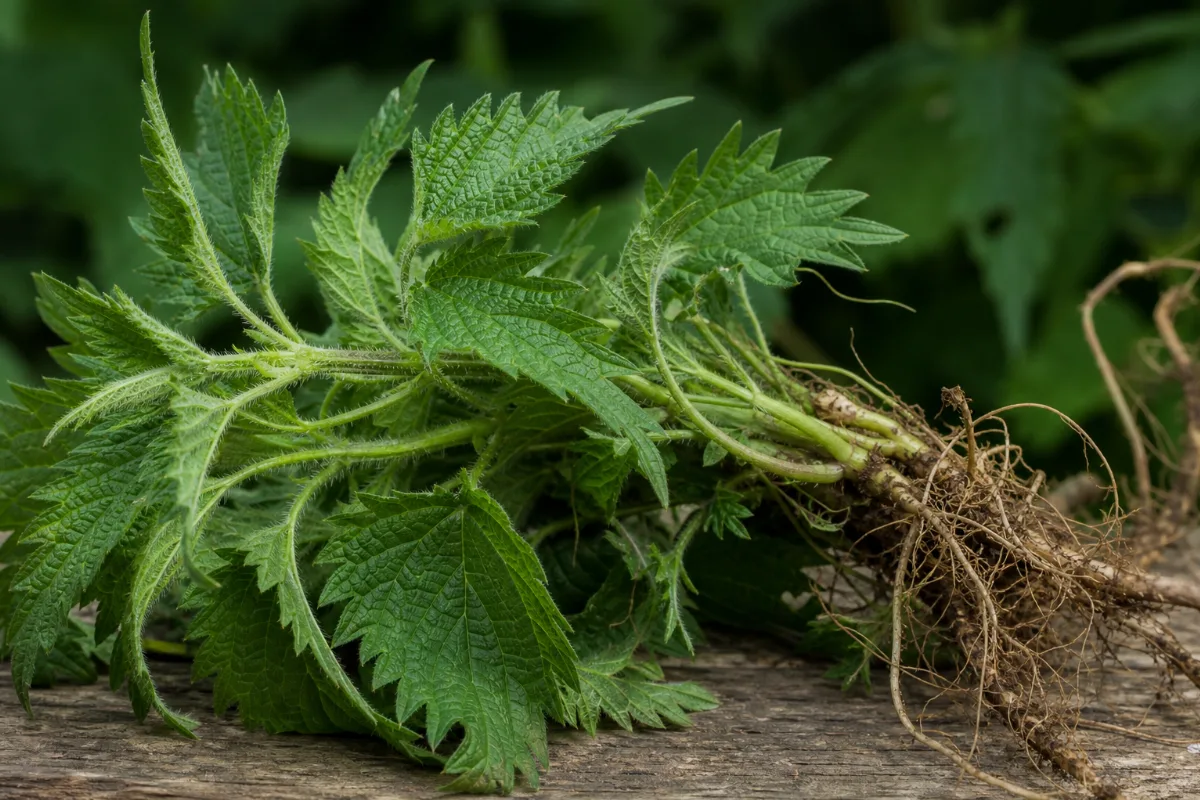
Stinging nettle is a perennial plant native to Asia, Europe and North America. [4] Its root is widely used for benign prostatic hyperplasia (BPH, a non-cancerous enlarged prostate), allergies, arthritis and inflammation. [4] Nettle is often combined with herbs such as saw palmetto and pygeum for BPH. [4] For the tea as a drink, see nettle tea. On prostate herbs as a group, see herbs for prostate and urinary symptoms.Names and plant parts
The accepted scientific name is Urtica dioica L., in the nettle family (Urticaceae). [5] The EU monographs cover both Urtica dioica and a second species, Urtica urens. [1] The parts used are the aerial parts or leaf (herba) and the root (radix). [2] [1] Plant parts matter: a result for root extract does not apply to leaf tea. See plant parts used in herbal products.Traditional use (not proof of effect)
NCCIH says nettle roots have been used for urination disorders associated with BPH, as well as for joint problems, as a diuretic and as an astringent. [3] The European Medicines Agency (EMA) lists the root for lower urinary tract symptoms related to BPH, and the leaf or herb for minor urinary complaints, minor joint pain and seborrhoeic skin conditions. Each is a traditional herbal medicinal product based only on long-standing use, not on proof of effect. [1] [2]What research shows
| Use | What the source found | Strength of evidence | Population and form studied |
|---|---|---|---|
| Prostate symptoms (root) | NCCIH says there is some limited evidence it may improve some BPH symptoms. [3] A 6-month trial reported improved symptom scores and flow versus placebo; NCCIH also cites this trial. [6] [3] A 12-month trial found a symptom score difference versus placebo but no significant difference in peak flow or residual urine. [7] | Promising but limited | Men with BPH; root extracts; 620 and 246 men in two trials [6] [7] |
| Prostate symptoms (with saw palmetto) | NCCIH describes trials of the combination, including one compared with tamsulosin in 140 men over 15 months, with both found helpful. [3] | Promising but limited; cannot be credited to nettle alone | Fixed combination products [3] |
| Allergic rhinitis (hay fever) | A 2017 trial of root extract in 74 people (40 finished) found symptom scores improved in both groups, and placebo did as well. [8] A 1990 trial of a freeze-dried preparation rated it higher than placebo in global assessment, but only slightly higher in diaries. [9] | Insufficient evidence | People with allergic rhinitis; root extract and freeze-dried product [8] [9] |
| Type 2 diabetes (blood sugar) | A meta-analysis of 8 trials (401 people) found fasting blood sugar fell on average 18 mg/dl, but no significant change in insulin or HbA1c. Results varied widely between trials. [10] | Promising but limited (a lab marker, not a clinical outcome) | Adults with type 2 diabetes; various nettle products [10] |
| Osteoarthritis | A hospital cancer center review says human studies are limited but suggest benefit in hip, knee and hand osteoarthritis. [4] | Promising but limited | Small human studies [4] |
| Kidney, liver and colitis protection | Studies in cells and animals suggest protective effects. [4] | Preclinical (cells or animals) | Cells and animals [4] |
Forms and why the form matters
Products include dried herb for infusion, root extracts in solid or liquid forms, and freeze-dried preparations. [1] [9] The EU root monograph alone lists many different extract types. [1] Because trials used different extracts, a result for one product does not carry over to another. This page gives no amounts for a reader. A clinician or pharmacist decides what is right for a person.Safety
- Common effects: the EU monographs list nausea, stomach upset, diarrhea and allergic reactions (itching, rash, hives). [1] [2] NCCIH says nettle seems generally well tolerated in trials. [3]
- Pregnancy and breastfeeding: the EU monograph for nettle herb says safety has not been established and use is not recommended. [2] A lactation database notes only minimal scientific support for a milk-supply effect, and suggests it is probably best not to apply nettle to the breast while breastfeeding, because one infant developed an allergic rash after a mother applied it to her nipple. [11] See pregnancy and breastfeeding.
- Fluid restriction: the EU monograph for nettle herb says it is not recommended for people whose conditions call for reduced fluid intake. [2]
- Blood sugar medicines: a cancer center review lists a case of low blood sugar in a 78-year-old man after he took an herbal remedy containing nettle for BPH. The nettle product was a mixture, so the cause is not certain. [4] See supplements and diabetes medicines.
- Diuretics and blood pressure medicines: the same review says nettle could add to the effect of diuretics and blood pressure medicines in theory, based on animal studies, and that the clinical relevance is not yet determined. [4] See supplements and blood pressure and heart medicines.
- Medicines cleared by liver enzymes: animal studies suggest nettle may inhibit CYP450 enzymes, and the clinical relevance has not been determined. [4]
- Iron: NCCIH notes a 2015 review saying nettle contains tannins, which can interact with iron and reduce its effect in people who need iron supplements. [3]
- Other case reports: breast enlargement in a man and milk flow in a woman with nettle tea; allergic rhinitis from nettle pollen. [4]
- EU monograph interactions: "none reported" for both root and herb. [1] [2]
- Children: the EU root monograph says there is no relevant use in children and adolescents under 18, and the herb monograph says use in children under 12 has not been established. [1] [2]
- Lithium, surgery, liver and kidney disease: not described in the sources we read. Lithium has a narrow safe range, so ask a pharmacist (narrow-range medicines). Tell the surgical team about any herb (supplements before surgery).
- Quality: see quality testing and certifications.
Frequently asked questions
Does nettle root help an enlarged prostate?
NCCIH says there is some limited evidence it may improve some symptoms. Trials were small or had design limits, so it is not established. [3] See a clinician first for urinary symptoms. [1]
Does nettle help allergies?
Two small trials of different nettle products gave mixed results, and one found placebo worked as well. [8] [9]
Is nettle safe in pregnancy?
The EU monograph for nettle herb says safety has not been established and use during pregnancy and lactation is not recommended. [2]
Can nettle lower blood sugar?
A meta-analysis found lower fasting blood sugar on average, but not HbA1c, with very variable results. If you take diabetes medicines, ask a pharmacist before using it. [10]
What is the scientific name?
Urtica dioica L., family Urticaceae. [5]
References
- EMA Committee on Herbal Medicinal Products (HMPC), European Union herbal monograph on Urtica dioica L.; Urtica urens L., radix, Final - Revision 1, 22 January 2025 (EMA/HMPC/322646/2023). Read 2026-10-23.
- EMA Committee on Herbal Medicinal Products (HMPC), European Union herbal monograph on Urtica dioica L.; Urtica urens L., herba, Final - Revision 1, 22 January 2025 (EMA/HMPC/261302/2022). Read 2026-10-23.
- NCCIH, Benign Prostatic Hyperplasia and Complementary and Integrative Approaches: What the Science Says (provider digest; date not shown on the page text we read). Read 2026-10-23.
- Memorial Sloan Kettering Cancer Center, About Herbs: Nettle. Last updated December 7, 2021. Read 2026-10-23.
- GBIF Backbone Taxonomy, species match: Urtica dioica. Read 2026-10-23.
- Urtica dioica for treatment of benign prostatic hyperplasia: a prospective, randomized, double-blind, placebo-controlled, crossover study. J Herb Pharmacother 2005. Read 2026-10-23.
- Stinging nettle root extract in long term treatment of benign prostatic syndrome: randomized, double-blind, placebo controlled multicenter study after 12 months. Urologe A 2004. Read 2026-10-23.
- Efficacy of Supportive Therapy of Allergic Rhinitis by Stinging Nettle (Urtica dioica) root extract: a randomized, double-blind, placebo-controlled clinical trial. Iran J Pharm Res 2017. Read 2026-10-23.
- Randomized, double-blind study of freeze-dried Urtica dioica in the treatment of allergic rhinitis. Planta Med 1990. Read 2026-10-23.
- The effect of nettle (Urtica dioica) supplementation on the glycemic control of patients with type 2 diabetes mellitus: a systematic review and meta-analysis. Phytother Res 2020. Read 2026-10-23.
- Stinging Nettle. In: Drugs and Lactation Database (LactMed), National Library of Medicine, 2006 entry. Read 2026-10-23.