Nuts & Seeds · Seed
Hemp Seeds
Cannabis sativa · also called Hemp hearts, hulled hemp seeds, hempseed, semillas de cañamo (Spanish)
Hulled hemp seeds (hemp hearts) are the soft kernels of the hemp plant, eaten for plant protein, essential fats and minerals. They are a nutritious food, but human trials on health effects are few and small: one found lower blood pressure with hemp protein powder, another found no change in cholesterol or blood sugar. The main cautions are seed allergy, which can be severe, and trace THC, which the FDA says cannot make you high.
General information, not medical advice. Last substantive update · Not medically reviewed. A named clinician has not signed off on this page. How this page is made
About Hemp Seeds
Hulled hemp seeds are a protein-, fat- and mineral-rich food. They are a nutritious seed, not a proven remedy: the few human trials are small and short, and several results are for protein powder or mixed hemp products.
What it is
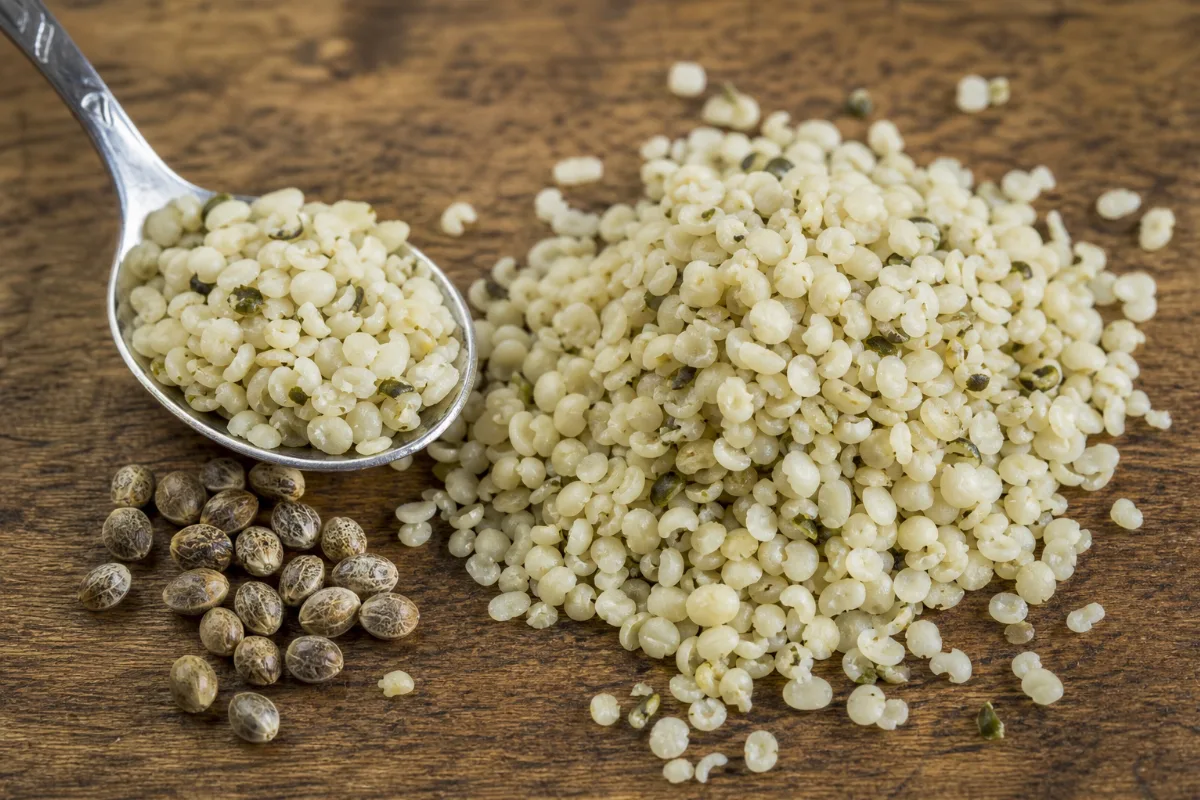
Hemp seeds are the seeds of Cannabis sativa, the same species as marijuana. The food is the soft kernel inside the hard shell, sold as hulled hemp seeds or hemp hearts. The FDA says the seeds themselves do not naturally contain THC.
USDA data for hulled hemp seed: 553 kcal per 100 g. A 3 tablespoon portion (30 g) has about 166 kcal, 9.5 g protein, 14.6 g fat, 1.2 g fibre, 2.6 g ALA, 8.2 g linoleic acid, 210 mg magnesium, 3.0 mg zinc, 2.4 mg iron and 360 mg potassium (our arithmetic from USDA).
What the research shows
The firmest facts are about content: protein, polyunsaturated fat and minerals. These come from food analysis, not trials of people eating hemp seeds.
A 2024 trial of 35 adults with mild high blood pressure found lower blood pressure after 6 weeks of hemp seed protein (50 g a day) than after casein. A 2026 trial of 30 adults found hemp products changed blood fats but not blood pressure, cholesterol, blood sugar or body composition.
A 2025 review says heart-health claims for hempseed rest mostly on animal and lab studies and calls for long-term trials.
Seeds versus protein powder, oil and CBD products
The blood pressure trial used hemp seed protein and a peptide product, not whole seeds. Hemp seed oil, hemp protein powder, CBD oil and hemp milk are different products. Drug-test findings are for oil. Results for one product do not carry over to another.
Amounts
This page gives no amounts to eat. Ask a doctor, pharmacist or dietitian what is right for you, especially if you take prescription medicines or have kidney problems.
At a glance
Traditional uses history, not proof
- Eaten as a seed food: sprinkled on yogurt, salads and cereal, or blended into smoothies
- Long use as food is not proof that it treats any condition
Studied for research
- Plant protein, high certainty for the nutrient content
- Essential omega-6 and omega-3 (ALA) fats, high certainty for the content
- Raising blood levels of these fats, low certainty (one small trial)
- Minerals such as magnesium, zinc and iron, high certainty for the content
- Blood pressure, low certainty (protein powder trial; a second trial found no change)
- Cholesterol, blood sugar and weight, low certainty (no change in one trial)
- Heart disease protection, insufficient evidence (mostly animal and lab work)
Main compounds
- Alpha-linolenic acid (ALA, omega-3)
- Linoleic acid (omega-6)
- Gamma-linolenic acid (GLA)
- Edestin and vicilin (proteins)
- Magnesium, zinc and iron
- Trace THC and CBD (from processing)
- Phytic acid and other anti-nutrients
Common forms
- Hulled seeds (hemp hearts) as food
- Whole seeds in the shell
- Hemp seed protein powder, hemp seed oil and hemp milk (different products, not covered here)
Research links: FDA: GRAS notices for hemp seed-derived ingredients · 2024 trial: hemp seed protein and blood pressure · 2025 review: hempseed and cardiovascular health · Research Library · Genes & Biomarkers Library
What it is and its history
- Accepted scientific name
- Cannabis sativa
- Naming authority
- L. (GBIF accepted)
- Common names
- Hemp seeds (English); Hemp hearts (English); Hulled hemp seeds (English); Hempseed (English)
- Family or group
- Cannabaceae (the cannabis family), as given by GBIF.
- Classification
- Plantae > Tracheophyta > Magnoliopsida > Rosales > Cannabaceae > Cannabis > Cannabis sativa
- Native range
- Not verified from a source read.
- Habitat
- Not verified from a source read.
- What it looks like
- Roots: Not verified.; Stems: Not verified.; Leaves: Not verified.; Flowers: Not verified.; Fruit: The food is the seed kernel inside a hard shell. USDA's household portion for hulled seed is 3 tablespoons, 30 g.
- Cultivation
- Not verified from a source read.
- Harvest and processing
- Sold hulled (hemp hearts), whole in the shell, or as protein powder, oil or hemp milk (existing nutrient summary). The FDA reviewed hulled hemp seed, hemp seed protein powder and hemp seed oil as separate ingredients.
- Look-alikes and adulterants
- Name: Marijuana (drug-type Cannabis sativa); Note: Same species as hemp. The FDA says the seeds themselves do not naturally contain THC, which is picked up in trace amounts during harvest and processing.; Name: CBD and hemp extract products; Note: Made from other parts of the plant. The FDA position on adding CBD or THC to food is separate from the hemp seed notices.
- Sustainability and conservation
- Not assessed.
Photographs
What is inside, and how it may work
What it contains and how those compounds act in cells and animals. Laboratory and animal mechanisms are not proven effects in people.
Main compounds
| Compound | Family | Where it is concentrated | Activity studied | Level of evidence |
|---|---|---|---|---|
| Alpha-linolenic acid (ALA, omega-3) PubChem 5280934 | fatty acid | Seed USDA: 8.68 g per 100 g | An essential omega-3 fat. Blood ALA rose after hemp products in a 2026 trial. 14 7 | Human data |
| Linoleic acid (omega-6) PubChem 5280450 | fatty acid | Seed USDA: 27.4 g per 100 g | An essential omega-6 fat. 14 | Composition only |
| Gamma-linolenic acid (GLA, omega-6) PubChem 5280933 | fatty acid | Seed USDA: 1.34 g per 100 g | Blood GLA and its product DGLA rose after hemp products in a 2026 trial. 14 7 | Human data |
| Stearidonic acid (SDA, omega-3) PubChem 5312508 | fatty acid | Seed USDA: 0.617 g per 100 g (listed as PUFA 18:4) | An omega-3 fat described in hemp by the 2024 review. No effect studied. 14 5 | Composition only |
| Edestin and vicilin (storage proteins) | protein | Seed Not given in the sources read | Edestin is named as a main hemp protein in the 2024 review; edestin and vicilin are potential allergens in the 2023 lab study. 5 3 | Lab |
| Delta-9-tetrahydrocannabinol (THC) and CBD (trace) PubChem 16078 | cannabinoid | Not made in the seed; picked up from other plant parts (FDA) FDA: trace amounts. 2017 lab study: above 10 micrograms per gram in almost all tests of 3 brands, by harsh extraction. | THC is psychoactive; the FDA says the trace amounts in the reviewed ingredients cannot make consumers high. CBD (PubChem CID 644019) is a separate compound. 13 2 | Lab |
| Phytic acid, tannins, saponins and trypsin inhibitors | anti-nutritional compounds | Seed Variable with variety and processing | Can reduce absorption of protein, minerals and vitamins (2024 review). 5 10 | Lab |
Mechanisms, receptors and pathways
| Target or pathway | Gene or receptor | What was found | Level |
|---|---|---|---|
| Blood pressure: ACE, renin and nitric oxide | ACE, renin, nitric oxide (measured in plasma) | After hemp seed protein, plasma ACE and renin activity were lower and nitric oxide higher than after casein. The authors suggest hemp protein may have a role in dietary management of hypertension. 4 | Human data |
| Essential fats in blood and tissues | Not specified | Blood fatty acid levels reflected the fatty acids hemp products are rich in, without changes in major risk factors. 7 | Human data |
| Heart-protective mechanisms (lipids, inflammation, oxidative stress) | Not specified | Suggested by preclinical studies in the 2025 review; clinical evidence limited. 6 | Animal research |
| Allergy: IgE binding to hemp seed storage proteins | IgE antibodies; vicilins and edestins | Sera from sensitized people bound hemp seed storage proteins; hemp seed extract inhibited IgE binding to hazelnut extract by about 25 to 30 percent. 3 | Lab |
Absorption, metabolism and elimination
- Absorption
- Not established for hemp seed nutrients. Plant compounds such as phytic acid can reduce mineral and protein uptake (2024 review).
- Distribution
- Not found.
- Metabolism
- THC is broken down mainly by CYP3A4 and CYP2C9 (2017 lab study text).
- Elimination
- Not found for food use.
- Bioavailability
- Protein digestibility score (PDCAAS) 66% for dehulled hemp seed (2024 review).
Isolated compounds versus whole extracts
The blood pressure trial used hemp seed protein and a peptide product at 50 g a day, not whole seeds. Hemp seed oil, hemp protein powder, CBD oil and hemp milk are different products with different safety questions. Drug-test findings are for oil.
Nutritional composition
Nutrition from USDA FoodData Central (Seeds, hemp seed, hulled, FDC 170148, SR Legacy, last updated 4/1/2019, read 2026-10-26). Per 100 g: 553 kcal, 31.6 g protein, 48.8 g fat (4.6 g saturated, 5.4 g monounsaturated, 38.1 g polyunsaturated), 8.67 g carbohydrate, 4.0 g fibre, 1.5 g sugars, about 5 g water, 70 mg calcium, 7.95 mg iron, 700 mg magnesium, 1,650 mg phosphorus, 1,200 mg potassium, 5 mg sodium, 9.9 mg zinc, 1.6 mg copper, 7.6 mg manganese, 1.28 mg thiamin, 9.2 mg niacin, 110 micrograms folate, 0.8 mg vitamin E. Fatty acids per 100 g: 27.4 g linoleic acid (omega-6), 8.68 g alpha-linolenic acid (omega-3), 1.34 g gamma-linolenic acid. One 3 tablespoon portion (30 g), our arithmetic: about 166 kcal, 9.5 g protein, 14.6 g fat (1.4 g saturated), 2.6 g carbohydrate, 1.2 g fibre, 210 mg magnesium, 495 mg phosphorus, 360 mg potassium, 3.0 mg zinc, 2.4 mg iron, 0.48 mg copper, 2.3 mg manganese, 2.6 g ALA, 8.2 g linoleic acid. Omega-6 to omega-3 is about 3 to 1 by our division of the two USDA figures. Values vary with variety, growing place and processing. USDA lists no selenium for this item.
3 high certainty3 low certainty1 not enough evidence
What was looked at
The 7 benefits and uses checked for Hemp Seeds, each with how strong the evidence is. Tap one to open it.
- Plant proteinHigh certainty
- Essential fats: omega-6 and omega-3 (ALA)High certainty
- Raising blood levels of omega-3 and omega-6 fatsLow certainty
- Minerals: magnesium, zinc, iron, phosphorus, copper, manganeseHigh certainty
- Blood pressure (hemp seed protein)Low certainty
- Cholesterol, blood sugar and body weightLow certainty
- Heart disease protectionNot enough evidence
Lab markers tracked in the studies
Blood omega-3 and omega-6 fatty acids24-hour blood pressureCholesterol, blood sugar, insulin and body composition
What is Hemp Seeds good for?
The main studied uses and how strong the human evidence is for each. Most results are for nutrient content, a protein powder, or a small short trial, not for eating hulled seeds over years.
Benefits, one by one
Each card is a research question, not a promise. Tap a goal to filter. Open a card to see the studies, doses and limits.
Plant protein
High certaintyHulled hemp seeds are a protein-rich seed. USDA lists 31.6 g of protein per 100 g, about 9.5 g in a 3 tablespoon (30 g) portion. A 2024 review says hemp contains all nine essential amino acids, but that its protein is less well digested than milk protein. This is a nutrient fact, not a trial of hemp seeds.
2 studiesHulled seeds as food. Whole seeds in the shell and hemp protein powde…
Studies, doses and limits
What the trials found
USDA lists 31.6 g protein per 100 g of hulled hemp seed (range across 17 data points 25.7 to 34.6 g). The 2024 review (Axentii and Codina) says hemp contains all nine essential amino acids, reports a protein quality score (PDCAAS) of 66% for dehulled hemp seed against 100% for casein and 92% for beef, and says hemp's score is similar to black beans, pinto beans and lentils.
Results
Hemp seed is a protein-dense food with a complete amino acid profile but only moderate protein digestibility. No trial of eating hulled seeds for muscle or protein status was read.
Effect sizes as reported
USDA: 31.6 g protein per 100 g; about 9.5 g per 30 g portion. Review: PDCAAS 66% for dehulled seed (casein 100%).
Why this rating
High for the amount of protein (USDA analysis). The quality score comes from a review and varies with variety and processing. No trial of hemp seeds for muscle or health outcomes was read.
Form and dose studied
Hulled seeds as food. Whole seeds in the shell and hemp protein powder are different products.
Who was studied
Anyone eating a varied diet; relevant to people who eat little animal protein.
Limits
Nutrient and lab data, not a trial of people eating the seeds. The review does not say how digestion changes with roasting or soaking.
Why researchers looked
Hemp seeds are sold as a plant protein food, so people ask how good that protein is.
Traditional use
Hulled hemp seeds (hemp hearts) are eaten raw on yogurt, salads and in smoothies. Long use as food is not proof that it treats any condition.
Proposed mechanism Authoritative guidance
Protein supplies amino acids the body cannot make. The review links hemp's lower digestibility to plant compounds such as phytic acid and trypsin inhibitors.
A proposed mechanism does not show that the effect happens in people.
Seed allergy is possible; see the Safety tab.
Essential fats: omega-6 and omega-3 (ALA)
High certaintyHemp seeds are high in polyunsaturated fat. Per 100 g USDA lists about 27.4 g linoleic acid (omega-6) and 8.7 g alpha-linolenic acid (ALA, omega-3), roughly 3 to 1 by our division. They also hold some gamma-linolenic acid (GLA, 1.3 g per 100 g). A fat ratio is a content fact, not a measured health effect.
3 studiesHulled seeds as food. Hemp seed oil is a separate product.
Studies, doses and limits
What the trials found
USDA per 100 g: total fat 48.8 g, polyunsaturated 38.1 g, saturated 4.6 g, monounsaturated 5.4 g, linoleic acid 27.4 g, ALA 8.68 g, GLA 1.34 g, stearidonic acid (SDA) 0.617 g. The 2025 review (Kacar and colleagues) describes hempseed as having an optimal omega-6 to omega-3 ratio, and the 2024 review gives 2:1 to 3:1 for hemp seed oil.
Results
Hemp seed is a rich source of essential fats, including some GLA and SDA. The ratio is a property of the food. Whether it changes health outcomes was not shown in a trial of hemp seeds.
Effect sizes as reported
USDA: ALA 8.68 g and linoleic acid 27.4 g per 100 g; about 2.6 g ALA and 8.2 g linoleic acid per 30 g portion (our arithmetic).
Why this rating
High for the fat content (USDA analysis). The claim that the ratio is 'optimal' is the reviewers' opinion; no trial testing the ratio was read.
Form and dose studied
Hulled seeds as food. Hemp seed oil is a separate product.
Who was studied
Anyone eating a varied diet.
Limits
Composition data. The 2:1 to 3:1 figure in the 2024 review is for the oil. Energy-dense food: 553 kcal per 100 g.
Why researchers looked
Hemp is promoted for a favourable omega-6 to omega-3 balance.
Traditional use
Hulled hemp seeds (hemp hearts) are eaten raw on yogurt, salads and in smoothies. Long use as food is not proof that it treats any condition.
Proposed mechanism Established nutrient role
Linoleic acid and ALA are essential fats the body cannot make. How well ALA turns into the fish fats EPA and DHA was not checked on this page.
A proposed mechanism does not show that the effect happens in people.
Hemp seeds are high in polyunsaturated fat; hemp-specific storage advice was not read.
Raising blood levels of omega-3 and omega-6 fats
Low certaintyIn a 2026 trial of 30 adults, eating hemp products for 4 weeks raised blood levels of ALA, GLA and related fats, and also EPA in red blood cells or plasma, compared with control products. It is one small crossover trial of hemp products (the abstract does not list the exact foods).
1 studiesHemp products (seeds and oil are the products the authors discuss); e…
Studies, doses and limits
What the trials found
She and colleagues ran a randomised, double-blind, crossover trial in 30 normoglycemic adults aged 18 to 65 with BMI 25 to 35. Each person consumed hemp products and control products for 4 weeks each. ALA, GLA and dihomo-gamma-linolenic acid (DGLA) were higher after hemp than after controls, and the abstract says ALA, DGLA and EPA were higher in the other blood measure.
Results
Blood levels of the fats that hemp contains went up, including some EPA. The abstract gives no numbers. Whether this changes health was not tested here (see the heart and metabolic results on the next tab).
Effect sizes as reported
Higher ALA, GLA, DGLA and EPA after hemp products than controls; no numbers in the abstract.
Why this rating
Low: one small crossover trial of 30 adults, a blood-marker result, and the abstract does not say which hemp foods or amounts were used or who paid for it.
Form and dose studied
Hemp products (seeds and oil are the products the authors discuss); exact products not stated in the abstract.
Who was studied
Adults aged 18 to 65 with BMI 25 to 35 and normal blood sugar.
Limits
A blood marker is not a health outcome. Results may not apply to hulled seeds alone.
Why researchers looked
If hemp seeds supply essential fats, do those fats show up in the blood?
Traditional use
Hulled hemp seeds (hemp hearts) are eaten raw on yogurt, salads and in smoothies. Long use as food is not proof that it treats any condition.
Proposed mechanism Human data
Blood fats reflect what is eaten. The trial authors say the changes mirrored the fatty acids that hemp products are rich in.
A proposed mechanism does not show that the effect happens in people.
None specific.
Minerals: magnesium, zinc, iron, phosphorus, copper, manganese
High certaintyHulled hemp seeds are a concentrated source of several minerals. Per 100 g USDA lists 700 mg magnesium, 9.9 mg zinc, 7.95 mg iron, 1,650 mg phosphorus, 1.6 mg copper and 7.6 mg manganese. A 2026 lab study agrees that hemp and pumpkin seeds are high in Mg, K, P, Fe, Mn and Zn. Plant compounds in the seed can reduce how much the body absorbs.
3 studiesHulled seeds as food.
Studies, doses and limits
What the trials found
USDA per 100 g: magnesium 700 mg, phosphorus 1,650 mg, potassium 1,200 mg, calcium 70 mg, zinc 9.9 mg, iron 7.95 mg, copper 1.6 mg, manganese 7.6 mg. A 2026 ICP-OES lab analysis of store-bought superfood seeds and grains found pumpkin and hemp seeds generally high in Mg, K, P, Fe, Mn and Zn. The 2024 review says phytic acid, tannins and trypsin inhibitors in hemp can reduce mineral and protein availability.
Results
Hemp seeds are mineral-rich foods. How much of each mineral the body absorbs from them was not measured in the sources read.
Effect sizes as reported
About 210 mg magnesium, 3.0 mg zinc, 2.4 mg iron, 495 mg phosphorus per 30 g portion (our arithmetic from USDA).
Why this rating
High for the mineral content (USDA analysis and an independent lab study). Absorption and any benefit for people who are low in a mineral were not tested.
Form and dose studied
Hulled seeds as food.
Who was studied
Anyone eating a varied diet.
Limits
Composition data only. Content varies with variety, growing place and processing.
Why researchers looked
Seeds are eaten as a source of minerals, so people ask how much hemp contains.
Traditional use
Hulled hemp seeds (hemp hearts) are eaten raw on yogurt, salads and in smoothies. Long use as food is not proof that it treats any condition.
Proposed mechanism Authoritative guidance
The body uses these minerals in enzymes, bones and blood. Phytic acid in the seed can bind minerals (2024 review).
A proposed mechanism does not show that the effect happens in people.
People with kidney disease are often advised to watch potassium and phosphorus; ask your kidney team (see the Safety tab).
Blood pressure (hemp seed protein)
Low certaintyOne 2024 crossover trial in 35 adults with mild high blood pressure found lower 24-hour blood pressure after 6 weeks of hemp seed protein than after casein. This used 50 g a day of a protein product, not whole seeds. A separate 2026 trial of hemp products found no blood pressure difference.
2 studiesHemp seed protein (50 g a day) and a peptide-enriched version, not wh…
Studies, doses and limits
What the trials found
Samsamikor and colleagues: double-blind, randomised, crossover trial, 35 adults with mild hypertension (systolic 130 to 160 mmHg). Three 6-week treatments of 50 g casein, 50 g hemp seed protein (HSP) or 45 g HSP plus 5 g hemp-derived peptides (HSP+), with 2-week washouts. Versus casein, 24-hour systolic and diastolic pressure fell from 135.1 and 80.0 mmHg to 128.1 and 76.0 after HSP+ and to 133.5 and 78.9 after HSP (P < 0.0001 for each). In the 2026 trial of hemp products in 30 adults with BMI 25 to 35, no blood pressure difference was seen.
Results
Hemp seed protein powder lowered 24-hour blood pressure in one small trial; hemp products did not change it in another. Neither tested plain hulled seeds.
Effect sizes as reported
HSP+: 24-hour BP 128.1/76.0 mmHg; HSP: 133.5/78.9 mmHg; from baseline 135.1/80.0 mmHg (abstract).
Why this rating
Low: one small crossover trial of a protein product plus a peptide product, 6-week treatments, and a second trial of hemp products with no blood pressure change. The authors report no conflicts of interest.
Form and dose studied
Hemp seed protein (50 g a day) and a peptide-enriched version, not whole seeds.
Who was studied
Adults with mild high blood pressure (first trial); adults with BMI 25 to 35 and normal blood sugar (second).
Limits
Powder doses are far larger than a spoonful of seeds. The trial compared with casein, not with a seed-free diet. Blood pressure medicines were not discussed in the abstract.
Why researchers looked
Hemp protein contains arginine and peptides that are thought to relax blood vessels, so researchers tested blood pressure.
Traditional use
Hulled hemp seeds (hemp hearts) are eaten raw on yogurt, salads and in smoothies. Long use as food is not proof that it treats any condition.
Proposed mechanism Human biomarker
The authors report lower ACE and renin activity and higher nitric oxide in blood after hemp protein than casein.
A proposed mechanism does not show that the effect happens in people.
People on blood pressure medicine should not change treatment based on food; ask your doctor.
Cholesterol, blood sugar and body weight
Low certaintyIn the 2026 trial of 30 adults, hemp products did not change serum lipids, glucose, insulin or body composition compared with control products.
2 studiesHemp products; exact foods not listed in the abstract.
Studies, doses and limits
What the trials found
She and colleagues found, in a randomised, double-blind crossover trial of 30 adults (4 weeks per treatment), no differences in serum lipid levels, glucose and insulin concentrations, blood pressure or body composition between hemp and control products.
Results
No effect on cholesterol, blood sugar, insulin or body composition was seen in the one human trial read.
Effect sizes as reported
No significant differences reported for any of these measures; no numbers in the abstract.
Why this rating
Low: a single small 4-week trial. A null result in a short trial does not rule out effects over longer periods.
Form and dose studied
Hemp products; exact foods not listed in the abstract.
Who was studied
Adults aged 18 to 65 with BMI 25 to 35 and normal blood sugar.
Limits
People with diabetes or high cholesterol were not studied here. Hemp seeds are energy dense (553 kcal per 100 g).
Why researchers looked
Hemp's fats and protein are often promoted for cholesterol, blood sugar and weight.
Traditional use
Hulled hemp seeds (hemp hearts) are eaten raw on yogurt, salads and in smoothies. Long use as food is not proof that it treats any condition.
Proposed mechanism Human data
Not established. The authors say the fatty acid changes in blood were not accompanied by changes in major risk factors.
A proposed mechanism does not show that the effect happens in people.
Hemp seeds add calories quickly; ask a dietitian if you track weight or blood sugar.
Heart disease protection
Not enough evidenceA 2025 review of hempseed and cardiovascular health says that animal and lab studies suggest benefits for blood fats, blood pressure and inflammation, but that clinical evidence is limited. The only human trials read did not show a heart-risk benefit from hemp seed foods.
3 studiesHempseed as food in the review; a mix of seed, oil and extracts in th…
Studies, doses and limits
What the trials found
Kacar and colleagues (Front Nutr 2025, narrative review): preclinical studies suggest hempseed can improve lipid profiles, reduce blood pressure, and reduce oxidative stress and inflammation, though clinical evidence remains limited and animal findings may not translate to humans. They call for long-term randomised trials.
Results
Heart protection is a hypothesis for hemp seeds, mostly from animals and lab work. No trial of heart attacks or strokes was found.
Effect sizes as reported
No effect sizes in the abstract.
Why this rating
Insufficient: the review rests mostly on preclinical work, and the human data found are two small short trials with mixed blood pressure results.
Form and dose studied
Hempseed as food in the review; a mix of seed, oil and extracts in the underlying studies.
Limits
Abstract of the review only was read. Animal results often do not carry over to people.
Why researchers looked
Hemp seed is marketed as heart-healthy because of its fats, protein and plant compounds.
Traditional use
Hulled hemp seeds (hemp hearts) are eaten raw on yogurt, salads and in smoothies. Long use as food is not proof that it treats any condition.
Proposed mechanism Lab and animal
The review points to fatty acids, tocopherols, phytosterols and polyphenols, mostly from preclinical work.
A proposed mechanism does not show that the effect happens in people.
None specific.
Connections to the rest of health
How Hemp Seeds connects to the rest of our health knowledge graph. Every link says what kind of connection it is. A safety link (for example to the liver) is a warning, not a benefit. A study that merely mentions a topic never creates a benefit link.
Explore every connection: goals, body systems, organs, symptoms, genes
B. Body systems
| Connected to | Kind of connection | Evidence status | Context | Studies |
|---|---|---|---|---|
| Digestive System | Biological association | High certainty | Studied for: Plant protein | 14 5 |
| Muscular System | Biological association | High certainty | Studied for: Plant protein | 14 5 |
| Cardiovascular System | Biological association | High certainty | Studied for: Essential fats: omega-6 and omega-3 (ALA) Studied for: Raising blood levels of omega-3 and omega-6 fats | 14 6 5 7 4 |
| Metabolic System | Biological association | Low certainty | Studied for: Raising blood levels of omega-3 and omega-6 fats Studied for: Cholesterol, blood sugar and body weight | 7 14 |
| Musculoskeletal System | Biological association | High certainty | Studied for: Minerals: magnesium, zinc, iron, phosphorus, copper, manganese | 14 9 5 |
| Blood And Immune | Biological association | High certainty | Studied for: Minerals: magnesium, zinc, iron, phosphorus, copper, manganese | 14 9 5 |
E. Health conditions
| Connected to | Kind of connection | Evidence status | Context | Studies |
|---|---|---|---|---|
| Food allergy | Adverse effect or risk | Documented risk | Case reports of anaphylaxis and a lab study of possible cross-reactivity with hazelnut. Case reports of anaphylaxis to hemp seed; possible cross-reactivity with hazelnut in a lab study. Preparation or compound: Hulled hemp seed as food |
1 12 3 |
I. Biomarkers
| Connected to | Kind of connection | Evidence status | Context | Studies |
|---|---|---|---|---|
| Blood omega-3 and omega-6 fatty acids | Biological association | Low certainty | Measured in trials: raised. A lab change is not the same as a health benefit. | 7 |
| 24-hour blood pressure | Biological association | Low certainty | Measured in trials: mixed. A lab change is not the same as a health benefit. | 4 7 |
| Cholesterol, blood sugar, insulin and body composition | Biological association | Low certainty | Measured in trials: no-change. A lab change is not the same as a health benefit. | 7 |
K. Biological pathways
| Connected to | Kind of connection | Evidence status | Context | Studies |
|---|---|---|---|---|
| Alpha-linolenic acid (omega-3) | Preliminary mechanism | Human | Hemp seed is a rich ALA food; blood ALA rose after hemp products in one trial. | 14 7 |
| Magnesium | Preliminary mechanism | Composition only | 700 mg per 100 g by USDA. | 14 |
| Renin-angiotensin system (ACE and renin) | Preliminary mechanism | Human | Plasma ACE and renin activity were lower after hemp protein than casein in one trial. | 4 |
L. Active compounds
| Connected to | Kind of connection | Evidence status | Context | Studies |
|---|---|---|---|---|
| THC (delta-9-tetrahydrocannabinol) | Documented risk | FDA: trace amounts, cannot make consumers high; a 2017 lab study measured more than the Canadian food limit in some tests. Preparation or compound: Trace THC on hemp seeds |
13 2 | |
| THC | Documented risk | Trace THC from processing; the FDA says it cannot make consumers high. Preparation or compound: Trace THC on hemp seeds |
13 2 | |
| Alpha-linolenic acid (ALA, omega-3) | Biological association | Human | An essential omega-3 fat. Blood ALA rose after hemp products in a 2026 trial. Preparation or compound: Seed |
14 7 |
| Linoleic acid (omega-6) | Biological association | Composition only | An essential omega-6 fat. Preparation or compound: Seed |
14 |
| Gamma-linolenic acid (GLA, omega-6) | Biological association | Human | Blood GLA and its product DGLA rose after hemp products in a 2026 trial. Preparation or compound: Seed |
14 7 |
| Stearidonic acid (SDA, omega-3) | Biological association | Composition only | An omega-3 fat described in hemp by the 2024 review. No effect studied. Preparation or compound: Seed |
14 5 |
| Edestin and vicilin (storage proteins) | Biological association | Lab | Edestin is named as a main hemp protein in the 2024 review; edestin and vicilin are potential allergens in the 2023 lab study. Preparation or compound: Seed |
5 3 |
| Delta-9-tetrahydrocannabinol (THC) and CBD (trace) | Biological association | Lab | THC is psychoactive; the FDA says the trace amounts in the reviewed ingredients cannot make consumers high. CBD (PubChem CID 644019) is a separate compound. Preparation or compound: Not made in the seed; picked up from other plant parts (FDA) |
13 2 |
| Phytic acid, tannins, saponins and trypsin inhibitors | Biological association | Lab | Can reduce absorption of protein, minerals and vitamins (2024 review). Preparation or compound: Seed |
5 10 |
Each connection is stored with the ingredient, the connected record, the kind of connection, the evidence status, the supporting studies, the preparation or compound involved, and a review date (last reviewed October 26, 2026).
Evidence at a glance: what changed in 3 lab markers
Tap a number to show only those markers. Counts are markers, not people.
The evidence
The research centre for Hemp Seeds. Every record here was checked against PubMed or the publisher's page; we never list a study we have not verified.
Evidence by outcome
Bars show how many studies we found for each outcome, not how well it works. People are added up across trials only (reviews are not added, to avoid double counting).
How we rate evidence
High certainty
Several well-run trials or reviews agree; further research is unlikely to change the picture much.
Moderate certainty
Good trials point the same way, but some doubt remains.
Low certainty
Small, short or inconsistent trials. The finding could change with better research.
Very low certainty
Very little or very weak human data. Treat as a possibility only.
Mixed findings
Trials or reviews disagree with each other.
Not enough evidence
Not enough human research to say either way.
Evidence against
Good research found no benefit, or found harm.
We take the reviewers' own risk-of-bias and GRADE statements where they exist, and otherwise judge from study size, design, consistency, directness and whether a product matches what is sold. Many publications do not make evidence high. Method note: We started from our existing hemp seed summary, re-checked nutrition at USDA FoodData Central, read the FDA and AAAAI pages and searched PubMed for trials, reviews and allergy reports. Only abstracts were read for most studies, and two allergy reports had no abstract. Items we could not verify are flagged in the research gaps.
Study library: every study we checked 14
| Study | Design | People | Product, dose, length | Result |
|---|---|---|---|---|
| p12847507 Stadtmauer G, Beyer K, Bardina L, Sicherer SH. Anaphylaxis to ingestion of hempseed (Cannabis sativa). J Allergy Clin Immunol 2003 · Source |
Case report |
Methods, limits and fundingRead: citation-only | ||
| p29098190 Yang Y, Lewis MM, Bello AM et al. Cannabis sativa (Hemp) Seeds, Delta9-Tetrahydrocannabinol, and Potential Overdose. Cannabis Cannabinoid Res 2017 · Source |
Laboratory analysis n/a |
Methods, limits and fundingRead: full-text | ||
| p37254358 Beriziky P et al. Hemp seed: an allergen source with potential cross-reactivity to hazelnut. Food Res Int 2023 · Source |
Laboratory immunology study human samples |
Methods, limits and fundingRead: abstract | ||
| p38710445 Samsamikor M et al. Hemp seed protein and its hydrolysate compared with casein protein consumption in adults with hypertension: a double-blind crossover study. Am J Clin Nutr 2024 · Source |
Randomised crossover trial |
Methods, limits and fundingRead: abstract | ||
| p38732410 Axentii M, Codina GG. Exploring the Nutritional Potential and Functionality of Hemp and Rapeseed Proteins: a review. Plants (Basel) 2024 · Source |
Narrative review n/a |
Methods, limits and fundingRead: full-text | ||
| p41132555 Kacar OF, Kose T, Kaya Kacar H. Dietary hempseed and cardiovascular health: nutritional composition, mechanisms and comparison with other seeds. Front Nutr 2025 · Source |
Narrative review human and animal |
Methods, limits and fundingRead: abstract | ||
| p41782552 She Y et al. The effect of hemp product consumption on blood fatty acid profiles and cardiovascular disease risk factors: a randomized, double-blind, crossover clinical trial. Food Funct 2026 · Source |
Randomised crossover trial |
Methods, limits and fundingRead: abstract | ||
| p41942676 Ovat DY et al. Impact of CBD and hemp oil use on drug test results: a systematic review. Int J Legal Med 2026 · Source |
Systematic review |
Methods, limits and fundingRead: abstract | ||
| p42123740 Mackiewicz E et al. Multielement Analysis of Selected Superfood Seeds and Grains Using ICP-OES. Molecules 2026 · Source |
Laboratory analysis n/a |
Methods, limits and fundingRead: abstract | ||
| p42789948 Matyjaszczyk E, Smiechowska M. Benefits and risks of consuming Cannabis sativa L. in food. J Food Drug Anal 2026 · Source |
Narrative review n/a |
Methods, limits and fundingRead: abstract | ||
| p42825381 Moncada Salinero A et al. Allergy to the Fatty Part of Hemp Seed. J Investig Allergol Clin Immunol 2026 · Source |
Case report |
Methods, limits and fundingRead: citation-only | ||
| s-aaaai-hemp-seed AAAAI Ask the Expert: Hemp seed allergy (question dated 10/20/2022) · Source |
Expert answer |
Methods, limits and fundingRead: full-text | ||
| s-fda-hemp-gras-2018 FDA: FDA Responds to Three GRAS Notices for Hemp Seed-Derived Ingredients for Use in Human Food · Source |
Health agency n/a |
Methods, limits and fundingRead: full-text | ||
| s-usda-fdc-170148 USDA FoodData Central: Seeds, hemp seed, hulled (FDC 170148) · Source |
Reference database n/a |
Methods, limits and fundingRead: full-text |
What we do not know yet
- No trial of eating plain hulled hemp seeds was found for blood pressure, cholesterol, blood sugar or weight.
- The blood pressure trial used a protein powder, and the fatty-acid trial did not list its exact hemp foods in the abstract.
- No long-term trial or observational study of hemp seeds and disease was found.
- THC absorption after eating seeds, and drug-test results after eating seeds, were not found.
- Pregnancy, breastfeeding, children, medicine interactions and hemp-specific heavy metal levels were not found in the sources read.
- Only abstracts of most papers were read; two allergy reports had no abstract.
How new research is added
New studies are found by a saved PubMed search and placed in a review queue before the page changes.
Lab markers
What changed in blood or saliva tests during trials. A changed number is not the same as feeling or being healthier, and we give no "normal ranges".
Other 3
Blood omega-3 and omega-6 fatty acids
Raised in trials
The amounts of particular fats (such as ALA, GLA and EPA) measured in blood plasma or red blood cells.
Low certaintyResults and what it means
Why it was measured
They show whether the fats eaten reach the blood.
Statistical vs. clinical meaning
A rise in blood fats that hemp contains. It is a marker, not proof of health benefit.
Safety implication
None specific.
| Study | Result | People | Product |
|---|---|---|---|
| 7 | ALA, GLA and DGLA higher after hemp products than controls; ALA, DGLA and EPA higher in the other blood measure (no numbers in the abstract) | 30 adults aged 18 to 65, BMI 25 to 35, normal blood sugar | Hemp products for 4 weeks versus control products (crossover) |
24-hour blood pressure
Mixed results in trials
Average systolic and diastolic blood pressure over a full day, measured by a wearable monitor.
Low certaintyResults and what it means
Why it was measured
High blood pressure is a major heart risk factor.
Statistical vs. clinical meaning
One small positive trial of a protein product and one null trial of hemp products.
Safety implication
None specific.
| Study | Result | People | Product |
|---|---|---|---|
| 4 | 24-hour systolic/diastolic fell from 135.1/80.0 to 128.1/76.0 mmHg after hemp protein plus peptides, and to 133.5/78.9 after hemp protein, compared with casein | 35 adults with mild high blood pressure | 50 g a day of hemp seed protein (or 45 g plus 5 g peptides) for 6 weeks versus casein |
| 7 | No blood pressure difference between hemp products and controls | 30 adults, BMI 25 to 35 | Hemp products for 4 weeks versus control products |
Cholesterol, blood sugar, insulin and body composition
No clear change in trials
Blood fats, glucose and insulin levels, and body fat and lean mass.
Low certaintyResults and what it means
Why it was measured
These are common targets of diet advice for the heart and metabolism.
Statistical vs. clinical meaning
A null result from one short trial.
Safety implication
None specific.
| Study | Result | People | Product |
|---|---|---|---|
| 7 | No differences in serum lipids, glucose, insulin or body composition between hemp and control products | 30 adults, BMI 25 to 35, normal blood sugar | Hemp products for 4 weeks versus control products |
Safety
What studies and official sources say about side effects, medicines and who should check first. Each point shows what kind of evidence it comes from.
Main points to know 4
- Seed allergy is possible and can be severe. A 2003 case report describes anaphylaxis after eating hempseed, and an allergist's answer (AAAAI, 2022) describes a child with trouble breathing, hives and facial swelling about an hour after a smoothie containing hemp seed, with a strongly positive skin test. A 2023 lab study found that hemp seed storage proteins (vicilins and edestins) can bind IgE and may cross-react with hazelnut, and a 2026 case report is titled 'Allergy to the fatty part of hemp seed'. These are case reports and lab work, so how common hemp seed allergy is cannot be said. For trouble breathing or swelling of the face or throat, call emergency services. Case report 1 12 3 11
- Trace THC: the FDA says hemp seed cannot make you high, but levels vary. The FDA (December 2018) says hulled hemp seed, hemp seed protein powder and hemp seed oil contain only trace THC and CBD, picked up during harvest and processing, and that eating them is not capable of making consumers 'high'. A 2017 lab study of three supermarket brands, using harsh extraction, measured THC well above Canada's 10 parts-per-million food limit in almost every test and estimated up to 3.8 mg of total THC in a 30 g portion of the highest brand. Much of that is the acid form THCA, which is not known to be psychoactive. What a person absorbs after eating was not measured. Authoritative guidance 13 2
- Drug tests: found for hemp oil and CBD oil, not tested for hulled seeds. A 2026 systematic review of CBD and hemp oil found that positive THC drug tests mainly came from product content, such as undeclared or excess THC, mislabelling and contamination. No source read tested drug tests after eating hulled hemp seeds. If you are tested at work, for sport or for the road, ask the testing body before eating hemp products regularly. Systematic review 8
- Heavy metals and plant compounds that block nutrients. A 2026 review lists the ability to accumulate toxic heavy metals and to produce anti-nutritional substances as the most characteristic hazards of hemp as a food. A 2026 lab study of store-bought seeds and grains found lead, cadmium and aluminium in some products overall, with cadmium of particular concern in flax seeds; the abstract names hemp only for high mineral content. No hemp-specific heavy metal numbers were read. Narrative review 10 9 5
Side effects 1
| Effect | How often | Severity and recovery | Evidence |
|---|---|---|---|
| Allergic reaction including anaphylaxis One child had a strongly positive skin prick test to hemp seed and negative tests to the other smoothie ingredients (AAAAI answer, 2022). | Not known; case reports only | Can be severe (breathing difficulty, facial swelling, hives) Not stated in the sources read | Case report 1 12 |
Liver
No liver injury from eating hemp seeds was found. A liver-safety source (such as LiverTox) was not searched for this food page.
How often. No frequency was found.
Monitoring. No agency monitoring advice was found.
This is a safety connection. It is not evidence that Hemp Seeds supports liver health.
Medicines and supplements 1
| With | Why it matters | Importance | Evidence | What to do |
|---|---|---|---|---|
| Medicines broken down by liver enzymes CYP3A4 and CYP2C9 prescription | The 2017 lab study notes that THC is broken down mainly by CYP3A4 and CYP2C9, so slower breakdown could raise THC levels. This is a theory from the authors, not a finding in people eating seeds. | No study of hemp seed and any medicine was found. | Pharmacological theory Very low certainty 2 | If you take prescription medicines and eat hemp seeds regularly, ask a pharmacist. |
Who should check first 4
| Situation | Advice | Evidence |
|---|---|---|
| Known allergy to hemp seed, or to cannabis | Avoid hemp seeds and products that contain them. Ask an allergist. The AAAAI answer says hemp and cannabis allergy has been described and may cross-react. | Case report 1 12 |
| Allergy to hazelnut or other tree nuts and seeds | A 2023 lab study found possible cross-reactivity between hemp seed proteins and hazelnut, but says its clinical relevance is not yet known. Ask an allergist before trying hemp seeds. | Laboratory research 3 |
| Drug testing at work, in sport or on the road | Hemp oil and CBD oil have caused positive THC results in some products. Seeds were not tested. Ask the testing body. | Systematic review 8 |
| Kidney disease (potassium and phosphorus) | One 30 g portion has about 360 mg potassium and 495 mg phosphorus (our arithmetic from USDA). Ask your kidney team; no kidney-diet source naming hemp seeds was read. | Authoritative guidance 14 |
Overdose, product quality and regulators
Summary. No poisoning from ordinary food amounts of hulled hemp seed was found in the sources read. The cautions are allergy, trace THC and possible contaminants.
Animal. Not reviewed.
Human doses studied. A 2024 trial gave 50 g a day of hemp seed protein for 6 weeks and a 2026 trial gave hemp products for 4 weeks; the abstracts do not describe adverse events.
Overdose response. Not found.
Genotoxicity. Not researched.
Toxic or hazardous parts. The seeds are the food. Other parts of the cannabis plant contain much more THC and are not covered by this page.
Trace THC and CBD can get onto the seed during harvest and processing. Heavy metals and anti-nutritional compounds are named as hazards in a review. Rancidity was not researched for hemp.
THC and CBD on the seed. The FDA says the reviewed hemp seed ingredients contain only trace THC and CBD picked up from other plant parts during harvest and processing. The 2017 lab study measured more than the Canadian limit in three brands using harsh extraction and says it is unclear whether this is contamination or another cause. 13 2
Heavy metals. A 2026 review says hemp can accumulate toxic heavy metals. A 2026 lab study found lead, cadmium and aluminium in some seeds and grains, with cadmium highlighted for flax; hemp-specific amounts were not in the abstract. 10 9
Plant compounds that reduce absorption. Phytic acid, tannins, saponins and trypsin inhibitors in hemp can reduce how much protein, minerals and vitamins the body takes up (2024 review). Amounts vary with variety and processing. 5
| Body | Action | Date |
|---|---|---|
| FDA (US) (United States) | No questions about the GRAS conclusions for hulled hemp seed (GRN765), hemp seed protein powder (GRN771) and hemp seed oil (GRN778); they contain only trace THC and CBD; products must name them on the ingredient list; adding CBD or THC to food remains prohibited in interstate commerce source | 2018-12-20 |
When to get medical help
- Trouble breathing, wheeze, swelling of the lips, face or throat, widespread hives or fainting after eating hemp seeds: call emergency services
- Vomiting, severe stomach pain or a spreading itchy rash soon after eating hemp seeds, especially if you have a nut or seed allergy
Stop using the product and contact a clinician or emergency service. In the US, Poison Control is 1-800-222-1222.
General information only, not medical advice. Ask a clinician or pharmacist before use, especially with medicines, in pregnancy or with a health condition. See the Natural Remedy Safety guide.
Frequently asked questions
What are hemp seeds good for?
Will hemp seeds make me high or show up on a drug test?
The FDA says hulled hemp seed has only trace THC and CBD and that eating it cannot make people high. A lab study found THC above Canada's food limit in some tests of three brands. Drug-test positives have been linked to hemp oil and CBD oil. Seeds were not tested. If you are tested, ask the testing body.
Can I be allergic to hemp seeds?
Do hemp seeds lower blood pressure?
Do hemp seeds lower cholesterol or blood sugar?
No effect was seen in the one trial read: 30 adults ate hemp products for 4 weeks and had no change in serum lipids, glucose or insulin. One short trial cannot rule out longer-term effects.
Are hemp seeds good for the heart?
Unproven. A 2025 review says animal and lab studies suggest benefits but clinical evidence is limited. No trial of heart attacks or strokes was found.
Do hemp seeds give you omega-3 like fish?
Is hemp protein a complete protein?
A 2024 review says hemp contains all nine essential amino acids. Its digestibility score is 66% for dehulled seed, compared with 100% for casein, because of plant compounds such as phytic acid and trypsin inhibitors.
Is hemp seed the same as marijuana or CBD?
Same species, different products. The FDA says the seeds do not naturally contain THC, and that adding CBD or THC to food is still prohibited.
Do hemp seeds contain heavy metals?
Are hemp seeds safe in pregnancy, breastfeeding or for children?
No official statement on hulled hemp seed as a food was read. One allergy case involved a child. Ask your doctor or pharmacist.
Explore by health goal
Editorial transparency
- Written by
- AlternativeMed editorial team. Research compiled with AI assistance, then checked against the sources listed.
- Medical review
- None. This page has not been reviewed by a physician or pharmacist.
- First published
- 2026-10-26
- Last substantive update
- 2026-10-26
- How we research
- We started from our existing hemp seed summary, re-checked nutrition at USDA FoodData Central, read the FDA and AAAAI pages and searched PubMed for trials, reviews and allergy reports. Only abstracts were read for most studies, and two allergy reports had no abstract. Items we could not verify are flagged in the research gaps.
- How we rate evidence
- See "How we rate evidence" in the Evidence tab.
- Independence
- No product is promoted on this page. No affiliate links are shown.
Sources 14
Each source was opened and checked. Where we read only the abstract, it says so. The small numbers in the text point here.
- . Stadtmauer G, Beyer K, Bardina L, Sicherer SH. Anaphylaxis to ingestion of hempseed (Cannabis sativa). J Allergy Clin Immunol 2003. . . (citation-only)
- . Yang Y, Lewis MM, Bello AM et al. Cannabis sativa (Hemp) Seeds, Delta9-Tetrahydrocannabinol, and Potential Overdose. Cannabis Cannabinoid Res 2017. . . (full-text)
- . Beriziky P et al. Hemp seed: an allergen source with potential cross-reactivity to hazelnut. Food Res Int 2023. . . (abstract)
- . Samsamikor M et al. Hemp seed protein and its hydrolysate compared with casein protein consumption in adults with hypertension: a double-blind crossover study. Am J Clin Nutr 2024. . . (abstract)
- . Axentii M, Codina GG. Exploring the Nutritional Potential and Functionality of Hemp and Rapeseed Proteins: a review. Plants (Basel) 2024. . . (full-text)
- . Kacar OF, Kose T, Kaya Kacar H. Dietary hempseed and cardiovascular health: nutritional composition, mechanisms and comparison with other seeds. Front Nutr 2025. . . (abstract)
- . She Y et al. The effect of hemp product consumption on blood fatty acid profiles and cardiovascular disease risk factors: a randomized, double-blind, crossover clinical trial. Food Funct 2026. . . (abstract)
- . Ovat DY et al. Impact of CBD and hemp oil use on drug test results: a systematic review. Int J Legal Med 2026. . . (abstract)
- . Mackiewicz E et al. Multielement Analysis of Selected Superfood Seeds and Grains Using ICP-OES. Molecules 2026. . . (abstract)
- . Matyjaszczyk E, Smiechowska M. Benefits and risks of consuming Cannabis sativa L. in food. J Food Drug Anal 2026. . . (abstract)
- . Moncada Salinero A et al. Allergy to the Fatty Part of Hemp Seed. J Investig Allergol Clin Immunol 2026. . . (citation-only)
- . AAAAI Ask the Expert: Hemp seed allergy (question dated 10/20/2022). . . (full-text)
- . FDA: FDA Responds to Three GRAS Notices for Hemp Seed-Derived Ingredients for Use in Human Food. . . (full-text)
- . USDA FoodData Central: Seeds, hemp seed, hulled (FDC 170148). . . (full-text)
Where to buy
Check the label first. Whatever you buy, look for these:
- Raw or roasted, and salted or unsalted
- A best-by date, since nuts and seeds turn rancid
- Tree nut and peanut allergy warnings
- A resealable bag, and cool storage once opened
Talk to a pharmacist or doctor before you start any supplement, especially if you take medicines. See the Safety tab for interactions.
Support our free guides: as an Amazon Associate we earn from qualifying purchases. Full disclosure.


