Fruits · Fruit
Guava
Psidium guajava · also called Guava, guayaba (Spanish), goiaba (Portuguese)
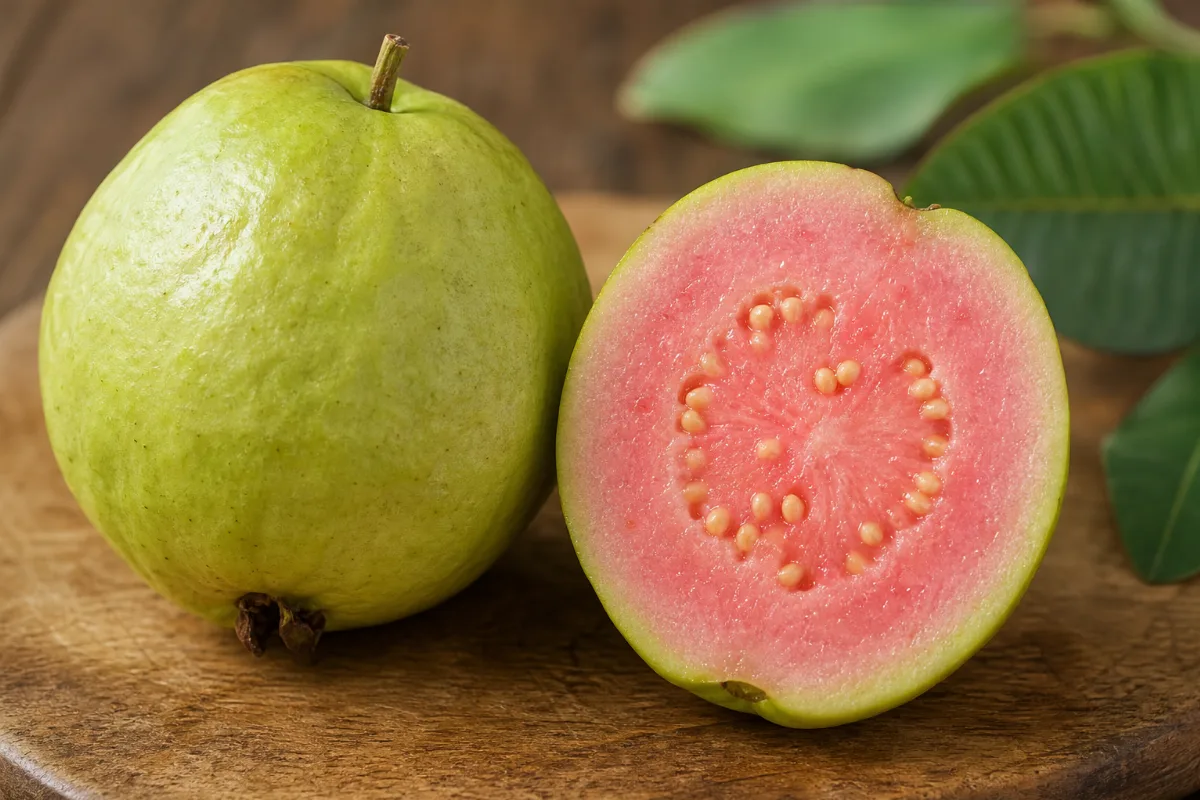
Guava is a tropical fruit with soft pink or white flesh, very rich in vitamin C and fibre. In trials in children, guava eaten with a meal raised hemoglobin, but its effect on blood pressure, cholesterol and blood sugar rests on old, small or extract-only studies. Allergy to guava is not well described in the sources we read, and the vitamin C warnings are about supplements, not the fruit.
General information, not medical advice. Last substantive update · Not medically reviewed. A named clinician has not signed off on this page. How this page is made
About Guava
Guava is a soft, fragrant tropical fruit that is very rich in vitamin C and fibre. It is a nutritious food, not a proven remedy: the best-supported finding is higher hemoglobin in children when guava was added to meals.
What it is
Guava is the fruit of Psidium guajava, a tree in the myrtle family (Myrtaceae). The flesh and small seeds are eaten fresh, as juice and in drinks.
USDA data for raw guava (carried from our earlier reading; the USDA service refused requests today): 68 kcal, 5.4 g fibre, 8.9 g sugars, 228 mg vitamin C and 417 mg potassium per 100 g. One cup (165 g) has about 112 kcal, 8.9 g fibre, 377 mg vitamin C and 688 mg potassium. USDA also lists lycopene and beta-carotene.
What the research shows
The firmest fact is that guava is a very rich vitamin C food, and vitamin C prevents scurvy. That is a nutrient fact, not a guava trial.
In three trials in children, guava added to meals raised hemoglobin. The biggest school trial did not show a clear rise in iron stores, and a juice trial called its effect marginal.
Blood pressure and cholesterol results come from two trials in the early 1990s using very large amounts of guava and a small student trial with mixed results. The blood sugar result is for a lab-made extract at a single sitting. The diarrhoea result is for leaves.
Fruit versus juice, extract and leaf
The iron and gum trials used fresh fruit or juice. The blood sugar trial used a lab-made extract and the diarrhoea trial used a leaf decoction. Results for one form do not carry over to another. The extract paper noted its effect seemed weaker after storage and freeze-thawing.
Amounts
This page gives no amounts to eat or drink. Ask a doctor or pharmacist what is right for you, especially if you take medicine or have kidney disease or diabetes.
At a glance
Traditional uses history, not proof
- Eaten fresh, as juice and in sweets in tropical regions
- Leaf decoction is used for diarrhoea in some places; the review we read says this use is global, and it is not the same as eating the fruit
Studied for research
- Vitamin C food (preventing scurvy), high certainty for the nutrient, no guava trial
- Iron status and anemia in children, low certainty (hemoglobin up, iron stores mixed)
- Gum inflammation, insufficient evidence (one small trial)
- Blood pressure and cholesterol, very low certainty (old trials, very large amounts)
- Blood sugar, insufficient evidence (a lab-made extract in healthy adults)
- Diarrhoea, insufficient evidence (leaf decoction, not fruit)
Main compounds
- Vitamin C (ascorbic acid)
- Fibre
- Lycopene and beta-carotene (measured by USDA; no health claim)
- Quercetin, rutin and gallic acid in the leaf
Common forms
- Fresh fruit, with or without peel
- Guava juice (used in a Mexican child trial)
- Lab-made fruit extract (used in a blood sugar trial; not the fruit)
- Leaf decoction (used in a diarrhoea trial; not the fruit)
Research links: NHS: Vitamin C · Rani et al. 2024: guava and anemia in Indian school children · Garrido et al. 2024: systematic review of guava and diarrhoea · Research Library · Genes & Biomarkers Library
What it is and its history
- Accepted scientific name
- Psidium guajava
- Naming authority
- L. (GBIF accepted; usageKey 5420380)
- Common names
- Guava (English); Guayaba (Spanish); Goiaba (Portuguese)
- Family or group
- Myrtaceae (the myrtle family).
- Classification
- Plantae > Tracheophyta > Magnoliopsida > Myrtales > Myrtaceae > Psidium > Psidium guajava
- Native range
- Not verified from a source read.
- Habitat
- Not verified from a source read.
- What it looks like
- Roots: Not verified.; Stems: Not verified.; Leaves: Not verified. Leaves are used in tea and decoction (studied separately from the fruit).; Flowers: Not verified.; Fruit: The fruit is the food. USDA lists one fruit without refuse as 55 g and 1 cup as 165 g (from our earlier reading of FDC 173044).
- Cultivation
- Not verified from a source read.
- Harvest and processing
- Eaten fresh, with or without peel; also as juice and in drinks, as in the trials. Leaf decoction and a CO2-extracted fruit extract were used in other trials.
- Look-alikes and adulterants
- Name: Other Psidium species (strawberry guava); Note: Not researched; this page is about common guava.
- Sustainability and conservation
- Not assessed.
Photographs
Traditional use and history history, not clinical proof
| Tradition or era | Documented use | Source |
|---|---|---|
| Leaf use for diarrhoea and blood sugar | The 2024 review says guava has been used globally for its antidiarrheal potential, and a 2016 trial paper says the sugar-lowering activity of guava leaves has been well documented. No dated historical sources were read. | p38578668 |
Traditional use shows how it was used. It does not show that it works or is safe today.
What is inside, and how it may work
What it contains and how those compounds act in cells and animals. Laboratory and animal mechanisms are not proven effects in people.
Main compounds
| Compound | Family | Where it is concentrated | Activity studied | Level of evidence |
|---|---|---|---|---|
| Ascorbic acid (vitamin C) PubChem 54670067 | vitamin | Fruit USDA: 228.3 mg per 100 g raw guava | Essential nutrient. The NHS says adults aged 19 to 64 need 40 mg a day. 22 17 18 | Human data |
| Lycopene PubChem 446925 | carotenoid | Fruit USDA: 5,204 micrograms per 100 g raw guava | A red pigment. No human trial of guava's lycopene was found; we make no health claim. 22 19 | None for this food |
| Beta-carotene | carotenoid | Fruit USDA: 374 micrograms per 100 g raw guava | Listed by USDA. No guava-specific study was read. PubChem id not looked up. 22 | None for this food |
| Quercetin (and rutin, gallic acid) PubChem 5280343 | flavonoid / phenolic | Leaf Not given | A 2025 review abstract links the leaf's sugar-lowering, antioxidant and anti-inflammatory properties to these compounds. Rutin and gallic acid ids were not looked up. 4 20 | Review claim |
Mechanisms, receptors and pathways
| Target or pathway | Gene or receptor | What was found | Level |
|---|---|---|---|
| Vitamin C and iron absorption | Not specified | The trial authors explain the rise in hemoglobin by guava's vitamin C helping iron absorption from plant meals. Absorption was not measured in the abstracts read. 8 9 7 | Human data |
| Intestinal glucose uptake (SGLT1 and GLUT2) | SGLT1, GLUT2 | The extract authors say their own lab and mouse work found the extract blocks glucose transport; in 31 people it lowered the rise after a glucose drink. 5 | Lab animal plus small human |
| Diarrhoea (antibacterial, anti-motility, anti-secretory) | Not specified | A 2024 review reports mostly preclinical mechanism findings for guava preparations (87% of 23 articles were preclinical). 3 | Lab animal |
Absorption, metabolism and elimination
- Absorption
- Not studied for guava.
- Distribution
- Not found.
- Metabolism
- Not found.
- Elimination
- Not found.
- Bioavailability
- Not established. The guava juice trial gave about 200 mg ascorbic acid and the preschool trial raised plasma vitamin C.
Isolated compounds versus whole extracts
The iron and gum trials used fresh fruit or juice. The blood-sugar extract trial used a lab-made CO2 extract and the diarrhoea trial used a leaf decoction. Results for one form do not carry over to another. The extract's effect appeared to weaken with storage and freeze-thawing.
Nutritional composition
Nutrition from USDA FoodData Central, Guavas, common, raw (FDC 173044, SR Legacy). These values were carried from our own reading on 2026-10-23 and were not re-fetched on 2026-10-25 because the USDA API refused requests. Per 100 g: 68 kcal, 5.4 g fibre, 8.9 g total sugars, 228 mg vitamin C, 417 mg potassium, 0.23 mg copper, 49 micrograms folate (DFE), 0.15 mg manganese, 0.11 mg vitamin B6, 5,204 micrograms lycopene, 374 micrograms beta-carotene. One cup (165 g), scaled from those values: about 112 kcal, 8.9 g fibre, 14.7 g sugars, 377 mg vitamin C and 688 mg potassium. USDA lists the portion 1 cup as 165 g and one fruit without refuse as 55 g. For comparison, the NHS counts 80 g of fresh fruit as one portion. Guava is mainly a vitamin C and fibre fruit. Values vary with variety and ripeness.
1 high certainty1 low certainty1 very low certainty6 not enough evidence
What was looked at
The 9 benefits and uses checked for Guava, each with how strong the evidence is. Tap one to open it.
- Vitamin C food (preventing scurvy)High certainty
- Iron status and anemia in children (guava eaten with an iron-containing meal)Low certainty
- Gum inflammation (experimental gingivitis)Not enough evidence
- Blood pressure and cholesterol (large daily amounts of guava)Very low certainty
- Blood sugar (fruit, and a lab-made fruit extract)Not enough evidence
- Diarrhoea (guava leaf decoction, not the fruit)Not enough evidence
- Respiratory infections in preschool childrenNot enough evidence
- Lycopene and beta-carotene in guavaNot enough evidence
- Guava leaf for diabetes (review)Not enough evidence
Lab markers tracked in the studies
HemoglobinSerum ferritin and body iron storesBlood pressureTotal cholesterol and triglyceridesFasting and post-meal blood glucoseGingival Index
What is Guava good for?
The main studied uses and how strong the human evidence is for each. Several results come from juice, a lab-made extract or the leaf, not the fruit.
Benefits, one by one
Each card is a research question, not a promise. Tap a goal to filter. Open a card to see the studies, doses and limits.
Vitamin C food (preventing scurvy)
High certaintyGuava is a very rich source of vitamin C. Too little vitamin C over a long time causes scurvy, which is rare. No trial has tested guava for scurvy, but it is one of many fruits that supply the vitamin.
3 studiesRaw fresh fruit. Cooking, juicing and storage were not compared in th…
Studies, doses and limits
What the trials found
USDA lists about 228 mg of vitamin C per 100 g of raw guava, and about 377 mg in one cup (165 g). The NHS says adults aged 19 to 64 need 40 mg a day, that fruit and vegetables are the main source, and that scurvy is caused by too little vitamin C over a long period and is rare.
Results
The link between vitamin C foods and scurvy is accepted. No trial of guava itself for scurvy was found.
Effect sizes as reported
USDA: 228.3 mg vitamin C per 100 g raw guava (value from our earlier reading, not re-fetched today).
Why this rating
High for the general point that a diet with vitamin C prevents scurvy (health-agency statement). There is no guava-specific trial, and an ordinary varied diet already supplies the vitamin.
Form and dose studied
Raw fresh fruit. Cooking, juicing and storage were not compared in the sources read.
Who was studied
People with very limited diets are at risk (NHS lists little fresh fruit and vegetables, smoking, heavy alcohol or drug use, and eating disorders).
Limits
Not a trial of guava. The USDA numbers were taken from our earlier reading, not re-fetched today.
Why researchers looked
Guava is best known as a vitamin C fruit, so people ask whether it helps cover the body's vitamin C needs.
Traditional use
Guava is eaten fresh, as juice and in sweets across the tropics; long use is not proof of any health effect.
Proposed mechanism Authoritative guidance
Vitamin C (ascorbic acid) is a nutrient the body cannot store, so it is needed from the diet each day (NHS).
A proposed mechanism does not show that the effect happens in people.
Anyone with bleeding gums, easy bruising, tiredness and joint pain should see a doctor rather than rely on food alone.
Iron status and anemia in children (guava eaten with an iron-containing meal)
Low certaintyIn three trials in India and Mexico, children who ate or drank guava with their meal had higher hemoglobin. Total iron stores did not clearly rise in the biggest trial. The effect is probably from the vitamin C helping iron absorption.
3 studiesFresh guava fruit with a meal (two trials) and guava juice (one trial…
Studies, doses and limits
What the trials found
A 7-month trial in 200 Indian school children found guava with a mungbean meal raised hemoglobin by 3.7 g/L more than the meal alone and cut anemia by 51%, but body iron stores did not clearly change. A 140-day cluster trial in 399 preschoolers found higher hemoglobin and ferritin and less iron deficiency with 25 g of guava than with banana or cucumber. A 10-week trial in 95 anaemic Mexican children found guava juice with about 200 mg vitamin C gave only a marginal rise in hemoglobin (0.64 g/dL) and no significant ferritin difference.
Results
Hemoglobin rose in all three trials. Iron stores rose in the preschool trial (ferritin) but not clearly in the school trial. The juice trial effect was called marginal.
Effect sizes as reported
Hb +3.7 g/L (school trial); anemia -51%; Hb +0.64 g/dL (juice trial); iron stores 0.65 mg/kg, P = 0.197 (not significant).
Why this rating
Three randomized trials, all in children in two countries, using different foods, amounts and outcomes. One was non-blinded, one analysed a small subsample, and none was in adults. Results for hemoglobin agree; results for iron stores do not.
Form and dose studied
Fresh guava fruit with a meal (two trials) and guava juice (one trial).
Who was studied
Children aged about 2 to 10 who were often iron deficient.
Limits
Children only, in places with iron-poor diets. Food trials; they do not show guava treats iron deficiency, and they do not apply to adults or to supplements.
Why researchers looked
Vitamin C helps the body absorb iron from plant foods, so researchers tried guava as an add-on to school and preschool meals.
Proposed mechanism Hypothesis in the trials
Vitamin C in guava is thought to help absorb iron from plant meals. This is the authors' explanation; the trials did not measure absorption directly.
A proposed mechanism does not show that the effect happens in people.
Anemia needs a clinician's diagnosis. Do not use guava in place of iron treatment a doctor has advised.
Gum inflammation (experimental gingivitis)
Not enough evidenceIn one small trial in young adults, eating 200 g of guava a day led to less gum inflammation than water during a period without tooth cleaning. Vitamin C tablets did similarly. It is one trial and the gingivitis was induced on purpose.
1 studiesFresh guava, 200 g a day in the trial.
Studies, doses and limits
What the trials found
Young non-smoking adults ate 200 g guava a day, took 200 mg vitamin C, or drank water for 14 days, then went through 14 days of experimental gingivitis. The Gingival Index rose by 0.10 with guava, 0.24 with vitamin C and 0.87 with water. Plaque rose less with guava than with water.
Results
Less gum inflammation than water with either guava or vitamin C.
Effect sizes as reported
Gingival Index rise 0.10 (guava), 0.24 (vitamin C), 0.87 (water).
Why this rating
One trial, young healthy adults, induced gum inflammation, short, group sizes not stated in the abstract.
Form and dose studied
Fresh guava, 200 g a day in the trial.
Who was studied
Young non-smoking adults.
Limits
Not a treatment for gum disease. Induced inflammation is not the same as natural gum disease.
Why researchers looked
Vitamin C is linked to gum health, so researchers tested guava as a food source.
Proposed mechanism Not stated
Guava was compared with a 200 mg synthetic vitamin C group; the authors do not separate guava's other components from vitamin C.
A proposed mechanism does not show that the effect happens in people.
See a dentist for bleeding gums.
Blood pressure and cholesterol (large daily amounts of guava)
Very low certaintyTwo 1990s trials in people with high blood pressure reported lower blood pressure and cholesterol after adding a lot of guava to the diet. A 2016 trial in healthy students was mixed and the peel made a difference. No modern confirmation was found.
3 studiesFresh guava, 0.5 to 1 kg or 400 g a day in the trials; with or withou…
Studies, doses and limits
What the trials found
In 120 adults with hypertension, 12 weeks of guava (single-blind) gave net falls of 9.0/8.0 mm Hg in blood pressure and 9.9% in total cholesterol versus the control group. In 145 adults, 0.5 to 1.0 kg of guava a day for 4 weeks gave net falls of 7.5/8.5 mm Hg. In 45 healthy students, 400 g a day for 6 weeks lowered blood pressure and BMI whether or not the peel was eaten, but with the peel fasting glucose, total cholesterol and triglycerides rose.
Results
Two old trials found falls; the newer small one found falls without peel and rises in glucose and lipids with peel.
Effect sizes as reported
BP -9.0/-8.0 mm Hg (12 weeks); -7.5/-8.5 mm Hg (4 weeks); peel group glucose and lipids rose.
Why this rating
Old single-blind trials by the same research group, with large diet changes and very large amounts, no later confirmation found, and a small mixed trial.
Form and dose studied
Fresh guava, 0.5 to 1 kg or 400 g a day in the trials; with or without peel.
Who was studied
Adults with essential hypertension (two trials) and healthy students (one).
Limits
Single-blind; very large amounts that few people eat; peel and diet confound results; trials are decades old.
Why researchers looked
Guava has fibre and potassium, which have been linked to blood pressure and cholesterol.
Proposed mechanism Authors hypothesis
The authors point to guava's soluble fibre and potassium (and a lower sodium to potassium ratio).
A proposed mechanism does not show that the effect happens in people.
Not a replacement for blood pressure or cholesterol treatment. Large amounts of any fruit add sugar and potassium.
Blood sugar (fruit, and a lab-made fruit extract)
Not enough evidenceA single-dose trial found a lab-made guava fruit extract lowered the rise in blood sugar after a glucose drink in 31 healthy adults. This is an extract, not the fruit, and the fruit trial in students was mixed. Nothing here shows guava helps people with diabetes.
2 studiesLab-made supercritical CO2 extract (not the fruit) in one trial; fres…
Studies, doses and limits
What the trials found
Thirty-one young healthy adults had a glucose drink with or without the extract. Glucose rose less with the extract at 30 minutes (1.96 vs 2.60 mmol/L, p = 0.039) and at 90 minutes (p = 0.023). Insulin did not differ significantly. In the student trial, eating guava with peel raised fasting glucose; the fall without peel was not significant.
Results
Extract: smaller rise after a glucose drink. Fruit: mixed and not significant without peel.
Effect sizes as reported
Peak rise 1.96 vs 2.60 mmol/L at 30 min (extract).
Why this rating
One sitting with an extract, one small mixed fruit trial, healthy people only.
Form and dose studied
Lab-made supercritical CO2 extract (not the fruit) in one trial; fresh fruit in the other.
Who was studied
Healthy young adults.
Limits
The extract's effect appeared to weaken with storage and freeze-thaw, per the authors. Neither trial involved people with diabetes.
Why researchers looked
A 2016 trial paper says guava leaves are well documented for sugar-lowering activity, but not the fruit, so researchers tested the fruit and an extract.
Proposed mechanism Lab and animal
In the extract trial, the authors suggest reduced glucose uptake in the gut, based on their own lab and mouse work.
A proposed mechanism does not show that the effect happens in people.
People with diabetes should not use guava or guava products in place of their treatment; ask the care team how fruit fits the diet.
Diarrhoea (guava leaf decoction, not the fruit)
Not enough evidenceA small open trial in adults found a guava leaf decoction ended acute diarrhoea sooner than oral rehydration alone. A 2024 review says most guava diarrhoea evidence is from animals and labs. This is about leaves, not the fruit.
2 studiesLeaf decoction (not fruit).
Studies, doses and limits
What the trials found
In 109 adults with acute infectious diarrhoea, a 14-leaf decoction (7.4 g leaf) three times a day restored normal stools in 72 hours versus 120 hours with oral rehydration alone. The 2024 systematic review found 23 articles, of which 20 were preclinical and 3 were clinical trials.
Results
Faster return to normal stools in one open trial.
Effect sizes as reported
72 h vs 120 h.
Why this rating
One open-label, retrospectively registered trial; a review that found only three clinical trials.
Form and dose studied
Leaf decoction (not fruit).
Who was studied
Adults aged 18 to 60 with acute diarrhoea.
Limits
Open label; leaf product; short; the results do not apply to fruit, and diarrhoea can be dangerous.
Why researchers looked
The 2024 review says guava has been used globally for its antidiarrheal potential.
Traditional use
Described in the review as global use; no historical source was read.
Proposed mechanism Lab and animal
The review lists antibacterial, anti-motility and anti-secretory findings, mostly from lab and animal work.
A proposed mechanism does not show that the effect happens in people.
Severe, bloody or lasting diarrhoea, or diarrhoea in children, needs medical care. Oral rehydration is the first-line approach in the trial.
Respiratory infections in preschool children
Not enough evidenceOne trial of guava with preschool meals found fewer acute respiratory infections than with banana or cucumber. This was not the main aim of the trial and has not been confirmed.
1 studies25 g fresh guava with a meal.
Studies, doses and limits
What the trials found
In the 399-child preschool trial, acute respiratory infection was less common in the guava group (P = 0.035). There was no effect on growth or thinking skills.
Results
Fewer respiratory infections with guava than with banana or cucumber.
Effect sizes as reported
P = 0.035 (no effect size in the abstract).
Why this rating
A secondary outcome in a non-blinded cluster trial; one region; not repeated.
Form and dose studied
25 g fresh guava with a meal.
Who was studied
Children aged 24 to 48 months.
Limits
Non-blinded; a secondary outcome.
Why researchers looked
Vitamin C is often linked to infections, so the trial recorded illness days.
Proposed mechanism Not stated
Not studied directly.
A proposed mechanism does not show that the effect happens in people.
Illness in a young child needs a clinician's advice.
Lycopene and beta-carotene in guava
Not enough evidenceUSDA measures lycopene and beta-carotene in raw guava, but we found no human trial that tested guava's lycopene or carotenoids for health. We make no health claim.
1 studiesWhole fruit.
Studies, doses and limits
What the trials found
No human trial of guava carotenoids was found. USDA lists lycopene at 5,204 micrograms and beta-carotene at 374 micrograms per 100 g.
Results
No evidence found.
Effect sizes as reported
Content only: 5,204 ug lycopene per 100 g.
Why this rating
Content in the food is not evidence of benefit.
Form and dose studied
Whole fruit.
Limits
No study.
Why researchers looked
Lycopene is a red plant pigment studied in other foods.
Proposed mechanism Not stated
No guava-specific mechanism study was read.
A proposed mechanism does not show that the effect happens in people.
None.
Guava leaf for diabetes (review)
Not enough evidenceA 2025 review of guava and jamun leaves describes sugar-lowering, antioxidant and anti-inflammatory properties. The abstract gives no numbers and the topic is the leaf, not the fruit.
1 studiesLeaf (not the fruit).
Studies, doses and limits
What the trials found
Only the abstract was read; it gives no trial results or counts.
Results
Not evaluated here.
Effect sizes as reported
Not given.
Why this rating
Abstract-only reading; claims not checked against the review's own sources.
Form and dose studied
Leaf (not the fruit).
Limits
Leaf results do not carry over to the fruit.
Why researchers looked
Guava leaf is studied as a natural remedy for blood sugar.
Traditional use
The review frames it as a natural remedy; no historical source read.
Proposed mechanism Review claim
The review links effects to quercetin, rutin and gallic acid in the leaf.
A proposed mechanism does not show that the effect happens in people.
People on diabetes medicine should not add leaf products without asking their care team.
Connections to the rest of health
How Guava connects to the rest of our health knowledge graph. Every link says what kind of connection it is. A safety link (for example to the liver) is a warning, not a benefit. A study that merely mentions a topic never creates a benefit link.
Explore every connection: goals, body systems, organs, symptoms, genes
B. Body systems
| Connected to | Kind of connection | Evidence status | Context | Studies |
|---|---|---|---|---|
| Immune System | Biological association | High certainty | Studied for: Vitamin C food (preventing scurvy) Studied for: Iron status and anemia in children (guava eaten with an iron-containing meal) | 22 17 16 8 9 7 |
| Integumentary System | Biological association | High certainty | Studied for: Vitamin C food (preventing scurvy) | 22 17 16 |
| Blood | Biological association | Low certainty | Studied for: Iron status and anemia in children (guava eaten with an iron-containing meal) | 8 9 7 |
| Digestive System | Biological association | Not enough evidence | Studied for: Gum inflammation (experimental gingivitis) Studied for: Diarrhoea (guava leaf decoction, not the fruit) | 1 2 3 |
| Cardiovascular System | Biological association | Very low certainty | Studied for: Blood pressure and cholesterol (large daily amounts of guava) | 10 11 6 |
| Endocrine System | Biological association | Not enough evidence | Studied for: Blood sugar (fruit, and a lab-made fruit extract) Studied for: Guava leaf for diabetes (review) | 5 6 4 |
E. Health conditions
| Connected to | Kind of connection | Evidence status | Context | Studies |
|---|---|---|---|---|
| Iron deficiency anemia | Biological association | Preliminary or mixed | Guava added to meals raised hemoglobin in child trials; iron stores did not clearly rise in one. Preparation or compound: Fresh guava with iron-containing meals |
8 9 |
| Scurvy | Biological association | Deficiency link | Guava is a very rich vitamin C food; scurvy comes from too little vitamin C. Preparation or compound: Raw guava as a vitamin C food |
16 22 |
I. Biomarkers
| Connected to | Kind of connection | Evidence status | Context | Studies |
|---|---|---|---|---|
| Hemoglobin | Biological association | Low certainty | Measured in trials: increase. A lab change is not the same as a health benefit. | 8 9 7 |
| Serum ferritin and body iron stores | Biological association | Low certainty | Measured in trials: mixed. A lab change is not the same as a health benefit. | 9 8 7 |
| Blood pressure | Biological association | Very low certainty | Measured in trials: decrease. A lab change is not the same as a health benefit. | 10 11 6 |
| Total cholesterol and triglycerides | Biological association | Very low certainty | Measured in trials: mixed. A lab change is not the same as a health benefit. | 10 11 6 |
| Fasting and post-meal blood glucose | Biological association | Not enough evidence | Measured in trials: mixed. A lab change is not the same as a health benefit. | 6 5 |
| Gingival Index | Biological association | Not enough evidence | Measured in trials: decrease. A lab change is not the same as a health benefit. | 1 |
K. Biological pathways
L. Active compounds
| Connected to | Kind of connection | Evidence status | Context | Studies |
|---|---|---|---|---|
| Ascorbic acid (vitamin C) | Biological association | Human | Essential nutrient. The NHS says adults aged 19 to 64 need 40 mg a day. Preparation or compound: Fruit |
22 17 18 |
| Lycopene | Biological association | None for this food | A red pigment. No human trial of guava's lycopene was found; we make no health claim. Preparation or compound: Fruit |
22 19 |
| Beta-carotene | Biological association | None for this food | Listed by USDA. No guava-specific study was read. PubChem id not looked up. Preparation or compound: Fruit |
22 |
| Quercetin (and rutin, gallic acid) | Biological association | Review claim | A 2025 review abstract links the leaf's sugar-lowering, antioxidant and anti-inflammatory properties to these compounds. Rutin and gallic acid ids were not looked up. Preparation or compound: Leaf |
4 20 |
Each connection is stored with the ingredient, the connected record, the kind of connection, the evidence status, the supporting studies, the preparation or compound involved, and a review date (last reviewed October 25, 2026).
The evidence
The research centre for Guava. Every record here was checked against PubMed or the publisher's page; we never list a study we have not verified.
Evidence by outcome
Bars show how many studies we found for each outcome, not how well it works. People are added up across trials only (reviews are not added, to avoid double counting).
How we rate evidence
High certainty
Several well-run trials or reviews agree; further research is unlikely to change the picture much.
Moderate certainty
Good trials point the same way, but some doubt remains.
Low certainty
Small, short or inconsistent trials. The finding could change with better research.
Very low certainty
Very little or very weak human data. Treat as a possibility only.
Mixed findings
Trials or reviews disagree with each other.
Not enough evidence
Not enough human research to say either way.
Evidence against
Good research found no benefit, or found harm.
We take the reviewers' own risk-of-bias and GRADE statements where they exist, and otherwise judge from study size, design, consistency, directness and whether a product matches what is sold. Many publications do not make evidence high. Method note: We started from our existing guava summary, re-read the trial abstracts on PubMed and the NHS and FDA pages, and checked taxonomy at GBIF. USDA nutrient values were carried from an earlier reading because the USDA service refused requests on the day of writing. Items we could not verify are flagged in the research gaps.
Study library: every study we checked 22
| Study | Design | People | Product, dose, length | Result |
|---|---|---|---|---|
| Amaliya 2018 Effect of guava and vitamin C supplementation on experimental gingivitis: A randomized clinical trial. J Clin Periodontol · PMID 29757462 · DOI |
Randomized controlled trial |
Young non-smoking adults; experimental gingivitis (a short period without tooth cleaning) | Guava 200 g a day, or synthetic vitamin C 200 mg a day Fruit (fresh) As used in the trial; not advice 14 days before plus 14 days of experimental gingivitis · vs Water |
Gingival Index rose less with guava (0.10) and vitamin C (0.24) than with water (0.87). Plaque rose less with guava than with water (1.30 vs 1.79). Fruit and vegetable intake was minimal in all groups during the study. Gingival Index rise 0.10 guava vs 0.87 water Methods, limits and fundingOutcomes: Plaque Index and Gingival Index Limitations: Group size not given in the abstract; induced (not natural) gum inflammation; short; young healthy adults. Funding and conflicts: Funding and conflicts not stated in the abstract. Read: abstract |
| Birdi 2020 A randomized open label efficacy clinical trial of oral guava leaf decoction in patients with acute infectious diarrhoea. J Ayurveda Integr Med · PMID 32507357 · DOI |
Randomized open label trial |
109 Adults aged 18 to 60 with acute infectious diarrhoea |
Guava leaf decoction (6, 10 or 14 leaves) three times a day Leaf (decoction), not the fruit As used in the trial; not advice 5 days · vs Oral rehydration solution |
The 14-leaf decoction (7.4 g) was the most effective: patients regained normal stools in 72 hours versus 120 hours with oral rehydration. Haemoglobin, liver and kidney tests were normal and no adverse events were reported. 72 h vs 120 h to normal stools Methods, limits and fundingOutcomes: Stool frequency and consistency Limitations: Open label (no blinding); retrospectively registered; leaf decoction, not fruit; small; one region. Funding and conflicts: Funding and conflicts not stated in the abstract. Registration: CTRI/2016/07/007095 Read: abstract |
| Garrido 2024 Antidiarrheal effect of Psidium guajava L. extract in acute diarrhea: a systematic review. J Sci Food Agric · PMID 38578668 · DOI |
Systematic review mixed (mostly animal and lab) |
23 articles up to 2021; 20 were preclinical studies and 3 were clinical trials | Guava preparations (galenic preparations or phytopharmaceuticals) Mostly leaf As used in the trial; not advice · vs Varied |
Most studies reported positive results, but 87% were preclinical. Only three articles (13%) were clinical trials. The authors say further studies are needed to define clinical significance and safety. 20 of 23 articles preclinical Methods, limits and fundingOutcomes: Antidiarrheal, antibacterial and antispasmodic effects Limitations: Searches only to 2021; mixed preparations; mostly lab and animal work. Funding and conflicts: Funding and conflicts not stated in the abstract. Read: abstract |
| Kaur 2025 A Comprehensive Review of the Effects of Psidium guajava and Syzygium cumini Leaves on Diabetes Mellitus. Prev Nutr Food Sci · PMID 40612758 · DOI |
Narrative review mixed |
Review of leaf studies | Guava (and jamun) leaf preparations Leaf As used in the trial; not advice · vs Varied |
The abstract says the leaves showed hypoglycemic, antioxidant and anti-inflammatory properties linked to quercetin, rutin and gallic acid. The abstract does not give study counts or human trial results. Not given Methods, limits and fundingOutcomes: Blood sugar, antioxidant and anti-inflammatory properties Limitations: Narrative review; the abstract gives no numbers or human trial results; leaf, not fruit. Funding and conflicts: Funding and conflicts not stated in the abstract. Read: abstract |
| Konig 2019 Guava (Psidium guajava) Fruit Extract Prepared by Supercritical CO2 Extraction Inhibits Intestinal Glucose Resorption in a Double-Blind, Randomized Clinical Study. Nutrients · PMID 31277259 · DOI |
Randomized controlled trial |
31 Young healthy adults |
Guava fruit extract (supercritical CO2 extraction) added to a glucose drink Fruit extract (lab-made, not the fruit) As used in the trial; not advice Single dose, 2 hours of sampling · vs Glucose drink without extract |
Rise in blood glucose was smaller with the extract at 30 minutes (1.96 vs 2.60 mmol/L, p = 0.039) and at 90 minutes (-0.18 vs 0.44 mmol/L, p = 0.023). Insulin did not differ significantly (p = 0.302). The authors note storage time and repeated freeze-thawing seemed to weaken the extract. Peak glucose rise 1.96 vs 2.60 mmol/L at 30 min Methods, limits and fundingOutcomes: Blood glucose and insulin after an oral glucose tolerance test Limitations: One sitting; lab-made extract, not the fruit; healthy volunteers; small. Funding and conflicts: Funding not stated in the abstract; not verified. Read: abstract |
| Kumari 2016 Effect of Guava in Blood Glucose and Lipid Profile in Healthy Human Subjects: A Randomized Controlled Study. J Clin Diagn Res · PMID 27790420 · DOI |
Randomized controlled trial |
45 Healthy medical students (15 per group) |
400 g ripe guava a day, with peel (group A) or without peel (group B) Fruit (fresh) As used in the trial; not advice 6 weeks · vs Control group with no guava (group C) |
With peel: BMI and blood pressure fell, but fasting glucose, total cholesterol and triglycerides rose significantly (p < 0.05). Without peel: BMI and blood pressure fell, the fall in fasting glucose was not significant, and total cholesterol, triglycerides and LDL fell significantly (p < 0.05). Peel and no-peel groups moved in opposite directions on glucose and lipids Methods, limits and fundingOutcomes: Fasting plasma glucose, lipids, BMI, blood pressure Limitations: Very small; healthy young students; the abstract's conclusion that guava without peel lowers blood sugar is stronger than its own result (glucose fall not significant). Funding and conflicts: Funding and conflicts not stated in the abstract. Read: abstract |
| Monarrez-Espino 2011 Randomized placebo-controlled trial of guava juice as a source of ascorbic acid to reduce iron deficiency in Tarahumara indigenous schoolchildren of northern Mexico. J Am Coll Nutr · PMID 21896877 · DOI |
Randomized controlled trial |
95 Anaemic boarding-school children aged 6 to 9 in northern Mexico; main outcomes in the 33 who were iron deficient at the start |
Natural guava juice (300 mL, about 200 mg ascorbic acid) with the main meal, 5 days a week Juice As used in the trial; not advice 10 weeks · vs Guava-flavoured juice without ascorbic acid |
Guava juice group had 0.64 g/dL higher hemoglobin (95% CI 0.18 to 1.11; p = 0.01) and 2.47 ng/mL higher ferritin (95% CI -1.04 to 5.98; p = 0.12, not significant). The authors call the effect marginal in children eating high-phytate diets. Hb +0.64 g/dL; ferritin difference not significant Methods, limits and fundingOutcomes: Hemoglobin and plasma ferritin Limitations: Main analysis in a small subsample (n = 33, 28 with final results); juice, not whole fruit; one region. Funding and conflicts: Funding and conflicts not stated in the abstract. Read: abstract |
| Rani 2024 Vitamin C-Rich Guava Consumed with Mungbean Dal Reduces Anemia and Increases Hemoglobin but not Iron Stores: A Randomized Controlled Trial of Food-to-Food Fortification in Indian Children. J Nutr · PMID 39481541 · DOI |
Randomized controlled trial |
200 School children aged 6 to 10 in rural Haryana, India (46% anemic, 71% iron-deficient) |
Fresh guava fruit served with a mungbean dal meal Fruit (fresh) As used in the trial; not advice 7 months · vs Mungbean dal meal without guava |
Body iron stores did not clearly change (mean treatment effect 0.65 mg/kg, P = 0.197). Hemoglobin rose more with guava (3.7 g/L, P = 0.001) and anemia fell more (-51%, P = 0.022). Iron-deficiency anemia fell -56% (P = 0.087, not significant). Effects were larger in children who were iron deficient at the start. Hemoglobin +3.7 g/L vs control; iron stores no clear change Methods, limits and fundingOutcomes: Body iron stores (primary); hemoglobin, anemia (secondary) Limitations: Children only; the guava meal gave about 170 mg vitamin C per meal (a large amount); school meals eaten under supervision, in India. Funding and conflicts: Funding and conflicts not stated in the abstract. Registration: NCT01191463 Read: abstract |
| Roy Choudhury 2021 Guava with an institutional supplementary meal improves iron status of preschoolers: a cluster-randomized controlled trial. Ann N Y Acad Sci · PMID 33385184 · DOI |
Cluster randomized controlled trial |
399 Children aged 24 to 48 months in 28 preschools in Telangana, India |
25 g guava added to a cereal and pulse-based preschool meal; control arms banana or cucumber Fruit (fresh) As used in the trial; not advice 140 days · vs Banana or cucumber with the same meal |
Hemoglobin (P = 0.002), serum ferritin (P < 0.001) and plasma vitamin C (P = 0.047) were higher, sTfR lower (P < 0.001) and iron deficiency less common (P = 0.003) in the guava group than in banana or cucumber groups. Acute respiratory infection was lower with guava (P = 0.035). No effect on cognitive development or growth. Higher hemoglobin and ferritin, less iron deficiency vs banana or cucumber Methods, limits and fundingOutcomes: Hemoglobin, serum ferritin, sTfR, iron deficiency, vitamin C, respiratory infection, cognition, growth Limitations: Non-blinded; cluster design (28 preschools); young children in one region of India; respiratory infection was a secondary outcome. Funding and conflicts: Funding and conflicts not stated in the abstract. Registration: CTRI/2014/09/004983 Read: abstract |
| Singh 1992 Effects of guava intake on serum total and high-density lipoprotein cholesterol levels and on systemic blood pressure. Am J Cardiol · PMID 1332463 · DOI |
Randomized single blind trial |
120 Adults with essential hypertension (61 in group A, 59 in group B) |
Guava fruit in addition to the usual diet Fruit (fresh) As used in the trial; not advice 12 weeks · vs Usual diet (group B) |
Net falls of 9.9% in total cholesterol, 7.7% in triglycerides and 9.0/8.0 mm Hg in blood pressure, and a net 8.0% rise in HDL cholesterol after 12 weeks in group A compared with group B. The authors report no adverse effects. BP -9.0/-8.0 mm Hg; total cholesterol -9.9% vs control Methods, limits and fundingOutcomes: Total cholesterol, triglycerides, HDL cholesterol, blood pressure Limitations: Single-blind; 1992; diet change (less saturated fat, more fibre) is part of the effect; no later confirmation found in our search. Funding and conflicts: Funding and conflicts not stated in the abstract. Read: abstract |
| Singh 1993 Can guava fruit intake decrease blood pressure and blood lipids? J Hum Hypertens · PMID 8383769 |
Randomized single blind trial |
145 Adults with essential hypertension (72 guava group, 73 usual diet) |
0.5 to 1.0 kg of guava a day as part of a soluble-fibre, potassium-rich diet Fruit (fresh) As used in the trial; not advice 4 weeks · vs Usual diet |
After 4 weeks, group A had a net fall of 7.5/8.5 mm Hg in systolic and diastolic blood pressure, total cholesterol fell 7.9% and triglycerides 7.0% compared with group B; HDL cholesterol rose by an insignificant 4.6%. BP -7.5/-8.5 mm Hg vs usual diet Methods, limits and fundingOutcomes: Blood pressure, lipids Limitations: Single-blind; 1993; 0.5 to 1.0 kg of fruit a day is a very large amount; the diet had many changes (fibre, potassium, sodium); no later confirmation found. Funding and conflicts: Funding and conflicts not stated in the abstract. Read: abstract |
| s-fda-produce FDA: Selecting and Serving Produce Safely · Source |
Regulator n/a |
Methods, limits and fundingRead: full-text | ||
| s-gbif-psidium-guajava GBIF Backbone: Psidium guajava L. (usageKey 5420380) · Source |
Reference database n/a |
Methods, limits and fundingRead: full-text | ||
| s-nhs-5aday NHS: 5 A Day - what counts? · Source |
Health agency n/a |
Methods, limits and fundingRead: full-text | ||
| s-nhs-potassium NHS: Vitamins and minerals - Others (potassium section) · Source |
Health agency n/a |
Methods, limits and fundingRead: full-text | ||
| s-nhs-scurvy NHS: Scurvy · Source |
Health agency n/a |
Methods, limits and fundingRead: full-text | ||
| s-nhs-vitc NHS: Vitamin C · Source |
Health agency n/a |
Methods, limits and fundingRead: full-text | ||
| s-pubchem-ascorbic-acid PubChem: L-Ascorbic acid (CID 54670067) · Source |
Reference database n/a |
Methods, limits and fundingRead: full-text | ||
| s-pubchem-lycopene PubChem: Lycopene (CID 446925) · Source |
Reference database n/a |
Methods, limits and fundingRead: full-text | ||
| s-pubchem-quercetin PubChem: Quercetin (CID 5280343) · Source |
Reference database n/a |
Methods, limits and fundingRead: full-text | ||
| s-pubmed-allergy-search PubMed search 2026-10-25: guava allergy OR anaphylaxis OR Psidium guajava allergen · Source |
Search record n/a |
Methods, limits and fundingRead: titles-only | ||
| s-usda-fdc-173044 USDA FoodData Central: Guavas, common, raw (FDC 173044, SR Legacy) · Source |
Reference database n/a |
Methods, limits and fundingRead: summary-only |
What we do not know yet
- No trial has tested guava for scurvy or in adults with iron deficiency.
- The blood pressure and cholesterol trials are from the early 1990s and were not confirmed in a later trial we found.
- Blood sugar findings are from healthy people and an extract at one sitting, not people with diabetes.
- Allergy, pregnancy, breastfeeding, seeds, oxalate and long-term leaf safety were not found in the sources read.
- Nutrient values come from our earlier USDA reading and were not re-fetched on the day of writing.
How new research is added
New studies are found by a saved PubMed search and placed in a review queue before the page changes.
Lab markers
What changed in blood or saliva tests during trials. A changed number is not the same as feeling or being healthier, and we give no "normal ranges".
Metabolic 2
Total cholesterol and triglycerides
Mixed results in trials
Blood fats linked to heart disease risk.
Very low certaintyResults and what it means
Why it was measured
Used to see whether guava changes blood fats.
Statistical vs. clinical meaning
The direction depended on the trial and on whether the peel was eaten.
Safety implication
None specific.
| Study | Result | People | Product |
|---|---|---|---|
| 10 | Total cholesterol fell 9.9% and triglycerides 7.7% net; HDL rose 8.0%. | 120 adults with hypertension | Guava, 12 weeks |
| 11 | Total cholesterol fell 7.9% and triglycerides 7.0% net. | 145 adults with hypertension | 0.5 to 1.0 kg guava a day, 4 weeks |
| 6 | With peel, total cholesterol and triglycerides rose; without peel they fell (both p < 0.05). | 45 healthy students | 400 g guava a day, 6 weeks |
Fasting and post-meal blood glucose
Mixed results in trials
Sugar in the blood, measured fasting or after a glucose drink.
Not enough evidenceResults and what it means
Why it was measured
A marker used for diabetes risk.
Statistical vs. clinical meaning
Opposite directions in the fruit and extract trials; healthy people only.
Safety implication
None specific.
| Study | Result | People | Product |
|---|---|---|---|
| 6 | Fasting glucose rose with guava eaten with peel (p < 0.05); the fall without peel was not significant. | 45 healthy students | 400 g guava a day, 6 weeks |
| 5 | Rise after a glucose drink was smaller with extract at 30 min (1.96 vs 2.60 mmol/L, p = 0.039) and 90 min (p = 0.023). | 31 healthy adults | Lab-made guava fruit extract, single dose |
Organ function 1
Hemoglobin
Increase in trials
The protein in red blood cells that carries oxygen. Low hemoglobin is how anemia is detected.
Low certaintyResults and what it means
Why it was measured
It is the standard blood test for anemia and was the secondary or main outcome in these trials.
Statistical vs. clinical meaning
Consistent in three child trials, but all in children and with different foods. A higher hemoglobin number is a lab marker; the trials did not show better health or school results.
Safety implication
None specific.
| Study | Result | People | Product |
|---|---|---|---|
| 8 | Rose 3.7 g/L more with guava than with the mungbean meal alone (95% CI 1.6 to 5.6; P = 0.001); anemia prevalence fell 51% more. | 200 school children, India | Fresh guava with mungbean dal, 7 months |
| 9 | Higher with guava than with banana or cucumber (P = 0.002). | 399 preschoolers, India | 25 g guava with a supplementary meal, 140 days |
| 7 | 0.64 g/dL higher with guava juice than with placebo juice (95% CI 0.18 to 1.11; p = 0.01). | Iron-deficient subsample (n = 33) of 95 anaemic Mexican children | 300 mL guava juice with about 200 mg ascorbic acid, 10 weeks |
Other 3
Serum ferritin and body iron stores
Mixed results in trials
Ferritin is a blood marker of how much iron the body has stored.
Low certaintyResults and what it means
Why it was measured
It shows whether iron stores, not just hemoglobin, improved.
Statistical vs. clinical meaning
One trial found a rise and two did not, so the effect on stored iron is unclear.
Safety implication
None specific.
| Study | Result | People | Product |
|---|---|---|---|
| 9 | Serum ferritin was higher with guava than with banana or cucumber (P < 0.001). | 399 preschoolers, India | 25 g guava with a supplementary meal, 140 days |
| 8 | Body iron stores did not clearly change (mean treatment effect 0.65 mg/kg; 95% CI -0.34 to 1.63; P = 0.197). | 200 school children, India | Fresh guava with mungbean dal, 7 months |
| 7 | 2.47 ng/mL higher ferritin with guava juice, not significant (95% CI -1.04 to 5.98; p = 0.12). | Iron-deficient subsample (n = 33), Mexico | Guava juice, 10 weeks |
Blood pressure
Decrease in trials
The force of blood against artery walls, measured as systolic over diastolic in mm Hg.
Very low certaintyResults and what it means
Why it was measured
High blood pressure raises heart and stroke risk; it was a main outcome in two trials.
Statistical vs. clinical meaning
Falls reported in all three, but the two bigger ones are old single-blind trials with very large amounts.
Safety implication
None specific.
| Study | Result | People | Product |
|---|---|---|---|
| 10 | Net fall of 9.0/8.0 mm Hg versus the control group. | 120 adults with hypertension | Guava fruit added to the usual diet, 12 weeks |
| 11 | Net fall of 7.5/8.5 mm Hg versus usual diet. | 145 adults with hypertension | 0.5 to 1.0 kg guava a day, 4 weeks |
| 6 | Blood pressure fell with and without peel (p < 0.05); no size given in the abstract. | 45 healthy students | 400 g guava a day, 6 weeks |
Gingival Index
Decrease in trials
A dentist's score of gum redness and bleeding.
Not enough evidenceResults and what it means
Why it was measured
It measures the gum inflammation outcome.
Statistical vs. clinical meaning
One small trial with induced gingivitis.
Safety implication
None specific.
| Study | Result | People | Product |
|---|---|---|---|
| 1 | Rose by 0.10 with guava, 0.24 with vitamin C and 0.87 with water. | Young non-smoking adults | 200 g guava a day, 14 days before and 14 days of experimental gingivitis |
Safety
What studies and official sources say about side effects, medicines and who should check first. Each point shows what kind of evidence it comes from.
Main points to know 4
- Allergy to guava is not well described. We did not find a source describing allergy to guava fruit. That is a gap, not proof of safety. Any food can cause an allergic reaction. Gap 21
- Vitamin C: a problem with supplements, not shown for the fruit. The NHS says more than 1,000 mg a day of vitamin C (supplements) can cause stomach pain, diarrhoea and wind, which go away when stopping. One cup of guava has about 377 mg (USDA). A 1992 trial using guava as an everyday food reported no adverse effects. Authoritative guidance 17 22 10
- Potassium and kidney problems. One cup has about 688 mg of potassium (USDA values scaled from 417 mg per 100 g). The NHS says older people may be at more risk from potassium because the kidneys may remove it less well. We found no guava-specific warning. Authoritative guidance 22 15
- Natural sugar. Guava has about 8.9 g of sugars per 100 g (USDA). Eating it with the peel raised fasting glucose in one small trial in healthy students. Controlled trial 22 6
Side effects 2
| Effect | How often | Severity and recovery | Evidence |
|---|---|---|---|
| Stomach pain, diarrhoea and wind from very large vitamin C amounts The NHS statement is about supplements. No source read described this from eating guava. | Not established | mild The NHS says symptoms should disappear once vitamin C supplements are stopped. | Authoritative guidance 17 |
| No adverse events reported in two guava trials The 1992 fruit trial reports no adverse effects; the leaf-decoction trial reports none and normal haemoglobin, liver and kidney tests. Both were small and short, and safety was not their main aim. | Not established | not applicable Not applicable | Controlled trial 10 2 |
Liver
No liver injury from eating guava was found in the sources read. In the leaf-decoction trial, liver and kidney tests stayed normal. LiverTox was not checked. 2
How often. No frequency found.
Monitoring. No agency monitoring advice found.
This is a safety connection. It is not evidence that Guava supports liver health.
Medicines and supplements 3
| With | Why it matters | Importance | Evidence | What to do |
|---|---|---|---|---|
| Medicines that raise potassium, and kidney disease prescription | Guava contains potassium (about 417 mg per 100 g, USDA). The NHS warns that older people may be at more risk from potassium because the kidneys may remove it less well. | The NHS statement is about potassium supplements; no guava-specific warning was found. | Authoritative guidance Low certainty 22 15 | If you have kidney disease or take medicine that raises potassium, ask a clinician or pharmacist how much fruit suits you. |
| Diabetes medicines prescription | Guava fruit contains natural sugar. A fruit extract lowered glucose after a glucose drink in healthy adults, and guava leaf is studied for blood sugar. | No interaction study with diabetes medicines was found. Leaf and extract effects might add to medicine effects, but this is not shown. | Theoretical Not enough evidence 5 4 | Do not use guava leaf or extracts in place of diabetes treatment; ask your care team. |
| Any medicine prescription | No guava-fruit medicine interaction was found in the sources read. | Absence of a report is not proof of safety. | Gap Not enough evidence | Ask a pharmacist if you take regular medicine and plan to eat large amounts or use leaf products. |
Who should check first 3
| Situation | Advice | Evidence |
|---|---|---|
| Kidney disease, or medicines that raise potassium | Ask a clinician about fruit portions; no guava-specific rule was found. | Authoritative guidance 15 22 |
| Diabetes | Guava has natural sugar. Ask your care team how it fits your diet; do not replace treatment with guava products. | Controlled trial 6 22 |
| Known allergy to guava | Avoid it and ask an allergist. For trouble breathing or swelling of the face, lips or throat call emergency services. | Gap 21 |
Overdose, product quality and regulators
Summary. No toxicity from guava as ordinary food was found in the sources read. Safety of leaf extracts over the long term was not found.
Animal. Not reviewed.
Human doses studied. Trials used 25 g with a meal, 200 g a day, 400 g a day and 0.5 to 1 kg a day of fruit, and 300 mL of juice; leaf decoction for 5 days.
High dose or long term signals. The leaf review said further studies are needed to define clinical significance and safety. One student trial saw fasting glucose, cholesterol and triglycerides rise with 400 g a day with peel.
Overdose response. Not found.
Genotoxicity. Not researched.
Toxic or hazardous parts. No toxic part was identified in the sources read.
Fresh produce can carry germs and dirt. Pesticide, heavy metal and fruit-fly or mould issues for guava were not researched.
Food safety handling. The FDA says to wash all produce under running water before eating, not to use soap, detergent or commercial produce wash, to cut away damaged areas and to throw away produce that looks rotten. 12
| Body | Action | Date |
|---|---|---|
| FDA (US Food and Drug Administration) (United States) | Produce safety guidance: wash, cut away damage, avoid soap or produce wash source | |
| NHS (UK) (United Kingdom) | Vitamin C page: adults 19 to 64 need 40 mg a day; over 1,000 mg a day (supplements) can cause stomach pain, diarrhoea and wind source | 2020-08-03 |
| NHS (UK) (United Kingdom) | Potassium section: older people may be at more risk of harm from potassium because kidneys may remove it less well source | 2020-08-03 |
| NHS (UK) (United Kingdom) | 5 A Day: 80 g of fresh, canned or frozen fruit is one portion; fruit juice or smoothie counts as one portion at most a day (150 ml) source | 2026-06-09 |
When to get medical help
- Trouble breathing, swelling of the lips, face or throat, or widespread hives after eating guava
- Diarrhoea that is bloody, severe, lasts several days, or happens in a young child or older person
- Signs of very low or very high blood sugar in someone with diabetes who has changed their diet or added guava products
- Muscle weakness or an irregular heartbeat in someone with kidney disease who has eaten a lot of potassium-rich food
Stop using the product and contact a clinician or emergency service. In the US, Poison Control is 1-800-222-1222.
General information only, not medical advice. Ask a clinician or pharmacist before use, especially with medicines, in pregnancy or with a health condition. See the Natural Remedy Safety guide.
Frequently asked questions
What is guava good for?
How much vitamin C is in guava?
Does guava help with anemia?
Does guava lower blood pressure?
Does guava lower cholesterol?
Does guava lower blood sugar?
Is guava leaf tea the same as eating guava?
Does guava help gums?
One small trial in young adults found less gum inflammation with 200 g of guava a day than with water during induced gingivitis. It is not a treatment for gum disease.
Can I be allergic to guava?
Any food can cause an allergy. We did not find a source describing guava allergy, which is a gap, not proof of safety. For trouble breathing or swelling of the face or throat, call emergency services.
Is guava high in potassium?
Is guava safe in pregnancy?
We did not find a guava-specific statement from an official body. Ask your doctor or midwife.
How should I wash guava?
The FDA says to wash all produce under running water before eating, not to use soap, detergent or produce wash, and to cut away damaged areas.
Explore by health goal
Editorial transparency
- Written by
- AlternativeMed editorial team. Research compiled with AI assistance, then checked against the sources listed.
- Medical review
- None. This page has not been reviewed by a physician or pharmacist.
- First published
- 2026-10-25
- Last substantive update
- 2026-10-25
- How we research
- We started from our existing guava summary, re-read the trial abstracts on PubMed and the NHS and FDA pages, and checked taxonomy at GBIF. USDA nutrient values were carried from an earlier reading because the USDA service refused requests on the day of writing. Items we could not verify are flagged in the research gaps.
- How we rate evidence
- See "How we rate evidence" in the Evidence tab.
- Independence
- No product is promoted on this page. No affiliate links are shown.
Sources 22
Each source was opened and checked. Where we read only the abstract, it says so. The small numbers in the text point here.
- Amaliya A, Risdiana AS, Van der Velden U.. Effect of guava and vitamin C supplementation on experimental gingivitis: A randomized clinical trial.. J Clin Periodontol. 2018. PMID 29757462. DOI 10.1111/jcpe.12922. (abstract)
- Birdi T, Krishnan GG, Kataria S, et al.. A randomized open label efficacy clinical trial of oral guava leaf decoction in patients with acute infectious diarrhoea.. J Ayurveda Integr Med. 2020. PMID 32507357. DOI 10.1016/j.jaim.2020.04.001. (abstract)
- Garrido G, Garrido-Suarez BB, Martinez-Tapia N, et al.. Antidiarrheal effect of Psidium guajava L. extract in acute diarrhea: a systematic review.. J Sci Food Agric. 2024. PMID 38578668. DOI 10.1002/jsfa.13515. (abstract)
- Kaur S, Chaudhary R.. A Comprehensive Review of the Effects of Psidium guajava and Syzygium cumini Leaves on Diabetes Mellitus.. Prev Nutr Food Sci. 2025. PMID 40612758. DOI 10.3746/pnf.2025.30.3.209. (abstract)
- Konig A, Schwarzinger B, Stadlbauer V, et al.. Guava (Psidium guajava) Fruit Extract Prepared by Supercritical CO2 Extraction Inhibits Intestinal Glucose Resorption in a Double-Blind, Randomized Clinical Study.. Nutrients. 2019. PMID 31277259. DOI 10.3390/nu11071512. (abstract)
- Kumari S, Rakavi R, Mangaraj M.. Effect of Guava in Blood Glucose and Lipid Profile in Healthy Human Subjects: A Randomized Controlled Study.. J Clin Diagn Res. 2016. PMID 27790420. DOI 10.7860/JCDR/2016/21291.8425. (abstract)
- Monarrez-Espino J, Lopez-Alarcon M, Greiner T.. Randomized placebo-controlled trial of guava juice as a source of ascorbic acid to reduce iron deficiency in Tarahumara indigenous schoolchildren of northern Mexico.. J Am Coll Nutr. 2011. PMID 21896877. DOI 10.1080/07315724.2011.10719960. (abstract)
- Rani V, Moretti D, Khetarpaul N, et al.. Vitamin C-Rich Guava Consumed with Mungbean Dal Reduces Anemia and Increases Hemoglobin but not Iron Stores: A Randomized Controlled Trial of Food-to-Food Fortification in Indian Children.. J Nutr. 2024. PMID 39481541. DOI 10.1016/j.tjnut.2024.10.042. (abstract)
- Roy Choudhury D, Nair Krishnapillai M, Nagalla B, et al.. Guava with an institutional supplementary meal improves iron status of preschoolers: a cluster-randomized controlled trial.. Ann N Y Acad Sci. 2021. PMID 33385184. DOI 10.1111/nyas.14556. (abstract)
- Singh RB, Rastogi SS, Singh R, et al.. Effects of guava intake on serum total and high-density lipoprotein cholesterol levels and on systemic blood pressure.. Am J Cardiol. 1992. PMID 1332463. DOI 10.1016/0002-9149(92)90763-o. (abstract)
- Singh RB, Rastogi SS, Singh NK, et al.. Can guava fruit intake decrease blood pressure and blood lipids?. J Hum Hypertens. 1993. PMID 8383769. (abstract)
- . FDA: Selecting and Serving Produce Safely. . . (full-text)
- . GBIF Backbone: Psidium guajava L. (usageKey 5420380). . . (full-text)
- . NHS: 5 A Day - what counts?. . . (full-text)
- . NHS: Vitamins and minerals - Others (potassium section). . . (full-text)
- . NHS: Scurvy. . . (full-text)
- . NHS: Vitamin C. . . (full-text)
- . PubChem: L-Ascorbic acid (CID 54670067). . . (full-text)
- . PubChem: Lycopene (CID 446925). . . (full-text)
- . PubChem: Quercetin (CID 5280343). . . (full-text)
- . PubMed search 2026-10-25: guava allergy OR anaphylaxis OR Psidium guajava allergen. . . (titles-only)
- . USDA FoodData Central: Guavas, common, raw (FDC 173044, SR Legacy). . . (summary-only)


