Fruits · Fruit
Oranges
Citrus x sinensis · also called Orange, sweet orange, naranja (Spanish)
The orange is a juicy citrus fruit. One medium orange has about 62 calories, 3 g of fibre and about 70 mg of vitamin C. Large studies link citrus and other fruit with lower heart disease, but that is an association, and orange juice trials show only tiny changes in blood pressure. The main cautions are medicines (Seville oranges, and orange juice with some drugs), potassium for people with kidney disease, and food allergy.
General information, not medical advice. Last substantive update · Not medically reviewed. A named clinician has not signed off on this page. How this page is made
About Oranges
The orange is an everyday vitamin C fruit. Apart from vitamin C, research on eating oranges is mostly observational or based on juice and supplements, so it is best seen as a nutritious food rather than a proven remedy.
What it is
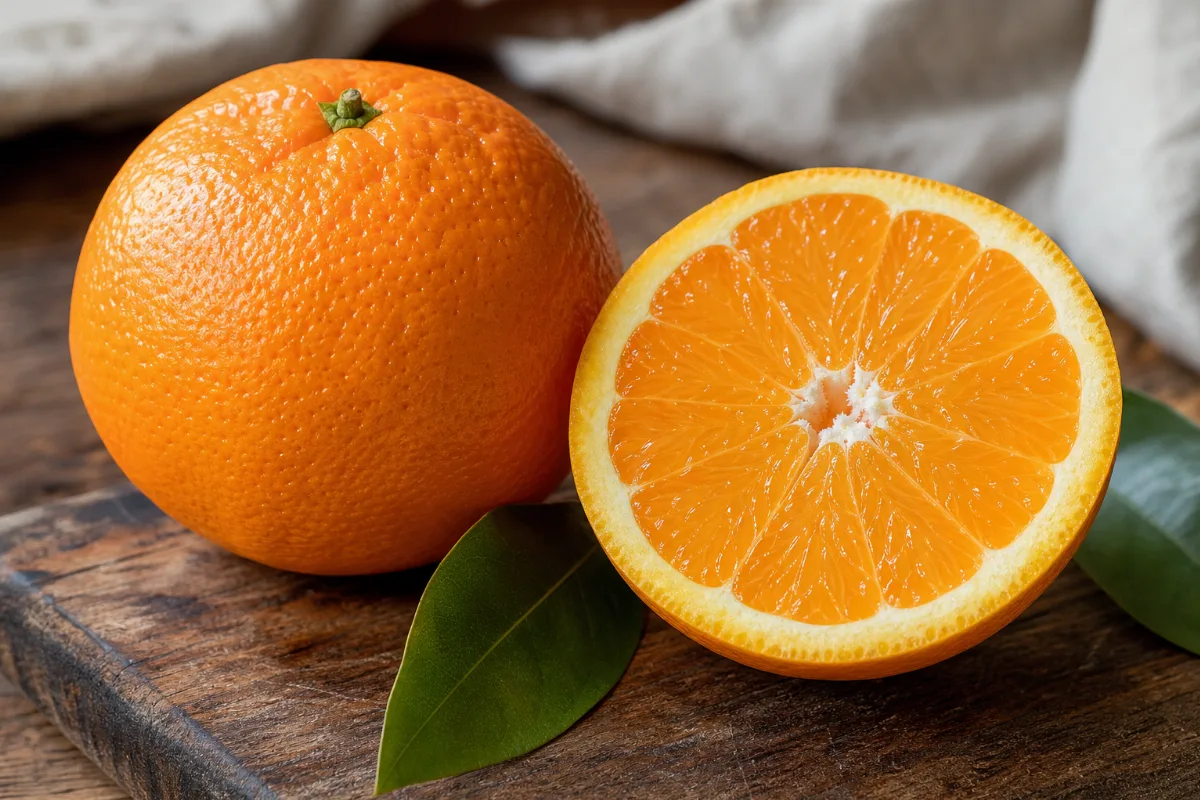
The orange (Citrus x sinensis, also called the sweet orange) is a juicy citrus fruit in the Rutaceae family, which also includes lemons, limes, grapefruit and mandarins. The flesh is eaten fresh or made into juice.
One medium raw orange (131 g) provides about 62 calories, 3.1 g of fibre, 12.2 g of natural sugars and about 70 mg of vitamin C, plus about 237 mg of potassium (USDA). The NHS says adults aged 19 to 64 need 40 mg of vitamin C a day.
What the research shows
Large studies that followed people over time link higher fruit and vegetable intake, including citrus fruit, with lower rates of heart disease and early death. People who eat more fruit may differ in other ways, so this is not proof.
A pooled analysis of 8 orange juice trials found systolic blood pressure about 1 mmHg lower and HDL slightly higher. LDL, total cholesterol, glucose, insulin and CRP did not change. Whole oranges were not tested in those trials.
Hesperidin supplement trials show small changes in some blood markers, and vitamin C tablet trials show shorter colds, but neither tells us what eating an orange does. Claims about cancer, memory or skin were not found in any source read.
Whole orange versus juice, supplements and extracts
Most orange trials used juice, which has less fibre than the fruit. In the diabetes studies, 100% fruit juice showed no benefit, unlike whole fruit, and juice that was not 100% was linked with higher risk.
Hesperidin trials used extracts or purified compound, and the cold trials used vitamin C tablets. The NHS says supplements above 1,000 mg of vitamin C a day can cause stomach pain and diarrhoea. Those are different products from the fruit and are not assessed on this page.
At a glance
Traditional uses history, not proof
- Eaten fresh, as juice, or as canned or frozen segments
- The idea that oranges help colds is popular, but no trial of oranges was found
Studied for research
- Vitamin C intake and preventing scurvy, high certainty (an established nutrition fact)
- Heart disease and early death in diets rich in citrus fruit, low certainty
- Blood pressure and HDL cholesterol in orange juice trials, low certainty
- Blood sugar and insulin after a raw orange or juice, very low certainty
- Hesperidin supplements and heart-risk markers (not oranges), low certainty
Main compounds
- Vitamin C (about 70 mg in a medium orange)
- Dietary fibre (about 3.1 g in a medium orange)
- Potassium (about 237 mg in a medium orange)
- Hesperidin, a citrus plant compound
Common forms
- Raw orange (the form the nutrition figures describe)
- Orange juice, 100% or sweetened
- Canned or frozen segments
- Seville oranges and marmalade (a different fruit)
- Hesperidin supplements (not the same as the fruit)
Research links: NHS: Vitamin C · FDA: Grapefruit juice and some drugs · Orange juice and heart-risk markers, meta-analysis (Food & Function, 2022) · USDA FoodData Central: raw orange · Research Library · Genes & Biomarkers Library
What it is and its history
- Accepted scientific name
- Citrus x sinensis (sweet orange)
- Naming authority
- Citrus sinensis (Mill.) Pers., 1806, per GBIF (listed there as a synonym; GBIF match 2026-10-25, usageKey 3190158)
- Synonyms
- Citrus sinensis (the name USDA uses); GBIF treats Citrus sinensis (Mill.) Pers. as a synonym of Citrus x aurantium L. (accepted key 8077391). This page keeps the common name 'sweet orange' for the fruit.
- Common names
- Orange (English); Sweet orange (English); Naranja (Spanish)
- Family or group
- Rutaceae (the citrus family), which also includes lemons, limes, grapefruit and mandarins (GBIF gives the family and genus).
- Classification
- Plantae > Tracheophyta > Magnoliopsida > Sapindales > Rutaceae > Citrus > Citrus x sinensis
- Native range
- Not verified from a source read.
- Habitat
- Not verified.
- What it looks like
- Roots: Not verified.; Stems: Not verified.; Leaves: Not verified.; Flowers: Not verified.; Fruit: A round citrus fruit with a peel; the juicy segments are eaten (existing site summary; not re-sourced).
- Cultivation
- Not verified from a source read.
- Harvest and processing
- Eaten fresh, as juice, as canned or frozen segments, or as dried peel (existing site summary; juice and canned forms differ in fibre and added sugar).
- Look-alikes and adulterants
- Name: Seville (bitter) orange, Citrus x aurantium; Note: Often used for marmalade. The FDA says Seville oranges might act like grapefruit juice on some medicines. Evidence for sweet oranges is not evidence for Seville oranges, and the herb bitter orange is a different product.; Name: Grapefruit and pomelo; Note: The citrus fruits with the well-known medicine interactions. Sweet oranges are not named in the FDA grapefruit warning.; Name: Mandarins and tangerines; Note: Related citrus fruits. The National Kidney Foundation lists mandarin oranges and tangerine in its lower-potassium list and orange in its higher-potassium list.
- Sustainability and conservation
- Not assessed.
Photographs
Traditional use and history history, not clinical proof
| Tradition or era | Documented use | Source |
|---|---|---|
| Everyday fruit | No source read documents the history of the orange. It is eaten worldwide as a fruit and drink and is a standard example of a vitamin C food in NHS guidance. | NOT verified for history (no source read); vitamin C food status from the NHS Vitamin C page (s-nhs-vitamin-c) |
Traditional use shows how it was used. It does not show that it works or is safe today.
What is inside, and how it may work
What it contains and how those compounds act in cells and animals. Laboratory and animal mechanisms are not proven effects in people.
Main compounds
| Compound | Family | Where it is concentrated | Activity studied | Level of evidence |
|---|---|---|---|---|
| Vitamin C (ascorbic acid) | vitamin | Flesh and juice 53.2 mg per 100 g; about 70 mg in a medium orange (USDA) | An essential nutrient. Lack of it causes scurvy (NHS). 18 16 | Composition data and official guidance |
| Dietary fibre | carbohydrate | Flesh (much less in juice) 2.4 g per 100 g; about 3.1 g in a medium orange (USDA) | Provides fibre in the diet. Not tested here as a treatment. 18 | Composition data |
| Potassium | mineral | Flesh and juice 181 mg per 100 g; about 237 mg in a medium orange (USDA) | A nutrient the body needs; matters for people on a potassium limit. 18 17 | Composition data and patient guidance |
| Hesperidin | flavanone (plant compound) | Citrus fruit (amount in oranges not given in the sources read) | Studied as an extract or purified compound for heart-risk markers; small changes in some markers. 6 10 | Human trials of supplements (marker level) |
| Beta-cryptoxanthin and beta-carotene | carotenoids | Flesh 116 mcg and 71 mcg per 100 g (USDA) | Listed in the nutrient record. Not tested here. 18 | Composition data |
Mechanisms, receptors and pathways
| Target or pathway | Gene or receptor | What was found | Level |
|---|---|---|---|
| Effects of hesperidin on cholesterol, glucose and inflammation markers | Small changes in markers were seen in trials of hesperidin supplements. The abstracts do not explain the route, and these are not trials of oranges. 6 10 | Human trials of supplements (marker level) |
Absorption, metabolism and elimination
- Absorption
- Orange juice has been reported to lower absorption of some medicines (review of trials; no figures in the abstract).
- Distribution
- Not found.
- Metabolism
- Not found.
- Elimination
- Not found.
- Bioavailability
- Not established.
Isolated compounds versus whole extracts
The blood pressure and cholesterol trials used orange juice, so they do not show what a whole orange does; juice has less fibre. The hesperidin trials used extracts or purified compound. The vitamin C and cold trials used tablets. The large studies of eating habits group oranges with other citrus fruit. In the diabetes studies, 100% fruit juice showed no benefit unlike whole fruit, and juice that was not 100% was linked with higher risk.
Nutritional composition
Per 100 g of raw orange, all commercial varieties (USDA FoodData Central, SR Legacy, record 169097): 47 kcal, 86.8 g water, 0.94 g protein, 0.12 g fat, 11.8 g carbohydrate of which 9.35 g are sugars, and 2.4 g fibre. One medium orange (131 g, USDA household portion 'fruit, 2-5/8 inch diameter') provides about 62 kcal, 3.1 g fibre, 12.2 g sugars and about 70 mg of vitamin C, plus 237 mg potassium, 52 mg calcium and 39 mcg folate (DFE). A medium orange has more vitamin C than the 40 mg a day the NHS gives for adults aged 19 to 64. It is a good source of vitamin C and a small source of most other nutrients. Per-portion figures are calculated from the per-100 g values. Values vary with variety, ripeness and storage; juice and canned fruit differ.
1 high certainty4 low certainty2 very low certainty1 not enough evidence
What was looked at
The 8 benefits and uses checked for Oranges, each with how strong the evidence is. Tap one to open it.
- Vitamin C intake and preventing scurvyHigh certainty
- Heart disease and early death (diets rich in citrus fruit)Low certainty
- Blood pressure and HDL cholesterol (orange juice trials)Low certainty
- Blood sugar and insulin after eating a raw orange or drinking juiceVery low certainty
- Type 2 diabetes risk and fruit juice (not specific to oranges)Low certainty
- Heart-risk and inflammation markers with hesperidin supplements (extracts, not oranges)Low certainty
- Colds (vitamin C supplement trials, not oranges)Not enough evidence
- Kidney stones and citrus juice (mixed)Very low certainty
Lab markers tracked in the studies
Systolic blood pressureHDL cholesterolLDL cholesterolBlood glucoseC-reactive protein (CRP)Insulin
What is Oranges good for?
The main studied uses and how strong the human evidence is for each. Apart from vitamin C, most results are links seen in eating habits or small changes in lab markers, and several come from juice or supplements rather than whole oranges.
Benefits, one by one
Each card is a research question, not a promise. Tap a goal to filter. Open a card to see the studies, doses and limits.
Vitamin C intake and preventing scurvy
High certaintyOranges are a good food source of vitamin C. A lack of vitamin C leads to scurvy, so a diet with enough vitamin C from foods such as oranges prevents it. This is an established fact about the nutrient, not a result from trials of oranges.
2 studiesRaw orange is the form the USDA figures describe. Juice and canned se…
Studies, doses and limits
What the trials found
The NHS lists citrus fruit such as oranges and orange juice among good sources of vitamin C and says lack of vitamin C can lead to scurvy. USDA lists 53.2 mg of vitamin C in 100 g of raw orange, about 70 mg in one medium fruit (131 g). The NHS says adults aged 19 to 64 need 40 mg a day.
Results
Oranges supply vitamin C. Scurvy is the deficiency disease. No trial of oranges against scurvy was read.
Why this rating
This is a long-established nutrition fact stated by the NHS. It rests on the role of the nutrient, not on a trial of oranges, and it matters mainly when intake is too low.
Form and dose studied
Raw orange is the form the USDA figures describe. Juice and canned segments differ.
Who was studied
People whose diet is low in vitamin C.
Limits
Eating more vitamin C than you need is not shown to bring extra benefit. NHS page last reviewed August 2020.
Why researchers looked
Oranges are one of the best-known vitamin C foods.
Proposed mechanism Authoritative guidance
The NHS says vitamin C helps protect cells, keeps skin, blood vessels, bones and cartilage healthy and helps wound healing.
A proposed mechanism does not show that the effect happens in people.
See the Safety tab for vitamin C supplements at high amounts.
Heart disease and early death (diets rich in citrus fruit)
Low certaintyIn large groups of people followed over time, those who ate more fruit and vegetables had lower rates of heart disease and early death, and the same pattern was seen for citrus fruit. This is a link seen across diets, not proof that oranges protect the heart.
1 studiesEating citrus fruit as part of the diet.
Studies, doses and limits
What the trials found
A 2017 review of 95 prospective studies found that fruit and vegetables combined went with lower cardiovascular disease and early death, and reported inverse associations for the intake of citrus fruits with cardiovascular disease and all-cause mortality.
Results
Lower risk in people who ate more citrus fruit. Citrus fruits were grouped together, so oranges alone are not isolated.
Effect sizes as reported
Fruit and vegetables combined, per 200 g a day: cardiovascular disease RR 0.92 (0.90-0.95), all-cause mortality RR 0.90 (0.87-0.93). No citrus-only figure is given in the abstract.
Why this rating
Observational data only. People who eat more fruit may differ in other ways. Citrus fruits are grouped together and the numbers in the abstract are for all fruit and vegetables combined.
Form and dose studied
Eating citrus fruit as part of the diet.
Who was studied
Adults in cohort studies.
Limits
Association, not cause. No orange-only effect size in the source read.
Why researchers looked
Oranges are among the most widely eaten fruits, and fruit-rich diets have long been linked with better heart health.
Proposed mechanism Preliminary mechanism
Possible routes include fibre, potassium, vitamin C and plant compounds such as flavanones. These ideas are unproven for oranges in people.
A proposed mechanism does not show that the effect happens in people.
None specific to this finding.
Blood pressure and HDL cholesterol (orange juice trials)
Low certaintyIn eight trials of adults with overweight or obesity, drinking orange juice for a while lowered the top blood pressure number by about 1 mmHg and raised HDL ("good") cholesterol a little. Total cholesterol, LDL, blood fats, glucose, insulin and CRP did not change. These were juice trials, not trials of whole oranges.
1 studiesOrange juice. The result does not show what eating whole oranges does…
Studies, doses and limits
What the trials found
A 2022 systematic review and meta-analysis pooled 8 randomised controlled trials of chronic orange juice drinking in adults with overweight or obesity.
Results
Small beneficial changes in systolic blood pressure and HDL cholesterol. No change in the other markers.
Effect sizes as reported
Systolic blood pressure -0.98 mmHg (95% CI -1.52 to -0.44); HDL cholesterol standardised mean difference 0.29 (95% CI 0.03 to 0.54).
Why this rating
Only eight small trials, marker outcomes only, tiny changes, in people with overweight or obesity. The authors did not give a GRADE rating in the abstract.
Form and dose studied
Orange juice. The result does not show what eating whole oranges does, and juice has less fibre.
Who was studied
Adults with overweight or obesity in randomised trials.
Limits
Markers, not heart attacks or strokes. Juice only. Funding of the trials was not stated in the abstract.
Why researchers looked
Orange juice contains vitamin C, potassium and flavanones that might affect heart-risk markers.
Proposed mechanism Unknown
Not tested in this analysis.
A proposed mechanism does not show that the effect happens in people.
Juice adds sugar to the diet; see the diabetes and juice item.
Blood sugar and insulin after eating a raw orange or drinking juice
Very low certaintyIn a small crossover study of 20 young women without diabetes, eating two raw oranges, drinking 100% fresh orange juice or drinking sweetened orange juice did not significantly change blood glucose over two hours. Insulin was lower at 120 minutes than at the start after all three drinks and foods.
1 studiesRaw orange compared with 100% juice and sweetened juice.
Studies, doses and limits
What the trials found
A 2019 randomised three-way crossover study in 13 normal-weight and 7 obese university women compared 2 raw oranges, 100% fresh orange juice and nectar-sweetened orange juice, with blood taken at 0, 30, 60, 90 and 120 minutes.
Results
No significant effect on plasma glucose with any of the three. Plasma insulin at 120 minutes was lower than at the start for all three. The abstract does not say whether the three differed from one another.
Effect sizes as reported
Insulin change at 120 min vs 0 min: raw orange -14 (95% CI -27.05 to -0.90); fresh juice -13.7 (-28.80 to 1.44); sweetened juice -9.2 (-28.75 to 10.30). Units not given in the abstract.
Why this rating
Twenty people, one session each, a single two-hour window and young women without diabetes. The abstract gives no comparison between the three drinks and foods.
Form and dose studied
Raw orange compared with 100% juice and sweetened juice.
Who was studied
Non-diabetic young women, normal weight and obese.
Limits
Healthy volunteers only, so it says nothing about people with diabetes. Very short term.
Why researchers looked
Oranges and juice contain natural sugars, so people ask how they affect blood sugar.
Proposed mechanism Unknown
Not established.
A proposed mechanism does not show that the effect happens in people.
People with diabetes should ask their care team how fruit and juice fit their own plan.
Type 2 diabetes risk and fruit juice (not specific to oranges)
Low certaintyIn 14 long-term studies, drinking fruit juice overall was not clearly linked with type 2 diabetes. Juice that was not 100% fruit juice was linked with a higher risk. 100% juice showed no significant link, and the authors say, unlike whole fruit, it had no beneficial effect. The studies do not single out orange juice.
1 studiesFruit juice, 100% and not 100%. Whole oranges were not the subject.
Studies, doses and limits
What the trials found
A 2025 systematic review and meta-analysis of 14 prospective cohort studies of fruit juice and type 2 diabetes.
Results
No significant link overall; a higher risk with non-100% fruit juice; no significant link with 100% fruit juice. A higher risk was seen only in Asian populations.
Effect sizes as reported
All fruit juice: RR 1.06 (95% CI 0.98-1.15). Non-100% fruit juice: RR 1.15 (1.03-1.28). Asian populations: RR 1.17 (1.02-1.34). No figure for 100% juice in the abstract.
Why this rating
Observational studies of many kinds of juice. People who drink different juices may differ in other ways. Orange juice is not separated out.
Form and dose studied
Fruit juice, 100% and not 100%. Whole oranges were not the subject.
Who was studied
Adults in cohort studies.
Limits
Association, not cause. Not orange-specific.
Why researchers looked
Fruit juice has the sugars of fruit without most of the fibre.
Proposed mechanism Unknown
Not established in the abstract.
A proposed mechanism does not show that the effect happens in people.
People with diabetes should ask their care team about juice.
Heart-risk and inflammation markers with hesperidin supplements (extracts, not oranges)
Low certaintyHesperidin is a plant compound found in citrus fruit. In trials of hesperidin extracts or purified hesperidin, LDL and total cholesterol, fasting glucose and CRP (a marker of inflammation) fell by small amounts. These were supplements. They do not show what eating an orange does.
2 studiesHesperidin extracts and purified hesperidin; the 2026 review also inc…
Studies, doses and limits
What the trials found
A 2024 meta-analysis pooled 12 trials with 589 participants of hesperidin extracts or purified hesperidin. A 2026 meta-analysis pooled 16 trials with 845 overweight or obese participants of hesperidin and hesperidin-containing citrus interventions, looking at inflammation and oxidative stress.
Results
2024: lower LDL cholesterol, total cholesterol, fasting glucose, CRP and two blood-vessel markers, no effect on other risk factors. 2026: CRP fell modestly (the authors' GRADE: moderate); TNF-alpha and VCAM-1 fell (GRADE: very low); no significant effect on IL-6, total antioxidant capacity or ICAM-1.
Effect sizes as reported
2024: LDL -0.22 mmol/L (95% CI -0.33 to -0.11); total cholesterol -0.20 mmol/L (-0.31 to -0.08); fasting glucose -0.15 mg/dL (-0.29 to -0.02); CRP -0.56 mg/L (-1.11 to -0.01). 2026: CRP/hsCRP -0.43 mg/L (-0.68 to -0.17).
Why this rating
Small changes in markers from supplements, mixed products and designs, with the 2026 authors rating most markers very low and CRP moderate. The trials used extracts, not oranges, and the 2026 authors say they cannot give dose or product advice.
Form and dose studied
Hesperidin extracts and purified hesperidin; the 2026 review also included some hesperidin-containing citrus interventions without separating them in the abstract.
Who was studied
Adults in randomised trials, including people with overweight or obesity.
Limits
Markers only. Supplements are not the fruit. Funding of the included trials was not stated in the abstracts.
Why researchers looked
Hesperidin is a flavanone found in oranges and other citrus fruit.
Proposed mechanism Preliminary mechanism
Not tested in these analyses.
A proposed mechanism does not show that the effect happens in people.
Concentrated supplements were not assessed for safety here. Ask a doctor or pharmacist before using them.
Colds (vitamin C supplement trials, not oranges)
Not enough evidenceOranges are a vitamin C food, so people ask about colds. The large Cochrane review tested vitamin C tablets of at least 0.2 g a day, not oranges. Regular supplements did not cut how many colds ordinary people caught, but colds were a little shorter. No trial of oranges for colds was read.
1 studiesVitamin C supplements of 0.2 g a day or more. Not a food.
Studies, doses and limits
What the trials found
A Cochrane review (2013 version) of placebo-controlled trials of vitamin C at 0.2 g a day or more: 29 trial comparisons with 11,306 participants for catching a cold, 31 comparisons for duration.
Results
In ordinary community trials the risk of catching a cold was almost unchanged. Colds were shorter by 8% in adults and 14% in children with regular supplements. Taking vitamin C only after symptoms began showed no consistent effect. Five trials in marathon runners, skiers and soldiers on subarctic exercises showed a lower risk.
Effect sizes as reported
Community trials RR 0.97 (95% CI 0.94-1.00); adult cold duration -8% (3% to 12%); children -14% (7% to 21%); marathon runners, skiers and soldiers RR 0.48 (0.35-0.64).
Why this rating
For oranges there is no trial. The review tested supplements, and this is a 2013 version of a review that may since have been updated (not checked).
Form and dose studied
Vitamin C supplements of 0.2 g a day or more. Not a food.
Who was studied
Adults and children in community trials; small groups under heavy exercise stress.
Limits
Does not apply to food. Authors note the low cost and safety of supplements but not that oranges would match them.
Why researchers looked
Vitamin C and colds have been argued about for decades.
Traditional use
The idea that oranges help colds is popular. No source we read tests it for oranges.
Proposed mechanism Unknown
Not established in the abstract.
A proposed mechanism does not show that the effect happens in people.
See the Safety tab for high-amount vitamin C supplements.
Kidney stones and citrus juice (mixed)
Very low certaintyA review of 13 articles found that orange juice did not raise the risk of kidney stones in three large studies of eating habits, and in small clinical studies it raised urine citrate, which is considered protective. It also raised urine oxalate. The authors say more data are needed before any advice.
1 studiesOrange juice. Whole oranges were not the focus.
Studies, doses and limits
What the trials found
A 2021 systematic review of 13 articles on citrus juices (oranges, grapefruit, lemonade) and kidney stone disease.
Results
Three large epidemiological studies: grapefruit juice was a risk factor for stones, orange juice did not increase the risk. Ten small prospective clinical studies: orange, grapefruit and lemon juices raised urinary citrate; orange and grapefruit juices were alkalinising; orange and grapefruit juices raised urinary oxalate. The authors conclude orange juice seems protective but data are limited and the high carbohydrate content should be considered.
Effect sizes as reported
No figures in the abstract.
Why this rating
Small studies, urine markers rather than stones, mixed directions (citrate up, oxalate up), and the authors ask for more accurate data.
Form and dose studied
Orange juice. Whole oranges were not the focus.
Who was studied
Adults in epidemiological and small clinical studies.
Limits
Juice only. No numbers in the abstract.
Why researchers looked
Citrate in citrus juice might help stop some stones forming.
Proposed mechanism Human biomarker
The review reports that orange juice raised urinary citrate and had an alkalinising effect on urine, and also raised urinary oxalate.
A proposed mechanism does not show that the effect happens in people.
People with a history of kidney stones should ask their kidney team before changing juice intake.
Connections to the rest of health
How Oranges connects to the rest of our health knowledge graph. Every link says what kind of connection it is. A safety link (for example to the liver) is a warning, not a benefit. A study that merely mentions a topic never creates a benefit link.
Explore every connection: goals, body systems, organs, symptoms, genes
A. Wellness goals
| Connected to | Kind of connection | Evidence status | Context | Studies |
|---|---|---|---|---|
| Immune Support | High certainty | Vitamin C intake and preventing scurvy: Oranges are a good food source of vitamin C. A lack of vitamin C leads to scurvy, so a diet with enough vitamin C from foods such as oranges prevents it. This is an established fact about the nutrient, not a result from trials of oranges. | 16 18 | |
| Heart Health | Potential benefit | Low certainty | Heart disease and early death (diets rich in citrus fruit): In large groups of people followed over time, those who ate more fruit and vegetables had lower rates of heart disease and early death, and the same pattern was seen for citrus fruit. This is a link seen across diets, not proof that oranges protect the heart. Blood pressure and HDL cholesterol (orange juice trials): In eight trials of adults with overweight or obesity, drinking orange juice for a while lowered the top blood pressure number by about 1 mmHg and raised HDL ("good") cholesterol a little. Total cholesterol, LDL, blood fats, glucose, insulin and CRP did not change. These were juice trials, not trials of whole oranges. | 2 8 |
| Blood Pressure | Potential benefit | Low certainty | Blood pressure and HDL cholesterol (orange juice trials): In eight trials of adults with overweight or obesity, drinking orange juice for a while lowered the top blood pressure number by about 1 mmHg and raised HDL ("good") cholesterol a little. Total cholesterol, LDL, blood fats, glucose, insulin and CRP did not change. These were juice trials, not trials of whole oranges. | 8 |
| Blood Sugar Balance | Very low certainty | Blood sugar and insulin after eating a raw orange or drinking juice: In a small crossover study of 20 young women without diabetes, eating two raw oranges, drinking 100% fresh orange juice or drinking sweetened orange juice did not significantly change blood glucose over two hours. Insulin was lower at 120 minutes than at the start after all three drinks and foods. | 9 | |
| Blood Sugar Balance | Low certainty | Type 2 diabetes risk and fruit juice (not specific to oranges): In 14 long-term studies, drinking fruit juice overall was not clearly linked with type 2 diabetes. Juice that was not 100% fruit juice was linked with a higher risk. 100% juice showed no significant link, and the authors say, unlike whole fruit, it had no beneficial effect. The studies do not single out orange juice. | 7 | |
| Heart Health | Low certainty | Heart-risk and inflammation markers with hesperidin supplements (extracts, not oranges): Hesperidin is a plant compound found in citrus fruit. In trials of hesperidin extracts or purified hesperidin, LDL and total cholesterol, fasting glucose and CRP (a marker of inflammation) fell by small amounts. These were supplements. They do not show what eating an orange does. | 6 10 | |
| Inflammation Balance | Low certainty | Heart-risk and inflammation markers with hesperidin supplements (extracts, not oranges): Hesperidin is a plant compound found in citrus fruit. In trials of hesperidin extracts or purified hesperidin, LDL and total cholesterol, fasting glucose and CRP (a marker of inflammation) fell by small amounts. These were supplements. They do not show what eating an orange does. | 6 10 | |
| Immune Support | Not enough evidence | Colds (vitamin C supplement trials, not oranges): Oranges are a vitamin C food, so people ask about colds. The large Cochrane review tested vitamin C tablets of at least 0.2 g a day, not oranges. Regular supplements did not cut how many colds ordinary people caught, but colds were a little shorter. No trial of oranges for colds was read. | 5 | |
| Kidney Health | Very low certainty | Kidney stones and citrus juice (mixed): A review of 13 articles found that orange juice did not raise the risk of kidney stones in three large studies of eating habits, and in small clinical studies it raised urine citrate, which is considered protective. It also raised urine oxalate. The authors say more data are needed before any advice. | 3 |
B. Body systems
| Connected to | Kind of connection | Evidence status | Context | Studies |
|---|---|---|---|---|
| Immune System | Biological association | High certainty | Studied for: Vitamin C intake and preventing scurvy | 16 18 |
| Cardiovascular System | Biological association | Low certainty | Studied for: Heart disease and early death (diets rich in citrus fruit) Studied for: Blood pressure and HDL cholesterol (orange juice trials) | 2 8 6 10 |
| Metabolic Health | Biological association | Very low certainty | Studied for: Blood sugar and insulin after eating a raw orange or drinking juice Studied for: Type 2 diabetes risk and fruit juice (not specific to oranges) | 9 7 |
| Respiratory System | Biological association | Not enough evidence | Studied for: Colds (vitamin C supplement trials, not oranges) | 5 |
| Urinary System | Biological association | Very low certainty | Studied for: Kidney stones and citrus juice (mixed) | 3 |
E. Health conditions
| Connected to | Kind of connection | Evidence status | Context | Studies |
|---|---|---|---|---|
| Food allergy | Adverse effect or risk | Documented risk | Pollen-food allergy can cause an itchy mouth after raw fruit; severe reactions are uncommon but need emergency care. Pollen-food allergy can cause an itchy mouth after raw fruit; any food can cause allergy. Preparation or compound: Raw fruit |
14 1 |
| Kidney disease and potassium limits | Documented risk | Listed among higher-potassium foods for people told to limit potassium. Orange and orange juice are on a higher-potassium list for people told to limit potassium. Preparation or compound: Orange and orange juice |
17 |
I. Biomarkers
| Connected to | Kind of connection | Evidence status | Context | Studies |
|---|---|---|---|---|
| Systolic blood pressure | Biological association | Low certainty | Measured in trials: lowered very slightly. A lab change is not the same as a health benefit. | 8 |
| HDL cholesterol | Biological association | Low certainty | Measured in trials: raised slightly. A lab change is not the same as a health benefit. | 8 |
| LDL cholesterol | Biological association | Low certainty | Measured in trials: no clear change. A lab change is not the same as a health benefit. | 8 |
| Blood glucose | Biological association | Very low certainty | Measured in trials: no clear change. A lab change is not the same as a health benefit. | 9 8 |
| C-reactive protein (CRP) | Biological association | Moderate certainty | Measured in trials: lowered slightly with hesperidin supplements; no change with orange juice. A lab change is not the same as a health benefit. | 10 8 |
| Insulin | Biological association | Very low certainty | Measured in trials: lower at 120 minutes than at the start after all three test meals. A lab change is not the same as a health benefit. | 9 |
L. Active compounds
| Connected to | Kind of connection | Evidence status | Context | Studies |
|---|---|---|---|---|
| Vitamin C (ascorbic acid) | Biological association | Composition data and official guidance | An essential nutrient. Lack of it causes scurvy (NHS). Preparation or compound: Flesh and juice |
18 16 |
| Dietary fibre | Biological association | Composition data | Provides fibre in the diet. Not tested here as a treatment. Preparation or compound: Flesh (much less in juice) |
18 |
| Potassium | Biological association | Composition data and patient guidance | A nutrient the body needs; matters for people on a potassium limit. Preparation or compound: Flesh and juice |
18 17 |
| Hesperidin | Biological association | Human trials of supplements (marker level) | Studied as an extract or purified compound for heart-risk markers; small changes in some markers. Preparation or compound: Citrus fruit (amount in oranges not given in the sources read) |
6 10 |
| Beta-cryptoxanthin and beta-carotene | Biological association | Composition data | Listed in the nutrient record. Not tested here. Preparation or compound: Flesh |
18 |
Each connection is stored with the ingredient, the connected record, the kind of connection, the evidence status, the supporting studies, the preparation or compound involved, and a review date (last reviewed October 25, 2026).
Evidence at a glance: what the research found for 8 outcomes
Each outcome below is one thing researchers measured. Certainty is how far the evidence can be trusted, not how well it works. The full studies are on the next tab.
The evidence
The research centre for Oranges. Every record here was checked against PubMed or the publisher's page; we never list a study we have not verified.
Evidence by outcome
Bars show how many studies we found for each outcome, not how well it works. People are added up across trials only (reviews are not added, to avoid double counting).
How we rate evidence
High certainty
Several well-run trials or reviews agree; further research is unlikely to change the picture much.
Moderate certainty
Good trials point the same way, but some doubt remains.
Low certainty
Small, short or inconsistent trials. The finding could change with better research.
Very low certainty
Very little or very weak human data. Treat as a possibility only.
Mixed findings
Trials or reviews disagree with each other.
Not enough evidence
Not enough human research to say either way.
Evidence against
Good research found no benefit, or found harm.
We take the reviewers' own risk-of-bias and GRADE statements where they exist, and otherwise judge from study size, design, consistency, directness and whether a product matches what is sold. Many publications do not make evidence high. Method note: We started from our existing orange summary, re-read the USDA FoodData Central record, and read PubMed abstracts and the NHS, FDA and National Kidney Foundation pages. Only abstracts were read for studies. Items we could not verify are flagged in the research gaps.
Study library: every study we checked 18
| Study | Design | People | Product, dose, length | Result |
|---|---|---|---|---|
| Al-Shaikhly 2024 An International Delphi Consensus on the Management of Pollen-Food Allergy Syndrome: A Work Group Report of the AAAAI Adverse Reactions to Foods Committee. J Allergy Clin Immunol Pract · PMID 39488768 · DOI |
Expert consensus (Delphi) |
Panel of allergists, researchers and nutritionists from 25 institutions in 11 countries | n/a |
After two Delphi rounds the panel agreed on 14 statements. They advise avoiding the raw food responsible for the first reaction, not every possibly cross-reactive fruit or vegetable, and recommend adrenaline auto-injectors for people who had severe symptoms beyond the mouth or are at risk of them. Consensus statements, not a trial Methods, limits and fundingOutcomes: Consensus statements on managing pollen-food allergy syndrome Limitations: Expert opinion. Oranges are not named in the abstract. Funding and conflicts: Several panel members declared industry consulting or research support (listed in the paper) Read: abstract |
| Aune 2017 Fruit and vegetable intake and the risk of cardiovascular disease, total cancer and all-cause mortality-a systematic review and dose-response meta-analysis of prospective studies. Int J Epidemiol · PMID 28338764 · DOI |
Systematic review (observational cohort studies) |
95 prospective studies (142 publications) of fruit and vegetable intake in adults | Usual dietary intake of fruit and vegetables; citrus fruits reported as a fruit type fruit Follow-up varied by study · vs Lower intake |
For fruits and vegetables combined, each 200 g a day went with a lower risk: coronary heart disease RR 0.92, stroke RR 0.84, cardiovascular disease RR 0.92, total cancer RR 0.97 and all-cause mortality RR 0.90. Inverse associations were reported for apples and pears, citrus fruits, green leafy vegetables, cruciferous vegetables and salads with cardiovascular disease and all-cause mortality. Fruit and vegetables combined, per 200 g/day: cardiovascular disease RR 0.92 (95% CI 0.90-0.95); all-cause mortality RR 0.90 (0.87-0.93). No citrus-specific figure in the abstract. (0.90-0.95 (cardiovascular disease, combined)) Methods, limits and fundingOutcomes: Cardiovascular disease, total cancer, all-cause mortality Limitations: Observational: shows an association, not cause. Citrus fruits are not separated into oranges, and the numbers in the abstract are for fruit and vegetables together. Funding and conflicts: Not stated in the abstract read Read: abstract |
| Barghouthy 2021 Role of Citrus Fruit Juices in Prevention of Kidney Stone Disease (KSD): A Narrative Review. Nutrients · PMID 34836376 · DOI |
Systematic review (PRISMA guided; titled narrative review) |
13 articles on citrus juices and kidney stone disease | Orange, grapefruit and lemon juices juice Varied Varied · vs Varied |
Three large epidemiological studies: grapefruit juice raised stone risk, orange juice did not. Ten small clinical studies: orange, grapefruit and lemon juices raised urinary citrate; orange and grapefruit juices alkalinised urine and raised urinary oxalate. Qualitative Methods, limits and fundingOutcomes: Kidney stone risk, urinary citrate, pH and oxalate Limitations: Juice only; no numbers in the abstract; the authors say more accurate data are needed. Funding and conflicts: Authors declared no relevant conflict of interest Read: abstract |
| Chen 2018 Food-drug interactions precipitated by fruit juices other than grapefruit juice: An update review. J Food Drug Anal · PMID 29703387 · DOI |
Systematic review of randomised controlled trials |
46 randomised trials of juice-drug combinations | Fruit juices other than grapefruit juice, including orange, apple and Seville orange juice juice Varied Varied · vs Varied |
Twenty-two juice-drug combinations showed possible clinical relevance. Orange juice lowered absorption of aliskiren, atenolol, celiprolol, montelukast, fluoroquinolones and alendronate; Seville orange juice raised felodipine absorption; orange raised aluminium absorption from aluminium-containing antacids; orange juice with ferrous fumarate was listed as beneficial. The authors say other fruit juices did not precipitate severely detrimental interactions, unlike grapefruit juice, despite sporadic case reports. Qualitative (no figures in the abstract) Methods, limits and fundingOutcomes: Pharmacokinetic and pharmacodynamic interactions with drugs Limitations: Abstract only; no sizes of effect. Interaction size depends on juice volume, variety, timing and genetics, according to the authors. Funding and conflicts: Authors declared no conflicts of interest Read: abstract |
| Hemila 2013 Vitamin C for preventing and treating the common cold. Cochrane Database Syst Rev · PMID 23440782 · DOI |
Cochrane systematic review and meta analysis of placebo controlled trials |
11306 29 trial comparisons with 11,306 participants (incidence); 31 comparisons (duration) |
Vitamin C supplements, at least 0.2 g a day supplement At least 0.2 g a day in included trials Varied · vs Placebo |
General community: RR 0.97 (0.94-1.00). Marathon runners, skiers and soldiers: RR 0.48 (0.35-0.64). Colds shorter by 8% in adults and 14% in children with regular supplements. No consistent effect when started after symptoms. Community RR 0.97 (0.94-1.00) Methods, limits and fundingOutcomes: Incidence, duration and severity of common cold Limitations: Supplements, not food. 2013 version of the review. Funding and conflicts: Conflict statement: none of the other review authors declared a conflict Read: abstract |
| Huang 2024 Effects of Citrus Flavanone Hesperidin Extracts or Purified Hesperidin Consumption on Risk Factors for Cardiovascular Disease: Evidence From an Updated Meta-analysis of Randomized Controlled Trials. Curr Dev Nutr · PMID 39279783 · DOI |
Systematic review and meta analysis of randomised controlled trials |
589 12 trials with 589 participants |
Hesperidin extracts or purified hesperidin extract / purified compound Varied (not stated in the abstract) Varied · vs Control |
Lower LDL cholesterol (WMD -0.22 mmol/L), total cholesterol (-0.20 mmol/L), fasting glucose (-0.15 mg/dL), insulin sensitivity index QUICKI (0.06), ICAM-1 (-13.60 ng/mL), VCAM-1 (-15.60 ng/mL) and CRP (-0.56 mg/L). No effects on other risk factors. LDL WMD -0.22 mmol/L (-0.33 to -0.11 (LDL)) Methods, limits and fundingOutcomes: Cardiovascular disease risk factors Limitations: Supplement trials, not oranges. Heterogeneity and funding not given in the abstract. Funding and conflicts: Not stated in the abstract read Read: abstract |
| Lee 2025 Consumption of Fruit Juice and Risk of Type 2 Diabetes Mellitus: A Systematic Review and Meta-Analysis of Prospective Cohort Studies. Am J Med · PMID 40393612 · DOI |
Systematic review and meta analysis of prospective cohort studies |
14 prospective cohort studies of fruit juice and type 2 diabetes | Fruit juice, grouped as 100% and non-100% juice juice Cohort follow-up · vs Lower intake |
All fruit juice: RR 1.06 (0.98-1.15), not significant. Non-100% juice: RR 1.15 (1.03-1.28). 100% juice: no significant association. Higher risk seen only in Asian populations (RR 1.17, 1.02-1.34). All fruit juice RR 1.06; non-100% juice RR 1.15 (0.98-1.15 (all juice)) Methods, limits and fundingOutcomes: Incidence of type 2 diabetes Limitations: Observational. Not orange-specific. Funding and conflicts: Not stated in the abstract read Read: abstract |
| Li 2022 Does chronic consumption of orange juice improve cardiovascular risk factors in overweight and obese adults? A systematic review and meta-analysis of randomized controlled trials. Food Funct · PMID 36383179 · DOI |
Systematic review and meta analysis of randomised controlled trials |
8 randomised trials of orange juice in adults with overweight or obesity | Orange juice fruit (juice) Varied (not stated in the abstract) Chronic consumption; length not stated in the abstract · vs Control |
Pooled results favoured orange juice for systolic blood pressure (MD -0.98 mmHg, 95% CI -1.52 to -0.44) and HDL cholesterol (SMD 0.29, 95% CI 0.03 to 0.54). Total cholesterol, triglycerides, LDL cholesterol, glucose, insulin, HOMA-IR and CRP did not change. Systolic blood pressure MD -0.98 mmHg; HDL SMD 0.29 (-1.52 to -0.44 mmHg (systolic); 0.03 to 0.54 (HDL)) Methods, limits and fundingOutcomes: Lipid profile, blood pressure, glucose, insulin, HOMA-IR, CRP Limitations: Juice, not whole fruit. Small number of trials and tiny changes. Trial funding not stated in the abstract. Funding and conflicts: Not stated in the abstract read Read: abstract |
| Papandreou 2019 Consumption of Raw Orange, 100% Fresh Orange Juice, and Nectar-Sweetened Orange Juice-Effects on Blood Glucose and Insulin Levels on Healthy Subjects. Nutrients · PMID 31509979 · DOI |
Randomised three way crossover study |
20 13 normal-weight and 7 obese non-diabetic young Emirati women (university students) |
2 raw oranges, 100% fresh orange juice, or nectar-sweetened orange juice fruit and juice One serving of each on separate days Single session, blood sampled to 120 minutes · vs Each of the other two |
No significant effect on glucose with any meal. Insulin at 120 minutes was lower than at 0 minutes for all three (raw orange -14, fresh juice -13.7, sweetened juice -9.2; 95% CI in the abstract). Glucose: no significant effect. Insulin at 120 min vs 0: -14 (-27.05 to -0.90) raw orange. (-27.05 to -0.90 (insulin, raw orange)) Methods, limits and fundingOutcomes: Plasma glucose and insulin Limitations: Twenty healthy young women, one session each; no between-meal comparison given in the abstract. Funding and conflicts: Authors declared no conflict of interest Read: abstract |
| Zhu 2026 Effects of hesperidin supplementation on inflammation and oxidative stress in overweight or obese individuals: a systematic review and meta-analysis of randomized controlled trials. Front Nutr · PMID 42434414 · DOI |
Systematic review and meta analysis of randomised controlled trials |
845 16 randomised trials with 845 overweight or obese participants |
Hesperidin and hesperidin-containing citrus interventions supplement / mixed Varied; the authors say matrix and design differences preclude dose or product advice Varied · vs Placebo or control |
CRP/hsCRP -0.43 mg/L (95% CI -0.68 to -0.17; GRADE moderate); TNF-alpha -2.84 pg/mL (GRADE very low); VCAM-1 -27.16 ng/mL (GRADE very low); no significant effect on IL-6, total antioxidant capacity or ICAM-1. CRP/hsCRP MD -0.43 mg/L (-0.68 to -0.17) Methods, limits and fundingOutcomes: Inflammation, oxidative stress and endothelial markers Limitations: Mixed interventions and designs; the authors call for better trials. Funding and conflicts: Authors declared no commercial or financial relationships Read: abstract |
| s-fda-grapefruit-juice FDA: Grapefruit Juice and Some Drugs Don't Mix · Source |
Official consumer guidance n/a |
Methods, limits and fundingRead: full-text | ||
| s-fda-produce-safely FDA: Selecting and Serving Produce Safely · Source |
Official consumer guidance n/a |
Methods, limits and fundingRead: full-text | ||
| s-gbif-citrus-sinensis GBIF Backbone: Citrus sinensis (Mill.) Pers. (usageKey 3190158), synonym of Citrus x aurantium L. (key 8077391) · Source |
Reference database n/a |
Methods, limits and fundingRead: full-text | ||
| s-nhs-food-allergy NHS: Food allergy · Source |
Official health guidance n/a |
Methods, limits and fundingRead: full-text | ||
| s-nhs-pregnancy-foods NHS: Foods to avoid in pregnancy · Source |
Official health guidance n/a |
Methods, limits and fundingRead: full-text | ||
| s-nhs-vitamin-c NHS: Vitamin C · Source |
Official health guidance n/a |
Methods, limits and fundingRead: full-text | ||
| s-nkf-potassium National Kidney Foundation: Potassium in Your CKD Diet · Source |
Patient guidance n/a |
Methods, limits and fundingRead: full-text | ||
| s-usda-fdc-169097 USDA FoodData Central: Oranges, raw, all commercial varieties (FDC 169097, SR Legacy) · Source |
Food composition database n/a |
Methods, limits and fundingRead: full-text |
What we do not know yet
- No trial has tested whole oranges alone for blood pressure, cholesterol, heart disease or diabetes outcomes.
- The large studies group oranges with other citrus fruit and fruit overall.
- Pregnancy, breastfeeding, young children, unpasteurised juice, pesticide residues, dental effects and acid reflux were not researched.
- The FDA warning about Seville oranges says 'might'; sweet oranges were not tested in the sources read.
- Cancer, memory, skin and bone claims for oranges were not found in any source read.
How new research is added
New studies are found by a saved PubMed search and placed in a review queue before the page changes.
Lab markers
What changed in blood or saliva tests during trials. A changed number is not the same as feeling or being healthier, and we give no "normal ranges".
Metabolic 4
HDL cholesterol
Raised slightly in trials
The so-called good cholesterol carried in the blood.
Low certaintyResults and what it means
Why it was measured
A common heart-risk marker.
Statistical vs. clinical meaning
A small change in a marker, with a confidence interval close to zero.
Safety implication
None specific.
| Study | Result | People | Product |
|---|---|---|---|
| 8 | Standardised mean difference 0.29 (95% CI 0.03 to 0.54) | Adults with overweight or obesity in 8 trials | Orange juice (chronic drinking) |
LDL cholesterol
No clear change in trials
The so-called bad cholesterol carried in the blood.
Low certaintyResults and what it means
Why it was measured
A common heart-risk marker.
Statistical vs. clinical meaning
No effect found in these trials.
Safety implication
None specific.
| Study | Result | People | Product |
|---|---|---|---|
| 8 | No change after chronic orange juice drinking (no figure in the abstract) | Adults with overweight or obesity in 8 trials | Orange juice (chronic drinking) |
Blood glucose
No clear change in trials
The amount of sugar in the blood.
Very low certaintyResults and what it means
Why it was measured
Used to watch blood sugar control.
Statistical vs. clinical meaning
No effect seen; the studies were small or short.
Safety implication
People with diabetes should ask their care team.
Insulin
Lower at 120 minutes than at the start after all three test meals in trials
The hormone that moves sugar from the blood into cells.
Very low certaintyResults and what it means
Why it was measured
Used to watch how the body handles sugar.
Statistical vs. clinical meaning
A small study with no comparison between the three given in the abstract.
Safety implication
None specific.
| Study | Result | People | Product |
|---|---|---|---|
| 9 | Raw orange -14 (95% CI -27.05 to -0.90); fresh juice -13.7 (-28.80 to 1.44); sweetened juice -9.2 (-28.75 to 10.30), at 120 min vs 0 min; units not given | 20 non-diabetic young women | Two raw oranges, 100% fresh juice or sweetened juice, each once |
Other 2
Systolic blood pressure
Lowered very slightly in trials
The top number in a blood pressure reading.
Low certaintyResults and what it means
Why it was measured
A main heart and stroke risk marker.
Statistical vs. clinical meaning
A very small change. No one knows if it changes heart outcomes.
Safety implication
None specific.
| Study | Result | People | Product |
|---|---|---|---|
| 8 | -0.98 mmHg (95% CI -1.52 to -0.44) | Adults with overweight or obesity in 8 trials | Orange juice (chronic drinking) |
C-reactive protein (CRP)
Lowered slightly with hesperidin supplements; no change with orange juice in trials
A blood marker of general inflammation.
Moderate certaintyResults and what it means
Why it was measured
Used as a stand-in for inflammation.
Statistical vs. clinical meaning
A modest fall in a marker with hesperidin supplements; not shown for orange juice or whole oranges.
Safety implication
None specific.
Safety
What studies and official sources say about side effects, medicines and who should check first. Each point shows what kind of evidence it comes from.
Main points to know 3
- Seville oranges and some orange juice can affect certain medicines. The FDA says Seville oranges (often used for marmalade) might have the same effect as grapefruit juice on medicines, and that people whose medicine interacts with grapefruit should not eat them. The FDA also says the antihistamine fexofenadine may not work as well with orange or apple juice. A review of trials found other medicines where orange juice lowered absorption. Ordinary sweet oranges are not named in the FDA grapefruit warning. Ask a pharmacist about your own medicines. Authoritative guidance 11 4
- Oranges are a higher-potassium fruit for people on a potassium limit. The National Kidney Foundation lists a medium orange and orange juice among foods higher in potassium (more than 200 mg per serving) for people with kidney disease who are told to limit potassium. USDA lists 181 mg of potassium in 100 g of raw orange, about 237 mg in one medium fruit (131 g). Ask your kidney team before changing fruit intake. Authoritative guidance 17 18
- A food allergy to oranges is possible, and a serious reaction is an emergency. The NHS says you can be allergic to any type of food. Some people with hay fever get an itchy mouth and throat from raw fruit; the NHS says this is not usually serious and that well-cooked fruit and vegetables help. The NHS page does not name oranges. Swelling of the lips, mouth, throat or tongue, fast breathing or struggling to breathe is an emergency. Authoritative guidance 14 1
Side effects 4
| Effect | How often | Severity and recovery | Evidence |
|---|---|---|---|
| Itchy mouth and throat after raw fruit (pollen-food allergy) General to raw fruit, not specific to oranges. No frequency was in the sources read. | Not established | mild, usually The NHS says well-cooked fruit and vegetables help. | Authoritative guidance 14 |
| Severe allergic reaction (anaphylaxis) The 2024 expert panel calls severe reactions beyond the mouth a rare chance in pollen-food allergy. Oranges are not named in the abstract. | Not established | severe Needs emergency treatment. | Authoritative guidance 14 1 |
| Stomach pain, diarrhoea and wind from vitamin C supplements The NHS ties this to more than 1,000 mg a day of vitamin C from supplements. It is not a statement about eating oranges. | Not established | mild The NHS says symptoms should disappear once you stop taking the supplements. | Authoritative guidance 16 |
| Foodborne illness from unwashed or poorly handled produce FDA says bacteria in soil or water can contaminate produce in the field or after harvest. | Not established | mild to severe Varies | Authoritative guidance 12 |
Liver
No liver injury linked to eating oranges was found in the sources read. LiverTox was not checked.
How often. No frequency found.
This is a safety connection. It is not evidence that Oranges supports liver health.
Medicines and supplements 5
| With | Why it matters | Importance | Evidence | What to do |
|---|---|---|---|---|
| Medicines affected by grapefruit juice (for example some statins, nifedipine, cyclosporine) prescription | Grapefruit juice blocks the gut enzyme CYP3A4. The FDA says Seville oranges, pomelos and tangelos might have the same effect. | The FDA says that if you must avoid grapefruit juice with your medicine, you should not eat Seville oranges. Sweet oranges are not named. | Authoritative guidance Low certainty 11 | Ask a doctor or pharmacist, and read the medicine's leaflet. Marmalade is often made from Seville oranges. |
| Fexofenadine (an antihistamine for allergy) prescription | Fruit juices can reduce how much of the drug enters the blood by affecting drug transporters. | The FDA says fexofenadine may not work as well with orange or apple juice and that the label says not to take it with fruit juices. | Authoritative guidance Moderate certainty 11 | Follow the medicine label and ask a pharmacist about timing. |
| Other medicines (aliskiren, atenolol, celiprolol, montelukast, fluoroquinolone antibiotics, alendronate) prescription | A review of randomised trials reports that orange juice lowered the absorption of these drugs. The abstract gives no figures. | The review judged that juices other than grapefruit did not cause severely harmful interactions, despite sporadic case reports, and that the size of an interaction can depend on how much juice is taken, the fruit variety and the timing. | Randomised trials (review) Low certainty 4 | A pharmacist can check your own medicines and tell you whether timing matters. |
| Seville orange juice and felodipine; orange and aluminium-containing antacids prescription and over-the-counter | The review lists Seville orange juice as raising felodipine absorption and orange as raising absorption of aluminium from aluminium-containing antacids. | Listed as potential adverse interactions in the review abstract. No details were in the abstract. | Randomised trials (review) Low certainty 4 | Ask a pharmacist if you use these medicines. |
| Iron supplements (ferrous fumarate) supplement | The review lists orange juice with ferrous fumarate as a beneficial combination. | A helpful interaction according to the review abstract. No details were given. | Randomised trials (review) Low certainty 4 | Ask a pharmacist before changing how you take iron. |
Who should check first 5
| Situation | Advice | Evidence |
|---|---|---|
| Known allergy to oranges or citrus that causes swelling or trouble breathing | Avoid the food and get an allergy assessment. Follow your own emergency plan. | Authoritative guidance 14 |
| Pollen-food allergy with a raw-fruit reaction | The 2024 expert panel advises avoiding the raw food that caused the reaction, not every possibly related fruit. The NHS says well-cooked fruit often helps. | Authoritative guidance 1 14 |
| Kidney disease with a doctor's advice to limit potassium | Oranges and orange juice are on the higher-potassium list. Ask your kidney team. | Authoritative guidance 17 |
| Taking a medicine that interacts with grapefruit juice | Do not eat Seville oranges or marmalade made from them until a pharmacist has checked. See interactions. | Authoritative guidance 11 |
| Pregnancy, breastfeeding and young children | No orange-specific warning was found, but oranges were not looked up in pregnancy, breastfeeding or child-feeding sources. The NHS pregnancy page says fruit and vegetables should be washed thoroughly before eating to remove soil. | Authoritative guidance 15 |
Overdose, product quality and regulators
Summary. Sweet orange flesh is an ordinary food. No toxic part of the orange was identified in the sources read.
Animal. Not reviewed.
Human doses studied. Trials of orange juice and whole oranges reported in the abstracts read did not describe safety problems, but safety was not their main question.
Overdose response. Not found.
Genotoxicity. Not reviewed.
Toxic or hazardous parts. Not checked. The peel, leaves and essential oil were not researched.
Oranges can carry bacteria on the surface like any fresh produce, and pesticide residues on the peel were not researched for this page.
Bacteria on produce. FDA says to wash produce under running water, even if you do not plan to eat the skin, so that dirt and bacteria are not moved to the flesh when peeling or cutting. Soap, detergent and commercial produce wash are not recommended. Washing reduces bacteria but does not eliminate them. Refrigerate cut or pre-cut produce. 12
Pesticide residues and unpasteurised juice. Not researched. No source on residues in oranges or on unpasteurised juice was read.
| Body | Action | Date |
|---|---|---|
| FDA (US Food and Drug Administration) (United States) | Consumer update on grapefruit juice and medicines: Seville oranges might have the same effect as grapefruit; fexofenadine may not work as well with orange or apple juice source | 2021-07-01 (content current as of) |
| FDA (United States) | Consumer advice on selecting, washing and storing fresh produce source | 2024-03-05 (content current as of) |
| NHS (UK) (United Kingdom) | Food allergy page: oral allergy syndrome and signs of a serious reaction; Vitamin C page: sources, deficiency and supplement effects source | Food allergy page last reviewed 20 August 2026; Vitamin C page last reviewed 3 August 2020 |
| National Kidney Foundation (US) (United States) | Lists a medium orange and orange juice among higher-potassium foods (more than 200 mg per serving) source | 2023-05-05 (page updated) |
When to get medical help
- Swelling of the lips, mouth, tongue or throat
- Fast breathing, wheezing, a tight throat or trouble swallowing
- Feeling faint, very dizzy or collapsing after eating
- Spreading hives or a swollen face after eating orange or citrus
- A child who is limp, floppy or not responding normally after eating
Stop using the product and contact a clinician or emergency service. In the US, Poison Control is 1-800-222-1222.
General information only, not medical advice. Ask a clinician or pharmacist before use, especially with medicines, in pregnancy or with a health condition. See the Natural Remedy Safety guide.
Frequently asked questions
What are oranges good for?
How much vitamin C, fibre and sugar are in an orange?
Do oranges help prevent heart disease?
Large studies link more fruit, including citrus fruit, with lower heart disease and early death. They cannot show that oranges are the cause, and the numbers in the abstract are for all fruit and vegetables together.
Does orange juice lower blood pressure or cholesterol?
A pooled analysis of 8 trials found systolic blood pressure about 1 mmHg lower and HDL slightly higher. LDL, total cholesterol, triglycerides, glucose, insulin and CRP did not change. The trials used juice, not whole oranges.
Is orange juice as healthy as a whole orange, and what about diabetes?
Do oranges prevent or cure colds?
No trial of oranges was found. The large Cochrane review tested vitamin C tablets: they did not cut how many colds ordinary people caught, but colds were a little shorter.
Are hesperidin supplements the same as eating oranges?
Do oranges interact with medicines?
What about Seville oranges and marmalade?
The FDA says Seville oranges, often used for marmalade, might have the same effect as grapefruit juice on some medicines. If your medicine interacts with grapefruit juice, ask a pharmacist before eating them.
Are oranges high in potassium for kidney disease?
Can I be allergic to oranges, and when is it an emergency?
Should I wash oranges if I peel them?
Yes. FDA advises washing produce under running water even if you will not eat the skin, so dirt and bacteria are not moved to the flesh when peeling. Do not use soap or produce wash.
Explore by health goal
Heart HealthImmune SupportBlood Sugar BalanceBlood PressureInflammation BalanceKidney Health
Editorial transparency
- Written by
- AlternativeMed editorial team. Research compiled with AI assistance, then checked against the sources listed.
- Medical review
- None. This page has not been reviewed by a physician or pharmacist.
- First published
- 2026-10-25
- Last substantive update
- 2026-10-25
- How we research
- We started from our existing orange summary, re-read the USDA FoodData Central record, and read PubMed abstracts and the NHS, FDA and National Kidney Foundation pages. Only abstracts were read for studies. Items we could not verify are flagged in the research gaps.
- How we rate evidence
- See "How we rate evidence" in the Evidence tab.
- Independence
- No product is promoted on this page. No affiliate links are shown.
Sources 18
Each source was opened and checked. Where we read only the abstract, it says so. The small numbers in the text point here.
- Al-Shaikhly T, Cox A, Nowak-Wegrzyn A, et al.. An International Delphi Consensus on the Management of Pollen-Food Allergy Syndrome: A Work Group Report of the AAAAI Adverse Reactions to Foods Committee.. J Allergy Clin Immunol Pract. 2024. PMID 39488768. DOI 10.1016/j.jaip.2024.09.037. (abstract)
- Aune D, Giovannucci E, Boffetta P, et al.. Fruit and vegetable intake and the risk of cardiovascular disease, total cancer and all-cause mortality-a systematic review and dose-response meta-analysis of prospective studies.. Int J Epidemiol. 2017. PMID 28338764. DOI 10.1093/ije/dyw319. (abstract)
- Barghouthy Y, Somani BK. Role of Citrus Fruit Juices in Prevention of Kidney Stone Disease (KSD): A Narrative Review.. Nutrients. 2021. PMID 34836376. DOI 10.3390/nu13114117. (abstract)
- Chen M, Zhou SY, Fabriaga E, et al.. Food-drug interactions precipitated by fruit juices other than grapefruit juice: An update review.. J Food Drug Anal. 2018. PMID 29703387. DOI 10.1016/j.jfda.2018.01.009. (abstract)
- Hemila H, Chalker E. Vitamin C for preventing and treating the common cold.. Cochrane Database Syst Rev. 2013. PMID 23440782. DOI 10.1002/14651858.CD000980.pub4. (abstract)
- Huang H, Liao D, He B, et al.. Effects of Citrus Flavanone Hesperidin Extracts or Purified Hesperidin Consumption on Risk Factors for Cardiovascular Disease: Evidence From an Updated Meta-analysis of Randomized Controlled Trials.. Curr Dev Nutr. 2024. PMID 39279783. DOI 10.1016/j.cdnut.2023.102055. (abstract)
- Lee CW, Myung SK. Consumption of Fruit Juice and Risk of Type 2 Diabetes Mellitus: A Systematic Review and Meta-Analysis of Prospective Cohort Studies.. Am J Med. 2025. PMID 40393612. DOI 10.1016/j.amjmed.2025.05.021. (abstract)
- Li L, Jin N, Ji K, et al.. Does chronic consumption of orange juice improve cardiovascular risk factors in overweight and obese adults? A systematic review and meta-analysis of randomized controlled trials.. Food Funct. 2022. PMID 36383179. DOI 10.1039/d2fo02195a. (abstract)
- Papandreou D, Magriplis E, Abboud M, et al.. Consumption of Raw Orange, 100% Fresh Orange Juice, and Nectar-Sweetened Orange Juice-Effects on Blood Glucose and Insulin Levels on Healthy Subjects.. Nutrients. 2019. PMID 31509979. DOI 10.3390/nu11092171. (abstract)
- Zhu K, Li W, Liao T, et al.. Effects of hesperidin supplementation on inflammation and oxidative stress in overweight or obese individuals: a systematic review and meta-analysis of randomized controlled trials.. Front Nutr. 2026. PMID 42434414. DOI 10.3389/fnut.2026.1871474. (abstract)
- . FDA: Grapefruit Juice and Some Drugs Don't Mix. . . (full-text)
- . FDA: Selecting and Serving Produce Safely. . . (full-text)
- . GBIF Backbone: Citrus sinensis (Mill.) Pers. (usageKey 3190158), synonym of Citrus x aurantium L. (key 8077391). . . (full-text)
- . NHS: Food allergy. . . (full-text)
- . NHS: Foods to avoid in pregnancy. . . (full-text)
- . NHS: Vitamin C. . . (full-text)
- . National Kidney Foundation: Potassium in Your CKD Diet. . . (full-text)
- . USDA FoodData Central: Oranges, raw, all commercial varieties (FDC 169097, SR Legacy). . . (full-text)
Where to buy
Check the label first. Whatever you buy, look for these:
- Unsweetened with no added sugar, if you want the fruit alone
- Sulfur dioxide (sulfites) listed on the label: some people react
- A best-by date and a resealable bag
- Dried fruit is high in sugar and calories, so watch portions
Talk to a pharmacist or doctor before you start any supplement, especially if you take medicines. See the Safety tab for interactions.
Support our free guides: as an Amazon Associate we earn from qualifying purchases. Full disclosure.


