Fruits · Fruit
Limes
Citrus latifolia and Citrus aurantiifolia · also called Lime, Persian lime, Tahiti lime, Key lime, limon (Spanish)
Limes are small, sour green citrus fruits, mainly the Persian or Tahiti lime and the Key lime. One lime has about 20 calories and 19.5 mg of vitamin C. Vitamin C prevents scurvy, but no good human trial shows that eating limes treats or prevents other diseases. The main caution is that lime juice or peel on the skin followed by sunlight can cause a rash and dark patches.
General information, not medical advice. Last substantive update · Not medically reviewed. A named clinician has not signed off on this page. How this page is made
About Limes
Limes are a small, sour, everyday citrus fruit with a modest amount of vitamin C. The established benefit is vitamin C itself, which prevents scurvy. Studies of limes for other conditions are lacking, so a lime is best seen as a flavourful food rather than a remedy.
What it is
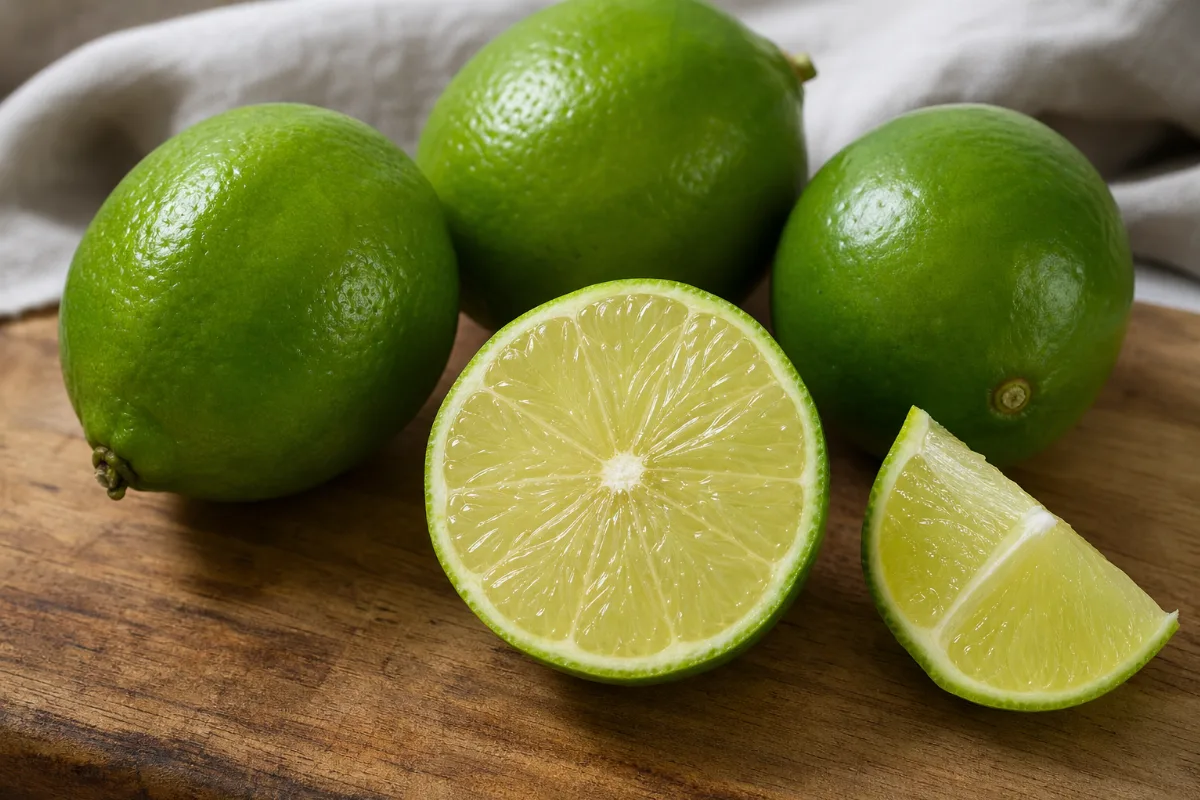
Limes are the small green fruits of citrus trees, mainly the Persian or Tahiti lime (Citrus latifolia) and the Key lime (Citrus aurantiifolia). Both belong to the citrus family, Rutaceae. The juicy flesh and juice are used, and sometimes the zest.
One raw lime (2 inch diameter, 67 g) provides about 20 calories, 1.9 g of fibre, 1.1 g of natural sugars, 19.5 mg of vitamin C and 68 mg of potassium (USDA). It is a modest source of vitamin C and a small source of most other nutrients. Most people use lime as juice, zest or a wedge, so the amount eaten is often small.
What the research shows
Vitamin C prevents scurvy, and the NHS and MedlinePlus list citrus fruit as a source. For colds, a Cochrane review of vitamin C tablets found little effect on the chance of catching a cold and a small shortening of colds with daily use. Limes were not tested, and the trials used far more vitamin C than a lime gives.
A US survey linked daily citrus, melon and berry intake with fewer kidney stones, and a Thai trial of a lime-based supplement found fewer new stones than placebo. Neither shows what eating limes does. No trial of limes for blood pressure, cholesterol or heart disease was found. Cancer and wound-healing claims come from lab and computer work on peel and fruit extracts.
Whole lime versus supplements and extracts
The cold review studied vitamin C tablets, the stone trial used a lime-based supplement, and the cancer and wound studies used extracts in the lab. None of these is the same as eating a lime or squeezing it over food. Lime juice also has less fibre than the whole fruit.
The NHS says taking more than 1,000 mg a day of vitamin C from supplements can cause stomach pain and diarrhoea. MedlinePlus puts the figure at over 2,000 mg a day, and says large supplement doses are not recommended in pregnancy. A lime has about 19.5 mg.
At a glance
Traditional uses history, not proof
- Squeezed or sliced to add sour flavour to food and drinks
- No source we read documents a traditional medicine use or the history of limes
Studied for research
- Vitamin C intake and preventing scurvy, high certainty for vitamin C itself
- Colds (vitamin C tablets, not limes), mixed
- Kidney stones, very low certainty for citrus intake and low for one lime-based supplement trial
- Blood pressure and heart risk markers, insufficient evidence for limes
- Cancer cells and wound healing in the lab only
Main compounds
- Vitamin C (about 19.5 mg in one lime)
- Fibre (about 1.9 g in one lime)
- Hesperidin and limonin, plant compounds studied in peel extract
- Furocoumarins, plant compounds linked to the sun-and-skin reaction
Common forms
- Fresh lime flesh and juice (the form the nutrition figures describe)
- Zest or peel
- Dried lime
- Lime juice, with less fibre than the whole fruit
- Lime extracts and lime-based supplements (not the same as the fruit)
Research links: NHS: Vitamin C · Vitamin C and the common cold, Cochrane review (2013) · Margarita dermatitis, case report and review (Cureus, 2026) · FDA: Grapefruit juice and some drugs don't mix · USDA FoodData Central: raw limes · Research Library · Genes & Biomarkers Library
What it is and its history
- Accepted scientific name
- Citrus x latifolia (Persian or Tahiti lime) and Citrus x aurantiifolia (Key lime)
- Naming authority
- Citrus x latifolia (Yu.Tanaka ex Yu.Tanaka) Yu.Tanaka (GBIF accepted, usageKey 3831655); Citrus x aurantiifolia (Christm.) Swingle (GBIF accepted, usageKey 3190164)
- Synonyms
- Mexican lime (alias used in the existing nutrient-graph summary; not checked in GBIF)
- Common names
- Lime (English); Persian lime (English); Tahiti lime (English); Key lime (English); Limon (lima, limon verde) (Spanish)
- Family or group
- Rutaceae, the citrus family (called the rue family in some sources), which also includes oranges, lemons and mandarins.
- Classification
- Plantae > Tracheophyta > Magnoliopsida > Sapindales > Rutaceae > Citrus > Citrus latifolia; Citrus aurantiifolia
- Native range
- Not verified from a source read.
- Habitat
- Not verified.
- What it looks like
- Roots: Not verified.; Stems: Not verified.; Leaves: Not verified.; Flowers: Not verified.; Fruit: Small green citrus fruit with juicy flesh, usually used as juice, zest or a wedge (existing nutrient-graph summary; USDA lists a 2 inch diameter fruit as 67 g).
- Cultivation
- Not verified from a source read.
- Harvest and processing
- Eaten or squeezed fresh; juice, zest and dried lime are also used (existing nutrient-graph summary). Dried lime is not covered by the USDA entry.
- Look-alikes and adulterants
- Name: Lemon; Note: Another citrus fruit. Studies of orange, lemon and mandarin allergy are not studies of limes.; Name: Kaffir (makrut) lime leaf and black lime (loomi); Note: Different products with their own pages. This page is about the fresh fruit.
- Sustainability and conservation
- Not assessed.
Photographs
Traditional use and history history, not clinical proof
| Tradition or era | Documented use | Source |
|---|---|---|
| Culinary use | Limes are used for their sour taste and their vitamin C (existing site summary). No source read documents their history, including any link with scurvy. | NOT verified (no source read) |
Traditional use shows how it was used. It does not show that it works or is safe today.
What is inside, and how it may work
What it contains and how those compounds act in cells and animals. Laboratory and animal mechanisms are not proven effects in people.
Main compounds
| Compound | Family | Where it is concentrated | Activity studied | Level of evidence |
|---|---|---|---|---|
| Vitamin C (ascorbic acid) | vitamin | Flesh and juice 29.1 mg per 100 g; about 19.5 mg in one 67 g lime (USDA) | Needed for collagen, wound healing and iron absorption; deficiency causes scurvy (MedlinePlus, NHS). 19 17 18 | Established physiology |
| Dietary fibre | carbohydrate | Flesh 2.8 g per 100 g; about 1.9 g in one lime (USDA) | Provides fibre in the diet. Lime juice has less fibre than the whole fruit (existing summary). 19 | Composition data |
| Hesperidin and limonin | flavonoid and limonoid (plant compounds) | Peel (in the peel extract studied) | Found in lime peel extract. In a dish, they affected liver cancer cells. No human result. 10 | Lab only |
| Total phenols and flavonoids | plant compounds | Fruit (extract) Phenols 44.42 mg GAE/g and flavonoids 38.60 mg CE/g in a Citrus latifolia fruit extract (lab measurement, not food values) | Antioxidant activity measured in the lab. 6 | Lab only |
| Furocoumarins | plant compounds (phototoxic) | Peel and juice | Named in a case report and a review as the cause of lime-related skin reactions after sun exposure. Amounts were not given. 2 7 | Case reports and review |
Mechanisms, receptors and pathways
| Target or pathway | Gene or receptor | What was found | Level |
|---|---|---|---|
| Plant compounds plus ultraviolet light in skin | Furocoumarins on the skin react with UVA light and damage skin cells, causing redness, blisters and later darkening (phytophotodermatitis). 4 2 7 | Human case reports and review | |
| Cell death in liver cancer cells | Lime peel extract caused cell death and reduced invasion of human liver cancer cells in a dish. 10 | Lab (cells) | |
| Urinary citrate, alkalinity and kidney inflammation | The authors of the stone trial suggest a lime-based preparation works through citrate, more alkaline urine and less inflammation (lower IL-8 and urine protein). Not proven. 5 | Authors' suggestion from a human trial |
Absorption, metabolism and elimination
- Absorption
- Not researched.
- Distribution
- Not found.
- Metabolism
- Not found.
- Elimination
- MedlinePlus says leftover vitamin C leaves the body in urine.
- Bioavailability
- Not established for limes.
Isolated compounds versus whole extracts
The cold evidence is for vitamin C tablets, the stone trial used a lime-based supplement, and the cancer and wound work used peel or fruit extracts in the lab. None of these is the same as eating a lime or squeezing it over food.
Nutritional composition
Per 100 g of raw lime (USDA FoodData Central, SR Legacy, FDC 168155): 30 kcal, 88.3 g water, 0.7 g protein, 0.2 g fat, 10.5 g carbohydrate of which 1.7 g are sugars, and 2.8 g fibre. One lime (2 inch diameter, 67 g) provides about 20 kcal, 1.9 g fibre, 1.1 g sugars, 19.5 mg vitamin C, 68 mg potassium, 22 mg calcium and 0.4 mg iron, plus small amounts of copper, vitamin B6 and folate. A lime is a modest source of vitamin C and a small source of most other nutrients. Per-fruit figures are calculated from the per-100 g values. Values vary with variety, ripeness and storage.
1 high certainty1 mixed findings1 low certainty1 very low certainty3 not enough evidence
What was looked at
The 7 benefits and uses checked for Limes, each with how strong the evidence is. Tap one to open it.
- Vitamin C intake and preventing scurvyHigh certainty
- Colds (vitamin C tablets, not limes)Mixed findings
- Kidney stones (citrus, melon and berry intake in a national survey)Very low certainty
- Kidney stone recurrence (a lime-based supplement, not the fruit)Low certainty
- Blood pressure, blood fats and artery function (citrus fruit trials, not limes)Not enough evidence
- Lime peel extract and cancer cells (lab only)Not enough evidence
- Lime fruit extracts and wound healing (lab and computer only)Not enough evidence
Lab markers tracked in the studies
Kidney stone recurrence (CT-confirmed)Urinary interleukin-8 (IL-8)24-hour urine proteinChance of catching a coldLength of coldsBlood pressure
What is Limes good for?
The main studied uses and how strong the human evidence is for each. Most results are about vitamin C or about extracts and supplements, not about eating limes.
Benefits, one by one
Each card is a research question, not a promise. Tap a goal to filter. Open a card to see the studies, doses and limits.
Vitamin C intake and preventing scurvy
High certaintyLimes contain vitamin C, and the body cannot store it. Not getting enough vitamin C causes scurvy. Eating foods with vitamin C, limes included, helps meet the body's needs. One lime gives a modest share of a day's needs.
3 studiesRaw lime flesh and juice. MedlinePlus says cooking, long storage and …
Studies, doses and limits
What the trials found
The NHS and MedlinePlus say a lack of vitamin C can lead to scurvy and list citrus among good food sources. USDA lists raw limes at 29.1 mg of vitamin C per 100 g, or about 19.5 mg in one 67 g lime. No trial in the sources read tested limes themselves for scurvy.
Results
Vitamin C prevents deficiency. Limes are one of many sources; fruit and vegetables in general supply it.
Why this rating
That vitamin C prevents scurvy is established and stated by official bodies. The rating applies to vitamin C, not to a lime-specific trial, which was not found.
Form and dose studied
Raw lime flesh and juice. MedlinePlus says cooking, long storage and light reduce vitamin C, and that raw fruit is the best source.
Who was studied
General population; scurvy mainly affects older, malnourished adults (MedlinePlus).
Limits
Official guidance, not a lime study. A lime is a modest, not a rich, vitamin C source compared with the daily needs MedlinePlus lists.
Why researchers looked
Citrus fruit is a classic source of vitamin C, and vitamin C deficiency is a long-known disease.
Traditional use
No source read documents the history of limes and scurvy.
Proposed mechanism Established physiology
Vitamin C is needed to make collagen, which is in skin, tendons, ligaments and blood vessels, and it helps wounds heal and iron to be absorbed (MedlinePlus).
A proposed mechanism does not show that the effect happens in people.
None from eating limes. Very large vitamin C supplement amounts can upset the stomach (NHS, MedlinePlus).
Colds (vitamin C tablets, not limes)
Mixed findingsLimes have not been tested for colds. A large Cochrane review of vitamin C tablets found they did not clearly stop people catching colds, but colds were a little shorter in people who took them every day. Starting vitamin C after a cold began showed no consistent effect.
2 studiesVitamin C tablets in the trials. Not limes.
Studies, doses and limits
What the trials found
Cochrane review (2013) of placebo-controlled trials of vitamin C supplements. 29 comparisons (11,306 people) for cold risk and 31 comparisons for cold length.
Results
General community trials: no clear change in the chance of a cold. People under heavy exercise stress (marathon runners, skiers, soldiers in the cold) had about half the risk. Colds were 8% shorter in adults and 14% shorter in children with regular vitamin C. Vitamin C started once a cold began: no consistent effect.
Effect sizes as reported
General community risk ratio 0.97 (95% CI 0.94 to 1.00); extreme-exercise groups RR 0.48 (0.35 to 0.64); duration -8% in adults, -14% in children.
Why this rating
The review's results differ by group and by whether vitamin C was taken regularly or started late. It studied tablets of at least 0.2 g a day, far more than the 19.5 mg in one lime, so it says almost nothing about limes.
Form and dose studied
Vitamin C tablets in the trials. Not limes.
Who was studied
Adults and children in the general community; a small group under extreme physical stress.
Limits
Supplement trials, not food. Published 2013; later trials were not read.
Why researchers looked
Vitamin C has been a popular cold remedy for decades.
Traditional use
MedlinePlus calls vitamin C a popular household remedy for colds.
Proposed mechanism Unknown
Not established in the sources read.
A proposed mechanism does not show that the effect happens in people.
See the Safety tab for vitamin C supplement amounts.
Kidney stones (citrus, melon and berry intake in a national survey)
Very low certaintyIn a US survey of 26,372 adults, people who ate citrus, melons and berries every day were less likely to report kidney stones. Limes were not studied on their own, and a survey cannot show that fruit caused the difference.
1 studiesMixed fruit group from diet recalls.
Studies, doses and limits
What the trials found
Cross-sectional analysis of US national survey data (NHANES 2007-2020) with two days of diet recall per person.
Results
Daily intake of the citrus, melon and berry group went with lower odds of kidney stones. The authors call for follow-up studies.
Effect sizes as reported
Odds ratio 0.81 (95% CI 0.70 to 0.93) for daily citrus, melons and berries.
Why this rating
Survey data cannot show cause, people reported their own stones and two days of diet, and limes are mixed in with melons, berries and other citrus.
Form and dose studied
Mixed fruit group from diet recalls.
Who was studied
US adults in a national survey.
Limits
Association only. Limes not separated.
Why researchers looked
Citrus fruits are a source of citrate, which is linked in the stone literature to urine chemistry. This page's sources did not test that route for whole limes.
Proposed mechanism Unknown
Not tested in the survey.
A proposed mechanism does not show that the effect happens in people.
People who form stones should ask their clinician about food choices; some stones relate to oxalate (see the related food page).
Kidney stone recurrence (a lime-based supplement, not the fruit)
Low certaintyIn one Thai trial of 173 people who had had stones removed, those given a special lime-based preparation for two years had far fewer new stones than those given a placebo. This tested a supplement, not limes from the shop, and it needs repeating.
1 studiesA lime-based, citrate- and flavonoid-rich preparation called LPR. Con…
Studies, doses and limits
What the trials found
A 2025 double-blind, placebo-controlled trial at six hospitals in Thailand. 151 of 173 people finished 24 months.
Results
Stones returned in 14% with the lime-based preparation and 45% with placebo. Urinary IL-8 and 24-hour urine protein were also lower than placebo among completers. No serious adverse events were reported.
Effect sizes as reported
Recurrence 14% vs 45% (p < 0.001); hazard ratio 0.24 (95% CI 0.13 to 0.44).
Why this rating
One trial of an unusual preparation, with 22 dropouts and results from completers for the secondary outcomes. It is not a fresh lime or lime juice.
Form and dose studied
A lime-based, citrate- and flavonoid-rich preparation called LPR. Contents and amount are not given in the abstract.
Who was studied
Adults in Thailand whose calcium oxalate stones had been removed.
Limits
Single trial, product not described in the abstract, not the fruit.
Why researchers looked
Citrate in citrus juice may raise urine citrate, and potassium citrate is a standard way to reduce stone recurrence; the authors tested a lime-based alternative.
Proposed mechanism Preliminary mechanism
The authors suggest higher urinary citrate, more alkaline urine and less kidney inflammation (lower IL-8 and urine protein). They did not prove the route.
A proposed mechanism does not show that the effect happens in people.
People with stones should ask their own doctor before using any product for stones.
Blood pressure, blood fats and artery function (citrus fruit trials, not limes)
Not enough evidenceNo trial of limes for blood pressure, cholesterol or heart disease was found. A review of 45 trials of berries, citrus and cherries found blood pressure improved with cranberry and cherry juice, and no significant improvement for the other fruits, which include citrus.
1 studiesFruit, juice or powder, mixed.
Studies, doses and limits
What the trials found
A 2021 systematic review and meta-analysis of 45 randomised trials of at least one week using berries, citrus or cherries.
Results
Only cranberry juice and cherry juice improved blood pressure. The authors say no other significant improvement was seen for the other specified fruits. The abstract gives no lime-specific result.
Effect sizes as reported
No citrus figures in the abstract.
Why this rating
Limes were not studied. The abstract reports no clear benefit for citrus fruit as a group, but gives no numbers for it.
Form and dose studied
Fruit, juice or powder, mixed.
Who was studied
Adults in trials.
Limits
Citrus trials mix several fruits and forms. Limes are small and used in small amounts in cooking.
Why researchers looked
Citrus fruit is often grouped with other fruit in heart studies.
Proposed mechanism Unknown
Not established.
A proposed mechanism does not show that the effect happens in people.
None specific.
Lime peel extract and cancer cells (lab only)
Not enough evidenceIn a dish, an alcohol extract of lime peel killed human liver cancer cells and slowed their spread. This is lab work on cells. It does not show that eating limes does anything for cancer.
1 studiesEthanol extract of Citrus aurantifolia peel in the lab.
Studies, doses and limits
Results
The extract's IC50 was about 503 micrograms per mL. It caused more cell death than hesperidin or limonin alone. 60 compounds were found by one method and 22 by another besides those two.
Effect sizes as reported
IC50: hesperidin 165.6, limonin 188.1, extract 503.0 micrograms per mL.
Why this rating
Cells in a dish, using a peel extract, not a food. No animal or human data in the source.
Form and dose studied
Ethanol extract of Citrus aurantifolia peel in the lab.
Limits
Lab only.
Why researchers looked
Lime peel is a food-industry waste product that holds plant compounds such as hesperidin and limonin.
Proposed mechanism Preliminary mechanism
The authors suggest the extract's many compounds work together. Shown in cells only.
A proposed mechanism does not show that the effect happens in people.
None specific.
Lime fruit extracts and wound healing (lab and computer only)
Not enough evidenceA 2026 lab study profiled the chemicals in Citrus latifolia fruit extracts and tested them on skin cells and in computer models. The authors suggest possible wound-healing effects for future research. No result in people or animals was reported.
1 studiesLaboratory extracts of Citrus latifolia fruit.
Studies, doses and limits
Results
The fruits showed total phenols of 44.42 mg GAE/g and total flavonoids of 38.60 mg CE/g. The abstract gives no result figures for the skin-cell test.
Why this rating
Extracts, cells and computer models only. An erratum was published; we did not read it.
Form and dose studied
Laboratory extracts of Citrus latifolia fruit.
Limits
Lab and computer models. Not food.
Why researchers looked
Citrus compounds have antioxidant properties in the lab.
Proposed mechanism Preliminary mechanism
Computer docking suggested the compounds could interact with proteins involved in wound healing. A model, not a finding in a body.
A proposed mechanism does not show that the effect happens in people.
Do not put lime juice or peel on wounds; lime on skin plus sunlight can cause a skin reaction (see the Safety tab).
Connections to the rest of health
How Limes connects to the rest of our health knowledge graph. Every link says what kind of connection it is. A safety link (for example to the liver) is a warning, not a benefit. A study that merely mentions a topic never creates a benefit link.
Explore every connection: goals, body systems, organs, symptoms, genes
A. Wellness goals
| Connected to | Kind of connection | Evidence status | Context | Studies |
|---|---|---|---|---|
| Immune Support | Demonstrated clinical effect | High certainty | Vitamin C intake and preventing scurvy: Limes contain vitamin C, and the body cannot store it. Not getting enough vitamin C causes scurvy. Eating foods with vitamin C, limes included, helps meet the body's needs. One lime gives a modest share of a day's needs. | 18 17 19 |
| Immune Support | Mixed findings | Colds (vitamin C tablets, not limes): Limes have not been tested for colds. A large Cochrane review of vitamin C tablets found they did not clearly stop people catching colds, but colds were a little shorter in people who took them every day. Starting vitamin C after a cold began showed no consistent effect. | 8 17 | |
| Preventive Wellness | Biological association | Very low certainty | Kidney stones (citrus, melon and berry intake in a national survey): In a US survey of 26,372 adults, people who ate citrus, melons and berries every day were less likely to report kidney stones. Limes were not studied on their own, and a survey cannot show that fruit caused the difference. | 9 |
| Preventive Wellness | Low certainty | Kidney stone recurrence (a lime-based supplement, not the fruit): In one Thai trial of 173 people who had had stones removed, those given a special lime-based preparation for two years had far fewer new stones than those given a placebo. This tested a supplement, not limes from the shop, and it needs repeating. | 5 | |
| Heart Health | Not enough evidence | Blood pressure, blood fats and artery function (citrus fruit trials, not limes): No trial of limes for blood pressure, cholesterol or heart disease was found. A review of 45 trials of berries, citrus and cherries found blood pressure improved with cranberry and cherry juice, and no significant improvement for the other fruits, which include citrus. | 11 |
B. Body systems
| Connected to | Kind of connection | Evidence status | Context | Studies |
|---|---|---|---|---|
| Immune System | Biological association | High certainty | Studied for: Vitamin C intake and preventing scurvy Studied for: Colds (vitamin C tablets, not limes) | 18 17 19 8 |
| Urinary System | Biological association | Very low certainty | Studied for: Kidney stones (citrus, melon and berry intake in a national survey) Studied for: Kidney stone recurrence (a lime-based supplement, not the fruit) | 9 5 |
| Cardiovascular System | Biological association | Not enough evidence | Studied for: Blood pressure, blood fats and artery function (citrus fruit trials, not limes) | 11 |
| Hepatic System | Biological association | Not enough evidence | Studied for: Lime peel extract and cancer cells (lab only) | 10 |
| Integumentary System | Biological association | Not enough evidence | Studied for: Lime fruit extracts and wound healing (lab and computer only) | 6 |
E. Health conditions
| Connected to | Kind of connection | Evidence status | Context | Studies |
|---|---|---|---|---|
| Photosensitivity of skin | Adverse effect or risk | Documented risk | Lime peel or juice on the skin followed by sunlight can cause phytophotodermatitis (margarita dermatitis). Lime juice or peel on the skin followed by sunlight can cause phytophotodermatitis. Preparation or compound: Lime juice or peel on skin |
4 2 7 |
| Food allergy | Adverse effect or risk | Insufficient evidence | Citrus allergy exists. Lime allergy was not described in the sources read. Preparation or compound: Citrus fruit |
12 |
| Scurvy | Established | Limes provide vitamin C, and a lack of vitamin C causes scurvy. Limes are one of many sources. Preparation or compound: Fresh lime |
18 17 |
I. Biomarkers
| Connected to | Kind of connection | Evidence status | Context | Studies |
|---|---|---|---|---|
| Kidney stone recurrence (CT-confirmed) | Biological association | Low certainty | Measured in trials: fewer new stones with the lime-based preparation. A lab change is not the same as a health benefit. | 5 |
| Urinary interleukin-8 (IL-8) | Biological association | Low certainty | Measured in trials: lower with the lime-based preparation among completers. A lab change is not the same as a health benefit. | 5 |
| 24-hour urine protein | Biological association | Low certainty | Measured in trials: lower with the lime-based preparation among completers. A lab change is not the same as a health benefit. | 5 |
| Chance of catching a cold | Biological association | Mixed findings | Measured in trials: no clear change in the general public. A lab change is not the same as a health benefit. | 8 |
| Length of colds | Biological association | Mixed findings | Measured in trials: slightly shorter with regular vitamin C tablets. A lab change is not the same as a health benefit. | 8 |
| Blood pressure | Biological association | Not enough evidence | Measured in trials: no clear change reported for citrus. A lab change is not the same as a health benefit. | 11 |
L. Active compounds
| Connected to | Kind of connection | Evidence status | Context | Studies |
|---|---|---|---|---|
| Vitamin C (ascorbic acid) | Biological association | Established physiology | Needed for collagen, wound healing and iron absorption; deficiency causes scurvy (MedlinePlus, NHS). Preparation or compound: Flesh and juice |
19 17 18 |
| Dietary fibre | Biological association | Composition data | Provides fibre in the diet. Lime juice has less fibre than the whole fruit (existing summary). Preparation or compound: Flesh |
19 |
| Hesperidin and limonin | Biological association | Lab only | Found in lime peel extract. In a dish, they affected liver cancer cells. No human result. Preparation or compound: Peel (in the peel extract studied) |
10 |
| Total phenols and flavonoids | Biological association | Lab only | Antioxidant activity measured in the lab. Preparation or compound: Fruit (extract) |
6 |
| Furocoumarins | Biological association | Case reports and review | Named in a case report and a review as the cause of lime-related skin reactions after sun exposure. Amounts were not given. Preparation or compound: Peel and juice |
2 7 |
Each connection is stored with the ingredient, the connected record, the kind of connection, the evidence status, the supporting studies, the preparation or compound involved, and a review date (last reviewed October 25, 2026).
Evidence at a glance: what the research found for 7 outcomes
Each outcome below is one thing researchers measured. Certainty is how far the evidence can be trusted, not how well it works. The full studies are on the next tab.
The evidence
The research centre for Limes. Every record here was checked against PubMed or the publisher's page; we never list a study we have not verified.
Evidence by outcome
Bars show how many studies we found for each outcome, not how well it works. People are added up across trials only (reviews are not added, to avoid double counting).
How we rate evidence
High certainty
Several well-run trials or reviews agree; further research is unlikely to change the picture much.
Moderate certainty
Good trials point the same way, but some doubt remains.
Low certainty
Small, short or inconsistent trials. The finding could change with better research.
Very low certainty
Very little or very weak human data. Treat as a possibility only.
Mixed findings
Trials or reviews disagree with each other.
Not enough evidence
Not enough human research to say either way.
Evidence against
Good research found no benefit, or found harm.
We take the reviewers' own risk-of-bias and GRADE statements where they exist, and otherwise judge from study size, design, consistency, directness and whether a product matches what is sold. Many publications do not make evidence high. Method note: We started from our existing lime summary, re-read the USDA FoodData Central record, and read PubMed abstracts and the NHS, MedlinePlus and FDA pages. Only abstracts were read for studies. Items we could not verify are flagged in the research gaps.
Study library: every study we checked 19
| Study | Design | People | Product, dose, length | Result |
|---|---|---|---|---|
| Albarnaz 2026 Acidified Acetonitrile Extraction and Ultra-High Performance Liquid Chromatography-Tandem Mass Spectrometry for Multiresidue Determination of 136 Pesticides in Tahiti Lime (Citrus latifolia). Foods · PMID 42737211 · DOI |
Laboratory method validation paper with a small sample test |
22 real Tahiti lime samples (origin not stated in the abstract) | Tahiti lime (Citrus latifolia) samples tested for 136 pesticides whole fruit |
The paper's main aim was to build and validate a testing method. Applying it to 22 real samples found 14 pesticide residues, with some compounds above European Union maximum residue limits. 14 different residues found in 22 samples; some above EU limits (abstract does not say how many samples) Methods, limits and fundingOutcomes: Pesticide residues Limitations: A method paper with 22 samples. It does not tell you the risk of limes in your shop. The abstract does not say which compounds, how many samples or where they were grown. Funding and conflicts: Authors declared no conflicts that influence the results; two authors are guest editors of the journal issue, with independent review (declared) Read: abstract |
| Aleksiev 2025 Mojito-Induced Phytophotodermatitis: A Case of Lime-Triggered Skin Reaction. Case Rep Dermatol · PMID 41064302 · DOI |
Single case report |
One 25-year-old woman | Lime juice from a spilled mojito, followed by prolonged sun juice |
A linear, darker (hyperpigmented) mark appeared on her forearm after a mojito spilled on the skin during prolonged sun. The author says furocoumarins in lime juice or peel cause the reaction, and that it is often mistaken for allergic dermatitis, burns, cellulitis or even abuse. One case Methods, limits and fundingOutcomes: Skin reaction Limitations: One person. Shows it can happen; cannot show how often. Funding and conflicts: Author declared no conflicts Read: abstract |
| Chen 2018 Food-drug interactions precipitated by fruit juices other than grapefruit juice: An update review. J Food Drug Anal · PMID 29703387 · DOI |
Systematic review of randomised trials |
46 randomised trials of fruit juices (not grapefruit) taken with medicines | Fruit juices other than grapefruit, including lime juice in one trial pairing juice Varied Varied · vs Varied |
Of 22 juice and drug combinations with possible clinical relevance, the authors list lime juice with antimalarials among the 'beneficial' combinations. The adverse ones named were apple, orange, pomelo, Seville orange and grape juices with certain medicines; lime juice is not in that list. The authors say other juices did not cause severe harmful interactions despite sporadic case reports, and that more research is needed. 22 combinations judged potentially relevant; lime juice listed only with antimalarials, as beneficial Methods, limits and fundingOutcomes: Changes in how medicines are absorbed or act Limitations: Juice, not whole limes. The abstract does not describe the lime-antimalarial trial. Published 2018. Funding and conflicts: Authors declared no conflicts of interest Read: abstract |
| Cohen 2026 Margarita Dermatitis Revisited: A Case Report and Literature Review of Lime-Associated Phytophotodermatitis. Cureus · PMID 42889495 · DOI |
Case report and literature review |
One 28-year-old man plus 13 earlier reports of delayed, painless lime-associated skin darkening (14 people in all) | Lime peel or lime juice on the skin, followed by sunlight (UVA) peel and juice |
Lime peel or juice on the skin followed by ultraviolet A light can cause margarita dermatitis. It often shows as painful or itchy redness and blisters, then darker skin that usually improves or clears. In the 14 people with painless, delayed darkening, the marks were most often on the backs of the hands (11 people) and appeared from two days up to three to seven weeks after contact (median seven days). The authors say it is often misdiagnosed. 14 people with delayed painless darkening: 11 on the backs of the hands, 3 on the back; onset median 7 days Methods, limits and fundingOutcomes: Skin reaction after lime contact and sun Limitations: Case reports and a review of cases. No rate of how often it happens. Not a trial. Funding and conflicts: Authors declared no financial relationships Read: abstract |
| Dissayabutra 2025 Lime-based supplement reduces calcium oxalate stone recurrence: A multicenter randomized controlled trial. PLoS One · PMID 41348736 · DOI |
Double blind randomised placebo controlled trial (multicentre, Thailand) |
173 adults with calcium oxalate kidney stones removed by surgery; 151 completed 24 months | A lime-based phytochemical-rich preparation (called LPR by the authors); a supplement, not the whole fruit. The abstract does not give its full contents lime-based preparation Not given in the abstract 24 months · vs Placebo |
Stones came back in 14% of the lime-preparation group and 45% of the placebo group at two years (p < 0.001). Hazard ratio 0.24 (95% CI 0.13-0.44). Among completers, urinary IL-8 and 24-hour urine protein were lower than at the start and lower than placebo. No serious adverse events were reported. Recurrence 14% vs 45%; HR 0.24 (95% CI 0.13-0.44) (0.13-0.44) Methods, limits and fundingOutcomes: Stone recurrence confirmed by CT; urinary interleukin-8 (IL-8); 24-hour urine protein Limitations: One trial of a special lime-based preparation, not a lime from the shop. Contents and amount not given in the abstract. 22 of 173 people did not finish. Needs repeating by other teams. Funding and conflicts: Authors declared no competing interests Read: abstract |
| Ghanem 2026 The wound healing effects of Citrus latifolia extracts: phytochemical profiling and in silico investigations. BMC Complement Med Ther · PMID 41845400 · DOI |
Laboratory and computer model study human cells (lab) and computer models |
Citrus latifolia extracts and fractions; BJ-1 human skin cells; computer docking models | Citrus latifolia fruit extracts and fractions fruit (extracts) Lab |
The authors profiled the extract chemically and reported total phenols of 44.42 mg GAE/g and total flavonoids of 38.60 mg CE/g in the fruits. They suggest possible wound-healing effects that 'should be investigated in the near future'. The abstract gives no results for the skin-cell test. An erratum was published in June 2026. Total phenols 44.42 mg GAE/g; total flavonoids 38.60 mg CE/g (extract measurements) Methods, limits and fundingOutcomes: Chemical profile, antioxidant activity, wound-healing potential in skin cells and computer models Limitations: Lab and computer models only. No human or animal wound-healing result in the abstract. An erratum exists; we did not read it. Funding and conflicts: Authors declared no competing interests Read: abstract |
| Grosu Dumitrescu 2024 New Insights Concerning Phytophotodermatitis Induced by Phototoxic Plants. Life (Basel) · PMID 39202761 · DOI |
Narrative review |
Published literature on phytophotodermatitis | Phototoxic plants, including limes; furocoumarins and psoralens various |
The review describes phytophotodermatitis as a non-immune skin reaction when plant compounds such as furocoumarins meet sunlight. It names limes as an example. Prevention measures discussed include long sleeves and gloves. Redness, fluid blisters, swelling and darker skin can occur. Qualitative Methods, limits and fundingOutcomes: How plant-and-sun skin reactions happen, diagnosis, prevention Limitations: Review of mixed plants. An erratum exists (Life 2025); we did not read it. Funding and conflicts: Authors declared no conflicts of interest Read: abstract |
| Hemila 2013 Vitamin C for preventing and treating the common cold. Cochrane Database Syst Rev · PMID 23440782 · DOI |
Systematic review and meta analysis of placebo controlled trials |
29 trial comparisons with 11,306 participants for cold risk; 31 comparisons (9,745 episodes) for cold length; 7 comparisons (3,249 episodes) of vitamin C started at the onset of a cold | Vitamin C (ascorbic acid) supplements, not limes or other foods Trials had to use at least 0.2 g (200 mg) a day; this is about ten times the 19.5 mg of vitamin C in one raw lime (USDA) Varied · vs Placebo |
In general community trials (10,708 people) regular vitamin C did not clearly change the chance of a cold (pooled RR 0.97, 95% CI 0.94 to 1.00). In 598 marathon runners, skiers and soldiers on subarctic exercises the pooled RR was 0.48 (0.35 to 0.64). Colds were 8% shorter in adults and 14% shorter in children with regular vitamin C. Vitamin C started after a cold began showed no consistent effect on length or severity. General community RR 0.97 (95% CI 0.94-1.00); extreme-exercise groups RR 0.48 (0.35-0.64); cold length -8% in adults (3% to 12%), -14% in children (7% to 21%) (0.94-1.00 (general community, cold risk)) Methods, limits and fundingOutcomes: Chance of catching a cold; length and severity of colds Limitations: Studied vitamin C tablets, not food. Excluded trials using under 0.2 g a day, so it says nothing about the small amount in a squeeze of lime. Published 2013. Funding and conflicts: Authors declared no conflict of interest Read: abstract |
| Li 2025 Associations between comprehensive dietary composition and kidney stone risk: insights from a nationally representative survey. Front Nutr · PMID 41245408 · DOI |
Cross sectional survey analysis (NHANES 2007 2020) |
26,372 US adults who reported kidney stone history and two days of diet | Daily consumption of the food group 'citrus, melons and berries' and other food groups, from two-day diet recalls fruit · vs People not eating the group daily |
Daily citrus, melons and berries went with lower odds of kidney stones (OR 0.81, 95% CI 0.70-0.93). Tomatoes, milk, total dairy and alcoholic drinks also showed lower odds; daily added sugars showed a slightly higher chance. The authors call for prospective studies to confirm it. Citrus, melons and berries: OR 0.81 (95% CI 0.70-0.93) (0.70-0.93) Methods, limits and fundingOutcomes: Self-reported kidney stones Limitations: Cross-sectional: cannot show cause. Limes are not separated from other citrus, melons and berries. Stones and diet were self-reported over two days. Funding and conflicts: Authors declared no commercial or financial conflicts Read: abstract |
| Phucharoenrak 2023 Metabolomic Analysis of Phytochemical Compounds from Ethanolic Extract of Lime (Citrus aurantifolia) Peel and Its Anti-Cancer Effects against Human Hepatocellular Carcinoma Cells. Molecules · PMID 37049726 · DOI |
Laboratory study (cell lines) human cells (lab) |
Human liver cancer cells (PLC/PRF/5) grown in the lab | Ethanolic extract of lime (Citrus aurantifolia) peel, and pure hesperidin and limonin peel (extract) Lab concentrations (IC50 values in micrograms per mL) 24 and 48 hours · vs Pure compounds |
The extract killed liver cancer cells in a dish at an IC50 of about 503 micrograms per mL, and caused more cell death than the pure compounds at their own IC50 levels. 60 compounds were found by LC-MS and 22 by GC-MS besides limonin and hesperidin. IC50: hesperidin 165.6, limonin 188.1, extract 503.0 micrograms per mL (cells in a dish) Methods, limits and fundingOutcomes: Cancer cell survival, cell death, invasion; chemical profile of the extract Limitations: Cells in a dish only. Says nothing about eating limes. Peel extract is not a food. Funding and conflicts: Authors declared no conflict of interest Read: abstract |
| Wang 2021 Effects of chronic consumption of specific fruit (berries, citrus and cherries) on CVD risk factors: a systematic review and meta-analysis of randomised controlled trials. Eur J Nutr · PMID 32535781 · DOI |
Systematic review and meta analysis of randomised trials |
45 randomised trials of at least one week using berries, citrus or cherries (searched to January 2020) | Berry, citrus and cherry fruits, juices and powders; citrus group not broken down to limes in the abstract fruit, juice, powder Varied At least 1 week · vs Control, varied |
Blood pressure fell with cranberry juice and cherry juice. The authors state that no other significant improvements were seen for the other specified fruits, which include citrus. The abstract gives no lime-specific result. Cranberry juice and cherry juice lowered blood pressure; no significant improvement reported for the other fruits Methods, limits and fundingOutcomes: Endothelial function, blood pressure, blood fats, inflammation markers Limitations: Citrus trials are not about limes specifically. Abstract gives no citrus numbers. Funding and conflicts: Authors declared no conflict of interest Read: abstract |
| Zamarro Parra 2025 Orange Allergy Beyond LTP: IgE Recognition of Germin-like Proteins in Citrus Fruits. Curr Issues Mol Biol · PMID 40864775 · DOI |
Case series with laboratory tests |
Five patients with immediate allergic reactions after eating orange | Orange, lemon and mandarin pulp, peel and seed extracts (limes were not tested) pulp, peel, seed Lab tests |
All five orange-allergic patients had IgE antibodies that bound a 23 kDa germin-like protein in orange, in lemon peel and in mandarin peel. The authors suggest a possible shared allergen across citrus. Limes were not tested. 5 of 5 patients recognised the 23 kDa band Methods, limits and fundingOutcomes: IgE binding to proteins in citrus extracts Limitations: Five people. Limes not tested. Some authors work for the laboratory company that did the tests (declared). Funding and conflicts: Two authors declared no conflicts; six authors are employees of DIATER Laboratories, which did the lab work (declared in the paper) Read: abstract |
| s-fda-grapefruit FDA: Grapefruit Juice and Some Drugs Don't Mix · Source |
Official consumer guidance n/a |
Methods, limits and fundingRead: full-text | ||
| s-fda-produce-safely FDA: Selecting and Serving Produce Safely · Source |
Official consumer guidance n/a |
Methods, limits and fundingRead: full-text | ||
| s-gbif-citrus-aurantiifolia GBIF Backbone: Citrus x aurantiifolia (Christm.) Swingle (usageKey 3190164) · Source |
Reference database n/a |
Methods, limits and fundingRead: full-text | ||
| s-gbif-citrus-latifolia GBIF Backbone: Citrus x latifolia (Yu.Tanaka ex Yu.Tanaka) Yu.Tanaka (usageKey 3831655) · Source |
Reference database n/a |
Methods, limits and fundingRead: full-text | ||
| s-medlineplus-vitamin-c MedlinePlus: Vitamin C · Source |
Official health guidance n/a |
Methods, limits and fundingRead: full-text | ||
| s-nhs-vitamin-c NHS: Vitamin C · Source |
Official health guidance n/a |
Methods, limits and fundingRead: full-text | ||
| s-usda-fdc-168155 USDA FoodData Central: Limes, raw (FDC 168155, SR Legacy) · Source |
Food composition database n/a |
Methods, limits and fundingRead: full-text |
What we do not know yet
- No trial has tested eating limes or lime juice for scurvy, colds, heart disease, blood pressure or kidney stones.
- The cold evidence is for vitamin C tablets of at least 0.2 g a day, far more than a lime gives.
- The kidney stone survey groups limes with other citrus, melons and berries, and the stone trial used a lime-based supplement whose contents were not in the abstract.
- No source gave how often the sun-and-skin reaction happens, or described lime allergy itself.
- No source settles whether limes affect medicines the way grapefruit does.
- Pregnancy and breastfeeding for limes as a food, dental effects of acidic juice and choking risk for young children were not researched.
How new research is added
New studies are found by a saved PubMed search and placed in a review queue before the page changes.
Lab markers
What changed in blood or saliva tests during trials. A changed number is not the same as feeling or being healthier, and we give no "normal ranges".
Other 6
Kidney stone recurrence (CT-confirmed)
Fewer new stones with the lime-based preparation in trials
New kidney stones seen on a CT scan after earlier stones were removed.
Low certaintyResults and what it means
Why it was measured
The main outcome of the trial.
Statistical vs. clinical meaning
A large difference in one trial of a supplement. It does not show what eating limes does.
Safety implication
None specific.
| Study | Result | People | Product |
|---|---|---|---|
| 5 | 14% vs 45% recurrence at 2 years; HR 0.24 (95% CI 0.13-0.44) | 173 adults, 151 completed | Lime-based preparation (LPR), a supplement |
Urinary interleukin-8 (IL-8)
Lower with the lime-based preparation among completers in trials
A signalling protein linked to inflammation, measured in urine.
Low certaintyResults and what it means
Why it was measured
The authors used it as a marker of kidney inflammation.
Statistical vs. clinical meaning
A marker change in completers only. Its meaning for patients is not established.
Safety implication
None specific.
| Study | Result | People | Product |
|---|---|---|---|
| 5 | Significantly reduced against baseline and placebo (p = 0.017); no figure in the abstract | Completers of the trial | Lime-based preparation (LPR), a supplement |
24-hour urine protein
Lower with the lime-based preparation among completers in trials
The amount of protein passing into the urine over a day.
Low certaintyResults and what it means
Why it was measured
A marker the authors linked to kidney inflammation.
Statistical vs. clinical meaning
A marker change in completers only.
Safety implication
None specific.
| Study | Result | People | Product |
|---|---|---|---|
| 5 | Significantly reduced against baseline and placebo (p = 0.032); no figure in the abstract | Completers of the trial | Lime-based preparation (LPR), a supplement |
Chance of catching a cold
No clear change in the general public in trials
How many people get one or more colds during a study.
Mixed findingsResults and what it means
Why it was measured
The main prevention outcome in cold trials.
Statistical vs. clinical meaning
Little change for most people. This is about tablets, not limes.
Safety implication
None specific.
| Study | Result | People | Product |
|---|---|---|---|
| 8 | RR 0.97 (95% CI 0.94-1.00) in general community trials; RR 0.48 (0.35-0.64) in people under extreme exercise stress | 10,708 community participants; 598 in extreme-stress groups | Vitamin C tablets, not limes |
Length of colds
Slightly shorter with regular vitamin C tablets in trials
The average number of days a cold lasts.
Mixed findingsResults and what it means
Why it was measured
The main treatment outcome in cold trials.
Statistical vs. clinical meaning
A small effect with regular tablets. Limes were not tested.
Safety implication
None specific.
| Study | Result | People | Product |
|---|---|---|---|
| 8 | -8% in adults (3% to 12%) and -14% in children (7% to 21%) with regular use; no consistent effect when started after symptoms began | 9,745 cold episodes | Vitamin C tablets, not limes |
Blood pressure
No clear change reported for citrus in trials
The pressure of blood in the arteries.
Not enough evidenceResults and what it means
Why it was measured
A common heart-risk marker.
Statistical vs. clinical meaning
Limes were not tested for this.
Safety implication
None specific.
| Study | Result | People | Product |
|---|---|---|---|
| 11 | Improvement only with cranberry and cherry juice; none reported for the other fruits including citrus (no citrus figure in the abstract) | 45 trials of berries, citrus and cherries | Citrus fruit or juice, mixed; not limes specifically |
Safety
What studies and official sources say about side effects, medicines and who should check first. Each point shows what kind of evidence it comes from.
Main points to know 3
- Lime juice or peel on the skin plus sunlight can cause a rash and dark marks. Lime peel or juice on the skin followed by sunlight (UVA) can cause a skin reaction called phytophotodermatitis, nicknamed margarita dermatitis. It can appear as painful or itchy redness and blisters, then darker patches. In people with painless delayed darkening, the marks were most often on the backs of the hands and appeared two days to several weeks later. The darkening often improves or clears. It is often mistaken for other conditions. Case reports and review 4 2 7
- A serious allergic reaction is an emergency. Citrus allergy exists. We found no source describing lime allergy specifically. Swelling of the lips, face, tongue or throat, trouble breathing, wheezing, dizziness or fainting after eating can be a serious allergic reaction. Call emergency services (911 in the US, 999 in the UK). Case series 12
- Limes are not named in the FDA's grapefruit and medicines warning. The FDA names grapefruit and grapefruit juice, and says Seville oranges, pomelos and tangelos might act the same way. Limes are not named. We found no source that settles the question for limes, so ask a pharmacist if your medicine carries a grapefruit warning. Authoritative guidance 13 3
Side effects 3
| Effect | How often | Severity and recovery | Evidence |
|---|---|---|---|
| Skin redness, blisters and dark patches after lime juice or peel on skin in the sun No rate was found in the sources read. It is a contact reaction, not an effect of eating limes. | Not established | mild to moderate; blisters can be painful The darkening often improves or resolves over time (case review). | Case reports and review 4 2 |
| Allergic reaction to citrus Described for orange; a shared protein was seen in lemon and mandarin peel. Limes were not tested. No lime-specific frequency found. | Not established | ranges from mild to serious Depends on the reaction. | Case series 12 |
| Stomach pain, diarrhoea and wind from very large vitamin C supplement amounts The NHS puts this above 1,000 mg a day from supplements; MedlinePlus says over 2,000 mg a day can cause stomach upset and diarrhoea, and rarely kidney stones. One lime has about 19.5 mg (USDA). | Not established | mild The NHS says symptoms should go away once supplements stop. | Authoritative guidance 18 17 |
Liver
No liver injury linked to eating limes was found in the sources read. LiverTox was not checked.
How often. No frequency found.
This is a safety connection. It is not evidence that Limes supports liver health.
Medicines and supplements 2
| With | Why it matters | Importance | Evidence | What to do |
|---|---|---|---|---|
| Medicines with a grapefruit warning (for example some statins, calcium channel blockers, immune-suppressing drugs) prescription | For grapefruit, the FDA says juice can block an intestinal enzyme (CYP3A4) and let more of some medicines into the blood. This is not shown for limes. | The FDA names grapefruit, Seville oranges, pomelos and tangelos. Limes are not named. A review of 46 trials of juices other than grapefruit found no severe harmful interactions for those juices, although it listed apple, orange, pomelo and other juices with certain medicines; lime juice appeared only in a combination with antimalarial drugs that the authors called beneficial. | Authoritative guidance and trial review Not enough evidence 13 3 | Ask your pharmacist if your own medicine has a grapefruit or fruit-juice warning, and tell them you use limes or lime juice. |
| Vitamin C supplements (high amounts) supplement | Not an interaction. Large supplement amounts can upset the stomach. | Normal food portions of limes are far below the amounts the NHS and MedlinePlus describe as causing stomach upset. | Authoritative guidance High certainty 18 17 | Tell your clinician about any vitamin C supplements. |
Who should check first 2
| Situation | Advice | Evidence |
|---|---|---|
| Known allergy to citrus fruit with swelling or trouble breathing | Avoid the fruit and get an allergy assessment. Follow your own emergency plan. | Case series 12 |
| A past skin reaction (blisters or dark marks) after getting lime juice or peel on the skin in the sun | Ask a doctor or skin specialist. The case reports say the cause is easily missed. | Case reports and review 4 2 |
Overdose, product quality and regulators
Summary. Limes are an ordinary food. The one lime-specific hazard in the sources read is the skin reaction with sunlight, caused by plant compounds called furocoumarins (named in the case report and a review).
Animal. Not reviewed.
Human doses studied. A trial of a lime-based preparation for 24 months reported no serious adverse events (abstract).
High dose or long term signals. Very large vitamin C supplement amounts can cause stomach upset (NHS, MedlinePlus). Not from food.
Overdose response. Not found.
Genotoxicity. Not reviewed.
Toxic or hazardous parts. Peel and juice on skin plus sunlight (skin reaction). Other parts were not checked.
Fresh limes can carry pesticide residues and, like any raw produce, bacteria. One 2026 method-testing paper found residues in a small set of Tahiti lime samples.
Pesticide residues in Tahiti lime (method paper, 2026). In 22 real samples the authors found 14 pesticide residues, with some compounds above EU maximum residue limits. The abstract does not say how many samples were above limits, which compounds, or where the fruit was grown. It was mainly a testing-method paper. 1
Washing and storing produce (FDA). Wash under running water even if you will not eat the peel. Do not use soap, detergent or produce wash. Washing lowers bacteria but does not remove them. Keep cut or packaged produce at 40 F (about 4 C) or colder. 14
| Body | Action | Date |
|---|---|---|
| FDA (United States) | Consumer advice that grapefruit juice can interact with some medicines; names Seville oranges, pomelos and tangelos as possibly similar; does not name limes source | 2021-07-01 (page current as of) |
| FDA (United States) | Consumer advice on selecting, washing and storing fresh produce source | 2024-03-05 (page current as of) |
| NHS (UK) (United Kingdom) | Vitamin C guidance: citrus fruit is a good source; supplements above 1,000 mg a day can cause stomach pain and diarrhoea source | 2020-08-03 (last reviewed; next review was due 2023) |
| MedlinePlus (US National Library of Medicine) (United States) | Vitamin C encyclopedia entry: food sources, side effects of very large supplement amounts, and not recommending large supplement doses in pregnancy source | 2025-01-21 (review date) |
When to get medical help
- Swelling of the lips, face, tongue or throat
- Trouble breathing, wheezing or a tight throat
- Feeling faint, dizzy or collapsing after eating
- Spreading hives after eating
- Large blisters, severe pain or signs of infection (fever, spreading redness, pus) on skin that had lime juice on it and then sun
- Vomiting, diarrhoea or fever after eating fresh produce that was not washed
Stop using the product and contact a clinician or emergency service. In the US, Poison Control is 1-800-222-1222.
General information only, not medical advice. Ask a clinician or pharmacist before use, especially with medicines, in pregnancy or with a health condition. See the Natural Remedy Safety guide.
Frequently asked questions
What are limes good for?
Do limes prevent scurvy?
Do limes help with colds?
Limes were not tested. A Cochrane review of vitamin C tablets found they did not clearly lower the chance of catching a cold in the general public, and colds were 8% shorter in adults and 14% shorter in children with daily use. Vitamin C started after symptoms began showed no consistent effect.
Can limes help prevent kidney stones?
Do limes lower blood pressure or cholesterol?
We found no trial of limes for this. A review of berry, citrus and cherry trials found improvement in blood pressure only with cranberry and cherry juice.
Why did lime juice on my skin cause a rash or dark patches?
Lime juice or peel on the skin followed by sunlight can cause phytophotodermatitis, nicknamed margarita dermatitis. Case reports describe redness, blisters or dark patches on the hands or arms, sometimes days or weeks later. The darkening often improves. A doctor or skin specialist can help if it happens.
How can I avoid the sun-and-skin reaction?
Can you be allergic to limes?
Citrus allergy exists. A small study of five people with orange allergy found a shared protein in orange, lemon peel and mandarin peel, and limes were not tested. We found no source describing lime allergy itself. Swelling of the face or throat, trouble breathing or fainting needs emergency help.
Do limes interact with medicines like grapefruit does?
How many calories and how much vitamin C is in a lime?
USDA lists one raw lime (2 inch diameter, 67 g) at about 20 calories, 1.9 g of fibre, 1.1 g of natural sugars, 19.5 mg of vitamin C and 68 mg of potassium.
Should I wash limes, and do they have pesticide residues?
Are limes safe in pregnancy?
Explore by health goal
Editorial transparency
- Written by
- AlternativeMed editorial team. Research compiled with AI assistance, then checked against the sources listed.
- Medical review
- None. This page has not been reviewed by a physician or pharmacist.
- First published
- 2026-10-25
- Last substantive update
- 2026-10-25
- How we research
- We started from our existing lime summary, re-read the USDA FoodData Central record, and read PubMed abstracts and the NHS, MedlinePlus and FDA pages. Only abstracts were read for studies. Items we could not verify are flagged in the research gaps.
- How we rate evidence
- See "How we rate evidence" in the Evidence tab.
- Independence
- No product is promoted on this page. No affiliate links are shown.
Sources 19
Each source was opened and checked. Where we read only the abstract, it says so. The small numbers in the text point here.
- Albarnaz KDS, Kuntz JDB, Floriano L, et al.. Acidified Acetonitrile Extraction and Ultra-High Performance Liquid Chromatography-Tandem Mass Spectrometry for Multiresidue Determination of 136 Pesticides in Tahiti Lime (Citrus latifolia).. Foods. 2026. PMID 42737211. DOI 10.3390/foods15172967. (abstract)
- Aleksiev T. Mojito-Induced Phytophotodermatitis: A Case of Lime-Triggered Skin Reaction.. Case Rep Dermatol. 2025. PMID 41064302. DOI 10.1159/000547675. (abstract)
- Chen M, Zhou SY, Fabriaga E, et al.. Food-drug interactions precipitated by fruit juices other than grapefruit juice: An update review.. J Food Drug Anal. 2018. PMID 29703387. DOI 10.1016/j.jfda.2018.01.009. (abstract)
- Cohen PR, Ramsay BL. Margarita Dermatitis Revisited: A Case Report and Literature Review of Lime-Associated Phytophotodermatitis.. Cureus. 2026. PMID 42889495. DOI 10.7759/cureus.116249. (abstract)
- Dissayabutra T, Anegkamol W, Ratchanon S, et al.. Lime-based supplement reduces calcium oxalate stone recurrence: A multicenter randomized controlled trial.. PLoS One. 2025. PMID 41348736. DOI 10.1371/journal.pone.0336892. (abstract)
- Ghanem MTM, Elshahid ZA, Elsayed WM, et al.. The wound healing effects of Citrus latifolia extracts: phytochemical profiling and in silico investigations.. BMC Complement Med Ther. 2026. PMID 41845400. DOI 10.1186/s12906-026-05309-2. (abstract)
- Grosu Dumitrescu C, Jijie AR, Manea HC, et al.. New Insights Concerning Phytophotodermatitis Induced by Phototoxic Plants.. Life (Basel). 2024. PMID 39202761. DOI 10.3390/life14081019. (abstract)
- Hemila H, Chalker E. Vitamin C for preventing and treating the common cold.. Cochrane Database Syst Rev. 2013. PMID 23440782. DOI 10.1002/14651858.CD000980.pub4. (abstract)
- Li B, Li F, Xie X, et al.. Associations between comprehensive dietary composition and kidney stone risk: insights from a nationally representative survey.. Front Nutr. 2025. PMID 41245408. DOI 10.3389/fnut.2025.1624543. (abstract)
- Phucharoenrak P, Muangnoi C, Trachootham D. Metabolomic Analysis of Phytochemical Compounds from Ethanolic Extract of Lime (Citrus aurantifolia) Peel and Its Anti-Cancer Effects against Human Hepatocellular Carcinoma Cells.. Molecules. 2023. PMID 37049726. DOI 10.3390/molecules28072965. (abstract)
- Wang Y, Gallegos JL, Haskell-Ramsay C, et al.. Effects of chronic consumption of specific fruit (berries, citrus and cherries) on CVD risk factors: a systematic review and meta-analysis of randomised controlled trials.. Eur J Nutr. 2021. PMID 32535781. DOI 10.1007/s00394-020-02299-w. (abstract)
- Zamarro Parra MS, Martinez-Gomariz M, Hernandez A, et al.. Orange Allergy Beyond LTP: IgE Recognition of Germin-like Proteins in Citrus Fruits.. Curr Issues Mol Biol. 2025. PMID 40864775. DOI 10.3390/cimb47080621. (abstract)
- . FDA: Grapefruit Juice and Some Drugs Don't Mix. . . (full-text)
- . FDA: Selecting and Serving Produce Safely. . . (full-text)
- . GBIF Backbone: Citrus x aurantiifolia (Christm.) Swingle (usageKey 3190164). . . (full-text)
- . GBIF Backbone: Citrus x latifolia (Yu.Tanaka ex Yu.Tanaka) Yu.Tanaka (usageKey 3831655). . . (full-text)
- . MedlinePlus: Vitamin C. . . (full-text)
- . NHS: Vitamin C. . . (full-text)
- . USDA FoodData Central: Limes, raw (FDC 168155, SR Legacy). . . (full-text)
Where to buy
Check the label first. Whatever you buy, look for these:
- Unsweetened with no added sugar, if you want the fruit alone
- Sulfur dioxide (sulfites) listed on the label: some people react
- A best-by date and a resealable bag
- Dried fruit is high in sugar and calories, so watch portions
Talk to a pharmacist or doctor before you start any supplement, especially if you take medicines. See the Safety tab for interactions.
Support our free guides: as an Amazon Associate we earn from qualifying purchases. Full disclosure.


