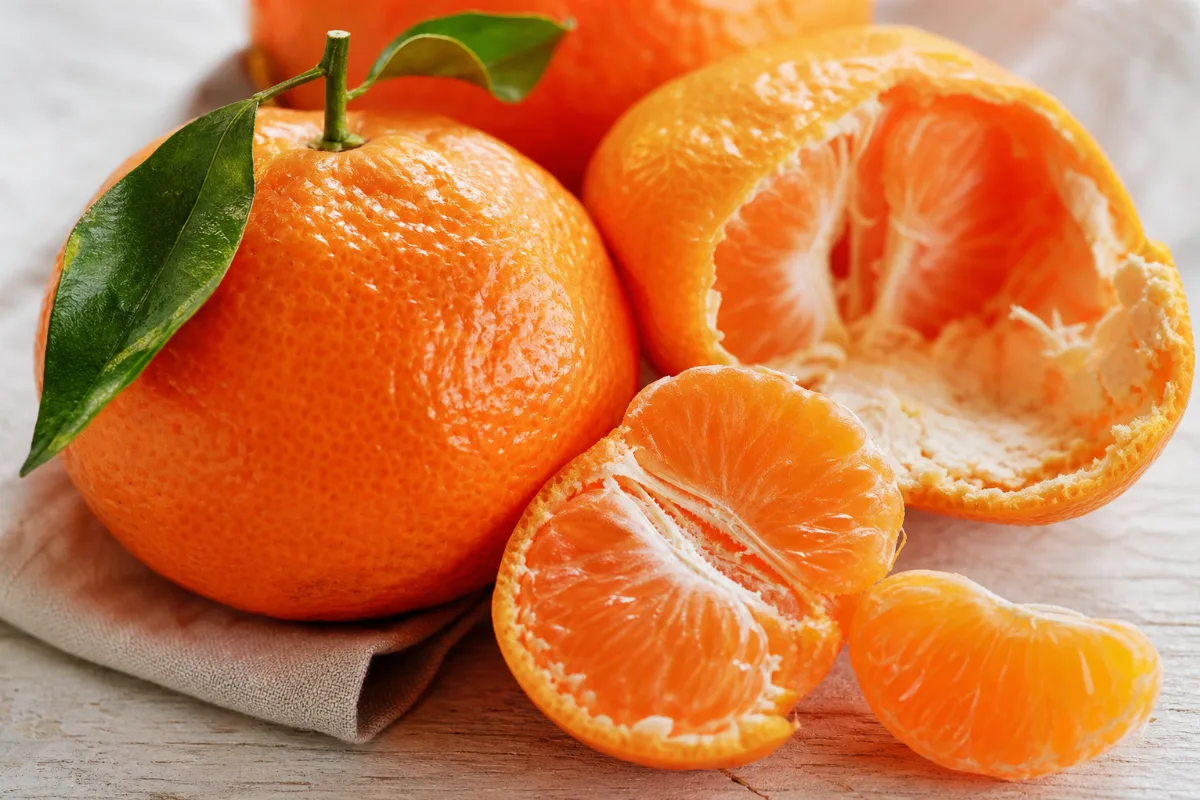
Fruits · Fruit
Mandarins & Tangerines
Citrus reticulata · also called Mandarin, mandarin orange, tangerine, Satsuma, mandarina (Spanish)
Mandarins and tangerines are small, easy-peel citrus fruits. A medium one has about 47 calories and 23.5 mg of vitamin C. Large studies link fruit-rich diets with lower heart disease, but that is an association, and the one small trial of whole mandarins was inconclusive. The main cautions are citrus allergy, itchy mouth from raw fruit in people with hay fever, and checking with a pharmacist about tangelos if your medicine warns against grapefruit.
General information, not medical advice. Last substantive update · Not medically reviewed. A named clinician has not signed off on this page. How this page is made
About Mandarins & Tangerines
Mandarins and tangerines are an easy-peel, vitamin C rich citrus fruit. Research on eating them is thin, so they are best seen as a nutritious everyday fruit rather than a proven remedy.
What it is
Mandarins (Citrus reticulata) are small, loose-skinned citrus fruits in the same family as oranges, lemons and grapefruit. Tangerine is a common name for the same kind of fruit, and Satsuma is a Japanese type.
A medium raw mandarin (88 g) provides about 47 calories, 1.6 g of fibre and 9.3 g of natural sugars, plus about 23.5 mg of vitamin C and 146 mg of potassium (USDA). It is a good source of vitamin C and a small source of fibre.
What the research shows
The NHS lists citrus fruit as a good source of vitamin C, and lack of the vitamin can lead to scurvy. That is the clearest benefit.
Large studies that followed people over time link higher fruit and vegetable intake, including citrus, with lower rates of heart disease and early death. People who eat more fruit may differ in other ways, so this is not proof, and mandarins were not separated. One Japanese cohort linked frequent Satsuma mandarin eating with less arterial stiffness.
A pilot trial of Satsuma mandarins in 26 people found no clear effect on a brain protein, and its mood differences were exploratory. Vitamin C cold trials used tablets, not fruit. Most other claims rest on reviews that give no numbers.
At a glance
Traditional uses history, not proof
- Eaten fresh, as canned segments or as juice
- Dried peel is used in teas and traditional preparations (not covered by the sources we read)
Studied for research
- Vitamin C from food and preventing scurvy, high certainty
- Heart disease and early death in diets rich in fruit and citrus, low certainty
- Arterial stiffness in a Japanese Satsuma cohort, very low certainty
- Mood and BDNF in one small trial, insufficient evidence
- Colds and vitamin C (tablet trials), insufficient for mandarins
Main compounds
- Vitamin C (about 23.5 mg in a medium mandarin)
- Beta-cryptoxanthin and beta-carotene, carotenoids the body can turn into vitamin A
- Dietary fibre (about 1.6 g in a medium mandarin) and potassium
- Citrus flavonoids
Common forms
- Fresh mandarin or tangerine (the form the nutrition figures describe)
- Canned segments
- Juice
- Dried peel (a different product, not assessed)
- Beta-cryptoxanthin supplements (not the fruit)
Research links: NHS: Vitamin C · NHS: Food allergy · Fruit, vegetables and heart disease (International Journal of Epidemiology, 2017) · Satsuma mandarin and arterial stiffness, Mikkabi cohort (2016) · USDA FoodData Central: raw tangerines (mandarin oranges) · Research Library · Genes & Biomarkers Library
What it is and its history
- Accepted scientific name
- Citrus reticulata
- Naming authority
- Blanco (GBIF accepted, usageKey 3190172)
- Synonyms
- Satsuma mandarin is listed in our earlier summary as Citrus unshiu; a GBIF name match for that name returned only the genus, so it was not resolved
- Common names
- Mandarin (English); Mandarin orange (English); Tangerine (English); Satsuma (English); Mandarina (Spanish)
- Family or group
- Rutaceae (the citrus family), which also includes orange, lemon and grapefruit.
- Classification
- Plantae > Sapindales > Rutaceae > Citrus > Citrus reticulata
- Native range
- Not verified from a source read.
- Habitat
- Not verified.
- What it looks like
- Roots: Not verified.; Stems: Not verified.; Leaves: Not verified.; Flowers: Not verified.; Fruit: Small, loose-skinned citrus fruit whose segments separate easily (general description from our earlier summary; not re-sourced).
- Cultivation
- Not verified from a source read.
- Harvest and processing
- Eaten fresh, as canned segments, or as juice; the dried peel is used in teas and traditional preparations (earlier summary; not re-sourced).
- Look-alikes and adulterants
- Name: Orange (Citrus sinensis); Note: A different citrus. USDA and the National Kidney Foundation treat it differently on potassium.; Name: Tangelo; Note: The FDA describes it as a cross between tangerines and grapefruit and says it might act like grapefruit with some medicines. It is not the same as a mandarin.
- Sustainability and conservation
- Not assessed.
Photographs
Traditional use and history history, not clinical proof
| Tradition or era | Documented use | Source |
|---|---|---|
| Satsuma mandarin in Japan | A review describes the Satsuma mandarin (Citrus unshiu) as a unique Japanese citrus. No source we read documents its wider history, or traditional medicinal uses of the fruit or peel. | p33783749 (abstract only); wider history NOT verified (no source read) |
Traditional use shows how it was used. It does not show that it works or is safe today.
What is inside, and how it may work
What it contains and how those compounds act in cells and animals. Laboratory and animal mechanisms are not proven effects in people.
Main compounds
| Compound | Family | Where it is concentrated | Activity studied | Level of evidence |
|---|---|---|---|---|
| Vitamin C | vitamin | Flesh 26.7 mg per 100 g; about 23.5 mg in a medium mandarin (USDA) | A nutrient the body needs; lack causes scurvy. 16 14 | Composition data and official guidance |
| Beta-cryptoxanthin | carotenoid | Flesh 407 mcg per 100 g (USDA); a review calls Satsuma mandarin one of the richest food sources | Can be converted to vitamin A (review). Supplement trial found no effect on mood or metabolic measures. 16 5 8 | Composition data, a small trial and a review |
| Beta-carotene | carotenoid | Flesh 155 mcg per 100 g (USDA) | A vitamin A precursor. Not tested here as a treatment. 16 | Composition data |
| Dietary fibre | carbohydrate | Flesh 1.8 g per 100 g; about 1.6 g in a medium mandarin (USDA) | Provides fibre in the diet. 16 | Composition data |
| Citrus flavonoids | plant compounds | Not verified | A review says citrus fruits contain flavonoids and carotenoids; amounts and effects in people were not given in the abstract. 2 | Review (abstract only) |
Mechanisms, receptors and pathways
| Target or pathway | Gene or receptor | What was found | Level |
|---|---|---|---|
| Conversion of beta-cryptoxanthin to vitamin A | A review says beta-cryptoxanthin may play a role in vitamin A function. 5 | Review (abstract only) | |
| Possible effect on BDNF | BDNF | Proposed reason for the mood trial; the main BDNF result was not significant. 6 | Hypothesis tested in one small trial |
| Vitamin C functions | Vitamin C helps protect cells, maintain skin, blood vessels, bones and cartilage, and helps wound healing (NHS). 14 | Established physiology (official guidance) |
Absorption, metabolism and elimination
- Absorption
- Not researched for the fruit.
- Distribution
- Not found.
- Metabolism
- Beta-cryptoxanthin can be converted to vitamin A (review).
- Elimination
- Not found.
- Bioavailability
- A supplement trial raised blood beta-cryptoxanthin clearly (9.0 umol/L at 6 mg a day versus 0.4 on placebo); this is not the fruit.
Isolated compounds versus whole extracts
The cold trials were of vitamin C tablets and the beta-cryptoxanthin trial used a purified supplement, so neither shows what eating a mandarin does. Juice has less fibre than the fruit. Dried peel and extracts are different products and are not assessed here.
Nutritional composition
Per 100 g of raw mandarin (tangerine) (USDA FoodData Central, SR Legacy): 53 kcal, 85.2 g water, 0.81 g protein, 0.31 g fat, 13.3 g carbohydrate of which 10.6 g are sugars, and 1.8 g fibre. One medium mandarin (88 g) provides about 47 kcal, 1.6 g fibre and 9.3 g sugars, plus about 23.5 mg vitamin C, 146 mg potassium, 33 mg calcium and 14 mcg folate. It also has about 358 mcg of beta-cryptoxanthin and 136 mcg of beta-carotene. A mandarin is a good source of vitamin C and a small source of fibre. Per-portion figures are calculated from the per-100 g values. Values vary with variety, ripeness and storage.
1 high certainty2 low certainty1 very low certainty3 not enough evidence
What was looked at
The 7 benefits and uses checked for Mandarins & Tangerines, each with how strong the evidence is. Tap one to open it.
- Vitamin C from food and preventing scurvyHigh certainty
- Heart disease and early death (diets rich in fruit and citrus)Low certainty
- Arterial stiffness (Satsuma mandarin eating in a Japanese cohort)Very low certainty
- Mood and BDNF (Satsuma mandarin pilot trial)Not enough evidence
- Common colds (vitamin C, from supplement trials)Not enough evidence
- Beta-cryptoxanthin (the carotenoid in mandarins) as a supplementLow certainty
- Body fat, bone, skin, tiredness, diabetes and other claimsNot enough evidence
Lab markers tracked in the studies
Brachial-ankle pulse wave velocity (arterial stiffness)Serum BDNFDepression-Dejection mood score
What is Mandarins & Tangerines good for?
The main studied uses and how strong the human evidence is for each. Most results are links seen in eating habits, or one small trial, not proof that mandarins prevent or treat a disease.
Benefits, one by one
Each card is a research question, not a promise. Tap a goal to filter. Open a card to see the studies, doses and limits.
Vitamin C from food and preventing scurvy
High certaintyMandarins are a source of vitamin C. A medium one gives about 23.5 mg, more than half of the 40 mg a day the NHS says adults need. Lack of vitamin C causes scurvy, so a diet with fruit like this helps prevent that. This is the ordinary job of the vitamin, not a special mandarin effect.
2 studiesFresh fruit. Canned segments and juice have different amounts; labels…
Studies, doses and limits
What the trials found
The NHS lists citrus fruit as a good source of vitamin C and says lack of the vitamin can lead to scurvy. USDA lists 26.7 mg of vitamin C per 100 g of raw mandarin.
Results
A medium mandarin (88 g) provides about 23.5 mg of vitamin C. The NHS says adults aged 19 to 64 need 40 mg a day and should get all they need from a varied diet.
Effect sizes as reported
Not a trial outcome. 26.7 mg per 100 g (USDA).
Why this rating
Well-established nutrition fact from official guidance and a food-composition database. It applies to getting enough vitamin C, not to extra benefit above that.
Form and dose studied
Fresh fruit. Canned segments and juice have different amounts; labels vary.
Who was studied
Everyone; matters most for people whose diet lacks fruit and vegetables.
Limits
Says nothing about benefits above what the body needs. Vitamin C content varies with variety, ripeness and storage.
Why researchers looked
Citrus is a classic food source of vitamin C.
Traditional use
Citrus fruit has long been linked with preventing scurvy; no source we read documents the history.
Proposed mechanism Established physiology
Vitamin C helps protect cells, keeps skin, blood vessels, bones and cartilage healthy, and helps wounds heal (NHS).
A proposed mechanism does not show that the effect happens in people.
Vitamin C from the fruit is not the concern; very large supplement amounts are covered on the Safety tab.
Heart disease and early death (diets rich in fruit and citrus)
Low certaintyIn large groups of people followed over time, those who ate more fruit and vegetables, including citrus fruits, had lower rates of heart disease and early death. This is a link seen in eating habits. It does not prove that mandarins protect the heart, and mandarins were not separated from other citrus.
1 studiesEating whole citrus fruit as part of the diet.
Studies, doses and limits
What the trials found
A 2017 review of 95 prospective studies found that fruit and vegetables combined went with lower cardiovascular disease and early death, and that citrus fruits showed inverse associations with cardiovascular disease and all-cause mortality.
Results
Lower risk in people who ate more fruit. Citrus fruits were grouped together, so mandarins alone are not isolated.
Effect sizes as reported
Fruit and vegetables combined, per 200 g a day: cardiovascular disease RR 0.92 (0.90-0.95), all-cause mortality RR 0.90 (0.87-0.93). No citrus-only or mandarin-only figure in the abstract.
Why this rating
Observational data only. People who eat more fruit may differ in other ways. Citrus is grouped, and the strongest numbers are for all fruit and vegetables together.
Form and dose studied
Eating whole citrus fruit as part of the diet.
Who was studied
Adults in cohort studies.
Limits
Association, not cause. No mandarin-specific effect size in the source read.
Why researchers looked
Fruit-rich diets have long been linked with better heart health, and citrus is a widely eaten fruit group.
Proposed mechanism Preliminary mechanism
Possible routes include fibre, potassium, vitamin C and plant compounds such as flavonoids and carotenoids. These ideas come largely from lab work and are unproven in people.
A proposed mechanism does not show that the effect happens in people.
None specific to this finding.
Arterial stiffness (Satsuma mandarin eating in a Japanese cohort)
Very low certaintyIn one group of Japanese adults followed for years, people who ate Satsuma mandarins often, and who had more mandarin carotenoids in their blood, were less likely to develop stiff arteries. It is a single regional observational study and a marker, not a heart attack or stroke.
1 studiesWhole Satsuma mandarin as usually eaten in Japan.
Studies, doses and limits
What the trials found
The Mikkabi cohort followed 635 adults with normal arterial stiffness at the start; 99 developed high stiffness. Those in the top third of blood beta-cryptoxanthin, beta-carotene and total carotenoids had significantly lower hazard than the bottom third, and eating 3 to 4 Satsuma mandarins a day was linked with lower risk than fewer than 1 a day.
Results
Lower chance of developing high arterial stiffness in higher-intake groups.
Effect sizes as reported
Hazard ratios are not given in the abstract.
Why this rating
One observational cohort in one region, a marker outcome, and the exact numbers were not in the abstract read. Other habits of frequent mandarin eaters may explain the link.
Form and dose studied
Whole Satsuma mandarin as usually eaten in Japan.
Who was studied
Adults in one Japanese town.
Limits
Association, not cause. The authors say longitudinal and interventional studies are needed.
Why researchers looked
Satsuma mandarins are very rich in the carotenoid beta-cryptoxanthin, and blood carotenoids have been linked with heart health.
Proposed mechanism Preliminary mechanism
Carotenoids may act as antioxidants, but this was not tested in the study.
A proposed mechanism does not show that the effect happens in people.
None specific.
Mood and BDNF (Satsuma mandarin pilot trial)
Not enough evidenceOne small trial of 26 healthy people tested two Satsuma mandarins a day for 8 weeks. The main test of BDNF, a brain protein, found no clear difference. Some mood scores looked better in the mandarin group in extra analyses. It is too small and too uncertain to count as evidence.
1 studiesWhole Satsuma mandarin fruit.
Studies, doses and limits
What the trials found
A 2026 pilot randomized trial: 13 people ate two Satsuma mandarins a day, 13 ate none, for 8 weeks.
Results
No significant group-by-time effect on serum BDNF and no significant group difference at any time point. In exploratory analyses the mandarin group had higher Vigor-Activity and lower Depression-Dejection scores than the no-intake group.
Effect sizes as reported
Main BDNF analysis not significant. Mood differences are exploratory; no effect sizes in the abstract.
Why this rating
A 26-person pilot, not blinded, no placebo fruit, main outcome not significant, mood findings exploratory.
Form and dose studied
Whole Satsuma mandarin fruit.
Who was studied
Healthy adults.
Limits
Preliminary; the authors themselves call it a pilot study.
Why researchers looked
BDNF is linked to mood, and mandarins contain carotenoids and flavonoids that researchers wanted to test.
Proposed mechanism Unknown
The idea is that plant compounds might raise or protect BDNF. Not established.
A proposed mechanism does not show that the effect happens in people.
None reported in the abstract.
Common colds (vitamin C, from supplement trials)
Not enough evidenceMandarins contain vitamin C, but the cold trials used vitamin C tablets, not fruit. In those trials, daily vitamin C did not clearly lower how many colds people caught in the general public, but it shortened colds a little. Nobody has tested mandarins for colds.
1 studiesVitamin C tablets in the trials (not the fruit).
Studies, doses and limits
What the trials found
A Cochrane review of 29 trial comparisons (11,306 people) of regular vitamin C tablets, at least 0.2 g a day.
Results
General community: risk ratio 0.97 (0.94 to 1.00) for catching a cold. Colds were 8% shorter in adults and 14% shorter in children with regular vitamin C. Starting after symptoms began showed no consistent effect. Five trials of people under heavy physical stress (marathon runners, skiers, soldiers) found a risk ratio of 0.48.
Effect sizes as reported
RR 0.97 (95% CI 0.94-1.00) general community; duration shorter by 8% (3-12%) in adults.
Why this rating
For mandarins specifically there is no trial. The supplement result is mixed and cannot be moved over to eating fruit.
Form and dose studied
Vitamin C tablets in the trials (not the fruit).
Who was studied
General community and people under brief severe exercise or cold stress.
Limits
Supplement trials only. The review concludes routine supplementation is not justified for the general population.
Why researchers looked
Vitamin C is often linked with colds.
Traditional use
Citrus is a popular folk idea for colds; the trials below are about tablets.
Proposed mechanism Unknown
Not established for fruit.
A proposed mechanism does not show that the effect happens in people.
See the Safety tab for large supplement amounts.
Beta-cryptoxanthin (the carotenoid in mandarins) as a supplement
Low certaintySatsuma mandarins are rich in a carotenoid called beta-cryptoxanthin. A trial of purified beta-cryptoxanthin in 90 healthy women found it safe over 8 weeks and found no effect on mood, sleep, activity or metabolic measures. This is a supplement, not the fruit.
1 studiesPurified supplement, not mandarins.
Studies, doses and limits
What the trials found
A 2023 randomized, double-blind, placebo-controlled trial of 3 or 6 mg a day for 8 weeks in 90 healthy women.
Results
Safe and well tolerated. Blood levels rose clearly. No effects on gene expression, mood, activity, sleep, metabolic measures or gut bacteria.
Effect sizes as reported
Blood beta-cryptoxanthin 9.0 umol/L (6 mg) versus 0.4 umol/L (placebo) at 8 weeks; no effect on tested outcomes.
Why this rating
A well-designed trial, but short, in healthy young women, using a purified supplement, and two authors work for a nutrition company.
Form and dose studied
Purified supplement, not mandarins.
Who was studied
Healthy Asian women aged 21 to 35.
Limits
Safety and levels were the aim; it was not designed to show benefit.
Why researchers looked
Beta-cryptoxanthin is a vitamin A precursor found in high amounts in Satsuma mandarin, and has been linked with several possible health effects.
Proposed mechanism Preliminary mechanism
The body can turn beta-cryptoxanthin into vitamin A; a review says it may play a role in vitamin A function.
A proposed mechanism does not show that the effect happens in people.
Well tolerated for 8 weeks in this trial.
Body fat, bone, skin, tiredness, diabetes and other claims
Not enough evidenceReviews list many possible benefits of Satsuma mandarin carotenoids, such as body fat, bone, skin whitening, exercise tiredness and diabetes prevention. The abstracts give no numbers and mix lab, animal and human work, so these are claims, not shown benefits.
2 studiesMixed.
Studies, doses and limits
What the trials found
A short 2021 narrative review of beta-cryptoxanthin (author at a company) and a 2025 review of citrus fruits and juices.
Results
Possible effects listed without figures.
Effect sizes as reported
Not given in the abstracts.
Why this rating
Abstract-only, no numbers, mixed study types, one review by a company author.
Form and dose studied
Mixed.
Who was studied
Mixed.
Limits
Cannot be separated into human and non-human results from the abstracts.
Why researchers looked
Mandarins are rich in carotenoids and flavonoids that are active in lab tests.
Proposed mechanism Preliminary mechanism
Antioxidant and other effects are described, mainly from lab studies.
A proposed mechanism does not show that the effect happens in people.
None specific.
Connections to the rest of health
How Mandarins & Tangerines connects to the rest of our health knowledge graph. Every link says what kind of connection it is. A safety link (for example to the liver) is a warning, not a benefit. A study that merely mentions a topic never creates a benefit link.
Explore every connection: goals, body systems, organs, symptoms, genes
A. Wellness goals
| Connected to | Kind of connection | Evidence status | Context | Studies |
|---|---|---|---|---|
| Immune Support | Demonstrated clinical effect | High certainty | Vitamin C from food and preventing scurvy: Mandarins are a source of vitamin C. A medium one gives about 23.5 mg, more than half of the 40 mg a day the NHS says adults need. Lack of vitamin C causes scurvy, so a diet with fruit like this helps prevent that. This is the ordinary job of the vitamin, not a special mandarin effect. | 14 16 |
| Heart Health | Potential benefit | Low certainty | Heart disease and early death (diets rich in fruit and citrus): In large groups of people followed over time, those who ate more fruit and vegetables, including citrus fruits, had lower rates of heart disease and early death. This is a link seen in eating habits. It does not prove that mandarins protect the heart, and mandarins were not separated from other citrus. Arterial stiffness (Satsuma mandarin eating in a Japanese cohort): In one group of Japanese adults followed for years, people who ate Satsuma mandarins often, and who had more mandarin carotenoids in their blood, were less likely to develop stiff arteries. It is a single regional observational study and a marker, not a heart attack or stroke. | 1 7 |
| Mood Balance | Potential benefit | Not enough evidence | Mood and BDNF (Satsuma mandarin pilot trial): One small trial of 26 healthy people tested two Satsuma mandarins a day for 8 weeks. The main test of BDNF, a brain protein, found no clear difference. Some mood scores looked better in the mandarin group in extra analyses. It is too small and too uncertain to count as evidence. | 6 |
| Immune Support | Biological association | Not enough evidence | Common colds (vitamin C, from supplement trials): Mandarins contain vitamin C, but the cold trials used vitamin C tablets, not fruit. In those trials, daily vitamin C did not clearly lower how many colds people caught in the general public, but it shortened colds a little. Nobody has tested mandarins for colds. | 3 |
| Healthy Skin | Biological association | Low certainty | Beta-cryptoxanthin (the carotenoid in mandarins) as a supplement: Satsuma mandarins are rich in a carotenoid called beta-cryptoxanthin. A trial of purified beta-cryptoxanthin in 90 healthy women found it safe over 8 weeks and found no effect on mood, sleep, activity or metabolic measures. This is a supplement, not the fruit. | 8 |
| Metabolic Health | Preliminary mechanism | Not enough evidence | Body fat, bone, skin, tiredness, diabetes and other claims: Reviews list many possible benefits of Satsuma mandarin carotenoids, such as body fat, bone, skin whitening, exercise tiredness and diabetes prevention. The abstracts give no numbers and mix lab, animal and human work, so these are claims, not shown benefits. | 5 2 |
B. Body systems
| Connected to | Kind of connection | Evidence status | Context | Studies |
|---|---|---|---|---|
| Integumentary System | Biological association | High certainty | Studied for: Vitamin C from food and preventing scurvy Studied for: Beta-cryptoxanthin (the carotenoid in mandarins) as a supplement | 14 16 8 |
| Cardiovascular System | Biological association | Low certainty | Studied for: Heart disease and early death (diets rich in fruit and citrus) Studied for: Arterial stiffness (Satsuma mandarin eating in a Japanese cohort) | 1 7 |
| Nervous System | Biological association | Not enough evidence | Studied for: Mood and BDNF (Satsuma mandarin pilot trial) | 6 |
| Immune System | Biological association | Not enough evidence | Studied for: Common colds (vitamin C, from supplement trials) | 3 |
| Endocrine System | Biological association | Not enough evidence | Studied for: Body fat, bone, skin, tiredness, diabetes and other claims | 5 2 |
E. Health conditions
| Connected to | Kind of connection | Evidence status | Context | Studies |
|---|---|---|---|---|
| Food allergy | Adverse effect or risk | Documented risk | Citrus allergy is possible and may cross between citrus species; pollen-food allergy can cause an itchy mouth after raw fruit. Citrus allergy is possible and may cross between citrus species; raw fruit can cause an itchy mouth in pollen-food allergy. Preparation or compound: Mandarin and other citrus |
9 13 4 |
| High blood potassium (kidney disease) | Documented risk | Listed as lower-potassium fruit by the National Kidney Foundation; individual limits come from a dietitian. Preparation or compound: Whole mandarin, juice |
15 | |
| Scurvy | Potential benefit | High certainty | Vitamin C from citrus fruit helps prevent the deficiency disease scurvy. Preparation or compound: Fresh mandarin |
14 16 |
I. Biomarkers
| Connected to | Kind of connection | Evidence status | Context | Studies |
|---|---|---|---|---|
| Brachial-ankle pulse wave velocity (arterial stiffness) | Biological association | Very low certainty | Measured in trials: lower risk of high stiffness with higher intake. A lab change is not the same as a health benefit. | 7 |
| Serum BDNF | Biological association | Not enough evidence | Measured in trials: no clear change. A lab change is not the same as a health benefit. | 6 |
| Depression-Dejection mood score | Biological association | Not enough evidence | Measured in trials: lower in an exploratory analysis. A lab change is not the same as a health benefit. | 6 |
L. Active compounds
| Connected to | Kind of connection | Evidence status | Context | Studies |
|---|---|---|---|---|
| Vitamin C | Biological association | Composition data and official guidance | A nutrient the body needs; lack causes scurvy. Preparation or compound: Flesh |
16 14 |
| Beta-cryptoxanthin | Biological association | Composition data, a small trial and a review | Can be converted to vitamin A (review). Supplement trial found no effect on mood or metabolic measures. Preparation or compound: Flesh |
16 5 8 |
| Beta-carotene | Biological association | Composition data | A vitamin A precursor. Not tested here as a treatment. Preparation or compound: Flesh |
16 |
| Dietary fibre | Biological association | Composition data | Provides fibre in the diet. Preparation or compound: Flesh |
16 |
| Citrus flavonoids | Biological association | Review (abstract only) | A review says citrus fruits contain flavonoids and carotenoids; amounts and effects in people were not given in the abstract. Preparation or compound: Not verified |
2 |
Each connection is stored with the ingredient, the connected record, the kind of connection, the evidence status, the supporting studies, the preparation or compound involved, and a review date (last reviewed October 25, 2026).
Evidence at a glance: what the research found for 7 outcomes
Each outcome below is one thing researchers measured. Certainty is how far the evidence can be trusted, not how well it works. The full studies are on the next tab.
The evidence
The research centre for Mandarins & Tangerines. Every record here was checked against PubMed or the publisher's page; we never list a study we have not verified.
Evidence by outcome
Bars show how many studies we found for each outcome, not how well it works. People are added up across trials only (reviews are not added, to avoid double counting).
How we rate evidence
High certainty
Several well-run trials or reviews agree; further research is unlikely to change the picture much.
Moderate certainty
Good trials point the same way, but some doubt remains.
Low certainty
Small, short or inconsistent trials. The finding could change with better research.
Very low certainty
Very little or very weak human data. Treat as a possibility only.
Mixed findings
Trials or reviews disagree with each other.
Not enough evidence
Not enough human research to say either way.
Evidence against
Good research found no benefit, or found harm.
We take the reviewers' own risk-of-bias and GRADE statements where they exist, and otherwise judge from study size, design, consistency, directness and whether a product matches what is sold. Many publications do not make evidence high. Method note: We started from our earlier mandarin summary, re-read the USDA FoodData Central record, and read PubMed abstracts and the NHS, FDA and National Kidney Foundation pages. Only abstracts were read for studies. Items we could not verify are flagged in the research gaps.
Study library: every study we checked 16
| Study | Design | People | Product, dose, length | Result |
|---|---|---|---|---|
| Aune 2017 Fruit and vegetable intake and the risk of cardiovascular disease, total cancer and all-cause mortality-a systematic review and dose-response meta-analysis of prospective studies. Int J Epidemiol · PMID 28338764 · DOI |
Systematic review (observational cohort studies) |
95 prospective studies (142 publications) of fruit and vegetable intake in adults | Usual dietary intake of fruit and vegetables; citrus fruits analysed as one fruit type fruit Follow-up varied by study · vs Lower intake |
For fruits and vegetables combined, each 200 g a day went with a lower risk: relative risk 0.92 for coronary heart disease, 0.84 for stroke, 0.92 for cardiovascular disease and 0.90 for all-cause death. Inverse associations were also seen for citrus fruits (with apples and pears, greens and others) with cardiovascular disease and all-cause mortality. The abstract gives no citrus-only figure and does not name mandarins. Fruit and vegetables combined, per 200 g/day: cardiovascular disease RR 0.92 (95% CI 0.90-0.95); all-cause mortality RR 0.90 (0.87-0.93) (0.90-0.95 (cardiovascular disease, combined)) Methods, limits and fundingOutcomes: Cardiovascular disease, total cancer, all-cause mortality Limitations: Observational: shows an association, not cause. Citrus fruits are grouped (mandarins not separated), and the headline numbers are for all fruit and vegetables together. Heterogeneity was high for some outcomes (I2 up to 83%). Funding and conflicts: Not stated in the abstract read Read: abstract |
| Dhuique-Mayer 2025 An overview of the nutritional quality and health benefits linked to the world diversity of citrus fruits/juices. J Food Sci · PMID 39731722 · DOI |
Narrative review mixed |
Human clinical trials of citrus fruit or citrus compound supplements, plus composition data | Citrus fruits and juices, and supplements of citrus bioactive compounds fruit, juice Varied Varied · vs Varied |
The review describes citrus fruits and juices as containing vitamins, minerals, fibre, flavonoids and carotenoids, and says the health effect of eating citrus seems to depend on the whole mix of compounds. The abstract gives no numbers and names no mandarin-specific result. Qualitative Methods, limits and fundingOutcomes: Type 2 diabetes, cardiovascular disease, obesity; composition of carotenoids and flavonoids Limitations: Narrative review; the abstract does not separate mandarins from other citrus or human from lab findings. Funding and conflicts: Authors declare no conflicts of interest Read: abstract |
| Hemila 2013 Vitamin C for preventing and treating the common cold. Cochrane Database Syst Rev · PMID 23440782 · DOI |
Systematic review and meta analysis of randomised placebo controlled trials (vitamin C supplements) |
29 trial comparisons with 11,306 people for colds caught; 31 comparisons for cold length | Vitamin C tablets, at least 0.2 g a day (supplement, not fruit) Trial doses, not advice Varied · vs Placebo |
In general community trials (10,708 people) regular vitamin C did not clearly cut the number of colds (risk ratio 0.97, 95% CI 0.94 to 1.00). In five trials of marathon runners, skiers and soldiers the risk ratio was 0.48 (0.35 to 0.64). Colds were shortened by 8% in adults and 14% in children. Starting vitamin C after a cold began showed no consistent effect. The authors conclude routine supplementation is not justified for the general population. General community: RR 0.97 (95% CI 0.94-1.00); cold duration shorter by 8% (3-12%) in adults (0.94-1.00 (general community, colds caught)) Methods, limits and fundingOutcomes: Number, length and severity of common colds Limitations: These are supplement trials. They do not test mandarins or any fruit, so they cannot be read as a mandarin result. Funding and conflicts: Authors declare no conflict of interest Read: abstract |
| Marzec 2026 Pollen-Food Allergy Syndrome in Children: Global Prevalence and Pathogenesis. Nutrients · PMID 42514315 · DOI |
Narrative review |
Studies of pollen-food allergy syndrome in children worldwide | n/a |
Pollen-food allergy syndrome usually causes itching, burning, swelling and redness of the mouth and throat within a short time of eating a raw plant food. It is mostly limited to the mouth and throat, but breathing or stomach symptoms and, rarely, anaphylaxis can occur. Rates range from a few percent in the general child population to 50 to 80% among children with allergic rhinitis. Mandarin is not named in the abstract. Review; prevalence ranges only Methods, limits and fundingOutcomes: Prevalence, symptoms and causes of pollen-food allergy syndrome Limitations: Abstract does not name mandarins or any specific fruit. Funding and conflicts: Authors declare no conflicts of interest Read: abstract |
| Mukai 2021 beta-Cryptoxanthin from Satsuma Mandarin and Its Multiple Functions. Adv Exp Med Biol · PMID 33783749 · DOI |
Narrative review mixed |
Mixed studies of beta-cryptoxanthin (human and non-human not separated in the abstract) | Beta-cryptoxanthin from Satsuma mandarin fruit Varied Varied · vs Varied |
The author says Satsuma mandarin is among the richest food sources of beta-cryptoxanthin and describes a range of possible functions, including body-fat reduction, cosmetic (whitening), osteoporosis prevention, and, in human studies, anti-exercise-fatigue and diabetes prevention actions. The abstract gives no numbers or study sizes. Qualitative Methods, limits and fundingOutcomes: Body fat, skin whitening, bone, exercise fatigue, diabetes prevention Limitations: Short narrative review with no figures in the abstract; mixes human and non-human work. The author works for Daicel Corporation, a company, so treat as possible commercial interest. Funding and conflicts: Author affiliation: Daicel Corporation, Tokyo (company) Read: abstract |
| Nakajima 2026 Effects of Citrus unshiu Intake on Serum Brain-Derived Neurotrophic Factor Levels and Mood States: A Pilot Randomized Controlled Trial. Prev Nutr Food Sci · PMID 42382031 · DOI |
Pilot randomized controlled trial (no placebo; control group ate no mandarins) |
26 26 healthy participants (13 in each group) |
Whole Satsuma mandarin (Citrus unshiu) fruit, about 107 g each fruit Two fruits a day (trial protocol, not advice) 8 weeks, measured at weeks 0, 4 and 8 · vs No mandarin intake |
The main analysis found no significant group-by-time difference in serum BDNF and no significant between-group difference at any time point. In extra, unadjusted analyses, the mandarin group had a higher Vigor-Activity score and a lower Depression-Dejection score than the no-intake group. The authors call the findings preliminary. No significant main BDNF effect; mood score differences were exploratory Methods, limits and fundingOutcomes: Serum BDNF (brain-derived neurotrophic factor) and mood scores (Profile of Mood States) Limitations: Only 26 people, not blinded, no placebo fruit, healthy people, mood differences came from exploratory analyses without a stated correction for many comparisons. Funding and conflicts: Authors declare no conflict of interest Read: abstract |
| Not listed in the abstract record read (corresponding author in Hamamatsu 2016 Serum beta-cryptoxanthin and beta-carotene derived from Satsuma mandarin and brachial-ankle pulse wave velocity: The Mikkabi cohort study. Nutr Metab Cardiovasc Dis · PMID 27212620 · DOI |
Prospective cohort study |
635 635 residents of Mikkabi, Japan, with normal arterial stiffness at the start; 99 developed high stiffness during 57,921 person-months of follow-up |
Usual Satsuma mandarin eating; blood levels of beta-cryptoxanthin and beta-carotene fruit Surveys 2003 to 2013 · vs Lowest tertile or fewer than 1 mandarin a day |
People in the highest third of blood beta-cryptoxanthin, beta-carotene and total carotenoids had a significantly lower hazard of developing high arterial stiffness than the lowest third. Blood levels were higher in people who ate Satsuma mandarin often. Compared with fewer than 1 a day, eating 3 to 4 a day was linked with a lower risk of high stiffness. Hazard ratios are not given in the abstract; the abstract says significantly low in the top versus bottom tertile Methods, limits and fundingOutcomes: High brachial-ankle pulse wave velocity (a measure of arterial stiffness) Limitations: Observational: people who eat more mandarins may differ in other ways. Arterial stiffness is a marker, not a heart attack or stroke. Regional cohort in Japan. Numbers beyond those above were not in the abstract. Funding and conflicts: Not stated in the abstract read Read: abstract |
| Tan 2023 Safety, Tolerability, and Pharmacokinetics of beta-Cryptoxanthin Supplementation in Healthy Women: A Double-Blind, Randomized, Placebo-Controlled Clinical Trial. Nutrients · PMID 37242207 · DOI |
Randomized double blind placebo controlled trial (supplement) |
90 90 healthy Asian women aged 21 to 35 |
Beta-cryptoxanthin supplement (the carotenoid found in mandarins), not the fruit 3 or 6 mg a day (trial doses, not advice) 8 weeks · vs Placebo |
Eight weeks of 3 or 6 mg a day was safe and well tolerated. Blood beta-cryptoxanthin rose a great deal. No effects were found on blood retinoid-dependent gene expression, mood, physical activity, sleep, metabolic measures or gut bacteria. No effect on the outcomes tested; blood beta-cryptoxanthin 9.0 umol/L (6 mg) versus 0.4 umol/L (placebo) Methods, limits and fundingOutcomes: Safety, blood carotenoid levels, gene expression, mood, activity, sleep, metabolic measures, gut bacteria Limitations: A purified supplement in healthy young women, not mandarins. Short trial. Funding and conflicts: Two authors work for DSM Nutritional Products Ltd (a nutrition company); treat as possible industry involvement Read: abstract |
| Zamarro Parra 2025 Orange Allergy Beyond LTP: IgE Recognition of Germin-like Proteins in Citrus Fruits. Curr Issues Mol Biol · PMID 40864775 · DOI |
Case series with lab testing |
5 5 patients in Spain with immediate allergic reactions after eating orange |
Skin and blood tests with orange, lemon and mandarin (pulp, peel, seeds) pulp, peel, seeds |
All five patients recognised a 23 kDa germin-like protein in orange (pulp and peel), lemon (peel) and mandarin (peel). The authors suggest a shared citrus allergen that could cause allergic reactions across citrus species. The abstract says orange allergy may account for up to 3 to 4% of food allergies. Lab recognition in 5 patients, not a frequency Methods, limits and fundingOutcomes: IgE (allergy antibody) binding to citrus proteins Limitations: Five people who were already allergic to orange; says nothing about how common mandarin allergy is. Some authors work for a diagnostics company (DIATER Laboratories). Funding and conflicts: Some authors employed by DIATER Laboratories (declared in the paper) Read: abstract |
| s-fda-grapefruit FDA: Grapefruit Juice and Some Drugs Don't Mix · Source |
Official health guidance n/a |
Methods, limits and fundingRead: full-text | ||
| s-fda-produce-safely FDA: Selecting and Serving Produce Safely · Source |
Official health guidance n/a |
Methods, limits and fundingRead: full-text | ||
| s-gbif-citrus-reticulata GBIF Backbone: Citrus reticulata Blanco (usageKey 3190172) · Source |
Reference database n/a |
Methods, limits and fundingRead: full-text | ||
| s-nhs-food-allergy NHS: Food allergy · Source |
Official health guidance n/a |
Methods, limits and fundingRead: full-text | ||
| s-nhs-vitamin-c NHS: Vitamin C · Source |
Official health guidance n/a |
Methods, limits and fundingRead: full-text | ||
| s-nkf-potassium National Kidney Foundation: Potassium and Your CKD Diet · Source |
Patient guidance from a charity n/a |
Methods, limits and fundingRead: full-text | ||
| s-usda-fdc-169105 USDA FoodData Central: Tangerines, (mandarin oranges), raw (FDC 169105, SR Legacy) · Source |
Food composition database n/a |
Methods, limits and fundingRead: full-text |
What we do not know yet
- No trial has tested eating mandarins for heart attacks, stroke, blood pressure, cholesterol, colds or weight.
- Only one small human trial of whole mandarins (26 people) was found; its main result was not significant.
- The large studies group citrus fruits together and do not separate mandarins.
- Pregnancy, breastfeeding, choking risk for young children, dental effects, heartburn, FODMAP and histamine were not researched.
- Pesticide residues on the peel, and dried peel and essential oil, were not researched.
- Whether the shared citrus allergen is a common cause of mandarin allergy was not found.
How new research is added
New studies are found by a saved PubMed search and placed in a review queue before the page changes.
Lab markers
What changed in blood or saliva tests during trials. A changed number is not the same as feeling or being healthier, and we give no "normal ranges".
Other 3
Brachial-ankle pulse wave velocity (arterial stiffness)
Lower risk of high stiffness with higher intake in trials
A measure of how fast the pulse travels between arm and ankle. Faster means stiffer arteries.
Very low certaintyResults and what it means
Why it was measured
A marker of blood-vessel health.
Statistical vs. clinical meaning
A marker only; it is not known if eating mandarins changes heart outcomes.
Safety implication
None specific.
| Study | Result | People | Product |
|---|---|---|---|
| 7 | Top third of blood beta-cryptoxanthin and carotenoids had significantly lower hazard of high stiffness; 3 to 4 Satsuma mandarins a day linked with lower risk than fewer than 1 a day. Exact ratios not in the abstract. | 635 Japanese adults | Usual Satsuma mandarin eating (observational) |
Serum BDNF
No clear change in trials
A blood measure of brain-derived neurotrophic factor, a protein involved in nerve cell health.
Not enough evidenceResults and what it means
Why it was measured
Sometimes used as a research marker linked to mood.
Statistical vs. clinical meaning
No clear effect found in a small pilot.
Safety implication
None specific.
| Study | Result | People | Product |
|---|---|---|---|
| 6 | No significant group-by-time effect and no significant between-group difference at weeks 0, 4 or 8 | 26 healthy adults | Two Satsuma mandarins a day for 8 weeks |
Depression-Dejection mood score
Lower in an exploratory analysis in trials
One scale of the Profile of Mood States questionnaire, which asks people how they feel.
Not enough evidenceResults and what it means
Why it was measured
A common questionnaire in mood research.
Statistical vs. clinical meaning
A questionnaire change in healthy people without placebo or blinding; not a treatment result.
Safety implication
None specific.
| Study | Result | People | Product |
|---|---|---|---|
| 6 | Significant improvement versus the no-intake group in exploratory analyses; the main BDNF analysis was not significant | 26 healthy adults | Two Satsuma mandarins a day for 8 weeks |
Safety
What studies and official sources say about side effects, medicines and who should check first. Each point shows what kind of evidence it comes from.
Main points to know 4
- Citrus allergy is possible, and reactions can cross between citrus fruits. Orange allergy is estimated to account for up to 3 to 4% of food allergies. In five orange-allergic patients, a shared citrus protein in orange, lemon and mandarin peel was recognised by their allergy antibodies, so reactions across citrus are possible. This was a small lab study and does not give how common mandarin allergy is. Case series and lab 9
- Raw mandarin can make the mouth itch in people with pollen allergy. Some people with hay fever get an itchy mouth and throat from raw fruit. The NHS calls this oral allergy syndrome (pollen food syndrome): it is not usually serious, and well-cooked fruit and vegetables help. A 2026 review says symptoms are usually limited to the mouth and throat, with rare breathing or stomach symptoms and, rarely, anaphylaxis. The sources do not name mandarin as a common trigger. Authoritative guidance 13 4
- A serious allergic reaction is an emergency. Swelling of the lips, mouth, throat or tongue, very fast breathing or struggling to breathe, a tight throat or trouble swallowing, or skin, tongue or lips turning blue, grey or pale needs an emergency call (999 in the UK, 911 in the US). Authoritative guidance 13
- Kidney disease and potassium: ask a dietitian. The National Kidney Foundation lists mandarin oranges and a whole tangerine in its lower-potassium fruit group (under 200 mg per serving), unlike an orange. A medium mandarin has about 146 mg by our calculation from USDA. People on a potassium limit still get their amounts from their own dietitian, and large servings can raise potassium. Authoritative guidance 15 16
Side effects 4
| Effect | How often | Severity and recovery | Evidence |
|---|---|---|---|
| Itchy mouth and throat after raw fruit (pollen-food allergy) A 2026 review gives children's rates of a few percent in the general population and 50 to 80% in children with allergic rhinitis. Not specific to mandarin. | Not established | mild, usually Usually settles quickly; the NHS says well-cooked fruit and vegetables help. | Authoritative guidance 13 4 |
| Allergic reaction to citrus, including possible severe reaction Five patients allergic to orange recognised a shared protein in mandarin peel. No mandarin-specific frequency was found. | Not established | mild to severe Severe reactions need emergency treatment. | Case series and lab 9 13 |
| Stomach pain, diarrhoea and wind from very large vitamin C supplement amounts The NHS names more than 1,000 mg a day, from supplements. This is not a mandarin-eating effect. | Not established | mild The NHS says symptoms should go away once vitamin C supplements are stopped. | Authoritative guidance 14 |
| Foodborne illness from unwashed or poorly handled fruit FDA says harmful bacteria can be on produce and washing reduces but does not eliminate them. | Not established | mild to severe Varies | Authoritative guidance 11 |
Liver
No liver injury linked to eating mandarins was found in the sources read. LiverTox was not checked.
How often. No frequency found.
This is a safety connection. It is not evidence that Mandarins & Tangerines supports liver health.
Medicines and supplements 3
| With | Why it matters | Importance | Evidence | What to do |
|---|---|---|---|---|
| Medicines affected by grapefruit juice prescription | Grapefruit blocks an intestinal enzyme (CYP3A4) and some drug transporters, so some medicines build up or work less well (FDA). | The FDA says Seville oranges, pomelos and tangelos (a cross between tangerines and grapefruit) might have the same effect as grapefruit juice. Mandarins and tangerines are not named in the page read. We did not find a source showing mandarin eating affects these medicines. | Authoritative guidance Not enough evidence 10 | If your medicine label warns against grapefruit, ask your pharmacist whether mandarins, tangerines or tangelos are fine for you. Do not assume. |
| Potassium limits (advanced kidney disease and some medicines) condition-and-diet | Fruit contains potassium; a medium mandarin has about 146 mg (USDA, calculated). | The National Kidney Foundation lists mandarin oranges and tangerines as lower-potassium fruit, but servings add up. Personal limits come from a clinician or dietitian. | Authoritative guidance Low certainty 15 16 | If you have been told to limit potassium, ask your dietitian about your portion and the form (fresh, canned, juice). |
| Other prescription and over-the-counter medicines prescription | No source read describes a medicine interaction with eating mandarins other than the questions above. | None found Not enough evidence | A pharmacist can check your own medicines. |
Who should check first 3
| Situation | Advice | Evidence |
|---|---|---|
| Known allergy to mandarin, orange or another citrus that causes swelling or trouble breathing | Avoid the fruit and ask an allergy specialist about related citrus. Follow your own emergency plan. | Authoritative guidance 13 9 |
| Pollen-food allergy with a raw-fruit reaction | The NHS says well-cooked fruit and vegetables often help. Ask your doctor about what is right for you. | Authoritative guidance 13 |
| A potassium limit from a kidney clinician | Follow your dietitian's advice about fruit portions and forms. | Authoritative guidance 15 |
Overdose, product quality and regulators
Summary. Mandarin flesh is an ordinary food. No toxicity concern was found in the sources read.
Animal. Not reviewed.
Human doses studied. A pilot trial used two Satsuma mandarins a day for 8 weeks; the abstract reports no safety problem. A purified beta-cryptoxanthin supplement at 3 and 6 mg a day for 8 weeks was well tolerated.
Overdose response. Not found.
Genotoxicity. Not reviewed.
Toxic or hazardous parts. Not checked (leaves, peel oils and seeds were not assessed).
Like any fresh produce, mandarins can carry bacteria on the outside. Pesticide residue on the peel, and the safety of dried or candied peel, were not researched.
Bacteria on produce. FDA says to wash all produce under running water, even if you will not eat the skin, without soap or produce wash. Washing can reduce bacteria but will not eliminate them. Pre-cut produce should be refrigerated at 40 F (about 4 C) or below. Children, older adults, pregnant women and people with weakened immune systems are more vulnerable to foodborne illness. 11
Pesticide residues on peel. No source on mandarin residues was read, so no statement is made.
| Body | Action | Date |
|---|---|---|
| NHS (UK) (United Kingdom) | Lists citrus fruit as a good vitamin C source; names stomach effects above 1,000 mg a day from supplements source | Page last reviewed 3 August 2020 (as printed) |
| NHS (UK) (United Kingdom) | Describes oral allergy syndrome and lists signs of a serious allergic reaction source | Page last reviewed 20 August 2026 (as printed) |
| FDA (US Food and Drug Administration) (United States) | Names Seville oranges, pomelos and tangelos as possibly acting like grapefruit with some medicines; mandarins and tangerines not named source | Content current as of 7 January 2021 (as printed 07/01/2021) |
| FDA (United States) | Consumer advice on washing and storing fresh produce source | Content current as of 5 March 2024 (as printed 03/05/2024) |
| National Kidney Foundation (US charity) (United States) | Lists mandarin oranges and tangerine among lower-potassium fruit source | Not stated in the text read |
When to get medical help
- Swelling of the lips, mouth, throat or tongue
- Breathing very fast, wheezing, or struggling to breathe
- A tight throat or trouble swallowing
- Skin, tongue or lips turning blue, grey or pale
- Feeling dizzy or faint, or collapsing, after eating citrus
Stop using the product and contact a clinician or emergency service. In the US, Poison Control is 1-800-222-1222.
General information only, not medical advice. Ask a clinician or pharmacist before use, especially with medicines, in pregnancy or with a health condition. See the Natural Remedy Safety guide.
Frequently asked questions
What are mandarins good for?
How much vitamin C is in a mandarin?
How many calories and how much fibre are in a mandarin?
A medium raw mandarin (88 g) has about 47 calories, 1.6 g of fibre and 9.3 g of natural sugars, calculated from USDA values.
Are mandarins and tangerines the same?
Do mandarins help prevent heart disease?
Large studies link more fruit, including citrus, with lower heart disease and early death. They cannot show that mandarins are the cause, and mandarins were not separated from other citrus.
Do mandarins help with colds?
No trial tested mandarins for colds. Trials of vitamin C tablets did not clearly lower how many colds people caught in the general public, but shortened colds a little.
Do mandarins improve mood?
One pilot trial of 26 healthy people eating two Satsuma mandarins a day for 8 weeks found no clear effect on BDNF. Some mood scores differed in exploratory analyses. It is too small to draw a conclusion.
Can you be allergic to mandarins?
When is a reaction to citrus an emergency?
Swelling of the lips, mouth, throat or tongue, struggling to breathe, a tight throat or trouble swallowing, or blue, grey or pale skin or lips needs emergency help. Call 999 in the UK or 911 in the US.
Do mandarins interact with medicines like grapefruit does?
The FDA names Seville oranges, pomelos and tangelos as possibly acting like grapefruit, but not mandarins or tangerines. Ask your pharmacist if your medicine has a grapefruit warning.
Are mandarins high in potassium?
Should I wash mandarins before peeling?
Yes. FDA advises washing produce under running water even if you will not eat the skin, without soap or produce wash, because dirt and bacteria can move from the peel to the flesh.
Explore by health goal
Immune SupportHeart HealthMood BalanceHealthy SkinMetabolic Health
Editorial transparency
- Written by
- AlternativeMed editorial team. Research compiled with AI assistance, then checked against the sources listed.
- Medical review
- None. This page has not been reviewed by a physician or pharmacist.
- First published
- 2026-10-25
- Last substantive update
- 2026-10-25
- How we research
- We started from our earlier mandarin summary, re-read the USDA FoodData Central record, and read PubMed abstracts and the NHS, FDA and National Kidney Foundation pages. Only abstracts were read for studies. Items we could not verify are flagged in the research gaps.
- How we rate evidence
- See "How we rate evidence" in the Evidence tab.
- Independence
- No product is promoted on this page. No affiliate links are shown.
Sources 16
Each source was opened and checked. Where we read only the abstract, it says so. The small numbers in the text point here.
- Aune D, Giovannucci E, Boffetta P, et al.. Fruit and vegetable intake and the risk of cardiovascular disease, total cancer and all-cause mortality-a systematic review and dose-response meta-analysis of prospective studies.. Int J Epidemiol. 2017. PMID 28338764. DOI 10.1093/ije/dyw319. (abstract)
- Dhuique-Mayer C, Servent A. An overview of the nutritional quality and health benefits linked to the world diversity of citrus fruits/juices.. J Food Sci. 2025. PMID 39731722. DOI 10.1111/1750-3841.17576. (abstract)
- Hemila H, Chalker E. Vitamin C for preventing and treating the common cold.. Cochrane Database Syst Rev. 2013. PMID 23440782. DOI 10.1002/14651858.CD000980.pub4. (abstract)
- Marzec A, Mysiorska D, Mlynska J, et al.. Pollen-Food Allergy Syndrome in Children: Global Prevalence and Pathogenesis.. Nutrients. 2026. PMID 42514315. DOI 10.3390/nu18142246. (abstract)
- Mukai K. beta-Cryptoxanthin from Satsuma Mandarin and Its Multiple Functions.. Adv Exp Med Biol. 2021. PMID 33783749. DOI 10.1007/978-981-15-7360-6_24. (abstract)
- Nakajima K, Muro T, Ohgami M, et al.. Effects of Citrus unshiu Intake on Serum Brain-Derived Neurotrophic Factor Levels and Mood States: A Pilot Randomized Controlled Trial.. Prev Nutr Food Sci. 2026. PMID 42382031. DOI 10.3746/pnf.2026.010. (abstract)
- Not listed in the abstract record read (corresponding author in Hamamatsu, Japan). Serum beta-cryptoxanthin and beta-carotene derived from Satsuma mandarin and brachial-ankle pulse wave velocity: The Mikkabi cohort study.. Nutr Metab Cardiovasc Dis. 2016. PMID 27212620. DOI 10.1016/j.numecd.2016.04.001. (abstract)
- Tan KML, Chee J, Lim KLM, et al.. Safety, Tolerability, and Pharmacokinetics of beta-Cryptoxanthin Supplementation in Healthy Women: A Double-Blind, Randomized, Placebo-Controlled Clinical Trial.. Nutrients. 2023. PMID 37242207. DOI 10.3390/nu15102325. (abstract)
- Zamarro Parra MS, Martinez-Gomariz M, Hernandez A, et al.. Orange Allergy Beyond LTP: IgE Recognition of Germin-like Proteins in Citrus Fruits.. Curr Issues Mol Biol. 2025. PMID 40864775. DOI 10.3390/cimb47080621. (abstract)
- . FDA: Grapefruit Juice and Some Drugs Don't Mix. . . (full-text)
- . FDA: Selecting and Serving Produce Safely. . . (full-text)
- . GBIF Backbone: Citrus reticulata Blanco (usageKey 3190172). . . (full-text)
- . NHS: Food allergy. . . (full-text)
- . NHS: Vitamin C. . . (full-text)
- . National Kidney Foundation: Potassium and Your CKD Diet. . . (full-text)
- . USDA FoodData Central: Tangerines, (mandarin oranges), raw (FDC 169105, SR Legacy). . . (full-text)


