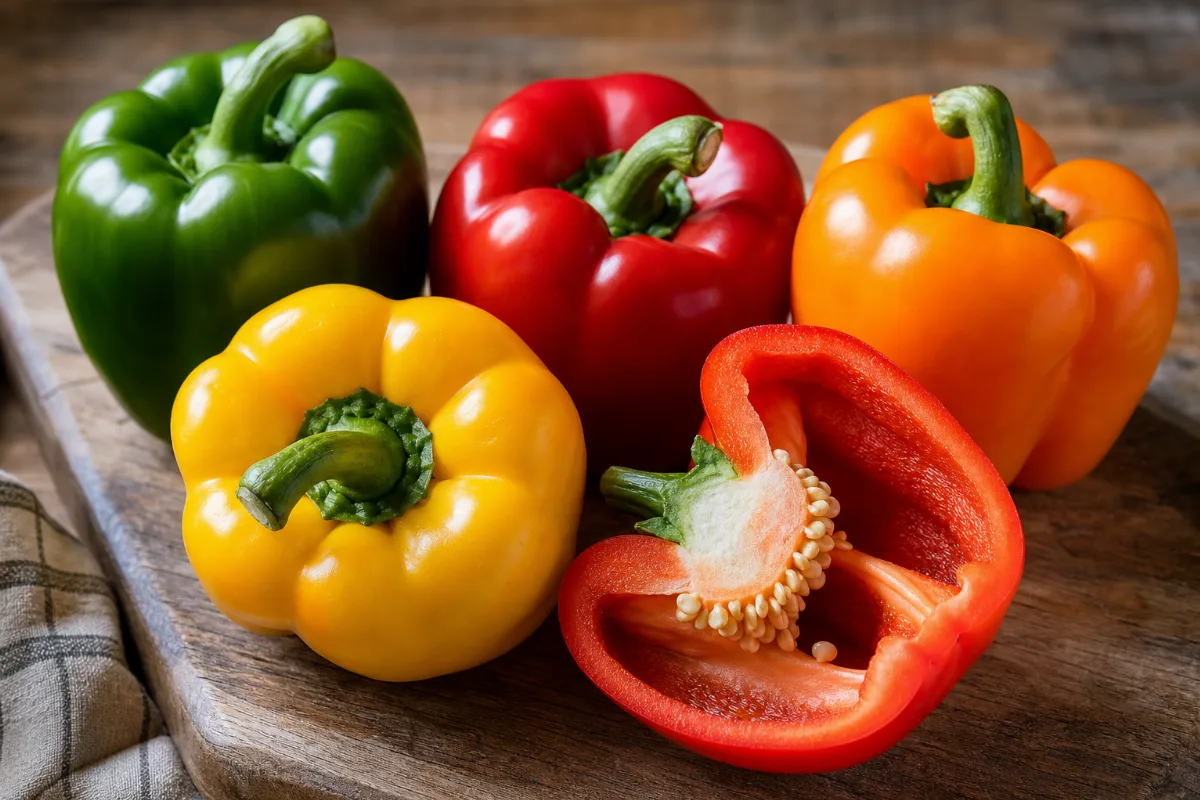
Vegetables · Vegetable
Bell Peppers
Capsicum annuum · also called Sweet pepper, capsicum (UK), pimiento morron (Spanish)
Bell peppers are the mild, thick-walled fruits of a nightshade plant, eaten raw or cooked in green, yellow, orange and red types. They are one of the richest vegetable sources of vitamin C. Eating more fruit and vegetables is linked to less heart disease in observational studies, but bell peppers have not been tested alone. The main cautions are allergy (including a link with latex) and food poisoning from raw produce.
General information, not medical advice. Last substantive update · Not medically reviewed. A named clinician has not signed off on this page. How this page is made
About Bell Peppers
Bell peppers are a nutritious vegetable, especially rich in vitamin C. They are a healthy food, not a proven remedy: most health claims come from studies of vitamin C tablets, of fruit and vegetables in general, or of supplements and extracts.
What it is
Bell peppers (Capsicum annuum) are the mild fruits of a plant in the nightshade family. People eat the whole fruit except the stem and seeds, raw or cooked. Hot chili peppers are a different product.
USDA data per 100 g raw: red pepper 26 kcal, 2.1 g fibre, 128 mg vitamin C, 211 mg potassium and 46 micrograms folate; green pepper 20 kcal, 1.7 g fibre, 80.4 mg vitamin C, 175 mg potassium and 10 micrograms folate. One cup chopped (149 g) of red pepper has about 39 kcal and 191 mg vitamin C; of green pepper about 30 kcal and 120 mg.
Red pepper has more beta-carotene and vitamin A, while green pepper has more lutein plus zeaxanthin. A 2019 review says the pigments change with ripeness.
What the research shows
The firmest facts are about nutrients: vitamin C prevents scurvy, helps make collagen and helps iron absorption, and peppers are a rich source. These are not trials of peppers.
Observational studies link more fruit and vegetables with less heart disease, cancer and early death, but they cannot prove cause and did not single out bell peppers. Vitamin C tablets did not lower colds in the general public in a Cochrane review.
The large eye trial used lutein capsules and found no significant benefit. The only bell pepper food trial found used juice for 4 days in 50 people with diabetes; the abstract gives no figures.
Food versus tablets, capsules and extracts
The cold results are for vitamin C tablets, the eye trial used lutein capsules, the skin trial used a paprika supplement and the immune study used a fibre extract from bell pepper made by a company. Results for a tablet, capsule or extract do not carry over to eating the vegetable. In the eye trial, beta carotene capsules were also linked to more lung cancers in former smokers; that finding is about capsules, not peppers.
Amounts
This page gives no amounts to eat. Ask a doctor, pharmacist or dietitian what is right for you, especially if you take medicines or have a health condition.
At a glance
Traditional uses history, not proof
- Eaten as a vegetable, raw in salads or cooked
- Dried and ground as paprika
- Long use as food is not proof that it treats any condition
Studied for research
- Vitamin C source and scurvy prevention, high certainty for the nutrient, no pepper trial
- Colds, mixed for vitamin C tablets, not tested with peppers
- Heart disease and early death (fruit and vegetables as a group), low certainty, observational
- Eye health, insufficient evidence (lutein capsule trial, not peppers)
- Blood sugar and blood pressure after pepper juice, very low certainty, one 4-day trial
- Nightshade avoidance for arthritis, insufficient evidence
Main compounds
- Vitamin C
- Capsanthin and capsorubin
- Beta-carotene
- Beta-cryptoxanthin
- Lutein and zeaxanthin
- Vitamin B6
- Folate
- Potassium
Common forms
- Raw bell peppers (green, yellow, orange, red)
- Cooked, frozen, canned or jarred peppers
- Pepper juice (used in one small trial)
- Dried and ground paprika (a spice; the supplement trial used a paprika extract)
Research links: MedlinePlus: Vitamin C · Cochrane review: vitamin C for the common cold · Review: fruit and vegetable intake and heart disease, cancer and death · Research Library · Genes & Biomarkers Library
What it is and its history
- Accepted scientific name
- Capsicum annuum
- Naming authority
- L. (GBIF accepted)
- Common names
- Bell pepper (English); Sweet pepper (English); Capsicum (English (UK)); Pimiento morron (Spanish)
- Family or group
- Solanaceae (the nightshade family), as given by GBIF. The Arthritis Foundation also lists peppers among the nightshades.
- Classification
- Plantae > Tracheophyta > Magnoliopsida > Solanales > Solanaceae > Capsicum > Capsicum annuum
- Native range
- Not verified from a source read.
- Habitat
- Not verified from a source read.
- What it looks like
- Roots: Not verified.; Stems: Not verified.; Leaves: Not verified.; Flowers: Not verified. Bell pepper pollen from greenhouse plants is an occupational allergen (PubMed 20584006).; Fruit: The thick-walled fruit is the food. USDA gives household portions of one medium pepper as 119 g and one large pepper as 164 g. Colours seen in USDA entries: green and red.
- Cultivation
- Not verified from a source read.
- Harvest and processing
- Eaten raw or cooked, frozen, or canned or jarred, and dried and ground as paprika (existing nutrient summary). Cooking effects on nutrients were not read from a source.
- Look-alikes and adulterants
- Name: Chili peppers (hot peppers); Note: Hot chili peppers are a different product with their own page. Trials of capsaicin or chili extracts do not describe bell peppers.; Name: Paprika and paprika supplements; Note: Paprika is dried red pepper used as a spice. The skin trial read used a paprika xanthophyll supplement, which is not the vegetable.; Name: Black pepper (Piper nigrum); Note: A different, unrelated plant that only shares the word pepper.
- Sustainability and conservation
- Not assessed.
Photographs
What is inside, and how it may work
What it contains and how those compounds act in cells and animals. Laboratory and animal mechanisms are not proven effects in people.
Main compounds
| Compound | Family | Where it is concentrated | Activity studied | Level of evidence |
|---|---|---|---|---|
| Vitamin C (ascorbic acid) PubChem 54670067 | vitamin | Fruit USDA: 128 mg per 100 g raw red pepper; 80.4 mg per 100 g raw green pepper | Needed to make collagen, heal wounds and absorb iron (MedlinePlus). Prevents scurvy. 20 18 25 24 | Human data |
| Capsanthin PubChem 5281228 | carotenoid (xanthophyll) | Fruit Not given in the sources read | A 2019 review names capsanthin and capsorubin as the main pepper carotenoids and describes them as lipophilic antioxidants (lab-level). 7 | Laboratory research |
| Capsorubin PubChem 5281229 | carotenoid (xanthophyll) | Fruit Not given in the sources read | Named with capsanthin as a main pepper carotenoid in the 2019 review. 7 | Laboratory research |
| Beta-carotene PubChem 5280489 | carotenoid | Fruit USDA: 1,620 micrograms per 100 g raw red pepper; 208 micrograms raw green | Orange-yellow pigment that the body can turn into vitamin A (this role is general knowledge, not read in a source for this page). In AREDS2, beta carotene capsules were linked to more lung cancers in former smokers. 25 24 1 | Human data |
| Beta-cryptoxanthin PubChem 5281235 | carotenoid | Fruit USDA: 490 micrograms per 100 g raw red pepper; 7 micrograms raw green | Listed with the other pepper carotenoids in the 2019 review. 25 24 7 | Laboratory research |
| Lutein (with zeaxanthin) PubChem 5281243 | carotenoid | Fruit USDA lutein plus zeaxanthin: 51 micrograms per 100 g raw red pepper; 341 micrograms raw green | Carotenoid plant pigments. The AREDS2 trial of lutein plus zeaxanthin capsules found no significant benefit for advanced macular degeneration. 1 25 24 | Human data |
Mechanisms, receptors and pathways
| Target or pathway | Gene or receptor | What was found | Level |
|---|---|---|---|
| Vitamin C, collagen and iron absorption | Not specified | Vitamin C is used to make collagen, heal wounds and help the body absorb iron (MedlinePlus). Peppers are a rich vitamin C food. 20 25 | Human data |
| Cross-reacting allergens shared with latex | Profilin; a beta-1,3-glucanase related to latex Hev b 2; an ascorbate peroxidase; a gibberellin-regulated protein (Cap a 7) | In patient blood tests, IgE antibodies bound proteins in bell pepper that are similar to latex proteins. Lab-level work in a few patients. 11 10 | Human data |
| Carotenoids as lipophilic antioxidants | Not specified | The 2019 review describes pepper carotenoids as lipophilic antioxidants and says lab, animal and clinical studies point to protective effects; the abstract gives no trial details. 7 | Laboratory research |
Absorption, metabolism and elimination
- Absorption
- Iron from vegetables is harder for the body to absorb than iron from meat (MedlinePlus). Absorption of pepper vitamin C and carotenoids was not read.
- Distribution
- Not found.
- Metabolism
- Not found.
- Elimination
- Not found.
- Bioavailability
- Not established for pepper nutrients in the sources read.
Isolated compounds versus whole extracts
The cold results are for vitamin C tablets, the eye trial used lutein capsules, the skin trial used a paprika supplement and the immune study used a concentrated fibre extract. None of these is the same as eating a bell pepper. The only bell pepper food-type trial read gave juice for 4 days.
Nutritional composition
Nutrition from USDA FoodData Central, read 2026-10-26 (SR Legacy, last updated 4/1/2019). Raw red pepper (FDC 170108), per 100 g: 26 kcal, 0.99 g protein, 0.3 g fat, 6.03 g carbohydrate, 2.1 g fibre, 4.2 g sugars, 92.2 g water, 7 mg calcium, 0.43 mg iron, 12 mg magnesium, 211 mg potassium, 4 mg sodium, 128 mg vitamin C, 0.291 mg vitamin B6, 46 micrograms folate (DFE), 157 micrograms vitamin A (RAE), 1,620 micrograms beta-carotene, 51 micrograms lutein plus zeaxanthin, 1.58 mg vitamin E, 4.9 micrograms vitamin K. Raw green pepper (FDC 170427), per 100 g: 20 kcal, 0.86 g protein, 0.17 g fat, 4.64 g carbohydrate, 1.7 g fibre, 2.4 g sugars, 93.9 g water, 10 mg calcium, 0.34 mg iron, 10 mg magnesium, 175 mg potassium, 3 mg sodium, 80.4 mg vitamin C, 0.224 mg vitamin B6, 10 micrograms folate (DFE), 18 micrograms vitamin A (RAE), 208 micrograms beta-carotene, 341 micrograms lutein plus zeaxanthin, 0.37 mg vitamin E, 7.4 micrograms vitamin K. USDA lists lycopene as 0 in both. Typical portions (USDA): one cup chopped = 149 g, one cup sliced = 92 g, one medium pepper = 119 g. One cup chopped (149 g), our arithmetic: red about 39 kcal, 3.1 g fibre, 191 mg vitamin C, 314 mg potassium, 69 micrograms folate; green about 30 kcal, 2.5 g fibre, 120 mg vitamin C, 261 mg potassium, 15 micrograms folate, 508 micrograms lutein plus zeaxanthin. One medium red pepper (119 g): about 31 kcal and 152 mg vitamin C; one medium green pepper: about 24 kcal and 96 mg vitamin C. USDA also lists boiled, drained red pepper without salt (FDC 170110) at 28 kcal, 1.2 g fibre, 166 mg potassium, 171 mg vitamin C and 16 micrograms folate per 100 g; this is a separate food entry, so it does not show how much cooking changes vitamin C. Yellow and orange peppers were not read. Figures vary with variety, ripeness and storage.
1 high certainty1 mixed findings2 low certainty3 very low certainty4 not enough evidence
What was looked at
The 11 benefits and uses checked for Bell Peppers, each with how strong the evidence is. Tap one to open it.
- Vitamin C from peppers (and scurvy prevention)High certainty
- Colds (vitamin C tablets, not peppers)Mixed findings
- Heart disease and early death (fruit and vegetables as a group)Low certainty
- Eye health (macular degeneration)Not enough evidence
- Cancer risk (fruit and vegetables as a group)Low certainty
- Helping the body absorb ironNot enough evidence
- Blood sugar and blood pressure (bell pepper juice, one small trial)Very low certainty
- Pepper carotenoids as antioxidantsVery low certainty
- Skin moisture (red paprika supplement, not the vegetable)Very low certainty
- Immune responses (a bell pepper fibre extract)Not enough evidence
- Avoiding nightshades for arthritisNot enough evidence
Lab markers tracked in the studies
Catching a common coldHow long a cold lastsCardiovascular disease events and deathsDeath from any causeProgression to advanced macular degenerationTotal cancer riskAfter-meal blood glucose and systolic blood pressureFacial skin moisture
What is Bell Peppers good for?
The main studied uses and how strong the human evidence is for each. Many results are for vitamin C tablets, fruit and vegetables as a group, capsules or extracts, not for eating bell peppers.
Benefits, one by one
Each card is a research question, not a promise. Tap a goal to filter. Open a card to see the studies, doses and limits.
Vitamin C from peppers (and scurvy prevention)
High certaintyBell peppers are one of the richest vegetable sources of vitamin C. USDA lists about 128 mg in 100 g of raw red pepper and 80.4 mg in raw green. Vitamin C prevents scurvy, a shortage disease that is rare in rich countries. This is a nutrient fact, not a trial of peppers.
5 studiesRaw peppers as food. Values vary with colour, variety, ripeness and s…
Studies, doses and limits
What the trials found
MedlinePlus lists green and red peppers among the vegetables with the highest vitamin C and says a severe shortage of vitamin C is called scurvy. The NHS lists peppers as a good source. The Linus Pauling Institute says scurvy is relatively rare in developed countries because as little as 10 mg of vitamin C a day can prevent it, and its food table lists sweet red pepper, raw, half a cup, at 59 mg. USDA lists 128 mg per 100 g for raw red pepper and 80.4 mg per 100 g for raw green.
Results
The role of vitamin C and the fact that peppers are a rich source are well accepted. No trial of eating peppers to prevent or treat scurvy was read.
Effect sizes as reported
USDA per 100 g raw: red pepper 128 mg vitamin C, green pepper 80.4 mg. One cup of chopped pepper (149 g): about 191 mg (red) or 120 mg (green), our arithmetic.
Why this rating
High for the nutrient role and for peppers being a rich source (health-agency statements and USDA data). There is no pepper-specific trial, and the NHS says a varied diet normally supplies all the vitamin C needed.
Form and dose studied
Raw peppers as food. Values vary with colour, variety, ripeness and storage.
Who was studied
Anyone eating a varied diet; the Linus Pauling Institute notes scurvy cases in children, critically ill patients and older adults on very restricted diets.
Limits
A nutrient fact, not a trial of peppers. Extra vitamin C beyond what the body needs is not shown here to add benefit. How cooking, freezing or canning change vitamin C in peppers was not read from a source that studied it.
Why researchers looked
Peppers are best known as a vitamin C food, so people ask whether eating them helps with vitamin C needs and with immunity.
Traditional use
Bell peppers are eaten raw or cooked as a vegetable. Long use as food is not proof that they treat any condition.
Proposed mechanism Authoritative guidance
Vitamin C is needed to make collagen (used in skin, tendons, ligaments and blood vessels), to heal wounds and to help the body absorb iron (MedlinePlus).
A proposed mechanism does not show that the effect happens in people.
The NHS says very large amounts of vitamin C from supplements (more than 1,000 mg a day) can cause stomach pain, diarrhoea and wind. That is about supplements, not about eating peppers.
Colds (vitamin C tablets, not peppers)
Mixed findingsA large Cochrane review found that regular vitamin C tablets did not lower the chance of catching a cold in the general public, but did in people under heavy physical stress such as marathon runners and soldiers, and shortened colds a little. No trial tested eating peppers.
1 studiesVitamin C tablets or similar supplements in the trials; not pepper.
Studies, doses and limits
What the trials found
The 2013 Cochrane review pooled 29 trial comparisons with 11,306 people. In the general community (10,708 people) regular vitamin C gave a risk ratio of 0.97 (95% CI 0.94 to 1.00) for catching a cold. In 598 marathon runners, skiers and soldiers on subarctic exercises it was 0.48 (0.35 to 0.64). Colds were 8% shorter in adults and 14% shorter in children. Trials that gave vitamin C only after a cold began showed no consistent effect.
Results
Vitamin C tablets: no clear effect on catching a cold in the general public; a clear effect in people under heavy exertion; a small shortening of colds. The tablets used at least 0.2 g a day, so this is not what a serving of pepper supplies. Nothing here is a result for eating peppers.
Effect sizes as reported
General community RR 0.97 (0.94-1.00); heavy exertion RR 0.48 (0.35-0.64); duration 8% shorter in adults (3% to 12%), 14% in children (7% to 21%).
Why this rating
Mixed for vitamin C tablets (no effect on catching colds in the general public, effect in a small group under heavy exertion, a small effect on duration). Insufficient for eating peppers, which was not tested.
Form and dose studied
Vitamin C tablets or similar supplements in the trials; not pepper.
Who was studied
General community, and athletes and soldiers under heavy exertion.
Limits
Supplement results do not carry over to eating a food. The review is from 2013.
Why researchers looked
Because peppers are rich in vitamin C, people ask whether they help against colds.
Traditional use
Bell peppers are eaten raw or cooked as a vegetable. Long use as food is not proof that they treat any condition.
Proposed mechanism Authoritative guidance
Not established for peppers. Vitamin C is a nutrient the body uses in many tissues (MedlinePlus).
A proposed mechanism does not show that the effect happens in people.
See the Safety tab for the NHS comment on large vitamin C supplement amounts.
Heart disease and early death (fruit and vegetables as a group)
Low certaintyIn observational studies, people who eat more fruit and vegetables have less heart disease and live longer. A large 2017 review put the figure at about 8% lower heart disease risk for each extra 200 g a day. Bell peppers were not studied on their own, and these studies cannot prove cause.
1 studiesFruit and vegetables as food; the per-200 g figure is the review's un…
Studies, doses and limits
What the trials found
A 2017 systematic review and dose-response meta-analysis of 95 prospective studies found, for fruits and vegetables combined, a relative risk per 200 g a day of 0.92 for cardiovascular disease (95% CI 0.90 to 0.95), 0.92 for coronary heart disease (0.90 to 0.94), 0.84 for stroke (0.76 to 0.92) and 0.90 for death from any cause (0.87 to 0.93). The abstract says similar associations were seen for fruits and vegetables separately and does not name bell peppers.
Results
More fruit and vegetables went with lower cardiovascular disease and lower death rates. This is a result for the food group, not for bell peppers.
Effect sizes as reported
Per 200 g a day of fruit and vegetables: CVD RR 0.92 (0.90-0.95); stroke RR 0.84 (0.76-0.92); all-cause mortality RR 0.90 (0.87-0.93).
Why this rating
Low: observational studies of the whole food group. They cannot show that vegetables cause the lower risk, and there is substantial heterogeneity for some outcomes (I2 73% for stroke and 83% for death).
Form and dose studied
Fruit and vegetables as food; the per-200 g figure is the review's unit of analysis, not advice.
Who was studied
Adults in 95 prospective studies.
Limits
Not specific to bell peppers. People who eat more vegetables may differ in other ways.
Why researchers looked
Peppers are a colourful vegetable, and population studies ask whether eating more vegetables goes with healthier hearts.
Traditional use
Bell peppers are eaten raw or cooked as a vegetable. Long use as food is not proof that they treat any condition.
Proposed mechanism Unknown
Not established. Which nutrient or plant compound in vegetables might matter, if any, is not shown by the abstract read.
A proposed mechanism does not show that the effect happens in people.
None specific.
Eye health (macular degeneration)
Not enough evidenceBell peppers contain lutein and zeaxanthin, plant pigments that are studied for the eye. Green peppers have more than red (USDA: 341 against 51 micrograms per 100 g). The big AREDS2 trial of lutein plus zeaxanthin capsules found no significant slowing of advanced macular degeneration. Peppers themselves were not tested.
3 studiesCapsules in the trial; raw peppers for the USDA values.
Studies, doses and limits
What the trials found
USDA lists lutein plus zeaxanthin at 51 micrograms per 100 g in raw red pepper and 341 micrograms per 100 g in raw green pepper. In the AREDS2 trial of 4,203 people at risk of advanced macular degeneration, lutein (10 mg) plus zeaxanthin (2 mg) capsules did not significantly reduce progression compared with placebo (HR 0.90, 98.7% CI 0.76 to 1.07, P=0.12; 5-year progression 29% against 31%).
Results
A capsule trial with no significant benefit. No trial of eating bell peppers for eye disease was read.
Effect sizes as reported
AREDS2: lutein plus zeaxanthin versus placebo, HR 0.90 (98.7% CI 0.76-1.07). USDA per 100 g raw: lutein plus zeaxanthin 51 micrograms (red), 341 micrograms (green).
Why this rating
No trial of peppers; the large capsule trial was not significant. Pigment content alone does not show an eye benefit.
Form and dose studied
Capsules in the trial; raw peppers for the USDA values.
Who was studied
People aged 50 to 85 at risk of advanced macular degeneration (trial).
Limits
Capsules are not the food. The trial's beta carotene arm is not about peppers.
Why researchers looked
Lutein and zeaxanthin collect in the part of the eye used for sharp central vision, so foods that contain them are studied for eye health.
Traditional use
Bell peppers are eaten raw or cooked as a vegetable. Long use as food is not proof that they treat any condition.
Proposed mechanism Unknown
Not established in the sources read. Lutein and zeaxanthin are carotenoid plant pigments (USDA lists them together).
A proposed mechanism does not show that the effect happens in people.
More lung cancers were noted with beta carotene capsules than without in this trial, mostly in former smokers. That finding is about capsules, not vegetables.
Cancer risk (fruit and vegetables as a group)
Low certaintyA large 2017 review of prospective studies linked more fruit and vegetables with slightly lower total cancer risk (about 3% lower per 200 g a day). Bell peppers were not studied alone, and these studies cannot show cause.
1 studiesFruit and vegetables as food; the per-200 g figure is the review's un…
Studies, doses and limits
What the trials found
In the 2017 meta-analysis of prospective studies, the relative risk of total cancer per 200 g a day of fruits and vegetables combined was 0.97 (95% CI 0.95 to 0.99, I2 49%). The abstract says risk reductions were seen up to 600 g a day for cancer and that green-yellow vegetables and cruciferous vegetables went with lower total cancer risk. Bell peppers are not named.
Results
A small association for the food group. No result for bell peppers.
Effect sizes as reported
Total cancer RR 0.97 (0.95-0.99) per 200 g a day of fruit and vegetables combined.
Why this rating
Low: observational, small effect size, food group rather than peppers.
Form and dose studied
Fruit and vegetables as food; the per-200 g figure is the review's unit, not advice.
Who was studied
Adults in prospective studies.
Limits
Observational; not specific to peppers.
Why researchers looked
Colourful vegetables contain vitamins and pigments, so population studies ask whether eating them goes with less cancer.
Traditional use
Bell peppers are eaten raw or cooked as a vegetable. Long use as food is not proof that they treat any condition.
Proposed mechanism Unknown
Not established. The abstract does not say which food components might matter.
A proposed mechanism does not show that the effect happens in people.
None specific.
Helping the body absorb iron
Not enough evidenceMedlinePlus says vitamin C helps the body absorb iron, and that iron from vegetables is harder to absorb than iron from meat. Bell peppers contain only a little iron (0.43 mg per 100 g red), so they are mainly a vitamin C food. No trial tested peppers for iron status.
4 studiesRaw peppers as food.
Studies, doses and limits
What the trials found
MedlinePlus lists aiding the absorption of iron among the functions of vitamin C and says iron from vegetables, fruits, grains and supplements is harder for the body to absorb than iron from meat. USDA lists 0.43 mg of iron per 100 g of raw red pepper and 0.34 mg in raw green.
Results
A general nutrient statement. No trial of bell peppers and iron levels or anaemia was read.
Effect sizes as reported
USDA per 100 g raw: iron 0.43 mg (red), 0.34 mg (green).
Why this rating
An agency statement about vitamin C in general; no pepper meal or trial was read.
Form and dose studied
Raw peppers as food.
Who was studied
General adult diet.
Limits
A nutrient role is not proof that a pepper treats low iron.
Why researchers looked
People pair vitamin C foods with plant iron foods, so they ask whether peppers help.
Traditional use
Bell peppers are eaten raw or cooked as a vegetable. Long use as food is not proof that they treat any condition.
Proposed mechanism Authoritative guidance
MedlinePlus lists helping to absorb iron among the functions of vitamin C. The page does not explain how.
A proposed mechanism does not show that the effect happens in people.
Suspected low iron or anaemia needs a blood test and a clinician's advice, not a food swap.
Blood sugar and blood pressure (bell pepper juice, one small trial)
Very low certaintyOne small 4-day trial in 50 people with type 2 diabetes added bell pepper juice to a yoga programme. After-meal blood sugar and systolic blood pressure fell more than in the yoga-only group, but fasting blood sugar did not differ. The trial is too short and small to rely on, and juice is not the whole vegetable.
1 studiesBell pepper juice (Capsicum annuum var. grossum), as given in the tri…
Studies, doses and limits
What the trials found
In a randomised controlled study of 50 people with type 2 diabetes (age 34 to 69), the study group had 100 ml of bell pepper juice twice a day plus an integrated yoga therapy programme for 4 days; the control group had the yoga programme only. Fasting and after-meal blood glucose combined did not differ significantly. After-meal glucose, systolic blood pressure, pulse pressure, rate pressure product and double product were significantly lower in the juice group.
Results
Some measures improved after 4 days with juice plus yoga, compared with yoga alone. The abstract gives no figures, so the size of the changes cannot be stated.
Effect sizes as reported
Not given in the abstract.
Why this rating
Very low: 4 days, 50 people, no figures in the abstract, juice rather than the whole vegetable, and the comparison is juice-plus-yoga against yoga alone.
Form and dose studied
Bell pepper juice (Capsicum annuum var. grossum), as given in the trial.
Who was studied
Adults with type 2 diabetes.
Limits
Very short; small; no numbers available; not a test of eating the vegetable.
Why researchers looked
Researchers tried pepper juice as an add-on in people with type 2 diabetes.
Traditional use
Bell peppers are eaten raw or cooked as a vegetable. Long use as food is not proof that they treat any condition.
Proposed mechanism Unknown
Not established; the abstract does not offer a mechanism.
A proposed mechanism does not show that the effect happens in people.
People with diabetes should not change their care because of a 4-day study; ask a clinician.
Pepper carotenoids as antioxidants
Very low certaintyRed peppers are rich in carotenoid pigments, mainly capsanthin and capsorubin. A 2019 review says these act as antioxidants in lab tests and mentions protective effects in lab, animal and some clinical studies. We read only its abstract, so the human evidence cannot be judged.
3 studiesPigments from several Capsicum species.
Studies, doses and limits
What the trials found
The 2019 review of Capsicum carotenoids says findings from in vitro, in vivo and clinical studies give appreciable evidence of protective effects against degenerative diseases. The abstract gives no trial details and covers several pepper species, not only bell peppers.
Results
Lab-level evidence for pepper pigments in general. No trial of eating bell peppers for a disease outcome was found.
Effect sizes as reported
Not available.
Why this rating
Mostly lab and animal evidence summarised in an abstract; the human part cannot be judged from it.
Form and dose studied
Pigments from several Capsicum species.
Limits
Abstract only; antioxidant activity in a test tube does not show a health benefit in people.
Why researchers looked
The pigments that colour peppers are strong antioxidants in test tubes, so they are studied for protection against ageing-related disease.
Traditional use
Bell peppers are eaten raw or cooked as a vegetable. Long use as food is not proof that they treat any condition.
Proposed mechanism Laboratory research
The review describes carotenoids as lipophilic (fat-loving) antioxidants. This is a lab-level description.
A proposed mechanism does not show that the effect happens in people.
None specific.
Skin moisture (red paprika supplement, not the vegetable)
Very low certaintyA 4-week trial of a red paprika supplement containing seven xanthophylls found higher skin moisture than control, but the number of brown stains also rose. It tested a concentrated supplement, not eating bell peppers.
1 studiesRed paprika xanthophyll supplement; not bell pepper as food.
Studies, doses and limits
What the trials found
In a 4-week randomised, single-blind, parallel-group trial, skin moisture was significantly higher with the paprika supplement than with control (21.0 +/- 8.9 against 13.4 +/- 6.0 arbitrary units). Viscoelasticity, wrinkles and water loss did not differ significantly. Brown stains in the paprika group rose from 173 +/- 30 to 190 +/- 26 (p<0.05).
Results
More skin moisture, no change in other skin measures, and more brown stains. The abstract does not give the number of people.
Effect sizes as reported
Moisture 21.0 (SD 8.9) vs 13.4 (SD 6.0) A.U.; brown stains 173 to 190 (p<0.05).
Why this rating
Very low: one short single-blind trial of a supplement, number of people not in the abstract, and a worrying change (more brown stains) alongside the benefit.
Form and dose studied
Red paprika xanthophyll supplement; not bell pepper as food.
Who was studied
Healthy adults (not further described in the abstract).
Limits
A supplement, not food; short; abstract only.
Why researchers looked
Paprika pigments are antioxidants, so researchers asked whether taking them changes skin.
Traditional use
Bell peppers are eaten raw or cooked as a vegetable. Long use as food is not proof that they treat any condition.
Proposed mechanism Laboratory research
The authors report that the paprika extract raised the activity of two skin-moisture genes (AQP3 and HAS3) in cultured skin cells. This is lab-level.
A proposed mechanism does not show that the effect happens in people.
The increase in brown stains is a possible downside of the supplement; it is not shown for the vegetable.
Immune responses (a bell pepper fibre extract)
Not enough evidenceA company-funded study isolated a fibre called RG-I from bell pepper and reported that an enriched extract was well tolerated and boosted innate immune responses in a small human proof-of-concept study. It is a concentrated ingredient, not the vegetable, and no infection outcome was tested.
1 studiesEnriched bell pepper RG-I extract (not the vegetable).
Studies, doses and limits
What the trials found
The abstract reports lab tests plus a human proof-of-concept study in which the bell pepper RG-I extract was well tolerated and enhanced innate immune responsiveness. No numbers or group sizes are in the abstract. The authors say a trial looking at infections is the next step.
Results
Early, company-funded, and about an extract. Nothing about colds or infections in people was shown.
Effect sizes as reported
Not available.
Why this rating
No numbers available, a concentrated extract, industry funding (the funder holds patents on the extract), and no clinical outcome.
Form and dose studied
Enriched bell pepper RG-I extract (not the vegetable).
Who was studied
Not described in the abstract.
Limits
Industry-funded; abstract only; not food.
Why researchers looked
Plant fibres of this type stimulate immune cells in the lab, so researchers tested a bell pepper version.
Traditional use
Bell peppers are eaten raw or cooked as a vegetable. Long use as food is not proof that they treat any condition.
Proposed mechanism Laboratory research
The authors identify the RG-I pectic fibre as the part that stimulated immune cells and changed gut bacteria in lab tests.
A proposed mechanism does not show that the effect happens in people.
The abstract says the extract was well tolerated; this does not extend to the vegetable or to long use.
Avoiding nightshades for arthritis
Not enough evidenceSome people avoid peppers and other nightshades because of arthritis. Harvard Health says there is no scientific evidence that avoiding nightshade foods improves rheumatoid arthritis. The Arthritis Foundation says there is little scientific evidence on either side. No trial results were found; one trial was only planned.
3 studiesNot applicable.
Studies, doses and limits
What the trials found
Harvard Health (May 2026) answers a question about potatoes and tomatoes: no scientific evidence that avoiding nightshade foods improves rheumatoid arthritis. The Arthritis Foundation names peppers among the nightshades, says there is little scientific evidence on either side, and describes a two-week elimination followed by slow re-introduction for people who suspect a sensitivity. A 2024 protocol describes a planned 8-week trial of 40 people with rheumatoid arthritis; no results were found.
Results
No trial evidence that avoiding peppers helps arthritis, and none that eating them harms. Some people feel better without them, and that is their own experience, not proof.
Effect sizes as reported
Not available.
Why this rating
Opinion and expert review only; the only trial found is a protocol with no results.
Who was studied
People with rheumatoid arthritis and other inflammatory arthritis.
Limits
The Harvard answer addresses potatoes and tomatoes and does not name peppers.
Why researchers looked
Many people with arthritis report that nightshade foods make them feel worse, so avoidance diets are widely tried.
Traditional use
Peppers are in the nightshade family. Avoidance diets are popular, but popularity is not evidence.
Proposed mechanism Authoritative guidance
The Arthritis Foundation says all nightshades contain small amounts of a compound called solanine and that no research suggests the level of poisoning seen in livestock eating tomato and potato vines applies to people; green potatoes are the exception it names for people. Mouse findings have gone both ways and rarely carry over to people.
A proposed mechanism does not show that the effect happens in people.
If a food seems to worsen symptoms, ask a clinician before cutting out whole food groups.
Connections to the rest of health
How Bell Peppers connects to the rest of our health knowledge graph. Every link says what kind of connection it is. A safety link (for example to the liver) is a warning, not a benefit. A study that merely mentions a topic never creates a benefit link.
Explore every connection: goals, body systems, organs, symptoms, genes
B. Body systems
| Connected to | Kind of connection | Evidence status | Context | Studies |
|---|---|---|---|---|
| Immune System | Biological association | High certainty | Studied for: Vitamin C from peppers (and scurvy prevention) Studied for: Colds (vitamin C tablets, not peppers) | 20 18 22 25 24 5 2 7 6 |
| Integumentary System | Biological association | High certainty | Studied for: Vitamin C from peppers (and scurvy prevention) Studied for: Skin moisture (red paprika supplement, not the vegetable) | 20 18 22 25 24 12 |
| Respiratory System | Biological association | Mixed findings | Studied for: Colds (vitamin C tablets, not peppers) | 5 |
| Cardiovascular System | Biological association | Low certainty | Studied for: Heart disease and early death (fruit and vegetables as a group) Studied for: Blood sugar and blood pressure (bell pepper juice, one small trial) | 2 8 |
| Eyes And Vision | Biological association | Not enough evidence | Studied for: Eye health (macular degeneration) | 1 25 24 |
| Blood And Immune | Biological association | Not enough evidence | Studied for: Helping the body absorb iron | 20 19 25 24 |
| Blood Sugar Support | Biological association | Very low certainty | Studied for: Blood sugar and blood pressure (bell pepper juice, one small trial) | 8 |
| Musculoskeletal System | Biological association | Not enough evidence | Studied for: Avoiding nightshades for arthritis | 17 13 3 |
| Pain Inflammation | Biological association | Not enough evidence | Studied for: Avoiding nightshades for arthritis | 17 13 3 |
E. Health conditions
| Connected to | Kind of connection | Evidence status | Context | Studies |
|---|---|---|---|---|
| Latex allergy | Documented risk | Bell pepper shares allergens with latex in a lab study of four patients. Bell pepper shares some allergens with latex in lab studies of patients. Preparation or compound: Bell pepper proteins (profilin and others) |
11 4 |
I. Biomarkers
| Connected to | Kind of connection | Evidence status | Context | Studies |
|---|---|---|---|---|
| Catching a common cold | Biological association | Mixed findings | Measured in trials: no-change. A lab change is not the same as a health benefit. | 5 |
| How long a cold lasts | Biological association | Mixed findings | Measured in trials: lowered. A lab change is not the same as a health benefit. | 5 |
| Cardiovascular disease events and deaths | Biological association | Low certainty | Measured in trials: lowered. A lab change is not the same as a health benefit. | 2 |
| Death from any cause | Biological association | Low certainty | Measured in trials: lowered. A lab change is not the same as a health benefit. | 2 |
| Progression to advanced macular degeneration | Biological association | Not enough evidence | Measured in trials: no-change. A lab change is not the same as a health benefit. | 1 |
| Total cancer risk | Biological association | Low certainty | Measured in trials: lowered. A lab change is not the same as a health benefit. | 2 |
| After-meal blood glucose and systolic blood pressure | Biological association | Very low certainty | Measured in trials: lowered. A lab change is not the same as a health benefit. | 8 |
| Facial skin moisture | Biological association | Very low certainty | Measured in trials: raised. A lab change is not the same as a health benefit. | 12 |
K. Biological pathways
| Connected to | Kind of connection | Evidence status | Context | Studies |
|---|---|---|---|---|
| Vitamin C | Preliminary mechanism | Human | Peppers are a rich vitamin C food; vitamin C prevents scurvy and helps iron absorption. | 20 18 |
| Carotenoids (beta-carotene, lutein, zeaxanthin, capsanthin) | Preliminary mechanism | In vitro | Pigments that colour peppers; red and green types differ. | 25 24 7 |
| Latex (Hevea) cross-reactive proteins | Preliminary mechanism | Human | Bell pepper shares some allergens with latex. | 11 |
L. Active compounds
| Connected to | Kind of connection | Evidence status | Context | Studies |
|---|---|---|---|---|
| Vitamin C (ascorbic acid) | Biological association | Human | Needed to make collagen, heal wounds and absorb iron (MedlinePlus). Prevents scurvy. Preparation or compound: Fruit |
20 18 25 24 |
| Capsanthin | Biological association | In vitro | A 2019 review names capsanthin and capsorubin as the main pepper carotenoids and describes them as lipophilic antioxidants (lab-level). Preparation or compound: Fruit |
7 |
| Capsorubin | Biological association | In vitro | Named with capsanthin as a main pepper carotenoid in the 2019 review. Preparation or compound: Fruit |
7 |
| Beta-carotene | Biological association | Human | Orange-yellow pigment that the body can turn into vitamin A (this role is general knowledge, not read in a source for this page). In AREDS2, beta carotene capsules were linked to more lung cancers in former smokers. Preparation or compound: Fruit |
25 24 1 |
| Beta-cryptoxanthin | Biological association | In vitro | Listed with the other pepper carotenoids in the 2019 review. Preparation or compound: Fruit |
25 24 7 |
| Lutein (with zeaxanthin) | Biological association | Human | Carotenoid plant pigments. The AREDS2 trial of lutein plus zeaxanthin capsules found no significant benefit for advanced macular degeneration. Preparation or compound: Fruit |
1 25 24 |
Each connection is stored with the ingredient, the connected record, the kind of connection, the evidence status, the supporting studies, the preparation or compound involved, and a review date (last reviewed October 26, 2026).
Evidence at a glance: what changed in 8 lab markers
Tap a number to show only those markers. Counts are markers, not people.
The evidence
The research centre for Bell Peppers. Every record here was checked against PubMed or the publisher's page; we never list a study we have not verified.
Evidence by outcome
Bars show how many studies we found for each outcome, not how well it works. People are added up across trials only (reviews are not added, to avoid double counting).
How we rate evidence
High certainty
Several well-run trials or reviews agree; further research is unlikely to change the picture much.
Moderate certainty
Good trials point the same way, but some doubt remains.
Low certainty
Small, short or inconsistent trials. The finding could change with better research.
Very low certainty
Very little or very weak human data. Treat as a possibility only.
Mixed findings
Trials or reviews disagree with each other.
Not enough evidence
Not enough human research to say either way.
Evidence against
Good research found no benefit, or found harm.
We take the reviewers' own risk-of-bias and GRADE statements where they exist, and otherwise judge from study size, design, consistency, directness and whether a product matches what is sold. Many publications do not make evidence high. Method note: We started from our existing bell pepper summary, re-checked nutrition at USDA FoodData Central, read the health agency and reference pages (MedlinePlus, NHS, Linus Pauling Institute, FDA, Harvard Health, Arthritis Foundation) and searched PubMed for reviews, trials and allergy papers. Only abstracts were read for studies. Items we could not verify are flagged in the research gaps.
Study library: every study we checked 26
| Study | Design | People | Product, dose, length | Result |
|---|---|---|---|---|
| AREDS2 Research Group 2013 Lutein + zeaxanthin and omega-3 fatty acids for age-related macular degeneration: the Age-Related Eye Disease Study 2 (AREDS2) randomized clinical trial. JAMA · PMID 23644932 · DOI |
Controlled trial |
4203 4,203 people aged 50 to 85 at risk of advanced age-related macular degeneration (AMD) |
Lutein plus zeaxanthin capsules (not peppers) Capsules Lutein 10 mg plus zeaxanthin 2 mg (trial detail, not advice) Median 5 years · vs Placebo (2 x 2 design with omega-3 and AREDS formula variations) |
Lutein plus zeaxanthin did not significantly reduce progression to advanced AMD versus placebo. Five-year progression was 31% on placebo and 29% on lutein plus zeaxanthin. More lung cancers were noted in the beta carotene group than the no-beta-carotene group, mostly in former smokers. Lutein + zeaxanthin vs placebo: HR 0.90, P=0.12; lung cancer 2.0% (23) vs 0.9% (11) with vs without beta carotene (HR 0.90 (98.7% CI 0.76-1.07); lung cancer nominal P=0.04) Methods, limits and fundingOutcomes: Progression to advanced AMD; lung cancer as a safety signal Limitations: Capsule trial, not a test of eating peppers. The lung cancer finding is about beta carotene capsules, not vegetables. Funding and conflicts: Not stated in the abstract; PubMed lists NIH research support. Registration: NCT00345176 Read: abstract |
| Aune 2017 Fruit and vegetable intake and the risk of cardiovascular disease, total cancer and all-cause mortality-a systematic review and dose-response meta-analysis of prospective studies. Int J Epidemiol · PMID 28338764 · DOI |
Systematic review meta analysis |
Adults in 95 prospective studies (142 publications) | Fruit and vegetable intake as food Fruit and vegetables Per 200 g/day (analysis unit, not advice) Prospective follow-up · vs Lower intake |
For fruits and vegetables combined, each 200 g/day was linked to lower risk of coronary heart disease, stroke, cardiovascular disease, total cancer and death from any cause. Reductions in risk were seen up to 800 g/day for all outcomes except cancer (600 g/day). Bell peppers are not named in the abstract. Combined fruit and vegetables per 200 g/day: CVD RR 0.92; total cancer RR 0.97; all-cause mortality RR 0.90 (CVD RR 0.92 (95% CI 0.90-0.95); total cancer 0.97 (0.95-0.99); all-cause mortality 0.90 (0.87-0.93)) Methods, limits and fundingOutcomes: Cardiovascular disease, total cancer, all-cause mortality Limitations: Prospective observational studies cannot show cause; people who eat more vegetables may differ in other ways. The figures are for fruit and vegetables combined, not for bell peppers. Funding and conflicts: Not stated in the abstract. Read: abstract |
| Golmohammadi 2024 The evaluation of nightshade elimination diet (NED) on inflammatory and rheumatologic markers of rheumatoid arthritis patients: study protocol for a randomized controlled trial. Trials · PMID 39127701 · DOI |
Trial protocol |
40 Planned: 40 people with rheumatoid arthritis |
Nightshade elimination diet (planned trial) Planned 8 weeks · vs Anti-inflammatory dietary advice alone |
This is a plan for a trial, not results. The authors state that there is a lack of randomised trials of nightshades in rheumatoid arthritis. No results (No results) Methods, limits and fundingOutcomes: Planned: inflammatory and rheumatologic markers Limitations: Protocol only: nothing can be concluded about benefit or harm. Peppers are not named in the abstract (tomatoes and eggplants are). Funding and conflicts: The authors declare no competing interests. Registration: IRCT20230220057465N1 Read: abstract |
| Gromek 2024 Revisiting Latex-Fruit Syndrome after 30 Years of Research: A Comprehensive Literature Review and Description of Two Cases. J Clin Med · PMID 39064262 · DOI |
Systematic literature review with two case reports |
People with latex-fruit syndrome in original studies, plus two cases | Latex-fruit syndrome (cross-reaction between latex and fruit allergens) Fruit |
The review found latex-fruit syndrome prevalence between 4% and 88% depending on methods and region. The most common allergenic fruits were banana, avocado, kiwifruit and papaya. 73% of the reported fruit reactions were systemic (whole body) and 27% were local. Bell pepper is not among the fruits named in the abstract. Prevalence 4% to 88%; 73% systemic symptoms (Not applicable) Methods, limits and fundingOutcomes: Prevalence, most common fruits, clinical symptoms Limitations: The abstract does not mention bell pepper, so it says nothing direct about peppers beyond the syndrome in general. Funding and conflicts: No conflicts of interest declared. Read: abstract |
| Hemila 2013 Vitamin C for preventing and treating the common cold. Cochrane Database Syst Rev · PMID 23440782 · DOI |
Systematic review meta analysis |
11306 29 trial comparisons with 11,306 people; general community (10,708), plus 598 marathon runners, skiers and soldiers on subarctic exercises |
Vitamin C supplements (ascorbic acid), not food Tablets or similar supplement forms At least 0.2 g a day (inclusion rule, not advice) Study periods varied · vs Placebo |
Regular vitamin C did not lower the chance of catching a cold in the general community. It did in runners, skiers and soldiers under heavy physical stress. Regular vitamin C shortened colds by 8% in adults and 14% in children. Taking vitamin C only after a cold began showed no consistent effect. General community RR 0.97; heavy-exertion group RR 0.48; cold duration shorter by 8% (adults) and 14% (children) (General community RR 0.97 (95% CI 0.94-1.00); heavy exertion 0.48 (0.35-0.64); adults 8% (3% to 12%); children 14% (7% to 21%)) Methods, limits and fundingOutcomes: Risk of catching a cold; length and severity of colds Limitations: Supplements, not peppers: no trial of peppers was found. The authors say routine supplementation is not justified for the general population. Funding and conflicts: The abstract states no conflict of interest for the other authors; funding is not described in the abstract. Read: abstract |
| McKay 2021 Development of an Affordable, Sustainable and Efficacious Plant-Based Immunomodulatory Food Ingredient Based on Bell Pepper or Carrot RG-I Pectic Polysaccharides. Nutrients · PMID 33809720 · DOI |
Lab and clinical mixed (lab and human) |
Lab experiments plus a human proof-of-concept study (size not given in the abstract) | Bell pepper extract enriched in RG-I pectic polysaccharides (a concentrated ingredient, not the vegetable) Fruit (extract) Not given in the abstract Not given in the abstract |
The authors report that the RG-I fibre from bell pepper showed immune-stimulating activity in lab tests and that the extract was well tolerated and enhanced innate immune responsiveness in a human proof-of-concept study. The abstract gives no numbers, and says an infection trial in humans is still needed. Not available (Not available) Methods, limits and fundingOutcomes: Immune cell responses in vitro; tolerability and immune responsiveness in people Limitations: A concentrated extract, not the vegetable. No numbers in the abstract and no infection outcome tested. Funding and conflicts: Industry-funded: the funder, Nutrileads, employs several authors and holds patents for the bell pepper extract. Read: abstract |
| Mohd Hassan 2019 Carotenoids of Capsicum Fruits: Pigment Profile and Health-Promoting Functional Attributes. Antioxidants (Basel) · PMID 31600964 · DOI |
Narrative review mixed (lab, animal, human) |
Review of Capsicum carotenoids across species (not only bell peppers) | Capsicum fruit carotenoids Fruit |
The abstract says pepper carotenoids are mainly capsanthin and capsorubin together with beta-carotene, beta-cryptoxanthin, lutein, zeaxanthin and others, and that profile and level change with fruit ripeness. It says findings from in vitro (lab), in vivo and clinical studies show protective effects against degenerative diseases, but the abstract gives no trial details. Not available (Not available) Methods, limits and fundingOutcomes: Pigment profile, antioxidant activity and safety Limitations: Abstract only: the strength of the human part cannot be judged. The review covers five Capsicum species, not only bell peppers. Funding and conflicts: The abstract states no conflict of interest. Read: abstract |
| Nagasukeerthi 2017 Short-term effect of add on bell pepper (Capsicum annuum var. grossum) juice with integrated approach of yoga therapy on blood glucose levels and cardiovascular functions in patients with type 2 diabetes mellitus: A randomized controlled study. Complement Ther Med · PMID 28917374 · DOI |
Controlled trial |
50 50 people with type 2 diabetes, aged 34 to 69 |
Bell pepper juice (Capsicum annuum var. grossum) added to an integrated yoga therapy programme Fruit (juice) 100 ml twice a day (trial detail, not advice) 4 consecutive days · vs Yoga therapy programme alone |
Overall (fasting and after-meal) blood glucose did not differ significantly between the groups. After-meal glucose, systolic blood pressure, pulse pressure, rate pressure product and double product fell significantly more in the juice group than in the yoga-only group. The abstract gives no numbers. Fasting glucose: no significant difference. After-meal glucose and systolic BP: significantly lower in the juice group (no figures in the abstract) (Not given in the abstract) Methods, limits and fundingOutcomes: Fasting and after-meal blood glucose; blood pressure and related heart measures Limitations: Very short (4 days), 50 people, juice plus yoga so the juice cannot be separated from the yoga programme, no figures in the abstract, and juice is not the whole vegetable. Funding and conflicts: Not stated in the abstract. Read: abstract |
| Patiwael 2010 Occupational allergy to bell pepper pollen in greenhouses in the Netherlands, an 8-year follow-up study. Allergy · PMID 20584006 · DOI |
Cohort study |
280 Bell pepper greenhouse workers in the Netherlands: 280 of 472 answered questionnaires, 250 had allergy tests |
Bell pepper plant pollen breathed in at work (not eating) Pollen 8-year follow-up |
Over 8 years, 9% became sensitised to bell pepper pollen, 19% developed work-related rhinitis and 8% work-related asthma symptoms. Hay-fever-type allergy (atopy) and smoking were risk factors. Cumulative incidence: sensitisation 9%, rhinitis 19%, asthma symptoms 8%; smoking OR 3.53 for rhinitis and 11.85 for asthma (Atopy OR 5.60 (rhinitis), 5.03 (asthma); smoking OR 3.53 (rhinitis), 11.85 (asthma)) Methods, limits and fundingOutcomes: Work-related nose and chest symptoms; skin-test sensitisation to bell pepper pollen Limitations: About inhaled pollen in greenhouses, not about eating peppers. Only part of the original group took part in follow-up. Funding and conflicts: Not stated in the abstract. Read: abstract |
| Takei 2022 Capsicum Allergy: Involvement of Cap a 7, a New Clinically Relevant Gibberellin-Regulated Protein Cross-Reactive With Cry j 7, the Gibberellin-Regulated Protein From Japanese Cedar Pollen. Allergy Asthma Immunol Res · PMID 35557497 · DOI |
Case report with laboratory tests |
1 One patient allergic to bell or chili pepper, peach, orange and Japanese cedar pollen |
Bell and chili pepper (Capsicum) allergens Fruit |
The authors say allergy to Capsicum is rare, that it is involved in the celery-birch-mugwort-spice syndrome, and that cross-reactions with latex were reported. They describe a new pepper allergen (Cap a 7, a gibberellin-regulated protein) in one patient who also reacted to peach, orange and Japanese cedar pollen. Not applicable (single patient) (Not applicable) Methods, limits and fundingOutcomes: Which proteins the patient reacted to; cross-reactions between pepper, peach, orange and cedar pollen Limitations: One patient; shows what can happen, not how often. The abstract does not describe the patient's symptoms. Funding and conflicts: No financial or other conflict of interest stated. Read: abstract |
| Wagner 2004 Characterization of cross-reactive bell pepper allergens involved in the latex-fruit syndrome. Clin Exp Allergy · PMID 15544599 · DOI |
Laboratory immunoblot study with patient sera |
4 Sera of four patients with clinical symptoms to both latex and bell pepper |
Fresh bell pepper (three cultivars) and latex protein extracts Fruit |
Three patients had IgE to profilins from bell pepper and latex. Two had IgE to a latex enzyme (Hev b 2, a beta-1,3-glucanase) and a similar protein in bell pepper. The authors conclude that bell pepper is part of the latex-fruit syndrome on the molecular level. The abstract says 30% to 50% of people allergic to latex products are also allergic to certain plant foods. 4 patients' blood tests (Not applicable) Methods, limits and fundingOutcomes: IgE reactivity to bell pepper and latex proteins Limitations: Only four patients; a lab study of antibody binding, not a measure of how many people react. Funding and conflicts: Not stated in the abstract; PubMed lists non-US government research support. Read: abstract |
| Yatsuhashi 2022 Effects of Oral Supplementation with Paprika Xanthophylls on Human Skin Moisture. J Oleo Sci · PMID 35387919 · DOI |
Controlled trial |
People in a 4-week randomised, single-blind, parallel-group trial (number not in the abstract) | Red paprika supplement containing seven xanthophylls (a concentrated product, not bell pepper as food) Fruit (paprika extract) Not given in the abstract 4 weeks · vs Control group |
Skin moisture was significantly higher with the paprika supplement than with control. Other measures (viscoelasticity, wrinkles, water loss) did not differ significantly. The number of brown stains rose significantly in the paprika group. Moisture 21.0 (SD 8.9) vs 13.4 (SD 6.0) arbitrary units; brown stains 190 (SD 26) vs 173 (SD 30) in the paprika group (p<0.05) (Not given in the abstract) Methods, limits and fundingOutcomes: Facial skin moisture, elasticity, wrinkles, water loss, brown stains Limitations: A supplement, not food. Single-blind, 4 weeks, number of people not in the abstract. The abstract does not state who funded it, and the authors' affiliations were not checked. Funding and conflicts: Not stated in the abstract. Read: abstract |
| s-arthritis-foundation-nightshades Arthritis Foundation: How Nightshades Affect Arthritis · Source |
Patient guidance from a charity n/a |
Methods, limits and fundingRead: full-text | ||
| s-fda-outbreaks FDA: Investigations of Foodborne Illness Outbreaks · Source |
Health agency n/a |
Methods, limits and fundingRead: full-text | ||
| s-fda-produce FDA: Selecting and Serving Produce Safely · Source |
Health agency n/a |
Methods, limits and fundingRead: full-text | ||
| s-gbif-capsicum-annuum GBIF Backbone: Capsicum annuum L. (usageKey 2932944) · Source |
Reference database n/a |
Methods, limits and fundingRead: full-text | ||
| s-harvard-nightshades Harvard Health Publishing: Do nightshade vegetables worsen rheumatoid arthritis? · Source |
Health agency n/a |
Methods, limits and fundingRead: full-text | ||
| s-lpi-vitc Linus Pauling Institute (Oregon State University): Vitamin C · Source |
University resource n/a |
Methods, limits and fundingRead: full-text | ||
| s-medlineplus-iron MedlinePlus: Iron in diet · Source |
Health agency n/a |
Methods, limits and fundingRead: full-text | ||
| s-medlineplus-vitc MedlinePlus: Vitamin C · Source |
Health agency n/a |
Methods, limits and fundingRead: full-text | ||
| s-medlineplus-vitk MedlinePlus: Vitamin K · Source |
Health agency n/a |
Methods, limits and fundingRead: full-text | ||
| s-nhs-vitc NHS: Vitamin C · Source |
Health agency n/a |
Methods, limits and fundingRead: full-text | ||
| s-nhs-warfarin NHS: Warfarin · Source |
Health agency n/a |
Methods, limits and fundingRead: full-text | ||
| s-usda-green-170427 USDA FoodData Central: Peppers, sweet, green, raw (FDC 170427) · Source |
Reference database n/a |
Methods, limits and fundingRead: full-text | ||
| s-usda-red-170108 USDA FoodData Central: Peppers, sweet, red, raw (FDC 170108) · Source |
Reference database n/a |
Methods, limits and fundingRead: full-text | ||
| s-usda-red-boiled-170110 USDA FoodData Central: Peppers, sweet, red, cooked, boiled, drained, without salt (FDC 170110) · Source |
Reference database n/a |
Methods, limits and fundingRead: full-text |
What we do not know yet
- No trial of eating bell peppers was found for scurvy, colds, heart disease, cancer, eye health, iron status or any other disease outcome.
- Fruit and vegetable studies pool many foods, and a bell pepper result was not in the abstracts read.
- The only bell pepper food trial read used juice for 4 days in 50 people, and its abstract gives no figures.
- How common pepper allergy is was not found; the papers read are small patient studies.
- Pesticide residues, heavy metals, histamine, FODMAPs, yellow and orange peppers and the effect of cooking were not researched.
How new research is added
New studies are found by a saved PubMed search and placed in a review queue before the page changes.
Lab markers
What changed in blood or saliva tests during trials. A changed number is not the same as feeling or being healthier, and we give no "normal ranges".
Other 8
Catching a common cold
No clear change in trials
Whether a person gets one or more colds during a study period.
Mixed findingsResults and what it means
Why it was measured
It is the main outcome in trials of vitamin C for colds.
Statistical vs. clinical meaning
No clear change in the general public; a large change in a small group under heavy exertion. Supplements, not peppers.
Safety implication
None specific.
| Study | Result | People | Product |
|---|---|---|---|
| 5 | General community: RR 0.97 (95% CI 0.94-1.00). Marathon runners, skiers and soldiers: RR 0.48 (0.35-0.64) | 10,708 people in the general community; 598 people under heavy physical stress | Regular vitamin C supplements, at least 0.2 g a day (not peppers) |
How long a cold lasts
Lowered in trials
The average number of days of illness per cold.
Mixed findingsResults and what it means
Why it was measured
Trials ask whether regular vitamin C makes colds shorter.
Statistical vs. clinical meaning
A small shortening with regular supplements; not seen when vitamin C was started after the cold began. Not a result for eating peppers.
Safety implication
None specific.
| Study | Result | People | Product |
|---|---|---|---|
| 5 | Adults 8% shorter (3% to 12%); children 14% shorter (7% to 21%). Therapeutic trials (started after symptoms began): no consistent effect | 31 comparisons covering 9,745 cold episodes | Regular vitamin C supplements (not peppers) |
Cardiovascular disease events and deaths
Lowered in trials
How many people in a study develop heart disease or stroke, or die of it.
Low certaintyResults and what it means
Why it was measured
These are the outcomes that matter most to health, so population studies count them.
Statistical vs. clinical meaning
An association in observational studies, not proof that vegetables prevent disease.
Safety implication
None specific.
| Study | Result | People | Product |
|---|---|---|---|
| 2 | Per 200 g a day of fruit and vegetables: CVD RR 0.92 (95% CI 0.90-0.95); coronary heart disease 0.92 (0.90-0.94); stroke 0.84 (0.76-0.92) | Adults in prospective studies | Fruit and vegetables as food (not bell peppers alone) |
Death from any cause
Lowered in trials
How many people in a study die during follow-up, whatever the cause.
Low certaintyResults and what it means
Why it was measured
A broad measure of whether a diet pattern goes with longer life.
Statistical vs. clinical meaning
An association with high heterogeneity; not proof of cause.
Safety implication
None specific.
| Study | Result | People | Product |
|---|---|---|---|
| 2 | Per 200 g a day of fruit and vegetables: RR 0.90 (95% CI 0.87-0.93), I2 83% | Adults in prospective studies | Fruit and vegetables as food (not bell peppers alone) |
Progression to advanced macular degeneration
No clear change in trials
Whether early age-related macular degeneration (AMD) in an eye worsens to the advanced stage.
Not enough evidenceResults and what it means
Why it was measured
Advanced AMD is the stage that causes serious loss of central vision.
Statistical vs. clinical meaning
No significant difference with capsules. Not a test of peppers.
Safety implication
More lung cancers in the beta carotene group than the no beta carotene group (2.0% vs 0.9%), mostly in former smokers. Capsules, not food.
| Study | Result | People | Product |
|---|---|---|---|
| 1 | Lutein plus zeaxanthin versus placebo: HR 0.90 (98.7% CI 0.76-1.07), P=0.12; 5-year progression 29% vs 31% | 4,203 people aged 50 to 85 at risk | Lutein 10 mg plus zeaxanthin 2 mg capsules, median 5 years (not peppers) |
Total cancer risk
Lowered in trials
How many people in a study develop any cancer.
Low certaintyResults and what it means
Why it was measured
Population studies count cancers in people who eat different amounts of fruit and vegetables.
Statistical vs. clinical meaning
A small association in observational studies; not proof of cause.
Safety implication
None specific.
| Study | Result | People | Product |
|---|---|---|---|
| 2 | Per 200 g a day of fruit and vegetables combined: RR 0.97 (95% CI 0.95-0.99), I2 49% | Adults in prospective studies | Fruit and vegetables as food (not bell peppers alone) |
After-meal blood glucose and systolic blood pressure
Lowered in trials
Blood sugar measured after a meal, and the top blood pressure number.
Very low certaintyResults and what it means
Why it was measured
Both are tracked in people with type 2 diabetes.
Statistical vs. clinical meaning
Short, small trial of juice plus yoga; the size of the changes is not available.
Safety implication
None reported in the abstract.
| Study | Result | People | Product |
|---|---|---|---|
| 8 | Significantly lower after-meal glucose and systolic blood pressure in the juice group than yoga alone; fasting glucose not significantly different (no figures in the abstract) | 50 adults with type 2 diabetes | 100 ml bell pepper juice twice a day plus yoga therapy for 4 days (trial detail, not advice) |
Facial skin moisture
Raised in trials
How much water the surface of the skin holds, measured by an instrument.
Very low certaintyResults and what it means
Why it was measured
A common outcome in trials of supplements for skin.
Statistical vs. clinical meaning
One small, short single-blind supplement trial.
Safety implication
More brown stains in the paprika group.
| Study | Result | People | Product |
|---|---|---|---|
| 12 | 21.0 (SD 8.9) vs 13.4 (SD 6.0) arbitrary units; brown stains also rose from 173 to 190 in the paprika group (p<0.05) | Adults in a 4-week trial (number not in the abstract) | Red paprika xanthophyll supplement (not the vegetable) |
Safety
What studies and official sources say about side effects, medicines and who should check first. Each point shows what kind of evidence it comes from.
Main points to know 4
- Allergy is rare but documented, and can be linked to latex and some pollens. A 2022 paper says allergy to Capsicum (bell and chili peppers) is rare, and that it is part of the celery-birch-mugwort-spice pattern with reported cross-reactions to latex. A lab study of four patients showed bell pepper shares allergens with latex. A 2024 review of latex-fruit syndrome found banana, avocado, kiwifruit and papaya most often involved, with bell pepper not named in its abstract. If you have a latex allergy or react to other fruits, vegetables or pollens, ask an allergist. Call emergency services for trouble breathing or swelling of the face or throat. Case report 10 11 4
- Food poisoning from raw produce. The FDA says harmful bacteria can contaminate fresh produce and that washing reduces but does not eliminate them; cooking thoroughly kills bacteria. Children, older adults, pregnant women and people with weakened immune systems are especially vulnerable. The FDA outbreak list read includes jalapeno pepper outbreaks (a different pepper) and no bell pepper entry. Authoritative guidance 15 14
- Greenhouse workers can react to the pollen. In an 8-year Dutch study of bell pepper greenhouse workers, 19% developed work-related rhinitis and 8% work-related asthma symptoms from breathing pollen. This is about the plant's pollen at work, not about eating the fruit. Cohort study 9
- No medicine interaction with eating peppers was found. Bell peppers are low in vitamin K (USDA: 4.9 micrograms per 100 g red, 7.4 green). The NHS warfarin page names broccoli, spinach and other green leafy vegetables as high vitamin K foods and does not name peppers. We found no source describing a medicine interaction with bell peppers as a food. If you take warfarin, ask your clinic about your whole diet. Authoritative guidance 23 25 24
Side effects 4
| Effect | How often | Severity and recovery | Evidence |
|---|---|---|---|
| Allergic reactions to bell pepper (including cross-reaction with latex and some pollens) The 2022 paper calls Capsicum allergy rare. The abstracts describe antibody tests in one and four patients and do not state symptoms or how common it is. | Not established | not stated Not stated | Case report 10 11 |
| Work-related rhinitis and asthma symptoms from bell pepper pollen in greenhouse workers Inhaled plant pollen at work, not eating the fruit. Atopy and smoking were risk factors. | 9% became sensitised, 19% developed rhinitis, 8% asthma symptoms over 8 years | not stated Not stated in the abstract | Cohort study 9 |
| Stomach pain, diarrhoea and wind from very large amounts of vitamin C supplements NHS: more than 1,000 mg a day. This is about supplements, not eating peppers. | Not established | not stated The NHS says symptoms should disappear once you stop taking vitamin C supplements | Authoritative guidance 22 |
| Foodborne illness from contaminated raw produce General produce advice; not specific to bell peppers. | Not established | not stated FDA: most people recover within a short period, but some develop severe or life-threatening problems | Authoritative guidance 15 |
Liver
No liver injury from eating bell peppers was found. A liver-safety source (such as LiverTox) was not searched for this food page.
How often. No frequency was found.
Monitoring. No agency monitoring advice was found.
This is a safety connection. It is not evidence that Bell Peppers supports liver health.
Medicines and supplements 2
| With | Why it matters | Importance | Evidence | What to do |
|---|---|---|---|---|
| Warfarin (blood thinner) prescription | Vitamin K lessens warfarin's effect. Bell peppers contain little vitamin K (USDA: 4.9 micrograms per 100 g red, 7.4 green). | The NHS warfarin page and the MedlinePlus vitamin K page do not name peppers. No source describing an interaction with bell peppers was found. | Authoritative guidance Low certainty 23 21 25 24 | Ask your warfarin clinic about your overall diet. Do not change a prescribed medicine on your own. |
| Vitamin C supplements in very large amounts supplement | Concentrated vitamin C, far more than peppers supply in ordinary meals. | The NHS says more than 1,000 mg a day can cause stomach pain, diarrhoea and wind; symptoms stop when the supplement is stopped. | Authoritative guidance High certainty 22 | Ask a clinician or pharmacist before taking vitamin C supplements, especially with other medicines. |
Who should check first 5
| Situation | Advice | Evidence |
|---|---|---|
| Known allergy to bell pepper or other Capsicum peppers | Avoid them and ask an allergist. Call emergency services for trouble breathing or swelling of the face or throat. | Case report 10 11 |
| Latex allergy, or reactions to other fruits, vegetables or pollens | Bell pepper has been shown to share allergens with latex. An allergist can test whether peppers affect you. | Case report 11 4 10 |
| Pregnancy, young children, older age or weakened immunity (foodborne illness) | The FDA says these groups can be especially vulnerable to foodborne illness. Follow official food-safety advice for raw produce. | Authoritative guidance 15 |
| Taking warfarin | No pepper interaction was found, but vitamin K and your overall diet matter. Ask your warfarin clinic. | Authoritative guidance 23 |
| Suspecting a nightshade sensitivity | The Arthritis Foundation describes a two-week break followed by slow re-introduction, and says to ask a clinician first. There is little scientific evidence on either side. | Authoritative guidance 13 |
Overdose, product quality and regulators
Summary. No toxicity from bell peppers as an ordinary food was found in the sources read. The cautions are about allergy, food safety and workplace pollen.
Animal. Not reviewed.
Human doses studied. A trial gave 100 ml of bell pepper juice twice a day for 4 days to people with type 2 diabetes; the abstract reports glucose and blood pressure results, not harm. A paprika xanthophyll supplement trial reported more brown stains of the skin.
Overdose response. Not found.
Genotoxicity. Not researched.
Toxic or hazardous parts. Not researched. The Arthritis Foundation says all nightshades contain small amounts of solanine and that green potatoes are the exception it names for humans; it does not name peppers.
Raw produce can carry germs. The FDA outbreak list read includes jalapeno pepper outbreaks but no bell pepper entry. Pesticide residues and heavy metals in bell peppers were not researched.
Food safety handling. The FDA says to choose produce that is not bruised or damaged, to bag it separately from raw meat, poultry and seafood, to wash all produce under running water before preparing, not to use soap, detergent or commercial produce wash, to dry it with a clean cloth or paper towel, to keep cut or packaged produce at 40 F (4 C) or below, and that washing reduces but does not eliminate bacteria. 15
Outbreaks. The FDA outbreak list read shows Salmonella outbreaks linked to jalapeno peppers (a closed 2024 entry with 90 cases and a 2026 entry listed as active). These are chili peppers, not bell peppers; no bell pepper entry was seen. 14
| Body | Action | Date |
|---|---|---|
| FDA (US Food and Drug Administration) (United States) | Produce safety page: wash produce under running water, do not use soap or produce wash, refrigerate cut or packaged produce at 40 F or below; some groups are especially vulnerable to foodborne illness source | 2024-03-05 |
| FDA (US Food and Drug Administration) (United States) | Outbreak investigations list: jalapeno pepper outbreaks (2024 closed entry, 90 cases; 2026 entry active); no bell pepper entry seen source | 2026-10-21 |
| NHS (UK) (United Kingdom) | Vitamin C page: peppers listed as a good source; more than 1,000 mg a day of vitamin C may cause stomach pain, diarrhoea and wind source | 2020-08-03 |
| NHS (UK) (United Kingdom) | Warfarin page: foods high in vitamin K such as broccoli, spinach and other green leafy vegetables can affect warfarin; peppers are not named source | 2026-02-24 |
When to get medical help
- Trouble breathing, swelling of the lips, face or throat, or widespread hives after eating peppers
- Vomiting, diarrhoea, stomach pain or fever after eating raw produce (the FDA lists these as symptoms of foodborne illness; contact a healthcare provider)
- Signs of serious bleeding while taking warfarin, such as blood in urine or stool, unexplained bruising or nosebleeds
Stop using the product and contact a clinician or emergency service. In the US, Poison Control is 1-800-222-1222.
General information only, not medical advice. Ask a clinician or pharmacist before use, especially with medicines, in pregnancy or with a health condition. See the Natural Remedy Safety guide.
Frequently asked questions
Are bell peppers a good source of vitamin C?
Yes. USDA lists about 128 mg of vitamin C per 100 g of raw red pepper and 80.4 mg per 100 g of raw green. MedlinePlus lists green and red peppers among the vegetables with the highest vitamin C, and the NHS lists peppers as a good source. Vitamin C prevents scurvy, but vitamin C tablets did not lower the chance of catching a cold in the general public in a Cochrane review.
Are red peppers healthier than green peppers?
They are different. By USDA values per 100 g, red has more vitamin C (128 against 80.4 mg), vitamin A (157 against 18 micrograms RAE), folate and vitamin E, while green has more lutein plus zeaxanthin (341 against 51 micrograms) and a little more vitamin K. We found no study comparing health outcomes of red and green peppers.
Do bell peppers help prevent colds?
Not shown. The Cochrane review tested vitamin C tablets, not peppers. The tablets did not lower the chance of catching a cold in the general public, but did in marathon runners, skiers and soldiers, and shortened colds by 8% in adults.
Are bell peppers good for the heart?
Observational studies link more fruit and vegetables to less heart disease (RR 0.92 per 200 g a day). Bell peppers were not studied alone, and these studies cannot show that vegetables are the cause.
Should I avoid bell peppers because they are nightshades?
Can people with a latex allergy eat bell peppers?
Are bell peppers good for the eyes?
Are bell peppers safe with warfarin?
Are bell peppers safe in pregnancy?
We found no pepper-specific statement from an official body. The FDA says pregnant women are especially vulnerable to foodborne illness, so wash peppers under running water and keep cut peppers cold. Ask your doctor.
Should I worry about germs on bell peppers?
The FDA says harmful bacteria can contaminate fresh produce and washing reduces but does not remove them. Wash under running water without soap, dry with a clean towel and keep cut peppers at 40 F (4 C) or below. The FDA outbreak list read shows jalapeno pepper outbreaks, a different pepper, and no bell pepper entry.
Does cooking change bell peppers?
Explore by health goal
Editorial transparency
- Written by
- AlternativeMed editorial team. Research compiled with AI assistance, then checked against the sources listed.
- Medical review
- None. This page has not been reviewed by a physician or pharmacist.
- First published
- 2026-10-26
- Last substantive update
- 2026-10-26
- How we research
- We started from our existing bell pepper summary, re-checked nutrition at USDA FoodData Central, read the health agency and reference pages (MedlinePlus, NHS, Linus Pauling Institute, FDA, Harvard Health, Arthritis Foundation) and searched PubMed for reviews, trials and allergy papers. Only abstracts were read for studies. Items we could not verify are flagged in the research gaps.
- How we rate evidence
- See "How we rate evidence" in the Evidence tab.
- Independence
- No product is promoted on this page. No affiliate links are shown.
Sources 26
Each source was opened and checked. Where we read only the abstract, it says so. The small numbers in the text point here.
- AREDS2 Research Group. Lutein + zeaxanthin and omega-3 fatty acids for age-related macular degeneration: the Age-Related Eye Disease Study 2 (AREDS2) randomized clinical trial.. JAMA. 2013. PMID 23644932. DOI 10.1001/jama.2013.4997. (abstract)
- Aune D, Giovannucci E, Boffetta P, et al.. Fruit and vegetable intake and the risk of cardiovascular disease, total cancer and all-cause mortality-a systematic review and dose-response meta-analysis of prospective studies.. Int J Epidemiol. 2017. PMID 28338764. DOI 10.1093/ije/dyw319. (abstract)
- Golmohammadi A, Hosseinikia M, Sadeghi MK, et al.. The evaluation of nightshade elimination diet (NED) on inflammatory and rheumatologic markers of rheumatoid arthritis patients: study protocol for a randomized controlled trial.. Trials. 2024. PMID 39127701. DOI 10.1186/s13063-024-08372-7. (abstract)
- Gromek W, Kołdej N, Świtała S, et al.. Revisiting Latex-Fruit Syndrome after 30 Years of Research: A Comprehensive Literature Review and Description of Two Cases.. J Clin Med. 2024. PMID 39064262. DOI 10.3390/jcm13144222. (abstract)
- Hemila H, Chalker E. Vitamin C for preventing and treating the common cold.. Cochrane Database Syst Rev. 2013. PMID 23440782. DOI 10.1002/14651858.CD000980.pub4. (abstract)
- McKay S, Oranje P, Helin J, et al.. Development of an Affordable, Sustainable and Efficacious Plant-Based Immunomodulatory Food Ingredient Based on Bell Pepper or Carrot RG-I Pectic Polysaccharides.. Nutrients. 2021. PMID 33809720. DOI 10.3390/nu13030963. (abstract)
- Mohd Hassan N, Yusof NA, Yahaya AF, et al.. Carotenoids of Capsicum Fruits: Pigment Profile and Health-Promoting Functional Attributes.. Antioxidants (Basel). 2019. PMID 31600964. DOI 10.3390/antiox8100469. (abstract)
- Nagasukeerthi P, Mooventhan A, Manjunath NK. Short-term effect of add on bell pepper (Capsicum annuum var. grossum) juice with integrated approach of yoga therapy on blood glucose levels and cardiovascular functions in patients with type 2 diabetes mellitus: A randomized controlled study.. Complement Ther Med. 2017. PMID 28917374. DOI 10.1016/j.ctim.2017.07.011. (abstract)
- Patiwael JA, Jong NW, Burdorf A, et al.. Occupational allergy to bell pepper pollen in greenhouses in the Netherlands, an 8-year follow-up study.. Allergy. 2010. PMID 20584006. DOI 10.1111/j.1398-9995.2010.02411.x. (abstract)
- Takei M, Nin C, Iizuka T, et al.. Capsicum Allergy: Involvement of Cap a 7, a New Clinically Relevant Gibberellin-Regulated Protein Cross-Reactive With Cry j 7, the Gibberellin-Regulated Protein From Japanese Cedar Pollen.. Allergy Asthma Immunol Res. 2022. PMID 35557497. DOI 10.4168/aair.2022.14.3.328. (abstract)
- Wagner S, Radauer C, Hafner C, et al.. Characterization of cross-reactive bell pepper allergens involved in the latex-fruit syndrome.. Clin Exp Allergy. 2004. PMID 15544599. DOI 10.1111/j.1365-2222.2004.02103.x. (abstract)
- Yatsuhashi H, Takumi H, Terada Y, et al.. Effects of Oral Supplementation with Paprika Xanthophylls on Human Skin Moisture.. J Oleo Sci. 2022. PMID 35387919. DOI 10.5650/jos.ess21427. (abstract)
- . Arthritis Foundation: How Nightshades Affect Arthritis. . . (full-text)
- . FDA: Investigations of Foodborne Illness Outbreaks. . . (full-text)
- . FDA: Selecting and Serving Produce Safely. . . (full-text)
- . GBIF Backbone: Capsicum annuum L. (usageKey 2932944). . . (full-text)
- . Harvard Health Publishing: Do nightshade vegetables worsen rheumatoid arthritis?. . . (full-text)
- . Linus Pauling Institute (Oregon State University): Vitamin C. . . (full-text)
- . MedlinePlus: Iron in diet. . . (full-text)
- . MedlinePlus: Vitamin C. . . (full-text)
- . MedlinePlus: Vitamin K. . . (full-text)
- . NHS: Vitamin C. . . (full-text)
- . NHS: Warfarin. . . (full-text)
- . USDA FoodData Central: Peppers, sweet, green, raw (FDC 170427). . . (full-text)
- . USDA FoodData Central: Peppers, sweet, red, raw (FDC 170108). . . (full-text)
- . USDA FoodData Central: Peppers, sweet, red, cooked, boiled, drained, without salt (FDC 170110). . . (full-text)


