Vegetables · Vegetable
Potatoes
Solanum tuberosum · also called White potato, Irish potato, papa or patata (Spanish)
The potato is a starchy tuber eaten cooked, and a source of potassium and vitamin C. In large observational studies, French fries are linked with a higher chance of type 2 diabetes, while baked, boiled or mashed potatoes are not clearly linked. The main cautions are green or sprouting potatoes (natural toxins), potassium for people with kidney disease, and acrylamide from high-heat cooking.
General information, not medical advice. Last substantive update · Not medically reviewed. A named clinician has not signed off on this page. How this page is made
About Potatoes
The potato is a nutritious starchy staple that supplies potassium and vitamin C. It is a food, not a proven remedy. The health picture depends on how it is cooked: studies link French fries and fried potatoes with worse results than baked, boiled or mashed potatoes.
What it is
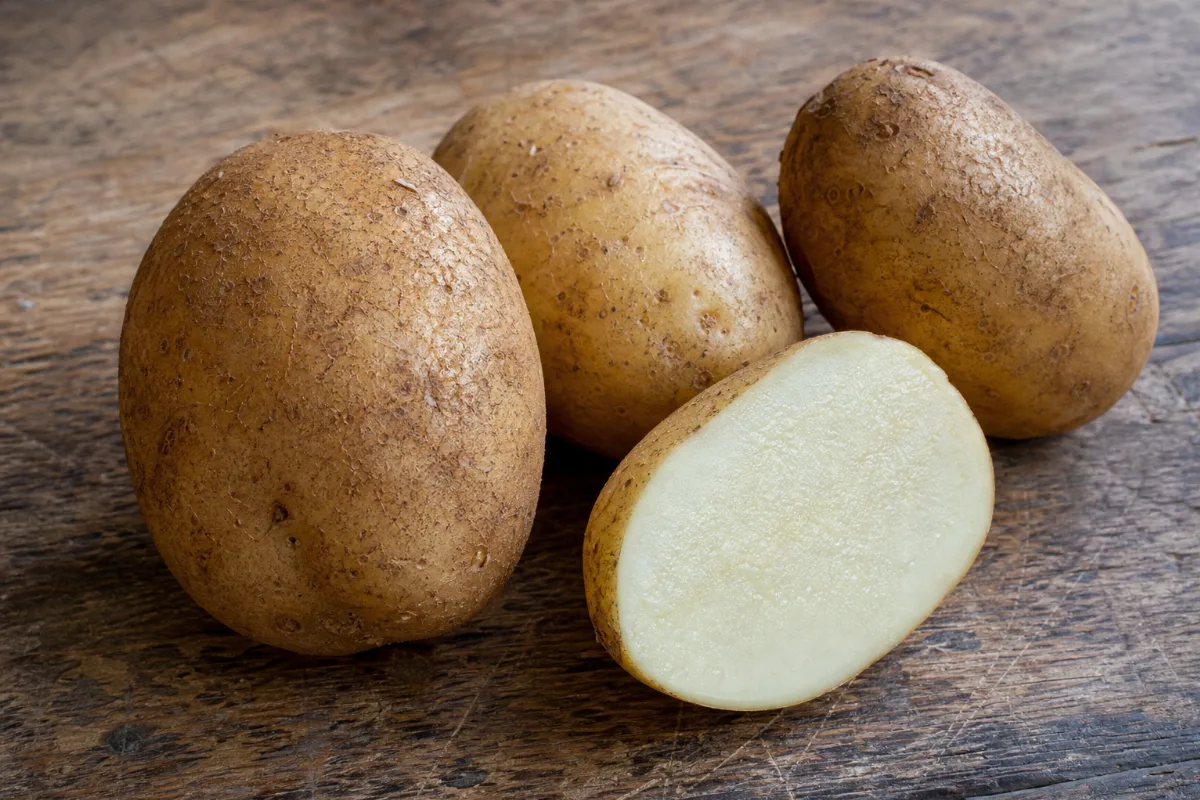
The potato (Solanum tuberosum) is the underground tuber of a plant in the nightshade family. People eat it boiled, baked, steamed, mashed, fried, frozen, canned or dried.
USDA data for raw potato with skin: 77 kcal per 100 g. One medium raw potato (213 g) has about 164 kcal, 4.5 g fibre, 4.4 g protein, 37 g carbohydrate (mostly starch), 905 mg potassium, 42 mg vitamin C, 0.63 mg vitamin B6 and 1.7 mg iron. These are raw values; boiling, baking or frying changes them, and added oil, butter or salt changes the food again.
The NHS does not count potatoes toward the UK 5 A Day because they are a starchy food; sweet potatoes, parsnips, swedes and turnips do count.
What the research shows
The firmest facts are about nutrients: potatoes are a source of vitamin C and potassium. These are not trials of potatoes.
Large cohort studies link French fries with a higher chance of type 2 diabetes, while baked, boiled or mashed potatoes together show no clear link. The findings for blood pressure, heart disease and death are mixed. None of this shows cause, because fries differ from boiled potatoes in oil, salt and portion size.
The few trials are small. One compared a daily baked potato with white rice in 24 adults with diabetes. One tested single meals of differently cooked potato. One tested a starch powder, not a potato. Two of these have links to potato industry groups, and these links are flagged on the page.
Cooking and food versus powders
A review says boiling and long cooking in water can lower water-soluble nutrients such as vitamin C, while steaming or microwaving may keep more, but findings are inconsistent for some nutrients. Resistant starch also depends on preparation.
The starch powder trial tested a concentrated ingredient from the maker, not a potato. A result for a powder does not tell us what eating potatoes does.
Amounts
This page gives no amounts to eat. Ask a doctor, pharmacist or dietitian what is right for you, especially if you have kidney disease or diabetes or take medicines that raise potassium.
At a glance
Traditional uses history, not proof
- Eaten as a starchy staple food, usually cooked
- Long use as food is not proof that it treats any condition
Studied for research
- Vitamin C for preventing scurvy, high certainty for the nutrient, no potato trial
- Potassium source, high certainty for the nutrient, no trial of potatoes for blood pressure
- Type 2 diabetes risk, low certainty, observational (fries versus baked, boiled or mashed)
- Blood sugar when potato replaces white rice, insufficient evidence (one small trial)
- Blood pressure, heart disease and early death, low certainty, mixed observational results
- Resistant starch from cooking methods, insufficient evidence (one single-meal trial)
- Resistant potato starch powder, very low certainty (a powder, not a potato)
Main compounds
- Vitamin C
- Potassium
- Vitamin B6
- Starch and resistant starch
- Solanine and chaconine (natural toxins in green or sprouted parts)
- Acrylamide (formed by high-heat cooking)
Common forms
- Boiled, baked, steamed or mashed potatoes as food
- Fried potatoes: French fries and chips
- Frozen, canned or dried potato products
- Resistant potato starch powder (the trial used a powder, not the vegetable)
Research links: WHO: Natural toxins in food · BMJ 2025: potato intake and type 2 diabetes · NCI: Acrylamide and cancer risk · Research Library · Genes & Biomarkers Library
What it is and its history
- Accepted scientific name
- Solanum tuberosum
- Naming authority
- L. (GBIF accepted)
- Common names
- Potato (English); White potato (English); Irish potato (English); Papa (also patata) (Spanish)
- Family or group
- Solanaceae (the nightshade family), as given by GBIF and by WHO, which says tomatoes, potatoes and eggplants all make solanines.
- Classification
- Plantae > Tracheophyta > Magnoliopsida > Solanales > Solanaceae > Solanum > Solanum tuberosum
- Native range
- Not verified from a source read.
- Habitat
- Not verified from a source read.
- What it looks like
- Roots: Not verified.; Stems: Not verified.; Leaves: Not verified.; Flowers: Not verified.; Fruit: The part eaten is the underground tuber (existing nutrient summary). USDA household portions: 1 small potato 170 g, 1 medium 213 g, 1 large 369 g, 0.5 cup diced 75 g.
- Cultivation
- Not verified from a source read.
- Harvest and processing
- Eaten boiled, baked, steamed, mashed, fried, frozen, canned or dried (existing nutrient summary). WHO says storage in a dark, cool, dry place limits solanine; cooking effects on nutrients are covered in the review read (boiling and long cooking in water may lower water-soluble nutrients).
- Look-alikes and adulterants
- Name: Sweet potato, cassava and yam; Note: Different root vegetables. The NHS counts sweet potatoes toward 5 A Day but not potatoes. Studies of potatoes do not apply to them.; Name: African potato; Note: A different plant sold as a herbal remedy with its own page. The plant relationship was not checked in a source read for this page.
- Sustainability and conservation
- Not assessed.
Photographs
What is inside, and how it may work
What it contains and how those compounds act in cells and animals. Laboratory and animal mechanisms are not proven effects in people.
Main compounds
| Compound | Family | Where it is concentrated | Activity studied | Level of evidence |
|---|---|---|---|---|
| Vitamin C (ascorbic acid) PubChem 54670067 | vitamin | Tuber USDA: 19.7 mg per 100 g raw | Needed to prevent scurvy; reduced by cooking (NHS, MedlinePlus). 23 24 | Human data |
| Potassium | mineral | Tuber USDA: 425 mg per 100 g raw | Helps the heart and muscles; a caution in kidney disease (MedlinePlus). The element's PubChem record was not checked for this page. 19 24 | Human data |
| Vitamin B6 PubChem 1054 | vitamin | Tuber USDA: 0.298 mg per 100 g raw | A B vitamin. Its role was not read in a source for this page. 24 | Human data |
| Starch (including resistant starch) | carbohydrate | Tuber USDA: starch 15.3 g per 100 g raw | Resistant starch escapes digestion in the small intestine, and its amount depends on preparation (review). Hard-cooked potato kept more in one trial. 24 13 15 | Human data |
| Alpha-solanine PubChem 30185 | glycoalkaloid | Sprouts, bitter peel and green parts (WHO) Not given in the sources read | Natural toxin; vomiting, diarrhoea and stomach pain in poisoning. CID is from a PubChem name lookup 2026-10-26. 25 2 8 | Human data |
| Alpha-chaconine PubChem 442971 | glycoalkaloid | Sprouts, bitter peel and green parts (WHO) Not given in the sources read | Natural toxin made with solanine (WHO). CID is from a PubChem name lookup 2026-10-26. 25 | Human data |
| Acrylamide (formed by cooking, not natural to the raw tuber) PubChem 6579 | process contaminant | Fried, roasted or baked potato foods Not given in the sources read | Forms when potatoes are heated to high temperatures with certain sugars (NCI, FDA); see Safety. 21 16 | Human data |
| Patatin (Sol t 1) | protein | Tuber Not given | A potato protein named as an allergen in the allergy case report. 10 | Human data |
Mechanisms, receptors and pathways
| Target or pathway | Gene or receptor | What was found | Level |
|---|---|---|---|
| Resistant starch and the blood sugar rise after a meal | Not specified | Hard-cooked potato kept more resistant starch than soft-cooked potato, and with rice it gave a smaller blood sugar and insulin rise in one single-meal trial; the authors tie the effect largely to the retained resistant starch. This is a suggested explanation, not proven. 15 13 | Human data |
| Potato allergy | Patatin (Sol t 1) and protease inhibitors named in the case report | The case report names potato proteins patatin and protease inhibitors as the likely allergic triggers; the child's blood test showed IgE to Sol t 1. 10 | Human data |
| Potassium load | Not specified | Poor kidney function and some medicines raise blood potassium (MedlinePlus), so a potassium-rich food matters more in those settings. No potato study of this was read. 19 | Human data |
Absorption, metabolism and elimination
- Absorption
- Not found for potato nutrients in the sources read. The resistant starch review says starch is classed by how fast it is digested in the small intestine.
- Distribution
- Not found.
- Metabolism
- Not found.
- Elimination
- Not found.
- Bioavailability
- Not established in the sources read.
Isolated compounds versus whole extracts
The resistant starch powder trial used a branded concentrated starch from the maker, not a potato, so it does not tell us about eating potatoes. Food results also depend on the cooking method: fried potato foods behave differently in studies from baked, boiled or mashed ones.
Nutritional composition
Nutrition from USDA FoodData Central (Potatoes, flesh and skin, raw, FDC 170026, SR Legacy, last updated 4/1/2019, read 2026-10-26). Per 100 g: 77 kcal, 2.05 g protein, 0.09 g fat, 17.5 g carbohydrate (15.3 g starch), 2.1 g fibre, about 79 g water, 12 mg calcium, 0.81 mg iron, 23 mg magnesium, 57 mg phosphorus, 425 mg potassium, 6 mg sodium, 0.11 mg copper, 0.153 mg manganese, 19.7 mg vitamin C, 0.298 mg vitamin B6, 15 micrograms folate (DFE), 2 micrograms vitamin K. One medium raw potato with skin (213 g), our arithmetic from the per-100 g values: about 164 kcal, 4.4 g protein, 37 g carbohydrate, 4.5 g fibre, 26 mg calcium, 1.7 mg iron, 49 mg magnesium, 905 mg potassium, 42 mg vitamin C, 0.63 mg vitamin B6, 32 micrograms folate, 0.33 mg manganese. Values vary with variety, ripeness and storage. These are raw values: boiling, baking or frying changes them, and added oil, butter or salt changes the food again. The NHS says boiled potatoes typically hold 7 to 9 mg of vitamin C per 100 g. The NHS also notes that potatoes are a starchy food and do not count toward 5 A Day in the UK.
2 high certainty2 low certainty1 very low certainty3 not enough evidence
What was looked at
The 8 benefits and uses checked for Potatoes, each with how strong the evidence is. Tap one to open it.
- Vitamin C from potatoes (preventing scurvy)High certainty
- Potassium from potatoesHigh certainty
- Type 2 diabetes risk (depends on how potatoes are cooked)Low certainty
- Blood sugar when potato replaces white rice (one small trial)Not enough evidence
- Blood pressure, heart disease and early deathLow certainty
- Resistant starch and blood sugar after meals (cooking method)Not enough evidence
- Resistant potato starch powder and gut bacteria (a powder, not a potato)Very low certainty
- Body weight and body fatNot enough evidence
Lab markers tracked in the studies
New type 2 diabetesFasting blood sugar and insulinBlood sugar control in type 2 diabetesNew high blood pressureHeart disease, stroke and deathsBlood sugar and insulin after a mealGut bacteria and stool patternWaist size and body fat
What is Potatoes good for?
The main studied uses and how strong the human evidence is for each. Most results come from large studies of what people usually eat, which cannot prove cause, and the cooking method matters.
Benefits, one by one
Each card is a research question, not a promise. Tap a goal to filter. Open a card to see the studies, doses and limits.
Vitamin C from potatoes (preventing scurvy)
High certaintyPotatoes are a source of vitamin C. USDA lists 19.7 mg per 100 g of raw potato, about 42 mg in one medium raw potato (213 g). The NHS lists potatoes among good sources and says a lack of vitamin C can lead to scurvy. Cooking lowers the amount: the NHS says boiled potatoes typically hold 7 to 9 mg per 100 g. This is a nutrient fact, not a potato trial.
4 studiesPotato as food. Raw values are higher than cooked values.
Studies, doses and limits
What the trials found
The NHS lists potatoes among good sources of vitamin C, says lack of the vitamin can lead to scurvy and that the body cannot store it. MedlinePlus lists white potatoes among vegetable sources, says the best sources are raw fruit and vegetables, and says cooking or long storage can reduce the vitamin C content. The NHS says boiled potatoes typically hold 7 to 9 mg per 100 g and that in the UK a lot of vitamin C comes from potatoes. USDA lists 19.7 mg per 100 g of raw potato with skin.
Results
Potatoes are a recognised source of vitamin C, and cooking lowers it. No trial of potatoes and scurvy was read.
Effect sizes as reported
USDA: 19.7 mg per 100 g raw; about 42 mg in a medium raw potato (213 g). NHS: boiled potato typically 7 to 9 mg per 100 g.
Why this rating
High for the nutrient role and for potatoes being a source (NHS, MedlinePlus, USDA). There is no potato-specific trial, and many other foods supply vitamin C.
Form and dose studied
Potato as food. Raw values are higher than cooked values.
Who was studied
Anyone eating a varied diet; MedlinePlus says severe deficiency (scurvy) mainly affects older, malnourished adults.
Limits
Nutrient information, not a trial. The amount left after cooking depends on method and time.
Why researchers looked
Potatoes are eaten so often that they supply a lot of the vitamin C in some diets, so people ask how much it counts for.
Traditional use
Potatoes are eaten as a starchy staple food, usually cooked. Long use as food is not proof that they treat any condition.
Proposed mechanism Authoritative guidance
Vitamin C is a water-soluble vitamin the body cannot store, so it is needed in the diet regularly (NHS).
A proposed mechanism does not show that the effect happens in people.
None specific for the food. Vitamin C supplements are a separate topic.
Potassium from potatoes
High certaintyPotatoes are a rich potassium food. USDA lists 425 mg per 100 g of raw potato, about 905 mg in one medium raw potato. MedlinePlus lists potatoes, particularly with the skin, among good sources. The same potassium is a caution for people with kidney disease or some blood pressure medicines (see the Safety tab). No trial of eating potatoes for blood pressure was read.
2 studiesPotato as food, with the skin on gives more (MedlinePlus wording).
Studies, doses and limits
What the trials found
MedlinePlus lists potatoes, particularly with the skin, sweet potatoes, beans, lentils and tomatoes as good sources of potassium. USDA lists 425 mg per 100 g of raw potato with skin.
Results
Potatoes are a recognised potassium source. No trial of potatoes for blood pressure or heart health was read.
Effect sizes as reported
USDA: 425 mg per 100 g raw; about 905 mg in a medium raw potato (213 g).
Why this rating
High for the nutrient role and for potatoes being a source (MedlinePlus, USDA). No potato-specific trial of a health effect from the potassium.
Form and dose studied
Potato as food, with the skin on gives more (MedlinePlus wording).
Who was studied
Everyone; people with kidney disease may need limits.
Limits
Nutrient information, not a trial. Frying, adding salt or peeling changes the food.
Why researchers looked
Potatoes are often named as a potassium food, and potassium is linked to heart and muscle function.
Traditional use
Potatoes are eaten as a starchy staple food, usually cooked. Long use as food is not proof that they treat any condition.
Proposed mechanism Authoritative guidance
Potassium helps the heart and muscles work and keeps the acid-base balance (MedlinePlus).
A proposed mechanism does not show that the effect happens in people.
High potassium can be a problem with kidney disease or some medicines: see the Safety tab.
Type 2 diabetes risk (depends on how potatoes are cooked)
Low certaintyLarge studies that follow people over years find that French fries go with a higher chance of type 2 diabetes, while baked, boiled or mashed potatoes together show no clear link. These are observational studies, so they show a link, not a cause. Fries also differ from boiled potatoes in oil, salt and portion size.
3 studiesFood as eaten; the studies compare fries, chips and fried potatoes wi…
Studies, doses and limits
What the trials found
Across three US cohorts of 205,107 people, each three extra weekly servings of French fries went with a 20% higher diabetes rate (HR 1.20), while baked, boiled or mashed potatoes together showed no significant link (HR 1.01). A 13-cohort meta-analysis found a 3% higher rate for total potato and 16% higher for fried potato per three servings a week. A harmonised analysis of seven US cohorts (105,531 people) found no link for total potato but a modest link for fried potato (HR 1.12 for more than one serving a week). A systematic review of 103 studies found fried potato linked to diabetes (RR 1.16) and non-fried potato to a small link (RR 1.05).
Results
Mixed. The link is clearest for fried potatoes. For baked, boiled or mashed potatoes it is null in some analyses and a small rise in another. The BMJ study also found that replacing potato with whole grains went with a lower rate, and replacing it with white rice with a higher rate.
Effect sizes as reported
Per 3 servings a week: French fries HR 1.20 (1.12 to 1.28); baked, boiled or mashed HR 1.01 (0.98 to 1.05); meta-analysis fried HR 1.16, total HR 1.03. Systematic review: fried RR 1.16 (1.04 to 1.30); non-fried RR 1.05 (1.01 to 1.10).
Why this rating
Observational studies only, so low certainty. Results differ between analyses, and the studies cannot separate cooking method from salt, oil and meal size.
Form and dose studied
Food as eaten; the studies compare fries, chips and fried potatoes with baked, boiled or mashed potatoes.
Who was studied
Adults in the US, Europe and elsewhere, mostly without diabetes at the start.
Limits
Self-reported diet. Cannot prove cause. The first harmonised analysis lists NIH support; the BMJ study lists NIH funding.
Why researchers looked
Potatoes raise blood sugar after a meal, so researchers ask whether eating them often raises the chance of diabetes.
Traditional use
Potatoes are eaten as a starchy staple food, usually cooked. Long use as food is not proof that they treat any condition.
Proposed mechanism Hypothesis
Not established. Fried potatoes add oil, salt and often larger portions, and the studies cannot separate these.
A proposed mechanism does not show that the effect happens in people.
People with diabetes who use insulin or other medicines should ask their care team how potatoes fit their meals.
Blood sugar when potato replaces white rice (one small trial)
Not enough evidenceIn one 12-week crossover trial of 24 adults with type 2 diabetes, a baked white potato each day did not worsen blood sugar, blood fats, blood pressure or vessel function compared with calorie-matched white rice. The authors call it preliminary. One author reports fees from a potato industry group.
2 studiesBaked white potato versus white rice, in the amounts used in the tria…
Studies, doses and limits
What the trials found
In the 24-person crossover trial (45 to 80 years, type 2 diabetes with overweight or obesity), baked white potato (100 g) or calorie-matched white rice (75 g) was eaten daily for 12 weeks each, with a 2-week gap. No measure of blood sugar control, blood fats, inflammation or blood pressure differed significantly between potato and rice over time.
Results
No harm to blood sugar, blood fats or blood pressure compared with rice, in a small preliminary trial.
Effect sizes as reported
No significant treatment-by-time difference for any outcome (P above 0.05).
Why this rating
One small trial (24 people) with an author who reports fees from the Alliance for Potato Research and Education. The authors call the results preliminary.
Form and dose studied
Baked white potato versus white rice, in the amounts used in the trial (trial detail, not advice).
Who was studied
Adults 45 to 80 with type 2 diabetes and overweight or obesity.
Limits
Small, preliminary, industry-linked author. Does not tell us about fried potatoes or other meals.
Why researchers looked
People with diabetes ask whether potatoes are worse than rice.
Traditional use
Potatoes are eaten as a starchy staple food, usually cooked. Long use as food is not proof that they treat any condition.
Proposed mechanism Unknown
Not established.
A proposed mechanism does not show that the effect happens in people.
People with diabetes should talk to their care team before changing meals.
Blood pressure, heart disease and early death
Low certaintyStudies that follow people over years give mixed answers. Total potato intake was not linked to heart disease or stroke in pooled studies. Fried potatoes were linked to a modest higher chance of high blood pressure in one pooled analysis but not in another, and a Chinese cohort linked potatoes to higher blood pressure risk. A large Norwegian cohort eating mostly boiled potatoes found a modestly lower chance of death. None of this shows cause.
4 studiesFood as eaten; cooking method differs by country.
Studies, doses and limits
What the trials found
A systematic review of 103 studies found no significant link of total potato intake with high blood pressure (RR 1.07), cardiovascular disease (RR 0.97) or stroke (RR 0.97). A harmonised analysis of seven US cohorts found total potato not linked to cardiovascular disease (HR 0.96) or high blood pressure (HR 1.04), and fried potato linked to 10% higher risk of high blood pressure. A Chinese cohort of 11,763 adults found a higher risk of high blood pressure in people eating potatoes compared with none (HR 1.40, 1.20, 1.12 across intake groups). A Norwegian cohort of 77,297 people, mostly eating boiled potatoes, found 14 or more potatoes a week linked to lower all-cause death (HR 0.88).
Results
Mixed. Mostly no link for total potato; a link to higher blood pressure for fried potato in one analysis and in China; a modest lower death risk in Norway.
Effect sizes as reported
Total potato: high blood pressure RR 1.07 (0.95 to 1.21); cardiovascular disease RR 0.97 (0.91 to 1.03). Fried potato and high blood pressure: 10% higher (4 to 17%). Norway: all-cause death HR 0.88 (0.84 to 0.93).
Why this rating
Observational studies only, with results that point in different directions and differ by country and cooking method. One analysis lists a grant from a potato industry group.
Form and dose studied
Food as eaten; cooking method differs by country.
Who was studied
Adults in the US, China and Norway.
Limits
Diet self-reported. Boiled-potato findings from Norway (1974 to 1988) may not apply to fries or chips.
Why researchers looked
Potatoes are rich in potassium but are often eaten fried and salted, so researchers ask about blood pressure and heart disease.
Traditional use
Potatoes are eaten as a starchy staple food, usually cooked. Long use as food is not proof that they treat any condition.
Proposed mechanism Hypothesis
Not established.
A proposed mechanism does not show that the effect happens in people.
People with high blood pressure should ask their care team about salt and fried foods.
Resistant starch and blood sugar after meals (cooking method)
Not enough evidenceResistant starch is starch that is not digested in the small intestine. A review says how much a food holds depends strongly on how it is prepared. One short trial found that hard-cooked potato eaten with rice gave a smaller blood sugar and insulin rise after the meal than rice alone, and the authors tied this to more retained resistant starch. This was a single-meal lab-style test, not long-term health.
2 studiesPotato cooked two ways, eaten with rice (trial detail, not advice).
Studies, doses and limits
What the trials found
A review (Raigond 2015) says the resistant starch in a food is highly influenced by food preparation and processing. In a randomised acute trial, hard-cooked or soft-cooked potato replaced one-third of the rice carbohydrate in a test meal. Hard-cooked potato retained more resistant starch and total phenolics, and with rice it lowered the blood sugar rise, the peak and the insulin response. The effect did not extend to the second meal, though total blood sugar over 540 minutes was lower.
Results
Preliminary: a smaller blood sugar rise after one meal with hard-cooked potato. No trial of cooled potatoes and long-term health was read.
Effect sizes as reported
Hard-cooked potato plus rice: lower glucose area under the curve, lower peak and lower insulin response (numbers not given in the abstract).
Why this rating
One single-meal trial with the number of people not given in the abstract, plus a narrative review. No long-term outcomes.
Form and dose studied
Potato cooked two ways, eaten with rice (trial detail, not advice).
Who was studied
Adults; health status not given in the abstract.
Limits
Single meals, short measures, number of people not stated in the abstract. The review is by an author at a potato research institute.
Why researchers looked
Cooking and cooling change potato starch, so researchers ask whether the way a potato is cooked changes the blood sugar rise after a meal.
Traditional use
Potatoes are eaten as a starchy staple food, usually cooked. Long use as food is not proof that they treat any condition.
Proposed mechanism Preliminary mechanism
Hard-cooked potato kept more resistant starch than soft-cooked potato in lab tests; resistant starch is digested more slowly (authors of the trial and review).
A proposed mechanism does not show that the effect happens in people.
None specific.
Resistant potato starch powder and gut bacteria (a powder, not a potato)
Very low certaintyA branded resistant potato starch powder changed some gut bacteria and stool pattern in one four-week placebo-controlled trial. The powder is a concentrated starch, not a potato, so the result does not tell us what eating potatoes does. The trial was contracted by the maker of the powder.
1 studiesConcentrated resistant potato starch powder (trial detail, not advice…
Studies, doses and limits
What the trials found
In a three-arm randomised, double-blind, placebo-controlled trial, 3.5 g or 7 g a day of Solnul resistant potato starch for four weeks. At 3.5 g a day the Bifidobacterium and Akkermansia changes were greater than with placebo and diarrhoea- and constipation-type bowel movements were fewer. The 7 g group responded similarly.
Results
The powder changed gut bacteria counts and stool pattern versus placebo. This is a supplement-type result.
Effect sizes as reported
Significant changes in two gut bacteria groups and fewer abnormal stools versus placebo (numbers not given in the abstract).
Why this rating
A powder, not the food. Gut bacteria counts are not a health outcome. The trial was contracted by the maker, and authors are employed by or consultants to it.
Form and dose studied
Concentrated resistant potato starch powder (trial detail, not advice).
Who was studied
Adults; number not given in the abstract.
Limits
Industry-linked. Not about eating potatoes.
Why researchers looked
A company tested its potato starch ingredient for effects on gut bacteria.
Traditional use
Potatoes are eaten as a starchy staple food, usually cooked. Long use as food is not proof that they treat any condition.
Proposed mechanism Unknown
Not established in the abstract. The trial measured gut bacteria and stool pattern only.
A proposed mechanism does not show that the effect happens in people.
Safety results were not given in the abstract.
Body weight and body fat
Not enough evidenceNo pooled study found that eating potatoes raises the chance of overweight or obesity: fried potato was not significantly linked in a review of observational studies. In the small potato versus rice trial, the potato period had a lower waist circumference and body fat percentage than the rice period, but the authors call this preliminary.
2 studiesBaked potato versus white rice in the trial; fried potato in the revi…
Studies, doses and limits
What the trials found
A systematic review found fried potato intake not significantly linked to overweight or obesity (RR 1.24, 95% CI 0.90 to 1.70); too few studies existed for total or non-fried potato. In the 24-person crossover trial in type 2 diabetes, averaged over the study, waist circumference was 4.5 cm lower and body fat 1.7% lower in the potato period than the rice period.
Results
No clear link in observational studies; a small preliminary trial favoured potato over rice for waist size.
Effect sizes as reported
Fried potato and overweight or obesity RR 1.24 (0.90 to 1.70), not significant. Trial: waist circumference 4.5 cm lower than with rice (P<0.0001).
Why this rating
Few observational studies and one small industry-linked trial (24 people).
Form and dose studied
Baked potato versus white rice in the trial; fried potato in the review.
Who was studied
Adults, including adults with type 2 diabetes and overweight.
Limits
Small trial, many outcomes tested, an author reports fees from a potato industry group.
Why researchers looked
Potatoes are a starchy staple, so people ask about weight.
Traditional use
Potatoes are eaten as a starchy staple food, usually cooked. Long use as food is not proof that they treat any condition.
Proposed mechanism Unknown
Not established.
A proposed mechanism does not show that the effect happens in people.
None specific.
Connections to the rest of health
How Potatoes connects to the rest of our health knowledge graph. Every link says what kind of connection it is. A safety link (for example to the liver) is a warning, not a benefit. A study that merely mentions a topic never creates a benefit link.
Explore every connection: goals, body systems, organs, symptoms, genes
B. Body systems
| Connected to | Kind of connection | Evidence status | Context | Studies |
|---|---|---|---|---|
| Blood And Immune | Biological association | High certainty | Studied for: Vitamin C from potatoes (preventing scurvy) | 23 20 24 22 |
| Cardiovascular System | Biological association | High certainty | Studied for: Potassium from potatoes Studied for: Blood pressure, heart disease and early death | 19 24 14 7 9 3 |
| Metabolism Weight | Biological association | Low certainty | Studied for: Type 2 diabetes risk (depends on how potatoes are cooked) Studied for: Blood sugar when potato replaces white rice (one small trial) | 11 6 14 1 |
| Blood Sugar Support | Biological association | Low certainty | Studied for: Type 2 diabetes risk (depends on how potatoes are cooked) Studied for: Blood sugar when potato replaces white rice (one small trial) | 11 6 14 1 15 13 |
| Digestive System | Biological association | Not enough evidence | Studied for: Resistant starch and blood sugar after meals (cooking method) Studied for: Resistant potato starch powder and gut bacteria (a powder, not a potato) | 15 13 4 |
C. Body parts and organs
| Connected to | Kind of connection | Evidence status | Context | Studies |
|---|---|---|---|---|
| Kidneys | Adverse effect or risk | Documented risk | People with poor kidney function may need to limit potassium-rich foods. Potassium-rich; caution for kidney disease and some blood pressure medicines. Preparation or compound: Potassium in potatoes |
19 24 |
| Gut | Adverse effect or risk | Documented risk | Vomiting, diarrhoea and stomach pain after eating green or sprouted potatoes (case report). Green or sprouted potatoes contain more solanine, which can cause vomiting, diarrhoea and stomach pain. Preparation or compound: Solanine in green or sprouted potatoes |
25 2 |
I. Biomarkers
| Connected to | Kind of connection | Evidence status | Context | Studies |
|---|---|---|---|---|
| New type 2 diabetes | Biological association | Low certainty | Measured in trials: mixed. A lab change is not the same as a health benefit. | 11 6 14 |
| Fasting blood sugar and insulin | Biological association | Low certainty | Measured in trials: raised. A lab change is not the same as a health benefit. | 12 |
| Blood sugar control in type 2 diabetes | Biological association | Not enough evidence | Measured in trials: no-change. A lab change is not the same as a health benefit. | 1 |
| New high blood pressure | Biological association | Low certainty | Measured in trials: mixed. A lab change is not the same as a health benefit. | 14 7 9 |
| Heart disease, stroke and deaths | Biological association | Low certainty | Measured in trials: mixed. A lab change is not the same as a health benefit. | 7 14 3 |
| Blood sugar and insulin after a meal | Biological association | Not enough evidence | Measured in trials: lowered. A lab change is not the same as a health benefit. | 15 |
| Gut bacteria and stool pattern | Biological association | Very low certainty | Measured in trials: raised. A lab change is not the same as a health benefit. | 4 |
| Waist size and body fat | Biological association | Not enough evidence | Measured in trials: lowered. A lab change is not the same as a health benefit. | 1 |
K. Biological pathways
| Connected to | Kind of connection | Evidence status | Context | Studies |
|---|---|---|---|---|
| Potassium | Preliminary mechanism | Human | Potatoes are potassium-rich; high blood potassium is a concern in kidney disease or with some medicines. | 19 24 |
| Vitamin C | Preliminary mechanism | Human | Potatoes are a vitamin C source; cooking lowers the amount. | 23 22 |
| Resistant starch | Preliminary mechanism | Human | Depends on preparation; tested in one single-meal trial. | 13 15 |
L. Active compounds
| Connected to | Kind of connection | Evidence status | Context | Studies |
|---|---|---|---|---|
| Vitamin C (ascorbic acid) | Biological association | Human | Needed to prevent scurvy; reduced by cooking (NHS, MedlinePlus). Preparation or compound: Tuber |
23 24 |
| Potassium | Biological association | Human | Helps the heart and muscles; a caution in kidney disease (MedlinePlus). The element's PubChem record was not checked for this page. Preparation or compound: Tuber |
19 24 |
| Vitamin B6 | Biological association | Human | A B vitamin. Its role was not read in a source for this page. Preparation or compound: Tuber |
24 |
| Starch (including resistant starch) | Biological association | Human | Resistant starch escapes digestion in the small intestine, and its amount depends on preparation (review). Hard-cooked potato kept more in one trial. Preparation or compound: Tuber |
24 13 15 |
| Alpha-solanine | Biological association | Human | Natural toxin; vomiting, diarrhoea and stomach pain in poisoning. CID is from a PubChem name lookup 2026-10-26. Preparation or compound: Sprouts, bitter peel and green parts (WHO) |
25 2 8 |
| Alpha-chaconine | Biological association | Human | Natural toxin made with solanine (WHO). CID is from a PubChem name lookup 2026-10-26. Preparation or compound: Sprouts, bitter peel and green parts (WHO) |
25 |
| Acrylamide (formed by cooking, not natural to the raw tuber) | Biological association | Human | Forms when potatoes are heated to high temperatures with certain sugars (NCI, FDA); see Safety. Preparation or compound: Fried, roasted or baked potato foods |
21 16 |
| Patatin (Sol t 1) | Biological association | Human | A potato protein named as an allergen in the allergy case report. Preparation or compound: Tuber |
10 |
Each connection is stored with the ingredient, the connected record, the kind of connection, the evidence status, the supporting studies, the preparation or compound involved, and a review date (last reviewed October 26, 2026).
Evidence at a glance: what changed in 8 lab markers
Tap a number to show only those markers. Counts are markers, not people.
The evidence
The research centre for Potatoes. Every record here was checked against PubMed or the publisher's page; we never list a study we have not verified.
Evidence by outcome
Bars show how many studies we found for each outcome, not how well it works. People are added up across trials only (reviews are not added, to avoid double counting).
How we rate evidence
High certainty
Several well-run trials or reviews agree; further research is unlikely to change the picture much.
Moderate certainty
Good trials point the same way, but some doubt remains.
Low certainty
Small, short or inconsistent trials. The finding could change with better research.
Very low certainty
Very little or very weak human data. Treat as a possibility only.
Mixed findings
Trials or reviews disagree with each other.
Not enough evidence
Not enough human research to say either way.
Evidence against
Good research found no benefit, or found harm.
We take the reviewers' own risk-of-bias and GRADE statements where they exist, and otherwise judge from study size, design, consistency, directness and whether a product matches what is sold. Many publications do not make evidence high. Method note: We started from our existing potato summary, re-checked nutrition at USDA FoodData Central, read the health agency pages (WHO, NHS, MedlinePlus, NCI, FDA) and PubMed abstracts for the studies. Only abstracts were read for studies. Items we could not verify are flagged in the research gaps.
Study library: every study we checked 25
| Study | Design | People | Product, dose, length | Result |
|---|---|---|---|---|
| Akhavan 2025 The Comparative Effects of White Potato and White Rice Consumption on Measures of Cardiometabolic Health in Individuals with Type 2 Diabetes Mellitus and Features of Metabolic Syndrome. Curr Dev Nutr · PMID 40927748 · DOI |
Controlled trial |
24 24 adults aged 45 to 80 with type 2 diabetes and overweight or obesity |
Baked white potato (100 g) or calorie-matched white rice (75 g) every day Whole potato food Observational or trial detail, not advice 12 weeks each, with a 2-week washout · vs White rice |
No significant difference over time between potato and rice for any outcome. Averaged across the study, the potato period had a lower waist circumference (4.5 cm), lower body fat percentage, lower waist-to-hip ratio and lower heart rate than the rice period. The authors call this preliminary and say white potatoes did not harm blood sugar, vessel health, blood fats or blood pressure compared with rice. Potato versus rice (main effect of treatment): waist circumference 4.5 cm lower (P<0.0001), fat mass 1.7% lower (P=0.01), heart rate 3.1 bpm lower (P=0.01). No treatment-by-time interaction for any outcome. (Not given in the abstract (values given as mean plus or minus error)) Methods, limits and fundingOutcomes: Blood sugar control, blood fats, inflammation, blood pressure, vessel function, body composition Limitations: Small crossover trial; many outcomes tested; the authors call the results preliminary. Funding and conflicts: Industry link: one author reports speaking and lecture fees from the Alliance for Potato Research and Education. Read: abstract |
| Al Masaoud 2022 A challenging case of suspected solanine toxicity in an eleven-year-old Saudi boy. J Family Med Prim Care · PMID 36387661 · DOI |
Case report |
1 One 11-year-old boy |
Raw potato eaten (suspected solanine poisoning) Raw potato Observational or trial detail, not advice Single episode |
The report says acute solanine poisoning from green or sprouted potatoes mainly causes vomiting, diarrhoea and stomach pain, with fever, fast pulse, low blood pressure, fast breathing and nerve symptoms at higher doses, and that poisoning is relatively rare. The boy ate raw potato, had heart and circulation complications, was treated conservatively in intensive care and recovered fully. One case; diagnosis based on history and symptoms, not a lab test (Not applicable) Methods, limits and fundingOutcomes: Symptoms and recovery Limitations: Single case; the diagnosis was suspected, not proven. Funding and conflicts: No conflicts of interest declared. Read: abstract |
| Arnesen 2024 Potato Consumption and All-Cause and Cardiovascular Disease Mortality - A Long-Term Follow-Up of a Norwegian Cohort. J Nutr · PMID 38763265 · DOI |
Retrospective cohort |
77297 77,297 Norwegian adults (mean age 41 at the start), median follow-up 33.5 years, 27,848 deaths |
Potato intake as food, mostly boiled potatoes Whole potato foods Observational or trial detail, not advice Median 33.5 years · vs Up to 6 potatoes a week |
People eating 14 or more potatoes a week had a lower risk of dying from any cause than people eating 6 or fewer. Each extra 100 g a day went with a 4% lower risk of death from any cause or from cardiovascular disease. The authors call the links modest and inverse. 14+/week versus 6 or fewer: all-cause death HR 0.88. Per 100 g a day: all-cause HR 0.96, cardiovascular HR 0.96 (All-cause 0.84 to 0.93 (14+/week); per 100 g a day 0.94 to 0.98) Methods, limits and fundingOutcomes: Death from any cause and from cardiovascular disease Limitations: Observational, one country, mostly boiled potatoes eaten in 1974 to 1988; cannot show cause. Not applicable to fries or chips. Funding and conflicts: No funding or conflict statement in the abstract. Read: abstract |
| Bush 2023 Consumption of Solnul(TM) Resistant Potato Starch Produces a Prebiotic Effect in a Randomized, Placebo-Controlled Clinical Trial. Nutrients · PMID 37049425 · DOI |
Controlled trial |
Adults (number and health status not given in the abstract) | Solnul resistant potato starch powder, 3.5 g or 7 g a day (a branded starch ingredient, not a potato) Concentrated starch powder Trial detail, not advice 4 weeks · vs Placebo |
At 3.5 g a day the powder gave greater changes in Bifidobacterium and Akkermansia than placebo, and fewer diarrhoea- and constipation-type bowel movements. The 7 g group responded similarly. Significantly greater changes in two gut bacteria groups and fewer abnormal stools than placebo (numbers not given in the abstract) (Not given in the abstract) Methods, limits and fundingOutcomes: Gut bacteria (Bifidobacterium and Akkermansia) and stool pattern Limitations: A powder, not the food. Gut bacteria counts are not a health outcome. Funding and conflicts: Industry link: authors are employed by, or were consultants to, the maker of the starch (MSP Starch Products), the maker contracted the trial, and its sister company holds relevant patents. Read: abstract |
| Coe 2022 Cooking at home to retain nutritional quality and minimise nutrient losses: A focus on vegetables, potatoes and pulses. Nutr Bull · PMID 36299246 · DOI |
Narrative review |
Review of home cooking methods for vegetables, potatoes and pulses | Boiling, steaming, microwaving and other home cooking Whole foods Observational or trial detail, not advice |
The review says cooking with high heat or water for a long time (for example boiling) may be the most damaging to water-soluble nutrients, and steaming or microwaving may retain more. For some nutrients the findings are insufficient and inconsistent. The abstract gives no potato-specific numbers. No effect size in the abstract (Not given) Methods, limits and fundingOutcomes: Nutrient and phytochemical losses with cooking Limitations: Narrative review. Abstract has no potato-specific figures. Funding and conflicts: PubMed lists non-US government research support; the author affiliation is the British Nutrition Foundation. No conflict statement in the abstract. Read: abstract |
| Djousse 2024 Potato Consumption and Risk of Type 2 Diabetes Mellitus: A Harmonized Analysis of 7 Prospective Cohorts. J Nutr · PMID 39289134 · DOI |
Meta-analysis |
105531 105,531 US adults in seven cohorts (mean age 25 to 72; 65% women) |
Potato intake as food: total, combined baked/boiled/mashed, fried Whole potato foods Observational or trial detail, not advice Cohort follow-up (length not given in the abstract) · vs No potato intake |
Total potato intake was not significantly linked to diabetes (HR 1.07 for 5 or more servings a week versus none). Baked, boiled and mashed potatoes together were not linked. Fried potatoes were linked with a modest higher risk (HR 1.12 for more than one serving a week). Total, 5+ servings/week: HR 1.07; fried, >1/week: HR 1.12 (Total 0.99 to 1.16; fried 1.03 to 1.22) Methods, limits and fundingOutcomes: Incident type 2 diabetes Limitations: Observational. Diet self-reported. Funding and conflicts: Abstract lists NIH research support; no industry funding is stated in the abstract. Read: abstract |
| Djousse 2025 Potato Consumption and Risk of Cardiovascular Disease in a Harmonized Analysis of Seven Prospective Cohorts. Nutrients · PMID 39940309 · DOI |
Meta-analysis |
110063 US adults in seven cohorts for cardiovascular disease (110,063) and five for high blood pressure (67,146) |
Potato intake as food: total, combined baked/boiled/mashed, fried Whole potato foods Observational or trial detail, not advice Cohort follow-up (length not given in the abstract) · vs No potato intake |
Total potato intake was not linked to cardiovascular disease or high blood pressure. Baked, boiled and mashed potatoes were not linked to either. Fried potatoes were not linked to cardiovascular disease but were linked to 10% higher risk of high blood pressure at one or more servings a week. Total, 5+ servings/week: cardiovascular disease HR 0.96, high blood pressure HR 1.04; fried, 1+/week: high blood pressure 10% higher (Cardiovascular 0.89 to 1.04; high blood pressure 0.99 to 1.08; fried high blood pressure 4% to 17% higher) Methods, limits and fundingOutcomes: Cardiovascular disease and high blood pressure Limitations: Observational. Diet self-reported. Funding and conflicts: Industry link: the first author received an investigator-initiated grant from the Alliance for Potato Research and Education (and other companies). The abstract says the sponsor had no role in the design, running, interpretation or writing. Read: abstract |
| Figueira 2026 Glycoalkaloids in potatoes: exploring health effects, analytical techniques, occurrence, mitigation measures. Food Chem Toxicol · PMID 41106768 · DOI |
Narrative review |
Review of potato glycoalkaloids | Glycoalkaloids (solanine and related compounds) in potato tubers Potato tuber Observational or trial detail, not advice |
The review says glycoalkaloids can become toxic above a certain level, that farming, storage and distribution conditions can raise them to toxic levels, and that they have also shown some possible health benefits (the abstract gives no details of these). No numbers in the abstract (Not given) Methods, limits and fundingOutcomes: Toxic and possible beneficial effects; factors that raise levels Limitations: Narrative review; abstract gives no thresholds or numbers. Funding and conflicts: Authors declare no competing interests. Read: abstract |
| Huang 2019 Potato consumption is prospectively associated with risk of hypertension: An 11.3-year longitudinal cohort study. Clin Nutr · PMID 30025746 · DOI |
Retrospective cohort |
11763 11,763 Chinese adults without high blood pressure at the start (China Health and Nutrition Survey) |
Potato intake as food: total, stir-fried, non-stir-fried Whole potato foods Observational or trial detail, not advice Average 11.3 years; 4,033 new cases of high blood pressure · vs Non-consumers |
Compared with people who ate no potatoes, those eating potatoes had a higher risk of high blood pressure (HRs 1.40, 1.20 and 1.12 across three intake groups; the last interval included 1). When non-consumers were left out, higher intake tended toward lower risk. The authors advise caution about promoting potatoes in China. Total potato, three intake groups versus none: HR 1.402, 1.198, 1.120 (1.270 to 1.548; 1.014 to 1.415; 0.929 to 1.349) Methods, limits and fundingOutcomes: New high blood pressure Limitations: Observational, one country. Results change depending on whether non-consumers are included. Cannot show cause. Funding and conflicts: Publication type lists NIH research support; no industry funding is stated in the abstract. Read: abstract |
| Kitsos 2025 A Case Report of Potato Allergy With Atypical Manifestations in a 2-Year-Old Child. Case Rep Pediatr · PMID 40955319 · DOI |
Case report |
1 One 2-year-old child |
Potato eaten as food Potato Observational or trial detail, not advice Single case with follow-up |
The report describes repeated vomiting, diarrhoea and wheezing linked to potato, then redness around the mouth. Skin-prick and blood tests were positive for potato and for the potato protein patatin (Sol t 1). A strict potato-free diet resolved the symptoms. Food challenge was deferred because of how severe the first symptoms were. The report calls potato allergy rare and under-recognised. A correction (erratum) was later published. One case (Not applicable) Methods, limits and fundingOutcomes: Allergy diagnosis and symptoms Limitations: Single case; no food challenge. Carries an erratum (Case Rep Pediatr 2026). Funding and conflicts: No conflicts of interest declared. Read: abstract |
| Mousavi 2025 Total and specific potato intake and risk of type 2 diabetes: results from three US cohort studies and a substitution meta-analysis of prospective cohorts. BMJ · PMID 40769531 · DOI |
Meta-analysis |
205107 205,107 US men and women free of diabetes, heart disease and cancer at the start (Nurses Health Studies and Health Professionals Follow-up Study); plus a meta-analysis of 13 cohorts (587,081 people) |
Potato intake as food: total, French fries, and combined baked, boiled or mashed Whole potato foods Observational or trial detail, not advice 5,175,501 person-years of follow-up · vs Lower versus higher intake; substitution analyses (whole grains, white rice) |
Each three extra servings a week of total potato went with a 5% higher diabetes rate and of French fries a 20% higher rate. Baked, boiled or mashed potatoes together showed no significant link. In the 13-cohort meta-analysis the rate was 3% higher per three weekly servings of total potato and 16% higher for fried potatoes. Swapping potato for whole grains went with a lower rate; swapping for white rice went with a higher one. Per 3 servings a week: total potato HR 1.05; French fries HR 1.20; baked, boiled or mashed HR 1.01. Meta-analysis: total HR 1.03, fried HR 1.16 (Total 1.02 to 1.08; fries 1.12 to 1.28; baked/boiled/mashed 0.98 to 1.05; meta-analysis total 1.02 to 1.05, fried 1.09 to 1.23) Methods, limits and fundingOutcomes: Incident type 2 diabetes Limitations: Observational: shows links, not cause. Diet was self-reported. Fries differ from boiled potatoes in oil, salt and portion size as well as cooking method. Funding and conflicts: Funding from the US National Institutes of Health; authors declare no relationships with organisations that might have an interest in the work. Read: abstract |
| Pokharel 2025 Associations of Vegetable and Potato Intakes With Markers of Type 2 Diabetes Risk in the AusDiab Cohort. J Clin Endocrinol Metab · PMID 38747471 · DOI |
Other |
8009 8,009 Australian adults (median age 52), 12-year follow-up |
Potato intake as food, including fries and chips Whole potato foods Observational or trial detail, not advice 12 years · vs Lower versus higher intake |
Higher intake of potato fries and chips went with higher fasting glucose, higher insulin and lower insulin sensitivity. The authors say potatoes prepared in a healthy way did not worsen glucose tolerance in this study. Fries/chips linked to higher fasting plasma glucose and insulin and lower insulin sensitivity (numbers not given in the abstract) (Not given in the abstract) Methods, limits and fundingOutcomes: Blood sugar, insulin and sensitivity markers; new type 2 diabetes Limitations: Observational; diet from a questionnaire at the start only. Numbers for potato results were not in the abstract. Funding and conflicts: No funding or conflict statement in the abstract. Read: abstract |
| Raigond 2015 Resistant starch in food: a review. J Sci Food Agric · PMID 25331334 · DOI |
Narrative review |
Review of published information on resistant starch | Resistant starch in foods and as an added ingredient Foods and ingredients Observational or trial detail, not advice |
The review says the amount of resistant starch in a food depends strongly on how it is prepared and processed, and lists proposed benefits such as blood sugar control and lower blood fats. The abstract gives no numbers and does not name potatoes. No effect size in the abstract (Not given) Methods, limits and fundingOutcomes: Classification, properties, applications and health benefits of resistant starch Limitations: Narrative review; the author affiliation is a potato research institute. The abstract does not give numbers. Funding and conflicts: No funding or conflict statement in the abstract. Author affiliation: Potato Research Institute, Shimla, India. Read: abstract |
| Su 2025 Potato Intake and the Risk of Overweight/Obesity, Hypertension, Diabetes, and Cardiovascular Disease: A Systematic Review and Meta-analysis of Observational Studies. Nutr Rev · PMID 39527022 · DOI |
Systematic review meta analysis |
51 articles (103 studies) of observational research | Potato intake as food: total, fried, non-fried Whole potato foods Observational or trial detail, not advice Studies searched to 13 July 2023 · vs Lowest versus highest intake |
Total potato intake was not significantly linked to high blood pressure, diabetes, gestational diabetes, coronary heart disease, cardiovascular disease or stroke. Fried potato intake was linked to higher diabetes risk. Non-fried potato intake was linked to a small higher diabetes risk but not to high blood pressure. The authors say more cohort studies are needed. Total potato and high blood pressure RR 1.07; total and diabetes RR 1.08; total and cardiovascular disease RR 0.97; fried and diabetes RR 1.16; non-fried and diabetes RR 1.05; non-fried and high blood pressure RR 1.06 (High blood pressure 0.95 to 1.21; diabetes 0.96 to 1.22; cardiovascular disease 0.91 to 1.03; fried diabetes 1.04 to 1.30; non-fried diabetes 1.01 to 1.10; non-fried high blood pressure 0.97 to 1.15) Methods, limits and fundingOutcomes: Overweight/obesity, high blood pressure, diabetes, gestational diabetes, heart disease, stroke Limitations: Pools observational studies of different design and different ways of cooking potatoes; cannot show cause. PROSPERO registered (RD42023454244). Funding and conflicts: No funding or conflict statement in the abstract. Registration: PROSPERO RD42023454244 Read: abstract |
| Wei 2026 Minimally Cooked Potato Improved Glycemic Response Across Two Meals and Insulin Sensitivity of Rice-Potato Mixed Meals: A Randomized Controlled Acute Trial. Nutrients · PMID 41901148 · DOI |
Controlled trial |
Adults (number and health status not given in the abstract) | Hard-cooked potato or soft-cooked potato replacing one-third of rice carbohydrate in a test meal Whole potato food, cooked two ways Trial detail, not advice Single meals, blood tests over about 9 hours · vs Rice meal |
Hard-cooked potato kept more resistant starch than soft-cooked potato. Eaten with rice, hard-cooked potato lowered the blood sugar rise, the peak and the insulin response after the meal. The effect did not carry to the second meal, though total blood sugar over 540 minutes was lower. The authors tie the effect largely to retained resistant starch. Hard-cooked potato plus rice: lower glucose area under the curve, lower peak glucose and lower insulin response (numbers not given in the abstract) (Not given in the abstract) Methods, limits and fundingOutcomes: Blood sugar and insulin after the meal; resistant starch and phenolics in the potato (lab) Limitations: Single-meal tests in the lab, not long-term health. Number of people not given in the abstract. Funding and conflicts: Authors declare no conflicts of interest. Read: abstract |
| s-fda-acrylamide FDA: Acrylamide · Source |
Health agency n/a |
Methods, limits and fundingRead: full-text | ||
| s-fda-produce FDA: Selecting and Serving Produce Safely · Source |
Health agency n/a |
Methods, limits and fundingRead: full-text | ||
| s-gbif-solanum-tuberosum GBIF Backbone: Solanum tuberosum L. (usageKey 2930262) · Source |
Reference database n/a |
Methods, limits and fundingRead: full-text | ||
| s-medlineplus-potassium MedlinePlus: Potassium in diet · Source |
Health agency n/a |
Methods, limits and fundingRead: full-text | ||
| s-medlineplus-vitc MedlinePlus: Vitamin C · Source |
Health agency n/a |
Methods, limits and fundingRead: full-text | ||
| s-nci-acrylamide National Cancer Institute: Acrylamide and Cancer Risk · Source |
Health agency n/a |
Methods, limits and fundingRead: full-text | ||
| s-nhs-5aday NHS: 5 A Day, what counts? · Source |
Health agency n/a |
Methods, limits and fundingRead: full-text | ||
| s-nhs-vitc NHS: Vitamin C · Source |
Health agency n/a |
Methods, limits and fundingRead: full-text | ||
| s-usda-fdc-170026 USDA FoodData Central: Potatoes, flesh and skin, raw (FDC 170026) · Source |
Reference database n/a |
Methods, limits and fundingRead: full-text | ||
| s-who-natural-toxins WHO: Natural toxins in food · Source |
Health agency n/a |
Methods, limits and fundingRead: full-text |
What we do not know yet
- No trial of eating potatoes was found for scurvy, blood pressure or heart disease.
- Cohort studies cannot separate cooking method from salt, oil, portion size and the rest of the diet.
- The only trials read were small, short or industry-linked, and one tested a starch powder, not a potato.
- No trial of cooked-and-cooled potatoes and long-term health was found.
- Allergy was found only in one case report; how common it is was not found.
- Whether peeling or cooking removes solanine, pesticide residues, heavy metals, nightshade claims, breastfeeding and the storage of cooked leftovers were not researched.
How new research is added
New studies are found by a saved PubMed search and placed in a review queue before the page changes.
Lab markers
What changed in blood or saliva tests during trials. A changed number is not the same as feeling or being healthier, and we give no "normal ranges".
Other 8
New type 2 diabetes
Mixed results in trials
How many people in a study develop type 2 diabetes over the years.
Low certaintyResults and what it means
Why it was measured
It is the main outcome in the large potato cohort studies.
Statistical vs. clinical meaning
Links, mainly for fried potato. Not proof that potatoes cause diabetes.
Safety implication
None specific.
| Study | Result | People | Product |
|---|---|---|---|
| 11 | French fries HR 1.20 and total potato HR 1.05 per three weekly servings; baked, boiled or mashed potatoes together HR 1.01 (0.98 to 1.05) | 205,107 US adults | Potato foods as eaten |
| 6 | Total potato not linked (HR 1.07 for 5+ servings a week, CI 0.99 to 1.16); fried potato HR 1.12 (1.03 to 1.22) for more than one serving a week | 105,531 US adults in seven cohorts | Potato foods as eaten |
| 14 | Fried potato RR 1.16 (1.04 to 1.30); non-fried RR 1.05 (1.01 to 1.10); total RR 1.08 (0.96 to 1.22) | 103 observational studies | Potato foods as eaten |
Fasting blood sugar and insulin
Raised in trials
Blood sugar and insulin levels measured after not eating, and how well the body responds to insulin.
Low certaintyResults and what it means
Why it was measured
These are early signs of how the body handles sugar.
Statistical vs. clinical meaning
An observational link for fries and chips only. Numbers were not in the abstract.
Safety implication
None specific.
| Study | Result | People | Product |
|---|---|---|---|
| 12 | Higher fries and chips intake went with higher fasting glucose, higher insulin and lower insulin sensitivity; the authors say potatoes prepared in a healthy way did not worsen glucose tolerance | 8,009 Australian adults | Potato foods as eaten, from a questionnaire |
Blood sugar control in type 2 diabetes
No clear change in trials
Measures of blood sugar control, blood fats, inflammation and blood pressure in people with diabetes.
Not enough evidenceResults and what it means
Why it was measured
A trial checked whether swapping rice for potato changes these measures.
Statistical vs. clinical meaning
No worsening versus rice in one small preliminary, industry-linked trial.
Safety implication
None specific.
| Study | Result | People | Product |
|---|---|---|---|
| 1 | No significant treatment-by-time difference for any outcome between baked potato and white rice | 24 adults with type 2 diabetes | Baked white potato versus white rice, 12 weeks |
New high blood pressure
Mixed results in trials
How many people in a study develop high blood pressure over the years.
Low certaintyResults and what it means
Why it was measured
Potatoes are high in potassium but often eaten fried and salted.
Statistical vs. clinical meaning
Mixed observational results, with a link for fried potato in one analysis and in China.
Safety implication
None specific.
| Study | Result | People | Product |
|---|---|---|---|
| 14 | Total potato RR 1.07 (0.95 to 1.21), not significant; non-fried RR 1.06 (0.97 to 1.15), not significant | 103 observational studies | Potato foods as eaten |
| 7 | Total potato HR 1.04 (0.99 to 1.08); fried potato 10% higher risk (4 to 17%) | 67,146 US adults in five cohorts | Potato foods as eaten |
| 9 | Potato eaters had higher risk than non-consumers (HR 1.402, 1.198, 1.120 across intake groups); excluding non-consumers, higher intake tended toward lower risk | 11,763 Chinese adults | Potato foods as eaten |
Heart disease, stroke and deaths
Mixed results in trials
How many people in a study develop heart disease or stroke, or die.
Low certaintyResults and what it means
Why it was measured
These are the outcomes that matter most to health.
Statistical vs. clinical meaning
No link in pooled studies; a modest lower death risk in one Norwegian cohort. Not proof of cause.
Safety implication
None specific.
| Study | Result | People | Product |
|---|---|---|---|
| 7 | Total potato and cardiovascular disease HR 0.96 (0.89 to 1.04), not significant | 110,063 US adults in seven cohorts | Potato foods as eaten |
| 14 | Total potato and cardiovascular disease RR 0.97 (0.91 to 1.03); stroke RR 0.97 (0.88 to 1.06); coronary heart disease RR 1.00 (0.99 to 1.02) | 103 observational studies | Potato foods as eaten |
| 3 | 14 or more potatoes a week versus 6 or fewer: all-cause death HR 0.88 (0.84 to 0.93); per 100 g a day, all-cause HR 0.96 and cardiovascular death HR 0.96 (0.93 to 0.99) | 77,297 Norwegian adults, 33.5 years | Mostly boiled potatoes |
Blood sugar and insulin after a meal
Lowered in trials
How high blood sugar and insulin rise in the hours after eating.
Not enough evidenceResults and what it means
Why it was measured
It shows how a meal with potato affects the body in the short term.
Statistical vs. clinical meaning
A short-term test, not a long-term health result.
Safety implication
None specific.
| Study | Result | People | Product |
|---|---|---|---|
| 15 | Hard-cooked potato with rice lowered the glucose rise, peak glucose and insulin response compared with a rice meal; no effect on the second meal alone | Adults (number not given in the abstract) | Hard-cooked potato replacing one-third of rice carbohydrate, single meal |
Gut bacteria and stool pattern
Raised in trials
The share of certain gut bacteria in stool and the form of bowel movements.
Very low certaintyResults and what it means
Why it was measured
The trial of a resistant starch powder measured these.
Statistical vs. clinical meaning
A powder result; bacteria counts are not a health outcome.
Safety implication
None specific.
| Study | Result | People | Product |
|---|---|---|---|
| 4 | Greater changes in Bifidobacterium and Akkermansia and fewer diarrhoea- and constipation-type stools with 3.5 g a day versus placebo at four weeks | Adults (number not given in the abstract) | Resistant potato starch powder, not a potato |
Waist size and body fat
Lowered in trials
Waist measurement and the share of the body that is fat.
Not enough evidenceResults and what it means
Why it was measured
Measured in the potato versus rice trial.
Statistical vs. clinical meaning
Small, preliminary, industry-linked author.
Safety implication
None specific.
| Study | Result | People | Product |
|---|---|---|---|
| 1 | Potato period versus rice period: waist circumference 4.5 cm lower (P<0.0001), fat mass 1.7% lower (P=0.01), waist-to-hip ratio lower | 24 adults with type 2 diabetes | Baked white potato versus white rice, 12 weeks |
Safety
What studies and official sources say about side effects, medicines and who should check first. Each point shows what kind of evidence it comes from.
Main points to know 5
- Green or sprouting potatoes: do not eat the green or sprouting parts. The WHO says potatoes make natural toxins called solanines and chaconine. Levels are usually low but are higher in sprouts, bitter-tasting peel and green parts, and rise when the potato is stressed by bruising, light or microbes. The WHO advises storing potatoes in a dark, cool and dry place and not eating green or sprouting parts. A case report describes poisoning mainly as vomiting, diarrhoea and stomach pain, with fever, fast pulse, low blood pressure and nerve symptoms at higher doses. Poisoning is described as rare. Seek medical care for severe symptoms. Authoritative guidance 25 2 8
- Kidney disease and some blood pressure medicines: potatoes are rich in potassium. USDA lists 425 mg of potassium per 100 g of raw potato. MedlinePlus says people with kidney problems, particularly those on dialysis, should not eat too many potassium-rich foods, and that too much potassium in the blood can cause dangerous heart rhythms. It names poor kidney function, ACE inhibitors, ARBs and potassium-sparing diuretics (spironolactone, triamterene, amiloride) among common causes. MedlinePlus lists potatoes as a good potassium source on the same page. Ask your care team whether you need a limit. Authoritative guidance 19 24
- Fried and baked potato foods form acrylamide. The US National Cancer Institute says acrylamide forms when foods with the amino acid asparagine, such as potatoes, are heated to high temperatures with certain sugars, and that French fries and potato chips are major dietary sources. It adds that many human studies have found no consistent evidence that dietary acrylamide is linked to any type of cancer, while animal studies have linked it to cancer, and the US National Toxicology Program considers it reasonably anticipated to be a human carcinogen. The FDA says it is not clear what risk acrylamide poses to humans. Authoritative guidance 21 16
- French fries and fried potatoes: links with diabetes and blood pressure in studies. In large observational studies, French fries and fried potatoes were linked with a higher chance of type 2 diabetes, and in one pooled analysis fried potatoes with a higher chance of high blood pressure. Baked, boiled or mashed potatoes together were not clearly linked. These studies show links, not cause, and fries differ from boiled potatoes in oil, salt and portion size. Systematic review 11 6 14 7
- Allergy is rare but has been reported. A case report describes a 2-year-old with vomiting, diarrhoea and wheezing linked to potato, with positive skin-prick and blood tests for potato and the potato protein patatin; a strict potato-free diet stopped the symptoms. No source read says how common potato allergy is. For trouble breathing or swelling of the face or throat, call emergency services. Case report 10
Side effects 3
| Effect | How often | Severity and recovery | Evidence |
|---|---|---|---|
| Vomiting, diarrhoea and stomach pain after eating green or sprouted potatoes (solanine poisoning) The case was suspected, based on history and symptoms. The boy had eaten raw potato. | Described as relatively rare; no rate found | From mild stomach upset to serious (fever, fast pulse, low blood pressure, nerve symptoms) at higher doses, per the case report The one boy in the case report recovered completely | Case report 2 25 |
| Allergic reaction to potato: vomiting, diarrhoea, wheezing, redness around the mouth One 2-year-old; report carries an erratum. | Not established | Not rated in the report; symptoms were severe enough to defer a food challenge Symptoms resolved with a strict potato-free diet | Case report 10 |
| Higher potassium in the blood in people with poor kidney function or taking certain medicines MedlinePlus does not name potatoes as the cause; the link is our reading of two separate facts (potatoes are potassium-rich; high blood potassium has these causes). | Not established | MedlinePlus says high blood potassium can cause abnormal and dangerous heart rhythms Not stated | Authoritative guidance 19 |
Liver
No liver injury from eating potatoes was found. A liver-safety source (such as LiverTox) was not searched for this food page.
How often. No frequency was found.
Monitoring. No agency monitoring advice was found.
This is a safety connection. It is not evidence that Potatoes supports liver health.
Medicines and supplements 2
| With | Why it matters | Importance | Evidence | What to do |
|---|---|---|---|---|
| Medicines that raise blood potassium (ACE inhibitors, ARBs, potassium-sparing diuretics) prescription | These medicines can raise potassium in the blood (MedlinePlus). Potatoes are potassium-rich (USDA: 425 mg per 100 g raw). | MedlinePlus does not name potatoes in this context; the link is our reading of two separate facts. Normal food amounts have not been tested in a trial. | Authoritative guidance Low certainty 19 24 | If you take one of these medicines or have kidney disease, ask a clinician or pharmacist about potassium-rich foods. |
| Medicines for diabetes (including insulin) prescription | Potatoes contain starch that raises blood sugar after a meal (general nutrition fact; no source read states a drug interaction). | No interaction was found in the sources read. The cohort and trial evidence on blood sugar is mixed. | None found Not enough evidence 11 1 | Ask your care team how potatoes fit your meals and medicine. |
Who should check first 5
| Situation | Advice | Evidence |
|---|---|---|
| Green, sprouting or badly bruised potatoes | The WHO advises not to eat green or sprouting parts. The FDA advises cutting away damaged or bruised areas of produce and throwing away produce that looks rotten. | Authoritative guidance 25 17 |
| Kidney disease, especially on dialysis, or taking ACE inhibitors, ARBs or potassium-sparing diuretics | Ask a clinician whether potassium-rich foods such as potatoes need a limit. | Authoritative guidance 19 |
| Known allergy to potato | Avoid it and ask an allergist. Call emergency services for trouble breathing or swelling of the face or throat. | Case report 10 |
| Diabetes | The evidence on potatoes and blood sugar is mixed and depends on cooking. Ask your care team how potatoes fit your meals. | Systematic review 11 6 1 |
| Pregnancy, young children, older age or weakened immunity (foodborne illness) | The FDA says these groups can be especially vulnerable to foodborne illness. Wash produce under running water and follow official food-safety advice. | Authoritative guidance 17 |
Overdose, product quality and regulators
Summary. Solanines and chaconine are natural toxins in potatoes. They are usually low but higher in sprouts, bitter peel and green parts, and a review says they are toxic above a certain level and that farming and storage can raise them.
Animal. Not reviewed.
Human doses studied. No dose study in people was read. One case report describes suspected poisoning in an 11-year-old after raw potato.
High dose or long term signals. A case report describes fever, fast pulse, low blood pressure, fast breathing and nerve symptoms at higher doses of solanine. No safe or toxic threshold was given in the sources read.
Overdose response. Seek medical care for severe symptoms after eating green or sprouted potatoes.
Genotoxicity. Not researched.
Toxic or hazardous parts. Sprouts, bitter peel and green parts of the tuber (WHO). The leaves and berries of the plant were not covered in the sources read.
Natural toxins (solanine), acrylamide from high-heat cooking, and germs on unwashed produce are the points covered by the sources read. Pesticide residues, heavy metals and storage of cooked leftovers were not researched.
Solanine and storage. The WHO says to store potatoes in a dark, cool and dry place, because stress such as bruising, UV light and microorganisms raises solanine. The WHO page does not say whether peeling or cooking removes it, so we make no claim. 25
Acrylamide. The NCI says shorter cooking time to avoid heavy crisping or browning, blanching potatoes before frying, not storing potatoes in a refrigerator, and drying after frying have been shown to lower acrylamide in some foods. The NCI and WHO storage points answer different questions and neither gives one fridge temperature. 21 25
Food safety handling. The FDA says to wash all produce under running water, including produce you will peel, not to use soap or produce wash, that washing reduces but does not eliminate bacteria, and to scrub firm produce with a clean brush. 17
| Body | Action | Date |
|---|---|---|
| WHO (World Health Organization) (International) | Natural toxins fact sheet: solanines and chaconine are higher in potato sprouts, bitter peel and green parts; store potatoes dark, cool and dry; do not eat green or sprouting parts source | 2023-03-10 |
| NCI (US National Cancer Institute) (United States) | Acrylamide and cancer risk: potato foods heated to high temperature form acrylamide; human studies show no consistent link with any cancer; animal studies link it to cancer source | 2017-12-05 |
| FDA (US Food and Drug Administration) (United States) | Acrylamide page: forms during frying, roasting and baking of plant foods including potato; not clear what risk it poses to humans source | 2024-03-05 |
| FDA (US Food and Drug Administration) (United States) | Produce safety: choose produce not bruised or damaged, cut away damaged areas, wash under running water without soap; children, older adults, pregnant women and people with weakened immunity are more vulnerable to foodborne illness source | 2024-03-05 |
| MedlinePlus (US National Library of Medicine) (United States) | Potassium page: people with kidney problems should not eat too many potassium-rich foods; ACE inhibitors, ARBs and potassium-sparing diuretics are listed among causes of high blood potassium source | 2026-04-30 |
When to get medical help
- Severe or repeated vomiting, severe stomach pain, fever, a fast pulse, faintness or confusion after eating green or sprouted potatoes
- Trouble breathing, swelling of the lips, face or throat, or widespread hives after eating potato
- Palpitations, muscle weakness or an irregular heartbeat in someone with kidney disease or taking potassium-raising medicines
- Vomiting, diarrhoea, stomach pain or fever after eating food that may have been handled unsafely (the FDA lists these as signs of foodborne illness)
Stop using the product and contact a clinician or emergency service. In the US, Poison Control is 1-800-222-1222.
General information only, not medical advice. Ask a clinician or pharmacist before use, especially with medicines, in pregnancy or with a health condition. See the Natural Remedy Safety guide.
Frequently asked questions
What are potatoes good for?
Do potatoes count as one of your 5 a day?
Not in the UK. The NHS says potatoes do not count because they are a starchy food, while sweet potatoes, parsnips and turnips do.
Are French fries worse than boiled or baked potatoes?
In observational studies, French fries and fried potatoes were linked with higher diabetes risk (20% higher rate per three weekly servings for fries), and in one analysis with higher blood pressure risk. Baked, boiled or mashed potatoes together were not clearly linked. Fries also differ in oil, salt and portion size, so cause is not shown.
Are potatoes bad for people with diabetes?
Do potatoes raise blood pressure?
Are green or sprouted potatoes dangerous?
Are potatoes safe with kidney disease?
Does acrylamide in fried potatoes cause cancer?
Do cooled potatoes have more resistant starch?
Can I be allergic to potato?
Yes, but it looks rare. One case report describes a 2-year-old with vomiting, diarrhoea and wheezing linked to potato, confirmed by skin and blood tests. For trouble breathing or swelling of the face or throat, call emergency services.
Are potatoes safe in pregnancy?
Potatoes in pregnancy were not researched beyond food safety. The FDA says pregnant women are especially vulnerable to foodborne illness, so wash produce under running water and cut away bruised areas. Ask your doctor.
Is resistant potato starch powder the same as eating potatoes?
No. A branded powder changed some gut bacteria in a four-week trial contracted by its maker. A concentrated powder does not tell us what eating potatoes does.
Explore by health goal
Editorial transparency
- Written by
- AlternativeMed editorial team. Research compiled with AI assistance, then checked against the sources listed.
- Medical review
- None. This page has not been reviewed by a physician or pharmacist.
- First published
- 2026-10-26
- Last substantive update
- 2026-10-26
- How we research
- We started from our existing potato summary, re-checked nutrition at USDA FoodData Central, read the health agency pages (WHO, NHS, MedlinePlus, NCI, FDA) and PubMed abstracts for the studies. Only abstracts were read for studies. Items we could not verify are flagged in the research gaps.
- How we rate evidence
- See "How we rate evidence" in the Evidence tab.
- Independence
- No product is promoted on this page. No affiliate links are shown.
Sources 25
Each source was opened and checked. Where we read only the abstract, it says so. The small numbers in the text point here.
- Akhavan NS, Clarke HE, Behl TA, et al.. The Comparative Effects of White Potato and White Rice Consumption on Measures of Cardiometabolic Health in Individuals with Type 2 Diabetes Mellitus and Features of Metabolic Syndrome.. Curr Dev Nutr. 2025. PMID 40927748. DOI 10.1016/j.cdnut.2025.107518. (abstract)
- Al Masaoud FS, Alharbi A, Behir MM, et al.. A challenging case of suspected solanine toxicity in an eleven-year-old Saudi boy.. J Family Med Prim Care. 2022. PMID 36387661. DOI 10.4103/jfmpc.jfmpc_1159_21. (abstract)
- Arnesen EK, Laake I, Carlsen MH, et al.. Potato Consumption and All-Cause and Cardiovascular Disease Mortality - A Long-Term Follow-Up of a Norwegian Cohort.. J Nutr. 2024. PMID 38763265. DOI 10.1016/j.tjnut.2024.05.011. (abstract)
- Bush JR, Baisley J, Harding SV, et al.. Consumption of Solnul(TM) Resistant Potato Starch Produces a Prebiotic Effect in a Randomized, Placebo-Controlled Clinical Trial.. Nutrients. 2023. PMID 37049425. DOI 10.3390/nu15071582. (abstract)
- Coe S, Spiro A. Cooking at home to retain nutritional quality and minimise nutrient losses: A focus on vegetables, potatoes and pulses.. Nutr Bull. 2022. PMID 36299246. DOI 10.1111/nbu.12584. (abstract)
- Djousse L, Zhou X, Lim J, et al.. Potato Consumption and Risk of Type 2 Diabetes Mellitus: A Harmonized Analysis of 7 Prospective Cohorts.. J Nutr. 2024. PMID 39289134. DOI 10.1016/j.tjnut.2024.07.020. (abstract)
- Djousse L, Zhou X, Lim J, et al.. Potato Consumption and Risk of Cardiovascular Disease in a Harmonized Analysis of Seven Prospective Cohorts.. Nutrients. 2025. PMID 39940309. DOI 10.3390/nu17030451. (abstract)
- Figueira JG, Barros SC, Valero-Cases E, et al.. Glycoalkaloids in potatoes: exploring health effects, analytical techniques, occurrence, mitigation measures.. Food Chem Toxicol. 2026. PMID 41106768. DOI 10.1016/j.fct.2025.115807. (abstract)
- Huang M, Zhuang P, Jiao J, et al.. Potato consumption is prospectively associated with risk of hypertension: An 11.3-year longitudinal cohort study.. Clin Nutr. 2019. PMID 30025746. DOI 10.1016/j.clnu.2018.06.973. (abstract)
- Kitsos N, Kourentis L. A Case Report of Potato Allergy With Atypical Manifestations in a 2-Year-Old Child.. Case Rep Pediatr. 2025. PMID 40955319. DOI 10.1155/crpe/2294523. (abstract)
- Mousavi SM, Gu X, Imamura F, et al.. Total and specific potato intake and risk of type 2 diabetes: results from three US cohort studies and a substitution meta-analysis of prospective cohorts.. BMJ. 2025. PMID 40769531. DOI 10.1136/bmj-2024-082121. (abstract)
- Pokharel P, Blekkenhorst LC, Bondonno CP, et al.. Associations of Vegetable and Potato Intakes With Markers of Type 2 Diabetes Risk in the AusDiab Cohort.. J Clin Endocrinol Metab. 2025. PMID 38747471. DOI 10.1210/clinem/dgae333. (abstract)
- Raigond P, Ezekiel R, Raigond B. Resistant starch in food: a review.. J Sci Food Agric. 2015. PMID 25331334. DOI 10.1002/jsfa.6966. (abstract)
- Su Y, Liu X, Jiang B, et al.. Potato Intake and the Risk of Overweight/Obesity, Hypertension, Diabetes, and Cardiovascular Disease: A Systematic Review and Meta-analysis of Observational Studies.. Nutr Rev. 2025. PMID 39527022. DOI 10.1093/nutrit/nuae159. (abstract)
- Wei J, Fan Z, Deng Y, et al.. Minimally Cooked Potato Improved Glycemic Response Across Two Meals and Insulin Sensitivity of Rice-Potato Mixed Meals: A Randomized Controlled Acute Trial.. Nutrients. 2026. PMID 41901148. DOI 10.3390/nu18060973. (abstract)
- . FDA: Acrylamide. . . (full-text)
- . FDA: Selecting and Serving Produce Safely. . . (full-text)
- . GBIF Backbone: Solanum tuberosum L. (usageKey 2930262). . . (full-text)
- . MedlinePlus: Potassium in diet. . . (full-text)
- . MedlinePlus: Vitamin C. . . (full-text)
- . National Cancer Institute: Acrylamide and Cancer Risk. . . (full-text)
- . NHS: 5 A Day, what counts?. . . (full-text)
- . NHS: Vitamin C. . . (full-text)
- . USDA FoodData Central: Potatoes, flesh and skin, raw (FDC 170026). . . (full-text)
- . WHO: Natural toxins in food. . . (full-text)


